

A protein tertiary structure mimetic modulator of the Hippo signalling pathway
Open accessThe DOI matches its Crossref record; 42 of the 42 references it cites were found in a registry or an index.
Abstract
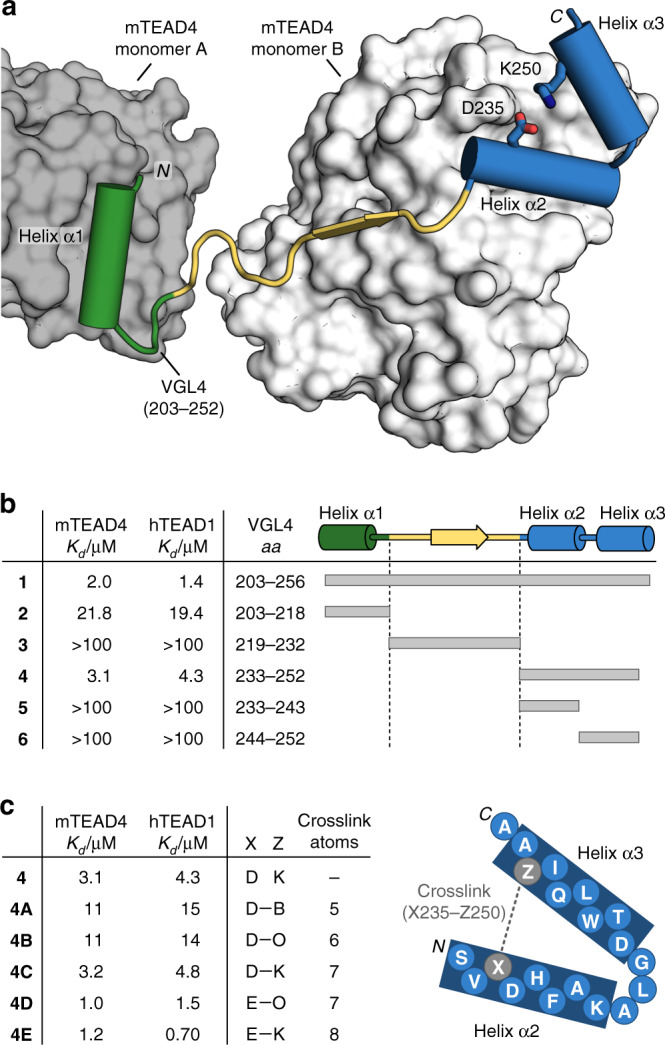
Transcription factors are key protein effectors in the regulation of gene transcription, and in many cases their activity is regulated via a complex network of protein–protein interactions (PPI). The chemical modulation of transcription factor activity is a long-standing goal in drug discovery but hampered by the difficulties associated with the targeting of PPIs, in particular when extended and flat protein interfaces are involved. Peptidomimetics have been applied to inhibit PPIs, however with variable success, as for certain interfaces the mimicry of a single secondary structure element is insufficient to obtain high binding affinities. Here, we describe the design and characterization of a stabilized protein tertiary structure that acts as an inhibitor of the interaction between the transcription factor TEAD and its co-repressor VGL4, both playing a central role in the Hippo signalling pathway. Modification of the inhibitor with a cell-penetrating entity yielded a cell-permeable proteomimetic that activates cell proliferation via regulation of the Hippo pathway, highlighting the potential of protein tertiary structure mimetics as an emerging class of PPI modulators.
Overview
The claims and statistics of this paper haven’t been checked yet.
Free: it reads the open-access text and checks the first 5 claims that cite a source we can check. Create a free account to check every claim.
Integrity signals
Registry
Cites
Statistics
Figures
Verification
Claims the paper makes
The claims and statistics of this paper haven’t been checked yet.
Free: it reads the open-access text and checks the first 5 claims that cite a source we can check. Create a free account to check every claim.
Claims other papers make about this one
Each is checked against this paper’s own text: does it say what the citing paper says it does?
The source backs part of the claim, not all of it — or backs it for a different population, condition or comparison.
In the citing paper
“The large unfavorable experimental binding ΔΔG, in this case, suggests that—as previously hypothesized [47]—a substantial rearrangement occurs for the unbound mutant peptide in the physical system, which was not sampled in simulation, and which would incur a reorganization penalty to adopt the binding-competent conformation present in the complex structure and FEP+ calculations.”
From Robust prediction of relative binding energies for protein-protein complex mutations using free energy perturbation calculations (2024) · cites this paper as [47]
Experimental — accuracy not yet measured
Self-check
Percentages, sums and reported differences re-computed from the paper’s own numbers.
The self-check needs the paper’s full text.
Citations
Cites
Vivès, E., Brodin, P., & Lebleu, B. (1997) · Journal of Biological Chemistry · doi:10.1074/jbc.272.25.16010 · Cited by 2,373
Lian, X., Zhang, J., Azarin, S. M., Zhu, K., Hazeltine, L. B., Bao, X., Hsiao, C., Kamp, T. J., & Palecek, S. P. (2013) · Nature Protocols · doi:10.1038/nprot.2012.150 · Cited by 1,748
Green, M., & Loewenstein, P. M. (1988) · Cell · doi:10.1016/0092-8674(88)90262-0 · Cited by 1,553
The Hippo pathway: regulators and regulations.
Yu, F.-X., & Guan, K.-L. (2013) · Genes & Development · doi:10.1101/gad.210773.112 · Cited by 1,231
The Hippo pathway in organ size control, tissue regeneration and stem cell self-renewal
Zhao, B., Tumaneng, K., & Guan, K.-L. (2011) · Nature Cell Biology · doi:10.1038/ncb2303 · Cited by 1,205
Hippo Pathway Inhibits Wnt Signaling to Restrain Cardiomyocyte Proliferation and Heart Size
Heallen, T., Zhang, M., Wang, J., Bonilla-Claudio, M., Klysik, E., Johnson, R. L., & Martin, J. F. (2011) · Science · doi:10.1126/science.1199010 · Cited by 1,092
Schafmeister, C. E., Po, J., & Verdine, G. L. (2000) · Journal of the American Chemical Society · doi:10.1021/ja000563a · Cited by 1,037
Hippo pathway effector Yap promotes cardiac regeneration
Xin, M., Kim, Y., Sutherland, L. B., Murakami, M., Qi, X., McAnally, J., Porrello, E. R., Mahmoud, A. I., Tan, W., Shelton, J. M., et al. (2013) · Proceedings of the National Academy of Sciences · doi:10.1073/pnas.1313192110 · Cited by 895
Rapid Transition of Cardiac Myocytes from Hyperplasia to Hypertrophy During Postnatal Development
Li, F. (1996) · Journal of Molecular and Cellular Cardiology · doi:10.1006/jmcc.1996.0163 · Cited by 833
Vassilev, A., Kaneko, K. J., Shu, H., Zhao, Y., & DePamphilis, M. L. (2001) · Genes & Development · doi:10.1101/gad.888601 · Cited by 719
Pelay‐Gimeno, M., Glas, A., Koch, O., & Grossmann, T. N. (2015) · Angewandte Chemie International Edition · doi:10.1002/anie.201412070 · Cited by 717
Self-citationPrinciples of Protein−Protein Interactions: What are the Preferred Ways For Proteins To Interact?
Keskin, O., Gursoy, A., Ma, B., & Nussinov, R. (2008) · Chemical Reviews · doi:10.1021/cr040409x · Cited by 697
A Peptide Mimicking VGLL4 Function Acts as a YAP Antagonist Therapy against Gastric Cancer
Jiao, S., Wang, H., Shi, Z., Dong, A., Zhang, W., Song, X., He, F., Wang, Y., Zhang, Z., Wang, W., et al. (2014) · Cancer Cell · doi:10.1016/j.ccr.2014.01.010 · Cited by 602
p38 MAP kinase inhibition enables proliferation of adult mammalian cardiomyocytes
Engel, F. B., Schebesta, M., Duong, M. T., Lu, G., Ren, S., Madwed, J. B., Jiang, H., Wang, Y., & Keating, M. T. (2005) · Genes & Development · doi:10.1101/gad.1306705 · Cited by 595
von Gise, A., Lin, Z., Schlegelmilch, K., Honor, L. B., Pan, G. M., Buck, J. N., Ma, Q., Ishiwata, T., Zhou, B., Camargo, F. D., et al. (2012) · Proceedings of the National Academy of Sciences · doi:10.1073/pnas.1116136109 · Cited by 573
Hippo signaling impedes adult heart regeneration
Heallen, T., Morikawa, Y., Leach, J., Tao, G., Willerson, J. T., Johnson, R. L., & Martin, J. F. (2013) · Development · doi:10.1242/dev.102798 · Cited by 458
New Modalities for Challenging Targets in Drug Discovery
Valeur, E., Guéret, S. M., Adihou, H., Gopalakrishnan, R., Lemurell, M., Waldmann, H., Grossmann, T. N., & Plowright, A. T. (2017) · Angewandte Chemie International Edition · doi:10.1002/anie.201611914 · Cited by 382
Self-citationEngel, F. B., Hsieh, P. C. H., Lee, R. T., & Keating, M. T. (2006) · Proceedings of the National Academy of Sciences · doi:10.1073/pnas.0607382103 · Cited by 371
From Cell Structure to Transcription: Hippo Forges a New Path
Edgar, B. A. (2006) · Cell · doi:10.1016/j.cell.2006.01.005 · Cited by 331
β-Hairpin Peptidomimetics: Design, Structures and Biological Activities
Robinson, J. A. (2008) · Accounts of Chemical Research · doi:10.1021/ar700259k · Cited by 321
Hydrocarbon Stapled Peptides as Modulators of Biological Function
Cromm, P. M., Spiegel, J., & Grossmann, T. N. (2015) · ACS Chemical Biology · doi:10.1021/cb501020r · Cited by 290
Self-citationInhibition of oncogenic Wnt signaling through direct targeting of β-catenin
Grossmann, T. N., Yeh, J. T.-H., Bowman, B. R., Chu, Q., Moellering, R. E., & Verdine, G. L. (2012) · Proceedings of the National Academy of Sciences · doi:10.1073/pnas.1208396109 · Cited by 268 · cited 1×
“…Pang9,10, Boon Seng Soh 9,10,11, Wanjin Hong 6, Elisabetta Chiarparin8, Dennis Schade5, Alleyn T. Plowright 1, Eric Valeur1, Malin Lemurell 1, Tom N. Grossmann 12,13✉ & Herbert Waldmann 3,14✉ Transcription factors are key protein effectors in the regulation of gene transcription, and in many cases…”
BackgroundSelf-citationEmerging roles of TEAD transcription factors and its coactivators in cancers
Pobbati, A. V., & Hong, W. (2013) · Cancer Biology & Therapy · doi:10.4161/cbt.23788 · Cited by 253
Self-citationTowards understanding cell penetration by stapled peptides
Chu, Q., Moellering, R. E., Hilinski, G. J., Kim, Y.-W., Grossmann, T. N., Yeh, J. T.-H., & Verdine, G. L. (2015) · MedChemComm · doi:10.1039/c4md00131a · Cited by 219
Self-citationThe GSK-3 Inhibitor BIO Promotes Proliferation in Mammalian Cardiomyocytes
Tseng, A.-S., Engel, F. B., & Keating, M. T. (2006) · Chemistry & Biology · doi:10.1016/j.chembiol.2006.08.004 · Cited by 216
Comprehensive analysis of loops at protein-protein interfaces for macrocycle design
Gavenonis, J., Sheneman, B. A., Siegert, T. R., Eshelman, M. R., & Kritzer, J. A. (2014) · Nature Chemical Biology · doi:10.1038/nchembio.1580 · Cited by 198
Proteomimetics as protein-inspired scaffolds with defined tertiary folding patterns
Horne, W. S., & Grossmann, T. N. (2020) · Nature Chemistry · doi:10.1038/s41557-020-0420-9 · Cited by 146
Self-citationThe Hippo pathway in tissue homeostasis and regeneration
Wang, Y., Yu, A., & Yu, F.-X. (2017) · Protein & Cell · doi:10.1007/s13238-017-0371-0 · Cited by 145
McCoull, W., Cheung, T., Anderson, E., Barton, P., Burgess, J., Byth, K., Cao, Q., Castaldi, M. P., Chen, H., Chiarparin, E., et al. (2018) · ACS Chemical Biology · doi:10.1021/acschembio.8b00698 · Cited by 139
Self-citationDietrich, L., Rathmer, B., Ewan, K., Bange, T., Heinrichs, S., Dale, T. C., Schade, D., & Grossmann, T. N. (2017) · Cell Chemical Biology · doi:10.1016/j.chembiol.2017.06.013 · Cited by 126
Self-citationChen, H.-H., Mullett, S. J., & Stewart, A. F. R. (2004) · Journal of Biological Chemistry · doi:10.1074/jbc.m400154200 · Cited by 114
Acetylation of VGLL4 Regulates Hippo-YAP Signaling and Postnatal Cardiac Growth
Lin, Z., Guo, H., Cao, Y., Zohrabian, S., Zhou, P., Ma, Q., VanDusen, N., Guo, Y., Zhang, J., Stevens, S. M., et al. (2016) · Developmental Cell · doi:10.1016/j.devcel.2016.09.005 · Cited by 106
Linnane, E., Davey, P., Zhang, P., Puri, S., Edbrooke, M., Chiarparin, E., Revenko, A. S., Macleod, A. R., Norman, J. C., & Ross, S. J. (2019) · Nucleic Acids Research · doi:10.1093/nar/gkz214 · Cited by 101
Self-citationProtein–Protein Interactions Mediated by Helical Tertiary Structure Motifs
Watkins, A. M., Wuo, M. G., & Arora, P. S. (2015) · Journal of the American Chemical Society · doi:10.1021/jacs.5b05527 · Cited by 87
Uosaki, H., Magadum, A., Seo, K., Fukushima, H., Takeuchi, A., Nakagawa, Y., Moyes, K. W., Narazaki, G., Kuwahara, K., Laflamme, M. A., et al. (2013) · Circulation Cardiovascular Genetics · doi:10.1161/circgenetics.113.000330 · Cited by 63
The Hippo pathway in cellular reprogramming and regeneration of different organs
Moya, I. M., & Halder, G. A. (2016) · Current Opinion in Cell Biology · doi:10.1016/j.ceb.2016.08.004 · Cited by 58
Raulf, A., Horder, H., Tarnawski, L., Geisen, C., Ottersbach, A., Roell, W., Jovinge, S. V., Fleischmann, B. K., & Hesse, M. (2015) · Basic Research in Cardiology · doi:10.1007/s00395-015-0489-2 · Cited by 55
Synthetic Control of Tertiary Helical Structures in Short Peptides
Wuo, M. G., Hong, S. H., Singh, A., & Arora, P. S. (2018) · Journal of the American Chemical Society · doi:10.1021/jacs.8b10082 · Cited by 39
An automated application for deconvolution of circular dichroism spectra of small peptides
Poschner, B. C., Reed, J., Langosch, D., & Hofmann, M. W. (2007) · Analytical Biochemistry · doi:10.1016/j.ab.2007.01.021 · Cited by 36
Wang, C., Li, X., Yu, F., Lu, L., Jiang, X., Xu, X., Wang, H., Lai, W., Zhang, T., Zhang, Z., et al. (2016) · Scientific Reports · doi:10.1038/srep32161 · Cited by 17
Chemical modulation of transcription factors
Wiedemann, B. M., Weisner, J., & Rauh, D. (2018) · MedChemComm · doi:10.1039/c8md00273h · Cited by 12
Lipidated Stapled Peptides Targeting the Acyl Binding Protein UNC119
Cromm, P. M., Adihou, H., Kapoor, S., Vázquez–Chantada, M., Davey, P. R. J., Longmire, D., Hennes, E., Hofer, W., Küchler, P., Chiarparin, E., et al. (2019) · ChemBioChem · doi:10.1002/cbic.201900615 · Cited by 10
Self-citation
Cited by
Targeting intracellular protein–protein interactions with macrocyclic peptides
Buyanova, M. Y., & Pei, D. (2021) · Trends in Pharmacological Sciences · doi:10.1016/j.tips.2021.11.008 · Cited by 96
Recent Therapeutic Approaches to Modulate the Hippo Pathway in Oncology and Regenerative Medicine
Barry, E., Simov, V., Valtingojer, I., & Venier, O. (2021) · Cells · doi:10.3390/cells10102715 · Cited by 78
“C motif chemokine 5 CYR61 Cysteine-rich angiogenic inducer 61 Cells 2021, 10, 2715 23 of 29 DSS Dextran sodium sulfate EdU Ethynyl deoxyuridine EGFR Epidermal growth factor receptor EML4 Echinoderm microtubule-associated protein-like 4 EMT Epithelial mesenchymal transition FOS Fos proto-oncogene, AP-1 transcription fa…”
BackgroundInfluentialWendt, M., Bellavita, R., Gerber, A., Efrém, N., van Ramshorst, T., Pearce, N. M., Davey, P. R. J., Everard, I., Vazquez‐Chantada, M., Chiarparin, E., et al. (2021) · Angewandte Chemie International Edition · doi:10.1002/anie.202102082 · Cited by 64
Self-citationTackling Undruggable Targets with Designer Peptidomimetics and Synthetic Biologics
Swenson, C., Mandava, G., Thomas, D. M., & Moellering, R. E. (2024) · Chemical Reviews · doi:10.1021/acs.chemrev.4c00423 · Cited by 64
Peptide‐based covalent inhibitors of protein–protein interactions
Paulussen, F. M., & Grossmann, T. N. (2022) · Journal of Peptide Science · doi:10.1002/psc.3457 · Cited by 58
Self-citation
Metadata
- Authors
- Adihou, H., Gopalakrishnan, R., Förster, T., Guéret, S. M., Gasper, R., Geschwindner, S., Carrillo García, C., Karatas, H., Pobbati, A. V., Vazquez‐Chantada, M., Davey, P., Wassvik, C. M., Pang, J. K. S., Soh, B. S., Hong, W., Chiarparin, E., Schade, D., Plowright, A. T., Valeur, E., Lemurell, M., Grossmann, T. N., & Waldmann, H.
- Affiliations
- AstraZeneca (Sweden) (SE)
- AstraZeneca (Germany) (DE)
- Max Planck Institute of Molecular Physiology (DE)
- Agency for Science, Technology and Research (SG)
- AstraZeneca (United Kingdom) (GB)
- Christian-Albrechts-Universität zu Kiel (DE)
- Vrije Universiteit Amsterdam (NL)
- TU Dortmund University (DE)
- Corresponding author
- Grossmann, Tom N.
- Waldmann, Herbert
- ORCID
- Venue
- Nature Communications
- Published
- 2020-10-27
- Volume
- 11
- Issue
- 1
- Pages
- 5425-5425
- ISSN
- 2041-1723 (ISSN-L)
- PMC
- PMC7591920
- OpenAlex
- W3096898590
- Semantic Scholar
- 71f1122d45e19d2a8c93b9ccaff62dd809d912e6
- Cited by
- 58
- References
- 42
- Citations by year
- 2026: 1 · 2025: 10 · 2024: 9 · 2023: 12 · 2022: 14 · 2021: 11 · 2020: 1
- FWCI
- 4.99
- Type
- journal article
- Language
- en
- Open access
- gold
- doi.org
- Licence
- cc-by
- creativecommons.org/licenses/by/4.0 (tdm)
- creativecommons.org/licenses/by/4.0 (vor)
- Locations
- Nature Communications (publishedVersion, cc-by)
- PubMed Central (publishedVersion, cc-by)
- PubMed (publishedVersion)
- VU Research Portal (publishedVersion, other-oa)
- DORA PSI (Paul Scherrer Institute) (submittedVersion, other-oa)
- National University of Singapore (submittedVersion, cc-by)
- RePEc: Research Papers in Economics (submittedVersion)
- DOAJ (DOAJ: Directory of Open Access Journals) (submittedVersion, cc-by-sa)
- MPG.PuRe (Max Planck Society) (submittedVersion)
- Data Archiving and Networked Services (DANS) (submittedVersion, other-oa)
- Funders
- Leibniz-Institut für Arbeitsforschung an der TU Dortmund
- Paul Scherrer Institut
- H2020 European Research Council (678623)
- Topics
- Life Sciences › Biochemistry, Genetics and Molecular Biology › Cell Biology › Hippo pathway signaling and YAP/TAZ
- Physical Sciences › Chemistry › Organic Chemistry › Chemical Synthesis and Analysis
- Life Sciences › Biochemistry, Genetics and Molecular Biology › Molecular Biology › Protein Structure and Dynamics
- Keywords
- Hippo signaling pathway, protein-protein interaction inhibitors, TEAD, peptidomimetics, cell-penetrating peptides, cell proliferation
- MeSH terms
- Hippo Signaling Pathway, TEA Domain Transcription Factors, DNA-Binding Proteins, Humans, Nuclear Proteins, Protein Binding, Transcription Factors, Signal Transduction, Protein Serine-Threonine Kinases, Protein Structure, Tertiary, Peptidomimetics
About these checks
Registry, retraction, Cites and statistics results are computed, not judged, with one exception: a printed reference that no index lists is read once by a model before it counts as a citation error. Claims are extracted by a model and kept only when their quote appears verbatim in the text; each cited source is then checked, with a model’s help, for whether it says what the claim relies on. Those verdicts can be wrong — read the claim’s quote and the cited source before relying on one.
Statistics and arithmetic are recomputed, not judged.
Confidence bands are shown only for fields calibrated on our annotated test set. None is calibrated yet, so no band is shown.
What counts as a claim ›How we measure confidence ›How we check this ›
Are you an author, or do you see a problem with this page? Request a review
Data sources
Bibliographic data: Semantic Scholar, OpenAlex, Crossref.
Contains information from the Semantic Scholar Academic Graph Datasets, made available under the ODC Attribution License (ODC-BY 1.0).
Semantic Scholar’s data is described in: Kinney, R., et al. (2023). The Semantic Scholar Open Data Platform. arXiv:2301.10140.
