

Pan-cancer landscape of homologous recombination deficiency.
Open accessPublished version of a preprint
The DOI matches its Crossref record; 51 of the 53 references it cites were found in a registry or an index; 28 of the 40 sources its claims cite were checked for support.
Abstract
Homologous recombination deficiency (HRD) results in impaired double strand break repair and is a frequent driver of tumorigenesis. Here, we develop a genome-wide mutational scar-based pan-cancer Classifier of HOmologous Recombination Deficiency (CHORD) that can discriminate BRCA1- and BRCA2-subtypes. Analysis of a metastatic (n = 3,504) and primary (n = 1,854) pan-cancer cohort reveals that HRD is most frequent in ovarian and breast cancer, followed by pancreatic and prostate cancer. We identify biallelic inactivation of BRCA1, BRCA2, RAD51C or PALB2 as the most common genetic cause of HRD, with RAD51C and PALB2 inactivation resulting in BRCA2-type HRD. We find that while the specific genetic cause of HRD is cancer type specific, biallelic inactivation is predominantly associated with loss-of-heterozygosity (LOH), with increased contribution of deep deletions in prostate cancer. Our results demonstrate the value of pan-cancer genomics-based HRD testing and its potential diagnostic value for patient stratification towards treatment with e.g. poly ADP-ribose polymerase inhibitors (PARPi).
Overview
CoChat Summary
TL;DR
The authors developed CHORD, a random forest classifier that detects homologous recombination deficiency (HRD) and distinguishes BRCA1-type from BRCA2-type HRD using whole-genome mutation contexts across cancers. In 5,122 primary and metastatic patients, HRD was most frequent in ovarian, breast, prostate, and pancreatic cancer, with BRCA1, BRCA2, RAD51C, and PALB2 biallelic inactivation as common genetic causes.
Key findings
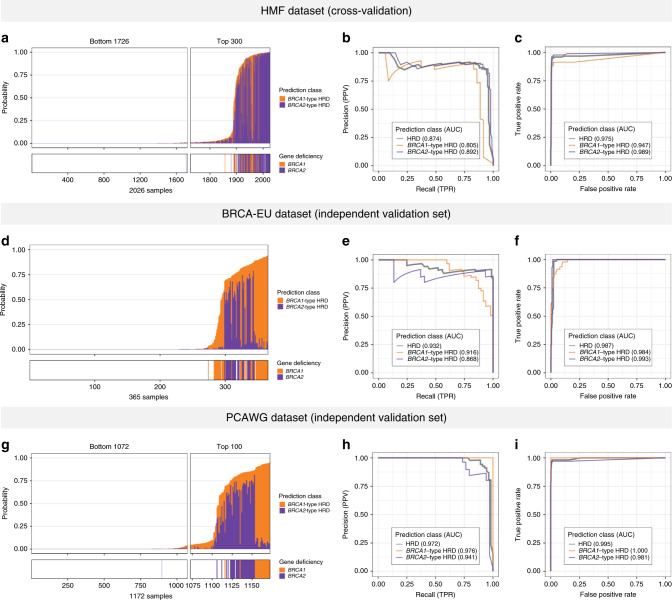
- CHORD achieved high performance in cross-validation (AUROC 0.98, AUPRC 0.87) and in independent BRCA-EU and PCAWG datasets (AUROC >0.98, AUPRC >0.93).
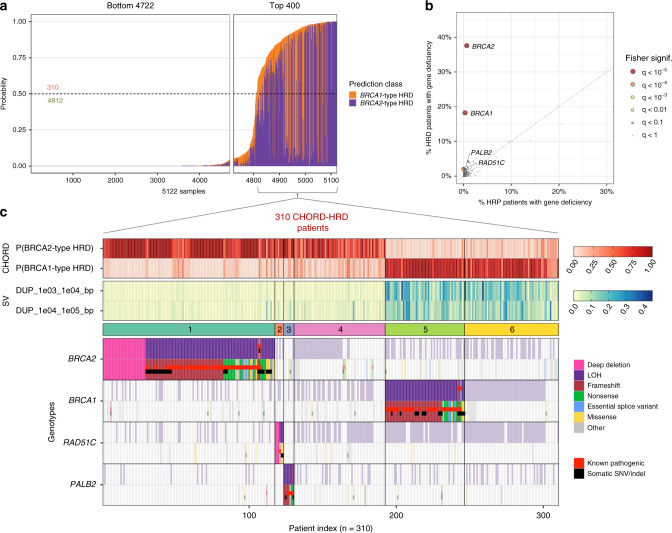
- Among 5,122 patients (3,504 HMF metastatic and 1,618 PCAWG primary), 310 (6%) were CHORD-HRD: 118 BRCA1-type and 192 BRCA2-type; 4,812 were CHORD-HRP.
- Biallelic inactivation was significantly enriched in CHORD-HRD vs CHORD-HRP for BRCA1 (q = 9.4e-51), BRCA2 (q = 4.8e-101), RAD51C (q = 5.6e-5), and PALB2 (q = 0.02); RAD51C and PALB2 inactivation produced BRCA2-type HRD.
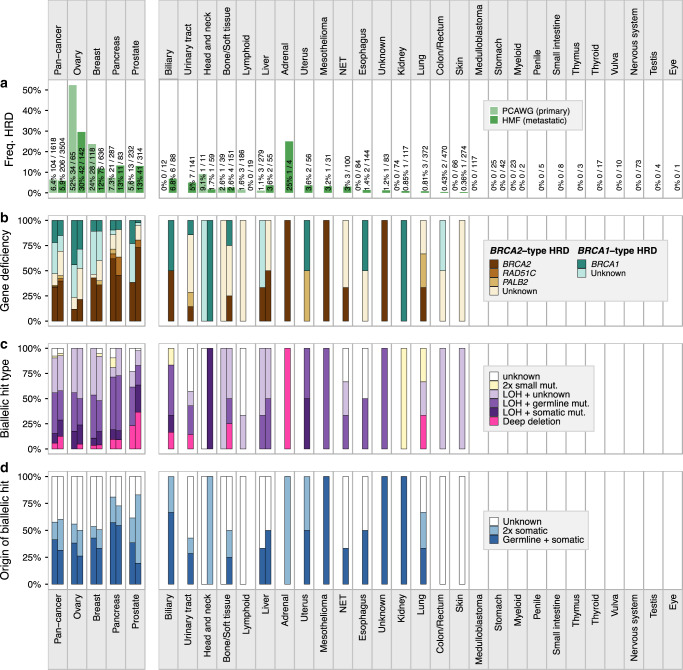
- HRD was most prevalent in ovarian, breast, prostate, and pancreatic cancer (85% combined); primary vs metastatic frequencies were ovarian 52% vs 30%, breast 24% vs 12%, prostate 5.6% vs 13%, and pancreatic 7.3% vs 13%.
Methods
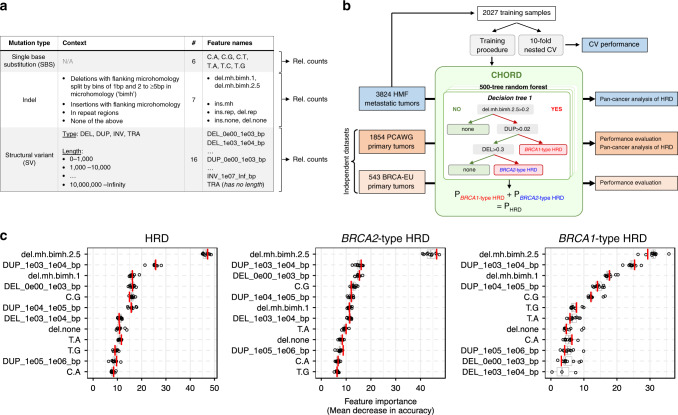
- CHORD is a random forest trained on relative counts of SNV, indel, and structural variant mutation contexts from 3,824 HMF metastatic tumors; 2,026 samples (53%) were used for training, including 35 BRCA1-deficient, 89 BRCA2-deficient, and 1,902 BRCA1/2-proficient samples.
- Performance was assessed by 10-fold nested cross-validation and by application to BRCA-EU (543 primary breast tumors; 365 used for HRDetect) and PCAWG (1,854 primary tumors; 1,172 selected for validation).
- For pan-cancer analysis, CHORD was applied to HMF and PCAWG samples passing QC; genetic causes were assessed by biallelic status of 781 cancer/HR-related genes, Fisher’s exact enrichment tests, and clustering of CHORD-HRD samples.
Limitations
- The paper states that primary vs metastatic HRD rate differences may be confounded by patient inclusion criteria, and that methylation data were unavailable for HMF and PCAWG, preventing direct assessment of promoter methylation as an HRD cause.
- The authors note that mutational scars reflect genomic history rather than ongoing processes, so false-positive CHORD predictions are possible (e.g., HRD reversion, recent HRD acquisition, or radiotherapy-associated microhomology deletions); subclonal predictions should be interpreted cautiously.
- The paper states that variant calling pipeline differences can affect CHORD, additional validation/threshold optimization is recommended for other pipelines, and low numbers of BRCA1/2-deficient samples in some cancer types may make error estimates and HRD frequency underestimates uncertain.
Model-written summary. Check it against the paper before relying on it.
Integrity signals
Registry
Cites
Statistics
Figures
Verification
Claims the paper makes
15 Valid · 7 Not valid · 9 Not checked · 71 Own results and interpretations
At least one cited source doesn’t support this claim or points to a different paper, and none confirmed it — see the verdicts below.
In the paper
“Two recent studies showed that common cancer treatments in general do not induce mutations that may interfere with CHORD predictions16,17.”
§ Pan-cancer landscape of homologous recombination deficiency > Results > Effect of treatment on HRD predictions
What the sources say
- Disputedcites [16] Pich O The mutational footprints of cancer therapies Nat. Genet. 2019 51 1732 1740 10.1038/s41588-019-0525-5 31740835 PMC6887544 sourceExperimental — accuracy not yet measured
The Results section, “The mutational footprints of six anti-cancer therapies,” identifies mutational signatures caused by widely used platinum-based treatments, contrary to the claim that common treatments generally do not induce mutations. The paper does not assess whether treatment-induced mutations interfere with CHORD predictions, so that specific effect cannot be judged from this source. (LLM, conf=0.83)
Checked by a reasoning model — may be wrong.
- Disputedcites [17] Kucab JE A compendium of mutational signatures of environmental agents Cell 2019 177 821 836.e16 10.1016/j.cell.2019.03.001 30982602 PMC6506336 sourceExperimental — accuracy not yet measured
The Results (Insights into Mutational Mechanisms of Platinum Complexes; page unavailable) report substitution and double-substitution signatures from cisplatin and carboplatin, with an indel signature from cisplatin. The Results (Mutational Signatures of Alkylating Agents; page unavailable) also report a mutational signature from temozolomide. Thus, the paper shows that some cancer treatments do induce mutations; it does not assess interference with CHORD predictions. (LLM, conf=0.85)
Checked by a reasoning model — may be wrong.
hedged- Asserted: passes — The authors put it forward as true.
- Checkable: passes — It can be checked against evidence.
- Load-bearing: passes — The paper’s conclusions depend on it.
- Based: passes — The paper gives a reason why it holds.
- Disputed
The cited sources that could be checked couldn’t confirm or dispute this claim.
In the paper
“In addition, the predictions of CHORD and HRDetect on the PCAWG dataset10 were concordant for the vast majority of samples (1506/1526; 99%) (Supplementary Fig. 10).”
§ Pan-cancer landscape of homologous recombination deficiency > Results > Performance of CHORD
What the sources say
- Could not verifycites [10] Degasperi A A practical framework and online tool for mutational signature analyses show intertissue variation and driver dependencies Nat. Cancer 2020 1 249 263 10.1038/s43018-020-0027-5 32118208 PMC7048622 sourceExperimental — accuracy not yet measured
The Methods (Datasets; page unavailable) identify the PCAWG cohort, and the Results (Homologous recombination deficiency across 21 organs; page unavailable) discuss HRDetect predictions. Searches for CHORD and for the 1506/1526 concordance figure found no passage comparing CHORD with HRDetect, so our copy does not verify the claimed 99% agreement. (LLM, conf=0.73)
plainstates an association- Asserted: passes — The authors put it forward as true.
- Checkable: passes — It can be checked against evidence.
- Load-bearing: passes — The paper’s conclusions depend on it.
- Based: passes — The paper gives a reason why it holds.
- Rests on an assumption not shown here.
- Could not verify
The cited sources that could be checked couldn’t confirm or dispute this claim.
In the paper
“We thus conclude that accurate detection of HRD does not require mutational signatures, thereby simplifying HRD calling and avoiding potential complications associated with the fitting step required for computing signature contributions in individual samples (for which there is currently no consensus approach)15.”
§ Pan-cancer landscape of homologous recombination deficiency > Results > Performance of CHORD
What the sources say
- Could not verifycites [15] Maura F A practical guide for mutational signature analysis in hematological malignancies Nat. Commun. 2019 10 1 12 10.1038/s41467-018-07882-8 31278357 PMC6611883 sourceExperimental — accuracy not yet measured
The Introduction and Results discuss photoelectron interference in neon dimers, not detection of homologous recombination deficiency. Searches of our copy for HRD, mutational signatures, and fitting signature contributions found no passage addressing the claim or the citation-attached point about consensus on fitting methods. (LLM, conf=0.79)
boostedn = 8- Asserted: passes — The authors put it forward as true.
- Checkable: passes — It can be checked against evidence.
- Load-bearing: passes — The paper’s conclusions depend on it.
- Based: passes — The paper gives a reason why it holds.
- Rests on an assumption not shown here.
- Could not verify
The cited sources support only part of this claim — read each source’s verdict below.
In the paper
“We note that CHORD performs similarly to HRDetect based on predictions on the BRCA-EU dataset (AUROC = 0.98 for both models)9.”
§ Pan-cancer landscape of homologous recombination deficiency > Results > Performance of CHORD
What the sources say
- Partly supportedcites [9] Davies H HRDetect is a predictor of BRCA1 and BRCA2 deficiency based on mutational signatures Nat. Med. 2017 23 517 525 10.1038/nm.4292 28288110 PMC5833945 sourceExperimental — accuracy not yet measured
The Results and Online Methods report an AUROC of 0.98 for HRDetect on the paper’s breast-cancer cohort (page numbers unavailable). They do not report CHORD predictions or a comparison on a dataset identified as BRCA-EU, so the claim that both models achieved 0.98 there is not supported by this source. (LLM, conf=0.90)
plain- Asserted: passes — The authors put it forward as true.
- Checkable: passes — It can be checked against evidence.
- Load-bearing: passes — The paper’s conclusions depend on it.
- Based: passes — The paper gives a reason why it holds.
- Rests on an assumption not shown here.
- Partly supported
Every source the paper cites for this claim was checked and supports it.
In the paper
“Given that these three genes all belong to the RAD51 paralog complex BCDX223, the BRCA2-type HRD suggests that RAD51B and XRCC2 deficiency could have led to HRD in these patients.”
§ Pan-cancer landscape of homologous recombination deficiency > Results > BRCA2, RAD51C, and PALB2 are associated with BRCA2-type HRD while only BRCA1 is associated with BRCA1-type HRD
What the sources say
- Supportedcites [23] Chun J Buechelmaier ES Powell SN Rad51 paralog complexes BCDX2 and CX3 act at different stages in the BRCA1-BRCA2-dependent homologous recombination pathway Mol. Cell. Biol. 2013 33 387 395 10.1128/MCB.00465-12 23149936 PMC3554112 source
The Abstract (page unavailable) identifies RAD51B and XRCC2 as members of BCDX2 and reports that the complex participates in BRCA2-dependent homologous recombination. Figure 1 (page unavailable) reports HR deficiency after depletion of individual RAD51 paralogs, including RAD51B and XRCC2. The cited paper therefore supports the proposed mechanism; the inference about these particular patients is the citing authors’ own. (LLM, conf=0.91)
hedgedstates a possible causen = 4- Asserted: passes — The authors put it forward as true.
- Checkable: passes — It can be checked against evidence.
- Load-bearing: passes — The paper’s conclusions depend on it.
- Based: passes — The paper gives a reason why it holds.
- Rests on an assumption not shown here.
- Supported
62 more claims · 8 with their cited sources checked
Create a free account to see all 102 claims and to verify the 1 reference still open.
- Probably not a substantial claim. 16
- It may state two separate claims as one. 22
Claims other papers make about this one
Each is checked against this paper’s own text: does it say what the citing paper says it does?
The source backs part of the claim, not all of it — or backs it for a different population, condition or comparison.
In the citing paper
“The encoded Brca1 protein is a component of the homologous recombination repair (HRR) machinery, and BRCA1 is uncommonly mutated in PDAC (~1%), typically in the germline, and associated with HRR defective cancers22,23.”
From Occult polyclonality of preclinical pancreatic cancer models drives in vitro evolution (2022) · cites this paper as [23]
Experimental — accuracy not yet measuredThe cited source says what the claim attributes to it.
In the citing paper
“Defects in HRR can lead to the presence of “genomic scars” caused by the cancer cell’s inability to accurately repair sites of double strand breaks (DSBs).”
From Three-dimensional modelling of ovarian cancer: from cell lines to organoids for discovery and personalized medicine (2022) · cites this paper as Nguyen et al., 2020
Self-check
Percentages, sums and reported differences re-computed from the paper’s own numbers.
Each contradiction between two passages listed here was confirmed by an independent check.
Rated minor: it would not touch a result — a value no result rests on, a p-value that stays on the same side of the significance level, or a conflict that is clerical, resolved elsewhere in the paper, or outside its own findings.
In the paper
§ Pan-cancer landscape of homologous recombination deficiency > Discussion
“but collectively this constitutes a sizable group of patients (15% of all patients).”
§ Pan-cancer landscape of homologous recombination deficiency > Results > The incidence and genetic cause of HRD varies in different tissue types and cancer stage
“HRD was most prevalent in ovarian, breast, prostate and pancreatic cancer (85% combined), and only occurred sporadically in other cancer types (15%)”
Rated minor: it would not touch a result — a value no result rests on, a p-value that stays on the same side of the significance level, or a conflict that is clerical, resolved elsewhere in the paper, or outside its own findings.
In the paper
§ Pan-cancer landscape of homologous recombination deficiency > Methods > Random forest training
“del.mh with 1 bp homology and 2 to ≥5 (i.e. equivalent to ≥5 bp) homology”
§ Pan-cancer landscape of homologous recombination deficiency > Results > Random forest classifier training
“Deletions with 2 to ≥5 bp (i.e. ≥2 bp) of flanking microhomology”
Rated minor: it would not touch a result — a value no result rests on, a p-value that stays on the same side of the significance level, or a conflict that is clerical, resolved elsewhere in the paper, or outside its own findings.
In the paper
§ Pan-cancer landscape of homologous recombination deficiency > Results > BRCA2, RAD51C, and PALB2 are associated with BRCA2-type HRD while only BRCA1 is associated with BRCA1-type HRD
“Of all CHORD-HRD HMF patients, ~60% (184/310)”
§ Pan-cancer landscape of homologous recombination deficiency > Results > BRCA2, RAD51C, and PALB2 are associated with BRCA2-type HRD while only BRCA1 is associated with BRCA1-type HRD
“This yielded a total of 5122 patients (3504 from HMF and 1618 from PCAWG), with 310 (6%) being classified as being homologous recombination deficient (CHORD-HRD).”
Citations
Cites
A method and server for predicting damaging missense mutations.
Adzhubei, I. A., Schmidt, S., Peshkin, L., Ramensky, V. E., Gerasimova, A., Bork, P., Kondrashov, A. S., & Sunyaev, S. R. (2010) · Nature Methods · doi:10.1038/nmeth0410-248 · Cited by 13,194
The mutational constraint spectrum quantified from variation in 141,456 humans
Karczewski, K. J., Francioli, L. C., Tiao, G., Cummings, B. B., Alföldi, J., Wang, Q., Collins, R. L., Laricchia, K. M., Ganna, A., Birnbaum, D. P., et al. (2020) · Nature · doi:10.1038/s41586-020-2308-7 · Cited by 9,434
Double-slit photoelectron interference in strong-field ionization of the neon dimer
Kunitski, M., Eicke, N., Huber, P., Köhler, J., Zeller, S., Voigtsberger, J., Schlott, N., Henrichs, K., Sann, H., Trinter, F., et al. (2019) · Nature Communications · doi:10.1038/s41467-018-07882-8 · Cited by 8,162
Double-slit photoelectron interference in strong-field ionization of the neon dimer
Kunitski, M., Eicke, N., Huber, P., Köhler, J., Zeller, S., Voigtsberger, J., Schlott, N., Henrichs, K., Sann, H., Trinter, F., et al. (2019) · Institutional Repository of Leibniz Universität Hannover (Leibniz Universität Hannover) · doi:10.15488/5174 · Cited by 8,161
Pan-cancer analysis of whole genomes
The ICGC/TCGA Pan-Cancer Analysis of Whole Genomes Consortium, Aaltonen, L. A., Abascal, F., Abeshouse, A., Aburatani, H., Adams, D. J., Agrawal, N., Ahn, K. S., Ahn, S.-M., Aikata, H., et al. (2020) · Nature · doi:10.1038/s41586-020-1969-6 · Cited by 3,064
SMARCAD1 ATPase activity is required to silence endogenous retroviruses in embryonic stem cells
Sachs, P., Ding, D., Bergmaier, P., Lamp, B., Schlagheck, C., Finkernagel, F., Nist, A., Stiewe, T., & Mermoud, J. E. (2019) · Nature Communications · doi:10.1038/s41467-019-09078-0 · Cited by 2,384
D’Hulst, G., Soro-Arnaiz, I., Masschelein, E., Veys, K., Fitzgerald, G., Smeuninx, B., Kim, S., Deldicque, L., Blaauw, B., Carmeliet, P., et al. (2020) · Nature Communications · doi:10.1038/s41467-019-13889-6 · Cited by 2,310
Maintenance Olaparib for Germline BRCA -Mutated Metastatic Pancreatic Cancer
Golan, T., Hammel, P., Reni, M., Van Cutsem, E., Macarulla, T., Hall, M. J., Park, J.-O., Hochhauser, D., Arnold, D., Oh, D.-Y., et al. (2019) · New England Journal of Medicine · doi:10.1056/nejmoa1903387 · Cited by 2,302
Audeh, M. W., Carmichael, J., Penson, R. T., Friedlander, M., Powell, B., Bell-McGuinn, K. M., Scott, C., Weitzel, J. N., Oaknin, A., Loman, N., et al. (2010) · The Lancet · doi:10.1016/s0140-6736(10)60893-8 · Cited by 2,279 · cited 1×
“Accurate detection of HR deficiency (HRD) is of clinical relevance as it is indicative of sensitivity to targeted therapy with poly ADP-ribose polymerase inhibitors (PARPi)[3, 4] as well as to DNA damaging reagents[1].”
BackgroundLandscape of somatic mutations in 560 breast cancer whole-genome sequences
Nik-Zainal, S., Davies, H., Staaf, J., Ramakrishna, M., Glodzik, D., Zou, X., Martincorena, I., Alexandrov, L. B., Martin, S., Wedge, D. C., et al. (2016) · Nature · doi:10.1038/nature17676 · Cited by 2,218 · cited 3×
“In the second approach, performance was evaluated on two independent datasets: the BRCA-EU dataset[8] (543 primary breast tumors) and the PCAWG dataset[14] (1,854 primary tumors, pancancer).”
BackgroundMethod
Cited by
Signatures of copy number alterations in human cancer
Steele, C. D., Abbasi, A., Islam, S. M. A., Bowes, A. L., Khandekar, A., Haase, K., Hames-Fathi, S., Ajayi, D., Verfaillie, A., Dhami, P., et al. (2022) · Nature · doi:10.1038/s41586-022-04738-6 · Cited by 501
Mosele, M. F., Westphalen, C. B., Stenzinger, A., Barlesi, F., Bayle, A., Bièche, I., Bonastre, J., Castro, E., Dienstmann, R., Krämer, A., et al. (2024) · Annals of Oncology · doi:10.1016/j.annonc.2024.04.005 · Cited by 415
Ovarian cancer mutational processes drive site-specific immune evasion
Vázquez-García, I., Uhlitz, F., Ceglia, N., Lim, J. L. P., Wu, M., Mohibullah, N., Niyazov, J., Ruiz, A. E. B., Boehm, K. M., Bojilova, V., et al. (2022) · Nature · doi:10.1038/s41586-022-05496-1 · Cited by 324
de Witte, C. J., Espejo Valle-Inclan, J., Hami, N., Lõhmussaar, K., Kopper, O., Vreuls, C. P. H., Jonges, G. N., van Diest, P., Nguyen, L., Clevers, H., et al. (2020) · Cell Reports · doi:10.1016/j.celrep.2020.107762 · Cited by 303
Self-citationde Bono, J. S., Mehra, N., Scagliotti, G. V., Castro, E., Dorff, T., Stirling, A., Stenzl, A., Fleming, M. T., Higano, C. S., Saad, F., et al. (2021) · The Lancet Oncology · doi:10.1016/s1470-2045(21)00376-4 · Cited by 286
Pan-cancer whole-genome comparison of primary and metastatic solid tumours
Martínez-Jiménez, F., Movasati, A., Brunner, S. R., Nguyen, L., Priestley, P., Cuppen, E., & Van Hoeck, A. (2023) · Nature · doi:10.1038/s41586-023-06054-z · Cited by 285
Self-citationMutational signatures: emerging concepts, caveats and clinical applications
Koh, G., Degasperi, A., Zou, X., Momen, S., & Nik-Zainal, S. (2021) · Nature Reviews Cancer · doi:10.1038/s41568-021-00377-7 · Cited by 287
Homologous Recombination Deficiency: Concepts, Definitions, and Assays
Stewart, M. D., Merino Vega, D., Arend, R. C., Baden, J. F., Barbash, O., Beaubier, N., Collins, G., French, T., Ghahramani, N., Hinson, P., et al. (2022) · The Oncologist · doi:10.1093/oncolo/oyab053 · Cited by 240
Expansion of Cancer Risk Profile for BRCA1 and BRCA2 Pathogenic Variants
Momozawa, Y., Sasai, R., Usui, Y., Shiraishi, K., Iwasaki, Y., Taniyama, Y., Parsons, M. T., Mizukami, K., Sekine, Y., Hirata, M., et al. (2022) · JAMA Oncology · doi:10.1001/jamaoncol.2022.0476 · Cited by 221
Sosinsky, A., Ambrose, J., Cross, W., Turnbull, C., Henderson, S., Jones, L., Hamblin, A., Arumugam, P., Chan, G., Chubb, D., et al. (2024) · Nature Medicine · doi:10.1038/s41591-023-02682-0 · Cited by 179
“HRDetect and CHORD were trained on the ICGC and Hartwig Medical Foundation cohorts, respectively.”
BackgroundMethodInfluentialMutationalPatterns: the one stop shop for the analysis of mutational processes
Manders, F., Brandsma, A. M., de Kanter, J., Verheul, M., Oka, R., van Roosmalen, M. J., van der Roest, B., van Hoeck, A., Cuppen, E., & van Boxtel, R. (2022) · BMC Genomics · doi:10.1186/s12864-022-08357-3 · Cited by 170
“For example, the presence of certain mutational 67 signatures can be used as a functional readout for deficiency of homologous recombination 68 (HR)-mediated double strand break repair (8,9).”
MethodSelf-citationTumour mutational burden: clinical utility, challenges and emerging improvements
Budczies, J., Kazdal, D. N., Menzel, M., Beck, S., Kluck, K., Altbürger, C., Schwab, C., Allgäuer, M., Ahadova, A., Kloor, M., et al. (2024) · Nature Reviews Clinical Oncology · doi:10.1038/s41571-024-00932-9 · Cited by 218
“…accuracy in separating patients with HRD-deficient cancers from those with HRD-proficient cancers is achieved using complex whole-genome sequencing (WGS)-based classifiers including larger sets of features such as SBSs, indels, genomic rearrangements and CNAs (such as CHORD and HRDetect) 119,120 .”
Genomic instability, inflammatory signaling and response to cancer immunotherapy
Chen, M., Linstra, R., & van Vugt, M. A. T. M. (2022) · Biochimica et Biophysica Acta (BBA) - Reviews on Cancer · doi:10.1016/j.bbcan.2021.188661 · Cited by 166
Kocakavuk, E., Anderson, K. J., Varn, F. S., Johnson, K. C., Amin, S. B., Sulman, E. P., Lolkema, M. P., Barthel, F. P., & Verhaak, R. G. W. (2021) · Nature Genetics · doi:10.1038/s41588-021-00874-3 · Cited by 167
Casolino, R., Paiella, S., Azzolina, D., Beer, P. A., Corbo, V., Lorenzoni, G., Gregori, D., Golan, T., Braconi, C., Froeling, F. E. M., et al. (2021) · Journal of Clinical Oncology · doi:10.1200/jco.20.03238 · Cited by 158
“Although this occurs in 90% or more in the case of germline BRCA1 and BRCA2 , 74,75 allowing the assumption that if a mutation in one allele is detected, the second is inactivated in 90%, the rate of loss of the second allele for somatic BRCA mutations is not well characterized.”
van Riet, J., van de Werken, H. J. G., Cuppen, E. P. J. G., Eskens, F. A. L. M., Tesselaar, M. E. T., van Veenendaal, L. M., Klümpen, H., Dercksen, M. W., Valk, G. D., Lolkema, M. P., et al. (2021) · Nature Communications · doi:10.1038/s41467-021-24812-3 · Cited by 147
Self-citationSingle-cell genomic variation induced by mutational processes in cancer
Funnell, T., O’Flanagan, C. H., Williams, M. J., McPherson, A., McKinney, S. E., Kabeer, F., Lee, H., Salehi, S., Vázquez-Garćıa, I., Shi, H., et al. (2022) · Nature · doi:10.1038/s41586-022-05249-0 · Cited by 167
ERα-associated translocations underlie oncogene amplifications in breast cancer
Lee, J. J.-K., Jung, Y. L., Cheong, T.-C., Valle-Inclán, J. E., Chu, C., Gulhan, D., Ljungström, V., Jin, H., Viswanadham, V., Watson, E. V., et al. (2023) · Nature · doi:10.1038/s41586-023-06057-w · Cited by 141
Homologous Recombination Deficiencies and Hereditary Tumors
Yamamoto, H., & Hirasawa, A. (2021) · International Journal of Molecular Sciences · doi:10.3390/ijms23010348 · Cited by 150
Luo, Y., Xia, Y., Liu, D., Li, X., Li, H., Liu, J., Zhou, D., Dong, Y. J., Li, X., Qian, Y., et al. (2024) · Cell · doi:10.1016/j.cell.2024.06.013 · Cited by 131
Moving pan-cancer studies from basic research toward the clinic
Chen, F., Wendl, M. C., Wyczalkowski, M. A., Bailey, M. H., Li, Y., & Ding, L. (2021) · Nature Cancer · doi:10.1038/s43018-021-00250-4 · Cited by 116
Genetic immune escape landscape in primary and metastatic cancer
Martínez-Jiménez, F., Priestley, P., Shale, C., Baber, J., Rozemuller, E. H., & Cuppen, E. P. J. G. (2023) · Nature Genetics · doi:10.1038/s41588-023-01367-1 · Cited by 123
Self-citationHomologous Recombination Repair Deficiency: An Overview for Pathologists
Doig, K., FELLOWES, A. P., & Fox, S. B. (2023) · Modern Pathology · doi:10.1016/j.modpat.2022.100049 · Cited by 124
The genomic and immune landscape of long-term survivors of high-grade serous ovarian cancer
Garsed, D. W., Pandey, A., Fereday, S., Kennedy, C. J., Takahashi, K., Alsop, K., Hamilton, P. T., Hendley, J., Chiew, Y.-E., Traficante, N., et al. (2022) · Nature Genetics · doi:10.1038/s41588-022-01230-9 · Cited by 121
Ongoing chromothripsis underpins osteosarcoma genome complexity and clonal evolution
Valle-Inclán, J. E., Noon, S. D., Trevers, K. E., Elrick, H., van Belzen, I. A. E. M., Zumalave, S., Sauer, C. M., Tanguy, M., Butters, T., Muyas, F., et al. (2025) · Cell · doi:10.1016/j.cell.2024.12.005 · Cited by 119
Pan-cancer analysis of genomic scar patterns caused by homologous repair deficiency (HRD)
Rempel, E., Kluck, K., Beck, S., Ourailidis, I., Kazdal, D. N., Neumann, O., Volckmar, A., Kirchner, M., Goldschmid, H., Pfarr, N., et al. (2022) · npj Precision Oncology · doi:10.1038/s41698-022-00276-6 · Cited by 114
“8%) of the tumors had TIB ≥ 50, the threshold setting used by Nguyen et al.(20) for the HRD-classification based on WGS data.”
MethodThatikonda, V., Islam, S. M. A., Autry, R. J., Jones, B. C., Gröbner, S. N., Warsow, G., Hutter, B., Hüebschmann, D., Fröhling, S., Kool, M., et al. (2023) · Nature Cancer · doi:10.1038/s43018-022-00509-4 · Cited by 107
Clinical Validation of Whole Genome Sequencing for Cancer Diagnostics
Roepman, P., de Bruijn, E., van Lieshout, S., Schoenmaker, L., Boelens, M. C., Dubbink, H. J., Geurts-Giele, W. R. R., Groenendijk, F. H., Huibers, M. M. H., Kranendonk, M. E. G., et al. (2021) · Journal of Molecular Diagnostics · doi:10.1016/j.jmoldx.2021.04.011 · Cited by 110
Self-citationHomologous recombination proficiency in ovarian and breast cancer patients
Creeden, J. F., Nanavaty, N. S., Einloth, K. R., Gillman, C. E., Stanbery, L., Hamouda, D., Dworkin, L. D., & Nemunaitis, J. J. (2021) · BMC Cancer · doi:10.1186/s12885-021-08863-9 · Cited by 107
“Indeed, in a sample of 3504 patients with metastatic cancer, genomic footprints indicative of HRD were found in only 6% of cancer cases, while approximately 30% of ovarian cancers and 13% of breast cancers were HRD [20].”
BackgroundSingle duplex DNA sequencing with CODEC detects mutations with high sensitivity
Bae, J. H., Liu, R., Roberts, E., Nguyen, E., Tabrizi, S., Rhoades, J., Blewett, T., Xiong, K., Gydush, G., Shea, D., et al. (2023) · Nature Genetics · doi:10.1038/s41588-023-01376-0 · Cited by 104
Precision cancer medicine: Concepts, current practice, and future developments
Edsjö, A., Holmquist, L., Geoerger, B., Nowak, F., Gomon, G., Alix‐Panabières, C., Staaf, J., Ploeger, C., Lassen, U., Tourneau, C. L., et al. (2023) · Journal of Internal Medicine · doi:10.1111/joim.13709 · Cited by 100
Mangiante, L., Alcala, N., Sexton‐Oates, A., Genova, A. D., González-Pérez, A., Khandekar, A., Bergstrom, E. N., Kim, J., Liu, X., Blázquez‐Encinas, R., et al. (2023) · Nature Genetics · doi:10.1038/s41588-023-01321-1 · Cited by 106
Unscrambling cancer genomes via integrated analysis of structural variation and copy number
Shale, C., Cameron, D., Baber, J., Wong, M., Cowley, M. J., Papenfuss, A. T., Cuppen, E. P. J. G., & Priestley, P. (2022) · Cell Genomics · doi:10.1016/j.xgen.2022.100112 · Cited by 91
Self-citationBergstrom, E. N., Abbasi, A., Díaz-Gay, M., Galland, L., Ladoire, S., Lippman, S. M., & Alexandrov, L. B. (2024) · Journal of Clinical Oncology · doi:10.1200/jco.23.02641 · Cited by 83
Therapeutic and prognostic insights from the analysis of cancer mutational signatures
Brady, S. W., Gout, A. M., & Zhang, J. (2021) · Trends in Genetics · doi:10.1016/j.tig.2021.08.007 · Cited by 93
Multiomic analysis of homologous recombination-deficient end-stage high-grade serous ovarian cancer
Burdett, N. L., Willis, M. O., Alsop, K., Hunt, A. L., Pandey, A., Hamilton, P. T., Abulez, T. S., Liu, X., Hoang, T., Craig, S., et al. (2023) · Nature Genetics · doi:10.1038/s41588-023-01320-2 · Cited by 88
Nguyen, L., van Hoeck, A., & Cuppen, E. P. J. G. (2022) · Nature Communications · doi:10.1038/s41467-022-31666-w · Cited by 96
Self-citationThe mutagenic forces shaping the genomes of lung cancer in never smokers
Díaz‐Gay, M., Zhang, T., Hoang, P. H., Leduc, C., Baine, M. K., Travis, W. D., Sholl, L. M., Joubert, P., Khandekar, A., Wei, Z., et al. (2025) · Nature · doi:10.1038/s41586-025-09219-0 · Cited by 105
Zhou, Z., Ding, Z., Yuan, J., Shen, S., Jian, H., Tan, Q., Yang, Y., Chen, Z., Luo, Q., Cheng, X., et al. (2022) · Journal of Hematology & Oncology · doi:10.1186/s13045-022-01283-7 · Cited by 82
Technical and biological constraints on ctDNA-based genotyping
Herberts, C., & Wyatt, A. W. (2021) · Trends in Cancer · doi:10.1016/j.trecan.2021.06.001 · Cited by 75
Westphalen, C. B., Fine, A. D., André, F., Ganesan, S., Heinemann, V., Rouleau, É., Turnbull, C., Palacios, L. G., López, J. A., Sokol, E. S., et al. (2021) · Clinical Cancer Research · doi:10.1158/1078-0432.ccr-21-2096 · Cited by 84
“The homologous recombination repair (HRR) pathway is a high-fi delitysysteminvolvedinrepairingdouble-strandedDNAbreaks,and is critical to the resolution of stalled replication forks during cell division (7, 8).”
Implementation of Whole-Genome and Transcriptome Sequencing Into Clinical Cancer Care
Cuppen, E. P. J. G., Elemento, O., Rosenquist, R., Nikic, S., IJzerman, M. J., Durand‐Zaleski, I., Frederix, G., Levin, L., Mullighan, C. G., Buettner, R., et al. (2022) · JCO Precision Oncology · doi:10.1200/po.22.00245 · Cited by 94
“WGS recently detected clear signs of HRD deficiency in a broad range of tumor types including the most common ones (ovarian, breast, pancreatic, prostate, and lung) and others such as biliary and urinary tract cancer (5%-6% HRD frequency), suggesting new therapeutic opportunities for difficult-to-treat cancer types.(5…”
BackgroundSelf-citationMultilevel Mechanisms of Cancer Drug Resistance
Roszkowska, M. (2024) · International Journal of Molecular Sciences · doi:10.3390/ijms252212402 · Cited by 87
“…combination approaches [30,31] Biomarker Development DNA repair proficiency assessment guides treatment selection: Homologous recombination deficiency (HRD) scoring [32,33] Molecular signatures of DNA repair capacity [34,35] Real-time monitoring of repair pathway activation [36,37].”
Biomarkers for Homologous Recombination Deficiency in Cancer
Wagener‐Ryczek, S., Merkelbach‐Bruse, S., & Siemanowski, J. (2021) · Journal of Personalized Medicine · doi:10.3390/jpm11070612 · Cited by 88
“With the Classifier of Homologous Recombination Deficiency (CHORD) algorithm, at least LOH status can be determined for possible HRD detection [51].”
MethodThe era of Cas12 and Cas13 CRISPR-based disease diagnosis
Singh, M., Bindal, G., Misra, C. S., & Rath, D. (2022) · Critical Reviews in Microbiology · doi:10.1080/1040841x.2021.2025041 · Cited by 81
Cadzow, L., Brenneman, J. B., Tobin, E. R., Sullivan, P., Nayak, S. U., Ali, J. A., Shenker, S., Griffith, J., McGuire, M. S., Grasberger, P. E., et al. (2024) · Cancer Research · doi:10.1158/0008-5472.can-24-0293 · Cited by 79
“Up to 50% of ovarian cancers and 25% of breast cancer samples are associated with defects in the HR pathway, including mutations in BRCA1 and BRCA2 (11), and USP1 expression is enriched in HR-defective basal-like breast cancers and BRCA1-mutant ovarian cancers that were resistant to platinum agents…”
BackgroundInfluentialHomologous Recombination Repair Deficiency and Implications for Tumor Immunogenicity
van Wilpe, S., Tolmeijer, S. H., Koornstra, R. H. T., de Vries, I. J. M., Gerritsen, W. R., Ligtenberg, M. J. L., & Mehra, N. (2021) · Cancers · doi:10.3390/cancers13092249 · Cited by 83
“HRD tumors exhibit a unique mutational signature, characterized by base-substitution signature 3 (enriched in C > G substitutions) and 8 (enriched in C > A substitutions) as well as an elevated number of small deletions (indels) with flanking microhomology (Figure 2) [5,17].”
BackgroundMethodInfluentialAnsari‐Pour, N., Zheng, Y., Yoshimatsu, T. F., Sanni, A., Ajani, M., Reynier, J.-B., Tapinos, A., Pitt, J. J., Dentro, S. C., Woodard, A., et al. (2021) · Nature Communications · doi:10.1038/s41467-021-27079-w · Cited by 69
Yee, C., Dickson, K.-A., Muntasir, M. N., Ma, Y., & Marsh, D. J. (2022) · Frontiers in Bioengineering and Biotechnology · doi:10.3389/fbioe.2022.836984 · Cited by 66
“These include extensive loss of heterozygosity (LOH), large scale transitions (LST) and telomeric allelic imbalance (TAI) (Watkins et al., 2014; Chao et al., 2018; Nguyen et al., 2020).”
BackgroundPoly (ADP-ribose) polymerase inhibitors in solid tumours: Systematic review and meta-analysis
Schettini, F., Giudici, F., Bernocchi, O., Sirico, M., Corona, S. P., Giuliano, M., Locci, M., Paris, I., Scambia, G., Placido, S. D., et al. (2021) · European Journal of Cancer · doi:10.1016/j.ejca.2021.02.035 · Cited by 68
Stok, C., Kok, Y. P., van den Tempel, N., & van Vugt, M. A. T. M. (2021) · Nucleic Acids Research · doi:10.1093/nar/gkab151 · Cited by 70
“Both HRDetect and CHORD algorithms have proven to be useful for the selection of patients eligible for PARP inhibitor treatment (5,213).”
BackgroundMöhrmann, L., Werner, M., Oleś, M., Möck, A., Uhrig, S., Jahn, A., Kreutzfeldt, S., Fröhlich, M., Hutter, B., Paramasivam, N., et al. (2022) · Nature Communications · doi:10.1038/s41467-022-31866-4 · Cited by 77
Signatures of copy number alterations in human cancerPreprint
Steele, C. D., Abbasi, A., Islam, S. M. A., et al. (2021) · bioRxiv (Cold Spring Harbor Laboratory) · doi:10.1101/2021.04.30.441940 · Cited by 60
When breaks get hot: inflammatory signaling in BRCA1/2-mutant cancers
van Vugt, M. A. T. M., & Parkes, E. E. (2022) · Trends in cancer · doi:10.1016/j.trecan.2021.12.003 · Cited by 67
Álvarez‐Álvarez, M. M., Biayna, J., & Supek, F. (2022) · Nature Communications · doi:10.1038/s41467-022-32285-1 · Cited by 68
Exploiting epigenetic dependencies in ovarian cancer therapy
Coughlan, A. Y., & Testa, G. (2021) · International Journal of Cancer · doi:10.1002/ijc.33727 · Cited by 61
“cer to PARP inhibition and cisplatin therapy through regulation of the DNA damage response machinery—a frequently disrupted pathway in ovarian cancer.(113,114) The success of the BRD9 degrader in clinical trials will be of great significance for future ovarian cancer”
BackgroundGenetic Landscape of Male Breast Cancer
Campos, F. A. B., Rouleau, É., Torrezan, G. T., Carraro, D. M., da Rocha, J. C. C., Mantovani, H. K., da Silva, L. R., Osório, C. A. B. D. T., Sanches, S. M., Caputo, S. M., et al. (2021) · Cancers · doi:10.3390/cancers13143535 · Cited by 61
Targeting Loss of Heterozygosity: A Novel Paradigm for Cancer Therapy
Zhang, X., & Sjöblom, T. (2021) · Pharmaceuticals · doi:10.3390/ph14010057 · Cited by 69
Leibowitz, B. D., Dougherty, B. V., Bell, J. S. K., Kapilivsky, J., Michuda, J., Sedgewick, A. J., Munson, W., Chandra, T. A., Dry, J. R., Beaubier, N. T., et al. (2022) · BMC Cancer · doi:10.1186/s12885-022-09669-z · Cited by 66
“Together, these models provide new biomarkers for HRD-status in solid tumor samples.”
InfluentialAbbasi, A., & Alexandrov, L. B. (2021) · DNA repair · doi:10.1016/j.dnarep.2021.103200 · Cited by 63
Utility of Homologous Recombination Deficiency Biomarkers Across Cancer Types
Takamatsu, S., Brown, J. B., Yamaguchi, K. D., Hamanishi, J., Yamanoi, K., Takaya, H., Kaneyasu, T., Mori, S., Mandai, M., & Matsumura, N. (2022) · JCO Precision Oncology · doi:10.1200/po.22.00085 · Cited by 60
Accurate and sensitive mutational signature analysis with MuSiCal
Jin, H., Gulhan, D., Geiger, B., Ben-Isvy, D., Geng, D., Ljungström, V., & Park, P. J. (2024) · Nature Genetics · doi:10.1038/s41588-024-01659-0 · Cited by 72
“Misleading signature assignments are pervasive in the literature, as we demonstrate using the results from two recent pan-cancer studies 20,24 (Supplementary Fig.”
ResultRoze, J. F., Monroe, G. R., Kutzera, J., Groeneweg, J. W., Stelloo, E., Paijens, S. T., Nijman, H. W., van Meurs, H. S., van Lonkhuijzen, L. R. C. W., Piek, J. M. J., et al. (2020) · Cancers · doi:10.3390/cancers12051308 · Cited by 58
“The main contexts used by CHORD are small deletions with flanking microhomology and 1–100 kb structural duplications [58].”
Fleury, H., MacEachern, M. K., Stiefel, C. M., Anand, R., Sempeck, C., Nebenfuehr, B., Maurer-Alcalá, K., Ball, K., Proctor, B., Belan, O., et al. (2023) · Molecular Cell · doi:10.1016/j.molcel.2023.03.017 · Cited by 52
(2022) · doi:10.1101/2022.07.21.500989 · Cited by 52
Heijink, A. M., Stok, C., Porubskỳ, D., Manolika, E. M., de Kanter, J. K., Kok, Y. P., Everts, M., de Boer, H. R., Audrey, A., Bakker, F. J., et al. (2022) · Nature Communications · doi:10.1038/s41467-022-34519-8 · Cited by 58
Embaby, A., Kutzera, J., Geenen, J. J. J., Pluim, D., Hofland, I., Sanders, J., López‐Yurda, M., Beijnen, J. H., Huitema, A. D. R., Witteveen, P. O., et al. (2023) · Gynecologic Oncology · doi:10.1016/j.ygyno.2023.05.063 · Cited by 55
DNA repair and the contribution to chemotherapy resistance
Nesic, K., Parker, P., Swisher, E. M., & Krais, J. J. (2025) · Genome Medicine · doi:10.1186/s13073-025-01488-8 · Cited by 66
A multi-platform reference for somatic structural variation detection
Valle-Inclán, J. E., Besselink, N. J. M., de Bruijn, E., Cameron, D., Ebler, J., Kutzera, J., van Lieshout, S., Marschall, T., Nelen, M. R., Pang, A. W. C., et al. (2022) · Cell Genomics · doi:10.1016/j.xgen.2022.100139 · Cited by 57
“…indels (Fujimoto et al., 2020) , homologous recombination deficient (HRD) tumors present many deletions with microhomology and large duplications (Nguyen et al., 2020) and paediatric haematological cancers cancers usually show very low mutational load but enhanced levels of somatic SVs,…”
BackgroundSelf-citationNakauma‐González, J. A., Rijnders, M., van Riet, J., van der Heijden, M. S., Voortman, J., Cuppen, E. P. J. G., Mehra, N., van Wilpe, S., Oosting, S. F., Rijstenberg, L. L., et al. (2022) · European Urology · doi:10.1016/j.eururo.2022.01.026 · Cited by 57
Self-citationLong-molecule scars of backup DNA repair in BRCA1- and BRCA2-deficient cancers
Setton, J. S., Hadi, K., Choo, Z.-N., Kuchin, K. S., Tian, H., Paula, A. D. C., Rosiene, J. A., Selenica, P., Behr, J. M., Yao, X., et al. (2023) · Nature · doi:10.1038/s41586-023-06461-2 · Cited by 54
Clinical Utility and Benefits of Comprehensive Genomic Profiling in Cancer
Tjota, M. Y., Segal, J. P., & Wang, P. (2024) · The Journal of Applied Laboratory Medicine · doi:10.1093/jalm/jfad091 · Cited by 53
Witz, A., Dardare, J., Betz, M., Michel, C., Husson, M., Gilson, P., Merlin, J., & Harlé, A. (2025) · Biomarker Research · doi:10.1186/s40364-025-00740-y · Cited by 65
“To note, CHORD cannot determine HRD status on MSI samples [141].”
Pérez‐Villatoro, F., Oikkonen, J., Casado, J., Chernenko, A., Gulhan, D., Tumiati, M., Li, Y., Lavikka, K., Hietanen, S., Hynninen, J., et al. (2022) · npj Precision Oncology · doi:10.1038/s41698-022-00339-8 · Cited by 57
Ernst, S. M., Mankor, J. M., van Riet, J., von der Thüsen, J. H., Dubbink, H. J., Aerts, J. G. J. V., de Langen, A. J., Smit, E. F., Dingemans, A. C., & Monkhorst, K. (2022) · Journal of Thoracic Oncology · doi:10.1016/j.jtho.2022.11.030 · Cited by 52
Patsouris, A., Diop, K., Trédan, O., Nenciu, D., Gonçalvès, A., Arnedos, M., Sablin, M., Jézéquel, P., Jimenez, M., Droin, N. M., et al. (2021) · European Journal of Cancer · doi:10.1016/j.ejca.2021.09.028 · Cited by 47
EXO1 protects BRCA1-deficient cells against toxic DNA lesions
van de Kooij, B., Schreuder, A., Pavani, R., Garzero, V., Uruci, S., Wendel, T. J., van Hoeck, A., Alonso, M. S. M., Everts, M., Koerse, D., et al. (2024) · Molecular Cell · doi:10.1016/j.molcel.2023.12.039 · Cited by 48
Self-citationPARP-inhibitors in epithelial ovarian cancer: Actual positioning and future expectations
Vanacker, H., Harter, P., Labidi‐Galy, S. I., Banerjee, S. N., Oaknin, A., Lorusso, D., & Ray-Coquard, I. L. (2021) · Cancer Treatment Reviews · doi:10.1016/j.ctrv.2021.102255 · Cited by 48
O’Neill, K., Pleasance, E., Fan, J., Akbari, V., Chang, G., Dixon, K., Csizmók, V., MacLennan, S., Porter, V., Galbraith, A., et al. (2024) · Cell Genomics · doi:10.1016/j.xgen.2024.100674 · Cited by 58
“75,76 Notably, the presence of BRCA1 and RAD51C promoter methylation was associated with a clinically relevant HRD phenotype when accompanied by a second hit, typically by LOH.”
Feasibility of whole‐genome sequencing‐based tumor diagnostics in routine pathology practice
Samsom, K. G., Schipper, L. J., Roepman, P., Bosch, L. J. W., Lalezari, F., Klompenhouwer, E. G., de Langen, A. J., Buffart, T. E., Riethorst, I., Schoenmaker, L., et al. (2022) · The Journal of Pathology · doi:10.1002/path.5988 · Cited by 50
“In all patients with biallelic loss of function of HRD or MMR genes, genome-wide signatures of HRD [15], and MSI, respectively, were present (supplementary material, Table S9).”
BackgroundSelf-citationGenomic instability as a driver and suppressor of anti-tumor immunity
Requesens, M., Foijer, F., Nijman, H. W., & de Bruyn, M. (2024) · Frontiers in Immunology · doi:10.3389/fimmu.2024.1462496 · Cited by 51
“In addition, somatic alterations in BRCA1/2 and other HR-related genes such as ATM or RAD51 are prevalent among several cancer types including ovarian, breast, pancreas, and prostate, among others (46).”
Homologous Recombination Deficiency Testing for BRCA-Like Tumors: The Road to Clinical Validation
Ladan, M. M., van Gent, D. C., & Jager, A. (2021) · Cancers · doi:10.3390/cancers13051004 · Cited by 54
“However, 85 out of 211 identified HRD tumors did not harbor any of these mutations [46].”
BackgroundHereditary cancer variants and homologous recombination deficiency in biliary tract cancer
Okawa, Y., Iwasaki, Y., Johnson, T. A., Ebata, N., Inai, C., Endo, M., Maejima, K., Sasagawa, S., Fujita, M., Matsuda, K., et al. (2022) · Journal of Hepatology · doi:10.1016/j.jhep.2022.09.025 · Cited by 48
Basyuni, S., Heskin, L., Degasperi, A., Black, D., Koh, C. C., Chmelova, L., Rinaldi, G., Bell, S., Grybowicz, L., Elgar, G., et al. (2024) · Nature Communications · doi:10.1038/s41467-024-51577-2 · Cited by 48
Genomic and molecular landscape of homologous recombination deficiency across multiple cancer types
Shi, Z., Chen, B., Han, X., Gu, W., Liang, S., & Wu, L. (2023) · Scientific Reports · doi:10.1038/s41598-023-35092-w · Cited by 49
Ewing, A., Meynert, A. M., Churchman, M., Grimes, G. R., Hollis, R. L., Herrington, C. S., Rye, T., Bartos, C., Croy, I., Ferguson, M., et al. (2021) · Clinical Cancer Research · doi:10.1158/1078-0432.ccr-20-4068 · Cited by 45
“Genome-wide patterns of SNVs, indels, and structural variation have been identified as strong predictors of BRCA1/2 deficiency (3, 13).”
BackgroundZhu, S., Zhao, J., Nie, L., Yin, W., Zhang, Y., Zhao, F., Ni, Y., Zhang, X., Wang, Z., Dai, J., et al. (2022) · BMC Medicine · doi:10.1186/s12916-022-02430-0 · Cited by 43
“Also, as PCa exhibits lower HRD scores [5], simply using this threshold for breast cancer and ovarian cancer may not Table 2 Baseline characteristics of the total cohort and cases with or without IDC-P”
BackgroundResultThe impact of rare germline variants on human somatic mutation processes
Vali-Pour, M., Park, S., Espinosa‐Carrasco, J., Ortiz-Martínez, D., Lehner, B., & Supek, F. (2022) · Nature Communications · doi:10.1038/s41467-022-31483-1 · Cited by 49
The Mutagenic Impact of Environmental Exposures in Human Cells and Cancer: Imprints Through Time
Huber, A. R., van Hoeck, A., & van Boxtel, R. (2021) · Frontiers in Genetics · doi:10.3389/fgene.2021.760039 · Cited by 43
“…endogenous signatures, which can provide information on the presence of genetic predisposition (Drost et al., 2017), and acquired targetable vulnerabilities (Davies et al., 2017; Nguyen et al., 2020), environmental signatures are not (yet) used in clinical decisionmaking (Van Hoeck et al., 2019).”
BackgroundLoeffler, C. M. L., Nahhas, O. S. M. E., Muti, H. S., Carrero, Z. I., Seibel, T., van Treeck, M., Çifçi, D., Gustav, M., Bretz, K., Gaisa, N. T., et al. (2024) · BMC Biology · doi:10.1186/s12915-024-02022-9 · Cited by 45
“Despite the evident link between HRD and BRCA1/2 mutations, it is now well established that the total number of HRD-H patients significantly exceeds the total number of BRCA -mutated patients in various cancer types [24, 58].”
BackgroundMethodvan der Wijngaart, H., Hoes, L. R., Henegouwen, J. M. V. B., van der Velden, D. L., Zeverijn, L. J., Roepman, P., van Werkhoven, E., de Leng, W. W. J., Jansen, A. M. L., Mehra, N., et al. (2021) · Clinical Cancer Research · doi:10.1158/1078-0432.ccr-21-1104 · Cited by 40
“A Classifier of Homologous Recombination Deficiency (CHORD) for pancancer HRD detection, as recently developed by HMF, was computed for each sample, hereafter referred to as “HRD score” (33).”
MethodMeijer, T. G., Nguyen, L., van Hoeck, A., Sieuwerts, A. M., Verkaik, N. S., Ladan, M. M., Ruigrok-Ritstier, K., van Deurzen, C. H. M., van de Werken, H. J. G., Lips, E. H., et al. (2022) · Oncogene · doi:10.1038/s41388-022-02363-1 · Cited by 37
“, mutations in other genes, such as PALB2 and RAD51C [9, 10]).”
BackgroundMethodSelf-citationBRCA1 and Metastasis: Outcome of Defective DNA Repair
Krishnan, R., Patel, P. S., & Hakem, R. (2021) · Cancers · doi:10.3390/cancers14010108 · Cited by 42
“Recently, the genome-wide mutational scar-based pan-cancer Classifier of HOmologous Recombination Deficiency (CHORD) estimated that 6% of tumors are HR-deficient with some cancers exhibiting greater prevalence of HR-deficiency (breast: 30%, ovary: 52%) [11].”
BackgroundWu, Z., Wu, H., Dai, Y., Wang, Z., Han, H., Shen, Y., Zhang, R., & Wang, X. (2024) · Heliyon · doi:10.1016/j.heliyon.2024.e27465 · Cited by 39
“The development of high-throughput sequencing technology has facilitated the extraction of features from extensive cancer data, enabling pan-cancer analysis [26 – 34].”
MethodPARP inhibitors for prostate cancer
Longoria, O., Beije, N., & de Bono, J. S. (2024) · Seminars in Oncology · doi:10.1053/j.seminoncol.2023.09.003 · Cited by 34
Unravelling roles of error-prone DNA polymerases in shaping cancer genomes
Vaziri, C., Rogozin, I. B., Gu, Q., Wu, D., & Day, T. A. (2021) · Oncogene · doi:10.1038/s41388-021-02032-9 · Cited by 35
Dotolo, S., Abate, R. E., Roma, C., Guido, D., Preziosi, A., Tropea, B., Palluzzi, F., Giacò, L., & Normanno, N. (2022) · Biomedicines · doi:10.3390/biomedicines10092074 · Cited by 39
“The CHORD algorithm uses deletions with flanking microhomology and 1–100 kb structural duplications to distinguish BRCA1-type HRD from BRCA2-type HRD [154].”
Backgroundvan de Kooij, B., van der Wal, F. J., Rother, M. B., Wiegant, W. W., Creixell, P., Stout, M., Joughin, B. A., Vornberger, J., Altmeyer, M., van Vugt, M. A. T. M., et al. (2024) · Nature Communications · doi:10.1038/s41467-024-51090-6 · Cited by 32
“In agreement, a high frequency of tumors, in particular those derived from breast and ovarian tissue, areHR-de fi cientduetogermlineorsomaticmutationsinHRgeneslike BRCA1 or BRCA2 15,16 .”
Clinical interpretation of whole-genome and whole-transcriptome sequencing for precision oncology
Jobanputra, V., Wrzeszczyński, K. O., Büttner, R., Caldas, C., Cuppen, E. P. J. G., Grimmond, S. M., Haferlach, T., Mullighan, C. G., Schuh, A., & Elemento, O. (2021) · Seminars in Cancer Biology · doi:10.1016/j.semcancer.2021.07.003 · Cited by 33
Self-citationOccult polyclonality of preclinical pancreatic cancer models drives in vitro evolution
Monberg, M. E., Geiger, H., Lee, J. J., Sharma, R., Semaan, A., Bernard, V., Wong, J., Wang, F., Liang, S., Swartzlander, D. B., et al. (2022) · Nature Communications · doi:10.1038/s41467-022-31376-3 · Cited by 30
“The encoded Brca1 protein is a component of the homologous recombination repair (HRR) machinery, and BRCA1 is uncommonly mutated in PDAC (~1%), typically in the germline, and associated with HRR defective cancers [30-33].”
Background
Metadata
- Authors
- Nguyen, L., W. M. Martens, J., Van Hoeck, A., & Cuppen, E.
- Affiliations
- University Medical Center Utrecht (NL)
- Corresponding author
- Cuppen, Edwin
- Venue
- Nature communications
- Published
- 2020-11-04
- Volume
- 11
- Issue
- 1
- Pages
- 5584-5584
- ISSN
- 2041-1723 (ISSN-L)
- PMC
- PMC7643118
- OpenAlex
- W3095003868
- Semantic Scholar
- 34fe49f6ed41a1bb70d4cc73adf42da1d05378b3
- Cited by
- 532
- References
- 48
- Citations by year
- 2026: 58 · 2025: 99 · 2024: 101 · 2023: 100 · 2022: 108 · 2021: 63 · 2020: 3
- FWCI
- 43.20
- Type
- journal article
- Language
- en
- Open access
- gold
- doi.org
- Licence
- cc-by
- creativecommons.org/licenses/by/4.0 (tdm)
- creativecommons.org/licenses/by/4.0 (vor)
- Locations
- Nature Communications (publishedVersion, cc-by)
- bioRxiv (Cold Spring Harbor Laboratory) (acceptedVersion, cc-by-nc)
- PubMed Central (publishedVersion, cc-by)
- PubMed (publishedVersion)
- EUR Research Repository (Erasmus University Rotterdam) (publishedVersion, other-oa)
- EUR Research Repository (Erasmus University Rotterdam) (submittedVersion, other-oa)
- RePub (Erasmus University Rotterdam) (submittedVersion, other-oa)
- RePEc: Research Papers in Economics (submittedVersion)
- DOAJ (DOAJ: Directory of Open Access Journals) (submittedVersion, cc-by-sa)
- Utrecht University Repository (Utrecht University) (submittedVersion, other-oa)
- Funders
- Nederlandse Organisatie voor Wetenschappelijk Onderzoek (024.001.028)
- Topics
- Life Sciences › Biochemistry, Genetics and Molecular Biology › Genetics › BRCA gene mutations in cancer
- Life Sciences › Biochemistry, Genetics and Molecular Biology › Cancer Research › Cancer Genomics and Diagnostics
- Health Sciences › Medicine › Oncology › PARP inhibition in cancer therapy
- Keywords
- homologous recombination deficiency, pan-cancer, BRCA1, BRCA2, RAD51C, PALB2, biallelic inactivation, loss of heterozygosity, DNA double-strand break repair, ovarian cancer, breast cancer, prostate cancer, pancreatic cancer, PARP inhibitors, patient stratification, metastatic cancer
- MeSH terms
- Fanconi Anemia Complementation Group N Protein, Alleles, Breast Neoplasms, DNA-Binding Proteins, Female, Multigene Family, Humans, Male, Mutation, Ovarian Neoplasms, Pancreatic Neoplasms, Prostatic Neoplasms, Incidence, BRCA1 Protein, Loss of Heterozygosity, Genomics, BRCA2 Protein, Databases, Genetic, Homologous Recombination
About these checks
Registry, retraction, Cites and statistics results are computed, not judged, with one exception: a printed reference that no index lists is read once by a model before it counts as a citation error. Claims are extracted by a model and kept only when their quote appears verbatim in the text; each cited source is then checked, with a model’s help, for whether it says what the claim relies on. Those verdicts can be wrong — read the claim’s quote and the cited source before relying on one.
The claim verdicts this report counts are experimental: their accuracy is not yet measured.
A language model drew the claims from the paper on 2026-10-10, under version 3 of the claim definition (model deepseek-v4.1-flash, prompt extract-v3).
A second model labelled each claim on 2026-10-10 (model jev-1.13-20260917, definition revision gold-guideline-v0.2).
Cited sources are checked with a language model’s help (gpt-6-sol).
Statistics and arithmetic are recomputed, not judged.
Confidence bands are shown only for fields calibrated on our annotated test set. None is calibrated yet, so no band is shown.
What counts as a claim ›How we measure confidence ›How we check this ›
Are you an author, or do you see a problem with this page? Request a review
Data sources
Bibliographic data: Semantic Scholar, OpenAlex, Crossref.
Contains information from the Semantic Scholar Academic Graph Datasets, made available under the ODC Attribution License (ODC-BY 1.0).
Semantic Scholar’s data is described in: Kinney, R., et al. (2023). The Semantic Scholar Open Data Platform. arXiv:2301.10140.
