

Pan-cancer landscape of homologous recombination deficiency.
Open accessPublished version of a preprint
The DOI matches its Crossref record; 51 of the 53 references it cites were found in a registry or an index; 28 of the 40 sources its claims cite were checked for support.
Abstract
Homologous recombination deficiency (HRD) results in impaired double strand break repair and is a frequent driver of tumorigenesis. Here, we develop a genome-wide mutational scar-based pan-cancer Classifier of HOmologous Recombination Deficiency (CHORD) that can discriminate BRCA1- and BRCA2-subtypes. Analysis of a metastatic (n = 3,504) and primary (n = 1,854) pan-cancer cohort reveals that HRD is most frequent in ovarian and breast cancer, followed by pancreatic and prostate cancer. We identify biallelic inactivation of BRCA1, BRCA2, RAD51C or PALB2 as the most common genetic cause of HRD, with RAD51C and PALB2 inactivation resulting in BRCA2-type HRD. We find that while the specific genetic cause of HRD is cancer type specific, biallelic inactivation is predominantly associated with loss-of-heterozygosity (LOH), with increased contribution of deep deletions in prostate cancer. Our results demonstrate the value of pan-cancer genomics-based HRD testing and its potential diagnostic value for patient stratification towards treatment with e.g. poly ADP-ribose polymerase inhibitors (PARPi).
Overview
CoChat Summary
TL;DR
The authors developed CHORD, a random forest classifier that detects homologous recombination deficiency (HRD) and distinguishes BRCA1-type from BRCA2-type HRD using whole-genome mutation contexts across cancers. In 5,122 primary and metastatic patients, HRD was most frequent in ovarian, breast, prostate, and pancreatic cancer, with BRCA1, BRCA2, RAD51C, and PALB2 biallelic inactivation as common genetic causes.
Key findings
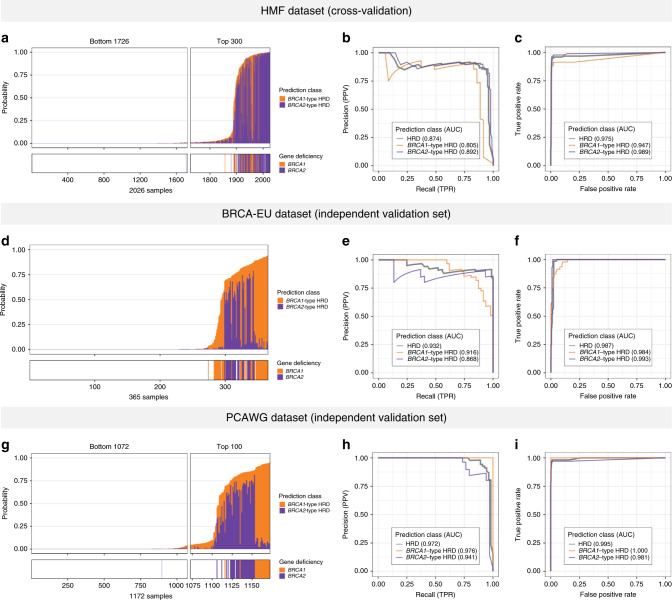
- CHORD achieved high performance in cross-validation (AUROC 0.98, AUPRC 0.87) and in independent BRCA-EU and PCAWG datasets (AUROC >0.98, AUPRC >0.93).
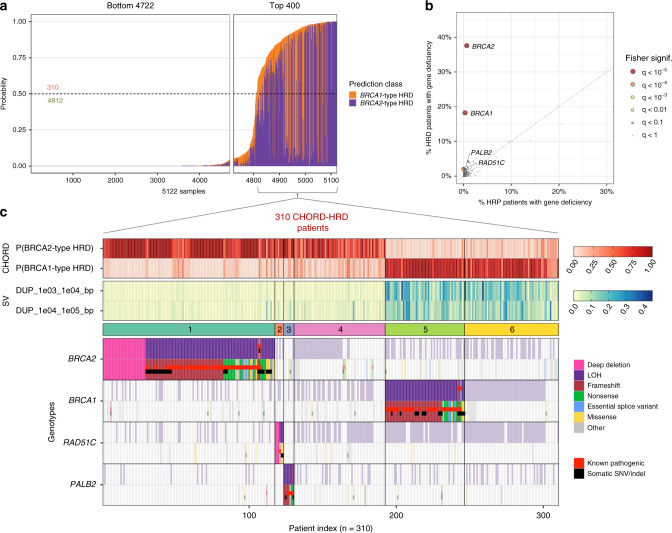
- Among 5,122 patients (3,504 HMF metastatic and 1,618 PCAWG primary), 310 (6%) were CHORD-HRD: 118 BRCA1-type and 192 BRCA2-type; 4,812 were CHORD-HRP.
- Biallelic inactivation was significantly enriched in CHORD-HRD vs CHORD-HRP for BRCA1 (q = 9.4e-51), BRCA2 (q = 4.8e-101), RAD51C (q = 5.6e-5), and PALB2 (q = 0.02); RAD51C and PALB2 inactivation produced BRCA2-type HRD.
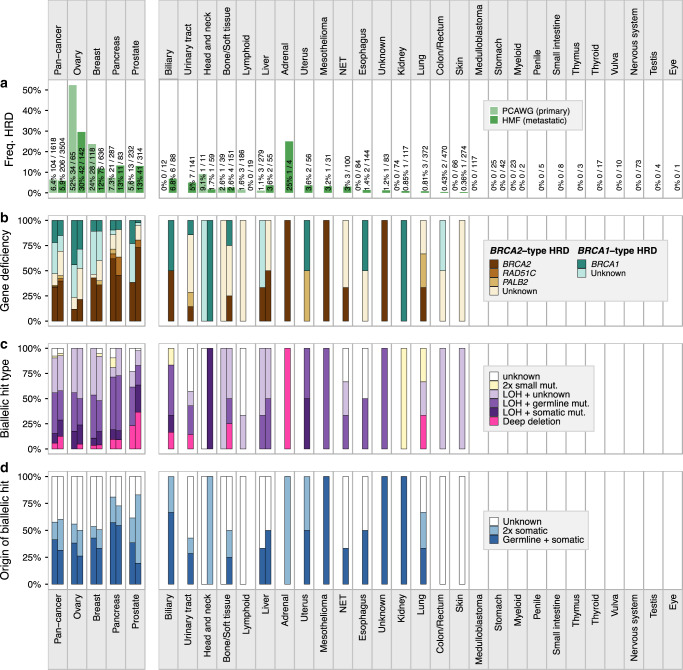
- HRD was most prevalent in ovarian, breast, prostate, and pancreatic cancer (85% combined); primary vs metastatic frequencies were ovarian 52% vs 30%, breast 24% vs 12%, prostate 5.6% vs 13%, and pancreatic 7.3% vs 13%.
Methods
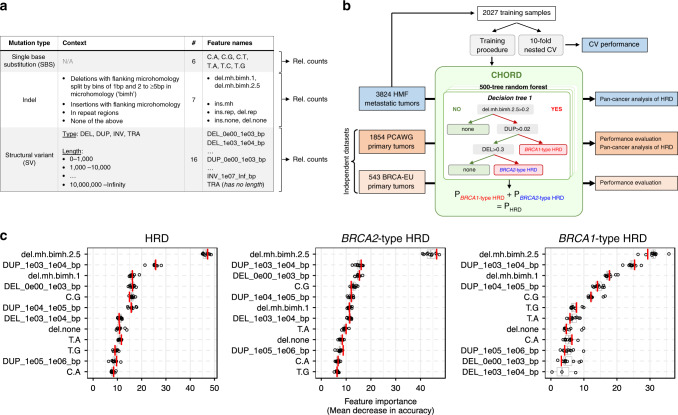
- CHORD is a random forest trained on relative counts of SNV, indel, and structural variant mutation contexts from 3,824 HMF metastatic tumors; 2,026 samples (53%) were used for training, including 35 BRCA1-deficient, 89 BRCA2-deficient, and 1,902 BRCA1/2-proficient samples.
- Performance was assessed by 10-fold nested cross-validation and by application to BRCA-EU (543 primary breast tumors; 365 used for HRDetect) and PCAWG (1,854 primary tumors; 1,172 selected for validation).
- For pan-cancer analysis, CHORD was applied to HMF and PCAWG samples passing QC; genetic causes were assessed by biallelic status of 781 cancer/HR-related genes, Fisher’s exact enrichment tests, and clustering of CHORD-HRD samples.
Limitations
- The paper states that primary vs metastatic HRD rate differences may be confounded by patient inclusion criteria, and that methylation data were unavailable for HMF and PCAWG, preventing direct assessment of promoter methylation as an HRD cause.
- The authors note that mutational scars reflect genomic history rather than ongoing processes, so false-positive CHORD predictions are possible (e.g., HRD reversion, recent HRD acquisition, or radiotherapy-associated microhomology deletions); subclonal predictions should be interpreted cautiously.
- The paper states that variant calling pipeline differences can affect CHORD, additional validation/threshold optimization is recommended for other pipelines, and low numbers of BRCA1/2-deficient samples in some cancer types may make error estimates and HRD frequency underestimates uncertain.
Model-written summary. Check it against the paper before relying on it.
Integrity signals
Registry
Cites
Statistics
Figures
Verification
Claims the paper makes
15 Valid · 7 Not valid · 9 Not checked · 71 Own results and interpretations
At least one cited source doesn’t support this claim or points to a different paper, and none confirmed it — see the verdicts below.
In the paper
“Two recent studies showed that common cancer treatments in general do not induce mutations that may interfere with CHORD predictions16,17.”
§ Pan-cancer landscape of homologous recombination deficiency > Results > Effect of treatment on HRD predictions
What the sources say
- Disputedcites [16] Pich O The mutational footprints of cancer therapies Nat. Genet. 2019 51 1732 1740 10.1038/s41588-019-0525-5 31740835 PMC6887544 sourceExperimental — accuracy not yet measured
The Results section, “The mutational footprints of six anti-cancer therapies,” identifies mutational signatures caused by widely used platinum-based treatments, contrary to the claim that common treatments generally do not induce mutations. The paper does not assess whether treatment-induced mutations interfere with CHORD predictions, so that specific effect cannot be judged from this source. (LLM, conf=0.83)
Checked by a reasoning model — may be wrong.
- Disputedcites [17] Kucab JE A compendium of mutational signatures of environmental agents Cell 2019 177 821 836.e16 10.1016/j.cell.2019.03.001 30982602 PMC6506336 sourceExperimental — accuracy not yet measured
The Results (Insights into Mutational Mechanisms of Platinum Complexes; page unavailable) report substitution and double-substitution signatures from cisplatin and carboplatin, with an indel signature from cisplatin. The Results (Mutational Signatures of Alkylating Agents; page unavailable) also report a mutational signature from temozolomide. Thus, the paper shows that some cancer treatments do induce mutations; it does not assess interference with CHORD predictions. (LLM, conf=0.85)
Checked by a reasoning model — may be wrong.
hedged- Asserted: passes — The authors put it forward as true.
- Checkable: passes — It can be checked against evidence.
- Load-bearing: passes — The paper’s conclusions depend on it.
- Based: passes — The paper gives a reason why it holds.
- Disputed
The cited sources that could be checked couldn’t confirm or dispute this claim.
In the paper
“In addition, the predictions of CHORD and HRDetect on the PCAWG dataset10 were concordant for the vast majority of samples (1506/1526; 99%) (Supplementary Fig. 10).”
§ Pan-cancer landscape of homologous recombination deficiency > Results > Performance of CHORD
What the sources say
- Could not verifycites [10] Degasperi A A practical framework and online tool for mutational signature analyses show intertissue variation and driver dependencies Nat. Cancer 2020 1 249 263 10.1038/s43018-020-0027-5 32118208 PMC7048622 sourceExperimental — accuracy not yet measured
The Methods (Datasets; page unavailable) identify the PCAWG cohort, and the Results (Homologous recombination deficiency across 21 organs; page unavailable) discuss HRDetect predictions. Searches for CHORD and for the 1506/1526 concordance figure found no passage comparing CHORD with HRDetect, so our copy does not verify the claimed 99% agreement. (LLM, conf=0.73)
plainstates an association- Asserted: passes — The authors put it forward as true.
- Checkable: passes — It can be checked against evidence.
- Load-bearing: passes — The paper’s conclusions depend on it.
- Based: passes — The paper gives a reason why it holds.
- Rests on an assumption not shown here.
- Could not verify
The cited sources that could be checked couldn’t confirm or dispute this claim.
In the paper
“We thus conclude that accurate detection of HRD does not require mutational signatures, thereby simplifying HRD calling and avoiding potential complications associated with the fitting step required for computing signature contributions in individual samples (for which there is currently no consensus approach)15.”
§ Pan-cancer landscape of homologous recombination deficiency > Results > Performance of CHORD
What the sources say
- Could not verifycites [15] Maura F A practical guide for mutational signature analysis in hematological malignancies Nat. Commun. 2019 10 1 12 10.1038/s41467-018-07882-8 31278357 PMC6611883 sourceExperimental — accuracy not yet measured
The Introduction and Results discuss photoelectron interference in neon dimers, not detection of homologous recombination deficiency. Searches of our copy for HRD, mutational signatures, and fitting signature contributions found no passage addressing the claim or the citation-attached point about consensus on fitting methods. (LLM, conf=0.79)
boostedn = 8- Asserted: passes — The authors put it forward as true.
- Checkable: passes — It can be checked against evidence.
- Load-bearing: passes — The paper’s conclusions depend on it.
- Based: passes — The paper gives a reason why it holds.
- Rests on an assumption not shown here.
- Could not verify
The cited sources support only part of this claim — read each source’s verdict below.
In the paper
“We note that CHORD performs similarly to HRDetect based on predictions on the BRCA-EU dataset (AUROC = 0.98 for both models)9.”
§ Pan-cancer landscape of homologous recombination deficiency > Results > Performance of CHORD
What the sources say
- Partly supportedcites [9] Davies H HRDetect is a predictor of BRCA1 and BRCA2 deficiency based on mutational signatures Nat. Med. 2017 23 517 525 10.1038/nm.4292 28288110 PMC5833945 sourceExperimental — accuracy not yet measured
The Results and Online Methods report an AUROC of 0.98 for HRDetect on the paper’s breast-cancer cohort (page numbers unavailable). They do not report CHORD predictions or a comparison on a dataset identified as BRCA-EU, so the claim that both models achieved 0.98 there is not supported by this source. (LLM, conf=0.90)
plain- Asserted: passes — The authors put it forward as true.
- Checkable: passes — It can be checked against evidence.
- Load-bearing: passes — The paper’s conclusions depend on it.
- Based: passes — The paper gives a reason why it holds.
- Rests on an assumption not shown here.
- Partly supported
Every source the paper cites for this claim was checked and supports it.
In the paper
“Given that these three genes all belong to the RAD51 paralog complex BCDX223, the BRCA2-type HRD suggests that RAD51B and XRCC2 deficiency could have led to HRD in these patients.”
§ Pan-cancer landscape of homologous recombination deficiency > Results > BRCA2, RAD51C, and PALB2 are associated with BRCA2-type HRD while only BRCA1 is associated with BRCA1-type HRD
What the sources say
- Supportedcites [23] Chun J Buechelmaier ES Powell SN Rad51 paralog complexes BCDX2 and CX3 act at different stages in the BRCA1-BRCA2-dependent homologous recombination pathway Mol. Cell. Biol. 2013 33 387 395 10.1128/MCB.00465-12 23149936 PMC3554112 source
The Abstract (page unavailable) identifies RAD51B and XRCC2 as members of BCDX2 and reports that the complex participates in BRCA2-dependent homologous recombination. Figure 1 (page unavailable) reports HR deficiency after depletion of individual RAD51 paralogs, including RAD51B and XRCC2. The cited paper therefore supports the proposed mechanism; the inference about these particular patients is the citing authors’ own. (LLM, conf=0.91)
hedgedstates a possible causen = 4- Asserted: passes — The authors put it forward as true.
- Checkable: passes — It can be checked against evidence.
- Load-bearing: passes — The paper’s conclusions depend on it.
- Based: passes — The paper gives a reason why it holds.
- Rests on an assumption not shown here.
- Supported
62 more claims · 8 with their cited sources checked
Create a free account to see all 102 claims and to verify the 1 reference still open.
- Probably not a substantial claim. 16
- It may state two separate claims as one. 22
Claims other papers make about this one
Each is checked against this paper’s own text: does it say what the citing paper says it does?
The source backs part of the claim, not all of it — or backs it for a different population, condition or comparison.
In the citing paper
“The encoded Brca1 protein is a component of the homologous recombination repair (HRR) machinery, and BRCA1 is uncommonly mutated in PDAC (~1%), typically in the germline, and associated with HRR defective cancers22,23.”
From Occult polyclonality of preclinical pancreatic cancer models drives in vitro evolution (2022) · cites this paper as [23]
Experimental — accuracy not yet measuredThe cited source says what the claim attributes to it.
In the citing paper
“Defects in HRR can lead to the presence of “genomic scars” caused by the cancer cell’s inability to accurately repair sites of double strand breaks (DSBs).”
From Three-dimensional modelling of ovarian cancer: from cell lines to organoids for discovery and personalized medicine (2022) · cites this paper as Nguyen et al., 2020
Self-check
Percentages, sums and reported differences re-computed from the paper’s own numbers.
Each contradiction between two passages listed here was confirmed by an independent check.
Rated minor: it would not touch a result — a value no result rests on, a p-value that stays on the same side of the significance level, or a conflict that is clerical, resolved elsewhere in the paper, or outside its own findings.
In the paper
§ Pan-cancer landscape of homologous recombination deficiency > Discussion
“but collectively this constitutes a sizable group of patients (15% of all patients).”
§ Pan-cancer landscape of homologous recombination deficiency > Results > The incidence and genetic cause of HRD varies in different tissue types and cancer stage
“HRD was most prevalent in ovarian, breast, prostate and pancreatic cancer (85% combined), and only occurred sporadically in other cancer types (15%)”
Rated minor: it would not touch a result — a value no result rests on, a p-value that stays on the same side of the significance level, or a conflict that is clerical, resolved elsewhere in the paper, or outside its own findings.
In the paper
§ Pan-cancer landscape of homologous recombination deficiency > Methods > Random forest training
“del.mh with 1 bp homology and 2 to ≥5 (i.e. equivalent to ≥5 bp) homology”
§ Pan-cancer landscape of homologous recombination deficiency > Results > Random forest classifier training
“Deletions with 2 to ≥5 bp (i.e. ≥2 bp) of flanking microhomology”
Rated minor: it would not touch a result — a value no result rests on, a p-value that stays on the same side of the significance level, or a conflict that is clerical, resolved elsewhere in the paper, or outside its own findings.
In the paper
§ Pan-cancer landscape of homologous recombination deficiency > Results > BRCA2, RAD51C, and PALB2 are associated with BRCA2-type HRD while only BRCA1 is associated with BRCA1-type HRD
“Of all CHORD-HRD HMF patients, ~60% (184/310)”
§ Pan-cancer landscape of homologous recombination deficiency > Results > BRCA2, RAD51C, and PALB2 are associated with BRCA2-type HRD while only BRCA1 is associated with BRCA1-type HRD
“This yielded a total of 5122 patients (3504 from HMF and 1618 from PCAWG), with 310 (6%) being classified as being homologous recombination deficient (CHORD-HRD).”
Citations
Cites
A method and server for predicting damaging missense mutations.
Adzhubei, I. A., Schmidt, S., Peshkin, L., Ramensky, V. E., Gerasimova, A., Bork, P., Kondrashov, A. S., & Sunyaev, S. R. (2010) · Nature Methods · doi:10.1038/nmeth0410-248 · Cited by 13,194
The mutational constraint spectrum quantified from variation in 141,456 humans
Karczewski, K. J., Francioli, L. C., Tiao, G., Cummings, B. B., Alföldi, J., Wang, Q., Collins, R. L., Laricchia, K. M., Ganna, A., Birnbaum, D. P., et al. (2020) · Nature · doi:10.1038/s41586-020-2308-7 · Cited by 9,434
Double-slit photoelectron interference in strong-field ionization of the neon dimer
Kunitski, M., Eicke, N., Huber, P., Köhler, J., Zeller, S., Voigtsberger, J., Schlott, N., Henrichs, K., Sann, H., Trinter, F., et al. (2019) · Nature Communications · doi:10.1038/s41467-018-07882-8 · Cited by 8,162
Double-slit photoelectron interference in strong-field ionization of the neon dimer
Kunitski, M., Eicke, N., Huber, P., Köhler, J., Zeller, S., Voigtsberger, J., Schlott, N., Henrichs, K., Sann, H., Trinter, F., et al. (2019) · Institutional Repository of Leibniz Universität Hannover (Leibniz Universität Hannover) · doi:10.15488/5174 · Cited by 8,161
Pan-cancer analysis of whole genomes
The ICGC/TCGA Pan-Cancer Analysis of Whole Genomes Consortium, Aaltonen, L. A., Abascal, F., Abeshouse, A., Aburatani, H., Adams, D. J., Agrawal, N., Ahn, K. S., Ahn, S.-M., Aikata, H., et al. (2020) · Nature · doi:10.1038/s41586-020-1969-6 · Cited by 3,064
SMARCAD1 ATPase activity is required to silence endogenous retroviruses in embryonic stem cells
Sachs, P., Ding, D., Bergmaier, P., Lamp, B., Schlagheck, C., Finkernagel, F., Nist, A., Stiewe, T., & Mermoud, J. E. (2019) · Nature Communications · doi:10.1038/s41467-019-09078-0 · Cited by 2,384
D’Hulst, G., Soro-Arnaiz, I., Masschelein, E., Veys, K., Fitzgerald, G., Smeuninx, B., Kim, S., Deldicque, L., Blaauw, B., Carmeliet, P., et al. (2020) · Nature Communications · doi:10.1038/s41467-019-13889-6 · Cited by 2,310
Maintenance Olaparib for Germline BRCA -Mutated Metastatic Pancreatic Cancer
Golan, T., Hammel, P., Reni, M., Van Cutsem, E., Macarulla, T., Hall, M. J., Park, J.-O., Hochhauser, D., Arnold, D., Oh, D.-Y., et al. (2019) · New England Journal of Medicine · doi:10.1056/nejmoa1903387 · Cited by 2,302
Audeh, M. W., Carmichael, J., Penson, R. T., Friedlander, M., Powell, B., Bell-McGuinn, K. M., Scott, C., Weitzel, J. N., Oaknin, A., Loman, N., et al. (2010) · The Lancet · doi:10.1016/s0140-6736(10)60893-8 · Cited by 2,279 · cited 1×
“Accurate detection of HR deficiency (HRD) is of clinical relevance as it is indicative of sensitivity to targeted therapy with poly ADP-ribose polymerase inhibitors (PARPi)[3, 4] as well as to DNA damaging reagents[1].”
BackgroundLandscape of somatic mutations in 560 breast cancer whole-genome sequences
Nik-Zainal, S., Davies, H., Staaf, J., Ramakrishna, M., Glodzik, D., Zou, X., Martincorena, I., Alexandrov, L. B., Martin, S., Wedge, D. C., et al. (2016) · Nature · doi:10.1038/nature17676 · Cited by 2,218 · cited 3×
“In the second approach, performance was evaluated on two independent datasets: the BRCA-EU dataset[8] (543 primary breast tumors) and the PCAWG dataset[14] (1,854 primary tumors, pancancer).”
BackgroundMethod
Cited by
Items 101–200 of 548
Xu, J., Lü, W., Wei, X., Zhang, B., Yang, H., Tu, M., Chen, X., Wu, S., & Guo, T. (2024) · Cancer Letters · doi:10.1016/j.canlet.2024.216928 · Cited by 36
Hong, W., Zhang, Y., Wang, S., Li, Z., Zheng, D.-X., Hsu, S.-J., Zhou, J., Fan, J., Chen, Z., Xia, X., et al. (2024) · Advanced Science · doi:10.1002/advs.202308009 · Cited by 42
Simoneau, A., Pratt, C. B., Wu, H., Rajeswaran, S. S., Comer, C. G., Sudsakorn, S., Zhang, W., Liu, S., Meier, S. R., Choi, A. H., et al. (2025) · Molecular Cancer Therapeutics · doi:10.1158/1535-7163.mct-24-0515 · Cited by 32
The repertoire of copy number alteration signatures in human cancer
Tao, Z., Wang, S., Wu, C., Wu, T., Zhao, X., Wei, N., Wang, G., Wang, J., Chen, J., Diao, K., et al. (2023) · Briefings in Bioinformatics · doi:10.1093/bib/bbad053 · Cited by 32
RAD52 resolves transcription-replication conflicts to mitigate R-loop induced genome instability
Jalan, M., Sharma, A., Pei, X., Weinhold, N., Buechelmaier, E. S., Zhu, Y., Ahmed‐Seghir, S., Ratnakumar, A., Bona, M. D., McDermott, N., et al. (2024) · Nature Communications · doi:10.1038/s41467-024-51784-x · Cited by 30
Dillon, K. M., Bekele, R., Sztupinszki, Z. M., Hanlon, T., Rafiei, S., Szállási, Z., Choudhury, A. D., & Mouw, K. W. (2022) · npj Precision Oncology · doi:10.1038/s41698-022-00291-7 · Cited by 34
Zhang, W., Wang, M., Song, Z., Fu, Q., Chen, J., Zhang, W., Gao, S., Sun, X., Yang, G., Zhang, Q., et al. (2023) · Nature Communications · doi:10.1038/s41467-023-37576-9 · Cited by 32
Luo, K., Qian, Z., Jiang, Y., Lv, D., Zhu, K., Shao, J., Hu, Y. C., Lv, C., Huang, Q., Gao, Y., et al. (2023) · Computers in Biology and Medicine · doi:10.1016/j.compbiomed.2023.107078 · Cited by 31
Torres‐Esquius, S., Llop‐Guevara, A., Gutiérrez‐Enríquez, S., Romey, M., Teulé, À., Llort, G., Herrero, A., Henaréjos, P. S., Vallmajó, A., González-Santiago, S., et al. (2024) · JAMA Network Open · doi:10.1001/jamanetworkopen.2024.7811 · Cited by 30
An overview of mutational and copy number signatures in human cancer
Steele, C. D., Pillay, N., & Alexandrov, L. B. (2022) · The Journal of Pathology · doi:10.1002/path.5912 · Cited by 31
“Other methods that are dependent on whole-genome sequencing [67] or that have removed the need for WGS data and are therefore applicable to targeted sequencing panels [68] have also been published.”
BackgroundFighting resistance: post-PARP inhibitor treatment strategies in ovarian cancer
Veneziani, A. C., Scott, C. L., Wakefield, M. J., Tinker, A. V., & Lheureux, S. (2023) · Therapeutic Advances in Medical Oncology · doi:10.1177/17588359231157644 · Cited by 33
Xu, F., Guan, Y., Zhang, P., Li, X., Ma, Y., Gao, M., Chong, T., & Ren, B. (2022) · BMC Endocrine Disorders · doi:10.1186/s12902-022-01017-3 · Cited by 27
Tsang, E. S., Csizmók, V., Williamson, L. M., Pleasance, E., Topham, J. T., Karasinska, J. M., Titmuss, E., Schrader, K. A., Yip, S. S. F., Tessier‐Cloutier, B., et al. (2023) · npj Precision Oncology · doi:10.1038/s41698-023-00368-x · Cited by 27
Peng, B., Peng, J., Kang, F., Zhang, W.-Q., Peng, E., & He, Q. (2022) · Frontiers in Cell and Developmental Biology · doi:10.3389/fcell.2022.881447 · Cited by 27
“Homologous recombination deficiency (HRD) is one of the common drivers for tumorigenesis (Nguyen et al., 2020).”
BackgroundIntegrative Genomic Tests in Clinical Oncology
Имянитов, Е. Н., & Соколенко, А. П. (2022) · International Journal of Molecular Sciences · doi:10.3390/ijms232113129 · Cited by 28
“, PALB2 or RAD51 paralogs, appear to be related to the HRD phenotype, although important nuances need to be considered [41,42].”
BackgroundMethodPlanas‐Paz, L., Pliego‐Mendieta, A., Hagedorn, C., Aguilera‐Garcia, D., Haberecker, M., Arnold, F. M., Herzog, M., Bankel, L., Guggenberger, R., Steiner, S., et al. (2023) · EMBO Molecular Medicine · doi:10.15252/emmm.202216863 · Cited by 28
“Aberrant proliferation associated with cancer cells promotes the accumulation of genomic alterations and mutations in genes regulating cell division and tumor suppression (Negrini et al, 2010; Nguyen et al, 2020).”
BackgroundInfluential(Single-stranded DNA) gaps in understanding BRCAness
Schreuder, A., Wendel, T. J., Dorresteijn, C. G. V., & Noordermeer, S. M. (2024) · Trends in Genetics · doi:10.1016/j.tig.2024.04.013 · Cited by 29
PARP Inhibitor Applicability: Detailed Assays for Homologous Recombination Repair Pathway Components
Coyne, G. O., Karlovich, C., Wilsker, D. F., Voth, A. R., Parchment, R. E., Chen, A. P., & Doroshow, J. H. (2022) · OncoTargets and Therapy · doi:10.2147/ott.s278092 · Cited by 25
“Similar to HRDetect, Nguyen et al developed CHORD, a mutational classifier for HR deficiency.(49) A drawback of both HRDetect and CHORD is the requirement for WGS, which is not typically performed in clinical sequencing laboratories.”
MethodHomologous Recombination Deficiency Scar: Mutations and Beyond—Implications for Precision Oncology
van der Wiel, A. M.-M. A., Schuitmaker, L., Cong, Y., Theys, J., van Hoeck, A., Vens, C., Lambin, P., Yaromina, A., & Dubois, L. J. (2022) · Cancers · doi:10.3390/cancers14174157 · Cited by 29
“CHORD uses a combination of 29 mutational features of three somatic mutation categories: SBSs, IDs, and structural variants (SV), with the presence of deletions with flanking homology of ≥2 bp being the most important predictor of HRD [6].”
BackgroundMethodInfluentialYuan, W., Ni, J., Wen, H., Shi, W., Chen, X., Huang, H., Zhang, X., Lu, X., Zhu, C., Dong, H., et al. (2022) · BJOG An International Journal of Obstetrics & Gynaecology · doi:10.1111/1471-0528.17324 · Cited by 29
“One is based on detecting mutational profiles, such as HRDetect, 16 CHORD, 17 YAPSA 18 and mutation signature SBS3.”
BackgroundXie, T., Dickson, K.-A., Yee, C., Ma, Y., Ford, C. E., Bowden, N. A., & Marsh, D. J. (2022) · Cancers · doi:10.3390/cancers14194621 · Cited by 28
Stiegeler, N., Garsed, D. W., Au‐Yeung, G., Bowtell, D. D. L., Heinzelmann-Schwarz, V. A., & Zwimpfer, T. A. (2024) · Frontiers in Oncology · doi:10.3389/fonc.2024.1387281 · Cited by 28
A decade of RAD51C and RAD51D germline variants in cancer
Boni, J., Idani, A., Roca, C., Feliubadaló, L., Tomiak, E. M., Weber, E., Foulkes, W. D., Orthwein, A., Haffaf, Z. E., Lázaro, C., et al. (2021) · Human Mutation · doi:10.1002/humu.24319 · Cited by 28
Mas-Ponte, D., McCullough, M., & Supek, F. (2022) · Clinical Science · doi:10.1042/cs20210682 · Cited by 26
Targeting homologous recombination deficiency in uterine leiomyosarcoma
Dall, G., Vandenberg, C. J., Nesic, K., Ratnayake, G., Zhu, W., Vissers, J. H. A., Bedő, J., Penington, J. S., Wakefield, M. J., Kee, D., et al. (2023) · Journal of Experimental & Clinical Cancer Research · doi:10.1186/s13046-023-02687-0 · Cited by 24
“Algorithmic assessment of HRD, for example using CHORD [34] and HRDetect [33] may also require further validation in certain rare cancer subtypes.”
BackgroundMethodInfluentialHong, W.-F., Zhang, F., Wang, N., Bi, J.-M., Zhang, D.-W., Wei, L., Song, Z., Mills, G. B., Chen, M., Li, X., et al. (2024) · Drug Resistance Updates · doi:10.1016/j.drup.2024.101115 · Cited by 22
Saner, F. A. M., Takahashi, K., Budden, T., Pandey, A., Ariyaratne, D., Zwimpfer, T. A., Meagher, N. S., Fereday, S., Twomey, L., Pishas, K. I., et al. (2024) · Clinical Cancer Research · doi:10.1158/1078-0432.ccr-23-3552 · Cited by 26
“41; Supplementary Table S2).”
MethodBRCA1/2 reversion mutations in a pan‐cancer cohort
Nakamura, K., Hayashi, H., Kawano, R., Ishikawa, M., Aimono, E., Mizuno, T., Kuroda, H., Kojima, Y., Niikura, N., Kawanishi, A., et al. (2023) · Cancer Science · doi:10.1111/cas.16033 · Cited by 25
Lansbergen, M. F., Dings, M. P. G., Manoukian, P., Sarasqueta, A. F., Waasdorp, C., Hooijer, G. K. J., Verheij, J., Köster, J., Zwijnenburg, D. A., Wilmink, J. W., et al. (2024) · Translational research · doi:10.1016/j.trsl.2024.08.002 · Cited by 23
Chao, A., Huang, C., Yu, W., Lin, C., Lin, H., Chao, A., Lin, C., Chou, H., Huang, K.-G., Huang, H.-J., et al. (2024) · BMC Cancer · doi:10.1186/s12885-024-13125-5 · Cited by 22
“Subsequently, we investigated the frequency of ARID1A deficiency due to biallelic loss using a previously described assessment method [43].”
Chen, D., Shao, M., Meng, P., Wang, C., Li, Q., Cai, Y., Song, C., Wang, X., & Shi, T. (2021) · BMC Bioinformatics · doi:10.1186/s12859-021-04487-9 · Cited by 21
“Platinum salts are currently one of the most important chemotherapeutic drugs and have a broad anticancer spectrum, which intro - duces DNA DSBs and interstrand crosslinks.”
BackgroundYang, D., Huang, F., Wei, W., Li, Q., Wu, J., Huang, Y., Li, Z., Zhang, H., Li, X., Yuan, Q.-E., et al. (2023) · International Journal of Biological Sciences · doi:10.7150/ijbs.79654 · Cited by 22
“HRD is a common feature which occurs in most of tumors, especially in ovarian cancer.[31] HRD causes tumor genomic instability, which derives considerable aberrant endogenous DNA fragments, activating innate immune system by the cGAS-STING pathway, etc.”
Feng, C., Zhang, Y., Wu, F., Li, J., Liu, M., Lv, W., Li, C., Wang, W., Tan, Q., Xue, X., et al. (2023) · The Breast · doi:10.1016/j.breast.2023.04.002 · Cited by 23
“Based on previous data, HRD was most prevalent in ovarian, breast, prostate, and pancreatic cancer (85% combined) and only occurred sporadically in other cancer types (15%) [7].”
BackgroundMethodHorgan, D., Ciliberto, G., Conte, P., Curigliano, G., Seijo, L. M., Montuenga, L. M., Paz-Ares, L., Garassino, M., Frederique, P.-L., Galli, F., et al. (2021) · Cancers · doi:10.3390/cancers13030583 · Cited by 21
“The homologous recombination deficiency (HRD) testing [14] which incorporates new genomic instability assessment algorithms, offers the opportunity to enhance the utility for BRCA testing in ovarian, breast, pancreatic and other cancers [14].”
BackgroundThe mutagenic consequences of defective DNA repair
Németh, E., & Szüts, D. (2024) · DNA repair · doi:10.1016/j.dnarep.2024.103694 · Cited by 23
Precancerous liver diseases do not cause increased mutagenesis in liver stem cells
Nguyen, L., Jager, M., Lieshout, R., de Ruiter, P. E., Locati, M. D., Besselink, N. J. M., der Roest, B. R. V., Janssen, R., Boymans, S., de Jonge, J., et al. (2021) · Communications Biology · doi:10.1038/s42003-021-02839-y · Cited by 21
Self-citationPatient Assessment and Therapy Planning Based on Homologous Recombination Repair Deficiency
Li, W., Gao, L., Yi, X., Shi, S., Huang, J., Shi, L. M., Zhou, X., Wu, L., & Ying, J. (2023) · Genomics Proteomics & Bioinformatics · doi:10.1016/j.gpb.2023.02.004 · Cited by 20
Watkins, J. A., Trotman, J., Tadross, J. A., Harrington, J., Hatcher, H. M., Horan, G., Prewett, S., Wong, H. H., McDonald, S., Tarpey, P. S., et al. (2024) · British Journal of Cancer · doi:10.1038/s41416-024-02721-8 · Cited by 21
Farmanbar, A., Firouzi, S., KNELLER, R. W., & Khiabanian, H. (2022) · Journal of Translational Medicine · doi:10.1186/s12967-022-03259-0 · Cited by 21
“Conversely, homologous recombination deficiency (HRd) has been mainly investigated in ovarian cancer and it remains relatively underexplored in other gynecological tumors [11, 12].”
BackgroundAbbasi, A., Steele, C. D., Bergstrom, E. N., Khandekar, A., Farswan, A., McKay, R. R., Pillay, N., & Alexandrov, L. B. (2025) · Cancer Research · doi:10.1158/0008-5472.can-24-2639 · Cited by 19
“CHORD was performed using the extractSigsChord function installed from GitHub: https://github.com/UMCUGenetics/CHORD/.”
InfluentialRebello, R. J., Posner, A., Dong, R., Prall, O. W. J., Sivakumaran, T., Mitchell, C. B., Flynn, A., Caneborg, A., Mitchell, C., Kanwal, S., et al. (2025) · Nature Communications · doi:10.1038/s41467-025-59661-x · Cited by 21
“HR-Detect HR-Detect andCHORD have not been validated using cancer panel data, therefore, this was not attempted.”
Influentialde Jong, A. C., Danyi, A., van Riet, J., de Wit, R., Sjöström, M., Feng, F. Y.-C., de Ridder, J., & Lolkema, M. P. (2023) · Nature Communications · doi:10.1038/s41467-023-37647-x · Cited by 20
Prevalence, causes and impact of TP53-loss phenocopying events in human tumors
Fito-Lopez, B., Salvadores, M., Álvarez‐Álvarez, M. M., & Supek, F. (2023) · BMC Biology · doi:10.1186/s12915-023-01595-1 · Cited by 22
“activation transcriptomic scores were proposed (20), and similarly homologous 879 recombination repair scores based on mutational signatures (86,87) Conceivably, 880 other important cancer pathways may be similarly addressed as well, analyzing their 881”
BackgroundBieńkowski, M., Tomasik, B., Braun, M., & Jassem, J. (2022) · Cancer Treatment Reviews · doi:10.1016/j.ctrv.2022.102359 · Cited by 20
Molecular Genetics of Prostate Cancer and Role of Genomic Testing
Akhoundova, D., Feng, F. Y.-C., Pritchard, C. C., & Rubin, M. A. (2022) · Surgical pathology clinics · doi:10.1016/j.path.2022.08.002 · Cited by 20
A redefined InDel taxonomy provides insights into mutational signatures
Koh, C. C., Nanda, A. S., Rinaldi, G., Boushaki, S., Degasperi, A., Badja, C., Pregnall, A. M., Zhao, S. J., Chmelova, L., Black, D., et al. (2025) · Nature Genetics · doi:10.1038/s41588-025-02152-y · Cited by 26
“For instance, a high proportion of microhomology-mediated deletions is a key predictor of clinically actionable homologous recombination deficiency, carrying the greatest weight in homologous recombination deficiency detection and classification algorithms 9,10 .”
Multi-Gene Testing Overview with a Clinical Perspective in Metastatic Triple-Negative Breast Cancer
Dameri, M., Ferrando, L., Cirmena, G., Vernieri, C., Pruneri, G., Ballestrero, A., & Zoppoli, G. M. (2021) · International Journal of Molecular Sciences · doi:10.3390/ijms22137154 · Cited by 19
Kole, C., Charalampakis, N., Tsakatikas, S., Frountzas, M., Apostolou, K. G., & Schizas, D. (2022) · Cancer Management and Research · doi:10.2147/cmar.s267260 · Cited by 19
“and to a lesser extent in other solid tumors, such as breast and prostate cancer.(138) When it comes to PDAC, about 14– 44% of patients carry mutations in at least one HRD gene, with BRCA and ATM being the most frequent(139) study.”
BackgroundGenomic features of renal cell carcinoma developed during end-stage renal disease and dialysis
Johnson, T. A., Maekawa, S., Fujita, M., An, J., Ju, Y.-S., Maejima, K., Kanazashi, Y., Jikuya, R., Okawa, Y., Sasagawa, S., et al. (2022) · Human Molecular Genetics · doi:10.1093/hmg/ddac180 · Cited by 17
Tsang, E. S., & Münster, P. N. (2022) · OncoTargets and Therapy · doi:10.2147/ott.s322297 · Cited by 22
“An easy, readily available histology-based assay could provide a less expensive test option which also requires less tissue per sample.(27) RAD51 immunostaining performed on tumor biopsies before and after olaparib in the Phase II PETREMAC trial, also predicted the response to PARP inhibition in patients with early tr…”
BackgroundMulti-scale characterisation of homologous recombination deficiency in breast cancer
Jacobson, D. H., Shi, P., Fisher, J., & Secrier, M. (2023) · Genome Medicine · doi:10.1186/s13073-023-01239-7 · Cited by 18
“As expected, BRCA-defective samples were strongly enriched within the seven HRD clusters, as were samples labelled as HRD by either HRDetect [11] or CHORD [12], with all BRCA-defective samples appearing in an HRD cluster (Additional file 1: Fig.”
BackgroundMethodZhao, D., Wang, A., Li, Y., Cai, X., Zhao, J., Zhang, T., Zhao, Y., Dong, Y., Zhou, F., Li, Y., et al. (2024) · Journal of the National Cancer Center · doi:10.1016/j.jncc.2024.05.005 · Cited by 22
“23 , 24 Consequently, the threshold values for HRD scores in ovarian and breast cancers may not be applicable to prostate cancer.”
New Therapeutic Options for BRCA Mutant Patients
Ghanem, A., & Domchek, S. M. (2024) · Annual Review of Medicine · doi:10.1146/annurev-med-082523-083843 · Cited by 19
Qiu, B., Kline, C., & Mueller, S. (2021) · Frontiers in Oncology · doi:10.3389/fonc.2021.674596 · Cited by 19
Wineland, D., Le, A. N., Hausler, R. M., Kelly, G., Barrett, E., Desai, H., Wubbenhorst, B. S., Pluta, J. B., Bastian, P., Symecko, H., et al. (2023) · JCO Precision Oncology · doi:10.1200/po.23.00036 · Cited by 21
Real-world clinical utility of tumor whole-genome sequencing in solid cancers
van Putten, J., Snaebjornsson, P., Bosch, L. J. W., Koster, R., Roepman, P., Usset, J. L., Boelens, M. C., van Wezel, T., Rosenberg, E. H., Marchetti, S., et al. (2026) · Nature Medicine · doi:10.1038/s41591-026-04280-2 · Cited by 26
“In addition, WGS generates a rich data resource for the discovery of previously unknown biomarkers for patient stratification 60,61 or non-responders 6 , which can further optimize the use of existing drugs and decrease total treatment costs for society.”
Self-citationRETRACTED: Utility of Homologous Recombination Deficiency Biomarkers Across Cancer Types
Takamatsu, S., Brown, J. B., Yamaguchi, K. D., Hamanishi, J., Yamanoi, K., Takaya, H., Kaneyasu, T., Mori, S., Mandai, M., & Matsumura, N. (2021) · JCO Precision Oncology · doi:10.1200/po.21.00141 · Cited by 17
RetractedWei, Y., Wei, C., Chen, L., Liu, N., 方鎮豪, Yin, J. C., Pang, J., Ou, Q., Wu, X., Wang, X., et al. (2022) · Cancer Research and Treatment · doi:10.4143/crt.2021.963 · Cited by 17
“other gynecological cancers including breast, ovarian, and endometrial cancer [25].”
BackgroundWalens, A., Alsten, S. C. V., Olsson, L. T., Smith, M. A., Lockhart, A., Gao, X., Hamilton, A. M., Kirk, E. L., Love, M. I., Gupta, G. P., et al. (2022) · Cancer Epidemiology Biomarkers & Prevention · doi:10.1158/1055-9965.epi-22-0590 · Cited by 23
Li, L., Yuan, Q., Chu, Y.-M., Jiang, H., Zhao, J., Su, Q., Huo, D., & Zhang, X. (2023) · Frontiers in Cell and Developmental Biology · doi:10.3389/fcell.2023.1106638 · Cited by 22
“The HR pathway is indispensable for protecting genome stability; it is critical both for repairing DNA lesions in mitosis and for chromosomal pairing and exchange during meiosis, thereby ensuring correct segregation of chromosomes during the first meiosis (Nguyen et al., 2020).”
BackgroundFeng, D., Li, D., Wang, J., Wu, R., & Zhang, C. (2023) · Acta Materia Medica · doi:10.15212/amm-2023-0025 · Cited by 20
Burdett, N. L., Willis, M. O., Pandey, A., Twomey, L., Alaei, S., Australian Ovarian Cancer Study Group, Management Group, Bowtell, D. D. L., Chenevix‐Trench, G., Green, A. C., et al. (2024) · Nature Communications · doi:10.1038/s41467-024-50137-y · Cited by 24
“Homologous recombination (HR) status can be quanti fi ed in a number of ways: HR gene annotation ( BRCA1 /2 annotation of somatic andgermlinevariants),COSMICSBSsignature3,HRDsum,Classi fi erof Homologous Recombination De fi ciency (CHORD) and copy number signature 17 (associated with HRD) 55,59 – 61 .”
Xu, L., Liddell, B., Nesic, K., Geissler, F., Ashwood, L. M., Wakefield, M. J., Scott, C. L., Waddell, N., & Kondrashova, O. (2024) · NAR Cancer · doi:10.1093/narcan/zcae033 · Cited by 23
“%) and BC (1.8%), consistent with previous reports ( 14 ).”
BackgroundMethodResultInfluentialBoonen, R. A. C. M., Vreeswijk, M. P. G., & van Attikum, H. (2020) · Frontiers in Molecular Biosciences · doi:10.3389/fmolb.2020.00169 · Cited by 19
“…of a deficiency in HR (Nik-Zainal et al., 2016; Polak et al., 2017), revealed that mutational inactivation of the BRCA1, BRCA2, and PALB2 genes was the most common genetic cause of the observed HR signatures (Nguyen et al., 2020), indicative of their important role in tumor suppression.”
BackgroundGenetic and Genomic Testing for Prostate Cancer: Beyond DNA Repair
Herberts, C., Wyatt, A. W., Nguyen, P. L., & Cheng, H. H. (2023) · American Society of Clinical Oncology Educational Book · doi:10.1200/edbk_390384 · Cited by 16
Salvadores, M., & Supek, F. (2024) · Nature Cancer · doi:10.1038/s43018-023-00707-8 · Cited by 17
“Indeed, we found that homologous recombination deficiencies (HRd) were commonly associated with RMDflat, and this was the case for both the BRCA1 and the BRCA2 subtypes of HRd ascertained by the CHORD method 31 (Extended Data Fig.”
Wang, S., Zheng, Q.-Y., Hong, W.-F., Tang, B., Hsu, S.-J., Zhang, Y., Zheng, X., Zeng, Z.-C., Gao, C., Ke, A., et al. (2024) · Radiotherapy and Oncology · doi:10.1016/j.radonc.2024.110424 · Cited by 17
Meijer, D. M., Ruano, D., Bruijn, I. H. B., Wijers‐Koster, P. M., van de Sande, M. A. J., Gelderblom, H. A. J., Cleton-Jansen, A., de Miranda, N. F. C. C., Kuijjer, M. L., & Bovée, J. V. M. G. (2024) · Genes Chromosomes and Cancer · doi:10.1002/gcc.23253 · Cited by 18
“Homologous recombination deficiency (HRD) detection was performed using CHORD: Classifier of Homologous Recombination Deficiency [12].”
Cleary, J. M., Wolpin, B. M., Dougan, S. K., Raghavan, S., Singh, H., Huffman, B. M., Sethi, N. S., Nowak, J. A., Shapiro, G. I., Aguirre, A. J., et al. (2021) · Clinical Cancer Research · doi:10.1158/1078-0432.ccr-21-1367 · Cited by 18
“Given the importance and challenge of identifying HR-deficient tumors, several genomic algorithms, including the Classifier of Homologous Recombination Deficiency (CHORD) and HRDetect, have been developed to identify the characteristic genomic scar caused by HR deficiency (46, 47).”
MethodTakamatsu, S., Murakami, K., & Matsumura, N. (2024) · Scientific Data · doi:10.1038/s41597-024-03018-4 · Cited by 18
“Recently, their clinical utility as biomarkers has been investigated in other cancer types 15–17 .”
BackgroundConvergence of machine learning and genomics for precision oncology
Reardon, B. M., Culhane, A. C., & Allen, E. M. V. (2026) · Nature reviews. Cancer · doi:10.1038/s41568-025-00897-6 · Cited by 17
Khaddour, K., Fernandez, M. F., Khabibov, M., Гарифуллин, А., Dressler, D., Topchu, I., Patel, J. D., Weinberg, F. D., & Boumber, Y. (2022) · Cancers · doi:10.3390/cancers14215305 · Cited by 16
“Abbreviations NSCLC: Non-small cell lung cancer; SCLC: small cell lung cancer; LAUD: lung adenocarcinoma; LUSC: lung squamous cell carcinoma; PD-L1: programmed death-ligand 1; Os: overall survival; ICI: immune checkpoint inhibitors; DDR: DNA-damage repair; TCGA: The Cancer Genome Atlas; NER: nucleotide excision repair…”
BackgroundInfluentialHomologous Recombination Deficiency Detection Algorithms: A Systematic Review
Mark, L. R., Terp, S. K., Krarup, H. B., Thomassen, M., Pedersen, I. S., & Bøgsted, M. (2023) · Cancers · doi:10.3390/cancers15235633 · Cited by 15
“Nine studies provided an area under the curve (AUC) ranging from 75% to 100% (Table 2), with AUC being highest for HRD-DNA [43], HRD-RNA [43], CHORD [37], 24-GPS [41], and WES-HRDetect [31].”
BackgroundMethodTögel, L., Schubart, C., Lettmaier, S., Neufert, C. F., Hoyer, J., Wolff, K., Moskalev, E. A., Stöhr, R., Agaimy, A., Reis, A., et al. (2023) · Cancers · doi:10.3390/cancers15245892 · Cited by 17
“The assessment of complex biomarkers, such as homologous repair deficiency (HRD), microsatellite analysis, and/or tumor mutational burden (TMB) was not part of the applied panel-mediated CPG. HRD is commonly observed in breast, ovarian, prostate, and pancreas cancer [38].”
BackgroundVogel, A., Haupts, A., Kloth, M. T., Roth, W., & Hartmann, N. (2024) · Diagnostic Pathology · doi:10.1186/s13000-023-01431-8 · Cited by 17
“The landscape of HRD was also affected by tumor type, status of metastasis and cancer stage [38].”
BackgroundUpdates in the Use of Targeted Therapies for Gynecologic Cancers
Cantillo, E., Blanc‐Durand, F., Leary, A. F., Slomovitz, B. M., Fuh, K. C., & Washington, C. R. (2024) · American Society of Clinical Oncology Educational Book · doi:10.1200/edbk_438582 · Cited by 14
Pan, J. W., Tan, Z.-C., Ng, P.-S., Zabidi, M. M. A., Rudin, P. N. F. A., Teo, J.-Y., Hasan, S. N., Islam, T., Teoh, L., Jamaris, S., et al. (2024) · npj Breast Cancer · doi:10.1038/s41523-024-00671-1 · Cited by 17
“The use of HRD-associated mutational signatures to predict “ BRCAness ” and thus response to PARP inhibitors and platinum chemotherapy hasreceived signi fi cantattentioninrecentyears, with toolssuch as HRDetect 19 and CHORD 38 demonstrating that HRD-associated muta-tionalsignaturescanbeusedtopredictBRCA1/BRCA2-de fi cie…”
A generalizable machine learning framework for classifying DNA repair defects using ctDNA exomes
Ritch, E. J., Herberts, C., Warner, E. W., Ng, S. W. S., Kwan, E. M., Bacon, J. V. W., Bernales, C. Q., Schönlau, E., Fonseca, N. M., Giri, V. N., et al. (2023) · npj Precision Oncology · doi:10.1038/s41698-023-00366-z · Cited by 18
“LOH and LST counts are also used as inputs in other machine learning-based classi fi ers 15,23 , and are being explored as standalone surrogates of PARP-inhibitor and/or platinum chemotherapy vulnerability (now reported as part of several commercial ctDNA assays) 25,39,40 .”
BackgroundMethodInfluentialFarmanbar, A., KNELLER, R. W., & Firouzi, S. (2023) · Scientific Data · doi:10.1038/s41597-023-02331-8 · Cited by 19
“Several studies have demonstrated that not all HR gene mutations result in identical consequences and only biallelic inactivation of many HR genes are functional and reflect underlying DNA-repair deficiency 16,52,53 .”
Genome instability and crosstalk with the immune response
Chabanon, R. M., Danlos, F. X., Ouali, K., & Postel-Vinay, S. C. (2025) · Genome Medicine · doi:10.1186/s13073-025-01509-6 · Cited by 21
“In this context, using germline or somatic BRCA1/2 mutations as HRD biomarkers may be challenging, especially in the case of liquid biopsies where clonality assessment is difficult, or when two different monoallelic alterations are combined [266].”
Homologous recombination deficiency and hemizygosity drive resistance in breast cancer
Safonov, A. M., Lee, M. K., Brown, D. N., Bielo, L. B., Mehine, M. M., Bandlamudi, C., O’Leary, B., Shao, H., Vicente, L., Muldoon, D. M., et al. (2026) · Nature · doi:10.1038/s41586-026-10197-0 · Cited by 18
“Such large deletions are a recognized hallmark of HRD-mediated instability 55 , highlighting the role of HRD in facilitating RB1 loss and validating our clinicogenomic observations in a rigorously controlled preclinical setting.”
Yao, H., Li, H., Wang, J., Wu, T., Ning, W., Diao, K., Wu, C., Wang, G., Tao, Z., Zhao, X., et al. (2023) · Communications Biology · doi:10.1038/s42003-023-04901-3 · Cited by 14
Lee, K., Lee, J. W., Choi, J., Sim, S. H., Kim, J. E., Kim, M. H., Park, Y. H., Kim, J. H., Koh, S., Park, K. H., et al. (2023) · Scientific Reports · doi:10.1038/s41598-023-35925-8 · Cited by 14
DNA Damage Response and Mismatch Repair Gene Defects in Advanced and Metastatic Prostate Cancer
Akhoundova, D., Francica, P., Rottenberg, S., & Rubin, M. A. (2023) · Advances in Anatomic Pathology · doi:10.1097/pap.0000000000000422 · Cited by 14
“This model outperformed previous classi fi ers, such as CHORD 106 or HRDdetect, 107 based on analysis of whole-genome sequencing data.”
MethodRecent Advances in Genomic Approaches for the Detection of Homologous Recombination Deficiency
Kim, Y., Gulhan, D., Jin, H., Głodzik, D., & Park, P. J. (2024) · Cancer Research and Treatment · doi:10.4143/crt.2024.154 · Cited by 14
“Another WGS-based algorithm is CHORD (Classifier of HOmologous Recombination Deficiency) [58], which utilizes a random-forest classifier with 29 features, many of which correspond to components of the mutational signatures used in HRDetect.”
MethodCho, H., Shiraishi, K., Sunami, K., Momozawa, Y., Yoshida, T., Matsumoto, S., Matsuda, K., Saito, M., Goto, A., Honda, T., et al. (2025) · Journal of Thoracic Oncology · doi:10.1016/j.jtho.2025.06.005 · Cited by 18
Cytotoxicity and transcriptome changes triggered by CuInS2/ZnS quantum dots in human glial cells
Xue, D., Zou, W., Liu, D., Li, L., Chen, T., Yang, Z., Chen, Y., Wang, X., Lu, W., & Lin, G. (2021) · NeuroToxicology · doi:10.1016/j.neuro.2021.11.007 · Cited by 13
DNA damage repair and cancer immunotherapy
Xiang, Z., Liu, H., & Hu, Y. (2023) · Genome Instability & Disease · doi:10.1007/s42764-023-00098-1 · Cited by 13
“, 1995), and are subsequently found also in pancreatic and prostate cancers (Nguyen et al., 2020).”
BackgroundThe utility of homologous recombination deficiency biomarkers across cancer typesPreprint
Takamatsu, S., Brown, J. B., Yamaguchi, K. D., Hamanishi, J., Yamanoi, K., Takaya, H., Kaneyasu, T., Mori, S., Mandai, M., & Matsumura, N. (2021) · medRxiv · doi:10.1101/2021.02.18.21251882 · Cited by 14
2023 Canadian Urological Association guideline: Genetic testing in prostate cancer
Rendon, R., Selvarajah, S., Wyatt, A. W., Kolinsky, M. P., Schrader, K. A., Fleshner, N. E., Kinnaird, A. S., Merrimen, J. L., Niazi, T. M., Saad, F., et al. (2023) · Canadian Urological Association Journal · doi:10.5489/cuaj.8588 · Cited by 18
Wu, Z., Wang, X., Wu, H., Du, S., Wang, Z., Xie, S., Zhang, R., Chen, G., & Chen, H. (2024) · Computers in Biology and Medicine · doi:10.1016/j.compbiomed.2024.108307 · Cited by 13
Thirty Years of BRCA1: Mechanistic Insights and Their Impact on Mutation Carriers
Moser, S. C., & Jonkers, J. (2025) · Cancer Discovery · doi:10.1158/2159-8290.cd-24-1326 · Cited by 16
Moving beyond PARP Inhibition: Current State and Future Perspectives in Breast Cancer
Palleschi, M., Tedaldi, G., Sirico, M., Virga, A., Ulivi, P., & Giorgi, U. D. (2021) · International Journal of Molecular Sciences · doi:10.3390/ijms22157884 · Cited by 14
Molecular tests for prediction of tumor sensitivity to cytotoxic drugs
Имянитов, Е. Н., & Iyevleva, A. G. (2021) · Cancer Letters · doi:10.1016/j.canlet.2021.11.021 · Cited by 12
PARP Inhibitors: A Major Therapeutic Option in Endocrine-Receptor Positive Breast Cancers
Collet, L., Péron, J., Penault-Llorca, F. M., Pujol, P., Lopez, J., Freyer, G., & You, B. (2022) · Cancers · doi:10.3390/cancers14030599 · Cited by 13
“Of note, it distinguishes “BRCA1-type HRD”, associated with BRCA1 PV along with deficiency in BRCA1 binding proteins such as BRIP1, FAM175A, FANCA, and BARD1, and “BRCA2 type HRD” associated with PALB2, RAD51C, and BRCA2 PV [13].”
BackgroundDistinct Genomic Profiles Are Associated with Treatment Response and Survival in Ovarian Cancer
de Witte, C. J., Kutzera, J., van Hoeck, A., Nguyen, L., Boere, I. A., Jalving, M., Ottevanger, P. B., de Mheen, C. V. S.-V., Stevense, M., Kloosterman, W. P., et al. (2022) · Cancers · doi:10.3390/cancers14061511 · Cited by 13
“Notably, the HR classifier CHORD independently classified 100% of the samples in clusters I and II as HR deficient based on genome-wide mutation patterns [19].”
MethodInfluentialSelf-citationŠtancl, P., Hamel, N., Sigel, K. M., Foulkes, W. D., Karlić, R., & Polak, P. P. (2022) · Frontiers in Genetics · doi:10.3389/fgene.2022.852159 · Cited by 13
Shao, C., Chang, M. S., Lam, F. C., Marley, A. R., Tang, H., Song, Y., Miller, C., Brown, M., Wan, I., Han, J., et al. (2022) · Journal of Oncology · doi:10.1155/2022/5830475 · Cited by 12
Lavinia Loeffler, C. M., El Nahhas, O. S. M., Muti, H. S., Seibel, T., Cifci, D., Treeck, M. V., Gustav, M., Carrero, Z. I., Gaisa, N. T., Lehmann, K.-V., et al. (2023) · doi:10.1101/2023.03.08.23286975 · Cited by 12
“Despite the evident link between HRD and BRCA1/2 339 mutations, it is now well established that the total number of HRD-positive patients significantly exceeds 340 the total number of BRCA-mutated patients in various cancer types (22,52).”
BackgroundBateman, N. W., Abulez, T. S., Soltis, A. R., McPherson, A., Choi, S., Garsed, D. W., Pandey, A., Tian, C., Hood, B. L., Conrads, K. A., et al. (2024) · npj Precision Oncology · doi:10.1038/s41698-024-00519-8 · Cited by 19
Metadata
- Authors
- Nguyen, L., W. M. Martens, J., Van Hoeck, A., & Cuppen, E.
- Affiliations
- University Medical Center Utrecht (NL)
- Corresponding author
- Cuppen, Edwin
- Venue
- Nature communications
- Published
- 2020-11-04
- Volume
- 11
- Issue
- 1
- Pages
- 5584-5584
- ISSN
- 2041-1723 (ISSN-L)
- PMC
- PMC7643118
- OpenAlex
- W3095003868
- Semantic Scholar
- 34fe49f6ed41a1bb70d4cc73adf42da1d05378b3
- Cited by
- 532
- References
- 48
- Citations by year
- 2026: 58 · 2025: 99 · 2024: 101 · 2023: 100 · 2022: 108 · 2021: 63 · 2020: 3
- FWCI
- 43.20
- Type
- journal article
- Language
- en
- Open access
- gold
- doi.org
- Licence
- cc-by
- creativecommons.org/licenses/by/4.0 (tdm)
- creativecommons.org/licenses/by/4.0 (vor)
- Locations
- Nature Communications (publishedVersion, cc-by)
- bioRxiv (Cold Spring Harbor Laboratory) (acceptedVersion, cc-by-nc)
- PubMed Central (publishedVersion, cc-by)
- PubMed (publishedVersion)
- EUR Research Repository (Erasmus University Rotterdam) (publishedVersion, other-oa)
- EUR Research Repository (Erasmus University Rotterdam) (submittedVersion, other-oa)
- RePub (Erasmus University Rotterdam) (submittedVersion, other-oa)
- RePEc: Research Papers in Economics (submittedVersion)
- DOAJ (DOAJ: Directory of Open Access Journals) (submittedVersion, cc-by-sa)
- Utrecht University Repository (Utrecht University) (submittedVersion, other-oa)
- Funders
- Nederlandse Organisatie voor Wetenschappelijk Onderzoek (024.001.028)
- Topics
- Life Sciences › Biochemistry, Genetics and Molecular Biology › Genetics › BRCA gene mutations in cancer
- Life Sciences › Biochemistry, Genetics and Molecular Biology › Cancer Research › Cancer Genomics and Diagnostics
- Health Sciences › Medicine › Oncology › PARP inhibition in cancer therapy
- Keywords
- homologous recombination deficiency, pan-cancer, BRCA1, BRCA2, RAD51C, PALB2, biallelic inactivation, loss of heterozygosity, DNA double-strand break repair, ovarian cancer, breast cancer, prostate cancer, pancreatic cancer, PARP inhibitors, patient stratification, metastatic cancer
- MeSH terms
- Fanconi Anemia Complementation Group N Protein, Alleles, Breast Neoplasms, DNA-Binding Proteins, Female, Multigene Family, Humans, Male, Mutation, Ovarian Neoplasms, Pancreatic Neoplasms, Prostatic Neoplasms, Incidence, BRCA1 Protein, Loss of Heterozygosity, Genomics, BRCA2 Protein, Databases, Genetic, Homologous Recombination
About these checks
Registry, retraction, Cites and statistics results are computed, not judged, with one exception: a printed reference that no index lists is read once by a model before it counts as a citation error. Claims are extracted by a model and kept only when their quote appears verbatim in the text; each cited source is then checked, with a model’s help, for whether it says what the claim relies on. Those verdicts can be wrong — read the claim’s quote and the cited source before relying on one.
The claim verdicts this report counts are experimental: their accuracy is not yet measured.
A language model drew the claims from the paper on 2026-10-10, under version 3 of the claim definition (model deepseek-v4.1-flash, prompt extract-v3).
A second model labelled each claim on 2026-10-10 (model jev-1.13-20260917, definition revision gold-guideline-v0.2).
Cited sources are checked with a language model’s help (gpt-6-sol).
Statistics and arithmetic are recomputed, not judged.
Confidence bands are shown only for fields calibrated on our annotated test set. None is calibrated yet, so no band is shown.
What counts as a claim ›How we measure confidence ›How we check this ›
Are you an author, or do you see a problem with this page? Request a review
Data sources
Bibliographic data: Semantic Scholar, OpenAlex, Crossref.
Contains information from the Semantic Scholar Academic Graph Datasets, made available under the ODC Attribution License (ODC-BY 1.0).
Semantic Scholar’s data is described in: Kinney, R., et al. (2023). The Semantic Scholar Open Data Platform. arXiv:2301.10140.
