

Pan-cancer landscape of homologous recombination deficiency.
Open accessPublished version of a preprint
The DOI matches its Crossref record; 51 of the 53 references it cites were found in a registry or an index; 28 of the 40 sources its claims cite were checked for support.
Abstract
Homologous recombination deficiency (HRD) results in impaired double strand break repair and is a frequent driver of tumorigenesis. Here, we develop a genome-wide mutational scar-based pan-cancer Classifier of HOmologous Recombination Deficiency (CHORD) that can discriminate BRCA1- and BRCA2-subtypes. Analysis of a metastatic (n = 3,504) and primary (n = 1,854) pan-cancer cohort reveals that HRD is most frequent in ovarian and breast cancer, followed by pancreatic and prostate cancer. We identify biallelic inactivation of BRCA1, BRCA2, RAD51C or PALB2 as the most common genetic cause of HRD, with RAD51C and PALB2 inactivation resulting in BRCA2-type HRD. We find that while the specific genetic cause of HRD is cancer type specific, biallelic inactivation is predominantly associated with loss-of-heterozygosity (LOH), with increased contribution of deep deletions in prostate cancer. Our results demonstrate the value of pan-cancer genomics-based HRD testing and its potential diagnostic value for patient stratification towards treatment with e.g. poly ADP-ribose polymerase inhibitors (PARPi).
Overview
CoChat Summary
TL;DR
The authors developed CHORD, a random forest classifier that detects homologous recombination deficiency (HRD) and distinguishes BRCA1-type from BRCA2-type HRD using whole-genome mutation contexts across cancers. In 5,122 primary and metastatic patients, HRD was most frequent in ovarian, breast, prostate, and pancreatic cancer, with BRCA1, BRCA2, RAD51C, and PALB2 biallelic inactivation as common genetic causes.
Key findings
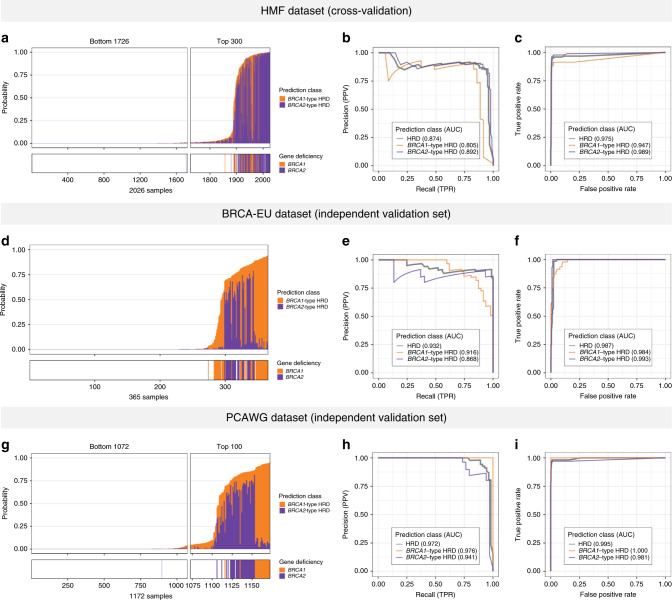
- CHORD achieved high performance in cross-validation (AUROC 0.98, AUPRC 0.87) and in independent BRCA-EU and PCAWG datasets (AUROC >0.98, AUPRC >0.93).
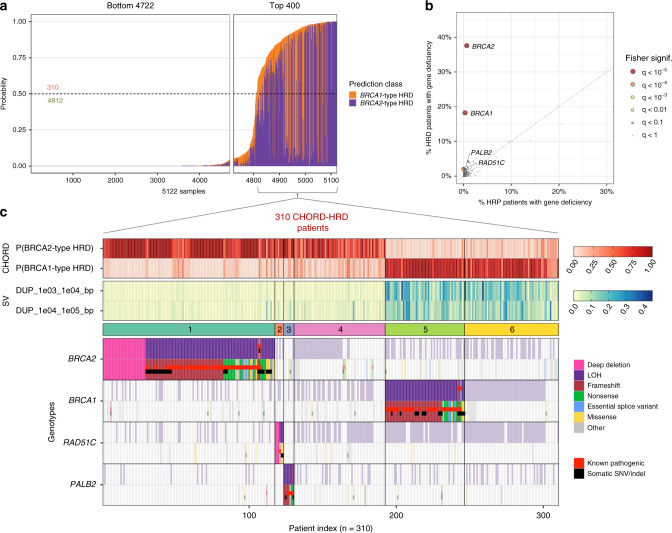
- Among 5,122 patients (3,504 HMF metastatic and 1,618 PCAWG primary), 310 (6%) were CHORD-HRD: 118 BRCA1-type and 192 BRCA2-type; 4,812 were CHORD-HRP.
- Biallelic inactivation was significantly enriched in CHORD-HRD vs CHORD-HRP for BRCA1 (q = 9.4e-51), BRCA2 (q = 4.8e-101), RAD51C (q = 5.6e-5), and PALB2 (q = 0.02); RAD51C and PALB2 inactivation produced BRCA2-type HRD.
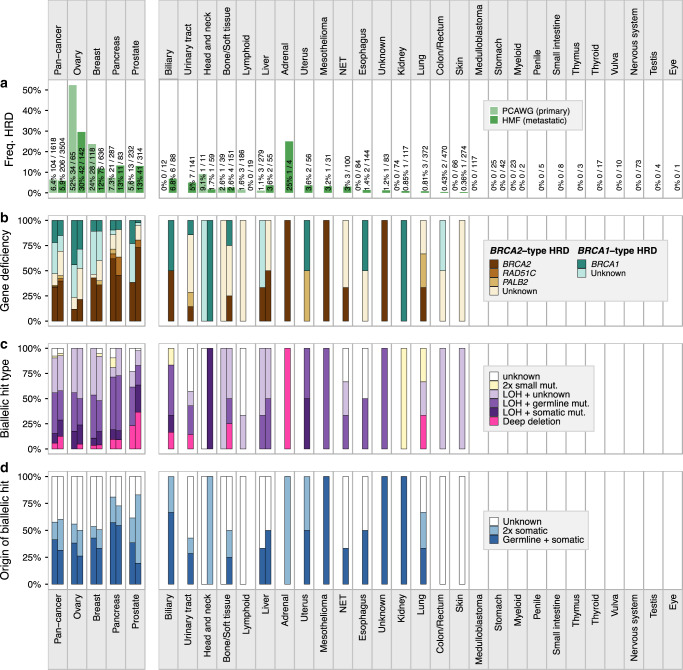
- HRD was most prevalent in ovarian, breast, prostate, and pancreatic cancer (85% combined); primary vs metastatic frequencies were ovarian 52% vs 30%, breast 24% vs 12%, prostate 5.6% vs 13%, and pancreatic 7.3% vs 13%.
Methods
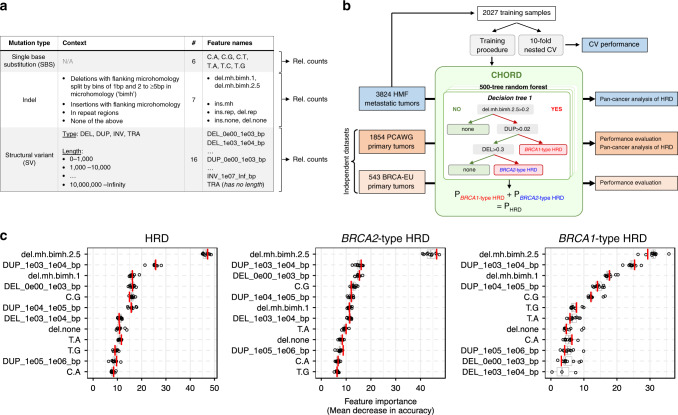
- CHORD is a random forest trained on relative counts of SNV, indel, and structural variant mutation contexts from 3,824 HMF metastatic tumors; 2,026 samples (53%) were used for training, including 35 BRCA1-deficient, 89 BRCA2-deficient, and 1,902 BRCA1/2-proficient samples.
- Performance was assessed by 10-fold nested cross-validation and by application to BRCA-EU (543 primary breast tumors; 365 used for HRDetect) and PCAWG (1,854 primary tumors; 1,172 selected for validation).
- For pan-cancer analysis, CHORD was applied to HMF and PCAWG samples passing QC; genetic causes were assessed by biallelic status of 781 cancer/HR-related genes, Fisher’s exact enrichment tests, and clustering of CHORD-HRD samples.
Limitations
- The paper states that primary vs metastatic HRD rate differences may be confounded by patient inclusion criteria, and that methylation data were unavailable for HMF and PCAWG, preventing direct assessment of promoter methylation as an HRD cause.
- The authors note that mutational scars reflect genomic history rather than ongoing processes, so false-positive CHORD predictions are possible (e.g., HRD reversion, recent HRD acquisition, or radiotherapy-associated microhomology deletions); subclonal predictions should be interpreted cautiously.
- The paper states that variant calling pipeline differences can affect CHORD, additional validation/threshold optimization is recommended for other pipelines, and low numbers of BRCA1/2-deficient samples in some cancer types may make error estimates and HRD frequency underestimates uncertain.
Model-written summary. Check it against the paper before relying on it.
Integrity signals
Registry
Cites
Statistics
Figures
Verification
Claims the paper makes
15 Valid · 7 Not valid · 9 Not checked · 71 Own results and interpretations
At least one cited source doesn’t support this claim or points to a different paper, and none confirmed it — see the verdicts below.
In the paper
“Two recent studies showed that common cancer treatments in general do not induce mutations that may interfere with CHORD predictions16,17.”
§ Pan-cancer landscape of homologous recombination deficiency > Results > Effect of treatment on HRD predictions
What the sources say
- Disputedcites [16] Pich O The mutational footprints of cancer therapies Nat. Genet. 2019 51 1732 1740 10.1038/s41588-019-0525-5 31740835 PMC6887544 sourceExperimental — accuracy not yet measured
The Results section, “The mutational footprints of six anti-cancer therapies,” identifies mutational signatures caused by widely used platinum-based treatments, contrary to the claim that common treatments generally do not induce mutations. The paper does not assess whether treatment-induced mutations interfere with CHORD predictions, so that specific effect cannot be judged from this source. (LLM, conf=0.83)
Checked by a reasoning model — may be wrong.
- Disputedcites [17] Kucab JE A compendium of mutational signatures of environmental agents Cell 2019 177 821 836.e16 10.1016/j.cell.2019.03.001 30982602 PMC6506336 sourceExperimental — accuracy not yet measured
The Results (Insights into Mutational Mechanisms of Platinum Complexes; page unavailable) report substitution and double-substitution signatures from cisplatin and carboplatin, with an indel signature from cisplatin. The Results (Mutational Signatures of Alkylating Agents; page unavailable) also report a mutational signature from temozolomide. Thus, the paper shows that some cancer treatments do induce mutations; it does not assess interference with CHORD predictions. (LLM, conf=0.85)
Checked by a reasoning model — may be wrong.
hedged- Asserted: passes — The authors put it forward as true.
- Checkable: passes — It can be checked against evidence.
- Load-bearing: passes — The paper’s conclusions depend on it.
- Based: passes — The paper gives a reason why it holds.
- Disputed
The cited sources that could be checked couldn’t confirm or dispute this claim.
In the paper
“In addition, the predictions of CHORD and HRDetect on the PCAWG dataset10 were concordant for the vast majority of samples (1506/1526; 99%) (Supplementary Fig. 10).”
§ Pan-cancer landscape of homologous recombination deficiency > Results > Performance of CHORD
What the sources say
- Could not verifycites [10] Degasperi A A practical framework and online tool for mutational signature analyses show intertissue variation and driver dependencies Nat. Cancer 2020 1 249 263 10.1038/s43018-020-0027-5 32118208 PMC7048622 sourceExperimental — accuracy not yet measured
The Methods (Datasets; page unavailable) identify the PCAWG cohort, and the Results (Homologous recombination deficiency across 21 organs; page unavailable) discuss HRDetect predictions. Searches for CHORD and for the 1506/1526 concordance figure found no passage comparing CHORD with HRDetect, so our copy does not verify the claimed 99% agreement. (LLM, conf=0.73)
plainstates an association- Asserted: passes — The authors put it forward as true.
- Checkable: passes — It can be checked against evidence.
- Load-bearing: passes — The paper’s conclusions depend on it.
- Based: passes — The paper gives a reason why it holds.
- Rests on an assumption not shown here.
- Could not verify
The cited sources that could be checked couldn’t confirm or dispute this claim.
In the paper
“We thus conclude that accurate detection of HRD does not require mutational signatures, thereby simplifying HRD calling and avoiding potential complications associated with the fitting step required for computing signature contributions in individual samples (for which there is currently no consensus approach)15.”
§ Pan-cancer landscape of homologous recombination deficiency > Results > Performance of CHORD
What the sources say
- Could not verifycites [15] Maura F A practical guide for mutational signature analysis in hematological malignancies Nat. Commun. 2019 10 1 12 10.1038/s41467-018-07882-8 31278357 PMC6611883 sourceExperimental — accuracy not yet measured
The Introduction and Results discuss photoelectron interference in neon dimers, not detection of homologous recombination deficiency. Searches of our copy for HRD, mutational signatures, and fitting signature contributions found no passage addressing the claim or the citation-attached point about consensus on fitting methods. (LLM, conf=0.79)
boostedn = 8- Asserted: passes — The authors put it forward as true.
- Checkable: passes — It can be checked against evidence.
- Load-bearing: passes — The paper’s conclusions depend on it.
- Based: passes — The paper gives a reason why it holds.
- Rests on an assumption not shown here.
- Could not verify
The cited sources support only part of this claim — read each source’s verdict below.
In the paper
“We note that CHORD performs similarly to HRDetect based on predictions on the BRCA-EU dataset (AUROC = 0.98 for both models)9.”
§ Pan-cancer landscape of homologous recombination deficiency > Results > Performance of CHORD
What the sources say
- Partly supportedcites [9] Davies H HRDetect is a predictor of BRCA1 and BRCA2 deficiency based on mutational signatures Nat. Med. 2017 23 517 525 10.1038/nm.4292 28288110 PMC5833945 sourceExperimental — accuracy not yet measured
The Results and Online Methods report an AUROC of 0.98 for HRDetect on the paper’s breast-cancer cohort (page numbers unavailable). They do not report CHORD predictions or a comparison on a dataset identified as BRCA-EU, so the claim that both models achieved 0.98 there is not supported by this source. (LLM, conf=0.90)
plain- Asserted: passes — The authors put it forward as true.
- Checkable: passes — It can be checked against evidence.
- Load-bearing: passes — The paper’s conclusions depend on it.
- Based: passes — The paper gives a reason why it holds.
- Rests on an assumption not shown here.
- Partly supported
Every source the paper cites for this claim was checked and supports it.
In the paper
“Given that these three genes all belong to the RAD51 paralog complex BCDX223, the BRCA2-type HRD suggests that RAD51B and XRCC2 deficiency could have led to HRD in these patients.”
§ Pan-cancer landscape of homologous recombination deficiency > Results > BRCA2, RAD51C, and PALB2 are associated with BRCA2-type HRD while only BRCA1 is associated with BRCA1-type HRD
What the sources say
- Supportedcites [23] Chun J Buechelmaier ES Powell SN Rad51 paralog complexes BCDX2 and CX3 act at different stages in the BRCA1-BRCA2-dependent homologous recombination pathway Mol. Cell. Biol. 2013 33 387 395 10.1128/MCB.00465-12 23149936 PMC3554112 source
The Abstract (page unavailable) identifies RAD51B and XRCC2 as members of BCDX2 and reports that the complex participates in BRCA2-dependent homologous recombination. Figure 1 (page unavailable) reports HR deficiency after depletion of individual RAD51 paralogs, including RAD51B and XRCC2. The cited paper therefore supports the proposed mechanism; the inference about these particular patients is the citing authors’ own. (LLM, conf=0.91)
hedgedstates a possible causen = 4- Asserted: passes — The authors put it forward as true.
- Checkable: passes — It can be checked against evidence.
- Load-bearing: passes — The paper’s conclusions depend on it.
- Based: passes — The paper gives a reason why it holds.
- Rests on an assumption not shown here.
- Supported
62 more claims · 8 with their cited sources checked
Create a free account to see all 102 claims and to verify the 1 reference still open.
- Probably not a substantial claim. 16
- It may state two separate claims as one. 22
Claims other papers make about this one
Each is checked against this paper’s own text: does it say what the citing paper says it does?
The source backs part of the claim, not all of it — or backs it for a different population, condition or comparison.
In the citing paper
“The encoded Brca1 protein is a component of the homologous recombination repair (HRR) machinery, and BRCA1 is uncommonly mutated in PDAC (~1%), typically in the germline, and associated with HRR defective cancers22,23.”
From Occult polyclonality of preclinical pancreatic cancer models drives in vitro evolution (2022) · cites this paper as [23]
Experimental — accuracy not yet measuredThe cited source says what the claim attributes to it.
In the citing paper
“Defects in HRR can lead to the presence of “genomic scars” caused by the cancer cell’s inability to accurately repair sites of double strand breaks (DSBs).”
From Three-dimensional modelling of ovarian cancer: from cell lines to organoids for discovery and personalized medicine (2022) · cites this paper as Nguyen et al., 2020
Self-check
Percentages, sums and reported differences re-computed from the paper’s own numbers.
Each contradiction between two passages listed here was confirmed by an independent check.
Rated minor: it would not touch a result — a value no result rests on, a p-value that stays on the same side of the significance level, or a conflict that is clerical, resolved elsewhere in the paper, or outside its own findings.
In the paper
§ Pan-cancer landscape of homologous recombination deficiency > Discussion
“but collectively this constitutes a sizable group of patients (15% of all patients).”
§ Pan-cancer landscape of homologous recombination deficiency > Results > The incidence and genetic cause of HRD varies in different tissue types and cancer stage
“HRD was most prevalent in ovarian, breast, prostate and pancreatic cancer (85% combined), and only occurred sporadically in other cancer types (15%)”
Rated minor: it would not touch a result — a value no result rests on, a p-value that stays on the same side of the significance level, or a conflict that is clerical, resolved elsewhere in the paper, or outside its own findings.
In the paper
§ Pan-cancer landscape of homologous recombination deficiency > Methods > Random forest training
“del.mh with 1 bp homology and 2 to ≥5 (i.e. equivalent to ≥5 bp) homology”
§ Pan-cancer landscape of homologous recombination deficiency > Results > Random forest classifier training
“Deletions with 2 to ≥5 bp (i.e. ≥2 bp) of flanking microhomology”
Rated minor: it would not touch a result — a value no result rests on, a p-value that stays on the same side of the significance level, or a conflict that is clerical, resolved elsewhere in the paper, or outside its own findings.
In the paper
§ Pan-cancer landscape of homologous recombination deficiency > Results > BRCA2, RAD51C, and PALB2 are associated with BRCA2-type HRD while only BRCA1 is associated with BRCA1-type HRD
“Of all CHORD-HRD HMF patients, ~60% (184/310)”
§ Pan-cancer landscape of homologous recombination deficiency > Results > BRCA2, RAD51C, and PALB2 are associated with BRCA2-type HRD while only BRCA1 is associated with BRCA1-type HRD
“This yielded a total of 5122 patients (3504 from HMF and 1618 from PCAWG), with 310 (6%) being classified as being homologous recombination deficient (CHORD-HRD).”
Citations
Cites
A method and server for predicting damaging missense mutations.
Adzhubei, I. A., Schmidt, S., Peshkin, L., Ramensky, V. E., Gerasimova, A., Bork, P., Kondrashov, A. S., & Sunyaev, S. R. (2010) · Nature Methods · doi:10.1038/nmeth0410-248 · Cited by 13,194
The mutational constraint spectrum quantified from variation in 141,456 humans
Karczewski, K. J., Francioli, L. C., Tiao, G., Cummings, B. B., Alföldi, J., Wang, Q., Collins, R. L., Laricchia, K. M., Ganna, A., Birnbaum, D. P., et al. (2020) · Nature · doi:10.1038/s41586-020-2308-7 · Cited by 9,434
Double-slit photoelectron interference in strong-field ionization of the neon dimer
Kunitski, M., Eicke, N., Huber, P., Köhler, J., Zeller, S., Voigtsberger, J., Schlott, N., Henrichs, K., Sann, H., Trinter, F., et al. (2019) · Nature Communications · doi:10.1038/s41467-018-07882-8 · Cited by 8,162
Double-slit photoelectron interference in strong-field ionization of the neon dimer
Kunitski, M., Eicke, N., Huber, P., Köhler, J., Zeller, S., Voigtsberger, J., Schlott, N., Henrichs, K., Sann, H., Trinter, F., et al. (2019) · Institutional Repository of Leibniz Universität Hannover (Leibniz Universität Hannover) · doi:10.15488/5174 · Cited by 8,161
Pan-cancer analysis of whole genomes
The ICGC/TCGA Pan-Cancer Analysis of Whole Genomes Consortium, Aaltonen, L. A., Abascal, F., Abeshouse, A., Aburatani, H., Adams, D. J., Agrawal, N., Ahn, K. S., Ahn, S.-M., Aikata, H., et al. (2020) · Nature · doi:10.1038/s41586-020-1969-6 · Cited by 3,064
SMARCAD1 ATPase activity is required to silence endogenous retroviruses in embryonic stem cells
Sachs, P., Ding, D., Bergmaier, P., Lamp, B., Schlagheck, C., Finkernagel, F., Nist, A., Stiewe, T., & Mermoud, J. E. (2019) · Nature Communications · doi:10.1038/s41467-019-09078-0 · Cited by 2,384
D’Hulst, G., Soro-Arnaiz, I., Masschelein, E., Veys, K., Fitzgerald, G., Smeuninx, B., Kim, S., Deldicque, L., Blaauw, B., Carmeliet, P., et al. (2020) · Nature Communications · doi:10.1038/s41467-019-13889-6 · Cited by 2,310
Maintenance Olaparib for Germline BRCA -Mutated Metastatic Pancreatic Cancer
Golan, T., Hammel, P., Reni, M., Van Cutsem, E., Macarulla, T., Hall, M. J., Park, J.-O., Hochhauser, D., Arnold, D., Oh, D.-Y., et al. (2019) · New England Journal of Medicine · doi:10.1056/nejmoa1903387 · Cited by 2,302
Audeh, M. W., Carmichael, J., Penson, R. T., Friedlander, M., Powell, B., Bell-McGuinn, K. M., Scott, C., Weitzel, J. N., Oaknin, A., Loman, N., et al. (2010) · The Lancet · doi:10.1016/s0140-6736(10)60893-8 · Cited by 2,279 · cited 1×
“Accurate detection of HR deficiency (HRD) is of clinical relevance as it is indicative of sensitivity to targeted therapy with poly ADP-ribose polymerase inhibitors (PARPi)[3, 4] as well as to DNA damaging reagents[1].”
BackgroundLandscape of somatic mutations in 560 breast cancer whole-genome sequences
Nik-Zainal, S., Davies, H., Staaf, J., Ramakrishna, M., Glodzik, D., Zou, X., Martincorena, I., Alexandrov, L. B., Martin, S., Wedge, D. C., et al. (2016) · Nature · doi:10.1038/nature17676 · Cited by 2,218 · cited 3×
“In the second approach, performance was evaluated on two independent datasets: the BRCA-EU dataset[8] (543 primary breast tumors) and the PCAWG dataset[14] (1,854 primary tumors, pancancer).”
BackgroundMethod
Cited by
Items 501–548 of 548
Lee, J. J., Kang, H. J., Kim, D., Lim, S. O., Kim, S. S., Kim, G., Kim, S., Lee, J.-K., & KIM, J. (2024) · Figshare · doi:10.6084/m9.figshare.26748635
Mutation patterns and prognostic potentiality of homologous recombination repair genes in gliomas
Bai, H., Liu, Y., Cheng, J., Zhang, Q., Luo, N., Zhang, X., & Zheng, Z. (2025) · BMC Cancer · doi:10.1186/s12885-025-15314-2
“Homologous recombination repair (HRR) is a vital pathway for repairing double-stranded DNA breaks [4].”
Iyevleva, A. G., Алексахина, С. Н., Соколенко, А. П., Отраднова, Е. А., Кулигина, Е. Ш., & Имянитов, Е. Н. (2025) · Voprosy Onkologii · doi:10.37469/0507-3758-2025-71-6-of-2326
Terpstra, H. M., Fülleborn, J. A., Kamenz, J., & Heinemann, M. (2026) · bioRxiv (Cold Spring Harbor Laboratory) · doi:10.64898/2026.01.22.701002
Ciarmoli, B., & Marbach, S. (2026) · The European Physical Journal E · doi:10.1140/epje/s10189-026-00616-5
Ge, Y., He, Y. Y., Yu, S., Gao, H., & Sun, P.-L. (2026) · Journal of Gynecologic Oncology · doi:10.3802/jgo.2026.37.e73
“BRCA1/2 mutations constitute the most extensively characterized cause of HRD [4], which exhibits high prevalence in HGSC compared to other malignancies [5].”
Zhou, Y., Cui, Y., Zhang, W. Q., Li, T., & Tong, A. Y. (2026) · Endocrine Related Cancer · doi:10.1530/erc-25-0301
Ribeiro, J. F., Steirnagel, A. V., Oliva, R. A., Betine, I. M., Aguiar, J. J., Chagas, L. G., Camargo, E., Dantas, L. D. S., Orso, N. C. D. S., Ferreira, J. M. G., et al. (2026) · Scripta Scientia · doi:10.66201/ss.v1.15
Genomic characterisation of rare thoracic tumours
Mangiante, L. (2021) · theses.fr (ABES) · doi:10.70675/d6df06b5zf45cz4546z9617z7ff4186a0a50
Exploitation du défaut de réparation de l'ADN à l'aide de la stratégie d'inhibition de CDK
Orhan, E. (2022) · theses.fr (ABES) · doi:10.70675/40065dd4z1f5bz4361zaa67z59acc4e5d6c2
DNA damage-induced nuclear envelope rupture : A new cancer vulnerability
Kovacs, M. (2023) · theses.fr (ABES) · doi:10.70675/fcbf63f9z5dc9z40e6z888cz9c26ac6e9766
Valenzuela, J. C., Matis, T., Roca, C., Flores, J. L. C., Hamel, N., Rivera, B., Gravel, S., Polak, P. P., Robles‐Espinoza, C. D., & Foulkes, W. D. (2026) · BJC Reports · doi:10.1038/s44276-026-00218-w
Mulder, F. I., Guman, N. A. M., van Riet, J., van Geffen, R. J., van Haaps, T. F., Hovsepjan, V., van Laarhoven, H. W. M., Cirkel, G. A., Vos, F. D., Westgeest, H. M., et al. (2026) · Circulation Genomic and Precision Medicine · doi:10.1161/circgen.124.005182
The impact of CHEK2 status on radiosurgical outcomes in breast cancer brain metastases
Harary, P. M., Hori, Y. S., Kattaa, A. H., Tan, S. K., Lam, F. C., Kalra, N., Zagzoog, N., Tayag, A. T., Ustrzynski, L., Emrich, S. C., et al. (2026) · Neurosurgical Review · doi:10.1007/s10143-026-04272-3
Du, J., Duan, C., Zhang, J., Zhou, Y., Wang, Y., Zhu, L., Li, J., Zhang, J., Pan, Y., Li, D., et al. (2026) · Clinical Breast Cancer · doi:10.1016/j.clbc.2026.04.014
Ozmen, T. Y., Frankston, C. M., Rames, M. J., Ozmen, F., Yardımcı, G. G., & Mills, G. B. (2026) · Expert Review of Clinical Pharmacology · doi:10.1080/17512433.2026.2665447
“Notably, DNA scar assays show HRD positivity in approximately 52% of ovarian, 24% of breast, 5.6% of prostate and 7.3% of pancreatic primary cancer tumors [45], suggesting that HRD may be more frequent than predicted by mutational analyses alone.”
InfluentialMarco, C. D., Rocca, V., Migliozzi, S., Veneziano, C., Gualtieri, F., Cerantonio, A., Butt, T. A., Santamaria, G., Angelis, M. T. D., Cello, A. D., et al. (2026) · Cancers · doi:10.3390/cancers18091390
“In ovarian cancer, this plasticity has been linked to stem-like states and poor response to platinum therapy [68,69], supporting the relevance of our findings.”
Wang, Z., Jiang, N., Guo, R., Li, X., Wei, Y., & Yang, S. (2026) · Scientific Reports · doi:10.1038/s41598-026-52094-6
“…(SNP) arrays or next generation sequencing (NGS) methods, including targeted panels like MyChoice CDx (Myriad Genetics Laboratories, Inc., Salt Lake City, UT) and FoundationOne CDx (Foundation Medicine, Inc., Cambridge, MA), shallow WGS 17 , and whole-genome sequencing (HRDetect, CHORD) 18,19 .”
DNA Damage Repair Pathways and Targeted Therapy for Doxorubicin-Resistant Breast Cancer
Wu, Y., Li, X., Wang, W., Liu, S., & Li, X. (2026) · Frontiers in Bioscience-Landmark · doi:10.31083/fbl47143
Maciaszek, J. L., Loyola, V. P., Cain, T., Cardenas, M. F., Blackburn, P. R., Wilkinson, M. R., Koo, S. C., Wu, C.-H., Li, C., Wang, L., et al. (2026) · medRxiv · doi:10.64898/2026.06.07.26354365
Targeting HORMAD1 splicing enhances MEK inhibitor sensitivity in breast cancers
Sun, C., Luo, H., & Zhang, J. (2026) · RNA · doi:10.1261/rna.081080.126
Homologous recombination pathway alterations in basal-like breast cancer
Aho, S., Guyot, B., & Maguer‐Satta, V. (2026) · Frontiers in Oncology · doi:10.3389/fonc.2026.1772663
Clofibrate downregulates DNA damage response proteins via the MELK-AKT-mTOR axis in breast cancer
Chen, H., Yang, W., Ying, Z., Li, A., Yang, X., Liu, Y., & Chen, S. (2026) · Scientific Reports · doi:10.1038/s41598-026-59162-x
“BRCA1/2 are key proteins encoding HRD, and previous studies have found that individuals carrying germline harmful mutations in BRCA1/2 can lead to HRD, which significantly increases their risk of developing BC 27 .”
Nacer, D. F., Veerla, S., Sasiain, I., Häkkinen, J., Vallon‐Christersson, J., Rossing, M., Nik‐Zainal, S., Edsjö, A., & Staaf, J. (2026) · Breast Cancer Research · doi:10.1186/s13058-026-02325-5
“Other HRD classification methods more reliant on large-scale sequencing data include CHORD (Classifier of HOmologous Recombination Deficiency) [22], HRDetect [6], and more [23–25].”
InfluentialReplication fork directionality reveals how structural variants arise under replication stressPreprint
Głodzik, D., Rigby, M., Andreopoulos, M., Crawford, J., Ehmsen, S. R., Tapinos, A., Cornish, A., Houlston, R. S., Wedge, D. C., Scully, R., et al. (2026) · bioRxiv (Cold Spring Harbor Laboratory) · doi:10.64898/2026.06.29.735381
Соколенко, А. П., Yanus, G. A., Цуцаев, А. К., Epkhiev, A. A., Станиславовна, Х. М., Salamova, A. S., Bolieva, M. B., Велюхова, Т. Ю., Romanko, A. A., Белышева, Я. В., et al. (2026) · Voprosy Onkologii · doi:10.37469/0507-3758-2026-72-3-of-2664
“Ген RAD51C кодирует белок-участник гомо-логичной рекомбинации — высокоточного меха-низма репарации ДНК, который часто поврежда-ется в серозных карциномах яичника и трижды негативных карциномах молочной железы [23].”
Harnessing tumor-agnostic biomarkers for precision medicine in lymphoma
Lee, Y., Lim, N.-A., Kwan, R. L. Y., & Chan, J. H. (2026) · Cancer Treatment and Research Communications · doi:10.1016/j.ctarc.2026.101312 · Cited by 1
Slootbeek, P. H. J., Quint, Y. M., Kokke, J. J. R., Naga, S. P., Velez, M. V. L., Ligtenberg, M. J. L., de Voer, R. M., & Mehra, N. (2026) · JCO Precision Oncology · doi:10.1200/po-26-00065
Wang, T., Zhang, X., Yan, X., Wang, G. Y., & Zhao, L. (2026) · Cell Communication and Signaling · doi:10.1186/s12964-026-03047-z
“In TCGA-COAD samples, CD55 expression negatively correlated with both HRD scores ( R = − 0.30) and LOH scores ( R = − 0.33), suggesting that CD55-high tumors tend to maintain genomic stability through proficient HR [30].”
InfluentialDong, M., Hua, J., Zc, M., Tang, R., Wei, M., Lv, Z., Liu, Y., Chen, K., Du, Q., Wang, W., et al. (2026) · Cancer Medicine · doi:10.1002/cam4.72083
Agarwal, N., Sharma, G., Sharma, A. R., Gupta, V. K., Guo, Y., Jha, A. K., & Kim, J. (2026) · Current Oncology Reports · doi:10.1007/s11912-026-01808-0
“HNC lacks a clear predictor, such as HRD scores, that can accurately predict how effectively DDR inhibitors will work, as do BRCA-mutated breast or ovarian malignancies [127–130 ].”
Goossens, S., Tepeli, Y. I., Seale, C., & Gonçalves, J. P. (2026) · NAR Genomics and Bioinformatics · doi:10.1093/nargab/lqag078 · Cited by 1
“It has been suggested that there could be two types of HRd, BRCA1 –HRd and BRCA2 –HRd, resulting in distinct mutational patterns [ 25 ].”
Hosseini, S. F., Karimi, A. H., Karimi, M. R., Schmitz, U., & Sadeghi, M. (2026) · Human Gene · doi:10.1016/j.humgen.2026.201602
Suryavanshi, M., Mehta, P., Kumar, M., Bhagmar, S., Kapoor, V., Kumar, D., Mishra, S., & Chauhan, B. (2026) · ecancermedicalscience · doi:10.3332/ecancer.2026.2204
Kim, Y. J., Baek, I.-P., Eom, B. W., Seo, M., Joo, H., Choi, Y. R., Park, M. K., Oh, J., Lee, B., Ham, S. M., et al. (2026) · Experimental & Molecular Medicine · doi:10.1038/s12276-026-01846-5
Liquid biopsy: a new window on the BRCA genes
Incorvaia, L., Gristina, V., Pepe, F., Russo, T. D. B., Santoni, M., Mujacic, C., Curigliano, G., Malapelle, U., Capoluongo, E. D., & Russo, A. D. (2026) · ESMO Open · doi:10.1016/j.esmoop.2026.108349
“7,8 The BRCA1/2 PVs remain key biomarkers of PARPi efficacy, highlighting the important role of BRCA status and homologous recombination (HR) competency to guide treatment selection.”
Transgenerational chromosome repair in the asexual bdelloid rotifer Adineta vaga
Houtain, A., Llirós, M., Hespeels, B., Nicolas, É., Simion, P., Virgo, J., Heuskin, A., Lenormand, T., Hallet, B., & Doninck, K. V. (2026) · Science Advances · doi:10.1126/sciadv.aee0891 · Cited by 1
Qu, S., Smid, M., Martens, J. W. M., & Hollestelle, A. (2026) · Scientific Reports · doi:10.1038/s41598-026-67158-w
“In fact, several classifiers based on these and other recurrent genomic characteristics have been developed, most prominently HRDetect and CHORD, which are able to identify HR-deficient tumors 15,16 .”
Song, Z., Zhang, Q., Zhang, W., Ta, N., Zhu, Y., Deng, L., Wu, H., Zhu, L., Yanan, G., Li, Y., et al. (2026) · The Innovation Oncology · doi:10.59717/j.xinn-oncol.2026.100043
Diagnostic and therapeutic impact of genomic testing in neuroendocrine neoplasms
Boehm, E., Flynn, A., Nip, W. F., Varghese, L. N., Nicolson, S., Balachander, S., Mitchell, C. B., Chan, T., Zhu, W. (., Rebello, R. J., et al. (2026) · Endocrine Related Cancer · doi:10.1530/erc-26-0225
Breast cancer immunogenicity as a spectrum: evolving concepts and therapeutic implications
Kay, J., Dixon-Douglas, J. R., Harris, M. A., van Geelen, C. T., & Loi, S. (2026) · Journal of Clinical Investigation · doi:10.1172/jci207634
Walmsley, C. S., Rodriguez, A., Konstantinopoulos, P. A., Shapiro, G. I., Tolaney, S. M., Garber, J. E., & Lynce, F. C. (2026) · Journal of Clinical Investigation · doi:10.1172/jci207632
Immunologic Consequences of Genomic Instabilities
Alouani, E. L., Fumet, J.-D., Johannet, P. M., Marabelle, A., & Rousseau, B. (2026) · Cancer Discovery · doi:10.1158/2159-8290.cd-25-2063
Basudan, A., Alshuweishi, Y., AlSudais, H., & Alfhili, M. A. (2026) · Biomedicines · doi:10.3390/biomedicines14102231
“Although pathogenic alterations in BRCA1 and BRCA2 are among the best-established causes of HRD, disruption of other components of the HR machinery can also impair HR repair [5].”
Erdoğdu, S., Ekinci, B., Örenay-Boyacıoğlu, S., Boyacıoğlu, O., Erdoğdu, İ. H., & Meteoğlu, İ. (2026) · International Journal of Molecular Sciences · doi:10.3390/ijms27198851
“…and mutational-signature approaches that use genome-wide features and specialized computational classifiers to identify functional BRCA1 - or BRCA2 -type HRD patterns [3,6], the present study focused on the individual components already generated by a conventional composite HRD assay [2,7,8].”
InfluentialGlobal signatures of Ribonucleotide Excision Repair deficiency and its therapeutic vulnerabilitiesPreprint
Toong, P. J., Boushaki, S., Zhao, S. J., Brough, R., Song, F., Krastev, D. B., Black, D., Rinaldi, G., Badja, C., Degasperi, A., et al. (2026) · bioRxiv (Cold Spring Harbor Laboratory) · doi:10.64898/2026.10.09.757935
“…encompassing SBS3, InD4c, and a distinct SV signature overlaps substantially with that of HRD, creating a dual problem: existing classifiers ( 18, 19 ) such as HRDetect ( 20 ) and HRProfiler ( 21 ) misclassify RER-deficient tumors as HR-deficient, while some RER-deficient tumors remain…”
Viveros-Carreño, D. A., Mora‐Soto, N., Beshar, I., Agustí, N., Garcia, R., Rauh-Hain, A., & Pareja, R. (2026) · International Journal of Gynecological Cancer · doi:10.1016/j.ijgc.2026.105667
Deng, Z., Jin, T., Mingwei, L., Guo, J., Sun, Y., Yongkun, Y., Zhang, Q., Qin, J., Lou, F., Cao, S., et al. (2026) · Therapeutic Advances in Medical Oncology · doi:10.1177/17588359261494096
Metadata
- Authors
- Nguyen, L., W. M. Martens, J., Van Hoeck, A., & Cuppen, E.
- Affiliations
- University Medical Center Utrecht (NL)
- Corresponding author
- Cuppen, Edwin
- Venue
- Nature communications
- Published
- 2020-11-04
- Volume
- 11
- Issue
- 1
- Pages
- 5584-5584
- ISSN
- 2041-1723 (ISSN-L)
- PMC
- PMC7643118
- OpenAlex
- W3095003868
- Semantic Scholar
- 34fe49f6ed41a1bb70d4cc73adf42da1d05378b3
- Cited by
- 532
- References
- 48
- Citations by year
- 2026: 58 · 2025: 99 · 2024: 101 · 2023: 100 · 2022: 108 · 2021: 63 · 2020: 3
- FWCI
- 43.20
- Type
- journal article
- Language
- en
- Open access
- gold
- doi.org
- Licence
- cc-by
- creativecommons.org/licenses/by/4.0 (tdm)
- creativecommons.org/licenses/by/4.0 (vor)
- Locations
- Nature Communications (publishedVersion, cc-by)
- bioRxiv (Cold Spring Harbor Laboratory) (acceptedVersion, cc-by-nc)
- PubMed Central (publishedVersion, cc-by)
- PubMed (publishedVersion)
- EUR Research Repository (Erasmus University Rotterdam) (publishedVersion, other-oa)
- EUR Research Repository (Erasmus University Rotterdam) (submittedVersion, other-oa)
- RePub (Erasmus University Rotterdam) (submittedVersion, other-oa)
- RePEc: Research Papers in Economics (submittedVersion)
- DOAJ (DOAJ: Directory of Open Access Journals) (submittedVersion, cc-by-sa)
- Utrecht University Repository (Utrecht University) (submittedVersion, other-oa)
- Funders
- Nederlandse Organisatie voor Wetenschappelijk Onderzoek (024.001.028)
- Topics
- Life Sciences › Biochemistry, Genetics and Molecular Biology › Genetics › BRCA gene mutations in cancer
- Life Sciences › Biochemistry, Genetics and Molecular Biology › Cancer Research › Cancer Genomics and Diagnostics
- Health Sciences › Medicine › Oncology › PARP inhibition in cancer therapy
- Keywords
- homologous recombination deficiency, pan-cancer, BRCA1, BRCA2, RAD51C, PALB2, biallelic inactivation, loss of heterozygosity, DNA double-strand break repair, ovarian cancer, breast cancer, prostate cancer, pancreatic cancer, PARP inhibitors, patient stratification, metastatic cancer
- MeSH terms
- Fanconi Anemia Complementation Group N Protein, Alleles, Breast Neoplasms, DNA-Binding Proteins, Female, Multigene Family, Humans, Male, Mutation, Ovarian Neoplasms, Pancreatic Neoplasms, Prostatic Neoplasms, Incidence, BRCA1 Protein, Loss of Heterozygosity, Genomics, BRCA2 Protein, Databases, Genetic, Homologous Recombination
About these checks
Registry, retraction, Cites and statistics results are computed, not judged, with one exception: a printed reference that no index lists is read once by a model before it counts as a citation error. Claims are extracted by a model and kept only when their quote appears verbatim in the text; each cited source is then checked, with a model’s help, for whether it says what the claim relies on. Those verdicts can be wrong — read the claim’s quote and the cited source before relying on one.
The claim verdicts this report counts are experimental: their accuracy is not yet measured.
A language model drew the claims from the paper on 2026-10-10, under version 3 of the claim definition (model deepseek-v4.1-flash, prompt extract-v3).
A second model labelled each claim on 2026-10-10 (model jev-1.13-20260917, definition revision gold-guideline-v0.2).
Cited sources are checked with a language model’s help (gpt-6-sol).
Statistics and arithmetic are recomputed, not judged.
Confidence bands are shown only for fields calibrated on our annotated test set. None is calibrated yet, so no band is shown.
What counts as a claim ›How we measure confidence ›How we check this ›
Are you an author, or do you see a problem with this page? Request a review
Data sources
Bibliographic data: Semantic Scholar, OpenAlex, Crossref.
Contains information from the Semantic Scholar Academic Graph Datasets, made available under the ODC Attribution License (ODC-BY 1.0).
Semantic Scholar’s data is described in: Kinney, R., et al. (2023). The Semantic Scholar Open Data Platform. arXiv:2301.10140.
