

Net decrease in spine-surface GluA1-containing AMPA receptors after post-learning sleep in the adult mouse cortex
Open accessThe DOI matches its Crossref record; 70 of the 70 references it cites were found in a registry or an index.
Abstract
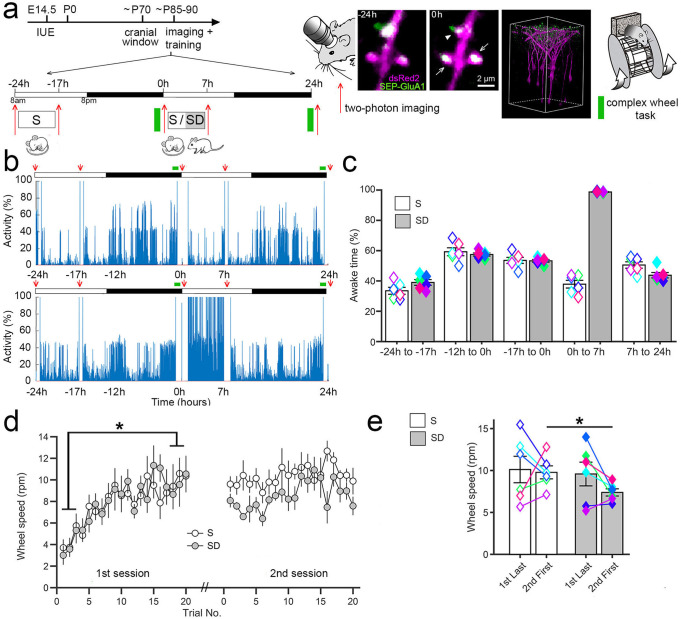
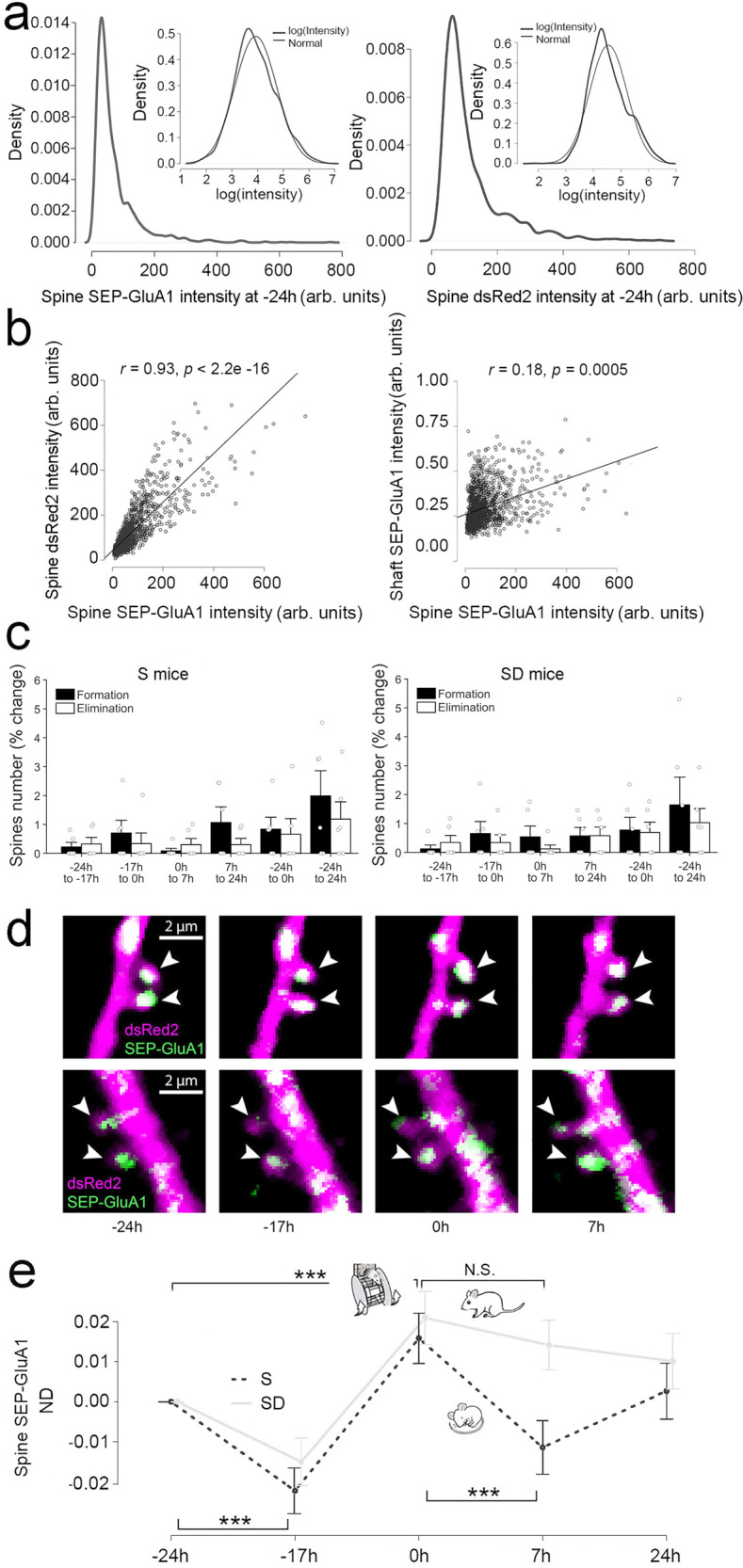
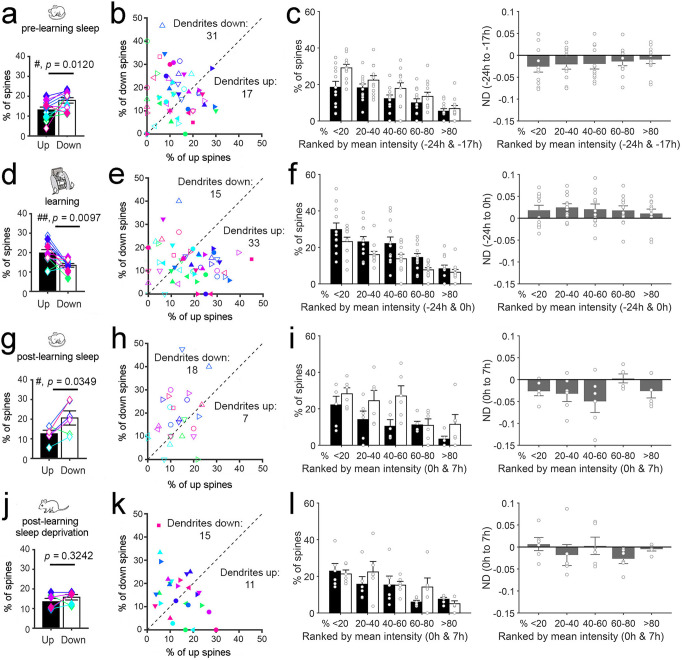
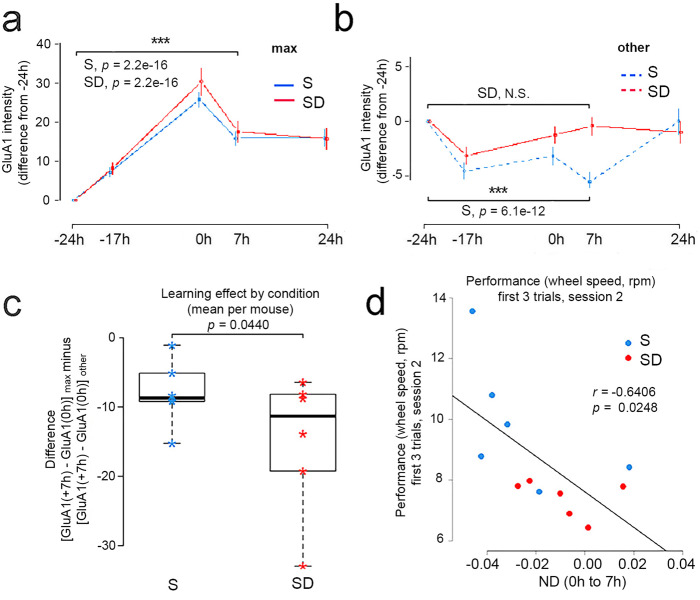
The mechanisms by which sleep benefits learning and memory remain unclear. Sleep may further strengthen the synapses potentiated by learning or promote broad synaptic weakening while protecting the newly potentiated synapses. We tested these ideas by combining a motor task whose consolidation is sleep-dependent, a marker of synaptic AMPA receptor plasticity, and repeated two-photon imaging to track hundreds of spines in vivo with single spine resolution. In mouse motor cortex, sleep leads to an overall net decrease in spine-surface GluA1-containing AMPA receptors, both before and after learning. Molecular changes in single spines during post-learning sleep are correlated with changes in performance after sleep. The spines in which learning leads to the largest increase in GluA1 expression have a relative advantage after post-learning sleep compared to sleep deprivation, because sleep weakens all remaining spines. These results are obtained in adult mice, showing that sleep-dependent synaptic down-selection also benefits the mature brain.
Overview
The claims and statistics of this paper haven’t been checked yet.
Free: it reads the open-access text and checks the first 5 claims that cite a source we can check. Create a free account to check every claim.
Integrity signals
Registry
Cites
Statistics
Figures
Verification
Claims the paper makes
The claims and statistics of this paper haven’t been checked yet.
Free: it reads the open-access text and checks the first 5 claims that cite a source we can check. Create a free account to check every claim.
Claims other papers make about this one
Each is checked against this paper’s own text: does it say what the citing paper says it does?
The source backs part of the claim, not all of it — or backs it for a different population, condition or comparison.
In the citing paper
“Spine-surface expression of GluA1 as well as average spine size, but not spine density, increased after training, and this increase was globally reduced during subsequent sleep, but not when the animals remained awake in the post-training interval.”
From Sleep—A brain-state serving systems memory consolidation (2023) · cites this paper as [165]
Experimental — accuracy not yet measuredThe source backs part of the claim, not all of it — or backs it for a different population, condition or comparison.
In the citing paper
“Interestingly, beyond evidencing the co-occurrence of differential synaptic scaling during sleep at global and local levels, the findings overall point to a compartmentalized response in this regulation.”
From Sleep—A brain-state serving systems memory consolidation (2023) · cites this paper as [165]
Experimental — accuracy not yet measuredThe source backs part of the claim, not all of it — or backs it for a different population, condition or comparison.
In the citing paper
“(D)Synaptic AMPA receptor density increases during learning and is globally reduced during subsequent sleep.”
From Sleep—A brain-state serving systems memory consolidation (2023) · cites this paper as [165]
Experimental — accuracy not yet measuredThe source backs part of the claim, not all of it — or backs it for a different population, condition or comparison.
In the citing paper
“Downscaling includes the synapses that were upscaled during learning, although to a lesser extent.165”
From Sleep—A brain-state serving systems memory consolidation (2023) · cites this paper as [165]
Experimental — accuracy not yet measuredThe cited source says what the claim attributes to it.
In the citing paper
“Importantly, this comparison revealed that the max spines-although also undergoing some downscaling-kept a relatively higher GLuA1 expression after sleep than after a post-training period of wakefulness.”
From Sleep—A brain-state serving systems memory consolidation (2023) · cites this paper as [165]
1 more claim about this paper
Create a free account to see every claim other papers make about this one.
Self-check
Percentages, sums and reported differences re-computed from the paper’s own numbers.
The self-check needs the paper’s full text.
Citations
Cites
Fitting Linear Mixed-Effects Models Using lme4
Bates, D., Mächler, M., Bolker, B., & Walker, S. (2015) · Journal of Statistical Software · doi:10.18637/jss.v067.i01 · Cited by 86,835
Fiji: an open-source platform for biological-image analysis
Schindelin, J., Arganda-Carreras, I., Frise, E., Kaynig, V., Longair, M., Pietzsch, T., Preibisch, S., Rueden, C., Saalfeld, S., Schmid, B., et al. (2012) · Nature Methods · doi:10.1038/nmeth.2019 · Cited by 66,890
Random-Effects Models for Longitudinal Data
Laird, N. M., & Ware, J. H. (1982) · Biometrics · doi:10.2307/2529876 · Cited by 8,923
Rasch, B., & Born, J. (2013) · Physiological Reviews · doi:10.1152/physrev.00032.2012 · Cited by 2,783
Visualizing secretion and synaptic transmission with pH-sensitive green fluorescent proteins
Miesenböck, G., De Angelis, D. A., & Rothman, J. E. (1998) · Nature · doi:10.1038/28190 · Cited by 2,563
Tononi, G., & Cirelli, C. (2014) · Neuron · doi:10.1016/j.neuron.2013.12.025 · Cited by 2,356
Self-citationNeurocognitive consequences of sleep deprivation
Goel, N., Rao, H., Durmer, J., & Dinges, D. (2009) · Seminars in Neurology · doi:10.1055/s-0029-1237117 · Cited by 2,154
Sleep function and synaptic homeostasis
Tononi, G., & Cirelli, C. (2006) · Sleep Medicine Reviews · doi:10.1016/j.smrv.2005.05.002 · Cited by 2,151
Self-citationExperience-dependent structural synaptic plasticity in the mammalian brain
Holtmaat, A., & Svoboda, K. (2009) · Nature Reviews Neuroscience · doi:10.1038/nrn2699 · Cited by 1,934
Bretz, F., Hothorn, T., & Westfall, P. (2016) · doi:10.1201/9781420010909 · Cited by 1,233
Cited by
Sleep—A brain-state serving systems memory consolidation
Brodt, S., Inostroza, M., Niethard, N., & Born, J. (2023) · Neuron · doi:10.1016/j.neuron.2023.03.005 · Cited by 343
Neural consequences of chronic sleep disruption
Zamore, Z. H., & Veasey, S. C. (2022) · Trends in Neurosciences · doi:10.1016/j.tins.2022.05.007 · Cited by 117
Salehinejad, M. A., Ghanavati, E., Reinders, J., Hengstler, J. G., Kuo, M.-F., & Nitsche, M. A. (2022) · eLife · doi:10.7554/elife.69308 · Cited by 94
“Sleep, on the other hand, desaturates synapses that have been potentiated during wakefulness in mice (Vyazovskiy et al., 2008; Miyamoto et al., 2021) resulting in a renewed capacity for encoding new information.”
BackgroundVisualizing synaptic plasticity in vivo by large-scale imaging of endogenous AMPA receptors
Graves, A. R., Roth, R. H., Tan, H. L., Zhu, Q., Bygrave, A. M., Lopez-Ortega, E., Hong, I., Spiegel, A. C., Johnson, R. C., Vogelstein, J. T., et al. (2021) · eLife · doi:10.7554/elife.66809 · Cited by 84
Cortico-basal ganglia plasticity in motor learning
Roth, R. H., & Ding, J. (2024) · Neuron · doi:10.1016/j.neuron.2024.06.014 · Cited by 127
“…motor cortex no 50 Yang et al., 51 Hayashi-Takagi et al., 52 and Yang et al. 53 Complex wheel freely moving McKenzie et al. 54 and Miyamoto et al. 55 Split treadmill freely moving Darmohray et al. 56 Head-fixed locomotion head-fixed Yang et al., 53 Adler et al., 57 Cichon and Gan, 58 and Ma et al.…”
Overnight neuronal plasticity and adaptation to emotional distress
Cabrera, Y., Koymans, K. J., Poe, G. R., Kessels, H. W. H. G., Someren, E. J. W. V., & Wassing, R. (2024) · Nature reviews. Neuroscience · doi:10.1038/s41583-024-00799-w · Cited by 72
“In support of active sleep-dependent plasticity, spines that gain high levels of GluA1 after learning a new task also retain most of their GluA1 after sleep, indicating selective maintenance of the expression of LTP across sleep at these synapses 154 .”
Sleep pressure modulates single-neuron synapse number in zebrafish
Suppermpool, A., Lyons, D. G., Broom, E. L., & Rihel, J. (2024) · Nature · doi:10.1038/s41586-024-07367-3 · Cited by 59
“The statement that neurons lose synapses only when sleep pressure is high (e.g. line 153) should be clarified; as it stands, it could be interpreted as if synapse loss only occurs during recovery sleep after sleep deprivation, which is clearly not the case because it happens also in controls.”
Coupling between motor cortex and striatum increases during sleep over long-term skill learning
Lemke, S. M., Ramanathan, D., Darevksy, D., Egert, D., Berke, J. D., & Ganguly, K. (2021) · eLife · doi:10.7554/elife.64303 · Cited by 56
“Such general downscaling can support memory consolidation indirectly by increasing the signal-to-noise of memory representations encoded during wake (Rasch and Born, 2013; Miyamoto et al., 2021).”
BackgroundSleep’s contribution to memory formation
Lutz, N. D., Harkotte, M., & Born, J. (2025) · Physiological Reviews · doi:10.1152/physrev.00054.2024 · Cited by 59
Vorster, A. P. A., Someren, E. J. W. V., Pack, A. I., Huber, R., Schmidt, M. H., & Bassetti, C. L. (2024) · Clinical and Translational Neuroscience · doi:10.3390/ctn8010008 · Cited by 53
“During learning, synaptic AMPA receptor density increases, while during subsequent sleep, synaptic AMPA receptor density is globally reduced [15].”
BackgroundThe Primary Motor Cortex: The Hub of Motor Learning in Rodents
Lee, C., Kim, Y.-J., & Kaang, B. (2022) · Neuroscience · doi:10.1016/j.neuroscience.2022.01.009 · Cited by 48
“Such behavioral paradigm is not only used for the acquisition of certain motor skills, but also for the assessment of motor illnesses (Hamm et al., 1994; Mizoguchi et al., 2002).”
BackgroundMethodLinking activity dyshomeostasis and sleep disturbances in Alzheimer disease
Slutsky, I. (2024) · Nature reviews. Neuroscience · doi:10.1038/s41583-024-00797-y · Cited by 47
“Weakening and loss of excitatory synapses may be a natural mechanism of homeostatic plasticity induced by sleep 141 , reflected in structural and functional synaptic changes 180–183 .”
Understanding neuron-glia crosstalk and biological clocks in insomnia
Carvalhas-Almeida, C., Serra, J., Moita, J. J., Cavadas, C., & Álvaro, A. R. (2023) · Neuroscience & Biobehavioral Reviews · doi:10.1016/j.neubiorev.2023.105100 · Cited by 43
Liu, J., Niethard, N., Yu, L., Dimitrov, S., Ehrlich, I., Born, J., & Hallschmid, M. (2024) · PLoS Biology · doi:10.1371/journal.pbio.3002768 · Cited by 27
“Supporting SHY, wake-related increases and sleep-related decreases in AMPAR levels have been shown in previous studies in neocortical as well as hippocampal networks [8–10 ,28, 29].”
Hacking the functions of sleep: noninvasive approaches to stimulate sleep neurophysiology
Krugliakova, E., Breuer, F., Adelhöfer, N., Alonso, A., Besedovsky, L., Murphy, K. R., Peters, E., Raczek, K., Rasch, B., Salvesen, L., et al. (2025) · Physiological Reviews · doi:10.1152/physrev.00007.2025 · Cited by 23
Offline neuronal activity and synaptic plasticity during sleep and memory consolidation
Goto, A., & Hayashi, Y. (2022) · Neuroscience Research · doi:10.1016/j.neures.2022.12.021 · Cited by 23
“Further evidence comes from in vivo time-lapse imaging studies which demonstrate a downscaling of spine morphology in motor cortex during sleep after motor learning (Miyamoto et al., 2021).”
BackgroundEvidence that Alzheimer’s Disease Is a Disease of Competitive Synaptic Plasticity Gone Awry
Huang, Z. (2024) · Journal of Alzheimer s Disease · doi:10.3233/jad-240042 · Cited by 21
Kim, D., Park, P., Li, X., Wong-Campos, J. D., Tian, H., Moult, E. M., Grimm, J. B., Lavis, L. D., & Cohen, A. E. (2025) · Nature Neuroscience · doi:10.1038/s41593-025-01922-5 · Cited by 23
Diering, G. H. (2022) · Neurobiology of Stress · doi:10.1016/j.ynstr.2022.100512 · Cited by 22
Ultrastructural effects of sleep and wake on the parallel fiber synapses of the cerebellum
Loschky, S. S., Spano, G. M., Marshall, W., Schroeder, A., Nemec, K. M., Schiereck, S. S., de Vivo, L., Bellesi, M., Banningh, S. W., Tononi, G., et al. (2022) · eLife · doi:10.7554/elife.84199 · Cited by 18
Self-citationAdler, A., Lai, C. S. W., Yang, G., Geron, E., Bai, Y., & Gan, W. (2021) · Proceedings of the National Academy of Sciences · doi:10.1073/pnas.2114856118 · Cited by 17
Astrocytes at the heart of sleep: from genes to network dynamics
Bellier, F. C., Walter, A., Lecoin, L., Chauveau, F., Rouach, N., & Rancillac, A. (2025) · Cellular and Molecular Life Sciences · doi:10.1007/s00018-025-05671-3 · Cited by 17
“The SHY hypothesis predicts that this downscaling is not uniform for all synapses, but that some, those associated with "memories", are protected and remain stable during sleep [143].”
Lu, K., Li, C., Liu, J., Wang, J., Li, Y., He, B., Li, J., Zhang, X., Wei, M., Tian, Y., et al. (2023) · Proceedings of the National Academy of Sciences · doi:10.1073/pnas.2303878120 · Cited by 15
The emergence of molecular systems neuroscience
Shen, Y., Luchetti, A., Fernandes, G., Heo, W. D., & Silva, A. J. (2022) · Molecular Brain · doi:10.1186/s13041-021-00885-5 · Cited by 14
“With this tool, it is now possible to easily track synaptic AMPAR trafficking after learning in vivo [36].”
Squarcio, F., Tononi, G., & Cirelli, C. (2024) · European Journal of Neuroscience · doi:10.1111/ejn.16460 · Cited by 12
“By contrast, in a small fraction of spines where GluA1 expression increased significantly due to learning, GluA1 levels remained high for at least 24 h after learning whether or not the mouse slept after training (Miyamoto et al., 2021).”
Self-citationRakowska, M., Bagrowska, P., Lazari, A., Navarrete, M., Abdellahi, M. E. A., Johansen‐Berg, H., & Lewis, P. A. (2024) · Imaging Neuroscience · doi:10.1162/imag_a_00250 · Cited by 10
“We chose linear mixed-effects analysis instead of an ANOVA to avoid listwise deletion due to missing data at S3 and S4 and to account for the non-independence of multiple responses collected over time, in line with previous literature ( Miyamoto et al., 2021; Schapiro et al., 2018).”
ResultVanasse, T. J., Boly, M., Allen, E., Wu, Y., Naselaris, T., Kay, K., Cirelli, C., & Tononi, G. (2022) · Proceedings of the National Academy of Sciences · doi:10.1073/pnas.2123426119 · Cited by 11
Self-citationNeuronal plasticity contributes to postictal death
Brodovskaya, A., Sun, H., Adotevi, N. K., Wenker, I. C., Mitchell, K. E., Clements, R. T., & Kapur, J. (2023) · Progress in Neurobiology · doi:10.1016/j.pneurobio.2023.102531 · Cited by 9
Neural circuit plasticity for complex non-declarative sensorimotor memory consolidation during sleep
Miyamoto, D. (2022) · Neuroscience Research · doi:10.1016/j.neures.2022.12.020 · Cited by 8
Self-citationOptical imaging and manipulation of sleeping-brain dynamics in memory processing
Miyamoto, D. (2022) · Neuroscience Research · doi:10.1016/j.neures.2022.04.005 · Cited by 8
Self-citationInduction of cortical on/off periods in awake mice fulfills sleep functions
Driessen, K., Squarcio, F., Tononi, G., & Cirelli, C. (2026) · Nature Neuroscience · doi:10.1038/s41593-026-02318-9 · Cited by 10
“…immediately after learning perform better in the next training session than mice that are sleep deprived, and the weak-ening of nontask-engaged excitatory synapses is correlated with that improvement (revealed through two-photon microscopic imaging of super ecliptic pHluorin-GluA1 expression 35 ).”
Self-citationA hippocampal ‘sharp-wave sleep’ state that is dissociable from cortical sleep
Findlay, G., Cavelli, M., Bugnon, T., Marshall, W., Tononi, G., & Cirelli, C. (2025) · Nature Neuroscience · doi:10.1038/s41593-025-02141-8 · Cited by 8
“Consistent with this hypothesis, recent evidence shows that, in both cortex 59 and hippocampus 16,60 , sleep-dependent weakening affects most synapses but spares those activated and potentiated during the previous wake experience.”
Self-citationBurnsed, J. C., Matysik, W., Yang, L., Sun, H., Joshi, S., & Kapur, J. (2022) · Cerebral Cortex · doi:10.1093/cercor/bhac368 · Cited by 7
Sleep-dependent decorrelation of hippocampal spatial representations
Valdivia, G. G., Espinosa, N., Lara-Vásquez, A., Caneo, M., Inostroza, M., Born, J., & Fuentealba, P. (2024) · iScience · doi:10.1016/j.isci.2024.110076 · Cited by 7
“100 Consonant with this prediction, we revealed the decrease in firing rate across sleep to be distinctlydampenedfor thosecells engaginginthe encodingof objectsandplaceduringtheOPRencodingphase,andthesecells alsomain-tained stronger pairwise correlations and locking to sleep oscillations throughout…”
Lopez-Ortega, E., Choi, J. Y., Hong, I., Roth, R. H., Cudmore, R. H., & Huganir, R. L. (2024) · Cell Reports · doi:10.1016/j.celrep.2024.113966 · Cited by 8
“24 We performed in vivo 2P imaging of electroporated mice at 2.5–3 months of age (Figures 4A and 4C) and exposed the mice to the same visual stimulation paradigm described above.”
InfluentialMulti-region processing during sleep for memory and cognition
Said, S. E., & Miyamoto, D. (2025) · Proceedings of the Japan Academy Series B · doi:10.2183/pjab.101.008 · Cited by 6
Self-citationTwo-factor synaptic consolidation reconciles robustness with pruning and homeostatic scaling
Iatropoulos, G., Gerstner, W., & Brea, J. (2025) · Proceedings of the National Academy of Sciences · doi:10.1073/pnas.2422602122 · Cited by 7
Synaptic correlates of the corticocortical circuit in motor learning
Kim, Y. K., Hong, I., & Kaang, B. (2024) · Philosophical Transactions of the Royal Society B Biological Sciences · doi:10.1098/rstb.2023.0228 · Cited by 5
“Previous studies have found that motor learning recruits surface α-amino-3-hydroxy-5-methyl-4-isoxazolepropionic acid (AMPA) receptors to the spine, while sleep generally downregulates spine surface AMPA receptors for consolidation [46,47].”
BackgroundZhang, P., Yan, J., Liu, Z., Yu, H., Zhao, R. Z., & Zhou, Q. (2022) · Communications Biology · doi:10.1038/s42003-022-04018-z · Cited by 6
Sleep and memory: Elucidating the effects of sleep deprivation on different types of memory
Sarma, A., & Havekes, R. (2024) · Elsevier eBooks · doi:10.1016/b978-0-443-15754-7.00048-1 · Cited by 5
Post-conditioning sleep deprivation facilitates delay and trace fear memory extinction
Miyamoto, D., & Mahmoud, M. A. (2024) · Molecular Brain · doi:10.1186/s13041-024-01163-w · Cited by 4
Self-citationMemory systems integration in sleep complements rapid systems consolidation in wakefulnessPreprint
Brodt, S., Schönauer, M., Seewald, A., Beck, J., Erb, M., Scheffler, K., & Gais, S. (2023) · bioRxiv (Cold Spring Harbor Laboratory) · doi:10.1101/2023.03.09.531360 · Cited by 5
“To achieve this on a neural level sleep concurrently strengthens and weakens select dendritic spines and affects excitation-inhibition balance (Miyamoto et al., 2021; Niethard et al., 2021; Yang et al., 2014).”
BackgroundWu, P., Fu, C., Chen, M., Wu, F., He, W., Luo, Q., Wang, H., & Li, Y. (2025) · ACS Chemical Neuroscience · doi:10.1021/acschemneuro.5c00214 · Cited by 3
Wang, H. Y., Mao, X., Liu, S., Zhang, J., Li, E., Song, Y., Li, H., Chang, L., & Wu, Y. (2025) · Journal of Alzheimer s Disease Reports · doi:10.1177/25424823251391704 · Cited by 4
“57 64 Bothhuman subjects andanimalsdemonstratepro-longed compensatory periods following SD to restore normal cerebral function.”
InfluentialSleep spindles promote hippocampal network downregulation during sleep
Niethard, N., Pagano, D. M., Mojtahedi, N., Kovalchuk, Y., Born, J., & Garaschuk, O. (2026) · Current Biology · doi:10.1016/j.cub.2026.01.075 · Cited by 3
Maiellano, G., Scandella, L., & Francolini, M. (2023) · Frontiers in Cellular Neuroscience · doi:10.3389/fncel.2023.1153593 · Cited by 4
“Importantly, these newly introduced elements describing subsynaptic portions that differ from the PSD itself, were demonstrated to be good predictors of synapse strength and activity (Bellesi et al., 2015; Miyamoto et al., 2021).”
BackgroundVorster, A. P. A., Someren, E. J. W. V., Pack, A. I., Huber, R., Schmidt, M. H., & Bassetti, C. L. (2025) · Ural Medical Journal · doi:10.52420/umj.24.1.159 · Cited by 2
How sleep shapes what we remember—and forget
Sakai, J. (2023) · Proceedings of the National Academy of Sciences · doi:10.1073/pnas.2220275120 · Cited by 2
“The 10% of synapses with the largest learning-related changes during waking were least affected during sleep (6).”
Mechanism of the anterior cingulate cortex in sleep regulation.
Zhou, S., Liu, C., Liu, W., & Wang, Y. (2024) · PubMed Central · doi:10.11817/j.issn.1672-7347.2024.240343 · Cited by 2
Ultrastructural effects of learning and post-learning sleep on the dorsal striatum
Squarcio, F., Loschky, S. S., Nagai, H., Spano, G. M., Marshall, W., Tononi, G., & Cirelli, C. (2025) · SLEEP · doi:10.1093/sleep/zsaf179 · Cited by 1
Self-citationSleep and experience-dependent visual plasticity in the adult cerebral cortex: an update
Cirelli, C., & Tononi, G. (2025) · SLEEP · doi:10.1093/sleep/zsaf224 · Cited by 1
Self-citationParaciani, C., Havekes, R., Meerlo, P., & Gervais, N. J. (2025) · Frontiers in Neuroendocrinology · doi:10.1016/j.yfrne.2025.101205 · Cited by 1
“However, SD of shorter duration or using different SD methodologies do not always replicate these effects (for example, see Miyamoto et al., 2021; Vecsey et al., 2009; Vyazovskiy et al., 2008; Xie et al., 2015).”
New method spotlights synaptic plasticity in living mice
Barker, H. (2021) · The Transmitter · doi:10.53053/uoeu4921
Hartnell, I. J., Simon, A., Hall, S. P., Ducotterd, F., Whittington, M. A., & Chawla, S. (2024) · bioRxiv (Cold Spring Harbor Laboratory) · doi:10.1101/2024.07.17.603872
“Sleep also decreases the expression of surface GluA1-containing AMPA receptors ([3]; [4]; [5]) and reduces synapse size [6].”
BackgroundLearning, Memory, and Synaptic Plasticity
Born, J., & Diekelmann, S. (2025) · Oxford University Press eBooks · doi:10.1093/med/9780197756782.003.0023
Nighttime Sleep Promotes Mechanosensory Habituation in DrosophilaPreprint
Lowe, S. A., Wilson, A. D., Chen, K., & Jepson, J. E. C. (2025) · SSRN Electronic Journal · doi:10.1101/2025.11.17.688779
Li, Y., Wang, J., Zhang, X., Li, J., Lu, K., Liu, Z., Wang, B., Yang, X., & Zhang, Y. (2025) · Neuroscience Bulletin · doi:10.1007/s12264-025-01547-5
Rêves et réactivation de la mémoire : fenêtre sur la consolidation de la mémoire durant le sommeil
Picard‐Deland, C. (2022) · Papyrus : Institutional Repository (Université de Montréal) · doi:10.71781/31803
Assessing the Role of Sleep in Shaping Hippocampal Engram Connectivity in CA3-CA1
Samson, I. (2021) · TSpace (University of Toronto)
Simayi, R., Santoni, L., Galizia, S., Avvisati, R., Biecher, E., de Vivo, L., & Bellesi, M. (2026) · Communications Biology · doi:10.1038/s42003-026-09666-z
Zheng, W., & Geng, D. (2026) · iScience · doi:10.1016/j.isci.2026.115683
Stepan, M. E., Mayeli, A., Kaskie, R. E., Whitehead, A. B., Gerlach, A., Peng, C. W., Habte, R. F., Janssen, S. A., Wallace, M. L., Buysse, D. J., et al. (2026) · Journal of NeuroEngineering and Rehabilitation · doi:10.1186/s12984-026-02064-w
“The Synaptic Homeostasis Hypothesis (SHY) [3, 4] posits that SWA helps to renor-malize synapses via downscaling, which globally reduces synaptic strength [5–7] but improves signal to noise ratio within cognitive networks and improves network efficiency.”
Ma, J., Braun, A., Oskamp, A., Kricsfalussy-Hrabár, L., Hermes, N., Djakkani, S., Holz, U., Jakobs, S., Klein, S., Stüsgen, S., et al. (2026) · iScience · doi:10.1016/j.isci.2026.116676
“23 These divergent findings may partly arise from methodological differences, including the brain regions examined and the synaptic markers used.”
Ortega, R. S., & Strauss, M. (2026) · Journal of Sleep Research · doi:10.1111/jsr.70404
Tau phosphorylation from neuronal adaptation to Alzheimer’s disease
Trouvé, R., Verstreken, P., & Hoekstra, M. M. (2026) · Neuron · doi:10.1016/j.neuron.2026.08.032
Sleep and Memory: Consolidation, Updating, and State-Dependent Control
Izuki-Miyamoto, K., & Miyamoto, D. (2026) · Current Neurology and Neuroscience Reports · doi:10.1007/s11910-026-01534-x
Self-citation
Metadata
- Authors
- Miyamoto, D., Marshall, W., Tononi, G., & Cirelli, C.
- Affiliations
- University of Wisconsin–Madison (US)
- Corresponding author
- Tononi, Giulio
- Cirelli, Chiara
- Venue
- Nature Communications
- Published
- 2021-05-17
- Volume
- 12
- Issue
- 1
- Pages
- 2881-2881
- ISSN
- 2041-1723 (ISSN-L)
- PMC
- PMC8129120
- OpenAlex
- W3162277611
- Cited by
- 60
- References
- 70
- Citations by year
- 2026: 5 · 2025: 14 · 2024: 17 · 2023: 8 · 2022: 12 · 2021: 4
- FWCI
- 5.39
- Type
- journal article
- Language
- en
- Open access
- gold
- doi.org
- Licence
- cc-by
- creativecommons.org/licenses/by/4.0 (tdm)
- creativecommons.org/licenses/by/4.0 (vor)
- Locations
- Nature Communications (publishedVersion, cc-by)
- PubMed Central (publishedVersion, cc-by)
- PubMed (publishedVersion)
- RePEc: Research Papers in Economics (submittedVersion)
- DOAJ (DOAJ: Directory of Open Access Journals) (submittedVersion, cc-by-sa)
- Funders
- U.S. Department of Health & Human Services | NIH | National Institute of Mental Health (1R01MH091326, 1R01MH099231)
- U.S. Department of Health & Human Services | NIH | NIH Office of the Director (DP 1OD579)
- U.S. Department of Health & Human Services | NIH | National Institute of Neurological Disorders and Stroke (1P01NS083514)
- U.S. Department of Defense (W911NF1910280)
- Human Frontier Science Program (LT000009/2017)
- Japan-US Brain Research Cooperation Program grant (DM).
- Topics
- Life Sciences › Neuroscience › Cognitive Neuroscience › Sleep and Wakefulness Research
- Life Sciences › Neuroscience › Cellular and Molecular Neuroscience › Neuroscience and Neuropharmacology Research
- Life Sciences › Neuroscience › Cognitive Neuroscience › Memory and Neural Mechanisms
- Keywords
- dendritic spines, sleep deprivation, motor learning, memory consolidation, motor cortex
- MeSH terms
- Animals, Female, Learning, Male, Memory, Mice, Inbred C57BL, Models, Neurological, Motor Activity, Motor Cortex, Sleep, Sleep Deprivation, Synapses, Receptors, AMPA, Dendritic Spines, Mice
About these checks
Registry, retraction, Cites and statistics results are computed, not judged, with one exception: a printed reference that no index lists is read once by a model before it counts as a citation error. Claims are extracted by a model and kept only when their quote appears verbatim in the text; each cited source is then checked, with a model’s help, for whether it says what the claim relies on. Those verdicts can be wrong — read the claim’s quote and the cited source before relying on one.
Statistics and arithmetic are recomputed, not judged.
Confidence bands are shown only for fields calibrated on our annotated test set. None is calibrated yet, so no band is shown.
What counts as a claim ›How we measure confidence ›How we check this ›
Are you an author, or do you see a problem with this page? Request a review
Data sources
Bibliographic data: Semantic Scholar, OpenAlex, Crossref.
Contains information from the Semantic Scholar Academic Graph Datasets, made available under the ODC Attribution License (ODC-BY 1.0).
Semantic Scholar’s data is described in: Kinney, R., et al. (2023). The Semantic Scholar Open Data Platform. arXiv:2301.10140.
