

The DOI matches its Crossref record; 82 of the 82 references it cites were found in a registry or an index.
Multimodal analysis of cell-free DNA whole-genome sequencing for pediatric cancers with low mutational burden
Open accessAbstract
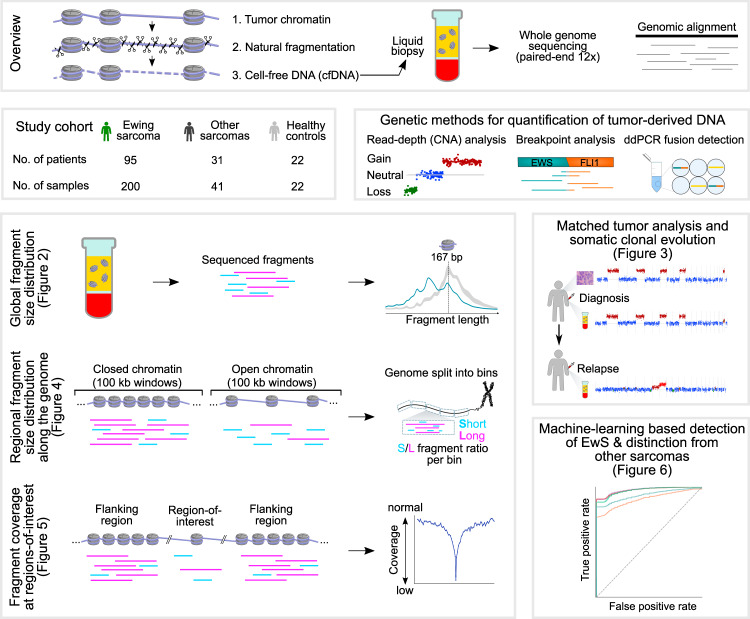
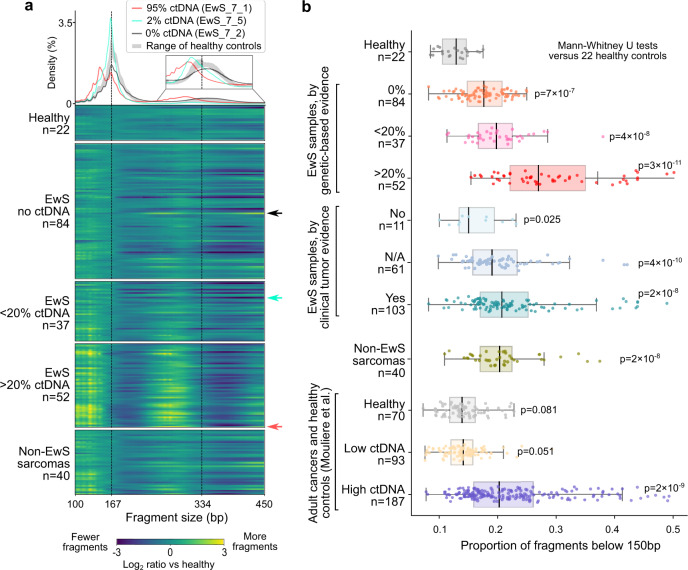
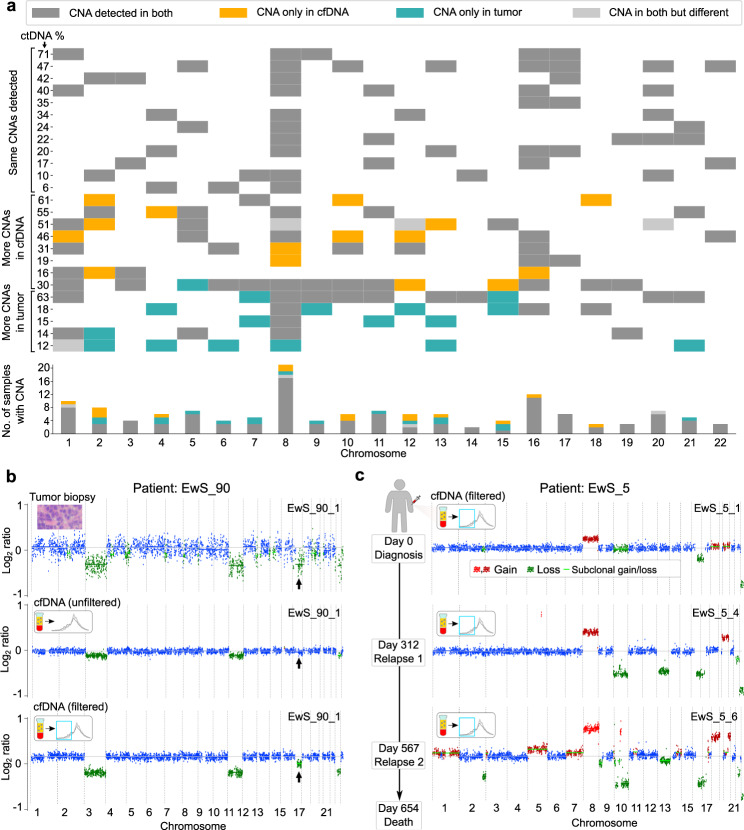
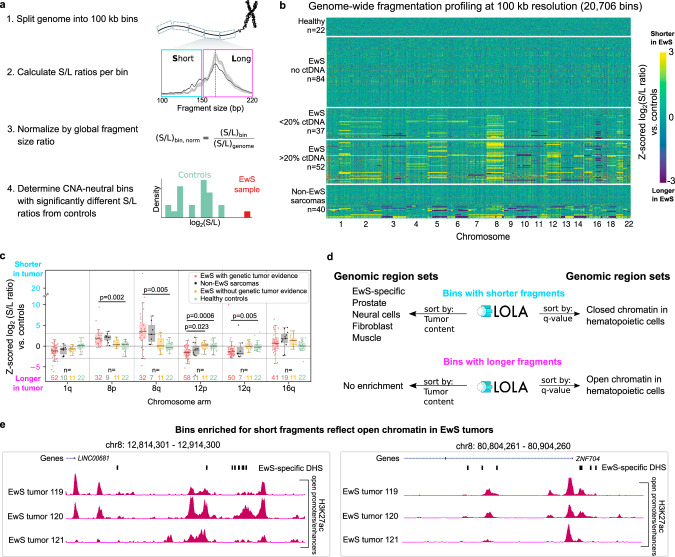
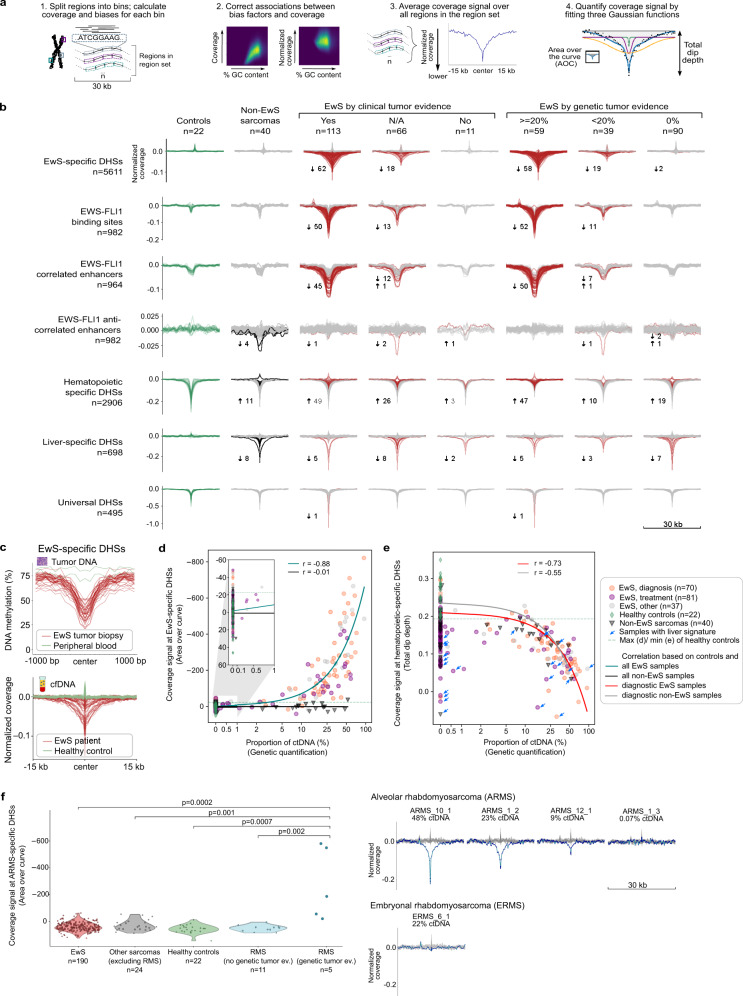
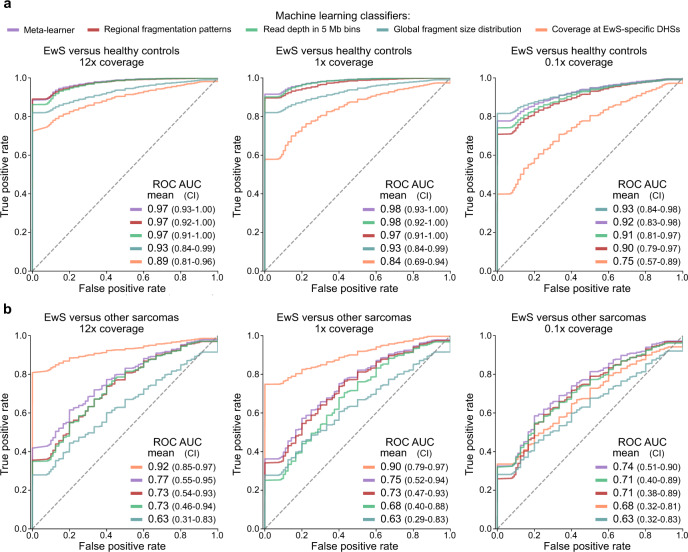
Sequencing of cell-free DNA in the blood of cancer patients (liquid biopsy) provides attractive opportunities for early diagnosis, assessment of treatment response, and minimally invasive disease monitoring. To unlock liquid biopsy analysis for pediatric tumors with few genetic aberrations, we introduce an integrated genetic/epigenetic analysis method and demonstrate its utility on 241 deep whole-genome sequencing profiles of 95 patients with Ewing sarcoma and 31 patients with other pediatric sarcomas. Our method achieves sensitive detection and classification of circulating tumor DNA in peripheral blood independent of any genetic alterations. Moreover, we benchmark different metrics for cell-free DNA fragmentation analysis, and we introduce the LIQUORICE algorithm for detecting circulating tumor DNA based on cancer-specific chromatin signatures. Finally, we combine several fragmentation-based metrics into an integrated machine learning classifier for liquid biopsy analysis that exploits widespread epigenetic deregulation and is tailored to cancers with low mutation rates. Clinical associations highlight the potential value of cfDNA fragmentation patterns as prognostic biomarkers in Ewing sarcoma. In summary, our study provides a comprehensive analysis of circulating tumor DNA beyond recurrent genetic aberrations, and it renders the benefits of liquid biopsy more readily accessible for childhood cancers.
Overview
The claims and statistics of this paper haven’t been checked yet.
Run the check — free, no account needed. It reads the open-access text and checks the sources it cites.
Integrity signals
Registry
Cites
Statistics
Figures
Verification
Claims the paper makes
The claims and statistics of this paper haven’t been checked yet.
Run the check — free, no account needed. It reads the open-access text and checks the sources it cites.
Claims other papers make about this one
Each is checked against this paper’s own text: does it say what the citing paper says it does?
The source backs part of the claim, not all of it — or backs it for a different population, condition or comparison.
In the citing paper
“Nevertheless, the application of WGS in longitudinal MRD detection remains challenging due to its relatively high sequencing cost and lower sensitivity, compared to NGS-based ctDNA panel detection.”
From Tumor-informed deep sequencing of ctDNA detects minimal residual disease and predicts relapse in osteosarcoma (2024) · cites this paper as [17]
Experimental — accuracy not yet measured
Self-check
Percentages, sums and reported differences re-computed from the paper’s own numbers.
The self-check needs the paper’s full text.
Citations
Cites
Scikit-learn: Machine Learning in Python
Pedregosa, F., Varoquaux, G., Gramfort, A., Michel, V., Thirion, B., Grisel, O., Blondel, M., Müller, A., Nothman, J., Louppe, G., et al. (2012) · arXiv · doi:10.48550/arxiv.1201.0490 · Cited by 71,016
fastp: an ultra-fast all-in-one FASTQ preprocessor
Chen, S., Zhou, Y., Chen, Y., & Gu, J. (2018) · Bioinformatics · doi:10.1093/bioinformatics/bty560 · Cited by 29,721
Robinson, J. T., Thorvaldsdóttir, H., Winckler, W., Guttman, M., Lander, E. S., Getz, G., & Mesirov, J. P. (2011) · Nature Biotechnology · doi:10.1038/nbt.1754 · Cited by 15,390
A method for the solution of certain non-linear problems in least squares
Levenberg, K. (1944) · Quarterly of Applied Mathematics · doi:10.1090/qam/10666 · Cited by 12,753
<tt>BLAT</tt> —The <tt>BLAST</tt> -Like Alignment Tool
Kent, W. J. (2002) · Genome Research · doi:10.1101/gr.229202 · Cited by 8,480
deepTools2: a next generation web server for deep-sequencing data analysis
Ramírez, F., Ryan, D. P., Grüning, B., Bhardwaj, V., Kilpert, F., Richter, A. S., Heyne, S., Dündar, F., & Manke, T. (2016) · Nucleic Acids Research · doi:10.1093/nar/gkw257 · Cited by 8,096
Detection of Circulating Tumor DNA in Early- and Late-Stage Human Malignancies
Bettegowda, C., Sausen, M., Leary, R. J., Kinde, I., Wang, Y., Agrawal, N., Bartlett, B. R., Wang, H., Luber, B., Alani, R. M., et al. (2014) · Science Translational Medicine · doi:10.1126/scitranslmed.3007094 · Cited by 5,067
Liquid biopsies come of age: Towards implementation of circulating tumour DNA
Wan, J. C. M., Massie, C., Garcia-Corbacho, J., Mouliere, F., Brenton, J. D., Caldas, C., Pacey, S., Baird, R., & Rosenfeld, N. (2017) · Nature Reviews Cancer · doi:10.1038/nrc.2017.7 · Cited by 2,809
Detection and localization of surgically resectable cancers with a multi-analyte blood test
Cohen, J. D., Li, L., Wang, Y., Thoburn, C., Afsari, B., Danilova, L., Douville, C., Javed, A. A., Wong, F., Mattox, A., et al. (2018) · Science · doi:10.1126/science.aar3247 · Cited by 2,783
Analysis of Circulating Tumor DNA to Monitor Metastatic Breast Cancer
Dawson, S.-J., Tsui, D. W. Y., Murtaza, M., Biggs, H., Rueda, O. M., Chin, S.-F., Dunning, M. J., Gale, D., Forshew, T., Mahler-Araujo, B., et al. (2013) · New England Journal of Medicine · doi:10.1056/nejmoa1213261 · Cited by 2,207
Research works printed but not linked: 1
- Li, H. Aligning sequence reads, clone sequences and assembly contigs with BWA-MEM. Preprint at https://arxiv.org/abs/1303.3997 (2013). · arXiv
Cited by
Sorted by citations
Items 201–201 of 201
Kim, J., Ko, Y., Jang, S. Y., Shin, J. E., Kim, J., Shin, J., Park, S., Kwon, M., Lim, S. H., Jung, H. A., et al. (2026) · Research Square · doi:10.21203/rs.3.rs-11257888/v1
Metadata
- Authors
- Peneder, P., Stütz, A. M., Surdez, D., Krumbholz, M., Semper, S., Chicard, M., Sheffield, N. C., Pierron, G., Lapouble, E., Tötzl, M., Ergüner, B., Barreca, D., Rendeiro, A. F., Agaimy, A., Boztug, H., Engstler, G., Dworzak, M., Bernkopf, M., Taschner-Mandl, S., Ambros, I. M., Myklebost, O., Marec-Bérard, P., Burchill, S. A., Brennan, B., Strauss, S. J., Whelan, J., Schleiermacher, G., Schaefer, C., Dirksen, U., Hutter, C., Boye, K., Ambros, P. F., Delattre, O., Metzler, M., Bock, C., & Tomazou, E. M.
- Affiliations
- St. Anna Children's Cancer Research Institute (AT)
- Inserm (FR)
- Universitätsklinikum Erlangen (DE)
- University of Virginia (US)
- Institut Curie (FR)
- Austrian Academy of Sciences (AT)
- St Anna Children's Hospital (AT)
- Oslo University Hospital (NO)
- St James's University Hospital (GB)
- Royal Manchester Children's Hospital (GB)
- University College Hospital (GB)
- Essen University Hospital (DE)
- Corresponding author
- Bock, Christoph
- Tomazou, Eleni M.
- ORCID
- Peneder, Peter
- Stütz, Adrian M.
- Surdez, Didier
- Krumbholz, Manuela
- Chicard, Mathieu
- Sheffield, Nathan C.
- Pierron, Gaelle
- Lapouble, Eve
- Tötzl, Marcus
- Ergüner, Bekir
- Barreca, Daniele
- Rendeiro, André F.
- Agaimy, Abbas
- Engstler, Gernot
- Dworzak, Michael
- Bernkopf, Marie
- Taschner-Mandl, Sabine
- Ambros, Inge M.
- Myklebost, Ola
- Burchill, Susan Ann
- Brennan, Bernadette
- Strauss, Sandra J.
- Whelan, Jeremy
- Schleiermacher, Gudrun
- Schaefer, Christiane
- Dirksen, Uta
- Hutter, Caroline
- Boye, Kjetil
- Ambros, Peter F.
- Delattre, Olivier
- Metzler, Markus
- Bock, Christoph
- Tomazou, Eleni M.
- Venue
- Nature Communications
- Published
- 2021-05-28
- Volume
- 12
- Issue
- 1
- Pages
- 3230-3230
- ISSN
- 2041-1723 (ISSN-L)
- PMC
- PMC8163828
- OpenAlex
- W3165287952
- Cited by
- 200
- References
- 82
- Citations by year
- 2026: 26 · 2025: 39 · 2024: 38 · 2023: 45 · 2022: 39 · 2021: 12
- FWCI
- 13.63
- Type
- journal article
- Language
- en
- Open access
- gold
- doi.org
- Locations
- Nature Communications (publishedVersion, cc-by)
- PubMed Central (publishedVersion, cc-by)
- PubMed (publishedVersion)
- White Rose Research Online (University of Leeds, The University of Sheffield, University of York) (acceptedVersion)
- Zurich Open Repository and Archive (University of Zurich) (acceptedVersion, cc-by)
- RePEc: Research Papers in Economics (submittedVersion)
- NORA - Norwegian Open Research Archives (submittedVersion, cc-by)
- DOAJ (DOAJ: Directory of Open Access Journals) (submittedVersion, cc-by-sa)
- UCL Discovery (University College London) (submittedVersion)
- Zurich Open Repository and Archive (University of Zurich) (submittedVersion, cc-by)
- Zurich Open Repository and Archive (University of Zurich)
- Funders
- Kreftforeningen
- European Commission (HORIZON2020, 602856)
- Vienna Science and Technology Fund (LS18-049)
- Austrian Science Fund (V 506, I 2798)
- Oesterreichische Nationalbank (17876)
- Ligue Contre le Cancer
- Deutsche Krebshilfe (#108128, 70112018, DKH 108128, 70113419)
- H2020 European Research Council (679146)
- Topics
- Life Sciences › Biochemistry, Genetics and Molecular Biology › Cancer Research › Cancer Genomics and Diagnostics
- Health Sciences › Medicine › Oncology › Sarcoma Diagnosis and Treatment
- Life Sciences › Biochemistry, Genetics and Molecular Biology › Genetics › Genomic variations and chromosomal abnormalities
- Keywords
- liquid biopsy, cell-free DNA, childhood cancer, Ewing sarcoma, pediatric sarcoma, low mutational burden, cfDNA fragmentation, chromatin signatures, epigenetic dysregulation, prognostic factors, machine learning classifiers
- MeSH terms
- Whole Genome Sequencing, Liquid Biopsy, Circulating Tumor DNA, Adolescent, Adult, Bone Neoplasms, Child, Child, Preschool, DNA Mutational Analysis, Female, Humans, Infant, Male, Middle Aged, Mutation, Sarcoma, Ewing, Biomarkers, Tumor, Case-Control Studies, Young Adult
About these checks
Registry, retraction, Cites and statistics results are computed, not judged, with one exception: a printed reference that no index lists is read once by a model before it counts as a citation error. Claims are extracted by a model and kept only when their quote appears verbatim in the text; each cited source is then checked, with a model’s help, for whether it says what the claim relies on. Those verdicts can be wrong — read the claim’s quote and the cited source before relying on one.
Statistics and arithmetic are recomputed, not judged.
Confidence bands are shown only for fields calibrated on our annotated test set. None is calibrated yet, so no band is shown.
What counts as a claim ›How we measure confidence ›How we check this ›
Are you an author, or do you see a problem with this page? Request a review
