

Adaptive and multifunctional hydrogel hybrid probes for long-term sensing and modulation of neural activity
Open accessThe DOI matches its Crossref record; 45 of the 46 references it cites were found in a registry or an index.
Abstract
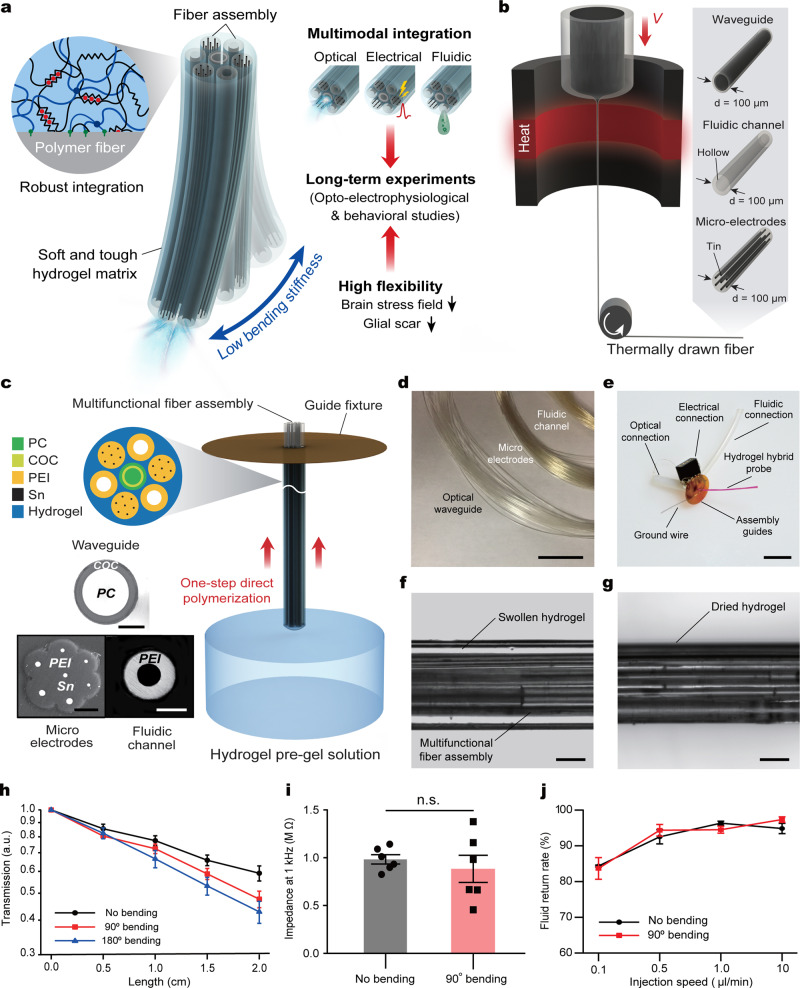
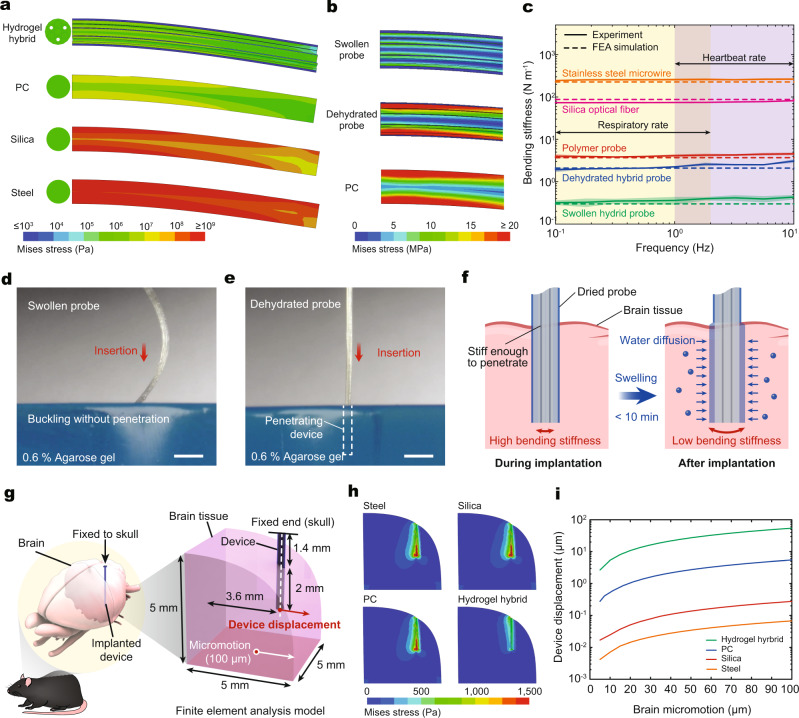
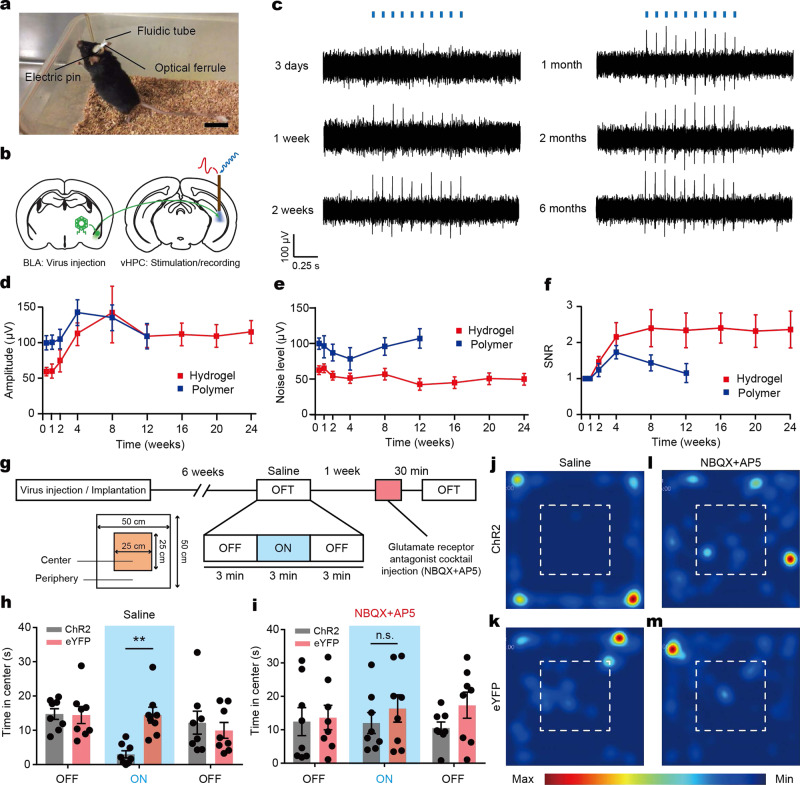
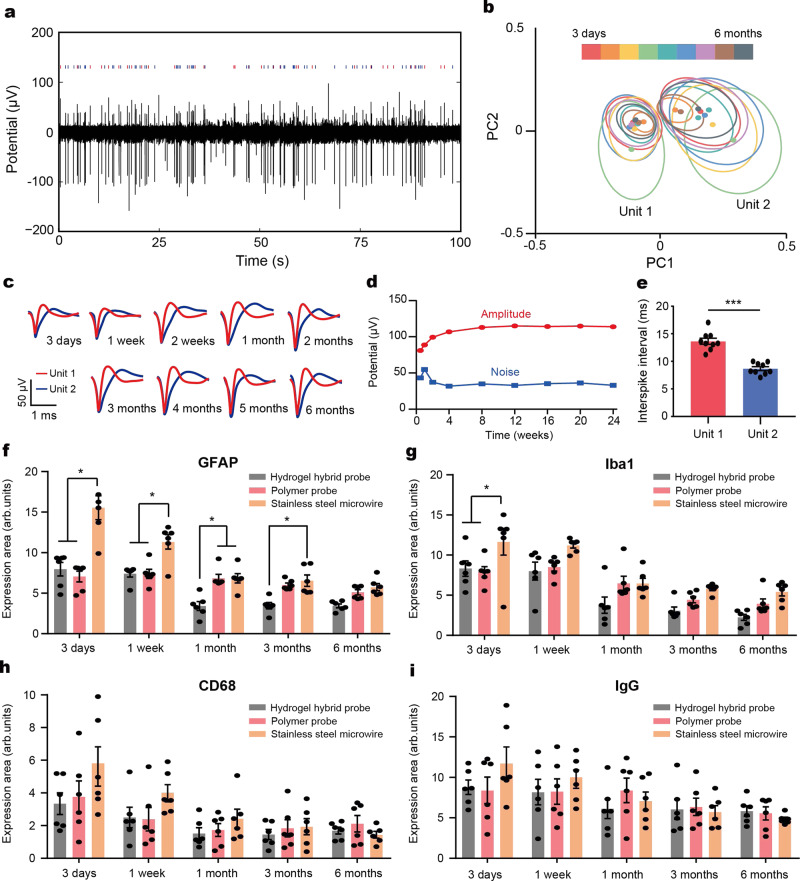
To understand the underlying mechanisms of progressive neurophysiological phenomena, neural interfaces should interact bi-directionally with brain circuits over extended periods of time. However, such interfaces remain limited by the foreign body response that stems from the chemo-mechanical mismatch between the probes and the neural tissues. To address this challenge, we developed a multifunctional sensing and actuation platform consisting of multimaterial fibers intimately integrated within a soft hydrogel matrix mimicking the brain tissue. These hybrid devices possess adaptive bending stiffness determined by the hydration states of the hydrogel matrix. This enables their direct insertion into the deep brain regions, while minimizing tissue damage associated with the brain micromotion after implantation. The hydrogel hybrid devices permit electrophysiological, optogenetic, and behavioral studies of neural circuits with minimal foreign body responses and tracking of stable isolated single neuron potentials in freely moving mice over 6 months following implantation.
Overview
The claims and statistics of this paper haven’t been checked yet.
Free: it reads the open-access text and checks the first 5 claims that cite a source we can check. Create a free account to check every claim.
Integrity signals
Registry
Cites
Statistics
Figures
Verification
Claims the paper makes
The claims and statistics of this paper haven’t been checked yet.
Free: it reads the open-access text and checks the first 5 claims that cite a source we can check. Create a free account to check every claim.
Claims other papers make about this one
Each is checked against this paper’s own text: does it say what the citing paper says it does?
The source backs part of the claim, not all of it — or backs it for a different population, condition or comparison.
In the citing paper
“As a material whose features resemble water-rich tissue in the human body, hydrogels can greatly reduce the inflammatory response of foreign objects, regulate cell or protein attachment, and prevent device failure in vivo,[52] which is important for implants.[53,54]”
From Flexible Electronics and Devices as Human–Machine Interfaces for Medical Robotics (2022) · cites this paper as [52]
Experimental — accuracy not yet measuredThe source backs part of the claim, not all of it — or backs it for a different population, condition or comparison.
In the citing paper
“Consequently, many integrated flexible stimulation systems can also perform electrophysiological recording.[52]”
From Flexible Electronics and Devices as Human–Machine Interfaces for Medical Robotics (2022) · cites this paper as [52]
Experimental — accuracy not yet measured
Self-check
Percentages, sums and reported differences re-computed from the paper’s own numbers.
The self-check needs the paper’s full text.
Citations
Cites
Highly stretchable and tough hydrogels
Sun, J.-Y., Zhao, X., Illeperuma, W. R. K., Chaudhuri, O., Oh, K. H., Mooney, D. J., Vlassak, J. J., & Suo, Z. (2012) · Nature · doi:10.1038/nature11409 · Cited by 5,481
Self-citationHydrogels for Tissue Engineering
Lee, K. Y., & Mooney, D. J. (2001) · Chemical Reviews · doi:10.1021/cr000108x · Cited by 5,277
Neurodegenerative Disorders: Parkinson's Disease and Huntington's Disease
Hague, S., Klaffke, S., & Bandmann, O. (2006) · IMPERIAL COLLEGE PRESS eBooks · doi:10.1142/9781860948961_0007 · Cited by 2,766
Response of brain tissue to chronically implanted neural electrodes
Polikov, V. S., Tresco, P. A., & Reichert, W. M. (2005) · Journal of Neuroscience Methods · doi:10.1016/j.jneumeth.2005.08.015 · Cited by 1,896
Stretchable, Transparent, Ionic Conductors
Keplinger, C., Sun, J.-Y., Foo, C. C., Rothemund, P., Whitesides, G. M., & Suo, Z. (2013) · Science · doi:10.1126/science.1240228 · Cited by 1,754
Optical Deconstruction of Parkinsonian Neural Circuitry
Gradinaru, V., Mogri, M., Thompson, K. R., Henderson, J. M., & Deisseroth, K. (2009) · Science · doi:10.1126/science.1167093 · Cited by 1,526
Tough bonding of hydrogels to diverse non-porous surfaces
Yuk, H., Zhang, T., Lin, S., Parada, G. A., & Zhao, X. (2016) · Nature Materials · doi:10.1038/nmat4463 · Cited by 1,184
Self-citationElectronic dura mater for long-term multimodal neural interfaces
Minev, I. R., Musienko, P., Hirsch, A., Barraud, Q., Wenger, N., Moraud, E. M., Gandar, J., Capogrosso, M., Milekovic, T., Asboth, L., et al. (2015) · Science · doi:10.1126/science.1260318 · Cited by 1,082
Skin-inspired hydrogel–elastomer hybrids with robust interfaces and functional microstructures
Yuk, H., Zhang, T., Parada, G. A., Liu, X., & Zhao, X. (2016) · Nature Communications · doi:10.1038/ncomms12028 · Cited by 1,035
Self-citationBioresorbable silicon electronic sensors for the brain
Kang, S.-K., Murphy, R. K. J., Hwang, S.-W., Lee, S. M., Harburg, D. V., Krueger, N. A., Shin, J., Gamble, P., Cheng, H., Yu, S., et al. (2016) · Nature · doi:10.1038/nature16492 · Cited by 998
Research works printed but not linked: 1
- 13. Park, S. I. et al. Soft, stretchable, fully implantable miniaturized optoelectronic systems for wireless optogenetics. Nat. Biotechnol. 33, 1280 (2015). · DOI · Paper page
Cited by
Technology Roadmap for Flexible Sensors
Luo, Y., Abidian, M. R., Ahn, J.-H., Akinwande, D., Andrews, A. M., Antonietti, M., Bao, Z., Berggren, M., Berkey, C. A., Bettinger, C. J., et al. (2023) · ACS Nano · doi:10.1021/acsnano.2c12606 · Cited by 1,383
Self-citationFlexible Electronics and Devices as Human–Machine Interfaces for Medical Robotics
Heng, W., Solomon, S., & Gao, W. (2022) · Advanced Materials · doi:10.1002/adma.202107902 · Cited by 609
3D printable high-performance conducting polymer hydrogel for all-hydrogel bioelectronic interfaces
Zhou, T., Yuk, H., Hu, F., Wu, J., Tian, F., Roh, H., Shen, Z., Gu, G., Xu, J., Lu, B., et al. (2023) · Nature Materials · doi:10.1038/s41563-023-01569-2 · Cited by 587
Self-citationWang, X., Sun, X., Gan, D., Soubrier, M., Chiang, H.-Y., Yan, L., Li, Y., Li, J., Yu, S., Xia, Y., et al. (2022) · Matter · doi:10.1016/j.matt.2022.01.012 · Cited by 200
Liang, Q., Xia, X., Sun, X., Yu, D., Huang, X., Han, G., Mugo, S. M., Chen, W., & Zhang, Q. (2022) · Advanced Science · doi:10.1002/advs.202201059 · Cited by 183
Bio-inspired electronics: Soft, biohybrid, and “living” neural interfaces
Boufidis, D., Garg, R., Angelopoulos, E., Cullen, D. K., & Vitale, F. (2025) · Nature Communications · doi:10.1038/s41467-025-57016-0 · Cited by 201
Design, fabrication and assembly considerations for electronic systems made of fibre devices
Zeng, K., Shi, X., Tang, C., Liu, T., & Peng, H. (2023) · Nature Reviews Materials · doi:10.1038/s41578-023-00573-x · Cited by 177
Advances in hydrogel-based vascularized tissues for tissue repair and drug screening
Wang, Y., Kankala, R. K., Ou, C., Chen, A., & Yang, Z. (2021) · Bioactive Materials · doi:10.1016/j.bioactmat.2021.07.005 · Cited by 191
“Among diverse biomaterials based on natural and synthetic origin, hydrogel materials have been demonstrated as an effective tool to serve as a 3D matrix for cells, specific factors, and drugs, attributing to their high permeability, water holding capacity, and excellent biocompatibility [34,35].”
BackgroundKim, H., Rigo, B., Wong, G., Lee, Y. J., & Yeo, W. (2023) · Nano-Micro Letters · doi:10.1007/s40820-023-01272-6 · Cited by 192
“Rather than using hydrogels in an ICP sensor, Park et al. [166] developed hydrogel hybrid probes to record electrophysiological signals associated with optical stimulation (Fig.”
MethodFlexible and Stretchable Electrochemical Sensors for Biological Monitoring
Zhao, Y., Jin, K., Li, J., Sheng, K., Huang, W., & Liu, Y. (2023) · Advanced Materials · doi:10.1002/adma.202305917 · Cited by 172
Entanglement in Smart Hydrogels: Fast Response Time, Anti‐Freezing and Anti‐Drying
Feng, Y., Wang, S., Li, Y., Ma, W., Zhang, G., Yang, M., Li, H., Yang, Y., & Long, Y. (2023) · Advanced Functional Materials · doi:10.1002/adfm.202211027 · Cited by 158
Wireless Miniature Magnetic Phase‐Change Soft Actuators
Tang, Y., Li, M., Wang, T., Dong, X., Hu, W., & Sitti, M. (2022) · Advanced Materials · doi:10.1002/adma.202204185 · Cited by 156
Shaping the future of robotics through materials innovation
Rothemund, P., Kim, Y., Heisser, R. H., Zhao, X., Shepherd, R. F., & Keplinger, C. (2021) · Nature Materials · doi:10.1038/s41563-021-01158-1 · Cited by 162
Self-citationLiu, H., Tian, H., Li, X., Chen, X., Zhang, K., Shi, H., Wang, C., & Shao, J. (2022) · Science Advances · doi:10.1126/sciadv.abn5722 · Cited by 161
Engineering Electrodes with Robust Conducting Hydrogel Coating for Neural Recording and Modulation
Zhang, J., Wang, L., Xue, Y., Lei, I. M., Chen, X., Zhang, P., Cai, C., Liang, X., Lu, Y., & Liu, J. (2022) · Advanced Materials · doi:10.1002/adma.202209324 · Cited by 158
Flexible Electrodes for Brain–Computer Interface System
Wang, J., Wang, T., Liu, H., Wang, K., Kumi, M., Feng, Z., Li, P., & Huang, W. (2023) · Advanced Materials · doi:10.1002/adma.202211012 · Cited by 158
Fatigue-resistant hydrogel optical fibers enable peripheral nerve optogenetics during locomotion
Liu, X., Rao, S., Chen, W., Felix, K., Ni, J., Sahasrabudhe, A., Lin, S., Wang, Q., Liu, Y., He, Z., et al. (2023) · Nature Methods · doi:10.1038/s41592-023-02020-9 · Cited by 123
“We envision the capability and adaptability of our hydrogel fiber technology being expanded for bidirectional optogenetics stimulation and optical recording via the use of fluorescence indicators 13,47 .”
MethodSelf-citationHigh-density soft bioelectronic fibres for multimodal sensing and stimulation
Khatib, M., Zhao, E. T., Wei, S., Park, J., Abramson, A., Bishop, E. S., Thomas, A.-L. A., Chen, C.-H., Emengo, P. O., Xu, C., et al. (2025) · Nature · doi:10.1038/s41586-025-09481-2 · Cited by 124
Ultraflexible endovascular probes for brain recording through micrometer-scale vasculature
Zhang, A., Mandeville, E. T., Xu, L., Stary, C. M., Lo, E. H., & Lieber, C. M. (2023) · Science · doi:10.1126/science.adh3916 · Cited by 116
Cho, M., Han, J.-K., Suh, J., Kim, J. J., Ryu, J. R., Min, I. S., Sang, M., Lim, S., Kim, T. S., Kim, K., et al. (2024) · Nature Communications · doi:10.1038/s41467-024-45803-0 · Cited by 115
Soft shape-programmable surfaces by fast electromagnetic actuation of liquid metal networks
Ni, X., Luan, H., Kim, J.-T., Rogge, S. I., Bai, Y., Kwak, J. W., Liu, S., Yang, D. S., Li, S., Li, S., et al. (2022) · Nature Communications · doi:10.1038/s41467-022-31092-y · Cited by 110
Luo, L., Wu, Z., Ding, Q., Wang, H., Luo, Y., Yu, J., Guo, H., Tao, K., Zhang, S., Huo, F., et al. (2024) · ACS Nano · doi:10.1021/acsnano.4c02359 · Cited by 109
Functional Hydrogel Interface Materials for Advanced Bioelectronic Devices
Yang, Q., Hu, Z., & Rogers, J. A. (2021) · Accounts of Materials Research · doi:10.1021/accountsmr.1c00142 · Cited by 113
Biocompatible and Biodegradable Polymer Optical Fiber for Biomedical Application: A Review
Wang, Y., Huang, Y., Bai, H., Wang, G., Hu, X., Kumar, S., & Min, R. (2021) · Biosensors · doi:10.3390/bios11120472 · Cited by 106
“Using biocompatible multifunctional fiber probes, researchers have recorded spinal cord [118] and brain circuits [53,54,119].”
BackgroundInfluentialHydrogels for next generation neural interfaces
Cheng, S., Zhu, R., & Xu, X. (2024) · Communications Materials · doi:10.1038/s43246-024-00541-0 · Cited by 110
Bioelectronic Implantable Devices for Physiological Signal Recording and Closed‐Loop Neuromodulation
Oh, S., Jekal, J., Liu, J., Kim, J., Park, J., Lee, T., & Jang, K. (2024) · Advanced Functional Materials · doi:10.1002/adfm.202403562 · Cited by 114
Functional conductive hydrogels: from performance to flexible sensor applications
Li, Q., Tian, B., Liang, J., & Wu, W. H. (2023) · Materials Chemistry Frontiers · doi:10.1039/d3qm00109a · Cited by 106
Recent progress in conductive self‐healing hydrogels for flexible sensors
Qin, T., Liao, W., Yu, L. H., Zhu, J., Wu, M. Y., Peng, Q., Han, L., & Zeng, H. (2022) · Journal of Polymer Science · doi:10.1002/pol.20210899 · Cited by 102
Hydrogel Fibers‐Based Biointerfacing
Chen, X., Feng, Y., Zhang, P., Ni, Z., Xue, Y., & Liu, J. (2024) · Advanced Materials · doi:10.1002/adma.202413476 · Cited by 110
Multifunctional Conductive Hydrogel Interface for Bioelectronic Recording and Stimulation
Tang, H., Li, Y., Liao, S., Liu, H., Qiao, Y., & Zhou, J. (2024) · Advanced Healthcare Materials · doi:10.1002/adhm.202400562 · Cited by 97
A Review of Hydrogel Fiber: Design, Synthesis, Applications, and Futures
Chen, G., Yang, Z., Pan, H., Zhang, J., Guo, Y., Zhou, Z., Zheng, J., Zhang, Z., Cao, R., Hou, K., et al. (2025) · Chemical Reviews · doi:10.1021/acs.chemrev.5c00159 · Cited by 96
Zheng, Y., Shariati, K., Ghovvati, M., Vo, S., Origer, N., Imahori, T., Kaneko, N., & Annabi, N. (2023) · Biomaterials · doi:10.1016/j.biomaterials.2023.122240 · Cited by 88
“The mechanical mismatch between the tissue and bioadhesive can cause tissue damage [64], discomfort [65] and induce inflammation [47,66].”
Hydrogels for active photonics
Ko, B., Jeon, N., Kim, J., Kang, H., Seong, J., Yun, S., Badloe, T., & Rho, J. (2024) · Microsystems & Nanoengineering · doi:10.1038/s41378-023-00609-w · Cited by 88
Dong, C., & Malliaras, G. G. (2025) · Advanced Materials · doi:10.1002/adma.202417325 · Cited by 89
A silk-based self-adaptive flexible opto-electro neural probe
Zhou, Y., Gu, C., Liang, J., Zhang, B., Yang, H., Zhou, Z., Li, M., Sun, L., Tao, T. H., & Wei, X. (2022) · Microsystems & Nanoengineering · doi:10.1038/s41378-022-00461-4 · Cited by 81
Shedding light on neurons: optical approaches for neuromodulation
Jiang, S., Wu, X., Rommelfanger, N. J., Ou, Z., & Hong, G. (2022) · National Science Review · doi:10.1093/nsr/nwac007 · Cited by 89
Hydrogels and conductive hydrogels for implantable bioelectronics
Sagdic, K., Lavado, E. F., Mariello, M., Akouissi, O., & Lacour, S. P. (2023) · MRS Bulletin · doi:10.1557/s43577-023-00536-1 · Cited by 86
Molecular design of an ultra-strong tissue adhesive hydrogel with tunable multifunctionality
Zheng, Y., Baidya, A., & Annabi, N. (2023) · Bioactive Materials · doi:10.1016/j.bioactmat.2023.06.007 · Cited by 112
Thermally drawn multifunctional fibers: Toward the next generation of information technology
Shen, Y., Wang, Z., Wang, Z., Wang, J., Yang, X. P., Zheng, X., Chen, H., Li, K., Wei, L., & Zhang, T. (2022) · InfoMat · doi:10.1002/inf2.12318 · Cited by 83
Electron Conductive and Transparent Hydrogels for Recording Brain Neural Signals and Neuromodulation
Liang, Q., Shen, Z., Sun, X., Yu, D., Liu, K., Mugo, S. M., Chen, W., Wang, D., & Zhang, Q. M. (2023) · Advanced Materials · doi:10.1002/adma.202211159 · Cited by 81
Long-term stability strategies of deep brain flexible neural interface
Lv, S., Xu, Z., Mo, F., Wang, Y., Duan, Y., Liu, Y., Jing, L., Shan, J., Jia, Q., Wang, M., et al. (2025) · npj Flexible Electronics · doi:10.1038/s41528-025-00410-x · Cited by 86
“6b) 88 .”
Multifunctional hydrogel electronics for closed-loop antiepileptic treatment
Qu, J., Xie, K., Chen, S., He, X., Wang, Y., Chamberlin, M., Zhao, X. J., Zhu, G., Xu, C., & Shi, P. (2024) · Science Advances · doi:10.1126/sciadv.adq9207 · Cited by 83
“With a soft modulus and similar bending stiffness to the brain tissue, the low water uptake volume and slight volume swelling would not cause any mechanical stress to surrounding brain tissues for long-term in vivo usage ( 40 ).”
Self-citationFunctional Bioelectronic Materials for Long-Term Biocompatibility and Functionality
Park, J., Lee, Y., Kim, T. Y., Hwang, S., & Seo, J. (2022) · ACS Applied Electronic Materials · doi:10.1021/acsaelm.1c01212 · Cited by 78
Park, Y., Kwon, Y. W., Koh, C. S., Kim, E., Lee, D. H., Kim, S., Mun, J., Hong, Y., Lee, S., Kim, J., et al. (2024) · Nature Communications · doi:10.1038/s41467-024-45768-0 · Cited by 78
“Therefore our system canoffer promising potential to signi fi cantly impact the fi eld of biomedical engineering by enabling extensive monitoring of various brain areas and providing customizable electronics beyond the pre-fabricated and pre-packaged devices 3,50 – 53 .”
Implantable hydrogels as pioneering materials for next-generation brain–computer interfaces
Khan, W. U., Shen, Z., Mugo, S. M., Wang, H., & Zhang, Q. M. (2025) · Chemical Society Reviews · doi:10.1039/d4cs01074d · Cited by 79
Towards integrated textile display systems
Wang, Z., Liu, Y., Zhou, Z., Chen, P., & Peng, H. (2024) · Nature Reviews Electrical Engineering · doi:10.1038/s44287-024-00063-4 · Cited by 75
“Simultaneously, the bonding strengths at the interfaces can also be improved by surface treatments 69 , by post-processing and by introducing transition layers 70 .”
Li, H., Wang, J., & Fang, Y. Z. (2023) · Microsystems & Nanoengineering · doi:10.1038/s41378-022-00444-5 · Cited by 73
Xu, S., Momin, M., Ahmed, S., Hossain, A., Veeramuthu, L., Pandiyan, A., Kuo, C., & Zhou, T. (2023) · Advanced Materials · doi:10.1002/adma.202303267 · Cited by 73
An Antidehydration Hydrogel Based on Zwitterionic Oligomers for Bioelectronic Interfacing
He, K., Cai, P., Ji, S., Tang, Z., Zhou, F. Q., Li, W., Yu, J., Su, J., Luo, Y., Zhang, F., et al. (2023) · Advanced Materials · doi:10.1002/adma.202311255 · Cited by 75
3D Bioprinting for Vascularization
Mir, A., Lee, E., Shih, W., Koljaka, S., Wang, A., Jorgensen, C., Hurr, R., Dave, A., Sudheendra, K., & Hibino, N. (2023) · Bioengineering · doi:10.3390/bioengineering10050606 · Cited by 76
The ultra-thin, minimally invasive surface electrode array NeuroWeb for probing neural activity
Lee, J. M., Pyo, Y., Kim, Y. J., Hong, J. H., Jo, Y., Choi, W., Lin, D., & Park, H. (2023) · Nature Communications · doi:10.1038/s41467-023-42860-9 · Cited by 65
“In conclusion, our NeuroWeb is, to the best of our knowledge, the thinnest neural probe ever developed 15,17,27 and has demonstrated unique features in fl exibility, adhesion and transparency.”
Recent Progress of Soft and Bioactive Materials in Flexible Bioelectronics
Wu, X., Ye, Y., Sun, M., Mei, Y., Ji, B., Wang, M., & Song, E. (2025) · Cyborg and Bionic Systems · doi:10.34133/cbsystems.0192 · Cited by 72
“Extensive research has focused on reducing the mechanical mismatch between implanted materials and surrounding tissues to mitigate immune responses, implant rejection, and foreign body reactions, thus enhancing biocompatibility [ 65 , 113 , 114 ].”
Materials and device strategies to enhance spatiotemporal resolution in bioelectronics
Zhang, J., Cheng, Z., Li, P., & Tian, B. (2025) · Nature Reviews Materials · doi:10.1038/s41578-025-00798-y · Cited by 71
“Unlike rigid or purely electronic materials, hydrogels provide a mechanically compliant and ionically conductive interface, enhancing charge transport and minimizing mechanical mismatch, which is essential for achieving high-resolution, long-term biointegration 109,160 .”
Huang, S., Liu, X., Lin, S., Glynn, C., Felix, K., Sahasrabudhe, A., Maley, C., Xu, J., Chen, W., Hong, E., et al. (2024) · Nature Communications · doi:10.1038/s41467-024-47988-w · Cited by 66
“Assistedwith hydrogel cross-linking as a soft material matrix, hybrid multifunction fi bers permit adaptive bending stiffness for long-term sensing and neural modulation 5,19 .”
Park, Y., Chung, T. S., Lee, G., & Rogers, J. A. (2021) · Chemical Reviews · doi:10.1021/acs.chemrev.1c00639 · Cited by 62
Tian, F., Yu, J., Wang, W., Zhao, D., Cao, J., Zhao, Q., Wang, F., Yang, H., Wu, Z., Xu, J., et al. (2023) · Journal of Colloid and Interface Science · doi:10.1016/j.jcis.2023.01.146 · Cited by 62
Zheng, W., Wang, L., Jiao, H., Wu, Z., Zhao, Q., Lin, T., Ma, H., Zhang, Z., Xu, X., Cao, J., et al. (2022) · Chemical Engineering Journal · doi:10.1016/j.cej.2022.140553 · Cited by 60
Conducting Hydrogel‐Based Neural Biointerfacing Technologies
Zhang, P., Yang, Y., Li, Z., Xue, Y., Wang, F., Shan, L., Wang, Y., Shi, X., Wu, K., & Liu, J. (2025) · Advanced Functional Materials · doi:10.1002/adfm.202422869 · Cited by 75
Injectable Conductive Hydrogels with Tunable Degradability as Novel Implantable Bioelectrodes
Park, J., Lee, S., Lee, M., Kim, H., & Lee, J. Y. (2023) · Small · doi:10.1002/smll.202300250 · Cited by 59
Organic Flexible Electronics for Innovative Applications in Electronic Skin
Liu, X., Li, H., Tao, M., Yu, Y., Zhu, Z., Wu, D., Hu, X., & Chen, Y. (2024) · Advanced Materials Technologies · doi:10.1002/admt.202400661 · Cited by 62
Digital Mechanical Metamaterial with Programmable Functionality
Lin, W.-Q., Yan, Y., Zhao, S., Qin, H., & Liu, Y. (2024) · Advanced Materials · doi:10.1002/adma.202406263 · Cited by 61
Roquero, D. M., & Katz, E. (2022) · Sensors and Actuators Reports · doi:10.1016/j.snr.2022.100095 · Cited by 65
Bioelectronic Applications of Intrinsically Conductive Polymers
Gao, X., Bao, Y., Chen, Z., Lu, J., Su, T., Zhang, L., & Ouyang, J. (2023) · Advanced Electronic Materials · doi:10.1002/aelm.202300082 · Cited by 60
Needle‐Like Multifunctional Biphasic Microfiber for Minimally Invasive Implantable Bioelectronics
Nam, S., Cha, G. D., Sunwoo, S., Jeong, J. H., Kang, H., Park, O. K., Lee, K., Oh, S., Hyeon, T., Choi, S. H., et al. (2024) · Advanced Materials · doi:10.1002/adma.202404101 · Cited by 64
Neuron devices: emerging prospects in neural interfaces and recognition
Wang, Y., Liu, S., Wang, H., Zhao, Y., & Zhang, X. (2022) · Microsystems & Nanoengineering · doi:10.1038/s41378-022-00453-4 · Cited by 59
Softening implantable bioelectronics: Material designs, applications, and future directions
Oh, S., Lee, S., Kim, S. W., Kim, C. Y., Jeong, E. Y., Lee, J., Kwon, D. A., & Jeong, J. (2024) · Biosensors and Bioelectronics · doi:10.1016/j.bios.2024.116328 · Cited by 50
Mariello, M., & Proctor, C. M. (2024) · Advanced Materials Technologies · doi:10.1002/admt.202400797 · Cited by 58
Won, C., Jeong, U., Lee, S., Lee, M., Kwon, C., Cho, S., Yoon, K., Lee, S.-M., Chun, D. W., Cho, I., et al. (2022) · Advanced Functional Materials · doi:10.1002/adfm.202205145 · Cited by 50
Wang, X., Xu, M., Yang, H., Jiang, W., Jiang, J., Zou, D., Zhu, Z., Tao, C., Ni, S., Zhou, Z., et al. (2024) · ACS Nano · doi:10.1021/acsnano.4c12429 · Cited by 50
From microfluidics to hierarchical hydrogel materials
Weigel, N., Li, Y., Thiele, J., & Fery, A. (2022) · Current Opinion in Colloid & Interface Science · doi:10.1016/j.cocis.2022.101673 · Cited by 50
In Vivo Chronic Brain Cortex Signal Recording Based on a Soft Conductive Hydrogel Biointerface
Rinoldi, C., Ziai, Y., Zargarian, S. S., Nakielski, P., Zembrzycki, K., Bayan, M. A. H., Zakrzewska, A., Fiorelli, R., Lanzi, M., Kostrzewska-Księżyk, A., et al. (2022) · ACS Applied Materials & Interfaces · doi:10.1021/acsami.2c17025 · Cited by 49
Fibrous hydrogels by electrospinning: Novel platforms for biomedical applications
Lee, J. W., & Song, K. H. (2023) · Journal of Tissue Engineering · doi:10.1177/20417314231191881 · Cited by 48
Current and emerging strategies for biocompatible materials for implantable electronics
Zhou, Y., Morris, G. H. B., & Nair, M. (2024) · Cell Reports Physical Science · doi:10.1016/j.xcrp.2024.101852 · Cited by 53
Flexible high-density microelectrode arrays for closed-loop brain–machine interfaces: a review
Liu, X., Gong, Y., Jiang, Z., Stevens, T., & Li, W. (2024) · Frontiers in Neuroscience · doi:10.3389/fnins.2024.1348434 · Cited by 53
Emerging Applications of Optical Fiber-Based Devices for Brain Research
Nazempour, R., Zhang, B., Ye, Z., Yin, L., Lv, X., & Sheng, X. (2021) · Advanced Fiber Materials · doi:10.1007/s42765-021-00092-w · Cited by 47
Submillimeter Multifunctional Ferromagnetic Fiber Robots for Navigation, Sensing, and Modulation
Zhang, Y., Wu, X., Vadlamani, R. A., Lim, Y., Kim, J., David, K., Gilbert, E. T., Li, Y., Wang, R., Jiang, S., et al. (2023) · Advanced Healthcare Materials · doi:10.1002/adhm.202300964 · Cited by 46
Kim, Y., Lee, Y., Yoo, J., Nam, K. S., Jeon, W., Lee, S.-M., & Park, S. (2024) · ACS Nano · doi:10.1021/acsnano.4c02578 · Cited by 43
Self-citationNature-inspired surface modification strategies for implantable devices
Lee, S.-H., Yoo, S., Kim, S. H., Kim, Y., Han, S. I., & Lee, H. (2025) · Materials Today Bio · doi:10.1016/j.mtbio.2025.101615 · Cited by 54
“In neural applications, hydrogels engineered to match brain tissue mechanics minimize foreign body responses, enabling stable and long-term integration in brain-machine interfaces [165,166].”
Flexible Microinterventional Sensors for Advanced Biosignal Monitoring
Liu, Y., Fan, P., Pan, Y., & Ping, J. F. (2025) · Chemical Reviews · doi:10.1021/acs.chemrev.5c00115 · Cited by 43
Chen, G., Xu, S., Zhou, Q., Zhang, Y., Song, Y., Mi, J., Liu, Y., Hou, K., & Pan, J. (2023) · Advanced Fiber Materials · doi:10.1007/s42765-023-00257-9 · Cited by 41
Polymer Complex Fiber: Property, Functionality, and Applications
Huang, H., Trentle, M., Liu, Z., Xiang, K., Higgins, W., Wang, Y., Xue, B., & Yang, S. (2023) · ACS Applied Materials & Interfaces · doi:10.1021/acsami.2c19583 · Cited by 42
Ultrathin Fiber‐Mesh Polymer Thermistors
Okutani, C., Yokota, T., & Someya, T. (2022) · Advanced Science · doi:10.1002/advs.202202312 · Cited by 41
Farzin, M. A., Naghib, S. M., & Rabiee, N. (2024) · Chemical Engineering Journal · doi:10.1016/j.cej.2024.152445 · Cited by 40
Perspectives on tissue-like bioelectronics for neural modulation
Sun, C., Cheng, Z., Abu-Halimah, J., & Tian, B. (2023) · iScience · doi:10.1016/j.isci.2023.106715 · Cited by 40
“A recent study sheds light on this direction by integratingmultiple functions into hydrogel probes that possess adaptive bending stiffness depending on the level of hydration.(54) To achieve sensing, modulation, and drug delivery, optical, electrical, and fluidic fibers were assembled into the hydrogel matrix (25 mm).”
BackgroundA mosquito mouthpart-like bionic neural probe
Zhou, Y., Yang, H., Wang, X., Yang, H., Sun, K., Zhou, Z., Sun, L., Zhao, J., Tao, T. H., & Wei, X. (2023) · Microsystems & Nanoengineering · doi:10.1038/s41378-023-00565-5 · Cited by 39
Yao, M., Yan, Z., Sun, X., Guo, B., Yu, C., Zhao, Z., Li, X., Tan, Z., Zhang, H., Yao, F., et al. (2023) · Acta Biomaterialia · doi:10.1016/j.actbio.2023.05.003 · Cited by 38
Jeon, W., Lee, J. M., Kim, Y., Lee, Y., Won, J., Lee, S., Son, W., Koo, Y. H., Hong, J., Gwac, H., et al. (2024) · Advanced Materials · doi:10.1002/adma.202313625 · Cited by 39
Self-citationMultifunctional bioelectronics for brain–body circuits
Sahasrabudhe, A., Cea, C., & Anikeeva, P. (2025) · Nature Reviews Bioengineering · doi:10.1038/s44222-025-00289-3 · Cited by 38
“these materials are compatible with traditional photolithographic processing 37,38 , and some permit thermal drawing into monolithic fibre-based devices 39,40 .”
Self-citationNanoscale surface coatings and topographies for neural interfaces
Cho, Y., Choi, Y., & Seong, H. (2023) · Acta Biomaterialia · doi:10.1016/j.actbio.2023.12.025 · Cited by 36
Recent progress in fabrications, properties and applications of multifunctional conductive hydrogels
Liu, J., Wang, W., Li, H., Huo, P., Teng, P., Ding, H., & Shen, X. (2024) · European Polymer Journal · doi:10.1016/j.eurpolymj.2024.112895 · Cited by 34
Fu, C., Ni, Y., Chen, L., Huang, F., Miao, Q., & Huang, L. (2022) · International Journal of Biological Macromolecules · doi:10.1016/j.ijbiomac.2022.05.101 · Cited by 36
Guo, Y., Liu, Y., Zhang, Z., Zhang, X., Xu, J. K., Zhang, R., Chen, G., Zhu, L., & Zhu, M. (2025) · Advanced Materials · doi:10.1002/adma.202414877 · Cited by 36
Recent developments in artificial spider silk and functional gel fibers
Khan, A. Q., Shafiq, M., Li, J., Yu, K., Liu, Z., Zhou, X. Y., & Zhu, M. (2023) · SmartMat · doi:10.1002/smm2.1189 · Cited by 33
“Park et al. 102 developed brain tissue ‐ mimicking multifunctional sensing and actuation platforms by the integration of multimaterial fibers within a soft hydrogel matrix.”
BackgroundFibrous wearable and implantable bioelectronics
Sadri, B., & Gao, W. F. (2023) · Applied Physics Reviews · doi:10.1063/5.0152744 · Cited by 31
Xia, M., Agca, B. N., Yoshida, T., Choi, J., Amjad, U., Bose, K., Keren, N., Zukerman, S., Cima, M. J., Graybiel, A. M., et al. (2023) · Biosensors and Bioelectronics · doi:10.1016/j.bios.2023.115625 · Cited by 33
Recent Progress of Biomaterial-Based Hydrogels for Wearable and Implantable Bioelectronics
Chen, B., Zhu, Y., Yu, R., Feng, Y., Han, Z., Liu, C., Zhu, P., Lu, L., & Mao, Y. (2025) · Gels · doi:10.3390/gels11060442 · Cited by 31
“This requirement imposes stringent demands on the materials used, particularly in terms of bio-compatibility, interfacial matching, and controllable degradation behavior [162,163].”
Chen, Z., Luo, J. T., Hu, Y., Fu, Y., Meng, J., Luo, S., Wang, L., Zhang, Y., Zhou, J., Zhang, M., et al. (2022) · International Journal of Biological Macromolecules · doi:10.1016/j.ijbiomac.2022.09.197 · Cited by 30
Lifetime engineering of bioelectronic implants with mechanically reliable thin film encapsulations
Niemiec, M., & Kim, K. (2023) · Progress in Biomedical Engineering · doi:10.1088/2516-1091/ad0b19 · Cited by 32
“Hydrogel materials have also been implemented in a variety of ways in recent years [84, 136, 145–148].”
Soft Optical Fibers for Biomedical and Wearable Technologies: Current Trends and Future Prospects
Wang, Y., Zhou, Y., Qi, L., & Zhang, Y. (2025) · Advanced Functional Materials · doi:10.1002/adfm.202507712 · Cited by 30
Lee, S., Lee, G., Kang, I.-H., Jeon, W., Kim, S., Ahn, Y., Kim, C. Y., Kwon, D. A., Dickey, M. D., Park, S., et al. (2025) · Science Advances · doi:10.1126/sciadv.adv4921 · Cited by 30
“In addition, because these materials are not inherently conductive, they cannot form electronics by themselves, needing the integration of a separate circuit layer to enable electronics functionality within a stiffness-tunable framework ( 37 , 40 , 42 , 43 ).”
Self-citation
Metadata
- Authors
- Park, S., Yuk, H., Zhao, R., Yim, Y. S., Woldeghebriel, E. W., Kang, J., Canales, A., Fink, Y., Choi, G. B., Zhao, X., & Anikeeva, P.
- Affiliations
- Korea Advanced Institute of Science and Technology (KR)
- Massachusetts Institute of Technology (US)
- The Ohio State University (US)
- McGovern Institute for Brain Research (US)
- Institute for Soldier Nanotechnologies (US)
- Corresponding author
- Zhao, Xuanhe
- Anikeeva, Polina
- ORCID
- Venue
- Nature Communications
- Published
- 2021-06-08
- Volume
- 12
- Issue
- 1
- Pages
- 3435-3435
- ISSN
- 2041-1723 (ISSN-L)
- PMC
- PMC8187649
- OpenAlex
- W3168009682
- Semantic Scholar
- 7839d6da46ddf95544a4fefa83d5e067981c25fd
- Cited by
- 312
- References
- 46
- Citations by year
- 2026: 42 · 2025: 74 · 2024: 72 · 2023: 67 · 2022: 41 · 2021: 16
- FWCI
- 22.59
- Type
- journal article
- Language
- en
- Open access
- gold
- doi.org
- Licence
- cc-by
- creativecommons.org/licenses/by/4.0 (tdm)
- creativecommons.org/licenses/by/4.0 (vor)
- Locations
- Nature Communications (publishedVersion, cc-by)
- PubMed Central (publishedVersion, cc-by)
- PubMed (publishedVersion)
- RePEc: Research Papers in Economics (submittedVersion)
- DOAJ (DOAJ: Directory of Open Access Journals) (submittedVersion, cc-by-sa)
- DSpace@MIT (Massachusetts Institute of Technology) (submittedVersion, cc-by-nc)
- Seoul National University Open Repository (Seoul National University) (submittedVersion)
- Funders
- National Research Foundation of Korea (2020R1C1C100758911)
- Electronics and Telecommunications Research Institute (20ZB1100)
- United States Department of Defense | United States Army | US Army Corps of Engineers | Engineer Research and Development Center (W911NF-13-D-0001)
- NSF | ENG/OAD | Division of Civil, Mechanical and Manufacturing Innovation (CMMI-1661627)
- U.S. Department of Health & Human Services | NIH | National Institute of Neurological Disorders and Stroke (5R01NS086804)
- NSF | Directorate for Mathematical & Physical Sciences | Division of Materials Research (DMR-1419807)
- NSF | ENG/OAD | Division of Engineering Education and Centers (EEC-1028725)
- Topics
- Life Sciences › Neuroscience › Cellular and Molecular Neuroscience › Neuroscience and Neural Engineering
- Physical Sciences › Materials Science › Polymers and Plastics › Conducting polymers and applications
- Physical Sciences › Materials Science › Biomaterials › Hydrogels: synthesis, properties, applications
- Keywords
- neural interfaces, foreign body reaction, optogenetics, electrophysiological recording, multimaterial fibers, freely moving mice
- MeSH terms
- Action Potentials, Animals, Behavior, Animal, Biological Assay, Brain, Foreign-Body Reaction, Male, Mice, Inbred C57BL, Neurons, Stress, Mechanical, Time Factors, Molecular Probes, Biosensing Techniques, Hydrogels, Mice, Electrophysiological Phenomena, Optogenetics
About these checks
Registry, retraction, Cites and statistics results are computed, not judged, with one exception: a printed reference that no index lists is read once by a model before it counts as a citation error. Claims are extracted by a model and kept only when their quote appears verbatim in the text; each cited source is then checked, with a model’s help, for whether it says what the claim relies on. Those verdicts can be wrong — read the claim’s quote and the cited source before relying on one.
Statistics and arithmetic are recomputed, not judged.
Confidence bands are shown only for fields calibrated on our annotated test set. None is calibrated yet, so no band is shown.
What counts as a claim ›How we measure confidence ›How we check this ›
Are you an author, or do you see a problem with this page? Request a review
Data sources
Bibliographic data: Semantic Scholar, OpenAlex, Crossref.
Contains information from the Semantic Scholar Academic Graph Datasets, made available under the ODC Attribution License (ODC-BY 1.0).
Semantic Scholar’s data is described in: Kinney, R., et al. (2023). The Semantic Scholar Open Data Platform. arXiv:2301.10140.
