

Adaptive and multifunctional hydrogel hybrid probes for long-term sensing and modulation of neural activity
Open accessThe DOI matches its Crossref record; 45 of the 46 references it cites were found in a registry or an index.
Abstract
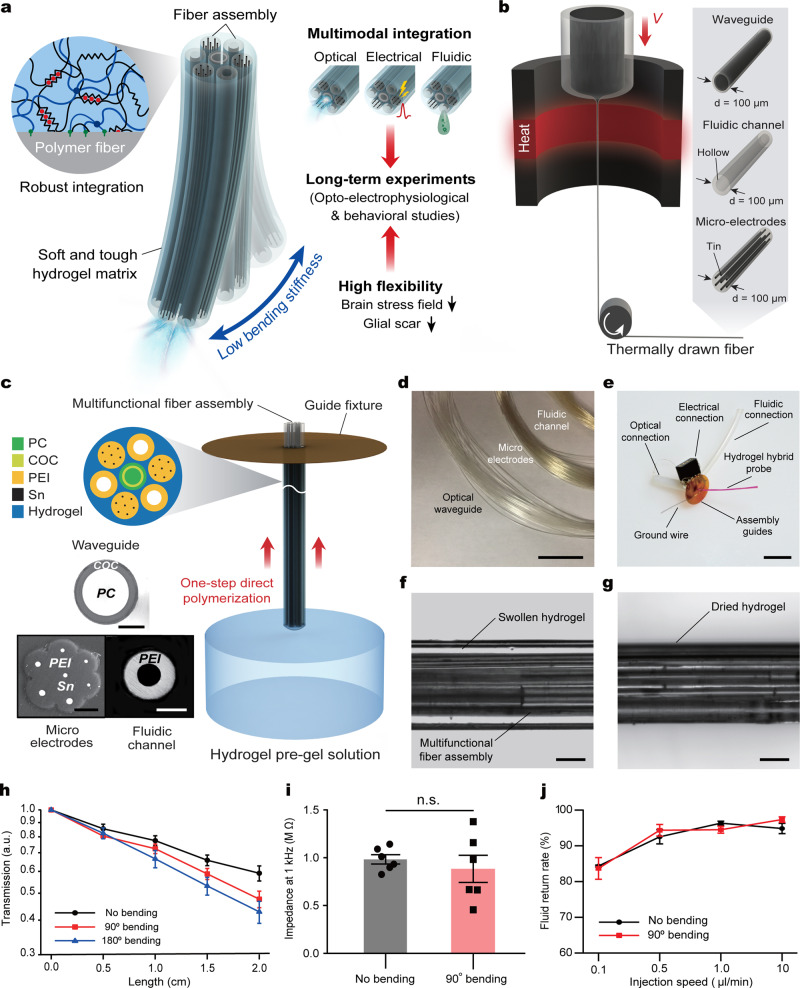
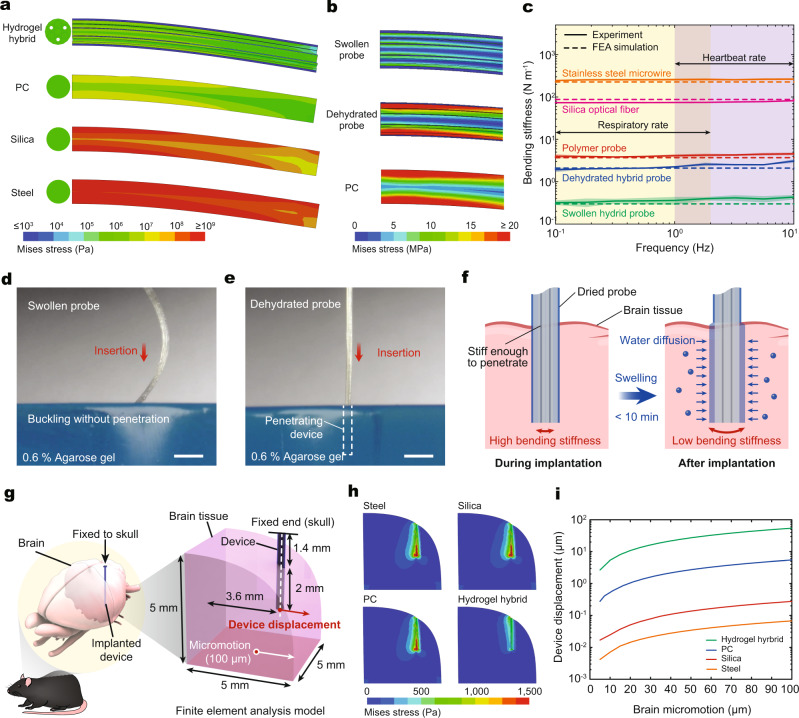
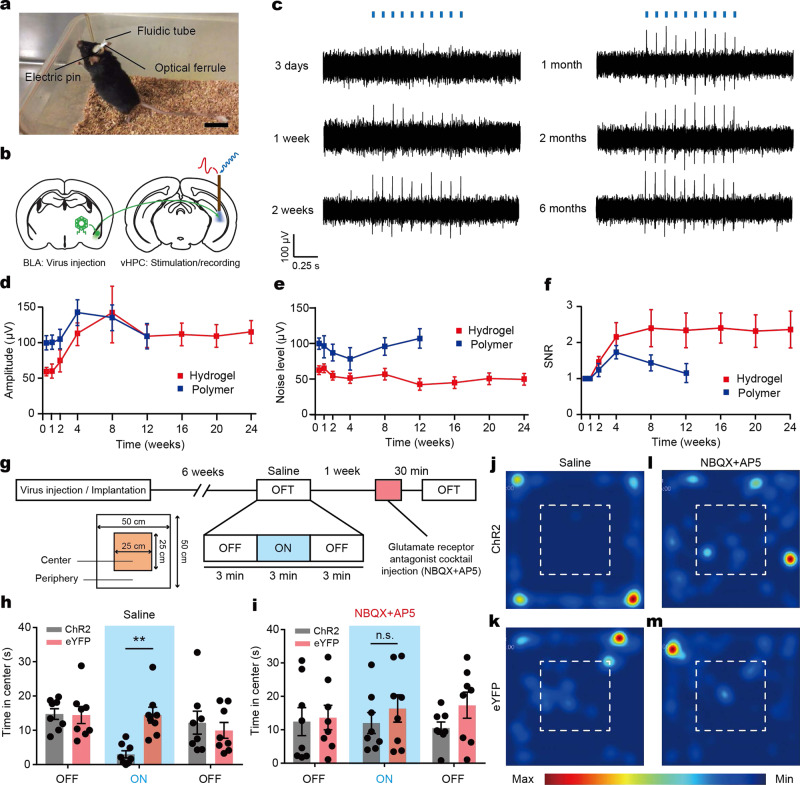
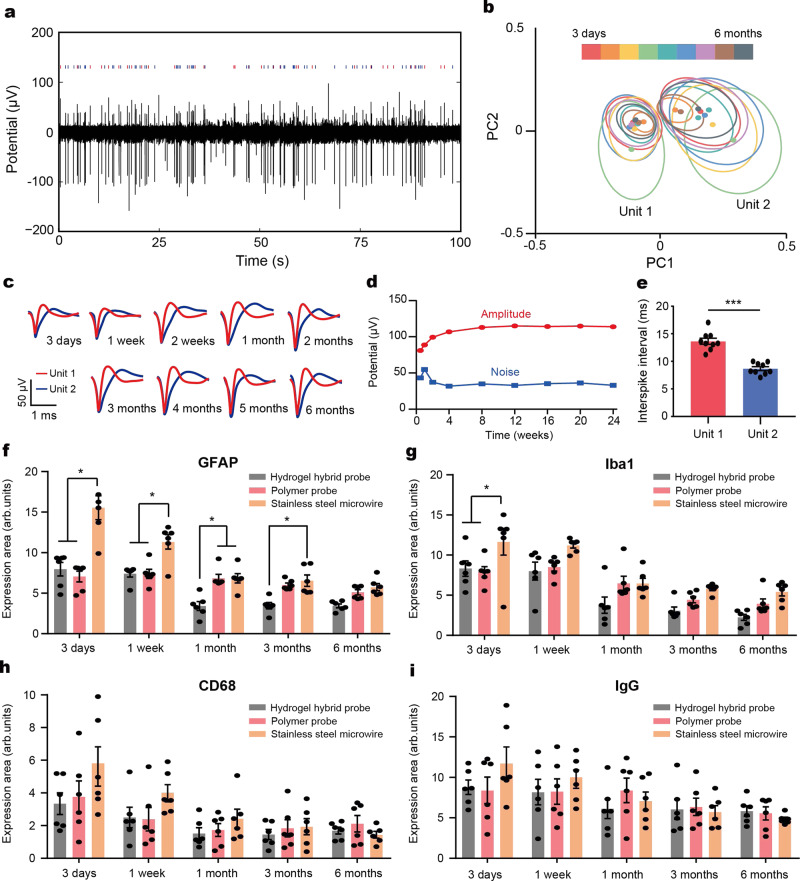
To understand the underlying mechanisms of progressive neurophysiological phenomena, neural interfaces should interact bi-directionally with brain circuits over extended periods of time. However, such interfaces remain limited by the foreign body response that stems from the chemo-mechanical mismatch between the probes and the neural tissues. To address this challenge, we developed a multifunctional sensing and actuation platform consisting of multimaterial fibers intimately integrated within a soft hydrogel matrix mimicking the brain tissue. These hybrid devices possess adaptive bending stiffness determined by the hydration states of the hydrogel matrix. This enables their direct insertion into the deep brain regions, while minimizing tissue damage associated with the brain micromotion after implantation. The hydrogel hybrid devices permit electrophysiological, optogenetic, and behavioral studies of neural circuits with minimal foreign body responses and tracking of stable isolated single neuron potentials in freely moving mice over 6 months following implantation.
Overview
The claims and statistics of this paper haven’t been checked yet.
Free: it reads the open-access text and checks the first 5 claims that cite a source we can check. Create a free account to check every claim.
Integrity signals
Registry
Cites
Statistics
Figures
Verification
Claims the paper makes
The claims and statistics of this paper haven’t been checked yet.
Free: it reads the open-access text and checks the first 5 claims that cite a source we can check. Create a free account to check every claim.
Claims other papers make about this one
Each is checked against this paper’s own text: does it say what the citing paper says it does?
The source backs part of the claim, not all of it — or backs it for a different population, condition or comparison.
In the citing paper
“As a material whose features resemble water-rich tissue in the human body, hydrogels can greatly reduce the inflammatory response of foreign objects, regulate cell or protein attachment, and prevent device failure in vivo,[52] which is important for implants.[53,54]”
From Flexible Electronics and Devices as Human–Machine Interfaces for Medical Robotics (2022) · cites this paper as [52]
Experimental — accuracy not yet measuredThe source backs part of the claim, not all of it — or backs it for a different population, condition or comparison.
In the citing paper
“Consequently, many integrated flexible stimulation systems can also perform electrophysiological recording.[52]”
From Flexible Electronics and Devices as Human–Machine Interfaces for Medical Robotics (2022) · cites this paper as [52]
Experimental — accuracy not yet measured
Self-check
Percentages, sums and reported differences re-computed from the paper’s own numbers.
The self-check needs the paper’s full text.
Citations
Cites
Highly stretchable and tough hydrogels
Sun, J.-Y., Zhao, X., Illeperuma, W. R. K., Chaudhuri, O., Oh, K. H., Mooney, D. J., Vlassak, J. J., & Suo, Z. (2012) · Nature · doi:10.1038/nature11409 · Cited by 5,481
Self-citationHydrogels for Tissue Engineering
Lee, K. Y., & Mooney, D. J. (2001) · Chemical Reviews · doi:10.1021/cr000108x · Cited by 5,277
Neurodegenerative Disorders: Parkinson's Disease and Huntington's Disease
Hague, S., Klaffke, S., & Bandmann, O. (2006) · IMPERIAL COLLEGE PRESS eBooks · doi:10.1142/9781860948961_0007 · Cited by 2,766
Response of brain tissue to chronically implanted neural electrodes
Polikov, V. S., Tresco, P. A., & Reichert, W. M. (2005) · Journal of Neuroscience Methods · doi:10.1016/j.jneumeth.2005.08.015 · Cited by 1,896
Stretchable, Transparent, Ionic Conductors
Keplinger, C., Sun, J.-Y., Foo, C. C., Rothemund, P., Whitesides, G. M., & Suo, Z. (2013) · Science · doi:10.1126/science.1240228 · Cited by 1,754
Optical Deconstruction of Parkinsonian Neural Circuitry
Gradinaru, V., Mogri, M., Thompson, K. R., Henderson, J. M., & Deisseroth, K. (2009) · Science · doi:10.1126/science.1167093 · Cited by 1,526
Tough bonding of hydrogels to diverse non-porous surfaces
Yuk, H., Zhang, T., Lin, S., Parada, G. A., & Zhao, X. (2016) · Nature Materials · doi:10.1038/nmat4463 · Cited by 1,184
Self-citationElectronic dura mater for long-term multimodal neural interfaces
Minev, I. R., Musienko, P., Hirsch, A., Barraud, Q., Wenger, N., Moraud, E. M., Gandar, J., Capogrosso, M., Milekovic, T., Asboth, L., et al. (2015) · Science · doi:10.1126/science.1260318 · Cited by 1,082
Skin-inspired hydrogel–elastomer hybrids with robust interfaces and functional microstructures
Yuk, H., Zhang, T., Parada, G. A., Liu, X., & Zhao, X. (2016) · Nature Communications · doi:10.1038/ncomms12028 · Cited by 1,035
Self-citationBioresorbable silicon electronic sensors for the brain
Kang, S.-K., Murphy, R. K. J., Hwang, S.-W., Lee, S. M., Harburg, D. V., Krueger, N. A., Shin, J., Gamble, P., Cheng, H., Yu, S., et al. (2016) · Nature · doi:10.1038/nature16492 · Cited by 998
Research works printed but not linked: 1
- 13. Park, S. I. et al. Soft, stretchable, fully implantable miniaturized optoelectronic systems for wireless optogenetics. Nat. Biotechnol. 33, 1280 (2015). · DOI · Paper page
Cited by
Items 201–300 of 334
Zhang, Q., He, S., Mei, A., Xia, W. J., Cao, Y., Zhang, Z., Jia, J., Yang, J., Li, J., Luo, G., et al. (2025) · Advanced Functional Materials · doi:10.1002/adfm.202423048 · Cited by 11
Monolithic multimodal neural probes for sustained stimulation and long-term neural recording
Zhang, L., Wang, S., Xia, J., Li, B., Zhang, S., Luo, J., Zhang, F., Zheng, T., Pan, G., Hasan, T., et al. (2025) · Science Advances · doi:10.1126/sciadv.adu1753 · Cited by 8
“Neural probes with integrated neural optical stimulation during electrical recording are a basic tool in brain optogenetics ( 15 – 23 ).”
Wearable Bioelectronics: Toward Future Personal Health Monitoring
Li, B., Wang, Y., Mei, J., & He, X. (2026) · BIO Integration · doi:10.15212/bioi-2025-0219 · Cited by 9
Choi, H., Kim, S., Kim, S., Park, J., An, S., Yoon, S., Shin, M., Cho, S., & Son, D. (2026) · Advanced Science · doi:10.1002/advs.202518255 · Cited by 10
Lee, D., Kim, S. A., Shim, B.-J., Lee, Y., Kim, T. Y., Park, S., Lee, Y., Choi, H. G., Son, K., Han, S. B., et al. (2026) · Advanced Materials · doi:10.1002/adma.202515767 · Cited by 12
Self-citationYiming, B., Zhang, Z., Ali, N., Lu, Y., Qu, S., Zhu, S., Creton, C., & Jia, Z. (2023) · Advanced Electronic Materials · doi:10.1002/aelm.202300069 · Cited by 8
Cerezo‐Sánchez, M., McGlynn, E., Bartoletti, S., Yalagala, B. P., Garofani, B. C., Capodiferro, A., Russell, E., Palazzolo, G., Walton, F., Curia, G., et al. (2023) · Advanced NanoBiomed Research · doi:10.1002/anbr.202200117 · Cited by 8
Progress in Mechanical Modeling of Implantable Flexible Neural Probes
You, X., Bai, R., Xue, K., Zhang, Z., Wang, M., Wang, X., Wang, J., Guo, J., Shen, Q., Chang, H., et al. (2024) · Computer Modeling in Engineering & Sciences · doi:10.32604/cmes.2024.049047 · Cited by 11
Wan, S., Huang, H., He, Z., Ye, Y., Li, S., Su, S., Shen, J., Han, L., Wan, P., Xu, R., et al. (2024) · Science China Materials · doi:10.1007/s40843-024-2985-8 · Cited by 8
Functional Hydrogels for Implantable Bioelectronic Devices
Tu, M., Zhao, T., Guo, H., Zhang, C., Liu, M., Zhang, Z., Wang, B., & Yu, H. (2025) · Luminescence · doi:10.1002/bio.70148 · Cited by 8
Flexible fibrous electrodes for implantable biosensing
Li, H., Li, C., Zhao, H., Li, Q., Zhao, Y., Gong, J., Li, G., Huan, Y., Tian, Q., Liu, Z., et al. (2025) · Nanoscale · doi:10.1039/d4nr04542d · Cited by 9
Atherton, E., Hu, Y., Brown, S., Papiez, E., Ling, V., Colvin, V. L., & Borton, D. A. (2022) · Journal of Neural Engineering · doi:10.1088/1741-2552/ac6908 · Cited by 8
Wang, Y., Wang, Q., Hu, X., He, D., Zhao, J., & Sun, G. (2022) · RSC Advances · doi:10.1039/d2ra04915e · Cited by 8
Jin, Y., Park, S., & Cho, S. (2026) · Nature Reviews Bioengineering · doi:10.1038/s44222-025-00384-5 · Cited by 9
Self-citationBiotic iontronics: foundations for the direct biotic-abiotic communication and modulation
Lei, C., He, J., Chen, W., Kong, X., & Wen, L. (2026) · Iontronics · doi:10.20517/iontronics.2026.08 · Cited by 7
Xiao, W., Liu, J., Lu, Z., Zhang, P., Wei, H., & Yu, Y. (2023) · ACS Macro Letters · doi:10.1021/acsmacrolett.2c00759 · Cited by 7
Multiscale Engineering of Ion‐Conducting Gels for Sustainable Bioelectronic Systems
Kim, J. H., Choi, W. H., Kim, J. H., Park, Y., Yun, S., Kim, T., & Kim, D. H. (2025) · Small Methods · doi:10.1002/smtd.202501625 · Cited by 6
Emerging strategies to engineer decellularized extracellular matrix in wound treatment
Xue, W. L., Sun, X., Xia, Y., Jiang, X., Duan, B., & Liu, X. (2025) · Chemical Engineering Journal · doi:10.1016/j.cej.2025.162270 · Cited by 8
Structural and Functional Designs of Advanced Neural Electrodes
Cheng, J., Xiao, M., & Li, Z. (2025) · ACS Applied Materials & Interfaces · doi:10.1021/acsami.5c15407 · Cited by 6
Multimodal integrated flexible neural probe for in situ monitoring of EEG and lactic acid
Zhang, L., Xia, J., Li, B., Cao, Z., & Dong, S. (2024) · RSC Advances · doi:10.1039/d4ra06336h · Cited by 6
Expansion mechanics of hydrogel-driven metamaterials with multiple deformation modes
Tao, R., Guo, Y., Li, J., Luo, J., Yang, Q., Chen, Y., & Wu, W. (2024) · Giant · doi:10.1016/j.giant.2024.100243 · Cited by 6
Cracking modes and force dynamics in the insertion of neural probes into hydrogel brain phantom
Li, G., Jang, D., Shin, Y., Qiang, Y., Qi, Y., Wang, S., & Fang, H. (2024) · Journal of Neural Engineering · doi:10.1088/1741-2552/ad5937 · Cited by 6
“Current neural probe designs are continuously evolving with variations in functions, footprints, and materials ( e.g. polymers, metals, and silicon) [4–7].”
BackgroundDesign of soft and hard active-passive composite beams
Ehrenhofer, A. (2022) · Mechanics of Advanced Materials and Structures · doi:10.1080/15376494.2022.2141387 · Cited by 6
Ahmed, B., Binder, S., Boroomand, S., Strathman, H. J., Hantak, M. P., Shepherd, T., Ehrenhofer, A., Zhang, H., Shepherd, J. D., Solzbacher, F., et al. (2023) · bioRxiv (Cold Spring Harbor Laboratory) · doi:10.1101/2023.08.08.552362 · Cited by 6
“A simulation of the mechanical behavior by means of a 3D Finite-Element model showed a bending stiffness of 280 to 325Nm−1, which is comparable to the stiffness of implantable optical fiber microelectrodes [16] (Fig.”
Zhang, C., Zheng, Q., Li, C., Zhu, Y., Ji, J., Yang, G., Guo, C., Wang, Y., Zhu, Q., Zhu, W., et al. (2025) · Analytical Chemistry · doi:10.1021/acs.analchem.5c00640 · Cited by 5
Magnetic‐Driven Torque‐Induced Electrical Stimulation for Millisecond‐Scale Wireless Neuromodulation
Cheng, C., Chen, L., Tseng, G., Huang, J., Ting, Y., & Chiang, P. (2025) · Advanced Healthcare Materials · doi:10.1002/adhm.202500805 · Cited by 5
Li, W., Zou, H., Yang, B., Xiao, L., Liu, S., Chen, Z., Xie, L., Zhu, W., Zhao, X. Q., Wang, L., et al. (2025) · Small Methods · doi:10.1002/smtd.202501471 · Cited by 6
Self-citationPan, H., Zheng, J., Xu, S., Pan, J., Hou, K., Chen, G., & Zhu, M. (2026) · ACS Nano · doi:10.1021/acsnano.5c19710 · Cited by 5
Engineered Optical Fibers for Deep‐Tissue Applications
Li, Y., Zheng, S., Li, W., Chen, K., Zhong, T., Woo, C. M., Pang, W., Yuan, C., Xiao, X., Yang, X., et al. (2026) · Advanced Optical Materials · doi:10.1002/adom.202502861 · Cited by 5
Xuan, C., Jia, Y., Chai, M., Wang, H., Zhao, X., Yang, W., Liu, X., Cao, C., Wu, W., Jiang, Y., et al. (2026) · Nature Biomedical Engineering · doi:10.1038/s41551-026-01705-8 · Cited by 5
Self-citationSoft biocompatible polymer optical fiber tapers for implantable neural devices
Meneghetti, M., Wang, J., Sui, K., Berg, R. W., & Markos, C. (2024) · Optics Letters · doi:10.1364/ol.546470 · Cited by 5
Ding, J., Tian, Y., Zeng, M., Zhang, Y., Chen, Z., Liu, X., Xiao, Z., Wu, C., Wei, D., Sun, J., et al. (2025) · Chemical Engineering Journal · doi:10.1016/j.cej.2025.160263 · Cited by 5
Greenhorn, S., Auzély‐Velty, R., Claude Verdier, A., Weber, M. J., Jeacomine, I., Zekentes, K., Bano, E., & Stambouli, V. (2025) · Surface and Coatings Technology · doi:10.1016/j.surfcoat.2025.132299 · Cited by 5
He, Q., Zhao, C., Jiang, Y., Liu, J., Liu, X., Jia, R., Yang, C., Liao, M., Zhao, Y., Kong, D., et al. (2025) · Chemical Engineering Journal · doi:10.1016/j.cej.2025.170043 · Cited by 4
Liu, Z., Liu, J., Zhang, P., & Xu, X. (2025) · Polymers · doi:10.3390/polym18010020 · Cited by 5
“In vivo, the benefits of these hybrid architectures become evident through reduced impedance drift, improved signal-to-noise ratio, and attenuated glial encapsulation [71].”
Li, M., Zhang, J., & Li, R. (2026) · Advanced Healthcare Materials · doi:10.1002/adhm.202504152 · Cited by 4
Sensing and Stimulating Electrodes for Electroceuticals
Liu, X., Wang, K., González‐González, M. A., Romero‐Ortega, M. I., & Wallace, G. G. (2022) · Frontiers in Sensors · doi:10.3389/fsens.2022.873862 · Cited by 4
“For example, functional polymer fibers were integrated into poly (acrylamide)-alginate hydrogel to achieve stable electrophysiological activity recording for up to 6 months (Park et al., 2021).”
MethodZhao, Y., Sun, R., Wang, Z., Ma, S., Wang, R., Li, F., & Geng, H. (2025) · ACS Applied Bio Materials · doi:10.1021/acsabm.5c01269 · Cited by 4
Stranahan, A. M., Tabet, A., & Anikeeva, P. (2023) · Brain Behavior and Immunity · doi:10.1016/j.bbi.2023.09.021 · Cited by 4
Self-citationEfficient taper optical hydrogel fiber coupler drawn from suspended photocuring 3D printing
Zhuo, X., Zhou, L., Bian, Y., & Shen, H. (2022) · Optics Letters · doi:10.1364/ol.470543 · Cited by 4
Machine learning-driven inverse design of puncture needles with tailored mechanics
Huang, Y., Zhang, F., Zhang, F. J., Wu, X., & Xinye, Y. (2025) · Minimally Invasive Therapy & Allied Technologies · doi:10.1080/13645706.2025.2537927 · Cited by 3
“For instance, prostate biopsies require needles that precisely locate targets while minimizing surrounding tissue damage, whereas thermal ablation treatments demand needles with good thermal conductivity and stability [11,12].”
Review of Multifunctional Neural Probe
Jia, Z., & Yoon, Y. (2025) · Advanced Materials Interfaces · doi:10.1002/admi.202401033 · Cited by 3
Friend, Not Foe: Lowered Tissue Reactivity to Long‐Term Polyimide Implants
Orlemann, C., Santis, L. M. D., Neering, P., Boehler, C., Sharma, K., Aarts, A. A. A., Holzhammer, T., van Daal, R. J. J., Ruther, P., Asplund, M., et al. (2026) · Advanced Science · doi:10.64898/2026.02.06.703281 · Cited by 3
Functional Fibers in Soft Robotics: Advances in Material, Structural, and Systemic Tactics
Won, J., Jang, J., Kim, H., Choi, I. S., Park, S., & Park, S. (2026) · Advanced Robotics Research · doi:10.1002/adrr.202500209 · Cited by 3
Self-citationImplantable microelectrode biosensors for monitoring neurometabolic markers
Fernandes, E., Ledo, A., & Barbosa, R. M. (2026) · Bioelectrochemistry · doi:10.1016/j.bioelechem.2026.109286 · Cited by 5
Won, C., Cho, Y. U., Kweon, S., Cho, S., Kwon, C., Kim, H. W., Lee, J. Y., Park, S. H., Han, S., Kim, Y. W., et al. (2026) · Science Advances · doi:10.1126/sciadv.aee2754 · Cited by 3
Self-citationTechnology roadmap from fiber materials to fiber electronics
Zhang, S., Chen, L., Chen, P., Cui, W., Ding, B., Ding, L., Gao, C., Huang, Y., Lei, T., Liao, M., et al. (2026) · National Science Review · doi:10.1093/nsr/nwag368 · Cited by 3
Tissue-adhesive hydrogel optical fiber for peripheral optogenetic neuromodulation
Chen, X., Wang, L., Wang, C., Wang, Y., Shan, L., Xue, Y., Ma, Z., Yu, C., Lu, Y., & Liu, J. (2026) · Nature Communications · doi:10.1038/s41467-026-74831-1 · Cited by 4
“11), approximately 4 – 5 orders lower than that of silica ( ∼ 50 GPa) or polycarbonate (PC, ∼ 3 GPa) fi bers 13 , with robust tensile strength (445±64 kPa) and stretchability (176 ±24%).”
InfluentialLang, W., Zhang, W., Zhang, N., Huang, H., Lin, F., Ge, A., Xue, B., & Yang, S. (2025) · Macromolecules · doi:10.1021/acs.macromol.4c03103 · Cited by 3
Multimodal Layer‐Crossing Interrogation of Brain Circuits Enabled by Microfluidic Axialtrodes
Sui, K., Codadu, N. K., Rathore, D., Li, G., Meneghetti, M., Bøcker, A. L., Berg, R. W., Wykes, R. C., & Markos, C. (2026) · Advanced Science · doi:10.1002/advs.202519744 · Cited by 3
“Despite the pronounced loss in the blue region of the spectrum (470 nm), optical neuromodulation can still be achieved since only a short length of fiber is needed for implantation 11,12,24,27 .”
Photolithographic Fabrication of Mechanically Adaptive Devices
Monney, B., Kilchoer, C., & Weder, C. (2021) · ACS Polymers Au · doi:10.1021/acspolymersau.1c00037 · Cited by 4
Soft integration of a neural cells network and bionic interfaces
Zhang, J., Wang, T., Zhang, Y., Lu, P., Shi, N., Zhu, W., Cai, C., & He, N. (2022) · Frontiers in Bioengineering and Biotechnology · doi:10.3389/fbioe.2022.950235 · Cited by 4
“These hydrogel-based brain–computer interfaces are expected to be able to conduct light, electricity, and molecules all at once (Park et al., 2021).”
BackgroundHydrogel fibers that enable optogenetic pain inhibition during locomotion
(2023) · Nature Methods · doi:10.1038/s41592-023-02022-7 · Cited by 3
“However, in the future, their array of functions can be expanded to other hydrogel-based functional components, such as microelectrodes for electrophysiology 5 .”
BackgroundHan, H., Han, S., Sim, S., Cho, I., & Kim, J. (2024) · IEEE International Conference on Micro Electro Mechanical Systems (MEMS) · doi:10.1109/mems58180.2024.10439368 · Cited by 3
Stretchable Microwrinkled Soft Neural Probe With Minimized Insertion Shuttle for Low Invasion
You, X., Wang, J., Liu, Q., Sun, F., Zhou, Y., Jin, M., Bai, R., Zhang, Z., Wang, M., Chang, H., et al. (2024) · IEEE Sensors Journal · doi:10.1109/jsen.2024.3429130 · Cited by 2
“The softer materials, such as silicone [15], shape memory polymers (SMPs) [16], and hydrogel [17], can adapt to the deformation of brain tissue much better.”
BackgroundFracture of multilayer soft materials
Yu, K., Cai, Y., & Jia, Z. (2024) · Engineering Fracture Mechanics · doi:10.1016/j.engfracmech.2024.110747 · Cited by 2
Liu, C., Liu, Z., Zhang, Y. X., Qin, Y., Zhang, M., Jin, W., Gu, W., Shi, C., & Yuan, L. Y. L. (2026) · ACS Sensors · doi:10.1021/acssensors.5c03604 · Cited by 2
Huang, J., Li, W., Zhou, Y., Wei, L., & Dong, C. (2026) · npj Flexible Electronics · doi:10.1038/s41528-026-00580-2 · Cited by 2
“In laboratory settings, the multifunctional fi ber utilizes modality-speci fi c strategies for small-scale backend connectorization, such as ferrule-based opticaltermination,conductivesolderingorpaintingtopinconnectors,and epoxy-sealedmicro fl uidic tubing integration 4,83 .”
InfluentialA Radial Modulus‐Gradient Fiber for Chronic Recording and Decoding in Deep Brain
Wang, L., Tang, C., Han, Z., Zhong, H., Zhang, K., Xie, Z., Guan, H., Zhai, P. C., Li, H., Liang, J., et al. (2026) · Advanced Materials · doi:10.1002/adma.202519697 · Cited by 2
Supramolecular Interaction Mediated Affine Deformation for Energy‐Dissipative Stiff Hydrogel
Xu, L., Li, B., Wan, B., Yang, H., Ke, Y., Zhu, B., & 邱东 (2026) · Advanced Materials · doi:10.1002/adma.73369 · Cited by 2
Cidonio, G., Brancato, V., Scognamiglio, C., Marzi, M., Barbetta, A., Riminucci, M., Nicassio, F., & Ruocco, G. (2023) · Tissue Engineering Part A · doi:10.1089/ten.tea.2023.29046.abstracts · Cited by 2
Design and application of thermally drawn multimaterial electronic fiber devices for smart sensing
Jin, Z., Geng, H., Liu, R., Wang, Y., Jin, Y., Zhu, L., Wang, H., Yan, W., & Zhu, M. (2024) · Chinese Science Bulletin (Chinese Version) · doi:10.1360/tb-2024-0837 · Cited by 2
Huang, H., Liu, Y., Yang, S., Hu, S. N., English, D. F., & Jia, X. (2025) · bioRxiv (Cold Spring Harbor Laboratory) · doi:10.1101/2025.06.29.662251 · Cited by 2
The application of advanced hydrogel in bioelectronics
Xia, X. (2024) · Theoretical and Natural Science · doi:10.54254/2753-8818/45/20240477 · Cited by 1
Artificial Tissues and Organs: Revolutionizing and Pioneering the Future of Medicine and Healthcare
Yadav, M., Kumar, A., & Verma, G. C. (2024) · Biomedical materials for multi-functional applications · doi:10.1007/978-981-97-5456-4_7 · Cited by 2
Review on Biological-based Hydrogels for Advanced Applications
Zhang, Y. (2025) · Applied and Computational Engineering · doi:10.54254/2755-2721/2025.24418 · Cited by 1
Junior, A. G. L., Nedoma, J., & Martinek, R. (2025) · IEEE Internet of Things Journal · doi:10.1109/jiot.2025.3622344 · Cited by 1
“Human-centric design must prioritize comfort and user-friendliness, especially in wearables, to ensure compliance and long-term use [201].”
Reliable AI Platform for Monitoring BCI Caused Brain Injury and Providing Real‐Time Protection
He, C., Ding, Y., Rabczuk, T., & Ding, C. (2025) · Advanced Science · doi:10.1002/advs.202506747 · Cited by 1
Zhuochen, 马. M., Zhengnan, 吴. W., Leshui, 余. Y., & Bing, 韩. H. (2026) · Laser & Optoelectronics Progress · doi:10.3788/lop252099 · Cited by 1
Engineering Skin–Electrode Interfaces for High-Fidelity, Long-Term Electrophysiological Monitoring
Feng, X., Ahn, J., You, Y., & Wang, B. (2026) · ACS Applied Electronic Materials · doi:10.1021/acsaelm.6c00488 · Cited by 1
Hydrogels and the Brain: Recent Advances in Neuroelectronic Devices
Heydari, M., Farahani, E., Shamshiri, M., Nematipour, S., Dorosti, N., & Taghipoor, M. (2026) · IntechOpen eBooks · doi:10.5772/intechopen.1014533 · Cited by 1
Soft Depth Neural Probes Enable Chronic Recordings from the Rat Brainstem
Alwahab, N. S. A., Furfaro, I., Rizzo, O., Lavado, E. F., Galan, K., Schiavone, G., & Lacour, S. P. (2026) · ACS Applied Bio Materials · doi:10.1021/acsabm.6c00412 · Cited by 1
Design and Manufacturing Principles of Smart Fibers
Wang, Y., Radtke, G., Peters, M. M., Lee, Y., Kawai, M., & Parker, K. K. (2026) · Advanced Materials · doi:10.1002/adma.73959 · Cited by 1
“Incorporating multifunctional designs, even logic circuits, into fibers grants systems greater accessibility to diverse sources of data, thereby improving both sensing resolution and processing efficiency [ 355–358 ] (Figure 15ai ).”
Yu, C., Liu, X., Wang, W. M., Zhang, J., Zeng, L., & Wang, J. (2026) · Analytical Chemistry · doi:10.1021/acs.analchem.6c02353 · Cited by 1
Li, Y., He, Z., Chen, X., Pan, L., Yu, Y., & Liu, C. (2026) · Advanced Materials Technologies · doi:10.1002/admt.71214 · Cited by 1
Su, J., Wang, H., Han, L., Cheng, R., Hao, R., & Sang, S. (2026) · Journal of Zhejiang University. Science A · doi:10.1631/jzus.a2600114 · Cited by 1
Optofluidic neural interfaces for in vivo photopharmacology
Frank, J. A. (2022) · Current Opinion in Pharmacology · doi:10.1016/j.coph.2022.102195 · Cited by 1
MRI COMPATIBLE MULTIFUNCTIONAL CARBON NANOFIBER NEURAL PROBE
Jia, Z., Rustogi, P., Judy, J. W., & Yoon, Y. (2022) · Solid-State Sensors, Actuators, and Microsystems Workshop (Hilton Head Workshop) · doi:10.31438/trf.hh2022.58 · Cited by 1
Recent progress in brain signal monitoring and neuromodulation technologies
Liang, Q., & Zhang, Q. M. (2023) · Chinese Science Bulletin (Chinese Version) · doi:10.1360/tb-2023-0798 · Cited by 1
Implantable soft electronics and sensors
Lim, H. (2024) · Elsevier eBooks · doi:10.1016/b978-0-323-99147-6.00011-9 · Cited by 1
Rousseau, E. B., Jackson, H. D., Guha, S. K., Sherman, S., Cima, M. J., & Chartoff, E. H. (2024) · Neuroscience · doi:10.1016/j.neuroscience.2024.10.047 · Cited by 1
Anti-fatigue, self-bonding, adhesive gels for easy-to-prepare 3D stacking flexible electronics
Shi, H., Wang, X., Guo, H., Yang, Y., & Yang, Y. (2025) · Journal of Materials Chemistry C · doi:10.1039/d4tc04784b · Cited by 1
Wireless Brain Oscillation Control via Magnetoelectric Stimulation with Millisecond PrecisionPreprint
Cheng, C., Chen, L., Huang, M.-Y., Tseng, C.-N., Ting, Y., Tseng, G., Huang, J., Wu, C.-H., & Chiang, P. (2024) · Research Square · doi:10.21203/rs.3.rs-3959025/v1 · Cited by 1
Yankun, 齐. Q., Zhihao, 张. Z., Lü, 吕. S., & Shifeng, 周. Z. (2023) · Laser & Optoelectronics Progress · doi:10.3788/lop230987
Yiheng, 唐. T., Yang, 翁. W., Zequn, 陈. C., Xiaojing, 李. L., Ke, 斯. S., Wei, 龚. G., Hongtao, 林. L., & Li, L. (2023) · Laser & Optoelectronics Progress · doi:10.3788/lop231425
Flexible intracortical probes for stable neural recording: from the perspective of structure
Wang, S., Jiang, Q., & Song, J. (2024) · Flexible and Printed Electronics · doi:10.1088/2058-8585/ad71dc
“Several materials with such properties have been developed, including shape memory polymers (SMP) [75–80], nanocomposites [81–83], liquid crystal polymers [84], and hydrogels [85].”
Advanced Fibers for Optogenetic Modulation
Du, M., & Zhou, S. (2024) · Wiley eBooks · doi:10.1002/9783527839322.ch7
Novel Functional Fibers for Neural Interfacing
Jiang, S., & Jia, X. (2024) · Wiley eBooks · doi:10.1002/9783527839322.ch8
Conductive Hydrogels for brain–computer interfaces
Shen, Z., Khan, W. U., & Zhang, Q. M. (2025) · Elsevier eBooks · doi:10.1016/b978-0-443-16168-1.00018-0
A Biocompatible Strain Sensor Based on Ni-GaIn and SA-Doped PAAM for Implantable Bioelectronics
Tu, M., Liang, J., Guo, H., Zhao, T., & Yu, H. (2025) · Lecture notes in computer science · doi:10.1007/978-981-96-0795-2_31
Ying, 刘. L., Yihao, 吴. W., Zhibo, 李. L., Jie, 毛. M., Zaijin, 方. F., Du, M., & Tuan, 郭. G. (2025) · Infrared and Laser Engineering · doi:10.3788/irla20250022
Development and challenges of implantable neural electrodes in brain-computer interface technology
Tian, Y., Wang, A., Jing, Y., & Bai, S. (2025) · Scientia Sinica Chimica · doi:10.1360/ssc-2025-0107
Greenhorn, S., Coizet, V., Terral, O., Dupuit, V., Fernandez, B., Bres, G., Claudel, A., GASNER, P., Warnking, J. M., Barbier, E., et al. (2025) · Biomedical Physics & Engineering Express · doi:10.1088/2057-1976/ae0d94
Seo, D., Jeong, S., & Kim, H. (2025) · Journal of the Korean Society for Precision Engineering · doi:10.7736/jkspe.d.25.00003
Surface Engineering of Neural Implants
Rasulov, A., Yaxshinorov, H., Abdisattorov, J., Berdimurodov, E. T., Dagdag, O., Rbaa, M., Mamanazarov, M., & Berdimuradov, K. (2025) · Royal Society of Chemistry eBooks · doi:10.1039/9781837676606-00320
Multifunctional Polymer Optical Fibers for Neuroscience
Sui, K., Meneghetti, M., Ioannou, A., Li, G., Wang, J., Nielsen, K., Kalli, K., Berg, R. W., & Markos, C. (2025) · Annual International Conference of the IEEE Engineering in Medicine and Biology Society (EMBC) · doi:10.1109/embc58623.2025.11253049
“This streamlined fabrication approach substantially reduces costs compared to conventional techniques such as microfabrication and photolithography [6], [7], [8].”
Wen, Y., Wang, X., Zhao, J., Zhai, X., Xia, W., Li, P., Lai, K., Zhu, M., 林正德, Luo, T., et al. (2025) · Advanced Materials Technologies · doi:10.1002/admt.202502127
Giannotti, A., Santanché, R., Zinno, C., Carpaneto, J., Micera, S., & Riva, E. R. (2024) · Figshare · doi:10.6084/m9.figshare.26839025
Naghib, S. M. (2025) · Series in bioengineering · doi:10.1007/978-981-95-1888-3_2
Pareto-optimization of hypodermic needles with respect to flow, buckling and piercing
Humer, A., Ehrenhofer, A., Wallmersperger, T., & Krommer, M. (2026) · Acta Mechanica · doi:10.1007/s00707-025-04543-y · Cited by 2
Metadata
- Authors
- Park, S., Yuk, H., Zhao, R., Yim, Y. S., Woldeghebriel, E. W., Kang, J., Canales, A., Fink, Y., Choi, G. B., Zhao, X., & Anikeeva, P.
- Affiliations
- Korea Advanced Institute of Science and Technology (KR)
- Massachusetts Institute of Technology (US)
- The Ohio State University (US)
- McGovern Institute for Brain Research (US)
- Institute for Soldier Nanotechnologies (US)
- Corresponding author
- Zhao, Xuanhe
- Anikeeva, Polina
- ORCID
- Venue
- Nature Communications
- Published
- 2021-06-08
- Volume
- 12
- Issue
- 1
- Pages
- 3435-3435
- ISSN
- 2041-1723 (ISSN-L)
- PMC
- PMC8187649
- OpenAlex
- W3168009682
- Semantic Scholar
- 7839d6da46ddf95544a4fefa83d5e067981c25fd
- Cited by
- 312
- References
- 46
- Citations by year
- 2026: 42 · 2025: 74 · 2024: 72 · 2023: 67 · 2022: 41 · 2021: 16
- FWCI
- 22.59
- Type
- journal article
- Language
- en
- Open access
- gold
- doi.org
- Licence
- cc-by
- creativecommons.org/licenses/by/4.0 (tdm)
- creativecommons.org/licenses/by/4.0 (vor)
- Locations
- Nature Communications (publishedVersion, cc-by)
- PubMed Central (publishedVersion, cc-by)
- PubMed (publishedVersion)
- RePEc: Research Papers in Economics (submittedVersion)
- DOAJ (DOAJ: Directory of Open Access Journals) (submittedVersion, cc-by-sa)
- DSpace@MIT (Massachusetts Institute of Technology) (submittedVersion, cc-by-nc)
- Seoul National University Open Repository (Seoul National University) (submittedVersion)
- Funders
- National Research Foundation of Korea (2020R1C1C100758911)
- Electronics and Telecommunications Research Institute (20ZB1100)
- United States Department of Defense | United States Army | US Army Corps of Engineers | Engineer Research and Development Center (W911NF-13-D-0001)
- NSF | ENG/OAD | Division of Civil, Mechanical and Manufacturing Innovation (CMMI-1661627)
- U.S. Department of Health & Human Services | NIH | National Institute of Neurological Disorders and Stroke (5R01NS086804)
- NSF | Directorate for Mathematical & Physical Sciences | Division of Materials Research (DMR-1419807)
- NSF | ENG/OAD | Division of Engineering Education and Centers (EEC-1028725)
- Topics
- Life Sciences › Neuroscience › Cellular and Molecular Neuroscience › Neuroscience and Neural Engineering
- Physical Sciences › Materials Science › Polymers and Plastics › Conducting polymers and applications
- Physical Sciences › Materials Science › Biomaterials › Hydrogels: synthesis, properties, applications
- Keywords
- neural interfaces, foreign body reaction, optogenetics, electrophysiological recording, multimaterial fibers, freely moving mice
- MeSH terms
- Action Potentials, Animals, Behavior, Animal, Biological Assay, Brain, Foreign-Body Reaction, Male, Mice, Inbred C57BL, Neurons, Stress, Mechanical, Time Factors, Molecular Probes, Biosensing Techniques, Hydrogels, Mice, Electrophysiological Phenomena, Optogenetics
About these checks
Registry, retraction, Cites and statistics results are computed, not judged, with one exception: a printed reference that no index lists is read once by a model before it counts as a citation error. Claims are extracted by a model and kept only when their quote appears verbatim in the text; each cited source is then checked, with a model’s help, for whether it says what the claim relies on. Those verdicts can be wrong — read the claim’s quote and the cited source before relying on one.
Statistics and arithmetic are recomputed, not judged.
Confidence bands are shown only for fields calibrated on our annotated test set. None is calibrated yet, so no band is shown.
What counts as a claim ›How we measure confidence ›How we check this ›
Are you an author, or do you see a problem with this page? Request a review
Data sources
Bibliographic data: Semantic Scholar, OpenAlex, Crossref.
Contains information from the Semantic Scholar Academic Graph Datasets, made available under the ODC Attribution License (ODC-BY 1.0).
Semantic Scholar’s data is described in: Kinney, R., et al. (2023). The Semantic Scholar Open Data Platform. arXiv:2301.10140.
