

Adaptive and multifunctional hydrogel hybrid probes for long-term sensing and modulation of neural activity
Open accessThe DOI matches its Crossref record; 45 of the 46 references it cites were found in a registry or an index.
Abstract
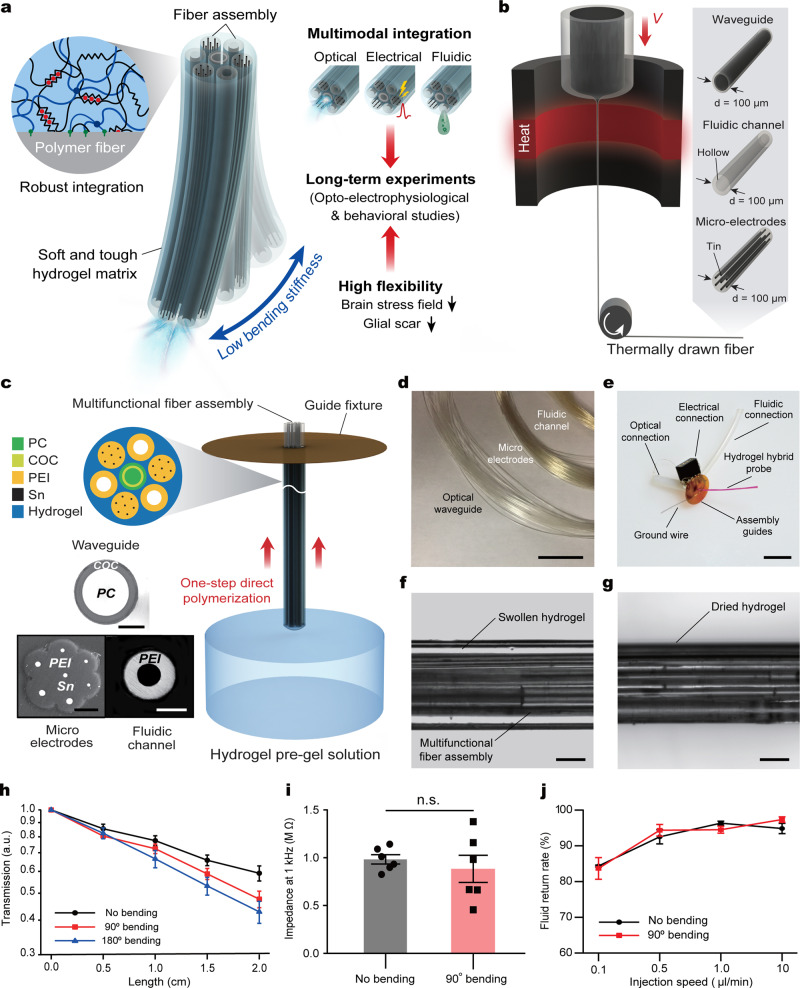
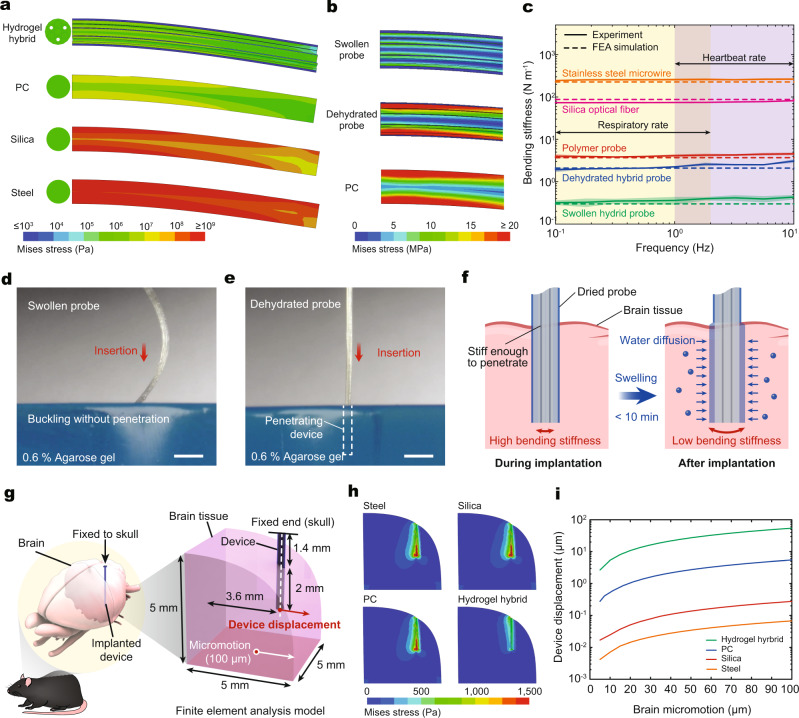
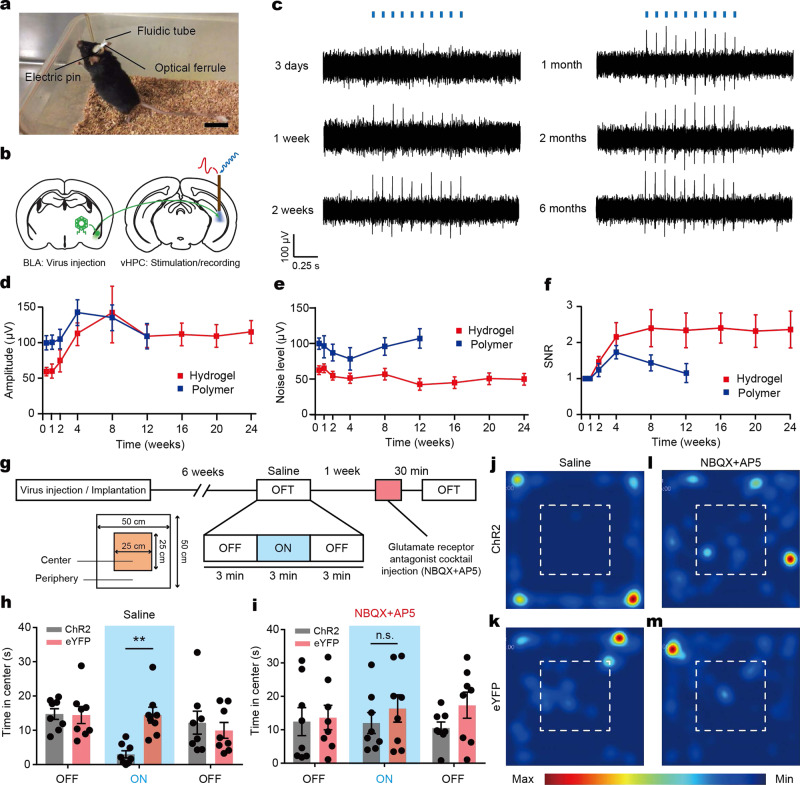
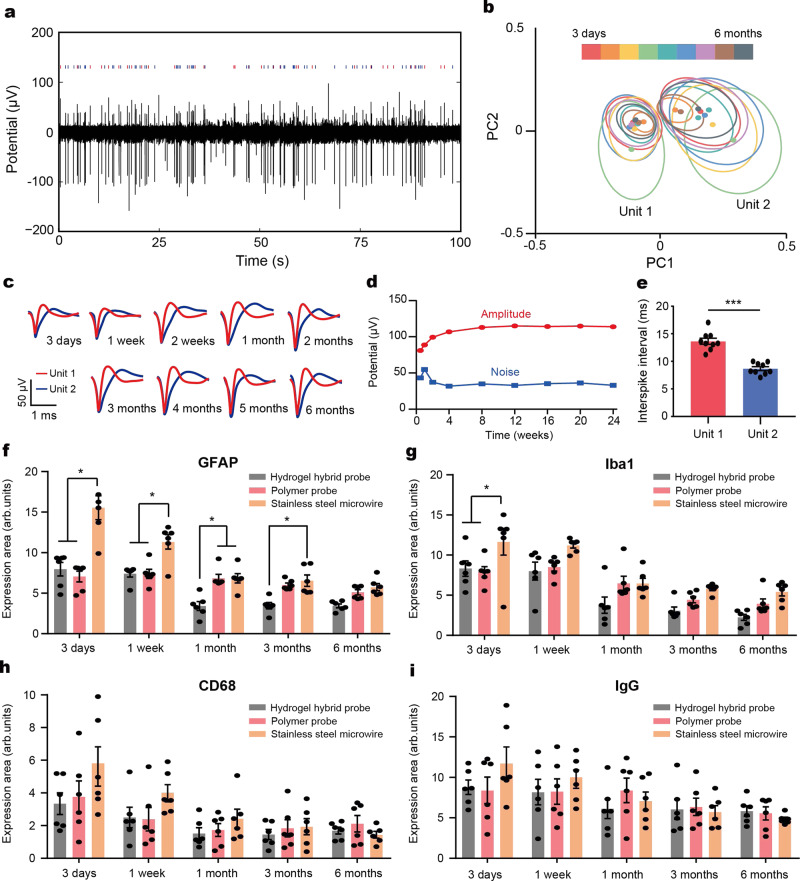
To understand the underlying mechanisms of progressive neurophysiological phenomena, neural interfaces should interact bi-directionally with brain circuits over extended periods of time. However, such interfaces remain limited by the foreign body response that stems from the chemo-mechanical mismatch between the probes and the neural tissues. To address this challenge, we developed a multifunctional sensing and actuation platform consisting of multimaterial fibers intimately integrated within a soft hydrogel matrix mimicking the brain tissue. These hybrid devices possess adaptive bending stiffness determined by the hydration states of the hydrogel matrix. This enables their direct insertion into the deep brain regions, while minimizing tissue damage associated with the brain micromotion after implantation. The hydrogel hybrid devices permit electrophysiological, optogenetic, and behavioral studies of neural circuits with minimal foreign body responses and tracking of stable isolated single neuron potentials in freely moving mice over 6 months following implantation.
Overview
The claims and statistics of this paper haven’t been checked yet.
Free: it reads the open-access text and checks the first 5 claims that cite a source we can check. Create a free account to check every claim.
Integrity signals
Registry
Cites
Statistics
Figures
Verification
Claims the paper makes
The claims and statistics of this paper haven’t been checked yet.
Free: it reads the open-access text and checks the first 5 claims that cite a source we can check. Create a free account to check every claim.
Claims other papers make about this one
Each is checked against this paper’s own text: does it say what the citing paper says it does?
The source backs part of the claim, not all of it — or backs it for a different population, condition or comparison.
In the citing paper
“As a material whose features resemble water-rich tissue in the human body, hydrogels can greatly reduce the inflammatory response of foreign objects, regulate cell or protein attachment, and prevent device failure in vivo,[52] which is important for implants.[53,54]”
From Flexible Electronics and Devices as Human–Machine Interfaces for Medical Robotics (2022) · cites this paper as [52]
Experimental — accuracy not yet measuredThe source backs part of the claim, not all of it — or backs it for a different population, condition or comparison.
In the citing paper
“Consequently, many integrated flexible stimulation systems can also perform electrophysiological recording.[52]”
From Flexible Electronics and Devices as Human–Machine Interfaces for Medical Robotics (2022) · cites this paper as [52]
Experimental — accuracy not yet measured
Self-check
Percentages, sums and reported differences re-computed from the paper’s own numbers.
The self-check needs the paper’s full text.
Citations
Cites
Highly stretchable and tough hydrogels
Sun, J.-Y., Zhao, X., Illeperuma, W. R. K., Chaudhuri, O., Oh, K. H., Mooney, D. J., Vlassak, J. J., & Suo, Z. (2012) · Nature · doi:10.1038/nature11409 · Cited by 5,481
Self-citationHydrogels for Tissue Engineering
Lee, K. Y., & Mooney, D. J. (2001) · Chemical Reviews · doi:10.1021/cr000108x · Cited by 5,277
Neurodegenerative Disorders: Parkinson's Disease and Huntington's Disease
Hague, S., Klaffke, S., & Bandmann, O. (2006) · IMPERIAL COLLEGE PRESS eBooks · doi:10.1142/9781860948961_0007 · Cited by 2,767
Response of brain tissue to chronically implanted neural electrodes
Polikov, V. S., Tresco, P. A., & Reichert, W. M. (2005) · Journal of Neuroscience Methods · doi:10.1016/j.jneumeth.2005.08.015 · Cited by 1,896
Stretchable, Transparent, Ionic Conductors
Keplinger, C., Sun, J.-Y., Foo, C. C., Rothemund, P., Whitesides, G. M., & Suo, Z. (2013) · Science · doi:10.1126/science.1240228 · Cited by 1,754
Optical Deconstruction of Parkinsonian Neural Circuitry
Gradinaru, V., Mogri, M., Thompson, K. R., Henderson, J. M., & Deisseroth, K. (2009) · Science · doi:10.1126/science.1167093 · Cited by 1,526
Tough bonding of hydrogels to diverse non-porous surfaces
Yuk, H., Zhang, T., Lin, S., Parada, G. A., & Zhao, X. (2016) · Nature Materials · doi:10.1038/nmat4463 · Cited by 1,184
Self-citationElectronic dura mater for long-term multimodal neural interfaces
Minev, I. R., Musienko, P., Hirsch, A., Barraud, Q., Wenger, N., Moraud, E. M., Gandar, J., Capogrosso, M., Milekovic, T., Asboth, L., et al. (2015) · Science · doi:10.1126/science.1260318 · Cited by 1,082
Skin-inspired hydrogel–elastomer hybrids with robust interfaces and functional microstructures
Yuk, H., Zhang, T., Parada, G. A., Liu, X., & Zhao, X. (2016) · Nature Communications · doi:10.1038/ncomms12028 · Cited by 1,035
Self-citationBioresorbable silicon electronic sensors for the brain
Kang, S.-K., Murphy, R. K. J., Hwang, S.-W., Lee, S. M., Harburg, D. V., Krueger, N. A., Shin, J., Gamble, P., Cheng, H., Yu, S., et al. (2016) · Nature · doi:10.1038/nature16492 · Cited by 998
Soft, stretchable, fully implantable miniaturized optoelectronic systems for wireless optogenetics
Park, S. I., Brenner, D. S., Shin, G., Morgan, C. D., Copits, B. A., Chung, H. U., Pullen, M. Y., Noh, K. N., Davidson, S., Oh, S. J., et al. (2015) · Nature Biotechnology · doi:10.1038/nbt.3415 · Cited by 794
Self-citationOptogenetic investigation of neural circuits underlying brain disease in animal models
Tye, K. M., & Deisseroth, K. (2012) · Nature Reviews Neuroscience · doi:10.1038/nrn3171 · Cited by 745
Materials and technologies for soft implantable neuroprostheses
Lacour, S. P., Courtine, G., & Guck, J. (2016) · Nature Reviews Materials · doi:10.1038/natrevmats.2016.63 · Cited by 738
Syringe-injectable electronics
Liu, J., Fu, T.-M., Cheng, Z., Hong, G., Zhou, T., Jin, L., Duvvuri, M., Jiang, Z., Kruskal, P., Xie, C., et al. (2015) · Nature Nanotechnology · doi:10.1038/nnano.2015.115 · Cited by 687
Ultraflexible nanoelectronic probes form reliable, glial scar–free neural integration
Luan, L., Wei, X., Zhao, Z., Siegel, J. J., Potnis, O., Tuppen, C. A., Lin, S., Kazmi, S., Fowler, R. A., Holloway, S., et al. (2017) · Science Advances · doi:10.1126/sciadv.1601966 · Cited by 612
BLA to vHPC inputs modulate anxiety-related behaviors
Felix-Ortiz, A. C., Beyeler, A., Seo, C., Leppla, C. A., Wildes, C. P., & Tye, K. M. (2013) · Neuron · doi:10.1016/j.neuron.2013.06.016 · Cited by 592
Wireless Optofluidic Systems for Programmable In Vivo Pharmacology and Optogenetics
Jeong, J.-W., McCall, J. G., Shin, G., Zhang, Y., Al-Hasani, R., Kim, M., Li, S., Sim, J. Y., Jang, K.-I., Shi, Y., et al. (2015) · Cell · doi:10.1016/j.cell.2015.06.058 · Cited by 498
Implanted Neural Interfaces: Biochallenges and Engineered Solutions
Grill, W. M., Norman, S. E., & Bellamkonda, R. V. (2009) · Annual Review of Biomedical Engineering · doi:10.1146/annurev-bioeng-061008-124927 · Cited by 488
Multifunctional Nanobiomaterials for Neural Interfaces
Abidian, M. R., & Martin, D. C. (2009) · Advanced Functional Materials · doi:10.1002/adfm.200801473 · Cited by 416
Three-dimensional macroporous nanoelectronic networks as minimally invasive brain probes
Xie, C., Liu, J., Fu, T.-M., Dai, X., Zhou, W., & Lieber, C. M. (2015) · Nature Materials · doi:10.1038/nmat4427 · Cited by 404
One-step optogenetics with multifunctional flexible polymer fibers
Park, S., Guo, Y., Jia, X., Choe, H. K., Grena, B., Kang, J., Park, J., Lu, C., Canales, A., Chen, R., et al. (2017) · Nature Neuroscience · doi:10.1038/nn.4510 · Cited by 381
Self-citationLight-guiding hydrogels for cell-based sensing and optogenetic synthesis in vivo
Choi, M., Choi, J. W., Kim, S., Nizamoglu, S., Hahn, S. K., & Yun, S. H. (2013) · Nature Photonics · doi:10.1038/nphoton.2013.278 · Cited by 379
Subbaroyan, J., Martin, D. C., & Kipke, D. R. (2005) · Journal of Neural Engineering · doi:10.1088/1741-2560/2/4/006 · Cited by 368
Parylene flexible neural probes integrated with microfluidic channels
Takeuchi, S., Ziegler, D., Yoshida, Y., Mabuchi, K., & Suzuki, T. (2005) · Lab on a Chip · doi:10.1039/b417497f · Cited by 364
How deeply cells feel: methods for thin gels
Buxboim, A., Rajagopal, K., Brown, A. E. X., & Discher, D. E. (2010) · Journal of Physics: Condensed Matter · doi:10.1088/0953-8984/22/19/194116 · Cited by 355
Simon, M. J., & Iliff, J. J. (2016) · Biochimica et Biophysica Acta (BBA) - Molecular Basis of Disease · doi:10.1016/j.bbadis.2015.10.014 · Cited by 342
Performance and biocompatibility of extremely tough alginate/polyacrylamide hydrogels
Darnell, M. C., Sun, J.-Y., Mehta, M., Johnson, C., Arany, P. R., Suo, Z., & Mooney, D. J. (2013) · Biomaterials · doi:10.1016/j.biomaterials.2013.06.061 · Cited by 336
Stable long-term chronic brain mapping at the single-neuron level
Fu, T.-M., Hong, G., Zhou, T., Schuhmann, T. G., Viveros, R. D., & Lieber, C. M. (2016) · Nature Methods · doi:10.1038/nmeth.3969 · Cited by 330
Toward a comparison of microelectrodes for acute and chronic recordings
Ward, M. P., Rajdev, P., Ellison, C., & Irazoqui, P. P. (2009) · Brain Research · doi:10.1016/j.brainres.2009.05.052 · Cited by 296
Step‐Index Optical Fiber Made of Biocompatible Hydrogels
Choi, M., Humar, M., Kim, S., & Yun, S. (2015) · Advanced Materials · doi:10.1002/adma.201501603 · Cited by 249
Relationship between intracortical electrode design and chronic recording function
Karumbaiah, L., Saxena, T., Carlson, D., Patil, K., Patkar, R., Gaupp, E. A., Betancur, M., Stanley, G. B., Carin, L., & Bellamkonda, R. V. (2013) · Biomaterials · doi:10.1016/j.biomaterials.2013.07.016 · Cited by 241
Chronic in vivo stability assessment of carbon fiber microelectrode arrays
Patel, P. R., Zhang, H., Robbins, M. T., Nofar, J. B., Marshall, S. P., Kobylarek, M. J., Kozai, T. D. Y., Kotov, N. A., & Chestek, C. A. (2016) · Journal of Neural Engineering · doi:10.1088/1741-2560/13/6/066002 · Cited by 204
Spencer, K. C., Sy, J. C., Ramadi, K. B., Graybiel, A. M., Langer, R., & Cima, M. J. (2017) · Scientific Reports · doi:10.1038/s41598-017-02107-2 · Cited by 181
A method for single-neuron chronic recording from the retina in awake mice
Hong, G., Fu, T.-M., Qiao, M., Viveros, R. D., Yang, X., Zhou, T., Lee, J. M., Park, H.-G., Sanes, J. R., & Lieber, C. M. (2018) · Science · doi:10.1126/science.aas9160 · Cited by 172
Biocompatibility of intracortical microelectrodes: current status and future prospects
Marin, C. (2010) · Frontier in Neuroengineering · doi:10.3389/fneng.2010.00008 · Cited by 160
Implantable and Biodegradable Poly( l ‐lactic acid) Fibers for Optical Neural Interfaces
Fu, R., Luo, W., Nazempour, R., Tan, D., Ding, H., Zhang, K., Yin, L., Guan, J., & Sheng, X. (2017) · Advanced Optical Materials · doi:10.1002/adom.201700941 · Cited by 143
Neurotrophin‐eluting hydrogel coatings for neural stimulating electrodes
Winter, J. O., Cogan, S. F., & Rizzo, J. F. (2007) · Journal of Biomedical Materials Research Part B: Applied Biomaterials · doi:10.1002/jbm.b.30696 · Cited by 98
Tailoring Hydrogel Adhesion to Polydimethylsiloxane Substrates Using Polysaccharide Glue
Cha, C., Antoniadou, E., Lee, M., Jeong, J. H., Ahmed, W. W., Saif, T. A., Boppart, S. A., & Kong, H. (2013) · Angewandte Chemie International Edition · doi:10.1002/anie.201302925 · Cited by 83
A Mosquito Inspired Strategy to Implant Microprobes into the Brain
Shoffstall, A. J., Srinivasan, S., Willis, M., Stiller, A. M., Ecker, M., Voit, W. E., Pancrazio, J. J., & Capadona, J. R. (2018) · Scientific Reports · doi:10.1038/s41598-017-18522-4 · Cited by 82
Kolarcik, C. L., Bourbeau, D., Azemi, E., Rost, E., Zhang, L., Lagenaur, C. F., Weber, D. J., & Cui, X. T. (2012) · Acta Biomaterialia · doi:10.1016/j.actbio.2012.06.034 · Cited by 59
A simple implantation method for flexible, multisite microelectrodes into rat brains
Richter, A., Xie, Y., Schumacher, A., Löffler, S., Kirch, R. D., Al-Hasani, J., Rapoport, D. H., Kruse, C., Moser, A., Tronnier, V., et al. (2013) · Frontiers in Neuroengineering · doi:10.3389/fneng.2013.00006 · Cited by 52
Simple, Benign, Aqueous-Based Amination of Polycarbonate Surfaces
VanDelinder, V., Wheeler, D. R., Small, L. J., Brumbach, M. T., Spoerke, E. D., Henderson, I. M., & Bachand, G. D. (2015) · ACS Applied Materials & Interfaces · doi:10.1021/am508797h · Cited by 38
Bioactive anti‐inflammatory coating for chronic neural electrodes
Taub, A. H., Hogri, R., Magal, A., Mintz, M., & Shacham‐Diamand, Y. (2012) · Journal of Biomedical Materials Research Part A · doi:10.1002/jbm.a.34152 · Cited by 35
Tailoring Hydrogel Adhesion to Polydimethylsiloxane Substrates Using Polysaccharide Glue
Cha, C., Antoniadou, E., Lee, M., Jeong, J. H., Ahmed, W., Saif, T. A., Boppart, S. A., & Kong, H. (2013) · Angewandte Chemie · doi:10.1002/ange.201302925 · Cited by 10
Au sujet des dégradations et des synthèses effectuées par Escherichia coli non proliférant
Aubel, E., GRUNBERG‐MANAGO, M., & Szulmajster, J. (1949) · Biochimica et Biophysica Acta · doi:10.1016/0006-3002(49)90117-1 · Cited by 5
Research works printed but not linked: 1
- 13. Park, S. I. et al. Soft, stretchable, fully implantable miniaturized optoelectronic systems for wireless optogenetics. Nat. Biotechnol. 33, 1280 (2015). · DOI · Paper page
Cited by
Technology Roadmap for Flexible Sensors
Luo, Y., Abidian, M. R., Ahn, J.-H., Akinwande, D., Andrews, A. M., Antonietti, M., Bao, Z., Berggren, M., Berkey, C. A., Bettinger, C. J., et al. (2023) · ACS Nano · doi:10.1021/acsnano.2c12606 · Cited by 1,383
Self-citationFlexible Electronics and Devices as Human–Machine Interfaces for Medical Robotics
Heng, W., Solomon, S., & Gao, W. (2022) · Advanced Materials · doi:10.1002/adma.202107902 · Cited by 609
3D printable high-performance conducting polymer hydrogel for all-hydrogel bioelectronic interfaces
Zhou, T., Yuk, H., Hu, F., Wu, J., Tian, F., Roh, H., Shen, Z., Gu, G., Xu, J., Lu, B., et al. (2023) · Nature Materials · doi:10.1038/s41563-023-01569-2 · Cited by 587
Self-citationWang, X., Sun, X., Gan, D., Soubrier, M., Chiang, H.-Y., Yan, L., Li, Y., Li, J., Yu, S., Xia, Y., et al. (2022) · Matter · doi:10.1016/j.matt.2022.01.012 · Cited by 200
Liang, Q., Xia, X., Sun, X., Yu, D., Huang, X., Han, G., Mugo, S. M., Chen, W., & Zhang, Q. (2022) · Advanced Science · doi:10.1002/advs.202201059 · Cited by 183
Metadata
- Authors
- Park, S., Yuk, H., Zhao, R., Yim, Y. S., Woldeghebriel, E. W., Kang, J., Canales, A., Fink, Y., Choi, G. B., Zhao, X., & Anikeeva, P.
- Affiliations
- Korea Advanced Institute of Science and Technology (KR)
- Massachusetts Institute of Technology (US)
- The Ohio State University (US)
- McGovern Institute for Brain Research (US)
- Institute for Soldier Nanotechnologies (US)
- Corresponding author
- Zhao, Xuanhe
- Anikeeva, Polina
- ORCID
- Venue
- Nature Communications
- Published
- 2021-06-08
- Volume
- 12
- Issue
- 1
- Pages
- 3435-3435
- ISSN
- 2041-1723 (ISSN-L)
- PMC
- PMC8187649
- OpenAlex
- W3168009682
- Semantic Scholar
- 7839d6da46ddf95544a4fefa83d5e067981c25fd
- Cited by
- 312
- References
- 46
- Citations by year
- 2026: 42 · 2025: 74 · 2024: 72 · 2023: 67 · 2022: 41 · 2021: 16
- FWCI
- 22.59
- Type
- journal article
- Language
- en
- Open access
- gold
- doi.org
- Licence
- cc-by
- creativecommons.org/licenses/by/4.0 (tdm)
- creativecommons.org/licenses/by/4.0 (vor)
- Locations
- Nature Communications (publishedVersion, cc-by)
- PubMed Central (publishedVersion, cc-by)
- PubMed (publishedVersion)
- RePEc: Research Papers in Economics (submittedVersion)
- DOAJ (DOAJ: Directory of Open Access Journals) (submittedVersion, cc-by-sa)
- DSpace@MIT (Massachusetts Institute of Technology) (submittedVersion, cc-by-nc)
- Seoul National University Open Repository (Seoul National University) (submittedVersion)
- Funders
- National Research Foundation of Korea (2020R1C1C100758911)
- Electronics and Telecommunications Research Institute (20ZB1100)
- United States Department of Defense | United States Army | US Army Corps of Engineers | Engineer Research and Development Center (W911NF-13-D-0001)
- NSF | ENG/OAD | Division of Civil, Mechanical and Manufacturing Innovation (CMMI-1661627)
- U.S. Department of Health & Human Services | NIH | National Institute of Neurological Disorders and Stroke (5R01NS086804)
- NSF | Directorate for Mathematical & Physical Sciences | Division of Materials Research (DMR-1419807)
- NSF | ENG/OAD | Division of Engineering Education and Centers (EEC-1028725)
- Topics
- Life Sciences › Neuroscience › Cellular and Molecular Neuroscience › Neuroscience and Neural Engineering
- Physical Sciences › Materials Science › Polymers and Plastics › Conducting polymers and applications
- Physical Sciences › Materials Science › Biomaterials › Hydrogels: synthesis, properties, applications
- Keywords
- neural interfaces, foreign body reaction, optogenetics, electrophysiological recording, multimaterial fibers, freely moving mice
- MeSH terms
- Action Potentials, Animals, Behavior, Animal, Biological Assay, Brain, Foreign-Body Reaction, Male, Mice, Inbred C57BL, Neurons, Stress, Mechanical, Time Factors, Molecular Probes, Biosensing Techniques, Hydrogels, Mice, Electrophysiological Phenomena, Optogenetics
About these checks
Registry, retraction, Cites and statistics results are computed, not judged, with one exception: a printed reference that no index lists is read once by a model before it counts as a citation error. Claims are extracted by a model and kept only when their quote appears verbatim in the text; each cited source is then checked, with a model’s help, for whether it says what the claim relies on. Those verdicts can be wrong — read the claim’s quote and the cited source before relying on one.
Statistics and arithmetic are recomputed, not judged.
Confidence bands are shown only for fields calibrated on our annotated test set. None is calibrated yet, so no band is shown.
What counts as a claim ›How we measure confidence ›How we check this ›
Are you an author, or do you see a problem with this page? Request a review
Data sources
Bibliographic data: Semantic Scholar, OpenAlex, Crossref.
Contains information from the Semantic Scholar Academic Graph Datasets, made available under the ODC Attribution License (ODC-BY 1.0).
Semantic Scholar’s data is described in: Kinney, R., et al. (2023). The Semantic Scholar Open Data Platform. arXiv:2301.10140.
