

Cas9-specific immune responses compromise local and systemic AAV CRISPR therapy in multiple dystrophic canine models
Open accessThe DOI matches its Crossref record; 57 of the 57 references it cites were found in a registry or an index.
Abstract
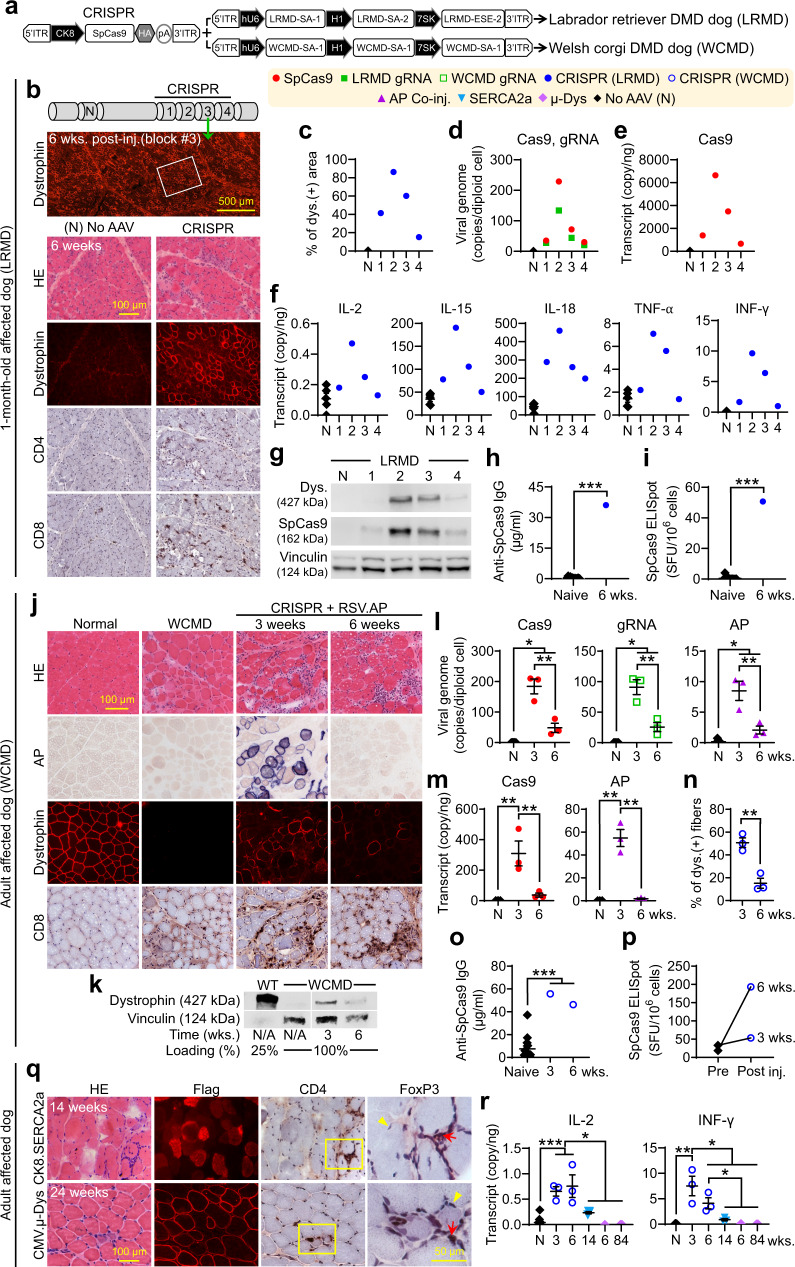
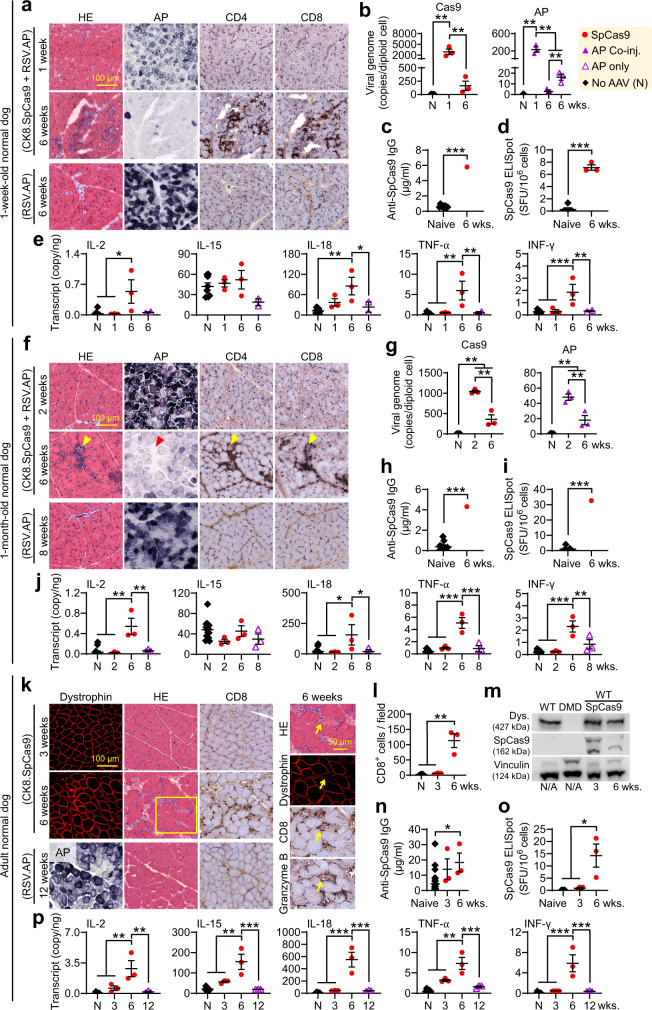
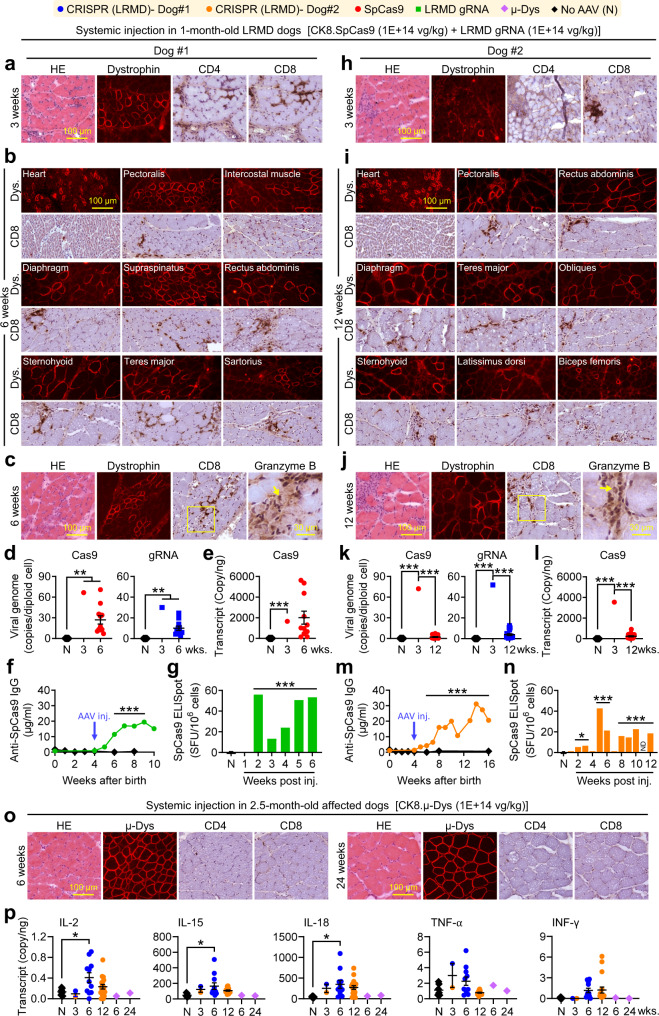
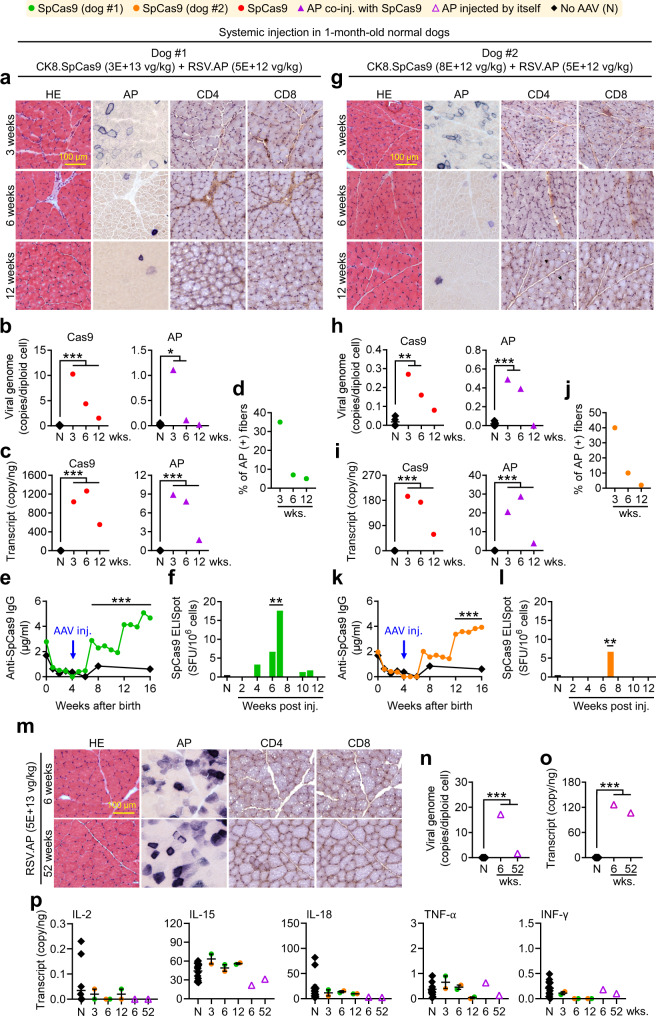
Adeno-associated virus (AAV)-mediated CRISPR-Cas9 editing holds promise to treat many diseases. The immune response to bacterial-derived Cas9 has been speculated as a hurdle for AAV-CRISPR therapy. However, immunological consequences of AAV-mediated Cas9 expression have thus far not been thoroughly investigated in large mammals. We evaluate Cas9-specific immune responses in canine models of Duchenne muscular dystrophy (DMD) following intramuscular and intravenous AAV-CRISPR therapy. Treatment results initially in robust dystrophin restoration in affected dogs but also induces muscle inflammation, and Cas9-specific humoral and cytotoxic T-lymphocyte (CTL) responses that are not prevented by the muscle-specific promoter and transient prednisolone immune suppression. In normal dogs, AAV-mediated Cas9 expression induces similar, though milder, immune responses. In contrast, other therapeutic (micro-dystrophin and SERCA2a) and reporter (alkaline phosphatase, AP) vectors result in persistent expression without inducing muscle inflammation. Our results suggest Cas9 immunity may represent a critical barrier for AAV-CRISPR therapy in large mammals.
Overview
The claims and statistics of this paper haven’t been checked yet.
Free: it reads the open-access text and checks the first 5 claims that cite a source we can check. Create a free account to check every claim.
Integrity signals
Registry
Cites
Statistics
Figures
Verification
Claims the paper makes
The claims and statistics of this paper haven’t been checked yet.
Free: it reads the open-access text and checks the first 5 claims that cite a source we can check. Create a free account to check every claim.
Claims other papers make about this one
Each is checked against this paper’s own text: does it say what the citing paper says it does?
The cited source says what the claim attributes to it.
In the citing paper
“Notably, it was recently shown that tissue-speci fi c promoter could not reduce immune responses in a canine study using AAV delivery of the CRISPR system (172).”
From A versatile toolkit for overcoming AAV immunity (2022) · cites this paper as [172]
In the citing paper
“AAV is also being developed as a delivery platform for in vivo gene editing in humans, raising the possibility of T cell responses against the editors, which are typically nucleases of bacterial origin.20,21”
From TLR9-independent CD8+ T cell responses in hepatic AAV gene transfer through IL-1R1-MyD88 signaling (2024) · cites this paper as [21]
In the citing paper
“This study indicated that older animals in a study are more likely to be positive for anti-Cas9 antibodies than the younger ones [5].”
From Immune responses to gene editing by viral and non-viral delivery vectors used in retinal gene therapy (2022) · cites this paper as [5]
In the citing paper
“An animal study conducted on 78 adult canines (60 WT and 18 models for Duchenne muscular dystrophy (DMD)) reported pre-existing anti-SpCas9 antibodies in all animals, but not in 16 newborn puppies, which only had moderate levels of maternally-derived Cas9 antibodies that dropped between two and six weeks of age.”
From Immune responses to gene editing by viral and non-viral delivery vectors used in retinal gene therapy (2022) · cites this paper as [5]
In the citing paper
“Both humoral and cellular immune responses were still observed, and reduced transduction efficiency was reported [5].”
From Immune responses to gene editing by viral and non-viral delivery vectors used in retinal gene therapy (2022) · cites this paper as [5]
Self-check
Percentages, sums and reported differences re-computed from the paper’s own numbers.
The self-check needs the paper’s full text.
Citations
Cites
Genome engineering using the CRISPR-Cas9 system
Ran, F. A., Hsu, P. D., Wright, J., Agarwala, V., Scott, D. A., & Zhang, F. (2013) · Nature Protocols · doi:10.1038/nprot.2013.143 · Cited by 11,133
The Human Genome Browser at UCSC
Kent, W. J., Sugnet, C. W., Furey, T. S., Roskin, K. M., Pringle, T. H., Zahler, A. M., & Haussler, A. D. (2002) · Genome Research · doi:10.1101/gr.229102 · Cited by 10,400
Bae, S., Park, J., & Kim, J.-S. (2014) · Bioinformatics · doi:10.1093/bioinformatics/btu048 · Cited by 2,339
CRISPR-Cas9 Gene Editing for Sickle Cell Disease and β-Thalassemia
Frangoul, H., Altshuler, D., Cappellini, M. D., Chen, Y.-S., Domm, J., Eustace, B. K., Foell, J., de la Fuente, J., Grupp, S., Handgretinger, R., et al. (2021) · New England Journal of Medicine · doi:10.1056/nejmoa2031054 · Cited by 1,962 · cited 1×
“Numbers (1, 2, 3, 4) in b–g are muscle block numbers.”
BackgroundESEfinder: a web resource to identify exonic splicing enhancers
Cartegni, L. (2003) · Nucleic Acids Research · doi:10.1093/nar/gkg616 · Cited by 1,603
Duan, D., Goemans, N., Takeda, S., Mercuri, E., & Aartsma-Rus, A. (2021) · Nature Reviews Disease Primers · doi:10.1038/s41572-021-00248-3 · Cited by 1,312
Self-citationComparing an Individual's Test Score Against Norms Derived from Small Samples
Crawford, J. R., & Howell, D. C. (1998) · The Clinical Neuropsychologist · doi:10.1076/clin.12.4.482.7241 · Cited by 1,264
In vivo genome editing improves muscle function in a mouse model of Duchenne muscular dystrophy
Nelson, C. E., Hakim, C. H., Ousterout, D. G., Thakore, P. I., Moreb, E. A., Rivera, R. M. C., Madhavan, S., Pan, X., Ran, F. A., Yan, W. X., et al. (2016) · Science · doi:10.1126/science.aad5143 · Cited by 1,144
Self-citationThe promise and challenge of therapeutic genome editing
Doudna, J. A. (2020) · Nature · doi:10.1038/s41586-020-1978-5 · Cited by 1,126 · cited 1×
“Numbers (1, 2, 3, 4) in b–g are muscle block numbers.”
Identification of preexisting adaptive immunity to Cas9 proteins in humans
Charlesworth, C. T., Deshpande, P. S., Dever, D. P., Camarena, J., Lemgart, V. T., Cromer, M. K., Vakulskas, C. A., Collingwood, M. A., Zhang, L., Bode, N. M., et al. (2019) · Nature Medicine · doi:10.1038/s41591-018-0326-x · Cited by 1,093
Cited by
Past, present, and future of CRISPR genome editing technologies
Pacesa, M., Pelea, O., & Jinek, M. (2024) · Cell · doi:10.1016/j.cell.2024.01.042 · Cited by 609
“90,91 Several strategies for overcoming pre-existing immunity have been proposed, for example, engineering Cas9 to eliminate immunogenic epitopes, modulating the immune responses, as well as limiting the duration of Cas9 expression.”
BackgroundLethal immunotoxicity in high-dose systemic AAV therapy
Duan, D. (2023) · Molecular Therapy · doi:10.1016/j.ymthe.2023.10.015 · Cited by 240
Self-citationCRISPR/Cas9 systems: Delivery technologies and biomedical applications
Du, Y., Liu, Y., Hu, J., Peng, X., & Liu, Z. (2023) · Asian Journal of Pharmaceutical Sciences · doi:10.1016/j.ajps.2023.100854 · Cited by 198
CAR-T Regulatory (CAR-Treg) Cells: Engineering and Applications
Arjomandnejad, M., Kopec, A. L., & Keeler, A. M. (2022) · Biomedicines · doi:10.3390/biomedicines10020287 · Cited by 171
Viral Vectors for the in Vivo Delivery of CRISPR Components: Advances and Challenges
Mengstie, M. A. (2022) · Frontiers in Bioengineering and Biotechnology · doi:10.3389/fbioe.2022.895713 · Cited by 168
Immunogenicity of CRISPR therapeutics—Critical considerations for clinical translation
Ewaisha, R., & Anderson, K. S. (2023) · Frontiers in Bioengineering and Biotechnology · doi:10.3389/fbioe.2023.1138596 · Cited by 165
CRISPR Modeling and Correction of Cardiovascular Disease
Liu, N., & Olson, E. N. (2022) · Circulation Research · doi:10.1161/circresaha.122.320496 · Cited by 117
Xiao, Y., Lian, X., Sun, Y., Sung, Y., Vaidya, A., Chen, Z., Gupta, A., Chatterjee, S., Zheng, L., Guerrero, E. D., et al. (2025) · Nature Materials · doi:10.1038/s41563-024-02116-3 · Cited by 109
mRNA trans-splicing dual AAV vectors for (epi)genome editing and gene therapy
Riedmayr, L. M., Hinrichsmeyer, K. S., Thalhammer, S. B., Mittas, D. M., Karguth, N., Otify, D. Y., Böhm, S., Weber, V. J., Bartoschek, M. D., Splith, V., et al. (2023) · Nature Communications · doi:10.1038/s41467-023-42386-0 · Cited by 103
Precision RNA base editing with engineered and endogenous effectors
Pfeiffer, L. S., & Stafforst, T. (2023) · Nature Biotechnology · doi:10.1038/s41587-023-01927-0 · Cited by 70
Lek, A., Atas, E., Hesterlee, S. E., Byrne, B. J., & Bönnemann, C. G. (2023) · Journal of Neuromuscular Diseases · doi:10.3233/jnd-221639 · Cited by 58
Rational engineering of minimally immunogenic nucleases for gene therapy
Raghavan, R. S., Friedrich, M., King, C., Vo, C.-D.-T., Strebinger, D., Lash, B., Kilian, M., Platten, M., Macrae, R. K., Song, Y., et al. (2025) · Nature Communications · doi:10.1038/s41467-024-55522-1 · Cited by 63
Kelley, C. P., Haerle, M. C., & Wang, E. T. (2022) · Cell Reports · doi:10.1016/j.celrep.2022.111226 · Cited by 61
Kolesnik, V. V., Nurtdinov, R. F., Oloruntimehin, E. S., Karabelsky, A. V., & Malogolovkin, A. S. (2024) · Clinical and Translational Medicine · doi:10.1002/ctm2.1607 · Cited by 59
A versatile toolkit for overcoming AAV immunity
Li, X., Wei, X., Lin, J., & Ou, L. (2022) · Frontiers in Immunology · doi:10.3389/fimmu.2022.991832 · Cited by 57
“Notably, it was recently shown that tissue-specific promoter could not reduce immune responses in a canine study using AAV delivery of the CRISPR system (172).”
BackgroundProgress of delivery methods for CRISPR-Cas9
Yang, W., Yan, J., Zhuang, P., Ding, T., Chen, Y., Zhang, Y., Zhang, H., & Cui, W. (2022) · Expert Opinion on Drug Delivery · doi:10.1080/17425247.2022.2100342 · Cited by 57
Majeau, N., Archambault, A. F., Gérard, C., Rousseau, J., Yaméogo, P., & Tremblay, J. P. (2022) · Molecular Therapy · doi:10.1016/j.ymthe.2022.05.023 · Cited by 55
CRISPR/Cas9-based gene-editing technology for sickle cell disease
Ma, L., Yang, S., Peng, Q., Zhang, J., & Zhang, J. (2023) · Gene · doi:10.1016/j.gene.2023.147480 · Cited by 56
CRISPR-Editing Therapy for Duchenne Muscular Dystrophy
Chemello, F., Olson, E. N., & Bassel‐Duby, R. (2023) · Human Gene Therapy · doi:10.1089/hum.2023.053 · Cited by 53
Ren, D., Fisson, S., Dalkara, D., & Ail, D. (2022) · Pharmaceutics · doi:10.3390/pharmaceutics14091973 · Cited by 52
O’Geen, H., Beitnere, U., Garcia, M. S., Adhikari, A., Cameron, D. L., Fenton, T. A., Copping, N. A., Deng, P., Lock, S., Halmai, J. A. N. M., et al. (2023) · Molecular Therapy · doi:10.1016/j.ymthe.2023.01.013 · Cited by 53
Understanding and Tackling Immune Responses to Adeno-Associated Viral Vectors
Verdera, H. C., Unzu, C., Valeri, E., Adriouch, S., González‐Aseguinolaza, G., Mingozzi, F., & Kajaste‐Rudnitski, A. (2023) · Human Gene Therapy · doi:10.1089/hum.2023.119 · Cited by 47
Duchenne Muscular Dystrophy Gene Therapy in 2023: Status, Perspective, and Beyond
Duan, D. (2023) · Human Gene Therapy · doi:10.1089/hum.2023.29242.ddu · Cited by 46
Self-citationGene therapy for genetic diseases: challenges and future directions
Beibei, Q. I. E., Tuo, J., Chen, F., Ding, H., & Lyu, L. (2025) · MedComm · doi:10.1002/mco2.70091 · Cited by 45
Li, G., Jin, M., Li, Z., Xiao, Q., Lin, J., Yang, D., Liu, Y., Wang, X., Xie, L., Ying, W., et al. (2023) · Journal of Clinical Investigation · doi:10.1172/jci162809 · Cited by 44
“Previous studies have shown low tropism of AAV for satellite cells (13, 18) and preexisting immunity against CRISPR reagents (19, 20), possibly leading to progressive loss of mxABE and”
BackgroundDelivery of CRISPR/Cas9 system by AAV as vectors for gene therapy
Wang, Y., Jiang, H., Li, M., Xu, Z., Xu, H., Chen, Y., Chen, K., Zheng, W., Lin, W., Liu, Z., et al. (2024) · Gene · doi:10.1016/j.gene.2024.148733 · Cited by 45
Gene therapy for hemophilia – From basic science to first approvals of “one-and-done” therapies
Herzog, R. W., Kaczmarek, R., & High, K. A. (2025) · Molecular Therapy · doi:10.1016/j.ymthe.2025.03.043 · Cited by 43
Self-citationThe road toward AAV-mediated gene therapy of Duchenne muscular dystrophy
Bengtsson, N. E., Tasfaout, H., & Chamberlain, J. S. (2025) · Molecular Therapy · doi:10.1016/j.ymthe.2025.03.065 · Cited by 40
Bio–Nano Toolbox for Precision Alzheimer's Disease Gene Therapy
Liu, Y., Xia, X., Zheng, M., & Shi, B. (2024) · Advanced Materials · doi:10.1002/adma.202314354 · Cited by 40
CRISPR and cardiovascular diseases
Musunuru, K. (2022) · Cardiovascular Research · doi:10.1093/cvr/cvac048 · Cited by 38
Breathing in Duchenne muscular dystrophy: translation to therapy
Mhandire, D. Z., Burns, D. P., Roger, A. L., O’Halloran, K. D., & ElMallah, M. K. (2022) · The Journal of Physiology · doi:10.1113/jp281671 · Cited by 38
Carneiro, S. P., Greco, A., Chiesa, E., Genta, I., & Merkel, O. M. (2023) · Expert Opinion on Drug Delivery · doi:10.1080/17425247.2023.2185220 · Cited by 38
Gene therapy for cardiac diseases: methods, challenges, and future directions
Grisorio, L., Bongianino, R., Gianeselli, M., & Priori, S. G. (2024) · Cardiovascular Research · doi:10.1093/cvr/cvae207 · Cited by 40
Liver directed adeno‐associated viral vectors to treat metabolic disease
Chuecos, M. A., & Lagor, W. R. (2023) · Journal of Inherited Metabolic Disease · doi:10.1002/jimd.12637 · Cited by 37
Chen, G., Wei, T., Yang, H., Li, G., & Li, H. (2022) · Cells · doi:10.3390/cells11192964 · Cited by 36
Advancements in CRISPR/Cas systems for disease treatment
Xu, Y., Le, H., Wu, Q., Wang, N., & Gong, C. (2025) · Acta Pharmaceutica Sinica B · doi:10.1016/j.apsb.2025.05.007 · Cited by 35
Robust genome and cell engineering via in vitro and in situ circularized RNAs
Tong, M., Palmer, N. D., Dailamy, A., Kumar, A., Khaliq, H., Han, S., Finburgh, E. N., Wing, M. K., Hong, C., Xiang, Y., et al. (2024) · Nature Biomedical Engineering · doi:10.1038/s41551-024-01245-z · Cited by 34
Zhang, Y., Li, H. Z., Nishiyama, T., McAnally, J., Sanchez‐Ortiz, E., Huang, J. H., Mammen, P. P. A., Bassel‐Duby, R., & Olson, E. N. (2022) · Molecular Therapy — Nucleic Acids · doi:10.1016/j.omtn.2022.07.024 · Cited by 34
Yang, X., Bui, T. A., Mei, H., Aksoy, Y. A., Deng, F., Hutvágner, G., & Deng, W. (2024) · Advanced Functional Materials · doi:10.1002/adfm.202402630 · Cited by 33
Peeling back the layers of immunogenicity in Cas9-based genomic medicine
Stigzelius, V., Cavallo, A. L., Chandode, R. K., & Nitsch, R. (2025) · Molecular Therapy · doi:10.1016/j.ymthe.2025.06.045 · Cited by 33
Kovalev, M. A., Mamaeva, N. Y., Kristovskiy, N. V., Feskin, P. G., Vinnikov, R. S., Oleinikov, P. D., Sosnovtseva, A. O., Yakovlev, V. A., Glukhov, G. S., & Shaytan, A. К. (2025) · International Journal of Molecular Sciences · doi:10.3390/ijms26136371 · Cited by 35
Engineering Cas9: next generation of genomic editors
Kovalev, M. A., Davletshin, A. I., & Karpov, D. S. (2024) · Applied Microbiology and Biotechnology · doi:10.1007/s00253-024-13056-y · Cited by 32
LMNA-related cardiomyopathy: From molecular pathology to cardiac gene therapy
Wang, Z., Wu, J., Lv, Z., Liang, P., Li, Q., Li, Y., & Guo, Y. (2025) · Journal of Advanced Research · doi:10.1016/j.jare.2025.01.001 · Cited by 32
TLR9-independent CD8+ T cell responses in hepatic AAV gene transfer through IL-1R1-MyD88 signaling
Kumar, S. R. P., Biswas, M., Cao, D., Arisa, S., Muñoz-Melero, M., Lam, A. K., Piñeros, A. R., Kapur, R., Kaisho, T., Kaufman, R. J., et al. (2024) · Molecular Therapy · doi:10.1016/j.ymthe.2023.11.029 · Cited by 31
Self-citationAdvances in CRISPR/Cas9 Genome Editing for the Treatment of Muscular Dystrophies
Fatehi, S., Marks, R. M., Rok, M. J., Perillat, L., Ivakine, E. A., & Cohn, R. D. (2023) · Human Gene Therapy · doi:10.1089/hum.2023.059 · Cited by 31
AAV-based CRISPR-Cas9 genome editing: Challenges and engineering opportunities
Kabadi, A. M., Mejía‐Guerra, M. K., Graef, J. D., Khan, S. Z., Walton, E. M., Wang, X., Gersbach, C. A., & Potter, R. A. (2023) · Current Opinion in Biomedical Engineering · doi:10.1016/j.cobme.2023.100517 · Cited by 29
Self-citationImmune Responses to Muscle-Directed Adeno-Associated Viral Gene Transfer in Clinical Studies
Kumar, S. R. P., Duan, D., & Herzog, R. W. (2023) · Human Gene Therapy · doi:10.1089/hum.2023.056 · Cited by 28
“70,71 Nonetheless, several highly promising avenues are being developed to manage the immunological hurdle.”
Self-citationCRISPR applications for Duchenne muscular dystrophy: From animal models to potential therapies
Chey, Y. C. J., Arudkumar, J., Aartsma-Rus, A. M., Adikusuma, F., & Thomas, P. Q. (2022) · WIREs Mechanisms of Disease · doi:10.1002/wsbm.1580 · Cited by 28
CRISPRa‐based activation of Fgf21 and Fndc5 ameliorates obesity by promoting adipocytes browning
Zhu, H., Liu, D., Sui, M., Zhou, M., Wang, B., Qi, Q., Wang, T., Zhang, G., Wan, F., & Zhang, B. (2023) · Clinical and Translational Medicine · doi:10.1002/ctm2.1326 · Cited by 28
Oncolytic viral therapy for gliomas: Advances in the mechanisms and approaches to delivery
Romanishin, A. O., Vasilev, A., Khasanshin, E., Evtekhov, A., Pusynin, E., Rubina, K., Kakotkin, V., Agapov, M., & Semina, E. (2024) · Virology · doi:10.1016/j.virol.2024.110033 · Cited by 26
Duan, D., & Herzog, R. W. (2026) · Molecular Therapy · doi:10.1016/j.ymthe.2025.12.067 · Cited by 25
Self-citationZhou, L., Su, J., Long, J., Tao, R. X., Tang, W., Qin, F., Liu, N., Wang, Y., Jiao, Y., Hu, Y. F., et al. (2022) · Molecular Therapy — Methods & Clinical Development · doi:10.1016/j.omtm.2022.01.001 · Cited by 24
CRISPR gene-editing therapies for hypertrophic cardiomyopathy
Strong, A. (2023) · Nature Medicine · doi:10.1038/s41591-022-02184-5 · Cited by 24
Current and emerging gene therapies for haemophilia A and B
Kaczmarek, R., Miesbach, W., Ozelo, M. C., & Chowdary, P. (2024) · Haemophilia · doi:10.1111/hae.14984 · Cited by 23
Characterizing off-target effects of genome editors
Rao, X., Zhao, H., Shao, C., & Yi, C. (2023) · Current Opinion in Biomedical Engineering · doi:10.1016/j.cobme.2023.100480 · Cited by 21
Delivery challenges for CRISPR—Cas9 genome editing for Duchenne muscular dystrophy
Padmaswari, M. H., Agrawal, S., Jia, M. S., Ivy, A., Maxenberger, D. A., Burcham, L. A., & Nelson, C. E. (2023) · Biophysics Reviews · doi:10.1063/5.0131452 · Cited by 19
Self-citationIn vivo evaluation of guide-free Cas9-induced safety risks in a pig model
Ge, W., Gou, S., Zhao, X., Jin, Q., Zhuang, Z., Zhao, Y., Liang, Y., Ouyang, Z., Liu, X., Chen, F., et al. (2024) · Signal Transduction and Targeted Therapy · doi:10.1038/s41392-024-01905-1 · Cited by 19
CRISPR-Cas9 in the Tailoring of Genetically Engineered Animals
Urban, W., Kropacz, M., Łach, M., & Jankowska, A. (2025) · Current Issues in Molecular Biology · doi:10.3390/cimb47050330 · Cited by 19
Hanson, B., Stenler, S., Ahlskog, N., Chwalenia, K., Svrzikapa, N., Coenen-Stass, A. M. L., Weinberg, M. S., Wood, M. J. A., & Roberts, T. C. (2022) · Molecular Therapy — Nucleic Acids · doi:10.1016/j.omtn.2022.10.010 · Cited by 19
Identification of Genetic Risk Factors for Monogenic and Complex Canine Diseases
Leeb, T., Bannasch, D. L., & Schoenebeck, J. J. (2022) · Annual Review of Animal Biosciences · doi:10.1146/annurev-animal-050622-055534 · Cited by 19
Zhao, R., Wang, C., 李佳楣, Liao, Y., Huang, C., Hu, T., Zhang, H., & Zhang, W. (2026) · Molecular Biomedicine · doi:10.1186/s43556-026-00456-x · Cited by 18
Challenges and progress related to gene editing in rare skin diseases
Hofbauer, J. P., Guttmann‐Gruber, C., Wally, V., Sharma, A. K., Gratz, I. K., & Koller, U. (2024) · Advanced Drug Delivery Reviews · doi:10.1016/j.addr.2024.115294 · Cited by 19
Gene Editing to Tackle Facioscapulohumeral Muscular Dystrophy
Mariot, V., & Dumonceaux, J. (2022) · Frontiers in Genome Editing · doi:10.3389/fgeed.2022.937879 · Cited by 17
Upregulation of utrophin improves the phenotype of Duchenne muscular dystrophy hiPSC-derived CMs
Andrysiak, K., Ferdek, P. E., Sanetra, A. M., Machaj, G., Schmidt, L., Kraszewska, I., Sarad, K., Palus‐Chramiec, K., Lis, O., Targosz‐Korecka, M., et al. (2024) · Molecular Therapy — Nucleic Acids · doi:10.1016/j.omtn.2024.102247 · Cited by 17
Advances in Therapeutic Applications of CRISPR Genome Editing for Spinal Pain Management
Kang, C. Y., Been, K. W., Kang, M. R., Choi, M. S., Kang, R. H., Hur, J. W., & Hur, J. K. (2025) · Neurospine · doi:10.14245/ns.2550462.231 · Cited by 17
Monitoring biological effects of somatic cell genome editing
Freedman, B., Bulte, J. W. M., Conklin, B. R., Judge, L. M., Dwinell, M. R., Geurts, A. M., Sitton, M. J., Mahajan, V., Kiani, S., Gersbach, C. A., et al. (2026) · Nature Reviews Genetics · doi:10.1038/s41576-025-00916-0 · Cited by 16
Self-citationImprovements in the genetic editing technologies: CRISPR-Cas and beyond
Mingarro, G., & del Olmo, M. (2022) · Gene · doi:10.1016/j.gene.2022.147064 · Cited by 16
Machine-Guided Dual-Objective Protein Engineering for Deimmunization and Therapeutic Functions
Wolfsberg, E., Paul, J.-S., Tycko, J., Chen, B., Bassik, M. C., Bintu, L., Alizadeh, A. A., & Gao, X. J. (2025) · Cell Systems · doi:10.1016/j.cels.2025.101299 · Cited by 16
Hakim, C. H., Yang, H. T., Burke, M. J., Teixeira, J. A., Jenkins, G. J., Yang, N. N., Yao, G., & Duan, D. (2021) · Disease Models & Mechanisms · doi:10.1242/dmm.049006 · Cited by 16
Self-citationGene and Cellular Therapies for Leukodystrophies
Aerts‐Kaya, F., & van Til, N. P. (2023) · Pharmaceutics · doi:10.3390/pharmaceutics15112522 · Cited by 16
Redundancy in Innate Immune Pathways That Promote CD8+ T-Cell Responses in AAV1 Muscle Gene Transfer
Li, N., Kumar, S. R. P., Cao, D., Muñoz-Melero, M., Arisa, S., Brian, B. A., Greenwood, C. M., Yamada, K., Duan, D., & Herzog, R. W. (2024) · Viruses · doi:10.3390/v16101507 · Cited by 14
Self-citationEscobar, H., Francescantonio, S. D., Smirnova, J., Graf, R., Müthel, S., Marg, A., Zhogov, A., Krishna, S., Metzler, E., Petkova, M. V., et al. (2025) · Nature Communications · doi:10.1038/s41467-024-55086-0 · Cited by 14
Lamothe, R. C., Storlie, M. D., Espinosa, D. A., Rudlaff, R. M., Browne, P. J., Liu, J., Rivas, A., Devoto, A. E., Oki, J., Khoubyari, A., et al. (2023) · The CRISPR Journal · doi:10.1089/crispr.2022.0089 · Cited by 14
Bengtsson, N. E., Crudele, J. M., Klaiman, J. M., Halbert, C. L., Hauschka, S. D., & Chamberlain, J. S. (2022) · Molecular Therapy · doi:10.1016/j.ymthe.2022.02.003 · Cited by 14
SERCA2a overexpression improves muscle function in a canine Duchenne muscular dystrophy model
Kodippili, K., Hakim, C. H., Burke, M. J., Yue, Y., Teixeira, J. A., Zhang, K., Yao, G., Babu, G. J., Herzog, R. W., & Duan, D. (2024) · Molecular Therapy — Methods & Clinical Development · doi:10.1016/j.omtm.2024.101268 · Cited by 13
Self-citationEngineering adeno-associated viral vectors for CRISPR/Cas based in vivo therapeutic genome editing
Moyo, B., Brown, L. B. C., Khondaker, I., & Bao, G. (2025) · Biomaterials · doi:10.1016/j.biomaterials.2025.123314 · Cited by 13
In vivo delivery systems for CRISPR genome editing: Viral and non-viral carriers
Lee, Y., Kim, B., Lee, D., Cheon, S. Y., Lim, S. G., Kim, Y., & Koo, H. (2025) · Applied Physics Reviews · doi:10.1063/5.0228874 · Cited by 13
CRISPR Technology: Transforming the Future of Medicine and Diagnostics
Iyer, K. A., Tenchov, R., Diaz, L. M. L., Jain, P., Thite, T., Deng, Y., & Zhou, Q. A. (2025) · Biochemistry · doi:10.1021/acs.biochem.5c00480 · Cited by 13
Gene Editing Therapy in Cardiovascular Disease: 2026 ACC Scientific Statement
Ambardekar, A. V., Bhatt, A., Hoekstra, M., Kelly, M., Musunuru, K., & Natarajan, P. (2026) · Journal of the American College of Cardiology · doi:10.1016/j.jacc.2026.02.5092 · Cited by 14
Insights into Prime Editing Technology: A Deep Dive into Fundamentals, Potentials, and Challenges
Hosseini, S. Y., Mallick, R., Mäkinen, P., & Ylä‐Herttuala, S. (2024) · Human Gene Therapy · doi:10.1089/hum.2024.043 · Cited by 13
Cas9 editing of ATXN1 in a spinocerebellar ataxia type 1 mice and human iPSC-derived neurons
Fagan, K. J., Chillon, G., Carrell, E. M., Waxman, E. A., & Davidson, B. L. (2024) · Molecular Therapy — Nucleic Acids · doi:10.1016/j.omtn.2024.102317 · Cited by 12
Apaydin, D. C., Sadhnani, G., Carlaw, T., Renziehausen, J., Lizunova, E., Filor, V., Hiller, A. L., Brumhard, S., Halim, V., Brüning, U., et al. (2026) · Cell stem cell · doi:10.1016/j.stem.2026.01.001 · Cited by 12
Gene Editing Applications as Future Cardiovascular Therapies
Tadokoro, T., Olson, E. N., & Liu, N. (2025) · Annual Review of Genetics · doi:10.1146/annurev-genet-011725-094039 · Cited by 11
Synergism of dual AAV gene therapy and rapamycin rescues GSDIII phenotype in muscle and liver
Jauze, L., Vie, M., Miagoux, Q., Rossiaud, L., Vidal, P., Montalvo-Romeral, V., Saliba, H., Jarrige, M., Polvèche, H., Nozi, J., et al. (2024) · JCI Insight · doi:10.1172/jci.insight.172614 · Cited by 11
Wang, D., Wang, Z., Jin, M., Lin, M.-T., & Wang, N. (2022) · Gene Therapy · doi:10.1038/s41434-022-00336-3 · Cited by 11
Temporal restriction of Cas9 expression improves CRISPR-mediated deletion efficacy and fidelity
Weber, J. A., Lang, J. F., Carrell, E. M., Alameh, M., & Davidson, B. L. (2024) · Molecular Therapy — Nucleic Acids · doi:10.1016/j.omtn.2024.102172 · Cited by 10
Developing AAV-delivered nonsense suppressor tRNAs for neurological disorders
Wang, J., Gao, G., & Wang, D. (2024) · Neurotherapeutics · doi:10.1016/j.neurot.2024.e00391 · Cited by 10
On RNA-programmable gene modulation as a versatile set of principles targeting muscular dystrophies
Capelletti, S., Soto, S. C. G., & Gonçalves, M. A. F. V. (2024) · Molecular Therapy · doi:10.1016/j.ymthe.2024.08.016 · Cited by 10
Is Duchenne gene therapy a suitable treatment despite its immunogenic class effect?
Tang, A., & Yokota, T. (2024) · Expert Opinion on Drug Safety · doi:10.1080/14740338.2024.2447072 · Cited by 10
Han, X., Han, J., Wang, N., Ji, G., Guo, R., Li, J., Wu, H., Ma, S., Fang, P., & Song, X. (2022) · Frontiers in Neuroscience · doi:10.3389/fnins.2022.891670 · Cited by 10
Self-citationMatsuzaka, Y., Hirai, Y., Hashido, K., & Okada, T. (2022) · International Journal of Molecular Sciences · doi:10.3390/ijms23031551 · Cited by 9
Functional analysis of vitamin D receptor (VDR) using adenovirus vector
Kise, S., Iijima, A., Nagao, C., Okada, T., Mano, H., Nishikawa, M., Ikushiro, S., Kanemoto, Y., Kato, S., Nakanishi, T., et al. (2023) · The Journal of Steroid Biochemistry and Molecular Biology · doi:10.1016/j.jsbmb.2023.106275 · Cited by 9
Essawi, K., Hakami, W., Khan, M. B. N., Martin, R., Zeng, J., Chu, R., Uchida, N., Bonifacino, A. C., Krouse, A. E., Linde, N. S., et al. (2023) · Molecular Therapy — Methods & Clinical Development · doi:10.1016/j.omtm.2023.04.004 · Cited by 9
Single-cut gene therapy in a one-step generated rhesus monkey model of Duchenne muscular dystrophy
Bai, R., Guo, W., Zhang, T., Ren, S., Liu, J., Xiao, P., Zhang, J., Sun, W., Yang, J., Ma, Y., et al. (2025) · Cell Reports Medicine · doi:10.1016/j.xcrm.2025.102037 · Cited by 8
CRISPR-Cas: From bacterial immunity to precision genome engineering
Abbas, S., Saeed, A., Bibi, M., Perveen, S., & Masood, N. (2025) · Gene Reports · doi:10.1016/j.genrep.2025.102296 · Cited by 8
Kise, S., Iijima, A., Nagao, C., Okada, T., Nishikawa, M., Ikushiro, S., Nakanishi, T., Sato, S., Yasuda, K., & Sakaki, T. (2023) · Scientific Reports · doi:10.1038/s41598-023-45594-2 · Cited by 8
Yi, Q., Ouyang, X., Zhu, G., & Zhong, J. (2024) · Journal of Translational Medicine · doi:10.1186/s12967-024-05834-z · Cited by 8
Preexisting maternal immunity to AAV but not Cas9 impairs in utero gene editing in mice
Riley, J. S., Luks, V. L., Berkowitz, C. L., Dumitru, A. M., Kus, N. J., Dave, A., Menon, P. V., Paepe, M. E. D., Jain, R., Li, L., et al. (2024) · Journal of Clinical Investigation · doi:10.1172/jci179848 · Cited by 8
Iyer, S. R., Daman, K., Sun, Y., Tutto, A. A., Holbrook, S. E., Joynt, A. T., Yan, J., Ambegaokar, P. P., Guo, D., Liu, P., et al. (2026) · Molecular Therapy · doi:10.1016/j.ymthe.2026.03.010 · Cited by 7
Wasala, N. B., Million, E. D., Watkins, T. B., Wasala, L. P., Han, J.-Y., Yue, Y., Lu, B., Chen, S., Hakim, C. H., & Duan, D. (2022) · Human Gene Therapy · doi:10.1089/hum.2021.130 · Cited by 7
Self-citation
Metadata
- Authors
- Hakim, C. H., Kumar, S. R. P., Pérez-López, D. O., Wasala, N. B., Zhang, D., Yue, Y., Teixeira, J., Pan, X., Zhang, K., Million, E. D., Nelson, C. E., Metzger, S., Han, J., Louderman, J. A., Schmidt, F., Feng, F., Grimm, D., Smith, B. F., Yao, G., Yang, N. N., Gersbach, C. A., Chen, S.-J., Herzog, R. W., & Duan, D.
- Affiliations
- National Institutes of Health (US)
- Indiana University Indianapolis (US)
- University of Missouri (US)
- Duke University (US)
- Heidelberg University (DE)
- Auburn University (US)
- Corresponding author
- Duan, Dongsheng
- ORCID
- Venue
- Nature Communications
- Published
- 2021-11-24
- Volume
- 12
- Issue
- 1
- Pages
- 6769-6769
- ISSN
- 2041-1723 (ISSN-L)
- PMC
- PMC8613397
- OpenAlex
- W3216412686
- Cited by
- 175
- References
- 57
- Citations by year
- 2026: 28 · 2025: 39 · 2024: 37 · 2023: 36 · 2022: 31 · 2021: 4
- FWCI
- 15.39
- Type
- journal article
- Language
- en
- Open access
- gold
- doi.org
- Licence
- cc-by
- creativecommons.org/licenses/by/4.0 (tdm)
- creativecommons.org/licenses/by/4.0 (vor)
- Locations
- Nature Communications (publishedVersion, cc-by)
- PubMed Central (publishedVersion, cc-by)
- PubMed (publishedVersion)
- RePEc: Research Papers in Economics (submittedVersion)
- DOAJ (DOAJ: Directory of Open Access Journals) (submittedVersion, cc-by-sa)
- IUScholarWorks (Indiana University) (submittedVersion, cc-by)
- Funders
- U.S. Department of Health & Human Services | NIH | National Institute of General Medical Sciences (T32 GM008396)
- University of Missouri Life Science Fellowship
- U.S. Department of Health & Human Services | NIH | National Institute of Neurological Disorders and Stroke (NS-90634)
- U.S. Department of Health & Human Services | NIH | National Institute of Arthritis and Musculoskeletal and Skin Diseases (AR-70517)
- Parent Project Muscular Dystrophy (no number)
- U.S. Department of Defense (MD150133)
- Hope for Javier, Jackson Freel DMD Research Fund, Team Joseph, Charley’s Fund, Zubin’s Wish, Jett Foundation, Cure Duchenne, and Destroy Duchenne
- Topics
- Life Sciences › Biochemistry, Genetics and Molecular Biology › Genetics › Virus-based gene therapy research
- Life Sciences › Biochemistry, Genetics and Molecular Biology › Molecular Biology › CRISPR and Genetic Engineering
- Life Sciences › Biochemistry, Genetics and Molecular Biology › Molecular Biology › RNA Interference and Gene Delivery
- Keywords
- Duchenne muscular dystrophy, canine model, dystrophin restoration, muscle inflammation, cytotoxic T lymphocytes, humoral immune response, muscle-specific promoter, microdystrophin, SERCA2a, alkaline phosphatase reporter
- MeSH terms
- Gene Editing, Dependovirus, Animals, Disease Models, Animal, Dogs, Genetic Vectors, Humans, Genetic Therapy, Dystrophin, Genes, Reporter, Muscle, Skeletal, Muscular Dystrophy, Duchenne, Sarcoplasmic Reticulum Calcium-Transporting ATPases, CRISPR-Cas Systems
About these checks
Registry, retraction, Cites and statistics results are computed, not judged, with one exception: a printed reference that no index lists is read once by a model before it counts as a citation error. Claims are extracted by a model and kept only when their quote appears verbatim in the text; each cited source is then checked, with a model’s help, for whether it says what the claim relies on. Those verdicts can be wrong — read the claim’s quote and the cited source before relying on one.
Statistics and arithmetic are recomputed, not judged.
Confidence bands are shown only for fields calibrated on our annotated test set. None is calibrated yet, so no band is shown.
What counts as a claim ›How we measure confidence ›How we check this ›
Are you an author, or do you see a problem with this page? Request a review
Data sources
Bibliographic data: Semantic Scholar, OpenAlex, Crossref.
Contains information from the Semantic Scholar Academic Graph Datasets, made available under the ODC Attribution License (ODC-BY 1.0).
Semantic Scholar’s data is described in: Kinney, R., et al. (2023). The Semantic Scholar Open Data Platform. arXiv:2301.10140.
