

Cas9-specific immune responses compromise local and systemic AAV CRISPR therapy in multiple dystrophic canine models
Open accessThe DOI matches its Crossref record; 57 of the 57 references it cites were found in a registry or an index.
Abstract
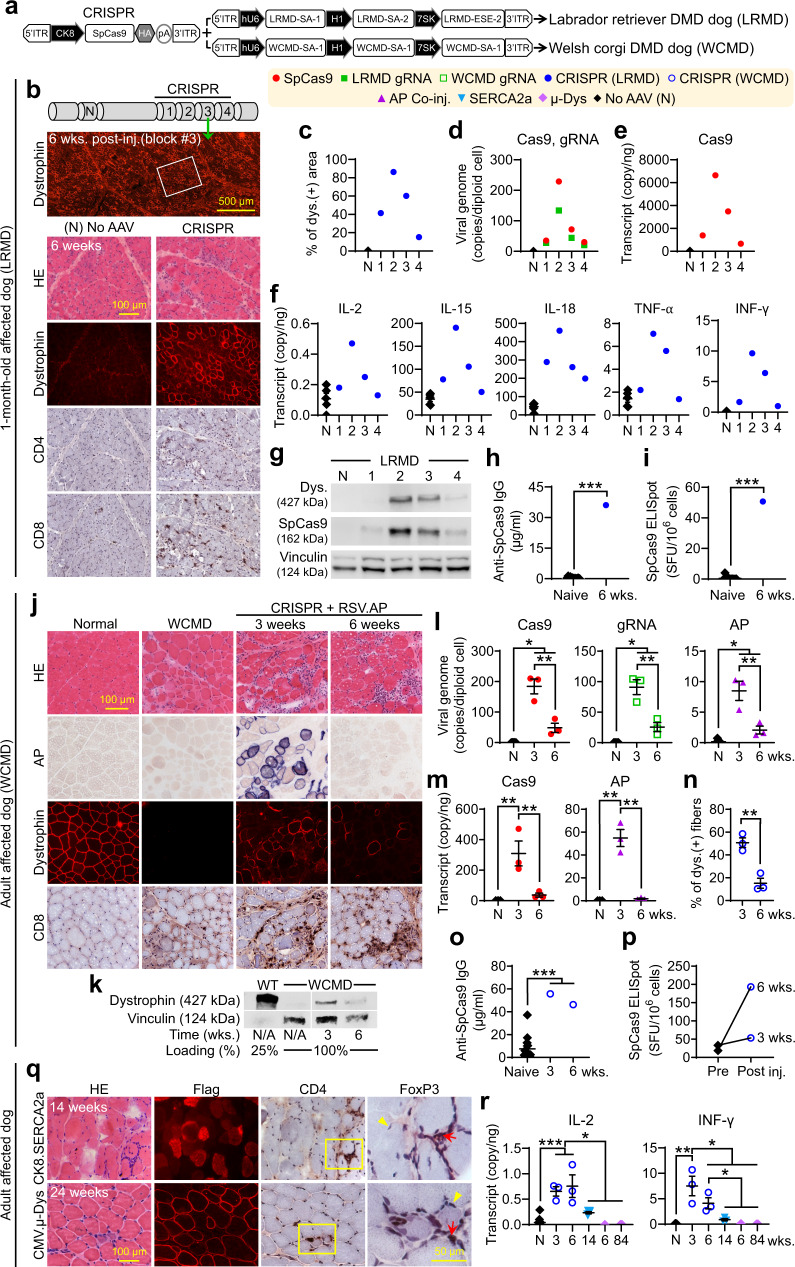
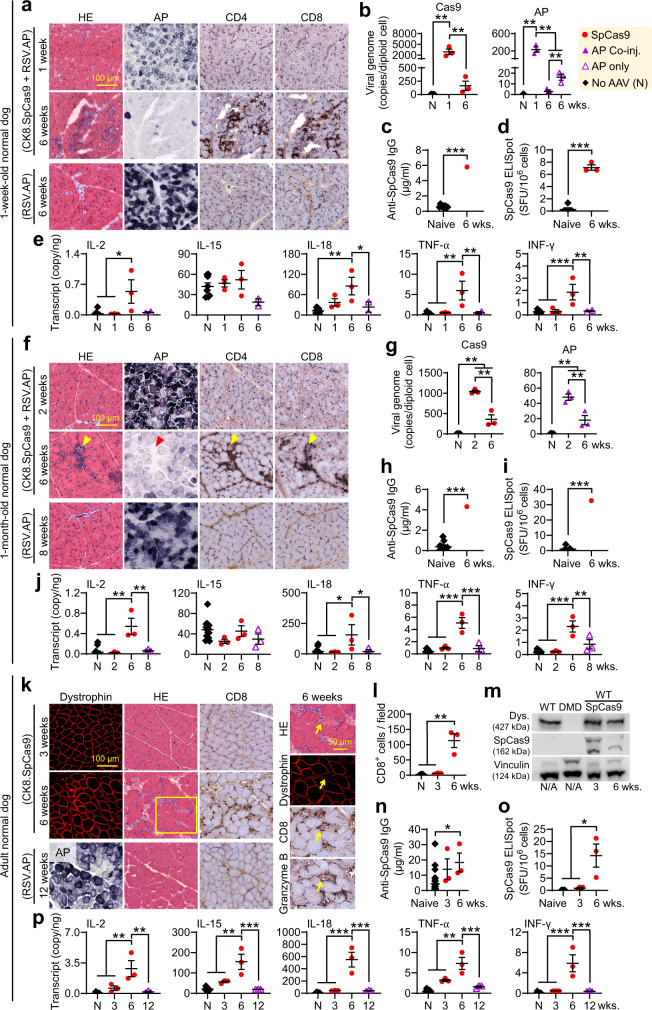
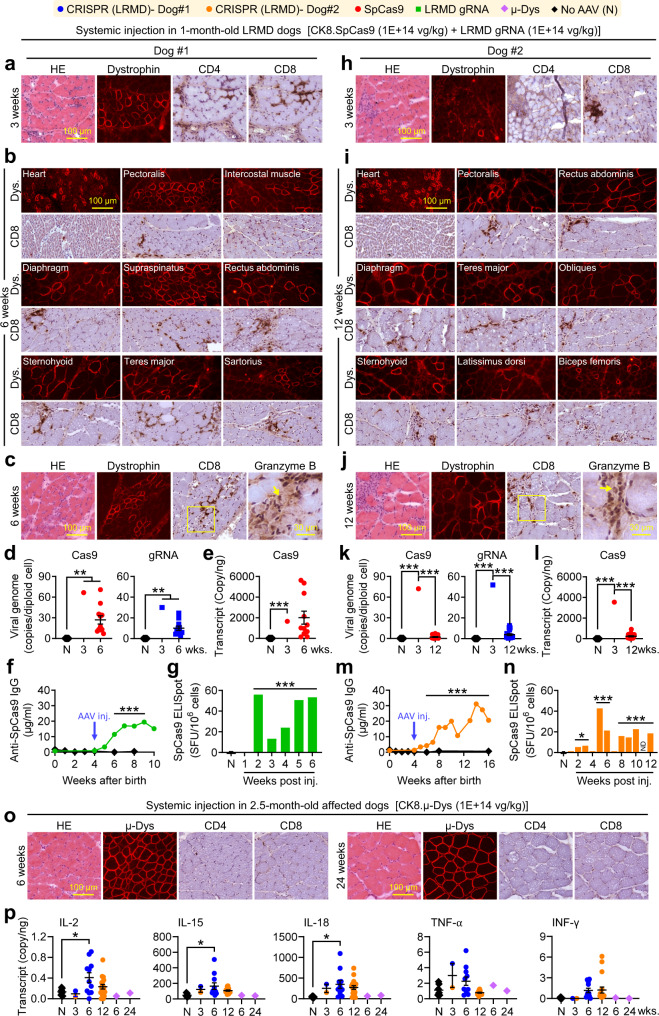
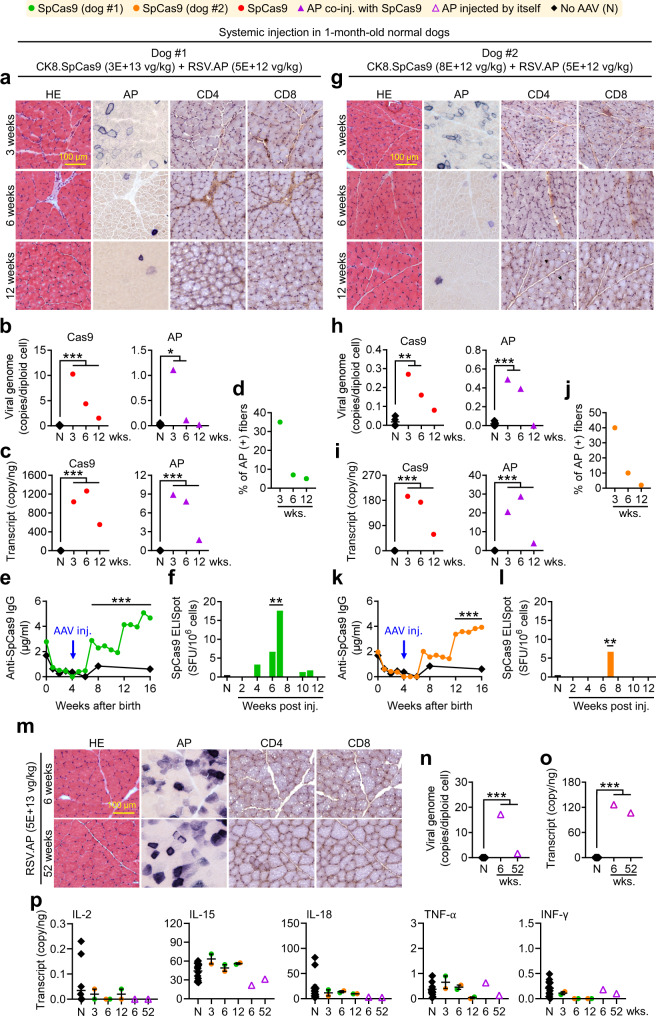
Adeno-associated virus (AAV)-mediated CRISPR-Cas9 editing holds promise to treat many diseases. The immune response to bacterial-derived Cas9 has been speculated as a hurdle for AAV-CRISPR therapy. However, immunological consequences of AAV-mediated Cas9 expression have thus far not been thoroughly investigated in large mammals. We evaluate Cas9-specific immune responses in canine models of Duchenne muscular dystrophy (DMD) following intramuscular and intravenous AAV-CRISPR therapy. Treatment results initially in robust dystrophin restoration in affected dogs but also induces muscle inflammation, and Cas9-specific humoral and cytotoxic T-lymphocyte (CTL) responses that are not prevented by the muscle-specific promoter and transient prednisolone immune suppression. In normal dogs, AAV-mediated Cas9 expression induces similar, though milder, immune responses. In contrast, other therapeutic (micro-dystrophin and SERCA2a) and reporter (alkaline phosphatase, AP) vectors result in persistent expression without inducing muscle inflammation. Our results suggest Cas9 immunity may represent a critical barrier for AAV-CRISPR therapy in large mammals.
Overview
The claims and statistics of this paper haven’t been checked yet.
Free: it reads the open-access text and checks the first 5 claims that cite a source we can check. Create a free account to check every claim.
Integrity signals
Registry
Cites
Statistics
Figures
Verification
Claims the paper makes
The claims and statistics of this paper haven’t been checked yet.
Free: it reads the open-access text and checks the first 5 claims that cite a source we can check. Create a free account to check every claim.
Claims other papers make about this one
Each is checked against this paper’s own text: does it say what the citing paper says it does?
The cited source says what the claim attributes to it.
In the citing paper
“Notably, it was recently shown that tissue-speci fi c promoter could not reduce immune responses in a canine study using AAV delivery of the CRISPR system (172).”
From A versatile toolkit for overcoming AAV immunity (2022) · cites this paper as [172]
In the citing paper
“AAV is also being developed as a delivery platform for in vivo gene editing in humans, raising the possibility of T cell responses against the editors, which are typically nucleases of bacterial origin.20,21”
From TLR9-independent CD8+ T cell responses in hepatic AAV gene transfer through IL-1R1-MyD88 signaling (2024) · cites this paper as [21]
In the citing paper
“This study indicated that older animals in a study are more likely to be positive for anti-Cas9 antibodies than the younger ones [5].”
From Immune responses to gene editing by viral and non-viral delivery vectors used in retinal gene therapy (2022) · cites this paper as [5]
In the citing paper
“An animal study conducted on 78 adult canines (60 WT and 18 models for Duchenne muscular dystrophy (DMD)) reported pre-existing anti-SpCas9 antibodies in all animals, but not in 16 newborn puppies, which only had moderate levels of maternally-derived Cas9 antibodies that dropped between two and six weeks of age.”
From Immune responses to gene editing by viral and non-viral delivery vectors used in retinal gene therapy (2022) · cites this paper as [5]
In the citing paper
“Both humoral and cellular immune responses were still observed, and reduced transduction efficiency was reported [5].”
From Immune responses to gene editing by viral and non-viral delivery vectors used in retinal gene therapy (2022) · cites this paper as [5]
Self-check
Percentages, sums and reported differences re-computed from the paper’s own numbers.
The self-check needs the paper’s full text.
Citations
Cites
Genome engineering using the CRISPR-Cas9 system
Ran, F. A., Hsu, P. D., Wright, J., Agarwala, V., Scott, D. A., & Zhang, F. (2013) · Nature Protocols · doi:10.1038/nprot.2013.143 · Cited by 11,133
The Human Genome Browser at UCSC
Kent, W. J., Sugnet, C. W., Furey, T. S., Roskin, K. M., Pringle, T. H., Zahler, A. M., & Haussler, A. D. (2002) · Genome Research · doi:10.1101/gr.229102 · Cited by 10,400
Bae, S., Park, J., & Kim, J.-S. (2014) · Bioinformatics · doi:10.1093/bioinformatics/btu048 · Cited by 2,339
CRISPR-Cas9 Gene Editing for Sickle Cell Disease and β-Thalassemia
Frangoul, H., Altshuler, D., Cappellini, M. D., Chen, Y.-S., Domm, J., Eustace, B. K., Foell, J., de la Fuente, J., Grupp, S., Handgretinger, R., et al. (2021) · New England Journal of Medicine · doi:10.1056/nejmoa2031054 · Cited by 1,962 · cited 1×
“Numbers (1, 2, 3, 4) in b–g are muscle block numbers.”
BackgroundESEfinder: a web resource to identify exonic splicing enhancers
Cartegni, L. (2003) · Nucleic Acids Research · doi:10.1093/nar/gkg616 · Cited by 1,603
Duan, D., Goemans, N., Takeda, S., Mercuri, E., & Aartsma-Rus, A. (2021) · Nature Reviews Disease Primers · doi:10.1038/s41572-021-00248-3 · Cited by 1,312
Self-citationComparing an Individual's Test Score Against Norms Derived from Small Samples
Crawford, J. R., & Howell, D. C. (1998) · The Clinical Neuropsychologist · doi:10.1076/clin.12.4.482.7241 · Cited by 1,264
In vivo genome editing improves muscle function in a mouse model of Duchenne muscular dystrophy
Nelson, C. E., Hakim, C. H., Ousterout, D. G., Thakore, P. I., Moreb, E. A., Rivera, R. M. C., Madhavan, S., Pan, X., Ran, F. A., Yan, W. X., et al. (2016) · Science · doi:10.1126/science.aad5143 · Cited by 1,144
Self-citationThe promise and challenge of therapeutic genome editing
Doudna, J. A. (2020) · Nature · doi:10.1038/s41586-020-1978-5 · Cited by 1,126 · cited 1×
“Numbers (1, 2, 3, 4) in b–g are muscle block numbers.”
Identification of preexisting adaptive immunity to Cas9 proteins in humans
Charlesworth, C. T., Deshpande, P. S., Dever, D. P., Camarena, J., Lemgart, V. T., Cromer, M. K., Vakulskas, C. A., Collingwood, M. A., Zhang, L., Bode, N. M., et al. (2019) · Nature Medicine · doi:10.1038/s41591-018-0326-x · Cited by 1,093
Cited by
Items 101–187 of 187
Hosseini, S. Y., Mallick, R., Mäkinen, P., & Ylä‐Herttuala, S. (2024) · Expert Review of Cardiovascular Therapy · doi:10.1080/14779072.2024.2328642 · Cited by 7
AAV5 Delivery of CRISPR/Cas9 Mediates Genome Editing in the Lungs of Young Rhesus Monkeys
Liang, S., Navia, A. W., Ramseier, M. L., Zhou, X., Martinez, M., Lee, C. K., Zhou, C., Wu, J., Xie, J., Su, Q., et al. (2024) · Human Gene Therapy · doi:10.1089/hum.2024.035 · Cited by 7
Early postnatal expression mitigates immune responses to Cas9 in the murine central nervous system
Duba-Kiss, R., & Hampson, D. R. (2025) · Molecular Therapy — Methods & Clinical Development · doi:10.1016/j.omtm.2025.101536 · Cited by 6
Efficient LAMA1 Gene Activation by Epigenome Editing as a Therapeutic Approach for LAMA2-CMD
Qin, Y., Akbulut, T., Mandraju, R., Connolly, K., Bechill, J., Assadian, F., Foster, C., Shottek, A., Levy, S., Benoit, J. D., et al. (2026) · Human Gene Therapy · doi:10.1177/10430342251401873 · Cited by 6
Decoding Undesirable Inflammatory Responses of Nucleic Acid‐Delivering Lipid Nanoparticles
Hu, R., Dou, Y., Li, C., Mu, Y., Ouyang, H., Shen, W., & Zhang, J. (2026) · Advanced Science · doi:10.1002/advs.75548 · Cited by 7
Yi, H., Yun, Y., Choi, W. H., Hwang, H.-Y., Cha, J. H., Seok, H., Song, J., Lee, J. H., Oh, S. H., Lee, S.-Y., et al. (2024) · Molecular Therapy — Nucleic Acids · doi:10.1016/j.omtn.2024.102199 · Cited by 6
Sosnovtseva, A. O., Demidova, N. A., Рафаиловна, К. Р., Kovalev, M. A., Aa, K., Starodubova, E. S., Latanova, A. A., & Karpov, D. S. (2024) · International Journal of Molecular Sciences · doi:10.3390/ijms252212346 · Cited by 6
Assessment of the Gene Therapy Immune Response in the Canine Muscular Dystrophy Model
Hakim, C. H., Kumar, S. R. P., Pérez‐López, D. O., Teixeira, J. A., Herzog, R. W., & Duan, D. (2022) · Methods in molecular biology · doi:10.1007/978-1-0716-2772-3_18 · Cited by 6
Self-citationModi, N., Guo, J. Z., Lee, R., Greenstein, A., & Lee, R. (2025) · International Journal of Molecular Sciences · doi:10.3390/ijms26125643 · Cited by 5
Shamsi, A., Alrouji, M., AlOmeir, O., Tasqeruddin, S., Khuzin, D., & Zuberi, A. (2025) · Frontiers in Cellular Neuroscience · doi:10.3389/fncel.2025.1681891 · Cited by 5
Precision and efficacy of RNA-guided DNA integration in high-expressing muscle loci
Padmaswari, M. H., Bulliard, G. N., Agrawal, S., Jia, M. S., Khadgi, S., Murach, K. A., & Nelson, C. E. (2024) · Molecular Therapy — Nucleic Acids · doi:10.1016/j.omtn.2024.102320 · Cited by 5
Self-citationSustained efficacy of CRISPR-Cas13b gene therapy for FSHD is challenged by immune response to Cas13bPreprint
Rashnonejad, A., Farea, M., Chermahini, G. A., Coulis, G., Taylor, N. D., Fowler, A. M., Villalta, S. A., King, O. D., & Harper, S. Q. (2025) · bioRxiv (Cold Spring Harbor Laboratory) · doi:10.1101/2024.12.18.629250 · Cited by 5
Lyu, G., Li, P., & Lang, W. (2025) · Journal of Translational Medicine · doi:10.1186/s12967-025-07066-1 · Cited by 4
Emerging Gene Therapies for Inherited Arrhythmia Syndromes
Grisorio, L., & Roberts, J. D. (2026) · Canadian Journal of Cardiology · doi:10.1016/j.cjca.2026.01.003 · Cited by 4
Precision Genetic Therapies: Balancing Risk and Benefit in Patients with Heart Failure
Johnston, J. R., & ADLER, E. D. (2024) · Current Cardiology Reports · doi:10.1007/s11886-024-02096-5 · Cited by 4
Sasaki‐Honda, M., Jonouchi, T., Arai, M., He, J., Okita, K., Sakurai, S., Yamamoto, T., & Sakurai, H. (2022) · bioRxiv (Cold Spring Harbor Laboratory) · doi:10.1101/2022.04.12.487997 · Cited by 4
Canine Model of Duchenne Muscular Dystrophy
Teixeira, J. A., Burke, M. J., Herzog, R. W., & Duan, D. (2025) · Methods in molecular biology · doi:10.1007/978-1-0716-4811-7_14 · Cited by 3
Self-citationJu, Z., Chen, L., Zhu, X., Cai, Y., Wei, S., Zhou, X., Shi, Y., Liu, C., Huang, C., Bi, S., et al. (2026) · Science Translational Medicine · doi:10.1126/scitranslmed.adx7857 · Cited by 3
Simhadri, V. L., Bajgain, P., Vijayanand, S., Jankowski, W., Rawal, A., Thijs, L., Doninck, T. V., Boonen, K., Pattyn, S., Pepermans, E., et al. (2026) · Nature Communications · doi:10.1038/s41467-026-75015-7 · Cited by 3
Ng, C. X., Mustafa, S., Yap, X. Y., & Lee, S. H. (2026) · Frontiers in Oncology · doi:10.3389/fonc.2026.1888734 · Cited by 3
Perillat, L., McFadyen, A., Furlong, P., & Anderson, J. (2025) · Frontiers in Medicine · doi:10.3389/fmed.2025.1493832 · Cited by 3
Circulatory CCL2 distinguishes Duchenne muscular dystrophy dogs
Pérez‐López, D. O., Burke, M. J., Hakim, C. H., Teixeira, J. A., Han, J.-Y., Yue, Y., Ren, Z., Sun, J., Chen, S., Herzog, R. W., et al. (2025) · Disease Models & Mechanisms · doi:10.1242/dmm.052137 · Cited by 3
Self-citationPreclinical development of genome editing to treat Duchenne muscular dystrophy by exon skipping
Padmaswari, M. H., Agrawal, S., & Nelson, C. E. (2025) · Journal of Neuromuscular Diseases · doi:10.1177/22143602251326993 · Cited by 3
Self-citationHakim, C. H., Pérez‐López, D. O., Burke, M. J., Teixeira, J. A., & Duan, D. (2022) · Methods in molecular biology · doi:10.1007/978-1-0716-2772-3_15 · Cited by 3
Self-citationLong-Term Evaluation of Retinal Morphology and Function in Rosa26-Cas9 Knock-In Mice
Mohan, K., Dubey, S. K., Jung, K., Dubey, R., Wang, Q. J., Prajapati, S. C., Roney, J., Abney, J., & Kleinman, M. E. (2023) · International Journal of Molecular Sciences · doi:10.3390/ijms24065186 · Cited by 3
Dowling, J. J. (2022) · Gene Therapy · doi:10.1038/s41434-022-00323-8 · Cited by 3
Nair, H. (2024) · Apollo Medicine · doi:10.1177/09760016241290651 · Cited by 2
Rocchi, A. R., Liao, S., Liu, H., Chen, C., Çakır, S., Bellizzi, A., Wollebo, H. S., Sariyer, I. K., & Khalili, K. (2025) · Molecular Therapy — Nucleic Acids · doi:10.1016/j.omtn.2025.102556 · Cited by 2
Wang, Y., Xiang, L., & Su, Z. (2025) · Tissue and Cell · doi:10.1016/j.tice.2025.103217 · Cited by 2
Screening strategy to identify Cas9 variants with higher HDR activity based on diphtheria toxin
Matsumoto, D., Kubota, K., Sato, Y., Kato-Inui, T., Nigorikawa, K., Miyaoka, Y., & Nomura, W. (2025) · Journal of Biomedical Science · doi:10.1186/s12929-025-01197-9 · Cited by 2
High-fidelity genome and prime editing enabled by the AI-designed openCRISPR-1
Hwang, H.-Y., Yi, H., Gwon, Y., Jeon, E. J., & Kim, D. (2026) · Genome Medicine · doi:10.1186/s13073-026-01682-2 · Cited by 2
Zaki, H. F., Bishri, J., Muqtadir, M. A., & Abu-Zaid, A. (2026) · Experimental Eye Research · doi:10.1016/j.exer.2026.111119 · Cited by 2
Zhang, Y., Yang, Y., Liu, Z., Li, Y., Xue, Y., Zhang, Z., Chen, G., Liu, J., He, M., Lu, T., et al. (2026) · Molecular Therapy · doi:10.1016/j.ymthe.2026.08.006 · Cited by 2
She, L., Liang, Z., Zou, Q., & Huo, Y. (2026) · ACS Synthetic Biology · doi:10.1021/acssynbio.6c00386 · Cited by 2
Recent advances in genetically modified large-animal models of human diseases
Zhang, J., Sun, X., & Cao, C. (2022) · BIO Integration · doi:10.15212/bioi-2022-0018 · Cited by 2
Anti-Cas9 immunity: A formidable challenge for muscle genome editing
Lagor, W. R. (2021) · Molecular Therapy · doi:10.1016/j.ymthe.2021.12.006 · Cited by 2
Boutin, J., Genevois, C., Couillaud, F., Lamrissi‐Garcia, I., Guyonnet‐Dupérat, V., Bibeyran, A., Lalanne, M., Amintas, S., Moranvillier, I., Richard, E., et al. (2024) · Molecular Therapy Oncology · doi:10.1016/j.omton.2024.200772 · Cited by 2
Liao, K. A., Lim, J., Choi, S. J., Yi, H., & Sun, B. (2025) · Advances in Cell and Gene Therapy · doi:10.1155/acg2/4639392 · Cited by 2
Lim, D., & Kim, H. (2025) · Biomolecules & Therapeutics · doi:10.4062/biomolther.2025.239 · Cited by 2
CRISPR in therapeutics and diagnostics: Perspectives from landscape analysisPreprint
Iyer, K. A., Tenchov, R., Diaz, L. M. L., Jain, P., Thite, T., Deng, Y., & Zhou, Q. A. (2025) · ChemRxiv · doi:10.26434/chemrxiv-2025-0qk09 · Cited by 2
Pulman, J., Ren, D., Visticot, L., Malki, H., Yao, Y., Cian, A. D., Ail, D., Concordet, J., Dalkara, D., & Fisson, S. (2025) · bioRxiv (Cold Spring Harbor Laboratory) · doi:10.64898/2025.12.11.693665 · Cited by 2
Han, X., Ji, G., Wang, N., Yi, L., Mao, Y., Deng, J., Wu, H., Ma, S., Han, J., Bu, Y., et al. (2023) · Journal of Translational Medicine · doi:10.1186/s12967-023-04301-5 · Cited by 1
Self-citationFatehi, S., Rok, M. J., Marks, R. M., Huynh, E., Kozman, N., Truong, H. A., Chi, L., Yan, B., Khazeeva, E., Delgado-Olguín, P., et al. (2025) · Molecular Therapy · doi:10.1016/j.ymthe.2025.05.005 · Cited by 1
Ren, D., Chauveau, G. A., Cabon, E., Vendomèle, J., Vignal‐Clermont, C., Saliba, H., Ail, D., Dalkara, D., & Fisson, S. (2026) · Progress in Retinal and Eye Research · doi:10.1016/j.preteyeres.2026.101443 · Cited by 1
Cytosine base editing of LPA in transgenic mice averts large deletions
Chuecos, M. A., Park, S. H., Bhakta, M., Too-Chiobi, U., Betancourth, D., Cao, M., Giorgi, M. D., Walkey, C. J., Tiwari, A., Godin, B., et al. (2026) · Molecular Therapy · doi:10.1016/j.ymthe.2026.02.049 · Cited by 1
Progress and challenges in cystic fibrosis gene editing
Witten, J. J., Egan, M. E., & Cereseto, A. (2026) · Journal of Cystic Fibrosis · doi:10.1016/j.jcf.2026.04.007 · Cited by 1
Sriwidodo, S., Suhandi, C., Sagitasa, S., Davinali, B. A. A., Maksum, I. P., & Safuan, S. (2026) · International Journal of Pharmaceutics X · doi:10.1016/j.ijpx.2026.100643 · Cited by 1
Immune Responses to Adeno-Associated Virus-Mediated CRISPR Therapy
Keeler, A. M. (2021) · Human Gene Therapy · doi:10.1089/hum.2021.29193.amk · Cited by 1
Applications of CRISPR-Cas System in Tumor Biology
Ma, M., Liu, Y., & Huang, W. (2021) · ONCOLOGIE · doi:10.32604/oncologie.2022.019415 · Cited by 1
Tùng, B. T., Trang, V. T. T., & Anh, N. T. V. (2024) · Elsevier eBooks · doi:10.1016/b978-0-443-16013-4.00004-x · Cited by 1
Ren, D., Chauveau, G. A., Vendomèle, J., Cabon, E., PINEIRO, A., Vignal‐Clermont, C., Saliba, H., Ronzitti, G., Galy, A. H. M., Dalkara, D., et al. (2026) · JCI Insight · doi:10.1172/jci.insight.199587 · Cited by 1
Edição de genes com Crispr-Cas9 em pacientes distróficos portadores de duplicação fora de fase
Barbosa, I. N. (2022) · Digital Library of Theses and Dissertations (Universidade de São Paulo) · doi:10.11606/d.41.2022.tde-24052022-142317 · Cited by 1
Szabó, P. L., & Kiss, A. (2022) · Gene Therapy · doi:10.1038/s41434-022-00337-2
Molecular Neurosurgery: Introduction to Gene Therapy and Clinical Applications
Addison, A. P., McGinnis, J. P., Ortiz‐Guzman, J., Tantry, E. K., Patel, D. M., Belfort, B. D. W., Srivastava, S., Romero, J. M., Arenkiel, B. R., & Curry, D. J. (2023) · Journal of Pediatric Epilepsy · doi:10.1055/s-0042-1760292
CaMKIIδ gene editing- A base hit for the heart
Walkey, C. J., & Lagor, W. R. (2023) · The Journal of Cardiovascular Aging · doi:10.20517/jca.2023.11
Han, X., Ji, G., Wang, N., Yi, L., Mao, Y., Deng, J., Wu, H., Ma, S., Han, J., Bu, Y., et al. (2023) · Figshare · doi:10.6084/m9.figshare.23665119
Self-citationDystrophin and Associated Proteins
Duan, D. (2024) · Elsevier eBooks · doi:10.1016/b978-0-323-95702-1.00155-x
Self-citationLess is more: Allele-specific removal of dysfunctional RYR1 channel subunits
Sun, D., & Lagor, W. R. (2024) · Molecular Therapy — Nucleic Acids · doi:10.1016/j.omtn.2024.102301
Bravo, D. T., Vaidyanathan, S., Baker, J. B., Sinha, V., Tsai, E. F., Roozdar, P., Kong, W. W., Atkinson, P. J., Patel, Z. M., Hwang, P. H., et al. (2025) · bioRxiv (Cold Spring Harbor Laboratory) · doi:10.1101/2025.01.24.634776
Pharmacogenomics and CRISPR-based therapies
Fatima, M., Tariq, I., Tariq, A., Talib, S., Fatima, M., Shehzadi, M., & Aqib, A. I. (2025) · Progress in brain research · doi:10.1016/bs.pbr.2025.08.009
Advanced Delivery Systems and Gene Editing in Neurotherapeutics
Upadhyay, P., Suhail, A., & Kumar, S. (2025) · Springer eBooks · doi:10.1007/978-981-95-3945-1_15
Self-citationHan, X., Ji, G., Wang, N., Yi, L., Mao, Y., Deng, J., 吴红然, Ma, S., HAN, J., Bu, Y., et al. (2023) · Figshare · doi:10.6084/m9.figshare.23665107
Self-citationHan, X., Ji, G., Wang, N., Yi, L., Mao, Y., Deng, J., 吴红然, Ma, S., HAN, J., Bu, Y., et al. (2023) · Figshare · doi:10.6084/m9.figshare.23665110
Self-citationHan, X., Ji, G., Wang, N., Yi, L., Mao, Y., Deng, J., 吴红然, Ma, S., HAN, J., Bu, Y., et al. (2023) · Figshare · doi:10.6084/m9.figshare.23665098
Self-citationHan, X., Ji, G., Wang, N., Yi, L., Mao, Y., Deng, J., 吴红然, Ma, S., HAN, J., Bu, Y., et al. (2023) · Figshare · doi:10.6084/m9.figshare.23665104
Self-citationHan, X., Ji, G., Wang, N., Yi, L., Mao, Y., Deng, J., 吴红然, Ma, S., HAN, J., Bu, Y., et al. (2023) · Figshare · doi:10.6084/m9.figshare.23665101
Self-citationHan, X., Ji, G., Wang, N., Yi, L., Mao, Y., Deng, J., 吴红然, Ma, S., HAN, J., Bu, Y., et al. (2023) · Figshare · doi:10.6084/m9.figshare.23665116
Self-citationSynergistic integration of inducible RNA switches enhances the manipulation of vector expressionPreprint
Zhang, Y., Yang, Y., Liu, Z., Li, Y., Xue, Y., Zhang, Z., Chen, G., Lu, T., Zhang, Y., Zhao, D., et al. (2026) · bioRxiv (Cold Spring Harbor Laboratory) · doi:10.64898/2026.02.06.704328
Radoua, A., Alrustom, B., Wang, J., Bordessoules, M., Chluba, J., Plenchette, S., & Micheau, O. (2026) · Methods in cell biology · doi:10.1016/bs.mcb.2026.02.005
Porenta, D., Benne, N., Sijts, A. J. A. M., Broere, F., & Mastrobattista, E. (2026) · The CRISPR Journal · doi:10.1177/25731599261456887
Galbiati, P., Leclerc, D., Mombled, M., Khan, R., Ralu, M., Bimbi, G., Scalisi, G., Mamchaoui, K., Tedesco, F. S., Albini, S., et al. (2026) · bioRxiv (Cold Spring Harbor Laboratory) · doi:10.64898/2026.07.29.741396
Efficient genome editing in the non-human primate brain using programmable extracellular vesiclesPreprint
Liang, X., Zhou, H., Nizamudeen, Z. A., Kyriakopoulou, E., Evans, A. E., Roudi, S., Estupiñan, H. Y., Rädler, J., Hou, V., Daniel, C. D. W., et al. (2026) · bioRxiv (Cold Spring Harbor Laboratory) · doi:10.64898/2026.08.05.741964
Hasan, M. U., Azhar, M. W., Noor-ul-Saba, Khurshid, M., & Riaz, R. (2026) · Journal of Virological Methods · doi:10.1016/j.jviromet.2026.115447
Hassanein, A., Cyprian, F., & Akhtar, S. (2026) · Expert Opinion on Biological Therapy · doi:10.1080/14712598.2026.2721412
RNA delivery to the corneal endothelium using charge-altering releasable transporters
Wang, S. K., Li, Z., Shah, S. H., Edwards, Q. A., Bouffard, R., Hines, E. S., Imventarza, J. A., Korte, S., Lawrence, M. S., Song, E., et al. (2026) · Science Advances · doi:10.1126/sciadv.ady8161
Hu, B., Gutty, V. S. R., Herzog, R. W., & Duan, D. (2026) · Frontiers in Medicine · doi:10.3389/fmed.2026.1930231
Self-citationTherapeutic potential of SAT-3247 in a canine model of Duchenne muscular dystrophy
Rayagiri, S., Smid, J. K., Lambert, P., Jaquith, J., Murray, T., Mitchell, R., Gleeson, F., Monast, J. G., Teixeira, J. A., Yue, Y., et al. (2026) · Skeletal Muscle · doi:10.21203/rs.3.rs-11220671/v1
Self-citationNano Delivery Systems for In Vivo CRISPR/Cas-Based Gene Therapy: From Vectors to Clinical Outcomes
Chen, R., Zhou, H., Wu, Q., & Gong, C. (2026) · ACS Nano · doi:10.1021/acsnano.6c12154 · Cited by 1
Exon skipping therapy for Duchenne Muscular Dystrophy with CRISPR base editors
Gapinske, M. (2022) · Illinois Digital Environment for Access to Learning and Scholarship (University of Illinois at Urbana-Champaign)
Edición genética: una valoración científica y bioética del primer caso en seres humanos en el Perú
Paredes-Moscosso, S. R., Villegas-Llerena, C., & Carbajal, C. Ñ. (2026) · Medicina y Ética · doi:10.36105/mye.2026v37n4.01
Pien, Y.-C., Li, H. Z., Bulliard, G., Liu, H., Durbacz, M. Z., Xu, Z., Chai, A. C., Chemello, F., Sanchez‐Ortiz, E., Zabaleta, N., et al. (2026) · Journal of Clinical Investigation · doi:10.1172/jci202378
Gene therapy for epilepsy: From SCN1A to broadened therapeutic horizons (Review)
Qin, R., Hu, X., Jiang, W., Jing, W., Zheng, M., Zhang, Z., & Ma, D. (2026) · Molecular Medicine Reports · doi:10.3892/mmr.2026.14060
CRISPR Technology: From Bench to Bedside Applications
Ma, X., Li, L., & Sun, Y. (2026) · MedComm · doi:10.1002/mco2.71011
Riegler, J. (2026) · Frontiers in Immunology · doi:10.3389/fimmu.2026.1976507
Han, X., Han, J., Wang, N., Ji, G., Guo, R., Li, J., Wu, H., Ma, S., Fang, P., & Song, X. (2022) · doi:10.3389/fnins.2022.891670.s002
Self-citation
Metadata
- Authors
- Hakim, C. H., Kumar, S. R. P., Pérez-López, D. O., Wasala, N. B., Zhang, D., Yue, Y., Teixeira, J., Pan, X., Zhang, K., Million, E. D., Nelson, C. E., Metzger, S., Han, J., Louderman, J. A., Schmidt, F., Feng, F., Grimm, D., Smith, B. F., Yao, G., Yang, N. N., Gersbach, C. A., Chen, S.-J., Herzog, R. W., & Duan, D.
- Affiliations
- National Institutes of Health (US)
- Indiana University Indianapolis (US)
- University of Missouri (US)
- Duke University (US)
- Heidelberg University (DE)
- Auburn University (US)
- Corresponding author
- Duan, Dongsheng
- ORCID
- Venue
- Nature Communications
- Published
- 2021-11-24
- Volume
- 12
- Issue
- 1
- Pages
- 6769-6769
- ISSN
- 2041-1723 (ISSN-L)
- PMC
- PMC8613397
- OpenAlex
- W3216412686
- Cited by
- 175
- References
- 57
- Citations by year
- 2026: 28 · 2025: 39 · 2024: 37 · 2023: 36 · 2022: 31 · 2021: 4
- FWCI
- 15.39
- Type
- journal article
- Language
- en
- Open access
- gold
- doi.org
- Licence
- cc-by
- creativecommons.org/licenses/by/4.0 (tdm)
- creativecommons.org/licenses/by/4.0 (vor)
- Locations
- Nature Communications (publishedVersion, cc-by)
- PubMed Central (publishedVersion, cc-by)
- PubMed (publishedVersion)
- RePEc: Research Papers in Economics (submittedVersion)
- DOAJ (DOAJ: Directory of Open Access Journals) (submittedVersion, cc-by-sa)
- IUScholarWorks (Indiana University) (submittedVersion, cc-by)
- Funders
- U.S. Department of Health & Human Services | NIH | National Institute of General Medical Sciences (T32 GM008396)
- University of Missouri Life Science Fellowship
- U.S. Department of Health & Human Services | NIH | National Institute of Neurological Disorders and Stroke (NS-90634)
- U.S. Department of Health & Human Services | NIH | National Institute of Arthritis and Musculoskeletal and Skin Diseases (AR-70517)
- Parent Project Muscular Dystrophy (no number)
- U.S. Department of Defense (MD150133)
- Hope for Javier, Jackson Freel DMD Research Fund, Team Joseph, Charley’s Fund, Zubin’s Wish, Jett Foundation, Cure Duchenne, and Destroy Duchenne
- Topics
- Life Sciences › Biochemistry, Genetics and Molecular Biology › Genetics › Virus-based gene therapy research
- Life Sciences › Biochemistry, Genetics and Molecular Biology › Molecular Biology › CRISPR and Genetic Engineering
- Life Sciences › Biochemistry, Genetics and Molecular Biology › Molecular Biology › RNA Interference and Gene Delivery
- Keywords
- Duchenne muscular dystrophy, canine model, dystrophin restoration, muscle inflammation, cytotoxic T lymphocytes, humoral immune response, muscle-specific promoter, microdystrophin, SERCA2a, alkaline phosphatase reporter
- MeSH terms
- Gene Editing, Dependovirus, Animals, Disease Models, Animal, Dogs, Genetic Vectors, Humans, Genetic Therapy, Dystrophin, Genes, Reporter, Muscle, Skeletal, Muscular Dystrophy, Duchenne, Sarcoplasmic Reticulum Calcium-Transporting ATPases, CRISPR-Cas Systems
About these checks
Registry, retraction, Cites and statistics results are computed, not judged, with one exception: a printed reference that no index lists is read once by a model before it counts as a citation error. Claims are extracted by a model and kept only when their quote appears verbatim in the text; each cited source is then checked, with a model’s help, for whether it says what the claim relies on. Those verdicts can be wrong — read the claim’s quote and the cited source before relying on one.
Statistics and arithmetic are recomputed, not judged.
Confidence bands are shown only for fields calibrated on our annotated test set. None is calibrated yet, so no band is shown.
What counts as a claim ›How we measure confidence ›How we check this ›
Are you an author, or do you see a problem with this page? Request a review
Data sources
Bibliographic data: Semantic Scholar, OpenAlex, Crossref.
Contains information from the Semantic Scholar Academic Graph Datasets, made available under the ODC Attribution License (ODC-BY 1.0).
Semantic Scholar’s data is described in: Kinney, R., et al. (2023). The Semantic Scholar Open Data Platform. arXiv:2301.10140.
