

Tissue extracellular matrix hydrogels as alternatives to Matrigel for culturing gastrointestinal organoids
Open accessThe DOI matches its Crossref record; 103 of the 103 references it cites were found in a registry or an index.
Abstract
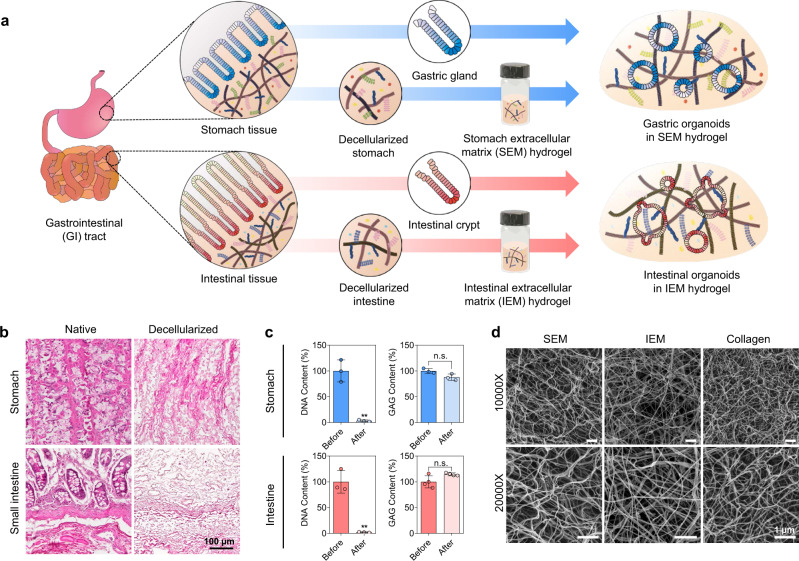
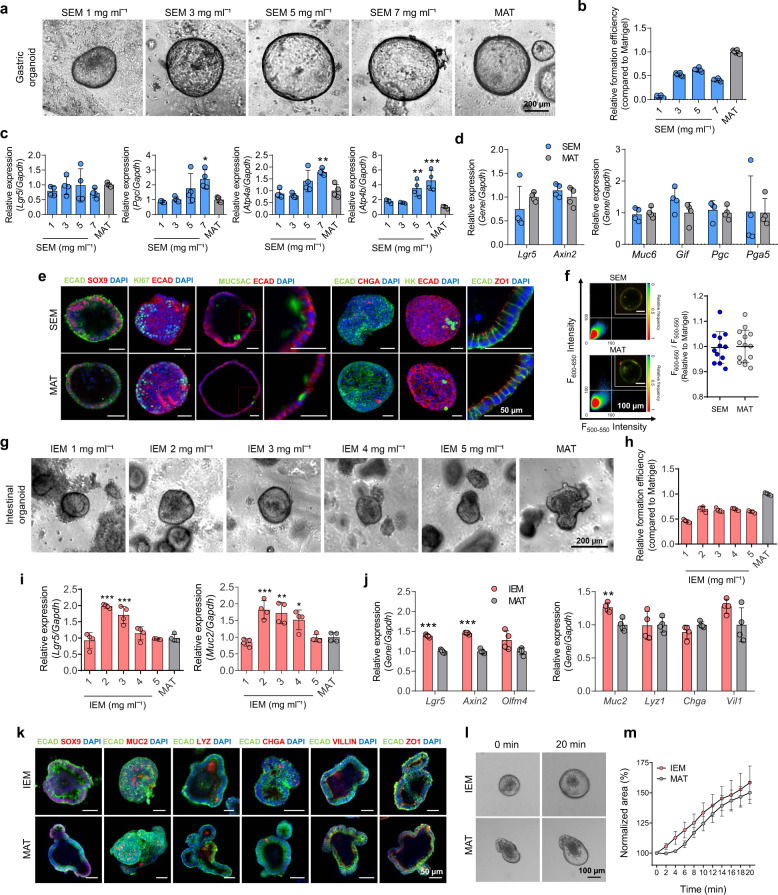
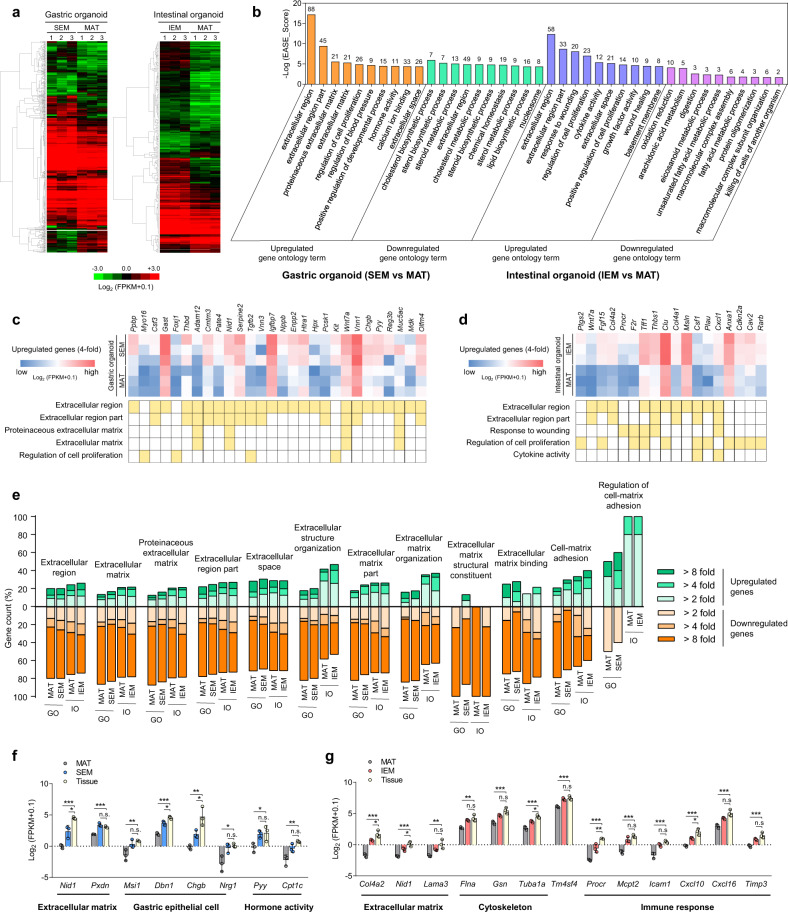
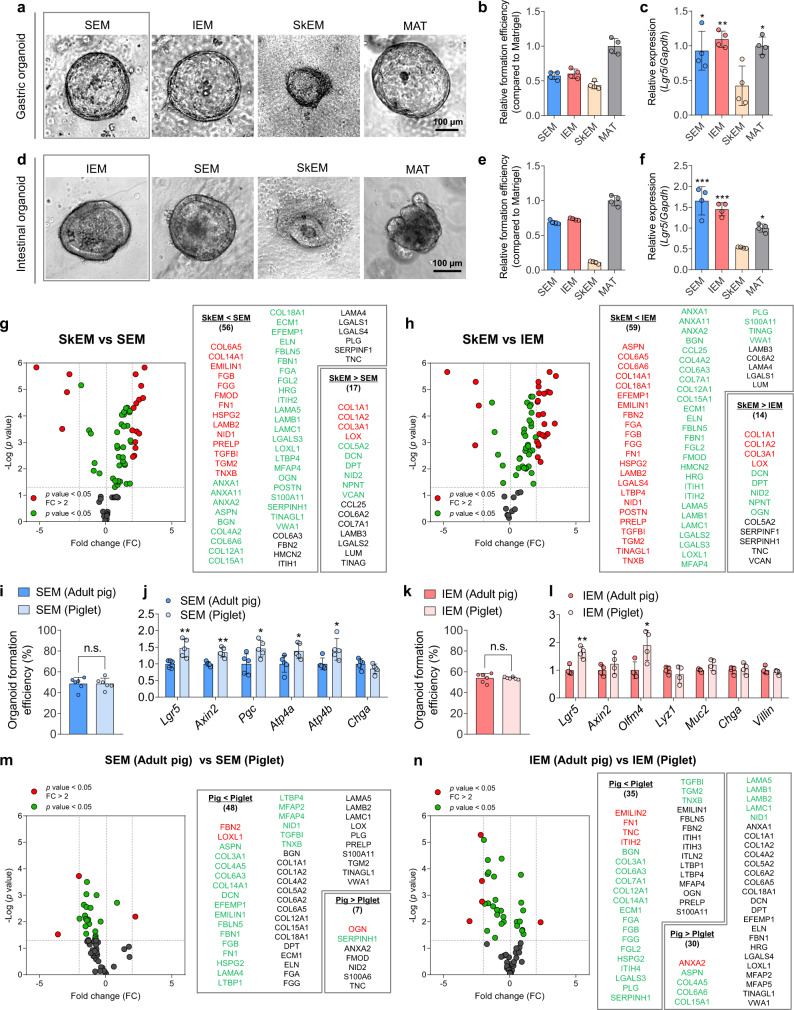
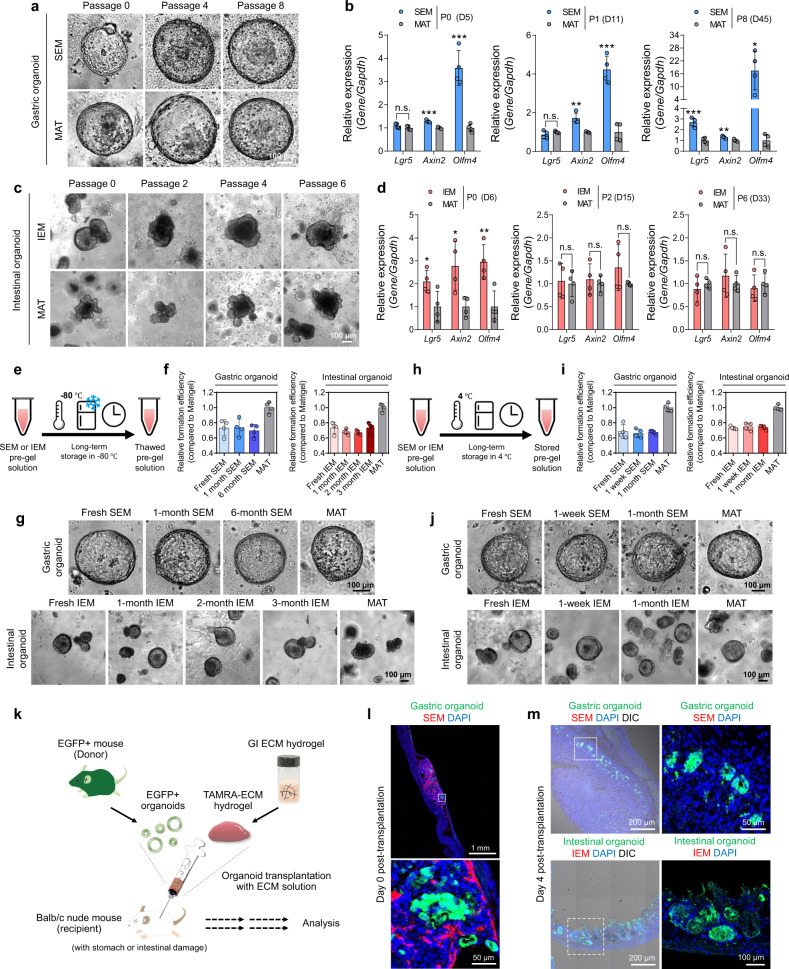
Matrigel, a mouse tumor extracellular matrix protein mixture, is an indispensable component of most organoid tissue culture. However, it has limited the utility of organoids for drug development and regenerative medicine due to its tumor-derived origin, batch-to-batch variation, high cost, and safety issues. Here, we demonstrate that gastrointestinal tissue-derived extracellular matrix hydrogels are suitable substitutes for Matrigel in gastrointestinal organoid culture. We found that the development and function of gastric or intestinal organoids grown in tissue extracellular matrix hydrogels are comparable or often superior to those in Matrigel. In addition, gastrointestinal extracellular matrix hydrogels enabled long-term subculture and transplantation of organoids by providing gastrointestinal tissue-mimetic microenvironments. Tissue-specific and age-related extracellular matrix profiles that affect organoid development were also elucidated through proteomic analysis. Together, our results suggest that extracellular matrix hydrogels derived from decellularized gastrointestinal tissues are effective alternatives to the current gold standard, Matrigel, and produce organoids suitable for gastrointestinal disease modeling, drug development, and tissue regeneration.
Overview
The claims and statistics of this paper haven’t been checked yet.
Free: it reads the open-access text and checks the first 5 claims that cite a source we can check. Create a free account to check every claim.
Integrity signals
Registry
Cites
Statistics
Figures
Verification
Claims the paper makes
The claims and statistics of this paper haven’t been checked yet.
Free: it reads the open-access text and checks the first 5 claims that cite a source we can check. Create a free account to check every claim.
Claims other papers make about this one
Each is checked against this paper’s own text: does it say what the citing paper says it does?
The cited source says what the claim attributes to it.
In the citing paper
“Kim et al. determined that gastrointestinal ECM hydrogels facilitated prolonged passaging and transplantation of organoids, producing organoids suitable for gastrointestinal disease modeling, drug development, and tissue regeneration by simulating the microenvironment of gastrointestinal tissues.[ 202 ]”
From Bioactive scaffolds for tissue engineering: A review of decellularized extracellular matrix applications and innovations (2025) · cites this paper as [202]
The check wasn’t confident either way, so it gives no verdict — never disputed.
In the citing paper
“macrophages could speed up cancer cell migration through secreting TGF‐β1.”
From 3D Biomimetic Models to Reconstitute Tumor Microenvironment In Vitro: Spheroids, Organoids, and Tumor‐on‐a‐Chip (2023) · cites this paper as [122]
Experimental — accuracy not yet measured
Self-check
Percentages, sums and reported differences re-computed from the paper’s own numbers.
The self-check needs the paper’s full text.
Citations
Cites
Gene Ontology: tool for the unification of biology
Ashburner, M., Ball, C. A., Blake, J. A., Botstein, D., Butler, H., Cherry, J. M., Davis, A. P., Dolinski, K., Dwight, S. S., Eppig, J. T., et al. (2000) · Nature Genetics · doi:10.1038/75556 · Cited by 43,206
Tissue-based map of the human proteome
Uhlén, M., Fagerberg, L., Hallström, B. M., Lindskog, C., Oksvold, P., Mardinoglu, A., Sivertsson, Å., Kampf, C., Sjöstedt, E., Asplund, A., et al. (2015) · Science · doi:10.1126/science.1260419 · Cited by 15,286
Cox, J., & Mann, M. (2008) · Nature Biotechnology · doi:10.1038/nbt.1511 · Cited by 14,855
The Perseus computational platform for comprehensive analysis of (prote)omics data
Tyanova, S., Temu, T., Sinitcyn, P., Carlson, A., Hein, M. Y., Geiger, T., Mann, M., & Cox, J. (2016) · Nature Methods · doi:10.1038/nmeth.3901 · Cited by 8,803
Single Lgr5 stem cells build crypt-villus structures in vitro without a mesenchymal niche
Sato, T., Vries, R. G., Snippert, H. J., van de Wetering, M., Barker, N., Stange, D. E., van Es, J. H., Abo, A., Kujala, P., Peters, P. J., et al. (2009) · Nature · doi:10.1038/nature07935 · Cited by 7,204 · cited 2×
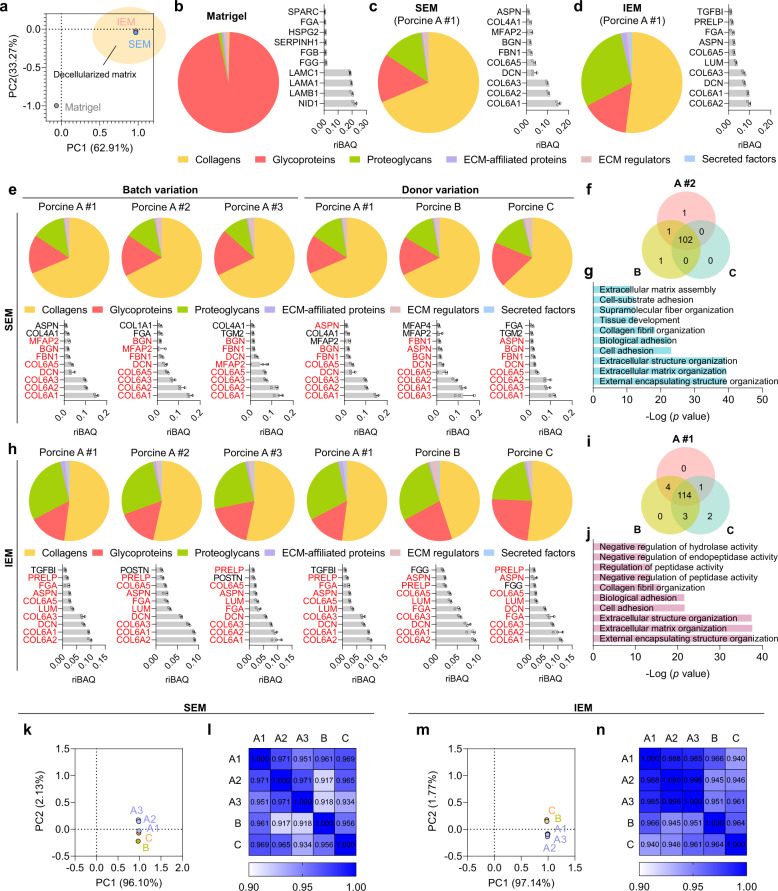
“To evaluate the variation of decellularized GI tissue-derived matrices in the ECM compositions, we compared the samples under two conditions: (1) comparison of multiple sample batches derived from different locations in the same donor tissue (batch variation—porcine A1–A3), (2) comparison of multiple samples derived f…”
BackgroundMethodGlobal quantification of mammalian gene expression control
Schwanhäusser, B., Busse, D., Li, N., Dittmar, G., Schuchhardt, J., Wolf, J., Chen, W., & Selbach, M. (2011) · Nature · doi:10.1038/nature10098 · Cited by 6,566
Andromeda: A Peptide Search Engine Integrated into the MaxQuant Environment
Cox, J., Neuhauser, N., Michalski, A., Scheltema, R. A., Olsen, J. V., & Mann, M. (2011) · Journal of Proteome Research · doi:10.1021/pr101065j · Cited by 5,500
Raudvere, U., Kolberg, L., Kuzmin, I., Arak, T., Adler, P., Peterson, H., & Vilo, J. (2019) · Nucleic Acids Research · doi:10.1093/nar/gkz369 · Cited by 5,045
The extracellular matrix at a glance
Frantz, C., Stewart, K. M., & Weaver, V. M. (2010) · Journal of Cell Science · doi:10.1242/jcs.023820 · Cited by 4,334
Sato, T., Stange, D. E., Ferrante, M., Vries, R. G. J., van Es, J. H., van den Brink, S., van Houdt, W. J., Pronk, A., van Gorp, J., Siersema, P. D., et al. (2011) · Gastroenterology · doi:10.1053/j.gastro.2011.07.050 · Cited by 3,753 · cited 1×
“In this study, we provide experimental evidence on how our approach with decellularized GI tissue-derived ECM hydrogels can resolve the major issues of Matrigel including (1) batch-to-batch variation, (2) safety, and (3) high-cost issues.”
Background
Cited by
Items 401–414 of 414
Silicate Biomaterials‐Stimulated Vascularized Callus Organoids for Bone Tissue Regeneration
Cao, S., Huang, J., Ma, W., Zhu, Y., Lu, H., Zhu, Y., Ma, H., & Wu, C. (2026) · Advanced Materials · doi:10.1002/adma.75339
Huang, X., Zhang, K., Li, S., & Liu, G. (2026) · Journal of Lipid Research · doi:10.1016/j.jlr.2026.101161
Mi, C., Liu, X., Tang, X., & 李国良 (2026) · Translational Oncology · doi:10.1016/j.tranon.2026.103065
“Defined matrices and tissue-derived ECM can reduce Matrigel dependence [29].”
Advances in engineering organ-on-a-chip models of angiogenesis
Tao, Y., Liu, T., Zhang, Y., Yue, H., Zhang, H., 赁可, Wu, C., Huang, Y., Liu, X., Wang, X., et al. (2026) · Theranostics · doi:10.7150/thno.136769
“Matrigel provides basement-membrane components and proangiogenic cues, but its murine tumor origin, ill-defined composition, and lot-to-lot variability hinder standardization and clinical translation [87-88].”
Cao, Z., Song, H., Wang, M., Guo, L., Zheng, X., Zhang, C., Shang, D., Wang, X., & Wang, X. (2026) · ACS Applied Materials & Interfaces · doi:10.1021/acsami.6c09854
Genetically programmable molecular framework for constructing precision recombinant human ECM mimicsPreprint
Evans, A. D., Keränen, J., Rauhalinna, S., Mombeinipour, M., Hossain, H., Turkki, P., Oommen, O. P., Rahikainen, R., & Hytönen, V. P. (2026) · bioRxiv (Cold Spring Harbor Laboratory) · doi:10.64898/2026.10.20.760354
Liu, K., Yang, F., Lyu, X., He, H., & Wen, W. (2026) · Journal of Translational Internal Medicine · doi:10.1515/jtim-2026-0060
“[62,63,65] In parallel, organoid-on-a-chip systems can impose controlled gradients of oxygen, nutrients, and soluble cues, enabling more stable long-term culture and higher-content functional readouts under physiologically relevant flow conditions.”
Modeling the Human Stomach In Vitro: Gastric Organoids in Development, Disease, and Therapy
Najafabadi, Z. E., Ryszkiel, I., Baharvand, H., Sadeghi, A., Stanek, A., & Meyfour, A. (2026) · Cells · doi:10.3390/cells15211973
From bench to clinic, are organoids ready for modeling drug delivery in brain disease?
Xiang, Q., Zheng, M.-X., Yuan, J.-R., Lin, S.-R., Li, X., & Li, X.-H. (2026) · International Journal of Pharmaceutics X · doi:10.1016/j.ijpx.2026.100693
Meyer, M. F., Sweet, C. W., Breau, K. A., Burclaff, J., Bliton, R. J., Dodson, H. M., Cannon, G. H., Bougaran, P., Puri, V., Frazer, L. C., et al. (2026) · bioRxiv (Cold Spring Harbor Laboratory) · doi:10.64898/2026.10.29.762618
Li, W., Liu, Z., Wang, P., Li, H., 云舞扬, Ge, Y., & Sun, G. (2026) · Materials & Design · doi:10.1016/j.matdes.2026.117444
3D models to capture and perturb tumour heterogeneity in vitro
Fomina, A., & McGuigan, A. P. (2026) · Nature reviews. Cancer · doi:10.1038/s41568-026-00993-1
The Development of a Biocomposite Microtissue Platform for High-Throughput Oncology Assays
Li, N. T. (2024) · TSpace (University of Toronto)
Oxidized Cellulose Nanofiber Hydrogels for 3D Airway Spheroids and Influenza Infection Modeling
Tang, J., Zheng, B., Dimde, M., Achazi, K., Nie, C., Ma, N., & Haag, R. (2026) · Advanced Healthcare Materials · doi:10.1002/adhm.71941
Metadata
- Authors
- Kim, S., Min, S., Choi, Y. S., Jo, S.-H., Jung, J. H., Han, K., Kim, J., An, S., Ji, Y. W., Kim, Y.-G., & Cho, S.-W.
- Affiliations
- Yonsei University (KR)
- Soongsil University (KR)
- Corresponding author
- Cho, Seung-Woo
- ORCID
- Venue
- Nature Communications
- Published
- 2022-03-30
- Volume
- 13
- Issue
- 1
- Pages
- 1692-1692
- ISSN
- 2041-1723 (ISSN-L)
- PMC
- PMC8967832
- OpenAlex
- W4220834703
- Semantic Scholar
- e21b3da2ea850f4368b57de14dfb52f8a36eef91
- Cited by
- 375
- References
- 103
- Citations by year
- 2026: 82 · 2025: 113 · 2024: 88 · 2023: 74 · 2022: 18
- FWCI
- 70.01
- Type
- journal article
- Language
- en
- Open access
- gold
- doi.org
- Licence
- cc-by
- creativecommons.org/licenses/by/4.0 (tdm)
- creativecommons.org/licenses/by/4.0 (vor)
- Locations
- Nature Communications (publishedVersion, cc-by)
- PubMed Central (publishedVersion, cc-by)
- PubMed (publishedVersion)
- YUHSpace (Yonsei University Medical Library) (submittedVersion, cc-by-nc-nd)
- RePEc: Research Papers in Economics (submittedVersion)
- DOAJ (DOAJ: Directory of Open Access Journals) (submittedVersion, cc-by-sa)
- Funders
- National Research Foundation of Korea (2018M3A9H1021382, 2021R1A2C3004262)
- Ministry of Trade, Industry and Energy, Korea | Korea Evaluation Institute of Industrial Technology (20009125)
- Institute for Basic Science (IBS-R026-D1)
- Topics
- Health Sciences › Medicine › Surgery › Tissue Engineering and Regenerative Medicine
- Physical Sciences › Materials Science › Biomaterials › Hydrogels: synthesis, properties, applications
- Physical Sciences › Engineering › Biomedical Engineering › 3D Printing in Biomedical Research
- Keywords
- extracellular matrix hydrogel, Matrigel alternative, gastric organoids, intestinal organoids, decellularized tissue, organoid culture, organoid transplantation, regenerative medicine
- MeSH terms
- Animals, Collagen, Drug Combinations, Extracellular Matrix, Laminin, Organoids, Proteoglycans, Hydrogels, Proteomics, Mice
About these checks
Registry, retraction, Cites and statistics results are computed, not judged, with one exception: a printed reference that no index lists is read once by a model before it counts as a citation error. Claims are extracted by a model and kept only when their quote appears verbatim in the text; each cited source is then checked, with a model’s help, for whether it says what the claim relies on. Those verdicts can be wrong — read the claim’s quote and the cited source before relying on one.
Statistics and arithmetic are recomputed, not judged.
Confidence bands are shown only for fields calibrated on our annotated test set. None is calibrated yet, so no band is shown.
What counts as a claim ›How we measure confidence ›How we check this ›
Are you an author, or do you see a problem with this page? Request a review
Data sources
Bibliographic data: Semantic Scholar, OpenAlex, Crossref.
Contains information from the Semantic Scholar Academic Graph Datasets, made available under the ODC Attribution License (ODC-BY 1.0).
Semantic Scholar’s data is described in: Kinney, R., et al. (2023). The Semantic Scholar Open Data Platform. arXiv:2301.10140.
