

The DOI matches its Crossref record; 118 of the 119 references it cites were found in a registry or an index.
Global stocks and capacity of mineral-associated soil organic carbon
Open accessAbstract
Soil is the largest terrestrial reservoir of organic carbon and is central for climate change mitigation and carbon-climate feedbacks. Chemical and physical associations of soil carbon with minerals play a critical role in carbon storage, but the amount and global capacity for storage in this form remain unquantified. Here, we produce spatially-resolved global estimates of mineral-associated organic carbon stocks and carbon-storage capacity by analyzing 1144 globally-distributed soil profiles. We show that current stocks total 899 Pg C to a depth of 1 m in non-permafrost mineral soils. Although this constitutes 66% and 70% of soil carbon in surface and deeper layers, respectively, it is only 42% and 21% of the mineralogical capacity. Regions under agricultural management and deeper soil layers show the largest undersaturation of mineral-associated carbon. Critically, the degree of undersaturation indicates sequestration efficiency over years to decades. We show that, across 103 carbon-accrual measurements spanning management interventions globally, soils furthest from their mineralogical capacity are more effective at accruing carbon; sequestration rates average 3-times higher in soils at one tenth of their capacity compared to soils at one half of their capacity. Our findings provide insights into the world’s soils, their capacity to store carbon, and priority regions and actions for soil carbon management.
Overview
The claims and statistics of this paper haven’t been checked yet.
Run the check — free, no account needed. It reads the open-access text and checks the sources it cites.
Integrity signals
Registry
Cites
Statistics
Figures
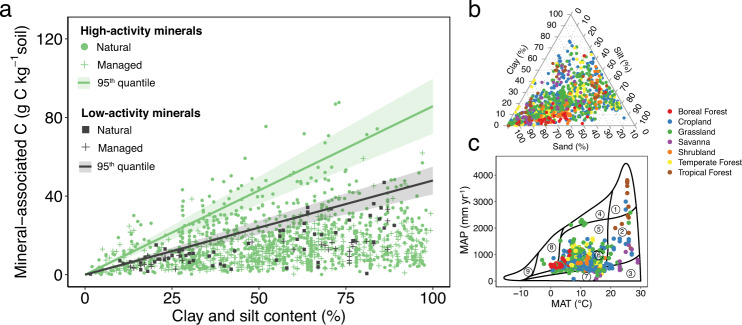
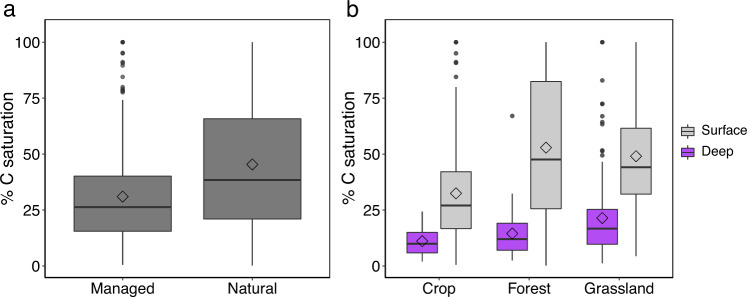
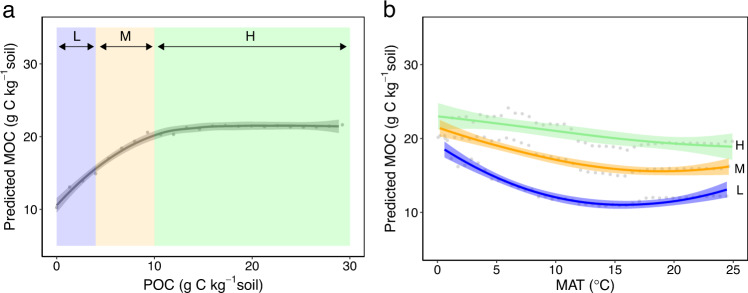
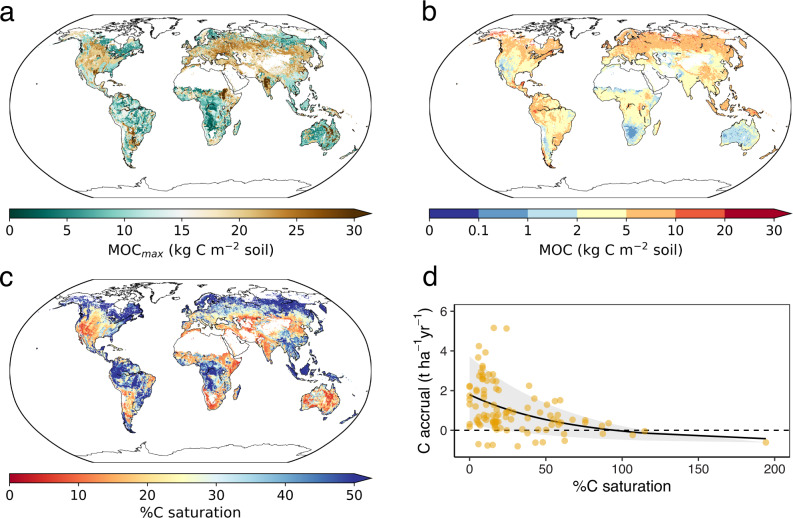
Verification
Claims the paper makes
The claims and statistics of this paper haven’t been checked yet.
Run the check — free, no account needed. It reads the open-access text and checks the sources it cites.
Claims other papers make about this one
Each is checked against this paper’s own text: does it say what the citing paper says it does?
The source backs part of the claim, not all of it — or backs it for a different population, condition or comparison.
In the citing paper
“Although SOC saturation represents a theoretical upper limit, most agricultural soils—particularly those with a history of degradation—remain far below this threshold (Georgiou et al., 2022;Georgiou et al., 2025;Sanderman et al., 2017).”
From Impact of 10 years of adaptive multi-paddock grazing on soil carbon and beef's greenhouse gas footprint in the US Upper Midwest (2026) · cites this paper as Georgiou et al., 2022
Experimental — accuracy not yet measured
Self-check
Percentages, sums and reported differences re-computed from the paper’s own numbers.
The self-check needs the paper’s full text.
Citations
Cites
Breiman, L. (2001) · Machine Learning · doi:10.1023/a:1010933404324 · Cited by 133,538
Greedy function approximation: A gradient boosting machine
Friedman, J. H. (2001) · The Annals of Statistics · doi:10.1214/aos/1013203451 · Cited by 30,731
Solutions for a cultivated planet
Foley, J. A., Ramankutty, N., Brauman, K. A., Cassidy, E. S., Gerber, J. S., Johnston, M., Mueller, N. D., O’Connell, C., Ray, D. K., West, P. C., et al. (2011) · Nature · doi:10.1038/nature10452 · Cited by 8,476
Soil Carbon Sequestration Impacts on Global Climate Change and Food Security
Lal, R. (2004) · Science · doi:10.1126/science.1097396 · Cited by 8,376
Temperature sensitivity of soil carbon decomposition and feedbacks to climate change
Davidson, E. A., & Janssens, I. A. (2006) · Nature · doi:10.1038/nature04514 · Cited by 6,919
Updated high‐resolution grids of monthly climatic observations – the CRU TS3 .10 Dataset
Harris, I. C., Jones, P. D., Osborn, T. J., & Lister, D. (2013) · International Journal of Climatology · doi:10.1002/joc.3711 · Cited by 6,326
THE VERTICAL DISTRIBUTION OF SOIL ORGANIC CARBON AND ITS RELATION TO CLIMATE AND VEGETATION
Jobbagy, E. G., & Jackson, R. B. (2000) · Ecological Applications · doi:10.1890/1051-0761(2000)010[0423:tvdoso]2.0.co;2 · Cited by 5,607
Self-citationSoilGrids250m: Global gridded soil information based on machine learning
Hengl, T., Mendes de Jesus, J., Heuvelink, G. B. M., Ruiperez Gonzalez, M., Kilibarda, M., Blagotić, A., Shangguan, W., Wright, M. N., Geng, X., Bauer-Marschallinger, B., et al. (2017) · PLOS ONE · doi:10.1371/journal.pone.0169748 · Cited by 4,733
Stabilization mechanisms of soil organic matter: Implications for C-saturation of soils
Six, J., Conant, R. T., Paul, E. A., & Paustian, K. (2002) · Plant and Soil · doi:10.1023/a:1016125726789 · Cited by 4,633
Cross‐validation strategies for data with temporal, spatial, hierarchical, or phylogenetic structure
Roberts, D. R., Bahn, V., Ciuti, S., Boyce, M. S., Elith, J., Guillera‐Arroita, G., Hauenstein, S., Lahoz‐Monfort, J. J., Schröder, B., Thuiller, W., et al. (2017) · Ecography · doi:10.1111/ecog.02881 · Cited by 3,689
Research works printed but not linked: 2
- Torn, M. S., Trumbore, S. E., Chadwick, O. A., Vitousek, P. M. & Hendricks, D. M. Mineral control of soil organic carbon storage and turnover. Nature 3603, 3601–3603 (1997).
- Liaw, A. & Wiener, M. Classification and Regression by randomForest. R. N. 2(3), 18–22 (2002).
Cited by
Sorted by citations
Unlocking complex soil systems as carbon sinks: multi-pool management as the key
Angst, G., Mueller, K. E., Castellano, M. J., Vogel, C., Wiesmeier, M., & Mueller, C. W. (2023) · Nature Communications · doi:10.1038/s41467-023-38700-5 · Cited by 493
Nitrogen increases soil organic carbon accrual and alters its functionality
Tang, B., Rocci, K. S., Lehmann, A., & Rillig, M. C. (2023) · Global Change Biology · doi:10.1111/gcb.16588 · Cited by 330
Global turnover of soil mineral-associated and particulate organic carbon
Zhou, Z., Ren, C., Wang, C., Delgado‐Baquerizo, M., Luo, Y., Luo, Z., Du, Z., Zhu, B., Yang, Y., Jiao, S., et al. (2024) · Nature Communications · doi:10.1038/s41467-024-49743-7 · Cited by 299
The Deep Soil Organic Carbon Response to Global Change
Pries, C. H., Ryals, R. A., Zhu, B., Min, K., Cooper, A., Goldsmith, S., Pett‐Ridge, J., Torn, M. S., & Berhe, A. A. (2023) · Annual Review of Ecology Evolution and Systematics · doi:10.1146/annurev-ecolsys-102320-085332 · Cited by 235
Self-citationNo detectable upper limit of mineral‐associated organic carbon in temperate agricultural soils
Begill, N., Don, A., & Poeplau, C. (2023) · Global Change Biology · doi:10.1111/gcb.16804 · Cited by 201
Metadata
- Authors
- Georgiou, K., Jackson, R. B., Vindušková, O., Abramoff, R. Z., Ahlström, A., Feng, W., Harden, J. W., Pellegrini, A. F. A., Polley, H. W., Soong, J. L., Riley, W. J., & Torn, M. S.
- Affiliations
- Lawrence Livermore National Laboratory (US)
- Stanford University (US)
- University of Antwerp (BE)
- Oak Ridge National Laboratory (US)
- Lund University (SE)
- Chinese Academy of Agricultural Sciences (CN)
- United States Geological Survey (US)
- University of Cambridge (GB)
- Agricultural Research Service (US)
- Colorado State University (US)
- Lawrence Berkeley National Laboratory (US)
- Corresponding author
- Georgiou, Katerina
- ORCID
- Venue
- Nature Communications
- Published
- 2022-07-01
- Volume
- 13
- Issue
- 1
- Pages
- 3797-3797
- ISSN
- 2041-1723 (ISSN-L)
- PMC
- PMC9249731
- OpenAlex
- W4283743401
- Cited by
- 979
- References
- 119
- Citations by year
- 2026: 322 · 2025: 299 · 2024: 213 · 2023: 125 · 2022: 20
- FWCI
- 88.54
- Type
- journal article
- Language
- en
- Open access
- gold
- doi.org
- Locations
- Nature Communications (publishedVersion, cc-by)
- PubMed Central (publishedVersion, cc-by)
- PubMed (publishedVersion)
- HAL (submittedVersion, cc-by)
- eScholarship (California Digital Library) (submittedVersion, cc-by)
- RePEc: Research Papers in Economics (submittedVersion)
- DOAJ (DOAJ: Directory of Open Access Journals) (submittedVersion)
- Lund University Publications (Lund University) (submittedVersion)
- OSTI OAI (U.S. Department of Energy Office of Scientific and Technical Information) (submittedVersion)
- Apollo (University of Cambridge) (submittedVersion, cc-by)
- Apollo
- Apollo (cc-by)
- Greater South Information System
- Funders
- DOE | LDRD | Lawrence Livermore National Laboratory (21-ERD-045)
- Topics
- Life Sciences › Agricultural and Biological Sciences › Soil Science › Soil Carbon and Nitrogen Dynamics
- Life Sciences › Agricultural and Biological Sciences › Soil Science › Soil Geostatistics and Mapping
- Life Sciences › Agricultural and Biological Sciences › Soil Science › Soil erosion and sediment transport
- Keywords
- mineral-associated organic carbon, soil organic carbon stocks, carbon storage capacity, carbon sequestration, soil carbon management, agricultural soils, soil depth, carbon-climate feedback
- MeSH terms
- Agriculture, Carbon, Minerals, Soil, Carbon Sequestration
About these checks
Registry, retraction, Cites and statistics results are computed, not judged, with one exception: a printed reference that no index lists is read once by a model before it counts as a citation error. Claims are extracted by a model and kept only when their quote appears verbatim in the text; each cited source is then checked, with a model’s help, for whether it says what the claim relies on. Those verdicts can be wrong — read the claim’s quote and the cited source before relying on one.
Statistics and arithmetic are recomputed, not judged.
Confidence bands are shown only for fields calibrated on our annotated test set. None is calibrated yet, so no band is shown.
What counts as a claim ›How we measure confidence ›How we check this ›
Are you an author, or do you see a problem with this page? Request a review
