

Asymmetric activity of NetrinB controls laterality of the Drosophila brain
Open accessThe DOI matches its Crossref record; 74 of the 74 references it cites were found in a registry or an index.
Abstract
Left-Right (LR) asymmetry of the nervous system is widespread across animals and is thought to be important for cognition and behaviour. But in contrast to visceral organ asymmetry, the genetic basis and function of brain laterality remain only poorly characterized. In this study, we performed RNAi screening to identify genes controlling brain asymmetry in Drosophila. We found that the conserved NetrinB (NetB) pathway is required for a small group of bilateral neurons to project asymmetrically into a pair of neuropils (Asymmetrical Bodies, AB) in the central brain in both sexes. While neurons project unilaterally into the right AB in wild-type flies, netB mutants show a bilateral projection phenotype and hence lose asymmetry. Developmental time course analysis reveals an initially bilateral connectivity, eventually resolving into a right asymmetrical circuit during metamorphosis, with the NetB pathway being required just prior symmetry breaking. We show using unilateral clonal analysis that netB activity is required specifically on the right side for neurons to innervate the right AB. We finally show that loss of NetB pathway activity leads to specific alteration of long-term memory, providing a functional link between asymmetrical circuitry determined by NetB and animal cognitive functions.
Overview
The claims and statistics of this paper haven’t been checked yet.
Free: it reads the open-access text and checks the first 5 claims that cite a source we can check. Create a free account to check every claim.
Integrity signals
Registry
Cites
Statistics
Figures
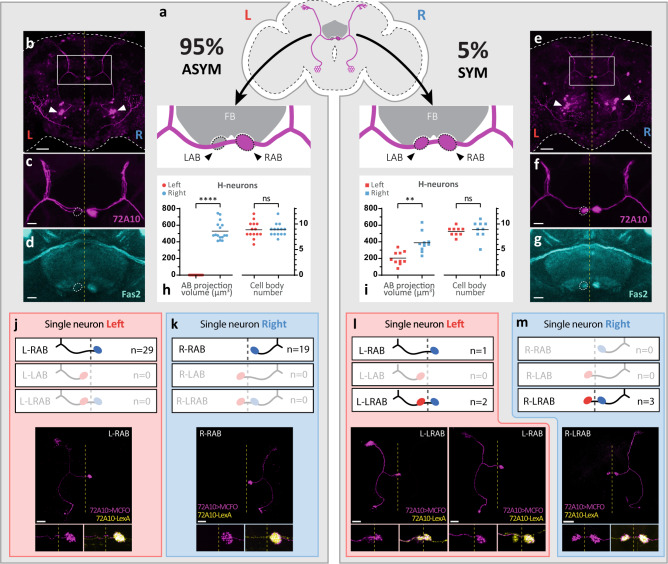
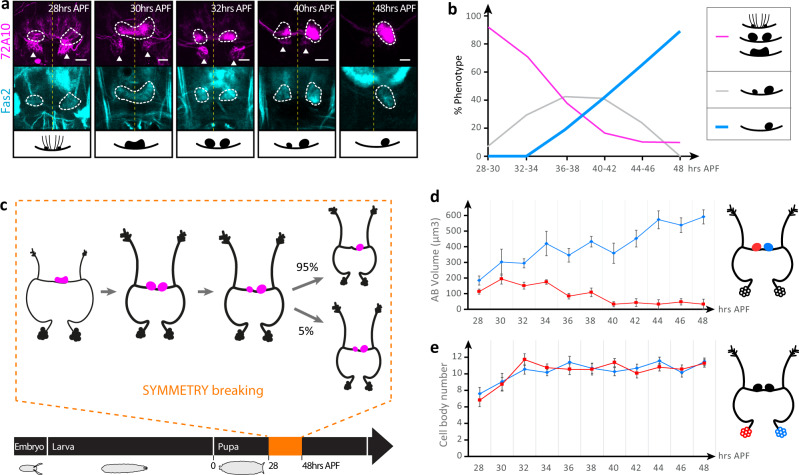
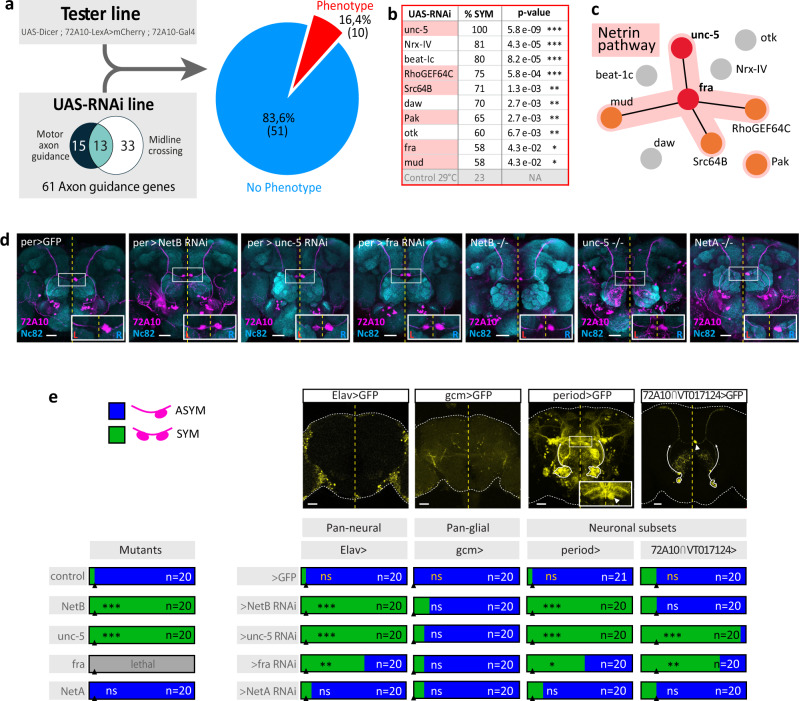
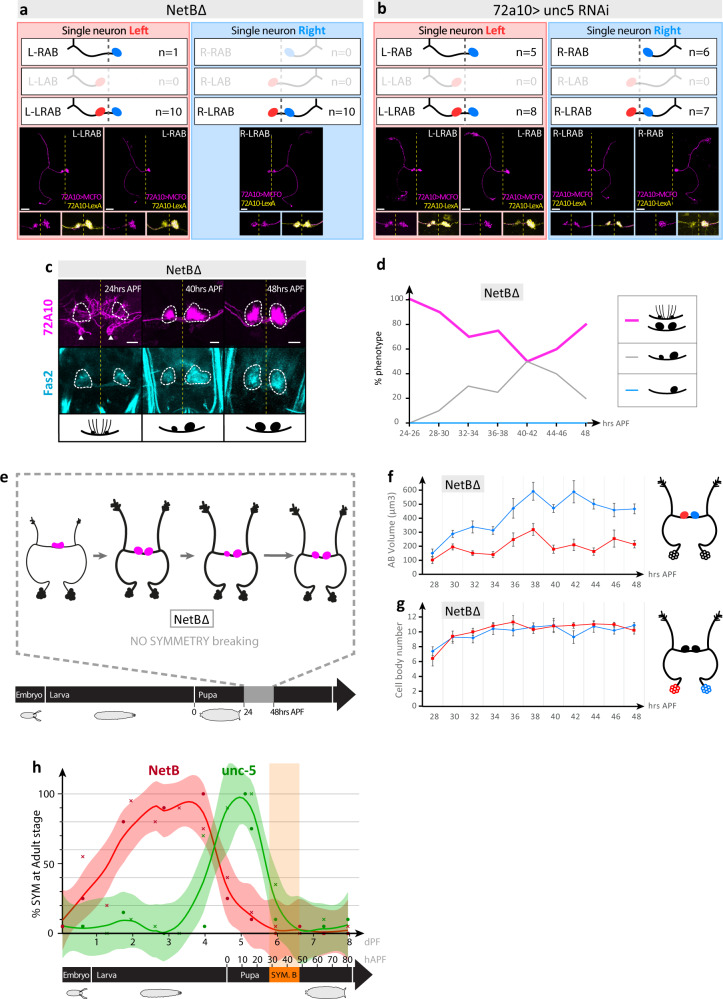
Verification
Claims the paper makes
The claims and statistics of this paper haven’t been checked yet.
Free: it reads the open-access text and checks the first 5 claims that cite a source we can check. Create a free account to check every claim.
Claims other papers make about this one
Each is checked against this paper’s own text: does it say what the citing paper says it does?
The source backs part of the claim, not all of it — or backs it for a different population, condition or comparison.
In the citing paper
“In the fly brain, the asymmetric body is reproducibly around 4 times larger on the right hemisphere than on the left112–114, except in rare cases of situs inversus114,115.”
From Whole-brain annotation and multi-connectome cell typing of Drosophila (2024) · cites this paper as [114]
Experimental — accuracy not yet measuredIn the citing paper
“A number of consortium members (A. Bates, P. Kandimalla, S. Noselli) alerted us that the FAFB imagery seemed left-right inverted based on cell types innervating the asymmetric body164.”
From Neuronal wiring diagram of an adult brain (2023) · cites this paper as [164]
Self-check
Percentages, sums and reported differences re-computed from the paper’s own numbers.
The self-check needs the paper’s full text.
Citations
Cites
A GAL4-Driver Line Resource for Drosophila Neurobiology
Jenett, A., Rubin, G. M., Ngo, T.-T. B., Shepherd, D., Murphy, C., Dionne, H., Pfeiffer, B. D., Cavallaro, A., Hall, D., Jeter, J., et al. (2012) · Cell Reports · doi:10.1016/j.celrep.2012.09.011 · Cited by 1,449
A connectome and analysis of the adult Drosophila central brain
Scheffer, L. K., Xu, C. S., Januszewski, M., Lu, Z., Takemura, S.-Y., Hayworth, K. J., Huang, G. B., Shinomiya, K., Maitlin-Shepard, J., Berg, S., et al. (2020) · eLife · doi:10.7554/elife.57443 · Cited by 1,128
Expression of baculovirus P35 prevents cell death in Drosophila
Hay, B. A., Wolff, T., & Rubin, G. M. (1994) · Development · doi:10.1242/dev.120.8.2121 · Cited by 1,066
Genetic Control of Programmed Cell Death in Drosophila
White, K., Grether, M. E., Abrams, J. M., Young, L., Farrell, K., & Steller, H. (1994) · Science · doi:10.1126/science.8171319 · Cited by 1,052
Nern, A., Pfeiffer, B. D., & Rubin, G. M. (2015) · Proceedings of the National Academy of Sciences · doi:10.1073/pnas.1506763112 · Cited by 584
The Carnegie Protein Trap Library: A Versatile Tool for Drosophila Developmental Studies
Buszczak, M., Paterno, S., Lighthouse, D., Bachman, J., Planck, J., Owen, S., Skora, A. D., Nystul, T. G., Ohlstein, B., Allen, A., et al. (2007) · Genetics · doi:10.1534/genetics.106.065961 · Cited by 577
Kolodziej, P. A., Timpe, L. C., Mitchell, K. J., Fried, S. R., Goodman, C. S., Jan, L. Y., & Jan, Y. N. (1996) · Cell · doi:10.1016/s0092-8674(00)81338-0 · Cited by 460
Handedness, language lateralisation and anatomical asymmetry in schizophrenia: Meta-analysis
Sommer, I., Aleman, A., Ramsey, N., Bouma, A., & Kahn, R. (2001) · British Journal of Psychiatry · doi:10.1192/bjp.178.4.344 · Cited by 452
Neuronal architecture of the central complex in Drosophila melanogaster
Hanesch, U., Fischbach, K. F., & Heisenberg, M. (1989) · Cell and Tissue Research · doi:10.1007/bf00261838 · Cited by 416
Mapping cortical brain asymmetry in 17,141 healthy individuals worldwide via the ENIGMA Consortium
Kong, X.-Z., Mathias, S. R., Guadalupe, T., ENIGMA Laterality Working Group, Glahn, D. C., Franke, B., Crivello, F., Tzourio-Mazoyer, N., Fisher, S. E., Thompson, P. M., et al. (2018) · Proceedings of the National Academy of Sciences · doi:10.1073/pnas.1718418115 · Cited by 415
Evolution of Hemispheric Specialization: Advantages and Disadvantages
Rogers, L. J. (2000) · Brain and Language · doi:10.1006/brln.2000.2305 · Cited by 357
The habenular nuclei: a conserved asymmetric relay station in the vertebrate brain
Bianco, I. H., & Wilson, S. W. (2009) · Philosophical Transactions of the Royal Society B: Biological Sciences · doi:10.1098/rstb.2008.0213 · Cited by 350
Plug-and-Play Genetic Access to Drosophila Cell Types using Exchangeable Exon Cassettes
Diao, F., Ironfield, H., Luan, H., Diao, F., Shropshire, W. C., Ewer, J., Marr, E., Potter, C. J., Landgraf, M., & White, B. H. (2015) · Cell Reports · doi:10.1016/j.celrep.2015.01.059 · Cited by 347
Short- and Long-Range Repulsion by the Drosophila Unc5 Netrin Receptor
Keleman, K., & Dickson, B. J. (2001) · Neuron · doi:10.1016/s0896-6273(01)00505-0 · Cited by 313
Exclusive Consolidated Memory Phases in Drosophila
Isabel, G., Pascual, A., & Preat, T. (2004) · Science · doi:10.1126/science.1094932 · Cited by 285
Self-citationLight experience and asymmetry of brain function in chickens
Rogers, L. J. (1982) · Nature · doi:10.1038/297223a0 · Cited by 268
McBride, S. M. J., Giuliani, G., Choi, C., Krause, P., Correale, D., Watson, K., Baker, G., & Siwicki, K. K. (1999) · Neuron · doi:10.1016/s0896-6273(00)81043-0 · Cited by 261
Activation of FAK and Src are receptor-proximal events required for netrin signaling
Li, W., Lee, J., Vikis, H. G., Lee, S.-H., Liu, G., Aurandt, J., Shen, T.-L., Fearon, E. R., Guan, J.-L., Han, M., et al. (2004) · Nature Neuroscience · doi:10.1038/nn1329 · Cited by 242
Asymmetry of the Brain: Development and Implications
Duboc, V., Dufourcq, P., Blader, P., & Roussigné, M. (2015) · Annual Review of Genetics · doi:10.1146/annurev-genet-112414-055322 · Cited by 229
Type ID unconventional myosin controls left–right asymmetry in Drosophila
Spéder, P., Ádám, G., & Noselli, S. (2006) · Nature · doi:10.1038/nature04623 · Cited by 228
Self-citationAn unconventional myosin in Drosophila reverses the default handedness in visceral organs
Hozumi, S., Maeda, R., Taniguchi, K., Kanai, M., Shirakabe, S., Sasamura, T., Spéder, P., Noselli, S., Aigaki, T., Murakami, R., et al. (2006) · Nature · doi:10.1038/nature04625 · Cited by 222
Self-citationBrain asymmetry and long-term memory
Pascual, A., Huang, K.-L., Neveu, J., & Préat, T. (2004) · Nature · doi:10.1038/427605a · Cited by 208
Self-citationFloor-plate-derived netrin-1 is dispensable for commissural axon guidance
Dominici, C., Moreno-Bravo, J. A., Puiggros, S. R., Rappeneau, Q., Rama, N., Vieugue, P., Bernet, A., Mehlen, P., & Chédotal, A. (2017) · Nature · doi:10.1038/nature22331 · Cited by 206
Miyasaka, N., Morimoto, K., Tsubokawa, T., Higashijima, S.-I., Okamoto, H., & Yoshihara, Y. (2009) · The Journal of Neuroscience · doi:10.1523/jneurosci.0118-09.2009 · Cited by 203
Varadarajan, S. G., Kong, J. H., Phan, K. D., Kao, T.-J., Panaitof, S. C., Cardin, J., Eltzschig, H., Kania, A., Novitch, B. G., & Butler, S. J. (2017) · Neuron · doi:10.1016/j.neuron.2017.03.007 · Cited by 182
Lowe, N., Rees, J. S., Roote, J., Ryder, E., Armean, I. M., Johnson, G., Drummond, E., Spriggs, H., Drummond, J., Magbanua, J. P., et al. (2014) · Development · doi:10.1242/dev.111054 · Cited by 180
Bouzaiane, E., Trannoy, S., Scheunemann, L., Plaçais, P.-Y., & Preat, T. (2015) · Cell Reports · doi:10.1016/j.celrep.2015.04.044 · Cited by 176
Self-citationShekarabi, M., Moore, S. W., Tritsch, N. X., Morris, S. J., Bouchard, J.-F., & Kennedy, T. E. (2005) · The Journal of Neuroscience · doi:10.1523/jneurosci.1920-04.2005 · Cited by 175
Molecular to organismal chirality is induced by the conserved myosin 1D
Lebreton, G., Géminard, C., Lapraz, F., Pyrpassopoulos, S., Cérézo, D., Spéder, P., Ostap, E. M., & Noselli, S. (2018) · Science · doi:10.1126/science.aat8642 · Cited by 172
Self-citationNetrins guide Drosophila commissural axons at short range
Brankatschk, M., & Dickson, B. J. (2006) · Nature Neuroscience · doi:10.1038/nn1625 · Cited by 169
Systematic analysis of neural projections reveals clonal composition of the Drosophila brain
Ito, M., Masuda, N., Shinomiya, K., Endo, K., & Ito, K. (2013) · Current Biology · doi:10.1016/j.cub.2013.03.015 · Cited by 166
Encoding asymmetry within neural circuits
Concha, M. L., Bianco, I. H., & Wilson, S. W. (2012) · Nature reviews. Neuroscience · doi:10.1038/nrn3371 · Cited by 166
Clonal Development and Organization of the Adult Drosophila Central Brain
Yu, H.-H., Awasaki, T., Schroeder, M. D., Long, F., Yang, J. S., He, Y., Ding, P., Kao, J.-C., Wu, G. Y.-Y., Peng, H., et al. (2013) · Current Biology · doi:10.1016/j.cub.2013.02.057 · Cited by 163
Brain and behavioral lateralization in invertebrates
Frasnelli, E. (2013) · Frontiers in Psychology · doi:10.3389/fpsyg.2013.00939 · Cited by 160
McManus, I. C., Davison, A., & Armour, J. A. L. (2013) · Annals of the New York Academy of Sciences · doi:10.1111/nyas.12102 · Cited by 156
Wolff, T., & Rubin, G. M. (2018) · Journal of Comparative Neurology · doi:10.1002/cne.24512 · Cited by 156
A genetic toolkit for tagging intronic MiMIC containing genes
Nagarkar-Jaiswal, S., DeLuca, S. Z., Lee, P.-T., Lin, W.-W., Pan, H., Zuo, Z., Lv, J., Spradling, A. C., & Bellen, H. J. (2015) · eLife · doi:10.7554/elife.08469 · Cited by 147
Elevated Levels of Atypical Handedness in Autism: Meta-Analyses
Markou, P., Ahtam, B., & Παπαδάτου-Παστού, Μ. (2017) · Neuropsychology Review · doi:10.1007/s11065-017-9354-4 · Cited by 145
Structure of the adult central complex in Drosophila: Organization of distinct neuronal subsets
Young, J. M., & Armstrong, J. D. (2010) · Journal of Comparative Neurology · doi:10.1002/cne.22284 · Cited by 141
Radish, a Drosophila mutant deficient in consolidated memory.
Folkers, E., Drain, P., & Quinn, W. G. (1993) · Proceedings of the National Academy of Sciences · doi:10.1073/pnas.90.17.8123 · Cited by 135
Pereanu, W., & Hartenstein, V. (2006) · The Journal of Neuroscience · doi:10.1523/jneurosci.4708-05.2006 · Cited by 129
Eastwood, S. L., & Harrison, P. J. (2010) · Biological Psychiatry · doi:10.1016/j.biopsych.2009.12.004 · Cited by 122
Strategies to establish left/right asymmetry in vertebrates and invertebrates
Spéder, P., Petzoldt, A. G., Suzanne, M., & Noselli, S. (2007) · Current Opinion in Genetics & Development · doi:10.1016/j.gde.2007.05.008 · Cited by 112
Self-citationCoupling of Apoptosis and L/R Patterning Controls Stepwise Organ Looping
Suzanne, M., Petzoldt, A. G., Spéder, P., Coutelis, J., Steller, H., & Noselli, S. (2010) · Current Biology · doi:10.1016/j.cub.2010.08.056 · Cited by 92
Self-citationHobert, O. (2014) · genesis · doi:10.1002/dvg.22747 · Cited by 85
Handedness and situs inversus in primary ciliary dyskinesia
Mcmanus, I., Martin, N., Stubbings, G. F., Chung, E., & Mitchison, H. (2004) · Proceedings of the Royal Society of London. Series B: Biological Sciences · doi:10.1098/rspb.2004.2881 · Cited by 82
The Atypical Cadherin Dachsous Controls Left-Right Asymmetry in Drosophila
González‐Morales, N., Géminard, C., Lebreton, G., Cérézo, D., Coutelis, J., & Noselli, S. (2015) · Developmental Cell · doi:10.1016/j.devcel.2015.04.026 · Cited by 78
Self-citationMechanisms for complexity in the brain: generating the insect central complex
Boyan, G. S., & Reichert, H. (2011) · Trends in Neurosciences · doi:10.1016/j.tins.2011.02.002 · Cited by 78
Diversity and convergence in the mechanisms establishing L/R asymmetry in metazoa
Coutelis, J., González‐Morales, N., Géminard, C., & Noselli, S. (2014) · EMBO Reports · doi:10.15252/embr.201438972 · Cited by 75
Self-citationMyosin1D is an evolutionarily conserved regulator of animal left–right asymmetry
Juan, T., Géminard, C., Coutelis, J., Cérézo, D., Polès, S., Noselli, S., & Fürthauer, M. (2018) · Nature Communications · doi:10.1038/s41467-018-04284-8 · Cited by 74
Self-citationThe Drosophila neural lineages: a model system to study brain development and circuitry
Spindler, S. R., & Hartenstein, V. (2010) · Development Genes and Evolution · doi:10.1007/s00427-010-0323-7 · Cited by 73
Bashaw, G. J., Hu, H., Nobes, C. D., & Goodman, C. S. (2001) · The Journal of Cell Biology · doi:10.1083/jcb.200110077 · Cited by 72
Toward localizing genes underlying cerebral asymmetry and mental health
Smalley, S. L., Loo, S. K., Yang, M. H., & Cantor, R. M. (2005) · American Journal of Medical Genetics Part B: Neuropsychiatric Genetics · doi:10.1002/ajmg.b.30141 · Cited by 68
Antimicrobial peptides modulate long-term memory
Barajas-Azpeleta, R., Wu, J., Gill, J., Welte, R., Seidel, C., McKinney, S., Dissel, S., & Si, K. (2018) · PLOS Genetics · doi:10.1371/journal.pgen.1007440 · Cited by 68
Drosophila Left/Right Asymmetry Establishment Is Controlled by the Hox Gene Abdominal-B
Coutelis, J., Géminard, C., Spéder, P., Suzanne, M., Petzoldt, A. G., & Noselli, S. (2013) · Developmental Cell · doi:10.1016/j.devcel.2012.11.013 · Cited by 60
Self-citationLeft–right asymmetry in Drosophila
Coutelis, J., Petzoldt, A. G., Spéder, P., Suzanne, M., & Noselli, S. (2008) · Seminars in Cell and Developmental Biology · doi:10.1016/j.semcdb.2008.01.006 · Cited by 60
Self-citationConservation and divergence of related neuronal lineages in the Drosophila central brain
Lee, Y.-J., Yang, C.-P., Miyares, R. L., Huang, Y.-F., He, Y., Ren, Q., Chen, H.-M., Kawase, T., Ito, M., Otsuna, H., et al. (2020) · eLife · doi:10.7554/elife.53518 · Cited by 60
Koshiba, M., Nakamura, S., Deng, C., & Rogers, L. J. (2002) · Neuroscience Letters · doi:10.1016/s0304-3940(02)01162-x · Cited by 59
Development‐based compartmentalization of the Drosophila central brain
Pereanu, W., Kumar, A., Jennett, A., Reichert, H., & Hartenstein, V. (2010) · Journal of Comparative Neurology · doi:10.1002/cne.22376 · Cited by 57
Larsen, C., Shy, D., Spindler, S. R., Fung, S., Pereanu, W., Younossi-Hartenstein, A., & Hartenstein, V. (2009) · Developmental Biology · doi:10.1016/j.ydbio.2009.06.015 · Cited by 57
A Conserved Role of the Unconventional Myosin 1d in Laterality Determination
Tingler, M., Kurz, S., Maerker, M., Ott, T., Fuhl, F., Schweickert, A., LeBlanc-Straceski, J., Noselli, S., & Blum, M. (2018) · Current Biology · doi:10.1016/j.cub.2018.01.075 · Cited by 53
Self-citationWong, D. C., Lovick, J. K., Ngo, K. T., Borisuthirattana, W., Omoto, J. J., & Hartenstein, V. (2013) · Developmental Biology · doi:10.1016/j.ydbio.2013.07.009 · Cited by 46
Left–right asymmetry: class I myosins show the direction
Spéder, P., & Noselli, S. (2006) · Current Opinion in Cell Biology · doi:10.1016/j.ceb.2006.12.006 · Cited by 45
Self-citationdeCarvalho, T., Akitake, C. M., Thisse, C., Thisse, B., & Halpern, M. E. (2013) · Frontiers in Neural Circuits · doi:10.3389/fncir.2013.00098 · Cited by 43
The myosin ID pathway and left–right asymmetry in Drosophila
Géminard, C., González‐Morales, N., Coutelis, J., & Noselli, S. (2014) · genesis · doi:10.1002/dvg.22763 · Cited by 42
Self-citationThe Drosophila actin nucleator DAAM is essential for left-right asymmetry
Chougule, A., Lapraz, F., Földi, I., Cérézo, D., Mihály, J., & Noselli, S. (2020) · PLoS Genetics · doi:10.1371/journal.pgen.1008758 · Cited by 34
Self-citationDevelopment and connectivity of the habenular nuclei
Roberson, S., & Halpern, M. E. (2018) · Seminars in Cell and Developmental Biology · doi:10.1016/j.semcdb.2017.10.007 · Cited by 30
Midline axon guidance in the Drosophila embryonic central nervous system
Howard, L. J., Brown, H. E., Wadsworth, B. C., & Evans, T. A. (2017) · Seminars in Cell and Developmental Biology · doi:10.1016/j.semcdb.2017.11.029 · Cited by 30
The molecular mechanisms controlling morphogenesis and wiring of the habenula
Schmidt, E. R. E., & Pasterkamp, R. J. (2017) · Pharmacology Biochemistry and Behavior · doi:10.1016/j.pbb.2017.08.008 · Cited by 25
Motor axon guidance in Drosophila
Zarin, A. A., & Labrador, J.-P. (2017) · Seminars in Cell and Developmental Biology · doi:10.1016/j.semcdb.2017.11.013 · Cited by 25
Bazooka mediates secondary axon morphology in Drosophila brain lineages
Spindler, S. R., & Hartenstein, V. (2011) · Neural Development · doi:10.1186/1749-8104-6-16 · Cited by 18
Takeuchi, Y., Ishikawa, A., Oda, Y., & Kitano, J. (2018) · Comparative Biochemistry and Physiology Part D Genomics and Proteomics · doi:10.1016/j.cbd.2018.07.002 · Cited by 14
Moncrieff, D. W. (2010) · The MIT Press eBooks · doi:10.7551/mitpress/9780262014137.003.0416 · Cited by 11
Mushroom body defect is required in parallel to Netrin for midline axon guidance in Drosophila
Cate, S., Gajendra, S., Alsbury, S., Raabe, T., Tear, G., & Mitchell, K. J. (2016) · Development · doi:10.1242/dev.129684 · Cited by 4
Research works printed but not linked: 2
- Broca PP Perte de la Parole, Ramollissement Chronique et Destruction Partielle du Lobe Antérieur Gauche du Cerveau Bull. de. la Soci.été Anthropologique 1861 2 235 238
- Lee YJ Conservation and divergence of related neuronal lineages in the drosophila central brain Elife 2020 9 e53518 10.7554/eLife.53518 32255422 PMC7173964 · DOI · Paper page
Cited by
Neuronal wiring diagram of an adult brain
Dorkenwald, S., Matsliah, A., Sterling, A. R., Schlegel, P., Yu, S.-C., McKellar, C. E., Lin, A., Costa, M., Eichler, K., Yin, Y., et al. (2024) · Nature · doi:10.1038/s41586-024-07558-y · Cited by 570
“A number of consortium members (A. Bates, P. Kandimalla and S. Noselli) alerted us that the FAFB imagery seemed to be left–right inverted based on the cell types innervating the asymmetric body 123 .”
BackgroundWhole-brain annotation and multi-connectome cell typing of Drosophila
Schlegel, P., Yin, Y., Bates, A. S., Dorkenwald, S., Eichler, K., Brooks, P., Han, D. S., Gkantia, M., dos Santos, M., Munnelly, E. J., et al. (2024) · Nature · doi:10.1038/s41586-024-07686-5 · Cited by 413
“In the fly brain, the asymmetric body is reproducibly around 4 times larger on the right hemisphere than on the left 112–114 , except in rare cases of situs inversus 114,115 .”
BackgroundNeuronal wiring diagram of an adult brain
Dorkenwald, S., Matsliah, A., Sterling, A. R., Schlegel, P., Yu, S.-C., McKellar, C. E., Lin, A., Costa, M., Eichler, K., Yin, Y., et al. (2023) · doi:10.1101/2023.06.27.546656 · Cited by 149
Whole-brain annotation and multi-connectome cell typing quantifies circuit stereotypy in Drosophila
Schlegel, P., Yin, Y., Bates, A. S., Dorkenwald, S., Eichler, K., Brooks, P., Han, D. S., Gkantia, M., dos Santos, M., Munnelly, E. J., et al. (2023) · doi:10.1101/2023.06.27.546055 · Cited by 102
Abbas, S., Alam, A., Abbas, M., Abbas, A., Ali, J., Schilthuizen, M., Romano, D., & Chen, R. (2024) · Bulletin of Entomological Research · doi:10.1017/s0007485324000178 · Cited by 18
Metadata
- Authors
- Lapraz, F., Boutres, C., Fixary-Schuster, C., De Queiroz, B. R., Plaçais, P. Y., Cerezo, D., Besse, F., Préat, T., & Noselli, S.
- Affiliations
- Centre National de la Recherche Scientifique (FR)
- Corresponding author
- Lapraz, F.
- Noselli, S.
- Venue
- Nature Communications
- Published
- 2023-02-24
- Volume
- 14
- Issue
- 1
- Pages
- 1052-1052
- ISSN
- 2041-1723 (ISSN-L)
- PMC
- PMC9958012
- OpenAlex
- W4321786279
- Cited by
- 25
- References
- 74
- Citations by year
- 2026: 6 · 2025: 4 · 2024: 10 · 2023: 5
- FWCI
- 3.02
- Type
- journal article
- Language
- en
- Open access
- gold
- doi.org
- Licence
- cc-by
- creativecommons.org/licenses/by/4.0 (tdm)
- creativecommons.org/licenses/by/4.0 (vor)
- Locations
- Nature Communications (publishedVersion, cc-by)
- PubMed Central (publishedVersion, cc-by)
- PubMed (publishedVersion)
- HAL (submittedVersion, other-oa)
- RePEc: Research Papers in Economics (submittedVersion)
- DOAJ (DOAJ: Directory of Open Access Journals) (submittedVersion, cc-by-sa)
- Funders
- Agence Nationale de la Recherche (ANR-17-CE13-0024, ANR-20-CE13-0004, ANR-17, ANR-11-LABX-0028)
- Institut National de la Santé et de la Recherche Médicale (ANR-11-LABX-0028-01)
- Fondation pour la Recherche Médicale (ANR-11-LABX-0028-01)
- Centre National de la Recherche Scientifique (ANR-11-LABX-0028-01)
- Topics
- Life Sciences › Neuroscience › Cellular and Molecular Neuroscience › Neurobiology and Insect Physiology Research
- Life Sciences › Neuroscience › Cognitive Neuroscience › Hemispheric Asymmetry in Neuroscience
- Life Sciences › Neuroscience › Cellular and Molecular Neuroscience › Axon Guidance and Neuronal Signaling
- Keywords
- brain laterality, left-right asymmetry, Drosophila brain, symmetry breaking, metamorphosis, long-term memory, RNAi screen
- MeSH terms
- Animals, Brain, Drosophila, Female, Functional Laterality, Male, Nerve Growth Factors, Body Patterning, Neuropil, Drosophila Proteins
About these checks
Registry, retraction, Cites and statistics results are computed, not judged, with one exception: a printed reference that no index lists is read once by a model before it counts as a citation error. Claims are extracted by a model and kept only when their quote appears verbatim in the text; each cited source is then checked, with a model’s help, for whether it says what the claim relies on. Those verdicts can be wrong — read the claim’s quote and the cited source before relying on one.
Statistics and arithmetic are recomputed, not judged.
Confidence bands are shown only for fields calibrated on our annotated test set. None is calibrated yet, so no band is shown.
What counts as a claim ›How we measure confidence ›How we check this ›
Are you an author, or do you see a problem with this page? Request a review
Data sources
Bibliographic data: Semantic Scholar, OpenAlex, Crossref.
Contains information from the Semantic Scholar Academic Graph Datasets, made available under the ODC Attribution License (ODC-BY 1.0).
Semantic Scholar’s data is described in: Kinney, R., et al. (2023). The Semantic Scholar Open Data Platform. arXiv:2301.10140.
