

Inferring neuron-neuron communications from single-cell transcriptomics through NeuronChat
Open accessPublished version of a preprint
The DOI matches its Crossref record; 55 of the 55 references it cites were found in a registry or an index.
Abstract
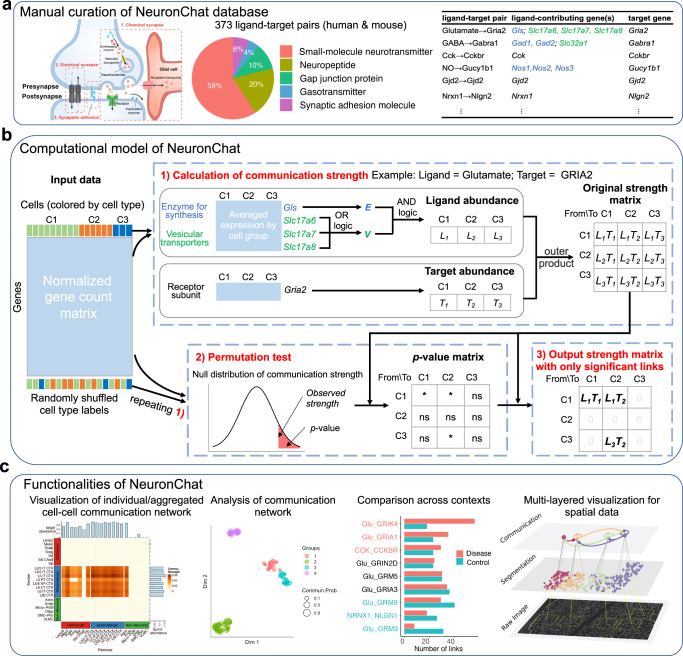
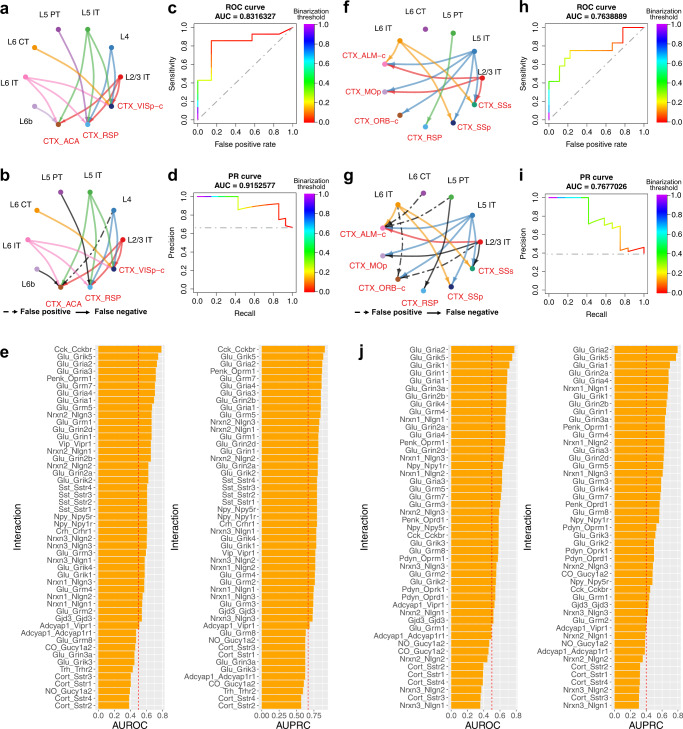
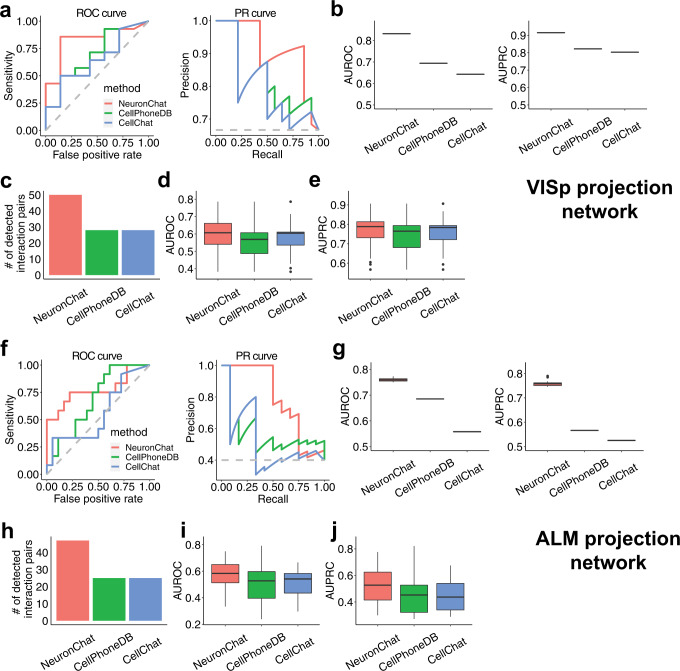
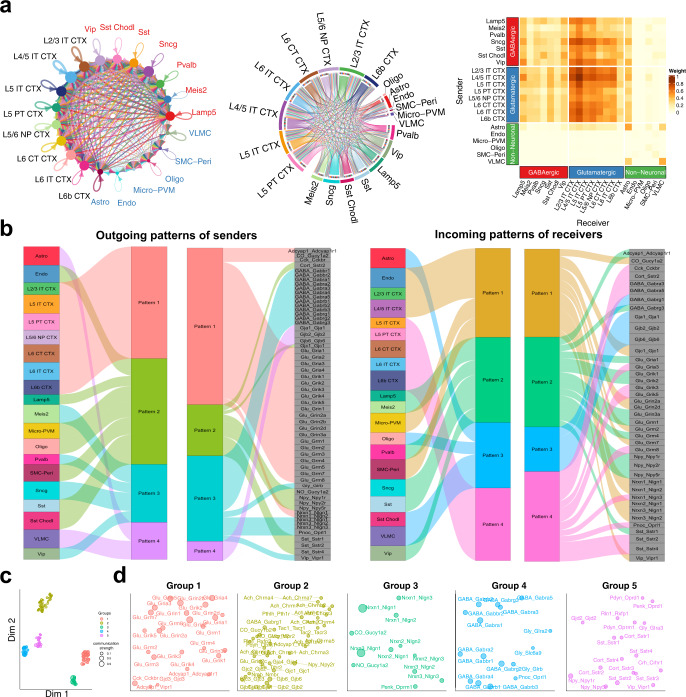
Neural communication networks form the fundamental basis for brain function. These communication networks are enabled by emitted ligands such as neurotransmitters, which activate receptor complexes to facilitate communication. Thus, neural communication is fundamentally dependent on the transcriptome. Here we develop NeuronChat, a method and package for the inference, visualization and analysis of neural-specific communication networks among pre-defined cell groups using single-cell expression data. We incorporate a manually curated molecular interaction database of neural signaling for both human and mouse, and benchmark NeuronChat on several published datasets to validate its ability in predicting neural connectivity. Then, we apply NeuronChat to three different neural tissue datasets to illustrate its functionalities in identifying interneural communication networks, revealing conserved or context-specific interactions across different biological contexts, and predicting communication pattern changes in diseased brains with autism spectrum disorder. Finally, we demonstrate NeuronChat can utilize spatial transcriptomics data to infer and visualize neural-specific cell-cell communication.
Overview
The claims and statistics of this paper haven’t been checked yet.
Free: it reads the open-access text and checks the first 5 claims that cite a source we can check. Create a free account to check every claim.
Integrity signals
Registry
Cites
Statistics
Figures
Verification
Claims the paper makes
The claims and statistics of this paper haven’t been checked yet.
Free: it reads the open-access text and checks the first 5 claims that cite a source we can check. Create a free account to check every claim.
Claims other papers make about this one
Each is checked against this paper’s own text: does it say what the citing paper says it does?
In the citing paper
“We manually curated a literature-supported signaling molecule interaction database called CellChatDB”
From CellChat for systematic analysis of cell–cell communication from single-cell transcriptomics (2025) · cites this paper as [7]
In the citing paper
“In terms of structural similarity, a structural similarity was used to compare their signaling network structure, without considering the similarity of senders and receivers.”
From CellChat for systematic analysis of cell–cell communication from single-cell transcriptomics (2025) · cites this paper as [7]
In the citing paper
“This analysis is helpful to predict putative functions of the poorly studied pathways based on their similarity with the pathways with well-known functions.”
From CellChat for systematic analysis of cell–cell communication from single-cell transcriptomics (2025) · cites this paper as [7]
In the citing paper
“It should be noted that functional similarity analysis is not applicable to multiple datasets with different cell type composition, but structural similarity analysis is applicable to multiple datasets either with the same cell type composition or with the vastly different cell type composition.”
From CellChat for systematic analysis of cell–cell communication from single-cell transcriptomics (2025) · cites this paper as [7]
In the citing paper
“CellChat is able to quantify the similarity between all significant signaling pathways and then group them based on their cellular communication network similarity.”
From CellChat for systematic analysis of cell–cell communication from single-cell transcriptomics (2025) · cites this paper as [7]
2 more claims about this paper
Create a free account to see every claim other papers make about this one.
Self-check
Percentages, sums and reported differences re-computed from the paper’s own numbers.
The self-check needs the paper’s full text.
Citations
Cites
Learning the parts of objects by non-negative matrix factorization
Lee, D. D., & Seung, H. S. (1999) · Nature · doi:10.1038/44565 · Cited by 13,868
KEGG: new perspectives on genomes, pathways, diseases and drugs
Kanehisa, M., Furumichi, M., Tanabe, M., Sato, Y., & Morishima, K. (2017) · Nucleic Acids Research · doi:10.1093/nar/gkw1092 · Cited by 8,865
Inference and analysis of cell-cell communication using CellChat
Jin, S., Guerrero-Juarez, C. F., Zhang, L., Chang, I., Ramos, R., Kuan, C.-H., Myung, P., Plikus, M. V., & Nie, Q. (2021) · Nature Communications · doi:10.1038/s41467-021-21246-9 · Cited by 8,409
Self-citationSzklarczyk, D., Gable, A. L., Nastou, K. C., Lyon, D., Kirsch, R., Pyysalo, S., Doncheva, N. T., Legeay, M., Fang, T., Bork, P., et al. (2021) · Nucleic Acids Research · doi:10.1093/nar/gkaa1074 · Cited by 8,056
Efremova, M., Vento-Tormo, M., Teichmann, S. A., & Vento-Tormo, R. (2020) · Nature Protocols · doi:10.1038/s41596-020-0292-x · Cited by 3,449
Interneurons of the neocortical inhibitory system
Markram, H., Toledo-Rodriguez, M., Wang, Y., Gupta, A., Silberberg, G., & Wu, C. (2004) · Nature Reviews Neuroscience · doi:10.1038/nrn1519 · Cited by 2,954
NicheNet: Modeling intercellular communication by linking ligands to target genes
Browaeys, R., Saelens, W., & Saeys, Y. (2020) · Nature Methods · doi:10.1038/s41592-019-0667-5 · Cited by 2,192
GABAergic Interneurons in the Neocortex: From Cellular Properties to Circuits
Tremblay, R., Lee, S., & Rudy, B. (2016) · Neuron · doi:10.1016/j.neuron.2016.06.033 · Cited by 2,033
Transcriptome-scale super-resolved imaging in tissues by RNA seqFISH
Eng, C.-H. L., Lawson, M., Zhu, Q., Dries, R., Koulena, N., Takei, Y., Yun, J., Cronin, C., Karp, C., Yuan, G.-C., et al. (2019) · Nature · doi:10.1038/s41586-019-1049-y · Cited by 1,754
Shared and distinct transcriptomic cell types across neocortical areas
Tasic, B., Yao, Z., Graybuck, L. T., Smith, K. A., Nguyen, T. N., Bertagnolli, D., Goldy, J., Garren, E., Economo, M. N., Viswanathan, S., et al. (2018) · Nature · doi:10.1038/s41586-018-0654-5 · Cited by 1,746
Neuronal subtype specification in the cerebral cortex
Molyneaux, B. J., Arlotta, P., Menezes, J. R. L., & Macklis, J. D. (2007) · Nature Reviews Neuroscience · doi:10.1038/nrn2151 · Cited by 1,652
Deciphering cell–cell interactions and communication from gene expression
Armingol, E., Officer, A., Harismendy, O., & Lewis, N. E. (2021) · Nature Reviews Genetics · doi:10.1038/s41576-020-00292-x · Cited by 1,267
Autism and Abnormal Development of Brain Connectivity: Figure 1.
Belmonte, M. K., Allen, G., Beckel-Mitchener, A., Boulanger, L. M., Carper, R. A., & Webb, S. J. (2004) · The Journal of Neuroscience · doi:10.1523/jneurosci.3340-04.2004 · Cited by 1,217
Monosynaptic Restriction of Transsynaptic Tracing from Single, Genetically Targeted Neurons
Wickersham, I. R., Lyon, D. C., Barnard, R. J. O., Mori, T., Finke, S., Conzelmann, K.-K., Young, J. A. T., & Callaway, E. M. (2007) · Neuron · doi:10.1016/j.neuron.2007.01.033 · Cited by 1,187
A Designer AAV Variant Permits Efficient Retrograde Access to Projection Neurons
Tervo, D. G. R., Hwang, B.-Y., Viswanathan, S., Gaj, T., Lavzin, M., Ritola, K. D., Lindo, S., Michael, S., Kuleshova, E., Ojala, D., et al. (2016) · Neuron · doi:10.1016/j.neuron.2016.09.021 · Cited by 1,179
A taxonomy of transcriptomic cell types across the isocortex and hippocampal formation
Yao, Z., van Velthoven, C. T. J., Nguyen, T. N., Goldy, J., Sedeno-Cortes, A. E., Baftizadeh, F., Bertagnolli, D., Casper, T., Chiang, M., Crichton, K., et al. (2021) · Cell · doi:10.1016/j.cell.2021.04.021 · Cited by 1,065
Single-cell genomics identifies cell type–specific molecular changes in autism
Velmeshev, D., Schirmer, L., Jung, D., Haeussler, M., Perez, Y., Mayer, S., Bhaduri, A., Goyal, N., Rowitch, D. H., & Kriegstein, A. R. (2019) · Science · doi:10.1126/science.aav8130 · Cited by 927
Giotto: a toolbox for integrative analysis and visualization of spatial expression data
Dries, R., Zhu, Q., Dong, R., Eng, C.-H. L., Li, H., Liu, K., Fu, Y., Zhao, T., Sarkar, A., Bao, F., et al. (2021) · Genome Biology · doi:10.1186/s13059-021-02286-2 · Cited by 917
Principles of connectivity among morphologically defined cell types in adult neocortex
Jiang, X., Shen, S., Cadwell, C. R., Berens, P., Sinz, F., Ecker, A. S., Patel, S., & Tolias, A. S. (2015) · Science · doi:10.1126/science.aac9462 · Cited by 908
Neurexin–neuroligin signaling in synapse development
Craig, A. M., & Kang, Y. (2007) · Current Opinion in Neurobiology · doi:10.1016/j.conb.2007.01.011 · Cited by 639
Chubykin, A. A., Atasoy, D., Etherton, M. R., Brose, N., Kavalali, E. T., Gibson, J. R., & Südhof, T. C. (2007) · Neuron · doi:10.1016/j.neuron.2007.05.029 · Cited by 594
Spatially resolved cell atlas of the mouse primary motor cortex by MERFISH
Zhang, M., Eichhorn, S. W., Zingg, B., Yao, Z., Cotter, K., Zeng, H., Dong, H., & Zhuang, X. (2021) · Nature · doi:10.1038/s41586-021-03705-x · Cited by 498
SingleCellSignalR: inference of intercellular networks from single-cell transcriptomics
Cabello-Aguilar, S., Alame, M., Kon-Sun-Tack, F., Fau, C., Lacroix, M., & Colinge, J. (2020) · Nucleic Acids Research · doi:10.1093/nar/gkaa183 · Cited by 407
Inferring spatial and signaling relationships between cells from single cell transcriptomic data
Cang, Z., & Nie, Q. (2020) · Nature Communications · doi:10.1038/s41467-020-15968-5 · Cited by 400
Self-citationBridging the Gap between Connectome and Transcriptome
Fornito, A., Arnatkevičiūtė, A., & Fulcher, B. D. (2019) · Trends in Cognitive Sciences · doi:10.1016/j.tics.2018.10.005 · Cited by 398
Integrated intra‐ and intercellular signaling knowledge for multicellular omics analysis
Türei, D., Valdeolivas, A., Gul, L., Palacio‐Escat, N., Klein, M., Ivanova, O., Ölbei, M., Gábor, A., Theis, F., Módos, D., et al. (2021) · Molecular Systems Biology · doi:10.15252/msb.20209923 · Cited by 369
Intracortical circuits of pyramidal neurons reflect their long-range axonal targets
Brown, S. P., & Hestrin, S. (2009) · Nature · doi:10.1038/nature07658 · Cited by 357
Disrupted cortical connectivity theory as an explanatory model for autism spectrum disorders
Kana, R. K., Libero, L. E., & Moore, M. S. (2011) · Physics of Life Reviews · doi:10.1016/j.plrev.2011.10.001 · Cited by 251
A graph neural network model to estimate cell-wise metabolic flux using single-cell RNA-seq data
Alghamdi, N., Chang, W., Dang, P., Lu, X., Wan, C., Gampala, S., Huang, Z., Wang, J., Ma, Q., Zang, Y., et al. (2021) · Genome Research · doi:10.1101/gr.271205.120 · Cited by 244
Single-cell analysis targeting the proteome
Labib, M., & Kelley, S. O. (2020) · Nature Reviews Chemistry · doi:10.1038/s41570-020-0162-7 · Cited by 231
Bienkowski, M. S., Bowman, I., Song, M. Y., Gou, L., Ard, T., Cotter, K., Zhu, M., Benavidez, N. L., Yamashita, S., Abu-Jaber, J., et al. (2018) · Nature Neuroscience · doi:10.1038/s41593-018-0241-y · Cited by 224
The essential role of AMPA receptor GluR2 subunit RNA editing in the normal and diseased brain
Wright, A., & Vissel, B. (2012) · Frontiers in Molecular Neuroscience · doi:10.3389/fnmol.2012.00034 · Cited by 212
Hnasko, T. S., Perez, F. A., Scouras, A. D., Stoll, E. A., Gale, S. D., Luquet, S., Phillips, P. E. M., Kremer, E. J., & Palmiter, R. D. (2006) · Proceedings of the National Academy of Sciences · doi:10.1073/pnas.0603081103 · Cited by 202
Architecture and subunit arrangement of native AMPA receptors elucidated by cryo-EM
Zhao, Y., Chen, S., Swensen, A. C., Qian, W.-J., & Gouaux, E. (2019) · Science · doi:10.1126/science.aaw8250 · Cited by 199
Hyman, S. E. (2005) · Current Biology · doi:10.1016/j.cub.2005.02.037 · Cited by 196
Nontoxic, double-deletion-mutant rabies viral vectors for retrograde targeting of projection neurons
Chatterjee, S., Sullivan, H. A., MacLennan, B. J., Xu, R., Hou, Y., Lavin, T. K., Lea, N. E., Michalski, J. E., Babcock, K. R., Dietrich, S., et al. (2018) · Nature Neuroscience · doi:10.1038/s41593-018-0091-7 · Cited by 174
Single-cell transcriptomic evidence for dense intracortical neuropeptide networks
Smith, S. J., Sümbül, U., Graybuck, L. T., Collman, F., Seshamani, S., Gala, R., Gliko, O., Elabbady, L., Miller, J. A., Bakken, T. E., et al. (2019) · eLife · doi:10.7554/elife.47889 · Cited by 156
Cell lineage and communication network inference via optimization for single-cell transcriptomics
Wang, S., Karikomi, M., MacLean, A. L., & Nie, Q. (2019) · Nucleic Acids Research · doi:10.1093/nar/gkz204 · Cited by 154
Self-citationHarding, S. D., Armstrong, J. F., Faccenda, E., Southan, C., Alexander, S. P. H., Davenport, A. P., Pawson, A. J., Spedding, M., Davies, J. A., & NC-IUPHAR (2022) · Nucleic Acids Research · doi:10.1093/nar/gkab1010 · Cited by 149
Phan, B. N., Bohlen, J. F., Davis, B. A., Ye, Z., Chen, H.-Y., Mayfield, B., Sripathy, S. R., Cerceo Page, S., Campbell, M. N., Smith, H. L., et al. (2020) · Nature Neuroscience · doi:10.1038/s41593-019-0578-x · Cited by 145
Manifold learning-based methods for analyzing single-cell RNA-sequencing data
Moon, K. R., Stanley, J. S., Burkhardt, D., van Dijk, D., Wolf, G., & Krishnaswamy, S. (2018) · Current Opinion in Systems Biology · doi:10.1016/j.coisb.2017.12.008 · Cited by 141
Single-cell metabolomics: where are we and where are we going?
Lanekoff, I., Sharma, V. V., & Marques, C. (2022) · Current Opinion in Biotechnology · doi:10.1016/j.copbio.2022.102693 · Cited by 117
Diversity and function of corticopetal and corticofugal GABAergic projection neurons
Melzer, S., & Monyer, H. (2020) · Nature reviews. Neuroscience · doi:10.1038/s41583-020-0344-9 · Cited by 107
Qiu, S., Anderson, C. T., Levitt, P., & Shepherd, G. M. G. (2011) · The Journal of Neuroscience · doi:10.1523/jneurosci.6569-10.2011 · Cited by 106
Uchigashima, M., Cheung, A., & Futai, K. (2021) · Frontiers in Molecular Neuroscience · doi:10.3389/fnmol.2021.749164 · Cited by 101
Differences in neurotropism and neurotoxicity among retrograde viral tracers
Sun, L., Tang, Y., Yan, K., Yu, J., Zou, Y., Xu, W., Xiao, K., Zhang, Z., Li, W., Wu, B., et al. (2019) · Molecular Neurodegeneration · doi:10.1186/s13024-019-0308-6 · Cited by 90
Communicating by touch – neurons are not alone
Kornberg, T. B., & Roy, S. (2014) · Trends in Cell Biology · doi:10.1016/j.tcb.2014.01.003 · Cited by 70
Leong, A. T. L., Chan, R. W., Gao, P. P., Chan, Y.-S., Tsia, K. K., Yung, W.-H., & Wu, E. X. (2016) · Proceedings of the National Academy of Sciences · doi:10.1073/pnas.1616361113 · Cited by 64
Proctor, D. T., Stotz, S. C., Scott, L. O. M., de la Hoz, C. L. R., Poon, K. W. C., Stys, P. K., & Colicos, M. A. (2015) · Glia · doi:10.1002/glia.22875 · Cited by 46
Zhang, M., Eichhorn, S. W., Zingg, B., Yao, Z., Zeng, H., Dong, H., & Zhuang, X. (2020) · doi:10.1101/2020.06.04.105700 · Cited by 44
Snyder, S. H. (2016) · The Annual Review of Pharmacology and Toxicology · doi:10.1146/annurev-pharmtox-010716-104511 · Cited by 35
New light on cortical neuropeptides and synaptic network plasticity
Smith, S. J., Hawrylycz, M., Rossier, J., & Sümbül, U. (2020) · Current Opinion in Neurobiology · doi:10.1016/j.conb.2020.04.002 · Cited by 26
Zhang, L., & Zhang, S. (2020) · IEEE Transactions on Fuzzy Systems · doi:10.1109/tfuzz.2019.2928518 · Cited by 25
Smith, S. J. (2021) · Current Opinion in Neurobiology · doi:10.1016/j.conb.2021.09.011 · Cited by 14
Wei-BioMath/NeuronChat: NeuronChat
Zhao, W., Johnston, K. G., Ren, H., Xu, X., & Nie, Q. (2023) · Zenodo (CERN European Organization for Nuclear Research) · doi:10.5281/zenodo.7600420 · Cited by 1
Self-citation
Research works printed but not linked: 1
- Zhao W Johnston KG Ren H Xu X Nie Q Inferring neuron-neuron communications from single-cell transcriptomics through NeuronChat, Wei-BioMath/NeuronChat Zenodo 2023 10.5281/zenodo.7600421 PMC9974942 36854676 · doi:10.5281/zenodo.7600421
Cited by
CellChat for systematic analysis of cell–cell communication from single-cell transcriptomics
Jin, S., Plikus, M. V., & Nie, Q. (2025) · Nature Protocols · doi:10.1038/s41596-024-01045-4 · Cited by 1,448
Self-citationCell-cell communication: New insights and clinical implications
Su, J., Song, Y., Zhu, Z., Huang, X., Fan, J., Qiao, J., & Mao, F. (2024) · Signal Transduction and Targeted Therapy · doi:10.1038/s41392-024-01888-z · Cited by 433
LIANA+ Provides an All-in-One Framework for Cell–Cell Communication Inference
Dimitrov, D., Schäfer, P. S. L., Farr, E., Rodriguez-Mier, P., Lobentanzer, S., Badia-i-Mompel, P., Dugourd, A., Tanevski, J., Ramirez Flores, R. O., & Saez-Rodriguez, J. (2024) · Nature Cell Biology · doi:10.1038/s41556-024-01469-w · Cited by 263
“CCC methods typically rely on pre-existing knowledge 2,3 , with extensive efforts dedicated to curating and extending protein-mediated 19,21,22 and, to a lesser extent, metabolite-mediated knowledge 11,13,14,23 .”
The diversification of methods for studying cell–cell interactions and communication
Armingol, E., Baghdassarian, H. M., & Lewis, N. E. (2024) · Nature Reviews Genetics · doi:10.1038/s41576-023-00685-8 · Cited by 201
Technology and Integration Roadmap for Optoelectronic Memristor
Wang, J., Ilyas, N., Ren, Y., Ji, Y., Li, S., Li, C., Liu, F., Gu, D., & Ang, K. (2023) · Advanced Materials · doi:10.1002/adma.202307393 · Cited by 177
Metadata
- Authors
- Zhao, W., Johnston, K. G., Ren, H., Xu, X., & Nie, Q.
- Venue
- Nature Communications
- Published
- 2023-02-28
- Volume
- 14
- Issue
- 1
- Pages
- 1128-1128
- ISSN
- 2041-1723 (ISSN-L)
- PMC
- PMC9974942
- OpenAlex
- W4322720350
- Cited by
- 74
- References
- 54
- FWCI
- 5.53
- Type
- journal article
- Language
- en
- Open access
- gold
- Licence
- creativecommons.org/licenses/by/4.0 (tdm)
- creativecommons.org/licenses/by/4.0 (vor)
- Funders
- Simons Foundation (594598)
- NSF | Directorate for Mathematical & Physical Sciences | Division of Mathematical Sciences (1763272)
- U.S. Department of Health & Human Services | NIH | National Institute of Neurological Disorders and Stroke (104897)
About these checks
Registry, retraction, Cites and statistics results are computed, not judged, with one exception: a printed reference that no index lists is read once by a model before it counts as a citation error. Claims are extracted by a model and kept only when their quote appears verbatim in the text; each cited source is then checked, with a model’s help, for whether it says what the claim relies on. Those verdicts can be wrong — read the claim’s quote and the cited source before relying on one.
Statistics and arithmetic are recomputed, not judged.
Confidence bands are shown only for fields calibrated on our annotated test set. None is calibrated yet, so no band is shown.
What counts as a claim ›How we measure confidence ›How we check this ›
Are you an author, or do you see a problem with this page? Request a review
Data sources
Bibliographic data: Semantic Scholar, OpenAlex, Crossref.
Contains information from the Semantic Scholar Academic Graph Datasets, made available under the ODC Attribution License (ODC-BY 1.0).
Semantic Scholar’s data is described in: Kinney, R., et al. (2023). The Semantic Scholar Open Data Platform. arXiv:2301.10140.
