

Subjective signal strength distinguishes reality from imagination
Open accessThe DOI matches its Crossref record; 81 of the 81 references it cites were found in a registry or an index.
Abstract
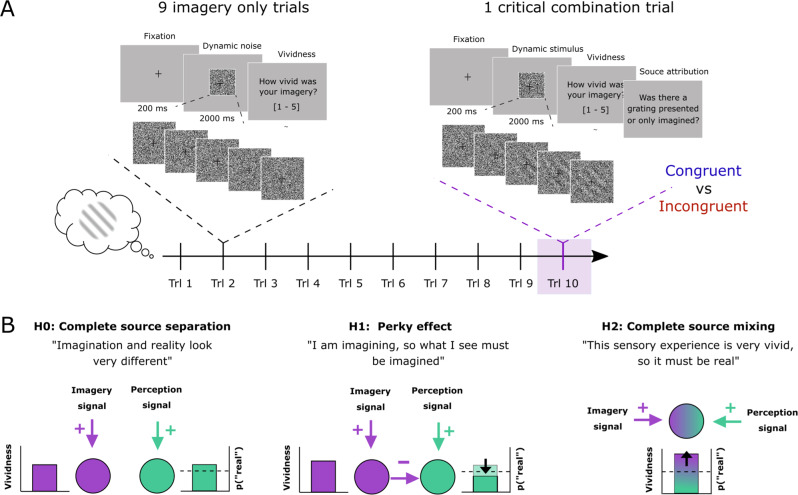
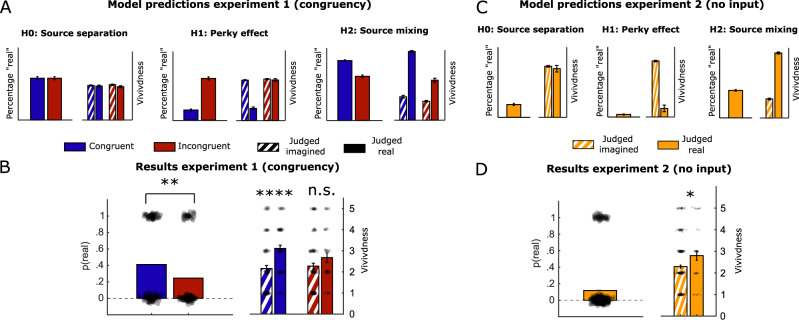
Humans are voracious imaginers, with internal simulations supporting memory, planning and decision-making. Because the neural mechanisms supporting imagery overlap with those supporting perception, a foundational question is how reality and imagination are kept apart. One possibility is that the intention to imagine is used to identify and discount self-generated signals during imagery. Alternatively, because internally generated signals are generally weaker, sensory strength is used to index reality. Traditional psychology experiments struggle to investigate this issue as subjects can rapidly learn that real stimuli are in play. Here, we combined one-trial-per-participant psychophysics with computational modelling and neuroimaging to show that imagined and perceived signals are in fact intermixed, with judgments of reality being determined by whether this intermixed signal is strong enough to cross a reality threshold. A consequence of this account is that when virtual or imagined signals are strong enough, they become subjectively indistinguishable from reality.
Overview
The claims and statistics of this paper haven’t been checked yet.
Free: it reads the open-access text and checks the first 5 claims that cite a source we can check. Create a free account to check every claim.
Integrity signals
Registry
Cites
Statistics
Figures
Verification
Claims the paper makes
The claims and statistics of this paper haven’t been checked yet.
Free: it reads the open-access text and checks the first 5 claims that cite a source we can check. Create a free account to check every claim.
Claims other papers make about this one
Each is checked against this paper’s own text: does it say what the citing paper says it does?
The check wasn’t confident either way, so it gives no verdict — never disputed.
In the citing paper
“For example, head direction signals from the brainstem can reach anterior thalamic nuclei239 (presumably through the ventral tegmental-lateral mammillary pathway), and from there reach the retrosplenial cortex and the hippocampus240.”
From Consciousness and sleep (2024) · cites this paper as [240]
Experimental — accuracy not yet measured
Self-check
Percentages, sums and reported differences re-computed from the paper’s own numbers.
The self-check needs the paper’s full text.
Citations
Cites
Signal detection theory and psychophysics
Ingleby, J. D. (1967) · Journal of Sound and Vibration · doi:10.1016/0022-460x(67)90197-6 · Cited by 8,509
U1 snRNP regulates cancer cell migration and invasion in vitro
Oh, J.-M., Venters, C. C., Di, C., Pinto, A. M., Wan, L., Younis, I., Cai, Z., Arai, C., So, B. R., Duan, J., et al. (2020) · Nature Communications · doi:10.1038/s41467-019-13993-7 · Cited by 7,157
Canonical Microcircuits for Predictive Coding
Bastos, A. M., Usrey, W. M., Adams, R. A., Mangun, G. R., Fries, P., & Friston, K. J. (2012) · Neuron · doi:10.1016/j.neuron.2012.10.038 · Cited by 2,421
Forward Models for Physiological Motor Control
Miall, R. C., & Wolpert, D. M. (1996) · Neural Networks · doi:10.1016/s0893-6080(96)00035-4 · Cited by 2,260
VISUAL IMAGERY DIFFERENCES IN THE RECALL OF PICTURES
MARKS, D. F. (1973) · British Journal of Psychology · doi:10.1111/j.2044-8295.1973.tb01322.x · Cited by 1,778
Central cancellation of self-produced tickle sensation
Blakemore, S.-J., Wolpert, D. M., & Frith, C. D. (1998) · Nature Neuroscience · doi:10.1038/2870 · Cited by 1,467
A free energy principle for the brain
Friston, K., Kilner, J., & Harrison, L. (2006) · Journal of Physiology-Paris · doi:10.1016/j.jphysparis.2006.10.001 · Cited by 1,369
Decoding reveals the contents of visual working memory in early visual areas
Harrison, S. A., & Tong, F. (2009) · Nature · doi:10.1038/nature07832 · Cited by 1,347
Sense of agency in the human brain
Haggard, P. (2017) · Nature Reviews Neuroscience · doi:10.1038/nrn.2017.14 · Cited by 1,107
Mental Imagery: Functional Mechanisms and Clinical Applications
Pearson, J., Naselaris, T., Holmes, E. A., & Kosslyn, S. M. (2015) · Trends in Cognitive Sciences · doi:10.1016/j.tics.2015.08.003 · Cited by 1,087
Research works printed but not linked: 3
- 39. Green, D. M. & Swets, J. A. Signal detection theory and psychophysics . John Wiley vol. 5 (1966).
- 56. Perky, C. W. An Experimental Study of Imagination. Am. J. Psychol. 21 , 422 -452 (1910). · DOI · Paper page
- 70. Marks, D. F. New directions for mental imagery research. J. Ment. Imag. 19 , 153 -167 (1995).
Cited by
Items 101–169 of 169
Markers of the perceptual and the cognitive
Block, N. J. (2023) · Oxford University Press eBooks · doi:10.1093/oso/9780197622223.003.0002
Perception is constitutively nonpropositional and nonconceptual
Block, N. J. (2023) · Oxford University Press eBooks · doi:10.1093/oso/9780197622223.003.0004
Two kinds of seeing-as and singular content
Block, N. J. (2023) · Oxford University Press eBooks · doi:10.1093/oso/9780197622223.003.0003
Block, N. J. (2023) · Oxford University Press eBooks · doi:10.1093/oso/9780197622223.003.0013
Block, N. (2023) · Oxford University Press eBooks · doi:10.1093/oso/9780197622223.002.0005
Block, N. (2023) · Oxford University Press eBooks · doi:10.1093/oso/9780197622223.002.0003
Nonconceptual color perception
Block, N. J. (2023) · Oxford University Press eBooks · doi:10.1093/oso/9780197622223.003.0006
Block, N. (2023) · Oxford University Press eBooks · doi:10.1093/oso/9780197622223.002.0007
Top-down effects that are probably not cases of cognitive penetration
Block, N. J. (2023) · Oxford University Press eBooks · doi:10.1093/oso/9780197622223.003.0010 · Cited by 1
Block, N. J. (2023) · Oxford University Press eBooks · doi:10.1093/oso/9780197622223.003.0001
The Evolving Concept of Cortical Hierarchy
Vezoli, J., Hou, Y., & Kennedy, H. (2023) · Oxford University Press eBooks · doi:10.1093/med/9780197676158.003.0037 · Cited by 1
Behavioral, functional, and anatomical study of tickertape synesthesia
Hauw, F. (2023) · theses.fr (ABES) · doi:10.70675/9c0a9937zd8bfz4f28z8c78z89e14d6171f2
Wang, D., Rhee, C., & Park, J. (2024) · SSRN Electronic Journal · doi:10.2139/ssrn.4886850
(2024) · Actes Sémiotiques · doi:10.25965/as.8649
Pratique de l’hypnose dentaire opératoire
Lemaire, B., & Pouysségur, V. (2024) · HEGEL - HEpato-GastroEntérologie Libérale · doi:10.3917/heg.143.0319
Andreu-Sánchez, C., Martín-Pascual, M. Á., Gruart, A., & Delgado-Garcia, J. M. (2024) · Symmetry · doi:10.3390/sym16111534
“In a certain way, there could be a different sensory strength to index reality [48], in this case, with screens.”
Mind, Motion and Multiscale Emergence: Exploring the Thermodynamics of Cognitive ExperiencesPreprint
Max, A. (2025) · PsyArXiv (OSF Preprints) · doi:10.31234/osf.io/w2rmx_v2 · Cited by 1
WITHDRAWNPreprint
Barnett, B., Mazor, M., Cabbai, G., & Dijkstra, N. (2025) · PsyArXiv (OSF Preprints) · doi:10.31234/osf.io/2uy9h_v1
Self-citationThe human brain mechanisms of afterimages: From networks to cortical layersPreprint
Kronemer, S. I., Akın, B., Holness, M., Morgan, A., Huber, L., Taylor, P. A., González-Castillo, J., Handwerker, D. A., & Bandettini, P. A. (2025) · bioRxiv (Cold Spring Harbor Laboratory) · doi:10.1101/2025.08.30.673266
Epistemological Models of Cognitive Feelings
Dokic, J. (2025) · Oxford University Press eBooks · doi:10.1093/9780191976650.003.0005
Cognitive Feelings and Emotions
Dokic, J. (2025) · Oxford University Press eBooks · doi:10.1093/9780191976650.003.0003
General Conclusion: Results and Prospects
Dokic, J. (2025) · Oxford University Press eBooks · doi:10.1093/9780191976650.003.0015
Dokic, J. (2025) · Oxford University Press eBooks · doi:10.1093/9780191976650.003.0014
Dokic, J. (2025) · Oxford University Press eBooks · doi:10.1093/9780191976650.002.0005
Introduction: What Are Cognitive Feelings and Why Study Them?
Dokic, J. (2025) · Oxford University Press eBooks · doi:10.1093/9780191976650.003.0001
Psychological Models of Cognitive Feelings
Dokic, J. (2025) · Oxford University Press eBooks · doi:10.1093/9780191976650.003.0004
Dokic, J. (2025) · Oxford University Press eBooks · doi:10.1093/9780191976650.003.0009
Reality II: Monitoring and Cues
Dokic, J. (2025) · Oxford University Press eBooks · doi:10.1093/9780191976650.003.0008
Dokic, J. (2025) · Oxford University Press eBooks · doi:10.1093/9780191976650.002.0004
Dokic, J. (2025) · Oxford University Press eBooks · doi:10.1093/9780191976650.003.0013
Reality I: Presence and Virtuality
Dokic, J. (2025) · Oxford University Press eBooks · doi:10.1093/9780191976650.003.0007
Reality, Familiarity, and Recognition
Dokic, J. (2025) · Oxford University Press eBooks · doi:10.1093/9780191976650.003.0010
Dokic, J. (2025) · Oxford University Press eBooks · doi:10.1093/9780191976650.003.0011
Morseth, B. K. (2025) · Studies in Chinese Religions · doi:10.1080/23729988.2025.2565892 · Cited by 1
Three-leveled predictive cognition: dissociated prediction, sensory artifacts and origins of mindPreprint
DOUVILLE, C. O. (2025) · SSRN Electronic Journal · doi:10.2139/ssrn.5807046
Characterising the neural correlates of perceptual experience
Barnett, B. (2024) · UCL Discovery (University College London)
Minden Ribeiro, M. (2025) · Lund University Publications (Lund University)
The neuroscience of creative perception: From visual ambiguity to neuroacoustics
Bellemare, A. (2024) · Spectrum Research Repository (Concordia University)
Mental Imagery and the Prefrontal Cortex in Sport: A Review
Shekhar, C., Dubey, S., Dubey, S., & Kumar, V. (2025) · International Journal of Interdisciplinary Approaches in Psychology · doi:10.61113/ijiap.v3i10.1169
First evidence supporting the theory of the sensorimotor paradox on the origins of mind and language
DOUVILLE, C. O. (2026) · Biosystems · doi:10.1016/j.biosystems.2026.105691
Atashrooz, M., Mirzai, F., Roaya, M. A., Rouhi, H. F., Ghadir, A., Vand, H. D. A., & Kianimoghadam, A. S. (2026) · Brain and Behavior · doi:10.1002/brb3.71203
The Schizophrenia Effect: Families Facing Schizophrenia-Spectrum Disorders
Christmas, G. A. (2026) · Digital Commons (Liberty University)
Barely depictive: Predicting imagery vividness relative to perception with EEGNetPreprint
Vanbuckhave, C., & Ganis, G. (2026) · bioRxiv (Cold Spring Harbor Laboratory) · doi:10.64898/2026.03.11.711041
“This implies that any neural activity during the VP task possibly reflected a mixture of spontaneous imagery and perception (consistent with Dijkstra & Fleming, 2023).”
A Dog Tail: To Trust or Not to Trust
Denishchich, V. A., & Christ, C. C. (2025) · Scholar Commons (University of South Carolina)
Stockart, F. (2024) · theses.fr (ABES) · doi:10.70675/c4f62883zfadez4797z9c4ezc049226f96a4 · Cited by 1
Imagery: Interference, facilitation, and theory
Reeves, A. (2026) · Attention Perception & Psychophysics · doi:10.3758/s13414-026-03251-6
“As many authors have pointed out (e.g., Byczynski & D’Angiulli, 2023; Dijkstra & Fleming, 2023), the reported Perky effects have diminished over the decades since Segal’s pioneering studies in the 1960s.”
InfluentialSyed, A. A., & Neelofur, S. (2026) · Medical Research Archives · doi:10.18103/mra.v14i4.7364
Suzuki, K. (2026) · Frontiers in Psychology · doi:10.3389/fpsyg.2026.1819038
“This prediction is consistent with the vulnerability of reality monitoring in vivid-imagery holders reported by Dijkstra and Fleming (2023).”
Computational Modeling of Human Cognition and Behavior
Wang, X., & Wu, H. (2026) · Springer eBooks · doi:10.1007/978-981-95-5585-7_2
Broadwell-Gulde, A. (2026) · Carolina Digital Repository (University of North Carolina at Chapel Hill) · doi:10.17615/vp13-c123
Planning paths not taken: False memories for unexecuted actionsPreprint
Armstrong, M. J., Yon, D., & Seghezzi, S. (2026) · SSRN Electronic Journal · doi:10.2139/ssrn.6982388
Remembering What We Did: Confidence Tracks the Distinctiveness of Action RepresentationsPreprint
Domagala, W., Armstrong, M. J., O’Neill, K. J., Yon, D., & Seghezzi, S. (2026) · SSRN Electronic Journal · doi:10.2139/ssrn.7168947
Metacognition and consciousness
Peters, M. A. K. (2026) · Elsevier eBooks · doi:10.1016/b978-0-443-29258-3.00052-5
The content and experiential qualities of mental imagery evoked by ambient music
Ayyildiz, C., Markert, N., Herff, S. A., & Küssner, M. B. (2026) · Jahrbuch der Deutschen Gesellschaft für Musikpsychologie/Jahrbuch Musikpsychologie · doi:10.5964/jbdgm.243
Imagery: Its measure, trait, source, and utility
Kronemer, S. I. (2026) · Elsevier eBooks · doi:10.1016/b978-0-443-29258-3.00019-7
Imagery in affective and neurodevelopmental conditions: an insula-based interoceptive framework
Kvamme, T. L., Nagai, Y., & Silvanto, J. (2026) · Trends Open · doi:10.1016/j.treopn.2026.06.003 · Cited by 1
Wang, L., Zhou, H. J., Fang, W., Fu, G., Zhang, Y., Min, B., & Dehaene, S. (2026) · Research Square · doi:10.21203/rs.3.rs-10130477/v1
Khan, J., Goerlandt, F., Manuel, P., & Aporta, C. (2026) · Marine Policy · doi:10.1016/j.marpol.2026.107222
Help, Don’t Control: Measuring User Emotional Background in AI Assistant Interaction
Satarenko, A. (2026) · ACM Conference on Conversational User Interfaces (CUI) · doi:10.1145/3816046.3816285
Haptic illusion during finger-held disk rotation: revisiting a deceptively simple illusion
Imai, A., Revol, P., & Rossetti, Y. (2026) · Experimental Brain Research · doi:10.1007/s00221-026-07363-1
“…Cohen 1998; Ehrsson et al. 2004; Gal-lace and Spence 2005 ; Hartcher-O’Brien et al. 2008; Pavani et al. 2000; Revol et al. 2009; Seizova-Cajic and Azzi 2011; Spence 2008; Stokes and Biggs 2015), and perception evokes a stronger sensory experience of vision than imagery (Dijkstra and Fleming 2023).”
Why do we need imagination–reality monitoring?
Dijkstra, N., Fleming, S. M., & Shea, N. J. (2026) · Neuroscience of Consciousness · doi:10.1093/nc/niag048
“One important focus for future research is to characterize how sensory richness is used for imagination–reality monitoring and what counts as ‘rich enough’ to cross a reality threshold ( Dijkstra and Fleming 2023).”
Self-citationSeri, T., Iwama, S., & Ushiba, J. (2026) · Journal of Neural Engineering · doi:10.1088/1741-2552/aea4f5
“MI is useful for examining this issue because it is not only a means of generating discriminable neural signatures, but also a form of internal motor simulation whose kinesthetic content can vary in its correspondence to overt action [11, 12].”
Joint perception biases subjective awareness reports.
Barnett, B., & Yon, D. (2026) · Journal of Experimental Psychology General · doi:10.1037/xge0002001
“…mechanisms tag perceptual representations with an unshakeable “ as-sertoric ” force that grants conscious perceptual experiences their undeniability (Lau, 2022), through private processes that track the strength of internal evidence (Dijkstra, von Rein, et al., 2025; Dijkstra & Fleming, 2023).”
Duckett, W., & Simons, J. S. (2026) · bioRxiv (Cold Spring Harbor Laboratory) · doi:10.64898/2026.10.22.761078
“As reported in several studies and meta-analyses, the VVIQ has poor predictive value (Dijkstra & Fleming, 2023; Duckett & Simons, 2026; Z. Liu et al., 2025; Runge et al., 2015, 2017), with the current findings supporting this pattern, and suggesting that trait and averaged measures fail to capture…”
Touch Boundaries During Physical Human-Robot Interaction
Pan, G., Kaur, G., & Alves‐Oliveira, P. (2026) · IEEE RO-MAN · doi:10.1109/ro-man72286.2026.11714816
Beyond Cortical Signatures: Measurement Gaps Across Theories of Consciousness
Svet, M., & Arachchige, A. S. P. M. (2026) · Brain Sciences · doi:10.3390/brainsci16101087
“…entailing dissociations of metacognitive sensitivity with first-order processing intact [105,106]; the most oper-ationalised variant nests a one-dimensional awareness state above a high-dimensional perceptual space [132], with consequences for confusing perception and imagination [133].”
Neural transformation from image realism to perceived realnessPreprint
Orima, T., & Ban, H. (2026) · bioRxiv (Cold Spring Harbor Laboratory) · doi:10.64898/2026.10.28.762323
Renz, L., GauthierDickey, K. L., Vibell, J. F., Francis, A. L., Corona–Strauss, F. I., & Strauß, D. J. (2026) · Research Square · doi:10.64898/2026.11.03.764079
Metadata
- Authors
- Dijkstra, N., & Fleming, S. M.
- Affiliations
- Wellcome Centre for Human Neuroimaging (GB)
- Corresponding author
- Dijkstra, Nadine
- Venue
- Nature Communications
- Published
- 2023-03-23
- Volume
- 14
- Issue
- 1
- Pages
- 1627-1627
- ISSN
- 2041-1723 (ISSN-L)
- PMC
- PMC10036541
- OpenAlex
- W4360607983
- Semantic Scholar
- 68e70ec5b6b14b13a5a0c0575e50daf30de0afb8
- Cited by
- 115
- References
- 80
- Citations by year
- 2026: 24 · 2025: 44 · 2024: 33 · 2023: 13
- FWCI
- 17.07
- Type
- journal article
- Language
- en
- Open access
- gold
- doi.org
- Licence
- cc-by
- creativecommons.org/licenses/by/4.0 (tdm)
- creativecommons.org/licenses/by/4.0 (vor)
- Locations
- Nature Communications (publishedVersion, cc-by)
- PubMed Central (publishedVersion, cc-by)
- PubMed (publishedVersion)
- UCL Discovery (University College London) (submittedVersion, cc-by)
- RePEc: Research Papers in Economics (submittedVersion)
- DOAJ (DOAJ: Directory of Open Access Journals) (submittedVersion, cc-by-sa)
- MPG.PuRe (Max Planck Society) (submittedVersion)
- Funders
- Canadian Institute for Advanced Research
- Wellcome Trust (Z/17/Z, 206648/Z/17/Z)
- Leverhulme Trust
- European Commission (HORIZON2020, 882832)
- Nederlandse Organisatie voor Wetenschappelijk Onderzoek (019.192SG.003)
- Max-Planck-Gesellschaft (206648/Z/17/Z)
- Topics
- Life Sciences › Neuroscience › Cognitive Neuroscience › Visual perception and processing mechanisms
- Social Sciences › Arts and Humanities › Philosophy › Philosophy and Theoretical Science
- Life Sciences › Neuroscience › Cognitive Neuroscience › Memory Processes and Influences
- Keywords
- mental imagery, perception, internal simulation, virtual reality, perceptual realism
- MeSH terms
- Computer Simulation, Humans, Imagination, Learning, Psychophysics, Imagery, Psychotherapy
About these checks
Registry, retraction, Cites and statistics results are computed, not judged, with one exception: a printed reference that no index lists is read once by a model before it counts as a citation error. Claims are extracted by a model and kept only when their quote appears verbatim in the text; each cited source is then checked, with a model’s help, for whether it says what the claim relies on. Those verdicts can be wrong — read the claim’s quote and the cited source before relying on one.
Statistics and arithmetic are recomputed, not judged.
Confidence bands are shown only for fields calibrated on our annotated test set. None is calibrated yet, so no band is shown.
What counts as a claim ›How we measure confidence ›How we check this ›
Are you an author, or do you see a problem with this page? Request a review
Data sources
Bibliographic data: Semantic Scholar, OpenAlex, Crossref.
Contains information from the Semantic Scholar Academic Graph Datasets, made available under the ODC Attribution License (ODC-BY 1.0).
Semantic Scholar’s data is described in: Kinney, R., et al. (2023). The Semantic Scholar Open Data Platform. arXiv:2301.10140.
