

Subjective signal strength distinguishes reality from imagination
Open accessThe DOI matches its Crossref record; 81 of the 81 references it cites were found in a registry or an index.
Abstract
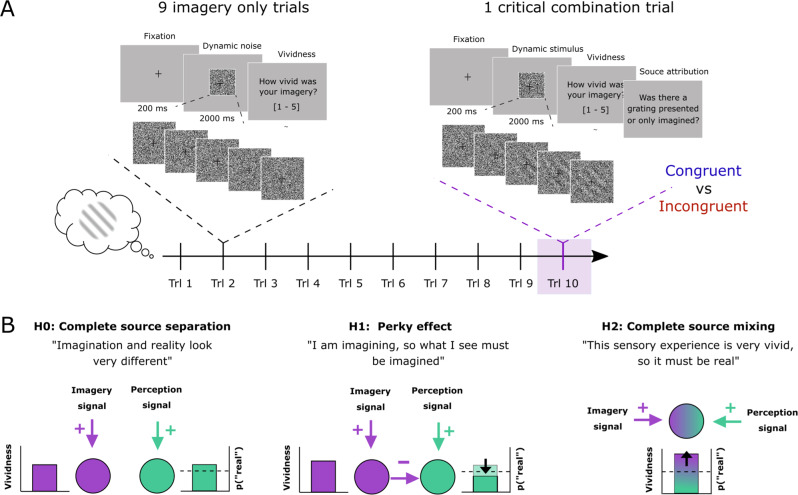
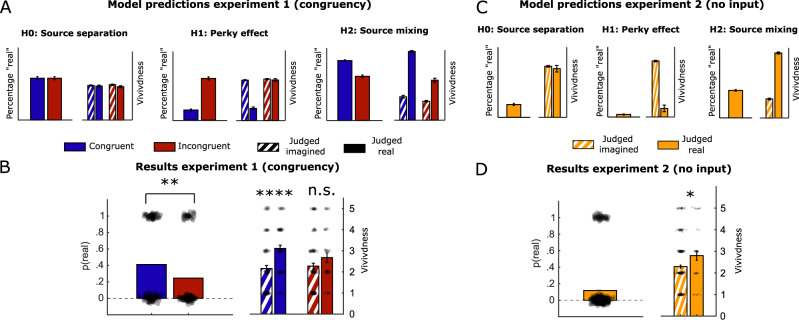
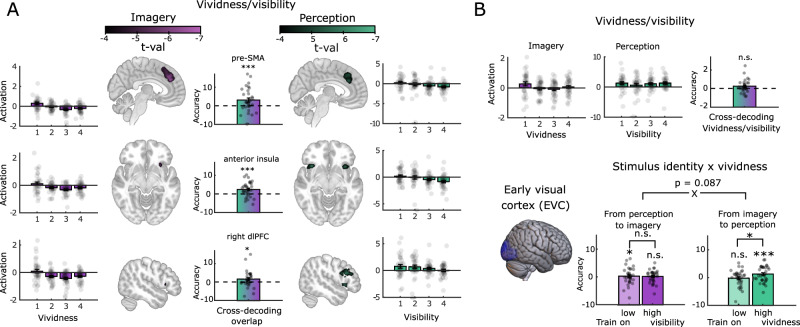
Humans are voracious imaginers, with internal simulations supporting memory, planning and decision-making. Because the neural mechanisms supporting imagery overlap with those supporting perception, a foundational question is how reality and imagination are kept apart. One possibility is that the intention to imagine is used to identify and discount self-generated signals during imagery. Alternatively, because internally generated signals are generally weaker, sensory strength is used to index reality. Traditional psychology experiments struggle to investigate this issue as subjects can rapidly learn that real stimuli are in play. Here, we combined one-trial-per-participant psychophysics with computational modelling and neuroimaging to show that imagined and perceived signals are in fact intermixed, with judgments of reality being determined by whether this intermixed signal is strong enough to cross a reality threshold. A consequence of this account is that when virtual or imagined signals are strong enough, they become subjectively indistinguishable from reality.
Overview
The claims and statistics of this paper haven’t been checked yet.
Free: it reads the open-access text and checks the first 5 claims that cite a source we can check. Create a free account to check every claim.
Integrity signals
Registry
Cites
Statistics
Figures
Verification
Claims the paper makes
The claims and statistics of this paper haven’t been checked yet.
Free: it reads the open-access text and checks the first 5 claims that cite a source we can check. Create a free account to check every claim.
Claims other papers make about this one
Each is checked against this paper’s own text: does it say what the citing paper says it does?
The check wasn’t confident either way, so it gives no verdict — never disputed.
In the citing paper
“For example, head direction signals from the brainstem can reach anterior thalamic nuclei239 (presumably through the ventral tegmental-lateral mammillary pathway), and from there reach the retrosplenial cortex and the hippocampus240.”
From Consciousness and sleep (2024) · cites this paper as [240]
Experimental — accuracy not yet measured
Self-check
Percentages, sums and reported differences re-computed from the paper’s own numbers.
The self-check needs the paper’s full text.
Citations
Cites
Signal detection theory and psychophysics
Ingleby, J. D. (1967) · Journal of Sound and Vibration · doi:10.1016/0022-460x(67)90197-6 · Cited by 8,509
U1 snRNP regulates cancer cell migration and invasion in vitro
Oh, J.-M., Venters, C. C., Di, C., Pinto, A. M., Wan, L., Younis, I., Cai, Z., Arai, C., So, B. R., Duan, J., et al. (2020) · Nature Communications · doi:10.1038/s41467-019-13993-7 · Cited by 7,157
Canonical Microcircuits for Predictive Coding
Bastos, A. M., Usrey, W. M., Adams, R. A., Mangun, G. R., Fries, P., & Friston, K. J. (2012) · Neuron · doi:10.1016/j.neuron.2012.10.038 · Cited by 2,421
Forward Models for Physiological Motor Control
Miall, R. C., & Wolpert, D. M. (1996) · Neural Networks · doi:10.1016/s0893-6080(96)00035-4 · Cited by 2,260
VISUAL IMAGERY DIFFERENCES IN THE RECALL OF PICTURES
MARKS, D. F. (1973) · British Journal of Psychology · doi:10.1111/j.2044-8295.1973.tb01322.x · Cited by 1,778
Central cancellation of self-produced tickle sensation
Blakemore, S.-J., Wolpert, D. M., & Frith, C. D. (1998) · Nature Neuroscience · doi:10.1038/2870 · Cited by 1,467
A free energy principle for the brain
Friston, K., Kilner, J., & Harrison, L. (2006) · Journal of Physiology-Paris · doi:10.1016/j.jphysparis.2006.10.001 · Cited by 1,369
Decoding reveals the contents of visual working memory in early visual areas
Harrison, S. A., & Tong, F. (2009) · Nature · doi:10.1038/nature07832 · Cited by 1,347
Sense of agency in the human brain
Haggard, P. (2017) · Nature Reviews Neuroscience · doi:10.1038/nrn.2017.14 · Cited by 1,107
Mental Imagery: Functional Mechanisms and Clinical Applications
Pearson, J., Naselaris, T., Holmes, E. A., & Kosslyn, S. M. (2015) · Trends in Cognitive Sciences · doi:10.1016/j.tics.2015.08.003 · Cited by 1,087
Research works printed but not linked: 3
- 39. Green, D. M. & Swets, J. A. Signal detection theory and psychophysics . John Wiley vol. 5 (1966).
- 56. Perky, C. W. An Experimental Study of Imagination. Am. J. Psychol. 21 , 422 -452 (1910). · DOI · Paper page
- 70. Marks, D. F. New directions for mental imagery research. J. Ment. Imag. 19 , 153 -167 (1995).
Cited by
The Border Between Seeing and Thinking
Block, N. (2023) · doi:10.1093/oso/9780197622223.001.0001 · Cited by 367
Consciousness in Artificial Intelligence: Insights from the Science of Consciousness
Butlin, P., Long, R., Elmoznino, E., Bengio, Y., Birch, J., Constant, A., Deane, G., Fleming, S. M., Frith, C., Ji, X., et al. (2023) · arXiv · doi:10.48550/arxiv.2308.08708 · Cited by 196
Self-citationImageless imagery in aphantasia revealed by early visual cortex decoding
Chang, S., Zhang, X., Cao, Y., Pearson, J., & Meng, M. (2025) · Current Biology · doi:10.1016/j.cub.2024.12.012 · Cited by 87
Tononi, G., Boly, M., & Cirelli, C. (2024) · Neuron · doi:10.1016/j.neuron.2024.04.011 · Cited by 70
Centering cognitive neuroscience on task demands and generalization
Nau, M., Schmid, A. C., Kaplan, S. M., Baker, C. I., & Kravitz, D. J. (2024) · Nature Neuroscience · doi:10.1038/s41593-024-01711-6 · Cited by 61
“Converging evidence for shared neural substrates for imagery and perception has even prompted the question of how we are able to differentiate between the two 72 .”
Cortical depth profiles in primary visual cortex for illusory and imaginary experiences
Bergmann, J., Petro, L. S., Abbatecola, C., Li, M. S., Morgan, A. T., & Muckli, L. (2024) · Nature Communications · doi:10.1038/s41467-024-45065-w · Cited by 39
Replay-triggered brain-wide activation in humans
Huang, Q., Xiao, Z., Yu, Q., Luo, Y., Xu, J., Qu, Y., Dolan, R. J., Behrens, T. E. J., & Liu, Y. (2024) · Nature Communications · doi:10.1038/s41467-024-51582-5 · Cited by 55
“While it could be a ceiling effect of vividness rating, it is also possible that the content of replay is more at a semantic level where imagery vividness is likely to exert little impact on replay quality 64 .”
An active inference perspective for the amygdala complex
Sladky, R., Kargl, D., Haubensak, W. E., & Lamm, C. (2023) · Trends in Cognitive Sciences · doi:10.1016/j.tics.2023.11.004 · Cited by 41
Quality space computations for consciousness
Fleming, S. M., & Shea, N. J. (2024) · Trends in Cognitive Sciences · doi:10.1016/j.tics.2024.06.007 · Cited by 47
“The contribution of a magnitude signal to reality monitoring has gained recent empirical support through observations that, in near-threshold perception, signals from perception and imagination jointly determine reality monitoring judgments [71].”
Self-citationEstrogen influences class-switched memory B cell frequency only in humans with two X chromosomes
Peckham, H., Radziszewska, A., Sikora, J., de Gruijter, N. M., Restuadi, R., Kartawinata, M., Martin‐Gutierrez, L., Robinson, G., Deakin, C. T., Wedderburn, L. R., et al. (2025) · The Journal of Experimental Medicine · doi:10.1084/jem.20241253 · Cited by 37
A neural basis for distinguishing imagination from reality
Dijkstra, N., von Rein, T., Kok, P., & Fleming, S. M. (2025) · Neuron · doi:10.1016/j.neuron.2025.05.015 · Cited by 40
“11 Twenty-six participants were instructed to detect barely visible left-or right-tilted gratings that gradually appeared within dynamic noise on half of the trials (Figure 1A).”
InfluentialSelf-citationWhat is the true range of mental imagery?
Schwarzkopf, D. S. (2023) · Cortex · doi:10.1016/j.cortex.2023.09.013 · Cited by 41
“In one commonly used paradigm, participants imagine oriented gratings and researchers test how these images affect the perception of physically presented stimuli (Dijkstra et al., 2022; Dijkstra & Fleming, 2023; Pearson, 2014; Pearson et al., 2008).”
Uncovering the Role of the Early Visual Cortex in Visual Mental Imagery
Dijkstra, N. (2024) · Vision · doi:10.3390/vision8020029 · Cited by 40
Self-citationConsciousness, (meta)cognition, and culture
Frith, C. (2023) · Quarterly Journal of Experimental Psychology · doi:10.1177/17470218231164502 · Cited by 26
A simple statistical framework for small sample studies.
Schwarzkopf, D. S., & Huang, Z. (2024) · Psychological Methods · doi:10.1037/met0000710 · Cited by 25
Li, S., Zeng, X., Shao, Z., & Yu, Q. (2023) · The Journal of Neuroscience · doi:10.1523/jneurosci.0592-23.2023 · Cited by 23
Confidence ratings do not distinguish imagination from reality
Dijkstra, N., Mazor, M., & Fleming, S. M. (2024) · Journal of Vision · doi:10.1167/jov.24.5.13 · Cited by 27
“Sensory activation during imagery tends to be much weaker than during externally triggered perception, which might be why we generally do not mistake our imagination for reality (Dijkstra & Fleming, 2023; Koenig-Robert & Pearson, 2021).”
BackgroundResultSelf-citationWhat makes deceptive online reviews? A linguistic analysis perspective
Zhang, W., Wang, Q., Li, J., Ma, Z., Bhandari, G., & Peng, R. (2023) · Humanities and Social Sciences Communications · doi:10.1057/s41599-023-02295-5 · Cited by 20
Foffani, G. (2023) · PNAS Nexus · doi:10.1093/pnasnexus/pgad442 · Cited by 20
“When the strength of a signal in first-order sensory processes reaches a sort of “reality threshold”, it is perceived as real independently of its internal or external origin (28).”
BackgroundAzañón, E., Pounder, Z., Figueroa, A., & Reeder, R. (2025) · Journal of Experimental Psychology General · doi:10.1037/xge0001756 · Cited by 20
A metacognitive account of phenomenal force
Teng, L. (2022) · Mind & Language · doi:10.1111/mila.12442 · Cited by 25
Imagery adds stimulus-specific sensory evidence to perceptual detection
Dijkstra, N., Kok, P., & Fleming, S. M. (2022) · Journal of Vision · doi:10.1167/jov.22.2.11 · Cited by 26
Self-citationMental strength: A theory of experience intensity
Morales, J. (2023) · Philosophical Perspectives · doi:10.1111/phpe.12189 · Cited by 18
A Standard Framework for Social Cognition: interoperable algorithms for inference and representationPreprint
Barnby, J. M., Alon, N., Bellucci, G., Schilbach, L., Frith, C., & Bell, V. (2023) · PsyArXiv (OSF Preprints) · doi:10.31234/osf.io/cmgu7 · Cited by 18
Uznadze’s Theory of Set: Experimental Diagnostics and Neurocognitive ImplicationsPreprint
Tqemaladze, J. (2025) · Preprints.org · doi:10.20944/preprints202511.1006.v1 · Cited by 16
Theories of consciousness from the perspective of an embedded processes view.
Cowan, N., Ahmed, N. I., Bao, C., Cissne, M. N., Flores, R. D., Gutierrez, R. M., Hayse, B., Musich, M. L., Nourbakhshi, H., Nuraini, N., et al. (2025) · Psychological Review · doi:10.1037/rev0000510 · Cited by 17
“(In evaluating such a case, caution would have to be taken to ensure that the de fi cit was not constructed merely from an unusual cognitive misunderstanding of the difference in vividness between percepts and mental images: see Dijkstra & Fleming, 2023.)”
BackgroundThe epistemic insignificance of phenomenal force
Teng, L. (2023) · Philosophy and Phenomenological Research · doi:10.1111/phpr.13020 · Cited by 13
Pounder, Z., Eardley, A. F., Loveday, C., & Evans, S. (2024) · PLoS ONE · doi:10.1371/journal.pone.0300219 · Cited by 13
“…because the two groups differ in their thresholds for labelling an image as ‘vivid’, in that individuals with aphantasia have a much higher threshold for reporting an image as vivid compared to those with typical imagery [65] with these thresholds potentially also differing across modalities.”
BackgroundNeural network topologies supporting individual variations in vividness of visual imagery
Kvamme, T. L., Lumaca, M., Bajada, C. J., Gregersen, S. D., Hobot, J., Paunović, D., Wierzchoń, M., Zana, B., Silvanto, J., & Sandberg, K. (2025) · NeuroImage · doi:10.1016/j.neuroimage.2025.121520 · Cited by 12
Introspective psychophysics for the study of subjective experience
Peters, M. A. K. (2024) · Cerebral Cortex · doi:10.1093/cercor/bhae455 · Cited by 16
Miyoshi, K., Webb, T. W., Rahnev, D., & Lau, H. C. (2023) · Elsevier eBooks · doi:10.1016/b978-0-12-820480-1.00049-8 · Cited by 12
The attentive reconstruction of objects facilitates robust object recognition
Ahn, S., Adeli, H., & Zelinsky, G. J. (2024) · PLoS Computational Biology · doi:10.1371/journal.pcbi.1012159 · Cited by 10
The exploration of consciousness in insects
Chıttka, L., Skeels, S., Dyakova, O., & Janbon, M. (2025) · Philosophical Transactions of the Royal Society B Biological Sciences · doi:10.1098/rstb.2024.0302 · Cited by 11
Introspective inference counteracts perceptual distortion
Mihali, A., Broeker, M. D., Ragalmuto, F. D. M., & Horga, G. (2023) · Nature Communications · doi:10.1038/s41467-023-42813-2 · Cited by 9
“Previousworkrelatedtorealitytestinghasbroadlyused two main approaches: (1) source (self versus other) memory tasks in the context of semantic association and sentence completion 7,8 ; and, more recently, (2) imagery tasks in the context of perceptual decision-making 9 – 13 .”
How does the primate brain combine generative and discriminative computations in vision?Preprint
Peters, B., DiCarlo, J. J., Gureckis, T. M., Haefner, R. M., Işık, L., Tenenbaum, J. B., Konkle, T., Naselaris, T., Stachenfeld, K., Tavares, Z., et al. (2024) · PubMed Central · doi:10.48550/arxiv.2401.06005 · Cited by 23
Imageless imagery in aphantasia: decoding non-sensory imagery in aphantasia
Meng, M., Chang, S., Zhang, X., & Pearson, J. (2023) · doi:10.21203/rs.3.rs-3162223/v1 · Cited by 8
Divergent Perception: Framing Creative Cognition Through the Lens of Sensory Flexibility
Bellemare‐Pepin, A., & Jerbi, K. (2024) · The Journal of Creative Behavior · doi:10.1002/jocb.1525 · Cited by 8
Vividness of mental imagery reflects a broad range of internally generated visual experiences
Schwarzkopf, D. S., Yu, X. A., Altan, E., Bouyer, L. N., Saurels, B. W., Pellicano, E., & Arnold, D. H. (2026) · Royal Society Open Science · doi:10.1098/rsos.251887 · Cited by 9
“Thus, imagery can sometimes interfere with perception [5,6,8,22,23].”
Shared and Diverging Neural Dynamics Underlying False and Veridical Perception
Haarsma, J., Hetenyi, D., & Kok, P. (2025) · Journal of Neuroscience · doi:10.1523/jneurosci.1479-24.2025 · Cited by 8
“Mechanisms other than prediction, such as imagery and choice history (Urai et al., 2019; Dijkstra and Fleming, 2023), may also be at play here.”
Vividness of Visual Imagery Supported by Intrinsic Structural-Functional Brain Network DynamicsPreprint
Kvamme, T. L., Lumaca, M., Zana, B., Paunović, D., Silvanto, J., & Sandberg, K. (2024) · bioRxiv (Cold Spring Harbor Laboratory) · doi:10.1101/2024.03.02.582470 · Cited by 8
“A neuroscientific understanding of imagery is thus of both basic science and clinical relevance, and it has received a surge of interest in recent years (Dijkstra et al., 2022, 2019; Dijkstra and Fleming, 2023).”
BackgroundPerspective taking activates one’s own perceptual object processing in infants and adultsPreprint
Tebbe, A., Rothmaler, K., Köster, M., & Wiesmann, C. G. (2024) · bioRxiv (Cold Spring Harbor Laboratory) · doi:10.1101/2024.08.06.605501 · Cited by 8
Rosen, M. G., & Trakas, M. (2024) · Philosophical Psychology · doi:10.1080/09515089.2024.2350500 · Cited by 7
“…to note that appealing to brain activation is not a plausible way of determining whether dreaming is imagination or hallucination since, although progress is being made, we have not discovered neural correlates of each state to allow us to distinguish them (Dijkstra & Fleming, 2023; Klein, 2010).”
The rational role of the perceptual sense of reality
Gładziejewski, P. (2022) · Mind & Language · doi:10.1111/mila.12445 · Cited by 7
Magioncalda, P., Yadav, A., & Martino, M. (2025) · Nature Mental Health · doi:10.1038/s44220-025-00493-5 · Cited by 5
“…vividness serves as a key reality-monitoring criterion, helping to distinguish perception (driven by stimuli from the surrounding environment and characterized by intrinsically higher vividness) from imagery (dissociated from the current environment and exhibiting lower vividness) 111 .”
Subtitled speech: the neural mechanisms of ticker-tape synaesthesia
Hauw, F., Béranger, B., & Cohen, L. (2024) · Brain · doi:10.1093/brain/awae114 · Cited by 5
“70 Moreover, closer to our finding of increased fronto-occipital correlation in synaesthetes, the functional connectivity between prefrontal and occipital areas contributes to mental imagery.”
BackgroundColafiglio, T., Lombardi, A., Noia, T. D., Bonis, M. L. N. D., Narducci, F., & Proverbio, A. M. (2025) · Expert Systems with Applications · doi:10.1016/j.eswa.2025.127076 · Cited by 6
Kathofer, M., Lamm, C., Leder, H., & Crone, J. S. (2025) · iScience · doi:10.1016/j.isci.2025.112588 · Cited by 7
“39 These findings suggest that if the strength of neural representations is high enough, vivid mental images might even be perceived as real.”
How disrupted interoception could lead to disturbances in perceptual reality monitoring
Dijkstra, N., Convertino, L., & Garfinkel, S. N. (2024) · Cognitive Neuropsychiatry · doi:10.1080/13546805.2024.2422620 · Cited by 10
“…emotionally valent imagery is experienced as more vivid (Bywaters et al., 2004; Mathews et al., 2013) and more vivid imagery is more likely to be mis-taken for reality (Dijkstra & Fleming, 2023; Shine et al., 2015), leading to more emotionally valent perceptual reality monitoring failures.”
Self-citationCognitive Feelings: An Essay on the Affective Interfaces of the Mind
Dokic, J. (2025) · doi:10.1093/9780191976650.001.0001 · Cited by 5
Spiking the mind: Rethinking the role of cortical feedback in visual mental imagery.
Koenig‐Robert, R., Pace, T., & Pearson, J. (2026) · Psychological Review · doi:10.1037/rev0000621 · Cited by 4
Inner speech and the body error theory
Endicott, R. P. (2024) · Frontiers in Psychology · doi:10.3389/fpsyg.2024.1360699 · Cited by 5
New ways of studying subjective experience
Keogh, R., & Lau, H. C. (2024) · Neuroscience Research · doi:10.1016/j.neures.2024.01.010 · Cited by 5
Noun imageability and the processing of sensory-based information
Gerwien, J., Filip, M., & Šmolík, F. (2023) · Quarterly Journal of Experimental Psychology · doi:10.1177/17470218231216304 · Cited by 3
State but not trait measures of vividness relate to memory accuracy
Duckett, W., & Simons, J. S. (2026) · Neuropsychologia · doi:10.1016/j.neuropsychologia.2026.109399 · Cited by 3
Towards an integrative neuroscience of metacognition
Fleming, S. M. (2026) · Nature reviews. Neuroscience · doi:10.1038/s41583-026-01081-x · Cited by 5
“When imagination is congruent with external stimulation and when it is particularly vivid, subjects are more likely to attribute their experience to reality — suggesting that a central driver of reality monitoring is the strength and precision of ongoing perceptual processing 201 .”
Self-citationCarl Jung: a life on the edge of reality with hypnagogia, hyperphantasia, and hallucinations
Incekara, F., & Blom, J. D. (2024) · Frontiers in Psychology · doi:10.3389/fpsyg.2024.1358329 · Cited by 4
“Taking into account the results of the above-mentioned experimental study by Dijkstra and Fleming (2023), it may well be that those individuals who go on to experience hallucinations either have an altered ‘reality threshold’ or experience an exceptionally high degree of imagery vividness.”
BackgroundResultInfluentialWang, D., Rhee, C., & Park, J. (2025) · Behaviour and Information Technology · doi:10.1080/0144929x.2025.2523444 · Cited by 4
Schille-Hudson, E. B., Weisman, K., & Luhrmann, T. M. (2025) · Schizophrenia Bulletin · doi:10.1093/schbul/sbaf138 · Cited by 3
Reality testing and metacognition
Greely, N. (2024) · Philosophical Psychology · doi:10.1080/09515089.2024.2336588 · Cited by 4
“Some of the properties are mental, such as Hume’s (1739) “vividness,” and thus support the metacognitive nature of reality testing (see also Dijkstra & Fleming, 2023).”
Ayyildiz, C., Prince, J. B., Delalande, J., & Herff, S. A. (2026) · Humanities and Social Sciences Communications · doi:10.1057/s41599-026-07057-7 · Cited by 3
“Mental imagery differs from “ true ” perception (Dijkstra and Fleming, 2023), and is a central component of everyday cognitive capacities such as memory (Milton et al., 2021), future planning (Bulley and Irish, 2018), language comprehension (Dils and Boroditsky, 2010), decision-making (Skard et…”
Unreal? A Behavioral, Physiological, and Computational Model of the Sense of RealityPreprint
Drori, G., Bar-Tal, P., Hirsh, O., berlinger, A., Goldberg, N., Zvilichovsky, Y., Hertz, U., Zaidel, A., & Salomon, R. (2025) · bioRxiv (Cold Spring Harbor Laboratory) · doi:10.1101/2025.04.07.647542 · Cited by 5
“…monitoring studies (also known as source monitoring), have investigated the ability to distinguish internally from externally generated information (i.e., whether remembered information originated from perception or imagery) by evaluating characteristics such as vividness or sensory detail (19–21).”
Cognitive penetration is common but does not challenge the joint
Block, N. J. (2023) · Oxford University Press eBooks · doi:10.1093/oso/9780197622223.003.0009 · Cited by 3
Holmes, J., Zhang, J., Francis, K., & Kapitány, R. (2025) · Imagination Cognition and Personality · doi:10.1177/02762366251339189 · Cited by 2
“Representations of perceptions of reality, and representations of the imagined share signi fi cant neural overlap, and are, in fact, intermixed (Dijkstra & Fleming, 2023).”
van Mulukom, V. (2025) · Imagination Cognition and Personality · doi:10.1177/02762366251339191 · Cited by 2
“…the more vividly participants imagined a visual stimulus, the more likely they were to believe it was real, even when nothing was actually presented (Dijkstra & Fleming, 2023), similar to a study which included blindfolding participants, and where greater visual imagery was associated with…”
Vivid imagery of objects primes perception of subliminal spatial information
Byczynski, G., & D’Angiulli, A. (2025) · Neuroscience of Consciousness · doi:10.1093/nc/niaf026 · Cited by 2
“In all, our findings offer a novel explanation for the contin ued decline of the Perky effect (Dijkstra and Fleming 2023), indeed showing that in subliminal conditions, imagery can prime and enhance subliminal processing, particularly amongst individuals with low TSDVI or high TSDVI under vivid…”
InfluentialBernasconi, F., Andrillon, T., Farah, J. C., Arnulf, I., Schwartz, S., Potheegadoo, J., Martínez‐Horta, S., Pagonabarraga, J., Kulisevsky, J., & Blanke, O. (2026) · Science Translational Medicine · doi:10.1101/2025.08.29.25334276 · Cited by 2
Varieties of memory, varieties of reconstruction, varieties of memory trace
Brown, S. A. B. (2025) · Philosophical Psychology · doi:10.1080/09515089.2025.2574486 · Cited by 2
“See e.g (Dijkstra & Fleming, 2023; Dijkstra et al., 2019; Gottfried et al., 2004; Kosslyn et al., 2006; Pearson et al., 2015; Vaidya et al., 2002; Wadia et al., 2024; Wheeler et al., 2000). although there are complexities here beyond the scope of this paper (Favila et al., 2020; She et al., 2024).”
Dilemmas and considerations of Arab parents in choosing Jewish schools for their children
Abdalkrem-Asla, M. R., & Abu‐Gweder, A. (2025) · Journal of Multilingual and Multicultural Development · doi:10.1080/01434632.2025.2562101 · Cited by 2
Vivid imagery is reported faster than weak imagery
Barnett, B., Mazor, M., Cabbai, G., & Dijkstra, N. (2025) · Neuroscience of Consciousness · doi:10.1093/nc/niaf054 · Cited by 2
“2025; Dijkstra and Fleming 2023) .”
Self-citationValidation of the Chinese version of the scientific imagination inventory in primary school students
Peng, D., Feng, J., & Wang, M. (2026) · Frontiers in Psychology · doi:10.3389/fpsyg.2026.1757878 · Cited by 2
Vanbuckhave, C., Eikner, J. S., Laeng, B., Onnis, L., & Mathôt, S. (2026) · Psychophysiology · doi:10.1111/psyp.70298 · Cited by 2
Reality check: how do we know what's real?
Keogh, R. (2023) · Trends in Cognitive Sciences · doi:10.1016/j.tics.2023.06.001 · Cited by 2
Mottram, J. A., & Dimmock, J. A. (2024) · Social Science & Medicine · doi:10.1016/j.socscimed.2024.117476 · Cited by 2
A never-ending prediction: meta-prediction, counter-oscillatory system and traumatic affordance
DOUVILLE, C. O. (2025) · Biosystems · doi:10.1016/j.biosystems.2025.105508 · Cited by 3
Contemporary neuroscientific concepts and psychotherapy: possibilities for integration
Dobrushina, O. R. (2024) · Журнал высшей нервной деятельности им И П Павлова · doi:10.31857/s0044467724010016 · Cited by 2
Current Neuroscientific Concepts and Psychotherapy: Possibilities for Integration
Dobrushina, O. R. (2024) · Neuroscience and Behavioral Physiology · doi:10.1007/s11055-024-01649-z · Cited by 1
“…recent study reported by Dijkstra and Fleming addressed the mechanisms distinguishing between images generated in the imagination (the top-down pathway) and those represented in real stimulus material (the bottom-up pathway) during the perception of highly noisy images [Dijkstra and Fleming, 2023].”
Distinguishing imagining from perceiving: reality monitoring and the ‘Perky effect’
Todd, C. (2024) · Phenomenology and the Cognitive Sciences · doi:10.1007/s11097-024-10009-8 · Cited by 1
Tokens of Reality: On the Prospective Nature of Virtual Consciousness
Hancock, P. A. (2024) · PRESENCE Virtual and Augmented Reality · doi:10.1162/pres_a_00436 · Cited by 1
Ілюзія проти реальності: український досвід Першої світової війни
Gerasymov, T., & Романюк, І. (2024) · Eminak · doi:10.33782/eminak2024.3(47).732 · Cited by 1
Eckhoff, D., Schnupp, J. W. H., Wong, P. C., & Cassinelli, Á. (2025) · IEEE Conference on Virtual Reality and 3D User Interfaces (VR) · doi:10.1109/vr59515.2025.00031 · Cited by 2
“However, a reduced number of participants reported thermal illusions in that case, suggesting that the threshold for virtual stimuli to be perceived as plausible is lower when they interact with the user’s own body [26].”
Silins, N. (2025) · Synthese · doi:10.1007/s11229-025-05047-x · Cited by 2
A Dharmakīrtian Model of Relevance Realization in Cognitive Agents
Amir, N., & Dunne, J. D. (2025) · Contemporary Buddhism · doi:10.1080/14639947.2025.2564476 · Cited by 2
“Furthermore, implementing a metacognitive arbitration mechanism, such as the one described in Dijkstra and Fleming (2023) may enable such systems to distinguish between simulations that originate in real perceptual experiences and those that are completely imagined.”
Validation of a French Version of the Plymouth Sensory Imagery Questionnaire (PSIQ-F)
Aka, S., Napias, A., Robert, C., & Mathey, S. (2025) · European Journal of Psychological Assessment · doi:10.1027/1015-5759/a000929 · Cited by 1
Psychotic subtitles: A case of transient ticker-tape synesthesia
Cohen, L., Jardri, R., & Hauw, F. (2026) · Cortex · doi:10.1016/j.cortex.2026.02.014 · Cited by 1
Giraldi, E., Frosolone, M., Corcoran, A. W., Barca, L., Corsini, A., Donnarumma, F., D’Ausilio, A., & Pezzulo, G. (2026) · Imaging Neuroscience · doi:10.1162/imag.a.1178 · Cited by 1
“This aligns with findings that internally generated signals are generally weaker than veridical sensory input— suggesting that signal strength may help the brain distinguish between reality and imagination ( Dijkstra & Fleming, 2023).”
Tqemaladze, J. (2025) · Longevity Horizon · doi:10.65649/f74e8cca · Cited by 5
Lau, H. C. (2022) · Oxford University Press eBooks · doi:10.1093/oso/9780198856771.003.0008 · Cited by 1
Perception is iconic; cognition is discursive
Block, N. J. (2023) · Oxford University Press eBooks · doi:10.1093/oso/9780197622223.003.0005 · Cited by 1
De l’Umwelt au récit. Une lecture biosémiotique des fictions et des attitudes face aux discours
Raimbault, M. (2024) · Actes Sémiotiques · doi:10.25965/as.8709 · Cited by 1
Reality and Imagination Intertwined : A Sensorimotor Paradox Interpretation
DOUVILLE, C. O. (2024) · Biosystems · doi:10.1016/j.biosystems.2024.105350 · Cited by 4
Confidence and metacognitionPreprint
Miyoshi, K., Webb, T. W., Rahnev, D., & Lau, H. C. (2024) · PsyArXiv (OSF Preprints) · doi:10.31234/osf.io/y3drq · Cited by 2
Mind, Motion and Multiscale Emergence: Exploring the Thermodynamics of Cognitive ExperiencesPreprint
Pereira, A. M. L. B. (2025) · SSRN Electronic Journal · doi:10.2139/ssrn.5156247 · Cited by 1
Sensory horizons and the functions of conscious visionPreprint
Fleming, S. M., & Michel, M. (2025) · PsyArXiv (OSF Preprints) · doi:10.31234/osf.io/4tqxs_v3 · Cited by 1
Self-citationBazac, A. (2025) · Qeios · doi:10.32388/n8ju5j · Cited by 1
Relative Blindsight Induced by Incongruency with Working MemoryPreprint
Che, W., Lau, H. C., & Nakamura, T. (2025) · bioRxiv (Cold Spring Harbor Laboratory) · doi:10.1101/2025.11.14.688399 · Cited by 1
Evidence that is wrongly taken to show that perception is conceptual
Block, N. J. (2023) · Oxford University Press eBooks · doi:10.1093/oso/9780197622223.003.0008
Block, N. J. (2023) · Oxford University Press eBooks · doi:10.1093/oso/9780197622223.003.0011
Core cognition and perceptual analogs of concepts
Block, N. J. (2023) · Oxford University Press eBooks · doi:10.1093/oso/9780197622223.003.0012
Block, N. J. (2023) · Oxford University Press eBooks · doi:10.1093/oso/9780197622223.003.0014
Neural evidence that perception is nonconceptual
Block, N. J. (2023) · Oxford University Press eBooks · doi:10.1093/oso/9780197622223.003.0007 · Cited by 1
Metadata
- Authors
- Dijkstra, N., & Fleming, S. M.
- Affiliations
- Wellcome Centre for Human Neuroimaging (GB)
- Corresponding author
- Dijkstra, Nadine
- Venue
- Nature Communications
- Published
- 2023-03-23
- Volume
- 14
- Issue
- 1
- Pages
- 1627-1627
- ISSN
- 2041-1723 (ISSN-L)
- PMC
- PMC10036541
- OpenAlex
- W4360607983
- Semantic Scholar
- 68e70ec5b6b14b13a5a0c0575e50daf30de0afb8
- Cited by
- 115
- References
- 80
- Citations by year
- 2026: 24 · 2025: 44 · 2024: 33 · 2023: 13
- FWCI
- 17.07
- Type
- journal article
- Language
- en
- Open access
- gold
- doi.org
- Licence
- cc-by
- creativecommons.org/licenses/by/4.0 (tdm)
- creativecommons.org/licenses/by/4.0 (vor)
- Locations
- Nature Communications (publishedVersion, cc-by)
- PubMed Central (publishedVersion, cc-by)
- PubMed (publishedVersion)
- UCL Discovery (University College London) (submittedVersion, cc-by)
- RePEc: Research Papers in Economics (submittedVersion)
- DOAJ (DOAJ: Directory of Open Access Journals) (submittedVersion, cc-by-sa)
- MPG.PuRe (Max Planck Society) (submittedVersion)
- Funders
- Canadian Institute for Advanced Research
- Wellcome Trust (Z/17/Z, 206648/Z/17/Z)
- Leverhulme Trust
- European Commission (HORIZON2020, 882832)
- Nederlandse Organisatie voor Wetenschappelijk Onderzoek (019.192SG.003)
- Max-Planck-Gesellschaft (206648/Z/17/Z)
- Topics
- Life Sciences › Neuroscience › Cognitive Neuroscience › Visual perception and processing mechanisms
- Social Sciences › Arts and Humanities › Philosophy › Philosophy and Theoretical Science
- Life Sciences › Neuroscience › Cognitive Neuroscience › Memory Processes and Influences
- Keywords
- mental imagery, perception, internal simulation, virtual reality, perceptual realism
- MeSH terms
- Computer Simulation, Humans, Imagination, Learning, Psychophysics, Imagery, Psychotherapy
About these checks
Registry, retraction, Cites and statistics results are computed, not judged, with one exception: a printed reference that no index lists is read once by a model before it counts as a citation error. Claims are extracted by a model and kept only when their quote appears verbatim in the text; each cited source is then checked, with a model’s help, for whether it says what the claim relies on. Those verdicts can be wrong — read the claim’s quote and the cited source before relying on one.
Statistics and arithmetic are recomputed, not judged.
Confidence bands are shown only for fields calibrated on our annotated test set. None is calibrated yet, so no band is shown.
What counts as a claim ›How we measure confidence ›How we check this ›
Are you an author, or do you see a problem with this page? Request a review
Data sources
Bibliographic data: Semantic Scholar, OpenAlex, Crossref.
Contains information from the Semantic Scholar Academic Graph Datasets, made available under the ODC Attribution License (ODC-BY 1.0).
Semantic Scholar’s data is described in: Kinney, R., et al. (2023). The Semantic Scholar Open Data Platform. arXiv:2301.10140.
