

Brain-inspired spatial intelligence for embodied agents
Open accessThe DOI matches its Crossref record; 77 of the 77 references it cites were found in a registry or an index; 23 of the 89 sources its claims cite were checked for support.
Abstract
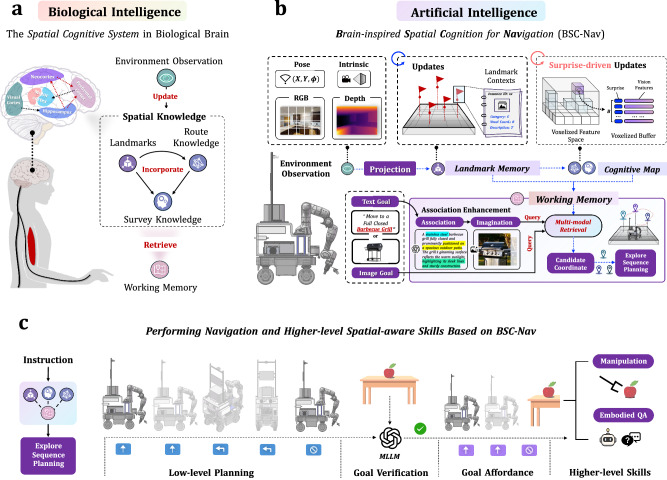
Spatial cognition enables adaptive goal-directed behavior through structured internal models of space. Robust biological systems consolidate spatial knowledge into three interconnected forms: landmarks for salient cues, route knowledge for movement trajectories, and survey knowledge for map-like representations. While recent advances in multi-modal large language models (MLLMs) have enabled visual-language reasoning in embodied agents, these efforts lack structured spatial memory and instead operate reactively, limiting their generalization and adaptability in complex real-world environments. Here we present Brain-inspired Spatial Cognition for Navigation (BSC-Nav), a unified framework for constructing and leveraging structured spatial memory in embodied agents. BSC-Nav builds allocentric cognitive maps from egocentric trajectories and contextual cues, and dynamically retrieves spatial knowledge aligned with semantic goals. Integrated with powerful MLLMs, BSC-Nav achieves state-of-the-art efficacy and efficiency across diverse embodied navigation tasks (e.g., improving success weighted by path length from 17.6% to 44.9% in instance-level navigation and from 42.7% to 53.1% in zero-shot long-horizon instruction-following), while also supporting versatile embodied behaviors in the real physical world. These results highlight a scalable path toward general-purpose spatial intelligence.
Overview
CoChat Summary
TL;DR
BSC-Nav is a brain-inspired framework that builds structured spatial memory—landmark, route, and survey knowledge—for embodied agents and couples it with MLLMs for goal-directed navigation. It reports state-of-the-art efficacy and efficiency across simulated and real-world navigation, instruction-following, embodied question answering, and mobile manipulation tasks.
Key findings
- BSC-Nav improves success weighted by path length from 17.6% to 44.9% in instance-level navigation and from 42.7% to 53.1% in zero-shot long-horizon instruction-following.
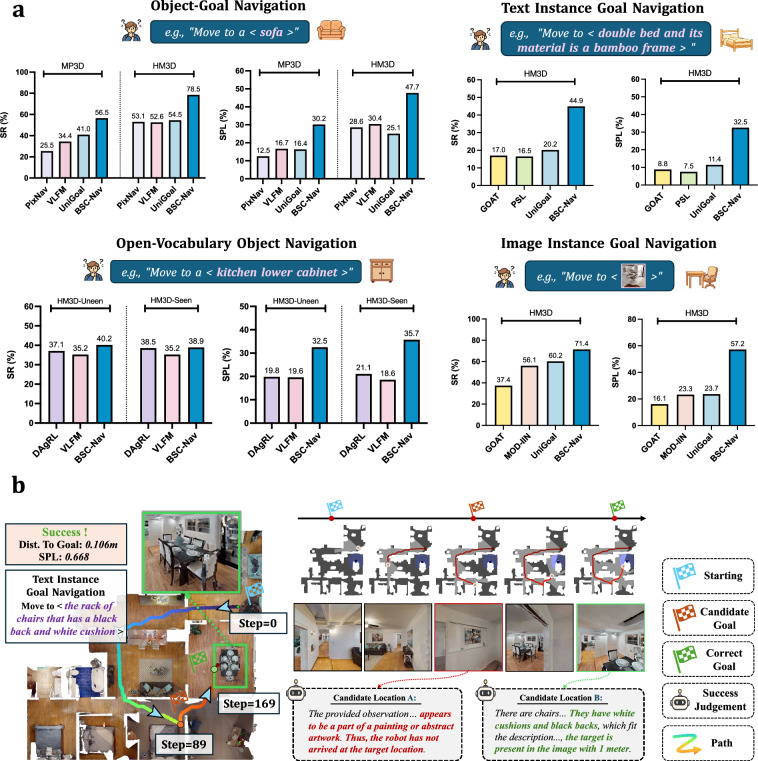
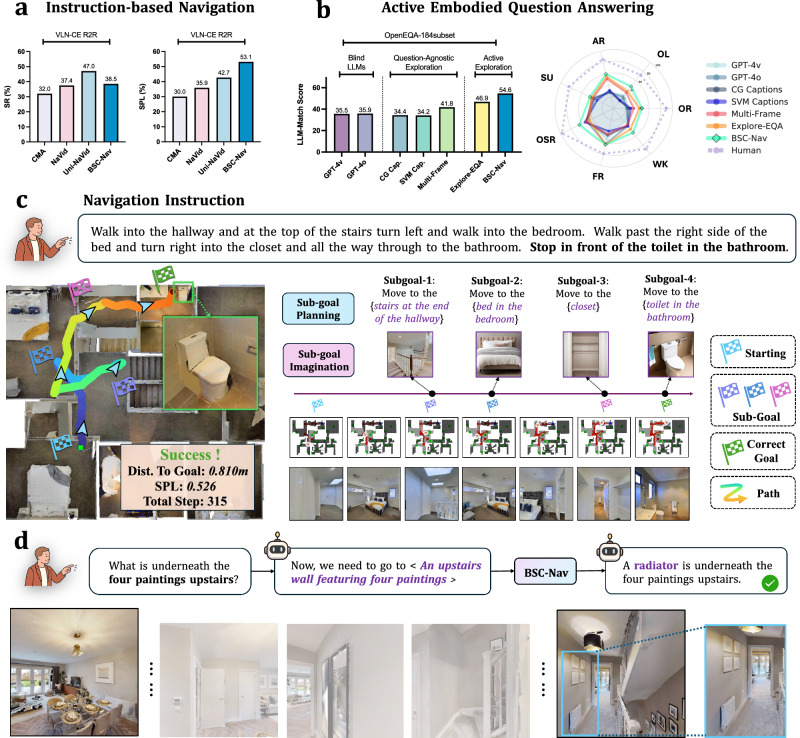
- In simulation, it achieves 78.5% SR on HM3D OGN and 56.5% on MP3D OGN, surpassing UniGoal by 24.0% and 15.5%; it reaches 40.2% and 38.9% SR on MP3D OVON unseen and seen validation sets, 71.4% SR on IIN, and 38.5% SR with 53.1% SPL on VLN-CE R2R.
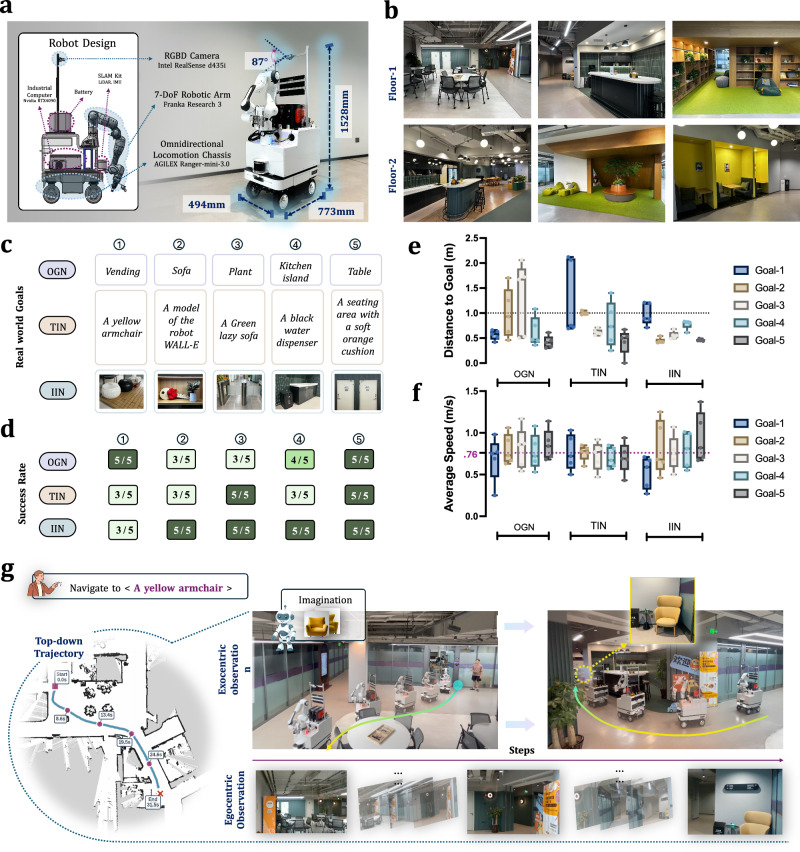
- On A-EQA, BSC-Nav achieves the highest LLM-Match score of 54.6; in real-world tests across 75 navigation episodes, it reaches at least 3/5 successful trials per target, with IIN reaching 100% SR on 4/5 targets, final distance below 2.5 m in all cases, and mean velocity 0.76 m/s.
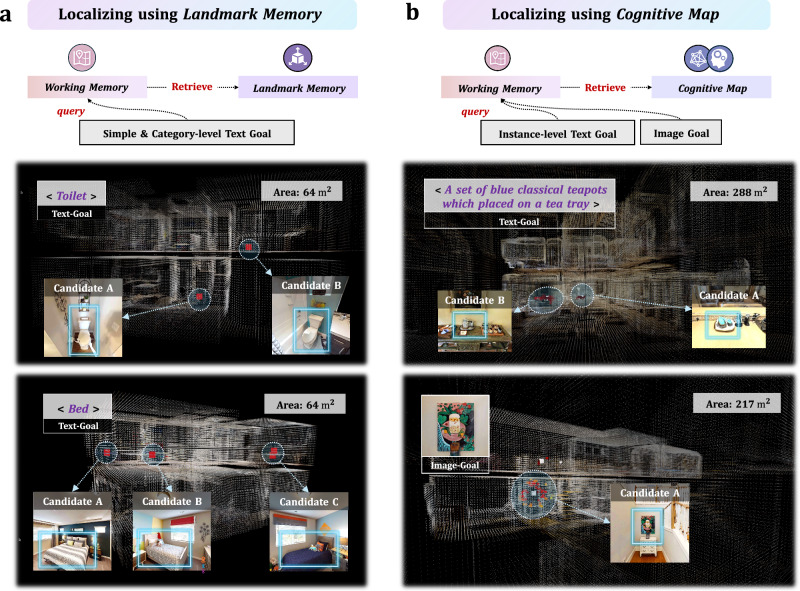
- In a real-world TIN ablation, the landmark-memory-only variant achieved 52% success versus 78% for full BSC-Nav.
Methods
- BSC-Nav constructs structured spatial memory via a landmark memory module, a cognitive map module that voxelizes egocentric trajectories into allocentric representations, and a working memory module for hierarchical retrieval and planning; it uses DINOv2, YOLO-World, CLIP, Stable Diffusion 3.5, and GPT-4/GPT-4o/o3-mini.
- Simulation evaluation covers 8195 episodes in 62 indoor scenes from MP3D and HM3D in Habitat across OGN, OVON, TIN, and IIN, plus VLN-CE R2R with 1000 episodes and OpenEQA A-EQA with 184 questions; metrics are SR, SPL, and LLM-Match.
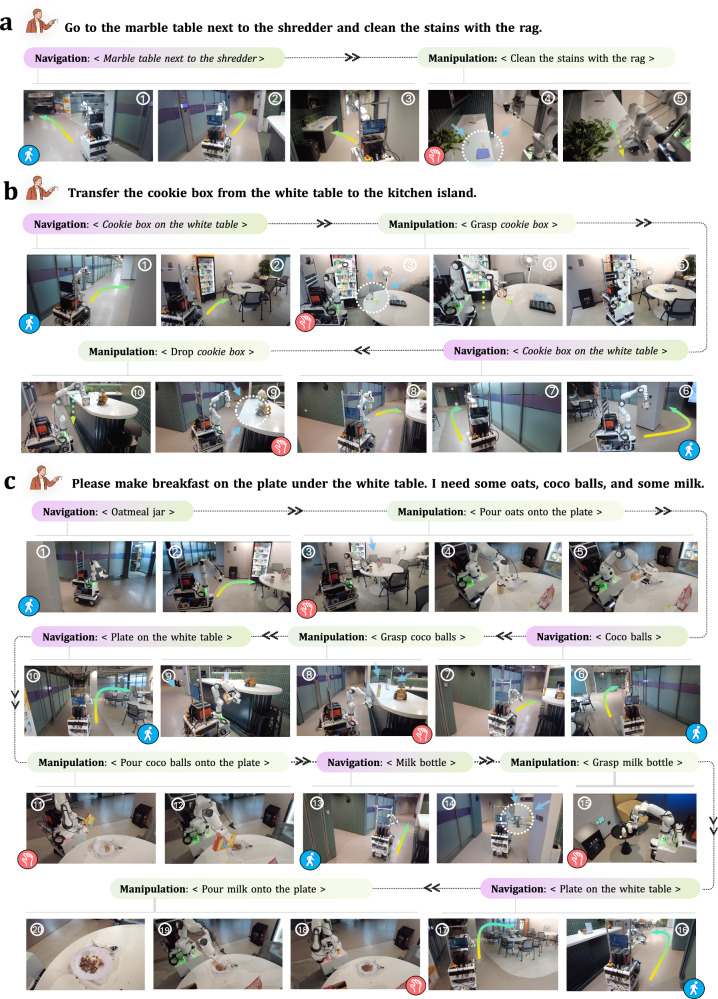
- Real-world deployment uses a custom mobile robotic platform in a two-story indoor space of around 200 m², with 75 navigation episodes across OGN, TIN, and IIN, and demonstrations of language-guided mobile manipulation.
Limitations
- The paper states that BSC-Nav is not intended as a cognitively faithful model of human cognition; MLLMs are used as engineering modules, and the theoretical contribution remains primarily architectural and computational, with more formal analyses needed.
- The paper states scalability challenges: compact environments require representational economy, while larger or open-ended environments face memory capacity, map consistency, and retrieval efficiency bottlenecks; dynamic environments require continual memory revision.
- The text makes evident additional constraints: real-world memory construction relies on manual teleoperation, real-world initial pose is manually specified, simulation uses ground-truth odometry, real-world evaluation is limited to one 200 m² environment with 75 episodes, and the surprise-driven update is explicitly a heuristic rather than a formal free-energy optimization.
Model-written summary. Check it against the paper before relying on it.
Integrity signals
Registry
Cites
Statistics
Figures
Verification
Claims the paper makes
15 Valid · 5 Not valid · 24 Not checked · 117 Own results and interpretations
At least one cited source doesn’t support this claim or points to a different paper, and none confirmed it — see the verdicts below.
In the paper
“Most existing methods, whether based on end-to-end reinforcement learning18–20 or modular pipelines with powerful MLLMs21,22, process observations in a reactive and stateless manner.”
§ Brain-inspired spatial intelligence for embodied agents > Introduction
What the sources say
- Disputedcites [18] Chaplot, D. S., Gandhi, D. P., Gupta, A. & Salakhutdinov, R. R. Object goal navigation using goal-oriented semantic exploration. Adv. Neural Inf. Process. Syst. 33, 4247 (2020). sourceExperimental — accuracy not yet measured
The Introduction (p. 1) describes end-to-end methods that use recurrent networks to build episodic memory and a modular system that maintains memory with explicit maps—contrary to calling these methods stateless. The paper does not address MLLM-based pipelines. (LLM, conf=0.88)
Checked by a reasoning model — may be wrong.
- Not matchedcites [19] Shah, D. et al. Offline reinforcement learning for visual navigation. In: Conference on Robot Learning, pp.44–54 (PMLR, 2023).
Its entry has no title and year that we can search by.
- Could not verifycites [20] Shah, D. et al. Vint: A foundation model for visual navigation. In: Conference on Robot Learning, pp. 711–733 (PMLR, 2023). sourceExperimental — accuracy not yet measured
Our copy of ViNT contains no characterization of prior navigation methods as 'reactive and stateless'. Its Related Work (Sec. 2) criticizes existing approaches on different axes — reliance on small single-platform real-world datasets or simulation [14][15][16], and specialist rather than generalist models [23]–[28] — and its baselines (E.1.3, E.2.1) are End-to-End BC, GNM, single-robot and RECON variants, not end-to-end RL or MLLM modular pipelines. Searches for 'reactive', 'stateless', 'current observation only', 'history/context' and 'end-to-end reinforcement learning / MLLM pipeline' returned only ViNT's own architecture descriptions (Sec. 3, Appendix A: it tokenizes P=5 past observations plus a goal), which describe ViNT, not a claim about existing methods. Nothing in our copy supports or contradicts the attributed statement. (LLM, conf=0.70)
- Not matchedcites [21] OpenAI GPT-4V(ision) System Card https://cdn.openai.com/papers/GPTV_System_Card.pdf (2023).
Its entry has no title and year that we can search by.
- Could not verifycites [22] Yang, H. et al. Qwen-VL: a versatile vision-language model. arXiv preprint arXiv:2308.12966 (2023) sourceExperimental — accuracy not yet measured
The Introduction and Related Work describe Qwen-VL and other vision-language models, but do not characterize existing methods as processing observations reactively or without state. Searches for “reactive,” “stateless,” memory, and reinforcement-learning pipelines found no passage addressing that claim. (LLM, conf=0.70)
plain- Asserted: passes — The authors put it forward as true.
- Checkable: passes — It can be checked against evidence.
- Load-bearing: passes — The paper’s conclusions depend on it.
- Based: passes — The paper gives a reason why it holds.
- Disputed
At least one cited source doesn’t support this claim or points to a different paper, and none confirmed it — see the verdicts below.
In the paper
“Furthermore, they heavily depend on task-specifically trained cross-modal Transformers or policies for memory attention and planning, which inherently constrain their generalization to unseen environments.”
§ Brain-inspired spatial intelligence for embodied agents > Methods > Experimental details
What the sources say
- Disputedcites [36] Chang, M. et al. GOAT: GO to Any Thing. In Proc. Robotics: Science and Systems (2024). sourceExperimental — accuracy not yet measured
The Discussion (p. 10) says GOAT’s modular design avoids the overfitting to training scenes that can affect end-to-end methods, and reports no generalization issues across nine visually diverse homes. The Discussion (p. 8) describes its mapping and planning as classical methods paired with pretrained components, not as heavily dependent on task-specific cross-modal Transformers or learned planning policies. (LLM, conf=0.90)
Checked by a reasoning model — may be wrong.
- Not checked yetcites [54] Krantz, J. et al. Navigating to objects specified by images. In: Proceedings of the IEEE/CVF International Conference on Computer Vision, pp. 10916–10925 (IEEE, 2023). source
Checked before — its earlier verdict is held back until a new check runs.
- Not matchedcites 13,
This doesn’t read as a citation we can look up.
plainstates a cause- Asserted: passes — The authors put it forward as true.
- Checkable: passes — It can be checked against evidence.
- Load-bearing: passes — The paper’s conclusions depend on it.
- Based: passes — The paper gives a reason why it holds.
- Disputed
The cited sources support only part of this claim — read each source’s verdict below.
In the paper
“Despite the rapid progress in multi-modal large language models (MLLMs) and growing efforts to equip embodied agents with visual-language reasoning11–13, current artificial systems remain fundamentally limited in large-scale spatial cognition14, especially in tasks requiring long-horizon navigation and mobile manipulation.”
§ Brain-inspired spatial intelligence for embodied agents > Introduction
What the sources say
- Partly supportedcites [14] Ramakrishnan, S.K., Wijmans, E., Kraehenbuehl, P., Koltun, V. Does spatial cognition emerge in frontier models? In:International Conference on Learning Representations (ICLR, 2024). sourceExperimental — accuracy not yet measured
The Abstract (p. 1) reports that contemporary frontier models fall short on spatial-cognition tests, and the paper includes large-scale navigation tasks such as route retracing and shortcut discovery (p. 4). This supports the claim about limitations in large-scale spatial cognition, but the cited passages do not establish a specific limitation in long-horizon navigation or mobile manipulation. (LLM, conf=0.86)
plain- Asserted: passes — The authors put it forward as true.
- Checkable: passes — It can be checked against evidence.
- Load-bearing: passes — The paper’s conclusions depend on it.
- Based: passes — The paper gives a reason why it holds.
- Partly supported
The sources with a verdict support this claim; the rest weren’t checked yet, have no full text we could read, or their verdicts aren’t rated yet.
In the paper
“Structured spatial memory is essential for guiding goal-directed behavior in complex real-world environments3–5, yet remains largely absent from current embodied agents.”
§ Brain-inspired spatial intelligence for embodied agents > Results > Construction and exploitation of structured spatial memory in embodied agents
What the sources say
- Not checked — no full text of the sourcecites [3] Bellmund, J. L., Gärdenfors, P., Moser, E. I. & Doeller, C. F. Navigating cognition: spatial codes for human thinking. Science 362, 6766 (2018). 30409861 source
- Supportedcites [4] Epstein, R. A., Patai, E. Z., Julian, J. B. & Spiers, H. J. The cognitive map in humans: spatial navigation and beyond. Nat. Neurosci. 20, 1504 (2017). 29073650 PMC6028313 source
The Abstract describes a structured representation of the spatial environment that supports memory and guides future action, and says spatial codes are used to plan routes. The Introduction explains how spatial knowledge lets a navigator flexibly choose a path to a goal. The claim about current embodied agents is the citing authors’ own contrast, not a claim attributed to this source. (LLM, conf=0.88)
- Not checked — no full text of the sourcecites [5] Denis, M. & Loomis, J. M. Perspectives on human spatial cognition: memory, navigation, and environmental learning. Psychol. Res. 71, 235 (2007). source
plainstates a cause- Asserted: passes — The authors put it forward as true.
- Checkable: passes — It can be checked against evidence.
- Load-bearing: passes — The paper’s conclusions depend on it.
- Based: passes — The paper gives a reason why it holds.
The cited sources support only part of this claim — read each source’s verdict below.
In the paper
“In our demonstrations, natural language instructions are interpreted by GPT-464 to generate waypoint-action sequences.”
§ Brain-inspired spatial intelligence for embodied agents > Results > Real-world navigation and mobile manipulation
What the sources say
- Partly supportedcites [64] Wu, Z. et al. Embodied task planning with large language models. arXiv preprint arXiv:2307.01848 (2023). sourceExperimental — accuracy not yet measured
The Conclusion (section 5; page unavailable) says TaPA generates action steps from human instructions for robot navigation and manipulation, supporting the general instruction-to-plan idea. It says the dataset was generated with GPT-3.5, while the Experiment section (section 4; page unavailable) identifies a finetuned LLaMA-7B model as the task planner. These passages do not support the specific attribution to GPT-4 or waypoint-action sequences in BSC-Nav demonstrations. (LLM, conf=0.85)
plainstates a cause- Asserted: passes — The authors put it forward as true.
- Checkable: passes — It can be checked against evidence.
- Load-bearing: unclear — It is unclear whether the paper’s conclusions depend on it.
- Based: passes — The paper gives a reason why it holds.
- Partly supported
72 more claims · 2 with their cited sources checked
Create a free account to see all 161 claims and to verify the 15 references still open.
- Probably not a substantial claim. 51
- It may state two separate claims as one. 47
Self-check
Percentages, sums and reported differences re-computed from the paper’s own numbers.
Each contradiction between two passages listed here was confirmed by an independent check.
Rated minor: it would not touch a result — a value no result rests on, a p-value that stays on the same side of the significance level, or a conflict that is clerical, resolved elsewhere in the paper, or outside its own findings.
In the paper
“For the cognitive map, we set a voxel resolution of δ = 0.1 m3, a grid dimension of G = 1000, and a buffer capacity of B = 10 per voxel.”
§ Brain-inspired spatial intelligence for embodied agents > Methods > Experimental details
Reported 0.1 · recomputed 0.001
Rated minor: it would not touch a result — a value no result rests on, a p-value that stays on the same side of the significance level, or a conflict that is clerical, resolved elsewhere in the paper, or outside its own findings.
In the paper
§ Brain-inspired spatial intelligence for embodied agents > Methods > Experimental details
“the predefined landmark category set is reduced from 21 to 16.”
§ Brain-inspired spatial intelligence for embodied agents > Methods > Experimental details
“YOLO-World-X (YOLOv8 Extra-Large, WorldV2)73 with a confidence threshold of 0.55 across 20 predefined object categories.”
Rated minor: it would not touch a result — a value no result rests on, a p-value that stays on the same side of the significance level, or a conflict that is clerical, resolved elsewhere in the paper, or outside its own findings.
In the paper
§ Brain-inspired spatial intelligence for embodied agents > Results > Higher-level spatially-aware skills
“we equip BSC-Nav with GPT-o357, a powerful MLLM with advanced reasoning capabilities. GPT-o3 decomposes complex instructions into spatially grounded subgoals”
§ Brain-inspired spatial intelligence for embodied agents > Methods > Experimental details
“and o3-mini57 for complex instruction decomposition in long-horizon navigation tasks.”
Citations
Cites
High-Resolution Image Synthesis with Latent Diffusion Models
Rombach, R., Blattmann, A., Lorenz, D., Esser, P., & Ommer, B. (2022) · 2022 IEEE/CVF Conference on Computer Vision and Pattern Recognition (CVPR) · doi:10.1109/cvpr52688.2022.01042 · Cited by 20,302 · cited 1×
“Theseenricheddescriptionsare then used to “ imagine ” potential visualappearances of targetsthrough a text-to-image generation model, defaulting to Stable Diffusion 3.5 75 .”
InfluentialA Formal Basis for the Heuristic Determination of Minimum Cost Paths
Hart, P., Nilsson, N., & Raphael, B. (1968) · IEEE Transactions on Systems Science and Cybernetics · doi:10.1109/tssc.1968.300136 · Cited by 12,738
The free-energy principle: a unified brain theory?
Friston, K. (2010) · Nature Reviews Neuroscience · doi:10.1038/nrn2787 · Cited by 8,120 · cited 3×
“Motivated by the broad idea in free-energy 37,38 and predictive-processing 39,40 accounts, that biological systems update internal representations in response to mismatches between observation and expectation, we implement a surprise-driven update strategy that selectively integrates novel or…”
Working Memory: Theories, Models, and Controversies
Baddeley, A. (2012) · Annual Review of Psychology · doi:10.1146/annurev-psych-120710-100422 · Cited by 4,271
Matterport3D: Learning from RGB-D Data in Indoor Environments
Chang, A., Dai, A., Funkhouser, T., Halber, M., Niebner, M., Savva, M., Song, S., Zeng, A., & Zhang, Y. (2017) · 2017 International Conference on 3D Vision (3DV) · doi:10.1109/3dv.2017.00081 · Cited by 1,858
The free-energy principle: a rough guide to the brain?
Friston, K. (2009) · Trends in Cognitive Sciences · doi:10.1016/j.tics.2009.04.005 · Cited by 1,831 · cited 3×
“Motivated by the broad idea in free-energy 37,38 and predictive-processing 39,40 accounts, that biological systems update internal representations in response to mismatches between observation and expectation, we implement a surprise-driven update strategy that selectively integrates novel or…”
The Development of Spatial Representations of Large-Scale Environments
Siegel, A. W., & White, S. H. (1975) · Advances in Child Development and Behavior · doi:10.1016/s0065-2407(08)60007-5 · Cited by 1,830 · cited 3×
“Decades of neuroscience research revealed that organisms consolidate spatial knowledge into three distinct yet interconnected forms 16,17 (Fig.”
Habitat: A Platform for Embodied AI Research
Savva, M., Kadian, A., Maksymets, O., Zhao, Y., Wijmans, E., Jain, B., Straub, J., Liu, J., Koltun, V., Malik, J., et al. (2019) · 2019 IEEE/CVF International Conference on Computer Vision (ICCV) · doi:10.1109/iccv.2019.00943 · Cited by 1,237 · cited 2×
“We conduct systematic evaluations across 8195 episodes in 62 indoor scenes from physically reconstructed environments (MP3D 44 and HM3D 45 datasets) in the Habitat simulator 46 , covering four representative navigation tasks (Fig.”
Overlapping mechanisms of attention and spatial working memory
Awh, E., & Jonides, J. (2001) · Trends in Cognitive Sciences · doi:10.1016/s1364-6613(00)01593-x · Cited by 1,229 · cited 2×
“Analogous to visual-spatial working memory in biological systems 28,29 , this module dynamically composes spatial representations based on task demands and environmental familiarity.”
Anderson, P., Wu, Q., Teney, D., Bruce, J., Johnson, M., Sunderhauf, N., Reid, I., Gould, S., & van den Hengel, A. (2018) · 2018 IEEE/CVF Conference on Computer Vision and Pattern Recognition · doi:10.1109/cvpr.2018.00387 · Cited by 1,187 · cited 3×
“We evaluate BSC-Nav on a representative task termed Long-horizon Instruction-based Navigation (LIN) 55,56 , which requires agents to understand and execute complex instructions containing multiple intermediate goals and spatialconstraints.”
Predictive coding: an account of the mirror neuron system
Kilner, J. M., Friston, K. J., & Frith, C. D. (2007) · Cognitive Processing · doi:10.1007/s10339-007-0170-2 · Cited by 1,134
How the Body Shapes the Way We Think: A New View of Intelligence
Pfeifer, R., & Bongard, J. (2006) · doi:10.7551/mitpress/3585.001.0001 · Cited by 956
Logie, R. H. (2014) · doi:10.4324/9781315804743 · Cited by 933
The cognitive map in humans: spatial navigation and beyond
Epstein, R. A., Patai, E. Z., Julian, J. B., & Spiers, H. J. (2017) · Nature Neuroscience · doi:10.1038/nn.4656 · Cited by 921
Kriegel, H., Kröger, P., Sander, J., & Zimek, A. (2011) · WIREs Data Mining and Knowledge Discovery · doi:10.1002/widm.30 · Cited by 900
YOLO-World: Real-Time Open-Vocabulary Object Detection
Cheng, T., Song, L., Ge, Y., Liu, W., Wang, X., & Shan, Y. (2024) · 2024 IEEE/CVF Conference on Computer Vision and Pattern Recognition (CVPR) · doi:10.1109/cvpr52733.2024.01599 · Cited by 815 · cited 1×
“For open-vocabulary object detection in the landmark memory module, we utilize YOLO-World-X (YOLOv8 Extra-Large, WorldV2) 73 with a con fi dence threshold of 0.55 across 20 prede fi ned object categories.”
InfluentialVector-based navigation using grid-like representations in artificial agents
Banino, A., Barry, C., Uria, B., Blundell, C., Lillicrap, T., Mirowski, P., Pritzel, A., Chadwick, M. J., Degris, T., Modayil, J., et al. (2018) · Nature · doi:10.1038/s41586-018-0102-6 · Cited by 677 · cited 7×
“Furthermore, detailed numerical results for all four navigation tasks are provided in Supplementary Tables 1 – 3.”
InfluentialNavigating cognition: Spatial codes for human thinking
Bellmund, J. L. S., Gärdenfors, P., Moser, E. I., & Doeller, C. F. (2018) · Science · doi:10.1126/science.aat6766 · Cited by 643 · cited 7×
“Full demonstrations are provided in Supplementary Movies 8 – 10.”
InfluentialOn evaluation of embodied navigation agents
Anderson, P., Chang, A., Chaplot, D. S., Dosovitskiy, A., Gupta, S., Koltun, V., Kosecka, J., Malik, J., Mottaghi, R., Savva, M., et al. (2018) · arXiv · doi:10.48550/arxiv.1807.06757 · Cited by 622 · cited 11×
“Notably, BSC-Nav achieves signi fi cantly higher navigation ef fi - ciency across all tasks compared to baseline methods, as measured by SPL scores.”
InfluentialHuang, Y., & Rao, R. P. N. (2011) · WIREs Cognitive Science · doi:10.1002/wcs.142 · Cited by 470
Das, A., Datta, S., Gkioxari, G., Lee, S., Parikh, D., & Batra, D. (2018) · 2018 IEEE/CVF Conference on Computer Vision and Pattern Recognition · doi:10.1109/cvpr.2018.00008 · Cited by 410
Symbol Interdependency in Symbolic and Embodied Cognition
Louwerse, M. M. (2011) · Topics in Cognitive Science · doi:10.1111/j.1756-8765.2010.01106.x · Cited by 399 · cited 1×
“In cognitive science, growing evidence suggests that language is not merely adetached symbolicinterfacebut can itself serveasasourceof grounding and a mode of action, while spatialknowledge and map-like representations are in turn deeply entangled with language experience 67 – 69 .”
Visual Language Maps for Robot Navigation
Huang, C., Mees, O., Zeng, A., & Burgard, W. (2023) · 2023 IEEE International Conference on Robotics and Automation (ICRA) · doi:10.1109/icra48891.2023.10160969 · Cited by 376
Embodied intelligence via learning and evolution
Gupta, A., Savarese, S., Ganguli, S., & Fei-Fei, L. (2021) · Nature Communications · doi:10.1038/s41467-021-25874-z · Cited by 352 · cited 1×
“Spatial cognition, the ability to acquire, organize, exploit, and update knowledgeaboutexternalspace,isfundamentaltobothhumanbeings andarti fi cialintelligence(AI) 1,2 .”
Variational Approach to Enhanced Sampling and Free Energy Calculations
Valsson, O., & Parrinello, M. (2014) · Physical Review Letters · doi:10.1103/physrevlett.113.090601 · Cited by 336 · cited 2×
“Here,thismechanismreferstoaheuristiccomputational design, rather than a strict implementation of variational free-energy optimization 41 .”
Model-based learning for mobile robot navigation from the dynamical systems perspective
Tani, J. (1996) · IEEE Transactions on Systems, Man, and Cybernetics, Part B (Cybernetics) · doi:10.1109/3477.499793 · Cited by 335 · cited 1×
“The necessity of internal spatial representation has been recognized since early computational models, such as the RNN-based dynamic forward models of Tani 86 , which achieved sequential planning and symbol grounding without explicit global coordinates.”
Subjective hierarchies in spatial memory.
McNamara, T. P., Hardy, J. K., & Hirtle, S. C. (1989) · Journal of Experimental Psychology: Learning, Memory, and Cognition · doi:10.1037/0278-7393.15.2.211 · Cited by 323
A Comparative Analysis of LiDAR SLAM-Based Indoor Navigation for Autonomous Vehicles
Zou, Q., Sun, Q., Chen, L., Nie, B., & Li, Q. (2022) · IEEE Transactions on Intelligent Transportation Systems · doi:10.1109/tits.2021.3063477 · Cited by 321
Object Goal Navigation using Goal-Oriented Semantic Exploration
Chaplot, D. S., Gandhi, D., Gupta, A., & Salakhutdinov, R. (2020) · arXiv · doi:10.48550/arxiv.2007.00643 · Cited by 321 · cited 10×
“Most existing methods, whether based on end-to-end reinforcement learning 18 – 20 or modular pipelines with powerful MLLMs 21,22 , process observations in a reactive and stateless manner.”
InfluentialCatalyzing next-generation Artificial Intelligence through NeuroAI
Zador, A., Escola, S., Richards, B., Ölveczky, B., Bengio, Y., Boahen, K., Botvinick, M., Chklovskii, D., Churchland, A., Clopath, C., et al. (2023) · Nature Communications · doi:10.1038/s41467-023-37180-x · Cited by 300 · cited 1×
“From this viewpoint, a future embodied Turing test for spatial cognition 70 may need to assess not only navigation accuracy, but also whether agents can construct reusable spatial representations, reason from sparse observations, and translate natural-language goals into grounded spatial plans in…”
Beyond the Nav-Graph: Vision-and-Language Navigation in Continuous Environments
Krantz, J., Wijmans, E., Majumdar, A., Batra, D., & Lee, S. (2020) · Lecture Notes in Computer Science · doi:10.1007/978-3-030-58604-1_7 · Cited by 266 · cited 3×
“We evaluate BSC-Nav on a representative task termed Long-horizon Instruction-based Navigation (LIN) 55,56 , which requires agents to understand and execute complex instructions containing multiple intermediate goals and spatialconstraints.”
ConceptFusion: Open-set multimodal 3D mapping
Jatavallabhula, K., Kuwajerwala, A., Gu, Q., Omama, M., Iyer, G., Saryazdi, S., Chen, T., Maalouf, A., Li, S., Keetha, N., et al. (2023) · Robotics: Science and Systems XIX · doi:10.15607/rss.2023.xix.066 · Cited by 228
ConceptFusion: Open-set Multimodal 3D Mapping
Jatavallabhula, K. M., Kuwajerwala, A., Gu, Q., Omama, M., Chen, T., Maalouf, A., Li, S., Iyer, G., Saryazdi, S., Keetha, N., et al. (2023) · arXiv · doi:10.48550/arxiv.2302.07241 · Cited by 228 · cited 1×
“We also forgo conventional fusion methods, such as grid averaging or distance-based weighting 31,74 , which often introduce bias in visual feature representation.”
CogVLM: Visual Expert for Pretrained Language Models
Wang, W., Lv, Q., Yu, W., Hong, W., Qi, J., Wang, Y., Ji, J., Yang, Z., Zhao, L., Song, X., et al. (2023) · arXiv · doi:10.48550/arxiv.2311.03079 · Cited by 217 · cited 1×
“Descriptions encompass both intrinsic attributes (inherent object properties including shape, color, and material) and extrinsic attributes (surrounding environmental contexts), annotated with a strong MLLM termed CogVLM 82 .”
Efficient trajectory optimization using a sparse model
Rosmann, C., Feiten, W., Wosch, T., Hoffmann, F., & Bertram, T. (2013) · 2013 European Conference on Mobile Robots · doi:10.1109/ecmr.2013.6698833 · Cited by 197 · cited 1×
“Local planning leverages the Timed Elastic Band (TEB) algorithm 78,79 , which dynamically adjusts trajectories to avoid obstacles while maintaining ef fi ciency.”
Qwen-VL: A Versatile Vision-Language Model for Understanding, Localization, Text Reading, and Beyond
Bai, J., Bai, S., Yang, S., Wang, S., Tan, S., Wang, P., Lin, J., Zhou, C., & Zhou, J. (2023) · arXiv · doi:10.48550/arxiv.2308.12966 · Cited by 193
ObjectNav Revisited: On Evaluation of Embodied Agents Navigating to Objects
Batra, D., Gokaslan, A., Kembhavi, A., Maksymets, O., Mottaghi, R., Savva, M., Toshev, A., & Wijmans, E. (2020) · arXiv · doi:10.48550/arxiv.2006.13171 · Cited by 177 · cited 1×
“3): Object-Goal Navigation (OGN) 18,47,48 , Open-Vocabulary Object Navigation (OVON) 49 , Text-Instance Navigation (TIN) 50 , and Image-Instance Navigation (IIN) 51 .”
Active and passive spatial learning in human navigation: Acquisition of survey knowledge.
Chrastil, E. R., & Warren, W. H. (2013) · Journal of Experimental Psychology: Learning, Memory, and Cognition · doi:10.1037/a0032382 · Cited by 170
CogVLM: Visual Expert for Pretrained Language Models
Chen, K., Ding, M., Dong, Y., Hong, W., Ji, J., Li, J., Lv, Q., Qi, J., Song, X., Tang, J., et al. (2024) · Advances in Neural Information Processing Systems 37 · doi:10.52202/079017-3860 · Cited by 152
VLFM: Vision-Language Frontier Maps for Zero-Shot Semantic Navigation
Yokoyama, N., Ha, S., Batra, D., Wang, J., & Bucher, B. (2024) · 2024 IEEE International Conference on Robotics and Automation (ICRA) · doi:10.1109/icra57147.2024.10610712 · Cited by 148 · cited 3×
“The comprehensive hyperparameter con fi gurations are provided in Supplementary Tables 12 and 13.”
Neural foundations of emerging route knowledge in complex spatial environments
Wolbers, T., Weiller, C., & Büchel, C. (2004) · Cognitive Brain Research · doi:10.1016/j.cogbrainres.2004.06.013 · Cited by 146
Embodied Question Answering in Photorealistic Environments With Point Cloud Perception
Wijmans, E., Datta, S., Maksymets, O., Das, A., Gkioxari, G., Lee, S., Essa, I., Parikh, D., & Batra, D. (2019) · 2019 IEEE/CVF Conference on Computer Vision and Pattern Recognition (CVPR) · doi:10.1109/cvpr.2019.00682 · Cited by 143
UniGoal: Towards Universal Zero-shot Goal-oriented Navigation
Yin, H. H., Xu, X., Zhao, L., Wang, Z., Zhou, J., & Lu, J. (2025) · IEEE Computer Society Conference on Computer Vision and Pattern Recognition/Proceedings - IEEE Computer Society Conference on Computer Vision and Pattern Recognition/Proceedings · doi:10.1109/cvpr52734.2025.01775 · Cited by 135 · cited 7×
“Unlike UniGoal, which organizes only landmark memory with abstract goals and scene graphs, BSC-Nav leverages structured spatial memory and thus obtains signi fi cant performance gains.”
InfluentialLandmarks: GIScience for Intelligent Services
Richter, K.-F., & Winter, S. (2014) · doi:10.1007/978-3-319-05732-3 · Cited by 133 · cited 2×
“Drawing inspiration from the robust spatial representations in biological systems, namely, landmarks 23,24 , route knowledge 25 , and survey knowledge 26 , BSC-Nav implements a modular architecture that explicitly constructs and exploits analogous memory structures to achieve spatial cognition…”
Spatial Cognition: The Role of Landmark, Route, and Survey Knowledge in Human and Robot Navigation1
Werner, S., Krieg-Brückner, B., Mallot, H. A., Schweizer, K., & Freksa, C. (1997) · Informatik aktuell · doi:10.1007/978-3-642-60831-5_8 · Cited by 126 · cited 3×
“Decades of neuroscience research revealed that organisms consolidate spatial knowledge into three distinct yet interconnected forms 16,17 (Fig.”
InfluentialNavigating to objects in the real world
Gervet, T., Chintala, S., Batra, D., Malik, J., & Chaplot, D. S. (2023) · Science Robotics · doi:10.1126/scirobotics.adf6991 · Cited by 125 · cited 3×
“Low-level navigation policies are typically derived from deterministic path planning conditioned on environmental constraints and high-level spatial goals 52 .”
InfluentialExplore until Confident: Efficient Exploration for Embodied Question Answering
Ren, A. Z., Clark, J., Dixit, A., Itkina, M., Majumdar, A., & Sadigh, D. (2024) · Robotics: Science and Systems · doi:10.15607/rss.2024.xx.089 · Cited by 124
Thinking in Space: How Multimodal Large Language Models See, Remember, and Recall Spaces
Yang, J., Yang, S., Gupta, A. W., Han, R., Fei-Fei, L., & Xie, S. (2025) · 2025 IEEE/CVF Conference on Computer Vision and Pattern Recognition (CVPR) · doi:10.1109/cvpr52734.2025.00994 · Cited by 120 · cited 4×
“The comprehensive hyperparameter con fi gurations are provided in Supplementary Tables 12 and 13.”
InfluentialHabitat-Matterport 3D Dataset (HM3D): 1000 Large-scale 3D Environments for Embodied AI
Ramakrishnan, S. K., Gokaslan, A., Wijmans, E., Maksymets, O., Clegg, A., Turner, J., Undersander, E., Galuba, W., Westbury, A., Chang, A. X., et al. (2021) · arXiv · doi:10.48550/arxiv.2109.08238 · Cited by 106
ETPNav: Evolving Topological Planning for Vision-Language Navigation in Continuous Environments
An, D., Wang, H., Wang, W., Wang, Z., Huang, Y., He, K., & Wang, L. (2025) · IEEE Transactions on Pattern Analysis and Machine Intelligence · doi:10.1109/tpami.2024.3386695 · Cited by 103 · cited 3×
“…embodied navigation frameworks con fi ned to localized modeling with a single granularity, such as purely dense grids 30,31 or sparse topologies 32,33 , the hierarchicalspatialarchitecture ofBSC-Nav achievesthedecouplingof spatial knowledge while incorporating targeted adaptive update…”
InfluentialSelf-citationNaVid: Video-based VLM Plans the Next Step for Vision-and-Language Navigation
Zhang, J., Wang, K., Xu, R., Zhou, G., Hong, Y., Fang, X., Wu, Q., Zhang, Z., & Wang, H. (2024) · Robotics: Science and Systems XX · doi:10.15607/rss.2024.xx.079 · Cited by 103
Jansen-Osmann, P., & Fuchs, P. (2006) · Experimental Psychology · doi:10.1027/1618-3169.53.3.171 · Cited by 101 · cited 2×
“Drawing inspiration from the robust spatial representations in biological systems, namely, landmarks 23,24 , route knowledge 25 , and survey knowledge 26 , BSC-Nav implements a modular architecture that explicitly constructs and exploits analogous memory structures to achieve spatial cognition…”
OpenEQA: Embodied Question Answering in the Era of Foundation Models
Majumdar, A., Ajay, A., Zhang, X., Putta, P., Yenamandra, S., Henaff, M., Silwal, S., Mcvay, P., Maksymets, O., Arnaud, S., et al. (2024) · 2024 IEEE/CVF Conference on Computer Vision and Pattern Recognition (CVPR) · doi:10.1109/cvpr52733.2024.01560 · Cited by 101 · cited 8×
“We evaluate BSC-Nav on the A-EQA subset of the OpenEQA benchmark 60 , which includes 184 questions that span seven categories.”
InfluentialGridMM: Grid Memory Map for Vision-and-Language Navigation
Wang, Z., Li, X., Yang, J., Liu, Y., & Jiang, S. (2023) · 2023 IEEE/CVF International Conference on Computer Vision (ICCV) · doi:10.1109/iccv51070.2023.01432 · Cited by 93
A Survey of Object Goal Navigation
Sun, J., Wu, J., Ji, Z., & Lai, Y. (2024) · IEEE Transactions on Automation Science and Engineering · doi:10.1109/tase.2024.3378010 · Cited by 86 · cited 1×
“3): Object-Goal Navigation (OGN) 18,47,48 , Open-Vocabulary Object Navigation (OVON) 49 , Text-Instance Navigation (TIN) 50 , and Image-Instance Navigation (IIN) 51 .”
Evidence for a unitary structure of spatial cognition beyond general intelligence
Malanchini, M., Rimfeld, K., Shakeshaft, N. G., McMillan, A., Schofield, K. L., Rodic, M., Rossi, V., Kovas, Y., Dale, P. S., Tucker-Drob, E. M., et al. (2020) · npj Science of Learning · doi:10.1038/s41539-020-0067-8 · Cited by 69 · cited 1×
“Spatial cognition, the ability to acquire, organize, exploit, and update knowledgeaboutexternalspace,isfundamentaltobothhumanbeings andarti fi cialintelligence(AI) 1,2 .”
Bridging Zero-shot Object Navigation and Foundation Models through Pixel-Guided Navigation Skill
Cai, W., Huang, S., Cheng, G., Long, Y., Gao, P., Sun, C., & Dong, H. (2024) · 2024 IEEE International Conference on Robotics and Automation (ICRA) · doi:10.1109/icra57147.2024.10610499 · Cited by 63 · cited 4×
“Despite the rapid progress in multi-modal large language models (MLLMs) and growing efforts to equip embodied agents with visual-language reasoning 11 – 13 , current arti fi cial systems remain fundamentally limited in large-scale spatial cognition 14 , especially in tasks requiring long-horizon…”
InfluentialNaVILA: Legged Robot Vision-Language-Action Model for Navigation
Cheng, A.-C., Ji, Y., Yang, Z., Gongye, Z., Zou, X., Kautz, J., Biyik, E., Yin, H., Liu, S., & Wang, X. (2025) · Robotics: Science and Systems XXI · doi:10.15607/rss.2025.xxi.018 · Cited by 54
Self-citationChang, M., Gervet, T., Khanna, M., Yenamandra, S., Shah, D., Min, S., Shah, K., Paxton, C., Gupta, S., Batra, D., et al. (2024) · Robotics: Science and Systems XX · doi:10.15607/rss.2024.xx.073 · Cited by 53
The Neuroscience of Spatial Navigation and the Relationship to Artificial Intelligence
Bermudez-Contreras, E., Clark, B. J., & Wilber, A. (2020) · Frontiers in Computational Neuroscience · doi:10.3389/fncom.2020.00063 · Cited by 51 · cited 2×
“…with the real physical world, spatial cognition has emerged as a central theme across disciplines, driving advances in robotics 6 , urban simulation 7 , and planetary-scale modeling 8 , while increasingly recognized as a foundational component of arti fi cial general intelligence (AGI) 3,9,10 .”
Does Spatial Cognition Emerge in Frontier Models?
Ramakrishnan, S. K., Wijmans, E., Kraehenbuehl, P., & Koltun, V. (2024) · arXiv · doi:10.48550/arxiv.2410.06468 · Cited by 49 · cited 1×
“…large language models (MLLMs) and growing efforts to equip embodied agents with visual-language reasoning 11 – 13 , current arti fi cial systems remain fundamentally limited in large-scale spatial cognition 14 , especially in tasks requiring long-horizon navigation and mobile manipulation.”
Audio Visual Language Maps for Robot Navigation
Huang, C., Mees, O., Zeng, A., & Burgard, W. (2024) · Springer proceedings in advanced robotics · doi:10.1007/978-3-031-63596-0_10 · Cited by 46
Uni-NaVid: A Video-based Vision-Language-Action Model for Unifying Embodied Navigation Tasks
Zhang, J., Wang, K., Wang, S., Li, M., Liu, H., Wei, S., Wang, Z., Zhang, Z., & Wang, H. (2025) · Robotics: Science and Systems XXI · doi:10.15607/rss.2025.xxi.013 · Cited by 45
ViNT: A Foundation Model for Visual Navigation
Shah, D., Sridhar, A., Dashora, N., Stachowicz, K., Black, K., Hirose, N., & Levine, S. (2023) · arXiv · doi:10.48550/arxiv.2306.14846 · Cited by 45
Perspectives on human spatial cognition: memory, navigation, and environmental learning
Denis, M., & Loomis, J. M. (2007) · Psychological Research · doi:10.1007/s00426-006-0079-x · Cited by 40 · cited 2×
“In humans, generalizable spatial representations support interpretation of sensory input, anticipation of future events, and fl exible adaptation tochangingenvironments, frombrewingcoffeeinafamiliarkitchento navigating an unfamiliar city 3 – 5 .”
Navigating to Objects Specified by Images
Krantz, J., Gervet, T., Yadav, K., Wang, A., Paxton, C., Mottaghi, R., Batra, D., Malik, J., Lee, S., & Singh Chaplot, D. (2023) · 2023 IEEE/CVF International Conference on Computer Vision (ICCV) · doi:10.1109/iccv51070.2023.01002 · Cited by 34
Embodied Task Planning with Large Language Models
Wu, Z., Wang, Z., Xu, X., Lu, J., & Yan, H. (2023) · arXiv · doi:10.48550/arxiv.2307.01848 · Cited by 23 · cited 11×
“Upon reaching the appropriate locations, GPT-4o 42 integrates local observations with the original question to generate spatially grounded answers.”
InfluentialHM3D-OVON: A Dataset and Benchmark for Open-Vocabulary Object Goal Navigation
Yokoyama, N., Ramrakhya, R., Das, A., Batra, D., & Ha, S. (2024) · 2024 IEEE/RSJ International Conference on Intelligent Robots and Systems (IROS) · doi:10.1109/iros58592.2024.10802709 · Cited by 22 · cited 9×
“The open-vocabulary object navigation benchmark and con fi guration fi les are from Yokoyama et al 49 .”
InfluentialPapadimitriou, S., & Virvou, M. (2025) · Intelligent Systems Reference Library · doi:10.1007/978-3-031-77464-5 · Cited by 19
Maps and Space Are Entangled with Language Experience
Rinaldi, L., & Marelli, M. (2020) · Trends in Cognitive Sciences · doi:10.1016/j.tics.2020.07.009 · Cited by 18 · cited 1×
“In cognitive science, growing evidence suggests that language is not merely adetached symbolicinterfacebut can itself serveasasourceof grounding and a mode of action, while spatialknowledge and map-like representations are in turn deeply entangled with language experience 67 – 69 .”
Prioritized Semantic Learning for Zero-Shot Instance Navigation
Sun, X., Liu, L., Zhi, H., Qiu, R., & Liang, J. (2025) · Lecture Notes in Computer Science · doi:10.1007/978-3-031-73254-6_10 · Cited by 12
Route sequence knowledge supports the formation of cognitive maps
Hilton, C., & Wiener, J. (2023) · Hippocampus · doi:10.1002/hipo.23574 · Cited by 11 · cited 1×
“Furthermore, recent fi ndings suggest that sequential route learning drives the formation of allocentric cognitive maps in the hippocampus-entorhinal circuits 66 , a process with similar ideas to BSC-Nav ’ s trajectory voxelization.”
Bigger is not always better: The importance of human-scale language modeling for psycholinguistics
Wilcox, E. G., Hu, M. Y., Mueller, A., Warstadt, A., Choshen, L., Zhuang, C., Williams, A., Cotterell, R., & Linzen, T. (2025) · Journal of Memory and Language · doi:10.1016/j.jml.2025.104650 · Cited by 9 · cited 1×
“Recent psycholinguistic work has likewise emphasized that strong linguistic generalizations learned by neural language models do not by themselves establish cognitively plausible mechanisms, especially for large-scale models trained far beyond human-like data conditions 71 .”
Instance-Specific Image Goal Navigation: Training Embodied Agents to Find Object Instances
Krantz, J., Lee, S., Malik, J., Batra, D., & Chaplot, D. S. (2022) · arXiv · doi:10.48550/arxiv.2211.15876 · Cited by 7
Language is a Source of Grounding and a Mode of Action
Dove, G. (2023) · Topics in Cognitive Science · doi:10.1111/tops.12665 · Cited by 4
Tucker, S. (2024) · arXiv · doi:10.48550/arxiv.2401.10279 · Cited by 2
Heathcliff-saku/BSC-Nav: Nature_Comms_version
Ruan, S. (2026) · Zenodo (CERN European Organization for Nuclear Research) · doi:10.5281/zenodo.19979369 · Cited by 1
Self-citation
Research works printed but not linked: 8
- Shah, D. et al. Offline reinforcement learning for visual navigation. In: Conference on Robot Learning, pp.44–54 (PMLR, 2023).
- Oquab, M. et al. DINOv2: learning robust visual features without supervision. Trans. Mach. Learn. Res. (2024).
- Esser, P. et al. Scaling rectified flow transformers for high-resolution image synthesis. In: International Conference on Machine Learning, pp. 12606–12633 (2024). PMLR
- Kim, M.J. et al. OpenVLA: an open-source vision-language-action model. In: Conference on Robot Learning, pp. 2679–2713 (PMLR, 2025).
- Liu, S. et al. RDT-1B: a diffusion foundation model for bimanual manipulation. In Proc. International Conference on Learning Representations (2025).
- Rösmann, C., Feiten, W., Wösch, T., Hoffmann, F., Bertram, T. Trajectory modification considering dynamic constraints of autonomous robots. In: German Conference on Robotics, pp. 1–6 (GCR, 2012).
- Puig, X. et al. Habitat 3.0: a co-habitat for humans, avatars and robots. In Proc. International Conference on Learning Representations (2024).
- Radford, A. et al. Learning transferable visual models from natural language supervision. In: Proceedings of the International Conference on Machine Learning, pp. 8748–8763 (PMLR, 2021).
Cited by
PreAct-Nav: Agentic Reasoning Before Action for Urban NavigationPreprint
Xie, J., Ruan, S., Wang, Y., Zhang, Y., Yang, J., Jin, S., & Shi, D. (2026) · arXiv (Cornell University) · doi:10.48550/arxiv.2610.04916
“Recent language and vision-language models (VLMs) have enabled navigation agents to reason explicitly about instructions, observations, and possible actions (Zhou et al., 2024; Long et al., 2024; Ruan et al., 2026).”
Self-citationActive Spatial Inspection for Effective and Efficient Embodied ExplorationPreprint
Wang, W., Bai, X., Wang, Y., Sun, H., Ren, D., Qin, J., Li, Q., & Wang, B. (2026) · arXiv (Cornell University) · doi:10.48550/arxiv.2609.22385
“Memory-centric zero-shot methods, including 3D-Mem [1], GSMem [49], and BSC-NAV [65], maintain structured spatial or persistent 3D memories for VLM reasoning.”
Ieong, I.-T., Feng, R., Lu, Z., Cao, Y., Zhao, J., Li, L., Zhu, S., & Ding, W. (2026) · arXiv (Cornell University) · doi:10.48550/arxiv.2609.14561
“We evaluate the resulting navigation system against a reproduced BSC-Nav baseline (Ruan et al., 2026) on the same HM3D-ObjectNav evaluation subset.”
Influential
Metadata
- Authors
- Ruan, S., Wang, L., Kang, C., Zhu, Q., Liu, S., Wei, X., & Su, H.
- Affiliations
- Beihang University (CN)
- Tsinghua University (CN)
- Corresponding author
- Wei, Xingxing
- Su, Hang
- Venue
- Nature Communications
- Published
- 2026-06-27
- Volume
- 17
- Issue
- 1
- ISSN
- 2041-1723 (ISSN-L)
- PMC
- PMC13454140
- OpenAlex
- W7166300381
- Semantic Scholar
- ea1c67338943ce4266f544b26dee255ad6963c70
- Cited by
- 1
- References
- 62
- Citations by year
- 2026: 1
- FWCI
- 1.76
- Type
- journal article
- Language
- en
- Open access
- gold
- doi.org
- Licence
- cc-by-nc-nd
- creativecommons.org/licenses/by-nc-nd/4.0 (tdm)
- creativecommons.org/licenses/by-nc-nd/4.0 (vor, 44 d)
- Locations
- Nature Communications (publishedVersion, cc-by-nc-nd)
- Research Square (acceptedVersion, cc-by)
- PubMed (publishedVersion)
- PubMed Central (publishedVersion, cc-by)
- DOAJ (DOAJ: Directory of Open Access Journals) (submittedVersion)
- Topics
- Social Sciences › Psychology › Experimental and Cognitive Psychology › Spatial Cognition and Navigation
- Physical Sciences › Computer Science › Artificial Intelligence › Reinforcement Learning in Robotics
- Physical Sciences › Computer Science › Computer Vision and Pattern Recognition › Robotics and Sensor-Based Localization
- Keywords
- spatial cognition, embodied agents, spatial memory, landmark-based navigation, route knowledge, survey knowledge, multimodal large language models, navigation, instruction following, zero-shot generalization, brain-inspired models
- MeSH terms
- Large Language Models, Artificial Intelligence, Brain, Cognition, Cues, Humans, Spatial Memory, Spatial Navigation
About these checks
Registry, retraction, Cites and statistics results are computed, not judged, with one exception: a printed reference that no index lists is read once by a model before it counts as a citation error. Claims are extracted by a model and kept only when their quote appears verbatim in the text; each cited source is then checked, with a model’s help, for whether it says what the claim relies on. Those verdicts can be wrong — read the claim’s quote and the cited source before relying on one.
The claim verdicts this report counts are experimental: their accuracy is not yet measured.
A language model drew the claims from the paper on 2026-10-01, under version 3 of the claim definition (model deepseek-v4.1-flash, prompt extract-v3).
A second model labelled each claim on 2026-10-01 (model jev-1.13-20260917, definition revision gold-guideline-v0.2).
Cited sources are checked with a language model’s help (gpt-6-sol and qwen3.8-omni-flash).
Statistics and arithmetic are recomputed, not judged.
Confidence bands are shown only for fields calibrated on our annotated test set. None is calibrated yet, so no band is shown.
What counts as a claim ›How we measure confidence ›How we check this ›
Are you an author, or do you see a problem with this page? Request a review
Data sources
Bibliographic data: Semantic Scholar, OpenAlex, Crossref.
Contains information from the Semantic Scholar Academic Graph Datasets, made available under the ODC Attribution License (ODC-BY 1.0).
Semantic Scholar’s data is described in: Kinney, R., et al. (2023). The Semantic Scholar Open Data Platform. arXiv:2301.10140.
