

Accelerating materials discovery using artificial intelligence, high performance computing and robotics
Open accessThe DOI matches its Crossref record; 78 of the 80 references it cites were found in a registry or an index.
Abstract
New tools enable new ways of working, and materials science is no exception. In materials discovery, traditional manual, serial, and human-intensive work is being augmented by automated, parallel, and iterative processes driven by Artificial Intelligence (AI), simulation and experimental automation. In this perspective, we describe how these new capabilities enable the acceleration and enrichment of each stage of the discovery cycle. We show, using the example of the development of a novel chemically amplified photoresist, how these technologies’ impacts are amplified when they are used in concert with each other as powerful, heterogeneous workflows.
Overview
The claims and statistics of this paper haven’t been checked yet.
Free: it reads the open-access text and checks the first 5 claims that cite a source we can check. Create a free account to check every claim.
Integrity signals
Registry
Cites
Statistics
Figures
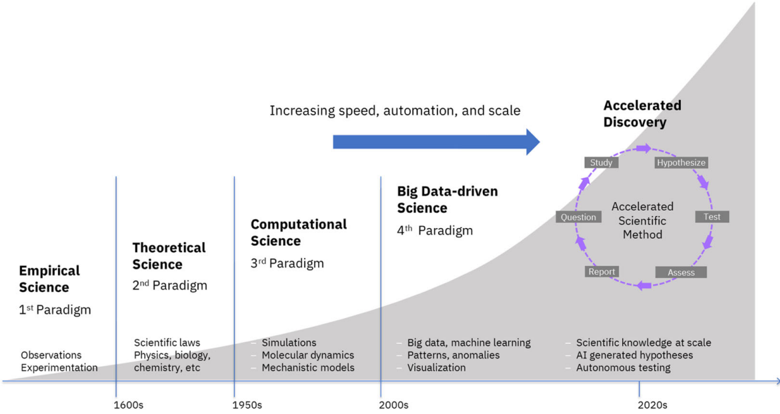
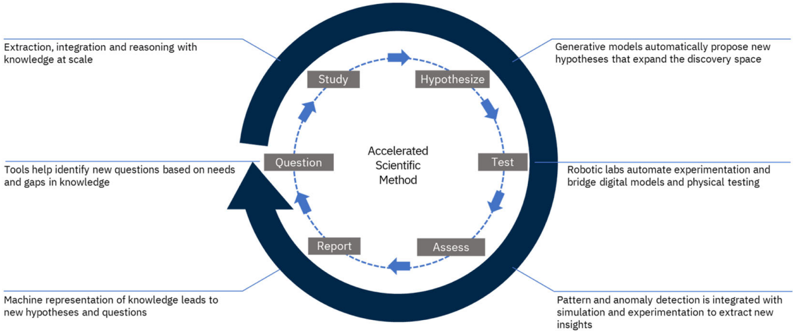
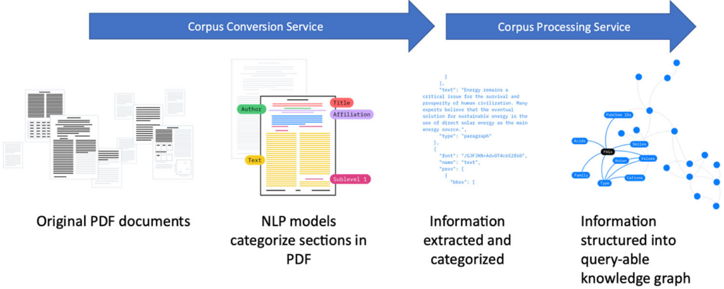
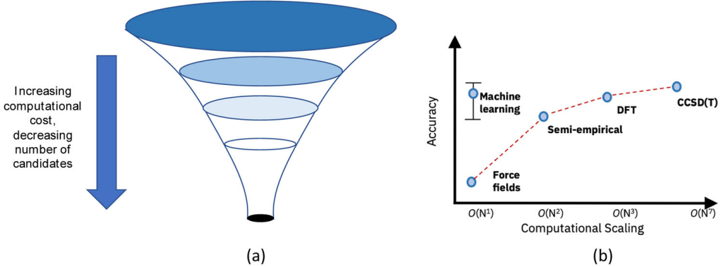
Verification
Claims the paper makes
The claims and statistics of this paper haven’t been checked yet.
Free: it reads the open-access text and checks the first 5 claims that cite a source we can check. Create a free account to check every claim.
Claims other papers make about this one
Each is checked against this paper’s own text: does it say what the citing paper says it does?
The cited source says what the claim attributes to it.
In the citing paper
“The central challenge is not only to predict a property, but to manage the sequence of reasoning and action that connects a scientific objective to executable computational or experimental steps [2-10].”
From From Scientific Copilots to Tool-Grounded Autonomy: AI Agents in Simulation-Driven Materials Discovery (2026) · cites this paper as [2]
Self-check
Percentages, sums and reported differences re-computed from the paper’s own numbers.
The self-check needs the paper’s full text.
Citations
Cites
Language Models are Few-Shot Learners
Brown, T. B., Mann, B., Ryder, N., Subbiah, M., Kaplan, J., Dhariwal, P., Neelakantan, A., Shyam, P., Sastry, G., Askell, A., et al. (2020) · arXiv · doi:10.48550/arxiv.2005.14165 · Cited by 23,372 · cited 1×
“Recent developments in AI technology based on pre-trained language models 47 and Generative Adversarial Networks (GANs) 48,49 , have been used to automatically generate images, speech, and natural language, and have recently been applied to materials discovery problems 50,51 .”
MethodGaussian Processes for Machine Learning
Rasmussen, C. E., & Williams, C. K. I. (2005) · doi:10.7551/mitpress/3206.001.0001 · Cited by 11,705
Density-Functional Theory for Time-Dependent Systems
Runge, E., & Gross, E. K. U. (1984) · Physical Review Letters · doi:10.1103/physrevlett.52.997 · Cited by 8,914
Extended-Connectivity Fingerprints
Rogers, D., & Hahn, M. (2010) · Journal of Chemical Information and Modeling · doi:10.1021/ci100050t · Cited by 7,524
Gaussian Processes in Machine Learning
Rasmussen, C. E. (2004) · Lecture Notes in Computer Science · doi:10.1007/978-3-540-28650-9_4 · Cited by 5,397
Improved protein structure prediction using potentials from deep learning
Senior, A. W., Evans, R., Jumper, J., Kirkpatrick, J., Sifre, L., Green, T., Qin, C., Žídek, A., Nelson, A. W. R., Bridgland, A., et al. (2020) · Nature · doi:10.1038/s41586-019-1923-7 · Cited by 3,378 · cited 1×
“Emerging from the use of neural networks to bypass expensive physics-based routines 28,29 , AI has been used to predict ever more complex properties, such as energetic materials 30 , solid-state materials properties 31,32 and even the structure of proteins 33 .”
MethodAutomatic Chemical Design Using a Data-Driven Continuous Representation of Molecules
Gómez-Bombarelli, R., Wei, J. N., Duvenaud, D., Hernández-Lobato, J. M., Sánchez-Lengeling, B., Sheberla, D., Aguilera-Iparraguirre, J., Hirzel, T. D., Adams, R. P., & Aspuru-Guzik, A. (2018) · ACS Central Science · doi:10.1021/acscentsci.7b00572 · Cited by 3,106 · cited 2×
“Recent developments in AI technology based on pre-trained language models 47 and Generative Adversarial Networks (GANs) 48,49 , have been used to automatically generate images, speech, and natural language, and have recently been applied to materials discovery problems 50,51 .”
BackgroundMethodRecent advances and applications of machine learning in solid-state materials science
Schmidt, J., Marques, M. R. G., Botti, S., & Marques, M. A. L. (2019) · npj Computational Materials · doi:10.1038/s41524-019-0221-0 · Cited by 2,607 · cited 1×
“Emerging from the use of neural networks to bypass expensive physics-based routines 28,29 , AI has been used to predict ever more complex properties, such as energetic materials 30 , solid-state materials properties 31,32 and even the structure of proteins 33 .”
MethodANI-1: an extensible neural network potential with DFT accuracy at force field computational cost
Smith, J. S., Isayev, O., & Roitberg, A. E. (2017) · Chemical Science · doi:10.1039/c6sc05720a · Cited by 1,921
Self-citationBurger, B., Maffettone, P. M., Gusev, V. V., Aitchison, C. M., Bai, Y., Wang, X., Li, X., Alston, B. M., Li, B., Clowes, R., et al. (2020) · Nature · doi:10.1038/s41586-020-2442-2 · Cited by 1,516 · cited 2×
“Concurrently, there is an explosion of automation and AI in chemical synthesis, with the important contribution in the use of commodity hardware 67 , fl uidic reactors 68 , or the use of robots able to execute the same tasks as human chemists 69 .”
Background
Research works printed but not linked: 8
- Kuhn, T. The Structure of Scientific Revolutions 2nd edn (The University of Chicago Press, 1970).
- arXiv.org e-Print archive. https://arxiv.org/.
- Hernández-Lobato, J. M., Requeima, J., Pyzer-Knapp, E. O. & Aspuru-Guzik, A. Parallel and distributed Thompson sampling for large-scale accelerated exploration of chemical space. In: Proc. 34th International Conference on Machine Learning-Volume 70 1470-1479 (JMLR. org, 2017).
- Brochu, E., Cora, V. M. & de Freitas, N. A Tutorial on Bayesian optimization of expensive cost functions, with application to active user modeling and hier- archical reinforcement learning. Preprint at https://arxiv.org/abs/10122599 (2010).
- Kusner, M. J., Paige, B. & Hernández-Lobato, J. M. Grammar variational auto- encoder. In: International Conference on Machine Learning 1945-1954 (PMLR, 2017).
- Crivello, J. V. & Lam, J. H. W. Photoinitiated cationic polymerization with triar- ylsulfonium salts. J. Polym. Sci. A: Polym. Chem. 17, 977-999 (1979).
- Carrete, J., Li, W., Mingo, N., Wang, S. & Curtarolo, S. Finding unprecedentedly low-thermal-conductivity half-Heusler semiconductors via high-throughput materials modeling. Phys. Rev. X 4, 011019 (2014).
- Shipley, G. & Dumpleton, G. OpenShift for Developers: A Guide for Impatient Beginners (O'Reilly Media, Inc., 2016).
Cited by
Items 401–500 of 532
Data-Driven Studies of van der Waals Magnetic Heterostructures
Bhattarai, R., Minch, P., & Rhone, T. D. (2025) · ACS Applied Materials & Interfaces · doi:10.1021/acsami.5c08915 · Cited by 1
New Intelligent Computing Techniques for Engineering Materials—A Comprehensive Review
Talreja, S. (2025) · Lecture notes in networks and systems · doi:10.1007/978-981-96-5784-1_9
Tooling Artificial Intelligence in Polymeric Nanofillers: A Review
Nkwoada, A. U., Anukam Basil, N., Otuuh, G. A., Nwanonenyi, S. C., Nwakile, T. I., Odo, C. G., Amakom, C. M., & Bilar, A. (2025) · Nanoscience & Nanotechnology-Asia · doi:10.2174/0122106812381641250815093955
Marmoset-human parcellation mapping with wakeful fMRI-derived networks
Xing, X.-X., & Zuo, X. (2025) · Chinese Science Bulletin (Chinese Version) · doi:10.1360/csb-2025-5191
Closing the Empirical Loop: Autonomous AI Agents Conduct End‐to‐end Research With Human Participants
Wehr, G., Rideaux, R., Fox, A. J., Lightfoot, D. R., Tangen, J. M., Mattingley, J. B., & Ehrhardt, S. E. (2026) · Advanced Science · doi:10.1002/advs.76675
Toward Agents of Intelligence: Bridging the AI Expertise Gap in Domain Sciences
Coleman, T., & Altintaş, İ. (2025) · IEEE International Conference on eScience · doi:10.1109/escience65000.2025.00092
“In fields like materials science [11], climate science [3], [4], and ecology [9], AI accelerates simulations, predicts outcomes, and uncovers patterns in high-dimensional data.”
RLENN: A Rule Loss Embedded Neural Network Framework for Knowledge Discovery and Integration
Dai, M., Xu, B., Li, C., Du, Z., Li, J., Wu, G. L., Lin, Y., Li, S., Dai, D., & Zhang, H. (2025) · International Conference on Artificial Intelligence, Big Data and Algorithms (CAIBDA) · doi:10.1109/caibda65784.2025.11183540
“ML-based knowledge discovery focuses on extracting explicit knowledge from data using ML algorithms such as symbolic regression, decision trees [5] , etc..”
What innovations for the climate and sustainability transition?
Thioye, M. (2025) · Technology Review for Carbon Neutrality · doi:10.26599/trcn.2025.9550012
Burrola, G. L., Hernández, S. L., Leal, M. Á. L., & Mijares, J. S. (2025) · Robotics Mexican Congress (COMRob) · doi:10.1109/comrob68109.2025.11264771 · Cited by 1
“However, it would not be until the consolidation of advanced computing and the improvement of perception sensors that the potential of GMRs to change multiple sectors, from security to space exploration, would be realized [3–5].”
A comprehensive understanding of the use of machine learning in polyoxometalates
Ghosh, S., & Rani, B. (2025) · Elsevier eBooks · doi:10.1016/b978-0-443-15686-1.00013-2
Rini, D. P., Atsahlantusay, C., Azhar, I. S. B., Ridwan, A., Saputra, D. M., & Prasetya, D. (2025) · Proceeding of the Electrical Engineering Computer Science and Informatics · doi:10.1109/eecsi67060.2025.11290155
“However, traditional HPC systems are often very costly, requiring high-end hardware with advanced specifications [6].”
Nelluri, K. D. D., Rahaman, S. A., Kommoju, M., & Alaparthi, B. (2025) · De Gruyter eBooks · doi:10.1515/9783111681870-009
175Chapter 8 AI-driven development: innovating biomedical polymer materials
Kalbhor, I., Chakote, S., Dabhade, R., Sharma, P., Gaikwad, S., Agarwal, R., & Polshettiwar, S. (2025) · De Gruyter eBooks · doi:10.1515/9783111681870-008
Machine Learning-assisted Discovery of Multifunctional Coordination in Multicomponent Composites
Guo, Z.-R., Xue, S., He, L., Xie, Z., Yang, T.-H., & Fu, Q. (2025) · Chinese Journal of Polymer Science · doi:10.1007/s10118-025-3479-3 · Cited by 1
Accelerating Steel Design with Multi-objective Machine Learning
Zhao, J., Zhang, S., Wang, J., Zhang, J. B., Li, J., Dai, J., & Luo, F. (2025) · JOM · doi:10.1007/s11837-025-08030-6
Editorial — Artificial Intelligence for Materials Discovery
Lim, Y.-F. (2025) · World Scientific Annual Review of Functional Materials · doi:10.1142/s2810922825010017
Chang, M.-C., Amsler, M., Sutherland, D. R., Ament, S., Gann, K. R., Zhou, L., Smieska, L., Woll, A. R., Gregoire, J. M., Gomes, C. P., et al. (2026) · PRX Intelligence · doi:10.1103/c362-349b · Cited by 1
Role of AI in Solar Cell Materials Research: A Review
Chethana, K., & Garai, B. (2025) · International Conference on Automation, Computing and Renewable Systems (ICACRS) · doi:10.1109/icacrs67045.2025.11324175
“AI has the potential to accelerate material discovery [10] especially for the discovery of alternative energy materials [11].”
Man, X., Sun, C., Chen, Z., Ji, Y., Du, J., & Yu, B. (2026) · ACS Synthetic Biology · doi:10.1021/acssynbio.5c00722
Ramírez, H. N. G., Gómez‐Sandoval, Z., Jayaprakash, G. K., Mojica-Sánchez, J. P., Flores‐Moreno, R., & Pineda‐Urbina, K. (2026) · Physical Chemistry Chemical Physics · doi:10.1039/d5cp04393j
An Introduction to Ionic Liquids, Nanofluids, Nanomaterials, and Nanotechnology
Namratha, B., Sushma, & Gaonkar, S. L. (2026) · Lecture notes in nanoscale science and technology · doi:10.1007/978-3-032-04008-4_1
Baburao, C., Rajyalakshmi, D., Lalitha, M. P., & Bontha, H. (2026) · Elsevier eBooks · doi:10.1016/b978-0-443-34135-9.00012-x
Atlan, F. (2026) · Özgür Yayınları eBooks · doi:10.58830/ozgur.pub1230.c4969
Lin, R., & Wang, C. (2026) · Journal of the Chinese Institute of Engineers · doi:10.1080/02533839.2026.2642706
Prediction of Stress-strain Behavior for Polyurethane Elastomers Based on Machine Learning
Zhou, L. L., Wang, M.-F., Huang, C., Song, M., & Wang, X. (2026) · Chinese Journal of Polymer Science · doi:10.1007/s10118-026-3606-9
Bai, R., & Lin, Z. (2025) · International Conference on Smart Electronics and Communication (ICOSEC) · doi:10.1109/icosec67334.2025.11459628
“Due to its low conductivity, high specific heat capacity and chemical stability, it has become the mainstream choice for the next generation of the high-performance computing systems [14]-[16].”
Qi, X., Gao, Y., & Sun, P. (2026) · Frontiers in Psychology · doi:10.3389/fpsyg.2026.1824256
“…workflows, authors have argued that AI can accelerate discovery, reduce routine burden, broaden access to advanced analytical capability, and expand the range of problems that a single researcher or team can address (Pyzer-Knapp et al., 2022; Abolhasani and Kumacheva, 2023; Zhang et al., 2025).”
AI for Materials Development and Degradation Analysis in Automotive, Battery and Nuclear Industries
Khan, M. U. F., Taylor, C. D., Kosanam, K., Quraishy, M. S., Raj, A., Jangid, M. K., & Zhao, X. (2026) · Synthesis lectures on computer science · doi:10.1007/978-3-032-18322-4_2
Distributed deep learning approaches for genomics analysis: A comprehensive review
Assali, T., Ayoub, Z. T., & Ouni, S. (2026) · Elsevier eBooks · doi:10.1016/b978-0-443-36554-6.00003-9
Educational and Training Tools for AI in Polymer Science
Bhandari, M., Kathayat, N., Sharma, N. P., Bhatt, P., Melkani, D. C., Dewali, S., Swetapadma, D., & Bisht, S. S. (2026) · Engineering materials · doi:10.1007/978-981-95-8353-9_11
ARTIFICIAL INTELLIGENCE AS A SUBJECT OF SCIENTIFIC COGNITION
Іскрик, А. (2026) · Visnyk of the Lviv University · doi:10.30970/pps.2026.64.11
Role of Machine Learning in the Perovskite Solar Cell Investigations
Taya, A., Dhakla, S., Deendyal, P. K., Kumar, S., & Kashyap, M. K. (2026) · Springer tracts in electrical and electronics engineering · doi:10.1007/978-981-95-6521-4_12
Fast and Flexible 3D Molecular Design Framework for Novel Organic Optoelectronic Materials
Zhao, G., Cheng, Z., Xu, K., Wan, T., Feng, M. S., Lu, S., Wang, H., Gao, Z., Ou, Q., Hu, L., et al. (2026) · JACS Au · doi:10.1021/jacsau.5c01756 · Cited by 1
A survey of agentic materials science and engineering: where are we and where are we going?
Zhu, J., Zhang, L., Zhu, Y., Lin, X., Wu, Y., Di, S., Liu, B., Luo, Y., & Zhang, T. (2026) · Journal of Materials Informatics · doi:10.20517/jmi.2026.07 · Cited by 3
Bo, J., LU, T., Fujii, T., & Lei, X.-W. (2026) · Applied Surface Science · doi:10.1016/j.apsusc.2026.167421
Computer simulation of polymer nanocomposites: Challenges and perspectives
Escañuela-Copado, S., Valero, D., Giunta, G., Martín‐Molina, A., & Patti, A. (2026) · Fluid Phase Equilibria · doi:10.1016/j.fluid.2026.114788
Band Gap Prediction of Two-Dimensional Materials Using a Gradient-Boosted Feature Selection Approach
Rowlinson, B. D., Ramamoorthy, S., Cole, J. M., & Prodromakis, T. (2026) · Journal of Chemical Information and Modeling · doi:10.1021/acs.jcim.6c00675
AI Deployment in Chemistry: Bibliometric and Topic Analysis of Top-Cited Papers (2015−2025)
Usenik, A., Meštrović, E., & Bach, M. P. (2026) · Croatica Chemica Acta · doi:10.5562/cca4229 · Cited by 1
Certification-aware uncertainty-guided inverse design of additively manufactured alloys
Jame, H. A., Dong, J., Karve, P., Mahadevan, S., & Taheri-Mousavi, S. M. (2026) · Materials & Design · doi:10.1016/j.matdes.2026.117511 · Cited by 1
Lin, J.-W., Cheng, S., Lin-fang, Z., & Zhang, L. (2026) · European Polymer Journal · doi:10.1016/j.eurpolymj.2026.114876
He, X., Hou, B., Wu, H., Hu, J., Zhang, L., Chen, L., Wan, Z., Chen, S., Xiao, M., Zhong, Z., et al. (2026) · npj Artificial Intelligence · doi:10.21203/rs.3.rs-9766294/v1
Zhang, X., Yin, J., Lei, Q., Zhou, S., Wang, C., Jiang, Y., Li, Y., & Wang, Z. (2026) · Materials & Design · doi:10.1016/j.matdes.2026.116481
Toward Exascale AI for Science: A Scalable AI Skill for Autonomous Microkinetics Discovery
Nomura, K.-I., Dawson, W., Ito, K., Dasgupta, N., Linker, T., Linker, T., & Nakano, A. (2026) · doi:10.1145/3806096.3844818
SCOPE+: Physically enriched crystal representations for the CLOUD model
Wang, B., 秦厚瑛, & Zhan, S. (2026) · Computational Materials Science · doi:10.1016/j.commatsci.2026.114861
Wang, Y., Nguyen, T., Berk, J., Rana, S., Kızıltaş, A., Blanchard, P., Venkatesh, S., & Walsh, T. R. (2026) · Journal of Colloid and Interface Science · doi:10.1016/j.jcis.2026.141078
Gupta, J., & Gupta, V. K. (2026) · Journal of Electronic Materials · doi:10.1007/s11664-026-12954-3
“65,93 These methods are especially effective in adjusting Schottky barriers to improve dual sensing capabilities (both optical and gas sensing).”
Gu, Y., Li, B., Jiang, L., Hu, Y., Liu, W., Xu, L., Zhai, P., Xue, H., Liu, J., & Duan, J. (2026) · Applied Physics Reviews · doi:10.1063/5.0323486
Cell-based bioactive materials for osteoarthritis therapy: a comprehensive review
Qing-jun, L., Cheng, S., & Qiao, B.-R. (2026) · Biomedical Materials · doi:10.1088/1748-605x/ae8e16 · Cited by 1
DynStabNet: A Deep Learning Framework for Fast Dynamical Stability Prediction of Crystal Structures
Li, H., Chen, Z., He, T., Cao, J., Deng, S., Xu, L., Xiao, H., He, X. D., & Fang, G. (2026) · The Journal of Physical Chemistry Letters · doi:10.1021/acs.jpclett.6c01523
EDUCACIÓN UNIVERSITARIA APLICACIÓN DE LA INTELIGENCIA ARTIFICIAL EN LAS CIENCIAS NATURALES
Leiva, A. M., Martinez, F. J. O., de Bardales, V. V., de Gómez, J. E. A. A., & Espejo, S. F. S. (2026) · doi:10.48209/978-65-5417-766-5
2026 Roadmap on Digitalising Materials Science
Rossi, K., Grasselli, F., Akagić, A., Friis, J., Lončarić, I., Pavloudis, T., Kioseoglou, J., Wasmer, J., Cangi, A., Blügel, S., et al. (2026) · Journal of Physics Materials · doi:10.1088/2515-7639/ae9010
SAGE-Net: Semantics-Augmented Geometric Encoder for Material Property PredictionPreprint
Zhang, G., Yao, Y., Spooner, K. B., Yin, J., Han, D., Scanlon, D. O., & Zhang, L. (2026) · arXiv (Cornell University) · doi:10.48550/arxiv.2607.22271
Computación cuántica en el currículo universitario
Guillermo, J., Gago, D. O., Salinas, R. G., Maguiña, W. M. E., Aguila, A. D. A. D., García, J. A. L., & Rosas, W. Z. M. (2026) · doi:10.17613/7v6hp-2c881
AI Foundation Models that Re-Shape Macroeconomy: Mechanisms and Measurement
C I C C Research CICC Global Institute (2026) · Springer eBooks · doi:10.1007/978-981-92-3270-3_1
Diffusion of AI Applications Has Passed the First Inflection Point
C I C C Research CICC Global Institute (2026) · Springer eBooks · doi:10.1007/978-981-92-3270-3_4
Wei, D., Sun, H., Xu, Z., Qiu, D., 易培云, & Peng, L. (2026) · Energy and AI · doi:10.1016/j.egyai.2026.100861
Ji, S., Bai, J., & Liu, J. (2026) · Journal of Materials Engineering and Performance · doi:10.1007/s11665-026-14818-7
Nguyen, H. D., Do, M. D., Chau, Q. C., Pham, T.-L., Nguyen, P. L., Novoselov, K. S., Ghaoui, L. E., Pham, P. N. L., & Phung, V. T. (2026) · Energy and AI · doi:10.1016/j.egyai.2026.100868
Han, Q., Yu, C., Dong, X., Yang, H., Liu, J., Lu, S., & Ji, S. (2026) · International Journal of Metalcasting · doi:10.1007/s40962-026-02111-1
Applications of AI in Health Services
Ain, Q. T. (2023) · International Journal of Innovations in Science and Technology · doi:10.33411/ijist/507
LLMs as Acquisition Policies for Finite-Pool Materials Optimization: A Controlled StudyPreprint
Demir, D.-R., Bronnec, F. L., & Yokota, R. (2026) · arXiv (Cornell University) · doi:10.48550/arxiv.2608.19790 · Cited by 1
Convex preoptimization for electromagnetic inverse design
Anonymous, He, X., Zhai, S., & Ma, Y. (2026) · Physical Review Applied · doi:10.1103/lh46-y9hy
FUCrIMODo: structure recovery from atomistic descriptors via multi-stage genetic algorithmsPreprint
Boehm, L., Kubáň, M., & Draxl, C. (2026) · arXiv (Cornell University) · doi:10.48550/arxiv.2608.23381
Li, Z., Gong, Y., Zhang, W., Wang, N., Zhu, C., Yang, H., Kobayashi, H., Yuan, B., & Zhu, R. (2026) · Digital Discovery · doi:10.1039/d5dd00515a
Shiravani, F., Patil, D., Estakhr, O., Zolghadr, A. R., & Tashkhourian, J. (2026) · ACS Applied Energy Materials · doi:10.1021/acsaem.6c01544
PolyBench: A Reproducible Open Benchmark Platform for Repeat-Unit-Based Polymer Property Prediction
Feng, W., Liu, L., & Li, H. (2026) · Polymer science & technology. · doi:10.1021/polymscitech.6c00094
Haiqian, G., Zhang, Y., Zan, W., Liu, J., Guo, S., Dawuti, A., & Ba, X. (2026) · Frontiers in Materials · doi:10.3389/fmats.2026.1919251
Synthetic Data as Scientific Intervention: A Conceptual Framework for Materials AI
Kumar, R., Sharma, N., Deshmukh, A., & Nair, A. (2022) · Journal of Artificial Intelligence for Materials Science · doi:10.68159/d940128195
Inference Without Ground Truth: A Conceptual Theory of Validation in Materials AI
Turner, M., Brooks, D., & Grant, O. (2022) · Journal of Artificial Intelligence for Materials Science · doi:10.68159/y074219531
Scientific Overconfidence in High-Performing Materials AI Systems
Mansour, A., & Saeed, O. (2022) · Journal of Artificial Intelligence for Materials Science · doi:10.68159/l160084911
The Cost of Early Convergence in AI-Guided Materials Search
Meyer, L., Schmid, A., & Braun, S. (2023) · Journal of Artificial Intelligence for Materials Science · doi:10.68159/s122118911
Gonzalez, M., & Ruiz, J. (2024) · Journal of Artificial Intelligence for Materials Science · doi:10.68159/v625521563
Human Oversight as System Design: A Conceptual Reframing of Control in Semi-Autonomous Materials AI
El-Kholy, A., Abdelrahman, N., Hassan, K., & Saad, M. (2026) · Journal of Artificial Intelligence for Materials Science · doi:10.68159/s840659201
Failure Modes in Materials AI Explanations: A Conceptual Catalog and Prevention Principles
Nakamura, H., & Kato, Y. (2024) · Journal of Artificial Intelligence for Materials Science · doi:10.68159/p903378881
Tanaka, H., Sato, Y., Mori, K., & Okabe, R. (2024) · Journal of Artificial Intelligence for Materials Science · doi:10.68159/g392575577
Artificial Intelligence in Scalable Materials Synthesis and Manufacturing
Andraju, N. (2026) · AI Chemistry · doi:10.3390/aichem1030014
The Literature on Ethical Frameworks for Materials AI—From Principles to Practices: A Review Study
Al-Mahdi, R., Al-Suwaidi, K., & Al-Kuwari, M. (2026) · Journal of Artificial Intelligence for Materials Science · doi:10.68159/v959378046
Huy, N. T., Bich, L. T., & Minh, P. Q. (2024) · Journal of Artificial Intelligence for Materials Science · doi:10.68159/e225827767
Conceptual Foundations for Scientific Falsifiability of AI-Generated Materials Claims
Youssef, A., Hassan, K., & Elamin, M. (2026) · Journal of Artificial Intelligence for Materials Science · doi:10.68159/n543062583
Fischer, D., Meier, L., & Braun, T. (2025) · Journal of Artificial Intelligence for Materials Science · doi:10.68159/e806702700
Tanaka, H., Sato, Y., Mori, K., & Okabe, R. (2026) · Journal of Artificial Intelligence for Materials Science · doi:10.68159/p251238849
When Models Agree for the Wrong Reasons: A Conceptual Analysis of Consensus in Materials AI
Huy, N. T., Minh, P. Q., & Bich, L. T. (2022) · Journal of Artificial Intelligence for Materials Science · doi:10.68159/z751921562
Causality in Materials Informatics — Conceptual Progress, Limitations, and Future Directions
Huy, N. T., Bich, L. T., & Minh, P. Q. (2025) · Journal of Artificial Intelligence for Materials Science · doi:10.68159/w708736063
Uncertainty-Aware Surrogate Modeling of High-Throughput DFT Data for Rapid Materials Screening
Fischer, D., Meier, L., & Braun, T. (2024) · Journal of Artificial Intelligence for Materials Science · doi:10.68159/t549787637
What Counts as Knowledge in AI-Driven Materials Science? A Philosophical and Practical Reframing
Hernandez, M., & Vega, C. (2024) · Journal of Artificial Intelligence for Materials Science · doi:10.68159/a045179042
Hernandez, M., Vega, C., & Torres, L. (2024) · Journal of Artificial Intelligence for Materials Science · doi:10.68159/g434591497
Throughput without Accountability: Responsibility Dilution in Autonomous Materials Innovation
Gonzalez, M., Ruiz, J., & Torres, L. (2025) · Journal of Computational and Data-Driven Materials Engineering · doi:10.68159/y641226911
Experimental Validation Bottlenecks in AI-Guided Materials Design
Grant, O., Brooks, D., & Carter, A. (2024) · Journal of Computational and Data-Driven Materials Engineering · doi:10.68159/m640561727
Prediction without Transferability: Domain Shift in Cross-Material AI Inference
Gonzalez, M., Ruiz, J., & Torres, L. (2022) · Journal of Computational and Data-Driven Materials Engineering · doi:10.68159/a908576617
Martins, B., & Pereira, L. (2025) · Journal of Computational and Data-Driven Materials Engineering · doi:10.68159/z204044064
Multimodal, Physics-Informed Machine Learning for Accelerated Materials Design and Discovery
Meyer, L., Braun, S., Schmid, A., & Keller, D. (2023) · Journal of Computational and Data-Driven Materials Engineering · doi:10.68159/y835005502
Knowledge Graphs for Materials Discovery: Data Structuring, Reasoning, and Applications
Hernandez, M., & Vega, C. (2024) · Journal of Computational and Data-Driven Materials Engineering · doi:10.68159/w895377926
Algorithmic Steering Without Consent: Control Asymmetries in AI-Directed Materials Exploration
Mansour, A., Saeed, O., & Hassan, L. (2025) · Journal of Computational and Data-Driven Materials Engineering · doi:10.68159/t675267267
Martin, C., Martin, J., & Bernard, S. (2022) · Journal of Computational and Data-Driven Materials Engineering · doi:10.68159/l805247528
Feature Engineering as Scientific Framing: Encoding Choices in Materials Informatics
Hernandez, M., & Vega, C. (2023) · Journal of Computational and Data-Driven Materials Engineering · doi:10.68159/o960920339
Temporal Governance Gaps: Oversight Latency in Accelerated Materials Discovery Systems
Huy, N. T., Minh, P. Q., & Bich, L. T. (2025) · Journal of Computational and Data-Driven Materials Engineering · doi:10.68159/f785636664
Algorithmic Screening Frontiers: How Model Priors Reshape Searchable Materials Space
Huy, N. T., Minh, P. Q., & Bich, L. T. (2022) · Journal of Computational and Data-Driven Materials Engineering · doi:10.68159/a503846256
Cascading Risk in Autonomous Materials Design: Governance Failure Propagation
Kulkarni, S., Joshi, M., & Patil, R. (2025) · Journal of Computational and Data-Driven Materials Engineering · doi:10.68159/e334793787
Nakamura, H., & Kato, Y. (2023) · Journal of Computational and Data-Driven Materials Engineering · doi:10.68159/i417074992
Algorithmic Novelty vs Chemical Novelty: Rethinking Innovation Metrics
Andrade, L., & Lopes, M. (2023) · Journal of Computational and Data-Driven Materials Engineering · doi:10.68159/j756092814
Metadata
- Authors
- Pyzer-Knapp, E. O., Pitera, J. W., Staar, P. W. J., Takeda, S., Laino, T., Sanders, D. P., Sexton, J., Smith, J. R., & Curioni, A.
- Affiliations
- IBM Research - Almaden (US)
- IBM Research - Zurich (CH)
- IBM Research - Tokyo (JP)
- IBM Research - Thomas J. Watson Research Center (US)
- Venue
- npj Computational Materials
- Published
- 2022-04-26
- Volume
- 8
- Issue
- 1
- ISSN
- 2057-3960 (ISSN-L)
- OpenAlex
- W4225000412
- Semantic Scholar
- 51bb51b06f57fada5d8f338aa484a87f93226468
- Cited by
- 465
- References
- 75
- Citations by year
- 2026: 120 · 2025: 150 · 2024: 107 · 2023: 65 · 2022: 23
- FWCI
- 24.26
- Type
- journal article
- Language
- en
- Open access
- gold
- doi.org
- Licence
- cc-by
- creativecommons.org/licenses/by/4.0 (tdm)
- creativecommons.org/licenses/by/4.0 (vor)
- Locations
- npj Computational Materials (publishedVersion, cc-by)
- DOAJ (DOAJ: Directory of Open Access Journals) (submittedVersion, cc-by-sa)
- Topics
- Physical Sciences › Materials Science › Materials Chemistry › Machine Learning in Materials Science
- Life Sciences › Pharmacology, Toxicology and Pharmaceutics › Drug Discovery › Computational Drug Discovery Methods
- Social Sciences › Decision Sciences › Information Systems and Management › Scientific Computing and Data Management
- Keywords
- materials discovery, artificial intelligence, high-performance computing, robotics, experimental automation, simulation automation, chemically amplified resists
About these checks
Registry, retraction, Cites and statistics results are computed, not judged, with one exception: a printed reference that no index lists is read once by a model before it counts as a citation error. Claims are extracted by a model and kept only when their quote appears verbatim in the text; each cited source is then checked, with a model’s help, for whether it says what the claim relies on. Those verdicts can be wrong — read the claim’s quote and the cited source before relying on one.
Statistics and arithmetic are recomputed, not judged.
Confidence bands are shown only for fields calibrated on our annotated test set. None is calibrated yet, so no band is shown.
What counts as a claim ›How we measure confidence ›How we check this ›
Are you an author, or do you see a problem with this page? Request a review
Data sources
Bibliographic data: Semantic Scholar, OpenAlex, Crossref.
Contains information from the Semantic Scholar Academic Graph Datasets, made available under the ODC Attribution License (ODC-BY 1.0).
Semantic Scholar’s data is described in: Kinney, R., et al. (2023). The Semantic Scholar Open Data Platform. arXiv:2301.10140.
