

Accelerating materials discovery using artificial intelligence, high performance computing and robotics
Open accessThe DOI matches its Crossref record; 76 of the 77 references it cites were found in a registry or an index.
Abstract
New tools enable new ways of working, and materials science is no exception. In materials discovery, traditional manual, serial, and human-intensive work is being augmented by automated, parallel, and iterative processes driven by Artificial Intelligence (AI), simulation and experimental automation. In this perspective, we describe how these new capabilities enable the acceleration and enrichment of each stage of the discovery cycle. We show, using the example of the development of a novel chemically amplified photoresist, how these technologies’ impacts are amplified when they are used in concert with each other as powerful, heterogeneous workflows.
Overview
The claims and statistics of this paper haven’t been checked yet.
Free: it reads the open-access text and checks the first 5 claims that cite a source we can check. Create a free account to check every claim.
Integrity signals
Registry
Cites
Statistics
Figures
Verification
Claims the paper makes
The claims and statistics of this paper haven’t been checked yet.
Free: it reads the open-access text and checks the first 5 claims that cite a source we can check. Create a free account to check every claim.
Claims other papers make about this one
Each is checked against this paper’s own text: does it say what the citing paper says it does?
The cited source says what the claim attributes to it.
In the citing paper
“The central challenge is not only to predict a property, but to manage the sequence of reasoning and action that connects a scientific objective to executable computational or experimental steps [2-10].”
From From Scientific Copilots to Tool-Grounded Autonomy: AI Agents in Simulation-Driven Materials Discovery (2026) · cites this paper as [2]
Self-check
Percentages, sums and reported differences re-computed from the paper’s own numbers.
The self-check needs the paper’s full text.
Citations
Cites
Language Models are Few-Shot Learners
Brown, T. B., Mann, B., Ryder, N., Subbiah, M., Kaplan, J., Dhariwal, P., Neelakantan, A., Shyam, P., Sastry, G., Askell, A., et al. (2020) · arXiv · doi:10.48550/arxiv.2005.14165 · Cited by 23,372 · cited 1×
“Recent developments in AI technology based on pre-trained language models 47 and Generative Adversarial Networks (GANs) 48,49 , have been used to automatically generate images, speech, and natural language, and have recently been applied to materials discovery problems 50,51 .”
MethodGaussian Processes for Machine Learning
Rasmussen, C. E., & Williams, C. K. I. (2005) · doi:10.7551/mitpress/3206.001.0001 · Cited by 11,705
Density-Functional Theory for Time-Dependent Systems
Runge, E., & Gross, E. K. U. (1984) · Physical Review Letters · doi:10.1103/physrevlett.52.997 · Cited by 8,914
Extended-Connectivity Fingerprints
Rogers, D., & Hahn, M. (2010) · Journal of Chemical Information and Modeling · doi:10.1021/ci100050t · Cited by 7,524
Improved protein structure prediction using potentials from deep learning
Senior, A. W., Evans, R., Jumper, J., Kirkpatrick, J., Sifre, L., Green, T., Qin, C., Žídek, A., Nelson, A. W. R., Bridgland, A., et al. (2020) · Nature · doi:10.1038/s41586-019-1923-7 · Cited by 3,378 · cited 1×
“Emerging from the use of neural networks to bypass expensive physics-based routines 28,29 , AI has been used to predict ever more complex properties, such as energetic materials 30 , solid-state materials properties 31,32 and even the structure of proteins 33 .”
MethodAutomatic Chemical Design Using a Data-Driven Continuous Representation of Molecules
Gómez-Bombarelli, R., Wei, J. N., Duvenaud, D., Hernández-Lobato, J. M., Sánchez-Lengeling, B., Sheberla, D., Aguilera-Iparraguirre, J., Hirzel, T. D., Adams, R. P., & Aspuru-Guzik, A. (2018) · ACS Central Science · doi:10.1021/acscentsci.7b00572 · Cited by 3,106 · cited 2×
“Recent developments in AI technology based on pre-trained language models 47 and Generative Adversarial Networks (GANs) 48,49 , have been used to automatically generate images, speech, and natural language, and have recently been applied to materials discovery problems 50,51 .”
BackgroundMethodRecent advances and applications of machine learning in solid-state materials science
Schmidt, J., Marques, M. R. G., Botti, S., & Marques, M. A. L. (2019) · npj Computational Materials · doi:10.1038/s41524-019-0221-0 · Cited by 2,607 · cited 1×
“Emerging from the use of neural networks to bypass expensive physics-based routines 28,29 , AI has been used to predict ever more complex properties, such as energetic materials 30 , solid-state materials properties 31,32 and even the structure of proteins 33 .”
MethodANI-1: an extensible neural network potential with DFT accuracy at force field computational cost
Smith, J. S., Isayev, O., & Roitberg, A. E. (2017) · Chemical Science · doi:10.1039/c6sc05720a · Cited by 1,921
Self-citationBurger, B., Maffettone, P. M., Gusev, V. V., Aitchison, C. M., Bai, Y., Wang, X., Li, X., Alston, B. M., Li, B., Clowes, R., et al. (2020) · Nature · doi:10.1038/s41586-020-2442-2 · Cited by 1,516 · cited 2×
“Concurrently, there is an explosion of automation and AI in chemical synthesis, with the important contribution in the use of commodity hardware 67 , fl uidic reactors 68 , or the use of robots able to execute the same tasks as human chemists 69 .”
BackgroundEnumeration of 166 Billion Organic Small Molecules in the Chemical Universe Database GDB-17
Ruddigkeit, L., van Deursen, R., Blum, L. C., & Reymond, J.-L. (2012) · Journal of Chemical Information and Modeling · doi:10.1021/ci300415d · Cited by 1,505 · cited 1×
“For example, today virtual chemical databases contain billions of identi fi ed and characterized compounds 6 .”
BackgroundRecent developments in the general atomic and molecular electronic structure system
Barca, G. M. J., Bertoni, C., Carrington, L., Datta, D., De Silva, N., Deustua, J. E., Fedorov, D. G., Gour, J. R., Gunina, A. O., Guidez, E., et al. (2020) · The Journal of Chemical Physics · doi:10.1063/5.0005188 · Cited by 1,443 · cited 1×
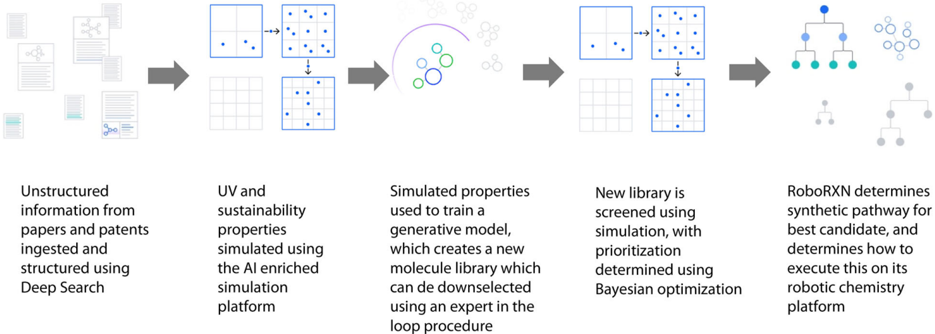
“To overcome the limited availability of key property values for most of the identi fi ed cations, AI-enriched simulation was used to compute both UV absorption using TD-DFT 82 using the GAMESS-US framework 83 and selected sustainability properties for several hundred sulfoniums using OPERA 84 .”
MethodA robotic platform for flow synthesis of organic compounds informed by AI planning
Coley, C. W., Thomas, D. A., Lummiss, J. A. M., Jaworski, J. N., Breen, C. P., Schultz, V., Hart, T., Fishman, J. S., Rogers, L., Gao, H., et al. (2019) · Science · doi:10.1126/science.aax1566 · Cited by 1,052
Molecular Transformer: A Model for Uncertainty-Calibrated Chemical Reaction Prediction
Schwaller, P., Laino, T., Gaudin, T., Bolgar, P., Hunter, C. A., Bekas, C., & Lee, A. A. (2019) · ACS Central Science · doi:10.1021/acscentsci.9b00576 · Cited by 928
Self-citationBig Data Meets Quantum Chemistry Approximations: The Δ-Machine Learning Approach
Ramakrishnan, R., Dral, P. O., Rupp, M., & von Lilienfeld, O. A. (2015) · Journal of Chemical Theory and Computation · doi:10.1021/acs.jctc.5b00099 · Cited by 911
Data‐Driven Materials Science: Status, Challenges, and Perspectives
Himanen, L., Geurts, A., Foster, A. S., & Rinke, P. (2019) · Advanced Science · doi:10.1002/advs.201900808 · Cited by 808
Accelerating the discovery of materials for clean energy in the era of smart automation
Tabor, D. P., Roch, L. M., Saikin, S. K., Kreisbeck, C., Sheberla, D., Montoya, J. H., Dwaraknath, S., Aykol, M., Ortiz, C., Tribukait, H., et al. (2018) · Nature Reviews Materials · doi:10.1038/s41578-018-0005-z · Cited by 776 · cited 2×
“Fortunately, our tools for performing such discovery cycles are transforming — with data, arti fi cial intelligence and hybrid cloud being used in new ways to break through long-standing bottlenecks 1,2 .”
BackgroundMethodDiaryliodonium Salts. A New Class of Photoinitiators for Cationic Polymerization
Crivello, J. V., & Lam, J. H. W. (1977) · Macromolecules · doi:10.1021/ma60060a028 · Cited by 661 · cited 1×
“Of the several classes of known PAGs 72 – 74 , sulfonium ([SR 3 ] + ) or iodonium ([IR 2 ] + ) -based complexes are the most widely used in semiconductor lithography 75 – 77 .”
BackgroundOPERA models for predicting physicochemical properties and environmental fate endpoints
Mansouri, K., Grulke, C. M., Judson, R. S., & Williams, A. J. (2018) · Journal of Cheminformatics · doi:10.1186/s13321-018-0263-1 · Cited by 624 · cited 1×
“To overcome the limited availability of key property values for most of the identi fi ed cations, AI-enriched simulation was used to compute both UV absorption using TD-DFT 82 using the GAMESS-US framework 83 and selected sustainability properties for several hundred sulfoniums using OPERA 84 .”
MethodMachine learning of molecular electronic properties in chemical compound space
Montavon, G., Rupp, M., Gobre, V., Vazquez-Mayagoitia, A., Hansen, K., Tkatchenko, A., Müller, K.-R., & Anatole von Lilienfeld, O. (2013) · New Journal of Physics · doi:10.1088/1367-2630/15/9/095003 · Cited by 623
Swain, M. C., & Cole, J. M. (2016) · Journal of Chemical Information and Modeling · doi:10.1021/acs.jcim.6b00207 · Cited by 598
On-the-fly closed-loop materials discovery via Bayesian active learning
Kusne, A. G., Yu, H., Wu, C., Zhang, H., Hattrick-Simpers, J., DeCost, B., Sarker, S., Oses, C., Toher, C., Curtarolo, S., et al. (2020) · Nature Communications · doi:10.1038/s41467-020-19597-w · Cited by 542 · cited 1×
“This methodology is similar to other active learning approaches 40 and allows us to balance the exploitation of trends from data we already have with the acquisition of new knowledge in unexplored areas 41,42 .”
The discovery and development of onium salt cationic photoinitiators
Crivello, J. V. (1999) · Journal of Polymer Science Part A Polymer Chemistry · doi:10.1002/(sici)1099-0518(19991201)37:23<4337::aid-pola10>3.0.co;2-8 · Cited by 531
S2ORC: The Semantic Scholar Open Research Corpus
Lo, K., Wang, L. L., Neumann, M., Kinney, R., & Weld, D. (2020) · Proceedings of the 58th Annual Meeting of the Association for Computational Linguistics · doi:10.18653/v1/2020.acl-main.447 · Cited by 457
Schwaller, P., Gaudin, T., Lányi, D., Bekas, C., & Laino, T. (2018) · Chemical Science · doi:10.1039/c8sc02339e · Cited by 441
Self-citationChemical Amplification Resists for Microlithography
Ito, H. (2005) · Advances in Polymer Science · doi:10.1007/b97574 · Cited by 428
Accelerated antimicrobial discovery via deep generative models and molecular dynamics simulations
Das, P., Sercu, T., Wadhawan, K., Padhi, I., Gehrmann, S., Cipcigan, F., Chenthamarakshan, V., Strobelt, H., dos Santos, C., Chen, P.-Y., et al. (2021) · Nature Biomedical Engineering · doi:10.1038/s41551-021-00689-x · Cited by 414 · cited 1×
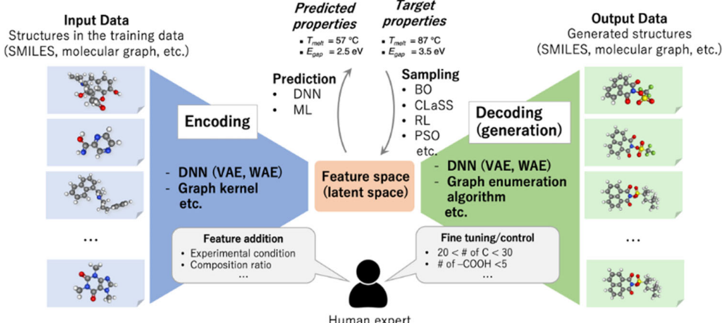
“In deep generative models, our approach is to leverage Wasserstein Auto Encoders (WAE) and Conditional Latent Space Sampling (CLaSS) for this purpose which we have demonstrated successfully in peptide sequence generation to design antimicrobial materials 59,60 .”
MethodObjective-Reinforced Generative Adversarial Networks (ORGAN) for Sequence Generation Models
Guimaraes, G. L., Sánchez-Lengeling, B., Outeiral, C., Farias, P. L. C., & Aspuru‐Guzik, A. (2017) · arXiv (Cornell University) · doi:10.48550/arxiv.1705.10843 · Cited by 413 · cited 1×
“Recent developments in AI technology based on pre-trained language models 47 and Generative Adversarial Networks (GANs) 48,49 , have been used to automatically generate images, speech, and natural language, and have recently been applied to materials discovery problems 50,51 .”
MethodSchwaller, P., Petraglia, R., Zullo, V., Nair, V. H., Haeuselmann, R. A., Pisoni, R., Bekas, C., Iuliano, A., & Laino, T. (2020) · Chemical Science · doi:10.1039/c9sc05704h · Cited by 403 · cited 1×
“Recent advances in AI enabled digitization of common tasks in chemical synthesis, including forward reaction prediction 64 , retro-synthetic analysis 65 , and inference of experimental protocols to execute novel chemical synthesis 66 .”
MethodSelf-citationGoodall, R. E. A., & Lee, A. A. (2020) · Nature Communications · doi:10.1038/s41467-020-19964-7 · Cited by 400 · cited 1×
“Emerging from the use of neural networks to bypass expensive physics-based routines 28,29 , AI has been used to predict ever more complex properties, such as energetic materials 30 , solid-state materials properties 31,32 and even the structure of proteins 33 .”
MethodJensen, J. H. (2019) · Chemical Science · doi:10.1039/c8sc05372c · Cited by 352 · cited 1×
“In addition to DGM, other AI approaches have been effectively used for this purpose, including Monte Carlo tree search 52 , genetic algorithms 53 , and the junction tree algorithm 54 .”
MethodWhat Is High-Throughput Virtual Screening? A Perspective from Organic Materials Discovery
Pyzer-Knapp, E. O., Suh, C., Gómez-Bombarelli, R., Aguilera-Iparraguirre, J., & Aspuru-Guzik, A. (2015) · Annual Review of Materials Research · doi:10.1146/annurev-matsci-070214-020823 · Cited by 299 · cited 1×
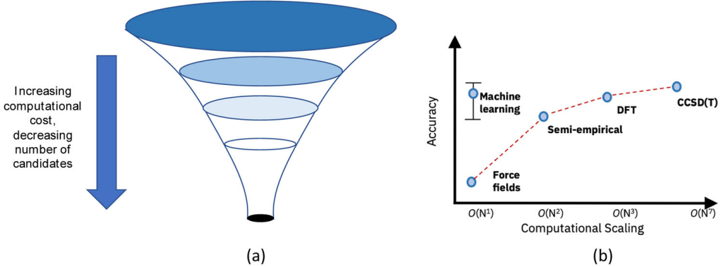
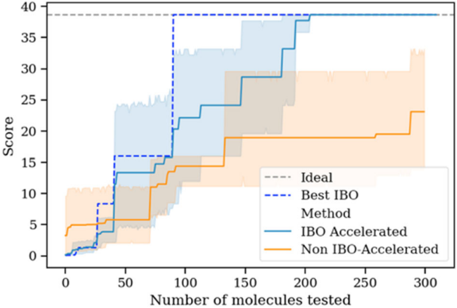
“…can dynamically improve candidate prioritization using Bayesian optimization 37,38 , allowing us to selectively spend our computational budget, and thus use more accurate models on a smaller amount of data, thus improving the traditional ‘ virtual high throughput screening ’ 39 model shown in Fig.”
MethodSelf-citationMolecule Attention TransformerPreprint
Maziarka, Ł., Danel, T., Mucha, S., Rataj, K., Tabor, J., & Jastrzȩbski, S. (2020) · arXiv (Cornell University) · doi:10.48550/arxiv.2002.08264 · Cited by 294 · cited 1×
“Generative AI models can generate new candidate chemicals, molecules 24,55,56 , and materials 57 , and expand both the discovery space and the creativity of scientists.”
BackgroundA Machine Learning Approach to Zeolite Synthesis Enabled by Automatic Literature Data Extraction
Jensen, Z., Kim, E., Kwon, S., Gani, T. Z. H., Román-Leshkov, Y., Moliner, M., Corma, A., & Olivetti, E. (2019) · ACS Central Science · doi:10.1021/acscentsci.9b00193 · Cited by 282 · cited 1×
“Furthermore, solutions such as ChemDataExtractor 15 and tmChem 16 allow users to extract materials related entities from these documents, either in the generic case or for very speci fi c use-cases — for example, zeolites 17 .”
MethodMol-CycleGAN: a generative model for molecular optimization
Maziarka, Ł., Pocha, A., Kaczmarczyk, J., Rataj, K., Danel, T., & Warchoł, M. (2020) · Journal of Cheminformatics · doi:10.1186/s13321-019-0404-1 · Cited by 275
Transcription initiation complex structures elucidate DNA opening
Plaschka, C., Hantsche, M., Dienemann, C., Burzinski, C., Plitzko, J., & Cramer, P. (2016) · Nature · doi:10.1038/nature17990 · Cited by 270
tmChem: a high performance approach for chemical named entity recognition and normalization
Leaman, R., Wei, C.-H., & Lu, Z. (2015) · Journal of Cheminformatics · doi:10.1186/1758-2946-7-s1-s3 · Cited by 268
Applying machine learning techniques to predict the properties of energetic materials
Elton, D. C., Boukouvalas, Z., Butrico, M. S., Fuge, M. D., & Chung, P. W. (2018) · Scientific Reports · doi:10.1038/s41598-018-27344-x · Cited by 263 · cited 1×
“Emerging from the use of neural networks to bypass expensive physics-based routines 28,29 , AI has been used to predict ever more complex properties, such as energetic materials 30 , solid-state materials properties 31,32 and even the structure of proteins 33 .”
MethodChemTS: an efficient python library for de novo molecular generation
Yang, X., Zhang, J., Yoshizoe, K., Terayama, K., & Tsuda, K. (2017) · Science and Technology of Advanced Materials · doi:10.1080/14686996.2017.1401424 · Cited by 262
Demystifying Multitask Deep Neural Networks for Quantitative Structure–Activity Relationships
Xu, Y., Ma, J., Liaw, A., Sheridan, R. P., & Svetnik, V. (2017) · Journal of Chemical Information and Modeling · doi:10.1021/acs.jcim.7b00087 · Cited by 238 · cited 1×
“This method exploits the fact that the joint training of similar tasks will be broadly additive and positive, whilst the effect of joint training broadly dissimilar tasks will be net negative 35 .”
MethodImage-Based Table Recognition: Data, Model, and Evaluation
Zhong, X., ShafieiBavani, E., & Jimeno Yepes, A. (2020) · Lecture Notes in Computer Science · doi:10.1007/978-3-030-58589-1_34 · Cited by 234
Zivic, N., Kuroishi, P. K., Dumur, F., Gigmes, D., Dove, A. P., & Sardon, H. (2019) · Angewandte Chemie International Edition · doi:10.1002/anie.201810118 · Cited by 228
Pyzer‐Knapp, E. O., Li, K., & Aspuru‐Guzik, A. (2015) · Advanced Functional Materials · doi:10.1002/adfm.201501919 · Cited by 222
Self-citationAutomated extraction of chemical synthesis actions from experimental procedures
Vaucher, A. C., Zipoli, F., Geluykens, J., Nair, V. H., Schwaller, P., & Laino, T. (2020) · Nature Communications · doi:10.1038/s41467-020-17266-6 · Cited by 202 · cited 1×
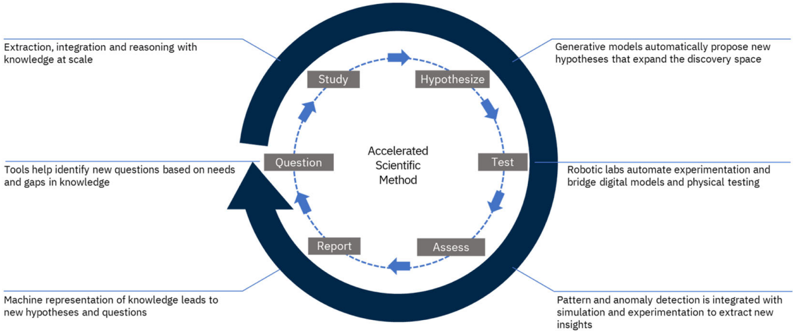
“This includes advances at each step, for example, to extract, integrate, and reason with knowledge at scale to better respond to question 10 , to the use of deep generative models to automatically propose new hypotheses, to automating testing and experimentation using robotic labs 11 .”
MethodSelf-citationThe reproducibility “crisis”: Reaction to replication crisis should not stifle innovation
Hunter, P. (2017) · The EMBO Reports · doi:10.15252/embr.201744876 · Cited by 201 · cited 1×
“Similarly, there are gaps in experimentation, bridging digital models and physical testing, and ensuring reproducibility — it has been reported that 70% of scientists have at least once tried and failed to replicate the results of another 9 .”
BackgroundAutomated hypothesis generation based on mining scientific literature
Spangler, S., Wilkins, A. D., Bachman, B. J., Nagarajan, M., Dayaram, T., Haas, P., Regenbogen, S., Pickering, C. R., Comer, A., Myers, J. N., et al. (2014) · Proceedings of the 20th ACM SIGKDD international conference on Knowledge discovery and data mining · doi:10.1145/2623330.2623667 · Cited by 170
Willson, C. G., Itô, H., Fréchet, J. M. J., Tessier, T. G., & Houlihan, F. M. (1986) · Journal of The Electrochemical Society · doi:10.1149/1.2108519 · Cited by 155
Manica, M., Oskooei, A., Born, J., Subramanian, V., Sáez-Rodríguez, J., & Rodríguez Martínez, M. (2019) · Molecular Pharmaceutics · doi:10.1021/acs.molpharmaceut.9b00520 · Cited by 147 · cited 2×
“Another approach is a combination of VAE and reinforcement learning (RL) 61,62 , where drug molecules ’ SMILES and target proteins are both encoded on a common latent space.”
BackgroundMethodThe enumeration of chemical space
Reymond, J., Ruddigkeit, L., Blum, L., & van Deursen, R. (2012) · WIREs Computational Molecular Science · doi:10.1002/wcms.1104 · Cited by 144 · cited 1×
“Estimates say there are 10 108 potential organic molecules 8 which implies an intelligent navigation is necessary for any kind of accelerated discovery beyond serendipity.”
BackgroundGenerative Models for Automatic Chemical Design
Schwalbe‐Koda, D., & Gómez‐Bombarelli, R. (2020) · Lecture notes in physics · doi:10.1007/978-3-030-40245-7_21 · Cited by 124
Suh, C., Fare, C., Warren, J. A., & Pyzer‐Knapp, E. O. (2020) · Annual Review of Materials Research · doi:10.1146/annurev-matsci-082019-105100 · Cited by 113 · cited 1×
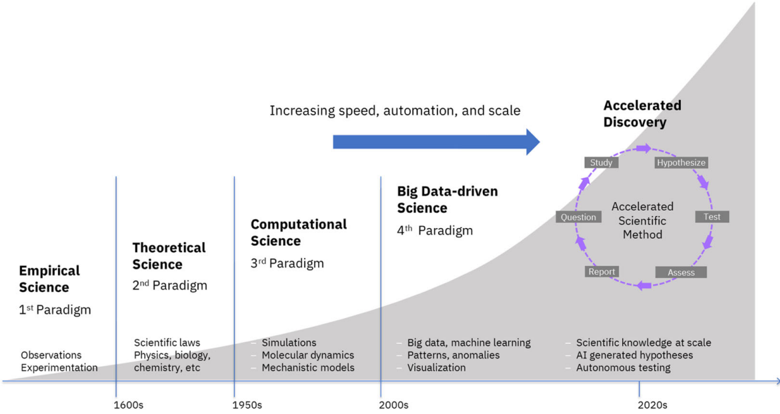
“A typical materials discovery effort can be decomposed into a series of phases: (1) specification of a research question, (2) collection of relevant existing data, then (3) formation of a hypothesis and finally (4) experimentation and testing of this hypothesis, which may in turn lead to knowledge generation and the c…”
BackgroundSelf-citationPalladium-Catalyzed Borylation of Aryl Sulfoniums with Diborons
Minami, H., Otsuka, S., Nogi, K., & Yorimitsu, H. (2017) · ACS Catalysis · doi:10.1021/acscatal.7b03841 · Cited by 110 · cited 1×
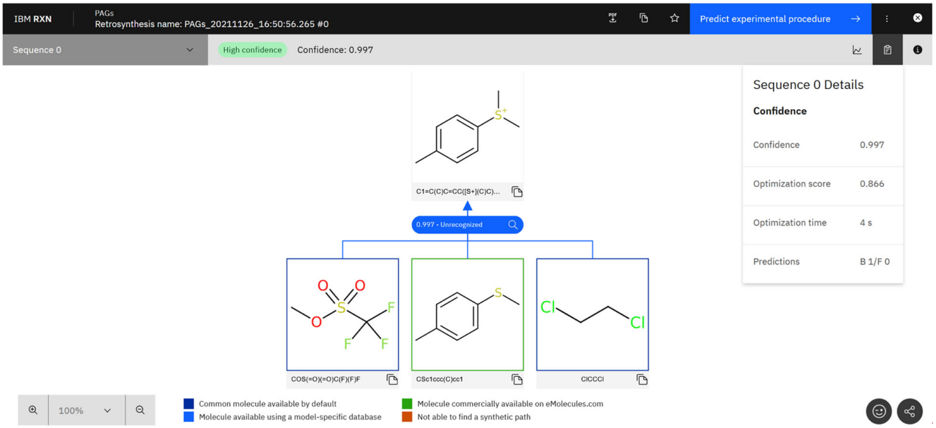
“Application of the AI retrosynthetic model identi fi ed a one-step reaction involving the S-alkylation of 4-(methylthio)toluene by methyl tri fl uoromethanesulfonate 86,87 as the most promising pathway (shown in Fig.”
MethodBayesian optimization for accelerated drug discovery
Pyzer‐Knapp, E. O. (2018) · IBM Journal of Research and Development · doi:10.1147/jrd.2018.2881731 · Cited by 106 · cited 2×
“This methodology is similar to other active learning approaches 40 and allows us to balance the exploitation of trends from data we already have with the acquisition of new knowledge in unexplored areas 41,42 .”
MethodSelf-citationInferring experimental procedures from text-based representations of chemical reactions
Vaucher, A. C., Schwaller, P., Geluykens, J., Nair, V. H., Iuliano, A., & Laino, T. (2021) · Nature Communications · doi:10.1038/s41467-021-22951-1 · Cited by 100 · cited 1×
“Recent advances in AI enabled digitization of common tasks in chemical synthesis, including forward reaction prediction 64 , retro-synthetic analysis 65 , and inference of experimental protocols to execute novel chemical synthesis 66 .”
MethodSelf-citationConvergence of multiple synthetic paradigms in a universally programmable chemical synthesis machine
Angelone, D., Hammer, A. J. S., Rohrbach, S., Krambeck, S., Granda, J. M., Wolf, J. B., Zalesskiy, S. S., Chisholm, G., & Cronin, L. (2020) · Nature Chemistry · doi:10.1038/s41557-020-00596-9 · Cited by 94 · cited 1×
“Concurrently, there is an explosion of automation and AI in chemical synthesis, with the important contribution in the use of commodity hardware 67 , fl uidic reactors 68 , or the use of robots able to execute the same tasks as human chemists 69 .”
BackgroundPyzer-Knapp, E. O., Simm, G. N., & Aspuru Guzik, A. (2016) · Materials Horizons · doi:10.1039/c5mh00282f · Cited by 88 · cited 2×
“For example, the choice of simulation protocol can present complexity, and a poor choice can doom a discovery campaign before it is begun 25 .”
BackgroundSelf-citationDeep Generative Models for Molecular Science
Jørgensen, P. B., Schmidt, M. N., & Winther, O. (2018) · Molecular Informatics · doi:10.1002/minf.201700133 · Cited by 85 · cited 1×
“Generative AI models can generate new candidate chemicals, molecules 24,55,56 , and materials 57 , and expand both the discovery space and the creativity of scientists.”
BackgroundPhotoacid generators. Application and current state of development
Kuznetsova, N. A., Malkov, G. V., & Gribov, B. G. (2020) · Russian Chemical Reviews · doi:10.1070/rcr4899 · Cited by 80
PaccMann: a web service for interpretable anticancer compound sensitivity prediction
Cadow, J., Born, J., Manica, M., Oskooei, A., & Rodríguez Martínez, M. (2020) · Nucleic Acids Research · doi:10.1093/nar/gkaa327 · Cited by 80
Redox-Neutral Borylation of Aryl Sulfonium Salts via C–S Activation Enabled by Light
Huang, C., Feng, J., Ma, R., Fang, S., Lu, T., Tang, W., Du, D., & Gao, J. T. (2019) · Organic Letters · doi:10.1021/acs.orglett.9b03850 · Cited by 73 · cited 1×
“Application of the AI retrosynthetic model identi fi ed a one-step reaction involving the S-alkylation of 4-(methylthio)toluene by methyl tri fl uoromethanesulfonate 86,87 as the most promising pathway (shown in Fig.”
MethodCorpus Conversion Service: A Machine Learning Platform to Ingest Documents at Scale
Staar, P., Dolfi, M., Auer, C., & Bekas, C. (2018) · ACM SIGKDD Conference on Knowledge Discovery and Data Mining (KDD) · doi:10.1145/3219819.3219834 · Cited by 70
Self-citationRecent Progress in Photo-Acid Generators for Advanced Photopolymer Materials
Tsuchimura, T. (2020) · Journal of Photopolymer Science and Technology · doi:10.2494/photopolymer.33.15 · Cited by 37
Robust PDF Document Conversion using Recurrent Neural Networks
Livathinos, N., Berrospi, C., Lysak, M., Kuropiatnyk, V., Nassar, A., de Carvalho, A. C. P. L. F., Dolfi, M., Auer, C., Dinkla, K., & Staar, P. (2021) · Proceedings of the AAAI Conference on Artificial Intelligence · doi:10.1609/aaai.v35i17.17777 · Cited by 32
Self-citationMolecular Inverse-Design Platform for Material Industries
Takeda, S., Hama, T., Hsu, H.-H., Piunova, V. A., Zubarev, D. Y., Sanders, D. P., Pitera, J. W., Kogoh, M., Hongo, T., Cheng, Y., et al. (2020) · ACM SIGKDD Conference on Knowledge Discovery and Data Mining (KDD) · doi:10.1145/3394486.3403346 · Cited by 31 · cited 2×
“Our experience is that generative models can accelerate early materials ideation processes by 100x 58 .”
BackgroundSelf-citationMachine Learning in Chemistry: The Impact of Artificial Intelligence
Viti, S., & Holdship, J. R. (2020) · RSC theoretical and computational chemistry series · doi:10.1039/9781839160233 · Cited by 31
Pyzer‐Knapp, E. O., Chen, L., Day, G. M., & Cooper, A. I. (2021) · Science Advances · doi:10.1126/sciadv.abi4763 · Cited by 26
Self-citationFare, C., Turcani, L., & Pyzer‐Knapp, E. O. (2020) · Physical Chemistry Chemical Physics · doi:10.1039/d0cp02319a · Cited by 17
Self-citationPepCVAE: Semi-Supervised Targeted Design of Antimicrobial Peptide Sequences
Das, P., Wadhawan, K., Chang, O., Sercu, T., dos Santos, C. N., Riemer, M., Chenthamarakshan, V., Padhi, I., & Mojsilović, A. (2018) · arXiv (Cornell University) · doi:10.48550/arxiv.1810.07743 · Cited by 17
Triphenylsulfonium topophotochemistry
Despagnet‐Ayoub, E., Kramer, W. W., Sattler, W., Sattler, A., LaBeaume, P., Thackeray, J. W., Cameron, J. F., Cardolaccia, T., Rachford, A. A., Winkler, J. R., et al. (2017) · Photochemical & Photobiological Sciences · doi:10.1039/c7pp00324b · Cited by 17 · cited 1×
“…have helped clarify the potential PBT risks associated with representative PAGs 79 as well as identify relevant photo-decomposition products 80,81 , it remains extremely challenging for industry to design, synthesize, test, and bring to market new PAGs with improved sustainability pro fi les…”
BackgroundExpert-in-the-loop AI for Polymer Discovery
Ristoski, P., Zubarev, D. Y., Gentile, A. L., Park, N. H., Sanders, D. P., Gruhl, D., Kato, L., & Welch, S. (2020) · ACM International Conference on Information and Knowledge Management (CIKM) · doi:10.1145/3340531.3416020 · Cited by 15 · cited 1×
“To overcome this, a combination of expert-de fi ned rules and discriminative expert-in-the-loop (EITL) AI models 85 were used to fi rst constrain the generative model output and then aid in the candidate downselection process, respectively.”
MethodSelf-citationEfficient and Scalable Batch Bayesian Optimization Using K-MeansPreprint
Groves, M., & Pyzer‐Knapp, E. O. (2018) · arXiv (Cornell University) · doi:10.48550/arxiv.1806.01159 · Cited by 15
Self-citationNiu, X.-Z., Pepel, R. D., Paniego, R., Field, J. A., Chorover, J., Abrell, L. M., Sáez, A. E., & Sierra‐Álvarez, R. (2021) · Journal of Photochemistry and Photobiology A Chemistry · doi:10.1016/j.jphotochem.2021.113324 · Cited by 14 · cited 1×
“…studies have helped clarify the potential PBT risks associated with representative PAGs 79 as well as identify relevant photo-decomposition products 80,81 , it remains extremely challenging for industry to design, synthesize, test, and bring to market new PAGs with improved sustainability pro fi…”
BackgroundCorpus processing service: A Knowledge Graph platform to perform deep data exploration on corpora
Staar, P., Dolfi, M., & Auer, C. (2020) · Applied AI Letters · doi:10.1002/ail2.20 · Cited by 12
Self-citationBioconcentration potential and microbial toxicity of onium cations in photoacid generators
Niu, X.-Z., Field, J. A., Paniego, R., Pepel, R. D., Chorover, J., Abrell, L. M., & Sierra‐Álvarez, R. (2021) · Environmental Science and Pollution Research · doi:10.1007/s11356-020-12250-5 · Cited by 12 · cited 9×
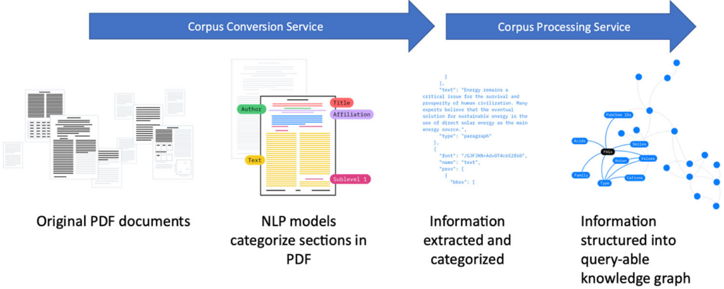
“In the fi rst stage of the work fl ow, approximately 6000 patents, papers, and data sources were ingested by Deep Search to form a knowledge graph from which the structures of approximately 5000 sulfonium PAGs were obtained.”
BackgroundInfluentialCognitive Materials Discovery and Onset of the 5th Discovery Paradigm
Zubarev, D. Y., & Pitera, J. W. (2019) · ACS symposium series · doi:10.1021/bk-2019-1326.ch006 · Cited by 8
Self-citationPyzer‐Knapp, E. O. (2020) · arXiv (Cornell University) · doi:10.48550/arxiv.2005.07121 · Cited by 6 · cited 1×
“This methodology is similar to other active learning approaches 40 and allows us to balance the exploitation of trends from data we already have with the acquisition of new knowledge in unexplored areas 41,42 .”
MethodSelf-citationTvermoes, B. E., & Speed, D. E. (2019) · Advances in Patterning Materials and Processes · doi:10.1117/12.2516159 · Cited by 5
Molecule Generation Experience: An Open Platform of Material Design for Public UsersPreprint
Takeda, S., Hama, T., Hsu, H.-H., Kishimoto, A., Kogoh, M., Hongo, T., Fujieda, K., Nakashika, H., Zubarev, D. Y., Sanders, D. P., et al. (2021) · arXiv (Cornell University) · doi:10.48550/arxiv.2108.03044 · Cited by 4
Self-citation
Research works printed but not linked: 9
- Kuhn, T. The Structure of Scientific Revolutions 2nd edn (The University of Chicago Press, 1970).
- arXiv.org e-Print archive. https://arxiv.org/.
- Hernández-Lobato, J. M., Requeima, J., Pyzer-Knapp, E. O. & Aspuru-Guzik, A. Parallel and distributed Thompson sampling for large-scale accelerated exploration of chemical space. In: Proc. 34th International Conference on Machine Learning-Volume 70 1470-1479 (JMLR. org, 2017).
- Brochu, E., Cora, V. M. & de Freitas, N. A Tutorial on Bayesian optimization of expensive cost functions, with application to active user modeling and hier- archical reinforcement learning. Preprint at https://arxiv.org/abs/10122599 (2010).
- Kusner, M. J., Paige, B. & Hernández-Lobato, J. M. Grammar variational auto- encoder. In: International Conference on Machine Learning 1945-1954 (PMLR, 2017).
- Jin, W., Barzilay, R. & Jaakkola, T. Junction tree variational autoencoder for molecular graph generation. In: International Conference on Machine Learning 2323-2332 (PMLR, 2018).
- Crivello, J. V. & Lam, J. H. W. Photoinitiated cationic polymerization with triar- ylsulfonium salts. J. Polym. Sci. A: Polym. Chem. 17, 977-999 (1979).
- Carrete, J., Li, W., Mingo, N., Wang, S. & Curtarolo, S. Finding unprecedentedly low-thermal-conductivity half-Heusler semiconductors via high-throughput materials modeling. Phys. Rev. X 4, 011019 (2014).
- Shipley, G. & Dumpleton, G. OpenShift for Developers: A Guide for Impatient Beginners (O'Reilly Media, Inc., 2016).
Cited by
Drawbacks of artificial intelligence and their potential solutions in the healthcare sector.
khan, B., Fatima, H., Qureshi, A., Kumar, S., Hanan, A., Hussain, J., & Abdullah, S. (2023) · Biomedical Materials & Devices · doi:10.1007/s44174-023-00063-2 · Cited by 461
“…DL bring innovations for professionals in medicines as well as in approaches like in materials sciences drug delivery vehicles (cyclodextrins [56], Ag nanoparticles [57], nanogels, TMPS [58]) structures are simulated by creating the algorithms [59] to explore the possibilities of their benefits.”
Deep Learning in Mechanical Metamaterials: From Prediction and Generation to Inverse Design
Zheng, X., Zhang, X., Chen, T., & Watanabe, I. (2023) · Advanced Materials · doi:10.1002/adma.202302530 · Cited by 372
Ding, R., Chen, J., Chen, Y., Liu, J., Bando, Y., & Wang, X. (2024) · Chemical Society Reviews · doi:10.1039/d4cs00844h · Cited by 239
Overcoming Challenges in Small-Molecule Drug Bioavailability: A Review of Key Factors and Approaches
Wu, K., Kwon, S. H., Zhou, X., Fuller, C., Wang, X., Vadgama, J., & Wu, Y. (2024) · International Journal of Molecular Sciences · doi:10.3390/ijms252313121 · Cited by 191
Hagos, D. H., Battle, R., & Rawat, D. B. (2024) · IEEE Transactions on Artificial Intelligence · doi:10.1109/tai.2024.3444742 · Cited by 303
“The application of Generative AI models in material science [82] can significantly accelerate the material discovery process by guiding experimental efforts, predicting new materials, and optimizing existing materials [83].”
Metadata
- Authors
- Pyzer-Knapp, E. O., Pitera, J. W., Staar, P. W. J., Takeda, S., Laino, T., Sanders, D. P., Sexton, J., Smith, J. R., & Curioni, A.
- Affiliations
- IBM Research - Almaden (US)
- IBM Research - Zurich (CH)
- IBM Research - Tokyo (JP)
- IBM Research - Thomas J. Watson Research Center (US)
- Venue
- npj Computational Materials
- Published
- 2022-04-26
- Volume
- 8
- Issue
- 1
- ISSN
- 2057-3960 (ISSN-L)
- OpenAlex
- W4225000412
- Cited by
- 465
- References
- 75
- Citations by year
- 2026: 120 · 2025: 150 · 2024: 107 · 2023: 65 · 2022: 23
- FWCI
- 24.26
- Type
- journal article
- Language
- en
- Open access
- gold
- doi.org
- Licence
- cc-by
- creativecommons.org/licenses/by/4.0 (tdm)
- creativecommons.org/licenses/by/4.0 (vor)
- Locations
- npj Computational Materials (publishedVersion, cc-by)
- DOAJ (DOAJ: Directory of Open Access Journals) (submittedVersion, cc-by-sa)
- Topics
- Physical Sciences › Materials Science › Materials Chemistry › Machine Learning in Materials Science
- Life Sciences › Pharmacology, Toxicology and Pharmaceutics › Drug Discovery › Computational Drug Discovery Methods
- Social Sciences › Decision Sciences › Information Systems and Management › Scientific Computing and Data Management
- Keywords
- materials discovery, artificial intelligence, high-performance computing, robotics, experimental automation, simulation automation, chemically amplified resists
About these checks
Registry, retraction, Cites and statistics results are computed, not judged, with one exception: a printed reference that no index lists is read once by a model before it counts as a citation error. Claims are extracted by a model and kept only when their quote appears verbatim in the text; each cited source is then checked, with a model’s help, for whether it says what the claim relies on. Those verdicts can be wrong — read the claim’s quote and the cited source before relying on one.
Statistics and arithmetic are recomputed, not judged.
Confidence bands are shown only for fields calibrated on our annotated test set. None is calibrated yet, so no band is shown.
What counts as a claim ›How we measure confidence ›How we check this ›
Are you an author, or do you see a problem with this page? Request a review
Data sources
Bibliographic data: Semantic Scholar, OpenAlex, Crossref.
Contains information from the Semantic Scholar Academic Graph Datasets, made available under the ODC Attribution License (ODC-BY 1.0).
Semantic Scholar’s data is described in: Kinney, R., et al. (2023). The Semantic Scholar Open Data Platform. arXiv:2301.10140.
