

Meta-analysis of the diagnostic and clinical utility of genome and exome sequencing and chromosomal microarray in children with suspected genetic diseases
Open accessPublished version of a preprint
The DOI matches its Crossref record; 74 of the 74 references it cites were found in a registry or an index.
Abstract
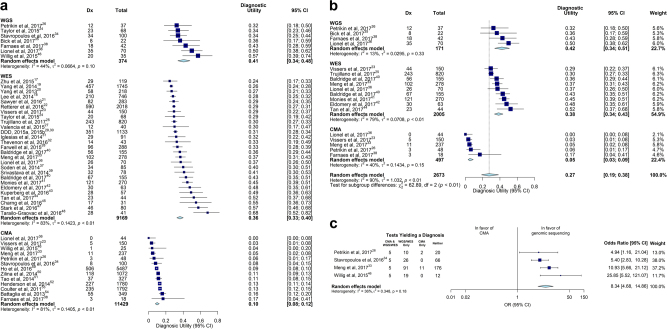
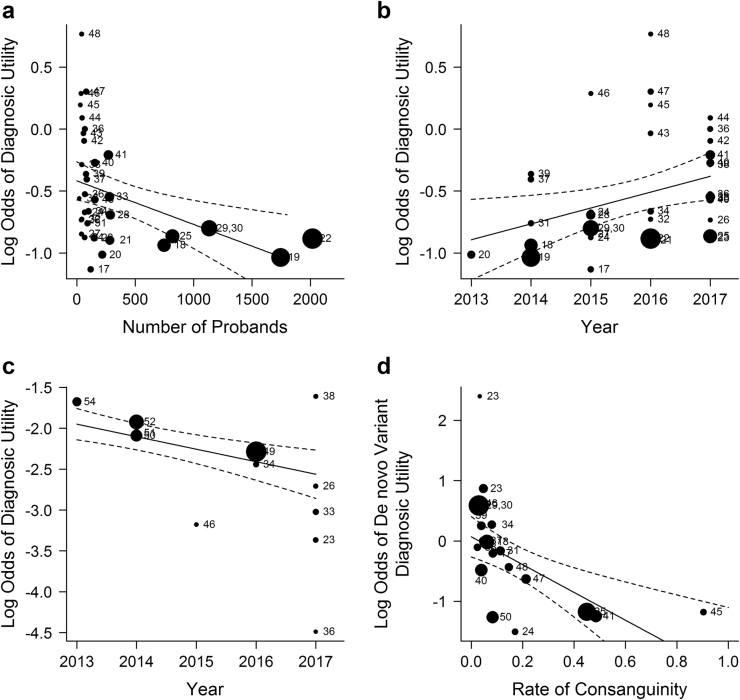
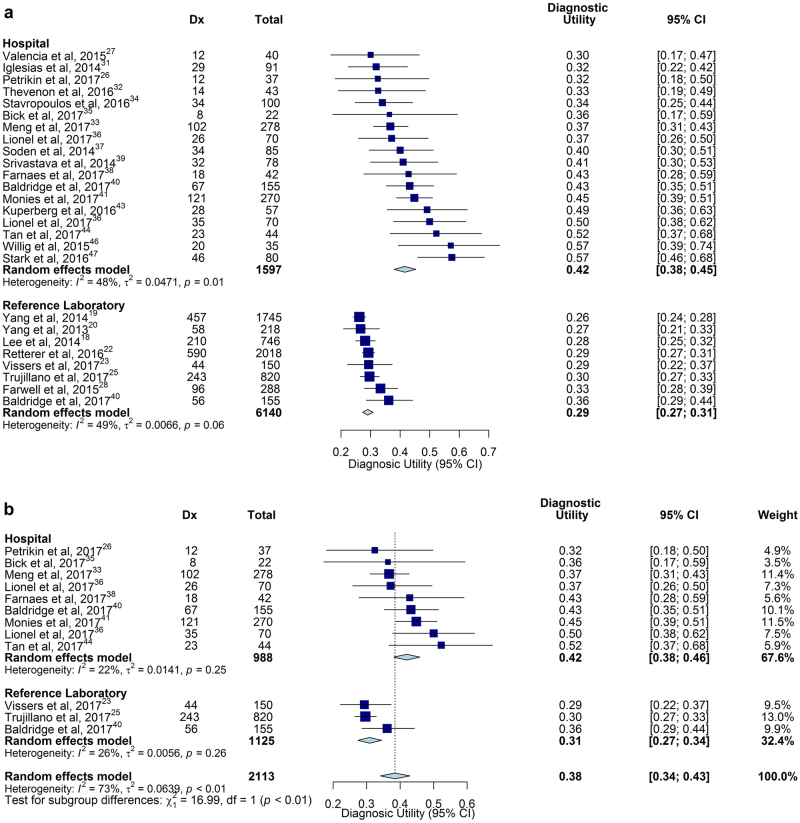
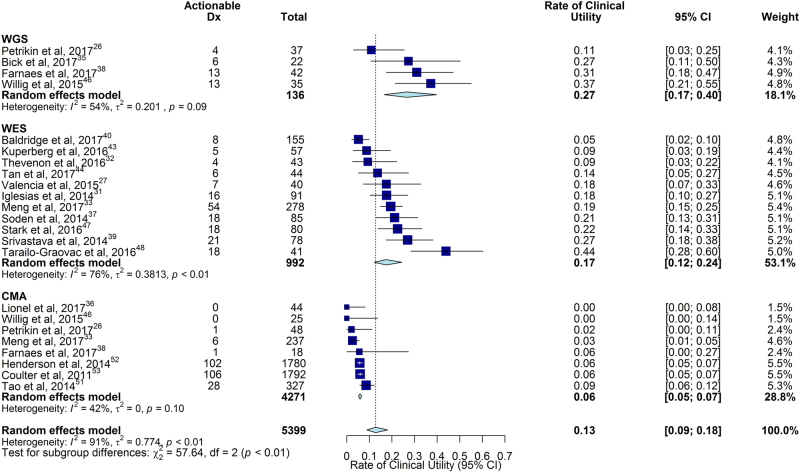
Genetic diseases are leading causes of childhood mortality. Whole-genome sequencing (WGS) and whole-exome sequencing (WES) are relatively new methods for diagnosing genetic diseases, whereas chromosomal microarray (CMA) is well established. Here we compared the diagnostic utility (rate of causative, pathogenic, or likely pathogenic genotypes in known disease genes) and clinical utility (proportion in whom medical or surgical management was changed by diagnosis) of WGS, WES, and CMA in children with suspected genetic diseases by systematic review of the literature (January 2011–August 2017) and meta-analysis, following MOOSE/PRISMA guidelines. In 37 studies, comprising 20,068 children, diagnostic utility of WGS (0.41, 95% CI 0.34–0.48, I 2 = 44%) and WES (0.36, 95% CI 0.33–0.40, I 2 = 83%) were qualitatively greater than CMA (0.10, 95% CI 0.08–0.12, I 2 = 81%). Among studies published in 2017, the diagnostic utility of WGS was significantly greater than CMA ( P < 0.0001, I 2 = 13% and I 2 = 40%, respectively). Among studies featuring within-cohort comparisons, the diagnostic utility of WES was significantly greater than CMA ( P < 0.001, I 2 = 36%). The diagnostic utility of WGS and WES were not significantly different. In studies featuring within-cohort comparisons of WGS/WES, the likelihood of diagnosis was significantly greater for trios than singletons (odds ratio 2.04, 95% CI 1.62–2.56, I 2 = 12%; P < 0.0001). Diagnostic utility of WGS/WES with hospital-based interpretation (0.42, 95% CI 0.38–0.45, I 2 = 48%) was qualitatively higher than that of reference laboratories (0.29, 95% CI 0.27–0.31, I 2 = 49%); this difference was significant among studies published in 2017 ( P < .0001, I 2 = 22% and I 2 = 26%, respectively). The clinical utility of WGS (0.27, 95% CI 0.17–0.40, I 2 = 54%) and WES (0.17, 95% CI 0.12–0.24, I 2 = 76%) were higher than CMA (0.06, 95% CI 0.05–0.07, I 2 = 42%); this difference was significant for WGS vs CMA ( P < 0.0001). In conclusion, in children with suspected genetic diseases, the diagnostic and clinical utility of WGS/WES were greater than CMA. Subgroups with higher WGS/WES diagnostic utility were trios and those receiving hospital-based interpretation. WGS/WES should be considered a first-line genomic test for children with suspected genetic diseases.
Overview
The claims and statistics of this paper haven’t been checked yet.
Free: it reads the open-access text and checks the first 5 claims that cite a source we can check. Create a free account to check every claim.
Integrity signals
Registry
Cites
Statistics
Figures

Verification
Claims the paper makes
The claims and statistics of this paper haven’t been checked yet.
Free: it reads the open-access text and checks the first 5 claims that cite a source we can check. Create a free account to check every claim.
Claims other papers make about this one
Each is checked against this paper’s own text: does it say what the citing paper says it does?
The source backs part of the claim, not all of it — or backs it for a different population, condition or comparison.
In the citing paper
“Molecular diagnostic laboratories typically use highly accurate DNA sequencing technologies to test for these types of rare pathogenic variants [3,4].”
From Assessing the analytical validity of SNP-chips for detecting very rare pathogenic variants: implications for direct-to-consumer genetic testing (2019) · cites this paper as [3]
Experimental — accuracy not yet measured
Self-check
Percentages, sums and reported differences re-computed from the paper’s own numbers.
The self-check needs the paper’s full text.
Citations
Cites
Quantifying heterogeneity in a meta‐analysis
Higgins, J. P. T., & Thompson, S. G. (2002) · Statistics in Medicine · doi:10.1002/sim.1186 · Cited by 36,763
Conducting Meta-Analyses in R with the metafor Package
Viechtbauer, W. (2010) · Journal of Statistical Software · doi:10.18637/jss.v036.i03 · Cited by 20,464
THE USE OF CONFIDENCE OR FIDUCIAL LIMITS ILLUSTRATED IN THE CASE OF THE BINOMIAL
CLOPPER, C. J., & PEARSON, E. S. (1934) · Biometrika · doi:10.1093/biomet/26.4.404 · Cited by 5,003
Miller, D. T., Adam, M. P., Aradhya, S., Biesecker, L. G., Brothman, A. R., Carter, N. P., Church, D. M., Crolla, J. A., Eichler, E. E., Epstein, C. J., et al. (2010) · The American Journal of Human Genetics · doi:10.1016/j.ajhg.2010.04.006 · Cited by 2,882
Clinical Whole-Exome Sequencing for the Diagnosis of Mendelian Disorders
Yang, Y., Muzny, D. M., Reid, J. G., Bainbridge, M. N., Willis, A., Ward, P. A., Braxton, A., Beuten, J., Xia, F., Niu, Z., et al. (2013) · New England Journal of Medicine · doi:10.1056/nejmoa1306555 · Cited by 1,964
THE COMPARISON OF PERCENTAGES IN MATCHED SAMPLES
COCHRAN, W. G. (1950) · Biometrika · doi:10.1093/biomet/37.3-4.256 · Cited by 1,465
Molecular Findings Among Patients Referred for Clinical Whole-Exome Sequencing
Yang, Y., Muzny, D. M., Xia, F., Niu, Z., Person, R., Ding, Y., Ward, P., Braxton, A., Wang, M., Buhay, C., et al. (2014) · JAMA · doi:10.1001/jama.2014.14601 · Cited by 1,360
Large-scale discovery of novel genetic causes of developmental disorders
Study, T. D. D. D. (2015) · Nature · doi:10.1038/nature14135 · Cited by 1,124
Clinical application of whole-exome sequencing across clinical indications
Retterer, K., Juusola, J., Cho, M. T., Vitazka, P., Millan, F., Gibellini, F., Vertino-Bell, A., Smaoui, N., Neidich, J., Monaghan, K. G., et al. (2016) · Genetics in Medicine · doi:10.1038/gim.2015.148 · Cited by 1,035
Clinical Exome Sequencing for Genetic Identification of Rare Mendelian Disorders
Lee, H., Deignan, J. L., Dorrani, N., Strom, S. P., Kantarci, S., Quintero-Rivera, F., Das, K., Toy, T., Harry, B., Yourshaw, M., et al. (2014) · JAMA · doi:10.1001/jama.2014.14604 · Cited by 973
Research works printed but not linked: 1
- Schwarzer, G. meta: an R package for meta-analysis. R. News 7, 40–45 (2007).
Cited by
Items 101–200 of 624
Evaluation of phenotype-driven gene prioritization methods for Mendelian diseases
Yuan, X., Wang, J., Dai, B., Sun, Y., Zhang, K., Chen, F., Peng, Q., Huang, Y., Zhang, X., Chen, J., et al. (2022) · Briefings in Bioinformatics · doi:10.1093/bib/bbac019 · Cited by 50
“However, the average positive diagnosis rates of these two approaches are 36 and 41% respectively [3], mainly because the molecular basis of a considerable part of the known Mendelian diseases is still unclear [4].”
Rare diseases, common barriers: disparities in pediatric clinical genetics outcomes
Wojcik, M. H., Bresnahan, M., del Rosario, M. C., Ojeda, M. M., Kritzer, A., & Fraiman, Y. S. (2022) · Pediatric Research · doi:10.1038/s41390-022-02240-3 · Cited by 64
Sharo, A. G., Zou, Y., Adhikari, A. N., & Brenner, S. E. (2023) · Genome Medicine · doi:10.1186/s13073-023-01199-y · Cited by 50
“Background Rare genetic diseases may affect as many as 1 in 20 Americans [1], but a definitive diagnosis is sometimes elusive [2].”
BackgroundBennett (2023) · doi:10.1097/yco.0000000000000775 · Cited by 51
Genetic testing for inherited eye conditions in over 6,000 individuals through the eyeGENE network
Goetz, K., Reeves, M. J., Gagadam, S., Blain, D., Bender, C., Lwin, C., Naik, A., Tumminia, S. J., & Hufnagel, R. B. (2020) · American Journal of Medical Genetics Part C Seminars in Medical Genetics · doi:10.1002/ajmg.c.31843 · Cited by 49
“It is estimated that the clinical utility of testing could be increased by 50–80% by employing CMA in combination with WES/WGS (Clark et al., 2018; Liu et al., 2019).”
BackgroundAssessment of mitochondrial respiratory chain enzymes in cells and tissues
Frazier, A. E., Vincent, A. E., Turnbull, D. M., Thorburn, D. R., & Taylor, R. W. (2019) · Methods in cell biology · doi:10.1016/bs.mcb.2019.11.007 · Cited by 51
Abul‐Husn, N. S., Marathe, P. N., Kelly, N. R., Bonini, K. E., Sebastin, M., Odgis, J. A., Abhyankar, A., Brown, K. M., Biase, M. D., Gallagher, K. M., et al. (2023) · Genetics in Medicine · doi:10.1016/j.gim.2023.100880 · Cited by 56
Pandey, R., Brennan, N. F., Trachana, K., Katsandres, S. C., Bodamer, O. A., Belmont, J. W., Veenstra, D. L., & Peng, S. (2025) · Genetics in Medicine · doi:10.1016/j.gim.2025.101398 · Cited by 64
Incerti, D., Xu, X.-M., Chou, J. W., Gonzaludo, N., Belmont, J. W., & Schroeder, B. E. (2021) · Genetics in Medicine · doi:10.1016/j.gim.2021.08.015 · Cited by 50
Shreeve, N., Sproule, C., Choy, K. W., Dong, Z., Gajewska‐Knapik, K., Kilby, M. D., & Mone, F. (2024) · Ultrasound in Obstetrics and Gynecology · doi:10.1002/uog.27491 · Cited by 64
Novel treatments for autism spectrum disorder based on genomics and systems biology
Baribeau, D. A., & Anagnostou, E. A. (2021) · Pharmacology & Therapeutics · doi:10.1016/j.pharmthera.2021.107939 · Cited by 56
Genome sequencing as a generic diagnostic strategy for rare disease
Schobers, G., Derks, R. C., den Ouden, A., Swinkels, H. L., van Reeuwijk, J., Bosgoed, E., Lugtenberg, D., Sun, S. M., Corominas, J., Weiss, M. M., et al. (2024) · Genome Medicine · doi:10.1186/s13073-024-01301-y · Cited by 56
“From our series of 1,000 genomes tested, we showed that ES can technically be replaced by GS (TPR>98%), in line with previous reports on comparing diagnostic outcomes of ES and GS (18-20).”
BackgroundResultKopajtich, R., Smirnov, D., Stenton, S. L., Loipfinger, S., Meng, C., Scheller, I. F., Freisinger, P., Baski, R., Berutti, R., Behr, J., et al. (2021) · medRxiv · doi:10.1101/2021.03.09.21253187 · Cited by 55
Cost Efficacy of Rapid Whole Genome Sequencing in the Pediatric Intensive Care Unit
Kobayashi, E. S., Waldman, B. M., Engorn, B. M., Perofsky, K., Allred, E. T., Briggs, B. J., Gatcliffe, C., Ramchandar, N., Gold, J. J., Doshi, A., et al. (2022) · Frontiers in Pediatrics · doi:10.3389/fped.2021.809536 · Cited by 56
Self-citationOn What We Have Learned and Still Need to Learn about the Psychosocial Impacts of Genetic Testing
Parens, E., & Appelbaum, P. S. (2019) · The Hastings Center Report · doi:10.1002/hast.1011 · Cited by 48
“Specifically, he discusses 8 systematic reviews, each of which focuses on the genomic testing space from a very different angle: (1) the psychosocial impact of Huntington’s disease testing; (2) the decision to decline testing; (3) testing for hereditary cancers; (4) testing of symptomatic individuals; (5) carrier test…”
BackgroundGenotype–phenotype analysis of 523 patients by genetics evaluation and clinical exome sequencing
Ziats, M. N., Ahmad, A., Bernat, J. A., Fisher, R. A., Glassford, M. R., Hannibal, M., Jacher, J. E., Weiser, N., Keegan, C. E., Lee, K. N., et al. (2019) · Pediatric Research · doi:10.1038/s41390-019-0611-5 · Cited by 51
Multicenter Consensus Approach to Evaluation of Neonatal Hypotonia in the Genomic Era: A Review
Morton, S. U., Christodoulou, J., Costain, G., Muntoni, F., Wakeling, E. L., Wojcik, M. H., French, C. E., Szuto, A., Dowling, J. J., Cohn, R. D., et al. (2022) · JAMA Neurology · doi:10.1001/jamaneurol.2022.0067 · Cited by 50
“29,45,46 Although advancements in bioinformatic analysis of ES/GS have shown increased potential for detecting structural variants (eg, SMA), repeated expansions (eg, DM1), and uniparental disomy (eg, PWS), criterion-standard targeted testing should be considered if the clinical suspicion of these…”
Self-citationLee, H.-F., Chi, C., & Tsai, C. (2020) · Developmental Medicine & Child Neurology · doi:10.1111/dmcn.14722 · Cited by 49
“Our case series showed that eight out of 10 SCN1A-positive individuals, who fulfilled the clinical diagnostic criteria of Dravet syndrome and received antiseizure medication recommended for Dravet syndrome, were initially screened as SCN1A-negative using Sanger sequencing, but were finally shown to have SCN1A gene mut…”
InfluentialGenetic Counseling and Genome Sequencing in Pediatric Rare Disease
Elliott, A. M. (2019) · Cold Spring Harbor Perspectives in Medicine · doi:10.1101/cshperspect.a036632 · Cited by 48
“However, it has been estimated that only ∼10% of patients with a rare pediatric disorder are diagnosed when using array-based techniques (Sagoo et al. 2009; Clark et al. 2018).”
BackgroundGenomic Data Sharing for Novel Mendelian Disease Gene Discovery: The Matchmaker Exchange
Azzariti, D. R., & Hamosh, A. (2020) · Annual Review of Genomics and Human Genetics · doi:10.1146/annurev-genom-083118-014915 · Cited by 49
Lazier, J., Hartley, T., Brock, J., Caluseriu, O., Chitayat, D. A., Laberge, A., Langlois, S., Lauzon, J. L., Nelson, T. N., Parboosingh, J. S., et al. (2021) · Journal of Medical Genetics · doi:10.1136/jmedgenet-2021-107897 · Cited by 48
Coelho, A. V. C., Mascaro-Cordeiro, B., Lucon, D. R., Nóbrega, M. S., Reis, R. D. S., de Alexandre, R. B., Moura, L. M. S., de Oliveira, G. S., Guedes, R. L. M., Caraciolo, M. P., et al. (2022) · Frontiers in Molecular Biosciences · doi:10.3389/fmolb.2022.821582 · Cited by 44
Torti, E. E., Keren, B., Palmer, E. E., Zhu, Z., Afenjar, A., Anderson, I. J., Andrews, M. V., Atkinson, C., Au, M., Berry, S. A., et al. (2019) · Genetics in Medicine · doi:10.1038/s41436-019-0454-9 · Cited by 43
The cost trajectory of the diagnostic care pathway for children with suspected genetic disorders
Dragojlovic, N., van Karnebeek, C., Ghani, A., Genereaux, D., Kim, E., Birch, P. H., Adam, S., Dragojlovic, N., du Souich, C., Elliott, A. M., et al. (2019) · Genetics in Medicine · doi:10.1038/s41436-019-0635-6 · Cited by 41
Exome Sequencing and Clinical Diagnosis
Friedman, J. M., Jones, K. L., & Carey, J. C. (2020) · JAMA · doi:10.1001/jama.2020.11126 · Cited by 42
An evaluation of GPT models for phenotype concept recognition
Groza, T., Caufield, H., Gration, D., Baynam, G., Haendel, M. A., Robinson, P. N., Mungall, C. J., & Reese, J. T. (2024) · BMC Medical Informatics and Decision Making · doi:10.1186/s12911-024-02439-w · Cited by 39
“The utility of using ontology-coded knowledge in rare diseases has been showcased repeatedly over the years in data sharing [1–3] and clinical variant prioritization and interpretation [4–6].”
Bradykinin-Mediated Angioedema: An Update of the Genetic Causes and the Impact of Genomics
Marcelino-Rodríguez, I., Callero, A., Mendoza-Álvarez, A., Perez-Rodriguez, E., Barrios-Recio, J., García-Robaina, J. C., & Flores, C. (2019) · Frontiers in Genetics · doi:10.3389/fgene.2019.00900 · Cited by 43
Advantages and Perils of Clinical Whole-Exome and Whole-Genome Sequencing in Cardiomyopathy
Mazzarotto, F., Olivotto, I., & Walsh, R. (2020) · Cardiovascular Drugs and Therapy · doi:10.1007/s10557-020-06948-4 · Cited by 41
Deverka, P. A., Douglas, M. P., & Phillips, K. A. (2020) · Value in Health · doi:10.1016/j.jval.2020.02.001 · Cited by 44
Cheema, H. A., Bertoli‐Avella, A. M., Skrahina, V., Anjum, M. N., Waheed, N. K., Saeed, A., Beetz, C., Pérez‐López, J., Rocha, M. E., Alawbathani, S., et al. (2020) · npj Genomic Medicine · doi:10.1038/s41525-020-00150-z · Cited by 41
Strategies to Uplift Novel Mendelian Gene Discovery for Improved Clinical Outcomes
Seaby, E. G., Rehm, H. L., & O’Donnell‐Luria, A. (2021) · Frontiers in Genetics · doi:10.3389/fgene.2021.674295 · Cited by 47
Lessons learned: next-generation sequencing applied to undiagnosed genetic diseases
Schuler, B. A., Nelson, E. T., Koziura, M. E., Cogan, J. D., Hamid, R., & Phillips, J. A. (2022) · Journal of Clinical Investigation · doi:10.1172/jci154942 · Cited by 43
Application of exome sequencing for prenatal diagnosis: a rapid scoping review
Pratt, M., Garritty, C., Thuku, M., Esmaeilisaraji, L., Hamel, C., Hartley, T., Millar, K. E., Skidmore, B., Dougan, S., & Armour, C. M. (2020) · Genetics in Medicine · doi:10.1038/s41436-020-0918-y · Cited by 47
The additional diagnostic yield of long-read sequencing in undiagnosed rare diseases
Gobbo, G. F. D., & Boycott, K. M. (2025) · Genome Research · doi:10.1101/gr.279970.124 · Cited by 54
“…disorders (NDDs) or multiple congenital anomalies (Srivastava et al. 2019; Manickam et al. 2021), with a diagnostic yield of ∼ 30% – 35% depending on the indication and previous testing history (Clark et al. 2018; Splinter et al. 2018; Shickh et al. 2021; Chung et al. 2023; Hartleyet al. 2024).”
TOWARDS TRANSCRIPTOMICS AS A PRIMARY TOOL FOR RARE DISEASE INVESTIGATION
Montgomery, S. B., Bernstein, J. A., & Wheeler, M. T. (2022) · Molecular Case Studies · doi:10.1101/mcs.a006198 · Cited by 55
“…current diagnostic yield of DNA sequencing is 25%–30% in large, heterogeneous rare disease cohorts (Jacob et al. 2013; Yang et al. 2013; Iglesias et al. 2014; Lee et al. 2014; Yang et al. 2014; Posey et al. 2016; Deciphering Developmental Disorders Study 2017; Tan et al. 2017; Clark et al. 2018).”
BackgroundCallahan, K. P., Mueller, R., Flibotte, J. J., Largent, E. A., & Feudtner, C. (2022) · JAMA Network Open · doi:10.1001/jamanetworkopen.2022.25980 · Cited by 45
Natural history of KBG syndrome in a large European cohort
Loberti, L., Bruno, L. P., Granata, S., Doddato, G., Resciniti, S., Fava, F., Carullo, M., Rahikkala, E., Jouret, G., Menke, L. A., et al. (2022) · Human Molecular Genetics · doi:10.1093/hmg/ddac167 · Cited by 36
“In conclusion, our results demonstrate that the combined use of exome sequencing analysis and array-CGH can result in the diagnosis of KBGS, particularly in paediatric patients with immature clinical findings (34,35).”
ResultThe current and future impact of genome-wide sequencing on fetal precision medicine
Sabbagh, R., & den Veyver, I. B. V. (2019) · Human Genetics · doi:10.1007/s00439-019-02088-4 · Cited by 43
Smith, H. S., Franciskovich, R., Lewis, A. M., Gerard, A., Littlejohn, R. O., Nugent, K. M., Rodriguez, J., & Streff, H. E. (2021) · Genetics in Medicine · doi:10.1038/s41436-020-01081-x · Cited by 37
A Survey of Autoencoder Algorithms to Pave the Diagnosis of Rare Diseases
Pratella, D., Ait-El-Mkadem, S., Bannwarth, S., Paquis‐Flucklinger, V., & Bottini, S. (2021) · International Journal of Molecular Sciences · doi:10.3390/ijms221910891 · Cited by 47
Wigby, K. M., Brockman, D., Costain, G., Hale, C. L., Taylor, S. L., Belmont, J. W., Bick, D. P., Dimmock, D., Fernbach, S. D., Greally, J. M., et al. (2024) · npj Genomic Medicine · doi:10.1038/s41525-024-00396-x · Cited by 49
Self-citationSingapore Undiagnosed Disease Program: Genomic Analysis aids Diagnosis and Clinical Management
Bhatia, N. S., Lim, J. Y., Bonnard, C., Kuan, J. L., Brett, M., Wei, H., Cham, B., Chin, H.-L. L., Bosso-Lefèvre, C., Dharuman, P., et al. (2020) · Archives of Disease in Childhood · doi:10.1136/archdischild-2020-319180 · Cited by 40
Bruel, A., Vitobello, A., Mau‐Them, F. T., Nambot, S., Sorlin, A., Denommé‐Pichon, A., Delanne, J., Moutton, S., Callier, P., Duffourd, Y., et al. (2020) · Clinical Genetics · doi:10.1111/cge.13764 · Cited by 46
“ES/srGS data in a research setting, including the systematic review of the literature to identify isolated cases, recent description of new genes or functional data, combined with data-sharing or meta-analysis, can increase the diagnostic rate of around 10% (Figure 4).(22,45,46,50,52,53)”
BackgroundHays, T., Hernan, R., Disco, M., Griffin, E. L., Goldshtrom, N., Vargas, D., Krishnamurthy, G., Bomback, M. J., Rehman, A. U., Thomas‐Wilson, A., et al. (2023) · Circulation Genomic and Precision Medicine · doi:10.1161/circgen.122.004050 · Cited by 32
“12,13 For example, it may be impossible to distinguish whether a congenital anomaly is an isolated feature, or the sentinel manifestation of a syndromic process that includes progressive multiorgan disease.”
BackgroundMyoclonus‐Ataxia Syndromes: A Diagnostic Approach
Rossi, M., van der Veen, S., Merello, M., Tijssen, M. A. J., & van de Warrenburg, B. P. C. (2020) · Movement Disorders Clinical Practice · doi:10.1002/mdc3.13106 · Cited by 34
Wang, H., Xiao, F., Dong, X., Lu, Y., Cheng, G., Wang, L., Lu, W., Yang, L., Chen, L., Kang, W., et al. (2021) · Human Mutation · doi:10.1002/humu.24170 · Cited by 36
“The advantage of analyzing SNVs and CNVs using NGS data is obvious, and the NGS data calling CNVs has been well published (Clark et al., 2018; Dong et al., 2020; Straver et al., 2017).”
BackgroundClinical implementation of RNA sequencing for Mendelian disease diagnosticsPreprint
Yépez, V. A., Gušić, M., Kopajtich, R., Mertes, C., Smith, N. H., Alston, C. L., Ban, R., Beblo, S., Berutti, R., Blessing, H., et al. (2021) · medRxiv · doi:10.1101/2021.04.01.21254633 · Cited by 32
Evaluating variants classified as pathogenic in ClinVar in the DDD Study
Wright, C. F., Eberhardt, R. Y., Constantinou, P., Hurles, M. E., FitzPatrick, D. R., & Firth, H. V. (2020) · Genetics in Medicine · doi:10.1038/s41436-020-01021-9 · Cited by 38
Brockman, D., Austin-Tse, C. A., Pelletier, R. C., Harley, C., Patterson, C., Head, H., Leonard, C. E., O’Brien, K., Mahanta, L., Lebo, M. S., et al. (2021) · Genetics in Medicine · doi:10.1038/s41436-021-01193-y · Cited by 31
“2% (16/99) of our cohort; this yield was consistent with other studies that report diagnostic yields ranging from 14% to 76%.(15,18,19) cGS detected all diagnostic variants reported by SOC, implying that cGS is sufficiently sensitive to replace SOC genetic testing.”
ResultLiu, Y., Lv, Y., Zarrei, M., Dong, R., Yang, X., Higginbotham, E. J., Li, Y., Zhao, D., Song, F., Yang, Y., et al. (2022) · npj Genomic Medicine · doi:10.1038/s41525-021-00271-z · Cited by 32
Diagnostic yield of genome sequencing for prenatal diagnosis of fetal structural anomalies
Wang, Y., Greenfeld, E., Watkins, N., Belesiotis, P., Zaidi, S. H. E., Marshall, C. R., Thiruvahindrapuram, B., Shannon, P. T., Roifman, M., Chong, K., et al. (2022) · Prenatal Diagnosis · doi:10.1002/pd.6108 · Cited by 33
“A review of ES and GS studies has shown a diagnostic yield of approximately 26%–58% in the postnatal setting, depending on the analytical approach and clinical population tested.(6)”
BackgroundProspect of genetic disorders in Saudi Arabia
Alqahtani, A., Alotibi, R. S., Aloraini, T., Almsned, F. M., Alassali, Y., Alfares, A. A., Alhaddad, B., & AlEissa, M. M. (2023) · Frontiers in Genetics · doi:10.3389/fgene.2023.1243518 · Cited by 33
“This could be because trio analysis might be more beneficial in the (de novo) AD pattern of inheritance than in AR disorders (Clark et al., 2018).”
BackgroundSeo, G. H., Lee, H., Lee, J., Han, H., Cho, Y. K., Kim, M., Choi, Y., Choi, J., Choi, I. H., Rhie, S., et al. (2022) · Molecular Medicine · doi:10.1186/s10020-022-00464-x · Cited by 38
“However, the diagnostic yield of CMA is approximately 10–15%, and many NDD/ID patients remain undiagnosed (Clark et al. 2018).”
BackgroundMethodInfluentialBreaking Barriers to Rapid Whole Genome Sequencing in Pediatrics: Michigan’s Project Baby Deer
Bupp, C. P., Ames, E. G., Arenchild, M., Caylor, S. A., Dimmock, D., Fakhoury, J., Karna, P., Lehman, A., Meghea, C. I., Misra, V. K., et al. (2023) · Children · doi:10.3390/children10010106 · Cited by 38
Self-citationKIF1A-Associated Neurological Disorder: An Overview of a Rare Mutational Disease
Nair, A., Greeny, A., Rajendran, R., Abdelgawad, M. A., Ghoneim, M. M., Raghavan, R. P., Sudevan, S. T., Mathew, B., & Kim, H. (2023) · Pharmaceuticals · doi:10.3390/ph16020147 · Cited by 32
“Although WES is frequently used to diagnose KAND, it has several technical limitations that make it difficult to detect trinucleotide repeats, big indels, and epigenetic modifications that could impede the diagnosis of the illness [50,51].”
MethodElmas, M., & Göğüş, B. (2020) · Molecular Syndromology · doi:10.1159/000505800 · Cited by 30
“[Clark et al., 2018].”
Almeida, L. S., Pereira, C. S., Aanicai, R., Schröder, S., Bochinski, T., Kaune, A., Urzì, A., Spohr, T. C. L. S., Viceconte, N., Oppermann, S., et al. (2022) · European Journal of Human Genetics · doi:10.1038/s41431-022-01119-5 · Cited by 29
“The obtained diagnostic yield of 37%, with genetic diagnoses established in 1389 patients, is comparable or even higher than the average reported yield after exome sequencing [14, 22].”
ResultGenetics of mitochondrial diseases: Current approaches for the molecular diagnosis
Schlieben, L. D., & Prokisch, H. (2023) · Handbook of clinical neurology · doi:10.1016/b978-0-12-821751-1.00011-7 · Cited by 39
Miller, C. R., Lee, K., Pfau, R. B., Reshmi, S. C., Corsmeier, D. J., Hashimoto, S., Dave‐Wala, A., Jayaraman, V., Koboldt, D. C., Matthews, T., et al. (2020) · Molecular Case Studies · doi:10.1101/mcs.a005231 · Cited by 33
“] INTRODUCTION Massively parallel sequencing (MPS) of theexomehas demonstrated significant diagnostic and clinical utility in patients with suspected genetic disorders (Lee et al. 2014; Farwell et al. 2015; Menget al. 2017; Clark et al. 2018; Hu et al. 2018).”
BackgroundResultInfluentialGoranitis, I., Best, S., Stark, Z., Boughtwood, T. F., & Christodoulou, J. (2020) · Genetics in Medicine · doi:10.1038/s41436-020-00949-2 · Cited by 28
Self-citationPhillips, K. A., Trosman, J. R., Douglas, M. P., Gelb, B. D., Ferket, B. S., Hindorff, L. A., Slavotinek, A. M., Berg, J. S., Russell, H. V., Devine, B., et al. (2021) · Genetics in Medicine · doi:10.1016/j.gim.2021.08.009 · Cited by 27
“(1) Payers’ feedback on postulated advantages of GS and solutions for incorporating advantages in in coverage decisions Phillips et al.”
BackgroundResultScoring Algorithm‐Based Genomic Testing in Dystonia: A Prospective Validation Study
Zech, M., Jech, R., Boesch, S., Škorvánek, M., Necpál, J., Švantnerová, J., Wagner, M., Sadr‐Nabavi, A., Distelmaier, F., Krenn, M., et al. (2021) · Movement Disorders · doi:10.1002/mds.28614 · Cited by 25
“Genomic (whole-exome and whole-genome) sequencing assays have gained broad use in the clinical setting, enabling accurate etiologic diagnosis, disorder-specific counselling, prognostication, and personalization of management.(1,2) However, molecular diagnostic rates with genomic sequencing vary across testing indicati…”
Cost-effectiveness of whole-exome sequencing in progressive neurological disorders of children
Aaltio, J., Hyttinen, V., Kortelainen, M., Frederix, G., Lönnqvist, T. R. I., Suomalainen, A., & Isohanni, P. (2021) · European Journal of Paediatric Neurology · doi:10.1016/j.ejpn.2021.11.006 · Cited by 31
“Our diagnostic yield in the WES group is in line with a recently published metaanalysis of children with suspected genetic diseases (9).”
BackgroundResultGenome-wide sequencing and the clinical diagnosis of genetic disease: The CAUSES study
Elliott, A. M., Adam, S., du Souich, C., Lehman, A., Nelson, T. N., van Karnebeek, C., Alderman, E., Armstrong, L., Aubertin, G., Blood, K. A., et al. (2022) · Human Genetics and Genomics Advances · doi:10.1016/j.xhgg.2022.100108 · Cited by 40
Bowman‐Smart, H., Vears, D. F., Brett, G. R., Martyn, M. M., Stark, Z., & Gyngell, C. (2022) · European Journal of Human Genetics · doi:10.1038/s41431-022-01140-8 · Cited by 29
Self-citationExpanding the phenotypic spectrum of MBOAT7‐related intellectual disability
Jacher, J. E., Roy, N., Ghaziuddin, M., & Innis, J. W. (2019) · American Journal of Medical Genetics Part B Neuropsychiatric Genetics · doi:10.1002/ajmg.b.32749 · Cited by 24
“WES has become the new gold standard test for patients with undiagnosed genetic disorders with a diagnostic yield, after an initial workup, of around 36% (Clark et al., 2018).”
BackgroundWhole‐genome sequencing analysis in fetal structural anomalies: novel phenotype–genotype discoveries
Qi, Q., Jiang, Y., Zhou, X., Lü, Y., Xiao, R., Bai, J., Lou, H., Sun, W., Lian, Y., Hao, N., et al. (2024) · Ultrasound in Obstetrics and Gynecology · doi:10.1002/uog.27517 · Cited by 28
“It can accurately and comprehensively detect various aberrations, particularly non-coding variants and small exon-level CNVs beyond the capability of CMA and ES 23,24 .”
BackgroundThe impact of clinical genome sequencing in a global population with suspected rare genetic disease
Thorpe, E., Williams, T., Shaw, C. A., Chekalin, E., Ortega, J. L., Robinson, K., Button, J., Jones, M. C., Campo, M. D., Basel, D., et al. (2024) · The American Journal of Human Genetics · doi:10.1016/j.ajhg.2024.05.006 · Cited by 30
Next generation sequencing in clinical diagnosis
Lee, H., Martínez-Agosto, J. A., Rexach, J. E., & Fogel, B. L. (2019) · The Lancet Neurology · doi:10.1016/s1474-4422(19)30110-3 · Cited by 25
Resta, C. D., Pipitone, G. B., Carrera, P., & Ferrari, M. (2020) · Neural Regeneration Research · doi:10.4103/1673-5374.293135 · Cited by 27
“Moreover, WGS allows for the detection of CNVs, gross chromosomal abnormalities and deep intronic variants, leading to a higher diagnostic yield compared to WES or TS, reaching about 73% of genetically-solved cases (Clark et al., 2018; Scocchia et al., 2019).”
BackgroundHayeems, R. Z., Luca, S., Ungar, W. J., Venkataramanan, V., Tsiplova, K., Bashir, N. S., Costain, G., Inglese, C. N., McNiven, V., Quercia, N. L., et al. (2021) · Genetics in Medicine · doi:10.1016/j.gim.2021.10.005 · Cited by 29
Nurchis, M. C., Riccardi, M. T., Radio, F. C., Chillemi, G., Bertini, E., Tartaglia, M., Cicchetti, A., Dallapiccola, B., & Damiani, G. (2022) · Health Policy · doi:10.1016/j.healthpol.2022.03.001 · Cited by 25
Colin, E., Duffourd, Y., Chevarin, M., Tisserant, É., Verdez, S., Paccaud, J., Bruel, A., Mau‐Them, F. T., Denommé‐Pichon, A., Thévenon, J., et al. (2023) · Frontiers in Cell and Developmental Biology · doi:10.3389/fcell.2023.1021920 · Cited by 28
“Exome sequencing (ES), the current gold-standard molecular test used for heterogeneous diseases with strong evidence of a genetic etiology, has a 30%–40% diagnostic yield, after negative cytogenetic tests including conventional karyotyping, subtelomeric screening, array comparative genomic hybridization (array–CGH), a…”
BackgroundMau‐Them, F. T., Delanne, J., Denommé‐Pichon, A., Safraou, H., Bruel, A., Vitobello, A., Garde, A., Nambot, S., Bourgon, N., Racine, C., et al. (2023) · Frontiers in Genetics · doi:10.3389/fgene.2023.1099995 · Cited by 25
“Postnatal clinical ES yield ranges from 30% to 50% depending on the clinical cohort and the strategy used (solo/ trio) (Clark et al., 2018).”
BackgroundStenton, S. L., O’Leary, M., Lemire, G., VanNoy, G. E., DiTroia, S. P., Ganesh, V. S., Groopman, E., O’Heir, E., Mangilog, B. E., Osei‐Owusu, I., et al. (2024) · Human Genomics · doi:10.1186/s40246-024-00604-w · Cited by 34
“In genomics-driven diagnostics, failure to recognize causal variants and to falsely prioritize non-causal variants are recognized complications [5, 41].”
BackgroundMethodMassively Parallel Sequencing for Rare Genetic Disorders: Potential and Pitfalls
McInerney-Leo, A. M., & Duncan, E. L. (2021) · Frontiers in Endocrinology · doi:10.3389/fendo.2020.628946 · Cited by 29
The diagnostic yield of CGH and WES in neurodevelopmental disorders
Alotibi, R. S., Sannan, N., AlEissa, M. M., Aldriwesh, M. G., Tuwaijri, A. A., Akiel, M., Almutairi, M., Alsamer, A., Altharawi, N., Aljawfan, G., et al. (2023) · Frontiers in Pediatrics · doi:10.3389/fped.2023.1133789 · Cited by 30
Balciuniene, J., Liu, R., Bean, L. J., Guo, F., Nallamilli, B. R. R., Guruju, N., Chen‐Deutsch, X., Yousaf, R., Fura, K., Chin, E., et al. (2023) · JAMA Network Open · doi:10.1001/jamanetworkopen.2023.26445 · Cited by 24
Sanchis-Juan, A., Megy, K., Stephens, J., Armirola Ricaurte, C., Dewhurst, E., Low, K., French, C. E., Grozeva, D., Stirrups, K., Erwood, M., et al. (2023) · The American Journal of Human Genetics · doi:10.1016/j.ajhg.2023.07.007 · Cited by 24
Resolving complex structural variants via nanopore sequencing
Romagnoli, S., Bartalucci, N., & Vannucchi, A. M. (2023) · Frontiers in Genetics · doi:10.3389/fgene.2023.1213917 · Cited by 33
“NGS approaches allowed the evaluation of the mutational status of the specific gene of interest related to the patients’ phenotype in approximately one-third of rare genetic diseases (Clark et al., 2018).”
Clinical utility of genomic sequencing
Neu, M. B., Bowling, K. M., & Cooper, G. M. (2019) · Current Opinion in Pediatrics · doi:10.1097/mop.0000000000000815 · Cited by 30
Weedon, M. N., Jackson, L., Harrison, J. W., Ruth, K. S., Tyrrell, J., Hattersley, A. T., & Wright, C. F. (2019) · bioRxiv (Cold Spring Harbor Laboratory) · doi:10.1101/696799 · Cited by 19
Regier, D. A., Loewen, R., Chan, B., Ehman, M., Pollard, S., Friedman, J. M., Stöckler‐Ipsiroglu, S., van Karnebeek, C., Race, S., Elliott, A. M., et al. (2024) · Genetics in Medicine · doi:10.1016/j.gim.2024.101069 · Cited by 28
Wu, Y., Balasubramaniam, S., Rius, R., Thorburn, D. R., Christodoulou, J., & Goranitis, I. (2021) · European Journal of Human Genetics · doi:10.1038/s41431-021-00916-8 · Cited by 24
New genes involved in Angelman syndrome-like: Expanding the genetic spectrum
Aguilera, C., Gabau, E., Ramírez-Mallafré, A., Gasca, C. B. I., Domínguez‐Carral, J., Delgadillo, V., Laurie, S., Derdak, S. V., Padilla, N., de la Cruz, X., et al. (2021) · PLoS ONE · doi:10.1371/journal.pone.0258766 · Cited by 32
“The global yield diagnostic of WES in this is study is 78,5%, which is higher to what has been reported in the literature for other neurodevelopmental disorders (24–68%) [49].”
ResultMurdock, D. R., Rosenfeld, J. A., & Lee, B. (2022) · Annual Review of Medicine · doi:10.1146/annurev-med-042120-014904 · Cited by 26
Riggs, E. R., Bingaman, T. I., Barry, C.-A., Behlmann, A., Bluske, K. K., Bostwick, B. L., Bright, A., Chen, C., Clause, A. R., Dharmadhikari, A. V., et al. (2022) · Genetics in Medicine · doi:10.1016/j.gim.2022.05.001 · Cited by 27
Félix, T. M., de Souza, C. F. M., Oliveira, J. B., Rico-Restrepo, M., Zanoteli, E., Zatz, M., & Giugliani, R. (2023) · International Journal for Equity in Health · doi:10.1186/s12939-022-01809-y · Cited by 32
“A meta-analysis comparing ES, WGS, and CMA for molecular diagnosis of children with suspected genetic disorders showed a diagnostic yield of WGS of 41%, ES of 36%, and CMA of 10%, suggesting that ES and WGS should be the first-line genomic test for children [4].”
BackgroundMethodMojarad, B. A., Yin, Y., Manshaei, R., Backstrom, I., Costain, G., Heung, T., Merico, D., Marshall, C. R., Bassett, A. S., & Yuen, R. K. C. (2021) · Translational Psychiatry · doi:10.1038/s41398-021-01211-2 · Cited by 27
“Electrifying dysmorphology”: Potassium channelopathies causing dysmorphic syndromes
Hamilton, M., & Suri, M. (2020) · Advances in genetics · doi:10.1016/bs.adgen.2020.03.002 · Cited by 20
Hopkins, C. E., Brock, T., Caulfield, T. R., & Bainbridge, M. N. (2022) · Molecular Aspects of Medicine · doi:10.1016/j.mam.2022.101153 · Cited by 23
The benefit of diagnostic whole genome sequencing in schizophrenia and other psychotic disorders
Alkelai, A., Greenbaum, L., Docherty, A. R., Shabalin, A. A., Povysil, G., Malakar, A., Hughes, D., Delaney, S. L., Peabody, E. P., McNamara, J., et al. (2021) · Molecular Psychiatry · doi:10.1038/s41380-021-01383-9 · Cited by 27
“In monogenic disorders, the increased yield of trio WGS compared to trio WES is rather small, in the range of a few percents [61, 62].”
BackgroundTuteja, S., Kadri, S., & Yap, K. L. (2022) · Journal of Pathology Informatics · doi:10.1016/j.jpi.2022.100130 · Cited by 21
Colin, E., Duffourd, Y., Tisserant, É., Relator, R., Bruel, A., Mau‐Them, F. T., Denommé‐Pichon, A., Safraou, H., Delanne, J., Jean‐Marçais, N., et al. (2022) · Frontiers in Cell and Developmental Biology · doi:10.3389/fcell.2022.1021785 · Cited by 25
“Its diagnostic yield ranges from 30% to 50% in patients presenting with heterogeneous rare syndromic genetic disorders with suspected Mendelian inheritance (McInerney-Leo et al., 2013; Veeramah et al., 2013; Clark et al., 2018).”
BackgroundMeta-learning in Healthcare: A Survey
Rafiei, A., Moore, R., Jahromi, S., Hajati, F., & Kamaleswaran, R. (2024) · SN Computer Science · doi:10.1007/s42979-024-03166-9 · Cited by 43
“Over the years, genetic testing has evolved from single-gene analysis to the feasibility of surveying the entire genome of a patient for disease-causing variants [94, 95].”
Vockley, J., Dobrowolski, S. F., Arnold, G. L., Guerrero, R. B., Derks, T. G. J., & Weinstein, D. A. (2019) · Molecular Genetics and Metabolism · doi:10.1016/j.ymgme.2019.07.011 · Cited by 23
“More recently, whole exome and whole genome sequencing (WES and WGS, respectively) have become the standard for genetic diagnosis [5].”
BackgroundClinical Application of Whole Exome Sequencing to Identify Rare but Remediable Neurologic Disorders
Kim, M., Yum, M., Seo, G. H., Lee, Y., Jang, H. N., Ko, T., & Lee, B. H. (2020) · Journal of Clinical Medicine · doi:10.3390/jcm9113724 · Cited by 19
Role of whole exome sequencing for unidentified genetic syndromes
Aggarwal, S. (2021) · Current Opinion in Obstetrics & Gynecology · doi:10.1097/gco.0000000000000688 · Cited by 21
Genome sequencing data analysis for rare disease gene discovery
Umlai, U. I., Bangarusamy, D. K., Estivill, X., & Jithesh, P. V. (2021) · Briefings in Bioinformatics · doi:10.1093/bib/bbab363 · Cited by 21
Diagnostic Yield and Economic Implications of Whole-Exome Sequencing for ASD Diagnosis in Israel
Ishay, R. T.-B., Shil, A., Solomon, S., Sadigurschi, N., Abu-Kaf, H., Meiri, G., Flusser, H., Michaelovski, A., Dinstein, I., Golan, H. M., et al. (2021) · Genes · doi:10.3390/genes13010036 · Cited by 22
“Specifically, we used the reported CMA diagnostic yield of 10% [50], the WES diagnosis yield found in this study, and the WES + CMA yield, assuming no overlap between WES and CMA findings.”
Method
Metadata
- Authors
- Clark, M. M., Stark, Z., Farnaes, L., Tan, T. Y., White, S. M., Dimmock, D., & Kingsmore, S. F.
- Affiliations
- Rady Children's Institute for Genomic Medicine (US)
- Murdoch Children's Research Institute (AU)
- University of California San Diego (US)
- The University of Melbourne (AU)
- Corresponding author
- Kingsmore, Stephen F.
- ORCID
- Venue
- npj Genomic Medicine
- Published
- 2018-07-09
- Volume
- 3
- Issue
- 1
- Pages
- 16-16
- ISSN
- 2056-7944 (ISSN-L)
- PMC
- PMC6037748
- OpenAlex
- W2805193585
- Semantic Scholar
- 083457862bf6abd6c563d1b8fec514c3f4e4a779
- Cited by
- 619
- References
- 74
- Citations by year
- 2026: 49 · 2025: 74 · 2024: 80 · 2023: 83 · 2022: 100 · 2021: 98 · 2020: 83 · 2019: 44 · 2018: 6
- FWCI
- 7.96
- Type
- journal article
- Language
- en
- Open access
- gold
- doi.org
- Licence
- cc-by
- creativecommons.org/licenses/by/4.0 (tdm)
- creativecommons.org/licenses/by/4.0 (vor)
- Locations
- npj Genomic Medicine (publishedVersion, cc-by)
- bioRxiv (Cold Spring Harbor Laboratory) (acceptedVersion, cc-by-nd)
- Europe PMC (PubMed Central) (publishedVersion, other-oa)
- PubMed Central (publishedVersion, cc-by)
- PubMed (publishedVersion)
- DOAJ (DOAJ: Directory of Open Access Journals) (submittedVersion)
- Minerva Access (University of Melbourne) (submittedVersion, cc-by)
- Funders
- National Human Genome Research Institute
- Eunice Kennedy Shriver National Institute of Child Health and Human Development (U19HD077693)
- Topics
- Life Sciences › Biochemistry, Genetics and Molecular Biology › Genetics › Genomics and Rare Diseases
- Health Sciences › Medicine › Pediatrics, Perinatology and Child Health › Prenatal Screening and Diagnostics
- Life Sciences › Biochemistry, Genetics and Molecular Biology › Genetics › Genomic variations and chromosomal abnormalities
- Keywords
- whole genome sequencing, exome sequencing, chromosomal microarray analysis, genetic diagnosis, diagnostic yield, clinical utility, genetic interpretation, pathogenic variants, pediatric genetics, rare genetic disorders
About these checks
Registry, retraction, Cites and statistics results are computed, not judged, with one exception: a printed reference that no index lists is read once by a model before it counts as a citation error. Claims are extracted by a model and kept only when their quote appears verbatim in the text; each cited source is then checked, with a model’s help, for whether it says what the claim relies on. Those verdicts can be wrong — read the claim’s quote and the cited source before relying on one.
Statistics and arithmetic are recomputed, not judged.
Confidence bands are shown only for fields calibrated on our annotated test set. None is calibrated yet, so no band is shown.
What counts as a claim ›How we measure confidence ›How we check this ›
Are you an author, or do you see a problem with this page? Request a review
Data sources
Bibliographic data: Semantic Scholar, OpenAlex, Crossref.
Contains information from the Semantic Scholar Academic Graph Datasets, made available under the ODC Attribution License (ODC-BY 1.0).
Semantic Scholar’s data is described in: Kinney, R., et al. (2023). The Semantic Scholar Open Data Platform. arXiv:2301.10140.
