

Meta-analysis of the diagnostic and clinical utility of genome and exome sequencing and chromosomal microarray in children with suspected genetic diseases
Open accessPublished version of a preprint
The DOI matches its Crossref record; 74 of the 74 references it cites were found in a registry or an index.
Abstract
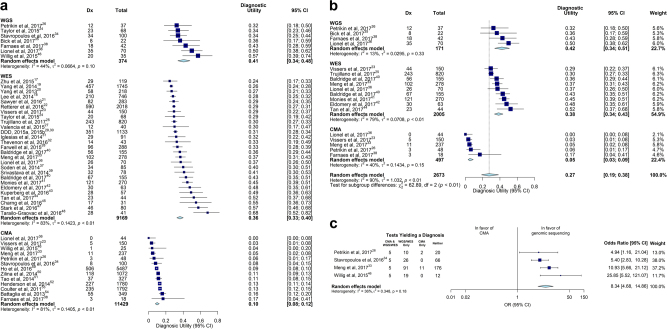
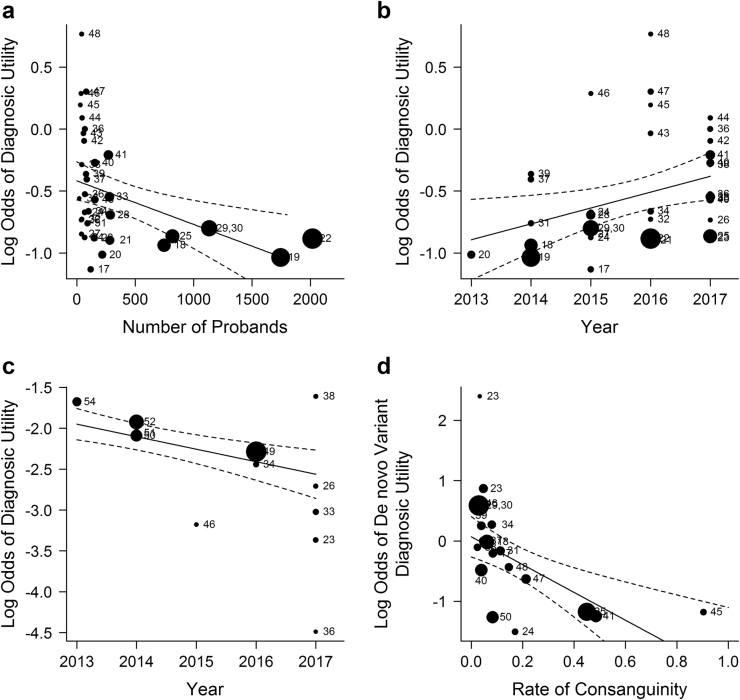
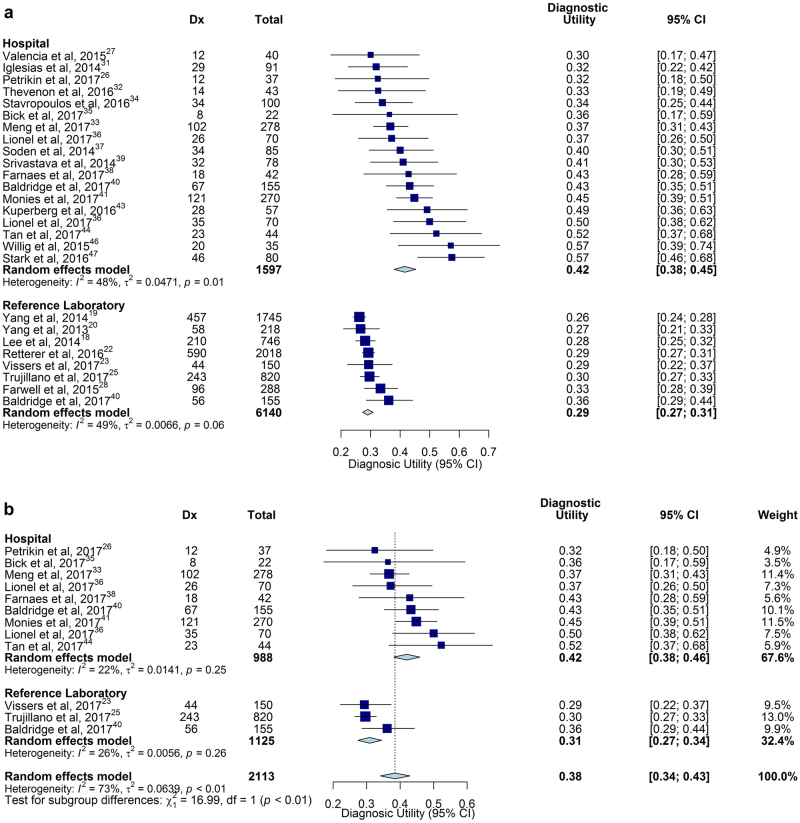
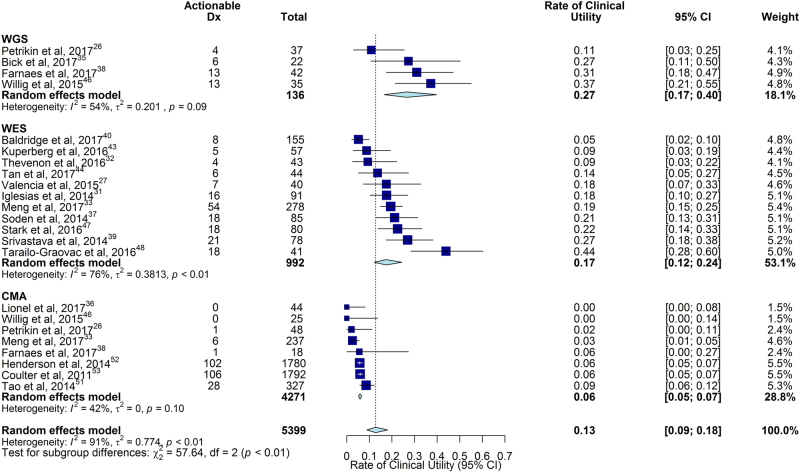
Genetic diseases are leading causes of childhood mortality. Whole-genome sequencing (WGS) and whole-exome sequencing (WES) are relatively new methods for diagnosing genetic diseases, whereas chromosomal microarray (CMA) is well established. Here we compared the diagnostic utility (rate of causative, pathogenic, or likely pathogenic genotypes in known disease genes) and clinical utility (proportion in whom medical or surgical management was changed by diagnosis) of WGS, WES, and CMA in children with suspected genetic diseases by systematic review of the literature (January 2011–August 2017) and meta-analysis, following MOOSE/PRISMA guidelines. In 37 studies, comprising 20,068 children, diagnostic utility of WGS (0.41, 95% CI 0.34–0.48, I 2 = 44%) and WES (0.36, 95% CI 0.33–0.40, I 2 = 83%) were qualitatively greater than CMA (0.10, 95% CI 0.08–0.12, I 2 = 81%). Among studies published in 2017, the diagnostic utility of WGS was significantly greater than CMA ( P < 0.0001, I 2 = 13% and I 2 = 40%, respectively). Among studies featuring within-cohort comparisons, the diagnostic utility of WES was significantly greater than CMA ( P < 0.001, I 2 = 36%). The diagnostic utility of WGS and WES were not significantly different. In studies featuring within-cohort comparisons of WGS/WES, the likelihood of diagnosis was significantly greater for trios than singletons (odds ratio 2.04, 95% CI 1.62–2.56, I 2 = 12%; P < 0.0001). Diagnostic utility of WGS/WES with hospital-based interpretation (0.42, 95% CI 0.38–0.45, I 2 = 48%) was qualitatively higher than that of reference laboratories (0.29, 95% CI 0.27–0.31, I 2 = 49%); this difference was significant among studies published in 2017 ( P < .0001, I 2 = 22% and I 2 = 26%, respectively). The clinical utility of WGS (0.27, 95% CI 0.17–0.40, I 2 = 54%) and WES (0.17, 95% CI 0.12–0.24, I 2 = 76%) were higher than CMA (0.06, 95% CI 0.05–0.07, I 2 = 42%); this difference was significant for WGS vs CMA ( P < 0.0001). In conclusion, in children with suspected genetic diseases, the diagnostic and clinical utility of WGS/WES were greater than CMA. Subgroups with higher WGS/WES diagnostic utility were trios and those receiving hospital-based interpretation. WGS/WES should be considered a first-line genomic test for children with suspected genetic diseases.
Overview
The claims and statistics of this paper haven’t been checked yet.
Free: it reads the open-access text and checks the first 5 claims that cite a source we can check. Create a free account to check every claim.
Integrity signals
Registry
Cites
Statistics
Figures

Verification
Claims the paper makes
The claims and statistics of this paper haven’t been checked yet.
Free: it reads the open-access text and checks the first 5 claims that cite a source we can check. Create a free account to check every claim.
Claims other papers make about this one
Each is checked against this paper’s own text: does it say what the citing paper says it does?
The source backs part of the claim, not all of it — or backs it for a different population, condition or comparison.
In the citing paper
“Molecular diagnostic laboratories typically use highly accurate DNA sequencing technologies to test for these types of rare pathogenic variants [3,4].”
From Assessing the analytical validity of SNP-chips for detecting very rare pathogenic variants: implications for direct-to-consumer genetic testing (2019) · cites this paper as [3]
Experimental — accuracy not yet measured
Self-check
Percentages, sums and reported differences re-computed from the paper’s own numbers.
The self-check needs the paper’s full text.
Citations
Cites
Quantifying heterogeneity in a meta‐analysis
Higgins, J. P. T., & Thompson, S. G. (2002) · Statistics in Medicine · doi:10.1002/sim.1186 · Cited by 36,763
Conducting Meta-Analyses in R with the metafor Package
Viechtbauer, W. (2010) · Journal of Statistical Software · doi:10.18637/jss.v036.i03 · Cited by 20,464
THE USE OF CONFIDENCE OR FIDUCIAL LIMITS ILLUSTRATED IN THE CASE OF THE BINOMIAL
CLOPPER, C. J., & PEARSON, E. S. (1934) · Biometrika · doi:10.1093/biomet/26.4.404 · Cited by 5,003
Miller, D. T., Adam, M. P., Aradhya, S., Biesecker, L. G., Brothman, A. R., Carter, N. P., Church, D. M., Crolla, J. A., Eichler, E. E., Epstein, C. J., et al. (2010) · The American Journal of Human Genetics · doi:10.1016/j.ajhg.2010.04.006 · Cited by 2,882
Clinical Whole-Exome Sequencing for the Diagnosis of Mendelian Disorders
Yang, Y., Muzny, D. M., Reid, J. G., Bainbridge, M. N., Willis, A., Ward, P. A., Braxton, A., Beuten, J., Xia, F., Niu, Z., et al. (2013) · New England Journal of Medicine · doi:10.1056/nejmoa1306555 · Cited by 1,964
THE COMPARISON OF PERCENTAGES IN MATCHED SAMPLES
COCHRAN, W. G. (1950) · Biometrika · doi:10.1093/biomet/37.3-4.256 · Cited by 1,465
Molecular Findings Among Patients Referred for Clinical Whole-Exome Sequencing
Yang, Y., Muzny, D. M., Xia, F., Niu, Z., Person, R., Ding, Y., Ward, P., Braxton, A., Wang, M., Buhay, C., et al. (2014) · JAMA · doi:10.1001/jama.2014.14601 · Cited by 1,360
Large-scale discovery of novel genetic causes of developmental disorders
Study, T. D. D. D. (2015) · Nature · doi:10.1038/nature14135 · Cited by 1,124
Clinical application of whole-exome sequencing across clinical indications
Retterer, K., Juusola, J., Cho, M. T., Vitazka, P., Millan, F., Gibellini, F., Vertino-Bell, A., Smaoui, N., Neidich, J., Monaghan, K. G., et al. (2016) · Genetics in Medicine · doi:10.1038/gim.2015.148 · Cited by 1,035
Clinical Exome Sequencing for Genetic Identification of Rare Mendelian Disorders
Lee, H., Deignan, J. L., Dorrani, N., Strom, S. P., Kantarci, S., Quintero-Rivera, F., Das, K., Toy, T., Harry, B., Yourshaw, M., et al. (2014) · JAMA · doi:10.1001/jama.2014.14604 · Cited by 973
Research works printed but not linked: 1
- Schwarzer, G. meta: an R package for meta-analysis. R. News 7, 40–45 (2007).
Cited by
Manickam, K., McClain, M. R., Demmer, L. A., Biswas, S., Kearney, H. M., Malinowski, J., Massingham, L. J., Miller, D., Yu, T. W., & Hisama, F. M. (2021) · Genetics in Medicine · doi:10.1038/s41436-021-01242-6 · Cited by 639
Neurodevelopmental Disorders: From Genetics to Functional Pathways
Parenti, I., Rabaneda, L. G., Schoen, H., & Novarino, G. (2020) · Trends in Neurosciences · doi:10.1016/j.tins.2020.05.004 · Cited by 618
“whole-exome sequencing (WES) is preferred as a diagnostic tool to the more informative whole-genome sequencing [115,116].”
MethodA guide for the diagnosis of rare and undiagnosed disease: beyond the exome
Marwaha, S., Knowles, J. W., & Ashley, E. A. (2022) · Genome Medicine · doi:10.1186/s13073-022-01026-w · Cited by 359
Kingsmore, S. F., Cakici, J. A., Clark, M. M., Gaughran, M., Feddock, M., Batalov, S., Bainbridge, M. N., Carroll, J., Caylor, S. A., Clarke, C., et al. (2019) · The American Journal of Human Genetics · doi:10.1016/j.ajhg.2019.08.009 · Cited by 352
“0001).(51) A likely explanation of the disparity in results herein was the difference in experimental design: herein, trios were used to confirm phasing and de novo occurrence of likely causative variants detected by singleton sequencing, but not in the other studies.”
ResultSelf-citationGA4GH: International policies and standards for data sharing across genomic research and healthcare
Rehm, H. L., Page, A. J. H., Smith, L., Adams, J. B., Alterovitz, G., Babb, L. J., Barkley, M. P., Baudis, M., Beauvais, M. J. S., Beck, T., et al. (2021) · Cell Genomics · doi:10.1016/j.xgen.2021.100029 · Cited by 311
Clark, M. M., Hildreth, A., Batalov, S., Ding, Y., Chowdhury, S., Watkins, K., Ellsworth, K., Camp, B., Kint, C. I., Yacoubian, C., et al. (2019) · Science Translational Medicine · doi:10.1126/scitranslmed.aat6177 · Cited by 300
Self-citationDimmock, D., Caylor, S., Waldman, B., Benson, W., Ashburner, C., Carmichael, J. L., Carroll, J., Cham, E., Chowdhury, S., Cleary, J., et al. (2021) · The American Journal of Human Genetics · doi:10.1016/j.ajhg.2021.05.008 · Cited by 259
Self-citationMellis, R., Oprych, K., Scotchman, E., Hill, M., & Chitty, L. S. (2022) · Prenatal Diagnosis · doi:10.1002/pd.6115 · Cited by 238
Expanding the Boundaries of RNA Sequencing as a Diagnostic Tool for Rare Mendelian Disease
Gonorazky, H. D., Naumenko, S., Ramani, A. K., Nelakuditi, V., Mashouri, P., Wang, P., Kao, D., Ohri, K., Viththiyapaskaran, S., Tarnopolsky, M. A., et al. (2019) · The American Journal of Human Genetics · doi:10.1016/j.ajhg.2019.01.012 · Cited by 236
Diagnostic utility of transcriptome sequencing for rare Mendelian diseases
Lee, H., Huang, A. Y., Wang, L.-K., Yoon, A. J., Renteria, G., Eskin, A., Signer, R. H., Dorrani, N., Nieves-Rodriguez, S., Wan, J., et al. (2020) · Genetics in Medicine · doi:10.1038/s41436-019-0672-1 · Cited by 224
Genetic Testing in Neurodevelopmental Disorders
Savatt, J. M., & Myers, S. M. (2021) · Frontiers in Pediatrics · doi:10.3389/fped.2021.526779 · Cited by 220
“Several studies suggest that the diagnostic yield of ES is higher when trios (probands and parents) are tested than when only the DNA of probands is sequenced (139, 140, 147).”
BackgroundGenomic newborn screening for rare diseases
Stark, Z., & Scott, R. H. (2023) · Nature Reviews Genetics · doi:10.1038/s41576-023-00621-w · Cited by 223
Self-citationClinical implementation of RNA sequencing for Mendelian disease diagnostics
Yépez, V. A., Gusic, M., Kopajtich, R., Mertes, C., Smith, N. H., Alston, C. L., Ban, R., Beblo, S., Berutti, R., Blessing, H., et al. (2022) · Genome Medicine · doi:10.1186/s13073-022-01019-9 · Cited by 209
“Although whole genome sequencing (WGS) allows, in principle, the detection of all genomic variants, its clinical implementation has reported similar diagnostic rates to those of WES [13, 14].”
ResultExpanding the Boundaries of RNA Sequencing as a Diagnostic Tool for Rare Mendelian Disease
Gonorazky, H. D., Naumenko, S., Ramani, A. K., Nelakuditi, V., Mashouri, P., Wang, P., Kao, D., Ohri, K., Viththiyapaskaran, S., Tarnopolsky, M. A., et al. (2019) · The American Journal of Human Genetics · doi:10.1016/j.ajhg.2019.04.004 · Cited by 204
A Diagnosis for All Rare Genetic Diseases: The Horizon and the Next Frontiers
Boycott, K. M., Hartley, T., Biesecker, L. G., Gibbs, R. A., Innes, A. M., Riess, O., Belmont, J., Dunwoodie, S. L., Jojic, N., Lassmann, T., et al. (2019) · Cell · doi:10.1016/j.cell.2019.02.040 · Cited by 177
Dimmock, D. P., Clark, M. M., Gaughran, M., Cakici, J. A., Caylor, S. A., Clarke, C., Feddock, M., Chowdhury, S., Salz, L., Cheung, C., et al. (2020) · The American Journal of Human Genetics · doi:10.1016/j.ajhg.2020.10.003 · Cited by 189
Self-citationWhole genome sequencing in clinical practice
Bagger, F. O., Borgwardt, L., Jespersen, A. S., Hansen, A. R., Bertelsen, B., Kodama, M., & Nielsen, F. C. (2024) · BMC Medical Genomics · doi:10.1186/s12920-024-01795-w · Cited by 178
“For children with healthy parents, a trio examination can be performed to identify pathogenic de novo heterozygous or compound heterozygous variants that are compatible with the clinical diagnosis [61].”
BackgroundKingsmore, S. F., Smith, L. D., Kunard, C. M., Bainbridge, M., Batalov, S., Benson, W., Blincow, E., Caylor, S., Chambers, C., Del Angel, G., et al. (2022) · The American Journal of Human Genetics · doi:10.1016/j.ajhg.2022.08.003 · Cited by 177
Self-citationRare disease emerging as a global public health priority
Chung, C. C. Y., Hong Kong Genome Project, Chu, A. T. W., & Chung, B. H. Y. (2022) · Frontiers in Public Health · doi:10.3389/fpubh.2022.1028545 · Cited by 170
Seo, G. H., Kim, T., Choi, I. H., Park, J., Lee, J., Kim, S., Won, D., Oh, A., Lee, Y., Choi, J., et al. (2020) · Clinical Genetics · doi:10.1111/cge.13848 · Cited by 172
De La Vega, F. M., Chowdhury, S., Moore, B., Frise, E., McCarthy, J., Hernandez, E. J., Wong, T., James, K., Guidugli, L., Agrawal, P. B., et al. (2021) · Genome Medicine · doi:10.1186/s13073-021-00965-0 · Cited by 172
Self-citationBest practices for the interpretation and reporting of clinical whole genome sequencing
Austin-Tse, C. A., Jobanputra, V., Perry, D. L., Bick, D., Taft, R. J., Venner, E., Gibbs, R. A., Young, T., Barnett, S., Belmont, J. W., et al. (2022) · npj Genomic Medicine · doi:10.1038/s41525-022-00295-z · Cited by 159
Integrated multi-omics for rapid rare disease diagnosis on a national scale
Lunke, S., Bouffler, S. E., Patel, C. V., Sandaradura, S. A., Wilson, M., Pinner, J., Hunter, M. F., Barnett, C. P., Wallis, M., Kamien, B., et al. (2023) · Nature Medicine · doi:10.1038/s41591-023-02401-9 · Cited by 155
Self-citationRapid whole genome sequencing has clinical utility in children in the PICU
Sanford, E. F., Clark, M. M., Farnaes, L., Williams, M. R., Perry, J. C., Ingulli, E. G., Sweeney, N. M., Doshi, A., Gold, J. J., Briggs, B., et al. (2019) · Pediatric Critical Care Medicine · doi:10.1097/pcc.0000000000002056 · Cited by 150
“WES primarily examines exons, while WGS analyzes exons and approximately 90% of the genome (21).”
BackgroundInfluentialSelf-citationUhlig, H. H., Charbit‐Henrion, F., Kotlarz, D., Shouval, D. S., Schwerd, T., Strisciuglio, C., de Ridder, L., Limbergen, J. V., Macchi, M., Snapper, S. B., et al. (2020) · Journal of Pediatric Gastroenterology and Nutrition · doi:10.1097/mpg.0000000000003017 · Cited by 175
“In the context of exome-wide sequencing, analysis of patient and parents (family trios) has a higher discovery rate than singleton patients sequencing (20,22).”
Lindstrand, A., Eisfeldt, J., Pettersson, M., Carvalho, C. M. B., Kvarnung, M., Grigelioniené, G., Anderlid, B., Bjerin, O., Gustavsson, P., Hammarsjö, A., et al. (2019) · Genome Medicine · doi:10.1186/s13073-019-0675-1 · Cited by 166
“Discussion Previous studies have suggested that short-read WGS could be a first-level test in individuals with neurodevelopmental delay and intellectual disability [80].”
BackgroundRehder, C., Bean, L. J. H., Bick, D., Chao, E., Chung, W., Das, S., O’Daniel, J., Rehm, H., Shashi, V., & Vincent, L. M. (2021) · Genetics in Medicine · doi:10.1038/s41436-021-01139-4 · Cited by 141
Marshall, C. R., Chowdhury, S., Taft, R. J., Lebo, M. S., Buchan, J. G., Harrison, S. M., Rowsey, R. A., Klee, E. W., Liu, P., Worthey, E. A., et al. (2020) · npj Genomic Medicine · doi:10.1038/s41525-020-00154-9 · Cited by 168
Self-citationden Veyver, I. B. V., Chandler, N. J., Wilkins-Haug, L. E., Wapner, R. J., Chitty, L. S., & ISPD Board of Directors (2022) · Prenatal Diagnosis · doi:10.1002/pd.6157 · Cited by 138
Case for genome sequencing in infants and children with rare, undiagnosed or genetic diseases
Bick, D. P., Jones, M. C., Taylor, S. L., Taft, R. J., & Belmont, J. W. (2019) · Journal of Medical Genetics · doi:10.1136/jmedgenet-2019-106111 · Cited by 170
“43 Direct comparisons between the diagnostic yields of GS and ES are difficult to make as rates tend to vary based on a variety of factors including patient selection bias, clinical indication and the continual discovery of disease-causing variants (see table 1).”
Epilepsy-Related Voltage-Gated Sodium Channelopathies: A Review
Menezes, L. F. S., Júnior, E. F. S., Tibery, D. V., Carneiro, L. D. A., & Schwartz, E. F. (2020) · Frontiers in Pharmacology · doi:10.3389/fphar.2020.01276 · Cited by 156
“The use of gene panels and whole-exome sequencing (WES) provides a powerful tool to change the paradigm of genetic epilepsy diagnosis (Ng et al., 2010; Clark et al., 2018).”
MethodClinical impact of genomic testing in patients with suspected monogenic kidney disease
Jayasinghe, K., Stark, Z., Kerr, P. G., Gaff, C., Martyn, M. M., Whitlam, J., Creighton, B., Donaldson, E., Hunter, M. F., Jarmolowicz, A. I., et al. (2020) · Genetics in Medicine · doi:10.1038/s41436-020-00963-4 · Cited by 131
Self-citationBeyond the exome: What’s next in diagnostic testing for Mendelian conditions
Wojcik, M. H., Reuter, C. M., Marwaha, S., Mahmoud, M., Duyzend, M., Barseghyan, H., Yuan, B., Boone, P. M., Groopman, E., Délot, E. C., et al. (2023) · The American Journal of Human Genetics · doi:10.1016/j.ajhg.2023.06.009 · Cited by 156
Bertoli‐Avella, A. M., Beetz, C., Ameziane, N., Rocha, M. E., Moreno, P. G., Pereira, C., Calvo, M., Ordonez‐Herrera, N., Castell, M. S., Diego‐Álvarez, D., et al. (2020) · European Journal of Human Genetics · doi:10.1038/s41431-020-00713-9 · Cited by 138
“In reported cohorts with ES requested, genetic diagnosis was reached in ~30% of the patients [1, 16], with only the most complex cases remaining undiagnosed and suggesting further GS testing.”
BackgroundResultInfluentialWhole exome and genome sequencing in mendelian disorders: a diagnostic and health economic analysis
Ewans, L., Minoche, A. E., SCHOFIELD, D. J., Shrestha, R. N., Puttick, C., Zhu, Y., Drew, A. P., Gayevskiy, V., Elakis, G., Walsh, C., et al. (2022) · European Journal of Human Genetics · doi:10.1038/s41431-022-01162-2 · Cited by 138
“Although there was a low detection rate of pathogenic SVs in this study, this may increase with time as more clinically important SVs are characterised and thus influence WGS diagnostic yields over WES [34, 35].”
BackgroundPrinciples of Genomic Newborn Screening Programs: A Systematic Review
Downie, L., Halliday, J. L., Lewis, S., & Amor, D. J. (2021) · JAMA Network Open · doi:10.1001/jamanetworkopen.2021.14336 · Cited by 121
Liu, Z., Zhu, L., Roberts, R. A., & Tong, W. (2019) · Trends in Genetics · doi:10.1016/j.tig.2019.08.006 · Cited by 129
“Furthermore, clinical utility could be increased by approximately 50%–80% from CMA to WES/WGS [14].”
BackgroundLimitations of exome sequencing in detecting rare and undiagnosed diseases
Burdick, K. J., Cogan, J. D., Rives, L. C., Robertson, A. K., Koziura, M. E., Brokamp, E., Duncan, L., Hannig, V., Pfotenhauer, J. P., Vanzo, R. J., et al. (2020) · American Journal of Medical Genetics Part A · doi:10.1002/ajmg.a.61558 · Cited by 128
“GS has greater breadth of coverage as well as detection of variants likely to affect protein function than ES and thus may be better equipped to identify and characterize NCV, CNV, inversions, and translocations (Belkadi et al., 2015; Clark et al., 2018; Kingsmore et al., 2019; Lelieveld, Spielmann, Mundlos, Veltman,…”
BackgroundThe clinical utility of exome and genome sequencing across clinical indications: a systematic review
Shickh, S., Mighton, C. E., Uleryk, E. M., Pechlivanoglou, P., & Bombard, Y. (2021) · Human Genetics · doi:10.1007/s00439-021-02331-x · Cited by 115
The expanding diagnostic toolbox for rare genetic diseases
Kernohan, K. D., & Boycott, K. M. (2024) · Nature Reviews Genetics · doi:10.1038/s41576-023-00683-w · Cited by 137
“There is emerging literature that questions this method compared with exome sequencing as a first-tier test 21 ; regardless, microarray remains a very valuable tool for suspected copy number variants (CNVs).”
seqr : A web‐based analysis and collaboration tool for rare disease genomics
Pais, L. S., Snow, H., Weisburd, B., Zhang, S., Baxter, S. M., DiTroia, S. P., O’Heir, E., England, E. M., Chao, K. R., Lemire, G., et al. (2022) · Human Mutation · doi:10.1002/humu.24366 · Cited by 135
“Many of these unsolved cases move into the research realm, where exome and genome sequencing have been shown to increase the diagnostic yield by identifying complex variants and novel causes of disease (Clark et al., 2018; Palmer et al., 2021).”
BackgroundHuman and mouse essentiality screens as a resource for disease gene discovery
Cacheiro, P., Muñoz-Fuentes, V., Murray, S. A., Dickinson, M. E., Bucan, M., Nutter, L. M. J., Peterson, K. A., Haselimashhadi, H., Flenniken, A. M., Morgan, H., et al. (2020) · Nature Communications · doi:10.1038/s41467-020-14284-2 · Cited by 106
“The diagnostic rate of large-scale, rare disease sequencing programmes ranges from 20% to 40% 31,43 , leaving the majority of patients without a diagnosis and with the associated personal, psycho-social and healthcare cost this entails.”
New Diagnostic Approaches for Undiagnosed Rare Genetic Diseases
Hartley, T., Lemire, G., Kernohan, K. D., Howley, H. E. A., Adams, D. R., & Boycott, K. M. (2020) · Annual Review of Genomics and Human Genetics · doi:10.1146/annurev-genom-083118-015345 · Cited by 117
Long-read sequencing for rare human genetic diseases
Mitsuhashi, S., & Matsumoto, N. (2019) · Journal of Human Genetics · doi:10.1038/s10038-019-0671-8 · Cited by 115
“approximately one-third of rare genetic diseases [3].”
ResultInfluentialMalinowski, J. R., Miller, D. T., Demmer, L., Gannon, J. L., Pereira, E. M., Schroeder, M. C., Scheuner, M. T., Tsai, A. C., Hickey, S. E., & Shen, J. (2020) · Genetics in Medicine · doi:10.1038/s41436-020-0771-z · Cited by 109
The performance of genome sequencing as a first-tier test for neurodevelopmental disorders
van der Sanden, B. P. G. H., Schobers, G., Corominas Galbany, J., Koolen, D. A., Sinnema, M., van Reeuwijk, J., Stumpel, C. T. R. M., Kleefstra, T., de Vries, B. B. A., Ruiterkamp-Versteeg, M., et al. (2023) · European Journal of Human Genetics · doi:10.1038/s41431-022-01185-9 · Cited by 97
Costain, G., Cordeiro, D., Matviychuk, D., & Mercimek‐Andrews, S. (2019) · Neuroscience · doi:10.1016/j.neuroscience.2019.08.016 · Cited by 101
The Role of Genome Sequencing in Neonatal Intensive Care Units
Kingsmore, S. F., & Cole, F. S. (2022) · Annual Review of Genomics and Human Genetics · doi:10.1146/annurev-genom-120921-103442 · Cited by 104
Self-citationAicher, J. K., Jewell, P., Vaquero-Garcia, J., Barash, Y., & Bhoj, E. J. K. (2020) · Genetics in Medicine · doi:10.1038/s41436-020-0780-y · Cited by 101
“1b): (1) the event is unquantifiable in the CAT due to low gene expression and/or sequencing depth, (2) the event is quantifiable but spliced differently, and (3) the event is quantifiable and not spliced differently.”
BackgroundMethodGenome Sequencing as a Diagnostic Test in Children With Unexplained Medical Complexity
Costain, G., Walker, S., Marano, M. M., Veenma, D. C. M., Snell, M., Curtis, M., Luca, S., Buera, J., Arje, D., Reuter, M. S., et al. (2020) · JAMA Network Open · doi:10.1001/jamanetworkopen.2020.18109 · Cited by 97
Chung, C. C. Y., Hue, S. P. Y., Ng, N. Y. T., Doong, P. H. L., Chu, A. T.-W., & Chung, B. H. (2023) · Genetics in Medicine · doi:10.1016/j.gim.2023.100896 · Cited by 113
Rapid genomic sequencing for genetic disease diagnosis and therapy in intensive care units: a review
Kingsmore, S. F., Nofsinger, R. R., & Ellsworth, K. (2024) · npj Genomic Medicine · doi:10.1038/s41525-024-00404-0 · Cited by 104
“When available, trio evaluation enables facile identi fi cation of variants that occurreddenovoand,inrecessivedisorders,whetherheterozygousvariants are in cis orintransin probandswhichresultsina slightly higherdiagnostic yield when trios are available 49 .”
BackgroundInfluentialSelf-citationQuinodoz, M., Peter, V. G., Cisarova, K. V., Royer‐Bertrand, B., Stenson, P. D., Cooper, D. N., Unger, S., Superti‐Furga, A., & Rivolta, C. (2022) · The American Journal of Human Genetics · doi:10.1016/j.ajhg.2022.01.006 · Cited by 98
“18,19 Next generation sequencing (NGS) is now being applied routinely in clinical diagnostic settings, 20 making the prediction of pathogenic DNA variants, and particularly of missense variants, a crucial element not only for medical research, but also in the context of patient diagnosis and…”
BackgroundGeoffroy, V., Guignard, T., Kress, A., Gaillard, J., Solli-Nowlan, T., Schalk, A., Gâtinois, V., Dollfus, H., Scheidecker, S., & Muller, J. (2021) · Nucleic Acids Research · doi:10.1093/nar/gkab402 · Cited by 113
“Current sequencing techniques encompassing targeted (panel and whole exome) and whole genome sequencing (WGS) but also array technologies are identifying tremendous amount of human variations (1,2).”
BackgroundFung, J. L. F., Yu, M. H. C., Huang, S., Chung, C. C. Y., Chan, M. C. Y., Pajusalu, S., Mak, C. C. Y., Hui, V. C. C., Tsang, M. H., Yeung, K. S., et al. (2020) · npj Genomic Medicine · doi:10.1038/s41525-020-00144-x · Cited by 107
Clinical utility of genomic sequencing: a measurement toolkit
Hayeems, R. Z., Dimmock, D., Bick, D. P., Belmont, J. W., Green, R. C., Lanpher, B. C., Jobanputra, V., Mendoza‐Londono, R., Kulkarni, S., Grove, M. E., et al. (2020) · npj Genomic Medicine · doi:10.1038/s41525-020-00164-7 · Cited by 102
Self-citationKerkhof, J., Rastin, C., Levy, M. A., Relator, R., McConkey, H., Demain, L. A. M., Domínguez‐Garrido, E., Kaat, L. D., Douzgou, S., DuPont, B. R., et al. (2024) · Genetics in Medicine · doi:10.1016/j.gim.2024.101075 · Cited by 91
Ending the Diagnostic Odyssey—Is Whole-Genome Sequencing the Answer?
Wu, A. C., McMahon, P. M., & Lu, C. Y. (2020) · Archives of Pediatrics and Adolescent Medicine · doi:10.1001/jamapediatrics.2020.1522 · Cited by 79
Improving diagnostics of rare genetic diseases with NGS approaches
Vinkšel, M., Writzl, K., Maver, A., & Peterlin, B. (2021) · Journal of Community Genetics · doi:10.1007/s12687-020-00500-5 · Cited by 99
Rapid Whole-Exome Sequencing as a Diagnostic Tool in a Neonatal/Pediatric Intensive Care Unit
Śmigiel, R. S., Biela, M., Szmyd, K., Błoch, M., Szmida, E., Skiba, P., Walczak, A., Gasperowicz, P., Kosińska, J., Rydzanicz, M., et al. (2020) · Journal of Clinical Medicine · doi:10.3390/jcm9072220 · Cited by 89
Clinical Genetic Screening in Adult Patients with Kidney Disease
Cocchi, E., Nestor, J. G., & Gharavi, A. G. (2020) · Clinical Journal of the American Society of Nephrology · doi:10.2215/cjn.15141219 · Cited by 85
Genetic testing for kidney disease of unknown etiology
Hays, T., Groopman, E., & Gharavi, A. G. (2020) · Kidney International · doi:10.1016/j.kint.2020.03.031 · Cited by 76
Stenton, S. L., Kremer, L. S., Kopajtich, R., Ludwig, C., & Prokisch, H. (2019) · Journal of Inherited Metabolic Disease · doi:10.1002/jimd.12130 · Cited by 83
“However, interpretation is often hindered by difficulty in prioritization of the vast numbers of variants detected and our incomplete understanding of the noncoding sequence, and so the diagnostic yield is only modestly increased to just over 40% by WGS.(1) Furthermore, a number of indels, somatic mutations, structura…”
BackgroundInfluentialCenters for Mendelian Genomics: A decade of facilitating gene discovery
Baxter, S. M., Posey, J. E., Lake, N. J., Sobreira, N. L. D. M., Chong, J. X., Buyske, S. G., Blue, E., Chadwick, L. H., Coban‐Akdemir, Z., Doheny, K. F., et al. (2022) · Genetics in Medicine · doi:10.1016/j.gim.2021.12.005 · Cited by 78
Similuk, M. N., Yan, J., Ghosh, R., Oler, A. J., Franco, L. M., Setzer, M. R., Kamen, M. J., Jodarski, C., DiMaggio, T., Davis, J., et al. (2022) · Journal of Allergy and Clinical Immunology · doi:10.1016/j.jaci.2022.06.009 · Cited by 81
Genomic Diagnosis for Pediatric Disorders: Revolution and Evolution
Lalonde, E., Rentas, S., Lin, F., Dulik, M. C., Skraban, C. M., & Spinner, N. B. (2020) · Frontiers in Pediatrics · doi:10.3389/fped.2020.00373 · Cited by 81
“The puzzle of their inheritance was solved in 1991, when cloning of the disease genes showed that these disorders were linked to repeat expansions in the corresponding genes (74, 75).”
BackgroundInfluentialChung, C. C. Y., Leung, G. K. C., Mak, C. C. Y., Fung, J. L. F., Lee, M., Pei, S. L. C., Yu, M. H. C., Hui, V. C. C., Chan, J. C. K., Chau, J. F. T., et al. (2020) · The Lancet Regional Health - Western Pacific · doi:10.1016/j.lanwpc.2020.100001 · Cited by 71
“Most studies included a small number of patients being offered rWES or rWGS (n < 50), with a focus on (i) infants younger than one year of age; and/ or (ii) patients recruited from intensive care units, with inadequate information on management implications and the associated costs.”
BackgroundInfluentialPhenotype‐driven approaches to enhance variant prioritization and diagnosis of rare disease
Jacobsen, J. O. B., Kelly, C., Cipriani, V., Research Consortium, G. E., Mungall, C. J., Reese, J., Danis, D., Robinson, P. N., & Smedley, D. (2022) · Human Mutation · doi:10.1002/humu.24380 · Cited by 70
“Despite these successes, the causative mutations in the genomes of the majority of patients remain undetected after WES or WGS with diagnostics yields of 25% – 50% (Clark et al., 2018; de Ligt et al., 2012; Rauch et al., 2012; Tammimies et al., 2015; Y. Yang et al., 2013, 2014; Zhu et al., 2015).”
BackgroundIdentification of Neuropsychiatric Copy Number Variants in a Health Care System Population
Martin, C. L., Wain, K. E., Oetjens, M. T., Tolwinski, K., Palen, E., Hare-Harris, A. E., Habegger, L., Maxwell, E. K., Reid, J. G., Walsh, L. K., et al. (2020) · JAMA Psychiatry · doi:10.1001/jamapsychiatry.2020.2159 · Cited by 77
Use of Whole-Genome Sequencing for Mitochondrial Disease Diagnosis
Davis, R. L., Kumar, K. R., Puttick, C., Liang, C., Ahmad, K. E., Edema‐Hildebrand, F., Park, J., Minoche, A. E., Gayevskiy, V., Mallawaarachchi, A. C., et al. (2022) · Neurology · doi:10.1212/wnl.0000000000200745 · Cited by 80
“Where parents can be recruited, trio analysis of WGS may further increase the diagnostic yield through improved filtering of autosomal recessive or de novo nuclear disorders.(52) However, this is often challenging with adult patients with MD, and familial segregation studies may be the only option, although these can…”
BackgroundChildren’s rare disease cohorts: an integrative research and clinical genomics initiative
Rockowitz, S., LeCompte, N., Carmack, M. M., Quitadamo, A., Wang, L., Park, M., Knight, D., Sexton, E. L., Smith, L. A., Sheidley, B. R., et al. (2020) · npj Genomic Medicine · doi:10.1038/s41525-020-0137-0 · Cited by 77
Nurchis, M. C., Radio, F. C., Salmasi, L., Alizadeh, A. H., Raspolini, G. M., Altamura, G., Tartaglia, M., Dallapiccola, B., Pizzo, E., Gianino, M. M., et al. (2024) · JAMA Network Open · doi:10.1001/jamanetworkopen.2023.53514 · Cited by 67
Li, Q., Ren, Z., Cao, K., Li, M. M., Wang, K., & Zhou, Y. (2022) · Science Advances · doi:10.1126/sciadv.abj1624 · Cited by 66
Long-read genome sequencing for the molecular diagnosis of neurodevelopmental disorders
Hiatt, S. M., Lawlor, J. M. J., Handley, L. H., Ramaker, R. C., Rogers, B. B., Partridge, E. C., Boston, L. B., Williams, M., Plott, C. B., Jenkins, J., et al. (2021) · Human Genetics and Genomics Advances · doi:10.1016/j.xhgg.2021.100023 · Cited by 65
“However, while discovery power and diagnostic yield of genomic testing have consistently improved over time,(4) most NDDs cannot be attributed to currently detectable genetic variation.(5) There are a variety of hypotheses that might explain the fact that most NDDs cannot be traced to a causal genetic variant after ES…”
Sharo, A. G., Hu, Z., Sunyaev, S. R., & Brenner, S. E. (2022) · The American Journal of Human Genetics · doi:10.1016/j.ajhg.2021.12.007 · Cited by 71
“Although we expect a small fraction of these unlabeled SVs are pathogenic, we made two 220 assumptions that mitigated this issue: (1) pathogenic SVs have been depleted by selection so 221 the large majority of unlabeled SVs are benign, and (2) the fraction of truly pathogenic SVs in 222 the pathogenic and benign train…”
BackgroundNurchis, M. C., Altamura, G., Riccardi, M. T., Radio, F. C., Chillemi, G., Bertini, E. S., Garlasco, J., Tartaglia, M., Dallapiccola, B., & Damiani, G. (2023) · Archives of Public Health · doi:10.1186/s13690-023-01112-4 · Cited by 65
SCHOFIELD, D. J., Rynehart, L., Shresthra, R., White, S. M., & Stark, Z. (2019) · Genetics in Medicine · doi:10.1038/s41436-019-0534-x · Cited by 64
Self-citationTan, T. Y., Lunke, S., Chong, B., Phelan, D., Fanjul‐Fernández, M., Marum, J. E., Kumar, V. S., Stark, Z., Yeung, A., Brown, N. J., et al. (2019) · European Journal of Human Genetics · doi:10.1038/s41431-019-0471-9 · Cited by 78
Self-citationCongenital cataract: a guide to genetic and clinical management
Bell, S., Oluonye, N., Harding, P., & Moosajee, M. (2020) · Therapeutic Advances in Rare Disease · doi:10.1177/2633004020938061 · Cited by 68
Roth, T. L., & Marson, A. (2021) · Annual Review of Pathology Mechanisms of Disease · doi:10.1146/annurev-pathmechdis-012419-032626 · Cited by 79
Bertoli-Avella, A. M., Kandaswamy, K. K., Khan, S., Ordonez-Herrera, N., Tripolszki, K., Beetz, C., Rocha, M. E., Urzi, A., Hotakainen, R., Leubauer, A., et al. (2021) · Genetics in Medicine · doi:10.1038/s41436-021-01159-0 · Cited by 61
“1038/s41436-021-01159-0 INTRODUCTION More than half of patients with genetic diseases remain undiagnosed, even after conducting genome-wide diagnostic approaches, such as exome and genome sequencing.(1,2) Despite recent technological advances, the challenge of variant interpretation remains, in part due to the missing…”
Background(2020) · Europe PMC (PubMed Central) · Cited by 83
Dashnow, H., Pedersen, B. S., Hiatt, L., Brown, J., Beecroft, S. J., Ravenscroft, G., LaCroix, A. J., Lamont, P. J., Roxburgh, R. H., Rodrigues, M. J., et al. (2022) · Genome biology · doi:10.1186/s13059-022-02826-4 · Cited by 64
Diagnosing rare diseases after the exome
Frésard, L., & Montgomery, S. B. (2018) · Molecular Case Studies · doi:10.1101/mcs.a003392 · Cited by 75
“Regardless of DNA sequencing approach, it is estimated that the diagnostic rate using exome or genome sequencing is plateauing between 35% and 50% (Taylor et al. 2015; Wortmann et al. 2015; Clark et al. 2018; Powis et al. 2018).”
BackgroundGenetic Counseling in Neurodevelopmental Disorders
Blesson, A., & Cohen, J. S. (2019) · Cold Spring Harbor Perspectives in Medicine · doi:10.1101/cshperspect.a036533 · Cited by 72
“By partnering our genetics knowledge and counseling skills with the clinical expertise of these specialists, we can greatly increase access to genetic evaluation and testing for individuals with NDD. Finally, although further evidence is needed from studies of interventions in this population, research thus far has id…”
BackgroundInfluentialMaron, J. L., Kingsmore, S. F., Wigby, K. M., Chowdhury, S., Dimmock, D., Poindexter, B. B., Suhrie, K. R., Vockley, J., Diacovo, T. G., Gelb, B. D., et al. (2021) · Archives of Pediatrics and Adolescent Medicine · doi:10.1001/jamapediatrics.2020.5906 · Cited by 61
Self-citationThe Impact of Rapid Exome Sequencing on Medical Management of Critically Ill Children
Freed, A. S., Candadai, S. V. C., Sikes, M. C., Thies, J. M., Byers, H. M., Dines, J. N., Ndugga-Kabuye, M. K., Smith, M. B., Fogus, K., Mefford, H. C., et al. (2020) · The Journal of Pediatrics · doi:10.1016/j.jpeds.2020.06.020 · Cited by 60
Revealing hidden genetic diagnoses in the ocular anterior segment disorders
Ma, A. S., Yousoof, S., Grigg, J., Flaherty, M. P., Minoche, A. E., Cowley, M. J., Nash, B. M., Ho, G., Gayagay, T., Lai, T., et al. (2020) · Genetics in Medicine · doi:10.1038/s41436-020-0854-x · Cited by 58
Lowther, C., Valkanas, E., Giordano, J. L., Wang, H. Z., Currall, B., O’Keefe, K., Pierce‐Hoffman, E., Kurtas, N. E., Whelan, C. W., Hao, S. P., et al. (2023) · The American Journal of Human Genetics · doi:10.1016/j.ajhg.2023.07.010 · Cited by 74
Clinical utility of 24-h rapid trio-exome sequencing for critically ill infants
Wang, H., Qian, Y., Lu, Y., Qin, Q., Lü, G., Cheng, G., Zhang, P., Yang, L., Wu, B., & Zhou, W. (2020) · npj Genomic Medicine · doi:10.1038/s41525-020-0129-0 · Cited by 64
Prenatal phenotyping: A community effort to enhance the Human Phenotype Ontology
Dhombres, F., Morgan, P., Chaudhari, B. P., Filges, I., Sparks, T. N., Lapunzina, P. D., Roscioli, T., Agarwal, U., Aggarwal, S., Bénéteau, C., et al. (2022) · American Journal of Medical Genetics Part C Seminars in Medical Genetics · doi:10.1002/ajmg.c.31989 · Cited by 66
“Targeted exome testing on fetuses with a suspected skeletal dysplasia phenotype showed a diagnostic rate of 81% (Chandler et al., 2018), and in some cases ES/GS reduced morbidity and lowered inpatient costs (Clark et al., 2018; Farnaes et al., 2018; Talkowski et al., 2012; Warburton, 1991).”
BackgroundMarshall, C. R., Bick, D. P., Belmont, J. W., Taylor, S. L., Ashley, E. A., Dimmock, D., Jobanputra, V., Kearney, H. M., Kulkarni, S., & Rehm, H. L. (2020) · Genome Medicine · doi:10.1186/s13073-020-00748-z · Cited by 57
“Thus, establishing a precise molecular diagnosis can reduce costs by ending this diagnostic odyssey and, in many cases, aiding in medical management [3, 4].”
BackgroundSelf-citationMN, W., L, J., JW, H., KS, R., J, T., AT, H., & CF, W. (2021) · BMJ · doi:10.1136/bmj.n214 · Cited by 51
Application of full-genome analysis to diagnose rare monogenic disorders
Shieh, J. T. C., Penon‐Portmann, M., Wong, K. H. Y., Levy‐Sakin, M., Verghese, M., Slavotinek, A. M., Gallagher, R. C., Mendelsohn, B. A., Tenney, J., Beleford, D. T., et al. (2021) · npj Genomic Medicine · doi:10.1038/s41525-021-00241-5 · Cited by 65
“FGA solved three classes of cases where short-read sequencing or microarray analyses had previously failed to detect the causal variants: (1) cryptic heterozygous structural variants (e.”
BackgroundTrosman, J. R., Weldon, C. B., Slavotinek, A. M., Norton, M. E., Douglas, M. P., & Phillips, K. A. (2019) · Genetics in Medicine · doi:10.1038/s41436-019-0650-7 · Cited by 56
Li, C., Vandersluis, S., Holubowich, C., Ungar, W. J., Goh, E. S., Boycott, K. M., Sikich, N., Dhalla, I. A., & Ng, V. (2020) · Genetics in Medicine · doi:10.1038/s41436-020-01012-w · Cited by 59
Martínez‐Granero, F., Blanco‐Kelly, F., Sanchez-Jimeno, C., Ávila‐Fernández, A., Arteche‐López, A., Bustamante‐Aragonés, A., Rodilla, C., Rodríguez‐Pinilla, E., Riveiro-Álvarez, R., Swafiri, S. T., et al. (2021) · npj Genomic Medicine · doi:10.1038/s41525-021-00188-7 · Cited by 61
Encoding Clinical Data with the Human Phenotype Ontology for Computational Differential Diagnostics
Köhler, S., Øien, N. C., Buske, O. J., Groza, T., Jacobsen, J. O. B., McNamara, C., Vasilevsky, N., Carmody, L., Gourdine, J.-P. F., Gargano, M. A., et al. (2019) · Current Protocols in Human Genetics · doi:10.1002/cphg.92 · Cited by 65
“…increased our understanding of the spectrum associated with a large number of rare genetic syndromes, molecular diagnosis rates using NGS data are still low (25% to 50%; Clark et al., 2018; de Ligt et al., 2012; Rauch et al., 2012; Tammimies et al., 2015; Yang et al., 2013, 2014; Zhu et al., 2015).”
BackgroundGenome sequencing as a diagnostic test
Costain, G., Cohn, R. D., Scherer, S. W., & Marshall, C. R. (2021) · Canadian Medical Association Journal · doi:10.1503/cmaj.210549 · Cited by 54
Horowitz, C. R., Orlando, L. A., Slavotinek, A. M., Peterson, J. F., Angelo, F., Biesecker, B. B., Bonham, V. L., Cameron, L. D., Fullerton, S. M., Gelb, B. D., et al. (2019) · The American Journal of Human Genetics · doi:10.1016/j.ajhg.2019.04.006 · Cited by 53
Metadata
- Authors
- Clark, M. M., Stark, Z., Farnaes, L., Tan, T. Y., White, S. M., Dimmock, D., & Kingsmore, S. F.
- Affiliations
- Rady Children's Institute for Genomic Medicine (US)
- Murdoch Children's Research Institute (AU)
- University of California San Diego (US)
- The University of Melbourne (AU)
- Corresponding author
- Kingsmore, Stephen F.
- ORCID
- Venue
- npj Genomic Medicine
- Published
- 2018-07-09
- Volume
- 3
- Issue
- 1
- Pages
- 16-16
- ISSN
- 2056-7944 (ISSN-L)
- PMC
- PMC6037748
- OpenAlex
- W2805193585
- Semantic Scholar
- 083457862bf6abd6c563d1b8fec514c3f4e4a779
- Cited by
- 619
- References
- 74
- Citations by year
- 2026: 49 · 2025: 74 · 2024: 80 · 2023: 83 · 2022: 100 · 2021: 98 · 2020: 83 · 2019: 44 · 2018: 6
- FWCI
- 7.96
- Type
- journal article
- Language
- en
- Open access
- gold
- doi.org
- Licence
- cc-by
- creativecommons.org/licenses/by/4.0 (tdm)
- creativecommons.org/licenses/by/4.0 (vor)
- Locations
- npj Genomic Medicine (publishedVersion, cc-by)
- bioRxiv (Cold Spring Harbor Laboratory) (acceptedVersion, cc-by-nd)
- Europe PMC (PubMed Central) (publishedVersion, other-oa)
- PubMed Central (publishedVersion, cc-by)
- PubMed (publishedVersion)
- DOAJ (DOAJ: Directory of Open Access Journals) (submittedVersion)
- Minerva Access (University of Melbourne) (submittedVersion, cc-by)
- Funders
- National Human Genome Research Institute
- Eunice Kennedy Shriver National Institute of Child Health and Human Development (U19HD077693)
- Topics
- Life Sciences › Biochemistry, Genetics and Molecular Biology › Genetics › Genomics and Rare Diseases
- Health Sciences › Medicine › Pediatrics, Perinatology and Child Health › Prenatal Screening and Diagnostics
- Life Sciences › Biochemistry, Genetics and Molecular Biology › Genetics › Genomic variations and chromosomal abnormalities
- Keywords
- whole genome sequencing, exome sequencing, chromosomal microarray analysis, genetic diagnosis, diagnostic yield, clinical utility, genetic interpretation, pathogenic variants, pediatric genetics, rare genetic disorders
About these checks
Registry, retraction, Cites and statistics results are computed, not judged, with one exception: a printed reference that no index lists is read once by a model before it counts as a citation error. Claims are extracted by a model and kept only when their quote appears verbatim in the text; each cited source is then checked, with a model’s help, for whether it says what the claim relies on. Those verdicts can be wrong — read the claim’s quote and the cited source before relying on one.
Statistics and arithmetic are recomputed, not judged.
Confidence bands are shown only for fields calibrated on our annotated test set. None is calibrated yet, so no band is shown.
What counts as a claim ›How we measure confidence ›How we check this ›
Are you an author, or do you see a problem with this page? Request a review
Data sources
Bibliographic data: Semantic Scholar, OpenAlex, Crossref.
Contains information from the Semantic Scholar Academic Graph Datasets, made available under the ODC Attribution License (ODC-BY 1.0).
Semantic Scholar’s data is described in: Kinney, R., et al. (2023). The Semantic Scholar Open Data Platform. arXiv:2301.10140.
