

Meta-analysis of the diagnostic and clinical utility of genome and exome sequencing and chromosomal microarray in children with suspected genetic diseases
Open accessPublished version of a preprint
The DOI matches its Crossref record; 74 of the 74 references it cites were found in a registry or an index.
Abstract
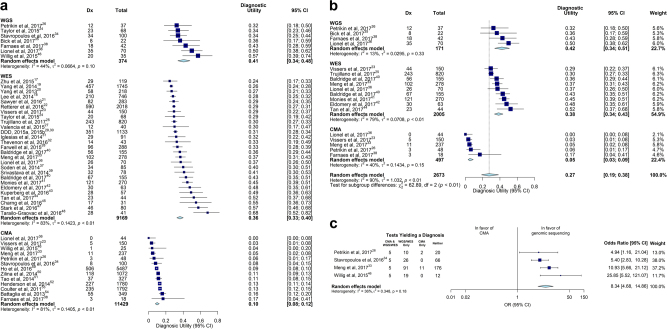
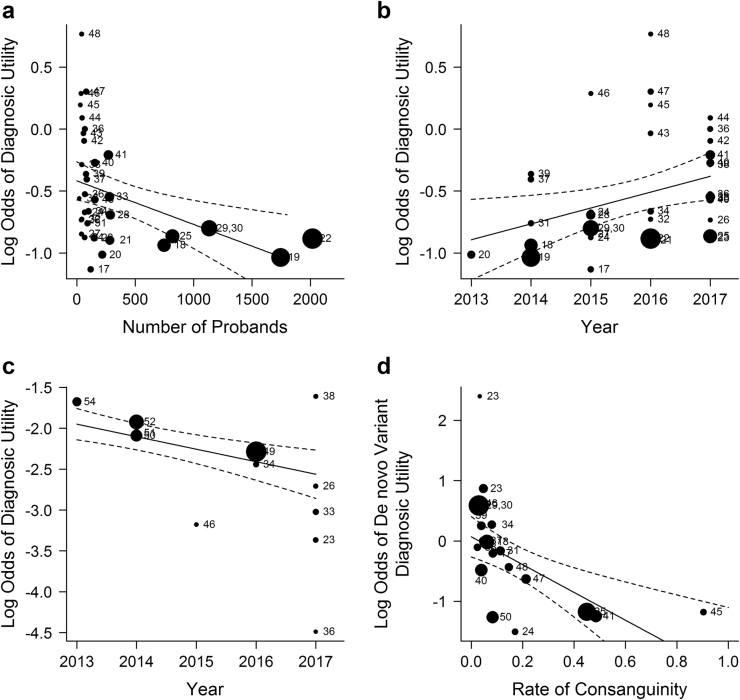
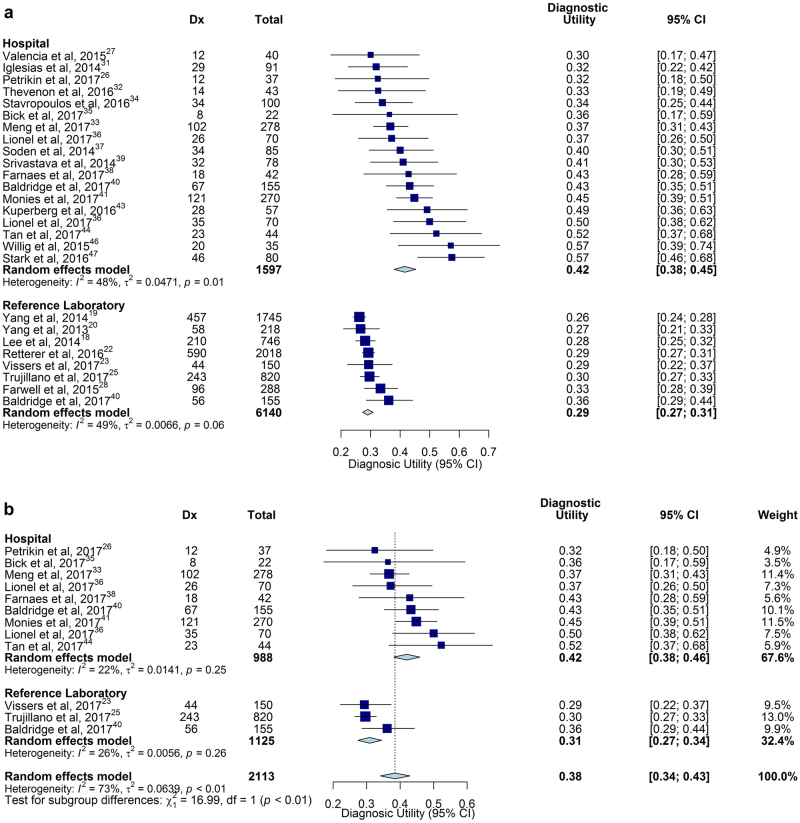
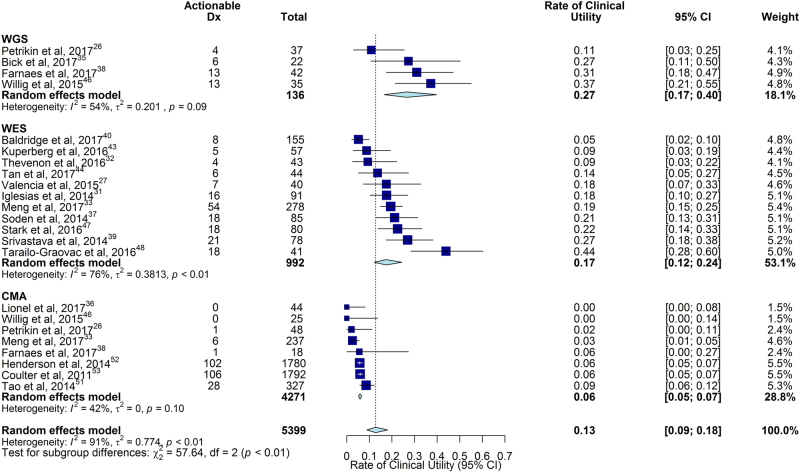
Genetic diseases are leading causes of childhood mortality. Whole-genome sequencing (WGS) and whole-exome sequencing (WES) are relatively new methods for diagnosing genetic diseases, whereas chromosomal microarray (CMA) is well established. Here we compared the diagnostic utility (rate of causative, pathogenic, or likely pathogenic genotypes in known disease genes) and clinical utility (proportion in whom medical or surgical management was changed by diagnosis) of WGS, WES, and CMA in children with suspected genetic diseases by systematic review of the literature (January 2011–August 2017) and meta-analysis, following MOOSE/PRISMA guidelines. In 37 studies, comprising 20,068 children, diagnostic utility of WGS (0.41, 95% CI 0.34–0.48, I 2 = 44%) and WES (0.36, 95% CI 0.33–0.40, I 2 = 83%) were qualitatively greater than CMA (0.10, 95% CI 0.08–0.12, I 2 = 81%). Among studies published in 2017, the diagnostic utility of WGS was significantly greater than CMA ( P < 0.0001, I 2 = 13% and I 2 = 40%, respectively). Among studies featuring within-cohort comparisons, the diagnostic utility of WES was significantly greater than CMA ( P < 0.001, I 2 = 36%). The diagnostic utility of WGS and WES were not significantly different. In studies featuring within-cohort comparisons of WGS/WES, the likelihood of diagnosis was significantly greater for trios than singletons (odds ratio 2.04, 95% CI 1.62–2.56, I 2 = 12%; P < 0.0001). Diagnostic utility of WGS/WES with hospital-based interpretation (0.42, 95% CI 0.38–0.45, I 2 = 48%) was qualitatively higher than that of reference laboratories (0.29, 95% CI 0.27–0.31, I 2 = 49%); this difference was significant among studies published in 2017 ( P < .0001, I 2 = 22% and I 2 = 26%, respectively). The clinical utility of WGS (0.27, 95% CI 0.17–0.40, I 2 = 54%) and WES (0.17, 95% CI 0.12–0.24, I 2 = 76%) were higher than CMA (0.06, 95% CI 0.05–0.07, I 2 = 42%); this difference was significant for WGS vs CMA ( P < 0.0001). In conclusion, in children with suspected genetic diseases, the diagnostic and clinical utility of WGS/WES were greater than CMA. Subgroups with higher WGS/WES diagnostic utility were trios and those receiving hospital-based interpretation. WGS/WES should be considered a first-line genomic test for children with suspected genetic diseases.
Overview
The claims and statistics of this paper haven’t been checked yet.
Free: it reads the open-access text and checks the first 5 claims that cite a source we can check. Create a free account to check every claim.
Integrity signals
Registry
Cites
Statistics
Figures

Verification
Claims the paper makes
The claims and statistics of this paper haven’t been checked yet.
Free: it reads the open-access text and checks the first 5 claims that cite a source we can check. Create a free account to check every claim.
Claims other papers make about this one
Each is checked against this paper’s own text: does it say what the citing paper says it does?
The source backs part of the claim, not all of it — or backs it for a different population, condition or comparison.
In the citing paper
“Molecular diagnostic laboratories typically use highly accurate DNA sequencing technologies to test for these types of rare pathogenic variants [3,4].”
From Assessing the analytical validity of SNP-chips for detecting very rare pathogenic variants: implications for direct-to-consumer genetic testing (2019) · cites this paper as [3]
Experimental — accuracy not yet measured
Self-check
Percentages, sums and reported differences re-computed from the paper’s own numbers.
The self-check needs the paper’s full text.
Citations
Cites
Quantifying heterogeneity in a meta‐analysis
Higgins, J. P. T., & Thompson, S. G. (2002) · Statistics in Medicine · doi:10.1002/sim.1186 · Cited by 36,763
Conducting Meta-Analyses in R with the metafor Package
Viechtbauer, W. (2010) · Journal of Statistical Software · doi:10.18637/jss.v036.i03 · Cited by 20,464
THE USE OF CONFIDENCE OR FIDUCIAL LIMITS ILLUSTRATED IN THE CASE OF THE BINOMIAL
CLOPPER, C. J., & PEARSON, E. S. (1934) · Biometrika · doi:10.1093/biomet/26.4.404 · Cited by 5,003
Miller, D. T., Adam, M. P., Aradhya, S., Biesecker, L. G., Brothman, A. R., Carter, N. P., Church, D. M., Crolla, J. A., Eichler, E. E., Epstein, C. J., et al. (2010) · The American Journal of Human Genetics · doi:10.1016/j.ajhg.2010.04.006 · Cited by 2,882
Clinical Whole-Exome Sequencing for the Diagnosis of Mendelian Disorders
Yang, Y., Muzny, D. M., Reid, J. G., Bainbridge, M. N., Willis, A., Ward, P. A., Braxton, A., Beuten, J., Xia, F., Niu, Z., et al. (2013) · New England Journal of Medicine · doi:10.1056/nejmoa1306555 · Cited by 1,964
THE COMPARISON OF PERCENTAGES IN MATCHED SAMPLES
COCHRAN, W. G. (1950) · Biometrika · doi:10.1093/biomet/37.3-4.256 · Cited by 1,465
Molecular Findings Among Patients Referred for Clinical Whole-Exome Sequencing
Yang, Y., Muzny, D. M., Xia, F., Niu, Z., Person, R., Ding, Y., Ward, P., Braxton, A., Wang, M., Buhay, C., et al. (2014) · JAMA · doi:10.1001/jama.2014.14601 · Cited by 1,360
Large-scale discovery of novel genetic causes of developmental disorders
Study, T. D. D. D. (2015) · Nature · doi:10.1038/nature14135 · Cited by 1,124
Clinical application of whole-exome sequencing across clinical indications
Retterer, K., Juusola, J., Cho, M. T., Vitazka, P., Millan, F., Gibellini, F., Vertino-Bell, A., Smaoui, N., Neidich, J., Monaghan, K. G., et al. (2016) · Genetics in Medicine · doi:10.1038/gim.2015.148 · Cited by 1,035
Clinical Exome Sequencing for Genetic Identification of Rare Mendelian Disorders
Lee, H., Deignan, J. L., Dorrani, N., Strom, S. P., Kantarci, S., Quintero-Rivera, F., Das, K., Toy, T., Harry, B., Yourshaw, M., et al. (2014) · JAMA · doi:10.1001/jama.2014.14604 · Cited by 973
Research works printed but not linked: 1
- Schwarzer, G. meta: an R package for meta-analysis. R. News 7, 40–45 (2007).
Cited by
Items 501–600 of 624
Update on Clinically Relevant Genetic Testing in Pediatric Dermatology
Boyd, K. P., Asumda, F. Z., & Hand, J. L. (2021) · Dermatologic Clinics · doi:10.1016/j.det.2021.08.001 · Cited by 1
秀芬, 李., 遲景上, & 啟仁, 蔡. (2020) · Developmental Medicine & Child Neurology · doi:10.1111/dmcn.14729
Vera, M., & Lin, H. J. (2021) · American Academy of PediatricsItasca, IL eBooks · doi:10.1542/9781610023733-20
Genome-Wide Sequencing In Clinical Genetic Counseling
Burroughs, B. (2021) · doi:10.15760/honors.1167
Freire, B. L. (2021) · Digital Library of Theses and Dissertations (Universidade de São Paulo) · doi:10.11606/t.5.2021.tde-07012022-092142
Gupta, S., Mathur, P., Mishra, A. K., Medicherla, K. M., Bandapalli, O. R., & Suravajhala, P. (2022) · SSRN Electronic Journal · doi:10.2139/ssrn.4000473
Séquençage du génome comme test diagnostique
Costain, G., Cohn, R. D., Scherer, S. W., & Marshall, C. R. (2022) · Canadian Medical Association Journal · doi:10.1503/cmaj.210549-f · Cited by 5
Botti, H., Naya, H., Méndez, S., Simoes, C., & Martufi, V. (2022) · Informatio · doi:10.35643/info.27.1.12 · Cited by 2
“Whole exome and genome sequencing (WES and WGS) technologies have been demonstrating their diagnostic potential, reducing costs and substantially shortening diagnostic times in rare diseases.”
BackgroundInfluentialGenomic Approaches for the Diagnosis of Inborn Errors of Metabolism
Stenton, S. L., Mayr, J. A., Wortmann, S. B., & Prokisch, H. (2022) · Springer eBooks · doi:10.1007/978-3-030-67727-5_9
Transforming paediatric practice by leveraging on genomic medicine
Koh, A., Jamuar, S. S., & Lai, A. (2021) · Singapore Medical Journal · doi:10.11622/smedj.2021072
Genomics screening of neonates
Kobayashi, E. S., & Hobbs, C. A. (2022) · Elsevier eBooks · doi:10.1016/b978-0-12-824010-6.00004-6
Bartsch, L. M. (2022) · eDiss (Georg-August-Universität Göttingen) · doi:10.53846/goediss-9438
Whole Genome Sequencing Will Reduce the Cost of Diagnostic Odyssey
Kang, D.-Y. (., & Terry, S. F. (2022) · Genetic Testing and Molecular Biomarkers · doi:10.1089/gtmb.2022.0200.persp
Implementation of Rapid Genome Sequencing for Infants with Congenital Heart DiseasePreprint
Hays, T., Hernan, R., Disco, M., Griffin, E., Goldshtrom, N., Vargas, D., Krishnamurthy, G., Rehman, A. U., Wilson, A. T., Guha, S., et al. (2022) · medRxiv · doi:10.1101/2022.12.16.22283479
Child with Global Developmental Delay
Flore, L. A., & Campbell, S. (2022) · Springer eBooks · doi:10.1007/978-3-031-10494-7_3
Genomic factors involved in neurodevelopment disorders
Ladino, A. M. F., & Giraldo, L. J. M. (2021) · Interdisciplinary Journal of Epidemiology and Public Health · doi:10.18041/2665-427x/ijeph.1.8638
Rare Diseases in the Genomic Health Care: Opportunities and Challenges in India
Datta, D. (2023) · Apollo Medicine · doi:10.4103/am.am_53_23
Unsolicited findings in next-generation sequencing: Hide or seek
van der Schoot, V. (2023) · Research Publications (Maastricht University) · doi:10.26481/dis.20230531vs
De novo RANBP2 variant in a fetal demise case with cerebral intraparenchymal hemorrhage
Meroni, A., Kalantari, S., Arossa, A., Spinillo, A., Melito, C., Scatigno, A. L., Cesari, S., Giorgio, E., Furione, M., Homfray, T., et al. (2023) · American Journal of Medical Genetics Part A · doi:10.1002/ajmg.a.63223
Economic evaluation of rare diseases and the diagnostic odyssey
Regier, D. A., Weymann, D., Cromwell, I., Ehman, M., & Pollard, S. (2023) · Elsevier eBooks · doi:10.1016/b978-0-12-813382-8.00001-x
Report of Two cases of Schaaf-Yang Syndrome: Same Genotype, Different PhenotypePreprint
Rodríguez, A., Schain, K., Jayakar, P., Wright, M. S., Chowdhury, S., & Salyakina, D. (2023) · doi:10.22541/au.168519429.95757984/v1
The Human Genome and Neonatal Care
Cotten, C. M. (2023) · Elsevier eBooks · doi:10.1016/b978-0-323-82823-9.00025-8
Estudo das bases genéticas da microcefalia sindrômica associada a distúrbios de neurodesenvolvimento
Tolezano, G. C. (2023) · Digital Library of Theses and Dissertations (Universidade de São Paulo) · doi:10.11606/t.41.2023.tde-23062023-134237
Bomback, M. J., Everett, S., Lyford, A., Sahni, R., Kim, F., Baptiste, C. D., Motelow, J. E., Tolia, V. N., Clark, R. H., & Hays, T. (2023) · medRxiv · doi:10.1101/2023.07.14.23292682 · Cited by 2
Gorzynski, J. E., Goenka, S. D., Ashley, E. A., & Jain, M. (2023) · Advances in Molecular Pathology · doi:10.1016/j.yamp.2023.08.002
Berkalieva, A., Kelly, N., Fisher, A., Hohmann, S. F., Sebastin, M., Biase, M. D., Bonini, K. E., Marathe, P. N., Odgis, J. A., Suckiel, S. A., et al. (2023) · Genetics in Medicine · doi:10.1016/j.gim.2023.101011
Seo, G. H., Lee, H., Lee, J., Han, H., Cho, Y. K., Kim, M., Choi, Y., Choi, J., Choi, I. H., Rhie, S., et al. (2022) · Figshare · doi:10.6084/m9.figshare.19445365
Seo, G. H., Lee, H., Lee, J., Han, H., Cho, Y. K., Kim, M., Choi, Y., Choi, J., Choi, I. H., Rhie, S., et al. (2022) · Figshare · doi:10.6084/m9.figshare.19445368
Seo, G. H., Lee, H., Lee, J., Han, H., Cho, Y. K., Kim, M., Choi, Y., Choi, J., Choi, I. H., Rhie, S., et al. (2022) · Figshare · doi:10.6084/m9.figshare.19445371
Seo, G. H., Lee, H., Lee, J., Han, H., Cho, Y. K., Kim, M., Choi, Y., Choi, J., Choi, I. H., Rhie, S., et al. (2022) · Figshare · doi:10.6084/m9.figshare.19445362
Manberg, S., & Butterfield, R. J. (2024) · Elsevier eBooks · doi:10.1016/b978-0-323-99417-0.00012-4
Techniques for genetic diagnosis: A practical guide
Ziegler, A. C., & Chung, W. K. (2024) · Elsevier eBooks · doi:10.1016/b978-0-323-99417-0.00005-7
Muscle weakness (genetic muscle diseases)
Lin, A. Y., & Wang, L. H. (2024) · Elsevier eBooks · doi:10.1016/b978-0-323-99417-0.00017-3
Slabá, K., Pokorná, P., Jugas, R., Pálová, H., Procházková, D., Aulická, Š., Danhofer, P., Horák, O., Tučková, J., Kleiblová, P., et al. (2024) · Research Square · doi:10.21203/rs.3.rs-4338921/v1
Meta-analysis of genome and predicted exome sequencing diagnostic yieldPreprint
Bergant, G., Maver, A., & Peterlin, B. (2024) · Research Square · doi:10.21203/rs.3.rs-4465187/v1
Peterson, B. D., Juarez, E. F., Moore, B., Hernandez, E. J., Frise, E., Li, J., Lussier, Y. A., Tristani‐Firouzi, M., Reese, M. G., Jenkins, S. M., et al. (2024) · medRxiv · doi:10.1101/2024.11.05.24316150
“An estimated one-fifth of NICU admissions involve Mendelian diseases, with WGS diagnostic yield commonly in the range of 25-50% 5–8 .”
BackgroundSelf-citationApproach to diagnosis and management of genetic neurodevelopmental disorders
Mo, A., Oanea, M., Cohen, J. S., Rodan, L. H., & Srivastava, S. (2024) · Elsevier eBooks · doi:10.1016/b978-0-12-824060-1.00002-x
Myers, S. M., & Challman, T. D. (2024) · Elsevier eBooks · doi:10.1016/b978-0-12-824060-1.00038-9
The informatics of developmental phenotypes
Schofield, P. N., Hoehndorf, R., Gkoutos, G. V., & Smith, C. L. (2024) · Elsevier eBooks · doi:10.1016/b978-0-443-23739-3.00012-2
Kirilova, L. G., Miroshnikov, О. О., Kharytonov, V., Dolenko, O. O., Badiuk, V. M., & Dyukareva-Bezdenezhnykh, S. V. (2025) · INTERNATIONAL NEUROLOGICAL JOURNAL · doi:10.22141/2224-0713.20.8.2024.1126
Li, R., Chu, H., Gao, K., Luo, H., & Jiang, Y. (2025) · Functional & Integrative Genomics · doi:10.1007/s10142-025-01534-z · Cited by 2
Shah, J., Mondal, D., Jain, D. K., Mhatre, P., Patel, K., Iyer, A., Pandya, M., Menghani, B., Dave, G., Sheth, J. J., et al. (2025) · Research Square · doi:10.21203/rs.3.rs-5950423/v1
The Importance of Prenatal Whole-Exome Sequencing Testing in the Romanian Population
Săbău, I.-D., Bohîlțea, L. C., Radoi, V. E., Bardan, A., Maioru, O., Țurcan, M., Suciu-Lazar, V., & Ceauşu, I. (2025) · Journal of Mind and Medical Sciences · doi:10.3390/jmms12010007 · Cited by 1
A decade of whole-exome sequencing in Brazilian Neurology: from past insights to future perspectives
Quaio, C. R. D. C., Silva, T. Y. T., Barsottini, O. G. P., Camargos, S., França, M. C., Saute, J. A. M., Marques, W., Kok, F., & Pedroso, J. L. (2025) · Arquivos de Neuro-Psiquiatria · doi:10.1055/s-0045-1807715 · Cited by 2
“17,18 It has been proven to be highly clinically useful, signi fi cantly impacting patient management and outcomes.”
Accurate detection of pathogenic structural variants guided by multi-platform comparisonPreprint
Alavi, N., Moeinzadeh, M.-H., Hertzberg, J., Melo, U. S., Raei, L. W. A., Infantino, P., Ghareghani, M., Savarese, M., Mundlos, S., & Vingron, M. (2025) · bioRxiv (Cold Spring Harbor Laboratory) · doi:10.1101/2025.05.21.655285 · Cited by 1
“Despite significant advances in our understanding of the human genome, the diagnostic rate for genetic diseases remains low, leaving many patients without a molecular diagnosis (Taylor et al., 2015; Wortmann et al., 2015; Clark et al., 2018; Powis et al., 2018).”
Attention-aware Rare Disease Diagnosis via Graph Attention Neural Network
Yang, X., He, D., Zhan, B., Zhang, Q., & Yan, S. (2024) · International Conference on Computational Biology and Bioinformatics (ICCBB) · doi:10.1145/3715020.3715060
“However, the average positive diagnostic rates of WES and WGS are only 36% and 41%[2], respectively, as the molecular mechanisms of many diseases remain unclear.”
Tandem splice acceptor sites: Profiling their relevance to human disease
Frost, F. G., Gu, S., Elbert, A., Huynh, S., Lee, H. K., Malicdan, M. C. V., Boerkoel, C. F., & Cherukuri, P. F. (2025) · Genetics in Medicine · doi:10.1016/j.gim.2025.101520
Profiling the developmental signatures of genetic global developmental delay
Metzler, M., Vesoulis, Z. A., & Wambach, J. (2025) · Pediatric Research · doi:10.1038/s41390-025-04268-7
“…cause GDD but may be missed with older techniques, with recent studies reporting diagnostic yields for GS of up to 61% for early childhood GDD. 7,13,14 PHENOTYPIC PROFILES, A KEY CONTRIBUTION Against this backdrop of improving clinical diagnostic sequencing tools, the authors compared the…”
Genetic Testing in the Neonate
D’Gama, A. M., & Agrawal, P. B. (2025) · Clinics in Perinatology · doi:10.1016/j.clp.2025.06.005 · Cited by 1
Is there a role for whole genome sequencing in idiopathic vocal fold immobility?
Florentine, M. M., Marvin, K., & Brigger, M. T. (2025) · International Journal of Pediatric Otorhinolaryngology · doi:10.1016/j.ijporl.2025.112493
Miguez, M. P., García‐Miñáur, S., del Pozo, Á., Suso, J. J. M., Alcalá, F. J. C., Holgado, M. S., García, P. Á., Rodríguez, C. J., Santos‐Simarro, F., & Palomares‐Bralo, M. (2025) · Anales de Pediatría · doi:10.1016/j.anpedi.2025.503956
Comparative analysis of WGS and WES for genetic diagnosis in a pediatric Albanian populationPreprint
Cullufi, P., Tabaku, M., Skrahin, A., Tomori, S., Velmishi, V., Dervishi, E., Hoxha, G., Gjikopulli, A., Troja, E., Tako, A., et al. (2025) · medRxiv · doi:10.1101/2025.07.24.25332056
Stanley, K. J., Chisholm, C., Gillespie, M. K., Caluseriu, O., del Signore, N., Elango, S., Hartley, T., Hewson, S., Kim, R. H., McSheffrey, G., et al. (2025) · BMJ Open · doi:10.1136/bmjopen-2025-107603
Progress, Challenges, and Prospects of Short‐Read Genome Sequencing in Prenatal Diagnosis
Wang, Y., Zhu, X., Gao, Z., & Xiangdong, K. (2025) · Birth Defects Research · doi:10.1002/bdr2.2516
Bajaj, S., Gandhi, S., Geetha, T. S., Venkata, M., Chitre, A., Sagi, N., Agrawal, N., Shah, S., Deo, R., Pai, S., et al. (2025) · Journal of Human Genetics · doi:10.1038/s10038-025-01368-4
Detección y manejo del retraso psicomotor en la infancia
Insuga, V. M. S., Alguacil, E. G., & Peñas, J. J. G. (2025) · Pediatría Integral · doi:10.63149/j.pedint.66 · Cited by 1
Chawner, S. J. R. A. (2025) · Frontiers in Psychiatry · doi:10.3389/fpsyt.2025.1627378
Miguez, M. P., García‐Miñáur, S., del Pozo, Á., Suso, J. J. M., Alcalá, F. J. C., Holgado, M. S., García, P. Á., Rodríguez, C. J., Santos‐Simarro, F., & Palomares‐Bralo, M. (2025) · Anales de Pediatría (English Edition) · doi:10.1016/j.anpede.2025.503956
Recent techniques and strategies for sequencing
Kumar, P., Kaur, H., Bishnoi, R., & Singla, D. (2025) · Elsevier eBooks · doi:10.1016/b978-0-443-21980-1.00005-x
Pulatov, O., Nguyen, W., Vega, D. A., & Barros, R. (2025) · Journal of Medical Case Reports · doi:10.1186/s13256-025-05675-4
“Cost-effectiveness analyses support whole genome sequencing as first-tier testing in complex neurodevelopmental disorders, demonstrating reduced overall healthcare costs through decreased diagnostic odyssey duration and earlier intervention implementation [22].”
Velluva, A., Radtke, M., Horn, S., Popp, B., Platzer, K., Gjermeni, E., Lin, C.-C., Lemke, J. R., Garten, A., Schöneberg, T., et al. (2021) · Figshare · doi:10.6084/m9.figshare.16946378
Raggio, V. E., Dell’Oca, N., Simoes, C., Tapié, A., Medici, C., Costa, G., Rodríguez, S., Greif, G., Garrone, E., Rovella, M. L., et al. (2021) · Figshare · doi:10.6084/m9.figshare.14570603
Dashnow, H., Pedersen, B. S., Hiatt, L., Brown, J., Beecroft, S. J., Ravenscroft, G., LaCroix, A. J., Lamont, P. J., Roxburgh, R. H., Rodrigues, M. J., et al. (2024) · Figshare · doi:10.6084/m9.figshare.26554481
Additional file 2 of Genome sequencing as a generic diagnostic strategy for rare disease
Schobers, G., Derks, R. C., den Ouden, A., Swinkels, H. L., van Reeuwijk, J., Bosgoed, E., Lugtenberg, D., Sun, S. M., Corominas, J., Weiss, M. M., et al. (2024) · Figshare · doi:10.6084/m9.figshare.25223922
Nurchis, M. C., Altamura, G., Riccardi, M. T., Radio, F. C., Chillemi, G., Bertini, E., Garlasco, J., Tartaglia, M., Dallapiccola, B., & Damiani, G. (2024) · Figshare · doi:10.6084/m9.figshare.26591855
Additional file 1 of An evaluation of GPT models for phenotype concept recognition
Groza, T., Caufield, H., Gration, D., Baynam, G. S., Haendel, M. A., Robinson, P. N., Mungall, C., & Reese, J. (2024) · Figshare · doi:10.6084/m9.figshare.26675171
Taft, R. J., Thorpe, E., Williams, T., Shaw, C., Chekalin, E., Ortega, J. L., Robinson, K., Button, J., Jones, M. C., Campo, M. D., et al. (2023) · Research Square · doi:10.21203/rs.3.rs-3117254/v1
Stenton, S. L., O’Leary, M., Lemire, G., VanNoy, G. E., DiTroia, S. P., Ganesh, V. S., Groopman, E., O’Heir, E., Mangilog, B. E., Osei‐Owusu, I., et al. (2024) · Figshare · doi:10.6084/m9.figshare.26713903
Additional file 1 of Genome sequencing as a generic diagnostic strategy for rare disease
Schobers, G., Derks, R. C., den Ouden, A., Swinkels, H. L., van Reeuwijk, J., Bosgoed, E., Lugtenberg, D., Sun, S. M., Corominas, J., Weiss, M. M., et al. (2024) · Figshare · doi:10.6084/m9.figshare.25223383
Nurchis, M. C., Altamura, G., Riccardi, M. T., Radio, F. C., Chillemi, G., Bertini, E., Garlasco, J., Tartaglia, M., Dallapiccola, B., & Damiani, G. (2024) · Figshare · doi:10.6084/m9.figshare.26591858
Félix, T. M., Fischinger Moura de Souza, C., Oliveira, J. B., Rico-Restrepo, M., Zanoteli, E., Zatz, M., & Giugliani, R. (2023) · Figshare · doi:10.6084/m9.figshare.22613387
Yang, Z., Yang, X., Sun, Y., Wang, Y., Song, L., Qiao, Z., Fang, Z., Wang, Z., Liu, L., Chen, Y., et al. (2024) · Figshare · doi:10.6084/m9.figshare.26580611
Velluva, A., Radtke, M., Horn, S., Popp, B., Platzer, K., Gjermeni, E., Lin, C.-C., Lemke, J. R., Garten, A., Schöneberg, T., et al. (2021) · Figshare · doi:10.6084/m9.figshare.16946384
Additional file 2 of Genetic heterogeneity of cardiomyopathy and its correlation with patient care
Kim, M. J., Cha, S., Baek, J. S., Yu, J. J., Seo, G. H., Kang, M., Do, H.-S., Lee, S. E., & Lee, B. H. (2024) · Figshare · doi:10.6084/m9.figshare.24465323
Liu, W., Liu, P., Guo, D., Jin, Y., Zhao, K., Zheng, J., Li, K., Li, L., & Zhang, S. (2023) · Figshare · doi:10.6084/m9.figshare.23930305
Stenton, S. L., O’Leary, M., Lemire, G., VanNoy, G. E., DiTroia, S. P., Ganesh, V. S., Groopman, E., O’Heir, E., Mangilog, B. E., Osei‐Owusu, I., et al. (2024) · Figshare · doi:10.6084/m9.figshare.26713900
Dashnow, H., Pedersen, B. S., Hiatt, L., Brown, J., Beecroft, S. J., Ravenscroft, G., LaCroix, A. J., Lamont, P. J., Roxburgh, R. H., Rodrigues, M. J., et al. (2024) · Figshare · doi:10.6084/m9.figshare.26554484
Additional file 1 of Genetic heterogeneity of cardiomyopathy and its correlation with patient care
Kim, M. J., Cha, S., Baek, J. S., Yu, J. J., Seo, G. H., Kang, M., Do, H.-S., Lee, S. E., & Lee, B. H. (2023) · Figshare · doi:10.6084/m9.figshare.24465076
Vega, F. M. D. L., Chowdhury, S., Moore, B., Frise, E., McCarthy, J. J., Hernandez, E. J., Wong, T., James, K. N., Guidugli, L., Agrawal, P. B., et al. (2021) · Figshare · doi:10.6084/m9.figshare.16807846
Self-citationAdditional file 3 of Genetic heterogeneity of cardiomyopathy and its correlation with patient care
Kim, M. J., Cha, S., Baek, J. S., Yu, J. J., Seo, G. H., Kang, M., Do, H.-S., Lee, S. E., & Lee, B. H. (2024) · Figshare · doi:10.6084/m9.figshare.26634030
Shim, Y., Yang, D. H., Eun, B., & Byeon, J. H. (2025) · Annals of Child Neurology · doi:10.26815/acn.2025.01060
Rinčić, M., Kopić, J., Klein, V., Krsnik, Ž., Liehr, T., Gießelmann, S., Kurth, I., & Kraft, F. (2026) · Molecular Medicine · doi:10.1186/s10020-025-01415-y
“However, despite the growing use of genome and exome sequencing (GS/ES), chromosomal microarray (CMA), and optical mapping to identify molecular diagnoses for rare diseases, diagnostic success rates vary widely, ranging from as low as 20% to as high as 60% (Clark et al. 2018).”
Shickh, S., Fooks, K., Venkataramanan, V., Acker, M., MacDonald, K. V., Seeger, T., Gillespie, M., Hartley, T., Boycott, K., Brudno, M., et al. (2026) · Genetics in Medicine · doi:10.1016/j.gim.2026.101684
Mégarbané, A., Mehawej, C., Hanna, E. M., Chouery, É., Khalil, K., ASSAF, R., Aoun, J., Jaoude, J. J. A., Corbani, S., Madi, M., et al. (2026) · Research Square · doi:10.21203/rs.3.rs-8406978/v1
Farquhar, H. (2026) · Research Square · doi:10.21203/rs.3.rs-8735672/v1
Chu, A. T. W., Chung, C. C. Y., Luk, H., Cheng, S. S. W., Hayeems, R. Z., Luca, S., & Chung, B. H. (2026) · Communications Medicine · doi:10.1038/s43856-026-01441-9
Clinical Testing for Genetic Conditions
Kim, H., Brakta, S., Ben‐Mahmoud, A., Kim, S., & Layman, L. C. (2025) · Seminars in Reproductive Medicine · doi:10.1055/a-2812-9577
“Although challenges remain in tissue accessibility, RNA integrity, and computational standardization, the increasing number of validated assays and reference frameworks indicates that RNA-seq will become a cornerstone of precision diagnostics.”
Genetic Variation in Clinical Cohorts
Collen, L. V., McGovern, D. P. B., & Snapper, S. B. (2026) · New England Journal of Medicine · doi:10.1056/nejmc2518638
Liver transcriptome sequencing contributes to the molecular diagnosis of genetic liver diseases
Cheng, Y., Li, Z., Guan, Z., Wang, L., Qiu, Y., Fang, W., Zhao, J., Zhang, K., Li, J., Xing, Q., et al. (2026) · Hepatology · doi:10.1097/hep.0000000000001747 · Cited by 2
Ehman, M., Montour, L., Pollard, S., Weymann, D., Kirk, D., Brown, K., Epp, S., Wadsworth, D., Garrison, N. A., Laberge, A., et al. (2026) · Genetics in Medicine · doi:10.1016/j.gim.2026.102555
Expanding beyond the exome: identifying pediatric patients best suited for genome sequencing
do Valle, D. A., Figueiredo, B. D. H., Araldi, G. C., Sachetim, G. P. B., Barby, I. M., Aihara, L. A., Ferreiro, M. R., Andrade, F. A., Santos, M. L. S. F., Zeny, M. S., et al. (2026) · Journal of Community Genetics · doi:10.1007/s12687-026-00881-z
“Similarly, the meta-analysis by Clark et al. (2018) found no significant difference in the diagnostic utility of GS compared to ES.”
Lu, Y., Tran, U. V., Tran, H.-T. T., Nguyen, T.-H., Nguyen, T. M., Vu, C.-D., Ta, T. A., Nguyen, T.-H. T., Hoang, L., Pham, A. N., et al. (2026) · Scientific Reports · doi:10.1038/s41598-026-48963-9
“Fortunately, a meta-analysis of over 20,000 pediatric patients established pooled diagnostic rates for WES at 36% and WGS at 41% for detecting genetic disorders in ill infants 26 .”
Genome sequencing for the diagnosis of rare disorders: The Brazilian Rare Genomes Project
Coelho, A. V. C., de Albuquerque, R. S., Gomes, C. D. S., Junior, J. B. D. N., de Oliveira, G. S., Moura, L. M. S., Mofatto, L. S., Guedes, R. L. M., Barreiro, R., Caraciolo, M. P., et al. (2026) · Human Genetics and Genomics Advances · doi:10.1016/j.xhgg.2026.100624 · Cited by 4
“A meta-analysis of 37 studies involving more than 20,000 children who underwent GS suggested an overall diagnostic yield of 41% (95% confidence interval [CI] = 34%–48%), 50 while other studies found yields as high as 68.3%, 51 depending on the population and disorder cohort.”
InfluentialAssessment of diagnostic yield and clinical utility of genome sequencing in critically ill infants
Moreno, C. A., de França, M., Prota, J. R. M., Migliavacca, M. P., Teixeira, A. C. B., de Azevedo, B. M. C., de Santana, L. S., Perrone, E., Espolaor, J. G. A., Virmond, L. D. A., et al. (2026) · Pediatric Research · doi:10.1038/s41390-026-04861-4 · Cited by 2
Al-Younis, I. M., Basque, L., Crapoulet, N., Dyack, S., del Caño‐Ochoa, F., Ramón‐Maiques, S., MacKay, S. B., Rzasa, J., Sadiković, B., McConkey, H., et al. (2026) · Frontiers in Genetics · doi:10.3389/fgene.2026.1813300
“…than 60% of patients left without a diagnosis after standard of care testing (Schwarze et al., 2018; de Ligt et al., 2012; Lemke et al., 2012; Sikkema-Raddatz et al., 2013; Chung et al., 2023; Clark et al., 2018), leads to a prolonged diagnostic odyssey, up to 12 years in Canada (Oei et al., 2017).”
Kana, S. L., & Leivant, M. (2026) · Springer eBooks · doi:10.1007/978-3-031-90919-1_6-1
Maassen, W., Pape, L. C. E. T., Niemeijer, T., Heijink, A. M., Meems-Veldhuis, M. T., Boerrigter, D. J., Vries, G. K.-D., Westers, H., Johansson, L. F., van der Velde, K., et al. (2026) · Frontiers in Immunology · doi:10.3389/fimmu.2026.1829883
Metadata
- Authors
- Clark, M. M., Stark, Z., Farnaes, L., Tan, T. Y., White, S. M., Dimmock, D., & Kingsmore, S. F.
- Affiliations
- Rady Children's Institute for Genomic Medicine (US)
- Murdoch Children's Research Institute (AU)
- University of California San Diego (US)
- The University of Melbourne (AU)
- Corresponding author
- Kingsmore, Stephen F.
- ORCID
- Venue
- npj Genomic Medicine
- Published
- 2018-07-09
- Volume
- 3
- Issue
- 1
- Pages
- 16-16
- ISSN
- 2056-7944 (ISSN-L)
- PMC
- PMC6037748
- OpenAlex
- W2805193585
- Semantic Scholar
- 083457862bf6abd6c563d1b8fec514c3f4e4a779
- Cited by
- 619
- References
- 74
- Citations by year
- 2026: 49 · 2025: 74 · 2024: 80 · 2023: 83 · 2022: 100 · 2021: 98 · 2020: 83 · 2019: 44 · 2018: 6
- FWCI
- 7.96
- Type
- journal article
- Language
- en
- Open access
- gold
- doi.org
- Licence
- cc-by
- creativecommons.org/licenses/by/4.0 (tdm)
- creativecommons.org/licenses/by/4.0 (vor)
- Locations
- npj Genomic Medicine (publishedVersion, cc-by)
- bioRxiv (Cold Spring Harbor Laboratory) (acceptedVersion, cc-by-nd)
- Europe PMC (PubMed Central) (publishedVersion, other-oa)
- PubMed Central (publishedVersion, cc-by)
- PubMed (publishedVersion)
- DOAJ (DOAJ: Directory of Open Access Journals) (submittedVersion)
- Minerva Access (University of Melbourne) (submittedVersion, cc-by)
- Funders
- National Human Genome Research Institute
- Eunice Kennedy Shriver National Institute of Child Health and Human Development (U19HD077693)
- Topics
- Life Sciences › Biochemistry, Genetics and Molecular Biology › Genetics › Genomics and Rare Diseases
- Health Sciences › Medicine › Pediatrics, Perinatology and Child Health › Prenatal Screening and Diagnostics
- Life Sciences › Biochemistry, Genetics and Molecular Biology › Genetics › Genomic variations and chromosomal abnormalities
- Keywords
- whole genome sequencing, exome sequencing, chromosomal microarray analysis, genetic diagnosis, diagnostic yield, clinical utility, genetic interpretation, pathogenic variants, pediatric genetics, rare genetic disorders
About these checks
Registry, retraction, Cites and statistics results are computed, not judged, with one exception: a printed reference that no index lists is read once by a model before it counts as a citation error. Claims are extracted by a model and kept only when their quote appears verbatim in the text; each cited source is then checked, with a model’s help, for whether it says what the claim relies on. Those verdicts can be wrong — read the claim’s quote and the cited source before relying on one.
Statistics and arithmetic are recomputed, not judged.
Confidence bands are shown only for fields calibrated on our annotated test set. None is calibrated yet, so no band is shown.
What counts as a claim ›How we measure confidence ›How we check this ›
Are you an author, or do you see a problem with this page? Request a review
Data sources
Bibliographic data: Semantic Scholar, OpenAlex, Crossref.
Contains information from the Semantic Scholar Academic Graph Datasets, made available under the ODC Attribution License (ODC-BY 1.0).
Semantic Scholar’s data is described in: Kinney, R., et al. (2023). The Semantic Scholar Open Data Platform. arXiv:2301.10140.
