

Meta-analysis of the diagnostic and clinical utility of genome and exome sequencing and chromosomal microarray in children with suspected genetic diseases
Open accessPublished version of a preprint
The DOI matches its Crossref record; 74 of the 74 references it cites were found in a registry or an index.
Abstract
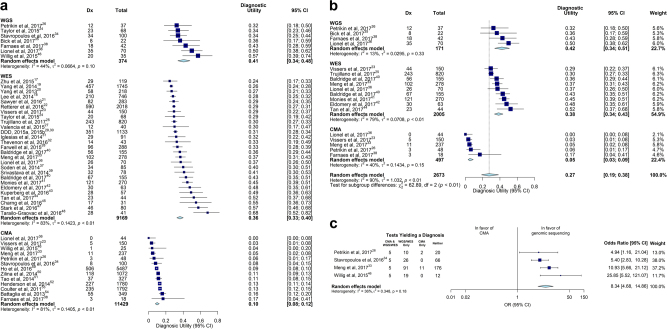
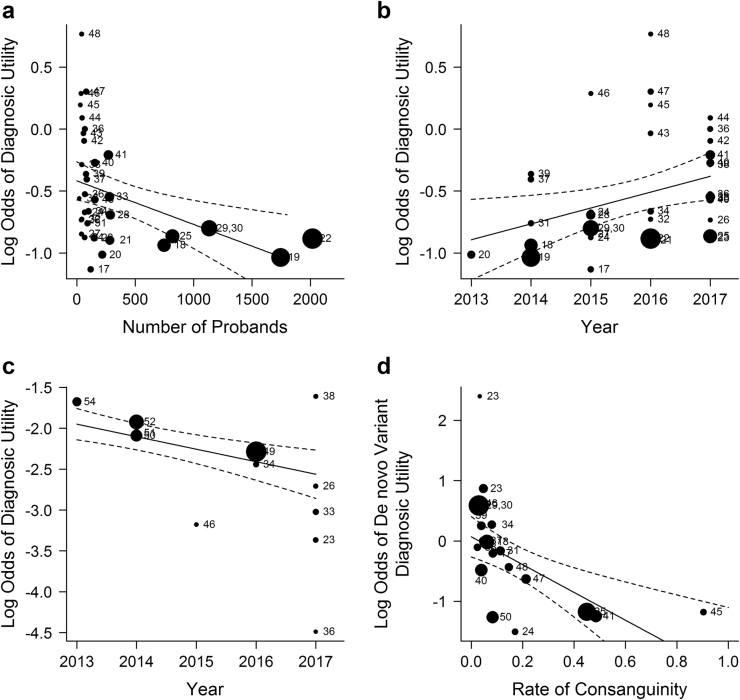
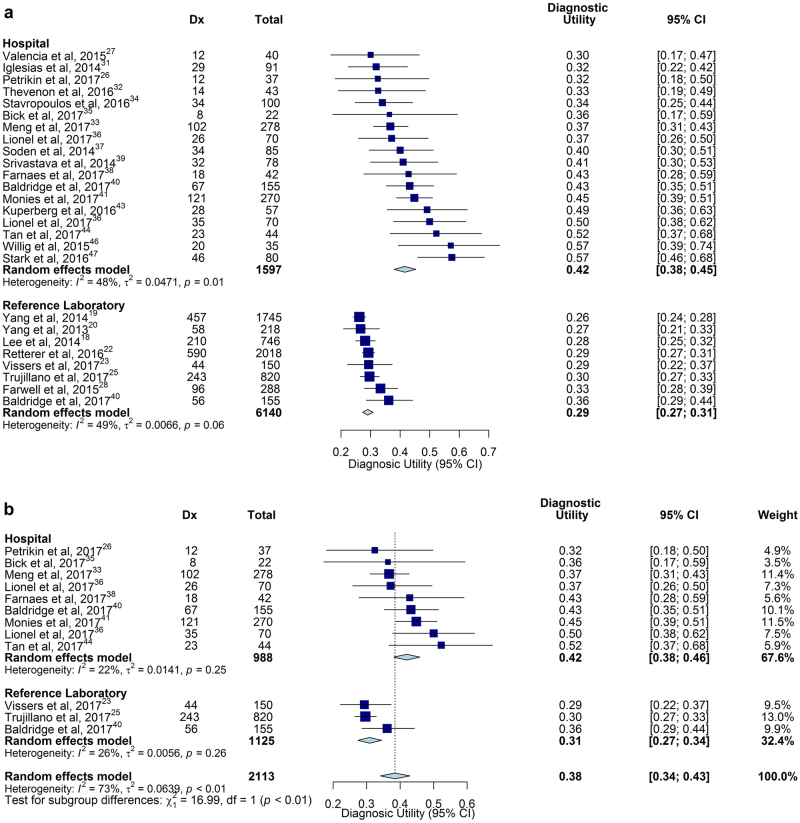
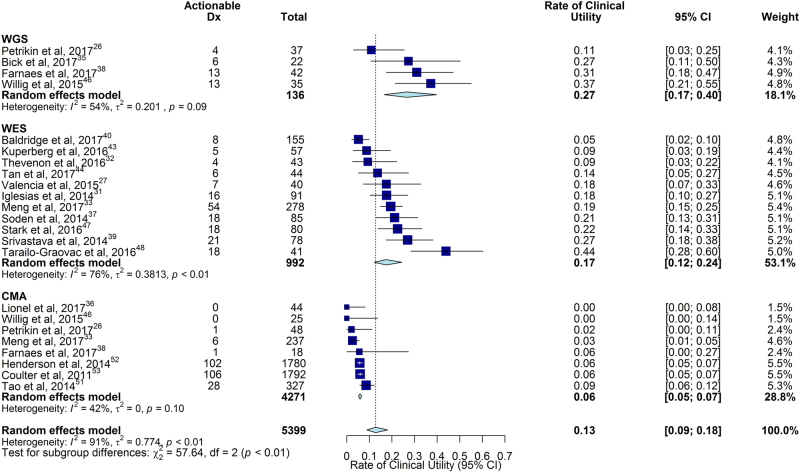
Genetic diseases are leading causes of childhood mortality. Whole-genome sequencing (WGS) and whole-exome sequencing (WES) are relatively new methods for diagnosing genetic diseases, whereas chromosomal microarray (CMA) is well established. Here we compared the diagnostic utility (rate of causative, pathogenic, or likely pathogenic genotypes in known disease genes) and clinical utility (proportion in whom medical or surgical management was changed by diagnosis) of WGS, WES, and CMA in children with suspected genetic diseases by systematic review of the literature (January 2011–August 2017) and meta-analysis, following MOOSE/PRISMA guidelines. In 37 studies, comprising 20,068 children, diagnostic utility of WGS (0.41, 95% CI 0.34–0.48, I 2 = 44%) and WES (0.36, 95% CI 0.33–0.40, I 2 = 83%) were qualitatively greater than CMA (0.10, 95% CI 0.08–0.12, I 2 = 81%). Among studies published in 2017, the diagnostic utility of WGS was significantly greater than CMA ( P < 0.0001, I 2 = 13% and I 2 = 40%, respectively). Among studies featuring within-cohort comparisons, the diagnostic utility of WES was significantly greater than CMA ( P < 0.001, I 2 = 36%). The diagnostic utility of WGS and WES were not significantly different. In studies featuring within-cohort comparisons of WGS/WES, the likelihood of diagnosis was significantly greater for trios than singletons (odds ratio 2.04, 95% CI 1.62–2.56, I 2 = 12%; P < 0.0001). Diagnostic utility of WGS/WES with hospital-based interpretation (0.42, 95% CI 0.38–0.45, I 2 = 48%) was qualitatively higher than that of reference laboratories (0.29, 95% CI 0.27–0.31, I 2 = 49%); this difference was significant among studies published in 2017 ( P < .0001, I 2 = 22% and I 2 = 26%, respectively). The clinical utility of WGS (0.27, 95% CI 0.17–0.40, I 2 = 54%) and WES (0.17, 95% CI 0.12–0.24, I 2 = 76%) were higher than CMA (0.06, 95% CI 0.05–0.07, I 2 = 42%); this difference was significant for WGS vs CMA ( P < 0.0001). In conclusion, in children with suspected genetic diseases, the diagnostic and clinical utility of WGS/WES were greater than CMA. Subgroups with higher WGS/WES diagnostic utility were trios and those receiving hospital-based interpretation. WGS/WES should be considered a first-line genomic test for children with suspected genetic diseases.
Overview
The claims and statistics of this paper haven’t been checked yet.
Free: it reads the open-access text and checks the first 5 claims that cite a source we can check. Create a free account to check every claim.
Integrity signals
Registry
Cites
Statistics
Figures

Verification
Claims the paper makes
The claims and statistics of this paper haven’t been checked yet.
Free: it reads the open-access text and checks the first 5 claims that cite a source we can check. Create a free account to check every claim.
Claims other papers make about this one
Each is checked against this paper’s own text: does it say what the citing paper says it does?
The source backs part of the claim, not all of it — or backs it for a different population, condition or comparison.
In the citing paper
“Molecular diagnostic laboratories typically use highly accurate DNA sequencing technologies to test for these types of rare pathogenic variants [3,4].”
From Assessing the analytical validity of SNP-chips for detecting very rare pathogenic variants: implications for direct-to-consumer genetic testing (2019) · cites this paper as [3]
Experimental — accuracy not yet measured
Self-check
Percentages, sums and reported differences re-computed from the paper’s own numbers.
The self-check needs the paper’s full text.
Citations
Cites
Quantifying heterogeneity in a meta‐analysis
Higgins, J. P. T., & Thompson, S. G. (2002) · Statistics in Medicine · doi:10.1002/sim.1186 · Cited by 36,763
Conducting Meta-Analyses in R with the metafor Package
Viechtbauer, W. (2010) · Journal of Statistical Software · doi:10.18637/jss.v036.i03 · Cited by 20,464
THE USE OF CONFIDENCE OR FIDUCIAL LIMITS ILLUSTRATED IN THE CASE OF THE BINOMIAL
CLOPPER, C. J., & PEARSON, E. S. (1934) · Biometrika · doi:10.1093/biomet/26.4.404 · Cited by 5,003
Miller, D. T., Adam, M. P., Aradhya, S., Biesecker, L. G., Brothman, A. R., Carter, N. P., Church, D. M., Crolla, J. A., Eichler, E. E., Epstein, C. J., et al. (2010) · The American Journal of Human Genetics · doi:10.1016/j.ajhg.2010.04.006 · Cited by 2,882
Clinical Whole-Exome Sequencing for the Diagnosis of Mendelian Disorders
Yang, Y., Muzny, D. M., Reid, J. G., Bainbridge, M. N., Willis, A., Ward, P. A., Braxton, A., Beuten, J., Xia, F., Niu, Z., et al. (2013) · New England Journal of Medicine · doi:10.1056/nejmoa1306555 · Cited by 1,964
THE COMPARISON OF PERCENTAGES IN MATCHED SAMPLES
COCHRAN, W. G. (1950) · Biometrika · doi:10.1093/biomet/37.3-4.256 · Cited by 1,465
Molecular Findings Among Patients Referred for Clinical Whole-Exome Sequencing
Yang, Y., Muzny, D. M., Xia, F., Niu, Z., Person, R., Ding, Y., Ward, P., Braxton, A., Wang, M., Buhay, C., et al. (2014) · JAMA · doi:10.1001/jama.2014.14601 · Cited by 1,360
Large-scale discovery of novel genetic causes of developmental disorders
Study, T. D. D. D. (2015) · Nature · doi:10.1038/nature14135 · Cited by 1,124
Clinical application of whole-exome sequencing across clinical indications
Retterer, K., Juusola, J., Cho, M. T., Vitazka, P., Millan, F., Gibellini, F., Vertino-Bell, A., Smaoui, N., Neidich, J., Monaghan, K. G., et al. (2016) · Genetics in Medicine · doi:10.1038/gim.2015.148 · Cited by 1,035
Clinical Exome Sequencing for Genetic Identification of Rare Mendelian Disorders
Lee, H., Deignan, J. L., Dorrani, N., Strom, S. P., Kantarci, S., Quintero-Rivera, F., Das, K., Toy, T., Harry, B., Yourshaw, M., et al. (2014) · JAMA · doi:10.1001/jama.2014.14604 · Cited by 973
Research works printed but not linked: 1
- Schwarzer, G. meta: an R package for meta-analysis. R. News 7, 40–45 (2007).
Cited by
Items 401–500 of 624
Whole-exome and whole-genome sequencing in the molecular diagnostic laboratory
Khan, W. A. (2023) · Elsevier eBooks · doi:10.1016/b978-0-12-822824-1.00012-2 · Cited by 5
The implementation and utility of clinical exome sequencing in a South African infant cohort
Campbell, L. J., Fredericks, J., Mathivha, K. T., Moshesh, P., Coovadia, A. H., Chirwa, P., Dillon, B., Ghoor, A., Lawrence, D., Nair, L. J., et al. (2023) · Frontiers in Genetics · doi:10.3389/fgene.2023.1277948 · Cited by 7
Term-BLAST-like alignment tool for concept recognition in noisy clinical texts
Groza, T., Wu, H., Dinger, M. E., Daniš, D., Hilton, C., Bagley, A. M., Davids, J. R., Luo, L., Lu, Z., & Robinson, P. N. (2023) · Bioinformatics · doi:10.1093/bioinformatics/btad716 · Cited by 5
Mordaunt, D., Stark, Z., Gonzalez, F. S., Dalziel, K., & Goranitis, I. (2023) · BMJ Open · doi:10.1136/bmjopen-2022-069441 · Cited by 3
Self-citationCAVaLRi: An Algorithm for Rapid Identification of Diagnostic Germline Variation
Schuetz, R. J., Antoniou, A. A., Lammi, G., Gordon, D. M., Kuck, H. C., Chaudhari, B. P., & White, P. (2024) · Human Mutation · doi:10.1155/2024/6411444 · Cited by 3
Single-cell metabolomics in rare disease: From technology to disease
Li, L., Zhang, Y., Zhou, J., Wang, J., & Wang, L. (2024) · Intractable & Rare Diseases Research · doi:10.5582/irdr.2023.01073 · Cited by 5
Genomic Screening: The Mutation and the Mustard Seed
Morgan, T. M. (2018) · The Journal of Law Medicine & Ethics · doi:10.1177/1073110518782963 · Cited by 3
Bastos, P. A. D., & Barbosa, R. P. (2020) · European Journal of Medical Genetics · doi:10.1016/j.ejmg.2020.104089 · Cited by 3
Apparent homozygosity for a novel splicing variant in EPS8 causes congenital profound hearing loss
Yu, S., Chen, W., Zhang, Y., Ni, Y., Lü, P., Wang, B., Wang, Y., Wu, B., Ni, Q., Wang, H., et al. (2021) · European Journal of Medical Genetics · doi:10.1016/j.ejmg.2021.104362 · Cited by 3
Shao, Z., Kyriakopoulou, L. G., & Ito, S. (2019) · Handbook of analytical separations · doi:10.1016/b978-0-444-64066-6.00014-9 · Cited by 11
Factors Affecting the Genetic Diagnostic Rate in Congenital Heart Disease
Park, J. S., Seo, G. H., Choi, Y., Hwang, S., Kang, M., Do, H., Kim, Y.-H., Yu, J. J., Kim, E. A., Jung, E., et al. (2022) · Congenital Heart Disease · doi:10.32604/chd.2022.021580 · Cited by 4
Will better evidence on clinical utility bring about greater use of (genetic) tests?
Hyde, C. (2021) · npj Genomic Medicine · doi:10.1038/s41525-021-00187-8 · Cited by 3
Genetics of mental retardation
Anisimova, I. V. (2021) · Nauchno-prakticheskii zhurnal «Medicinskaia genetika» · doi:10.25557/2073-7998.2021.02.3-20 · Cited by 5
Enns, E. A., Wainstein, T., Dragojlovic, N., Kopac, N., Study, G., Lynd, L. D., & Elliott, A. M. (2021) · Molecular Genetics & Genomic Medicine · doi:10.1002/mgg3.1784 · Cited by 2
“…of GWS over other testing strategies (multi- gene panels, sequential testing) have been described to include potentially higher diagnostic yields (Clark et al., 2018; Lionel et al., 2018), a broader, unbiased testing strategy that can detect multiple genetic diseases in a single patient (Boycott…”
BackgroundThe incorporation of next-generation sequencing into pediatric care
Lee, N. (2022) · Pediatrics & Neonatology · doi:10.1016/j.pedneo.2022.11.002 · Cited by 4
From bedside to bench and back: Translating ASD models
Drozd, H. P., Karathanasis, S. F., Molosh, A. I., Lukkes, J. L., Clapp, D. W., & Shekhar, A. (2018) · Progress in brain research · doi:10.1016/bs.pbr.2018.10.003 · Cited by 4
Ongoing reanalysis of prenatal exome sequencing data leads to higher diagnostic yield
Li, L. ‐., & Li, D. (2022) · Ultrasound in Obstetrics and Gynecology · doi:10.1002/uog.24923 · Cited by 5
Genome sequencing as a generic diagnostic strategy for rare diseasePreprint
Schobers, G., Derks, R. C., den Ouden, A., Swinkels, H. L., van Reeuwijk, J., Bosgoed, E., Lugtenberg, D., Sun, S. M., Corominas, J., Weiss, M. M., et al. (2023) · medRxiv · doi:10.1101/2023.09.28.23296271 · Cited by 3
Kaschta, D., Post, C., Gaass, F., Greiten, B., Liegmann, A.-S., Gembicki, R., Pozojevic, J., Meyenborg, M., Wehnert, J., Schau-Römer, K., et al. (2024) · medRxiv · doi:10.1101/2024.12.20.24319228 · Cited by 3
Maggo, S. D. S., Pan, Y., Ostrow, D. G., Nguyen, J. Q., Biegel, J. A., Deardorff, M. A., & Gai, X. (2025) · Frontiers in Genetics · doi:10.3389/fgene.2025.1574325 · Cited by 3
Chaigneau, M., Bowman, M. L., Guerin, A. A., & James, P. (2025) · Blood Vessels Thrombosis & Hemostasis · doi:10.1016/j.bvth.2025.100090 · Cited by 2
Shah, J., Mondal, D., Jain, D. K., Mhatre, P., Patel, K., Iyer, A., Pandya, M., Menghani, B., Dave, G., Sheth, J. J., et al. (2025) · BMC Medical Genomics · doi:10.1186/s12920-025-02204-6 · Cited by 4
“Nonetheless, a definitive diagnosis can only be achieved in up to 70% of cases, depending on the genetic complexity of the disorder [78, 79].”
Liu, Y., Gong, D., Dang, K., Guo, J., Yan, Z., Shen, X., & Wang, J. (2025) · Survey of Ophthalmology · doi:10.1016/j.survophthal.2025.09.023 · Cited by 3
Validation of the NovaSeq6000 platform and automated library preparation for CE-IVD equivalence
Pasquinelli, E., Rollo, G., Tinella, F., Danelli, M., Minetto, S., Casamassima, G., Bader, M., Calonaci, L., Colavecchio, O. L., Tita, R., et al. (2025) · Computational and Structural Biotechnology Journal · doi:10.1016/j.csbj.2025.10.051 · Cited by 2
“These results reflect the known limitations of exome-based CNV detection, which tends to perform optimally on large events with clear coverage shifts, while smaller or complex rearrangements remain more challenging to resolve accurately [22,23].”
Dobrose, M. M., Kars, M. E., Pérez-Caraballo, J. J., Roark, C. M., Mariskanish, C., Martínez, O. Z., Gómez-Hernández, N., Reyes, S. O. L., Itan, Y., Galicia, L. B., et al. (2025) · Genes and Immunity · doi:10.1038/s41435-025-00368-w · Cited by 4
“Over the last decade, next-generation sequencing has become increasingly more accessible, allowing for increased rates of diagnostic ef fi ciency and changes in clinical treatment for patients with rare genetic diseases [13, 14].”
Mancuso, G., Serventi, L., Cocco, C., Lai, F., Soddu, C., Marica, M., Mereu, C., Lorrai, M., Tosone, G. M., Cannas, F., et al. (2026) · International Journal of Molecular Sciences · doi:10.3390/ijms27020964 · Cited by 3
RNA Sequencing Resolves Cryptic Pathogenic Variants in Mitochondrial Disease
Liu, Z. H., Duan, X., Peymani, F., Wang, J., Bao, C., Xu, C., Zou, Y., Zhang, Z., Zhang, Y., Li, T. Y., et al. (2026) · Annals of Clinical and Translational Neurology · doi:10.1002/acn3.70379 · Cited by 4
“While whole-genome sequencing (WGS), especially in its long-read form, can detect these variant types, its incremental diagnostic yield remains modest [3].”
MAJIQ-CLIN: A novel tool to help identify Mendelian disease-causing variants from RNA-seq data
Aicher, J. K., Issakova, D., Slaff, B., Jewell, S., Lahens, N. F., Grant, G. R., Baralle, D., Rosenfeld, J. A., Scott, D. A., Bhoj, E. J. K., et al. (2026) · Genetics in Medicine · doi:10.1016/j.gim.2026.102628 · Cited by 2
LLM-Assisted Reanalysis of Unsolved Rare Disease Genomes Increases Diagnostic Yield
Jaech, A., Cheatham, M., Shringarpure, S., Genetti, C. A., Pradhan, P., Bagul, A., Panch, T., Rader, B. M., Sewalk, K. C., Distler, R., et al. (2026) · NEJM AI · doi:10.1056/aics2501343 · Cited by 2
Rogač, M., Neubauer, D., Leonardis, L., Meglič, N. P., Meznarič, M., Maver, A., Sperl, W., Garavaglia, B., Lamantea, E., & Peterlin, B. (2021) · Balkan Journal of Medical Genetics · doi:10.2478/bjmg-2021-0019 · Cited by 2
“Whole-genome sequencing has overtaken WES as the preferred NGS method for DNA sequencing [26-28].”
MethodPoogoda, S., Lynch, F., Stark, Z., Wilkinson, D. J. C., Savulescu, J., Vears, D. F., & Gyngell, C. (2023) · Children · doi:10.3390/children10060970 · Cited by 3
Self-citationJiang, S., Ye, J., Wáng, H., Wang, J., Chen, S., Zhang, Y., Du, Q., Yang, L., Wang, L., & Sun, K. (2023) · Cardiology Discovery · doi:10.1097/cd9.0000000000000089 · Cited by 2
Dreikorn, E., Munro, C., Berman, N. R., Kunovac, A., Bellissimo, D. B., & Massart, M. B. (2024) · Frontiers in Genetics · doi:10.3389/fgene.2024.1380552 · Cited by 2
A rare homozygous ALX4 mutation in a Bangladeshi girl with frontonasal dysplasia type-2 (FND2)
Goswami, B., Rahman, A., Jahan, I., Akter, S., Banu, T. A., Osman, E., Uzzaman, M. S., Habib, A., Alam, M. S., Obaida, A. S. M. A., et al. (2024) · Heliyon · doi:10.1016/j.heliyon.2024.e34929 · Cited by 2
“It provides the highest coverage of the human genome, not only in regions not covered by other methods [4 – 6].”
BackgroundQualitative genomic research with Indigenous peoples: a scoping review of participatory practice
Ehman, M., Caron, N. R., Montour, L., & Regier, D. A. (2024) · BMJ Global Health · doi:10.1136/bmjgh-2024-015377 · Cited by 2
Chung, C. C. Y., Chu, A. T.-W., & Chung, B. H. (2025) · Communications Medicine · doi:10.1038/s43856-025-00917-4 · Cited by 4
Yu, J., MacDuffie, K. E., Sommerland, O. M., Theoryn, T. N., Murali, P., Anderson, K., Sikes, M. C., Kruidenier, L., Gildersleeve, H. I. S., Scott, A. A., et al. (2025) · Human Genetics and Genomics Advances · doi:10.1016/j.xhgg.2025.100464 · Cited by 3
Chehadeh, S. E., Heide, S., Quēlin, C., Rio, M., Margot, H., Geneviève, D., Isidor, B., Goldenberg, A., Guégan, C., Lesca, G., et al. (2025) · Genome Medicine · doi:10.1186/s13073-025-01527-4 · Cited by 5
“Overall, as expected, de novo variants were the most frequent pathogenic variants, as reported in many studies [25, 83, 89–91].”
La tecnologia genetica: ciò che ogni pediatra dovrebbe sapere
Mariani, M., Cianci, P., Cereda, A., Maitz, S. B., Giagnacovo, M., Modena, P., Iascone, M. R., & Selicorni, A. (2021) · Medico e Bambino · doi:10.53126/meb40291 · Cited by 2
Demystifying genetic jargon in psychiatry
Mizen, L. A. M. (2021) · BJPsych Advances · doi:10.1192/bja.2021.37 · Cited by 2
DYNC1H1 de novo mutation, spinal muscular atrophy and attention problems
Perrone, A. L. F., Fernández, P. M., Álvarez, S., & Fernández‐Jaén, A. (2022) · Neurología (English Edition) · doi:10.1016/j.nrleng.2021.08.001 · Cited by 3
Data Analysis in Rare Disease Diagnostics
Veeramachaneni, V. (2020) · Journal of the Indian Institute of Science · doi:10.1007/s41745-020-00189-y · Cited by 2
Femoral artery embolism in patients undergoing a laterally extended parametrectomy (LEP) procedure.
Tarnai, L., Ungár, L., Pálfalvi, L., & Nagy, Z. (2011) · PubMed · Cited by 3
Genomic disorders in the genomics era
Zepeda‐Mendoza, C. J., & Gonzaga-Jauregui, C. G. (2021) · Elsevier eBooks · doi:10.1016/b978-0-12-820140-4.00004-1 · Cited by 4
Valarmathi, M. T. (2021) · IntechOpen eBooks · doi:10.5772/intechopen.99486 · Cited by 2
Genetic Testing in Newborns Moves From Rare to Routine Application
Pillers, D. M. (2022) · Archives of Pediatrics and Adolescent Medicine · doi:10.1001/jamapediatrics.2022.0184 · Cited by 2
Yokoi, K., Nakajima, Y., Sudo, Y., Mariya, T., Kawamura, R., Tsutsumi, M., Inagaki, H., Yoshikawa, T., Ito, T., & Kurahashi, H. (2022) · JIMD Reports · doi:10.1002/jmd2.12333 · Cited by 2
“Some reports recommend wholegenome sequencing as the first approach in the diagnosis of unexplained diseases in newborns.(14) In patients with inborn errors of metabolism, biochemical diagnosis is generally sufficient to treat the clinical symptoms of the patients, but genetic diagnosis is necessary for carrier testin…”
BackgroundCloud-based genomics pipelines for ophthalmology: reviewed from research to clinical practice
Wong, D., Olivera, M., Yu, J., Szabó, A., Moghul, I., Balaskas, K., Luben, R., Khawaja, A. P., Pontikos, N., & Keane, P. A. (2021) · Modeling and Artificial Intelligence in Ophthalmology · doi:10.35119/maio.v3i1.115 · Cited by 2
Genetics of Congenital Cataract
Ahmad, R. R., Bell, S., & Moosajee, M. (2022) · Advances in Ophthalmology and Optometry · doi:10.1016/j.yaoo.2022.03.004 · Cited by 2
Lee, Y., Lee, J. S., Kim, S. Y., Cho, J., Yoo, Y., Lee, S., Yoo, T., Lee, M., Seo, J., Lee, J., et al. (2018) · bioRxiv (Cold Spring Harbor Laboratory) · doi:10.1101/472803 · Cited by 2
“6 (7-624) Primary clinical diagnosis (n (%)) Neurodegenerative disease Neurometabolic disorder Epileptic and developmental encephalopathy Hypotonia White-matter abnormalities Unknown spasticity Other 66 (18.”
BackgroundSmartRNASeqCaller: improving germline variant calling from RNAseqPreprint
Bosio, M., Valencia, A., & Capella-Gutiérrez, S. (2019) · bioRxiv (Cold Spring Harbor Laboratory) · doi:10.1101/684993 · Cited by 2
Douglas, M. P., Deverka, P. A., Gelb, B. D., Ferket, B. S., Lich, K. H., Smith, H. S., Norton, M. E., Berg, J. S., Slavotinek, A. M., Hindorff, L. A., et al. (2022) · medRxiv · doi:10.1101/2022.10.10.22280925 · Cited by 2
Systematic evaluation of the two main blood-based RNA-seq approaches for Mendelian disease diagnosisPreprint
Yang, Z., Yang, X., Chen, Y., Wang, Z., Song, L., Sun, J., Peng, H., Yang, X., Peng, Z., & Dai, Y. (2023) · medRxiv · doi:10.1101/2023.04.22.23288779 · Cited by 2
Deng, R., Perenthaler, E., Nikoncuk, A., Yousefi, S., Lanko, K., Schot, R., Maresca, M., Salsench, E. M., Sanderson, L. E., Parker, M. J., et al. (2024) · medRxiv · doi:10.1101/2024.04.13.24305761 · Cited by 2
Exames genéticos como ferramentas auxiliares para o diagnóstico do Transtorno do Espectro Autista
Braz, N. M., & Albuquerque, E. P. A. (2022) · VITTALLE - Revista de Ciências da Saúde · doi:10.14295/vittalle.v34i1.13792 · Cited by 3
“Já o SCE analisará as regiões gênicas, especificamente os éxons, que representam apenas 2% do DNA.”
BackgroundInfluentialMarathe, P. N., Suckiel, S. A., Bonini, K. E., Kelly, N., Scarimbolo, L., Insel, B. J., Odgis, J. A., Sebastin, M., Ramos, M. A., Biase, M. D., et al. (2024) · Human Genetics and Genomics Advances · doi:10.1016/j.xhgg.2024.100321 · Cited by 3
Flexible, production-scale, human whole genome sequencing on a benchtop sequencer
Green, K., Krajacich, B. J., Wiseman, K. N., Mains, P. T., Robertson, S., Billings, S., McCowin, M., Sudkamp, M., Lo, C. S., Lajoie, B. R., et al. (2025) · BMC Genomics · doi:10.1186/s12864-025-11741-4 · Cited by 1
MPSE identifies newborns for whole genome sequencing within 48 h of NICU admission
Peterson, B. D., Juarez, E. F., Moore, B., Hernandez, E. J., Frise, E., Li, J., Lussier, Y. A., Tristani‐Firouzi, M., Reese, M. G., Jenkins, S. M., et al. (2025) · npj Genomic Medicine · doi:10.1038/s41525-025-00506-3 · Cited by 3
“A short description of these data types is given in Supplementary Table 4, and summary statistics of observation counts for each alternative data type are shown in Supplementary Table 5.”
InfluentialSelf-citationYerkhojayeva, N., Zharkinbekova, N., Azhayev, S., Oshibayeva, A., Nuskabayeva, G. O., & Kaiyrzhanov, R. B. (2025) · Journal of Clinical Medicine of Kazakhstan · doi:10.23950/jcmk/16890 · Cited by 1
Mehr, F. K., & Moradzadegan, A. (2025) · Jentashapir Journal of Cellular and Molecular Biology · doi:10.5812/jjcmb-161702 · Cited by 1
Advancing Neuropediatric Rare Disease Diagnosis Through Clinical Genome Sequencing
Sirchia, F., Kalantari, S., Carli, D., Zadorozhna, M., Bassanese, F., Thorpe, E., Taft, R. J., Kesari, A., Sorasio, L., Antona, V., et al. (2026) · Pediatric Neurology · doi:10.1016/j.pediatrneurol.2026.01.004 · Cited by 1
“12 These challenges can be mitigated by focusing in silico bioinformatics analyses on the coding regions and exon-intron junctions of known disease-related genes (clinical genome sequencing [cGS]).”
Emerging Topics in Neurogenomics: Summary From Inaugural Child Neurology Society Genetics Summit
Sen, K., Gottlieb‐Smith, R., Amin, S., Ananth, A., Bartlett, V., Bass, N. E., Brock, D., Conrad, E., Ceulemans, S., Davids, L., et al. (2026) · Pediatric Neurology · doi:10.1016/j.pediatrneurol.2026.04.002 · Cited by 1
Efficacy of universal genome sequencing in infant extracorporeal membrane oxygenation
Carr, N., Fulmer, M. L., Rumpel, J. A., Makkar, A., Mahmood, B., Keene, S. D., Rintoul, N. E., Wild, K. T., Ashrafi, A., Gogcu, S., et al. (2026) · Journal of Perinatology · doi:10.1038/s41372-026-02716-8 · Cited by 1
“Several studies have shown that rapid GS outperforms conventional genetic testing in terms of diagnostic yield and turnaround time, leading to changes in management and possibly improved clinical outcomes [1 – 4].”
Tagimacruz, T., Seeger, T., Degeling, K., Fooks, K., Venkataramanan, V., Bernier, F. P., Boycott, K. M., Mendoza‐Londono, R., Hartley, T., Hayeems, R. Z., et al. (2026) · Genetics in Medicine · doi:10.1016/j.gim.2026.102626 · Cited by 3
Alavi, N., Moeinzadeh, M.-H., Hertzberg, J., Melo, U. S., Raei, L. W. A., Infantino, P., Ghareghani, M., Savarese, M., Mundlos, S., & Vingron, M. (2026) · Genome biology · doi:10.1186/s13059-026-04280-y
Microarray and Next Generation Sequencing
Kurahashi, H., & Kato, T. (2020) · Comprehensive gynecology and obstetrics · doi:10.1007/978-981-15-8171-7_26 · Cited by 1
Enhancing Molecular Testing for Effective Delivery of Actionable Gene Diagnostics
Kovács, Á. F., Némethi, Z., Abonyi, T., Fekete, G., & Kovács, G. (2022) · Bioengineering · doi:10.3390/bioengineering9120745 · Cited by 3
Mau‐Them, F. T., Overs, A., Bruel, A., Duquet, R., Thareau, M., Denommé‐Pichon, A., Vitobello, A., Sorlin, A., Safraou, H., Nambot, S., et al. (2023) · Frontiers in Genetics · doi:10.3389/fgene.2023.1122985 · Cited by 3
“ES has a diagnostic yield ranging from 25% to 70% (Stark et al., 2016; Tan et al., 2017; Clark et al., 2018), depending on the type of disorder, the presence of consanguinity, and the strategy used (solo or trio).”
MethodPharmacogenetic Informed Care in Early Childhood: Options for Improving Access and Health Equity
Suhrie, K. R., & Tillman, E. M. (2023) · Pharmacogenomics · doi:10.2217/pgs-2023-0119 · Cited by 1
Preparedness and training of genetic counselors practicing in inpatient settings
Mancl, N., Myers, M. F., Miller, E. M., Jackson, F., & Widmeyer, K. M. (2023) · Journal of Genetic Counseling · doi:10.1002/jgc4.1754 · Cited by 2
“The availability of rapid genomic sequencing, which includes exome and genome sequencing, has allowed real-time results during the inpatient stay which could impact medical management (Clark et al., 2018; Farnaes et al., 2018 ; Meng et al., 2017 ; Petrikin et al., 2018; Sweeney et al., 2021 ).”
BackgroundRapid Whole-Genome Sequencing in Acutely Ill Children: A Single Pediatric Center Experience
Totapally, B., Jayakar, P., Diaz-Barbosa, M., Sasaki, J. D., Jayakar, A., Sendi, P. R., Soler, D., Janvier, M., Espinal, P., Gupta, A., et al. (2024) · Journal of Pediatric Intensive Care · doi:10.1055/s-0044-1790556 · Cited by 1
“Although the trio sequence will add tothe expense of testing, it improves the diagnostic yield, 33,34 and helps identify the de novo variants.”
Mainstreaming Diagnostic Genetic Testing and Precision Medicine for Autism Spectrum Disorder
Ledbetter, D. H., Finucane, B. M., Moreno‐De‐Luca, D., & Myers, S. M. (2025) · Psychiatric Clinics of North America · doi:10.1016/j.psc.2025.01.010 · Cited by 1
Dowling, J. J., & Cohn, R. D. (2024) · Elsevier eBooks · doi:10.1016/b978-0-443-10944-7.00159-1 · Cited by 1
Modern applications of neurogenetics
Morón, D. G., & Kauffman, M. (2019) · Elsevier eBooks · doi:10.1016/b978-0-12-819178-1.00013-7 · Cited by 1
L’errance et l’impasse diagnostiques dans les maladies rares d’origine génétique
Faivre, L. O., Vitobello, A., Padre, M., Odent, S., Domenighetti, L., Giot, G., & Thauvin‐Robinet, C. (2020) · Les Tribunes de la santé · doi:10.3917/seve1.062.0079 · Cited by 1
Mutación de novo en DYNC1H1, atrofia muscular espinal y problemas atencionales
Perrone, A. L. F., Fernández, P. M., Álvarez, S., & Fernández‐Jaén, A. (2021) · Neurología · doi:10.1016/j.nrl.2021.08.001 · Cited by 1
Clinical exome sequencing in Serbian patients with movement disorders: Single centre experience
Branković, M., Dragašević, N., Dobričić, V., Maver, A., Bergant, G., Petrović, I. N., Perić, S., Marjanović, A., Janković, M. Z., Jančić, J., et al. (2022) · Genetika · doi:10.2298/gensr2201395b · Cited by 1
Pooled-parent exome sequencing to prioritise de novo variants in genetic diseasePreprint
Dashnow, H., Bell, K. M., Stark, Z., Tan, T. Y., White, S. M., & Oshlack, A. (2019) · bioRxiv (Cold Spring Harbor Laboratory) · doi:10.1101/601740 · Cited by 2
“Yet, in a meta-analysis of diagnostic next-generation sequencing in children, de novo variants accounted for the majority of genetic diagnoses in non-consanguineous families [5].”
BackgroundSelf-citationExome Sequencing in Gastrointestinal Food Allergy Induced by Multiple Food Protein
Sanchis‐Juan, A. (2019) · RiuNet (Universitat Politècnica de València) · doi:10.4995/thesis/10251/134361 · Cited by 1
Bergen, N. J. V., Linster, C. L., & Christodoulou, J. (2020) · Brain · doi:10.1093/brain/awaa131 · Cited by 1
Editorial: Improving medical diagnosis in rare diseases
Linhares, N. D., Gorman, K. M., & Brusco, A. (2022) · Frontiers in Genetics · doi:10.3389/fgene.2022.974129 · Cited by 1
“varies (24–68%) depending on the technology employed, the disease group studied, the patient age groups, clinical indications, family structures and variant types analysed (Clark et al., 2018).”
BackgroundThe Importance of Prenatal WES Testing in the Romanian PopulationPreprint
Sabau, D. I., Radoi, V. E., Maioru, O. V., Bohîlțea, L. C., Suciu-Lazar, V., & Ceauşu, I. (2023) · Preprints.org · doi:10.20944/preprints202309.1240.v1 · Cited by 1
Yépez, V. A., Smith, N. H., Scheller, I. F., Gagneur, J., & Mertes, C. (2023) · Research Square · doi:10.21203/rs.3.rs-3405211/v1 · Cited by 1
Loukas, Y. L., Anagnostopoulou, K. K., Thodi, G., Spanou, M., Gavalas, C., Dotsikas, Y., Alvanou, M., Pons, R. M., Tziouvas, K., Vartzelis, G., et al. (2024) · Preprints.org · doi:10.20944/preprints202406.0760.v1
Whole Genome Sequencing for the Diagnosis of Rare DisordersPreprint
Coelho, A. V. C., de Albuquerque, R. S., Gomes, C. D. S., Júnior, J. B. D. N., de Oliveira, G. S., Moura, L. M. S., Mofatto, L. S., Guedes, R. L. M., Barreiro, R., Caraciolo, M. P., et al. (2025) · medRxiv · doi:10.1101/2025.04.25.25326373 · Cited by 1
Geysens, M., Souche, E. L., Chiara, B. M., Benoît, V., Tessi, B., Bossuyt, W., Bours, V., Crabbe, M., Didier, C., Matthias, D. S., et al. (2025) · medRxiv · doi:10.1101/2025.10.18.25328208 · Cited by 1
Singh, M., Stenton, S. L., Groopman, E., Singer‐Berk, M., Ma, J., Choufani, S., O’Heir, E., DiTroia, S. P., Osei‐Owusu, I., Pais, L. S., et al. (2026) · medRxiv · doi:10.64898/2026.10.05.26364218 · Cited by 2
Self-citationFuture Directions to Support People with Intellectual Disabilities
Shaw, S. R., & Jankowska, A. M. (2018) · Pediatric school psychology · doi:10.1007/978-3-030-02992-0_9
Identifizierung genetischer Ursachen für mentale Retardierung
Claßen, M. (2018) · Pädiatrie · doi:10.1007/s15014-018-1518-z
Bioinformatics methods and approaches to discover disease variants from DNA sequencing data
Dashnow, H. (2019) · Minerva Access (University of Melbourne)
Bergen, N. J. V., & Christodoulou, J. (2020) · Brain · doi:10.1093/brain/awaa047
Whole-Exome Sequencing in Czech Patients with Neurogenetic Diseases
Staněk, D., Sedláčková, L., Seeman, P., Brožková, D. Š., & Laššuthová, P. (2020) · Genetic Testing and Molecular Biomarkers · doi:10.1089/gtmb.2019.0232
“We opted for WES, as the diagnostic utility of WES has been shown repeatedly (Helbig et al. , 2016; Clark et al. , 2018).”
Perez-Maturo, J., Salinas, V., & Kauffman, M. (2020) · Elsevier eBooks · doi:10.1016/b978-0-12-817819-5.00005-x · Cited by 1
[Application of RNA sequencing in clinical diagnosis of Mendelian disease].
Xiao, H., & Zhou, W. (2020) · Zhongguo dangdai erke zazhi · doi:10.7499/j.issn.1008-8830.2005004
Moignard, B. (2011) · Dialnet (Universidad de la Rioja)
Amended Informative Negative Whole Exome Sequencing ResultsPreprint
Alsubaie, L., Aloraini, T., Alfarsi, A., Mutairi, F. A., Alswaid, A. F., Alothaim, A., Eyaid, W., Balwi, M. A. A., Asinan, A., Alniwaider, R. A., et al. (2021) · Research Square · doi:10.21203/rs.3.rs-147916/v1
“Based on these factors, WES is recommended as the rst tier testing for suspected genetic disorders (Clark et al. 2018, Stark et al. 2016).”
BackgroundInvestigation of hereditary muscle disorders in the genomic era
Ghaoui, R., & Needham, M. (2020) · Advances in Clinical Neuroscience & Rehabilitation · doi:10.47795/ayyz8676
Other omics approaches to the study of rare diseases
Gatta, G. D. (2021) · Elsevier eBooks · doi:10.1016/b978-0-12-820140-4.00008-9
Molecular Genetics in the Next Generation Sequencing Era
Dopazo, J. (2021) · Springer eBooks · doi:10.1007/978-3-030-70147-5_9
McNulty, S. M., Cole, Y., Powell, B. C., & Rentas, S. (2021) · Advances in Molecular Pathology · doi:10.1016/j.yamp.2021.07.001
Metadata
- Authors
- Clark, M. M., Stark, Z., Farnaes, L., Tan, T. Y., White, S. M., Dimmock, D., & Kingsmore, S. F.
- Affiliations
- Rady Children's Institute for Genomic Medicine (US)
- Murdoch Children's Research Institute (AU)
- University of California San Diego (US)
- The University of Melbourne (AU)
- Corresponding author
- Kingsmore, Stephen F.
- ORCID
- Venue
- npj Genomic Medicine
- Published
- 2018-07-09
- Volume
- 3
- Issue
- 1
- Pages
- 16-16
- ISSN
- 2056-7944 (ISSN-L)
- PMC
- PMC6037748
- OpenAlex
- W2805193585
- Semantic Scholar
- 083457862bf6abd6c563d1b8fec514c3f4e4a779
- Cited by
- 619
- References
- 74
- Citations by year
- 2026: 49 · 2025: 74 · 2024: 80 · 2023: 83 · 2022: 100 · 2021: 98 · 2020: 83 · 2019: 44 · 2018: 6
- FWCI
- 7.96
- Type
- journal article
- Language
- en
- Open access
- gold
- doi.org
- Licence
- cc-by
- creativecommons.org/licenses/by/4.0 (tdm)
- creativecommons.org/licenses/by/4.0 (vor)
- Locations
- npj Genomic Medicine (publishedVersion, cc-by)
- bioRxiv (Cold Spring Harbor Laboratory) (acceptedVersion, cc-by-nd)
- Europe PMC (PubMed Central) (publishedVersion, other-oa)
- PubMed Central (publishedVersion, cc-by)
- PubMed (publishedVersion)
- DOAJ (DOAJ: Directory of Open Access Journals) (submittedVersion)
- Minerva Access (University of Melbourne) (submittedVersion, cc-by)
- Funders
- National Human Genome Research Institute
- Eunice Kennedy Shriver National Institute of Child Health and Human Development (U19HD077693)
- Topics
- Life Sciences › Biochemistry, Genetics and Molecular Biology › Genetics › Genomics and Rare Diseases
- Health Sciences › Medicine › Pediatrics, Perinatology and Child Health › Prenatal Screening and Diagnostics
- Life Sciences › Biochemistry, Genetics and Molecular Biology › Genetics › Genomic variations and chromosomal abnormalities
- Keywords
- whole genome sequencing, exome sequencing, chromosomal microarray analysis, genetic diagnosis, diagnostic yield, clinical utility, genetic interpretation, pathogenic variants, pediatric genetics, rare genetic disorders
About these checks
Registry, retraction, Cites and statistics results are computed, not judged, with one exception: a printed reference that no index lists is read once by a model before it counts as a citation error. Claims are extracted by a model and kept only when their quote appears verbatim in the text; each cited source is then checked, with a model’s help, for whether it says what the claim relies on. Those verdicts can be wrong — read the claim’s quote and the cited source before relying on one.
Statistics and arithmetic are recomputed, not judged.
Confidence bands are shown only for fields calibrated on our annotated test set. None is calibrated yet, so no band is shown.
What counts as a claim ›How we measure confidence ›How we check this ›
Are you an author, or do you see a problem with this page? Request a review
Data sources
Bibliographic data: Semantic Scholar, OpenAlex, Crossref.
Contains information from the Semantic Scholar Academic Graph Datasets, made available under the ODC Attribution License (ODC-BY 1.0).
Semantic Scholar’s data is described in: Kinney, R., et al. (2023). The Semantic Scholar Open Data Platform. arXiv:2301.10140.
