

Meta-analysis of the diagnostic and clinical utility of genome and exome sequencing and chromosomal microarray in children with suspected genetic diseases
Open accessPublished version of a preprint
The DOI matches its Crossref record; 74 of the 74 references it cites were found in a registry or an index.
Abstract
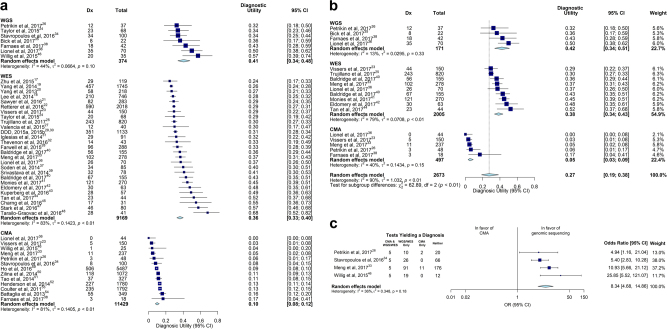
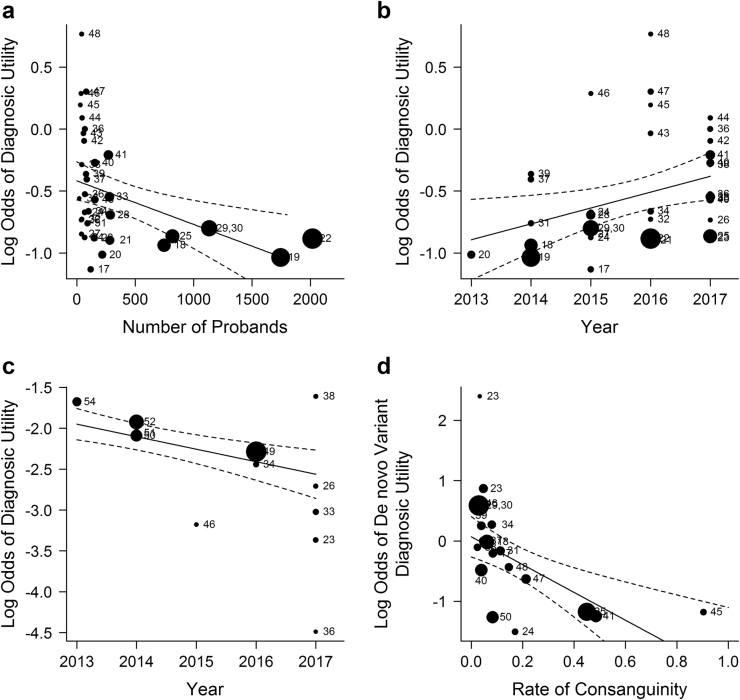
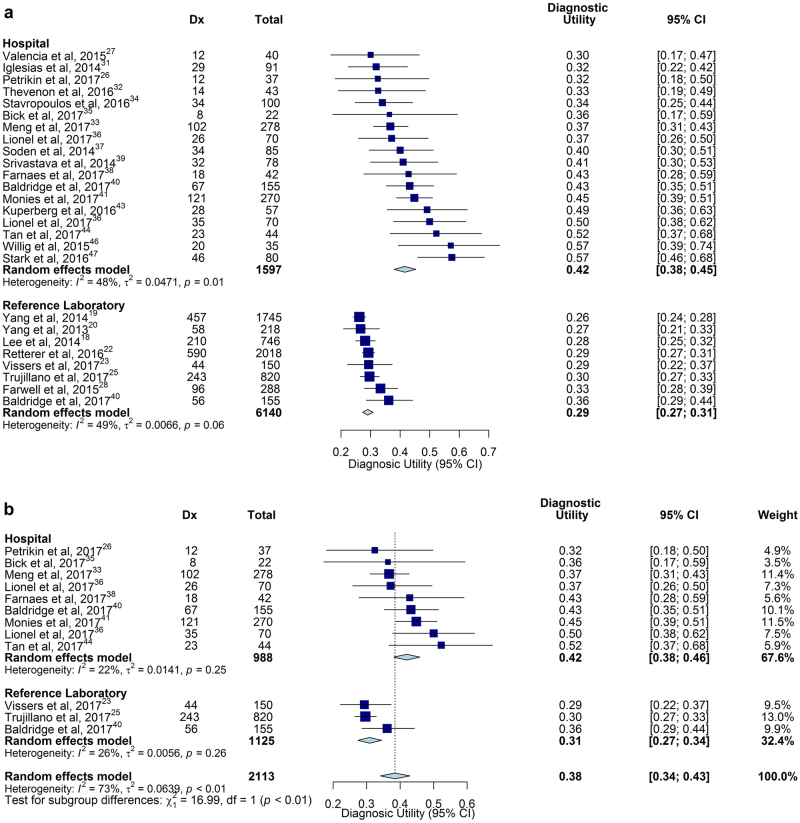
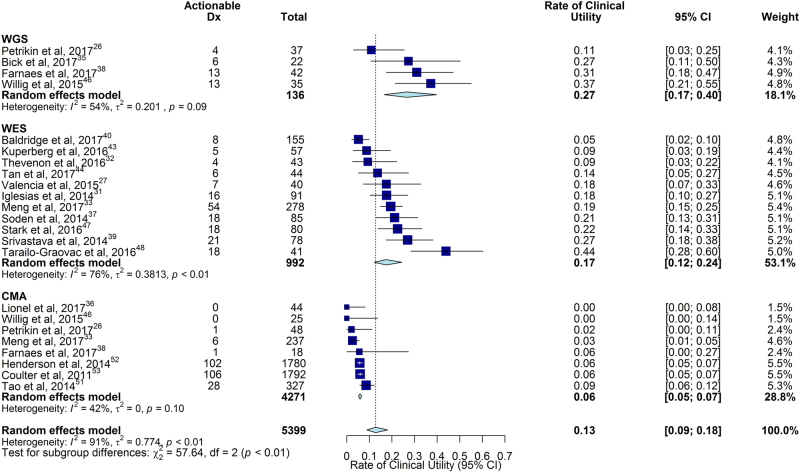
Genetic diseases are leading causes of childhood mortality. Whole-genome sequencing (WGS) and whole-exome sequencing (WES) are relatively new methods for diagnosing genetic diseases, whereas chromosomal microarray (CMA) is well established. Here we compared the diagnostic utility (rate of causative, pathogenic, or likely pathogenic genotypes in known disease genes) and clinical utility (proportion in whom medical or surgical management was changed by diagnosis) of WGS, WES, and CMA in children with suspected genetic diseases by systematic review of the literature (January 2011–August 2017) and meta-analysis, following MOOSE/PRISMA guidelines. In 37 studies, comprising 20,068 children, diagnostic utility of WGS (0.41, 95% CI 0.34–0.48, I 2 = 44%) and WES (0.36, 95% CI 0.33–0.40, I 2 = 83%) were qualitatively greater than CMA (0.10, 95% CI 0.08–0.12, I 2 = 81%). Among studies published in 2017, the diagnostic utility of WGS was significantly greater than CMA ( P < 0.0001, I 2 = 13% and I 2 = 40%, respectively). Among studies featuring within-cohort comparisons, the diagnostic utility of WES was significantly greater than CMA ( P < 0.001, I 2 = 36%). The diagnostic utility of WGS and WES were not significantly different. In studies featuring within-cohort comparisons of WGS/WES, the likelihood of diagnosis was significantly greater for trios than singletons (odds ratio 2.04, 95% CI 1.62–2.56, I 2 = 12%; P < 0.0001). Diagnostic utility of WGS/WES with hospital-based interpretation (0.42, 95% CI 0.38–0.45, I 2 = 48%) was qualitatively higher than that of reference laboratories (0.29, 95% CI 0.27–0.31, I 2 = 49%); this difference was significant among studies published in 2017 ( P < .0001, I 2 = 22% and I 2 = 26%, respectively). The clinical utility of WGS (0.27, 95% CI 0.17–0.40, I 2 = 54%) and WES (0.17, 95% CI 0.12–0.24, I 2 = 76%) were higher than CMA (0.06, 95% CI 0.05–0.07, I 2 = 42%); this difference was significant for WGS vs CMA ( P < 0.0001). In conclusion, in children with suspected genetic diseases, the diagnostic and clinical utility of WGS/WES were greater than CMA. Subgroups with higher WGS/WES diagnostic utility were trios and those receiving hospital-based interpretation. WGS/WES should be considered a first-line genomic test for children with suspected genetic diseases.
Overview
The claims and statistics of this paper haven’t been checked yet.
Free: it reads the open-access text and checks the first 5 claims that cite a source we can check. Create a free account to check every claim.
Integrity signals
Registry
Cites
Statistics
Figures

Verification
Claims the paper makes
The claims and statistics of this paper haven’t been checked yet.
Free: it reads the open-access text and checks the first 5 claims that cite a source we can check. Create a free account to check every claim.
Claims other papers make about this one
Each is checked against this paper’s own text: does it say what the citing paper says it does?
The source backs part of the claim, not all of it — or backs it for a different population, condition or comparison.
In the citing paper
“Molecular diagnostic laboratories typically use highly accurate DNA sequencing technologies to test for these types of rare pathogenic variants [3,4].”
From Assessing the analytical validity of SNP-chips for detecting very rare pathogenic variants: implications for direct-to-consumer genetic testing (2019) · cites this paper as [3]
Experimental — accuracy not yet measured
Self-check
Percentages, sums and reported differences re-computed from the paper’s own numbers.
The self-check needs the paper’s full text.
Citations
Cites
Quantifying heterogeneity in a meta‐analysis
Higgins, J. P. T., & Thompson, S. G. (2002) · Statistics in Medicine · doi:10.1002/sim.1186 · Cited by 36,763
Conducting Meta-Analyses in R with the metafor Package
Viechtbauer, W. (2010) · Journal of Statistical Software · doi:10.18637/jss.v036.i03 · Cited by 20,464
THE USE OF CONFIDENCE OR FIDUCIAL LIMITS ILLUSTRATED IN THE CASE OF THE BINOMIAL
CLOPPER, C. J., & PEARSON, E. S. (1934) · Biometrika · doi:10.1093/biomet/26.4.404 · Cited by 5,003
Miller, D. T., Adam, M. P., Aradhya, S., Biesecker, L. G., Brothman, A. R., Carter, N. P., Church, D. M., Crolla, J. A., Eichler, E. E., Epstein, C. J., et al. (2010) · The American Journal of Human Genetics · doi:10.1016/j.ajhg.2010.04.006 · Cited by 2,882
Clinical Whole-Exome Sequencing for the Diagnosis of Mendelian Disorders
Yang, Y., Muzny, D. M., Reid, J. G., Bainbridge, M. N., Willis, A., Ward, P. A., Braxton, A., Beuten, J., Xia, F., Niu, Z., et al. (2013) · New England Journal of Medicine · doi:10.1056/nejmoa1306555 · Cited by 1,964
THE COMPARISON OF PERCENTAGES IN MATCHED SAMPLES
COCHRAN, W. G. (1950) · Biometrika · doi:10.1093/biomet/37.3-4.256 · Cited by 1,465
Molecular Findings Among Patients Referred for Clinical Whole-Exome Sequencing
Yang, Y., Muzny, D. M., Xia, F., Niu, Z., Person, R., Ding, Y., Ward, P., Braxton, A., Wang, M., Buhay, C., et al. (2014) · JAMA · doi:10.1001/jama.2014.14601 · Cited by 1,360
Large-scale discovery of novel genetic causes of developmental disorders
Study, T. D. D. D. (2015) · Nature · doi:10.1038/nature14135 · Cited by 1,124
Clinical application of whole-exome sequencing across clinical indications
Retterer, K., Juusola, J., Cho, M. T., Vitazka, P., Millan, F., Gibellini, F., Vertino-Bell, A., Smaoui, N., Neidich, J., Monaghan, K. G., et al. (2016) · Genetics in Medicine · doi:10.1038/gim.2015.148 · Cited by 1,035
Clinical Exome Sequencing for Genetic Identification of Rare Mendelian Disorders
Lee, H., Deignan, J. L., Dorrani, N., Strom, S. P., Kantarci, S., Quintero-Rivera, F., Das, K., Toy, T., Harry, B., Yourshaw, M., et al. (2014) · JAMA · doi:10.1001/jama.2014.14604 · Cited by 973
Research works printed but not linked: 1
- Schwarzer, G. meta: an R package for meta-analysis. R. News 7, 40–45 (2007).
Cited by
Items 201–300 of 624
Insurance denials and diagnostic rates in a pediatric genomic research cohort
Zion, T. N., Berrios, C., Cohen, A. S. A., Bartik, L. E., Cross, L., Engleman, K. L., Fleming, E. A., Gadea, R. N., Hughes, S. S., Jenkins, J. L., et al. (2023) · Genetics in Medicine · doi:10.1016/j.gim.2023.100020 · Cited by 19
Long overdue: including adults with brain disorders in precision health initiatives
Finucane, B. M., Myers, S. M., Martin, C. L., & Ledbetter, D. H. (2020) · Current Opinion in Genetics & Development · doi:10.1016/j.gde.2020.05.001 · Cited by 19
“Rare copy number (CNVs) and single nucleotide variants (SNVs) that result in loss of gene function are among the most common known etiologies, with numerous reports over several decades linking specific genetic diagnoses to DBD clinical phenotypes [3,4].”
BackgroundRapid acute care genomics: Challenges and opportunities for genetic counselors
Lynch, F., Nisselle, A. E., Gaff, C., & McClaren, B. (2020) · Journal of Genetic Counseling · doi:10.1002/jgc4.1362 · Cited by 20
Cloney, T., Gallacher, L., Pais, L. S., Tan, N. B., Yeung, A., Stark, Z., Brown, N. J., McGillivray, G., Delatycki, M. B., Silva, M. D., et al. (2021) · Journal of Medical Genetics · doi:10.1136/jmedgenet-2021-107902 · Cited by 23
Self-citationKobayashi, E. S., Jones, M. C., Brigger, M. T., Hammer, M. B., Giudugli, L., Kingsmore, S. F., Dimmock, D., & Bainbridge, M. N. (2020) · Molecular Case Studies · doi:10.1101/mcs.a005611 · Cited by 23
“…gene panels and to interrogate the genome for disorders that were not included in the premortem differential diagnosis because of an atypical or previously unrecognized presentation (Miller et al. 2015; Clark et al. 2018, 2019; Lionel et al. 2018; Vasilescu et al. 2018; Sanford et al. 2019).”
BackgroundSelf-citationComparison of Mendeliome exome capture kits for use in clinical diagnostics
Pengelly, R. J., Ward, D., Hunt, D., Mattocks, C., & Ennis, S. (2020) · Scientific Reports · doi:10.1038/s41598-020-60215-y · Cited by 21
Exome and Whole Genome Sequencing in the Neonatal Intensive Care Unit
Muriello, M. J. (2022) · Clinics in Perinatology · doi:10.1016/j.clp.2021.11.018 · Cited by 18
Smith, H. S., Rubanovich, C. K., Robinson, J. O., Levchenko, A. N., Classen, S. A., Malek, J., Biesecker, B. B., Brothers, K. B., Wilfond, B. S., Rini, C. K., et al. (2024) · Genetics in Medicine · doi:10.1016/j.gim.2024.101146 · Cited by 22
Reynolds, J. M. (2020) · The Southern Journal of Philosophy · doi:10.1111/sjp.12353 · Cited by 24
“” The authors also noted that “the diagnostic utility of WGS and WES [whole-exome sequencing] were not significantly different” (Clark et al. 2018).”
BackgroundDiscouraging Elective Genetic Testing of Minors: A Norm under Siege in a New Era of Genomic Medicine
Hercher, L. (2019) · Cold Spring Harbor Perspectives in Medicine · doi:10.1101/cshperspect.a036657 · Cited by 20
Long-read genome sequencing resolves complex genomic rearrangements in rare genetic syndromes
Showpnil, I. A., Hernandez‐Gonzalez, M. E., Ramadesikan, S., Marhabaie, M., Daley, A., Dublin-Ryan, L., Pastore, M., Umamaheswaran, G., Hunter, J. M., Stone, B. S., et al. (2024) · npj Genomic Medicine · doi:10.1038/s41525-024-00454-4 · Cited by 19
Determining the value of genomics in healthcare
Goranitis, I., Hayeems, R. Z., Smith, H. S., Buchanan, J. P., Weymann, D., Regier, D. A., Mackley, M. P., Scott, R. H., Hill, S. L., Chung, B. H., et al. (2025) · Nature Medicine · doi:10.1038/s41591-025-04061-3 · Cited by 22
“…these complexities, the discourse about the utility of genomics has evolved from diagnostic outcomes and clinically action-able findings, to broader definitions of utility that encompass a range of clinical and personal outcomes relevant to individuals, families, health systems and society 8–13 .”
Self-citationXiao, F., Yan, K., Tang, M., Ji, X., Hu, L., Yang, L., & Zhou, W. (2022) · Expert Review of Molecular Diagnostics · doi:10.1080/14737159.2022.2123704 · Cited by 18
“exome sequencing (WES) was greater than for chromosomal microarray [4].”
BackgroundRosina, E., Pezzani, L., Apuril, E., Pezzoli, L., Marchetti, D., Bellini, M., Lucca, C., Meossi, C., Massimello, M., Mariani, M., et al. (2023) · Molecular Genetics & Genomic Medicine · doi:10.1002/mgg3.2316 · Cited by 18
“This is supported by the fact that, although CMA was performed as first/second ‘traditional’ test in 61% of patients, pathogenic CNVs were found in only 2.5% of them, against the 10%–15% DR estimated for CMA in children population (Clark et al., 2018; Miller et al., 2010).”
ResultInfluentialThe cost of proband and trio exome and genome analysis in rare disease: A micro-costing study
Mordaunt, D., Gonzalez, F. S., Lunke, S., Eggers, S., Sadedin, S., Chong, B., Dalziel, K., Stark, Z., & Goranitis, I. (2023) · Genetics in Medicine · doi:10.1016/j.gim.2023.101058 · Cited by 17
Self-citationOptimizing Genetic Diagnosis of Neurodevelopmental Disorders in the Clinical Setting
Michelson, D. J., & Clark, R. D. (2020) · Clinics in Laboratory Medicine · doi:10.1016/j.cll.2020.05.001 · Cited by 19
Schlieben, L. D., Prokisch, H., & Yépez, V. A. (2021) · Frontiers in Molecular Biosciences · doi:10.3389/fmolb.2021.647277 · Cited by 19
“This fraction can be further reduced by using WGS, allowing the discovery of structural variants, which explain up to 25% of expression outliers (Ferraro et al., 2020).”
BackgroundInfluentialMau‐Them, F. T., Duffourd, Y., Vitobello, A., Bruel, A., Denommé‐Pichon, A., Nambot, S., Delanne, J., Moutton, S., Sorlin, A., Orphanomix Physician’s Group, et al. (2021) · Molecular Genetics & Genomic Medicine · doi:10.1002/mgg3.1836 · Cited by 22
“In addition, soloES provides a mean diagnostic yield of approximately 25% to 58% (Clark et al., 2018; Snoeijnen- Schouwenaars et al., 2019; Stark et al., 2016) while trio- ES diagnostic yield ranges from 24% to 68% (Clark et al.”
BackgroundInfluentialEthical issues raised by new genomic technologies: the case study of newborn genome screening
Horton, R. H., & Lucassen, A. (2022) · Cambridge Prisms Precision Medicine · doi:10.1017/pcm.2022.2 · Cited by 19
“Genome sequencing has an excellent track record when deployed to answer specific clinical questions about unwell newborns: many studies show that exome and genome sequencing in neonatal and paediatric critical care settings is effective at finding diagnoses for unwell children, and can usefully influence medical care…”
BackgroundDetermining the utility of diagnostic genomics: a conceptual framework
Mallett, A. J., Stark, Z., Fehlberg, Z., Best, S., & Goranitis, I. (2023) · Human Genomics · doi:10.1186/s40246-023-00524-1 · Cited by 17
“Diagnostic efficacy is now well established for the application of diagnostic genomic testing in rare disease [1].”
BackgroundSelf-citationMolecular Diagnostics and In Utero Therapeutics for Orofacial Clefts
Oliver, J. D., Turner, E. C., Halpern, L. R., Jia, S., Schneider, P., & D’Souza, R. N. (2020) · Journal of Dental Research · doi:10.1177/0022034520936245 · Cited by 15
“Recently, next-generation technologies have surpassed chromosomal microarray techniques for the diagnosis of genetic disease (Clark et al. 2018).”
MethodPrecision/Genomic Medicine for Domestic Cats
Buckley, R. M., & Lyons, L. A. (2020) · Veterinary Clinics of North America Small Animal Practice · doi:10.1016/j.cvsm.2020.05.005 · Cited by 15
“Independent of the expanded range of sequencesWGS captures, a variety of analyses demonstrate a number of metrics showing WGS generally outperforms WES,(28,29) including diagnostic successes, which is approximately 36% for WES and approximately 41% for WGS.(30) In terms of cost, WES can be performed”
BackgroundThe diagnostic trajectory of infants and children with clinical features of genetic disease
Schroeder, B. E., Gonzaludo, N., Everson, K., Than, K., Sullivan, J., Taft, R. J., & Belmont, J. W. (2021) · npj Genomic Medicine · doi:10.1038/s41525-021-00260-2 · Cited by 19
Evaluating use of changing technologies for rapid next-generation sequencing in pediatrics
Palmquist, R. N., Jenkins, S. M., Bentley, D., Miller, C., Mao, R., Meibos, B., Bayrak‐Toydemir, P., Tvrdik, T., Nadauld, L. D., Bleyl, S. B., et al. (2022) · Pediatric Research · doi:10.1038/s41390-022-01965-5 · Cited by 16
Driver, H. G., Hartley, T., Price, E. M., Turinsky, A. L., Buske, O. J., Osmond, M., Ramani, A. K., Kirby, E., Kernohan, K. D., Couse, M., et al. (2022) · PubMed Central · doi:10.1002/humu.24354 · Cited by 17
Challenges in the clinical understanding of genetic testing in birth defects and pediatric diseases
Findley, T. O., Parchem, J. G., Ramdaney, A., & Morton, S. U. (2023) · Translational Pediatrics · doi:10.21037/tp-23-54 · Cited by 20
“ES does not detect variants outside of capture regions, such as noncoding variants, and many tandem repeat elements (64,65).”
Racine, C., Denommé‐Pichon, A., Engel, C., Mau‐Them, F. T., Bruel, A., Vitobello, A., Safraou, H., Sorlin, A., Nambot, S., Delanne, J., et al. (2023) · Journal of Medical Genetics · doi:10.1136/jmg-2023-109170 · Cited by 15
Next-generation sequencing in dermatology
King, A., Deirawan, H., Klein, P. A., Dasgeb, B., Dumur, C. I., & Mehregan, D. R. (2023) · Frontiers in Medicine · doi:10.3389/fmed.2023.1218404 · Cited by 18
International Undiagnosed Diseases Programs (UDPs): components and outcomes
Curic, E., Ewans, L., Pysar, R., Taylan, F., Botto, L. D., Nordgren, A., Gahl, W. A., & Palmer, E. E. (2023) · Orphanet Journal of Rare Diseases · doi:10.1186/s13023-023-02966-1 · Cited by 16
“As both ES and WGS are important technologies in the diagnosis of rare diseases [43, 44], comprehensive reporting of outcomes by UDPs allows for continuous evaluation of their utility in an undiagnosed cohort [19].”
BackgroundWalker, S., Lamoureux, S., Khan, T. I., Joynt, A. C. M., Bradley, M., Branson, H. M., Carter, M. T., Hayeems, R. Z., Jagiello, L., Marshall, C. R., et al. (2021) · American Journal of Medical Genetics Part A · doi:10.1002/ajmg.a.62389 · Cited by 16
“There is substantial evidence supporting its benefits for individuals with unexplained phenotypes associated with high genetic heterogeneity (Bick et al., 2019; Clark et al., 2018; Costain et al., 2020; French et al., 2019; Lionel et al., 2018).”
BackgroundChimirri, L., Caufield, J. H., Bridges, Y., Matentzoglu, N., Gargano, M. A., Cazalla, M., Chen, S., Daniš, D., Dingemans, A. J. M., Gehle, K., et al. (2025) · EBioMedicine · doi:10.1016/j.ebiom.2025.105957 · Cited by 30
“12 Therefore, the differential diagnosis of RDs represents a challenging task with which to evaluate the capabilities of LLMs. LLMs have shown promise in supporting the differential diagnosis of RDs in English, 13 yet most of the earth’s population does not use English as their first language and…”
Toward representative genomic research: the children’s rare disease cohorts experience
Frazier, Z. J., Brown, E., Rockowitz, S., Lee, T., Zhang, B., Sveden, A., Chamberlin, N. L., Dies, K. A., Poduri, A., Sliz, P., et al. (2023) · Therapeutic Advances in Rare Disease · doi:10.1177/26330040231181406 · Cited by 19
FastHPOCR: pragmatic, fast, and accurate concept recognition using the human phenotype ontology
Groza, T., Gration, D., Baynam, G. S., & Robinson, P. N. (2024) · Bioinformatics · doi:10.1093/bioinformatics/btae406 · Cited by 32
“…knowledge in rare diseases has been consistently demonstrated through data sharing (Taruscio et al. 2015, Boycott et al. 2022, Jacobsen et al. 2022), as well as in clinical variant prioritization and interpretation (Smedley et al. 2016, Clark et al. 2018, Son et al. 2018) over the years.”
BackgroundPhenotype driven molecular genetic test recommendation for diagnosing pediatric rare disorders
Chen, F., Ahimaz, P. R., Nguyen, Q. M., Lewis, R., Chung, W. K., Ta, C., Szigety, K. M., Sheppard, S. E., Campbell, I. M., Wang, K., et al. (2024) · npj Digital Medicine · doi:10.1038/s41746-024-01331-1 · Cited by 15
de Castro, M. J., González‐Vioque, E., Gouveia, S., Salguero, E., Gracia, S. R., López-Suárez, O., Pérez‐Muñuzuri, A., & Couce, M. L. (2020) · Journal of Clinical Medicine · doi:10.3390/jcm9082362 · Cited by 16
“Studies have demonstrated that the adoption of this technology as a first-tier test for genetic diagnosis of severely ill newborns increases the diagnostic rate and reduces the time to diagnosis, improving outcomes while reducing health costs [29,30].”
BackgroundYusuf, A., Peltekova, I. T., Savion‐Lemieux, T., Frei, J., Joober, R., Howe, J., Scherer, S. W., & Elsabbagh, M. (2020) · Journal of Genetic Counseling · doi:10.1002/jgc4.1323 · Cited by 17
“The diagnostic yields of CMA and exome/genome sequencing are relatively high (20% and ~40%-68%, respectively (Clark et al., 2018; Farnaes et al., 2018; Malinowski et al., 2020; Scocchia et al., 2019)).”
BackgroundExome Sequencing for Isolated Congenital Hearing Loss: A Cost‐Effectiveness Analysis
Downie, L., Amor, D. J., Halliday, J. L., Lewis, S., Martyn, M. M., & Goranitis, I. (2020) · The Laryngoscope · doi:10.1002/lary.29356 · Cited by 14
“INTRODUCTION Exome sequencing (ES) has become the gold standard for investigation of genetic disease.(1) Despite this,”
BackgroundPLXNA2 and LRRC40 as candidate genes in autism spectrum disorder
Pijuan, J., Ortigoza‐Escobar, J. D., Ortiz, J., Alcalá, A. M., Calvo, M. C. C., Cubells, M., Hernando‐Davalillo, C., Palau, F., & Hoenicka, J. (2021) · Autism Research · doi:10.1002/aur.2502 · Cited by 16
“New high throughput technologies for genomic analysis, either chromosomal microarray analysis (CMA) or next-generation sequencing (NGS; Clark et al., 2018), have allowed identifying more than 800 genes and loci, related to ASD as well as ASD risk-related biological pathways (Bacchelli et al., 2019).”
BackgroundIs Prenatal Diagnosis Necessary for Fetal Isolated Nasal Bone Absence or Hypoplasia?
Zhang, F., Long, W., Zhou, Q., Wang, J., Shi, Y., Liu, J., & Wang, Q. (2021) · International Journal of General Medicine · doi:10.2147/ijgm.s322359 · Cited by 15
“A meta-analysis by Clark et al reported that the diagnostic and clinical utility of WGS/WES was greater than that of CMA in children with suspected genetic diseases.(12) During prenatal diagnosis, even when karyotype or CMA is normal, fetal genetic abnormalities may still occur, while WES may improve the identificatio…”
BackgroundMethodHayeems, R. Z., Marshall, C. R., Gillespie, M. K., Szuto, A., Chisholm, C., Stavropoulos, D. J., Venkataramanan, V., Tsiplova, K., Sawyer, S. L., Price, E. M., et al. (2022) · CMAJ Open · doi:10.9778/cmajo.20210272 · Cited by 16
“8 However, for both ES and GS, the likelihood of diagnosis was significantly higher when sequencing was performed on the index case plus 2 biological relatives (usually parents; referred to as “trios”) compared to the index case alone (referred to as “single-tons”).”
Assoum, M., Bruel, A., Crenshaw, M. L., Delanne, J., Wentzensen, I. M., McWalter, K., Dent, K. M., Vitobello, A., Kuentz, P., Thevenon, J., et al. (2020) · American Journal of Medical Genetics Part A · doi:10.1002/ajmg.a.61487 · Cited by 14
“Over the last few years, exome sequencing (ES) has proved to be an efficient diagnostic tool for detecting variants in patients with intellectual disability (ID) and other neurodevelopmental disorders (Clark et al., 2018).”
BackgroundMethodInfluentialLee, W., Luca, S., Costain, G., Snell, M., Marano, M. M., Curtis, M., Dunsmore, K., Veenma, D. C. M., Walker, S., Cohn, R. D., et al. (2021) · Journal of Genetic Counseling · doi:10.1002/jgc4.1522 · Cited by 15
“…related literature suggesting that GS will reduce the time, economic, and emotional burden associated with diagnostic delays for this population (Clark et al., 2018; Costain et al., 2020; Farnaes et al., 2018; Oei et al., 2017), we sought to understand the value of undergoing GS from the…”
BackgroundMeng, Y., Clarke, P., & Goranitis, I. (2021) · PharmacoEconomics · doi:10.1007/s40273-021-01103-9 · Cited by 15
Hospital-wide access to genomic data advanced pediatric rare disease research and clinical outcomes
French, C. E., Andrews, N. C., Beggs, A. H., Boone, P. M., Brownstein, C. A., Chopra, M., Chou, J. S., Chung, W. K., D’Gama, A. M., Doan, R. N., et al. (2024) · npj Genomic Medicine · doi:10.1038/s41525-024-00441-9 · Cited by 17
Genetic Diagnosis of Rare Diseases: Past and Present
Fuentes, F. J. R., González‐Meneses, A., Ars, E., & Hernández‐Jaras, J. (2020) · Advances in Therapy · doi:10.1007/s12325-019-01176-1 · Cited by 18
Hayeems, R. Z., Luca, S., Hurst, A., Cochran, J. N., Owens, C., Hossain, A., Chad, L., Meyn, M. S., Pullenayegum, E., Ungar, W. J., et al. (2022) · European Journal of Human Genetics · doi:10.1038/s41431-022-01192-w · Cited by 14
“Informed by the literature [1, 5, 9, 10, 24], local practice patterns, and study design considerations, we hypothesized that C-GUIDE total scores would rank as follows: (A) diagnostic/partially diagnostic results > potentially diagnostic results > non-diagnostic results; (B) trio GS > singleton/duo GS; (C) prior genet…”
BackgroundA second look at exome sequencing data: detecting mobile elements insertion in a rare disease cohort
Garret, P., Chevarin, M., Vitobello, A., Verdez, S., Fournier, C., Verloès, A., Tisserant, É., Vabres, P., Prevel, O., Philippe, C., et al. (2022) · European Journal of Human Genetics · doi:10.1038/s41431-022-01250-3 · Cited by 16
“The current large-scale use of exome sequencing (ES) has led to a significant increase in the diagnostic rate for unexplained rare genetic diseases [11].”
BackgroundEssa, M., Elbashir, E., Alroqi, F. J., Mohammed, R. W., & Alsultan, A. S. (2020) · Clinical Immunology · doi:10.1016/j.clim.2020.108365 · Cited by 13
Precision Child Health: an Emerging Paradigm for Paediatric Quality and Safety
Costain, G., Cohn, R. D., & Malkin, D. M. (2020) · Current Treatment Options in Pediatrics · doi:10.1007/s40746-020-00207-2 · Cited by 13
Systematic evaluation of genome sequencing for the assessment of fetal structural anomaliesPreprint
Lowther, C., Valkanas, E., Giordano, J. L., Wang, H. Z., Currall, B., O’Keefe, K., Pierce‐Hoffman, E., Kurtas, N. E., Whelan, C. W., Hao, S. P., et al. (2020) · bioRxiv (Cold Spring Harbor Laboratory) · doi:10.1101/2020.08.12.248526 · Cited by 13
Predicting genes from phenotypes using human phenotype ontology (HPO) terms
Slavotinek, A. M., Prasad, H., Yip, T., Rego, S. M., Hoban, H., & Kvale, M. N. (2022) · Human Genetics · doi:10.1007/s00439-022-02449-6 · Cited by 14
“Natural language processing programs are faster at generating HPO terms, which may be critical for ill patients (Clark et al. 2018).”
BackgroundResultInfluentialThompson, L., Larson, A. A., Salz, L., Veith, R. L., Tsai, J.-P., Jayakar, A., Chapman, R. L., Gupta, A., Kingsmore, S. F., Dimmock, D., et al. (2024) · Frontiers in Pediatrics · doi:10.3389/fped.2024.1349519 · Cited by 16
Self-citationGoranitis, I., Sheen, D., Fehlberg, Z., Mallett, A. J., Best, S., & Stark, Z. (2024) · Value in Health · doi:10.1016/j.jval.2024.11.014 · Cited by 12
Self-citationExome sequencing of 18,994 ethnically diverse patients with suspected rare Mendelian disorders
Han, H., Seo, G. H., Hyun, S., Kwon, K., Ryu, S. W., Khang, R., Lee, E., Kim, J., Song, Y., Jeong, W. C., et al. (2025) · npj Genomic Medicine · doi:10.1038/s41525-024-00455-3 · Cited by 17
Hocking, L. J., Andrews, C., Armstrong, C., Ansari, M., Baty, D. U., Berg, J. N., Bradley, T., Clark, C., Diamond, A. G., Doherty, J., et al. (2022) · European Journal of Human Genetics · doi:10.1038/s41431-022-01226-3 · Cited by 15
Wojcik, M. H., Thiele, K., Grant, C. F., Chao, K. R., Goodrich, J. K., O’Donnell‐Luria, A., Lacro, R. V., Tan, W., & Agrawal, P. B. (2019) · The Journal of Pediatrics · doi:10.1016/j.jpeds.2019.05.029 · Cited by 11
Long‐read whole genome sequencing reveals HOXD13 alterations in synpolydactyly
Melas, M., Kautto, E. A., Franklin, S. J., Mori, M., McBride, K. L., Mosher, T. M., Pfau, R. B., Hernandez‐Gonzalez, M. E., McGrath, S. D., Magrini, V. J., et al. (2021) · Human Mutation · doi:10.1002/humu.24304 · Cited by 12
“Despite numerous advances in molecular genetic testing over the past decade, ∼60% of patients with rare, likely‐genetic disorders fail to receive a diagnosis from the most comprehensive widely available tests, that is, exome or genome sequencing (Clark et al., 2018).”
BackgroundRaggio, V. E., Dell’Oca, N., Simoes, C., Tapié, A., Medici, C., Costa, G., Rodríguez, S., Greif, G., Garrone, E., Rovella, M. L., et al. (2021) · Human Genomics · doi:10.1186/s40246-021-00328-1 · Cited by 12
“The advent of NGS techniques has improved diagnosis in several different areas, from pediatrics, achieving a diagnostic rate of 41% with whole genome sequencing (WGS) and 36% with whole exome sequencing (WES) [2], to neurology, achieving a diagnostic rate between 47 and 48.5% with WGS [3, 4].”
BackgroundInfluentialSchuetz, R. J., Ceyhan, D., Antoniou, A. A., Chaudhari, B. P., & White, P. (2024) · Scientific Reports · doi:10.1038/s41598-024-72470-4 · Cited by 13
Phenotypic spectrum of dual diagnoses in developmental disorders
Ridsdale, A. M., Dickerson, A., Chundru, V. K., Firth, H. V., & Wright, C. F. (2024) · The American Journal of Human Genetics · doi:10.1016/j.ajhg.2024.08.025 · Cited by 14
Clinically Responsive Genomic Analysis Pipelines
Sundercombe, S., Berbic, M., Evans, C., Cliffe, C. C., Elakis, G., Temple, S. E. L., Selvanathan, A., Ewans, L., Quayum, N., Nixon, C. Y., et al. (2021) · Journal of Molecular Diagnostics · doi:10.1016/j.jmoldx.2021.04.007 · Cited by 12
Tisserant, É., Vitobello, A., Callegarin, D., Verdez, S., Bruel, A., Aho, S., Sorlin, A., Viora‐Dupont, E., Konyukh, M., Marle, N., et al. (2022) · Annals of Human Genetics · doi:10.1111/ahg.12459 · Cited by 13
“The diagnosis yield averages 31% in trio or in solo clinical Exome Sequencing (ES) (Clark et al., 2018).”
BackgroundWhole Exome-Trio Analysis Reveals Rare Variants Associated with Congenital Pouch Colon
Gupta, S., Mathur, P., Mishra, A. K., Medicherla, K. M., Bandapalli, O. R., & Suravajhala, P. (2023) · Children · doi:10.3390/children10050902 · Cited by 11
Mudau, M. M., Seymour, H., Nevondwe, P., Kerr, R. A., Spencer, C., Feben, C., Lombard, Z., Honey, E. M., Krause, A., & Carstens, N. (2023) · Journal of Community Genetics · doi:10.1007/s12687-023-00674-8 · Cited by 14
“Data analysis for NGS is complex and requires high throughput computational software as well as bioinformatics expertise, and despite the decreasing costs of NGS technologies, these technologies remain expensive (Clark et al. 2018; Fujiki et al. 2018).”
BackgroundIs Gene-Size an Issue for the Diagnosis of Skeletal Muscle Disorders?
Savarese, M., Välipakka, S., Johari, M., Hackman, P., & Udd, B. (2020) · Journal of Neuromuscular Diseases · doi:10.3233/jnd-190459 · Cited by 15
Consecutive medical exome analysis at a tertiary center: Diagnostic and health‐economic outcomes
Kosaki, R., Kubota, M., Uehara, T., Suzuki, H., Takenouchi, T., & Kosaki, K. (2020) · American Journal of Medical Genetics Part A · doi:10.1002/ajmg.a.61589 · Cited by 11
“, 2017), and optimal implementation in routine clinical practice has yet to be established (Clark et al., 2018; Schwarze et al., 2018; Smith et al., 2019; Tsiplova et al., 2017).”
BackgroundYahia, A., & Stévanin, G. (2021) · Frontiers in Genetics · doi:10.3389/fgene.2021.638730 · Cited by 13
Wouters, R. H. P., van der Graaf, R., Rigter, T., Bunnik, E. M., Ploem, M. C., de Wert, G. M. W. R., Dondorp, W., Cornel, M. C., & Bredenoord, A. L. (2021) · Journal of Personalized Medicine · doi:10.3390/jpm11060539 · Cited by 13
Genomic sequencing of rare diseases
Gonzaga-Jauregui, C. G., & Zepeda‐Mendoza, C. J. (2021) · Elsevier eBooks · doi:10.1016/b978-0-12-820140-4.00001-6 · Cited by 12
Undiagnosed Rare Genetic Disorders: Importance of Functional Characterization of Variants
Umair, M., & Waqas, A. (2023) · Genes · doi:10.3390/genes14071469 · Cited by 12
Genetic heterogeneity of cardiomyopathy and its correlation with patient care
Kim, M. J., Cha, S., Baek, J. S., Yu, J. J., Seo, G. H., Kang, M., Do, H., Lee, S. E., & Lee, B. H. (2023) · BMC Medical Genomics · doi:10.1186/s12920-023-01639-z · Cited by 12
“In addition, higher diagnostic yield was detected in our patients with NYHA class III/IV as in previous studies [13, 27], warranting the genetic evaluation in the patients with severe cardiac dysfunction.”
ResultKaschta, D., Post, C., Gaass, F., Greiten, B., Liegmann, A.-S., Gembicki, R., Pozojevic, J., Meyenborg, M., Wehnert, J., Schau-Römer, K., et al. (2025) · Genome Medicine · doi:10.1186/s13073-025-01516-7 · Cited by 15
Mensah, N., Sabir, A. H., Bond, A., Roworth, W., Irving, M. D., Davies, A. C., & Ahn, J. W. (2021) · Genetics in Medicine · doi:10.1016/j.gim.2021.11.021 · Cited by 11
Bohn, E., Lau, T. T. Y., Wagih, O. M., Masud, T., & Merico, D. (2023) · Frontiers in Molecular Biosciences · doi:10.3389/fmolb.2023.1257550 · Cited by 11
“As the diagnostic utility of whole genome sequencing (WGS) in rare disease populations is increasingly documented (Stavropoulos et al., 2016; Clark et al., 2018), there is a growing appreciation for the direct implication of non-coding variation in heritable disease (French and Edwards, 2020).”
BackgroundKasak, L., Hunter, J. M., Udani, R., Bakolitsa, C., Hu, Z., Adhikari, A. N., Babbi, G., Casadio, R., Gough, J., Guerrero, R. F., et al. (2019) · Human Mutation · doi:10.1002/humu.23874 · Cited by 10
“…as a first tier diagnostic test has the potential to revolutionize the diagnosis of genetic disorders, given that the diagnostic yield of WGS for children suspected of a Mendelian disorder currently averages over 40% and continues to increase with time (Clark et al., 2018; Scocchia et al., 2019).”
BackgroundNovel frameshift mutation in PURA gene causes severe encephalopathy of unclear cause
Spangenberg, L., Gueçaimburú, R., Tapié, A., Vivas, S., Rodríguez, S., Graña, M., Naya, H., & Raggio, V. E. (2021) · Molecular Genetics & Genomic Medicine · doi:10.1002/mgg3.1622 · Cited by 10
“Many studies have shown that the use of whole- exome sequencing (WES) in rare Mendelian diseases has a diagnostic yield between 30% and 50% depending on the disease (Clark et al., 2018; Yang et al., 2014).”
BackgroundMachine learning models for accurate prioritization of variants of uncertain significance
Mahecha, D., Núñez, H., Lattig, M. C., & Duitama, J. (2022) · Human Mutation · doi:10.1002/humu.24339 · Cited by 13
“…of high ‐ throughput sequencing technologies (whole ‐ exome and whole ‐ genome sequencing) have increased the yield of variants detected in a single test, and have demonstrated superior clinical and diagnostic utility than the formerly used first ‐ line tests for many diseases (Clark et al., 2018).”
BackgroundIdentification of Clinical Variants beyond the Exome in Inborn Errors of Metabolism
Soriano‐Sexto, A., Gallego, D., Leal, F., Castejón‐Fernández, N., Navarrete, R., Alcaide, P., Couce, M. L., Martín‐Hernández, E., Quijada‐Fraile, P., Quintana, L. P., et al. (2022) · International Journal of Molecular Sciences · doi:10.3390/ijms232112850 · Cited by 11
“Indeed, with WGS, the diagnostic rate only increases to 40% [10].”
BackgroundHartley, T., Soubry, É., Acker, M., Osmond, M., Couse, M., Gillespie, M. K., Itō, Y., Marshall, A. E., Lemire, G., Huang, L., et al. (2022) · Clinical Genetics · doi:10.1111/cge.14262 · Cited by 10
“Variants within GUS were prioritized based on the following: (1) the segregation of the variants fit with the associated pedigree; (2) the variant was sufficiently rare within internal and control databases (e.”
BackgroundMethodResultInfluentialHartley, T., Marshall, D. A., Acker, M., Fooks, K., Gillespie, M. K., Price, E. M., Graham, I. D., White‐Brown, A. M., MacKay, L., MacDonald, S. K., et al. (2023) · Genetics in Medicine · doi:10.1016/j.gim.2023.101012 · Cited by 11
Elasbali, A. M., Al‐Soud, W. A., Adnan, M., Alhassan, H. H., Mohammad, T., & Hassan, M. I. (2024) · Molecular Neurobiology · doi:10.1007/s12035-023-03868-w · Cited by 9
“In recent years, meta-analysis has become an effective strategy for harnessing information from multiple independent studies to enhance statistical power and provide robust insights [9, 10].”
Srivastava, S., Cole, J. J., Cohen, J. S., Chopra, M., Smith, H. S., Deardorff, M. A., Pedapati, E. V., Corner, B., Anixt, J. S., Jeste, S., et al. (2024) · Annals of Neurology · doi:10.1002/ana.27045 · Cited by 12
“32 These rates are only expected to increase over time as precision therapies are developed and research accumulates regarding best practices for rare neurogenetic disorders.”
Exome and Genome Sequencing to Diagnose the Genetic Basis of Neonatal Hypotonia
Morton, S. U., Costain, G., French, C. E., Wakeling, E. L., Szuto, A., Christodoulou, J., Cohn, R. D., Darras, B. T., Wojcik, M. H., D’Gama, A. M., et al. (2024) · Neurology · doi:10.1212/wnl.0000000000210106 · Cited by 11
Self-citationden Veyver, I. B. V., Yaron, Y., & Deans, Z. C. (2022) · Prenatal Diagnosis · doi:10.1002/pd.6247 · Cited by 11
“Efforts to develop an international data repository focused on collecting data from prenatal sequencing linked to phenotypes recorded in standardized ways using Human Phenotype Ontology terms are currently underway.31 The scientific community would benefit from collecting this data, as population frequencies suggest a…”
ResultBeers, B., Similuk, M. N., Ghosh, R., Seifert, B. A., Jamal, L., Kamen, M. J., Setzer, M. R., Jodarski, C., Duncan, R., Hunt, D. J., et al. (2023) · Frontiers in Immunology · doi:10.3389/fimmu.2023.1172004 · Cited by 13
Nurchis, M. C., Radio, F. C., Salmasi, L., Alizadeh, A. H., Raspolini, G. M., Altamura, G., Tartaglia, M., Dallapiccola, B., & Damiani, G. (2023) · The European Journal of Health Economics · doi:10.1007/s10198-023-01644-0 · Cited by 10
“In particular, Clarke et al. estimated that the pooled diagnostic yield of WGS was higher than the diagnostic yield of WES and usual care [10] while Nurchis et al. showed the cost-effectiveness of WGS over WES by pooling their incremental net benefits [31].”
MethodResultA pediatric perspective on genomics and prevention in the twenty-first century
Chaudhari, B. P., Manickam, K., & McBride, K. L. (2019) · Pediatric Research · doi:10.1038/s41390-019-0597-z · Cited by 8
Protocols of Investigation of Neonatal Cholestasis—A Critical Appraisal
Quelhas, P., Jacinto, J. G. P., Cerski, C. T. S., Oliveira, R. C., Oliveira, J., de Carvalho, E., & dos Santos, J. L. (2022) · Healthcare · doi:10.3390/healthcare10102012 · Cited by 13
“In children with suspected genetic diseases, the diagnostic and clinical utility of NGS shows better results than chromosomal microarray study, especially when resorting to trios (patient and both parents) [80].”
BackgroundEarly-onset Wilson disease caused by ATP7B exon skipping associated with intronic variantPreprint
Koboldt, D. C., Hickey, S. E., Chaudhari, B. P., Mosher, T. M., Bedrosian, T. A., Crist, E. R., Kaler, S. G., McBride, K. L., White, P., & Wilson, R. K. (2020) · Molecular Case Studies · doi:10.1101/mcs.a005306 · Cited by 9
“Despite this progress, a recent meta-analysis of 37 studies comprising 20,068 children found that the diagnostic utility of exome sequencing (ES) and whole-genome sequencing (WGS) is only 36% – 41% (Clark et al. 2018).”
Ethical and Legal Issues Surrounding Genetic Testing in the NICU
Callahan, K. P., Clayton, E. W., Lemke, A. A., Chaudhari, B. P., Wenger, T. L., Lyle, A. N. J., & Brothers, K. B. (2024) · NeoReviews · doi:10.1542/neo.25-3-e127 · Cited by 9
Prioritizing genomic variants through neuro-symbolic, knowledge-enhanced learning
Althagafi, A., Zhapa-Camacho, F., & Hoehndorf, R. (2024) · Bioinformatics · doi:10.1093/bioinformatics/btae301 · Cited by 17
Sund, K. L., Liu, J., Lee, J., Garbe, J., Abdelhamed, Z., Chelsey, M., Hallinan, B. E., Wu, S. W., Sperry, E. D., Deshpande, A., et al. (2024) · American Journal of Medical Genetics Part A · doi:10.1002/ajmg.a.63818 · Cited by 10
“Even with the advent of genome sequencing, a meta-analysis showed a diagnostic rate of 42% in children with suspected genetic disease including neurologic phenotypes (Clark et al., 2018), leaving many patients without genetic diagnoses.”
Kim, J.-W., Lee, J., Kim, M., & Jang, D. (2024) · Diagnostics · doi:10.3390/diagnostics14151680 · Cited by 9
“Previous studies have predicted the diagnostic yield of WGS in neurodevelopmental disorders to be up to 41% [7,12].”
BackgroundClinical and genetic findings in autism spectrum disorders analyzed using exome sequencing
Blázquez, A., Rodríguez‐Revenga, L., Álvarez‐Mora, M. I., & Calvo, R. M. (2025) · Frontiers in Psychiatry · doi:10.3389/fpsyt.2025.1515793 · Cited by 9
Yang, S.-H., Liu, J., Quan, Y., Lin, G., Zhou, X., He, H., Gan, X., Yang, T., Cui, M.-Y., Du, X., et al. (2025) · Biochimica et Biophysica Acta (BBA) - Molecular Basis of Disease · doi:10.1016/j.bbadis.2025.167854 · Cited by 9
Bensouna, I., Doreille, A., Dancer, M. S., Lèbre, A.-S., Robert, T., & Mesnard, L. (2025) · Nature Reviews Nephrology · doi:10.1038/s41581-025-00970-1 · Cited by 15
“The diagnostic yield of genetic testing depends heavily on the quality and quantity of phenotypic information available, and the ability to engage in discussions with clinicians regarding variant interpretations 68,69 .”
Karam, A., Delvallée, C., Estrada‐Cuzcano, A., Geoffroy, V., Lamouche, J.-B., Leuvrey, A., Nourisson, E., Tarabeux, J., Stoetzel, C., Scheidecker, S., et al. (2023) · International Journal of Molecular Sciences · doi:10.3390/ijms24108729 · Cited by 12
Recent advances in neurometabolic diseases: The genetic role in the modern era
Tein, I. (2023) · Epilepsy & Behavior · doi:10.1016/j.yebeh.2023.109338 · Cited by 11
Gobbo, G. F. D., Wang, X., Couse, M., Mackay, L., Goldsmith, C. L., Marshall, A. E., Liang, Y., Lambert, C. C., Zhang, S., Dhillon, H., et al. (2023) · American Journal of Medical Genetics Part A · doi:10.1002/ajmg.a.63522 · Cited by 11
Metadata
- Authors
- Clark, M. M., Stark, Z., Farnaes, L., Tan, T. Y., White, S. M., Dimmock, D., & Kingsmore, S. F.
- Affiliations
- Rady Children's Institute for Genomic Medicine (US)
- Murdoch Children's Research Institute (AU)
- University of California San Diego (US)
- The University of Melbourne (AU)
- Corresponding author
- Kingsmore, Stephen F.
- ORCID
- Venue
- npj Genomic Medicine
- Published
- 2018-07-09
- Volume
- 3
- Issue
- 1
- Pages
- 16-16
- ISSN
- 2056-7944 (ISSN-L)
- PMC
- PMC6037748
- OpenAlex
- W2805193585
- Semantic Scholar
- 083457862bf6abd6c563d1b8fec514c3f4e4a779
- Cited by
- 619
- References
- 74
- Citations by year
- 2026: 49 · 2025: 74 · 2024: 80 · 2023: 83 · 2022: 100 · 2021: 98 · 2020: 83 · 2019: 44 · 2018: 6
- FWCI
- 7.96
- Type
- journal article
- Language
- en
- Open access
- gold
- doi.org
- Licence
- cc-by
- creativecommons.org/licenses/by/4.0 (tdm)
- creativecommons.org/licenses/by/4.0 (vor)
- Locations
- npj Genomic Medicine (publishedVersion, cc-by)
- bioRxiv (Cold Spring Harbor Laboratory) (acceptedVersion, cc-by-nd)
- Europe PMC (PubMed Central) (publishedVersion, other-oa)
- PubMed Central (publishedVersion, cc-by)
- PubMed (publishedVersion)
- DOAJ (DOAJ: Directory of Open Access Journals) (submittedVersion)
- Minerva Access (University of Melbourne) (submittedVersion, cc-by)
- Funders
- National Human Genome Research Institute
- Eunice Kennedy Shriver National Institute of Child Health and Human Development (U19HD077693)
- Topics
- Life Sciences › Biochemistry, Genetics and Molecular Biology › Genetics › Genomics and Rare Diseases
- Health Sciences › Medicine › Pediatrics, Perinatology and Child Health › Prenatal Screening and Diagnostics
- Life Sciences › Biochemistry, Genetics and Molecular Biology › Genetics › Genomic variations and chromosomal abnormalities
- Keywords
- whole genome sequencing, exome sequencing, chromosomal microarray analysis, genetic diagnosis, diagnostic yield, clinical utility, genetic interpretation, pathogenic variants, pediatric genetics, rare genetic disorders
About these checks
Registry, retraction, Cites and statistics results are computed, not judged, with one exception: a printed reference that no index lists is read once by a model before it counts as a citation error. Claims are extracted by a model and kept only when their quote appears verbatim in the text; each cited source is then checked, with a model’s help, for whether it says what the claim relies on. Those verdicts can be wrong — read the claim’s quote and the cited source before relying on one.
Statistics and arithmetic are recomputed, not judged.
Confidence bands are shown only for fields calibrated on our annotated test set. None is calibrated yet, so no band is shown.
What counts as a claim ›How we measure confidence ›How we check this ›
Are you an author, or do you see a problem with this page? Request a review
Data sources
Bibliographic data: Semantic Scholar, OpenAlex, Crossref.
Contains information from the Semantic Scholar Academic Graph Datasets, made available under the ODC Attribution License (ODC-BY 1.0).
Semantic Scholar’s data is described in: Kinney, R., et al. (2023). The Semantic Scholar Open Data Platform. arXiv:2301.10140.
