

Meta-analysis of the diagnostic and clinical utility of genome and exome sequencing and chromosomal microarray in children with suspected genetic diseases
Open accessPublished version of a preprint
The DOI matches its Crossref record; 74 of the 74 references it cites were found in a registry or an index.
Abstract
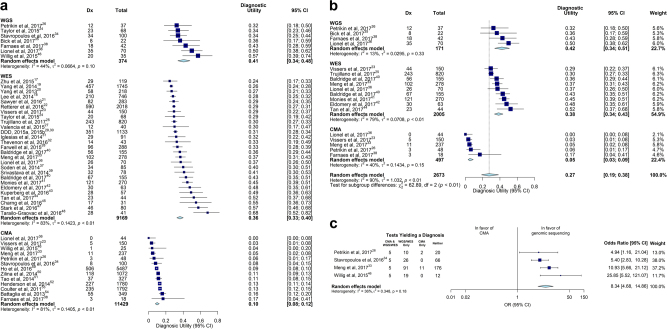
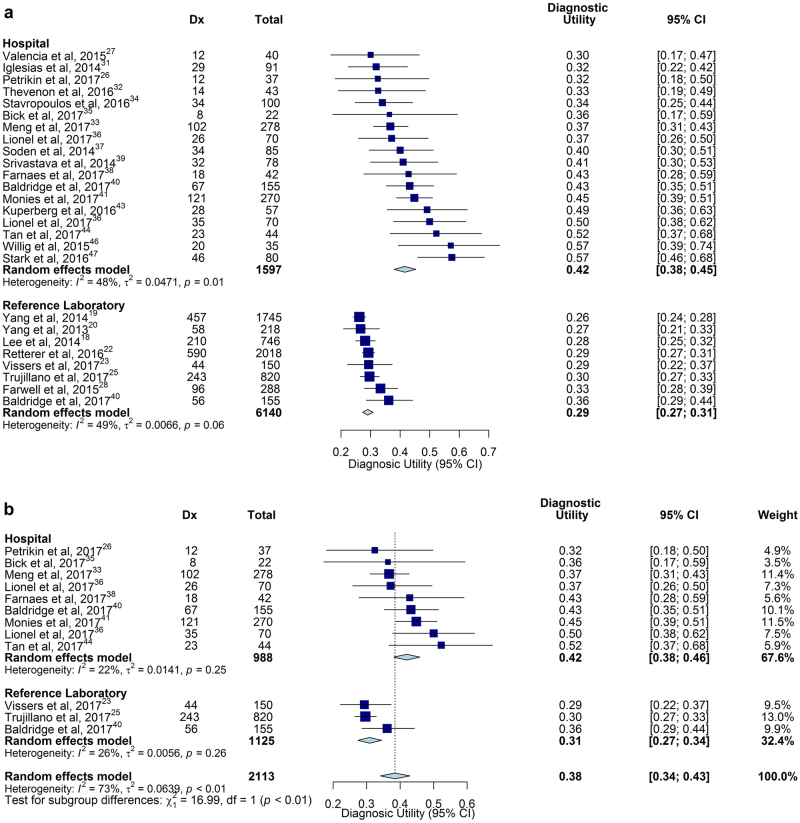
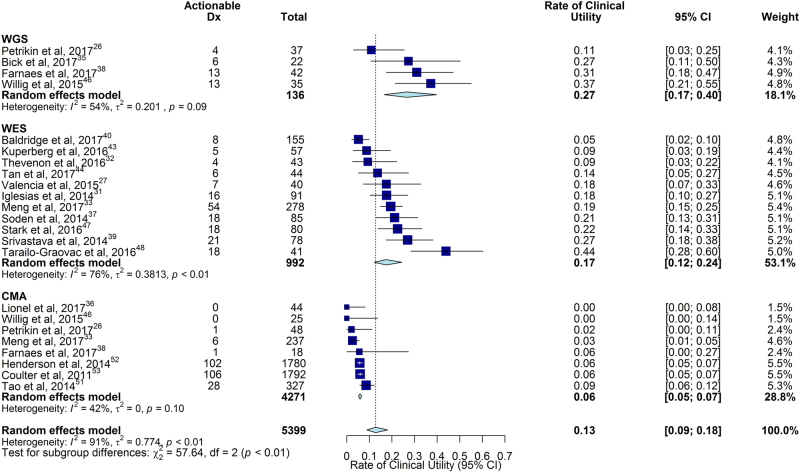
Genetic diseases are leading causes of childhood mortality. Whole-genome sequencing (WGS) and whole-exome sequencing (WES) are relatively new methods for diagnosing genetic diseases, whereas chromosomal microarray (CMA) is well established. Here we compared the diagnostic utility (rate of causative, pathogenic, or likely pathogenic genotypes in known disease genes) and clinical utility (proportion in whom medical or surgical management was changed by diagnosis) of WGS, WES, and CMA in children with suspected genetic diseases by systematic review of the literature (January 2011–August 2017) and meta-analysis, following MOOSE/PRISMA guidelines. In 37 studies, comprising 20,068 children, diagnostic utility of WGS (0.41, 95% CI 0.34–0.48, I 2 = 44%) and WES (0.36, 95% CI 0.33–0.40, I 2 = 83%) were qualitatively greater than CMA (0.10, 95% CI 0.08–0.12, I 2 = 81%). Among studies published in 2017, the diagnostic utility of WGS was significantly greater than CMA ( P < 0.0001, I 2 = 13% and I 2 = 40%, respectively). Among studies featuring within-cohort comparisons, the diagnostic utility of WES was significantly greater than CMA ( P < 0.001, I 2 = 36%). The diagnostic utility of WGS and WES were not significantly different. In studies featuring within-cohort comparisons of WGS/WES, the likelihood of diagnosis was significantly greater for trios than singletons (odds ratio 2.04, 95% CI 1.62–2.56, I 2 = 12%; P < 0.0001). Diagnostic utility of WGS/WES with hospital-based interpretation (0.42, 95% CI 0.38–0.45, I 2 = 48%) was qualitatively higher than that of reference laboratories (0.29, 95% CI 0.27–0.31, I 2 = 49%); this difference was significant among studies published in 2017 ( P < .0001, I 2 = 22% and I 2 = 26%, respectively). The clinical utility of WGS (0.27, 95% CI 0.17–0.40, I 2 = 54%) and WES (0.17, 95% CI 0.12–0.24, I 2 = 76%) were higher than CMA (0.06, 95% CI 0.05–0.07, I 2 = 42%); this difference was significant for WGS vs CMA ( P < 0.0001). In conclusion, in children with suspected genetic diseases, the diagnostic and clinical utility of WGS/WES were greater than CMA. Subgroups with higher WGS/WES diagnostic utility were trios and those receiving hospital-based interpretation. WGS/WES should be considered a first-line genomic test for children with suspected genetic diseases.
Overview
The claims and statistics of this paper haven’t been checked yet.
Free: it reads the open-access text and checks the first 5 claims that cite a source we can check. Create a free account to check every claim.
Integrity signals
Registry
Cites
Statistics
Figures

Verification
Claims the paper makes
The claims and statistics of this paper haven’t been checked yet.
Free: it reads the open-access text and checks the first 5 claims that cite a source we can check. Create a free account to check every claim.
Claims other papers make about this one
Each is checked against this paper’s own text: does it say what the citing paper says it does?
The source backs part of the claim, not all of it — or backs it for a different population, condition or comparison.
In the citing paper
“Molecular diagnostic laboratories typically use highly accurate DNA sequencing technologies to test for these types of rare pathogenic variants [3,4].”
From Assessing the analytical validity of SNP-chips for detecting very rare pathogenic variants: implications for direct-to-consumer genetic testing (2019) · cites this paper as [3]
Experimental — accuracy not yet measured
Self-check
Percentages, sums and reported differences re-computed from the paper’s own numbers.
The self-check needs the paper’s full text.
Citations
Cites
Quantifying heterogeneity in a meta‐analysis
Higgins, J. P. T., & Thompson, S. G. (2002) · Statistics in Medicine · doi:10.1002/sim.1186 · Cited by 36,763
Conducting Meta-Analyses in R with the metafor Package
Viechtbauer, W. (2010) · Journal of Statistical Software · doi:10.18637/jss.v036.i03 · Cited by 20,464
THE USE OF CONFIDENCE OR FIDUCIAL LIMITS ILLUSTRATED IN THE CASE OF THE BINOMIAL
CLOPPER, C. J., & PEARSON, E. S. (1934) · Biometrika · doi:10.1093/biomet/26.4.404 · Cited by 5,003
Miller, D. T., Adam, M. P., Aradhya, S., Biesecker, L. G., Brothman, A. R., Carter, N. P., Church, D. M., Crolla, J. A., Eichler, E. E., Epstein, C. J., et al. (2010) · The American Journal of Human Genetics · doi:10.1016/j.ajhg.2010.04.006 · Cited by 2,882
Clinical Whole-Exome Sequencing for the Diagnosis of Mendelian Disorders
Yang, Y., Muzny, D. M., Reid, J. G., Bainbridge, M. N., Willis, A., Ward, P. A., Braxton, A., Beuten, J., Xia, F., Niu, Z., et al. (2013) · New England Journal of Medicine · doi:10.1056/nejmoa1306555 · Cited by 1,964
THE COMPARISON OF PERCENTAGES IN MATCHED SAMPLES
COCHRAN, W. G. (1950) · Biometrika · doi:10.1093/biomet/37.3-4.256 · Cited by 1,465
Molecular Findings Among Patients Referred for Clinical Whole-Exome Sequencing
Yang, Y., Muzny, D. M., Xia, F., Niu, Z., Person, R., Ding, Y., Ward, P., Braxton, A., Wang, M., Buhay, C., et al. (2014) · JAMA · doi:10.1001/jama.2014.14601 · Cited by 1,360
Large-scale discovery of novel genetic causes of developmental disorders
Study, T. D. D. D. (2015) · Nature · doi:10.1038/nature14135 · Cited by 1,124
Clinical application of whole-exome sequencing across clinical indications
Retterer, K., Juusola, J., Cho, M. T., Vitazka, P., Millan, F., Gibellini, F., Vertino-Bell, A., Smaoui, N., Neidich, J., Monaghan, K. G., et al. (2016) · Genetics in Medicine · doi:10.1038/gim.2015.148 · Cited by 1,035
Clinical Exome Sequencing for Genetic Identification of Rare Mendelian Disorders
Lee, H., Deignan, J. L., Dorrani, N., Strom, S. P., Kantarci, S., Quintero-Rivera, F., Das, K., Toy, T., Harry, B., Yourshaw, M., et al. (2014) · JAMA · doi:10.1001/jama.2014.14604 · Cited by 973
Research works printed but not linked: 1
- Schwarzer, G. meta: an R package for meta-analysis. R. News 7, 40–45 (2007).
Cited by
Items 301–400 of 624
Cole, J. J., Williams, J., Sellitto, A. D., Baratta, L. R., Huecker, J. B., Baldridge, D., Kannampallil, T., Gurnett, C. A., & Balls‐Berry, J. E. (2025) · Neurology · doi:10.1212/wnl.0000000000210275 · Cited by 12
Beuschel, J. J., Geyer, H., Rich, M., Leimanis, M. L., Kampfschulte, A., VanSickle, E., Rajasekaran, S., & Bupp, C. P. (2021) · The Journal of Pediatrics · doi:10.1016/j.jpeds.2021.08.010 · Cited by 8
Delanne, J., Bruel, A., Huet, F., Moutton, S., Nambot, S., Grisval, M., Houcinat, N., Kuentz, P., Sorlin, A., Callier, P., et al. (2021) · Molecular Genetics and Metabolism Reports · doi:10.1016/j.ymgmr.2021.100812 · Cited by 10
Velluva, A., Radtke, M., Horn, S., Popp, B., Platzer, K., Gjermeni, E., Lin, C.-C., Lemke, J. R., Garten, A., Schöneberg, T., et al. (2021) · BMC Genomics · doi:10.1186/s12864-021-08125-9 · Cited by 7
What can go wrong in the non-coding genome and how to interpret whole genome sequencing data
Krude, H., Mundlos, S., Øien, N. C., Opitz, R., & Schuelke, M. (2021) · Medizinische Genetik · doi:10.1515/medgen-2021-2071 · Cited by 13
“The current average WES diagnostic rate is 30 %, with a substantial variation of 7–44 % between disease groups [7, 8].”
BackgroundJohnson, K., Saylor, K. W., Guynn, I., Hicklin, K., Berg, J. S., & Lich, K. H. (2021) · Genetics in Medicine · doi:10.1016/j.gim.2021.10.008 · Cited by 9
Xiao, T., Dong, X., Lu, Y., & Zhou, W. (2022) · Phenomics · doi:10.1007/s43657-022-00071-0 · Cited by 9
“2022), enables the management of predictable complications (Clark et al. 2018), and facilitates the acquisition of financial and practical support (Wang et al.”
BackgroundHayeems, R. Z., Bernier, F. P., Boycott, K. M., Hartley, T., Michaels-Igbokwe, C., & Marshall, D. A. (2022) · BMJ Open · doi:10.1136/bmjopen-2022-061468 · Cited by 8
Test development, optimization and validation of a WGS pipeline for genetic disorders
Yang, Z., Yang, X., Sun, Y., Wang, Y., Song, L., Qiao, Z., Fang, Z., Wang, Z., Liu, L., Chen, Y., et al. (2023) · BMC Medical Genomics · doi:10.1186/s12920-023-01495-x · Cited by 10
“Although compared to other testing method, WGS remains very expensive and has limitations in accuracy for variants in regions of high homology, low complexity, and other technically challenging regions [5], WGS as a primary clinical test has demonstrated diagnostic superiority compared with conventional testing in ped…”
ResultLiu, W., Liu, P., Guo, D., Jin, Y., Zhao, K., Zheng, J., Li, K., Li, L., & Zhang, S. (2023) · Orphanet Journal of Rare Diseases · doi:10.1186/s13023-023-02847-7 · Cited by 7
“Since rare diseases are mostly hereditary and caused by genetic defects, genetic testing has become an important tool [4, 5] for the diagnosis and prevention of rare diseases.”
BackgroundBhatia, S., Pal, S., Kulshrestha, S., Gupta, D., Soni, A., Saxena, R., Bijarnia‐Mahay, S., Verma, I. C., & Puri, R. D. (2024) · European Journal of Human Genetics · doi:10.1038/s41431-024-01569-z · Cited by 9
“A recent meta-analysis reported a change in clinical management in 6 – 27% children and recommended that WGS/WES should be considered a fi rst-line genomic test in suspected genetic disease [37].”
Health Care Costs After Genome-Wide Sequencing for Children With Rare Diseases in England and Canada
Weymann, D., Buckell, J., Fahr, P., Loewen, R., Ehman, M., Pollard, S., Friedman, J. M., Stöckler‐Ipsiroglu, S., Elliott, A. M., Wordsworth, S., et al. (2024) · JAMA Network Open · doi:10.1001/jamanetworkopen.2024.20842 · Cited by 10
Orellana, C., Rosello, M., Sanchís, A., Pedrola, L., Grau, C. M., Gabaldón-Albero, A., Senent, M. L., Such, E., García-Ruiz, C., Avetisyan, G., et al. (2025) · International Journal of Molecular Sciences · doi:10.3390/ijms26031244 · Cited by 7
“However, the diagnostic yield of these approaches, even when combined, only reaches at most 30% to 50% depending on the clinical cohort and the strategy used [1].”
Benefits and barriers to broad implementation of genomic sequencing in the NICU
Goldin, M. R., Ruderfer, D. M., Bick, A. G., Roden, D. M., Schuler, B. A., & Robinson, J. R. (2025) · The American Journal of Human Genetics · doi:10.1016/j.ajhg.2025.04.007 · Cited by 9
Britten‐Jones, A. C., Hickey, D. G., Edwards, T. L., & Ayton, L. N. (2025) · Genes · doi:10.3390/genes16080888 · Cited by 7
“Trio testing could facilitate the detection of de novo variants and allow phasing of compound heterozygous variants during interpretation, rather than post-test [38].”
Please give me a copy of my child’s raw genomic data
Chad, L., & Szego, M. J. (2021) · npj Genomic Medicine · doi:10.1038/s41525-021-00175-y · Cited by 10
Blake, B., Brady, L., Rouse, N. A., Nagy, P. L., & Tarnopolsky, M. A. (2021) · Journal of Pediatric Genetics · doi:10.1055/s-0041-1736610 · Cited by 10
A clinician's guide to omics resources in dermatology
Doolan, B. J., McGrath, J. A., & Onoufriadis, A. (2022) · Clinical and Experimental Dermatology · doi:10.1111/ced.15117 · Cited by 8
Delanne, J., Lecat, M., Blackburn, P. R., Klee, E. W., Schrander-Stumpel, C. T. R. M., Stegmann, A. P. A., Stevens, S. J. C., Nava, C., Héron, D., Keren, B., et al. (2022) · SSRN Electronic Journal · doi:10.1016/j.ejmg.2022.104670 · Cited by 8
Neuhofer, C. M., & Prokisch, H. (2024) · International Journal of Molecular Sciences · doi:10.3390/ijms25094602 · Cited by 11
“Furthermore, using the current gold standard methods of Whole-Exome-Sequencing (WES) or Whole-Genome-Sequencing (WGS), diagnostic rates cap at 30–50%, leaving >50% of patients with a suspected hereditary disorder without a diagnosis [3–5].”
MethodImpact of prenatal genomics on clinical genetics practice
Zemet, R., & den Veyver, I. B. V. (2024) · Best Practice & Research Clinical Obstetrics & Gynaecology · doi:10.1016/j.bpobgyn.2024.102545 · Cited by 8
Asano, K., Yoshimi, K., Takeshita, K., Mitsuhashi, S., Kochi, Y., Hirano, R., Tingyu, Z., Ishida, S., & Mashimo, T. (2024) · ACS Synthetic Biology · doi:10.1021/acssynbio.4c00265 · Cited by 7
Stoyanova, M., Yahya, D., Hachmeriyan, M., & Levkova, M. (2025) · Medical Sciences · doi:10.3390/medsci13020075 · Cited by 11
“These findings align with prior studies suggesting that the diagnostic success of next-generation sequencing increases with the complexity and specificity of the clinical phenotype [16].”
Genetic diagnoses and associated anomalies in fetuses prenatally diagnosed with esophageal atresia
Rohanizadegan, M., Tracy, S. A., Galarreta, C. I., Poorvu, T., Buchmiller, T. L., Bird, L. M., Estroff, J. A., & Tan, W. (2020) · American Journal of Medical Genetics Part A · doi:10.1002/ajmg.a.61639 · Cited by 7
Chandran, J., Bellad, A., Ramarajan, M. G., & Rangiah, K. (2021) · Analytical Science Advances · doi:10.1002/ansa.202100010 · Cited by 6
“113 Based on these considerations, IEMs can be arbitrarily classified into three categories based on the metabolic profile of the disease and the nature of their diagnostic biomarkers.”
BackgroundNeptune: an environment for the delivery of genomic medicine
Venner, E., Yi, V., Murdock, D. R., Kalla, S. E., Wu, T.-J., Sabo, A., Li, S., Meng, Q., Xia, T., Murugan, M., et al. (2021) · Genetics in Medicine · doi:10.1038/s41436-021-01230-w · Cited by 6
“These include (1) insufficient infrastructure for high-throughput clinical reporting [1–3], (2) challenges handling protected health information (PHI) [4, 5], (3) labor-intensive genomic variant interpretation [6], (4) clinical site specific data integration requirements [7, 8], (5) few actionable findings in some dis…”
BackgroundNaseer, M. I., Abdulkareem, A. A., Rasool, M., Algahtani, H. A., Muthaffar, O. Y., & Pushparaj, P. N. (2022) · Frontiers in Pediatrics · doi:10.3389/fped.2022.919996 · Cited by 9
Pucel, J., Briere, L. C., Reuter, C. M., Gochyyev, P., Acosta, M. T., Adams, D. R., Alvarez, R. L., Alvey, J., Allworth, A., Andrews, A., et al. (2024) · Genetics in Medicine · doi:10.1016/j.gim.2024.101115 · Cited by 7
Resolving unsolved whole-genome sequencing data in paediatric neurological disorders: a cohort study
Chi, C., Tsai, C., & Lee, H.-F. (2024) · Archives of Disease in Childhood · doi:10.1136/archdischild-2024-326985 · Cited by 6
“…diagnostic performance and clinical physicians tend to prioritise WGS over CMA in healthcare decision-making to find out causative variants more than SV. 6 22 The workflow proposed in this study combines multiple SV calling algorithms to mitigate obstacles to SV detection of single algorithm.”
Morales‐Romero, B., Muñoz‐Pujol, G., Artuch, R., García‐Cazorla, À., O’Callaghan, M., Sykut‐Cegielska, J., Campistol, J., Moreno, P., Oud, M. M., Wevers, R. A., et al. (2024) · Molecular Genetics and Metabolism · doi:10.1016/j.ymgme.2024.108511 · Cited by 7
Biesecker, B. B., Ackerman, S., Brothers, K. B., East, K. M., Foreman, A. K. M., Hindorff, L. A., Horowitz, C. R., Jarvik, G. P., Knight, S. J., Leo, M. C., et al. (2025) · Genetics in Medicine · doi:10.1016/j.gim.2025.101363 · Cited by 7
Yang, M., Kim, J. A., Jo, H. S., Park, J.-H., Ahn, S. Y., Sung, S. I., Park, W. S., Cho, H.-W., Kim, J., Park, M.-H., et al. (2024) · Journal of Korean Medical Science · doi:10.3346/jkms.2024.39.e250 · Cited by 7
Clinical genome sequencing in patients with suspected rare genetic disease in Peru
Bazalar‐Montoya, J., Cornejo‐Olivas, M., Dueñas, M., Purizaca-Rosillo, N. D., Rodriguez, R. S., Milla‐Neyra, K., Torre-Hernandez, C. A. D. L., Sarapura‐Castro, E. H., Galarreta, C. I., Manassero‐Morales, G., et al. (2024) · npj Genomic Medicine · doi:10.1038/s41525-024-00434-8 · Cited by 9
Pal, L. R., Kundu, K., Yin, Y., & Moult, J. (2019) · Human Mutation · doi:10.1002/humu.23933 · Cited by 6
Wain, K. E., Tolwinski, K., Palen, E., Heidlebaugh, A. R., Holdren, K., Walsh, L. K., Oetjens, M. T., Ledbetter, D. H., & Martin, C. L. (2021) · Journal of Personalized Medicine · doi:10.3390/jpm11050365 · Cited by 6
Paediatric genomic testing: Navigating genomic reports for the general paediatrician
Shah, M., Selvanathan, A., Baynam, G. S., Berman, Y. D., Boughtwood, T. F., Freckmann, M., Parasivam, G., White, S. M., Roberts, N. J., Kirk, E. P., et al. (2021) · Journal of Paediatrics and Child Health · doi:10.1111/jpc.15703 · Cited by 6
Self-citationRapid Exome and Genome Sequencing in the Intensive Care Unit
Muriello, M. J., & Basel, D. (2022) · Critical Care Clinics · doi:10.1016/j.ccc.2021.11.001 · Cited by 8
Kobayashi, E. S., & Dimmock, D. (2022) · Human Mutation · doi:10.1002/humu.24422 · Cited by 8
Self-citationVariantAlert: A web‐based tool to notify updates in genetic variant annotations
Atzeni, R., Massidda, M., Fotia, G., & Uva, P. (2022) · Human Mutation · doi:10.1002/humu.24495 · Cited by 6
“Human Mutation published by Wiley Periodicals LLC. depending on the type of disease and selection criteria (Clark et al., 2018; Fung et al., 2020; Wright et al., 2015).”
BackgroundElusive variants in autosomal recessive disease: how can we improve timely diagnosis?
Horton, A., Lunke, S., Sadedin, S., Fennell, A. P., & Stark, Z. (2023) · European Journal of Human Genetics · doi:10.1038/s41431-023-01293-0 · Cited by 6
“9% of hospital admissions [2], a molecular diagnosis remains elusive in >50% of individuals with a suspected genetic disorder [3].”
BackgroundSelf-citationGenetic Defects in Early-Onset Inflammatory Bowel Disease
Dagci, A. O. B., & Cushing, K. C. (2023) · Rheumatic Disease Clinics of North America · doi:10.1016/j.rdc.2023.06.006 · Cited by 8
Lee, Y., Park, S., Lee, J. S., Kim, S. Y., Cho, J., Yoo, Y., Lee, S., Yoo, T., Lee, M., Seo, J., et al. (2020) · Scientific Reports · doi:10.1038/s41598-020-58101-8 · Cited by 7
Llorian, E. R., Dragojlovic, N., Campbell, T., Friedman, J. M., Osiovich, H. C., Candido, T., Christilaw, J., Dragojlovic, N., du Souich, C., Elliott, A. M., et al. (2022) · Genetics in Medicine · doi:10.1016/j.gim.2022.04.014 · Cited by 7
Mathew, M. T., Antoniou, A. A., Ramesh, N., Hu, M., Gaither, J., Mouhlas, D., Hashimoto, S., Humphrey, M., Matthews, T., Hunter, J. M., et al. (2022) · Journal of Molecular Diagnostics · doi:10.1016/j.jmoldx.2022.06.001 · Cited by 6
A complete pedigree-based graph workflow for rare candidate variant analysis
Markello, C., Huang, C., Rodríguez, Á., Carroll, A. W., Chang, P.-C., Eizenga, J. M., Markello, T. C., Haussler, D. H., & Paten, B. (2022) · Genome Research · doi:10.1101/gr.276387.121 · Cited by 6
“In typical clinical diagnostics, in particular for the case of rare diseases, parental genomes are sequenced to help improve the chances of successful clinical diagnosis of a proband (Clark et al. 2018).”
BackgroundDiagnostic utility of exome sequencing followed by research reanalysis in human brain malformations
Kooshavar, D., Amor, D. J., Boggs, K., Baker, N. L., Barnett, C., Silva, M. D., Edwards, S., Fahey, M. C., Marum, J. E., Snell, P., et al. (2024) · Brain Communications · doi:10.1093/braincomms/fcae056 · Cited by 7
“74 Prioritization and curation of the variants found through genomic testing also benefits from the collaboration of clinicians and bioinformaticians before the final genomic report is returned to the referring clinician for discussion with the patient and their parents.”
BackgroundSlabá, K., Pokorná, P., Jugas, R., Pálová, H., Procházková, D., Aulická, Š., Španělová, K., Danhofer, P., Horák, O., Tučková, J., et al. (2024) · Scientific Reports · doi:10.1038/s41598-024-79872-4 · Cited by 8
“On the other hand, the diagnostic rate of WGS did not differ significantly from that of WES in the two meta-analyses 12,32 .”
Moore, C., Arenchild, M., Waldman, B. M., Rego, S. P., Kingsmore, S. F., Field, J., Barnhart, J., Nee, S., & Nofsinger, R. R. (2025) · The Journal of Applied Laboratory Medicine · doi:10.1093/jalm/jfaf045 · Cited by 5
Self-citationEdiae, G. U., Lemire, G., Chisholm, C., Hartley, T., Eaton, A. J., Osmond, M., Rojas, S. K., Huang, L., Gillespie, M. K., Sawyer, S. L., et al. (2022) · American Journal of Medical Genetics Part A · doi:10.1002/ajmg.a.63022 · Cited by 7
“Unfortunately, this type of approach is not typically integrated into most genetic clinics due to limited time, resources, and/or knowledge; as a result, the testing process for many patients with RGD ends after clinical ES, even if the result is nondiagnostic.”
BackgroundMethodResultInfluentialThe Approach to a Child with Dysmorphic Features: What the Pediatrician Should Know
Ciancia, S., Madeo, S. F., Calabrese, O., & Iughetti, L. (2024) · Children · doi:10.3390/children11050578 · Cited by 7
Rolando, M., Raggio, V. E., Naya, H., Spangenberg, L., & Cagnina, L. (2025) · Scientific Reports · doi:10.1038/s41598-025-90450-0 · Cited by 8
Sakaria, R. P., Zaveri, P. G., Holtrop, S., Zhang, J., Brown, C., & Pivnick, E. K. (2021) · Frontiers in Genetics · doi:10.3389/fgene.2021.766316 · Cited by 5
“In general, WES and WGS also provide important information regarding prognosis and surveillance measures and inform clinical management decisions (Meng et al., 2017; Clark et al., 2018; Manickam et al., 2021; NICUSeq study group et al., 2021).”
BackgroundNovel ITPA variants identified by whole genome sequencing and RNA sequencing
Omichi, N., Kishita, Y., Nakama, M., Sasai, H., Terazawa, A., Kobayashi, E., Fushimi, T., Sugiyama, Y., Ichimoto, K., Nitta, K. R., et al. (2023) · Journal of Human Genetics · doi:10.1038/s10038-023-01156-y · Cited by 5
“WES has enabled the diagnosis of conditions in ~35% of the patients [1].”
BackgroundFuentes-Bolanos, N., Padhye, B. D., Daley, M., Hunter, J. D., Hetherington, K., Warby, M., Courtney, E., Kirk, J., Josephi‐Taylor, S., Chen, Y., et al. (2023) · BMJ Open · doi:10.1136/bmjopen-2022-070082 · Cited by 5
“6 7–9 This suggests that the ideal test for paediatric CP would be trio whole-genome germline sequencing (trio WGS), however its use to screen for CP in all paediatric cancer patients remains a research-only activity that is difficult and costly to implement in a health-care setting.”
BackgroundVuocolo, B., German, R. J., Lalani, S. R., Murali, C. N., Bacino, C. A., Baskin, S. M., Littlejohn, R. O., Odom, J. D., McLean, S., Schmid, C., et al. (2024) · Genetics in Medicine · doi:10.1016/j.gim.2024.101102 · Cited by 6
Rapid Genomic Testing in Intensive Care: Health Professionals’ Perspectives on Ethical Challenges
Arkell, K., Gyngell, C., Stark, Z., & Vears, D. F. (2023) · Children · doi:10.3390/children10050824 · Cited by 9
“HPs may prioritize the urGS test result because they see it as an efficient use of resources in a time-sensitive environment [6,29,30].”
BackgroundSelf-citationHayeems, R. Z., Luca, S., Chad, L., Quercia, N. L., Xiao, B., Hossain, A., Meyn, M. S., Pullenayegum, E., & Ungar, W. J. (2023) · Clinical Therapeutics · doi:10.1016/j.clinthera.2023.07.006 · Cited by 5
Elliott, A. M., Dragojlovic, N., Campbell, T., Adam, S., du Souich, C., Fryer, M., Lehman, A., van Karnebeek, C., Lynd, L. D., & Friedman, J. M. (2021) · Journal of Telemedicine and Telecare · doi:10.1177/1357633x20982737 · Cited by 6
Somatic variation as an incidental finding in the pediatric next-generation sequencing eraPreprint
Melas, M., Mathew, M., Mori, M., Jayaraman, V., Wilson, S. A., Martin, C., Jacobson‐Kelly, A. E., Kelly, B., Magrini, V. J., Mardis, E. R., et al. (2021) · Molecular Case Studies · doi:10.1101/mcs.a006135 · Cited by 5
“In the pediatric setting, ES has shown clinical utility in patients with suspected genetic disorders (Meng et al. 2017; Clark et al. 2018).”
BackgroundRNA sequencing driven diagnosis expands the phenotypic spectrum of NBAS deficiency
Silverstein, S., Cassini, T. A., Fu, J., Pusey, B. N., Macnamara, E. F., Frost, F. G., Williams, C., Huang, Y., Tifft, C. J., Gahl, W. A., et al. (2025) · Molecular Genetics and Metabolism · doi:10.1016/j.ymgme.2025.109105 · Cited by 5
Ng, H., Ma, W., Lam, W. P., Lau, C.-S., Luk, H., Au, L. W. C., Cheng, S. S. W., Chong, J. S. C., Ho, S., Ma, B. M., et al. (2025) · Human Genetics and Genomics Advances · doi:10.1016/j.xhgg.2025.100469 · Cited by 9
“14,15 Recognizing the potential and importance of WGS in the development and advancement of genomic medicine, the Hong Kong Genome Project (HKGP) was launched in 2021 to cater to the diagnostic needs of patients.”
Hayeems, R. Z., Ungar, W. J., Marshall, C. R., Gillespie, M. K., Szuto, A., Huang, L., Venkataramanan, V., Xiao, B., Chisholm, C., Stavropoulos, D. J., et al. (2025) · Genetics in Medicine · doi:10.1016/j.gim.2025.101605 · Cited by 7
Lamsal, R., Smith, H. S., & Grosse, S. D. (2025) · Applied Health Economics and Health Policy · doi:10.1007/s40258-025-01013-3 · Cited by 5
“Genomic sequencing can identify genetic risk for highly penetrant, monogenic, rare conditions that may be undetectable by current NBS analytic approaches [141, 147–151].”
BRAIN-MAGNET: A functional genomics atlas for interpretation of non-coding variants
Deng, R., Perenthaler, E., Nikoncuk, A., Yousefi, S., Lanko, K., Schot, R., Maresca, M., Salsench, E. M., Sanderson, L. E., Parker, M. J., et al. (2025) · Cell · doi:10.1016/j.cell.2025.10.029 · Cited by 6
Information content as a health system screening tool for rare diseases
Groza, T., Robinson, P. N., Lim, W. K., Narasimhalu, K., Hsieh, J. Y. C., Yeo, K. K., Goh, B. K., Thomas, T. G. S., Wong, T. Y., Karnani, N., et al. (2025) · npj Digital Medicine · doi:10.1038/s41746-025-02096-x · Cited by 7
Groza, T., Marcello, A., Carlisle, T., Lim, W. K., Haendel, M. A., Karnani, N., Robinson, P. N., Graeßner, H., Chong, J. X., Baynam, G. S., et al. (2025) · Human Genetics and Genomics Advances · doi:10.1016/j.xhgg.2025.100558 · Cited by 10
“…(HPO) in 2008 6,7 standardized the vocabulary for describing clinical features of RDs and, in combination with large curation efforts such as OMIM, the Monarch Initiative, 8 and Orphanet, 9 enabled algorithmic methods for patient matchmaking, 10,11 variant prioritization, 12,13 and disease ranking.”
Afridi, T. U. K., Fatima, A., Satti, H. S., Akram, Z., Yousafzai, I. K., Naeem, W. B., Fatima, N., Ali, A., Iqbal, Z., Khan, A., et al. (2024) · Molecular Genetics and Genomics · doi:10.1007/s00438-024-02149-y · Cited by 4
“With an average diagnostic yield of 30–50%, ES has emerged as a key diagnostic tool in clinical and research environments and is considered a first-tier (Clark et al. 2018; Srivastava et al. 2019) diagnostic approach.”
Saba, L. F., Streff, H. E., Lopez-Terrada, D. H., & Scull, J. C. (2024) · Genetics in Medicine · doi:10.1016/j.gim.2024.101330 · Cited by 4
Long-term follow-up of children who received rapid genomic sequencing
Kobayashi, E. S., Tobin, L. E., Arenchild, M., Benson, W., Coufal, N. G., Juarez, E. F., Kingsmore, S. F., Knight, J. R., Lenberg, J. L., Schwarz, A., et al. (2025) · Genetics in Medicine · doi:10.1016/j.gim.2025.101403 · Cited by 6
Self-citationUngar, W. J., Wu, V., Marshall, C. R., Hwang, J., Hayeems, R. Z., Tsiplova, K., Gillespie, M. K., Szuto, A., Chisholm, C., Stavropoulos, D. J., et al. (2025) · Genetics in Medicine · doi:10.1016/j.gim.2025.101561 · Cited by 4
Jezkova, J., Heath, J., Williams, A., Barrell, D., Norton, J., Collinson, M. N., Beal, S. J., Corrin, S., & Morgan, S. (2020) · npj Genomic Medicine · doi:10.1038/s41525-020-0136-1 · Cited by 6
Choi, I. H., Seo, G. H., Park, J. Y., Kim, Y.-M., Cheon, C. K., Kim, Y., Oh, A., Byeon, J. H., Kang, E., Shin, Y., et al. (2022) · Medicine · doi:10.1097/md.0000000000029424 · Cited by 5
“[9,10] 14] Recently, in the healthcare industry, artificial intelligence (AI) has been applied to facilitate disease diagnosis and treatment development.”
BackgroundHow do genetic tests answer questions about neurodevelopmental differences? A sociological take
Navon, D. (2022) · Developmental Medicine & Child Neurology · doi:10.1111/dmcn.15376 · Cited by 5
“However, with rapid progress in genomic testing technologies and the development of enormous databases of relevant genes, variants, and phenotypes, clinical diagnostic tests can identify a genetic explanation in a growing proportion of cases— something like 10% to 40% using different combinations of cytogenetic and mi…”
BackgroundJames, K. N., Chowdhury, S., Ding, Y., Batalov, S., Watkins, K., Kwon, Y. H., Kraan, L. V. D., Ellsworth, K. A., Kingsmore, S. F., & Guidugli, L. (2023) · Genetics in Medicine · doi:10.1016/j.gim.2023.101006 · Cited by 8
Self-citationExploring uncertainties regarding unsolicited findings in genetic testing
van der Schoot, V., van der Meer, E., Hillen, M. A., Yntema, H. G., Brunner, H. G., & Oerlemans, A. J. M. (2023) · Patient Education and Counseling · doi:10.1016/j.pec.2023.108064 · Cited by 6
Fetal whole genome sequencing as a clinical diagnostic tool: Advantages, limitations and pitfalls
Basel-Salmon, L., & Brabbing‐Goldstein, D. (2024) · Best Practice & Research Clinical Obstetrics & Gynaecology · doi:10.1016/j.bpobgyn.2024.102549 · Cited by 6
Wu, D., Chen, R., Zhang, J., Yan, W., Chen, M., Xia, D., Li, X., Dai, Y., Chen, Y., & Li, R. (2025) · The Italian Journal of Pediatrics/Italian journal of pediatrics · doi:10.1186/s13052-025-01839-6 · Cited by 4
Khang, R., Lee, H., Kim, J., Moon, D., Jang, S., Lee, E., Song, Y., Ryu, S. W., Lee, S., Han, H., et al. (2025) · Human Mutation · doi:10.1155/humu/6096758 · Cited by 7
Zhang, H., Chen, X., Tan, H., Teng, Y., Liu, D., Wu, J., Duan, R., Liang, D., Li, Z., & Wu, L. (2022) · Clinica Chimica Acta · doi:10.1016/j.cca.2022.10.023 · Cited by 5
Ungar, W. J., Hayeems, R. Z., Marshall, C. R., Gillespie, M. K., Szuto, A., Chisholm, C., Stavropoulos, D. J., Huang, L., Jarinova, O., Wu, V., et al. (2023) · Clinical Therapeutics · doi:10.1016/j.clinthera.2023.06.004 · Cited by 4
Borle, K. J., Kopac, N., Dragojlovic, N., Llorian, E. R., & Lynd, L. D. (2023) · Clinical Therapeutics · doi:10.1016/j.clinthera.2023.07.005 · Cited by 6
Report of two cases of Schaaf‐Yang syndrome: Same genotype and different phenotype
Rodríguez, A., Schain, K., Jayakar, P., Wright, M. S., Chowdhury, S., & Salyakina, D. (2023) · Clinical Case Reports · doi:10.1002/ccr3.7753 · Cited by 4
Cole, J. J., & Aravamuthan, B. R. (2023) · Neurology Clinical Practice · doi:10.1212/cpj.0000000000200192 · Cited by 6
Turbitt, E., Callinan, E., Shakes, P., McEwen, A., & Amor, D. J. (2024) · Current Developmental Disorders Reports · doi:10.1007/s40474-024-00291-1 · Cited by 8
“A genetic diagnosis should also allow for preventative healthcare through targeted health screening and support access to appropriate therapies and services [7].”
Bao, Y., Yang, J., Chen, L., Chen, M., Zhao, P., Qiu, S., Zhang, L., & Zhang, G. (2019) · Genetic Testing and Molecular Biomarkers · doi:10.1089/gtmb.2019.0099 · Cited by 5
“Next generation sequencing provides simultaneously a comprehensive and differential diagnostic methodology for such patients (Willig et al. , 2015; Clark et al. , 2018) that can be used for prenatal genetic screening and early intervention for affected to prevent or minimize the sequelae associated…”
McConkie‐Rosell, A., Schoch, K., Sullivan, J. A., Spillmann, R. C., Cope, H., Tan, Q. K. ‐., Palmer, C. G. S., Undiagnosed Disease Network, Hooper, S. R., & Shashi, V. (2021) · Journal of Genetic Counseling · doi:10.1002/jgc4.1451 · Cited by 4
“The benefits include a diagnosis rate of 30%– 40% (Clark et al., 2018; Gilissen et al., 2011; Lee & et al., 2014; Need Stephen Hooper and Vandana Shashi should be considered joint senior authors.”
BackgroundSubstantial role of rare inherited variation in individuals with developmental disordersPreprint
Samocha, K. E., Chundru, V. K., Fu, J. M., Gardner, E. J., Danecek, P., Wigdor, E. M., Malawsky, D. S., Lindsay, S., Campbell, P. H., Singh, T., et al. (2024) · medRxiv · doi:10.1101/2024.08.28.24312746 · Cited by 4
“However, we are able to find diagnostic genetic variants for only ~40% of cases 1,2 , leaving over half of patients with potential genetic contributions undiagnosed.”
BackgroundConsistent Performance of GPT-4o in Rare Disease Diagnosis Across Nine Languages and 4967 CasesPreprint
Chimirri, L., Caufield, J. H., Bridges, Y., Matentzoglu, N., Gargano, M. A., Cazalla, M., Chen, S., Daniš, D., Dingemans, A. J. M., Gehle, P., et al. (2025) · medRxiv · doi:10.1101/2025.02.26.25322769 · Cited by 4
“12 Therefore, the differential diagnosis of RDs represents a challenging task with which to evaluate the capabilities of LLMs. LLMs have shown promise in supporting the differential diagnosis of RDs in English, 13 yet most of the earth's population does not use English as their first language and…”
Evaluating the Clinical Utility of Genomic Sequencing After Perinatal Death
Schubert, C., Jackson, M. R., Barnett, C., Scott, H. S., Sullivan, T., Goodall, S., & Merlin, T. (2025) · Clinical Genetics · doi:10.1111/cge.70028 · Cited by 3
Ehman, M., Sharma, K., Weymann, D., Maroilley, T., Mohajeri, A., Lehman, A., Tarailo‐Graovac, M., Jones, S. J. M., Marra, M. A., Wasserman, W. W., et al. (2025) · Genetics in Medicine · doi:10.1016/j.gim.2025.101568 · Cited by 3
Integrating paediatric subspecialists into the delivery of genomic medicine: A qualitative study
Mackley, M. P., Shickh, S., Lee, W., Hansen, A., Fooks, K., Dolman, L. I., Peltekova, I. T., Hartley, T., GSO Study Team, Aucoin, S., et al. (2025) · Paediatrics & Child Health · doi:10.1093/pch/pxaf080 · Cited by 3
“Genomic sequencing (GS), which includes both exome and genome sequencing, has emerged as an important test to facilitate diagnoses for patients with suspected genetic conditions (1–3).”
Next-generation sequencing as an applicable method: from technical basis to use in medical diagnosis
Moradi, A., Mousavi, M., Maleki, M., Tabatabaei, S. Z., & Malakootian, M. (2026) · Gene · doi:10.1016/j.gene.2026.150002 · Cited by 3
Degeling, K., Tagimacruz, T., MacDonald, K. V., Seeger, T., Fooks, K., Venkataramanan, V., Boycott, K. M., Bernier, F. P., Mendoza‐Londono, R., Hartley, T., et al. (2024) · Applied Health Economics and Health Policy · doi:10.1007/s40258-024-00936-7 · Cited by 4
“Except for the CMA indicator test [45], no basis for the diagnostic yield of the non-ES indicator test categories across multiple tiers of testing and conditional on previous tests performed can be found in the literature.”
Gnanaolivu, R. D., Oliver, G. R., Jenkinson, G., Blake, E., Chen, W., Chia, N. V. C., Klee, E. W., & Wang, C. (2025) · BMC Bioinformatics · doi:10.1186/s12859-025-06096-2 · Cited by 5
“Exome and genome data are playing an increasingly vital role in the diagnosis of rare diseases, with the genotype– phenotype associations further elucidating the study of complex biological processes that involve the coordinated expression and interaction of proteins [2, 3].”
Aleem, T., Rashid, M., Ahmad, N., Asif, M. F., Tariq, M., Malik, N. A., & Poulter, J. A. (2025) · European Journal of Human Genetics · doi:10.1038/s41431-025-01915-9 · Cited by 7
“WES and WGS offer rapid, cost-ef fi cient, and precise molecular diagnosis in patients with complex, unsolved disorders affecting the peripheral and central nervous system [19, 20].”
Ediae, G. U., White‐Brown, A. M., Chisholm, C., Terekhov, I., Seymour, J., Guo, J., Mitsakakis, N., Sawyer, S. L., & Boycott, K. M. (2025) · Genetics in Medicine · doi:10.1016/j.gim.2025.101570 · Cited by 8
Ciaccio, C., Pantaleoni, C., Bulgheroni, S., Sciacca, F. L., & D’Arrigo, S. (2020) · The Cerebellum · doi:10.1007/s12311-020-01145-3 · Cited by 3
Clin.iobio: A Collaborative Diagnostic Workflow to Enable Team-Based Precision Genomics
Ward, A. N., Velinder, M., Sera, T. D., Ekawade, A., Jenkins, S. M., Moore, B., Mao, R., Bayrak‐Toydemir, P., & Marth, G. (2022) · Journal of Personalized Medicine · doi:10.3390/jpm12010073 · Cited by 4
Barseghyan, H., Pang, A. W. C., Zhang, Y., Sahajpal, N., Delpu, Y., Lai, C.-Y. J., Lee, J., Tessereau, C., Oldakowski, M., Kolhe, R. B., et al. (2022) · Neuromethods · doi:10.1007/978-1-0716-2357-2_9 · Cited by 5
A retrospective cohort analysis of the Yale pediatric genomics discovery program
Al‐Ali, S., Jeffries, L., Faustino, E. V. S., Ji, W., Mis, E. K., Konstantino, M., Zerillo, C. A., Jiang, Y., Spencer‐Manzon, M., Bale, A. E., et al. (2022) · American Journal of Medical Genetics Part A · doi:10.1002/ajmg.a.62918 · Cited by 4
“2022;188A:2869–2878. wileyonlinelibrary.com/journal/ajmga © 2022 Wiley Periodicals LLC. 2869 et al., 2020; Clark et al., 2018; Kingsmore et al., 2019).”
Metadata
- Authors
- Clark, M. M., Stark, Z., Farnaes, L., Tan, T. Y., White, S. M., Dimmock, D., & Kingsmore, S. F.
- Affiliations
- Rady Children's Institute for Genomic Medicine (US)
- Murdoch Children's Research Institute (AU)
- University of California San Diego (US)
- The University of Melbourne (AU)
- Corresponding author
- Kingsmore, Stephen F.
- ORCID
- Venue
- npj Genomic Medicine
- Published
- 2018-07-09
- Volume
- 3
- Issue
- 1
- Pages
- 16-16
- ISSN
- 2056-7944 (ISSN-L)
- PMC
- PMC6037748
- OpenAlex
- W2805193585
- Semantic Scholar
- 083457862bf6abd6c563d1b8fec514c3f4e4a779
- Cited by
- 619
- References
- 74
- Citations by year
- 2026: 49 · 2025: 74 · 2024: 80 · 2023: 83 · 2022: 100 · 2021: 98 · 2020: 83 · 2019: 44 · 2018: 6
- FWCI
- 7.96
- Type
- journal article
- Language
- en
- Open access
- gold
- doi.org
- Licence
- cc-by
- creativecommons.org/licenses/by/4.0 (tdm)
- creativecommons.org/licenses/by/4.0 (vor)
- Locations
- npj Genomic Medicine (publishedVersion, cc-by)
- bioRxiv (Cold Spring Harbor Laboratory) (acceptedVersion, cc-by-nd)
- Europe PMC (PubMed Central) (publishedVersion, other-oa)
- PubMed Central (publishedVersion, cc-by)
- PubMed (publishedVersion)
- DOAJ (DOAJ: Directory of Open Access Journals) (submittedVersion)
- Minerva Access (University of Melbourne) (submittedVersion, cc-by)
- Funders
- National Human Genome Research Institute
- Eunice Kennedy Shriver National Institute of Child Health and Human Development (U19HD077693)
- Topics
- Life Sciences › Biochemistry, Genetics and Molecular Biology › Genetics › Genomics and Rare Diseases
- Health Sciences › Medicine › Pediatrics, Perinatology and Child Health › Prenatal Screening and Diagnostics
- Life Sciences › Biochemistry, Genetics and Molecular Biology › Genetics › Genomic variations and chromosomal abnormalities
- Keywords
- whole genome sequencing, exome sequencing, chromosomal microarray analysis, genetic diagnosis, diagnostic yield, clinical utility, genetic interpretation, pathogenic variants, pediatric genetics, rare genetic disorders
About these checks
Registry, retraction, Cites and statistics results are computed, not judged, with one exception: a printed reference that no index lists is read once by a model before it counts as a citation error. Claims are extracted by a model and kept only when their quote appears verbatim in the text; each cited source is then checked, with a model’s help, for whether it says what the claim relies on. Those verdicts can be wrong — read the claim’s quote and the cited source before relying on one.
Statistics and arithmetic are recomputed, not judged.
Confidence bands are shown only for fields calibrated on our annotated test set. None is calibrated yet, so no band is shown.
What counts as a claim ›How we measure confidence ›How we check this ›
Are you an author, or do you see a problem with this page? Request a review
Data sources
Bibliographic data: Semantic Scholar, OpenAlex, Crossref.
Contains information from the Semantic Scholar Academic Graph Datasets, made available under the ODC Attribution License (ODC-BY 1.0).
Semantic Scholar’s data is described in: Kinney, R., et al. (2023). The Semantic Scholar Open Data Platform. arXiv:2301.10140.
