

Imperceptive and reusable dermal surface EMG for lower extremity neuro-prosthetic control and clinical assessment
Open accessThe DOI matches its Crossref record; 49 of the 50 references it cites were found in a registry or an index.
Abstract
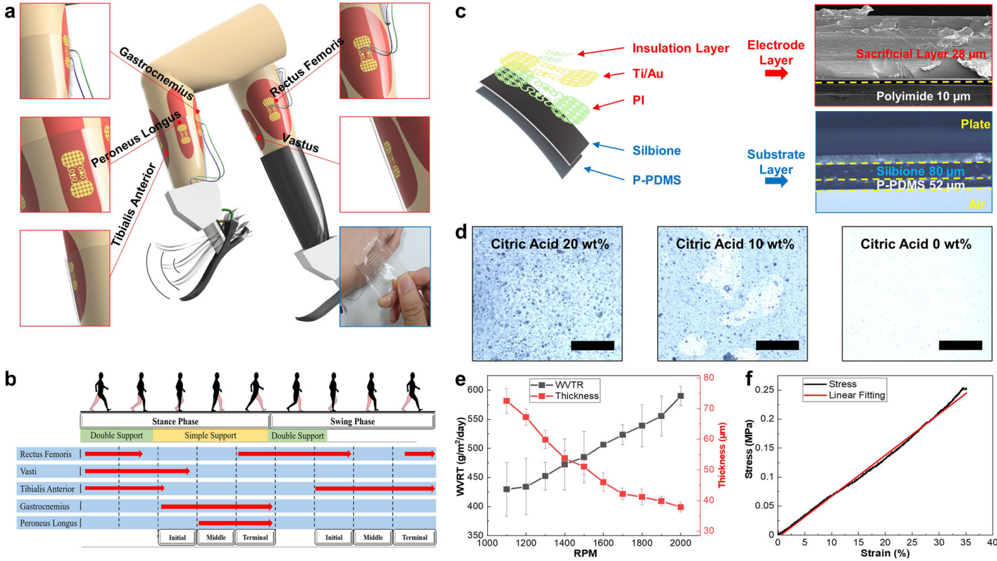
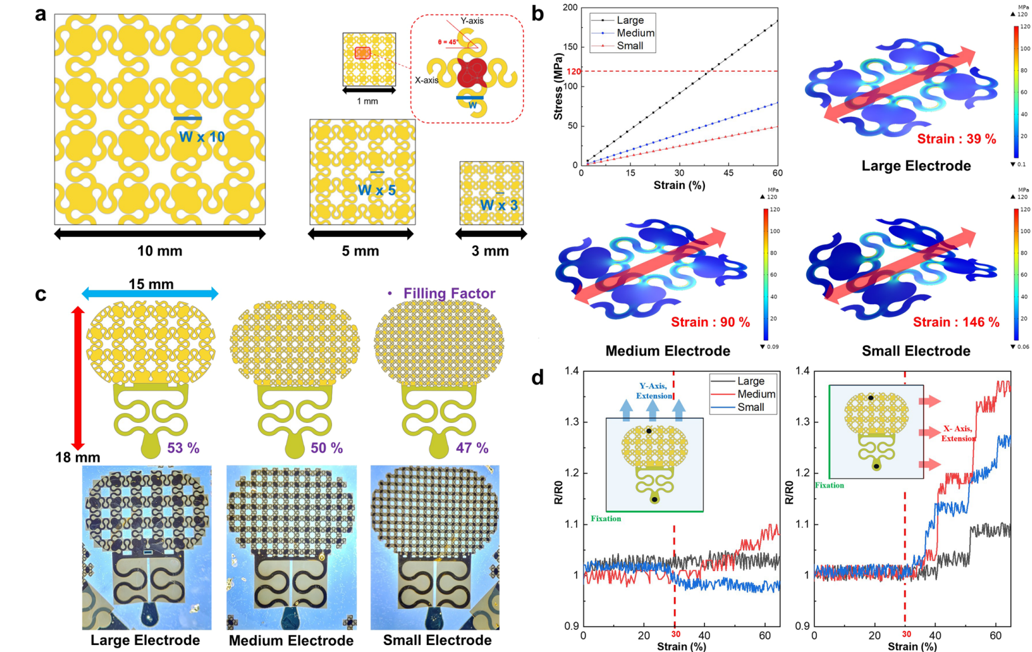
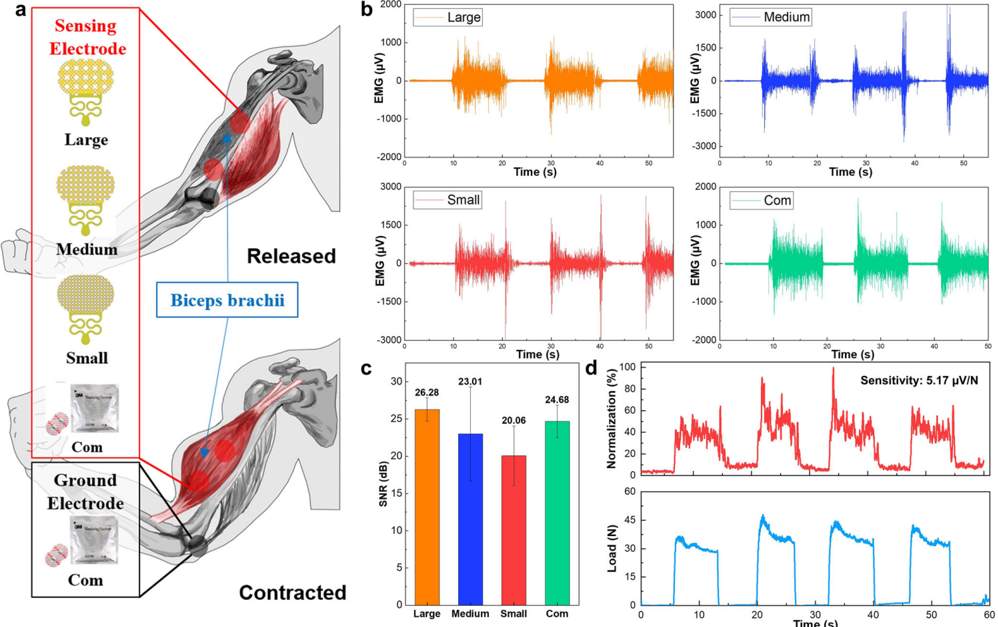
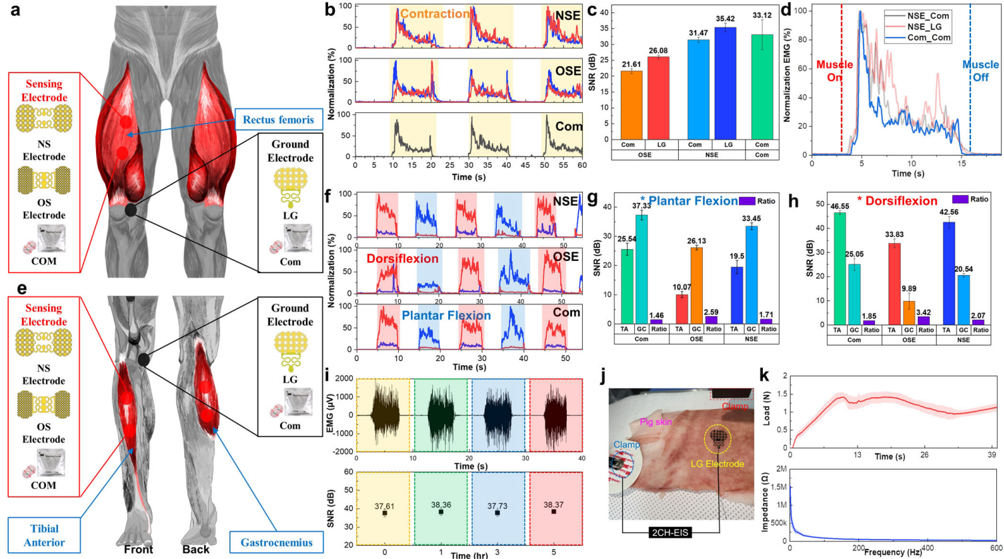
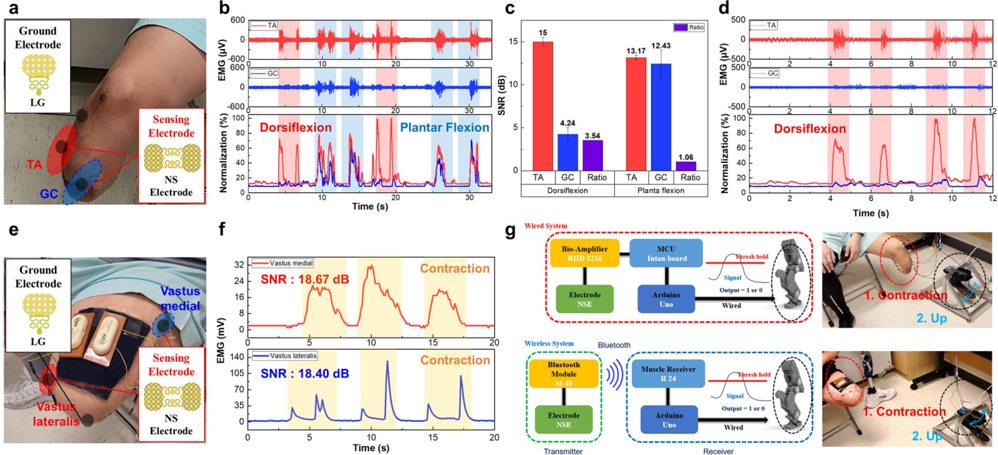
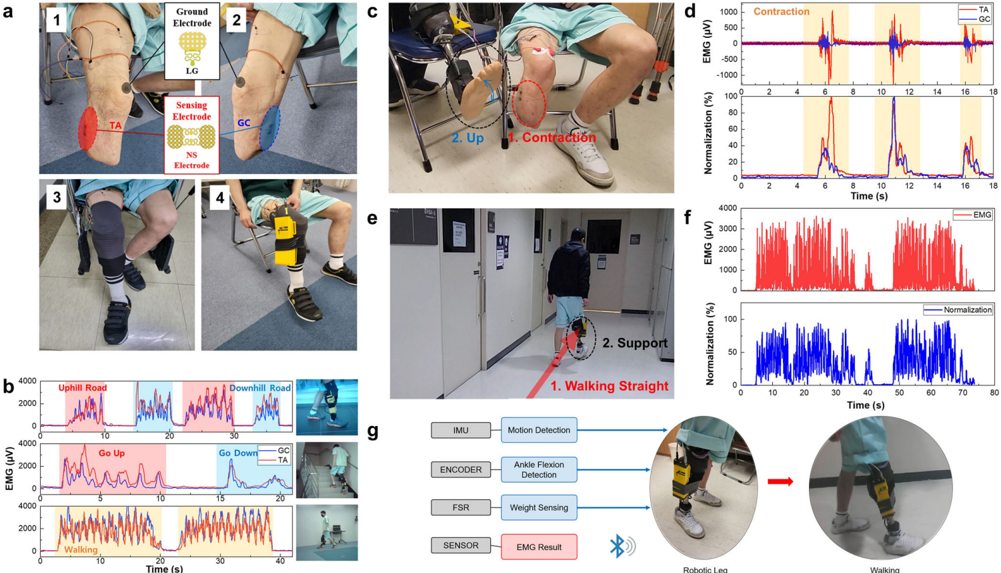
Surface electromyography (sEMG) sensors play a critical role in diagnosing muscle conditions and enabling prosthetic device control, especially for lower extremity robotic legs. However, challenges arise when utilizing such sensors on residual limbs within a silicon liner worn by amputees, where dynamic pressure, narrow space, and perspiration can negatively affect sensor performance. Existing commercial sEMG sensors and newly developed sensors are unsuitable due to size and thickness, or susceptible to damage in this environment. In this paper, our sEMG sensors are tailored for amputees wearing sockets, prioritizing breathability, durability, and reliable recording performance. By employing porous PDMS and Silbione substrates, our design achieves exceptional permeability and adhesive properties. The serpentine electrode pattern and design are optimized to improve stretchability, durability, and effective contact area, resulting in a higher signal-to-noise ratio (SNR) than conventional electrodes. Notably, our proposed sensors wirelessly enable to control of a robotic leg for amputees, demonstrating its practical feasibility and expecting to drive forward neuro-prosthetic control in the clinical research field near future.
Overview
The claims and statistics of this paper haven’t been checked yet.
Free: it reads the open-access text and checks the first 5 claims that cite a source we can check. Create a free account to check every claim.
Integrity signals
Registry
Cites
Statistics
Figures
Verification
Claims the paper makes
The claims and statistics of this paper haven’t been checked yet.
Free: it reads the open-access text and checks the first 5 claims that cite a source we can check. Create a free account to check every claim.
Claims other papers make about this one
Each is checked against this paper’s own text: does it say what the citing paper says it does?
The cited source says what the claim attributes to it.
In the citing paper
“Based on this feature, real-time measurement of muscle strength has been proven to enhance both athletic performance and rehabilitation outcomes (Fig. 5c) 95 , while sEMG sensors developed for amputees have also significantly improved prosthetic control capability (Fig. 5d) 92 .”
From Recent advances in intelligent wearable systems: from multiscale biomechanical features towards human motion intent prediction (2026) · cites this paper as [92]
In the citing paper
“In recent years, advances in material manufacturing processes have reduced electrode thickness (8-100 μm) 92 , making sEMG more portable and accurate, and easier to apply to the human body.”
From Recent advances in intelligent wearable systems: from multiscale biomechanical features towards human motion intent prediction (2026) · cites this paper as [92]
Self-check
Percentages, sums and reported differences re-computed from the paper’s own numbers.
The self-check needs the paper’s full text.
Citations
Cites
Kim, D.-H., Lu, N., Ma, R., Kim, Y.-S., Kim, R.-H., Wang, S., Wu, J., Won, S. M., Tao, H., Islam, A., et al. (2011) · Science · doi:10.1126/science.1206157 · Cited by 4,836
Lab-on-Skin: A Review of Flexible and Stretchable Electronics for Wearable Health Monitoring
Liu, Y., Pharr, M., & Salvatore, G. A. (2017) · ACS Nano · doi:10.1021/acsnano.7b04898 · Cited by 1,725
Dynamic Sensorimotor Interactions in Locomotion
Rossignol, S., Dubuc, R., & Gossard, J.-P. (2006) · Physiological Reviews · doi:10.1152/physrev.00028.2005 · Cited by 1,096
All-printed soft human-machine interface for robotic physicochemical sensing
Yu, Y., Li, J., Solomon, S. A., Min, J., Tu, J., Guo, W., Xu, C., Song, Y., & Gao, W. (2022) · Science Robotics · doi:10.1126/scirobotics.abn0495 · Cited by 365
Lamke, L.-O., Nilsson, G. E., & Reithner, H. L. (1977) · Burns · doi:10.1016/0305-4179(77)90004-3 · Cited by 282
Robotic Leg Control with EMG Decoding in an Amputee with Nerve Transfers
Hargrove, L. J., Simon, A. M., Young, A. J., Lipschutz, R. D., Finucane, S. B., Smith, D. G., & Kuiken, T. A. (2013) · New England Journal of Medicine · doi:10.1056/nejmoa1300126 · Cited by 253
Cutaneous afferents from human plantar sole contribute to body posture awareness
Roll, R., Kavounoudias, A., & Roll, J.-P. (2002) · NeuroReport · doi:10.1097/00001756-200210280-00025 · Cited by 237
Proprioception from a neurally controlled lower-extremity prosthesis
Clites, T. R., Carty, M. J., Ullauri, J. B., Carney, M. E., Mooney, L. M., Duval, J.-F., Srinivasan, S. S., & Herr, H. M. (2018) · Science Translational Medicine · doi:10.1126/scitranslmed.aap8373 · Cited by 233
Fleming, A., Stafford, N., Huang, S., Hu, X., Ferris, D. P., & Huang, H. (. (2021) · Journal of Neural Engineering · doi:10.1088/1741-2552/ac1176 · Cited by 216
Role of sensory feedback in the control of stance duration in walking cats
Pearson, K. G. (2008) · Brain Research Reviews · doi:10.1016/j.brainresrev.2007.06.014 · Cited by 192
Research works printed but not linked: 3
- Bonnefoy-Mazure, A. & Armand, S. Normal gait. Orthop. Manag. Child. Cereb. Palsy 40, 567 (2015).
- Stegeman, D. & Hermens, H. Standards for surface electromyography: the Eur- opean project Surface EMG for non-invasive assessment of muscles (SENIAM). Enschede Roessingh Res. Dev. 10, 8-12 (2007).
- Kalra, A., Lowe, A. & Al-Jumaily, A. Mechanical behaviour of skin: a review. J. Mater. Sci. Eng. 5, 1000254 (2016).
Cited by
Chen, S., Fan, S., Qiao, Z., Wu, Z., Lin, B., Li, Z., Riegler, M. A., Wong, M. Y. H., Opheim, A., Korostynska, O., et al. (2025) · Advanced Materials · doi:10.1002/adma.202500412 · Cited by 164
A bioabsorbable mechanoelectric fiber as electrical stimulation suture
Sun, Z., Jin, Y., Luo, J., Li, L., Ding, Y., Luo, Y., Qi, Y., Li, Y., Zhang, Q., Li, K., et al. (2024) · Nature Communications · doi:10.1038/s41467-024-52354-x · Cited by 104
“…generated electrical stimulation under the mechanical movement state, which activated calcium signaling (VGCC) and triggered Ca 2+ in fl ux via voltage-gated ion channels 44 , thus generating stronger EMG signals and promoting cellular secretion of endogenous growth factors (Supplementary Fig.”
Recent Advances in Wearable Healthcare Devices: From Material to Application
Luo, X., Tan, H., & Wen, W. (2024) · Bioengineering · doi:10.3390/bioengineering11040358 · Cited by 81
“Park et al. [175] developed reusable dermal surface EMG to control lower extremity robotic legs.”
BackgroundSoft skin-interfacing electrodes for wearable bioelectronics
Carneiro, M. R., Tavakoli, M., & Majidi, C. (2025) · Matter · doi:10.1016/j.matt.2025.102409 · Cited by 44
Sayyad, P. W., Al-Nashash, H. A., Al–Othman, A., & Al-Sayah, M. H. (2025) · IEEE Transactions on Components Packaging and Manufacturing Technology · doi:10.1109/tcpmt.2025.3539978 · Cited by 29
Yang, K., Zhang, S.-H., Yang, Y., Liu, X., Li, J.-Q., Bao, B.-K., Liu, C., Yang, H.-B., Guo, K., & Cheng, H.-Y. (2024) · Materials & Design · doi:10.1016/j.matdes.2024.113029 · Cited by 21
Highly Adhesive and Stretchable Epidermal Electrode for Bimodal Recording Patch
Yang, S., Liu, C., Tang, L., Shang, J., Zhang, J., & Jiang, X. (2024) · ACS Applied Materials & Interfaces · doi:10.1021/acsami.4c05705 · Cited by 22
Piyathilaka, L., Sul, J.-H., Arachchige, S. D., Jayawardena, A., & Moratuwage, D. (2026) · Electronics · doi:10.3390/electronics15030590 · Cited by 31
Recent advances in materials and structural designs for flexible surface electromyography electrodes
Hou, Z., Jin, Y., Qian, C., Zhu, J., Zhang, T., Wu, J., Li, S., Zou, B., & Huo, F. (2025) · Journal of Materials Chemistry C · doi:10.1039/d5tc01312g · Cited by 9
Chen, S., Peng, C., Yang, B., Lin, J., Zhou, L., Jiang, Z., Liu, Z., Liu, Y., & Tang, L. (2026) · npj Artificial Intelligence · doi:10.1038/s44387-026-00083-5 · Cited by 9
Nano/micro-engineered metallic flexible electrodes: advancing the era of epidermal electronics
Zhu, H., Liu, H., Cho, J. H., & Liu, G. (2025) · International Journal of Extreme Manufacturing · doi:10.1088/2631-7990/ae02ca · Cited by 14
Toward Natural Limb Function: A New Era in Prosthetic Innovation
Tian, Y., Wallace, D. M., Cederna, P. S., Chestek, C. A., & Kemp, S. W. P. (2025) · Annals of Neurology · doi:10.1002/ana.27287 · Cited by 8
“19 These electrodes allow for muscle recordings with relatively higher signal-to-noise ratios (SNRs) than traditional sEMG electrodes, demonstrating improved neuroprosthetic control in 3 individuals with lower limb loss.”
Skin-conformal electronics for intelligent gesture recognition
Lee, I., Shin, H., Cho, H., Choi, J.-G., Wang, G., & Park, S. (2025) · Nature Reviews Electrical Engineering · doi:10.1038/s44287-025-00215-0 · Cited by 11
“a ground electrode 88–90 , aids in minimizing contact impedance 91–93 and enhancing signal-to-noise ratio 93–95 .”
Krishnamoorthy, U., Priya, L., & Fayek, H. H. (2026) · BioMedical Engineering OnLine · doi:10.1186/s12938-025-01485-3 · Cited by 8
“The device exhibited an SNR of 24.68 dB, sensitivity of 5.17 µV N − 1 for muscle contraction exercise which was better in comparison to an available sEMG sensor [151].”
InfluentialBioinspired Intelligent Electronic Skin for Medicine and Healthcare
Liu, Z., Hu, J., & Shen, G. (2025) · Small Methods · doi:10.1002/smtd.202402164 · Cited by 10
Chowdhury, T. A., Gratz‐Kelly, S., Wagner, E., Motzki, P., & Lehser, M. (2026) · Advanced Intelligent Discovery · doi:10.1002/aidi.202500217 · Cited by 6
Kim, S., Jang, H. J., Kim, K., Hwang, Y.-J., Lee, Y. B., Jeong, J., Jung, S., Jeong, E., Han, D., Sung, E., et al. (2026) · Small · doi:10.1002/smll.202514966 · Cited by 3
“However, these electrodes often exhibit insufficient skin adhesion force and contact, leading to unstable signal acquisition under dynamic and motion conditions [29, 30].”
Self-citationZhao, N., Shen, G., Jiang, C., Wen, H., Lin, Z., You, M., Wang, X., Yang, B. T., & Liu, J. (2024) · IEEE Sensors Journal · doi:10.1109/jsen.2024.3374416 · Cited by 2
“Representative HD-sEMG sensors offer significant advantages, such as flexibility, ultrathinness, low contact impedance, and high signal-to-noise ratio (SNR) [5], [7], [8], [9], [10], [11], [12], [13], [14], [15], [16], [17].”
Li, X., Tang, W., Wang, M., Moretti, G., Lin, J., & Shi, C. (2026) · Soft Matter · doi:10.1039/d6sm00123h · Cited by 1
Asai, K. (2024) · International Conference on Image, Video and Signal Processing (IVSP) · doi:10.1145/3655755.3655776
Pan, L., Ding, Z., Li, C., Zhao, H., Mu, R., Li, J., & Li, J. (2024) · International Conference on Mechatronics and Machine Vision in Practice (M2VIP) · doi:10.1109/m2vip62491.2024.10746199
“Among them, the EMG signals can provide with rich psychological muscle information, which are easy to obtain [9], showing great potential in decoding human movement intention [10].”
BackgroundFeature Selection and Classification of Electromyographic Signals for Improved Motion Recognition
Li, H., Li, J., Zhang, X., Liu, T., Yin, J., & Gu, Y. X. (2025) · IEEE/ASME International Conference on Advanced Intelligent Mechatronics · doi:10.1109/aim64088.2025.11175703
“These signals, being non-invasive, easy to record, and capable of providing rich information about muscle activity, have seen widespread use in a variety of applications [3], [4], such as motion recognition, prosthetic control systems [5], and human-computer interaction [6].”
Wang, Z., Chen, Z., Li, J., Jia, D., Hou, X., Li, Z., & Fan, H. (2026) · Microsystems & Nanoengineering · doi:10.1038/s41378-026-01247-8
“This biomimetic approach has been validated in the fi eld of electrodes, as demonstrated by deformable structures such as wrinkled 28 – 30 , waved 31 , or serpentine structures 32 .”
Comparative study of HD-EMG electrode setups for Smart Mechatronic Ankle-Foot Orthoses development
Mirkov, M., Strbac, M. D., & Vujaklija, I. (2025) · Annual International Conference of the IEEE Engineering in Medicine and Biology Society (EMBC) · doi:10.1109/embc58623.2025.11252730
“However, this introduces new challenges in maintaining signal stability and reliability [10].”
A Skin-Adhesive Bimodal Sensing Patch for Decoding Occlusal DysfunctionPreprint
Huang, L., Li, R., Li, X., Sun, Y., Li, G., Jin, L. Y., Zhu, W., Yang, W., & Deng, W. (2026) · Research Square · doi:10.21203/rs.3.rs-8679011/v1
Stretchable sensors for detection of complex deformations
恭仁子, Ji, K., Wang, C., Du, Z., Liu, Z., Wang, S., Liang, Z., He, Y., Li, Z., Wang, W., et al. (2026) · National Science Open · doi:10.1360/nso/20260011 · Cited by 1
Initial Movement of Bionic Foot: Control Mapping Concept
Prawibowo, H., Ismail, R., Putri, F. T., Tauviqirrahman, M., Novriansyah, R., & Nur, S. (2026) · Lecture notes in electrical engineering · doi:10.1007/978-981-95-9233-3_11
Wan, X., Li, D., Fu, D., & Wen, D. (2026) · IEEE Transactions on Mobile Computing · doi:10.1109/tmc.2026.3697898
“This technology has shown great promise in kinematic state tracking, gesture recognition, and even movement intent prediction [5], [6]. sEMG-based hand gesture recognition systems have a wide range of applications such as MR interaction [7], [8], smart wheelchair control [9] and robot control [10].”
Bioinspired heliconical auxetic biofibers for intelligent biomechanical surveillance
Zhou, Y., Wang, X., Wang, Y., Xie, L., Qiang, Y., Wang, W., Li, L., Yue, O., & Liu, X. (2026) · Science Advances · doi:10.1126/sciadv.aed6233 · Cited by 1
“Figure 6B presents the characteristic transverse strain distribution of the lower limb under healthy, mild varicose, and severe varicose conditions, underscoring the need for precise sensing in the microstrain regime ( 51 – 53 ).”
Advanced Electromyography Electrode Design Through Technical Yarn Embroidery
Perego, P., Cappoli, G., Sironi, R., Gruppioni, E., Davalli, A., Lopomo, N. F., & Andreoni, G. (2025) · International Conference on the Challenges, Opportunities, Innovations and Applications in Electronic Textiles (E-Textiles) · doi:10.1109/e-textiles67498.2025.11686682
“This approach ensured consistent muscle activation levels across trials, allowing for robust comparison of the sEMG signal quality across different electrode designs [22].”
Metadata
- Authors
- Park, J., Jeong, J., Kang, M., Pritish, N., Cho, Y., Ha, J., Yea, J., Jang, K.-I., Kim, H., Hwang, J., Kim, B., Min, S., Kim, H., Kwon, S., Pak, C. J., Suh, H. P., Hong, J. P., & Lee, S.
- Affiliations
- Daegu Gyeongbuk Institute of Science and Technology (KR)
- Asan Medical Center (KR)
- Kwangwoon University (KR)
- Corresponding author
- Lee, Sanghoon
- ORCID
- Venue
- npj Flexible Electronics
- Published
- 2023-10-25
- Volume
- 7
- Issue
- 1
- ISSN
- 2397-4621 (ISSN-L)
- OpenAlex
- W4388266007
- Semantic Scholar
- 150a746cd7012561f25842e0d8b22d35e6cdc62c
- Cited by
- 30
- References
- 49
- Citations by year
- 2026: 12 · 2025: 11 · 2024: 7
- FWCI
- 2.37
- Type
- journal article
- Language
- en
- Open access
- gold
- doi.org
- Licence
- cc-by
- creativecommons.org/licenses/by/4.0 (tdm)
- creativecommons.org/licenses/by/4.0 (vor)
- Locations
- npj Flexible Electronics (publishedVersion, cc-by)
- DOAJ (DOAJ: Directory of Open Access Journals) (submittedVersion, cc-by-sa)
- Funders
- Korea Medical Device Development Fund (1711135031)
- Ministry of Trade, Industry and Energy
- Ministry of Food and Drug Safety (1711135031)
- Ministry of Science and ICT, South Korea
- Topics
- Physical Sciences › Engineering › Biomedical Engineering › Muscle activation and electromyography studies
- Life Sciences › Neuroscience › Cellular and Molecular Neuroscience › Neuroscience and Neural Engineering
- Physical Sciences › Engineering › Biomedical Engineering › Advanced Sensor and Energy Harvesting Materials
- Keywords
- amputees, residual limb, serpentine electrodes, stretchable electrodes, wireless sensors, signal-to-noise ratio, sensor durability, breathability
About these checks
Registry, retraction, Cites and statistics results are computed, not judged, with one exception: a printed reference that no index lists is read once by a model before it counts as a citation error. Claims are extracted by a model and kept only when their quote appears verbatim in the text; each cited source is then checked, with a model’s help, for whether it says what the claim relies on. Those verdicts can be wrong — read the claim’s quote and the cited source before relying on one.
Statistics and arithmetic are recomputed, not judged.
Confidence bands are shown only for fields calibrated on our annotated test set. None is calibrated yet, so no band is shown.
What counts as a claim ›How we measure confidence ›How we check this ›
Are you an author, or do you see a problem with this page? Request a review
Data sources
Bibliographic data: Semantic Scholar, OpenAlex, Crossref.
Contains information from the Semantic Scholar Academic Graph Datasets, made available under the ODC Attribution License (ODC-BY 1.0).
Semantic Scholar’s data is described in: Kinney, R., et al. (2023). The Semantic Scholar Open Data Platform. arXiv:2301.10140.
