

Imperceptive and reusable dermal surface EMG for lower extremity neuro-prosthetic control and clinical assessment
Open accessThe DOI matches its Crossref record; 49 of the 50 references it cites were found in a registry or an index.
Abstract
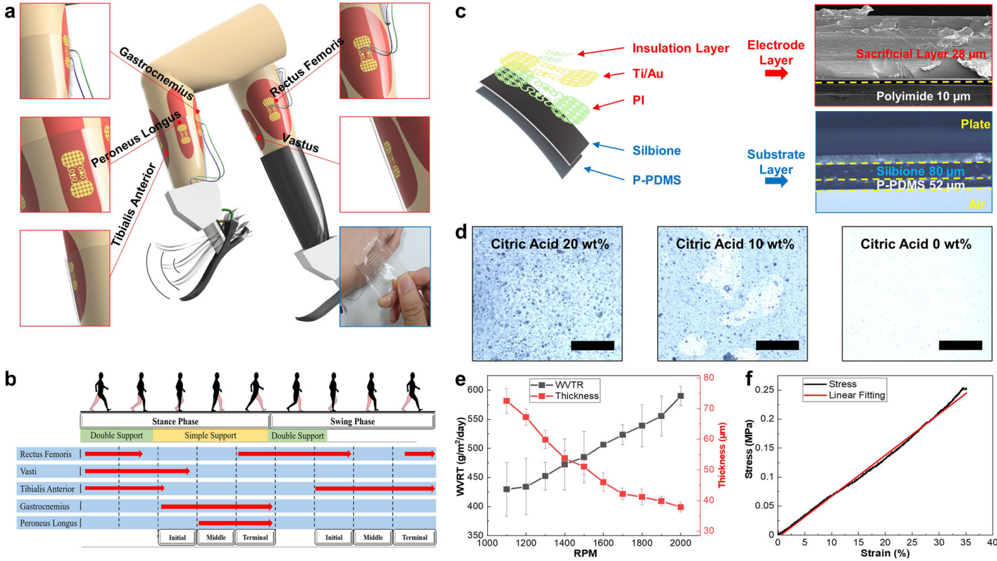
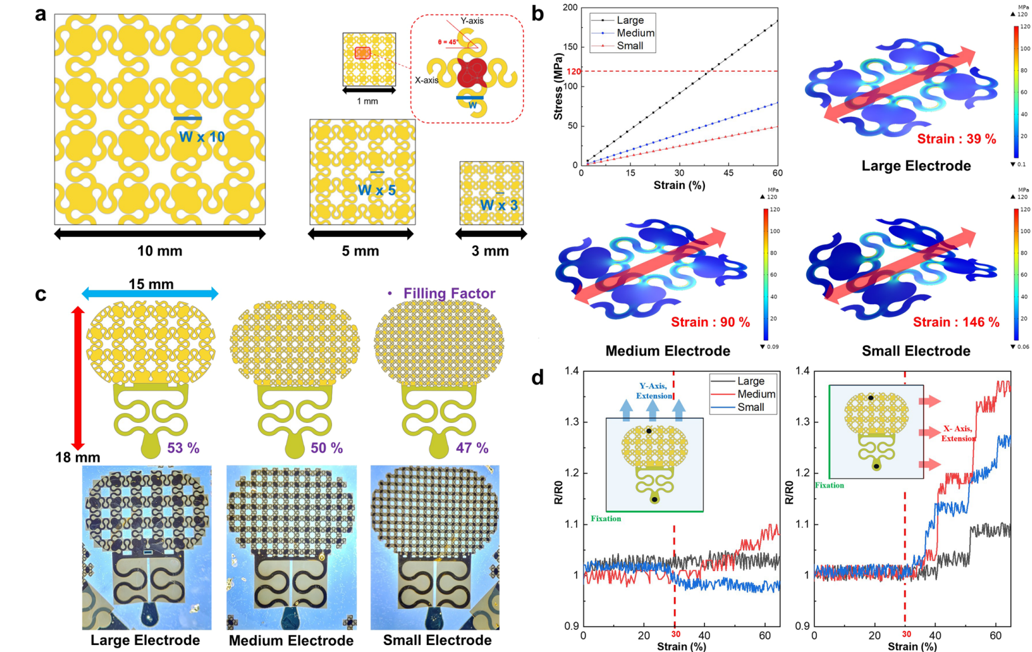
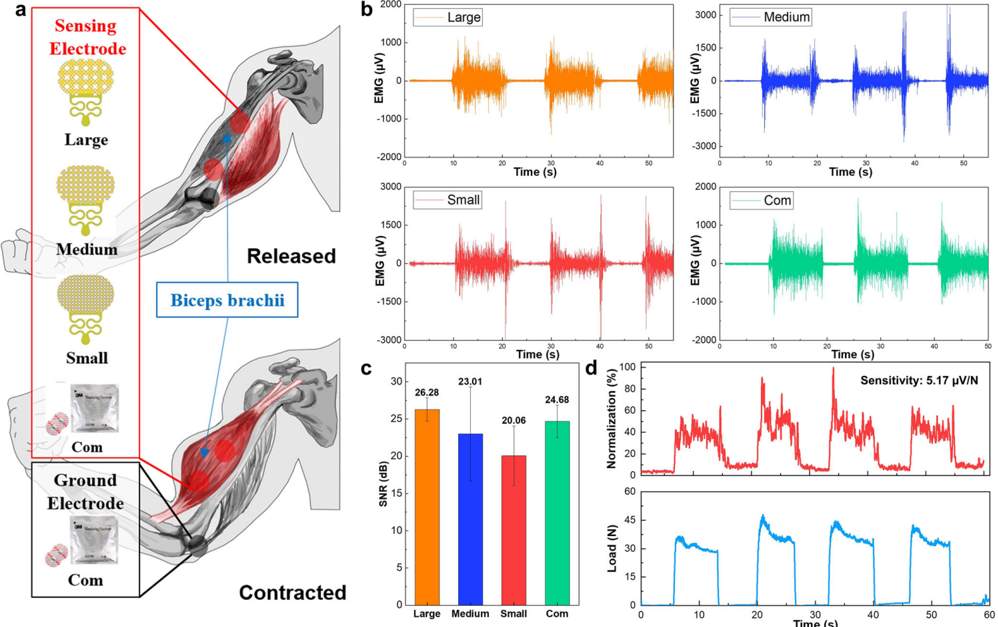
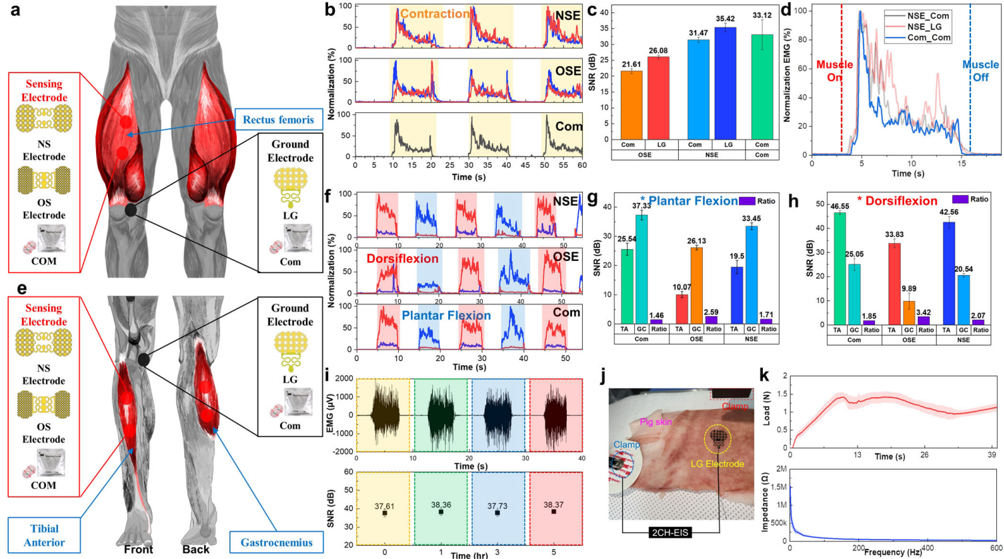
Surface electromyography (sEMG) sensors play a critical role in diagnosing muscle conditions and enabling prosthetic device control, especially for lower extremity robotic legs. However, challenges arise when utilizing such sensors on residual limbs within a silicon liner worn by amputees, where dynamic pressure, narrow space, and perspiration can negatively affect sensor performance. Existing commercial sEMG sensors and newly developed sensors are unsuitable due to size and thickness, or susceptible to damage in this environment. In this paper, our sEMG sensors are tailored for amputees wearing sockets, prioritizing breathability, durability, and reliable recording performance. By employing porous PDMS and Silbione substrates, our design achieves exceptional permeability and adhesive properties. The serpentine electrode pattern and design are optimized to improve stretchability, durability, and effective contact area, resulting in a higher signal-to-noise ratio (SNR) than conventional electrodes. Notably, our proposed sensors wirelessly enable to control of a robotic leg for amputees, demonstrating its practical feasibility and expecting to drive forward neuro-prosthetic control in the clinical research field near future.
Overview
The claims and statistics of this paper haven’t been checked yet.
Free: it reads the open-access text and checks the first 5 claims that cite a source we can check. Create a free account to check every claim.
Integrity signals
Registry
Cites
Statistics
Figures
Verification
Claims the paper makes
The claims and statistics of this paper haven’t been checked yet.
Free: it reads the open-access text and checks the first 5 claims that cite a source we can check. Create a free account to check every claim.
Claims other papers make about this one
Each is checked against this paper’s own text: does it say what the citing paper says it does?
The cited source says what the claim attributes to it.
In the citing paper
“Based on this feature, real-time measurement of muscle strength has been proven to enhance both athletic performance and rehabilitation outcomes (Fig. 5c) 95 , while sEMG sensors developed for amputees have also significantly improved prosthetic control capability (Fig. 5d) 92 .”
From Recent advances in intelligent wearable systems: from multiscale biomechanical features towards human motion intent prediction (2026) · cites this paper as [92]
In the citing paper
“In recent years, advances in material manufacturing processes have reduced electrode thickness (8-100 μm) 92 , making sEMG more portable and accurate, and easier to apply to the human body.”
From Recent advances in intelligent wearable systems: from multiscale biomechanical features towards human motion intent prediction (2026) · cites this paper as [92]
Self-check
Percentages, sums and reported differences re-computed from the paper’s own numbers.
The self-check needs the paper’s full text.
Citations
Cites
Kim, D.-H., Lu, N., Ma, R., Kim, Y.-S., Kim, R.-H., Wang, S., Wu, J., Won, S. M., Tao, H., Islam, A., et al. (2011) · Science · doi:10.1126/science.1206157 · Cited by 4,836
Lab-on-Skin: A Review of Flexible and Stretchable Electronics for Wearable Health Monitoring
Liu, Y., Pharr, M., & Salvatore, G. A. (2017) · ACS Nano · doi:10.1021/acsnano.7b04898 · Cited by 1,725
Dynamic Sensorimotor Interactions in Locomotion
Rossignol, S., Dubuc, R., & Gossard, J.-P. (2006) · Physiological Reviews · doi:10.1152/physrev.00028.2005 · Cited by 1,096
All-printed soft human-machine interface for robotic physicochemical sensing
Yu, Y., Li, J., Solomon, S. A., Min, J., Tu, J., Guo, W., Xu, C., Song, Y., & Gao, W. (2022) · Science Robotics · doi:10.1126/scirobotics.abn0495 · Cited by 365
Lamke, L.-O., Nilsson, G. E., & Reithner, H. L. (1977) · Burns · doi:10.1016/0305-4179(77)90004-3 · Cited by 282
Robotic Leg Control with EMG Decoding in an Amputee with Nerve Transfers
Hargrove, L. J., Simon, A. M., Young, A. J., Lipschutz, R. D., Finucane, S. B., Smith, D. G., & Kuiken, T. A. (2013) · New England Journal of Medicine · doi:10.1056/nejmoa1300126 · Cited by 253
Cutaneous afferents from human plantar sole contribute to body posture awareness
Roll, R., Kavounoudias, A., & Roll, J.-P. (2002) · NeuroReport · doi:10.1097/00001756-200210280-00025 · Cited by 237
Proprioception from a neurally controlled lower-extremity prosthesis
Clites, T. R., Carty, M. J., Ullauri, J. B., Carney, M. E., Mooney, L. M., Duval, J.-F., Srinivasan, S. S., & Herr, H. M. (2018) · Science Translational Medicine · doi:10.1126/scitranslmed.aap8373 · Cited by 233
Fleming, A., Stafford, N., Huang, S., Hu, X., Ferris, D. P., & Huang, H. (. (2021) · Journal of Neural Engineering · doi:10.1088/1741-2552/ac1176 · Cited by 216
Role of sensory feedback in the control of stance duration in walking cats
Pearson, K. G. (2008) · Brain Research Reviews · doi:10.1016/j.brainresrev.2007.06.014 · Cited by 192
Transtibial amputee gait: Timedistance parameters and EMG activity
Isakov, E., Keren, O., & Benjuya, N. (2000) · Prosthetics and Orthotics International · doi:10.1080/03093640008726550 · Cited by 189
Pencil–paper on-skin electronics
Xu, Y., Zhao, G., Zhu, L., Fei, Q., Zhang, Z., Chen, Z., An, F., Chen, Y., Ling, Y., Guo, P., et al. (2020) · Proceedings of the National Academy of Sciences · doi:10.1073/pnas.2008422117 · Cited by 182
MXene-infused bioelectronic interfaces for multiscale electrophysiology and stimulation
Driscoll, N., Erickson, B., Murphy, B. B., Richardson, A. G., Robbins, G., Apollo, N. V., Mentzelopoulos, G., Mathis, T., Hantanasirisakul, K., Bagga, P., et al. (2021) · Science Translational Medicine · doi:10.1126/scitranslmed.abf8629 · Cited by 180
Kwak, J. W., Han, M., Xie, Z., Chung, H. U., Lee, J. Y., Avila, R., Yohay, J., Chen, X., Liang, C., Patel, M., et al. (2020) · Science Translational Medicine · doi:10.1126/scitranslmed.abc4327 · Cited by 164
Li, J., Ma, Y., Huang, D., Wang, Z., Zhang, Z., Ren, Y., Hong, M., Chen, Y., Li, T., Shi, X., et al. (2022) · Nano-Micro Letters · doi:10.1007/s40820-022-00870-0 · Cited by 152
Salminger, S., Sturma, A., Hofer, C., Evangelista, M., Perrin, M., Bergmeister, K. D., Roche, A. D., Hasenoehrl, T., Dietl, H., Farina, D., et al. (2019) · Science Robotics · doi:10.1126/scirobotics.aaw6306 · Cited by 139
Huang, C.-Y., & Chiu, C. (2021) · ACS Applied Electronic Materials · doi:10.1021/acsaelm.0c00841 · Cited by 127
Traumatic and Trauma-Related Amputations: Part I: General Principles and Lower-Extremity Amputations
Tintle, L. S. M., Keeling, C. J. J., Shawen, L. S. B., Forsberg, L. J. A., & Potter, M. B. K. (2010) · Journal of Bone and Joint Surgery · doi:10.2106/jbjs.j.00257 · Cited by 104
Sadikoglu, F. M., Kavalcıoğlu, C., & Dağman, B. (2017) · Procedia Computer Science · doi:10.1016/j.procs.2017.11.259 · Cited by 104
Huang, S., & Ferris, D. P. (2012) · Journal of NeuroEngineering and Rehabilitation · doi:10.1186/1743-0003-9-55 · Cited by 100
Prosthetic Liners for Lower Limb Amputees
Klute, G. K., Glaister, B. C., & Berge, J. S. (2010) · Prosthetics and Orthotics International · doi:10.3109/03093641003645528 · Cited by 96
On prosthetic control: A regenerative agonist-antagonist myoneural interface
Srinivasan, S. S., Carty, M. J., Calvaresi, P. W., Clites, T. R., Maimon, B. E., Taylor, C. R., Zorzos, A. N., & Herr, H. (2017) · Science Robotics · doi:10.1126/scirobotics.aan2971 · Cited by 90
Mechanisms of neuro-robotic prosthesis operation in leg amputees
Valle, G., Saliji, A., Fogle, E., Cimolato, A., Petrini, F. M., & Raspopovic, S. (2021) · Science Advances · doi:10.1126/sciadv.abd8354 · Cited by 89
Srivastava, C. M., Purwar, R., & Gupta, A. P. (2019) · International Journal of Biological Macromolecules · doi:10.1016/j.ijbiomac.2018.12.255 · Cited by 86
Shen, C., Li, Y., Zhao, R., Zhang, L., Li, Y., Wang, C., & Li, X. (2018) · Journal of Drug Delivery Science and Technology · doi:10.1016/j.jddst.2018.01.022 · Cited by 76
Murphy, B. B., Mulcahey, P. J., Driscoll, N., Richardson, A. G., Robbins, G. T., Apollo, N. V., Maleski, K., Lucas, T. H., Gogotsi, Y. G., Dillingham, T. R., et al. (2020) · Advanced Materials Technologies · doi:10.1002/admt.202000325 · Cited by 62
Wearable porous PDMS layer of high moisture permeability for skin trouble reduction
Yoon, S., Seok, M., Kim, M., & Cho, Y.-H. (2021) · Scientific Reports · doi:10.1038/s41598-020-78580-z · Cited by 60
Self-citationHussain, T., Iqbal, N., Maqbool, H. F., Khan, M., Awad, M. I., & Dehghani-Sanij, A. A. (2020) · Biocybernetics and Biomedical Engineering · doi:10.1016/j.bbe.2020.05.010 · Cited by 58
Wang, C., Cai, M., Hao, Z., Nie, S., Liu, C., Du, H.-G., Wang, J., Chen, W., & Song, J. (2021) · Advanced Intelligent Systems · doi:10.1002/aisy.202100031 · Cited by 57
Krysiak, Z. J., Knapczyk‐Korczak, J., Maniak, G., & Stachewicz, U. (2020) · Colloids and Surfaces B Biointerfaces · doi:10.1016/j.colsurfb.2020.111554 · Cited by 52
Chandra, S., Li, J., Afsharipour, B., Cardona, A. F., Suresh, N. L., Tian, L., Deng, Y., Zhong, Y., Xie, Z., Shen, H., et al. (2020) · IEEE Transactions on Biomedical Engineering · doi:10.1109/tbme.2020.3032354 · Cited by 49
Trends and Challenges in Lower Limb Prosthesis
Kumar, P. K., Charan, M. U., & Kanagaraj, S. (2017) · IEEE Potentials · doi:10.1109/mpot.2016.2614756 · Cited by 48
Assessment of Carbon/Salt/Adhesive Electrodes for Surface Electromyography Measurements
Posada-Quintero, H. F., Rood, R., Burnham, K., Pennace, J., & Chon, K. H. (2016) · IEEE Journal of Translational Engineering in Health and Medicine · doi:10.1109/jtehm.2016.2567420 · Cited by 46
Cho, S., Nam, H. J., Shi, C., Kim, C. Y., Byun, S.-H., Agno, K.-C., Lee, B. C., Xiao, J., Sim, J. Y., & Jeong, J.-W. (2023) · Biosensors and Bioelectronics · doi:10.1016/j.bios.2022.115018 · Cited by 46
Self-citationNext-Generation Prosthetic Hand: from Biomimetic to Biorealistic
Lan, N., Hao, M., Niu, C. M., Cui, H., Wang, Y., Zhang, T., Fang, P., & Chou, C.-H. (2021) · Research · doi:10.34133/2021/4675326 · Cited by 43
Liu, L., Kuffel, K., Scott, D. K., Constantinescu, G., Chung, H.-J., & Rieger, J. (2017) · Biomedical Physics & Engineering Express · doi:10.1088/2057-1976/aa91fb · Cited by 41
Fatigue Life Prediction of Serpentine Interconnects on Soft Elastomers for Stretchable Electronics
Nie, S., Cai, M., Wang, C., & Song, J. (2019) · Journal of Applied Mechanics · doi:10.1115/1.4045237 · Cited by 41
Integration of surface electromyographic sensors with the transfemoral amputee socket
Hefferman, G. M., Zhang, F., Nunnery, M. J., & Huang, H. (2014) · Prosthetics and Orthotics International · doi:10.1177/0309364613516484 · Cited by 37
A Flexible Wireless sEMG System for Wearable Muscle Strength and Fatigue Monitoring in Real Time
Gong, Q., Jiang, X., Liu, Y., Yu, M., & Hu, Y. (2023) · Advanced Electronic Materials · doi:10.1002/aelm.202200916 · Cited by 37
Reduction of residual limb volume in people with transtibial amputation
Tantua, A. T., Geertzen, J. H. B., van den Dungen, J. J. A. M., Breek, J. C., & Dijkstra, P. U. (2014) · The Journal of Rehabilitation Research and Development · doi:10.1682/jrrd.2013.11.0243 · Cited by 34
Physical Characterization of a New Skin Bioadhesive Film
NUSSINOVITCH, A., Gal, A., Padula, C., & Santi, P. (2008) · AAPS PharmSciTech · doi:10.1208/s12249-008-9061-9 · Cited by 29
Differences in EMG Feature Space between Able-Bodied and Amputee Subjects for Myoelectric Control
Campbell, E., Phinyomark, A., Al-Timemy, A. H., Khushaba, R. N., Petri, G., & Scheme, E. (2019) · International IEEE/EMBS Conference on Neural Engineering · doi:10.1109/ner.2019.8717161 · Cited by 29
Dong, W., Zhu, C., Hu, W., Xiao, L. J., & Huang, Y. (2018) · Journal of Semiconductors · doi:10.1088/1674-4926/39/1/014001 · Cited by 21
Flexible Dry Electrodes for EMG Acquisition within Lower Extremity Prosthetic Sockets
Yeon, S. H., Shu, T., Rogers-Bradley, E., Song, H., Hsieh, T., Freed, L. E., & Herr, H. (2020) · IEEE/RAS-EMBS International Conference on Biomedical Robotics and Biomechatronics (BioRob) · doi:10.1109/biorob49111.2020.9224338 · Cited by 17
Flexible Electrode by Hydrographic Printing for Surface Electromyography Monitoring
Zeng, X., Dong, Y., & Wang, X. (2020) · Materials · doi:10.3390/ma13102339 · Cited by 14
A 3-D-Printed Portable EMG Wristband for the Quantitative Detection of Finger Motion
Su, H., Kim, T., Moeinnia, H., & Kim, W. S. (2023) · IEEE Sensors Journal · doi:10.1109/jsen.2023.3247695 · Cited by 13
Wang, S., Dong, S., Li, W., Cen, J., Zhu, H., Fu, C., Jin, H., Li, Y., Feng, X., Luo, J., et al. (2021) · Advanced Science · doi:10.1002/advs.202004987 · Cited by 10
Meigal, A. Y., Rissanen, S. M., Zaripova, Y. R., Miroshnichenko, G. G., & Karjalainen, P. A. (2015) · Human Physiology · doi:10.1134/s0362119715050102 · Cited by 9
Fylstra, B. L., Dai, C., Hu, X., & Huang, H. (2018) · Annual International Conference of the IEEE Engineering in Medicine and Biology Society (EMBC) · doi:10.1109/embc.2018.8513661 · Cited by 8
Evaluation of Electromyogram Signals in the Control of Prosthetic Limb: A Review
Sharma, T., Sharma, K. P., & Veer, K. (2021) · Current Signal Transduction Therapy · doi:10.2174/1574362416666210920164335 · Cited by 2
Research works printed but not linked: 3
- Bonnefoy-Mazure, A. & Armand, S. Normal gait. Orthop. Manag. Child. Cereb. Palsy 40, 567 (2015).
- Stegeman, D. & Hermens, H. Standards for surface electromyography: the Eur- opean project Surface EMG for non-invasive assessment of muscles (SENIAM). Enschede Roessingh Res. Dev. 10, 8-12 (2007).
- Kalra, A., Lowe, A. & Al-Jumaily, A. Mechanical behaviour of skin: a review. J. Mater. Sci. Eng. 5, 1000254 (2016).
Cited by
Chen, S., Fan, S., Qiao, Z., Wu, Z., Lin, B., Li, Z., Riegler, M. A., Wong, M. Y. H., Opheim, A., Korostynska, O., et al. (2025) · Advanced Materials · doi:10.1002/adma.202500412 · Cited by 164
A bioabsorbable mechanoelectric fiber as electrical stimulation suture
Sun, Z., Jin, Y., Luo, J., Li, L., Ding, Y., Luo, Y., Qi, Y., Li, Y., Zhang, Q., Li, K., et al. (2024) · Nature Communications · doi:10.1038/s41467-024-52354-x · Cited by 104
“…generated electrical stimulation under the mechanical movement state, which activated calcium signaling (VGCC) and triggered Ca 2+ in fl ux via voltage-gated ion channels 44 , thus generating stronger EMG signals and promoting cellular secretion of endogenous growth factors (Supplementary Fig.”
Recent Advances in Wearable Healthcare Devices: From Material to Application
Luo, X., Tan, H., & Wen, W. (2024) · Bioengineering · doi:10.3390/bioengineering11040358 · Cited by 81
“Park et al. [175] developed reusable dermal surface EMG to control lower extremity robotic legs.”
BackgroundSoft skin-interfacing electrodes for wearable bioelectronics
Carneiro, M. R., Tavakoli, M., & Majidi, C. (2025) · Matter · doi:10.1016/j.matt.2025.102409 · Cited by 44
Sayyad, P. W., Al-Nashash, H. A., Al–Othman, A., & Al-Sayah, M. H. (2025) · IEEE Transactions on Components Packaging and Manufacturing Technology · doi:10.1109/tcpmt.2025.3539978 · Cited by 29
Metadata
- Authors
- Park, J., Jeong, J., Kang, M., Pritish, N., Cho, Y., Ha, J., Yea, J., Jang, K.-I., Kim, H., Hwang, J., Kim, B., Min, S., Kim, H., Kwon, S., Pak, C. J., Suh, H. P., Hong, J. P., & Lee, S.
- Affiliations
- Daegu Gyeongbuk Institute of Science and Technology (KR)
- Asan Medical Center (KR)
- Kwangwoon University (KR)
- Corresponding author
- Lee, Sanghoon
- ORCID
- Venue
- npj Flexible Electronics
- Published
- 2023-10-25
- Volume
- 7
- Issue
- 1
- ISSN
- 2397-4621 (ISSN-L)
- OpenAlex
- W4388266007
- Semantic Scholar
- 150a746cd7012561f25842e0d8b22d35e6cdc62c
- Cited by
- 30
- References
- 49
- Citations by year
- 2026: 12 · 2025: 11 · 2024: 7
- FWCI
- 2.37
- Type
- journal article
- Language
- en
- Open access
- gold
- doi.org
- Licence
- cc-by
- creativecommons.org/licenses/by/4.0 (tdm)
- creativecommons.org/licenses/by/4.0 (vor)
- Locations
- npj Flexible Electronics (publishedVersion, cc-by)
- DOAJ (DOAJ: Directory of Open Access Journals) (submittedVersion, cc-by-sa)
- Funders
- Korea Medical Device Development Fund (1711135031)
- Ministry of Trade, Industry and Energy
- Ministry of Food and Drug Safety (1711135031)
- Ministry of Science and ICT, South Korea
- Topics
- Physical Sciences › Engineering › Biomedical Engineering › Muscle activation and electromyography studies
- Life Sciences › Neuroscience › Cellular and Molecular Neuroscience › Neuroscience and Neural Engineering
- Physical Sciences › Engineering › Biomedical Engineering › Advanced Sensor and Energy Harvesting Materials
- Keywords
- amputees, residual limb, serpentine electrodes, stretchable electrodes, wireless sensors, signal-to-noise ratio, sensor durability, breathability
About these checks
Registry, retraction, Cites and statistics results are computed, not judged, with one exception: a printed reference that no index lists is read once by a model before it counts as a citation error. Claims are extracted by a model and kept only when their quote appears verbatim in the text; each cited source is then checked, with a model’s help, for whether it says what the claim relies on. Those verdicts can be wrong — read the claim’s quote and the cited source before relying on one.
Statistics and arithmetic are recomputed, not judged.
Confidence bands are shown only for fields calibrated on our annotated test set. None is calibrated yet, so no band is shown.
What counts as a claim ›How we measure confidence ›How we check this ›
Are you an author, or do you see a problem with this page? Request a review
Data sources
Bibliographic data: Semantic Scholar, OpenAlex, Crossref.
Contains information from the Semantic Scholar Academic Graph Datasets, made available under the ODC Attribution License (ODC-BY 1.0).
Semantic Scholar’s data is described in: Kinney, R., et al. (2023). The Semantic Scholar Open Data Platform. arXiv:2301.10140.
