

Thought disorder measured as random speech structure classifies negative symptoms and schizophrenia diagnosis 6 months in advance
Open accessThe DOI matches its Crossref record; 28 of the 28 references it cites were found in a registry or an index.
Abstract
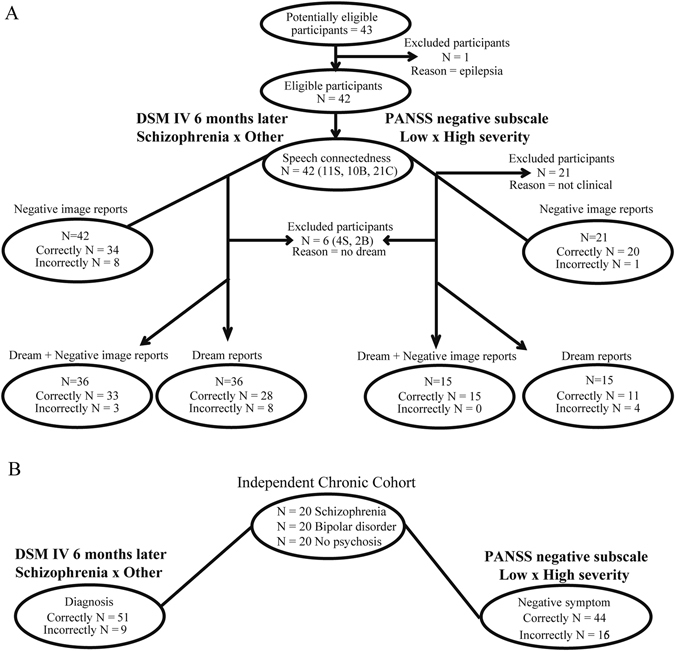
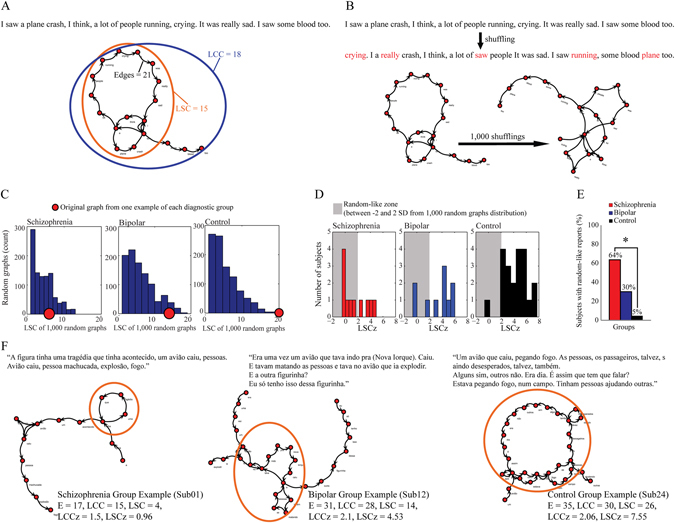
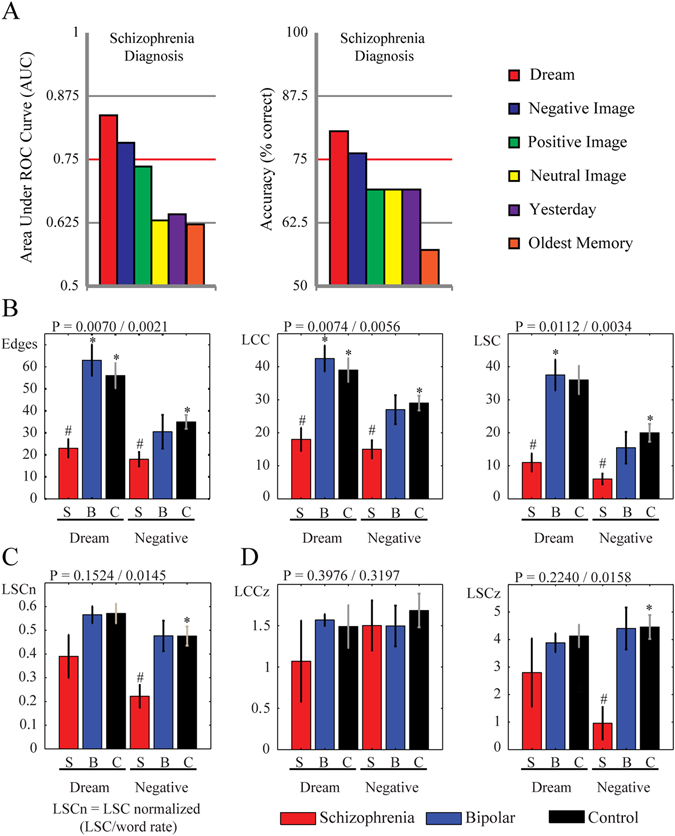
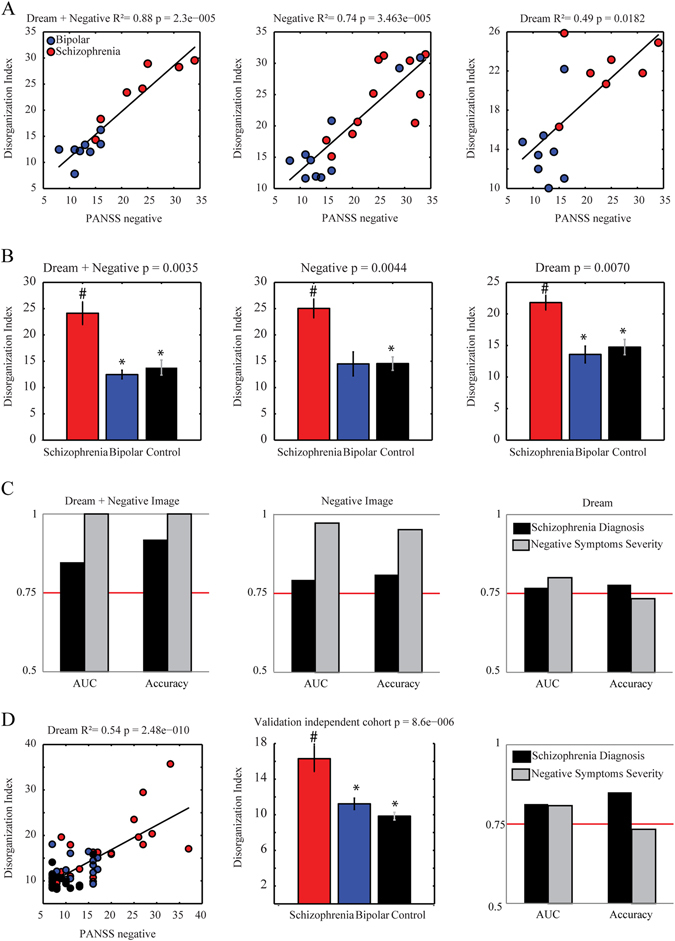
In chronic psychotic patients, word graph analysis shows potential as complementary psychiatric assessment. This analysis relies mostly on connectedness, a structural feature of speech that is anti-correlated with negative symptoms. Here we aimed to verify whether speech disorganization during the first clinical contact, as measured by graph connectedness, can correctly classify negative symptoms and the schizophrenia diagnosis 6 months in advance. Positive and negative syndrome scale scores and memory reports were collected from 21 patients undergoing first clinical contact for recent-onset psychosis, followed for 6 months to establish diagnosis, and compared to 21 well-matched healthy subjects. Each report was represented as a word-trajectory graph. Connectedness was measured by number of edges, number of nodes in the largest connected component and number of nodes in the largest strongly connected component. Similarities to random graphs were estimated. All connectedness attributes were combined into a single Disorganization Index weighted by the correlation with the positive and negative syndrome scale negative subscale, and used for classifications. Random-like connectedness was more prevalent among schizophrenia patients (64 × 5% in Control group, p = 0.0002). Connectedness from two kinds of memory reports (dream and negative image) explained 88% of negative symptoms variance (p < 0.0001). The Disorganization Index classified low vs. high severity of negative symptoms with 100% accuracy (area under the receiver operating characteristic curve = 1), and schizophrenia diagnosis with 91.67% accuracy (area under the receiver operating characteristic curve = 0.85). The index was validated in an independent cohort of chronic psychotic patients and controls (N = 60) (85% accuracy). Thus, speech disorganization during the first clinical contact correlates tightly with negative symptoms, and is quite discriminative of the schizophrenia diagnosis.
Overview
The claims and statistics of this paper haven’t been checked yet.
Free: it reads the open-access text and checks the first 5 claims that cite a source we can check. Create a free account to check every claim.
Integrity signals
Registry
Cites
Statistics
Figures
Verification
Claims the paper makes
The claims and statistics of this paper haven’t been checked yet.
Free: it reads the open-access text and checks the first 5 claims that cite a source we can check. Create a free account to check every claim.
Claims other papers make about this one
Each is checked against this paper’s own text: does it say what the citing paper says it does?
The source backs part of the claim, not all of it — or backs it for a different population, condition or comparison.
In the citing paper
“Third, it opens the door to voice or speech analysis, whereas features of the patient’s utterances can be passively monitored to derive health states [28-31].”
From Voice-Based Conversational Agents for the Prevention and Management of Chronic and Mental Health Conditions: Systematic Literature Review (2021) · cites this paper as [30]
Experimental — accuracy not yet measured
Self-check
Percentages, sums and reported differences re-computed from the paper’s own numbers.
The self-check needs the paper’s full text.
Citations
Cites
The Positive and Negative Syndrome Scale (PANSS) for schizophrenia.
Kay, S. R., Fiszbein, A., & Opler, L. A. (1987) · Schizophrenia Bulletin · doi:10.1093/schbul/13.2.261 · Cited by 21,378 · cited 1×
“The negative subscale measured seven symptoms: Blunted affect (N1), Emotional withdrawal (N2), Poor rapport (N3), Passive/apathetic social withdrawal (N4), Difficulty in abstract thinking (N5), Lack of spontaneity and flow of conversation (N6), Stereotyped thinking (N7).(28) Only one researcher performed PANSS scoring…”
The WEKA data mining software: an update
Hall, M., Frank, E., Holmes, G., Pfahringer, B., Reutemann, P., & Witten, I. H. (2009) · ACM SIGKDD Explorations Newsletter · doi:10.1145/1656274.1656278 · Cited by 17,750
Insel, T., Cuthbert, B., Garvey, M., Heinssen, R., Pine, D. S., Quinn, K., Sanislow, C., & Wang, P. (2010) · American Journal of Psychiatry · doi:10.1176/appi.ajp.2010.09091379 · Cited by 7,067
Comprehensive Textbook of Psychiatry
Freedman, A. M., & Kaplan, H. I. (1967) · The American Journal of the Medical Sciences · doi:10.1097/00000441-196712000-00052 · Cited by 3,799
Looking at pictures: Affective, facial, visceral, and behavioral reactions
LANG, P. J., GREENWALD, M. K., BRADLEY, M. M., & HAMM, A. O. (1993) · Psychophysiology · doi:10.1111/j.1469-8986.1993.tb03352.x · Cited by 3,190
Biostatistics: A Foundation for Analysis in the Health Sciences.
Rosenfeld, B., & Daniel, W. W. (1984) · Journal of the American Statistical Association · doi:10.2307/2288760 · Cited by 2,834
The NIMH Research Domain Criteria (RDoC) Project: Precision Medicine for Psychiatry
Insel, T. R. (2014) · American Journal of Psychiatry · doi:10.1176/appi.ajp.2014.14020138 · Cited by 1,472 · cited 1×
“This raises the point that precise behavioral measurements are more likely to describe symptomatology than standard diagnosis.(20) Importantly, it was possible to correctly classify schizophrenia diagnosis and negative symptom severity using the Disorganization Index from dream reports of an independent cohort of chro…”
Computational psychiatry as a bridge from neuroscience to clinical applications
Huys, Q. J. M., Maia, T. V., & Frank, M. J. (2016) · Nature Neuroscience · doi:10.1038/nn.4238 · Cited by 1,002
Automated analysis of free speech predicts psychosis onset in high-risk youths
Bedi, G., Carrillo, F., Cecchi, G. A., Slezak, D. F., Sigman, M., Mota, N. B., Ribeiro, S., Javitt, D. C., Copelli, M., & Corcoran, C. M. (2015) · npj Schizophrenia · doi:10.1038/npjschz.2015.30 · Cited by 673
Self-citationWhitaker, K. J., Vértes, P. E., Romero-Garcia, R., Váša, F., Moutoussis, M., Prabhu, G., Weiskopf, N., Callaghan, M. F., Wagstyl, K., Rittman, T., et al. (2016) · Proceedings of the National Academy of Sciences · doi:10.1073/pnas.1601745113 · Cited by 520
Research works printed but not linked: 2
- Mota, N. B., Carrillo, F., Slezak, D. F., Copelli, M. & Ribeiro, S. in Fiftieth Asilomar Conference on Signals, Systems and Computers. (IEEE Conference Publishing).
- First, M. H., Spitzer, R. L., Gibbon, M. & Williams, J. Structured clinical interview for DSM-IV Axis I disorders -- Research version, patient edition (SCID-I/P). (Biometrics Research, New York State Psychiatric Institute, 1990).
Cited by
Items 101–168 of 168
Naeim, M., Narimani, M., & Aghajani, S. (2026) · BMC Psychiatry · doi:10.1186/s12888-026-07888-3 · Cited by 7
Ahuja, S., Zaher, F., & Palaniyappan, L. K. (2025) · Journal of Psychopharmacology · doi:10.1177/02698811251319455 · Cited by 7
“The degree of this disorganisation is limited when compared to the speech of patients with schizophrenia (Mota et al., 2017).”
Argôlo, F. C., Ramos, W. H. D. P., Mota, N. B., Gondim, J. M., Lopes-Rocha, A. C., Andrade, J. C., van de Bilt, M. T., de Jesus, L. P., Jafet, A. F., Cecchi, G., et al. (2024) · Brazilian Journal of Psychiatry · doi:10.47626/1516-4446-2023-3419 · Cited by 9
“The second, based on the experimental paradigm of Mota, 29,39,40 requested oral memory reports of a recent or old dream and short-term memory reports based on three positively affective pictures – a baby, a puppy, and a dessert.”
Self-citationGraph structure analysis of speech production among second language learners of Spanish and Chinese
Botezatu, M. R., Weissheimer, J., Ribeiro, M., Guo, T., Finger, I., & Mota, N. B. (2022) · Frontiers in Psychology · doi:10.3389/fpsyg.2022.940269 · Cited by 8
Self-citationHe, R., Grodzki, R., Altay, N., Aston, B., Alonso-Sánchez, M. F., Homan, P., Sommer, I. E., Palaniyappan, L. K., & Hinzen, W. (2026) · Scientific Reports · doi:10.1038/s41598-026-39025-1 · Cited by 9
“Even at a sentential level, the weakness of the correlations and unclear reasons for the selectivity of the correlating measures urge caution on continuing to interpret these measures as targeting coherence, as has been done relatively routinely in the field 3–7 .”
Gesticulation in individuals with at risk mental states for psychosis
Lopes-Rocha, A. C., Ramos, W. H. D. P., Argôlo, F. C., Gondim, J. M., Mota, N. B., Andrade, J. C., Jafet, A. F., de Medeiros, M. W., Serpa, M. H., Cecchi, G., et al. (2023) · Schizophrenia · doi:10.1038/s41537-023-00360-1 · Cited by 8
Self-citationRodríguez‐Ferreiro, J., Aguilera, M., & Davies, R. A. I. (2020) · PeerJ · doi:10.7717/peerj.9511 · Cited by 7
Mota, N. B. (2021) · Schizophrenia Research · doi:10.1016/j.schres.2021.11.013 · Cited by 6
Self-citationMota, N. B., Ribeiro, M., Malcorra, B. L. C., Argôlo, F. C., Lopes-Rocha, A. C., Ara, A., Gondim, J. M., Cecchi, G., Loch, A. A., & Corcoran, C. M. (2025) · Psychiatry Research · doi:10.1016/j.psychres.2025.116469 · Cited by 6
Self-citationMota, N. B., Soares, E. S., Altszyler, E., Sánchez-Gendriz, I., Muto, V., Heib, D. P. J., Slezak, D. F., Sigman, M., Copelli, M., Schabus, M., et al. (2022) · NeuroImage · doi:10.1016/j.neuroimage.2022.119690 · Cited by 9
Self-citationKim-Dufor, D.-H., Walter, M., Krebs, M., Haralambous, Y., Lenca, P., & Lemey, C. (2025) · Frontiers in Psychiatry · doi:10.3389/fpsyt.2025.1595197 · Cited by 4
Speech graph analysis in obsessive-compulsive disorder: The relevance of dream reports
Gomes, M., Picó‐Pérez, M., Castro, I., Moreira, P. S., Ribeiro, S. T. G., Mota, N. B., & Morgado, P. F. (2023) · Journal of Psychiatric Research · doi:10.1016/j.jpsychires.2023.03.035 · Cited by 7
Self-citationHallucinatory Symptomatology in Major Psychoses (Schizophrenia and Bipolar Disorders)
Raballo, A., Poletti, M., & Henriksen, M. G. (2018) · Springer eBooks · doi:10.1007/978-3-319-75124-5_6 · Cited by 4
Olah, J., Cummins, N., Arribas, M., Gibbs-Dean, T., Molina, E., Sethi, D., Kempton, M. J., Morgan, S. E., Spencer, T., & Diederen, K. M. J. (2024) · Translational Psychiatry · doi:10.1038/s41398-024-02851-w · Cited by 7
“…time (ranging from − 1 to 1) (tangentiality), the mean of the cosine similarities between each sentence and the a priori stimulus description (ranging from − 1 to 1) (on topic) and as the maximum cosine similarity between all possible pairs of sentences (ranging from − 1 to 1) (repetition) [25].”
BackgroundReilly, J. J., Zuckerman, B. M., Finley, A. M., Litovsky, C. P., & Kenett, Y. N. (2022) · PsyArXiv (OSF Preprints) · doi:10.31234/osf.io/6fuhv · Cited by 4
Tecnologias digitais, subjetividade e psicopatologia: possíveis impactos da pandemia
Bezerra, B. (2020) · Revista Latinoamericana de Psicopatologia Fundamental · doi:10.1590/1415-4714.2020v23n3p495.4 · Cited by 7
Social media in screening and monitoring for early intervention in psychosis
Feldman, J., Hamlyn, A., & Rice, T. (2021) · Schizophrenia Research · doi:10.1016/j.schres.2021.09.023 · Cited by 3
Mota, N. B. (2022) · Psychiatry Research · doi:10.1016/j.psychres.2022.114995 · Cited by 4
Self-citationSaga, T., Tanaka, H., & Nakamura, S. (2023) · INTERNATIONAL CONFERENCE ON MULTIMODAL INTERACTION · doi:10.1145/3577190.3614132 · Cited by 5
Costa, A. C., Cury, L. D. S., Finger, I., Mota, N. B., & Weissheimer, J. (2023) · Ilha do Desterro A Journal of English Language Literatures in English and Cultural Studies · doi:10.5007/2175-8026.2023.e94537 · Cited by 3
“According to Mota (2017), the LCC is the “largest set of nodes directly or indirectly connected by some path” (p. 2) and the LSC is the “largest set of nodes directly or indirectly connected by reciprocal paths, so that all component nodes are mutually reachable” (p. 2) .”
MethodSelf-citationCorcoran, C. M. (2020) · Schizophrenia Research · doi:10.1016/j.schres.2020.09.024 · Cited by 3
“…distinguish language in schizophrenia from that of mania(Mota et al., 2012), are highly correlated with negative symptoms and predict schizophrenia diagnosis among individuals with first episode psychosis(Mota et al., 2017), and represent a failure of maturation in schizophrenia(Mota et al., 2018).”
BackgroundCamon, E., Masier, S., Mota, N. B., & D’Agostino, A. (2025) · Schizophrenia Research · doi:10.1016/j.schres.2025.10.017 · Cited by 2
Self-citationDikaios, K., Rempel, S., Dumpala, S. H., d’Eon, J., Alda, M., Kiefte, M., Matwin, S., Oore, S., & Uher, R. (2025) · Psychiatry Research · doi:10.1016/j.psychres.2025.116895 · Cited by 3
He, R., Kirdun, M., Palominos, C., Orejudo, L. N., Barthélémy, S., Bhola, S., Ciampelli, S., Decker, A., Demirlek, C., Fusaroli, R., et al. (2026) · EClinicalMedicine · doi:10.1016/j.eclinm.2026.104265 · Cited by 3
Multidisciplinary characterization of embarrassment through behavioral and acoustic modeling
Šipka, D., Vlasenko, B., Stein, M., Dierks, T., Magimai.-Doss, M., & Morishima, Y. (2025) · Scientific Reports · doi:10.1038/s41598-025-94051-9 · Cited by 2
“Since part 1 is irrelevant to this study, it was not further explained here (see 23 , for the study procedure of part 1).”
InfluentialArgôlo, F. C., Ramos, W. H. D. P., Mota, N. B., Gondim, J. M., Lopes-Rocha, A. C., Cecchi, G., Corcoran, C. M., Ara, A., & Loch, A. A. (2023) · PsyArXiv (OSF Preprints) · doi:10.31234/osf.io/epgfy · Cited by 2
Self-citationExploring language and cognition in schizophrenia: Insights from computational analysis
Cecchi, G., & Corcoran, C. M. (2023) · Schizophrenia Research · doi:10.1016/j.schres.2023.07.030 · Cited by 2
Schizophrenia and Other Primary Psychoses: Clinical Features
Liddle, P. F. (2024) · Cambridge University Press eBooks · doi:10.1017/9781911623861.010 · Cited by 1
Detecting psychosis via natural language processing of social media posts: potentials and pitfalls
Plank, L., & Zlomuzica, A. (2025) · Neuropsychologia · doi:10.1016/j.neuropsychologia.2025.109325 · Cited by 3
Mutlu, E., İlhan, B., İlhan, B. Ç., & Yağcioğlu, A. E. A. (2026) · Psychiatric Quarterly · doi:10.1007/s11126-026-10259-6 · Cited by 1
Westhoff, M., Berg, M., Stein, F., Rief, W., Tan, R., Thomas‐Odenthal, F., Usemann, P. L., Teutenberg, L., Nenadić, I., Straube, B., et al. (2026) · Journal of Affective Disorders · doi:10.1016/j.jad.2026.121810 · Cited by 1
A graph theory approach to chart the architecture of dream and mind-wandering reports
Coppola, P., Sikka, P., Valli, K., Tuominen, J., Revonsuo, A., Loukola, V., Bernstein, R., Strid, N., Kirberg, M., Nassar, A. E., et al. (2026) · Communications Psychology · doi:10.1038/s44271-026-00509-5 · Cited by 1
Self-citationMarques, P. C. F., Soares, L. R. F., Araujo, A. V. D. A., Monteiro, A. R., Batista, A. D. A. L., Pimentel, T., Calheiros, L. D. L., Padilla, M., Pacheco, A. L. D. G., Queda, F., et al. (2024) · Brazilian Journal of Health Review · doi:10.34119/bjhrv7n2-337 · Cited by 1
Lopes-Rocha, A. C., Corcoran, C. M., Argôlo, F. C., Jafet, A. F., Ara, A., Gondim, J. M., Haddad, N. M., de Jesus, L. P., Serpa, M. H., van de Bilt, M. T., et al. (2025) · Brazilian Journal of Psychiatry · doi:10.47626/1516-4446-2024-3919 · Cited by 1
“The second protocol, performed after the SIPS interview, was based on Mota’s paradigm, 31 which included memory reports of a recent or old dream and short-term memory reports based on three positive affective pictures (baby, a puppy, and a dessert).”
de Boer, J. N. (2023) · University of Groningen research database (University of Groningen / Centre for Information Technology) · doi:10.33612/diss.668440255 · Cited by 1
Trognon, A. (2022) · theses.fr (ABES) · doi:10.70675/a61baf2dz0493z4668z80b0za8538881eb16 · Cited by 4
Martin, J. M. (2017) · LA Referencia (Red Federada de Repositorios Institucionales de Publicaciones Científicas)
Fourier Analysis of Written Words Focusing on Vowels: From Word Salad to Literary Works
Shimizu, J., & Kuwata, K. (2019) · Journal of Literature, Languages and Linguistics · doi:10.7176/jlll/63-05
Myers, E. J. (2021) · Purdue e-Pubs (Purdue University System) · doi:10.25394/pgs.15032664.v1
“…has demonstrated these tools’ sensitivity to differences between people with schizophrenia, controls (Docherty et al., 1996; Elvevåg et al., 2007; Mota et al., 2017; Willits et al., 2018), and patients’ unaffected biological relatives (Docherty et al., 1998; Elvevåg et al., 2010; Gooding et…”
BackgroundPsicolinguística e Modelos Baseados no Uso
Filho, N. S. D. S., & Godoy, M. C. (2024) · Revista de Estudos da Linguagem · doi:10.17851/2237-2083.30.2.1103-1133
Gabrić, P., Nagels, A., Kircher, T. T. J., & Rosenkranz, A. (2021) · PsyArXiv (OSF Preprints) · doi:10.31234/osf.io/7tndz
STRUCTURAL DEFICIENCY IN SCHIZOPHRENIA: AN EXPLORATORY STUDY OF THE NOMINAL AND SENTENTIAL DOMAINS
Chaves, M. F. (2022) · doi:10.17771/pucrio.acad.59075 · Cited by 2
A commentary on the interpretability of computational linguistic findings in schizophrenia research
Kapitány‐Fövény, M. (2022) · Schizophrenia Research · doi:10.1016/j.schres.2022.10.012
Völker, J. S. D., Micluția, I., & Hanga, A.-M. (2023) · Current Psychiatry Research and Reviews · doi:10.2174/2666082219666230116100934
HuMenDisCo: A Hungarian Speech Corpus of Schizophrenia, Schizoaffective and Bipolar DisordersPreprint
Szabó, M. K., Vincze, V., Guba, C., Dam, B., Solymos, A., Bagi, A., & Szendi, I. (2023) · Research Square · doi:10.21203/rs.3.rs-2589753/v1 · Cited by 1
Exploring the relationship between frequent cannabis use, vocal changes and language use
Diederen, K., Olah, J., Chesney, E., Oliver, D., Obreshkova, S., Wang, S., Dinzeo, T. J., Gibbs-Dean, T., Cummins, N., Englund, A., et al. (2026) · Journal of Psychiatric Research · doi:10.1016/j.jpsychires.2026.11.018
Álvaro Cavieres, F., & Alonso-Sánchez, M. F. (2023) · Psiquiatría Biológica · doi:10.1016/j.psiq.2023.100438 · Cited by 1
Alimi, S., Kuyoro, A. O., Eze, M. O., & Akande, O. (2025) · Indonesian Journal of Electrical Engineering and Informatics (IJEEI) · doi:10.52549/ijeei.v13i1.5506
Bozdağ, M. Ç., Kumcu, A., Şenel, L. K., Temizkan, H. N., Özil, Ö., Arslanyürek, İ., Ertekin, P. N., & Candansayar, S. (2026) · Psychiatry Research · doi:10.1016/j.psychres.2026.117215
Raheel, K., Biabani, N., Ivanenko, O., See, Q. R., Bertani, R., Gnoni, V., O’Regan, D., Cvetković, Z., Drakatos, P., Bernardi, G., et al. (2025) · Research Square · doi:10.21203/rs.3.rs-6761771/v1
Schizophrenia Diagnosis Support with Spectral and Cepstral Features of Speech
Teixeira, F., Mendes, J., Soares, S., Abreu, J. L. P., & Teixeira, J. P. (2025) · Communications in computer and information science · doi:10.1007/978-3-032-00137-5_12
Palominos Flores, C. (2025) · Repositori digital de la UPF (Universitat Pompeu Fabra)
Age-related differences in speech production: Evidence from graph analyses.
Walters, K., Cosgrove, A. L., Weissheimer, J., & Diaz, M. T. (2026) · Psychology and Aging · doi:10.1037/pag0001038
Çabuk, T. (2024) · Bilkent University Institutional Repository (Bilkent University)
Just, S. A., Pandey, S., Stein, D., Nenchev, I., Bröcker, A., Montag, C., & Morgan, S. E. (2026) · Translational Psychiatry · doi:10.1038/s41398-026-04389-5
Tang, X., Chen, J., Huang, Y., & Yao, Q. (2026) · International Journal of Medical Informatics · doi:10.1016/j.ijmedinf.2026.106690
Suta, M. D. P. G., Echeverry-Correa, J. D., & Herrera, P. (2026) · Technologies · doi:10.3390/technologies14090547
“Our hypothesis is consistent with studies that have proposed indices to quantify aspects such as speech disorganization in patients with schizophrenia, bipolar disorder, and first-episode psychosis [54,55].”
ANALYSIS OF NATURAL SPEECH FOR THE ASSESSMENT OF MOOD DISORDERS
Dikaios, K. (2021) · DalSpace (Dalhousie University) · Cited by 1
Generalizing the study of thought organization with language models
Plank, L. (2026) · Dokumentenrepositorium der RUB (Ruhr University Bochum) · doi:10.13154/294-14947
Brasso, C. (n.d.) · Institutional Research Information System University of Turin (University of Turin)
Ribeiro, M., Amorim, J., Malcorra, B., Piccolo, R., Jensen, L., Soares, D., Meletti, T., & Mota, N. B. (2026) · medRxiv · doi:10.64898/2026.10.28.26366635
Self-citationKorda, A. I., Andreou, C., Mineur, L., Stein, F., Zhorzholiani, M., Avram, M., Seuffert, S., Mülfarth, R. R., Martinetz, T., Heinz Handels, A., et al. (2026) · NPP—Digital Psychiatry and Neuroscience · doi:10.1038/s44277-026-00074-z
“Larger, more diverse cohorts and assessment of potential confounders, including substance use, are needed to establish the robustness and generalizability of these fi ndings.”
Speech Phenotyping of Schizophrenia Symptoms using PANSS Recordings: A Cross-Study Validation
Worthington, M., Efstathiadis, G., Yadav, V., Patel, T., Sauder, C. L., Kaul, I., Brannan, S. K., & Abbas, A. (2026) · Psychiatry Research · doi:10.1016/j.psychres.2026.117568
Chaves, M. F., Rodrigues, C., Ribeiro, S., Mota, N. B., & Copelli, M. (2023) · doi:10.1371/journal.pone.0291446.r003
Self-citation
Metadata
- Authors
- Mota, N. B., Copelli, M., & Ribeiro, S.
- Affiliations
- Universidade Federal do Rio Grande do Norte (BR)
- Universidade Federal de Pernambuco (BR)
- Corresponding author
- Mota, Natália B.
- Venue
- npj Schizophrenia
- Published
- 2017-04-13
- Volume
- 3
- Issue
- 1
- Pages
- 18-18
- ISSN
- 2334-265X (ISSN-L)
- PMC
- PMC5441540
- OpenAlex
- W2604132829
- Cited by
- 157
- References
- 27
- Citations by year
- 2026: 10 · 2025: 13 · 2024: 17 · 2023: 29 · 2022: 32 · 2021: 17 · 2020: 20 · 2019: 11 · 2018: 5 · 2017: 3
- FWCI
- 8.76
- Type
- journal article
- Language
- en
- Open access
- gold
- doi.org
- Licence
- cc-by
- creativecommons.org/licenses/by/4.0 (tdm)
- creativecommons.org/licenses/by/4.0 (vor)
- Locations
- Schizophrenia (publishedVersion, cc-by)
- Europe PMC (PubMed Central) (publishedVersion, other-oa)
- PubMed Central (publishedVersion, cc-by)
- PubMed (publishedVersion)
- LA Referencia (Red Federada de Repositorios Institucionales de Publicaciones Científicas) (publishedVersion, other-oa)
- Americanae (AECID Library) (submittedVersion, other-oa)
- DOAJ (DOAJ: Directory of Open Access Journals) (submittedVersion, cc-by-sa)
- Funders
- Fundação de Amparo à Pesquisa do Estado de São Paulo (2013-07699-0, 13/07699-0)
- Coordenação de Aperfeiçoamento de Pessoal de Nível Superior (2013/07699-0, 0898/2013, 308775/2015-5, 408145/2016-1, 062/2015, OBEDUC-ACERTA 0898/2013)
- Conselho Nacional de Desenvolvimento Científico e Tecnológico (2013/07699–0, 308775/20155, 408145/2016-1)
- Universidade Federal do Rio Grande do Norte
- Topics
- Health Sciences › Medicine › Psychiatry and Mental health › Schizophrenia research and treatment
- Social Sciences › Psychology › Experimental and Cognitive Psychology › Mental Health Research Topics
- Social Sciences › Arts and Humanities › Philosophy › Mental Health and Psychiatry
- Keywords
- thought disorder, graph connectivity, negative symptoms, schizophrenia diagnosis, early diagnosis, recent-onset psychosis, memory reports, chronic psychosis
About these checks
Registry, retraction, Cites and statistics results are computed, not judged, with one exception: a printed reference that no index lists is read once by a model before it counts as a citation error. Claims are extracted by a model and kept only when their quote appears verbatim in the text; each cited source is then checked, with a model’s help, for whether it says what the claim relies on. Those verdicts can be wrong — read the claim’s quote and the cited source before relying on one.
Statistics and arithmetic are recomputed, not judged.
Confidence bands are shown only for fields calibrated on our annotated test set. None is calibrated yet, so no band is shown.
What counts as a claim ›How we measure confidence ›How we check this ›
Are you an author, or do you see a problem with this page? Request a review
Data sources
Bibliographic data: Semantic Scholar, OpenAlex, Crossref.
Contains information from the Semantic Scholar Academic Graph Datasets, made available under the ODC Attribution License (ODC-BY 1.0).
Semantic Scholar’s data is described in: Kinney, R., et al. (2023). The Semantic Scholar Open Data Platform. arXiv:2301.10140.
