

Building dementia knowledge globally through the Understanding Dementia Massive Open Online Course (MOOC)
Open accessThe DOI matches its Crossref record; 39 of the 39 references it cites were found in a registry or an index.
Abstract
The prevalence of dementia is escalating world-wide and knowledge deficits remain a barrier to community inclusiveness and quality care. The need for quality, comprehensive education has been identified as a key priority for global action plans on dementia. The Understanding Dementia Massive Open Online Course (UDMOOC) offers the potential to improve dementia knowledge globally. Completion rates for the UDMOOC (2016-2017) were on average 42% of enrolments, and 69% of participants care or have cared for people with dementia. The current study shows baseline dementia knowledge was positively related to previous learning about dementia from various types of exposure to the condition including having family members and/or working with people with the condition, and having undertaken dementia education. However, knowledge of all participant groups showed substantial improvements after completion of the UDMOOC. This was shown regardless of educational background and previous experience of dementia, and group differences after completing the UDMOOC were minimised. The UDMOOC is therefore an effective knowledge translation strategy to improve dementia knowledge for a diverse, international learner group.
Overview
The claims and statistics of this paper haven’t been checked yet.
Free: it reads the open-access text and checks the first 5 claims that cite a source we can check. Create a free account to check every claim.
Integrity signals
Registry
Cites
Statistics
Figures
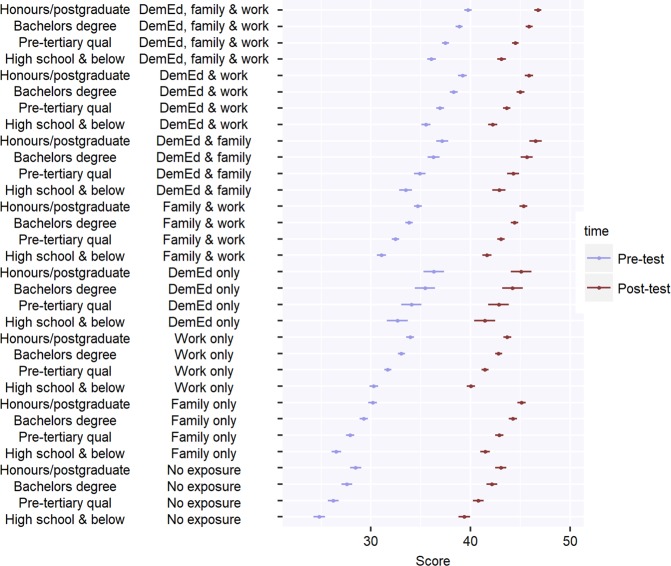
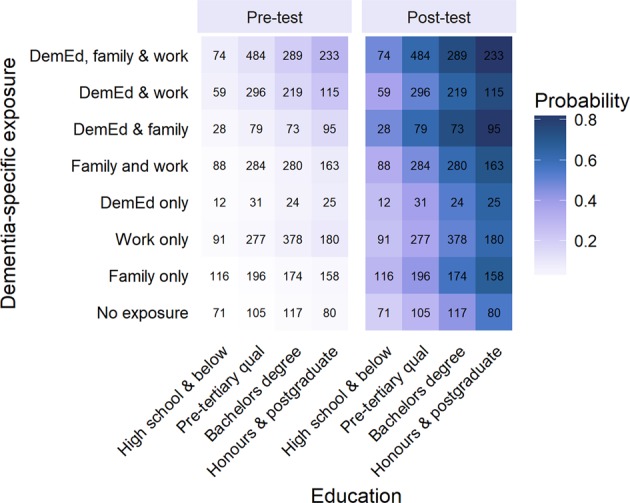
Verification
Claims the paper makes
The claims and statistics of this paper haven’t been checked yet.
Free: it reads the open-access text and checks the first 5 claims that cite a source we can check. Create a free account to check every claim.
Claims other papers make about this one
Each is checked against this paper’s own text: does it say what the citing paper says it does?
The source backs part of the claim, not all of it — or backs it for a different population, condition or comparison.
In the citing paper
“All studies revealed that these programs improved healthcare workers' attitudes about caring for patients with dementia, as well as their overall knowledge.”
From Awareness of dementia risk factors among healthcare professionals at Hamad Medical Corporation, Qatar: a cross-sectional survey (2024) · cites this paper as [17]
Experimental — accuracy not yet measured
Self-check
Percentages, sums and reported differences re-computed from the paper’s own numbers.
The self-check needs the paper’s full text.
Citations
Cites
Fitting Linear Mixed-Effects Models Using lme4
Bates, D., Mächler, M., Bolker, B., & Walker, S. (2015) · Journal of Statistical Software · doi:10.18637/jss.v067.i01 · Cited by 86,835
Dementia prevention, intervention, and care
Livingston, G., Sommerlad, A., Orgeta, V., Costafreda, S. G., Huntley, J., Ames, D., Ballard, C., Banerjee, S., Burns, A., Cohen-Mansfield, J., et al. (2017) · The Lancet · doi:10.1016/s0140-6736(17)31363-6 · Cited by 6,072
Informal learning in the workplace
Eraut *, M. (2004) · Studies in Continuing Education · doi:10.1080/158037042000225245 · Cited by 2,611
Caregiver Burden: A Clinical Review
Adelman, R. D., Tmanova, L. L., Delgado, D., Dion, S., & Lachs, M. S. (2014) · JAMA · doi:10.1001/jama.2014.304 · Cited by 2,002
Halekoh, U., & Højsgaard, S. (2014) · Journal of Statistical Software · doi:10.18637/jss.v059.i09 · Cited by 1,324
The worldwide economic impact of dementia 2010
Wimo, A., Jönsson, L., Bond, J., Prince, M., Winblad, B., & International, A. D. (2013) · Alzheimer's & Dementia · doi:10.1016/j.jalz.2012.11.006 · Cited by 1,141
Experiential learning: Transforming theory into practice
Yardley, S., Teunissen, P. W., & Dornan, T. (2012) · Medical Teacher · doi:10.3109/0142159x.2012.643264 · Cited by 589
Learning in MOOCs: Motivations and self-regulated learning in MOOCs
Littlejohn, A., Hood, N., Milligan, C., & Mustain, P. (2016) · The Internet and Higher Education · doi:10.1016/j.iheduc.2015.12.003 · Cited by 578 · cited 1×
“Few MOOCs, include objective measures of knowledge acquisition,(30) instead choosing primary outcome measures such as engagement, retention and completion as evidence of success.(31) However, not only was the UDMOOC designed to build dementia knowledge in a broad learner cohort,(21) but validated and robust measures o…”
BackgroundDall, T. M., Gallo, P. D., Chakrabarti, R., West, T., Semilla, A. P., & Storm, M. V. (2013) · Health Affairs · doi:10.1377/hlthaff.2013.0714 · Cited by 529 · cited 1×
“The knowledge of caregivers, health professionals and the general public about dementia is consistently reported as inadequate.(4,7,10,11) The critical need to address such lack of awareness and understanding about dementia is identified by international public health advocates, including to meet the aims of the Globa…”
BackgroundAmjad, H., Roth, D. L., Sheehan, O. C., Lyketsos, C. G., Wolff, J. L., & Samus, Q. M. (2018) · Journal of General Internal Medicine · doi:10.1007/s11606-018-4377-y · Cited by 501
Health literacy, social support, and health: a research agenda
Lee, S.-Y. D., Arozullah, A. M., & Cho, Y. I. (2004) · Social Science & Medicine · doi:10.1016/s0277-9536(03)00329-0 · Cited by 424
Health literacy: concept analysis
Speros, C. (2005) · Journal of Advanced Nursing · doi:10.1111/j.1365-2648.2005.03448.x · Cited by 322
Hearing Their Voice: A Systematic Review of Dementia Family Caregivers’ Needs
McCabe, M., You, E., & Tatangelo, G. (2016) · The Gerontologist · doi:10.1093/geront/gnw078 · Cited by 300
Stevenson, K. T., Peterson, M. N., Bondell, H. D., Moore, S. E., & Carrier, S. J. (2014) · Climatic Change · doi:10.1007/s10584-014-1228-7 · Cited by 277
A Systematic Review of the Public’s Knowledge and Understanding of Alzheimer’s Disease and Dementia
Cahill, S., Pierce, M., Werner, P., Darley, A., & Bobersky, A. (2015) · Alzheimer Disease & Associated Disorders · doi:10.1097/wad.0000000000000102 · Cited by 265
Democratizing education? Examining access and usage patterns in massive open online courses
Hansen, J. D., & Reich, J. (2015) · Science · doi:10.1126/science.aab3782 · Cited by 255
Cations, M., Radisic, G., Crotty, M., & Laver, K. E. (2018) · PLOS ONE · doi:10.1371/journal.pone.0196085 · Cited by 233
Closing global achievement gaps in MOOCs
Kizilcec, R. F., Saltarelli, A. J., Reich, J., & Cohen, G. L. (2017) · Science · doi:10.1126/science.aag2063 · Cited by 210
Dementia Knowledge Assessment Scale: Development and Preliminary Psychometric Properties
Annear, M. J., Toye, C. M., Eccleston, C. E., McInerney, F. J., Elliott, K. J., Tranter, B. K., Hartley, T., & Robinson, A. L. (2015) · Journal of the American Geriatrics Society · doi:10.1111/jgs.13707 · Cited by 184
Self-citationWang, Y., Xiao, L. D., Luo, Y., Xiao, S.-Y., Whitehead, C., & Davies, O. (2018) · BMC Geriatrics · doi:10.1186/s12877-018-0821-4 · Cited by 128
Stajduhar, K., Funk, L. M., & Outcalt, L. (2013) · Palliative Medicine · doi:10.1177/0269216313487765 · Cited by 121 · cited 1×
“Family carers learn largely by trial and error, active information seeking, application of previous knowledge or skills and being guided by others.(14) Similarly, unregulated care workers/assistants,(15) as well as health care students,(16) gain knowledge through experience, in addition to more formal training opportu…”
BackgroundSex differences in variance of intelligence across childhood
Arden, R., & Plomin, R. (2006) · Personality and Individual Differences · doi:10.1016/j.paid.2005.11.027 · Cited by 118
Goldberg, L. R., Bell, E., King, C., O’Mara, C., McInerney, F., Robinson, A., & Vickers, J. (2015) · BMC Medical Education · doi:10.1186/s12909-015-0344-z · Cited by 116
Self-citationPhillipson, L., Magee, C., Jones, S., Reis, S., & Skaldzien, E. (2015) · Aging & Mental Health · doi:10.1080/13607863.2014.995588 · Cited by 115 · cited 1×
“While both the death rate and disease burden from dementia are increasing, rates of diagnosis remain low(2) and stigma and perceived futility of diagnosis continue to impact on health seeking behaviour.(3) The aged care workforce is inadequately resourced and prepared to meet the growing need for dementia care,(4) and…”
BackgroundMassive open online courses and underserved students in the United States
Stich, A. E., & Reeves, T. D. (2016) · The Internet and Higher Education · doi:10.1016/j.iheduc.2016.09.001 · Cited by 99
Learning in an introductory physics MOOC: All cohorts learn equally, including an on-campus class
Colvin, K. F., Champaign, J., Liu, A., Zhou, Q., Fredericks, C., & Pritchard, D. E. (2014) · The International Review of Research in Open and Distributed Learning · doi:10.19173/irrodl.v15i4.1902 · Cited by 91
Annear, M. J., Eccleston, C. E., McInerney, F. J., Elliott, K. J., Toye, C. M., Tranter, B. K., & Robinson, A. L. (2016) · Journal of the American Geriatrics Society · doi:10.1111/jgs.14142 · Cited by 77
Self-citationFoley, T., Boyle, S., Jennings, A., & Smithson, W. H. (2017) · BMC Family Practice · doi:10.1186/s12875-017-0639-8 · Cited by 74 · cited 1×
“The knowledge of caregivers, health professionals and the general public about dementia is consistently reported as inadequate.(4,7,10,11) The critical need to address such lack of awareness and understanding about dementia is identified by international public health advocates, including to meet the aims of the Globa…”
BackgroundKnowledge of Dementia Among the Australian Health Workforce: A National Online Survey
Annear, M. J. (2020) · Journal of Applied Gerontology · doi:10.1177/0733464817752085 · Cited by 64
What should we know about dementia in the 21st Century? A Delphi consensus study
Annear, M. J., Toye, C., McInerney, F., Eccleston, C., Tranter, B., Elliott, K.-E., & Robinson, A. (2015) · BMC Geriatrics · doi:10.1186/s12877-015-0008-1 · Cited by 58
Self-citationTargeted MOOC captivates students
King, C., Robinson, A., & Vickers, J. C. (2014) · Nature · doi:10.1038/505026a · Cited by 51
Self-citationPreventing Chronic Pain: A Human Systems Approach—Results from a Massive Open Online Course
Fricton, J., Anderson, K., Clavel, A., Fricton, R., Hathaway, K., Kang, W., Jaeger, B., Maixner, W., Pesut, D., Russell, J., et al. (2015) · Global Advances in Health and Medicine · doi:10.7453/gahmj.2015.048 · Cited by 39
Choi, S., & Park, M. (2017) · Educational Gerontology · doi:10.1080/03601277.2016.1273732 · Cited by 32
It’s the learning, stupid! Discussing the role of learning outcomes in MOOCs
Otto, D., Bollmann, A., Becker, S., & Sander, K. (2018) · Open Learning The Journal of Open Distance and e-Learning · doi:10.1080/02680513.2018.1486183 · Cited by 32
MOOCs as a Remedial Complement: Students’ Adoption and Learning Outcomes
Hernández, J., Rodríguez, M. F., Hilliger, I., & Pérez‐Sanagustín, M. (2018) · IEEE Transactions on Learning Technologies · doi:10.1109/tlt.2018.2830373 · Cited by 24
Designing for Quality: The Understanding Dementia MOOC.
King, C., Kelder, J., Doherty, K., Phillips, R., McInerney, F. J., Walls, J., Robinson, A., & Vickers, J. C. (2014) · The Electronic Journal of e-Learning · Cited by 22
Self-citationMOOCs with attitudes: Insights from a practitioner based investigation
Chadaj, M., Allison, C., & Baxter, G. D. (2014) · IEEE Frontiers in Education Conference (FIE) · doi:10.1109/fie.2014.7044101 · Cited by 11 · cited 1×
“While MOOCs have been publicised as a way to provide education to those who would otherwise not have access, they are yet to deliver on their disruptive, emancipatory and democratising potential.(17,18) The Understanding Dementia MOOC (UDMOOC(19)) aims to improve knowledge of dementia in a broad international communit…”
Bindoff, A. D. (2019) · Zenodo (CERN European Organization for Nuclear Research) · doi:10.5281/zenodo.2553707 · Cited by 1
Self-citationBindoff, A. D. (2019) · Zenodo (CERN European Organization for Nuclear Research) · doi:10.5281/zenodo.2553706 · Cited by 1
Self-citation
Research works printed but not linked: 2
- Laurillard D Rethinking University Teaching: A Conversational Framework for the Effective Use of Learning Technologies 2002 London Routledge
- World Health Organisation. Global Action Plan on the Public Health Response to Dementia 2017–2025 2017 Geneva World Health Organisation
Cited by
Wei, X., Saab, N., & Admiraal, W. (2021) · Computers & Education · doi:10.1016/j.compedu.2020.104097 · Cited by 232
Bartlett, L., Buscot, M., Bindoff, A. D., Chambers, R., & Hassed, C. S. (2021) · Frontiers in Psychology · doi:10.3389/fpsyg.2021.724126 · Cited by 85
“Emerging evidence supports the effectiveness of the MOOC format for delivering health-related behavioral and educational interventions (Eccleston et al., 2019).”
BackgroundSelf-citationNieder, J., Schwerdtle, P. N., Sauerborn, R., & Barteit, S. (2022) · Frontiers in Public Health · doi:10.3389/fpubh.2022.891987 · Cited by 58
“5%) focused on infectious diseases and were predominantly developed as part of an epidemic response (18, 38, 50, 65), eight (20%) focused on the treatment and prevention of non-communicable diseases, including diabetes (68), chronic pain (49), undernutrition (51), dentistry (58), and dementia (46, 72), and two (5%) on…”
BackgroundDementia education and training for the general public: A scoping review
Matsumoto, H., Maeda, A., Igarashi, A., Weller, C. D., & Yamamoto‐Mitani, N. (2021) · Gerontology & Geriatrics Education · doi:10.1080/02701960.2021.1999938 · Cited by 53
“Four dementia-friendly studies (Eccleston et al., 2019; Mahoney, 2002; Peisah et al., 2016; Robertshaw & Kotera, 2019), an early diagnosis study (Anstey et al., 2015), and two prevention studies (Isaacson et al., 2014) adopted e-learning for intervention.”
BackgroundMethodInfluentialPacifico, D., Fiordelli, M., Fadda, M., Serena, S., Piumatti, G., Carlevaro, F., Magno, F., Franscella, G., & Albanese, E. (2022) · BMC Public Health · doi:10.1186/s12889-022-14578-8 · Cited by 42
“Our findings are based on the DKAS, which has been used to assess the acquisition of dementia knowledge through educational online courses [35] and interventions [36, 37].”
Method
Metadata
- Authors
- Eccleston, C., Doherty, K., Bindoff, A., Robinson, A., Vickers, J., & McInerney, F.
- Affiliations
- University of Tasmania (AU)
- Corresponding author
- Vickers, James
- Venue
- npj Science of Learning
- Published
- 2019-04-10
- Volume
- 4
- Issue
- 1
- Pages
- 3-3
- ISSN
- 2056-7936 (ISSN-L)
- PMC
- PMC6458180
- OpenAlex
- W2935756927
- Cited by
- 68
- References
- 39
- Citations by year
- 2026: 4 · 2025: 14 · 2024: 10 · 2023: 9 · 2022: 9 · 2021: 12 · 2020: 8 · 2019: 2
- FWCI
- 8.40
- Type
- journal article
- Language
- en
- Open access
- gold
- doi.org
- Licence
- cc-by
- creativecommons.org/licenses/by/4.0 (tdm)
- creativecommons.org/licenses/by/4.0 (vor)
- Locations
- npj Science of Learning (publishedVersion, cc-by)
- PubMed Central (publishedVersion, cc-by)
- PubMed (publishedVersion)
- UTAS Research Repository (acceptedVersion)
- DOAJ (DOAJ: Directory of Open Access Journals) (submittedVersion)
- Figshare (submittedVersion, cc-by)
- Funders
- J.O. and J.R. Wicking Trust (Equity Trustees) - no grant reference number.
- Topics
- Physical Sciences › Computer Science › Computer Science Applications › Online Learning and Analytics
- Social Sciences › Education › Innovations in Medical Education
- Health Sciences › Medicine › Psychiatry and Mental health › Dementia and Cognitive Impairment Research
- Keywords
- dementia, dementia knowledge, massive open online courses, knowledge translation, dementia education, caregiver experiences, family caregivers, online learning, knowledge improvement
About these checks
Registry, retraction, Cites and statistics results are computed, not judged, with one exception: a printed reference that no index lists is read once by a model before it counts as a citation error. Claims are extracted by a model and kept only when their quote appears verbatim in the text; each cited source is then checked, with a model’s help, for whether it says what the claim relies on. Those verdicts can be wrong — read the claim’s quote and the cited source before relying on one.
Statistics and arithmetic are recomputed, not judged.
Confidence bands are shown only for fields calibrated on our annotated test set. None is calibrated yet, so no band is shown.
What counts as a claim ›How we measure confidence ›How we check this ›
Are you an author, or do you see a problem with this page? Request a review
Data sources
Bibliographic data: Semantic Scholar, OpenAlex, Crossref.
Contains information from the Semantic Scholar Academic Graph Datasets, made available under the ODC Attribution License (ODC-BY 1.0).
Semantic Scholar’s data is described in: Kinney, R., et al. (2023). The Semantic Scholar Open Data Platform. arXiv:2301.10140.
