

The DOI matches its Crossref record; 119 of the 123 references it cites were found in a registry or an index, and 3 are not checked yet.
Biologically informed deep learning to query gene programs in single-cell atlases
Open accessPublished version of a preprint
Abstract
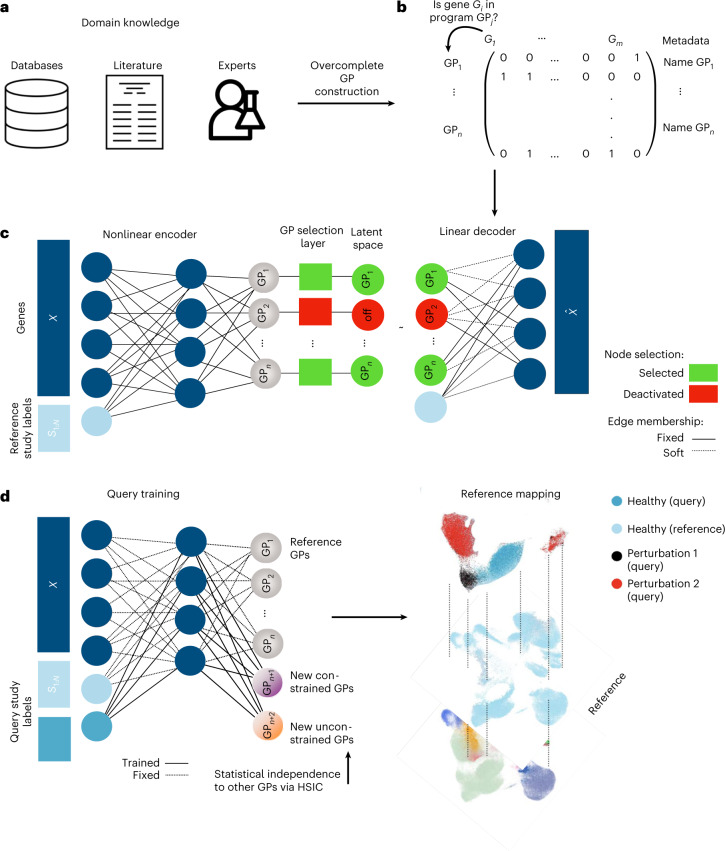
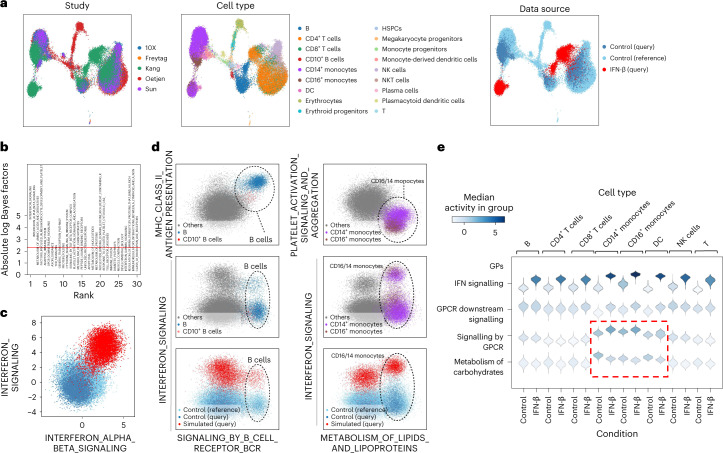
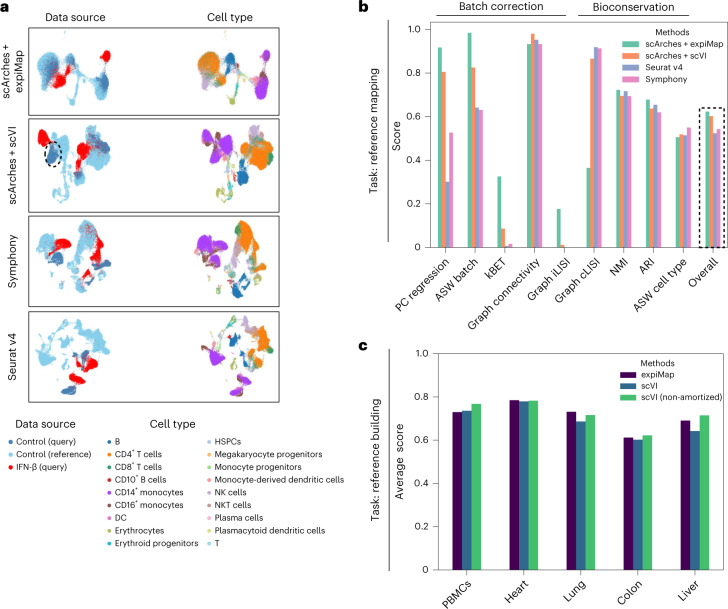
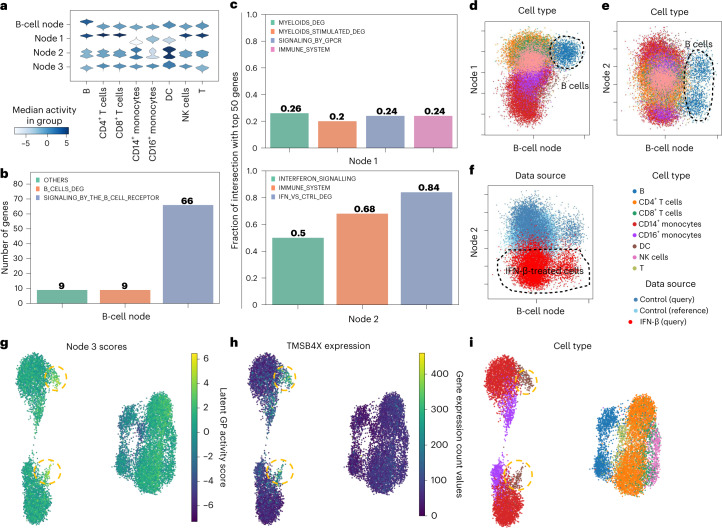
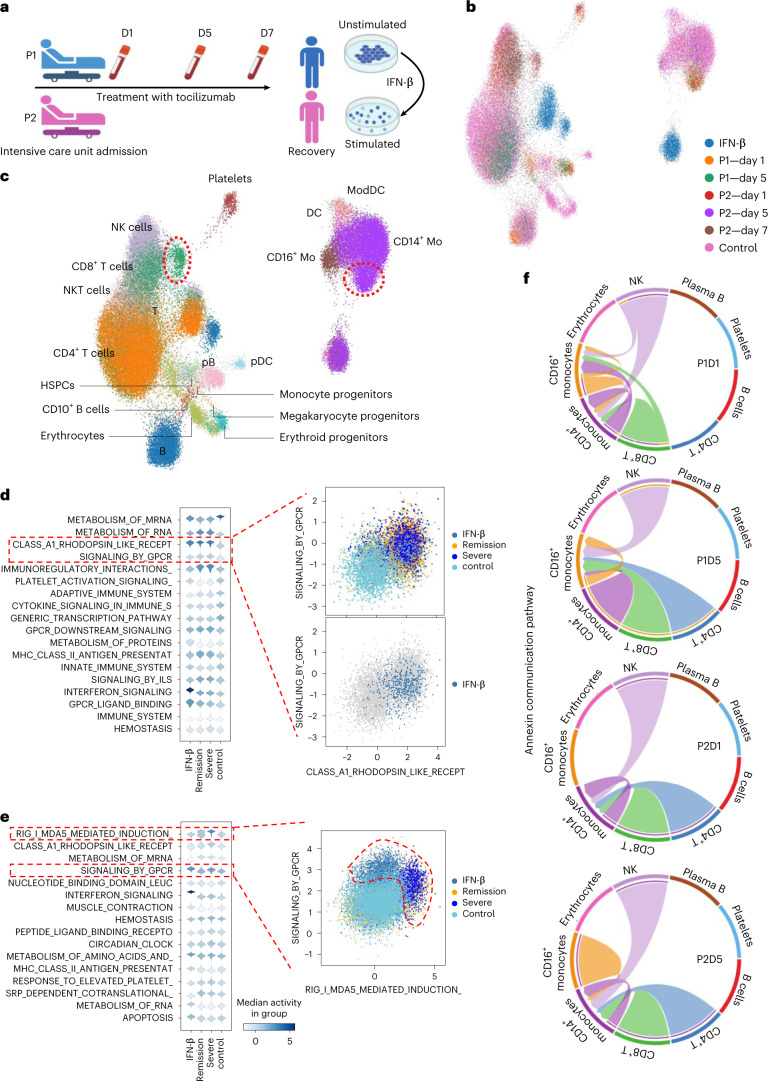
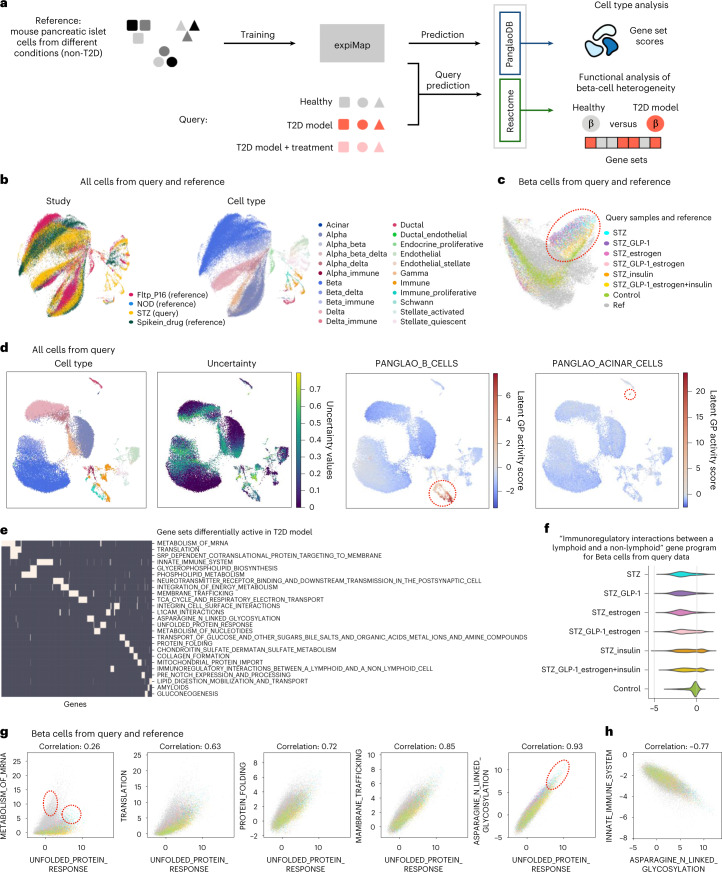
The increasing availability of large-scale single-cell atlases has enabled the detailed description of cell states. In parallel, advances in deep learning allow rapid analysis of newly generated query datasets by mapping them into reference atlases. However, existing data transformations learned to map query data are not easily explainable using biologically known concepts such as genes or pathways. Here we propose expiMap, a biologically informed deep-learning architecture that enables single-cell reference mapping. ExpiMap learns to map cells into biologically understandable components representing known ‘gene programs’. The activity of each cell for a gene program is learned while simultaneously refining them and learning de novo programs. We show that expiMap compares favourably to existing methods while bringing an additional layer of interpretability to integrative single-cell analysis. Furthermore, we demonstrate its applicability to analyse single-cell perturbation responses in different tissues and species and resolve responses of patients who have coronavirus disease 2019 to different treatments across cell types.
Overview
The claims and statistics of this paper haven’t been checked yet.
Free: it reads the open-access text and checks the first 5 claims that cite a source we can check. Create a free account to check every claim.
Integrity signals
Registry
Cites
Statistics
Figures
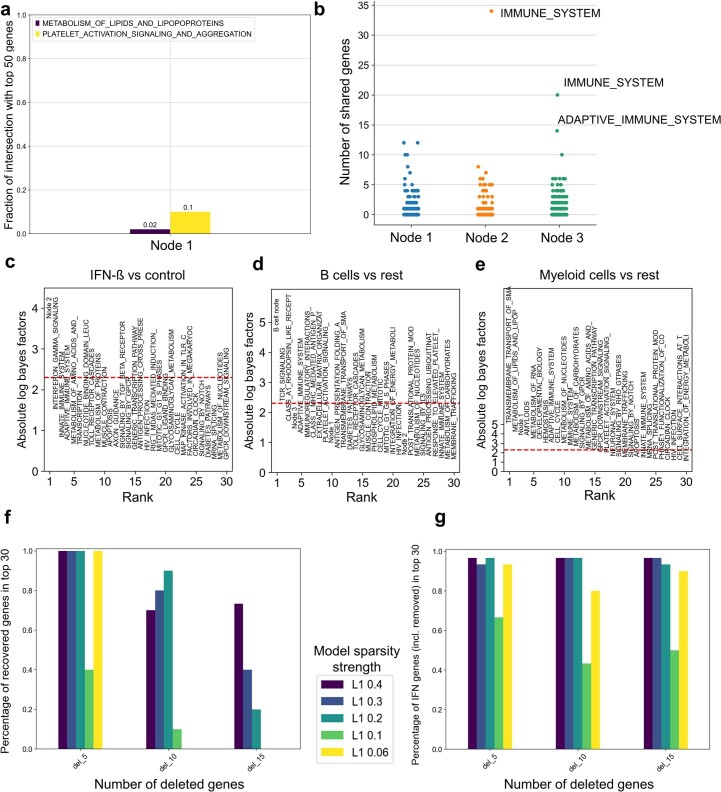
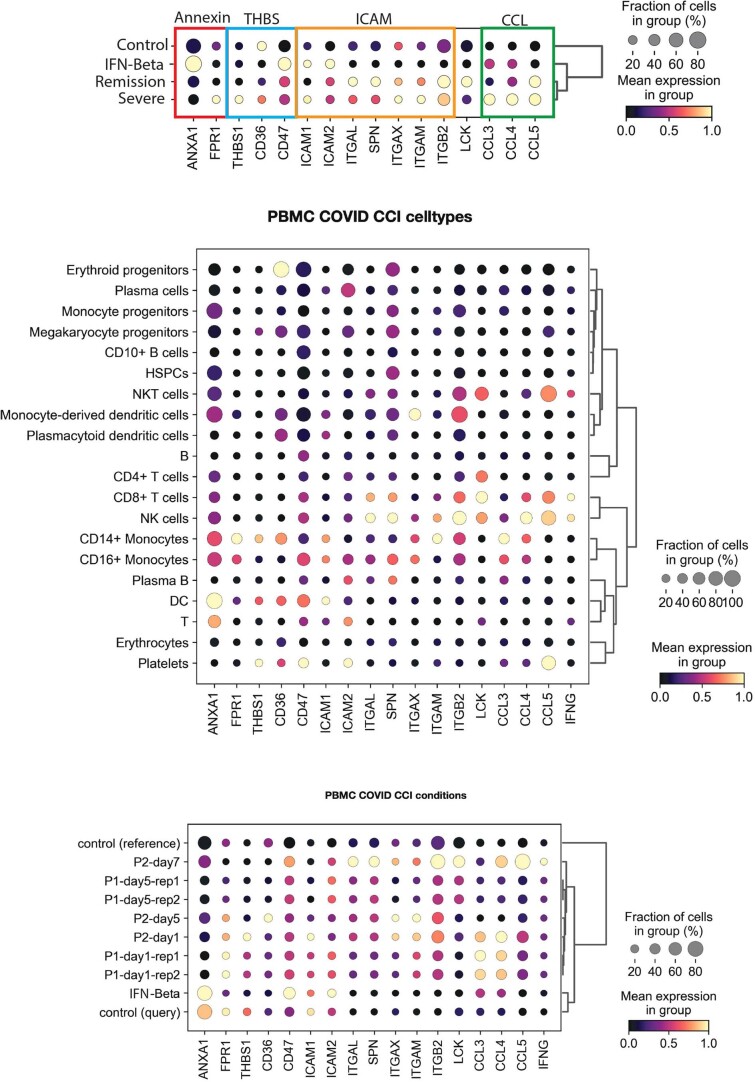
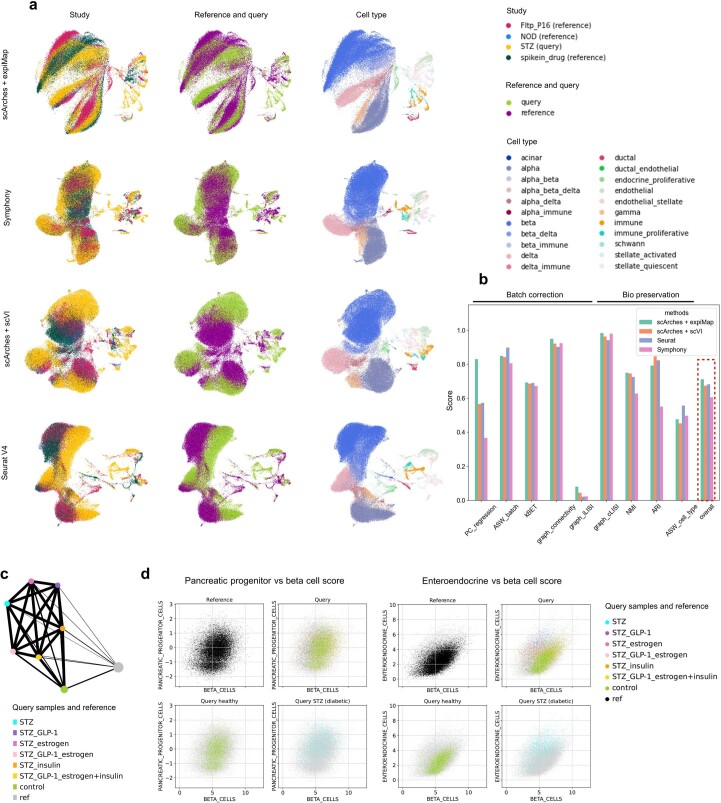
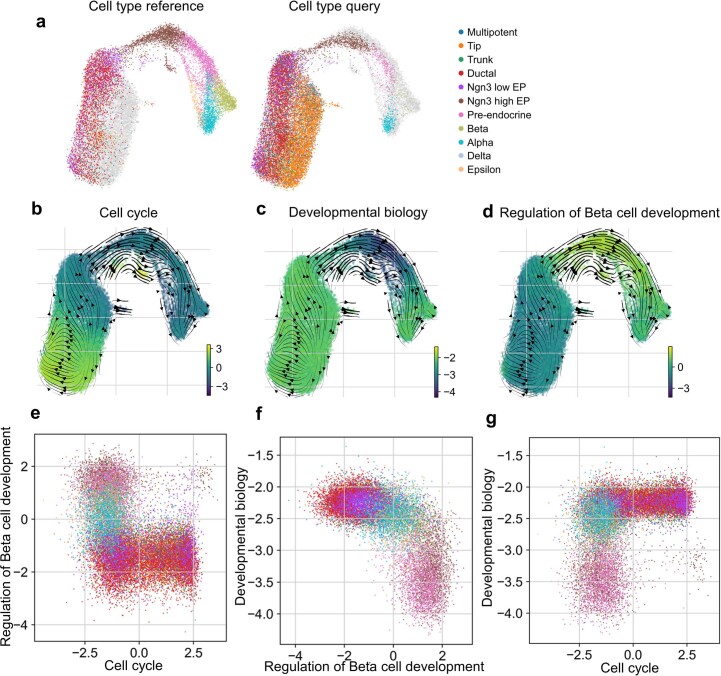
Verification
Claims the paper makes
The claims and statistics of this paper haven’t been checked yet.
Free: it reads the open-access text and checks the first 5 claims that cite a source we can check. Create a free account to check every claim.
Claims other papers make about this one
Each is checked against this paper’s own text: does it say what the citing paper says it does?
The source backs part of the claim, not all of it — or backs it for a different population, condition or comparison.
In the citing paper
“While multiple deep learning methods have been developed to integrate biological pathway information with neural network architectures [116,166], these methods are still limited by the predefined pathway annotations.”
From Challenges in AI-driven Biomedical Multimodal Data Fusion and Analysis (2025) · cites this paper as [166]
Experimental — accuracy not yet measuredThe cited source says what the claim attributes to it.
In the citing paper
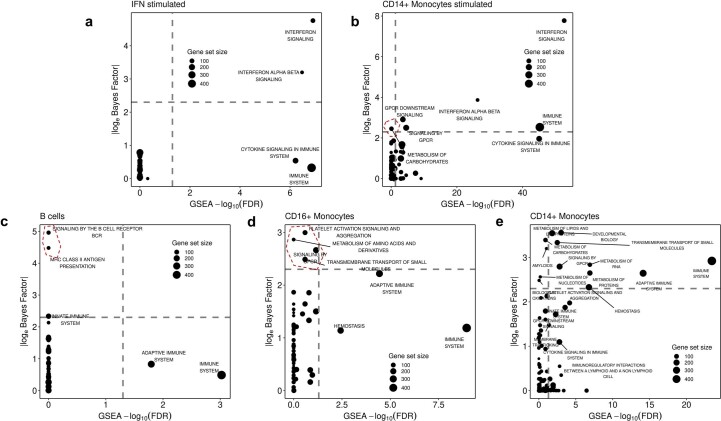
“expiMap can be more specific in retrieving biological pathways (in the form of GPs) that emerge as deregulated in a perturbation query dataset compared to the healthy reference atlas, outperforming traditional GSEA, which is prone to more generic enrichments.”
From A mini-review on perturbation modelling across single-cell omic modalities (2024) · cites this paper as [60]
The cited source says what the claim attributes to it.
In the citing paper
“For instance, Lotfollahi et al. introduced expiMap, which used biological domain databases to learn cellular gene programs and was designed for inferring de novo gene programs, which enables more efficient cellular annotation and querying of new single-cell datasets [166].”
From Challenges in AI-driven Biomedical Multimodal Data Fusion and Analysis (2025) · cites this paper as [166]
In the citing paper
“expiMap designates biological processes in normal and disease states when mapping the new queries to the atlas while maintaining comparable integration performance to relevant state-of-the-art tools.”
From A mini-review on perturbation modelling across single-cell omic modalities (2024) · cites this paper as [60]
In the citing paper
“expiMap can also learn new GPs not previously included in the reference atlas specific to the perturbed query dataset.”
From A mini-review on perturbation modelling across single-cell omic modalities (2024) · cites this paper as [60]
1 more claim about this paper
Create a free account to see every claim other papers make about this one.
Self-check
Percentages, sums and reported differences re-computed from the paper’s own numbers.
The self-check needs the paper’s full text.
Citations
Cites
Vaswani, A., Shazeer, N., Parmar, N., Uszkoreit, J., Jones, L., Gomez, A. N., Kaiser, L., & Polosukhin, I. (2017) · arXiv · doi:10.48550/arxiv.1706.03762 · Cited by 120,404
Subramanian, A., Tamayo, P., Mootha, V. K., Mukherjee, S., Ebert, B. L., Gillette, M. A., Paulovich, A., Pomeroy, S. L., Golub, T. R., Lander, E. S., et al. (2005) · Proceedings of the National Academy of Sciences · doi:10.1073/pnas.0506580102 · Cited by 53,625
Highly accurate protein structure prediction with AlphaFold
Jumper, J., Evans, R., Pritzel, A., Green, T., Figurnov, M., Ronneberger, O., Tunyasuvunakool, K., Bates, R., Žídek, A., Potapenko, A., et al. (2021) · Nature · doi:10.1038/s41586-021-03819-2 · Cited by 43,764
Robinson, M. D., McCarthy, D. J., & Smyth, G. K. (2010) · Bioinformatics · doi:10.1093/bioinformatics/btp616 · Cited by 41,364
limma powers differential expression analyses for RNA-sequencing and microarray studies
Ritchie, M. E., Phipson, B., Wu, D., Hu, Y., Law, C. W., Shi, W., & Smyth, G. K. (2015) · Nucleic Acids Research · doi:10.1093/nar/gkv007 · Cited by 40,458
Auto-Encoding Variational Bayes
Kingma, D. P., & Welling, M. (2013) · arXiv · doi:10.48550/arxiv.1312.6114 · Cited by 20,067
Integrated analysis of multimodal single-cell data
Hao, Y., Hao, S., Andersen-Nissen, E., Mauck, W. M., Zheng, S., Butler, A., Lee, M. J., Wilk, A. J., Darby, C., Zagar, M., et al. (2020) · doi:10.1101/2020.10.12.335331 · Cited by 15,508
Fast, sensitive and accurate integration of single-cell data with Harmony
Korsunsky, I., Millard, N., Fan, J., Slowikowski, K., Zhang, F., Wei, K., Baglaenko, Y., Brenner, M., Loh, P.-R., & Raychaudhuri, S. (2019) · Nature Methods · doi:10.1038/s41592-019-0619-0 · Cited by 10,488
SCANPY: large-scale single-cell gene expression data analysis
Wolf, F. A., Angerer, P., & Theis, F. J. (2018) · Genome Biology · doi:10.1186/s13059-017-1382-0 · Cited by 8,881
Self-citationInference and analysis of cell-cell communication using CellChat
Jin, S., Guerrero-Juarez, C. F., Zhang, L., Chang, I., Ramos, R., Kuan, C.-H., Myung, P., Plikus, M. V., & Nie, Q. (2021) · Nature Communications · doi:10.1038/s41467-021-21246-9 · Cited by 8,409
Research works printed but not linked: 6
- Sohn, K., Lee, H. & Yan, X. Learning structured output representation using deep conditional generative models. in Advances in Neural Information Processing Systems, Vol. 28 (eds Cortes, C., Lawrence, N., Lee, D., Sugiyama, M. & Garnett, R.) (Curran Associates, 2015).
- Ainsworth, S. K., Foti, N. J., Lee, A. K. C. & Fox, E. B. oi-VAE: output interpretable VAEs for nonlinear group factor analysis. In Proc. 35th International Conference on Machine Learning (eds Dy, J. & Krause, A.) Vol. 80, 119–128 (PMLR, 2018).
- Yu, Y. On decomposing the proximal map. In Proc. 26th International Conference on Neural Information Processing Systems Vol. 1, 91–99 (Curran Associates, 2013).
- Kang, H. M. et al. Multiplexed droplet single-cell RNA-sequencing using natural genetic variation. Nat. Biotechnol. 36, 89–94 (2018). · DOI · Paper page
- Franzén, O., Gan, L.-M. & Björkegren, J. PanglaoDB: a web server for exploration of mouse and human single-cell RNA sequencing data. Database J. Biol. Databases Curation 2019, 46 (2019).
- Hao, Y. et al. Integrated analysis of multimodal single-cell data. Cell 184, 3573–3587.e29 (2021). · doi:10.1016/j.cell.2021.04.048 · Paper page
Cited by
Improved reconstruction of single-cell developmental potential with CytoTRACE 2
Kang, M., Gulati, G. S., Brown, E. L., Qi, Z., Avagyan, S., Armenteros, J. J. A., Gleyzer, R., Zhang, W., Steen, C. B., D’Silva, J. P., et al. (2025) · Nature Methods · doi:10.1038/s41592-025-02857-2 · Cited by 229
Deep learning applications in single-cell genomics and transcriptomics data analysis
Erfanian, N., Heydari, A. A., Feriz, A. M., Picazo, P. I., Derakhshani, A., GhasemiGol, M., Farahpour, M., Razavi, S. M., Nasseri, S., Safarpour, H., et al. (2023) · Biomedicine & Pharmacotherapy · doi:10.1016/j.biopha.2023.115077 · Cited by 182
Quantitative characterization of cell niches in spatially resolved omics data
Birk, S., Bonafonte-Pardàs, I., Feriz, A. M., Boxall, A. R., Agirre, E., Memi, F., Maguza, A., Yadav, A., Armingol, E., Fan, R., et al. (2025) · Nature Genetics · doi:10.1038/s41588-025-02120-6 · Cited by 139
Self-citationSupervised discovery of interpretable gene programs from single-cell data
Kunes, R., Walle, T., Land, M., Nawy, T., & Pe’er, D. (2023) · Nature Biotechnology · doi:10.1038/s41587-023-01940-3 · Cited by 116
Causal identification of single-cell experimental perturbation effects with CINEMA-OT
Dong, M., Wang, B., Wei, J., de O. Fonseca, A. H., Perry, C. J., Frey, A., Ouerghi, F., Foxman, E. F., Ishizuka, J. J., Dhodapkar, R. M., et al. (2023) · Nature Methods · doi:10.1038/s41592-023-02040-5 · Cited by 94
“e: ChemCPA [62], expiMap [63]) to achieve causally-meaningful extrapolation for unseen perturbation effects remains a promising future direction to explore.”
Background
Metadata
- Authors
- Lotfollahi, M., Rybakov, S., Hrovatin, K., Hediyeh-zadeh, S., Talavera-López, C., Misharin, A. V., & Theis, F. J.
- Affiliations
- Wellcome Sanger Institute (GB)
- Helmholtz Munich (DE)
- Walter and Eliza Hall Institute of Medical Research (AU)
- Northwestern University (US)
- Corresponding author
- Theis, Fabian J.
- ORCID
- Venue
- Nature Cell Biology
- Published
- 2023-02-02
- Volume
- 25
- Issue
- 2
- Pages
- 337-350
- ISSN
- 1465-7392 (ISSN-L)
- 1476-4679
- PMC
- PMC9928587
- OpenAlex
- W4318981406
- Cited by
- 100
- References
- 123
- Citations by year
- 2026: 11 · 2025: 32 · 2024: 35 · 2023: 20
- FWCI
- 8.73
- Type
- journal article
- Language
- en
- Open access
- hybrid
- doi.org
- Licence
- cc-by
- creativecommons.org/licenses/by/4.0 (tdm)
- creativecommons.org/licenses/by/4.0 (vor)
- Locations
- Nature Cell Biology (publishedVersion, cc-by)
- bioRxiv (Cold Spring Harbor Laboratory) (acceptedVersion, cc-by-nc-nd)
- PubMed Central (publishedVersion, cc-by)
- PubMed (publishedVersion)
- PuSH - Publication Server of Helmholtz Zentrum München (submittedVersion, cc-by)
- Funders
- Joachim Herz Stiftung
- European Commission (874656, HORIZON2020)
- Bundesministerium für Bildung und Forschung (01IS18036B, 01IS18036A)
- Helmholtz Artificial Intelligence Cooperation Unit (ZT-I-PF-5-01)
- National Institute on Aging (P01AG049665)
- National Heart, Lung, and Blood Institute (R01HL153312)
- Topics
- Life Sciences › Biochemistry, Genetics and Molecular Biology › Molecular Biology › Single-cell and spatial transcriptomics
- Life Sciences › Biochemistry, Genetics and Molecular Biology › Molecular Biology › Gene Regulatory Network Analysis
- Life Sciences › Biochemistry, Genetics and Molecular Biology › Molecular Biology › Gene expression and cancer classification
- Keywords
- gene programs, single-cell atlas, interpretability, deep learning, cell-type resolution, cross-species comparison
- MeSH terms
- Deep Learning, COVID-19, Humans, Single-Cell Analysis
About these checks
Registry, retraction, Cites and statistics results are computed, not judged, with one exception: a printed reference that no index lists is read once by a model before it counts as a citation error. Claims are extracted by a model and kept only when their quote appears verbatim in the text; each cited source is then checked, with a model’s help, for whether it says what the claim relies on. Those verdicts can be wrong — read the claim’s quote and the cited source before relying on one.
Statistics and arithmetic are recomputed, not judged.
Confidence bands are shown only for fields calibrated on our annotated test set. None is calibrated yet, so no band is shown.
What counts as a claim ›How we measure confidence ›How we check this ›
Are you an author, or do you see a problem with this page? Request a review
How to cite
Cite CoChat for the checks on this page, and the paper for its own findings.
- This page
- CoChat. (2026). Citation check: Biologically informed deep learning to query gene programs in single-cell atlases. https://app.cochat.ai/papers/10.1038/s41556-022-01072-x
- The paper
- Lotfollahi, M., Rybakov, S., Hrovatin, K., Hediyeh-zadeh, S., Talavera-López, C., Misharin, A. V., & Theis, F. J. (2023). Biologically informed deep learning to query gene programs in single-cell atlases. Nature Cell Biology. https://doi.org/10.1038/s41556-022-01072-x
Data sources
Bibliographic data: Semantic Scholar, OpenAlex, Crossref.
Contains information from the Semantic Scholar Academic Graph Datasets, made available under the ODC Attribution License (ODC-BY 1.0).
Semantic Scholar’s data is described in: Kinney, R., et al. (2023). The Semantic Scholar Open Data Platform. arXiv:2301.10140.
