

Measuring the impact of COVID-19 vaccine misinformation on vaccination intent in the UK and USA
Open accessPublished version of a preprint
The DOI matches its Crossref record; 56 of the 59 references it cites were found in a registry or an index; 25 of the 36 sources its claims cite were checked for support.
Abstract
Widespread acceptance of a vaccine for severe acute respiratory syndrome coronavirus 2 (SARS-CoV-2) will be the next major step in fighting the coronavirus disease 2019 (COVID-19) pandemic, but achieving high uptake will be a challenge and may be impeded by online misinformation. To inform successful vaccination campaigns, we conducted a randomized controlled trial in the UK and the USA to quantify how exposure to online misinformation around COVID-19 vaccines affects intent to vaccinate to protect oneself or others. Here we show that in both countries-as of September 2020-fewer people would 'definitely' take a vaccine than is likely required for herd immunity, and that, relative to factual information, recent misinformation induced a decline in intent of 6.2 percentage points (95th percentile interval 3.9 to 8.5) in the UK and 6.4 percentage points (95th percentile interval 4.0 to 8.8) in the USA among those who stated that they would definitely accept a vaccine. We also find that some sociodemographic groups are differentially impacted by exposure to misinformation. Finally, we show that scientific-sounding misinformation is more strongly associated with declines in vaccination intent.
Overview
CoChat Summary
## TL;DR
In a randomized controlled survey experiment of 8,001 adults in the UK and USA, exposure to COVID-19 vaccine misinformation reduced stated willingness to vaccinate compared with factual information. The effect was about 6 percentage points among those who initially said they would “definitely” accept a vaccine, and some sociodemographic groups were differentially affected.
## Key findings
- Before exposure, only 54.1% of respondents in the UK and 42.5% in the USA said they would “definitely” accept a COVID-19 vaccine for themselves; for protecting others, the figures were 63.7% in the UK and 53.3% in the USA.
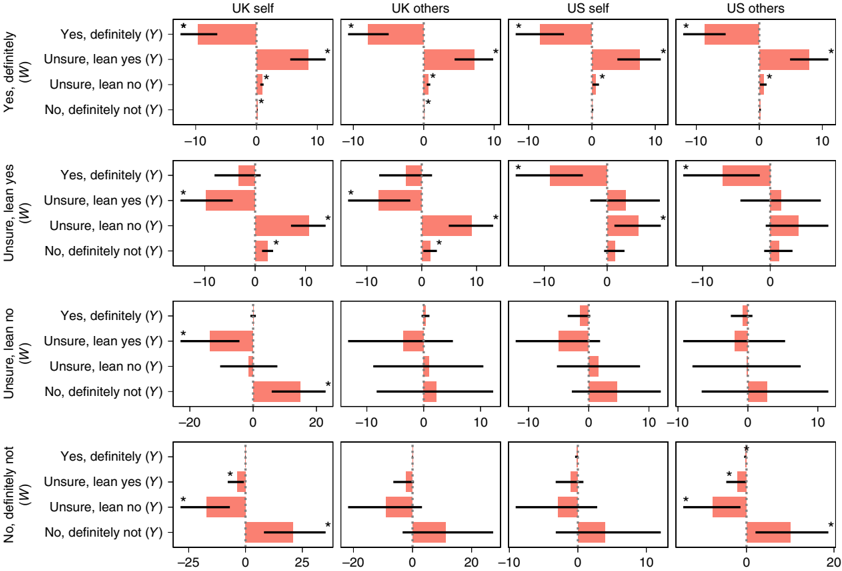
- Exposure to misinformation reduced the share answering “yes, definitely” by 6.2 percentage points in the UK (95% PI 3.9 to 8.5) and 6.4 percentage points in the USA (95% PI 4.0 to 8.8) for self-protection; for protecting others the decreases were 5.7 points in the UK (95% PI 3.5 to 7.9) and 6.5 points in the USA (95% PI 4.1 to 8.8).
- Misinformation also shifted respondents toward lower-intent categories: in the UK, for self-protection there was an increase of 2.7 points in “unsure, but leaning towards no” and 3.3 points in “no, definitely not”; in the USA, there was a 2.3-point rise in “unsure, but leaning towards no.”
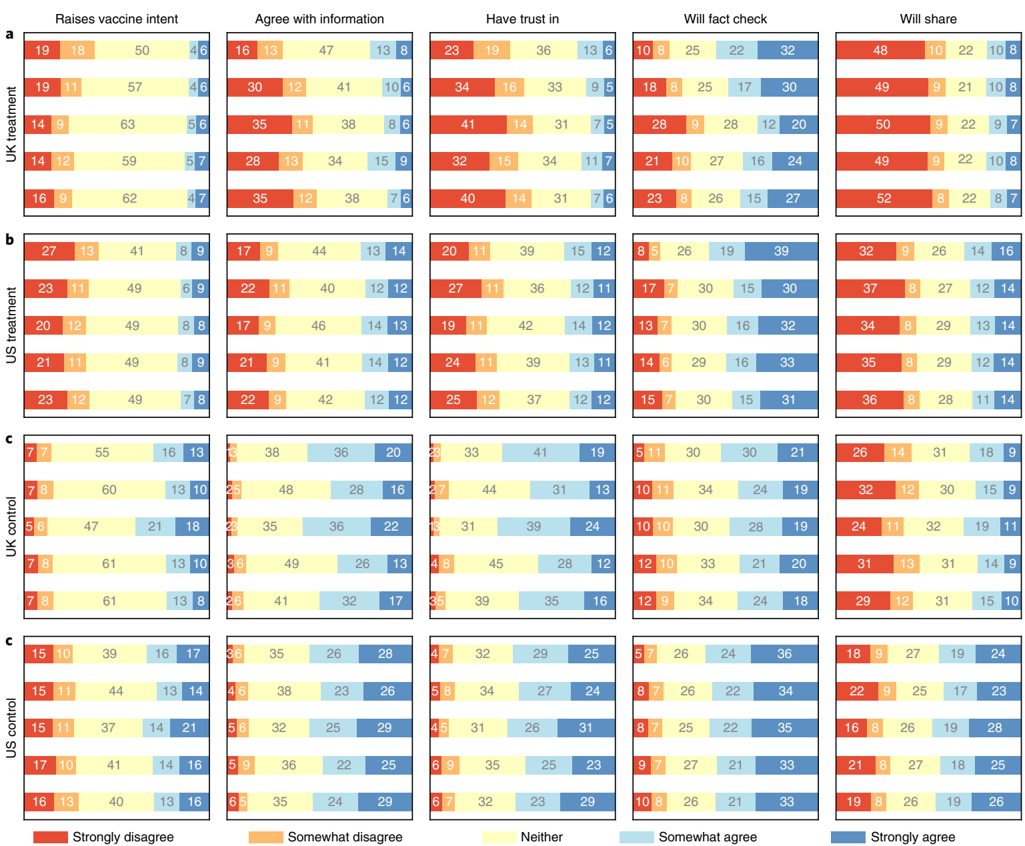
- Scientific-sounding misinformation was more damaging: the paper reports that the misinformation image with the strongest association with reduced intent had weight 0.42 in the UK (95% PI 0.28 to 0.56) and 0.41 in the USA (95% PI 0.25 to 0.58), and that around a quarter of respondents found some misinformation agreeable or trustworthy.
## Methods
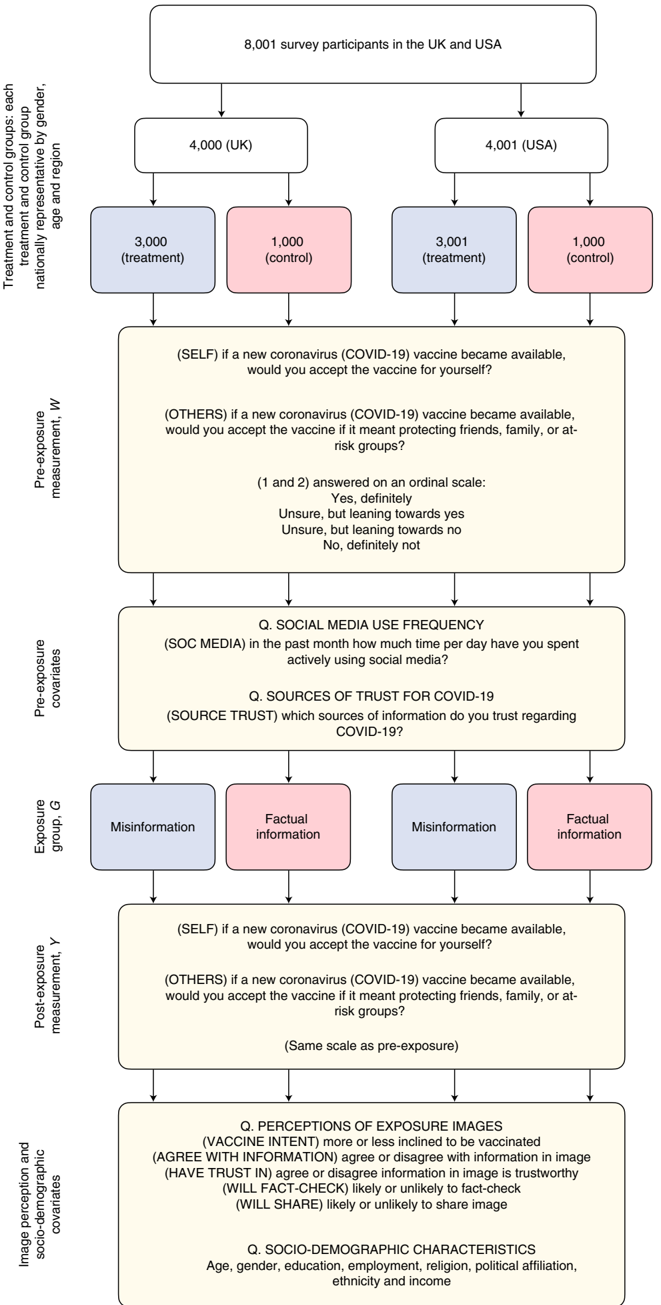
- Quantitative cross-sectional pre-post randomized controlled survey experiment in the UK and USA, fielded 7–14 September 2020.
- 8,001 respondents recruited via an online panel: 4,000 in the UK and 4,001 in the USA; within each country, 75% were assigned to misinformation and 25% to factual-information control.
- Respondents reported vaccination intent on a four-point ordered scale before and after exposure, for both self-protection and protecting others; analysis used hierarchical Bayesian ordered logistic regression with treatment effects, heterogeneous treatment effects, and image-impact models estimated via Hamiltonian Monte Carlo / NUTS in PyStan.
## Limitations
- The paper states that the design does not replicate a real-world social media platform environment, and that results are unlikely to be representative of real-world uptake rates.
- The authors state that the study does not allow causal inferences about different kinds of vaccine messaging from the post-exposure perception measures, and that they were limited in the type and volume of misinformation presented.
- Evident from the text: the sample was an online panel and respondents who did not participate simply did not complete the survey; the authors also note possible technological-literacy biases in this sampling mode.
Model-written summary. Check it against the paper before relying on it.
Integrity signals
Registry
Cites
Statistics
Figures


Verification
Claims the paper makes
14 Valid · 1 Not valid · 5 Not checked · 82 Own results and interpretations
The cited sources support only part of this claim — read each source’s verdict below.
In the paper
“Here we show that in both countries-as of September 2020-fewer people would 'definitely' take a vaccine than is likely required for herd immunity”
What the sources say
- Partly supportedcites [15] Kwok, K. O., Lai, F., Wei, W. I., Wong, S. Y. S. & Tang, J. W. T. Herd immunity—estimating the level required to halt the COVID-19 epidemics in affected countries. J. Infect. 80, e32–e33 (2020). sourceExperimental — accuracy not yet measured
The paper’s main text gives a formula for the minimum population immunity needed to halt spread, and Table 1 estimates thresholds for countries using data as of 13 March 2020. It does not report September 2020 vaccine willingness, whether people would ‘definitely’ take a vaccine, or a comparison between willingness and those thresholds in the two countries. (LLM, conf=0.88)
- Supportedcites [16] Sanche, S. et al. High contagiousness and rapid spread of severe acute respiratory syndrome coronavirus 2. Emerg. Infect. Dis. 26, 1470–1477 (2020). source
The Results section (‘Implications for Intervention Strategies’; page unavailable) estimates that more than 82% of the population would need immunity to stop transmission at R0 = 5.7. That supports the herd-immunity benchmark attributed to this source. The two-country September 2020 vaccine-willingness comparison is introduced as the citing authors’ own finding (‘Here we show’), not as a finding of this paper. (LLM, conf=0.87)
plain- Asserted: passes — The authors put it forward as true.
- Checkable: passes — It can be checked against evidence.
- Load-bearing: passes — The paper’s conclusions depend on it.
- Based: passes — The paper gives a reason why it holds.
- Partly supported
The cited sources support only part of this claim — read each source’s verdict below.
In the paper
“Under these current plausible COVID-19 vaccine acceptance rates, possible levels of existing protective immunity-though it is unclear whether post-infection immunity confers long-term immunity 29 and the rapidly evolving nature of misinformation surrounding the pandemic 23,30 , it is unclear whether vaccination will reach the levels required for herd immunity.”
What the sources say
- Supportedcites [29] Altmann, D. M., Douek, D. C. & Boyton, R. J. What policy makers need to know about COVID-19 protective immunity. Lancet 395, 1527–1529 (2020). source
The paper’s discussion of how long COVID-19 immunity might last says immunity could wane and that evidence extending only a little beyond one year offers little reassurance about longer-term protection. In the citing sentence, this source is attached to the uncertainty about long-term post-infection immunity, not to vaccine acceptance or misinformation. (LLM, conf=0.91)
- Partly supportedcites [23] Pennycook, G., McPhetres, J., Zhang, Y., Lu, J. G. & Rand, D. G. Fighting COVID-19 misinformation on social media: experimental evidence for a scalable accuracy-nudge intervention. Psychol. Sci. 31, 770–780 (2020). sourceExperimental — accuracy not yet measured
The citation is attached to the statement about pandemic misinformation, not the citing authors’ conclusion about herd immunity. The paper’s Abstract says COVID-19 misinformation has proliferated and takes many forms, but it does not establish that the misinformation is rapidly evolving. (LLM, conf=0.78)
- Supportedcites [30] Zarocostas, J. How to fight an infodemic. Lancet 395, 676 (2020). source
The citation is attached to the rapidly changing misinformation surrounding COVID-19, not to the citing authors’ conclusion about vaccination and herd immunity. In “How to fight an infodemic,” the paper describes misinformation spreading rapidly through social media and says its amplification makes timely responses a challenge. (LLM, conf=0.90)
hedged- Asserted: passes — The authors put it forward as true.
- Checkable: passes — It can be checked against evidence.
- Load-bearing: passes — The paper’s conclusions depend on it.
- Based: passes — The paper gives a reason why it holds.
- Supported
The cited sources support only part of this claim — read each source’s verdict below.
In the paper
“While large-scale vaccine rejection threatens herd immunity goals, large-scale acceptance with local vaccine rejection can also have negative consequences for community (herd) immunity, as clustering of non-vaccinators can disproportionately increase the needed percentage of vaccination coverage to achieve herd immunity in adjacent geographical regions and encourage epidemic spread 24 .”
What the sources say
- Partly supportedcites [24] Salathé, M. & Bonhoeffer, S. The effect of opinion clustering on disease outbreaks. J. R. Soc. Interface 5, 1505–1508 (2008). sourceExperimental — accuracy not yet measured
The Results and Discussion (pp. not specified) report that clusters of unvaccinated people can undermine herd immunity, increase outbreak probability, and mean that vaccination-coverage estimates needed to avoid outbreaks are too low. The Discussion also says infection can spread from one susceptible cluster to another. The paper does not specifically find that clustering raises the coverage percentage needed in adjacent geographical regions. (LLM, conf=0.86)
plainstates a cause- Asserted: passes — The authors put it forward as true.
- Checkable: passes — It can be checked against evidence.
- Load-bearing: unclear — It is unclear whether the paper’s conclusions depend on it.
- Based: passes — The paper gives a reason why it holds.
- Partly supported
The cited sources that could be checked couldn’t confirm or dispute this claim.
In the paper
“In the UK, this contrasted with more memetic imaging (for example, 'striking images with text superimposed on top' 42 ) which showed far weaker associations (images 3 and 4 in Supplementary Table 1).”
What the sources say
- Could not verifycites [42] Lazer, D. M. J. et al. The science of fake news. Science 359, 1094–1096 (2018). sourceExperimental — accuracy not yet measured
Citation 42 is attached to the description of memetic images, not to the UK association results, which the citing sentence attributes to its own Supplementary Table 1. Our copy discusses fake-news exposure and impact (Prevalence and Impact, p. 3), but searches for the quoted phrase and for memetic images or text-overlaid images found no passage defining them that way. (LLM, conf=0.77)
plainstates an association- Asserted: passes — The authors put it forward as true.
- Checkable: passes — It can be checked against evidence.
- Load-bearing: unclear — It is unclear whether the paper’s conclusions depend on it.
- Based: passes — The paper gives a reason why it holds.
- Could not verify
A result the paper reports from its own data — it cites no other source for it, so there is none to check. The quote shows it is in the paper.
In the paper
“while in the USA it was image 1 (Supplementary Table 1), with weight 0.41 (95% PI 0.25 to 0.58).”
plainstates an association- Asserted: passes — The authors put it forward as true.
- Checkable: passes — It can be checked against evidence.
- Load-bearing: passes — The paper’s conclusions depend on it.
- Based: passes — The paper gives a reason why it holds.
- Rests on an assumption not shown here.
52 more claims
Create a free account to see all 102 claims and to verify the 3 references still open.
- It may state two separate claims as one. 23
- Probably not a substantial claim. 32
- The quote only partly states this claim. 1
Claims other papers make about this one
Each is checked against this paper’s own text: does it say what the citing paper says it does?
The cited source says what the claim attributes to it.
In the citing paper
“Other research has found a causal link between exposure to vaccine misinformation and reduced intentions to get vaccinated (Loomba et al. 2021).”
From Social Media and Morality. (2024) · cites this paper as Loomba et al. 2021
In the citing paper
“belief in misinformation about coronavirus disease 2019 (COVID-19) has been linked to reduced willingness to get vaccinated against the disease and lower intentions to comply with public health measures (2, 3).”
From Psychological inoculation improves resilience against misinformation on social media (2022) · cites this paper as [3]
In the citing paper
“At the same time, misinformation about both technologies is already circulating among the public that can and should be targeted in a debunking intervention (e.g., Loomba et al., 2021;Wang & Song, 2020).”
From How to debunk misinformation? An experimental online study investigating text structures and headline formats (2023) · cites this paper as Loomba et al., 2021
Self-check
Percentages, sums and reported differences re-computed from the paper’s own numbers.
Each contradiction between two passages listed here was confirmed by an independent check.
Rated minor: it would not touch a result — a value no result rests on, a p-value that stays on the same side of the significance level, or a conflict that is clerical, resolved elsewhere in the paper, or outside its own findings.
In the paper
§ Methods
“Ethical approval for this study was obtained by the London School of Hygiene and Tropical Medicine ethics committee on 15 June 2020 with reference 22647.”
§ Human research participants
“Approval for this study was obtained by the LSHTM ethics committee on 15 June 2020 with reference 22130.”
Citations
Cites
A pneumonia outbreak associated with a new coronavirus of probable bat origin
Zhou, P., Yang, X.-L., Wang, X.-G., Hu, B., Zhang, L., Zhang, W., Si, H.-R., Zhu, Y., Li, B., Huang, C.-L., et al. (2020) · Nature · doi:10.1038/s41586-020-2012-7 · Cited by 21,969
Inference from iterative simulation using multiple sequences
Gelman, A., & Rubin, D. B. (1992) · Statistical Science · doi:10.1214/ss/1177011136 · Cited by 16,627
Estimating causal effects of treatments in randomized and nonrandomized studies
Rubin, D. B. (1974) · Journal of Educational Psychology · doi:10.1037/h0037350 · Cited by 9,436
The spread of true and false news online
Vosoughi, S., Roy, D., & Aral, S. (2018) · Science · doi:10.1126/science.aap9559 · Cited by 8,847
Statistics and Causal Inference
Holland, P. W. (1986) · Journal of the American Statistical Association · doi:10.1080/01621459.1986.10478354 · Cited by 5,293
The proximal origin of SARS-CoV-2
Andersen, K. G., Rambaut, A., Lipkin, W. I., Holmes, E. C., & Garry, R. F. (2020) · Nature Medicine · doi:10.1038/s41591-020-0820-9 · Cited by 5,081
Voysey, M., Clemens, S. A. C., Madhi, S. A., Weckx, L. Y., Folegatti, P. M., Aley, P. K., Angus, B., Baillie, V. L., Barnabas, S. L., Bhorat, Q. E., et al. (2021) · The Lancet · doi:10.1016/s0140-6736(20)32661-1 · Cited by 4,616
Regression Models for Ordinal Data
McCullagh, P. (1980) · Journal of the Royal Statistical Society Series B: Statistical Methodology · doi:10.1111/j.2517-6161.1980.tb01109.x · Cited by 4,453
Lazer, D. M. J., Baum, M. A., Benkler, Y., Berinsky, A. J., Greenhill, K. M., Menczer, F., Metzger, M. J., Nyhan, B., Pennycook, G., Rothschild, D., et al. (2018) · Science · doi:10.1126/science.aao2998 · Cited by 4,160
An mRNA Vaccine against SARS-CoV-2 — Preliminary Report
Jackson, L. A., Anderson, E. J., Rouphael, N. G., Roberts, P. C., Makhene, M., Coler, R. N., McCullough, M. P., Chappell, J. D., Denison, M. R., Stevens, L. J., et al. (2020) · New England Journal of Medicine · doi:10.1056/nejmoa2022483 · Cited by 3,406
Research works printed but not linked: 2
- Pfizer. Pfizer and BioNTech conclude phase 3 study of COVID-19 vaccine candidate, meeting all primary efficacy endpoints https://www.pfizer.com/news/press-release/press-release-detail/pfizer-and-biontech-conclude-phase-3-study-covid-19-vaccine (2020).
- Graham, M. & Coppock, A. Asking about attitude change. Public Opinion Quarterly (in the press).
Cited by
Items 1,501–1,600 of 1,802
Domestic Laws and Emergency Measures
Bennett, B., Freckelton, I. R., & Wolf, G. (2023) · Oxford University Press eBooks · doi:10.1093/oso/9780192896742.003.0005
Law, Regulation, and Rights: Reflections on the COVID-19 Pandemic
Bennett, B., Freckelton, I. R., & Wolf, G. (2023) · Oxford University Press eBooks · doi:10.1093/oso/9780192896742.003.0013
Bennett, B., Freckelton, I. R., & Wolf, G. (2023) · Oxford University Press eBooks · doi:10.1093/oso/9780192896742.002.0011
Bennett, B., Freckelton, I. R., & Wolf, G. (2023) · Oxford University Press eBooks · doi:10.1093/oso/9780192896742.003.0003
Bennett, B., Freckelton, I. R., & Wolf, G. (2023) · Oxford University Press eBooks · doi:10.1093/oso/9780192896742.002.0010
Bennett, B., Freckelton, I. R., & Wolf, G. (2023) · Oxford University Press eBooks · doi:10.1093/oso/9780192896742.002.0004
Bennett, B., Freckelton, I. R., & Wolf, G. (2023) · Oxford University Press eBooks · doi:10.1093/oso/9780192896742.002.0003
Civil Liability, Regulation, and Accountability
Bennett, B., Freckelton, I. R., & Wolf, G. (2023) · Oxford University Press eBooks · doi:10.1093/oso/9780192896742.003.0009
Bennett, B., Freckelton, I. R., & Wolf, G. (2023) · Oxford University Press eBooks · doi:10.1093/oso/9780192896742.002.0005
COVID-19 and Workplace and Occupational Health and Safety
Bennett, B., Freckelton, I. R., & Wolf, G. (2023) · Oxford University Press eBooks · doi:10.1093/oso/9780192896742.003.0010
Development of COVID-19 Treatments and Vaccines
Bennett, B., Freckelton, I. R., & Wolf, G. (2023) · Oxford University Press eBooks · doi:10.1093/oso/9780192896742.003.0011
Attitudes towards COVID-19 vaccine in Spain: correlational and configurational analyses
de Andrés-Sánchez, J., Arias-Oliva, M., & Borondo, J. P. (2023) · International Journal of Public Health Science (IJPHS) · doi:10.11591/ijphs.v12i2.22414
Vaccine hesitancy: a major hurdle even among women healthcare workers
Kamath, A. A., Yadav, A., Baghel, J., & Mundle, S. R. (2023) · International Journal of Reproduction Contraception Obstetrics and Gynecology · doi:10.18203/2320-1770.ijrcog20230811
LEBLEBİCİ, E., AYÖZCAN, M. N., & İkizer, G. (2023) · Klinik Psikoloji Dergisi · doi:10.57127/kpd.26024438.1274631
Analyzing the impact of vaccinations and weather factors on the COVID-19 pandemic
Iloanusi, O. N., Iloanusi, N. I., & Ross, A. A. (2023) · Current Medical Research and Opinion · doi:10.1080/03007995.2023.2197493
IRMA: the 335-million-word Italian coRpus for studying MisinformAtionPreprint
Carrella, F., Miani, A., & Lewandowsky, S. (2023) · doi:10.31234/osf.io/s58m9
Saber, H. A., & Albayaty, M. A. (2023) · medRxiv · doi:10.1101/2023.04.07.23288262
Agosti, E., Garg, K., Tandon, V., et al. (2023) · Journal of Neurosurgical Sciences · doi:10.23736/s0390-5616.22.05885-4
School Without Walls High School Students and COVID-19 Vaccine Hesitancy
Mullins, K., Scherer, A. M., & Briggs, G. (2022) · Journal of Student Research · doi:10.47611/jsrhs.v11i4.3276
Kaya, Ç., Başkaya, E., & Solmaz, P. (2023) · Balıkesır Health Sciences Journal · doi:10.53424/balikesirsbd.1221247
Early COVID-19 Home-Based Care Knowledge and Efficacies: Comparing Ghanaian and US Respondents
Thompson, E. E. (2023) · Journal of Health Communication · doi:10.1080/10810730.2023.2208080
Lulu, P. M., Atim, F., Ronald, K., Wakula, F. L., & Okiria, J. C. (2023) · medRxiv · doi:10.1101/2023.05.16.23290042
The Double-Edged Sword Effect of Social Media on COVID-19 in Sub-Saharan Africa
Rukasha, I. (2023) · Commonwealth Youth and Development · doi:10.25159/2663-6549/11252
The Impact Of Online Misinformation On Covid-19 Vaccines: A Literature Review
Fradita, F., & Haksama, S. (2022) · THE SPIRIT OF SOCIETY JOURNAL · doi:10.29138/scj.v5i2.1780 · Cited by 1
Westerbeek, L., Hendriks, H., Smit, E. S., & Meppelink, C. S. (2023) · European Journal of Health Communication · doi:10.47368/ejhc.2023.205
COVID-19 Vaccination in Persons with Diabetes: How to Approach Patients
Crow, M. T., & Johnson, E. N. (2023) · Contemporary Endocrinology · doi:10.1007/978-3-031-28536-3_12
The Unbelieving Minority: Singapore’s Anti-Falsehood Law and Vaccine Scepticism
Maheshwari, S., & Hwa, A. P. (2023) · Mobile communication in Asia · doi:10.1007/978-94-024-2225-2_3
What is the impact of artificial intelligence-based chatbots on Infodemic management? (Preprint)Preprint
Morita, P. P., Lotto, M., Kaur, J., Chumachenko, D., Oetomo, A., Espiritu, K. D., & Hussain, I. Z. (2023) · doi:10.2196/preprints.49805
Nwoke, C. E., Daniel, E. O., Olagbegi, O. M., Abiodun, P. O., Bello, A. M., Avwerhota, M., Tomori, M. O., Igbinovia, F. I., Ogun, A. A., Abiodun, F. A., et al. (2023) · World Journal of Public Health · doi:10.11648/j.wjph.20230801.11
Urban agglomeration and innovation in developing economiesPreprint
Zhang, P., Estrin, S., Hu, Y., & Shapiro, D. (2023) · Research Square · doi:10.21203/rs.3.rs-3065065/v1
"Motivators and Barriers to Uptake of Covid-19 Vaccination among Health Workers in Uganda"
Mukembo, A. (2023) · Biomedical Journal of Scientific & Technical Research · doi:10.26717/bjstr.2023.48.007633
دور تعليم العلوم في مواجهة التضليل العلمي لدى طلاب الجيل Z
الباز, م. م. م. (2023) · إبداعات تربوية · doi:10.21608/eji.2023.306135
Knowledge, attitudes, and perceptions of COVID-19 vaccine among health-care professionals
Kaya, L. (2023) · Zeynep Kamil Medical Journal · doi:10.14744/zkmj.2022.25986 · Cited by 1
Mallah, N., Pardo‐Seco, J., Calle, I. R., Zhu-Huang, O., Prada, M. F., Kat, C. R.-D., Benes, O., Mosina, L., Datta, S. S., Aleksinskaya, O., et al. (2023) · doi:10.2196/preprints.50563
COVID-19 vaccine information, misinformation, and vaccine uptake in MalawiPreprint
Songo, J., Whitehead, H. S., Phiri, K., Kalande, P., Lungu, E., Phiri, S., van Oosterhout, J. J., Moses, A., Hoffman, R. M., & Moucheraud, C. (2023) · medRxiv · doi:10.1101/2023.07.14.23292688
Jalbert, M. C., Harris, M., & Williams, L. (2023) · doi:10.31234/osf.io/8hxdg
Alharthi, N. H., Alanazi, E. M., & Liu, X. (2023) · Computer Methods and Programs in Biomedicine Update · doi:10.1016/j.cmpbup.2023.100117
Abdulah, D. M., MohammedSadiq, H. A., & Liamputtong, P. (2023) · Vacunas (English Edition) · doi:10.1016/j.vacun.2023.06.010
Selçuk, E. D., & Demi̇rbağ, B. C. (2023) · Clinical and Experimental Health Sciences · doi:10.33808/clinexphealthsci.1007360
Wissenschaftliche Falschinformation: Erforschung von Faktoren der Verbreitung im Gesundheitsbereich
Stiller, Trkulja, Dewitz, Peters, Henkel, & Bressel (2023) · Nomos Verlagsgesellschaft mbH & Co. KG eBooks · doi:10.5771/9783748938743-319
Chen, X., Wang, Y., Huang, Y., Wang, Z., & Shen, C. (2023) · Systems · doi:10.3390/systems11100491 · Cited by 1
Preventive Behaviors Following COVID-19 Vaccine among a Sample of Egyptians: A Cross-Sectional Study
Mostafa, R. M., Zein, M. M., Saad, A., et al. (2023) · Egyptian Journal of Nutrition and Health · doi:10.21608/ejnh.2023.317756
Alkaff, R. N., Nasir, N. M., Aristi, D., et al. (2023) · Jurnal Kesehatan Reproduksi · doi:10.58185/jkr.v12i1.3
The impact of fake news on social media users during the COVID-19 pandemic: A deep lookPreprint
Mahlous, A. R. (2023) · doi:10.36227/techrxiv.24272326
The impact of fake news on social media users during the COVID-19 pandemic: A deep lookPreprint
Mahlous, A. R. (2023) · doi:10.36227/techrxiv.24272326.v1
Social Network Analysis of Misinformation Spreading and Science Communication during COVID ‐19
Liu, J., & Regulagedda, R. M. (2023) · Proceedings of the Association for Information Science and Technology · doi:10.1002/pra2.944 · Cited by 1
Martinez, S.-K., Sonderegger, S., Brownback, A., Cruces, G., Pompeo, M., & Morling, J. R. (2023) · SSRN Electronic Journal · doi:10.2139/ssrn.4611489
Lup, O. (2023) · Nomos Verlagsgesellschaft mbH & Co. KG eBooks · doi:10.5771/9783748915553-117
Socialization of the Covid-19 vaccine for children on the acceptance of parents
Adhani, A., Anshori, A., & Nasution, N. (2022) · International Journal of Communication and Society · doi:10.31763/ijcs.v4i2.813
Fake News and the COVID-19 Pandemic
van der Linden, S., & Roozenbeek, J. (2023) · Oxford University Press eBooks · doi:10.1093/oso/9780197615133.003.0036
Mwale, P. N. (2023) · Routledge eBooks · doi:10.4324/9781003425861-5
Actual and Perceived Partisan Bias in Judgments of Political Misinformation as LiesPreprint
Reins, L. M., & Wiegmann, A. (2023) · doi:10.31234/osf.io/357fh
Pal, R., Srinidhi, S., Mahto, D., Agrawal, K., Mengi, G., Nagpal, S., Devadiga, A., & Sethi, T. (2023) · SSRN Electronic Journal · doi:10.2139/ssrn.4677013
Desinformação relacionada à COVID-19 entre idosos falantes de português: estudo internacional
de Oliveira, R. M. (2023) · Digital Library of Theses and Dissertations (Universidade de São Paulo) · doi:10.11606/d.22.2023.tde-08122023-170804 · Cited by 1
Arbel, Y., Arbel, Y., Kerner, A., & Kerner, M. (2024) · Cogent Social Sciences · doi:10.1080/23311886.2023.2299136
Brylska, K. (2024) · Communications in computer and information science · doi:10.1007/978-3-031-53001-2_8
Habibilla, A. F., & Fahadayna, A. C. (2023) · Jurnal Politik · doi:10.7454/jp.v9i1.1157
THE SCIENCE OF HOPE: A COMPREHENSIVE REVIEW OF COVID-19 VACCINE PROGRESS
Srivastava, A., Chaturvedi, V., Wal, P., Srivastava, P., Wal, A., & Yadav, A. (2022) · Journal of Population Therapeutics and Clinical Pharmacology · doi:10.53555/jptcp.v29i04.4383
Feldmane, S., Mārtinsone, K., & Perepjolkina, V. (2024) · Proceedings of the Latvian Academy of Sciences Section B Natural Exact and Applied Sciences · doi:10.2478/prolas-2024-0010 · Cited by 1
Yin, J. D.-C., Wu, T.-C., Chen, C.-Y., et al. (2024) · doi:10.2196/preprints.57951
Makin, D. A., Howell, E., Wilson, T., & Parks, M. (2024) · International Journal of Disaster Risk Reduction · doi:10.1016/j.ijdrr.2024.104387
Radell, M. L., & Thompson, W. B. (2024) · Quarterly Journal of Experimental Psychology · doi:10.1177/17470218241242127
Daşıkan, Z., & Waiswa, M. K. (2024) · Vacunas (English Edition) · doi:10.1016/j.vacune.2024.02.007
Ullah, N., Martin, S., & Poduval, S. (2024) · JMIR Formative Research · doi:10.2196/51152
Hammarlin, M.-M., Kokkinakis, D., Miegel, F., & Stoencheva, J. (2024) · Routledge eBooks · doi:10.4324/9781003305859-13 · Cited by 1
Labeled data and models for COVID-19 vaccine related tweets with stance, location, and topics
Rahman, A., Ehsan, M., & Alhoori, H. (2024) · Zenodo (CERN European Organization for Nuclear Research) · doi:10.5281/zenodo.6842883
Quantifying Opinion Rejection: A Method to Detect Social Media Echo Chambers
Perera, K., & Karunasekera, S. A. (2024) · Lecture notes in computer science · doi:10.1007/978-981-97-2266-2_5 · Cited by 4
Skirrow, H., Lewis, C., Haque, H., et al. (2024) · SSRN Electronic Journal · doi:10.2139/ssrn.4813068
McGowan, B. S. (2024) · Elsevier eBooks · doi:10.1016/b978-0-323-95689-5.00142-5 · Cited by 3
Srikant, S., Dave, D., Gordon, S. S., Christopher, K., Jasper, O. S. R., Nabunje, J., Joyce, N. L., Angella, N., Zack, S. P., Noori, M., et al. (2024) · OALib · doi:10.4236/oalib.1111455
Creating Visual Persona Profiles in Telegram using NLP
Choi, J., Schäfer, K., & Steinebach, M. (2024) · Electronic Imaging · doi:10.2352/ei.2024.36.1.vda-359 · Cited by 1
Vaccine Misinformation and Social Determinants of Vaccine Intentions in a PandemicPreprint
Shanker, A. (2024) · PsyArXiv (OSF Preprints) · doi:10.31234/osf.io/rebkd
Data visualization of vaccine hesitancy among African American community in Tuskegee County
Rekhaa, R., Fergersonb, A., Witt, J. L., et al. (2024) · doi:10.1117/12.3015529
TBHEB 2024-2 Vol 81 Full Printed Journal
ERCÖMERT, U. (2024) · Turkish Bulletin of Hygiene and Experimental Biology · doi:10.5505/turkhijyen.2024.17999
COVID-19 vaccine hesitancy in Türkiye: An infodemiological study
Avcı, K. (2024) · Turkish Bulletin of Hygiene and Experimental Biology · doi:10.5505/turkhijyen.2024.34079 · Cited by 2
Antoliš, K., & Pačelat, J. (2024) · Medijska istraživanja · doi:10.22572/mi.30.1.2
Exploring COVID-19 Vaccine Misinformation on Twitter (x): A Case of #VaccineRollOutSA
Manene, S., & Cilliers, L. (2024) · IFIP advances in information and communication technology · doi:10.1007/978-3-031-66986-6_8
Bhattacharya, P., Simons, J. J., Yuen, C. T. H., & Quek, B. (2024) · SocArXiv (OSF Preprints) · doi:10.31235/osf.io/r8fhm
Causal inference in misinformation and conspiracy researchPreprint
Tay, L. Q., Hurlstone, M. J., Jiang, Y., et al. (2024) · doi:10.31234/osf.io/wh5fy
Jang, K., & Baek, Y. M. (2024) · Korean Journal of Journalism & Communication Studies · doi:10.20879/kjjcs.2024.68.4.001
Krotinger, A., Yang, L., & Taylor, S. (2024) · Collaborative bioethics · doi:10.1007/978-3-031-72371-1_10
Lim, J. S., Zhang, J., Kim, J., & Lee, C. (2024) · Health & New Media Research · doi:10.22720/hnmr.2024.00094
Li, Z. (2024) · MOspace Institutional Repository (University of Missouri) · doi:10.32469/10355/105959
del Magdalena, U., Caballero‐Domínguez, C. C., Herazo, E., et al. (2024) · Revista Facultad Nacional de Salud Pública · doi:10.17533/udea.rfnsp.e356281
Issues and Concerns for Human–Robot Interaction
Barfield, W., Weng, Y.-H., & Pagallo, U. (2024) · Cambridge University Press eBooks · doi:10.1017/9781009386708.013 · Cited by 2
The Scope and Effects of Vaccine Misinformation on Social Media
Barbati, J. L., Duncan, K. L., Yan, K., Turner, C., Tovar, I., Rains, S. A., & Warner, E. L. (2024) · Wiley eBooks · doi:10.1002/9781394184972.ch8 · Cited by 1
The Empire of Beliefs and Digital Worlds : What Does Contemporary Science Say?
Bronner, G. (2024) · The Tocqueville Review/La revue Tocqueville · doi:10.3138/ttr.45.2.11 · Cited by 2
Optional disclosure and observational learning
Peng, D., Rao, Y., Sun, X., & Xiao, E. (2024) · Journal of Economic Behavior & Organization · doi:10.1016/j.jebo.2024.106817 · Cited by 2
Gümral, N., Erarslan, A. S., Deniz, B. T., Aslankoç, R., & Karaibrahimoğlu, A. (2024) · Süleyman Demirel Üniversitesi Sağlık Bilimleri Dergisi · doi:10.22312/sdusbed.1448666
Crowd recognition system to Thwart Covid-19
Mumtaj, A. B. S., Arumugam, K. K., Angumuthu, K., & Raju, K. N. K. (2025) · AIP conference proceedings · doi:10.1063/5.0247431
Ham, C. D. (2022) · University of North Texas Digital Library (University of North Texas) · doi:10.12794/metadc2048596
The COVID-19 Infodemic: A Survey (Preprint)Preprint
Al-Qahtani, A. F., Abbas, H., Cresci, S., & Pietro, R. D. (2025) · doi:10.2196/preprints.71318
Health Behaviours and Policies during Covid-19
Costa‐Font, J. (2024) · Cambridge University Press eBooks · doi:10.1017/9781009438438.016
Biases in Vaccine Authorisation: Erring on the Side of Rare Events in SARS-CoV-2 Vaccines
Costa‐Font, J., Asaria, M., & Mossialos, E. A. (2024) · Cambridge University Press eBooks · doi:10.1017/9781009438438.023
Evidence from Experiments and Behavioural Insights
Galizzi, M. M. (2024) · Cambridge University Press eBooks · doi:10.1017/9781009438438.003
Magcamit, M., & Chinudomsub, P. (2024) · Japanese Journal of Political Science · doi:10.1017/s146810992400015x
Willingness to COVID-19 Vaccination: Empirical Evidence from EUPreprint
Austin, A., Rahman, I. U., & Nelson, N. (2025) · SSRN Electronic Journal · doi:10.2139/ssrn.5119395
A Survey on the Criteria Used to Judge (Fake) News in Italian Population
Battista, F., Lanciano, T., & Curci, A. (2025) · Brain and Behavior · doi:10.1002/brb3.70315 · Cited by 1
Metadata
- Authors
- Loomba, S., de Figueiredo, A., Piatek, S. J., de Graaf, K., & Larson, H. J.
- Affiliations
- Imperial College London (GB)
- London School of Hygiene & Tropical Medicine (GB)
- University of Antwerp (BE)
- Corresponding author
- Larson, Heidi J.
- Venue
- Nature Human Behaviour
- Published
- 2021-02-05
- Volume
- 5
- Issue
- 3
- Pages
- 337-348
- ISSN
- 2397-3374 (ISSN-L)
- OpenAlex
- W3128392043
- Semantic Scholar
- fad25c63595eefecba05d0b6a34163f54deb9a62
- Cited by
- 1,800
- References
- 59
- Citations by year
- 2026: 175 · 2025: 206 · 2024: 277 · 2023: 379 · 2022: 500 · 2021: 256
- FWCI
- 489.51
- Type
- journal article
- Language
- en
- Update notices
- Open access
- bronze
- doi.org
- Licence
- www.springernature.com/gp/researchers/text-and-data-mining (tdm)
- www.springernature.com/gp/researchers/text-and-data-mining (vor)
- Locations
- Nature Human Behaviour (publishedVersion)
- PubMed (publishedVersion)
- LSHTM Research Online (London School of Hygiene and Tropical Medicine) (acceptedVersion)
- RePEc: Research Papers in Economics (submittedVersion)
- Topics
- Social Sciences › Sociology and Political Science › Misinformation and Its Impacts
- Social Sciences › Health › Vaccine Coverage and Hesitancy
- Social Sciences › Communication › Communication and COVID-19 Impact
- Keywords
- COVID-19 vaccines, vaccine misinformation, vaccination intention, vaccine hesitancy, online misinformation, herd immunity, sociodemographic differences, vaccine acceptance
- MeSH terms
- COVID-19, SARS-CoV-2, COVID-19 Vaccines, Adolescent, Adult, Aged, Communication, Female, United Kingdom, Humans, Health Knowledge, Attitudes, Practice, Male, Middle Aged, United States, Health Behavior, Internet, Immunity, Herd, Intention, Young Adult
About these checks
Registry, retraction, Cites and statistics results are computed, not judged, with one exception: a printed reference that no index lists is read once by a model before it counts as a citation error. Claims are extracted by a model and kept only when their quote appears verbatim in the text; each cited source is then checked, with a model’s help, for whether it says what the claim relies on. Those verdicts can be wrong — read the claim’s quote and the cited source before relying on one.
The claim verdicts this report counts are experimental: their accuracy is not yet measured.
A language model drew the claims from the paper on 2026-10-10, under version 3 of the claim definition (model deepseek-v4.1-flash, prompt extract-v3).
A second model labelled each claim on 2026-10-10 (model jev-1.13-20260917, definition revision gold-guideline-v0.2).
Cited sources are checked with a language model’s help (gpt-6-sol).
Statistics and arithmetic are recomputed, not judged.
Confidence bands are shown only for fields calibrated on our annotated test set. None is calibrated yet, so no band is shown.
What counts as a claim ›How we measure confidence ›How we check this ›
Are you an author, or do you see a problem with this page? Request a review
Data sources
Bibliographic data: Semantic Scholar, OpenAlex, Crossref.
Contains information from the Semantic Scholar Academic Graph Datasets, made available under the ODC Attribution License (ODC-BY 1.0).
Semantic Scholar’s data is described in: Kinney, R., et al. (2023). The Semantic Scholar Open Data Platform. arXiv:2301.10140.
