

Measuring the impact of COVID-19 vaccine misinformation on vaccination intent in the UK and USA
Open accessPublished version of a preprint
The DOI matches its Crossref record; 56 of the 59 references it cites were found in a registry or an index; 25 of the 36 sources its claims cite were checked for support.
Abstract
Widespread acceptance of a vaccine for severe acute respiratory syndrome coronavirus 2 (SARS-CoV-2) will be the next major step in fighting the coronavirus disease 2019 (COVID-19) pandemic, but achieving high uptake will be a challenge and may be impeded by online misinformation. To inform successful vaccination campaigns, we conducted a randomized controlled trial in the UK and the USA to quantify how exposure to online misinformation around COVID-19 vaccines affects intent to vaccinate to protect oneself or others. Here we show that in both countries-as of September 2020-fewer people would 'definitely' take a vaccine than is likely required for herd immunity, and that, relative to factual information, recent misinformation induced a decline in intent of 6.2 percentage points (95th percentile interval 3.9 to 8.5) in the UK and 6.4 percentage points (95th percentile interval 4.0 to 8.8) in the USA among those who stated that they would definitely accept a vaccine. We also find that some sociodemographic groups are differentially impacted by exposure to misinformation. Finally, we show that scientific-sounding misinformation is more strongly associated with declines in vaccination intent.
Overview
CoChat Summary
## TL;DR
In a randomized controlled survey experiment of 8,001 adults in the UK and USA, exposure to COVID-19 vaccine misinformation reduced stated willingness to vaccinate compared with factual information. The effect was about 6 percentage points among those who initially said they would “definitely” accept a vaccine, and some sociodemographic groups were differentially affected.
## Key findings
- Before exposure, only 54.1% of respondents in the UK and 42.5% in the USA said they would “definitely” accept a COVID-19 vaccine for themselves; for protecting others, the figures were 63.7% in the UK and 53.3% in the USA.
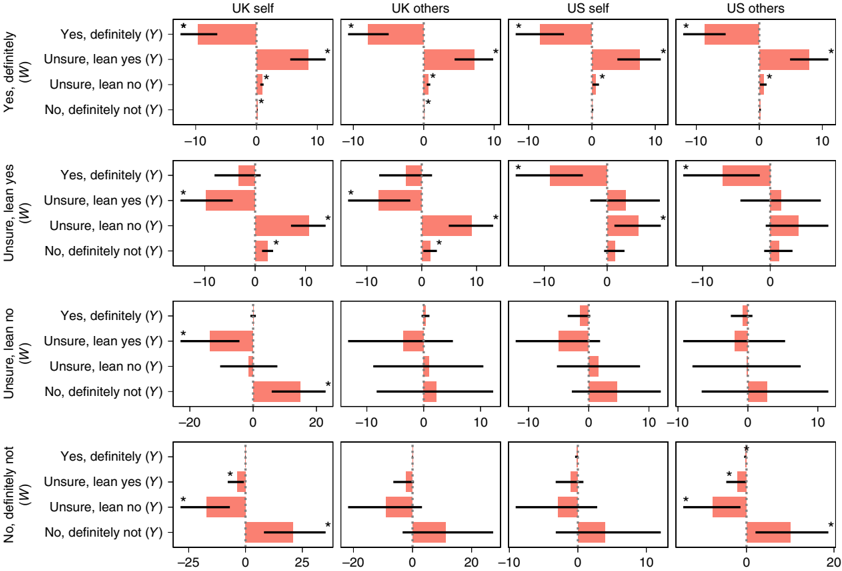
- Exposure to misinformation reduced the share answering “yes, definitely” by 6.2 percentage points in the UK (95% PI 3.9 to 8.5) and 6.4 percentage points in the USA (95% PI 4.0 to 8.8) for self-protection; for protecting others the decreases were 5.7 points in the UK (95% PI 3.5 to 7.9) and 6.5 points in the USA (95% PI 4.1 to 8.8).
- Misinformation also shifted respondents toward lower-intent categories: in the UK, for self-protection there was an increase of 2.7 points in “unsure, but leaning towards no” and 3.3 points in “no, definitely not”; in the USA, there was a 2.3-point rise in “unsure, but leaning towards no.”
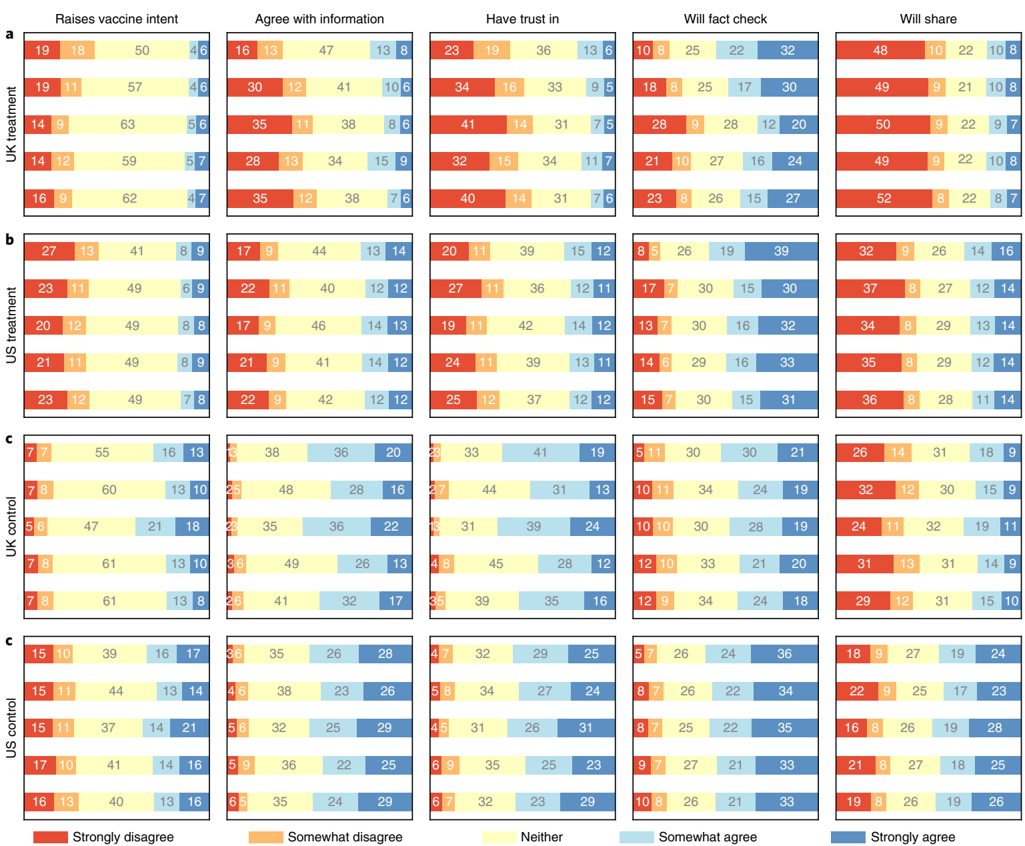
- Scientific-sounding misinformation was more damaging: the paper reports that the misinformation image with the strongest association with reduced intent had weight 0.42 in the UK (95% PI 0.28 to 0.56) and 0.41 in the USA (95% PI 0.25 to 0.58), and that around a quarter of respondents found some misinformation agreeable or trustworthy.
## Methods
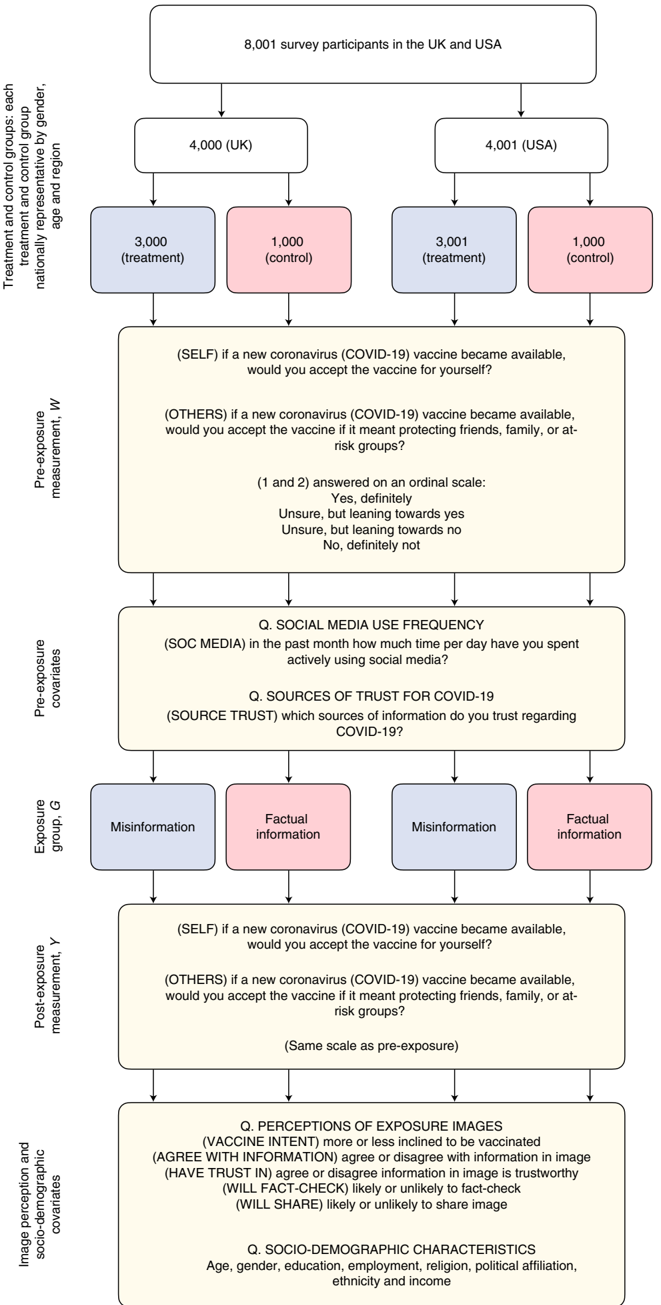
- Quantitative cross-sectional pre-post randomized controlled survey experiment in the UK and USA, fielded 7–14 September 2020.
- 8,001 respondents recruited via an online panel: 4,000 in the UK and 4,001 in the USA; within each country, 75% were assigned to misinformation and 25% to factual-information control.
- Respondents reported vaccination intent on a four-point ordered scale before and after exposure, for both self-protection and protecting others; analysis used hierarchical Bayesian ordered logistic regression with treatment effects, heterogeneous treatment effects, and image-impact models estimated via Hamiltonian Monte Carlo / NUTS in PyStan.
## Limitations
- The paper states that the design does not replicate a real-world social media platform environment, and that results are unlikely to be representative of real-world uptake rates.
- The authors state that the study does not allow causal inferences about different kinds of vaccine messaging from the post-exposure perception measures, and that they were limited in the type and volume of misinformation presented.
- Evident from the text: the sample was an online panel and respondents who did not participate simply did not complete the survey; the authors also note possible technological-literacy biases in this sampling mode.
Model-written summary. Check it against the paper before relying on it.
Integrity signals
Registry
Cites
Statistics
Figures


Verification
Claims the paper makes
14 Valid · 1 Not valid · 5 Not checked · 82 Own results and interpretations
The cited sources support only part of this claim — read each source’s verdict below.
In the paper
“Here we show that in both countries-as of September 2020-fewer people would 'definitely' take a vaccine than is likely required for herd immunity”
What the sources say
- Partly supportedcites [15] Kwok, K. O., Lai, F., Wei, W. I., Wong, S. Y. S. & Tang, J. W. T. Herd immunity—estimating the level required to halt the COVID-19 epidemics in affected countries. J. Infect. 80, e32–e33 (2020). sourceExperimental — accuracy not yet measured
The paper’s main text gives a formula for the minimum population immunity needed to halt spread, and Table 1 estimates thresholds for countries using data as of 13 March 2020. It does not report September 2020 vaccine willingness, whether people would ‘definitely’ take a vaccine, or a comparison between willingness and those thresholds in the two countries. (LLM, conf=0.88)
- Supportedcites [16] Sanche, S. et al. High contagiousness and rapid spread of severe acute respiratory syndrome coronavirus 2. Emerg. Infect. Dis. 26, 1470–1477 (2020). source
The Results section (‘Implications for Intervention Strategies’; page unavailable) estimates that more than 82% of the population would need immunity to stop transmission at R0 = 5.7. That supports the herd-immunity benchmark attributed to this source. The two-country September 2020 vaccine-willingness comparison is introduced as the citing authors’ own finding (‘Here we show’), not as a finding of this paper. (LLM, conf=0.87)
plain- Asserted: passes — The authors put it forward as true.
- Checkable: passes — It can be checked against evidence.
- Load-bearing: passes — The paper’s conclusions depend on it.
- Based: passes — The paper gives a reason why it holds.
- Partly supported
The cited sources support only part of this claim — read each source’s verdict below.
In the paper
“Under these current plausible COVID-19 vaccine acceptance rates, possible levels of existing protective immunity-though it is unclear whether post-infection immunity confers long-term immunity 29 and the rapidly evolving nature of misinformation surrounding the pandemic 23,30 , it is unclear whether vaccination will reach the levels required for herd immunity.”
What the sources say
- Supportedcites [29] Altmann, D. M., Douek, D. C. & Boyton, R. J. What policy makers need to know about COVID-19 protective immunity. Lancet 395, 1527–1529 (2020). source
The paper’s discussion of how long COVID-19 immunity might last says immunity could wane and that evidence extending only a little beyond one year offers little reassurance about longer-term protection. In the citing sentence, this source is attached to the uncertainty about long-term post-infection immunity, not to vaccine acceptance or misinformation. (LLM, conf=0.91)
- Partly supportedcites [23] Pennycook, G., McPhetres, J., Zhang, Y., Lu, J. G. & Rand, D. G. Fighting COVID-19 misinformation on social media: experimental evidence for a scalable accuracy-nudge intervention. Psychol. Sci. 31, 770–780 (2020). sourceExperimental — accuracy not yet measured
The citation is attached to the statement about pandemic misinformation, not the citing authors’ conclusion about herd immunity. The paper’s Abstract says COVID-19 misinformation has proliferated and takes many forms, but it does not establish that the misinformation is rapidly evolving. (LLM, conf=0.78)
- Supportedcites [30] Zarocostas, J. How to fight an infodemic. Lancet 395, 676 (2020). source
The citation is attached to the rapidly changing misinformation surrounding COVID-19, not to the citing authors’ conclusion about vaccination and herd immunity. In “How to fight an infodemic,” the paper describes misinformation spreading rapidly through social media and says its amplification makes timely responses a challenge. (LLM, conf=0.90)
hedged- Asserted: passes — The authors put it forward as true.
- Checkable: passes — It can be checked against evidence.
- Load-bearing: passes — The paper’s conclusions depend on it.
- Based: passes — The paper gives a reason why it holds.
- Supported
The cited sources support only part of this claim — read each source’s verdict below.
In the paper
“While large-scale vaccine rejection threatens herd immunity goals, large-scale acceptance with local vaccine rejection can also have negative consequences for community (herd) immunity, as clustering of non-vaccinators can disproportionately increase the needed percentage of vaccination coverage to achieve herd immunity in adjacent geographical regions and encourage epidemic spread 24 .”
What the sources say
- Partly supportedcites [24] Salathé, M. & Bonhoeffer, S. The effect of opinion clustering on disease outbreaks. J. R. Soc. Interface 5, 1505–1508 (2008). sourceExperimental — accuracy not yet measured
The Results and Discussion (pp. not specified) report that clusters of unvaccinated people can undermine herd immunity, increase outbreak probability, and mean that vaccination-coverage estimates needed to avoid outbreaks are too low. The Discussion also says infection can spread from one susceptible cluster to another. The paper does not specifically find that clustering raises the coverage percentage needed in adjacent geographical regions. (LLM, conf=0.86)
plainstates a cause- Asserted: passes — The authors put it forward as true.
- Checkable: passes — It can be checked against evidence.
- Load-bearing: unclear — It is unclear whether the paper’s conclusions depend on it.
- Based: passes — The paper gives a reason why it holds.
- Partly supported
The cited sources that could be checked couldn’t confirm or dispute this claim.
In the paper
“In the UK, this contrasted with more memetic imaging (for example, 'striking images with text superimposed on top' 42 ) which showed far weaker associations (images 3 and 4 in Supplementary Table 1).”
What the sources say
- Could not verifycites [42] Lazer, D. M. J. et al. The science of fake news. Science 359, 1094–1096 (2018). sourceExperimental — accuracy not yet measured
Citation 42 is attached to the description of memetic images, not to the UK association results, which the citing sentence attributes to its own Supplementary Table 1. Our copy discusses fake-news exposure and impact (Prevalence and Impact, p. 3), but searches for the quoted phrase and for memetic images or text-overlaid images found no passage defining them that way. (LLM, conf=0.77)
plainstates an association- Asserted: passes — The authors put it forward as true.
- Checkable: passes — It can be checked against evidence.
- Load-bearing: unclear — It is unclear whether the paper’s conclusions depend on it.
- Based: passes — The paper gives a reason why it holds.
- Could not verify
A result the paper reports from its own data — it cites no other source for it, so there is none to check. The quote shows it is in the paper.
In the paper
“while in the USA it was image 1 (Supplementary Table 1), with weight 0.41 (95% PI 0.25 to 0.58).”
plainstates an association- Asserted: passes — The authors put it forward as true.
- Checkable: passes — It can be checked against evidence.
- Load-bearing: passes — The paper’s conclusions depend on it.
- Based: passes — The paper gives a reason why it holds.
- Rests on an assumption not shown here.
52 more claims
Create a free account to see all 102 claims and to verify the 3 references still open.
- It may state two separate claims as one. 23
- Probably not a substantial claim. 32
- The quote only partly states this claim. 1
Claims other papers make about this one
Each is checked against this paper’s own text: does it say what the citing paper says it does?
The cited source says what the claim attributes to it.
In the citing paper
“Other research has found a causal link between exposure to vaccine misinformation and reduced intentions to get vaccinated (Loomba et al. 2021).”
From Social Media and Morality. (2024) · cites this paper as Loomba et al. 2021
In the citing paper
“belief in misinformation about coronavirus disease 2019 (COVID-19) has been linked to reduced willingness to get vaccinated against the disease and lower intentions to comply with public health measures (2, 3).”
From Psychological inoculation improves resilience against misinformation on social media (2022) · cites this paper as [3]
In the citing paper
“At the same time, misinformation about both technologies is already circulating among the public that can and should be targeted in a debunking intervention (e.g., Loomba et al., 2021;Wang & Song, 2020).”
From How to debunk misinformation? An experimental online study investigating text structures and headline formats (2023) · cites this paper as Loomba et al., 2021
Self-check
Percentages, sums and reported differences re-computed from the paper’s own numbers.
Each contradiction between two passages listed here was confirmed by an independent check.
Rated minor: it would not touch a result — a value no result rests on, a p-value that stays on the same side of the significance level, or a conflict that is clerical, resolved elsewhere in the paper, or outside its own findings.
In the paper
§ Methods
“Ethical approval for this study was obtained by the London School of Hygiene and Tropical Medicine ethics committee on 15 June 2020 with reference 22647.”
§ Human research participants
“Approval for this study was obtained by the LSHTM ethics committee on 15 June 2020 with reference 22130.”
Citations
Cites
A pneumonia outbreak associated with a new coronavirus of probable bat origin
Zhou, P., Yang, X.-L., Wang, X.-G., Hu, B., Zhang, L., Zhang, W., Si, H.-R., Zhu, Y., Li, B., Huang, C.-L., et al. (2020) · Nature · doi:10.1038/s41586-020-2012-7 · Cited by 21,969
Inference from iterative simulation using multiple sequences
Gelman, A., & Rubin, D. B. (1992) · Statistical Science · doi:10.1214/ss/1177011136 · Cited by 16,627
Estimating causal effects of treatments in randomized and nonrandomized studies
Rubin, D. B. (1974) · Journal of Educational Psychology · doi:10.1037/h0037350 · Cited by 9,436
The spread of true and false news online
Vosoughi, S., Roy, D., & Aral, S. (2018) · Science · doi:10.1126/science.aap9559 · Cited by 8,847
Statistics and Causal Inference
Holland, P. W. (1986) · Journal of the American Statistical Association · doi:10.1080/01621459.1986.10478354 · Cited by 5,293
The proximal origin of SARS-CoV-2
Andersen, K. G., Rambaut, A., Lipkin, W. I., Holmes, E. C., & Garry, R. F. (2020) · Nature Medicine · doi:10.1038/s41591-020-0820-9 · Cited by 5,081
Voysey, M., Clemens, S. A. C., Madhi, S. A., Weckx, L. Y., Folegatti, P. M., Aley, P. K., Angus, B., Baillie, V. L., Barnabas, S. L., Bhorat, Q. E., et al. (2021) · The Lancet · doi:10.1016/s0140-6736(20)32661-1 · Cited by 4,616
Regression Models for Ordinal Data
McCullagh, P. (1980) · Journal of the Royal Statistical Society Series B: Statistical Methodology · doi:10.1111/j.2517-6161.1980.tb01109.x · Cited by 4,453
Lazer, D. M. J., Baum, M. A., Benkler, Y., Berinsky, A. J., Greenhill, K. M., Menczer, F., Metzger, M. J., Nyhan, B., Pennycook, G., Rothschild, D., et al. (2018) · Science · doi:10.1126/science.aao2998 · Cited by 4,160
An mRNA Vaccine against SARS-CoV-2 — Preliminary Report
Jackson, L. A., Anderson, E. J., Rouphael, N. G., Roberts, P. C., Makhene, M., Coler, R. N., McCullough, M. P., Chappell, J. D., Denison, M. R., Stevens, L. J., et al. (2020) · New England Journal of Medicine · doi:10.1056/nejmoa2022483 · Cited by 3,406
Research works printed but not linked: 2
- Pfizer. Pfizer and BioNTech conclude phase 3 study of COVID-19 vaccine candidate, meeting all primary efficacy endpoints https://www.pfizer.com/news/press-release/press-release-detail/pfizer-and-biontech-conclude-phase-3-study-covid-19-vaccine (2020).
- Graham, M. & Coppock, A. Asking about attitude change. Public Opinion Quarterly (in the press).
Cited by
Items 1,701–1,800 of 1,802
Willingness to receive a COVID-19 booster vaccine: the role of health literacy and the 7Cs model
Romero, M. F., Rodríguez‐Blázquez, C., Fernández‐Gutiérrez, M., et al. (2026) · European Journal of Public Health · doi:10.1093/eurpub/ckag028
Wong, R., Yu, L., Veldre, A., & Reichle, E. D. (2026) · Cognitive Research Principles and Implications · doi:10.1186/s41235-026-00723-z · Cited by 1
MSTD: A Joint Structural–Temporal Framework for Fake News Detection
Xia, J.-X., Jia, W.-W., Li, P., & Xu, X.-K. (2026) · IEEE Transactions on Computational Social Systems · doi:10.1109/tcss.2026.3674080 · Cited by 1
Singh, V., Maheshwari, N., Khekare, G. S., & Rana, S. S. (2026) · IGI Global eBooks · doi:10.4018/979-8-3373-5467-5.ch003
Time to (Re)visualise victims? Introducing shadow victims of digital misinformation
Mukherjee, S., & Chang, L. Y. C. (2026) · Computers in Human Behavior · doi:10.1016/j.chb.2026.109002 · Cited by 2
Koumi, K., Jeon, S., & Lee, Y. S. (2026) · Epidemiologia · doi:10.3390/epidemiologia7020045
Improving Trust in Fact-Checking Systems with Synthetic Training Data and Explanations
Bussotti, J.-F. (2024) · theses.fr (ABES) · doi:10.70675/6f25f951z9b70z4941z86e9zaaa746e7effe
Abdulrauf, H., Lawal, A. A., Essien, E. A., Mba, A. N. U., Nenger, P. A., Odejide, G. S., & Agada, P. (2026) · Cureus · doi:10.7759/cureus.106737
Anilionytė, M., & Mikuličiūtė, V. (2026) · Psichologija · doi:10.15388/psichol.2026.75.5
Stallard, M., Jones, M. G., Nieuwsma, J., Bordewieck, K. E., Ferdous, T., & Meeks, A. (2026) · Journal of Biological Education · doi:10.1080/00219266.2026.2652854
Exposure to COVID-19 misinformation and its association with vaccine uptake in Southwest NigeriaPreprint
Aisagbonhi, H. O., Onwuchuluba, E. E., Ajakaiye, E. A., Oyewande, A. A., Oseni, Y. O., Odofin, M. O., Chukwu, E. A., Okafor, U. G., Abiodun, I. S., Okoye, T. W. O., et al. (2026) · Research Square · doi:10.21203/rs.3.rs-9120312/v1
McLellan, A., Kabir, M., Lacombe, C., Khorsand, S., Geller, C., Bair, L., & Eyre, A. (2026) · BMC Family Practice · doi:10.1186/s12875-026-03304-7 · Cited by 1
Erol, S., Çın, D., Davarcı, K., Akbıyık, E. Y., Çınar, E., & Cengiz, H. (2026) · Hemşirelikte araştırma geliştirme dergisi. · doi:10.69487/hemarge.1798131
Li, Y., Chen, T., Zhao, Y., Ke, W., Pang, P., McKay, D., Chang, S., & Baxter, N. (2026) · PLoS ONE · doi:10.1371/journal.pone.0346568
Duplaga, M., Sikorska, M., Zwierczyk, U., & Kowalska‐Duplaga, K. (2026) · International Digital Public Health Conference (DPH) · doi:10.1109/dph70309.2026.11650286
False Information on COVID-19: Scoping Review and Future Research Directions
Shahi, G. K., & Majchrzak, T. A. (2026) · Communications in computer and information science · doi:10.1007/978-3-032-19096-3_8
Wahlheim, C. N., Kemp, P. L., & Loaiza, V. M. (2024) · OSF Preprints (OSF Preprints)
Suleman, D. B., & Edet, R. (2026) · Social Science & Medicine · doi:10.1016/j.socscimed.2026.119387
Wong, L. P., Hashim, M. M. A. A. M., Huang, Z., et al. (2026) · Expert Review of Vaccines · doi:10.1080/14760584.2026.2674683
Nilsson, O., Eiben, G., Simiyu, S., et al. (2026) · Frontiers in Public Health · doi:10.3389/fpubh.2026.1743484
How can governments prevent the spread of fake news? A situational cyberdeviance prevention analysis
Shirish, A., Srivastava, S. C., & Chandra, S. (2026) · European Journal of Information Systems · doi:10.1080/0960085x.2026.2665141
Resilience: Muting and Resisting Conspiracy Theories
Rao, H., & Greve, H. R. (2026) · Oxford University Press eBooks · doi:10.1093/9780197772324.003.0009
Topic Modeling and Word Embedding
Rao, H., & Greve, H. R. (2026) · Oxford University Press eBooks · doi:10.1093/9780197772324.005.0001
Linguistic Patterns in Online Conspiracy Theory
Rao, H., & Greve, H. R. (2026) · Oxford University Press eBooks · doi:10.1093/9780197772324.003.0001
Opportunities for Future Research
Rao, H., & Greve, H. R. (2026) · Oxford University Press eBooks · doi:10.1093/9780197772324.003.0010
Cultural Toolkit: Conspiracy Theorists as Echolocators
Rao, H., & Greve, H. R. (2026) · Oxford University Press eBooks · doi:10.1093/9780197772324.003.0005
From Mindsets and Algorithms to a Cultural Toolkit
Rao, H., & Greve, H. R. (2026) · Oxford University Press eBooks · doi:10.1093/9780197772324.003.0004
Why Do Online Conspiracy Theories Matter?
Rao, H., & Greve, H. R. (2026) · Oxford University Press eBooks · doi:10.1093/9780197772324.003.0002
Rao, H., & Greve, H. R. (2026) · Oxford University Press eBooks · doi:10.1093/9780197772324.002.0001
Online Conspiracy Theorizing as Conversational Coordination
Rao, H., & Greve, H. R. (2026) · Oxford University Press eBooks · doi:10.1093/9780197772324.003.0008
Fake News, Rumors, Folk Theories: A Neglect of Language
Rao, H., & Greve, H. R. (2026) · Oxford University Press eBooks · doi:10.1093/9780197772324.003.0003
Online Conspiracy Rabbit Hole as a Semantic Cascade
Rao, H., & Greve, H. R. (2026) · Oxford University Press eBooks · doi:10.1093/9780197772324.003.0006
Rao, H., & Greve, H. R. (2026) · Oxford University Press eBooks · doi:10.1093/9780197772324.002.0006
How We Studied Conspiracy Theories
Rao, H., & Greve, H. R. (2026) · Oxford University Press eBooks · doi:10.1093/9780197772324.005.0002
Rao, H., & Greve, H. R. (2026) · Oxford University Press eBooks · doi:10.1093/9780197772324.002.0007
Ctrl+Alt+Doubt: Decoding the Language of Online Conspiracy Talk
Rao, H., & Greve, H. R. (2026) · doi:10.1093/9780197772324.001.0001
Linguistic Signature of Superspreaders
Rao, H., & Greve, H. R. (2026) · Oxford University Press eBooks · doi:10.1093/9780197772324.003.0007
Harris, M., & Jalbert, M. C. (2025) · OSF Preprints (OSF Preprints)
The COVID-19 pandemic in the eyes of Polish and Slovak medical students
Dąbek, J., Kurucová, R., Žiaková, K., Szynal, M., & Tomagová, M. (2026) · Frontiers in Public Health · doi:10.3389/fpubh.2026.1821945
Disinformation in Science: A Review of Empirical Evidence on Causes, Diffusion, and Countermeasures
Lysek, J., Šaradín, P., Zapletalová, M., Lebeda, T., Lebedová, E., Ostrá, D., & MOLNÁR, O. (2026) · Czech Sociological Review · doi:10.13060/csr.2026.021
Evaluating the impact of content warning labels on individuals with prior fringe beliefs
Horne, B. D. (2026) · Telematics and Informatics · doi:10.1016/j.tele.2026.102433
Malek, S., Griffin, C. H., Fraleigh, R. D., Lennon, R. P., & Shen, L. (2026) · doi:10.2196/preprints.99538
Harris, M., Sinclair, A. H., Pullano, G., Beckett, S. J., LeJeune, L., Agusto, F. B., Bauch, C. T., Baur, C., Berestycki, H., Dushoff, J. G., et al. (2026) · Royal Society Open Science · doi:10.1098/rsos.260369 · Cited by 1
Asraoui, A., & Soulaymani, A. (2026) · BMC Public Health · doi:10.1186/s12889-026-28209-z · Cited by 2
Grimalda, G., Murtin, F., Pipke, D., Putterman, L., & Sutter, M. (2026) · Economica · doi:10.1111/ecca.70062
Artemenko, E. D., Koltsova, O. Y., & Terpilovskii, M. (2026) · Journal of Health Communication · doi:10.1080/10810730.2026.2689434 · Cited by 1
Helbing, A., & Krumpal, I. (2026) · Journal of Public Health · doi:10.1007/s10389-026-02837-6
Duarte, L., & Boente, A. N. P. (2026) · RECIMA21 - Revista Científica Multidisciplinar · doi:10.47820/recima21.v7i7.8406
Trust in transition in the United States: examining health equity priorities, 2021–2024
Kloft, S., & López‐Cevallos, D. F. (2026) · Journal of Public Health Policy · doi:10.1057/s41271-026-00653-6
Patient, A. R., & Khattak, A. (2026) · Innovative Research in Applied Biological and Chemical Sciences · doi:10.62497/irabcs.235
Jansen, M., Hendriks, H., Verberne, S., de Bruijn, G., & Das, E. (2026) · JMIR Infodemiology · doi:10.2196/90916
Xu, S., Zhang, L., Jamison, A., Saiyed, S., Hou, A. B., Du, H., & Gardner, L. (2026) · npj Digital Public Health · doi:10.1038/s44482-026-00026-6 · Cited by 2
Reasonably partisan: Bayesian belief updating in politically charged contextsPreprint
Sanna, G. A., Pilditch, T. D., & Lagnado, D. A. (2026) · SSRN Electronic Journal · doi:10.2139/ssrn.7070489
Cmeciu, C. M. (2026) · Connectist Istanbul University Journal of Communication Sciences · doi:10.26650/connectist2026-1889745
From infodemics to collective resistance: populist mobilisation and health consequences
Wang, Y. (2026) · Health Economics Policy and Law · doi:10.1017/s1744133126100589
Guidry, J. P. D., Laestadius, L. I., Severijns, Y., Miller, C. A., Stevens, M. P., Burton, C. W., Carlyle, K. E., Tatar, J.-M., Moffett, K. S., & Perrin, P. B. (2026) · Vaccines · doi:10.3390/vaccines14070608
Nie, W., He, Y., Khanoba, C., & Zhang, Y. (2026) · doi:10.2196/preprints.106771
Elsayed, E. S. M., Kotb, K. M., Heiba, A., Elhussini, M. S., Emara, A. A., Nzana, V. B., Khalil, H. M. A. E., ElTaweel, B. A., Samea, M. S. A., Ahmed, S. O., et al. (2026) · Kidney Medicine · doi:10.1016/j.xkme.2026.101465 · Cited by 1
Population-level behavioral and structural drivers of COVID-19 vaccine uptake in the US
Xu, R., Ghaffarzadegan, N., Zhang, G., Aoki, G., & Rahmandad, H. (2026) · PLoS Computational Biology · doi:10.1371/journal.pcbi.1013988
Catalán-Matamoros, D., Moreno, M. V., & Peñafiel-Saiz, C. (2026) · Frontiers in Medicine · doi:10.3389/fmed.2026.1842755
Pereira, A. V., Cardoso, J. B., Ribeiro, L. H. D. S., et al. (2026) · Revista de Gestão e Secretariado (Management and Administrative Professional Review) · doi:10.7769/gesec.v17i7.5609
Puppis, M., & Pedrazzi, S. (2026) · Springer eBooks · doi:10.1007/978-3-658-46851-4_6-1
Truth Vigilance to Traditional Balance: Role Conceptions among Health Journalists
Hinnant, A., Young, R., Tang, R., Len-Ríos, M. E., & Madu, U. A. (2026) · Journalism Practice · doi:10.1080/17512786.2026.2704006
Ekholuenetale, M., Nzoputam, C. I., Ochagu, V. A., & Barrow, A. (2026) · BMJ Public Health · doi:10.1136/bmjph-2025-004858 · Cited by 3
Zhang, M., Huang, S., Ruan, C., Chen, D., Hu, X., Liu, N., Wang, L., Li, L., Fang, M., Zhang, X., et al. (2026) · Human Vaccines & Immunotherapeutics · doi:10.1080/21645515.2026.2708449
Yan, Z., Du, R., Fan, W., Zhou, X., & Wang, H. (2026) · Electronic Markets · doi:10.1007/s12525-026-00924-w
Linegar, M., Sinclair, B., van der Linden, S., & Alvarez, R. M. (2026) · Royal Society Open Science · doi:10.1098/rsos.252226 · Cited by 1
Silva, H. M. (2026) · SCIAS Educação Comunicação e Tecnologia · doi:10.36704/sciaseducomtec.v8i1.10871
Munblit, D., Buonsenso, D., Olliaro, P., Semple, M. G., Greenhawt, M., Genuneit, J., Ashkenazi‐Hoffnung, L., Wilder‐Smith, A., Warner, J. O., Chang, A. Y., et al. (2026) · Clinical Infectious Diseases · doi:10.1093/cid/ciag403
Alromaih, Y., Aldakhil, S., Alsaloom, D., Alkhalaf, G. A., & Alshehi, R. (2026) · Frontiers in Public Health · doi:10.3389/fpubh.2026.1827711
Praschk, A., Fischill-Neudeck, V., Caspari, T., & Wiesinger, H. (2026) · Journal of Medical Systems · doi:10.1007/s10916-026-02449-3
Azizi, A., Kazancı, C., & Guo, X. (2026) · Bulletin of Mathematical Biology · doi:10.1007/s11538-026-01719-y
Na, K. (2026) · Journal of Health Communication · doi:10.1080/10810730.2026.2716163
Akanbi, O. O., Emenuga, C. O., Uchejuru, U. O., Ekundayo, Z., Udochukwu, E., Beverla, E., & Olayinka, A. S. (2026) · Epidemiology and Health Data Insights · doi:10.63946/ehdi/19127
From Smallpox to COVID-19: The German-Language Anti-vaccination Movement
Tschiggerl, M. (2026) · Minerva · doi:10.1007/s11024-026-09656-9
The Reliability of Human Evaluation of Large Language Models in Health Care Settings: Scoping Review
Yang, E., Ko, S., & Woo, H. (2026) · Journal of Medical Internet Research · doi:10.2196/98184 · Cited by 2
Maru, D., Purnat, T. D., Etheredge, A. J., Scales, D. A., Uccelli, I. G., Metlapalli, S. K. K., Fleuristal, J., Myers, G., Ngamwajasat, C., & Morse, M. E. (2026) · doi:10.2196/preprints.107720
Ramachandran, R., & Pillai, S. (2026) · IGI Global eBooks · doi:10.4018/979-8-3373-7670-7.ch009
AI-enabled health communication to address misinformation on social media: a mini review
Hu, Y. (2026) · Frontiers in Communication · doi:10.3389/fcomm.2026.1907956
Zhou, Q., Duan, X., & Yu, G. (2026) · Information Processing & Management · doi:10.1016/j.ipm.2026.105094
Expansion of the Adult Immunization Schedule: How This has Influenced Vaccine Hesitancy
Rohani, R., Abdeljaber, A., Affinati, J., & Affinati, B. R. (2026) · Springer eBooks · doi:10.1007/978-1-0716-5464-4_27
Nowak, G. J., & Duarte, M. N. (2026) · Springer eBooks · doi:10.1007/978-1-0716-5464-4_10
Rune, K. T., Devonald, S. J., & Keech, J. J. (2026) · Australian Journal of Psychology · doi:10.1080/00049530.2026.2716072
Global vaccine readiness: equity-by-design in pandemic preparedness and response
Ghafari, M., Watson, O. J., Dascalu, S., et al. (2026) · Expert Review of Vaccines · doi:10.1080/14760584.2026.2732508
Barhoum, B., Hecker, M., Suntah, A. M., Langenberger, J. E., Baldt, J., Streckenbach, B., Richter, J., Frahm, N., Heidler, F., & Zettl, U. K. (2026) · Therapeutic Advances in Neurological Disorders · doi:10.1177/17562864261476877
Ribeiro, L. R., Lima, L. D. S., & Costa, C. I. A. (2026) · Aracê. · doi:10.56238/arev8n9-106
Katsiroumpa, A., Kolisiati, A., Moisoglou, I., Nystazaki, M., & Galanis, P. (2026) · Frontiers in Psychology · doi:10.3389/fpsyg.2026.1935732
Johansson, S., Rodin, P., Srugies, A., & Johansson, B. (2026) · Frontiers in Communication · doi:10.3389/fcomm.2026.1736525
Hekmati, A., Stanc, L. L., Salvia, É., Borst, G., & Cassotti, M. (2026) · Research Square · doi:10.21203/rs.3.rs-11124803/v1
Otitoju, G. T., Hernandez, A., Sudanagunta, S., et al. (2026) · Public Health in Practice · doi:10.1016/j.puhip.2026.100864
Conversational AI in Hereditary Cancer Care: Sociotechnical Study of Responsible Design Requirements
Lammert, D., Lammert, J., Hofenbitzer, J., Radtke, T., Sun, Y., Haimerl, M., Betz, S., Scholl, D. H., & Pfeffer, J. (2026) · JMIR Human Factors · doi:10.2196/97869
Hing, N. Y. L., Lee, Y. K., Kim, H. J., Lothfi, N. M., Wong, E. R., & Costa‐Font, J. (2026) · PLOS Global Public Health · doi:10.1371/journal.pgph.0007397
Fear over Facts: The Political and Social Consequences of Health Misinformation
Jakaria, S. Y., & VALENCIA, P. D. (2026) · International Journal of Research on Multidisciplinary Studies · doi:10.67903/ijroms0421
Dube, R., Goud, M., Habra, Y. G., Dawood, S., Sharifian, Y., Kar, S. S., Ali, M. M., Alahmed, O. M., Alshamsi, H. E., & Kar, S. (2026) · Vaccines · doi:10.3390/vaccines14100876
Huang, Y., & Wang, W.-R. (2026) · The social science · doi:10.3390/socsci15100676
Zhang, X., Xuan, D., Liang, Y., He, H., Wang, Y., Chen, Y., Wang, S., Lu, Y., & Yao, Y. (2026) · npj Digital Public Health · doi:10.1038/s44482-026-00047-1
A perfect storm: How social media may heighten older adults’ vulnerability to health misinformation
Mennie, K., LaCour, M., & Morse, M. (2026) · Educational Gerontology · doi:10.1080/03601277.2026.2744721
A Brief Review of Vaccine History, Hesitancy, and Education Today
Youssef, A. S., Gupta, A. S., Gollamudi, S., & Moore, K. T. (2026) · The Journal of Clinical Pharmacology · doi:10.1002/jcph.70302
Metadata
- Authors
- Loomba, S., de Figueiredo, A., Piatek, S. J., de Graaf, K., & Larson, H. J.
- Affiliations
- Imperial College London (GB)
- London School of Hygiene & Tropical Medicine (GB)
- University of Antwerp (BE)
- Corresponding author
- Larson, Heidi J.
- Venue
- Nature Human Behaviour
- Published
- 2021-02-05
- Volume
- 5
- Issue
- 3
- Pages
- 337-348
- ISSN
- 2397-3374 (ISSN-L)
- OpenAlex
- W3128392043
- Semantic Scholar
- fad25c63595eefecba05d0b6a34163f54deb9a62
- Cited by
- 1,800
- References
- 59
- Citations by year
- 2026: 175 · 2025: 206 · 2024: 277 · 2023: 379 · 2022: 500 · 2021: 256
- FWCI
- 489.51
- Type
- journal article
- Language
- en
- Update notices
- Open access
- bronze
- doi.org
- Licence
- www.springernature.com/gp/researchers/text-and-data-mining (tdm)
- www.springernature.com/gp/researchers/text-and-data-mining (vor)
- Locations
- Nature Human Behaviour (publishedVersion)
- PubMed (publishedVersion)
- LSHTM Research Online (London School of Hygiene and Tropical Medicine) (acceptedVersion)
- RePEc: Research Papers in Economics (submittedVersion)
- Topics
- Social Sciences › Sociology and Political Science › Misinformation and Its Impacts
- Social Sciences › Health › Vaccine Coverage and Hesitancy
- Social Sciences › Communication › Communication and COVID-19 Impact
- Keywords
- COVID-19 vaccines, vaccine misinformation, vaccination intention, vaccine hesitancy, online misinformation, herd immunity, sociodemographic differences, vaccine acceptance
- MeSH terms
- COVID-19, SARS-CoV-2, COVID-19 Vaccines, Adolescent, Adult, Aged, Communication, Female, United Kingdom, Humans, Health Knowledge, Attitudes, Practice, Male, Middle Aged, United States, Health Behavior, Internet, Immunity, Herd, Intention, Young Adult
About these checks
Registry, retraction, Cites and statistics results are computed, not judged, with one exception: a printed reference that no index lists is read once by a model before it counts as a citation error. Claims are extracted by a model and kept only when their quote appears verbatim in the text; each cited source is then checked, with a model’s help, for whether it says what the claim relies on. Those verdicts can be wrong — read the claim’s quote and the cited source before relying on one.
The claim verdicts this report counts are experimental: their accuracy is not yet measured.
A language model drew the claims from the paper on 2026-10-10, under version 3 of the claim definition (model deepseek-v4.1-flash, prompt extract-v3).
A second model labelled each claim on 2026-10-10 (model jev-1.13-20260917, definition revision gold-guideline-v0.2).
Cited sources are checked with a language model’s help (gpt-6-sol).
Statistics and arithmetic are recomputed, not judged.
Confidence bands are shown only for fields calibrated on our annotated test set. None is calibrated yet, so no band is shown.
What counts as a claim ›How we measure confidence ›How we check this ›
Are you an author, or do you see a problem with this page? Request a review
Data sources
Bibliographic data: Semantic Scholar, OpenAlex, Crossref.
Contains information from the Semantic Scholar Academic Graph Datasets, made available under the ODC Attribution License (ODC-BY 1.0).
Semantic Scholar’s data is described in: Kinney, R., et al. (2023). The Semantic Scholar Open Data Platform. arXiv:2301.10140.
