

The impacts of remote learning in secondary education during the pandemic in Brazil
Open accessPublished version of a preprint
The DOI matches its Crossref record; 57 of the 59 references it cites were found in a registry or an index.
Abstract
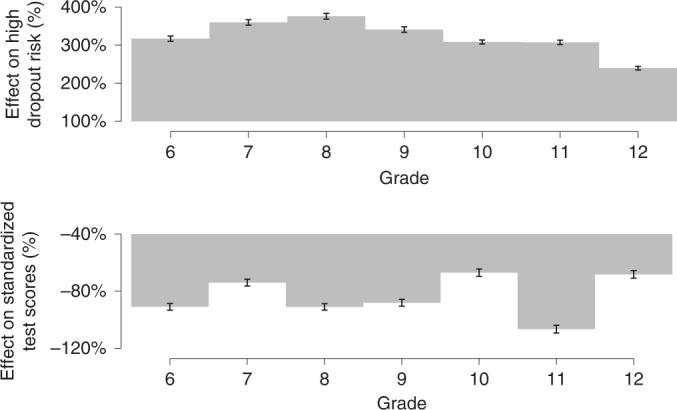
The transition to remote learning in the context of coronavirus disease 2019 (COVID-19) might have led to dramatic setbacks in education. Taking advantage of the fact that São Paulo State featured in-person classes for most of the first school quarter of 2020 but not thereafter, we estimate the effects of remote learning in secondary education using a differences-in-differences strategy that contrasts variation in students’ outcomes across different school quarters, before and during the pandemic. We also estimate intention-to-treat effects of reopening schools in the pandemic through a triple-differences strategy, contrasting changes in educational outcomes across municipalities and grades that resumed in-person classes or not over the last school quarter in 2020. We find that, under remote learning, dropout risk increased by 365% while test scores decreased by 0.32 s.d., as if students had only learned 27.5% of the in-person equivalent. Partially resuming in-person classes increased test scores by 20% relative to the control group.
Overview
The claims and statistics of this paper haven’t been checked yet.
Free: it reads the open-access text and checks the first 5 claims that cite a source we can check. Create a free account to check every claim.
Integrity signals
Registry
Cites
Statistics
Figures
Verification
Claims the paper makes
The claims and statistics of this paper haven’t been checked yet.
Free: it reads the open-access text and checks the first 5 claims that cite a source we can check. Create a free account to check every claim.
Claims other papers make about this one
Each is checked against this paper’s own text: does it say what the citing paper says it does?
The cited source says what the claim attributes to it.
In the citing paper
“In fact, the three largest estimates of learning deficits in our sample are from middle-income countries (Fig. 3) [36][37][38] .”
From A systematic review and meta-analysis of the evidence on learning during the COVID-19 pandemic (2023) · cites this paper as [38]
Self-check
Percentages, sums and reported differences re-computed from the paper’s own numbers.
The self-check needs the paper’s full text.
Citations
Cites
The Proceedings of the National Academy of Sciences
Richards, J. W. (1915) · Science · doi:10.1126/science.42.1074.161 · Cited by 13,983
A global panel database of pandemic policies (Oxford COVID-19 Government Response Tracker)
Hale, T., Angrist, N., Goldszmidt, R., Kira, B., Petherick, A., Phillips, T., Webster, S., Cameron-Blake, E., Hallas, L., Majumdar, S., et al. (2021) · Nature Human Behaviour · doi:10.1038/s41562-021-01079-8 · Cited by 4,578
Learning loss due to school closures during the COVID-19 pandemic
Engzell, P., Frey, A., & Verhagen, M. D. (2021) · Proceedings of the National Academy of Sciences · doi:10.1073/pnas.2022376118 · Cited by 1,848
Social relationships and motivation in middle school: The role of parents, teachers, and peers.
Wentzel, K. R. (1998) · Journal of Educational Psychology · doi:10.1037/0022-0663.90.2.202 · Cited by 1,828
Learning loss due to school closures during the COVID-19 pandemic
Engzell, P., Frey, A., & Verhagen, M. D. (2020) · doi:10.31235/osf.io/ve4z7 · Cited by 1,739
Projecting the Potential Impact of COVID-19 School Closures on Academic Achievement
Kuhfeld, M., Soland, J., Tarasawa, B., Johnson, A., Ruzek, E., & Liu, J. (2020) · Educational Researcher · doi:10.3102/0013189x20965918 · Cited by 997
How is COVID-19 pandemic impacting mental health of children and adolescents?
Marques de Miranda, D., da Silva Athanasio, B., Sena Oliveira, A. C., & Simoes-e-Silva, A. C. (2020) · International Journal of Disaster Risk Reduction · doi:10.1016/j.ijdrr.2020.101845 · Cited by 786
Pandemics Depress the Economy, Public Health Interventions Do Not: Evidence from the 1918 Flu
Correia, S., Luck, S., & Verner, E. (2022) · The Journal of Economic History · doi:10.1017/s0022050722000407 · Cited by 533
Preliminary evidence on long COVID in children
Buonsenso, D., Munblit, D., De Rose, C., Sinatti, D., Ricchiuto, A., Carfi, A., & Valentini, P. (2021) · Acta Paediatrica · doi:10.1111/apa.15870 · Cited by 513
Goldemberg, D., Azevedo, J. P., Iqbal, S. A., Hasan, A., & Geven, K. (2020) · doi:10.1596/1813-9450-9284 · Cited by 476
Research works printed but not linked: 6
- Sales A Balby L Cajueiro A Exploiting academic records for predicting student drop out: a case study in Brazilian higher education J. Inform. Data Manage. 2016 7 166 181
- Moscoviz, L. & Evans, D. Learning loss and student dropouts during the covid-19 pandemic: A review of the evidence two years after schools shut down. Working paper. Center for Global Development https://www.cgdev.org/publication/learning-loss-and-student-dropouts-during-covid-19-pandemic-review-evidence-two-years (2022).
- Carter, C. Early Detection of Dropout Risk: Measuring Student Engagement at the Elementary-School Level. PhD thesis, Graduate Faculty of the Univ. of Georgia (2007).
- Reopening K–12 Schools during the COVID-19 Pandemic: Prioritizing Health, Equity, and Communities (National Academies Press, 2020). 33231959
- Lessler J Household COVID-19 risk and in-person schooling Trends Neurosci. Educ. 2020 20 100138 10.1016/j.tine.2020.100138 32917303 PMC7417296 · DOI · Paper page
- Viera, A. Escola? Não, Obrigado: Um Retrato da Homeschooling no Brasil. PhD thesis, Univ. of Brasília (2012).
Cited by
Items 101–138 of 138
Digitization and Community ParticipationPreprint
Pocchiari, M., & Roos, J. M. T. (2023) · SSRN Electronic Journal · doi:10.2139/ssrn.4671557
Macana, E. C., Mirolli, T. Z., Silva, A. L. F., Lazaretti, L. R., França, M. T. A., Bianchi, L. L., & Frio, G. S. (2023) · Forum for Social Economics · doi:10.1080/07360932.2023.2297161 · Cited by 3
“Para o ensino secundário brasileiro, Lichand et al. (2022) encontraram que o Ensino remote aumenta em 4,5 vezes a chance de abandon escolar.”
Cools, A., Esparza, C., & Park, J. (2024) · SSRN Electronic Journal · doi:10.2139/ssrn.4748765
The Impact of COVID-19 on Peer Relationships: Insights from Classroom Social NetworksPreprint
Turkum, B., & Agus, Y. (2024) · Social Science Research Network · doi:10.2139/ssrn.4800467
Cools, A., Esparza, C., & Park, J. (2024) · SSRN Electronic Journal · doi:10.2139/ssrn.4805866
Thriving Through Autonomy: High-Ability Adolescents’ Well-Being Amidst the Pandemic
Palíšek, P., Jabůrek, M., & Portešová, Š. (2024) · The Journal of Early Adolescence · doi:10.1177/02724316241249485 · Cited by 2
“Especially young children also exhibited setbacks in fundamental skills such as writing (e.g., K¨onig & Frey, 2022; Lichand et al., 2022; Skar et al., 2023; but see Hallin et al., 2022, who did not observe this effect).”
Going the Distance: Hybrid Vocational Training for Women in Nepal *Preprint
Janzen, S., Magnan, N., Mullally, C., Sharma, S., & Shrestha, B. S. (2024) · SSRN Electronic Journal · doi:10.2139/ssrn.4843229
Vasu, K., Supian, N., Nimehchisalem, V., Kirshner, J., & Ling, S. C. Y. (2024) · Creative Education · doi:10.4236/ce.2024.156069
Teja, B. M. N., & Singh, M. (2024) · Child & Youth Services · doi:10.1080/0145935x.2024.2402979
LeDNA: a cut-and-build toolkit to democratize education on CRISPR gene editing technologyPreprint
Kundlatsch, G. E., Rodrigues, A. D. S. L., Zocca, V. F. B., Amorim, L. A. D. S., de Paiva, G. B., Neto, A. P. D. S., Campos, J. Á. D. B., & Pedrolli, D. B. (2024) · bioRxiv (Cold Spring Harbor Laboratory) · doi:10.1101/2024.10.09.617025
“We speculate that the poor performance was due to educational difficulties arising from the pandemic, especially in public education institutions in Brazil 22 .”
BackgroundInfluentialNeidhöfer, G., Lustig, N. C., & Larroulet, P. (2022) · The Journal of Economic Inequality · doi:10.1007/s10888-024-09648-3 · Cited by 5
“This alarming picture mirrors the projections of Neidhöfer et al. (2021) for Latin America, which found some confirmation in current analyses of education drop-outs using household survey data (Bracco et al. 2024) and administrative data (Lichand et al. 2022).”
Wang, H., Chen, Z., Xu, K., & Liang, W. (2024) · Journal of Global Health · doi:10.7189/jogh.14.04222
“This method balances the distribution of covariates between treated and control groups by matching treated observations with control observations based on their propensity scores for residing in policy-implemented prefectures [36].”
Efeitos da Pandemia sobre o Abandono Escolar
Lacruz, A. J., Carniel, F., Pezzin, C. M. D. S., & Lemos, K. R. (2024) · Navus - Revista de Gestão e Tecnologia · doi:10.22279/navus.v14.2015 · Cited by 2
The impact of COVID-related school disruption on kindergarten children’s development
Lee, K. L., Gao, X., Zhang, D., Fong, Y., Ng, C. W., Bautista, A., Sun, J., Capio, C. M., Cheung, S. K., Siu, T. S. C., et al. (2025) · Early Child Development and Care · doi:10.1080/03004430.2025.2459918
“With a few exceptions from South Africa, Brazil, and Australia (e.g. Ardington et al., 2021; Gore et al., 2021; Lichand et al., 2022), the extant findings are derived primarily from Europe or America.”
Do Math and Science Suffer More from Covid-19 than Languages? Evidence from IndiaPreprint
Sureka, K., & Filippini, M. (2025) · SSRN Electronic Journal · doi:10.2139/ssrn.5239371
The impact of digitalisation on skills development in South Africa: A comparative analysis
Chikungwa, T. (2025) · International Journal of Business Ecosystem and Strategy (2687-2293) · doi:10.36096/ijbes.v7i4.913
Multi-Source Data-Driven Network Teaching Quality Evaluation System of Police Colleges
Wang, Q., Li, S. J., & Zhang, X. (2025) · International Journal of Information and Communication Technology Education · doi:10.4018/ijicte.386634 · Cited by 3
Forgone and Forgotten Learning: A framework and national estimates from BangladeshPreprint
Djaker, S., Sabarwal, S., Ramachandra, S., Angrist, N., & Chang, A. Y. (2025) · SSRN Electronic Journal · doi:10.2139/ssrn.5442021
Virtual charter students have worse labor market outcomes as young adults
Yoo, P., Domina, T., McEachin, A. J., Clark, L. R., Hertenstein, H., & Penner, A. M. (2025) · Social Science Research · doi:10.1016/j.ssresearch.2025.103240
“Furthermore, analyses conducted in Brazil point to substantial learning loss as well as a more than threefold increase in dropout for high school students who received only remote instruction throughout 2020 (Lichand et al., 2022).”
Effects of the COVID-19 pandemic on student performance in anatomy and physiology labs
Pollock, N. B. (2025) · AJP Advances in Physiology Education · doi:10.1152/advan.00163.2025
Hasei, J. (2025) · Research Square · doi:10.21203/rs.3.rs-7736679/v1
A lost generation? The impact of COVID-19 on high school students’ achievements
Contini, D., Tommaso, M. L. D., Muratori, C., Piazzalunga, D., & Schiavon, L. (2025) · The Journal of Economic Inequality · doi:10.1007/s10888-025-09708-2 · Cited by 13
“Lichand et al. (2022) estimates that in 2020 in Brazil the dropout risk more than triplicated and average learning loss in maths and reading amounted to 0.32 s.d. for students in Grades 6 through 12, with some variation by grade but no distinctive difference between lower and upper secondary school.”
InfluentialOroni, C. Z., & Xianping, F. (2025) · Sustainable Futures · doi:10.1016/j.sftr.2025.101554 · Cited by 12
Santos, V. P. S., Subtil, A. G. D. S., Brandao, M. P., Fonseca, J. M., & Rodrigues, L. N. (2026) · The Physics Teacher · doi:10.1119/5.0209224
Asanov, I., Åstebro, T. B., Buenstorf, G., Crépon, B., Francisco Pablo Flores, T., McKenzie, D. J., Mensmann, M., & Schulte, M. (2026) · Nature Human Behaviour · doi:10.1038/s41562-026-02421-8 · Cited by 2
Vitorino, M. C. C., da Silva, M. C. C., Soares, R. D. C. E. S., de Melo, M. M., von Humboldt, S., & Vitorino, L. M. (2026) · The Journal of Mental Health Training Education and Practice · doi:10.1108/jmhtep-12-2025-0139
Religious Participation After Covid‐19: Evidence From US Catholic Dioceses and Smartphone Data
Cools, A., Carlos Esparza, S. J., & Park, J. (2026) · Journal for the Scientific Study of Religion · doi:10.1111/jssr.70067
COVID-19 and peer relationships: Insights from classroom social networks
Agus, Y., & Turkum, B. (2026) · Journal of Economic Behavior & Organization · doi:10.1016/j.jebo.2026.107661
Generative AI in Engineering Education: Equity-Enhancing Tool or Digital Divide Deepener?
Biswas, R. (2026) · IEEE Global Engineering Education Conference (EDUCON) · doi:10.1109/educon67543.2026.11574391 · Cited by 1
“Evidence from pandemic-era remote learning indicates that unstable connectivity was strongly associated with lower conceptual gains, lower attendance persistence, and higher dropout probabilities [14].”
Häll, C., Lindskog, A., & Lundin, M. (2026) · Economics of Education Review · doi:10.1016/j.econedurev.2026.102818 · Cited by 1
“In contrast, Lichand et al. (2022) find large declines in test scores and increased dropout rates due to remote learning among secondary students in Brazil.”
Aso, N. Y., Costa, G. P., de Quadros, A. C., & Figueira, T. R. (2026) · Journal of Chemical Education · doi:10.1021/acs.jchemed.5c00801
Who continued studying during the pandemic? An intersectional analysis with peripheral students
Toledo, C. T., Érnica, M., & de Carvalho, M. P. (2026) · Pro-Posições · doi:10.1590/1980-6248-2025-0066en
Zhao, N. (2026) · Digital Commons - DU (University of Denver) · doi:10.56902/etdcrp.2026.127
Linhares, F. (2026) · International Multidisciplinary Journal of Emerging Technologies and Applications · doi:10.67294/mndd3088
“Brazilian evidence from secondary education is consistent with this pattern and documents substantial losses under remote instruction (Lichand et al., 2022).”
InfluentialZheng, X., Lou, B., & Zhou, Y. (2026) · Oxford Bulletin of Economics and Statistics · doi:10.1111/obes.70135
Zhao, H., Xiao, B., Biferie, M. D., & Shapka, J. D. (2026) · Pastoral Care in Education · doi:10.1080/02643944.2026.2746063
Increased performance in tutoring systems during COVID-19 in Uruguay and Germany
Spitzer, M., Bardach, L., Kopatz, M., & Moeller, K. (2026) · Acta Psychologica · doi:10.1016/j.actpsy.2026.107955 · Cited by 2
Linhares, F. S., Queiroz, F. D. S., & Machado, J. C. F. (2026) · Conferência Latino-Americana de Tecnologias de Aprendizagem (LACLO) · doi:10.5753/laclo_estendido.2026.46031
“During school closures, unequal access to connectivity, devices, adult support, and suitable study environments contributed to heterogeneous learning losses, with greater harm among socially disadvantaged students [Lichand et al. 2022; Schady et al. 2023].”
Metadata
- Authors
- Lichand, G., Doria, C. A., Leal-Neto, O., & Fernandes, J. P. C.
- Affiliations
- University of Zurich (CH)
- Corresponding author
- Lichand, Guilherme
- Venue
- Nature Human Behaviour
- Published
- 2022-05-26
- Volume
- 6
- Issue
- 8
- Pages
- 1079-1086
- ISSN
- 2397-3374 (ISSN-L)
- PMC
- PMC9391221
- OpenAlex
- W4281763316
- Semantic Scholar
- a12b85bcd9dc6254458f6d808ead3c322d978935
- Cited by
- 139
- References
- 50
- Citations by year
- 2026: 19 · 2025: 27 · 2024: 38 · 2023: 38 · 2022: 14
- FWCI
- 63.67
- Type
- journal article
- Language
- en
- Update notices
- correction (2022-07-01)
- Open access
- hybrid
- doi.org
- Licence
- cc-by
- creativecommons.org/licenses/by/4.0 (tdm)
- creativecommons.org/licenses/by/4.0 (vor)
- Locations
- Nature Human Behaviour (publishedVersion, cc-by)
- Research Square (acceptedVersion, cc-by)
- PubMed Central (publishedVersion, cc-by)
- PubMed (publishedVersion)
- Zurich Open Repository and Archive (University of Zurich) (acceptedVersion, cc-by)
- RePEc: Research Papers in Economics (submittedVersion)
- Zurich Open Repository and Archive (University of Zurich) (submittedVersion, cc-by)
- Zurich Open Repository and Archive (University of Zurich)
- Funders
- Inter-American Development Bank
- Topics
- Social Sciences › Education › Education during COVID-19 pandemic
- Social Sciences › Education › School Choice and Performance
- Social Sciences › Economics, Econometrics and Finance › Economics and Econometrics › COVID-19 Pandemic Impacts
- Keywords
- distance education, COVID-19 pandemic, secondary education, school closures, school reopening, school dropout, test scores, educational outcomes, São Paulo state, face-to-face teaching
- MeSH terms
- COVID-19, Brazil, Humans, Learning, Education, Distance, Pandemics
About these checks
Registry, retraction, Cites and statistics results are computed, not judged, with one exception: a printed reference that no index lists is read once by a model before it counts as a citation error. Claims are extracted by a model and kept only when their quote appears verbatim in the text; each cited source is then checked, with a model’s help, for whether it says what the claim relies on. Those verdicts can be wrong — read the claim’s quote and the cited source before relying on one.
Statistics and arithmetic are recomputed, not judged.
Confidence bands are shown only for fields calibrated on our annotated test set. None is calibrated yet, so no band is shown.
What counts as a claim ›How we measure confidence ›How we check this ›
Are you an author, or do you see a problem with this page? Request a review
Data sources
Bibliographic data: Semantic Scholar, OpenAlex, Crossref.
Contains information from the Semantic Scholar Academic Graph Datasets, made available under the ODC Attribution License (ODC-BY 1.0).
Semantic Scholar’s data is described in: Kinney, R., et al. (2023). The Semantic Scholar Open Data Platform. arXiv:2301.10140.
