

The impacts of remote learning in secondary education during the pandemic in Brazil
Open accessPublished version of a preprint
The DOI matches its Crossref record; 57 of the 57 references it cites were found in a registry or an index.
Abstract
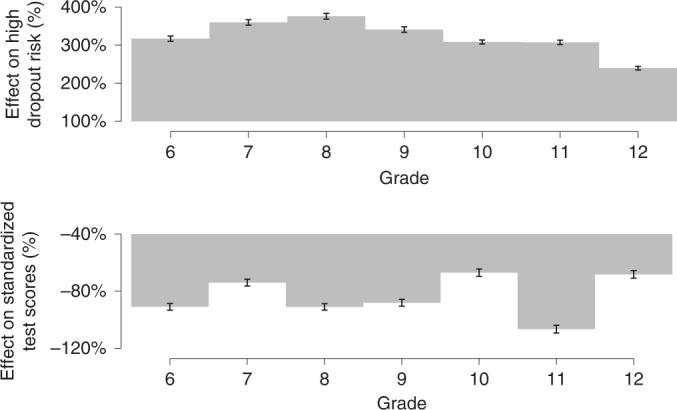
The transition to remote learning in the context of coronavirus disease 2019 (COVID-19) might have led to dramatic setbacks in education. Taking advantage of the fact that São Paulo State featured in-person classes for most of the first school quarter of 2020 but not thereafter, we estimate the effects of remote learning in secondary education using a differences-in-differences strategy that contrasts variation in students’ outcomes across different school quarters, before and during the pandemic. We also estimate intention-to-treat effects of reopening schools in the pandemic through a triple-differences strategy, contrasting changes in educational outcomes across municipalities and grades that resumed in-person classes or not over the last school quarter in 2020. We find that, under remote learning, dropout risk increased by 365% while test scores decreased by 0.32 s.d., as if students had only learned 27.5% of the in-person equivalent. Partially resuming in-person classes increased test scores by 20% relative to the control group.
Overview
The claims and statistics of this paper haven’t been checked yet.
Free: it reads the open-access text and checks the first 5 claims that cite a source we can check. Create a free account to check every claim.
Integrity signals
Registry
Cites
Statistics
Figures
Verification
Claims the paper makes
The claims and statistics of this paper haven’t been checked yet.
Free: it reads the open-access text and checks the first 5 claims that cite a source we can check. Create a free account to check every claim.
Claims other papers make about this one
Each is checked against this paper’s own text: does it say what the citing paper says it does?
The cited source says what the claim attributes to it.
In the citing paper
“In fact, the three largest estimates of learning deficits in our sample are from middle-income countries (Fig. 3) [36][37][38] .”
From A systematic review and meta-analysis of the evidence on learning during the COVID-19 pandemic (2023) · cites this paper as [38]
Self-check
Percentages, sums and reported differences re-computed from the paper’s own numbers.
The self-check needs the paper’s full text.
Citations
Cites
The Proceedings of the National Academy of Sciences
Richards, J. W. (1915) · Science · doi:10.1126/science.42.1074.161 · Cited by 13,983
A global panel database of pandemic policies (Oxford COVID-19 Government Response Tracker)
Hale, T., Angrist, N., Goldszmidt, R., Kira, B., Petherick, A., Phillips, T., Webster, S., Cameron-Blake, E., Hallas, L., Majumdar, S., et al. (2021) · Nature Human Behaviour · doi:10.1038/s41562-021-01079-8 · Cited by 4,578
Learning loss due to school closures during the COVID-19 pandemic
Engzell, P., Frey, A., & Verhagen, M. D. (2021) · Proceedings of the National Academy of Sciences · doi:10.1073/pnas.2022376118 · Cited by 1,848
Social relationships and motivation in middle school: The role of parents, teachers, and peers.
Wentzel, K. R. (1998) · Journal of Educational Psychology · doi:10.1037/0022-0663.90.2.202 · Cited by 1,828
Learning loss due to school closures during the COVID-19 pandemic
Engzell, P., Frey, A., & Verhagen, M. D. (2020) · doi:10.31235/osf.io/ve4z7 · Cited by 1,739
Projecting the Potential Impact of COVID-19 School Closures on Academic Achievement
Kuhfeld, M., Soland, J., Tarasawa, B., Johnson, A., Ruzek, E., & Liu, J. (2020) · Educational Researcher · doi:10.3102/0013189x20965918 · Cited by 997
How is COVID-19 pandemic impacting mental health of children and adolescents?
Marques de Miranda, D., da Silva Athanasio, B., Sena Oliveira, A. C., & Simoes-e-Silva, A. C. (2020) · International Journal of Disaster Risk Reduction · doi:10.1016/j.ijdrr.2020.101845 · Cited by 786
Pandemics Depress the Economy, Public Health Interventions Do Not: Evidence from the 1918 Flu
Correia, S., Luck, S., & Verner, E. (2022) · The Journal of Economic History · doi:10.1017/s0022050722000407 · Cited by 533
Preliminary evidence on long COVID in children
Buonsenso, D., Munblit, D., De Rose, C., Sinatti, D., Ricchiuto, A., Carfi, A., & Valentini, P. (2021) · Acta Paediatrica · doi:10.1111/apa.15870 · Cited by 513
Goldemberg, D., Azevedo, J. P., Iqbal, S. A., Hasan, A., & Geven, K. (2020) · doi:10.1596/1813-9450-9284 · Cited by 476
Research works printed but not linked: 7
- Sales A Balby L Cajueiro A Exploiting academic records for predicting student drop out: a case study in Brazilian higher education J. Inform. Data Manage. 2016 7 166 181
- Lichand, G. & Christen, J. Behavioral Nudges Prevent Student Dropouts in the Pandemic. ECON - Working Papers 363 (Univ. of Zurich, 2021). · DOI
- Moscoviz, L. & Evans, D. Learning loss and student dropouts during the covid-19 pandemic: A review of the evidence two years after schools shut down. Working paper. Center for Global Development https://www.cgdev.org/publication/learning-loss-and-student-dropouts-during-covid-19-pandemic-review-evidence-two-years (2022).
- Carter, C. Early Detection of Dropout Risk: Measuring Student Engagement at the Elementary-School Level. PhD thesis, Graduate Faculty of the Univ. of Georgia (2007).
- Reopening K–12 Schools during the COVID-19 Pandemic: Prioritizing Health, Equity, and Communities (National Academies Press, 2020). 33231959
- Lessler J Household COVID-19 risk and in-person schooling Trends Neurosci. Educ. 2020 20 100138 10.1016/j.tine.2020.100138 32917303 PMC7417296 · DOI · Paper page
- Viera, A. Escola? Não, Obrigado: Um Retrato da Homeschooling no Brasil. PhD thesis, Univ. of Brasília (2012).
Cited by
A systematic review and meta-analysis of the evidence on learning during the COVID-19 pandemic
Betthäuser, B. A., Bach-Mortensen, A. M., & Engzell, P. (2023) · Nature Human Behaviour · doi:10.1038/s41562-022-01506-4 · Cited by 568
Learning loss and learning inequality during the Covid-19 pandemic
Bartholo, T. L., Koslinski, M. C., Tymms, P. B., & de Castro, D. L. (2023) · Ensaio Avaliação e Políticas Públicas em Educação · doi:10.1590/s0104-40362022003003776 · Cited by 99
The potential effects of the COVID-19 pandemic on learnings
Monroy-Gómez-Franco, L. Á., Vélez-Grajales, R., & López-Calva, L. F. (2022) · International Journal of Educational Development · doi:10.1016/j.ijedudev.2022.102581 · Cited by 50
Building Resilient Education Systems: Evidence from Large-Scale Randomized Trials in Five Countries
Angrist, N., Ainomugisha, M., Bathena, S. P., Bergman, P., Crossley, C., Cullen, C., Letsomo, T., Matsheng, M., Panti, R. M., Sabarwal, S., et al. (2023) · National Bureau of Economic Research · doi:10.3386/w31208 · Cited by 63
The Longer Students Were Out of School, the Less They Learned
Patrinos, H. A. (2023) · Journal of School Choice · doi:10.1080/15582159.2023.2210941 · Cited by 35
The impact of the COVID-19 pandemic on children’s learning and wellbeing: Evidence from India
Guariso, A., & Nyqvist, M. B. (2023) · Journal of Development Economics · doi:10.1016/j.jdeveco.2023.103133 · Cited by 44
Ramaiya, A., Chandra‐Mouli, V., Both, R., Gottert, A., Guglielmi, S., Beckwith, S., Li, M., & Blum, R. W. (2023) · Sexual and Reproductive Health Matters · doi:10.1080/26410397.2023.2187170 · Cited by 42
“There were two studies which showed a decrease in test scores during the pandemic.(98,99) One study in Bangladesh showed a decrease in test scores compared to the pre-pandemic period.”
BackgroundResultLearning losses during the COVID-19 pandemic: Evidence from Mexico
Alasino, E., Ramírez, M. J., Romero, M., Schady, N., & Uribe, D. (2023) · Economics of Education Review · doi:10.1016/j.econedurev.2023.102492 · Cited by 40
Bakirov, A. S., Vitulyova, Y. S., Зоткин, А. А., & Suleimenov, I. E. (2021) · The international archives of the photogrammetry, remote sensing and spatial information sciences/International archives of the photogrammetry, remote sensing and spatial information sciences · doi:10.5194/isprs-archives-xlvi-4-w5-2021-83-2021 · Cited by 31
Starling‐Alves, I., Hirata, G., & Oliveira, J. B. A. E. (2023) · International Journal of Educational Development · doi:10.1016/j.ijedudev.2023.102753 · Cited by 45
Learning loss and recovery from the COVID-19 pandemic: A systematic review of evidence
Cruz, N. A. D., Adona, A. J., Molato-Gayares, R., & Park, A. F. (2025) · International Journal of Educational Development · doi:10.1016/j.ijedudev.2025.103271 · Cited by 38
Socioeconomic disparities in the reopening of schools during the pandemic in Chile
Kuzmanic, D., Valenzuela, J. P., Claro, S., Canales, A., Cerda, D. C., & Undurraga, E. A. (2023) · International Journal of Educational Development · doi:10.1016/j.ijedudev.2023.102805 · Cited by 29
The heterogeneity of Covid-19 learning loss across Italian primary and middle schools
Bertoletti, A., Cannistrà, M., Soncin, M., & Agasisti, T. (2023) · Economics of Education Review · doi:10.1016/j.econedurev.2023.102435 · Cited by 38
Exacerbated Inequalities: The Learning Loss from COVID-19 in Italy
Carlana, M., Ferrara, E. L., & Lopez, C. (2023) · AEA Papers and Proceedings · doi:10.1257/pandp.20231010 · Cited by 30
Lichand, G., Christen, J., & van Egeraat, E. (2022) · Zurich Open Repository and Archive (University of Zurich) · doi:10.5167/uzh-229903 · Cited by 20
Self-citationJin, H., Ma, X., & Jiao, S. (2022) · Sustainability · doi:10.3390/su142214976 · Cited by 34
Systems thinking on the gendered impacts of COVID-19 in Bangladesh: A systematic review
Sarker, M. R., Sarkar, M. A. R., Alam, M. J., Begum, I. A., & Bhandari, H. (2023) · Heliyon · doi:10.1016/j.heliyon.2023.e13773 · Cited by 25
COVID-19 disruptions and education in South Africa: Two years of evidence
Wills, G., & van der Berg, S. (2024) · Development Southern Africa · doi:10.1080/0376835x.2024.2311711 · Cited by 24
“Some learning has been promoted through a combination of phone-based tutoring and text messaging in LMICs (Hassan et al., 2021; Angrist et al., 2022; Lichand et al., 2022).”
BackgroundSpitzer, M., & Moeller, K. (2024) · Computers and Education Open · doi:10.1016/j.caeo.2024.100162 · Cited by 16
Apart but Connected: Online Tutoring, Cognitive Outcomes, and Soft Skills
Carlana, M., & Ferrara, E. L. (2024) · National Bureau of Economic Research · doi:10.3386/w32272 · Cited by 30
A generational catastrophe: COVID-19 and children’s access to education and food in South Africa
Shepherd, D. L., & Mohohlwane, N. L. (2021) · Development Southern Africa · doi:10.1080/0376835x.2021.2017855 · Cited by 17
Jiao, S., & Liang, F. (2022) · Sustainability · doi:10.3390/su141912619 · Cited by 19
The lasting impacts of remote learning in the absence of remedial policies: Evidence from Brazil
Lichand, G., & Dória, C. A. (2024) · Proceedings of the National Academy of Sciences · doi:10.1073/pnas.2316300121 · Cited by 21
Self-citationOnline learning during the COVID-19 pandemic, lessons learned and what’s next?Preprint
Baber, H. (2023) · Qeios · doi:10.32388/tg5vlg · Cited by 15
Delprato, M., & Antequera, G. (2024) · International Journal of Educational Research · doi:10.1016/j.ijer.2024.102493 · Cited by 13
COVID-19 and inequality in reading outcomes in South Africa: PIRLS 2016 and 2021
Böhmer, B., & Wills, G. (2025) · Large-scale Assessments in Education · doi:10.1186/s40536-025-00256-9 · Cited by 14
Pathway through which COVID-19 exacerbates energy poverty and proposed relief measures
Shao, Q. (2023) · Energy Sustainable Development/Energy for sustainable development · doi:10.1016/j.esd.2023.03.008 · Cited by 11
Early Childhood Education in Brazil: Child Rights to ECE in Context of Great Disparities
Raikes, A., Lima, J. H.-N. A., & Abuchaim, B. (2023) · Children · doi:10.3390/children10060919 · Cited by 21
“Between 2019 and 2021, the total proportion of children, aged six and seven, unable to read and write increased by 15% [29] and school dropout was expected to increase by 365% [30].”
BackgroundRemote tutoring with low-tech means to accelerate learning: Evidence for El Salvador
Zoido, P., Flores-Ceceña, I., Székely, M., Hevia, F., & Castro, E. (2024) · Economics of Education Review · doi:10.1016/j.econedurev.2023.102506 · Cited by 14
Measuring learning losses from delayed return to school: Evidence from Mexico
Székely, M., Flores-Ceceña, I., Hevia, F., & Calderón, D. (2024) · International Journal of Educational Development · doi:10.1016/j.ijedudev.2024.102998 · Cited by 16
A meta-analysis of students’ academic learning losses over the course of the COVID-19 pandemic
Wisenöcker, A. S., Helm, C., Große, C. S., Hübner, N., & Zitzmann, S. (2025) · Learning and Instruction · doi:10.1016/j.learninstruc.2025.102111 · Cited by 29
Education data needs and challenges for building back from COVID-19
Recch, F., Petherick, A., Hinton, R., Nagesh, R., Furst, R., & Goldszmidt, R. B. (2023) · Epidemics · doi:10.1016/j.epidem.2023.100673 · Cited by 13
Moreira‐Soto, A., Bruno, A., de Mora, D., Paez, M., Garcés, J., Wulf, B., Sander, A., Olmedo, M., Mantilla, M. J. B., Gonzalez, M. A., et al. (2023) · Emerging Microbes & Infections · doi:10.1080/22221751.2023.2259001 · Cited by 8
“…COVID-19 cases, e.g. intensive care units, respirators, and oxygen, all limited in resource-limited settings like Latin America [45,46] and the high societal [47] and economic costs associated with NPIs. written to perform the analyses can be found at: https://github.com/Dokandres/EcuadorNPI.”
BackgroundThe educational experiences of Indian children during COVID-19
Andrew, A., & Salisbury, A. (2023) · Economics of Education Review · doi:10.1016/j.econedurev.2023.102478 · Cited by 9
Asakawa, S., Ohtake, F., & Sano, S. (2024) · Review of Economics of the Household · doi:10.1007/s11150-024-09715-8 · Cited by 12
“However, most existing studies have conducted DID analyses using two cohorts over two periods (Contini et al., 2022; Engzell et al., 2021; Haelermans et al., 2022; Lichand et al., 2022).”
The impact of personality type on online learning performance among high school students
Wang, Y., Yu, R., Wu, X., Chen, Z., & Huang, Y. (2024) · Education and Information Technologies · doi:10.1007/s10639-024-13161-5 · Cited by 7
“Recent research has shown that younger students (Tomasik et al., 2021), girls (Lichand et al., 2022) and students in low-income communities (Hill & Reimer, 2024) are more likely to be adversely affected by online learning.”
InfluentialLearning Loss and Recovery from the COVID-19 Pandemic: A Systematic Review of Evidence
Cruz, N. A. D., Adona, A. J., Molato-Gayares, R., & Park, A. F. (2024) · doi:10.22617/wps240093-2 · Cited by 10
Measuring Child Labor: Whom Should Be Asked, and Why It MattersPreprint
Lichand, G., & Wolf, S. (2022) · Research Square · doi:10.21203/rs.3.rs-1474562/v1 · Cited by 10
Self-citationCOVID-19 learning loss and recovery in Brazil: Assessing gaps across social groups
Miranda, E. D. M., & Baum, D. R. (2024) · Education Policy Analysis Archives · doi:10.14507/epaa.32.8082 · Cited by 11
Learning Losses and Dropouts: The Heavy Cost COVID-19 Imposed on School-Age Children
Sabarwal, S., Chang, A. Y., Angrist, N., & D’Souza, R. (2023) · World Bank, Washington, DC eBooks · doi:10.1596/978-1-4648-1901-8_ch3 · Cited by 8
School closures and student achievement, evidence from a high stakes exam
Riudavets-Barcons, M., & Uusitalo, R. (2024) · Journal of the Finnish Economic Association · doi:10.33358/jfea.129470 · Cited by 13
Abstract reasoning, theory of mind and character development in the school
Alan, Ş., & Turkum, B. (2024) · Journal of Economic Behavior & Organization · doi:10.1016/j.jebo.2024.03.024 · Cited by 9
Mobile education builds resilience during shocks in five countries
Angrist, N., Ainomugisha, M., Bathena, S. P., Bergman, P., Crossley, C., Cullen, C., Letsomo, T., Matsheng, M., Panti, R. M., Sabarwal, S., et al. (2026) · Nature · doi:10.1038/s41586-026-10990-x · Cited by 5
Kuzmanic, D., Meneses, F. J., Valenzuela, J. P., Rodríguez, P., & Claro, S. (2024) · School Effectiveness and School Improvement · doi:10.1080/09243453.2024.2328016 · Cited by 10
Neglecting students’ socio-emotional skills magnified learning losses during the pandemic
Lichand, G., Christen, J., & van Egeraat, E. (2024) · npj Science of Learning · doi:10.1038/s41539-024-00235-9 · Cited by 19
Self-citationThe Impact of the COVID-19 Pandemic on Education Learning
Sanz, I., & Tena, J. D. (2023) · Springer eBooks · doi:10.1007/978-3-031-45802-6_2 · Cited by 7
Oikawa, M., Tanaka, R., Bessho, S., Kawamura, A., & Noguchi, H. (2022) · Journal of the Japanese and International Economies · doi:10.1016/j.jjie.2025.101387 · Cited by 6
Han, X., Xia, Y., Yang, P., Li, D., Ding, X., Zhang, R., & Zhang, M. (2023) · Frontiers in Psychology · doi:10.3389/fpsyg.2023.1093128 · Cited by 3
“Moreover, online teaching and prolonged home isolation have reduced opportunities for interacting with peers and teachers, which may undermine the physical and mental health of children and adolescents (Liu et al., 2021; Lichand et al., 2022).”
BackgroundPreparing for the next pandemic: predictors and effects of COVID-19 remote learning
Brenner, B. A., & Thompson‐Brenner, H. (2024) · Frontiers in Psychology · doi:10.3389/fpsyg.2023.1256808 · Cited by 4
Post-COVID-19 Pandemic Era Teaching and Learning Strategies in South African Schools
Damoah, B., & Omodan, B. I. (2022) · E-Journal of Humanities Arts and Social Sciences · doi:10.38159/ehass.2022sp3118 · Cited by 6
Lichand, G., Christen, J., & van Egeraat, E. (2023) · AEA Papers and Proceedings · doi:10.1257/pandp.20231011 · Cited by 10
Self-citationTurmas multisseriadas no ensino básico brasileiro
Lichand, G., Schweickardt, K. H. S. C., Campos, G. D., & Simões, A. A. (2023) · Cadernos de Estudos e Pesquisas em Políticas Educacionais · doi:10.24109/9786558011125.ceppe.v8.5770 · Cited by 4
Self-citationLabibatussolihah, L., Adriani, N. M., Fathiraini, N., & Sumirat, Y. (2022) · PEDAGOGIK Jurnal Pendidikan · doi:10.33650/pjp.v9i2.4589 · Cited by 10
Composition of peer mothers and gender norms: Class randomization and short-run effects
Chen, L., Chung, B. W., & Wang, G. (2025) · Journal of Economic Behavior & Organization · doi:10.1016/j.jebo.2025.107008 · Cited by 4
Disruption to Schooling Impedes the Development of Abstract Reasoning and Theory of Mind in ChildrenPreprint
Alan, Ş., & Turkum, B. (2023) · Research Square · doi:10.21203/rs.3.rs-2813458/v1 · Cited by 3
Learning Loss and Recovery from the COVID-19 Pandemic: A Systematic Review of EvidencePreprint
Cruz, N. A. D., Adona, A. J., Molato-Gayares, R., & Park, A. F. (2024) · SSRN Electronic Journal · doi:10.2139/ssrn.4749492 · Cited by 11
Wang, C., Wang, Y., Xiao, A., Zhang, Y., & Zou, H. (2025) · Journal of Public Economics · doi:10.1016/j.jpubeco.2024.105285 · Cited by 8
Orozco, M. T. V., & Crosetti, B. L. D. B. (2026) · Education Sciences · doi:10.3390/educsci16010169 · Cited by 6
La competencia digital docente en tiempos de pandemia: actitudes, prácticas y procesos formativos
Franco, A. V., Gil, K. L., & Casierra, L. M. T. (2024) · Tecné Episteme y Didaxis TED · doi:10.17227/ted.num55-19025 · Cited by 11
Nivelando por baixo: Pandemia e queda de aprendizado no ensino fundamental
Senkevics, A. S., & Alcântara, V. G. (2024) · Estudos em Avaliação Educacional · doi:10.18222/eae.v35.10525 · Cited by 20
“…a crise; além das perdas de aprendizado, observam-se elevação das desigualdades educacionais, aumento da evasão escolar e impactos negativos no bem-estar e na saúde mental de estudantes e professores (Bartholo et al., 2022; Engzell et al., 2021; Lichand et al., 2022; Moscoviz & Evans, 2022).”
Senarath, N., Dedunupitiya, W., Ilangarathna, G. A., Thilakasiri, I., Samarakoon, B., Ramanayake, L., Godaliyadda, R. I., Ekanayake, P., Herath, V. R., Pinnawala, M., et al. (2024) · Humanities and Social Sciences Communications · doi:10.1057/s41599-024-04099-7 · Cited by 5
“…has profoundly impacted the education systems of countries worldwide (Almossa and Alzahrani 2022; Mpungose 2020; Hoofman and Secord 2021; Kuhfeld et al. 2020; Lichand et al. 2022; Parolin and Lee 2021; Salleh et al. 2023; Tanemura and Chiba 2022; Van Lancker and Parolin 2020; Zamir and Wang 2023).”
Universalização do ensino médio e abandono escolar: O que dizem os dados de 2022
Travitzki, R. (2024) · Estudos em Avaliação Educacional · doi:10.18222/eae.v35.10907 · Cited by 2
The impact of mobile internet on student cognitive performance during COVID: Evidence from Pakistan
Ponnusamy, S., & Trinh, T. (2025) · Economics of Education Review · doi:10.1016/j.econedurev.2025.102651 · Cited by 4
Viola, T. W., de Carvalho, M. T., Krumenauer, R. C. P., Kampff, A. J. C., & Padoin, A. V. (2025) · Scientific Reports · doi:10.1038/s41598-025-15644-y · Cited by 3
“A study conducted in Brazil suggests that early-primary cohorts affected by the 2020 school closures experienced the greatest unfinished learning in reading, with this effect potentially being more pronounced in the public system than in the private one 40 .”
Lucchini, L., Marziano, V., Trentini, F., Chiavenna, C., D’Agnese, E., Offeddu, V., Manica, M., Poletti, P., Balsamo, D., Guzzetta, G., et al. (2026) · Communications Medicine · doi:10.1038/s43856-026-01543-4 · Cited by 6
“Among the many measures aimed at reducing the transmissibility of SARS-CoV-2, school closures have been widely debated 3 amidst concerns about their negative short-and long-term impact on young individuals ’ education and psychological well-being 3 – 5 .”
Social Biases During Covid 19: Managing the Anxiety of Uncertainty
Kulesza, W. M., & Doliński, D. (2023) · SpringerBriefs in psychology · doi:10.1007/978-3-031-34706-1 · Cited by 2
Gandhi, A., Gani, P. H., & Sardi, I. L. (2023) · AL-ISHLAH Jurnal Pendidikan · doi:10.35445/alishlah.v15i3.3513 · Cited by 2
“Research that discusses distance learning is dominated by quantitative approaches, such as Bork-Hüffer et al. (2021), Coulange, Stunell, & Train (2021), Lichand (2022), and Zarzycka et al. (2022).”
BackgroundHernández, J., Namen, O., Näslund-Hadley, E. I., & Biehl, M. L. (2022) · doi:10.18235/0003913 · Cited by 3
Remote Tutoring with Low-tech Means to Accelerate Learning: Evidence for El Salvador
Zoido, P., Flores, I., Hevia, F., Székely, M., & Castro, E. (2022) · doi:10.18235/0004690 · Cited by 2
Increased Performance in Tutoring Systems During COVID-19 in UruguayPreprint
Spitzer, M., Bardach, L., Kopatz, M., & Moeller, K. (2024) · doi:10.31234/osf.io/cevux · Cited by 2
The Learning Crisis: Three Years After COVID-19Preprint
Gajderowicz, T. J., Jakubowski, M., Kennedy, A., Kjeldsen, C. C., Patrinos, H. A., & Strietholt, R. (2025) · SSRN Electronic Journal · doi:10.2139/ssrn.5059328 · Cited by 11
Students’ non-cognitive skills in times of crisis: COVID-19 in Mexico
Herrera, T. C., González, M. L., & López‐Feldman, A. (2023) · Social Sciences & Humanities Open · doi:10.1016/j.ssaho.2023.100723 · Cited by 1
Learning losses amid COVID-19 school closures: evidence from Bangladesh
Nath, S. R. (2024) · Irish Educational Studies · doi:10.1080/03323315.2024.2441160 · Cited by 1
“Secondary school students in Brazil learned only 27.5% of in-person equivalent under remote learning; only a part of the losses could be gained by partially resuming in-person classes (Lichand et al. 2022).”
InfluentialJia, W., Leon, S., Sylvester, R. M., & Gopalakrishnan, A. (2025) · Journal of School Choice · doi:10.1080/15582159.2024.2443863 · Cited by 1
Learning disruptions and academic outcomes
Banerjee, R., & Bharati, T. (2025) · Economics of Education Review · doi:10.1016/j.econedurev.2025.102650 · Cited by 6
Matijasevich, A., Maruyama, J. M., Santos, I. S., Costa, A. C. A. D., Barros, A. J. D., & Tovo‐Rodrigues, L. (2025) · Cadernos de Saúde Pública · doi:10.1590/0102-311xen063724 · Cited by 1
“As the authors discussed, the consequences of school closures and remote learning during the pandemic might not only affect the already frail learning outcomes but also severely threaten to reverse decades of efforts to ensure universal education in Brazil 31 .”
Impact of COVID-19 pandemic on the cognitive and non-cognitive skills of elementary school students
Asakawa, S., & Ohtake, F. (2025) · Japanese Economic Review · doi:10.1007/s42973-025-00218-4 · Cited by 2
O Impacto da Guerra às Drogas na Educação das Crianças das Periferias do Rio de Janeiro
Cano, I., Bartholo, T. L., Koslinski, M. C., Machado, R. P. D. S., & Siracusa, M. J. (2025) · Dados · doi:10.1590/dados.2025.68.3.379 · Cited by 3
Wang, Y., Zhang, C., & Zhang, J. (2025) · Journal of Comparative Economics · doi:10.1016/j.jce.2025.09.001 · Cited by 2
LeDNA: a cut-and-build toolkit to democratize CRISPR gene editing technology education
Kundlatsch, G. E., Rodrigues, A. D. S. L., Zocca, V. F. B., Amorim, L. A. D. S., de Paiva, G. B., Neto, A. P. D. S., Campos, J. Á. D. B., & Pedrolli, D. B. (2025) · Nature Biotechnology · doi:10.1038/s41587-025-02849-9 · Cited by 1
Jules, T. D., & Salajan, F. D. (2026) · Comparative Education Review · doi:10.1086/739614 · Cited by 1
CEO compensation: US college student and adult perceptions
Steele, C. R., & Holtzen, S. (2024) · Organization Management Journal · doi:10.1108/omj-01-2023-1700 · Cited by 2
Macana, E. C., Mirolli, T. Z., Silva, A. D. S., Lazaretti, L. R., Bianchi, L. L., Frio, G. S., & França, M. T. A. (2024) · EconomiA · doi:10.1108/econ-07-2023-0124 · Cited by 2
Going the distance: Hybrid vocational training for women in Nepal
Janzen, S., Magnan, N., Mullally, C., Sharma, S., & Shrestha, B. S. (2024) · Journal of Development Economics · doi:10.1016/j.jdeveco.2024.103414 · Cited by 3
Learning during the pandemic: Evidence from Uzbekistan
Iqbal, S. A., & Patrinos, H. A. (2025) · Prospects · doi:10.1007/s11125-025-09736-w · Cited by 3
“Recently, more data have been published from middle-income countries, such as Brazil (Lichand et al., 2022), China (Clark et al., 2021), Ghana (Wolf et al., 2022), and Türkiye (Coskun & Kara, 2022), showing large losses on average.”
Lichand, G., Christen, J., & van Egeraat, E. (2020) · SSRN Electronic Journal · doi:10.2139/ssrn.3724386 · Cited by 8
Self-citationUnderstanding the potential of using EdTech to measure and mitigate learning loss
Wyss, N., & Myers, C. (2022) · doi:10.53832/edtechhub.0110 · Cited by 3
Pérdidas de aprendizaje debido al COVID-19: desafíos y hallazgos en el caso de Colombia
Dueñas, X., Elacqua, G., Flechas, L. E. J., & Margitic, J. F. (2022) · doi:10.18235/0004662 · Cited by 3
Argentina: Lessons Learned from a Remote Tutoring Pilot
Dorna, G., & Gertner, G. (2023) · doi:10.18235/0005110 · Cited by 2
Apart but Connected: Online Tutoring, Cognitive Outcomes, and Soft SkillsPreprint
Carlana, M., & Ferrara, E. L. (2024) · SSRN Electronic Journal · doi:10.2139/ssrn.4771248 · Cited by 1
Disconnecting Women: Gender Disparities in the Impact of Online InstructionPreprint
Shan, X., Zölitz, U., & Backes‐Gellner, U. (2025) · SSRN Electronic Journal · doi:10.2139/ssrn.5363191 · Cited by 1
Moreira‐Soto, A., Bruno, A., de Mora, D., Paez, M., Garcés, J., Wulf, B., Sander, A., Olmedo, M., Mantilla, M. J. B., Gonzalez, M. A., et al. (2023) · medRxiv · doi:10.1101/2023.03.01.23286616
de Abreu, J. C. A., dos Santos, P. M. P., Macario, N. M., Casiraghi, B., Delgado, M. V. A., Campos, A. M. D. S., Soares, G. A., da Silva, M. M., & Gonçalves, V. D. O. A. (2022) · Revista Valore · doi:10.22408/reva702022119521 · Cited by 1
Learning During the Pandemic: Evidence from UzbekistanPreprint
Iqbal, S. A., & Patrinos, H. A. (2023) · SSRN Electronic Journal · doi:10.2139/ssrn.4479174
Kulesza, W. M., & Doliński, D. (2023) · SpringerBriefs in psychology · doi:10.1007/978-3-031-34706-1_5
Designing for Heterogeneous Types
Lichand, G., Serdeira, A. D. P., & Rizardi, B. (2023) · Springer eBooks · doi:10.1007/978-3-031-33034-6_10
Self-citationAugmenting the Public Management Toolkit with Behavioral Insights: The PRIx Framework
Lichand, G., Serdeira, A. D. P., & Rizardi, B. (2023) · Springer eBooks · doi:10.1007/978-3-031-33034-6_7
Self-citationTeixeira, J. E. D. S., Rocha, P. R. H., Veiga, E. C. D. A., Salomão, K. B., Barbieri, M. R., de Oliveira, M. M., Cardoso, V. C., Cavalli, R. D. C., Barbieri, M. A., Saraiva, M. D. C. P., et al. (2023) · Revista Brasileira de Epidemiologia · doi:10.1590/1980-549720230036
Soluções inovadoras para reduzir desigualdades educacionais
Sato, C., Lacerda, G. D. A., Cossi, J., & Aguiar, M. A. D. F. B. (2023) · doi:10.18235/0005078 · Cited by 1
Botelho, D. C., & Prata-Linhares, M. M. (2023) · Educação Ciência e Cultura · doi:10.18316/recc.v28i2.10750
Metadata
- Authors
- Lichand, G., Doria, C. A., Leal-Neto, O., & Fernandes, J. P. C.
- Affiliations
- University of Zurich (CH)
- Corresponding author
- Lichand, Guilherme
- Venue
- Nature Human Behaviour
- Published
- 2022-05-26
- Volume
- 6
- Issue
- 8
- Pages
- 1079-1086
- ISSN
- 2397-3374 (ISSN-L)
- PMC
- PMC9391221
- OpenAlex
- W4281763316
- Semantic Scholar
- a12b85bcd9dc6254458f6d808ead3c322d978935
- Cited by
- 139
- References
- 50
- Citations by year
- 2026: 19 · 2025: 27 · 2024: 38 · 2023: 38 · 2022: 14
- FWCI
- 63.67
- Type
- journal article
- Language
- en
- Update notices
- correction (2022-07-01)
- Open access
- hybrid
- doi.org
- Licence
- cc-by
- creativecommons.org/licenses/by/4.0 (tdm)
- creativecommons.org/licenses/by/4.0 (vor)
- Locations
- Nature Human Behaviour (publishedVersion, cc-by)
- Research Square (acceptedVersion, cc-by)
- PubMed Central (publishedVersion, cc-by)
- PubMed (publishedVersion)
- Zurich Open Repository and Archive (University of Zurich) (acceptedVersion, cc-by)
- RePEc: Research Papers in Economics (submittedVersion)
- Zurich Open Repository and Archive (University of Zurich) (submittedVersion, cc-by)
- Zurich Open Repository and Archive (University of Zurich)
- Funders
- Inter-American Development Bank
- Topics
- Social Sciences › Education › Education during COVID-19 pandemic
- Social Sciences › Education › School Choice and Performance
- Social Sciences › Economics, Econometrics and Finance › Economics and Econometrics › COVID-19 Pandemic Impacts
- Keywords
- distance education, COVID-19 pandemic, secondary education, school closures, school reopening, school dropout, test scores, educational outcomes, São Paulo state, face-to-face teaching
- MeSH terms
- COVID-19, Brazil, Humans, Learning, Education, Distance, Pandemics
About these checks
Registry, retraction, Cites and statistics results are computed, not judged, with one exception: a printed reference that no index lists is read once by a model before it counts as a citation error. Claims are extracted by a model and kept only when their quote appears verbatim in the text; each cited source is then checked, with a model’s help, for whether it says what the claim relies on. Those verdicts can be wrong — read the claim’s quote and the cited source before relying on one.
Statistics and arithmetic are recomputed, not judged.
Confidence bands are shown only for fields calibrated on our annotated test set. None is calibrated yet, so no band is shown.
What counts as a claim ›How we measure confidence ›How we check this ›
Are you an author, or do you see a problem with this page? Request a review
Data sources
Bibliographic data: Semantic Scholar, OpenAlex, Crossref.
Contains information from the Semantic Scholar Academic Graph Datasets, made available under the ODC Attribution License (ODC-BY 1.0).
Semantic Scholar’s data is described in: Kinney, R., et al. (2023). The Semantic Scholar Open Data Platform. arXiv:2301.10140.
