

Evidence of a predictive coding hierarchy in the human brain listening to speech
Open accessThe DOI matches its Crossref record; 92 of the 92 references it cites were found in a registry or an index.
Abstract
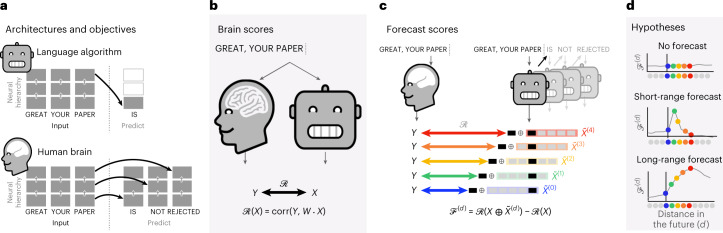
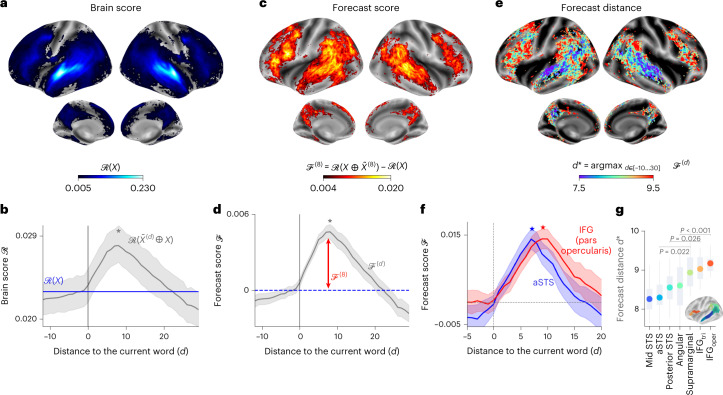
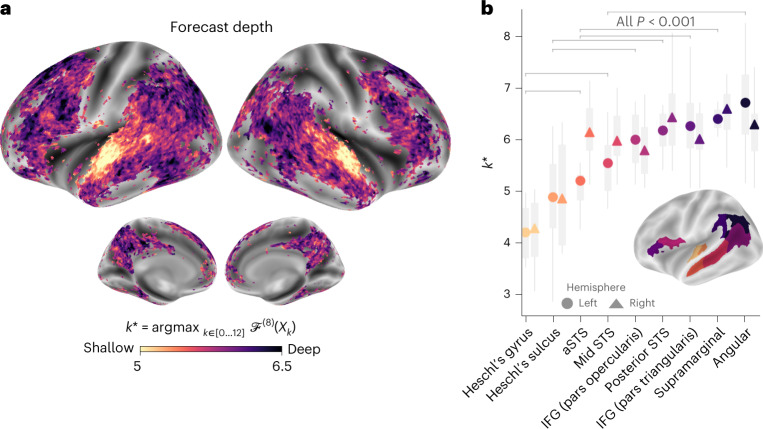
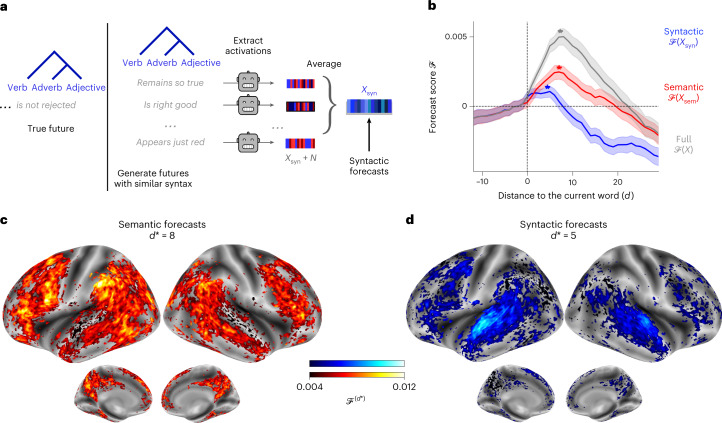
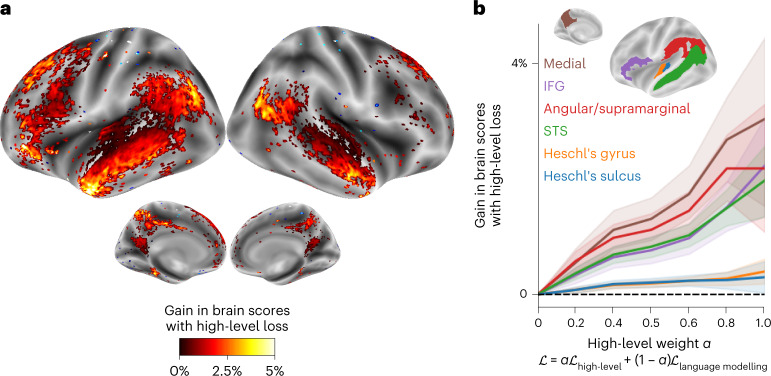
Considerable progress has recently been made in natural language processing: deep learning algorithms are increasingly able to generate, summarize, translate and classify texts. Yet, these language models still fail to match the language abilities of humans. Predictive coding theory offers a tentative explanation to this discrepancy: while language models are optimized to predict nearby words, the human brain would continuously predict a hierarchy of representations that spans multiple timescales. To test this hypothesis, we analysed the functional magnetic resonance imaging brain signals of 304 participants listening to short stories. First, we confirmed that the activations of modern language models linearly map onto the brain responses to speech. Second, we showed that enhancing these algorithms with predictions that span multiple timescales improves this brain mapping. Finally, we showed that these predictions are organized hierarchically: frontoparietal cortices predict higher-level, longer-range and more contextual representations than temporal cortices. Overall, these results strengthen the role of hierarchical predictive coding in language processing and illustrate how the synergy between neuroscience and artificial intelligence can unravel the computational bases of human cognition.
Overview
The claims and statistics of this paper haven’t been checked yet.
Free: it reads the open-access text and checks the first 5 claims that cite a source we can check. Create a free account to check every claim.
Integrity signals
Registry
Cites
Statistics
Figures
Verification
Claims the paper makes
The claims and statistics of this paper haven’t been checked yet.
Free: it reads the open-access text and checks the first 5 claims that cite a source we can check. Create a free account to check every claim.
Claims other papers make about this one
Each is checked against this paper’s own text: does it say what the citing paper says it does?
The cited source doesn’t support the claim as written.
In the citing paper
“Previous studies in the neural encoding literature all used LLMs that were only aware of the short-term context, i.e., where the context window size was as large as several tens of words1–10.”
From Incremental accumulation of linguistic context in artificial and biological neural networks (2025) · cites this paper as [5]
Checked by a reasoning model — may be wrong.
Experimental — accuracy not yet measuredThe source backs part of the claim, not all of it — or backs it for a different population, condition or comparison.
In the citing paper
“Additionally, we focused on the intermediate-to-deep layers ( 𝑙 = 2 3 𝑛 𝑙𝑎𝑦𝑒𝑟𝑠 ) of each LLM, as suggested by Caucheteux et al. (2023). These layers merit particular attention due to their demonstrated superior predictive capabilities for human brain activity (Schrimpf et al., 2021; Caucheteux and King, 2022; Caucheteux et al., 2023).”
From Can "consciousness" be observed from large language model (LLM) internal states? Dissecting LLM representations obtained from Theory of Mind test with Integrated Information Theory and Span Representation analysis (2025) · cites this paper as Caucheteux et al., 2023
Experimental — accuracy not yet measuredThe cited source says what the claim attributes to it.
In the citing paper
“Recent studies have increasingly explored LLM representations as analogs to neuroimaging data, aligning and comparing the human brain with the LLM”
From Can "consciousness" be observed from large language model (LLM) internal states? Dissecting LLM representations obtained from Theory of Mind test with Integrated Information Theory and Span Representation analysis (2025) · cites this paper as Caucheteux et al., 2023
The cited source says what the claim attributes to it.
In the citing paper
“This finding is consistent with previous studies, which suggest that the 2 3 layer is optimal for predicting human brain activity (Schrimpf et al., 2021; Caucheteux and King, 2022; Caucheteux et al., 2023).”
From Can "consciousness" be observed from large language model (LLM) internal states? Dissecting LLM representations obtained from Theory of Mind test with Integrated Information Theory and Span Representation analysis (2025) · cites this paper as Caucheteux et al., 2023
The cited source says what the claim attributes to it.
In the citing paper
“While LLM representations are being increasingly studied as analogs of neuroimaging data when comparing and aligning human brain activity with LLM”
From Can "consciousness" be observed from large language model (LLM) internal states? Dissecting LLM representations obtained from Theory of Mind test with Integrated Information Theory and Span Representation analysis (2025) · cites this paper as Caucheteux et al., 2023
3 more claims about this paper
Create a free account to see every claim other papers make about this one.
Self-check
Percentages, sums and reported differences re-computed from the paper’s own numbers.
The self-check needs the paper’s full text.
Citations
Cites
Vaswani, A., Shazeer, N., Parmar, N., Uszkoreit, J., Jones, L., Gomez, A. N., Kaiser, L., & Polosukhin, I. (2017) · arXiv · doi:10.48550/arxiv.1706.03762 · Cited by 120,404 · cited 10×
“For each word, (1) we generated n = 10”
BackgroundMethodResultInfluentialScikit-learn: Machine Learning in Python
Pedregosa, F., Varoquaux, G., Gramfort, A., Michel, V., Thirion, B., Grisel, O., Blondel, M., Müller, A., Nothman, J., Louppe, G., et al. (2012) · arXiv · doi:10.48550/arxiv.1201.0490 · Cited by 71,016
Self-citationGoing deeper with convolutions
Szegedy, C., Liu, W., Jia, Y., Sermanet, P., Reed, S., Anguelov, D., Erhan, D., Vanhoucke, V., & Rabinovich, A. (2015) · 2015 IEEE Conference on Computer Vision and Pattern Recognition (CVPR) · doi:10.1109/cvpr.2015.7298594 · Cited by 48,562
SciPy 1.0: fundamental algorithms for scientific computing in Python
Virtanen, P., Gommers, R., Oliphant, T. E., Haberland, M., Reddy, T., Cournapeau, D., Burovski, E., Peterson, P., Weckesser, W., Bright, J., et al. (2020) · Nature Methods · doi:10.1038/s41592-019-0686-2 · Cited by 38,430
Language Models are Few-Shot Learners
Brown, T. B., Mann, B., Ryder, N., Subbiah, M., Kaplan, J., Dhariwal, P., Neelakantan, A., Shyam, P., Sastry, G., Askell, A., et al. (2020) · arXiv · doi:10.48550/arxiv.2005.14165 · Cited by 23,372 · cited 8×
“with F(Xk) = R(Xk ⊕ X̃k (d) ) − R(Xk) (equation (3)).”
MethodResultInfluentialRoBERTa: A Robustly Optimized BERT Pretraining Approach
Liu, Y., Ott, M., Goyal, N., Du, J., Joshi, M., Chen, D., Levy, O., Lewis, M., Zettlemoyer, L., & Stoyanov, V. (2019) · arXiv · doi:10.48550/arxiv.1907.11692 · Cited by 16,515
Momentum Contrast for Unsupervised Visual Representation LearningPreprint
He, K., Fan, H., Wu, Y., Xie, S., & Girshick, R. B. (2019) · Computer Vision and Pattern Recognition · doi:10.48550/arxiv.1911.05722 · Cited by 16,321
Bellman, R. E. (2010) · doi:10.1515/9781400835386 · Cited by 14,588
Momentum Contrast for Unsupervised Visual Representation Learning
He, K., Fan, H., Wu, Y., Xie, S., & Girshick, R. (2020) · 2020 IEEE/CVF Conference on Computer Vision and Pattern Recognition (CVPR) · doi:10.1109/cvpr42600.2020.00975 · Cited by 13,347
Proceedings of the 24th international conference on Machine learning
(2007) · doi:10.1145/1273496 · Cited by 11,630
Research works printed but not linked: 5
- Toneva, M. & Wehbe, L. Interpreting and improving natural-language processing (in machines) with natural language-processing (in the brain). In Advances in Neural Information Processing Systems, Vol. 32 (Curran Associates, 2019).
- Holtzman, A., Buys, J., Maxwell Forbes, L. D. & Choi, Y. The curious case of neural text degeneration. In International Conference on Learning Representations (2020).
- Thakur, N., Reimers, N., Rücklé, A., Srivastava, A. & Gurevych, I. BEIR: a heterogenous benchmark for zero-shot evaluation of information retrieval models. In Thirty-fifth Conference on Neural Information Processing Systems Datasets and Benchmarks Track (Round 2) (2021).
- Devlin, J., Chang, M.-W., Lee, K. & Toutanova, K. BERT: pre-training of deep bidirectional transformers for language understanding. In Proceedings of the 2019 Conference of the North American Chapter of the Association for Computational Linguistics: Human Language Technologies, 1, 4171–4186, (Association for Computational Linguistics, 2019).
- Bardes, A., Ponce, J. & LeCun, Y. VICReg: variance-invariance-covariance regularization for self-supervised learning. In International Conference on Learning Representations (2022).
Cited by
The language network as a natural kind within the broader landscape of the human brain
Fedorenko, E., Ivanova, A. A., & Regev, T. I. (2024) · Nature Reviews Neuroscience · doi:10.1038/s41583-024-00802-4 · Cited by 293
“Indeed, this network is recruited for coherent texts more than for disconnected sentences 295,310,311 and can integrate information over multiple sentences 159,161,193,199,201 .”
BackgroundPrediction during language comprehension: what is next?
Ryskin, R., & Nieuwland, M. S. (2023) · Trends in Cognitive Sciences · doi:10.1016/j.tics.2023.08.003 · Cited by 165
“tigations find that models engaged in (hierarchical multiscale) prediction provide the best fit to brain data [4,60,62,192].”
Driving and suppressing the human language network using large language models
Tuckute, G., Sathe, A., Srikant, S., Taliaferro, M., Wang, M., Schrimpf, M., Kay, K., & Fedorenko, E. (2024) · Nature Human Behaviour · doi:10.1038/s41562-023-01783-7 · Cited by 69
“…the LLMs were not developed with the goal of modelling human language processing, some of these models (especially the unidirectional Transformer architectures 14 ) have a remarkable capacity to mimic human language behaviour 16,17 and predict brain activity during language processing 18–23 .”
Shared functional specialization in transformer-based language models and the human brain
Kumar, S., Sumers, T. R., Yamakoshi, T., Goldstein, A., Hasson, U., Norman, K. A., Griffiths, T. L., Hawkins, R. D., & Nastase, S. A. (2024) · Nature Communications · doi:10.1038/s41467-024-49173-5 · Cited by 86
Zada, Z., Goldstein, A., Michelmann, S., Simony, E., Price, A. R., Hasenfratz, L., Barham, E., Zadbood, A., Doyle, W., Friedman, D. J., et al. (2024) · Neuron · doi:10.1016/j.neuron.2024.06.025 · Cited by 104
Huang, K., Arehalli, S., Kugemoto, M., Muxica, C., Prasad, G., Dillon, B., & Linzen, T. (2023) · PsyArXiv (OSF Preprints) · doi:10.1016/j.jml.2024.104510 · Cited by 134
“…in our analyses stand in contrast to recent studies in which measures derived from next-word-prediction models explained a substantial portion of the variance in human measurements, in particular neuroimaging data (Caucheteux, Gramfort, & King, 2023; Goldstein et al., 2022; Schrimpf et al., 2021).”
Contextual feature extraction hierarchies converge in large language models and the brain
Mischler, G., Li, Y. A., Bickel, S., Mehta, A. D., & Mesgarani, N. (2024) · Nature Machine Intelligence · doi:10.1038/s42256-024-00925-4 · Cited by 112
“Some studies [10, 11] support the predictive coding hypothesis in human language processing by finding stronger similarities with autoregressive LLMs.”
The Digital Twin Brain: A Bridge between Biological and Artificial Intelligence
Xiong, H., Chu, C., Fan, L., Song, M. X., Zhang, J., Ma, Y., Zheng, R., Zhang, J., Yang, Z., & Jiang, T. (2023) · Intelligent Computing · doi:10.34133/icomputing.0055 · Cited by 80
“Similarly, CNNs have demonstrated correspondence with the functional activities of human brain when encountering the same acoustic stimuli 139-141 .”
BackgroundData science opportunities of large language models for neuroscience and biomedicine
Bzdok, D., Thieme, A., Levkovskyy, O., Wren, P. B., Ray, T. S., & Reddy, S. (2024) · Neuron · doi:10.1016/j.neuron.2024.01.016 · Cited by 72
Goldstein, A., Wang, H., Niekerken, L., Schain, M., Zada, Z., Aubrey, B., Sheffer, T., Nastase, S. A., Gazula, H., Singh, A., et al. (2025) · Nature Human Behaviour · doi:10.1038/s41562-025-02105-9 · Cited by 95
Allostatic Interoceptive Overload Across Psychiatric and Neurological Conditions
Santamaría-García, H., Migeot, J., Medel, V., Hazelton, J. L., Teckentrup, V., Romero-Ortuno, R., Piguet, O., Lawor, B., Northoff, G., & Ibanez, A. (2025) · Biological Psychiatry · doi:10.1016/j.biopsych.2024.06.024 · Cited by 65
“This framework is consistent with predictive coding, which states that the brain anticipates and models external demands based on internal cues and demands (16,20,58,59).”
A Survey on Continual Semantic Segmentation: Theory, Challenge, Method and Application
Yuan, B., & Zhao, D. (2024) · IEEE Transactions on Pattern Analysis and Machine Intelligence · doi:10.1109/tpami.2024.3446949 · Cited by 81
“[182]mapdeeplanguagemodelstobrainactiv-ityandquantitativelystudythesimilaritybetweendeeplanguagemodelsandthebrainwhentheinputcontentisthesame.”
Hierarchical dynamic coding coordinates speech comprehension in the human brain
Gwilliams, L., Marantz, A. P., Poeppel, D., & King, J.-R. (2025) · Proceedings of the National Academy of Sciences · doi:10.1073/pnas.2422097122 · Cited by 71
Self-citationGoldstein, A., Ham, E., Schain, M., Nastase, S. A., Aubrey, B., Zada, Z., Grinstein-Dabush, A., Gazula, H., Feder, A., Doyle, W., et al. (2025) · Nature Communications · doi:10.1038/s41467-025-65518-0 · Cited by 75
“Following prior work, we use GPT2-XL to demonstrate the fundamental similarities between LLMs and the brain 1,2,4,13 .”
Collective behavior from surprise minimization
Heins, C., Millidge, B., Da Costa, L., Mann, R. P., Friston, K. J., & Couzin, I. D. (2024) · Proceedings of the National Academy of Sciences · doi:10.1073/pnas.2320239121 · Cited by 55
Pulvermüller, F. (2023) · Progress in Neurobiology · doi:10.1016/j.pneurobio.2023.102511 · Cited by 55
“guage processing and generation at human performance levels but even successfully modeled data recorded from single neurons or whole brain neuroimaging (Caucheteux et al., 2023; Schrimpf et al., 2021).”
Trajectories through semantic spaces in schizophrenia and the relationship to ripple bursts
Nour, M. M., McNamee, D., Liu, Y., & Dolan, R. J. (2023) · Proceedings of the National Academy of Sciences · doi:10.1073/pnas.2305290120 · Cited by 56
Towards decoding individual words from non-invasive brain recordings
d’Ascoli, S., Bel, C., Rapin, J., Banville, H. J., Benchetrit, Y., Pallier, C., & King, J.-R. (2025) · Nature Communications · doi:10.1038/s41467-025-65499-0 · Cited by 77
Self-citationBrain-inspired artificial intelligence research: A review
Wang, G., Bao, H., Liu, Q., Zhou, T., Wu, S., Huang, T., Yu, Z., Lu, C., Gong, Y., Zhang, Z., et al. (2024) · Science China Technological Sciences · doi:10.1007/s11431-024-2732-9 · Cited by 47
“Developed in 2022 to explore the relationship between language understanding and deep language representation, Caucheteux et al. [97] uses a linear model to predict brain activity based on GPT-2 activation.”
Modeling Structure‐Building in the Brain With CCG Parsing and Large Language Models
Stanojević, M., Brennan, J., Dunagan, D. G., Steedman, M. J., & Hale, J. (2023) · Cognitive Science · doi:10.1111/cogs.13312 · Cited by 62
Language acquisition: do children and language models follow similar learning stages?
Evanson, L., Lakretz, Y., & King, J. R. (2023) · Findings of the Association for Computational Linguistics: ACL (Findings of ACL) · doi:10.18653/v1/2023.findings-acl.773 · Cited by 82
Self-citationHovsepyan, S., Olasagasti, I., & Giraud, A. (2023) · PLoS Computational Biology · doi:10.1371/journal.pcbi.1011595 · Cited by 38
Exploring mechanisms of psychedelic action using neuroimaging
Erritzøe, D., Timmermann, C., Godfrey, K., Castro-Rodrigues, P., Peill, J. M., Carhart-Harris, R. L., Nutt, D. J., & Wall, M. B. (2024) · Nature Mental Health · doi:10.1038/s44220-023-00172-3 · Cited by 42
“As an example, recent evidence shows that human speech perception is associated with brain activity that predicts semantic and syntactic features over a range of timescales 129 .”
Neural populations in the language network differ in the size of their temporal receptive windows
Regev, T. I., Casto, C., Hosseini, E. A., Adamek, M., Ritaccio, A. L., Willie, J. T., Brunner, P., & Fedorenko, E. G. (2024) · Nature Human Behaviour · doi:10.1038/s41562-024-01944-2 · Cited by 47
“Past fMRI studies have shown that the TRW of the language system is somewhere between a word and a sentence (e.g., Lerner et al., 2011; Jacoby and Fedorenko, 2020; Blank and Fedorenko, 2020; Jain et al., 2020; Caucheteux et al., 2023), although some recent work suggests that the language network may even be sensitive…”
BackgroundSpurious reconstruction from brain activity
Shirakawa, K., Nagano, Y., Tanaka, M., Aoki, S., Muraki, Y., Majima, K., & Kamitani, Y. (2025) · Neural Networks · doi:10.1016/j.neunet.2025.107515 · Cited by 44
Large Language Models Are Human-Like Internally
Kuribayashi, T., Oseki, Y., Taieb, S. B., Inui, K., & Baldwin, T. (2025) · Transactions of the Association for Computational Linguistics · doi:10.1162/tacl.a.58 · Cited by 56
ROSE: A Universal Neural Grammar
Murphy, E. (2025) · Cognitive Neuroscience · doi:10.1080/17588928.2025.2523875 · Cited by 33
“…Chomsky, 2013, 2023, Chomsky et al., 2019, 2023; Friederici, 2017; Murphy, 2023, 2024; Murphy, Holmes et al., 2024) or predictive processing (e.g., Caucheteux et al., 2023; Kwiatkowski et al., 2012; Schrimpf et al., 2021; Zhou et al., 2025), without a means for integration (but see Martin, 2020;…”
Large-scale foundation models and generative AI for BigData neuroscience
Wang, R., & Chen, Z. S. (2024) · Neuroscience Research · doi:10.1016/j.neures.2024.06.003 · Cited by 34
Yu, S., Gu, C., Huang, K., & Li, P. (2024) · Science Advances · doi:10.1126/sciadv.adn7744 · Cited by 40
“This multilayered nature of human language comprehension is shown in recent findings that the brain predicts multiple ranges and levels of language representations ( 17 ).”
BackgroundThe “Podcast” ECoG dataset for modeling neural activity during natural language comprehension
Zada, Z., Nastase, S. A., Aubrey, B., Jalon, I., Michelmann, S., Wang, H., Hasenfratz, L., Doyle, W., Friedman, D. J., Dugan, P. C., et al. (2025) · Scientific Data · doi:10.1038/s41597-025-05462-2 · Cited by 35
Hadidi, N., Feghhi, E., Song, B. H., Blank, I., & Kao, J. C. (2026) · Nature Communications · doi:10.1038/s41467-026-72253-7 · Cited by 30
Sharpe, V. P., Mackinley, M., Eddine, S. N., Wang, L., Palaniyappan, L. K., & Kuperberg, G. R. (2025) · Biological Psychiatry · doi:10.1016/j.biopsych.2025.06.001 · Cited by 28
Investigating the Perception of the Future in GPT-3, -3.5 and GPT-4
Kozachek, D. (2023) · Creativity and Cognition · doi:10.1145/3591196.3596827 · Cited by 25
“Complex predictions occur over multiple timescales and levels of representations across the cortical hierarchy [3].”
BackgroundIncremental accumulation of linguistic context in artificial and biological neural networks
Tikochinski, R., Goldstein, A., Meiri, Y., Hasson, U., & Reichart, R. (2025) · Nature Communications · doi:10.1038/s41467-025-56162-9 · Cited by 24
Dissociating prosodic from syntactic delta activity during natural speech comprehension
Chalas, N., Meyer, L., Lo, C.-W., Park, H., Kluger, D. S., Abbasi, O., Kayser, C., Nitsch, R., & Groß, J. (2024) · Current Biology · doi:10.1016/j.cub.2024.06.072 · Cited by 27
“Here, the profound increase in accuracy with chunk onsets might reflect long-term memory processes, which align (in a feedback manner) to contextual dependencies acquired through development, 90 and facilitating predictions, 91 accessed through long temporal integration windows.”
Yadulla, A. R., Sajja, G. S., Addula, S. R., Maturi, M. H., Nadella, G. S., Cruz, E. D. L., Meduri, K., & Gonaygunta, H. (2025) · Psychology International · doi:10.3390/psycholint7030061 · Cited by 28
“According to predictive coding theory, the brain operates as a prediction machine that continuously generates and updates internal models of the world based on sensory inputs (Caucheteux et al., 2023; Ficco et al., 2021).”
Zhang, T., Zhou, S., Bai, X., Zhou, F., Zhai, Y., Long, Y., & Lu, C. (2023) · NeuroImage · doi:10.1016/j.neuroimage.2023.120400 · Cited by 21
“, BOLD signal) and the reconstructed signal has been widely used for selecting the best models (Caucheteux et al., 2023; Goldstein et al., 2022; Heilbron et al., 2022).”
Schönmann, I., Szewczyk, J., de Lange, F. P., & Heilbron, M. (2026) · eLife · doi:10.7554/elife.106543 · Cited by 20
“On first consideration, encoding modelling provides a new and more direct line of evidence that can assess pre-stimulus prediction ( Schrimpf et al., 2021 ; Goldstein et al., 2022b ; Caucheteux et al., 2023 ; Azizpour et al., 2024 ).”
Fan, Y., Wang, M., Fang, F., Ding, N., & Luo, H. (2024) · Nature Human Behaviour · doi:10.1038/s41562-024-02047-8 · Cited by 24
“D neural geometry arises from same brain regions, largely excluding the possibility that the two representational dimensions are mediated by dissociated brain areas, for example, lower-and higher-level regions 6,9,61 .”
Anderson, A. J., Davis, C., & Lalor, E. C. (2024) · PLoS Computational Biology · doi:10.1371/journal.pcbi.1012537 · Cited by 23
Karunathilake, I. M. D., Brodbeck, C., Bhattasali, S., Resnik, P., & Simon, J. Z. (2025) · The Journal of Neuroscience · doi:10.1523/jneurosci.1143-24.2025 · Cited by 20
Third‐order self‐embedded vocal motifs in wild orangutans, and the selective evolution of recursion
Gregorio, C. D., Gamba, M., & Lameira, A. R. (2025) · Annals of the New York Academy of Sciences · doi:10.1111/nyas.15373 · Cited by 19
Deep speech-to-text models capture the neural basis of spontaneous speech in everyday conversationsPreprint
Goldstein, A., Wang, H., Niekerken, L., Zada, Z., Aubrey, B., Sheffer, T., Nastase, S. A., Gazula, H., Schain, M., Singh, A., et al. (2023) · bioRxiv (Cold Spring Harbor Laboratory) · doi:10.1101/2023.06.26.546557 · Cited by 23
Guided by Expectations: Overweighted Semantic Priors in Schizotypy and Their Links to Glutamate
Knolle, F., Sterner, E., Demler, V. F., MacGregor, L. J., & Mathys, C. D. (2025) · Biological Psychiatry · doi:10.1016/j.biopsych.2025.06.025 · Cited by 22
Synthetic surprise as the foundation of the psychedelic experience
Filippo, R. D., & Schmitz, D. (2024) · Neuroscience & Biobehavioral Reviews · doi:10.1016/j.neubiorev.2024.105538 · Cited by 19
He, Y., Shao, X., Liu, C., Fan, C., Jefferies, E., Zhang, M., & Li, X. (2024) · Journal of Neuroscience · doi:10.1523/jneurosci.1404-24.2024 · Cited by 17
“Given the importance of IFG and TPJ within fronto-parietal cortices in semantic prediction (Siman-Tov et al., 2019; Caucheteux et al., 2023), we aimed to explore (1) the changes in the connectivity patterns of these core regions depending on the strength of prediction that is possible for a…”
InfluentialEmergence of syntax and word prediction in an artificial neural circuit of the cerebellum
Ohmae, K., & Ohmae, S. (2024) · Nature Communications · doi:10.1038/s41467-024-44801-6 · Cited by 17
Constituent-constrained word prediction during language comprehension
Zou, J., Poeppel, D., & Ding, N. (2026) · Nature Neuroscience · doi:10.1038/s41593-026-02272-6 · Cited by 17
“Recent developments in predictive coding also emphasize that predictions occur at different linguistic levels 3,45 .”
Beyond Markov: Transformers, memory, and attention
Parr, T., Pezzulo, G., & Friston, K. J. (2025) · Cognitive Neuroscience · doi:10.1080/17588928.2025.2484485 · Cited by 18
Direct brain recordings reveal implicit encoding of structure in random auditory streams
Fuhrer, J., Glette, K., Ivanović, J., Larsson, P. G., Bekinschtein, T. A., Kochen, S. S., Knight, R. T., Tørresen, J., Solbakk, A., Endestad, T., et al. (2025) · Scientific Reports · doi:10.1038/s41598-025-98865-5 · Cited by 17
Ferrante, M., Boccato, T., Rashkov, G., & Toschi, N. (2025) · Information Fusion · doi:10.1016/j.inffus.2025.103650 · Cited by 20
Temporal integration in human auditory cortex is predominantly yoked to absolute time
Norman-Haignere, S., Keshishian, M., Devinsky, O., Doyle, W., McKhann, G. M., Schevon, C. A., Flinker, A., & Mesgarani, N. (2025) · Nature Neuroscience · doi:10.1038/s41593-025-02060-8 · Cited by 20
“Similarly, language models that integrate across words and word pieces implicitly assume that the integration window varies with word duration 21–23 .”
Human cortical dynamics of auditory word form encoding
Zhang, Y., Leonard, M. K., Bhaya-Grossman, I., Gwilliams, L., & Chang, E. F. (2025) · Neuron · doi:10.1016/j.neuron.2025.10.011 · Cited by 19
Zada, Z., Nastase, S. A., Speer, S. P. H., Mwilambwe-Tshilobo, L., Tsoi, L., Burns, S. M., Falk, E. B., Hasson, U., & Tamir, D. (2025) · Neuron · doi:10.1016/j.neuron.2025.11.004 · Cited by 18
“…neural systems for the comprehension of natural language: for example, that representations for a single word depend on context (Goldstein et al., 2022) and that language processing involves prediction (Caucheteux et al., 2023; Goldstein et al., 2022; Heilbron et al., 2022; Schrimpf et al., 2021).”
Zhang, X., Li, J., Li, Z., Hong, B., Diao, T., Ma, X., Nolte, G., Engel, A. K., & Zhang, D. (2023) · NeuroImage · doi:10.1016/j.neuroimage.2023.120404 · Cited by 17
Imagination vs. routines: festive time, weekly time, and the predictive brain
Bortolotti, A., Conti, A., Romagnoli, A., & Sacco, P. L. (2024) · Frontiers in Human Neuroscience · doi:10.3389/fnhum.2024.1357354 · Cited by 13
Spatiotemporal Mapping of Auditory Onsets during Speech Production
Kurteff, G., Field, A. M., Asghar, S., Tyler‐Kabara, E. C., Clarke, D., Weiner, H. L., Anderson, A. E., Watrous, A. J., Buchanan, R. J., Modur, P. N., et al. (2024) · Journal of Neuroscience · doi:10.1523/jneurosci.1109-24.2024 · Cited by 15
Finding structure during incremental speech comprehension
Lyu, B., Marslen‐Wilson, W. D., Fang, Y., & TYLER, L. K. (2024) · eLife · doi:10.7554/elife.89311 · Cited by 13
PC-SNN: Predictive coding-based local Hebbian plasticity learning in spiking neural networks
Wang, H., Xiong, X., Lan, M., Chu, Y., Jiang, Z., Santosh, K., Wang, S., & Zhong, R. (2026) · Neurocomputing · doi:10.1016/j.neucom.2026.133421 · Cited by 15
“…and biological plausibility Our PC-SNN framework relies on a Hebbian-based rule to regulate synaptic plasticity, controlled entirely by local nodes which shares similarities with synaptic plasticity in the human brain (Lillicrap et al., 2020; Caucheteux et al., 2023; Lillicrap et al., 2016).”
Marais, A.-L., & Roche-Labarbe, N. (2025) · Developmental Cognitive Neuroscience · doi:10.1016/j.dcn.2025.101519 · Cited by 12
Syntactic bootstrapping as a mechanism for language learning
Babineau, M., Barbir, M., de Carvalho, A., Havron, N., Dautriche, I., & Christophe, A. (2024) · Nature Reviews Psychology · doi:10.1038/s44159-024-00317-w · Cited by 16
“Predictive coding has been empirically demonstrated across cognitive domains, from low-level perceptual processing, such as vision 144,147 , to high-level cognitive processing, such as language 148,149 (for a meta-analysis, see ref.”
Predictive Coding Networks and Inference Learning: Tutorial and Survey
van Zwol, B. H., Jefferson, R., & van den Broek, E. L. (2026) · ACM Computing Surveys · doi:10.1145/3797870 · Cited by 13
“In 2017, Whittington & Bogacz applied PCNs to supervised learning tasks, revealing notable properties that connect them to traditional feedforward neural networks (FNNs).”
RDoC Framework Through the Lens of Predictive Processing: Focusing on Cognitive Systems Domain
Banaraki, A. K., Toghi, A., & Mohammadzadeh, A. (2024) · Computational Psychiatry · doi:10.5334/cpsy.119 · Cited by 12
“Towards a mechanistic understanding of this interplay, Caucheteux et al. (2023) fit deep language algorithms with long-range predictions to fMRI brain activation of 304 participants while listening to spoken language.”
BackgroundMetacognition in the listening brain
Obleser, J. (2025) · Trends in Neurosciences · doi:10.1016/j.tins.2024.12.007 · Cited by 12
Conversational content is organized across multiple timescales in the brain
Yamashita, M., Kubo, R., & Nishimoto, S. (2025) · Nature Human Behaviour · doi:10.1038/s41562-025-02231-4 · Cited by 15
“This procedure is described in detail in the Methods section under "Variance partitioning”: “For TRs containing single (either production or comprehension) or overlapping conditions (production and comprehension), we applied variance partitioning consistently.””
InfluentialTowards large language models with human-like episodic memory
Dong, C., Lu, Q., Norman, K. A., & Michelmann, S. (2025) · Trends in Cognitive Sciences · doi:10.1016/j.tics.2025.06.016 · Cited by 28
Dogonasheva, O., Doelling, K. B., Геннадьевич, З. Д., Giraud, A., & Gutkin, B. S. (2025) · Nature Computational Science · doi:10.1038/s43588-025-00876-9 · Cited by 12
Gu, C., Nastase, S. A., Zada, Z., & Li, P. (2025) · npj Science of Learning · doi:10.1038/s41539-025-00337-y · Cited by 16
“Support for this principle has documented the superior performance of contextual embeddings in predicting brain activity in higher-order (e.g., prefrontal and temporal cortices) and lower-order auditory/visual regions 2,4,5,8 .”
InfluentialBrainWavLM: Fine-tuning Speech Representations with Brain Responses to LanguagePreprint
Vattikonda, N., Vaidya, A. R., Antonello, R., & Huth, A. G. (2025) · arXiv (Cornell University) · doi:10.48550/arxiv.2502.08866 · Cited by 16
“Estimated encoding models can then be used to study which types of information are represented in each brain area and many other questions [Goldstein et al., 2022, Ivanova et al., 2022, Caucheteux et al., 2023, Tang et al., 2023, Weissbart and Martin, 2024].”
Palma, R. D., Falco, L., Coccia, A., Amitrano, F., Pagano, G., & D’Addio, G. (2025) · Frontiers in Neurology · doi:10.3389/fneur.2025.1638254 · Cited by 10
“Predictive coding theory further attributes frontoparietal regions with generating higher-level, contextual predictions beyond those in sensory cortices, especially during complex tasks like working memory and language comprehension (7, 8).”
Progress, challenges and future of linguistic neural decoding with deep learning
Wang, Y., Liu, H., Wang, Y., Xuan, C., Hou, Y., Feng, S., Liu, H., Liao, Y., & Wang, Y. (2025) · Communications Biology · doi:10.1038/s42003-025-08511-z · Cited by 15
“Predictive processing funda-mentallyformsthecomprehensionmechanisms,occurringhierarchicallyin bothacousticandlinguisticlevels 13 – 16 .”
Hosseini, E. A., & Fedorenko, E. G. (2023) · bioRxiv (Cold Spring Harbor Laboratory) · doi:10.1101/2023.11.05.564832 · Cited by 11
“…explain why representations from the middle layers of transformer language models align best with human neural responses during language processing (e.g., Schrimpf et al., 2021; Goldstein et al., 2022; Caucheteux and King, 2022; Caucheteux et al., 2023; Toneva and Wehbe, 2019; Jain and Huth, 2018).”
BackgroundArtificial Self-Awareness Over TimePreprint
Mousavi, S. K. (2024) · Qeios · doi:10.32388/ylxn96 · Cited by 10
“Predictive coding of auditory information is a natural process in the human brain [17] .”
BackgroundContrastive representation learning with transformers for robust auditory EEG decoding
Bollens, L., Accou, B., hamme, H. V., & Francart, T. (2025) · Scientific Reports · doi:10.1038/s41598-025-13646-4 · Cited by 13
Neuro-oscillatory models of cortical speech processing
Dogonasheva, O., Giraud, A., Геннадьевич, З. Д., & Gutkin, B. S. (2025) · Neural Networks · doi:10.1016/j.neunet.2025.108194 · Cited by 11
Zhou, F., Zhou, S., Long, Y., Flinker, A., & Lu, C. (2025) · Communications Biology · doi:10.1038/s42003-025-09377-x · Cited by 11
“Toourknowledge,thislineofresearchisstillunderstudied,withonly afewstudiesbeginningtoexploreitrecently 25,26 .”
Wang, L., Eddine, S. N., Brothers, T. A., Jensen, O. B., & Kuperberg, G. R. (2024) · NeuroImage · doi:10.1016/j.neuroimage.2024.120977 · Cited by 9
“…and taken as evidence for a computational framework known as predictive coding (Blank and Davis, 2016; Bornkessel-Schlesewsky and Schlesewsky, 2019; Caucheteux et al., 2023; Kuperberg et al. 2020; Price and Devlin, 2011; Rabovsky and McRae, 2014; Sohoglu and Davis, 2020; Wang et al., 2023; Xiang…”
Prinz, R., Bücher, P., Kun, Á., Paredes, O., Aragno, A., Shelby, C. L., Gumbel, M., Fimmel, E., & Strüngmann, L. (2025) · Biosystems · doi:10.1016/j.biosystems.2025.105515 · Cited by 10
Recurrent neural networks as neuro-computational models of human speech recognition
Brodbeck, C. J., Hannagan, T., & Magnuson, J. S. (2025) · PLoS Computational Biology · doi:10.1371/journal.pcbi.1013244 · Cited by 9
“For comparison, phoneme onsets derived from forced alignment improved predictions by 0.2% over the baseline model, and phoneme surprisal improved them by another 0.4%.”
InfluentialAI shares emotion with humans across languages and culturesPreprint
Xiangshu, W. U., Wang, H., Yan, Z., Tang, X., Xu, P., Siok, W. T., Li, P., Gao, J., Lyu, B., & Qin, L. (2025) · arXiv (Cornell University) · doi:10.48550/arxiv.2506.13978 · Cited by 14
Sohoglu, E., Beckers, L., & Davis, M. H. (2024) · Nature Communications · doi:10.1038/s41467-024-53782-5 · Cited by 13
“49,50,57 – 59).”
Freteault, M., Clei, M. L., Tetrel, L., Bellec, P., & Farrugia, N. (2025) · Imaging Neuroscience · doi:10.1162/imag_a_00525 · Cited by 14
“More recently, Giordano et al. (2023) provided further evidence for the intermediary role of the superior temporal gyrus (STG) in auditory processing using three different CNNs, while Caucheteux et al. (2023) use of a modified GPT-2 provided new insights into predictive coding theory.”
InfluentialOn the limits of LLM surprisal as a functional explanation of the N400 and P600
Krieger, B., Brouwer, H., Aurnhammer, C., & Crocker, M. W. (2025) · Brain Research · doi:10.1016/j.brainres.2025.149841 · Cited by 10
“From a broader methodological perspective, Caucheteux et al. (2023) view their results as illustrating ‘‘how the synergy between neuroscience and artificial intelligence can unravel the computational bases of human cognition’’.”
Understanding semantic impairments in schizophrenia from a predictive coding perspective
Matsumoto, Y., Hayashi, R., & Takahashi, H. (2025) · Neuroscience Research · doi:10.1016/j.neures.2025.104990 · Cited by 9
Donnarumma, F., Frosolone, M., & Pezzulo, G. (2025) · Physics of Life Reviews · doi:10.1016/j.plrev.2025.08.008 · Cited by 8
Ye, H., Song, P., Xu, H., Li, Q., Chen, Y., Zhai, Y., Chang, C., Bao, X., Tanigawa, H., Tu, Z., et al. (2025) · Research · doi:10.34133/research.0960 · Cited by 8
“However, it is important to note that most investigations of temporal processing across multiple scales have been conducted in humans, typically using spoken language and macroscopic recording techniques [ 2 , 4 , 5 ], which together limit direct access to underlying neuronal mechanisms.”
Attention, not scale, drives human-AI alignment in multimodal language prediction
Kewenig, V. N., Lampinen, A. K., Nastase, S. A., Edwards, C., D’Elascombe, Q., Rechardt, A., Skipper, J. I., & Vigliocco, G. (2026) · npj Artificial Intelligence · doi:10.1038/s44387-026-00086-2 · Cited by 7
Can prediction error explain predictability effects on the N1 during picture-word verification?
Taylor, J. E., Rousselet, G. A., & Sereno, S. C. (2024) · Imaging Neuroscience · doi:10.1162/imag_a_00131 · Cited by 9
Yakura, H. (2024) · Journal of Intelligence · doi:10.3390/jintelligence12070070 · Cited by 10
“This study aimed to evaluate the capabilities of LLMs in comprehending figurative language, specifically metaphors and sarcasm.”
BackgroundZhang, Y., Wang, S., Lin, N., Fan, L., & Zong, C. (2025) · NeuroImage · doi:10.1016/j.neuroimage.2025.121096 · Cited by 12
Speech Neurophysiology in Realistic Contexts: Big Hype or Big Leap?
Liberto, G. M. D., & Ip, E. Y. J. (2026) · European Journal of Neuroscience · doi:10.1111/ejn.70496 · Cited by 7
“Interestingly, recent work related LLM embeddings at progressively deeper hidden layers with neural activity, tracing a precise neural pathway for the speech- to-meaning transformation in a data-driven manner (Caucheteux et al. 2022, 2023; Mischler et al. 2024).”
Is self-supervised learning enough to fill in the gap? A study on speech inpainting
Asaad, I., Jacquelin, M., Perrotin, O., Girin, L., & Hueber, T. (2025) · Computer Speech & Language · doi:10.1016/j.csl.2025.101922 · Cited by 8
Tarder-Stoll, H., Baldassano, C. A., & Aly, M. (2024) · Psychological Science · doi:10.1177/09567976241256617 · Cited by 8
The self, its body and its brain
Overgaard, M. S., Preston, C., & Aspell, J. E. (2023) · Scientific Reports · doi:10.1038/s41598-023-39959-w · Cited by 7
Azizpour, S., Westner, B. U., Szewczyk, J., Güçlü, U., & Geerligs, L. (2026) · eLife · doi:10.7554/elife.110085.1 · Cited by 7
“Here we applied a similar approach as Caucheteux et al. ( 2023 ) to test whether including future word embed-dings enhances model performance.”
InfluentialKeshishian, M., Mischler, G., Thomas, S., Kingsbury, B. E. D., Bickel, S., Mehta, A. D., & Mesgarani, N. (2026) · Nature Machine Intelligence · doi:10.1038/s42256-026-01185-0 · Cited by 7
“The post-implantation CT and MRI scans were co-registered to the preoperative MRI scan using FSL’s BET and FLIRT algorithms 70–72 .”
InfluentialLinguistics and human brain: a perspective of computational neuroscience
Zhang, F., Chai, B., Wu, Y., Siok, W. T., & Wang, N. (2026) · Cognitive Neurodynamics · doi:10.1007/s11571-026-10496-2 · Cited by 7
“…positions them as a distinctive mesoscale computational reference frame (Kriegeskorte and Douglas 2018; Schrimpf et al. 2021; An et al. 2025; Goldstein et al. 2022; Caucheteux and King 2022; Wang et al. 2024; Cai et al. 2024; Caucheteux et al. 2023; Radford and Narasimhan 2018; Oniani et al. 2024).”
The conductor model of consciousness, our neuromorphic twins, and the human-AI deal
Benitez, F., Pennartz, C. M. A., & Senn, W. (2024) · AI and Ethics · doi:10.1007/s43681-024-00580-w · Cited by 7
Bailey, L. M., Matheson, H. E., Fawcett, J. M., Bodner, G. E., & Newman, A. J. (2025) · Imaging Neuroscience · doi:10.1162/imag_a_00428 · Cited by 7
The cortical architecture representing the linguistic hierarchy of the conversational speech
Aili, R., Zhou, S., Xu, X., He, X., & Lu, C. (2025) · NeuroImage · doi:10.1016/j.neuroimage.2025.121180 · Cited by 7
Metadata
- Authors
- Caucheteux, C., Gramfort, A., & King, J.-R.
- Affiliations
- Institut national de recherche en sciences et technologies du numérique (FR)
- Centre National de la Recherche Scientifique (FR)
- Corresponding author
- Caucheteux, Charlotte
- King, Jean-Rémi
- Venue
- Nature Human Behaviour
- Published
- 2023-03-02
- Volume
- 7
- Issue
- 3
- Pages
- 430-441
- ISSN
- 2397-3374 (ISSN-L)
- PMC
- PMC10038805
- OpenAlex
- W4322766928
- Semantic Scholar
- 66c286df54551baba7351a1ed44019367e5aa7ea
- Cited by
- 308
- References
- 82
- Citations by year
- 2026: 78 · 2025: 109 · 2024: 76 · 2023: 43
- FWCI
- 45.83
- Type
- journal article
- Language
- en
- Open access
- hybrid
- doi.org
- Licence
- cc-by
- creativecommons.org/licenses/by/4.0 (tdm)
- creativecommons.org/licenses/by/4.0 (vor)
- Locations
- Nature Human Behaviour (publishedVersion, cc-by)
- PubMed Central (publishedVersion, cc-by)
- PubMed (publishedVersion)
- HAL (submittedVersion, other-oa)
- RePEc: Research Papers in Economics (submittedVersion)
- Funders
- Philippe Foundation
- Agence Nationale de la Recherche (ANR-17-EURE-, ANR-17-EURE-0017, ANR-17)
- Université de Recherche Paris Sciences et Lettres (ANR-17-EURE-0017)
- Topics
- Life Sciences › Neuroscience › Cognitive Neuroscience › Neurobiology of Language and Bilingualism
- Life Sciences › Neuroscience › Cognitive Neuroscience › Neuroscience and Music Perception
- Social Sciences › Psychology › Developmental and Educational Psychology › Reading and Literacy Development
- Keywords
- predictive coding, hierarchical predictive coding, speech perception, language processing, natural language models, short stories, frontoparietal cortex, temporal cortex, multiple time scales, computational neuroscience, artificial intelligence
- MeSH terms
- Artificial Intelligence, Auditory Perception, Brain, Humans, Speech, Temporal Lobe
About these checks
Registry, retraction, Cites and statistics results are computed, not judged, with one exception: a printed reference that no index lists is read once by a model before it counts as a citation error. Claims are extracted by a model and kept only when their quote appears verbatim in the text; each cited source is then checked, with a model’s help, for whether it says what the claim relies on. Those verdicts can be wrong — read the claim’s quote and the cited source before relying on one.
Statistics and arithmetic are recomputed, not judged.
Confidence bands are shown only for fields calibrated on our annotated test set. None is calibrated yet, so no band is shown.
What counts as a claim ›How we measure confidence ›How we check this ›
Are you an author, or do you see a problem with this page? Request a review
Data sources
Bibliographic data: Semantic Scholar, OpenAlex, Crossref.
Contains information from the Semantic Scholar Academic Graph Datasets, made available under the ODC Attribution License (ODC-BY 1.0).
Semantic Scholar’s data is described in: Kinney, R., et al. (2023). The Semantic Scholar Open Data Platform. arXiv:2301.10140.
