

Evidence of a predictive coding hierarchy in the human brain listening to speech
Open accessThe DOI matches its Crossref record; 92 of the 92 references it cites were found in a registry or an index.
Abstract
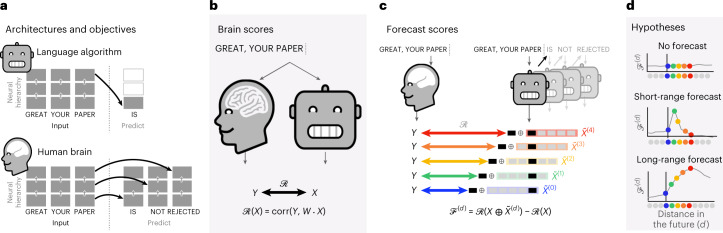
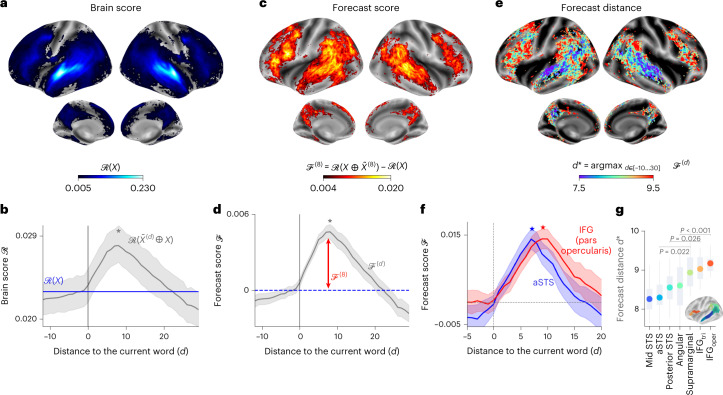
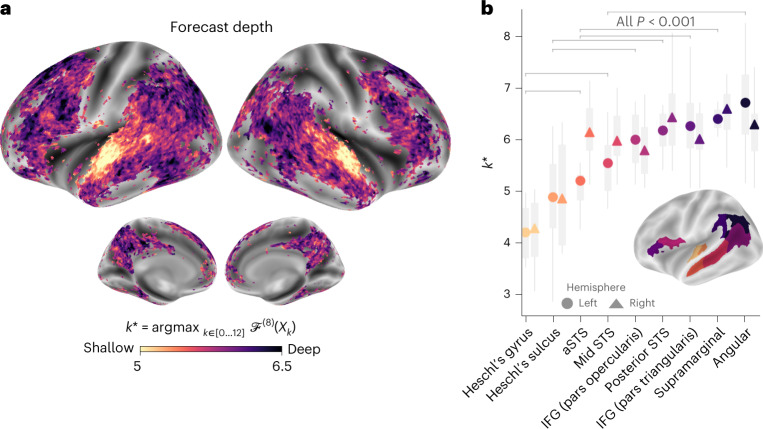
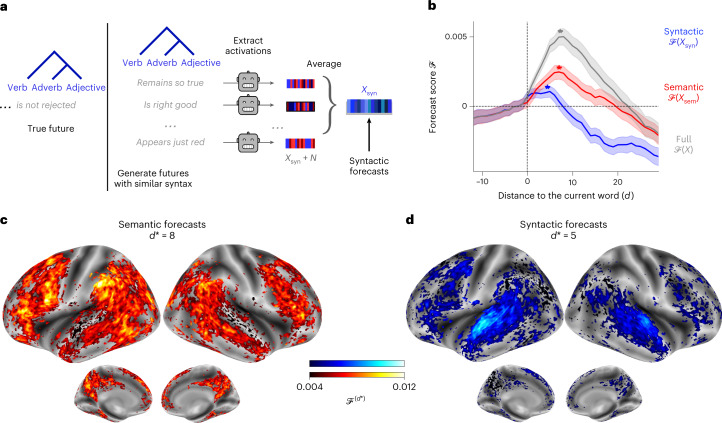
Considerable progress has recently been made in natural language processing: deep learning algorithms are increasingly able to generate, summarize, translate and classify texts. Yet, these language models still fail to match the language abilities of humans. Predictive coding theory offers a tentative explanation to this discrepancy: while language models are optimized to predict nearby words, the human brain would continuously predict a hierarchy of representations that spans multiple timescales. To test this hypothesis, we analysed the functional magnetic resonance imaging brain signals of 304 participants listening to short stories. First, we confirmed that the activations of modern language models linearly map onto the brain responses to speech. Second, we showed that enhancing these algorithms with predictions that span multiple timescales improves this brain mapping. Finally, we showed that these predictions are organized hierarchically: frontoparietal cortices predict higher-level, longer-range and more contextual representations than temporal cortices. Overall, these results strengthen the role of hierarchical predictive coding in language processing and illustrate how the synergy between neuroscience and artificial intelligence can unravel the computational bases of human cognition.
Overview
The claims and statistics of this paper haven’t been checked yet.
Free: it reads the open-access text and checks the first 5 claims that cite a source we can check. Create a free account to check every claim.
Integrity signals
Registry
Cites
Statistics
Figures
Verification
Claims the paper makes
The claims and statistics of this paper haven’t been checked yet.
Free: it reads the open-access text and checks the first 5 claims that cite a source we can check. Create a free account to check every claim.
Claims other papers make about this one
Each is checked against this paper’s own text: does it say what the citing paper says it does?
The cited source doesn’t support the claim as written.
In the citing paper
“Previous studies in the neural encoding literature all used LLMs that were only aware of the short-term context, i.e., where the context window size was as large as several tens of words1–10.”
From Incremental accumulation of linguistic context in artificial and biological neural networks (2025) · cites this paper as [5]
Checked by a reasoning model — may be wrong.
Experimental — accuracy not yet measuredThe source backs part of the claim, not all of it — or backs it for a different population, condition or comparison.
In the citing paper
“Additionally, we focused on the intermediate-to-deep layers ( 𝑙 = 2 3 𝑛 𝑙𝑎𝑦𝑒𝑟𝑠 ) of each LLM, as suggested by Caucheteux et al. (2023). These layers merit particular attention due to their demonstrated superior predictive capabilities for human brain activity (Schrimpf et al., 2021; Caucheteux and King, 2022; Caucheteux et al., 2023).”
From Can "consciousness" be observed from large language model (LLM) internal states? Dissecting LLM representations obtained from Theory of Mind test with Integrated Information Theory and Span Representation analysis (2025) · cites this paper as Caucheteux et al., 2023
Experimental — accuracy not yet measuredThe cited source says what the claim attributes to it.
In the citing paper
“Recent studies have increasingly explored LLM representations as analogs to neuroimaging data, aligning and comparing the human brain with the LLM”
From Can "consciousness" be observed from large language model (LLM) internal states? Dissecting LLM representations obtained from Theory of Mind test with Integrated Information Theory and Span Representation analysis (2025) · cites this paper as Caucheteux et al., 2023
The cited source says what the claim attributes to it.
In the citing paper
“This finding is consistent with previous studies, which suggest that the 2 3 layer is optimal for predicting human brain activity (Schrimpf et al., 2021; Caucheteux and King, 2022; Caucheteux et al., 2023).”
From Can "consciousness" be observed from large language model (LLM) internal states? Dissecting LLM representations obtained from Theory of Mind test with Integrated Information Theory and Span Representation analysis (2025) · cites this paper as Caucheteux et al., 2023
The cited source says what the claim attributes to it.
In the citing paper
“While LLM representations are being increasingly studied as analogs of neuroimaging data when comparing and aligning human brain activity with LLM”
From Can "consciousness" be observed from large language model (LLM) internal states? Dissecting LLM representations obtained from Theory of Mind test with Integrated Information Theory and Span Representation analysis (2025) · cites this paper as Caucheteux et al., 2023
3 more claims about this paper
Create a free account to see every claim other papers make about this one.
Self-check
Percentages, sums and reported differences re-computed from the paper’s own numbers.
The self-check needs the paper’s full text.
Citations
Cites
Vaswani, A., Shazeer, N., Parmar, N., Uszkoreit, J., Jones, L., Gomez, A. N., Kaiser, L., & Polosukhin, I. (2017) · arXiv · doi:10.48550/arxiv.1706.03762 · Cited by 120,404 · cited 10×
“For each word, (1) we generated n = 10”
BackgroundMethodResultInfluentialScikit-learn: Machine Learning in Python
Pedregosa, F., Varoquaux, G., Gramfort, A., Michel, V., Thirion, B., Grisel, O., Blondel, M., Müller, A., Nothman, J., Louppe, G., et al. (2012) · arXiv · doi:10.48550/arxiv.1201.0490 · Cited by 71,016
Self-citationGoing deeper with convolutions
Szegedy, C., Liu, W., Jia, Y., Sermanet, P., Reed, S., Anguelov, D., Erhan, D., Vanhoucke, V., & Rabinovich, A. (2015) · 2015 IEEE Conference on Computer Vision and Pattern Recognition (CVPR) · doi:10.1109/cvpr.2015.7298594 · Cited by 48,562
SciPy 1.0: fundamental algorithms for scientific computing in Python
Virtanen, P., Gommers, R., Oliphant, T. E., Haberland, M., Reddy, T., Cournapeau, D., Burovski, E., Peterson, P., Weckesser, W., Bright, J., et al. (2020) · Nature Methods · doi:10.1038/s41592-019-0686-2 · Cited by 38,430
Exploring the Limits of Transfer Learning with a Unified Text-to-Text Transformer
Raffel, C., Shazeer, N., Roberts, A., Lee, K., Narang, S., Matena, M., Zhou, Y., Li, W., & Liu, P. J. (2019) · arXiv · doi:10.48550/arxiv.1910.10683 · Cited by 31,859
Language Models are Few-Shot Learners
Brown, T. B., Mann, B., Ryder, N., Subbiah, M., Kaplan, J., Dhariwal, P., Neelakantan, A., Shyam, P., Sastry, G., Askell, A., et al. (2020) · arXiv · doi:10.48550/arxiv.2005.14165 · Cited by 23,372 · cited 8×
“with F(Xk) = R(Xk ⊕ X̃k (d) ) − R(Xk) (equation (3)).”
MethodResultInfluentialRoBERTa: A Robustly Optimized BERT Pretraining Approach
Liu, Y., Ott, M., Goyal, N., Du, J., Joshi, M., Chen, D., Levy, O., Lewis, M., Zettlemoyer, L., & Stoyanov, V. (2019) · arXiv · doi:10.48550/arxiv.1907.11692 · Cited by 16,515
Momentum Contrast for Unsupervised Visual Representation LearningPreprint
He, K., Fan, H., Wu, Y., Xie, S., & Girshick, R. B. (2019) · Computer Vision and Pattern Recognition · doi:10.48550/arxiv.1911.05722 · Cited by 16,385
Bellman, R. E. (2010) · doi:10.1515/9781400835386 · Cited by 14,588
Momentum Contrast for Unsupervised Visual Representation Learning
He, K., Fan, H., Wu, Y., Xie, S., & Girshick, R. (2020) · 2020 IEEE/CVF Conference on Computer Vision and Pattern Recognition (CVPR) · doi:10.1109/cvpr42600.2020.00975 · Cited by 13,347
Proceedings of the 24th international conference on Machine learning
(2007) · doi:10.1145/1273496 · Cited by 11,630
A simple framework for contrastive learning of visual representations
Chen, T., Kornblith, S., Norouzi, M., & Hinton, G. (2020) · arXiv · doi:10.48550/arxiv.2002.05709 · Cited by 10,857
SciPy 1.0: fundamental algorithms for scientific computing in Python
Virtanen, P., Gommers, R., Oliphant, T. E., Haberland, M., Reddy, T., Cournapeau, D., Burovski, E., Peterson, P., Weckesser, W., Bright, J., et al. (2019) · Apollo - University of Cambridge Repository · doi:10.17863/cam.64134 · Cited by 10,460
Lewis, M., Liu, Y., Goyal, N., Ghazvininejad, M., Mohamed, A., Levy, O., Stoyanov, V., & Zettlemoyer, L. (2020) · Proceedings of the 58th Annual Meeting of the Association for Computational Linguistics · doi:10.18653/v1/2020.acl-main.703 · Cited by 8,821
Lewis, M., Liu, Y., Goyal, N., Ghazvininejad, M., Mohamed, A., Levy, O., Stoyanov, V., & Zettlemoyer, L. (2019) · arXiv · doi:10.48550/arxiv.1910.13461 · Cited by 8,816
Transformers: State-of-the-Art Natural Language Processing
Wolf, T., Debut, L., Sanh, V., Chaumond, J., Delangue, C., Moi, A., Cistac, P., Rault, T., Louf, R., Funtowicz, M., et al. (2020) · Proceedings of the 2020 Conference on Empirical Methods in Natural Language Processing: System Demonstrations · doi:10.18653/v1/2020.emnlp-demos.6 · Cited by 8,741
Distributed hierarchical processing in the primate cerebral cortex
Felleman, D. J., & Van Essen, D. C. (1991) · Cerebral Cortex · doi:10.1093/cercor/1.1.1 · Cited by 7,783
XLNet: Generalized Autoregressive Pretraining for Language Understanding
Yang, Z., Dai, Z., Yang, Y., Carbonell, J., Salakhutdinov, R., & Le, Q. V. (2019) · arXiv · doi:10.48550/arxiv.1906.08237 · Cited by 6,687
The cortical organization of speech processing
Hickok, G., & Poeppel, D. (2007) · Nature Reviews Neuroscience · doi:10.1038/nrn2113 · Cited by 5,495
Rao, R. P. N., & Ballard, D. H. (1999) · Nature Neuroscience · doi:10.1038/4580 · Cited by 5,483
McClelland, J. L., & Rumelhart, D. E. (1981) · Psychological Review · doi:10.1037/0033-295x.88.5.375 · Cited by 4,889
fMRIPrep: A robust preprocessing pipeline for functional MRI
Esteban, O., Markiewicz, C. J., Blair, R. W., Moodie, C. A., Isik, A. I., Erramuzpe, A., Kent, J. D., Goncalves, M., DuPre, E., Snyder, M., et al. (2019) · Nature Methods · doi:10.1038/s41592-018-0235-4 · Cited by 3,905
MEG and EEG data analysis with MNE-Python
Gramfort, A. (2013) · Frontiers in Neuroscience · doi:10.3389/fnins.2013.00267 · Cited by 3,784
Self-citationPreface: Cerebral Cortex Has Come of Age
Goldman-Rakic, P. S., & Rakic, P. (1991) · Cerebral Cortex · doi:10.1093/cercor/1.1.1-a · Cited by 3,393
Foundations of Language: Brain, Meaning, Grammar, Evolution
Jackendoff, R. (2002) · doi:10.1093/acprof:oso/9780198270126.001.0001 · Cited by 3,244
Transformer-XL: Attentive language models beyond a fixed-length context
Dai, Z., Yang, Z., Yang, Y., Carbonell, J., Le, Q., & Salakhutdinov, R. (2019) · Proceedings of the 57th Annual Meeting of the Association for Computational Linguistics · doi:10.18653/v1/p19-1285 · Cited by 3,169
Automatic parcellation of human cortical gyri and sulci using standard anatomical nomenclature
Destrieux, C., Fischl, B., Dale, A., & Halgren, E. (2010) · NeuroImage · doi:10.1016/j.neuroimage.2010.06.010 · Cited by 2,956
DEFICITS IN STRATEGY APPLICATION FOLLOWING FRONTAL LOBE DAMAGE IN MAN
SHALLICE, T., & BURGESS, P. W. (1991) · Brain · doi:10.1093/brain/114.2.727 · Cited by 2,017
ELECTRA: Pre-training Text Encoders as Discriminators Rather Than Generators
Clark, K., Luong, M.-T., Le, Q. V., & Manning, C. D. (2020) · arXiv · doi:10.48550/arxiv.2003.10555 · Cited by 1,844
SpanBERT: Improving Pre-training by Representing and Predicting Spans
Joshi, M., Chen, D., Liu, Y., Weld, D. S., Zettlemoyer, L., & Levy, O. (2020) · Transactions of the Association for Computational Linguistics · doi:10.1162/tacl_a_00300 · Cited by 1,827
SpanBERT: Improving Pre-training by Representing and Predicting Spans
Joshi, M., Chen, D., Liu, Y., Weld, D. S., Zettlemoyer, L., & Levy, O. (2019) · arXiv · doi:10.48550/arxiv.1907.10529 · Cited by 1,827
Predictive coding under the free-energy principle
Friston, K., & Kiebel, S. (2009) · Philosophical Transactions of the Royal Society B: Biological Sciences · doi:10.1098/rstb.2008.0300 · Cited by 1,579
Rumelhart, D. E., & McClelland, J. L. (1982) · Psychological Review · doi:10.1037//0033-295x.89.1.60 · Cited by 1,525
Question Answering For Toxicological Information Extraction
Ferreira, B. C. L., Gonçalo Oliveira, H., Amaro, H., Laranjeiro, Â., & Silva, C. (2022) · DROPS (Schloss Dagstuhl – Leibniz Center for Informatics) · doi:10.4230/oasics.slate.2022.3 · Cited by 1,520
Natural speech reveals the semantic maps that tile human cerebral cortex
Huth, A. G., de Heer, W. A., Griffiths, T. L., Theunissen, F. E., & Gallant, J. L. (2016) · Nature · doi:10.1038/nature17637 · Cited by 1,504
The mismatch negativity: a review of underlying mechanisms
Garrido, M. I., Kilner, J. M., Stephan, K. E., & Friston, K. J. (2009) · Clinical Neurophysiology · doi:10.1016/j.clinph.2008.11.029 · Cited by 1,441
(2019) · doi:10.18653/v1/p19-1356 · Cited by 1,291
Hierarchical Neural Story Generation
Fan, A., Lewis, M., & Dauphin, Y. (2018) · Proceedings of the 56th Annual Meeting of the Association for Computational Linguistics (Volume 1: Long Papers) · doi:10.18653/v1/p18-1082 · Cited by 1,266 · cited 3×
“X̃(0) Y X̃(3) Y X̃(2) Y X̃(1) Y X̃(4) Y Hypotheses a b c d”
MethodResultHierarchical Neural Story Generation
Fan, A., Lewis, M., & Dauphin, Y. (2018) · arXiv · doi:10.48550/arxiv.1805.04833 · Cited by 1,242 · cited 3×
“X̃(0) Y X̃(3) Y X̃(2) Y X̃(1) Y X̃(4) Y Hypotheses a b c d”
MethodResultCortical tracking of hierarchical linguistic structures in connected speech
Ding, N., Melloni, L., Zhang, H., Tian, X., & Poeppel, D. (2016) · Nature Neuroscience · doi:10.1038/nn.4186 · Cited by 1,059
Data-Efficient Image Recognition with Contrastive Predictive Coding
Hénaff, O. J., Srinivas, A., De Fauw, J., Razavi, A., Doersch, C., Eslami, S. M. A., & Oord, A. V. D. (2019) · arXiv · doi:10.48550/arxiv.1905.09272 · Cited by 1,014
Phonetic Feature Encoding in Human Superior Temporal Gyrus
Mesgarani, N., Cheung, C., Johnson, K., & Chang, E. F. (2014) · Science · doi:10.1126/science.1245994 · Cited by 993
Topographic mapping of a hierarchy of temporal receptive windows using a narrated story
Lerner, Y., Honey, C. J., Silbert, L. J., & Hasson, U. (2011) · The Journal of Neuroscience · doi:10.1523/jneurosci.3684-10.2011 · Cited by 834
Neural correlates, computation and behavioural impact of decision confidence
Kepecs, A., Uchida, N., Zariwala, H. A., & Mainen, Z. F. (2008) · Nature · doi:10.1038/nature07200 · Cited by 809
Evidence for a hierarchy of predictions and prediction errors in human cortex
Wacongne, C., Labyt, E., van Wassenhove, V., Bekinschtein, T., Naccache, L., & Dehaene, S. (2011) · Proceedings of the National Academy of Sciences · doi:10.1073/pnas.1117807108 · Cited by 560
Kell, A. J. E., Yamins, D. L. K., Shook, E. N., Norman-Haignere, S. V., & McDermott, J. H. (2018) · Neuron · doi:10.1016/j.neuron.2018.03.044 · Cited by 544
Challenges in Data-to-Document Generation
Wiseman, S., Shieber, S., & Rush, A. (2017) · Proceedings of the 2017 Conference on Empirical Methods in Natural Language Processing · doi:10.18653/v1/d17-1239 · Cited by 524
The neural architecture of language: Integrative modeling converges on predictive processing
Schrimpf, M., Blank, I. A., Tuckute, G., Kauf, C., Hosseini, E. A., Kanwisher, N., Tenenbaum, J. B., & Fedorenko, E. (2021) · Proceedings of the National Academy of Sciences · doi:10.1073/pnas.2105646118 · Cited by 517
Gilbert, S. J., & Burgess, P. W. (2008) · Current Biology · doi:10.1016/j.cub.2007.12.014 · Cited by 455
Shared computational principles for language processing in humans and deep language models
Goldstein, A., Zada, Z., Buchnik, E., Schain, M., Price, A., Aubrey, B., Nastase, S. A., Feder, A., Emanuel, D., Cohen, A., et al. (2022) · Nature Neuroscience · doi:10.1038/s41593-022-01026-4 · Cited by 447
A hierarchy of linguistic predictions during natural language comprehension
Heilbron, M., Armeni, K., Schoffelen, J.-M., Hagoort, P., & de Lange, F. P. (2022) · Proceedings of the National Academy of Sciences · doi:10.1073/pnas.2201968119 · Cited by 343
Emergent linguistic structure in artificial neural networks trained by self-supervision
Manning, C. D., Clark, K., Hewitt, J., Khandelwal, U., & Levy, O. (2020) · Proceedings of the National Academy of Sciences · doi:10.1073/pnas.1907367117 · Cited by 339
Neurophysiological dynamics of phrase-structure building during sentence processing
Nelson, M. J., El Karoui, I., Giber, K., Yang, X., Cohen, L., Koopman, H., Cash, S. S., Naccache, L., Hale, J. T., Pallier, C., et al. (2017) · Proceedings of the National Academy of Sciences · doi:10.1073/pnas.1701590114 · Cited by 319
Brains and algorithms partially converge in natural language processing
Caucheteux, C., & King, J.-R. (2022) · Communications Biology · doi:10.1038/s42003-022-03036-1 · Cited by 318
Self-citationPrediction during natural language comprehension
Willems, R. M., Frank, S. L., Nijhof, A. D., Hagoort, P., & van den Bosch, A. (2016) · Cerebral Cortex · doi:10.1093/cercor/bhv075 · Cited by 288
XCiT: Cross-Covariance Image Transformers
El-Nouby, A., Touvron, H., Caron, M., Bojanowski, P., Douze, M., Joulin, A., Ivan Laptev, A., Neverova, N., Synnaeve, G., Verbeek, J. J., et al. (2021) · arXiv (Cornell University) · doi:10.48550/arxiv.2106.09681 · Cited by 227
fMRI reveals language-specific predictive coding during naturalistic sentence comprehension
Shain, C., Blank, I. A., van Schijndel, M., Schuler, W., & Fedorenko, E. (2020) · Neuropsychologia · doi:10.1016/j.neuropsychologia.2019.107307 · Cited by 215
Neural correlate of the construction of sentence meaning
Fedorenko, E., Scott, T. L., Brunner, P., Coon, W. G., Pritchett, B., Schalk, G., & Kanwisher, N. (2016) · Proceedings of the National Academy of Sciences · doi:10.1073/pnas.1612132113 · Cited by 199
Toward a Realistic Model of Speech Processing in the Brain with Self-Supervised Learning
Millet, J., Caucheteux, C., Orhan, P., Boubenec, Y., Gramfort, A., Dunbar, E., Pallier, C., & King, J.-R. (2022) · neural information processing systems · doi:10.52202/068431-2422 · Cited by 198
Self-citationTwo Distinct Neural Timescales for Predictive Speech Processing
Donhauser, P. W., & Baillet, S. (2020) · Neuron · doi:10.1016/j.neuron.2019.10.019 · Cited by 189
What Artificial Neural Networks Can Tell Us About Human Language AcquisitionPreprint
Warstadt, A., & Bowman, S. R. (2022) · arXiv.org · doi:10.48550/arxiv.2208.07998 · Cited by 170
Feature-space selection with banded ridge regression
la Tour, T. D., Eickenberg, M., Núñez-Elizalde, A. O., & Gallant, J. L. (2022) · NeuroImage · doi:10.1016/j.neuroimage.2022.119728 · Cited by 167
Incorporating Context into Language Encoding Models for fMRI
Jain, S., & Huth, A. G. (2018) · doi:10.1101/327601 · Cited by 155
The “Narratives” fMRI dataset for evaluating models of naturalistic language comprehension
Nastase, S. A., Liu, Y.-F., Hillman, H., Zadbood, A., Hasenfratz, L., Keshavarzian, N., Chen, J., Honey, C. J., Yeshurun, Y., Regev, M., et al. (2021) · Scientific Data · doi:10.1038/s41597-021-01033-3 · Cited by 148
Word meaning in minds and machines.
Lake, B. M., & Murphy, G. L. (2023) · Psychological Review · doi:10.1037/rev0000297 · Cited by 131
Neurocomputational Models of Language Processing
Hale, J., Campanelli, L., Li, J., Bhattasali, S., Pallier, C., & Brennan, J. (2021) · Annual Review of Linguistics · doi:10.1146/annurev-linguistics-051421-020803 · Cited by 124
Hurdles to Progress in Long-form Question Answering
Krishna, K., Roy, A., & Iyyer, M. (2021) · Proceedings of the 2021 Conference of the North American Chapter of the Association for Computational Linguistics: Human Language Technologies · doi:10.18653/v1/2021.naacl-main.393 · Cited by 114
Voxelwise encoding models with non-spherical multivariate normal priors
Núñez-Elizalde, A. O., Huth, A. G., & Gallant, J. L. (2018) · NeuroImage · doi:10.1016/j.neuroimage.2019.04.012 · Cited by 111
What Artificial Neural Networks Can Tell Us about Human Language Acquisition
Warstadt, A., & Bowman, S. R. (2022) · Algebraic Structures in Natural Language · doi:10.1201/9781003205388-2 · Cited by 111
Anticipation of temporally structured events in the brain
Lee, C. S., Aly, M., & Baldassano, C. A. (2021) · eLife · doi:10.7554/elife.64972 · Cited by 104
Linguistic generalization and compositionality in modern artificial neural networks
Baroni, M. (2020) · Philosophical Transactions of the Royal Society B: Biological Sciences · doi:10.1098/rstb.2019.0307 · Cited by 102
Discourse-Based Objectives for Fast Unsupervised Sentence Representation Learning
Jernite, Y., Bowman, S. R., & Sontag, D. (2017) · arXiv · doi:10.48550/arxiv.1705.00557 · Cited by 101
Combining computational controls with natural text reveals aspects of meaning composition
Toneva, M., Mitchell, T. M., & Wehbe, L. (2022) · Nature Computational Science · doi:10.1038/s43588-022-00354-6 · Cited by 98
Language prediction mechanisms in human auditory cortex
Forseth, K. J., Hickok, G., Rollo, P. S., & Tandon, N. (2020) · Nature Communications · doi:10.1038/s41467-020-19010-6 · Cited by 97
Aligning context-based statistical models of language with brain activity during reading
Wehbe, L., Vaswani, A., Knight, K., & Mitchell, T. (2014) · Proceedings of the 2014 Conference on Empirical Methods in Natural Language Processing (EMNLP) · doi:10.3115/v1/d14-1030 · Cited by 95
Deep language algorithms predict semantic comprehension from brain activity
Caucheteux, C., Gramfort, A., & King, J.-R. (2022) · Scientific Reports · doi:10.1038/s41598-022-20460-9 · Cited by 91
Self-citationLopopolo, A., Frank, S. L., van den Bosch, A., & Willems, R. M. (2017) · PLOS ONE · doi:10.1371/journal.pone.0177794 · Cited by 84
Neural evidence for predictive coding in auditory cortex during speech production
Okada, K., Matchin, W., & Hickok, G. S. (2017) · Psychonomic Bulletin & Review · doi:10.3758/s13423-017-1284-x · Cited by 79
Predictive coding across the left fronto-temporal hierarchy during language comprehension
Wang, L., Schoot, L., Brothers, T. A., Alexander, E., Warnke, L., Kim, M. J., Khan, S., Hämäläinen, M., & Kuperberg, G. R. (2022) · Cerebral Cortex · doi:10.1093/cercor/bhac356 · Cited by 59
Can fMRI reveal the representation of syntactic structure in the brain?Preprint
Reddy, A. J., & Wehbe, L. (2020) · bioRxiv · doi:10.1101/2020.06.16.155499 · Cited by 56
The emergence of number and syntax units in LSTM language models
Lakretz, Y., Kruszewski, G., Desbordes, T., Hupkes, D., Dehaene, S., & Baroni, M. (2019) · arXiv (Cornell University) · doi:10.48550/arxiv.1903.07435 · Cited by 45
Toward a realistic model of speech processing in the brain with self-supervised learningPreprint
Millet, J., Caucheteux, C., Orhan, P., et al. (2022) · arXiv (Cornell University) · doi:10.48550/arxiv.2206.01685 · Cited by 40
Self-citationCan RNNs learn Recursive Nested Subject-Verb Agreements?Preprint
Lakretz, Y., Desbordes, T., King, J.-R., Crabbé, B., Oquab, M., & Dehaene, S. (2021) · arXiv (Cornell University) · doi:10.48550/arxiv.2101.02258 · Cited by 30
Self-citationNeural Language Models Capture Some, But Not All, Agreement Attraction EffectsPreprint
Arehalli, S., & Linzen, T. (2020) · PsyArXiv (OSF Preprints) · doi:10.31234/osf.io/97qcg · Cited by 23
Model-based analysis of brain activity reveals the hierarchy of language in 305 subjects
Caucheteux, C., Gramfort, A., & King, J.-R. (2021) · Findings of the Association for Computational Linguistics: EMNLP 2021 · doi:10.18653/v1/2021.findings-emnlp.308 · Cited by 21
Self-citationTracking naturalistic linguistic predictions with deep neural language models
Heilbron, M., Ehinger, B., Peter Hagoort, A., & de Lange, F. P. (2019) · MPG.PuRe (Max Planck Society) · Cited by 19
Tracking Naturalistic Linguistic Predictions with Deep Neural Language Models
Heilbron, M., Ehinger, B., Hagoort, P., & de Lange, F. (2019) · 2019 Conference on Cognitive Computational Neuroscience · doi:10.32470/ccn.2019.1096-0 · Cited by 16
'Constituent length' effects in fMRI do not provide evidence for abstract syntactic processingPreprint
Shain, C., Kean, H. H., Lipkin, B., Affourtit, J., Siegelman, M., Mollica, F., & Fedorenko, E. (2021) · bioRxiv (Cold Spring Harbor Laboratory) · doi:10.1101/2021.11.12.467812 · Cited by 16
Neural Signal to Violations of Abstract Rules Using Speech-Like Stimuli
Vidal, Y., Brusini, P., Bonfieni, M., Mehler, J., & Bekinschtein, T. A. (2019) · eNeuro · doi:10.1523/eneuro.0128-19.2019 · Cited by 15
Brain signatures of surprise in EEG and MEG dataPreprint
Mousavi, Z., Kiani, M. M., & Aghajan, H. K. (2020) · bioRxiv (Cold Spring Harbor Laboratory) · doi:10.1101/2020.01.06.895664 · Cited by 12
Predictive coding across the left fronto-temporal hierarchy during language comprehensionPreprint
Wang, L., Schoot, L., Brothers, T., et al. (2021) · bioRxiv (Cold Spring Harbor Laboratory) · doi:10.1101/2021.02.17.431452 · Cited by 7
Research works printed but not linked: 5
- Toneva, M. & Wehbe, L. Interpreting and improving natural-language processing (in machines) with natural language-processing (in the brain). In Advances in Neural Information Processing Systems, Vol. 32 (Curran Associates, 2019).
- Holtzman, A., Buys, J., Maxwell Forbes, L. D. & Choi, Y. The curious case of neural text degeneration. In International Conference on Learning Representations (2020).
- Thakur, N., Reimers, N., Rücklé, A., Srivastava, A. & Gurevych, I. BEIR: a heterogenous benchmark for zero-shot evaluation of information retrieval models. In Thirty-fifth Conference on Neural Information Processing Systems Datasets and Benchmarks Track (Round 2) (2021).
- Devlin, J., Chang, M.-W., Lee, K. & Toutanova, K. BERT: pre-training of deep bidirectional transformers for language understanding. In Proceedings of the 2019 Conference of the North American Chapter of the Association for Computational Linguistics: Human Language Technologies, 1, 4171–4186, (Association for Computational Linguistics, 2019).
- Bardes, A., Ponce, J. & LeCun, Y. VICReg: variance-invariance-covariance regularization for self-supervised learning. In International Conference on Learning Representations (2022).
Cited by
The language network as a natural kind within the broader landscape of the human brain
Fedorenko, E., Ivanova, A. A., & Regev, T. I. (2024) · Nature Reviews Neuroscience · doi:10.1038/s41583-024-00802-4 · Cited by 293
“Indeed, this network is recruited for coherent texts more than for disconnected sentences 295,310,311 and can integrate information over multiple sentences 159,161,193,199,201 .”
BackgroundPrediction during language comprehension: what is next?
Ryskin, R., & Nieuwland, M. S. (2023) · Trends in Cognitive Sciences · doi:10.1016/j.tics.2023.08.003 · Cited by 165
“tigations find that models engaged in (hierarchical multiscale) prediction provide the best fit to brain data [4,60,62,192].”
Driving and suppressing the human language network using large language models
Tuckute, G., Sathe, A., Srikant, S., Taliaferro, M., Wang, M., Schrimpf, M., Kay, K., & Fedorenko, E. (2024) · Nature Human Behaviour · doi:10.1038/s41562-023-01783-7 · Cited by 69
“…the LLMs were not developed with the goal of modelling human language processing, some of these models (especially the unidirectional Transformer architectures 14 ) have a remarkable capacity to mimic human language behaviour 16,17 and predict brain activity during language processing 18–23 .”
Shared functional specialization in transformer-based language models and the human brain
Kumar, S., Sumers, T. R., Yamakoshi, T., Goldstein, A., Hasson, U., Norman, K. A., Griffiths, T. L., Hawkins, R. D., & Nastase, S. A. (2024) · Nature Communications · doi:10.1038/s41467-024-49173-5 · Cited by 86
Zada, Z., Goldstein, A., Michelmann, S., Simony, E., Price, A. R., Hasenfratz, L., Barham, E., Zadbood, A., Doyle, W., Friedman, D. J., et al. (2024) · Neuron · doi:10.1016/j.neuron.2024.06.025 · Cited by 104
Metadata
- Authors
- Caucheteux, C., Gramfort, A., & King, J.-R.
- Affiliations
- Institut national de recherche en sciences et technologies du numérique (FR)
- Centre National de la Recherche Scientifique (FR)
- Corresponding author
- Caucheteux, Charlotte
- King, Jean-Rémi
- Venue
- Nature Human Behaviour
- Published
- 2023-03-02
- Volume
- 7
- Issue
- 3
- Pages
- 430-441
- ISSN
- 2397-3374 (ISSN-L)
- PMC
- PMC10038805
- OpenAlex
- W4322766928
- Semantic Scholar
- 66c286df54551baba7351a1ed44019367e5aa7ea
- Cited by
- 308
- References
- 82
- Citations by year
- 2026: 78 · 2025: 109 · 2024: 76 · 2023: 43
- FWCI
- 45.83
- Type
- journal article
- Language
- en
- Open access
- hybrid
- doi.org
- Licence
- cc-by
- creativecommons.org/licenses/by/4.0 (tdm)
- creativecommons.org/licenses/by/4.0 (vor)
- Locations
- Nature Human Behaviour (publishedVersion, cc-by)
- PubMed Central (publishedVersion, cc-by)
- PubMed (publishedVersion)
- HAL (submittedVersion, other-oa)
- RePEc: Research Papers in Economics (submittedVersion)
- Funders
- Philippe Foundation
- Agence Nationale de la Recherche (ANR-17-EURE-, ANR-17-EURE-0017, ANR-17)
- Université de Recherche Paris Sciences et Lettres (ANR-17-EURE-0017)
- Topics
- Life Sciences › Neuroscience › Cognitive Neuroscience › Neurobiology of Language and Bilingualism
- Life Sciences › Neuroscience › Cognitive Neuroscience › Neuroscience and Music Perception
- Social Sciences › Psychology › Developmental and Educational Psychology › Reading and Literacy Development
- Keywords
- predictive coding, hierarchical predictive coding, speech perception, language processing, natural language models, short stories, frontoparietal cortex, temporal cortex, multiple time scales, computational neuroscience, artificial intelligence
- MeSH terms
- Artificial Intelligence, Auditory Perception, Brain, Humans, Speech, Temporal Lobe
About these checks
Registry, retraction, Cites and statistics results are computed, not judged, with one exception: a printed reference that no index lists is read once by a model before it counts as a citation error. Claims are extracted by a model and kept only when their quote appears verbatim in the text; each cited source is then checked, with a model’s help, for whether it says what the claim relies on. Those verdicts can be wrong — read the claim’s quote and the cited source before relying on one.
Statistics and arithmetic are recomputed, not judged.
Confidence bands are shown only for fields calibrated on our annotated test set. None is calibrated yet, so no band is shown.
What counts as a claim ›How we measure confidence ›How we check this ›
Are you an author, or do you see a problem with this page? Request a review
Data sources
Bibliographic data: Semantic Scholar, OpenAlex, Crossref.
Contains information from the Semantic Scholar Academic Graph Datasets, made available under the ODC Attribution License (ODC-BY 1.0).
Semantic Scholar’s data is described in: Kinney, R., et al. (2023). The Semantic Scholar Open Data Platform. arXiv:2301.10140.
