

Evidence of a predictive coding hierarchy in the human brain listening to speech
Open accessThe DOI matches its Crossref record; 92 of the 92 references it cites were found in a registry or an index.
Abstract
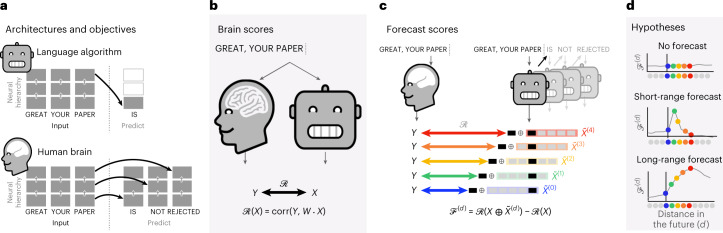
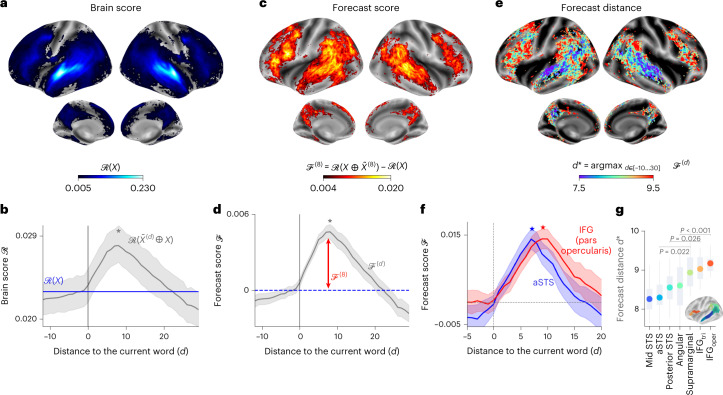
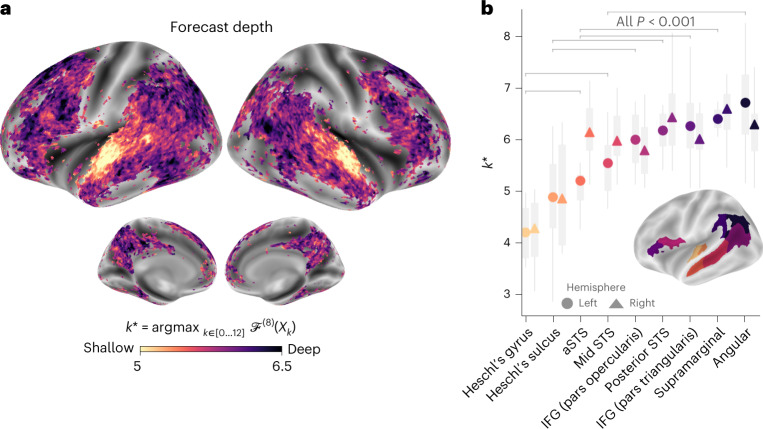
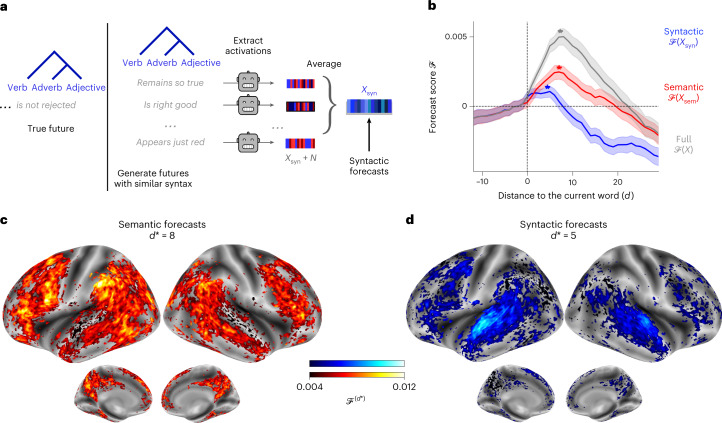
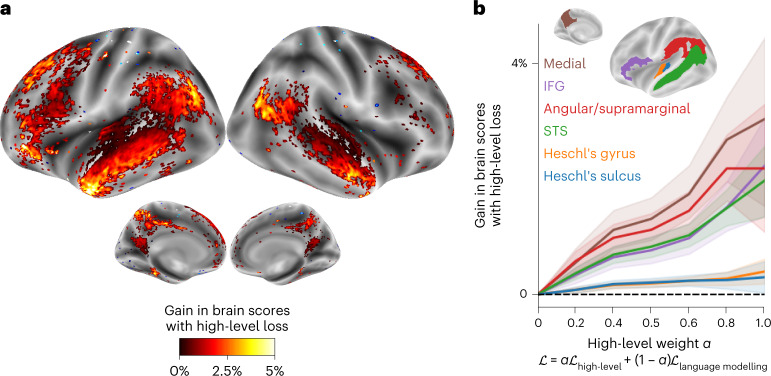
Considerable progress has recently been made in natural language processing: deep learning algorithms are increasingly able to generate, summarize, translate and classify texts. Yet, these language models still fail to match the language abilities of humans. Predictive coding theory offers a tentative explanation to this discrepancy: while language models are optimized to predict nearby words, the human brain would continuously predict a hierarchy of representations that spans multiple timescales. To test this hypothesis, we analysed the functional magnetic resonance imaging brain signals of 304 participants listening to short stories. First, we confirmed that the activations of modern language models linearly map onto the brain responses to speech. Second, we showed that enhancing these algorithms with predictions that span multiple timescales improves this brain mapping. Finally, we showed that these predictions are organized hierarchically: frontoparietal cortices predict higher-level, longer-range and more contextual representations than temporal cortices. Overall, these results strengthen the role of hierarchical predictive coding in language processing and illustrate how the synergy between neuroscience and artificial intelligence can unravel the computational bases of human cognition.
Overview
The claims and statistics of this paper haven’t been checked yet.
Free: it reads the open-access text and checks the first 5 claims that cite a source we can check. Create a free account to check every claim.
Integrity signals
Registry
Cites
Statistics
Figures
Verification
Claims the paper makes
The claims and statistics of this paper haven’t been checked yet.
Free: it reads the open-access text and checks the first 5 claims that cite a source we can check. Create a free account to check every claim.
Claims other papers make about this one
Each is checked against this paper’s own text: does it say what the citing paper says it does?
The cited source doesn’t support the claim as written.
In the citing paper
“Previous studies in the neural encoding literature all used LLMs that were only aware of the short-term context, i.e., where the context window size was as large as several tens of words1–10.”
From Incremental accumulation of linguistic context in artificial and biological neural networks (2025) · cites this paper as [5]
Checked by a reasoning model — may be wrong.
Experimental — accuracy not yet measuredThe source backs part of the claim, not all of it — or backs it for a different population, condition or comparison.
In the citing paper
“Additionally, we focused on the intermediate-to-deep layers ( 𝑙 = 2 3 𝑛 𝑙𝑎𝑦𝑒𝑟𝑠 ) of each LLM, as suggested by Caucheteux et al. (2023). These layers merit particular attention due to their demonstrated superior predictive capabilities for human brain activity (Schrimpf et al., 2021; Caucheteux and King, 2022; Caucheteux et al., 2023).”
From Can "consciousness" be observed from large language model (LLM) internal states? Dissecting LLM representations obtained from Theory of Mind test with Integrated Information Theory and Span Representation analysis (2025) · cites this paper as Caucheteux et al., 2023
Experimental — accuracy not yet measuredThe cited source says what the claim attributes to it.
In the citing paper
“Recent studies have increasingly explored LLM representations as analogs to neuroimaging data, aligning and comparing the human brain with the LLM”
From Can "consciousness" be observed from large language model (LLM) internal states? Dissecting LLM representations obtained from Theory of Mind test with Integrated Information Theory and Span Representation analysis (2025) · cites this paper as Caucheteux et al., 2023
The cited source says what the claim attributes to it.
In the citing paper
“This finding is consistent with previous studies, which suggest that the 2 3 layer is optimal for predicting human brain activity (Schrimpf et al., 2021; Caucheteux and King, 2022; Caucheteux et al., 2023).”
From Can "consciousness" be observed from large language model (LLM) internal states? Dissecting LLM representations obtained from Theory of Mind test with Integrated Information Theory and Span Representation analysis (2025) · cites this paper as Caucheteux et al., 2023
The cited source says what the claim attributes to it.
In the citing paper
“While LLM representations are being increasingly studied as analogs of neuroimaging data when comparing and aligning human brain activity with LLM”
From Can "consciousness" be observed from large language model (LLM) internal states? Dissecting LLM representations obtained from Theory of Mind test with Integrated Information Theory and Span Representation analysis (2025) · cites this paper as Caucheteux et al., 2023
3 more claims about this paper
Create a free account to see every claim other papers make about this one.
Self-check
Percentages, sums and reported differences re-computed from the paper’s own numbers.
The self-check needs the paper’s full text.
Citations
Cites
Vaswani, A., Shazeer, N., Parmar, N., Uszkoreit, J., Jones, L., Gomez, A. N., Kaiser, L., & Polosukhin, I. (2017) · arXiv · doi:10.48550/arxiv.1706.03762 · Cited by 120,404 · cited 10×
“For each word, (1) we generated n = 10”
BackgroundMethodResultInfluentialScikit-learn: Machine Learning in Python
Pedregosa, F., Varoquaux, G., Gramfort, A., Michel, V., Thirion, B., Grisel, O., Blondel, M., Müller, A., Nothman, J., Louppe, G., et al. (2012) · arXiv · doi:10.48550/arxiv.1201.0490 · Cited by 71,016
Self-citationGoing deeper with convolutions
Szegedy, C., Liu, W., Jia, Y., Sermanet, P., Reed, S., Anguelov, D., Erhan, D., Vanhoucke, V., & Rabinovich, A. (2015) · 2015 IEEE Conference on Computer Vision and Pattern Recognition (CVPR) · doi:10.1109/cvpr.2015.7298594 · Cited by 48,562
SciPy 1.0: fundamental algorithms for scientific computing in Python
Virtanen, P., Gommers, R., Oliphant, T. E., Haberland, M., Reddy, T., Cournapeau, D., Burovski, E., Peterson, P., Weckesser, W., Bright, J., et al. (2020) · Nature Methods · doi:10.1038/s41592-019-0686-2 · Cited by 38,430
Exploring the Limits of Transfer Learning with a Unified Text-to-Text Transformer
Raffel, C., Shazeer, N., Roberts, A., Lee, K., Narang, S., Matena, M., Zhou, Y., Li, W., & Liu, P. J. (2019) · arXiv · doi:10.48550/arxiv.1910.10683 · Cited by 31,859
Language Models are Few-Shot Learners
Brown, T. B., Mann, B., Ryder, N., Subbiah, M., Kaplan, J., Dhariwal, P., Neelakantan, A., Shyam, P., Sastry, G., Askell, A., et al. (2020) · arXiv · doi:10.48550/arxiv.2005.14165 · Cited by 23,372 · cited 8×
“with F(Xk) = R(Xk ⊕ X̃k (d) ) − R(Xk) (equation (3)).”
MethodResultInfluentialRoBERTa: A Robustly Optimized BERT Pretraining Approach
Liu, Y., Ott, M., Goyal, N., Du, J., Joshi, M., Chen, D., Levy, O., Lewis, M., Zettlemoyer, L., & Stoyanov, V. (2019) · arXiv · doi:10.48550/arxiv.1907.11692 · Cited by 16,515
Momentum Contrast for Unsupervised Visual Representation LearningPreprint
He, K., Fan, H., Wu, Y., Xie, S., & Girshick, R. B. (2019) · Computer Vision and Pattern Recognition · doi:10.48550/arxiv.1911.05722 · Cited by 16,385
Bellman, R. E. (2010) · doi:10.1515/9781400835386 · Cited by 14,588
Momentum Contrast for Unsupervised Visual Representation Learning
He, K., Fan, H., Wu, Y., Xie, S., & Girshick, R. (2020) · 2020 IEEE/CVF Conference on Computer Vision and Pattern Recognition (CVPR) · doi:10.1109/cvpr42600.2020.00975 · Cited by 13,347
Research works printed but not linked: 5
- Toneva, M. & Wehbe, L. Interpreting and improving natural-language processing (in machines) with natural language-processing (in the brain). In Advances in Neural Information Processing Systems, Vol. 32 (Curran Associates, 2019).
- Holtzman, A., Buys, J., Maxwell Forbes, L. D. & Choi, Y. The curious case of neural text degeneration. In International Conference on Learning Representations (2020).
- Thakur, N., Reimers, N., Rücklé, A., Srivastava, A. & Gurevych, I. BEIR: a heterogenous benchmark for zero-shot evaluation of information retrieval models. In Thirty-fifth Conference on Neural Information Processing Systems Datasets and Benchmarks Track (Round 2) (2021).
- Devlin, J., Chang, M.-W., Lee, K. & Toutanova, K. BERT: pre-training of deep bidirectional transformers for language understanding. In Proceedings of the 2019 Conference of the North American Chapter of the Association for Computational Linguistics: Human Language Technologies, 1, 4171–4186, (Association for Computational Linguistics, 2019).
- Bardes, A., Ponce, J. & LeCun, Y. VICReg: variance-invariance-covariance regularization for self-supervised learning. In International Conference on Learning Representations (2022).
Cited by
Items 201–300 of 340
Central Themes and Open Questions in the Philosophy of Computer Science
Angius, N., & Symons, J. (2023) · Global Philosophy · doi:10.1007/s10516-023-09704-z · Cited by 1
“…modeling is being used in many scientific and simulative contexts, such as physics (Monk 2018), meteorology (Espeholt et al. 2021), neuroscience (Caucheteux et al. 2023), or most impressively in biology with the recent achievements of the Alphafold team in the domain of protein folding (Jumper…”
MethodInsights from Ecstatic Epilepsy: From Uncertainty to Metacognitive Feelings
Sooter, N. M., Seragnoli, F., & Picard, F. (2024) · Current topics in behavioral neurosciences · doi:10.1007/7854_2024_528 · Cited by 2
Stimulus-driven leakage in naturalistic neuroimaging
Kim, S. (2026) · Imaging Neuroscience · doi:10.1101/2025.04.01.646146 · Cited by 1
EEG-Depth: Learning Structural Information from Visual Brain Decoding via Depth Estimation
Nigam, J., Prakash, A., Uthamkumar, M., Salgotra, S., & Bhavsar, A. V. (2025) · Lecture notes in computer science · doi:10.1007/978-3-031-87657-8_18 · Cited by 3
Zhang, Y. F., & Strelnikov, K. (2025) · Informatics · doi:10.3390/informatics12030083 · Cited by 1
“It is a dynamic and anticipatory process driven by predictive mechanisms [3–5].”
Saracini, C., & Buhler, M. (2026) · Cognitive Processing · doi:10.1007/s10339-026-01337-5 · Cited by 1
“This trade-off is regulated by frontoparietal networks involved in confidence estimation and learning-rate modu - lation (Jiang and Rao 2024; Caucheteux et al. 2023), which also support emotional regulatory flexibility, a key factor for psychological resilience (Cavanagh and Frank 2014; Bonanno and…”
Individual Recognition in Wild Chimpanzees and Beyond: Supervised Representation LearningPreprint
Brima, Y., Southern, L. M., Krumnack, U., Heidemann, G., & Pika, S. (2023) · SSRN Electronic Journal · doi:10.2139/ssrn.4520570 · Cited by 1
Finding structure during incremental speech comprehensionPreprint
Lyu, B., Marslen‐Wilson, W. D., Fang, Y., & TYLER, L. K. (2023) · eLife · doi:10.7554/elife.89311.1 · Cited by 1
Predictive and Error Coding for Vocal Communication Signals in the Songbird Auditory ForebrainPreprint
Rudraraju, S., Turvey, M., Theilman, B. H., & Gentner, T. Q. (2024) · SSRN Electronic Journal · doi:10.1101/2024.02.25.581987 · Cited by 1
“Put forth originally as a model for visual cortex [1, 2], PC has been proposed as a general cortical mechanism [3, 4] including for speech processing [5, 6].”
BackgroundDeepSpeech models show Human-like Performance and Processing of Cochlear Implant InputsPreprint
Steinhardt, C. R., Keshishian, M., Mesgarani, N., & Stachenfeld, K. (2024) · arXiv (Cornell University) · doi:10.48550/arxiv.2407.20535 · Cited by 1
“Often, comparisons have addressed representational similarities between LLMs and the brain [4, 33, 34, 35].”
BackgroundPrediction tendency, eye movements, and attention in a unified framework of neural speech trackingPreprint
Schubert, J., Gehmacher, Q., Schmidt, F., Hartmann, T., & Weisz, N. (2026) · eLife · doi:10.7554/elife.101262 · Cited by 1
Comprehensive Neural Representations of Naturalistic Stimuli through Multimodal Deep LearningPreprint
Fu, M., Chen, G., Zhang, Y., Zhang, M., & Wang, Y. (2025) · bioRxiv (Cold Spring Harbor Laboratory) · doi:10.1101/2025.04.15.646250 · Cited by 1
“Specifically, for each time point, we combined the current feature representation (F t ) with that of a future segment (F t + d ), where d indicates the prediction distance 32 .”
The Empirical Brain: Language Processing as Sensory ExperiencePreprint
Lang, B. (2025) · OSF Preprints (OSF Preprints) · doi:10.31219/osf.io/te5y7_v2 · Cited by 1
Prediction tendency, eye movements, and attention in a unified framework of neural speech trackingPreprint
Schubert, J., Gehmacher, Q., Schmidt, F., Hartmann, T., & Weisz, N. (2025) · eLife · doi:10.7554/elife.101262.2 · Cited by 1
Why, where and how do top-down and bottom-up signals interact in the primate brain?Preprint
Hou, Y., Vezoli, J., Knoblauch, K., Goebel, R., Vinck, M. A., & Kennedy, H. (2025) · PsyArXiv (OSF Preprints) · doi:10.31234/osf.io/7mryq_v4 · Cited by 1
Evaluating Scientific Theories As Predictive Models in Language NeurosciencePreprint
Singh, C., Antonello, R., Guo, S., Mischler, G., Gao, J., Mesgarani, N., & Huth, A. G. (2025) · SSRN Electronic Journal · doi:10.1101/2025.08.12.669958 · Cited by 8
“The advent of powerful deep learning models has provided neuroscientists with new tools for modeling how the brain encodes information across language, vision, and audition ( 1, 2, 3 ).”
Comprehensive Neural Representations of Naturalistic Stimuli through Multimodal Deep LearningPreprint
Fu, M., Chen, G., Zhang, Y., Zhang, M., & Wang, Y. (2026) · eLife · doi:10.7554/elife.107607 · Cited by 2
Structure leads and dominates comprehension in naturalistic readingPreprint
Wang, N., Wu, H., & Li, J. (2026) · SSRN Electronic Journal · doi:10.2139/ssrn.7115090 · Cited by 1
Artificial Self-Consciousness In Over TimePreprint
mousavi, S. K. (2023) · Preprints.org · doi:10.20944/preprints202309.1777.v1 · Cited by 1
Hierarchical Signatures of Language in the Human BrainPreprint
Eichert, N., Favre, C., Cabalo, D. G., Ngo, A., DeKraker, J., Hwang, Y., Smith, M., Crooks, V., Bautin, P., Rodríguez‐Cruces, R., et al. (2026) · bioRxiv (Cold Spring Harbor Laboratory) · doi:10.64898/2026.02.15.705992 · Cited by 1
“More recently, interest in the field has been further driven by the prospect that integrating neuroanatomy with artificial intelligence could yield in-silico models of the brain and shed light on its functional and computational architecture (Caucheteux et al. 2023).”
Yang, N., He, R., Homan, P., Sommer, I. E., Staub, D., & Hinzen, W. (2026) · arXiv (Cornell University) · doi:10.48550/arxiv.2605.21049 · Cited by 1
A number simplex in the human medial temporal lobePreprint
Zhu, H., Chericoni, A., Ismail, T., Mickiewicz, E. A., Franch, M. C., Nigam, T., Yan, X., Belanger, J. L., Chavez, A. G., Nair, J., et al. (2026) · bioRxiv (Cold Spring Harbor Laboratory) · doi:10.64898/2026.06.25.734462 · Cited by 1
Evidence of predictive information compression in latent space in humans during speech listeningPreprint
Corsini, A., Schneider, S., Tomassini, A., Pedani, L., Fadiga, L., & D’Ausilio, A. (2026) · bioRxiv (Cold Spring Harbor Laboratory) · doi:10.64898/2026.07.14.738305 · Cited by 1
Can working memory be explained by predictive coding?Preprint
Feng, M. (2023) · Thesis Commons (OSF Preprints) · doi:10.31237/osf.io/sqfr9
Artificial neural networks to analyze and simulate language acquisition in childrenPreprint
Lavechin, M. (2023) · PsyArXiv (OSF Preprints) · doi:10.31234/osf.io/5p8ge
Language representations in deep learning algorithms and the brain
Caucheteux, C. (2023) · theses.fr (ABES) · doi:10.70675/9258df96z16fbz4531zb578za0d6684b0d14 · Cited by 1
Self-citationKozachek, D. (2024) · SSRN Electronic Journal · doi:10.2139/ssrn.4767192
Author response: Finding structure during incremental speech comprehension
Lyu, B., Marslen‐Wilson, W. D., Fang, Y., & TYLER, L. K. (2024) · eLife · doi:10.7554/elife.89311.3.sa3
Composing, not-composing, and integrating: The neuroscience of multi-word expressions
Canal, P., Vespignani, F., & Molinaro, N. (2024) · Elsevier eBooks · doi:10.1016/b978-0-12-820480-1.00140-6
Author response: Reconstructing Voice Identity from Noninvasive Auditory Cortex Recordings
Lamothe, C., Thoret, E., Trapeau, R., Giordano, B. L., Sein, J., Takerkart, S., Ayache, S., Artières, T., & Belin, P. (2024) · eLife · doi:10.7554/elife.98047.1.sa4
eLife Assessment: Reconstructing Voice Identity from Noninvasive Auditory Cortex Recordings
Martin, A. E. (2024) · eLife · doi:10.7554/elife.98047.1.sa3
Reconstructing Voice Identity from Noninvasive Auditory Cortex RecordingsPreprint
Lamothe, C., Thoret, E., Trapeau, R., Giordano, B. L., Sein, J., Takerkart, S., Ayache, S., Artières, T., & Belin, P. (2024) · eLife · doi:10.7554/elife.98047.1
Hu, Y., Hou, X., & Wang, F. (2024) · KSII Transactions on Internet and Information Systems · doi:10.3837/tiis.2024.07.005
What Can Complex Systems Theory Tell Us About Understanding in the Human–AI Communication System?
Wang, J., Wang, S., Fong, M. C., H, M. K., & Wang, W. Y. (2024) · doi:10.1109/icnlp60986.2024.10692435
“Both humans and AI use statistical learning in order to capture language patterns [12], [13], [14].”
BackgroundThermoceptive predictions and prediction errors in the anterior insulaPreprint
Toussaint, B., Heinzle, J., Friedli, N., Zahnd, N., Federici, E., Köchli, L., Harrison, O. K., Iglesias, S., & Stephan, K. E. (2024) · bioRxiv (Cold Spring Harbor Laboratory) · doi:10.1101/2024.10.11.617819 · Cited by 1
Schubert, J., Gehmacher, Q., Schmidt, F., Hartmann, T., & Weisz, N. (2024) · eLife · doi:10.7554/elife.101262.3.sa0
Touch to text: Spatiotemporal evolution of braille letter representations in blind readersPreprint
Teng, S., Cichy, R. M., Pantazis, D., & Oliva, A. (2024) · bioRxiv (Cold Spring Harbor Laboratory) · doi:10.1101/2024.10.30.620429
“…letters are less straightforward than those of whole words (Popham et al., 2021), phrases (Fyshe et al., 2016; Fyshe, 2020), or continuous language (Caucheteux et al., 2023), sublexical processing is tied to visual reading performance in development (Ritchey and Speece, 2006; Acha et al., 2024) as…”
Spatial organization of multisensory convergence in mouse isocortexPreprint
Patel, K., Ryoo, A. H.-W., Buice, M. A., Mihalaş, Ş., & Tripp, B. (2024) · bioRxiv (Cold Spring Harbor Laboratory) · doi:10.1101/2024.12.09.627642
Bridging Auditory Perception and Language Comprehension through MEG-Driven Encoding ModelsPreprint
Ciferri, M., Ferrante, M., & Toschi, N. (2025) · arXiv (Cornell University) · doi:10.48550/arxiv.2501.03246
Inference of Abstraction for Human-Like Logical Reasoning
Kido, H. (2025) · Lecture notes in computer science · doi:10.1007/978-3-031-82487-6_14 · Cited by 1
Expectation management in humans and LLMs
Menashe, B. A., Drake, A., & Ben‐Shachar, M. (2026) · Scientific Reports · doi:10.1038/s41598-026-62526-y
Robust Speech Encoding System Under Noisy Environments
Thimmaraja Yadava, G., Nagaraja, B. G., Monisha, C., Revanth, K., & Siri, S. (2025) · International Conference on Integrated Circuits and Communication Systems (ICICACS) · doi:10.1109/icicacs65178.2025.10968617
“The performance evaluation of noise elimination techniques is done using PESQ and NCM metrics for NOIZEUS database [13-17].”
Artificial Self-Awareness Over TimePreprint
Mousavi, S. K. (2024) · Qeios · doi:10.32388/ylxn96.2
The Empirical Brain: Language Processing as Sensory ExperiencePreprint
Lang, B. (2025) · OSF Preprints (OSF Preprints) · doi:10.31219/osf.io/te5y7_v1
Can working memory be explained by predictive coding?Preprint
Feng, M., & Nunez, M. D. (2025) · PsyArXiv (OSF Preprints) · doi:10.31234/osf.io/5zbc6_v1
Can working memory be explained by predictive coding?Preprint
Feng, M., & Nunez, M. D. (2025) · PsyArXiv (OSF Preprints) · doi:10.31234/osf.io/5zbc6_v2
Kubo, R., Nishimoto, S., & Nakai, T. (2025) · bioRxiv (Cold Spring Harbor Laboratory) · doi:10.1101/2025.06.17.660057
“The observed brain-LLM alignment can be interpreted through computational frameworks such as generalizable representation 66 and predictive coding 27,32,67,68 .”
InfluentialBénon, J., Pessiglione, M., Vinckier, F., & Daunizeau, J. (2025) · bioRxiv (Cold Spring Harbor Laboratory) · doi:10.1101/2025.07.10.664081
Menschliches Verhalten als Ausgangs- und Zielkoordinate des transformadaptiven Kulturdesigns
Schuchardt, C. (2025) · Springer eBooks · doi:10.1007/978-3-658-46180-5_2
Imagined Speech Reconstruction with 3D Neural Metabolism and Large Language Model IntegrationPreprint
Rajagopal, G., Chaudhari, A., LaRocco, J., Xue, J., Zachariah, E., Varanasi, S., & Rothman, D. L. (2025) · bioRxiv (Cold Spring Harbor Laboratory) · doi:10.1101/2025.07.30.667805 · Cited by 1
Bowers, J. S. (2025) · PsyArXiv (OSF Preprints) · doi:10.31234/osf.io/5wt9m_v2
Brains, Bodies, and Their Worlds: Towards a Model of Predictive Social Actors
Cheadle, J. E., Davidson-Turner, K., & Goosby, B. J. (2025) · Handbooks of sociology and social research · doi:10.1007/978-3-031-95615-7_16
SIGNAL: Dataset for Semantic and Inferred Grammar Neurological Analysis of Language
Komissarenko, A., Волошина, Е. В., Cheveleva, A., Semenkov, I., Serikov, O., & Ossadtchi, A. E. (2025) · Scientific Data · doi:10.1038/s41597-025-05966-x
“However, LLMs performance still falls behind human language abilities supported by complex, dynamic and context-dependent hierarchical multidimensional neural networks 1,3,4 .”
Natural Evolution at the Level of the Individual MindPreprint
Tozzi, A. (2025) · Preprints.org · doi:10.20944/preprints202510.2447.v1
Heikkinen, P., Lepistö, S., Wikman, P. A., Koskinen, E., Peräkylä, A., Ravaja, N., & Harjunen, V. J. (2026) · Journal of Neuroscience · doi:10.1101/2025.11.06.686308
“Instead, semantic meaning unfolds continuously as words and sentences are integratively processed within an evolving contextual structure (Caucheteux, 2023; Xu et al., 2005).”
The Roads Not Taken: The Neural Dynamics of Lexical Alternatives During Free Language ProductionPreprint
Lioubashevski, D., Friedman, D. J., Flinker, A., & Goldstein, A. (2025) · bioRxiv (Cold Spring Harbor Laboratory) · doi:10.1101/2025.11.09.687421
Richard Avenarius’ Oscillations and the Neural Code: From Historical Insights to Future NeurosciencePreprint
Tozzi, A. (2025) · Preprints.org · doi:10.20944/preprints202511.0800.v1
Guessing at Ghosts in the Machine
Yetter‐Chappell, H. (2025) · Ratio · doi:10.1111/rati.70013
Reconstructing Voice Identity from Noninvasive Auditory Cortex RecordingsPreprint
Lamothe, C., Thoret, E., Trapeau, R., Giordano, B. L., Sein, J., Takerkart, S., Ayache, S., Artières, T., & Belin, P. (2025) · eLife · doi:10.7554/elife.98047.2
From generative AI to the brain: five takeaways
Gros, C. (2025) · Frontiers in Computational Neuroscience · doi:10.3389/fncom.2025.1718778
“…“predictive coding” (neuroscience) and “autoregressive language modeling” are both dedicated to the task of building world models, with the former also having active components (Brodski-Guerniero et al., 2017), operating in addition on distinct scales and modalities (Caucheteux et al., 2023).”
Neural Speech Tracking with EEG: Integrating Acoustics and Linguistics for Hearing Aid Users
Skoglund, M. A., Almgren, K., Mentzer, A., Bernhardsson, B., Wendt, D., & Alickovic, E. (2025) · Annual International Conference of the IEEE Engineering in Medicine and Biology Society (EMBC) · doi:10.1109/embc58623.2025.11254077 · Cited by 1
“Similar to [11], our findings report the emergence of contextual contextual word surprisal processing, where the brain incorporates contextual information to predict structured meaning, in line with predictive coding theories [28], [29].”
Using computational semantics to study meaning in the brain.
Fodor, J., & Suzuki, S. (2025) · Neuroscience and Biobehavioral Reviews · doi:10.1016/j.neubiorev.2025.106514 · Cited by 1
Auditory representations of words during silent visual readingPreprint
Li, J., Doerig, A., & Cichy, R. M. (2025) · bioRxiv (Cold Spring Harbor Laboratory) · doi:10.64898/2025.12.12.693932
Yu, M., & Xu, Z. (2025) · Advanced technology in neuroscience . · doi:10.4103/atn.atn-d-25-00013 · Cited by 1
Concreteness shapes semantic representations in bilingual brainsPreprint
Lamarre, M., Gong, X. L., Chen, C., & Deniz, F. (2025) · bioRxiv (Cold Spring Harbor Laboratory) · doi:10.64898/2025.12.23.696243
“These areas are typically associated with language (Fedorenko et al. 2016; Caucheteux et al. 2023).”
Surrogate deep neural networks reveal hierarchical handwriting encoding in the human motor cortex
Chen, J., Xu, T., Xiong, X., Yang, X., Wang, Y., & Qi, Y. Y. (2025) · Cell Reports · doi:10.1016/j.celrep.2025.116837
Cortical encoding of acoustic and linguistic rhythms reflects L2 narrative comprehension
Zhang, J., Liang, J., Liu, Y., & Luo, C. (2026) · NeuroImage · doi:10.1016/j.neuroimage.2026.121716 · Cited by 1
You, J., Salmelin, R. H., & van Vliet, M. (2026) · bioRxiv (Cold Spring Harbor Laboratory) · doi:10.64898/2026.01.13.699236
Liu, Y., Ding, J., Wang, S., Kou, N., & Wang, S. (2026) · Brain Research · doi:10.1016/j.brainres.2026.150201
RetractedComprehensive Neural Representations of Naturalistic Stimuli through Multimodal Deep LearningPreprint
Fu, M., Chen, G., Zhang, Y., Zhang, M., & Wang, Y. (2026) · eLife · doi:10.7554/elife.107607.2
Artificial Intelligence: A Useful Tool for Integral Human Development
(2026) · IGI Global eBooks · doi:10.4018/979-8-3373-6771-2.ch020
Abassi, E., & Zatorre, R. J. (2026) · Cerebral Cortex · doi:10.1093/cercor/bhag023
“This outcome supports the idea that the brain continuously generates top-down predictions about upcoming linguistic input, a core mechanism during speech processing (Shain et al. 2020; Heilbron et al. 2022; Caucheteux et al. 2023).”
The Universal Derivative Principle: Cognition as a Change-Detecting FacultyPreprint
Ayienda, A. O. (2026) · SSRN Electronic Journal · doi:10.2139/ssrn.6422298
Evolution of sound representations in the early auditory system and their modulation by anesthesia
Gosselin, E. (2024) · theses.fr (ABES) · doi:10.70675/f669f4b7z7620z4f6bz986dzb5301602de08
Signatures of monitoring in speech and their precursors : a multi-facet outlook
Dorokhova, L. (2023) · theses.fr (ABES) · doi:10.70675/3281b525z7a88z44a2z9ddczea8275ab221d
Unsupervised multilingual models of speech representation, an approach inspired by cognitive science
de Seyssel, M. (2023) · theses.fr (ABES) · doi:10.70675/2974e23cz54f3z4282z8000z612287446e7f · Cited by 2
ReVIS: Reconstructing the Individual Visual Perception via EEG Signals
Tan, Y., Yin, X., Chen, X., Zhang, G., & Xu, C. (2026) · IEEE International Conference on Acoustics Speech and Signal Processing · doi:10.1109/icassp55912.2026.11461871
Zhang, Z., Zhou, W. H., Zhao, C., Dong, L. F., Zhang, L., & Li, L. (2026) · IEEE International Conference on Acoustics Speech and Signal Processing · doi:10.1109/icassp55912.2026.11462182
Azizpour, S., Westner, B. U., Szewczyk, J., Güçlü, U., & Geerligs, L. (2026) · eLife · doi:10.7554/elife.110085.1.sa0
Azizpour, S., Westner, B. U., Szewczyk, J., Güçlü, U., & Geerligs, L. (2026) · eLife · doi:10.7554/elife.110085 · Cited by 1
Acoustic and Sublexical Rhythms
Meyer, L., & Strauß, A. (2026) · Cambridge University Press eBooks · doi:10.1017/9781009295888.010
Does the brain really know what word is coming next?
Antonello, R. (2026) · eLife · doi:10.7554/elife.111163
Information-Rich vs. Rhetorical Arabic Discourse: Behavioral and Neurocognitive EvidencePreprint
Mekheimer, M. A. A. G. (2026) · SSRN Electronic Journal · doi:10.2139/ssrn.6664294
Independent-Component-Based Encoding Models of Brain Activity During Story ComprehensionPreprint
Hari, K., Binhuraib, T. O. A., Li, J., Shain, C., & Ivanova, A. A. (2026) · arXiv (Cornell University) · doi:10.48550/arxiv.2604.24942
“…accounts of hierarchical stimulus tracking during naturalistic listening, in which early auditory regions primarily track input density and temporal speech structure, while downstream language-selective regions may additionally reflect higher-level predictive information (Caucheteux et al., 2023).”
Predictive and feedback signals differently shape the formation of language representationsPreprint
Yang, S., Yu, S., Jiang, X., Wang, S., & Feng, G. (2026) · arXiv (Cornell University) · doi:10.48550/arxiv.2605.09409
“…contextual representations (Caucheteux & King, 2022; De Heer et al., 2017), and that model-brain alignment is strongest when models capture hierarchical and contextual computations in higher-order language and association networks (Caucheteux et al., 2023; Mischler et al., 2024; Tang et al., 2023).”
InfluentialKloots, M. D. H., Kazemian, A., Turner, W., Parvizi, J., & Gwilliams, L. (2026) · bioRxiv (Cold Spring Harbor Laboratory) · doi:10.64898/2026.05.13.724774 · Cited by 1
“…models as evidence that models and brains employ shared objectives for next-token prediction (Schrimpf et al., 2021; Goldstein et al., 2022; Caucheteux et al., 2023), it’s possible that the observed results are instead driven by inherent co-occurrence statistics in natural language data…”
Wu, X., Wang, H., Yan, Z., Xiaohan, T., Xu, P., Siok, W. T., Li, P., Gao, J., Lyu, B., & Qin, L. (2026) · Computers in Human Behavior · doi:10.1016/j.chb.2026.109051 · Cited by 1
Human-like sequential sound-to-meaning transfer drives artificial speech comprehensionPreprint
Zhang, S., Li, S., Yang, R., Chen, G., Tian, X., Wang, Q., & Fang, F. (2026) · bioRxiv (Cold Spring Harbor Laboratory) · doi:10.64898/2026.05.13.723203
Gözükara, D., Ahmad, N., Oetringer, D., & Geerligs, L. (2026) · arXiv (Cornell University) · doi:10.48550/arxiv.2605.31473
“…the current narrative context or social situation), while states in early sensory areas could be used to generate expectations about rapidly changing low-level features (e.g., the trajectory of a moving object or the spectral content of speech; Caucheteux et al., 2023; C. S. Lee et al., 2021).”
Chen, Y., Ghavami, M., St‐Laurent, M., Bellec, P., & Ghosh, S. (2026) · bioRxiv (Cold Spring Harbor Laboratory) · doi:10.64898/2026.05.31.729141
“…subjects ( Figure 3A ; relative depth 0.48–0.57; peak balanced accuracy 0.096–0.150, lag 3–4 TRs ≈ 4.5–6.0 s), the layer band that prior cortical-encoding work identifies as the contextually-informative locus within Wav2Vec-BERT for auditory cortex (Vaidya et al., 2022; Caucheteux et al., 2023).”
InfluentialWang, L., Tongtong, Z., Yicheng, W., Jin, L., Yuanfu, D., Hao, N., & Wang, Y. (2026) · Biological Psychology · doi:10.1016/j.biopsycho.2026.109315 · Cited by 1
Cochlear Nonlinear Network Correlate of Consonant vs Dissonant Sounds Perception
Gomez, F., & Stoop, R. (2026) · Physical Review Letters · doi:10.1103/8brp-kdpy
Estimation of neuronal tuning for word meaning from passively recorded naturalistic speechPreprint
Ismail, T., Chavez, A. G., Yan, X., Zhu, H., Franch, M. C., Belanger, J. L., Chamarthi, S., Kabotyanski, K. E., Katlowitz, K. A., Chericoni, A., et al. (2026) · bioRxiv (Cold Spring Harbor Laboratory) · doi:10.64898/2026.06.23.733980
Metadata
- Authors
- Caucheteux, C., Gramfort, A., & King, J.-R.
- Affiliations
- Institut national de recherche en sciences et technologies du numérique (FR)
- Centre National de la Recherche Scientifique (FR)
- Corresponding author
- Caucheteux, Charlotte
- King, Jean-Rémi
- Venue
- Nature Human Behaviour
- Published
- 2023-03-02
- Volume
- 7
- Issue
- 3
- Pages
- 430-441
- ISSN
- 2397-3374 (ISSN-L)
- PMC
- PMC10038805
- OpenAlex
- W4322766928
- Semantic Scholar
- 66c286df54551baba7351a1ed44019367e5aa7ea
- Cited by
- 308
- References
- 82
- Citations by year
- 2026: 78 · 2025: 109 · 2024: 76 · 2023: 43
- FWCI
- 45.83
- Type
- journal article
- Language
- en
- Open access
- hybrid
- doi.org
- Licence
- cc-by
- creativecommons.org/licenses/by/4.0 (tdm)
- creativecommons.org/licenses/by/4.0 (vor)
- Locations
- Nature Human Behaviour (publishedVersion, cc-by)
- PubMed Central (publishedVersion, cc-by)
- PubMed (publishedVersion)
- HAL (submittedVersion, other-oa)
- RePEc: Research Papers in Economics (submittedVersion)
- Funders
- Philippe Foundation
- Agence Nationale de la Recherche (ANR-17-EURE-, ANR-17-EURE-0017, ANR-17)
- Université de Recherche Paris Sciences et Lettres (ANR-17-EURE-0017)
- Topics
- Life Sciences › Neuroscience › Cognitive Neuroscience › Neurobiology of Language and Bilingualism
- Life Sciences › Neuroscience › Cognitive Neuroscience › Neuroscience and Music Perception
- Social Sciences › Psychology › Developmental and Educational Psychology › Reading and Literacy Development
- Keywords
- predictive coding, hierarchical predictive coding, speech perception, language processing, natural language models, short stories, frontoparietal cortex, temporal cortex, multiple time scales, computational neuroscience, artificial intelligence
- MeSH terms
- Artificial Intelligence, Auditory Perception, Brain, Humans, Speech, Temporal Lobe
About these checks
Registry, retraction, Cites and statistics results are computed, not judged, with one exception: a printed reference that no index lists is read once by a model before it counts as a citation error. Claims are extracted by a model and kept only when their quote appears verbatim in the text; each cited source is then checked, with a model’s help, for whether it says what the claim relies on. Those verdicts can be wrong — read the claim’s quote and the cited source before relying on one.
Statistics and arithmetic are recomputed, not judged.
Confidence bands are shown only for fields calibrated on our annotated test set. None is calibrated yet, so no band is shown.
What counts as a claim ›How we measure confidence ›How we check this ›
Are you an author, or do you see a problem with this page? Request a review
Data sources
Bibliographic data: Semantic Scholar, OpenAlex, Crossref.
Contains information from the Semantic Scholar Academic Graph Datasets, made available under the ODC Attribution License (ODC-BY 1.0).
Semantic Scholar’s data is described in: Kinney, R., et al. (2023). The Semantic Scholar Open Data Platform. arXiv:2301.10140.
