

Evidence of a predictive coding hierarchy in the human brain listening to speech
Open accessThe DOI matches its Crossref record; 92 of the 92 references it cites were found in a registry or an index.
Abstract
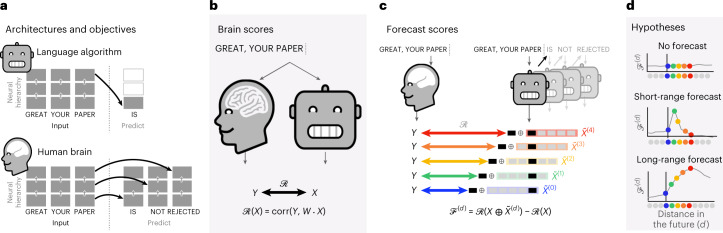
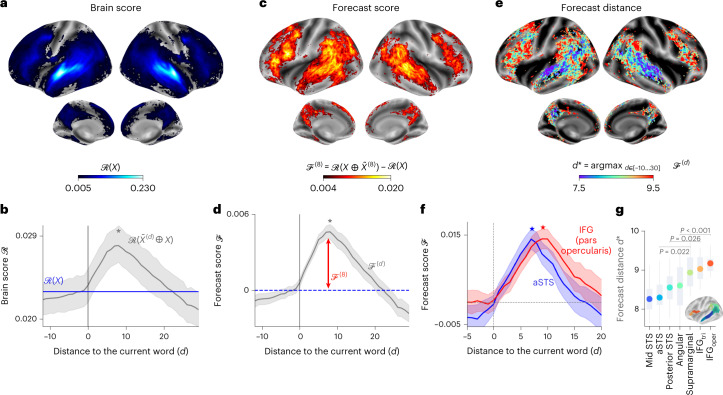
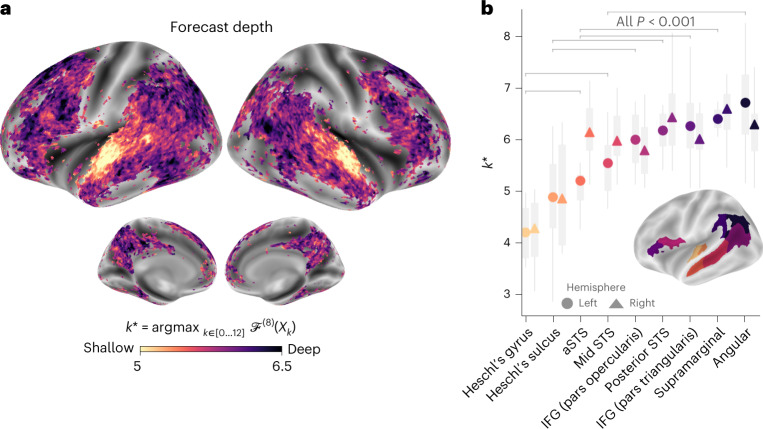
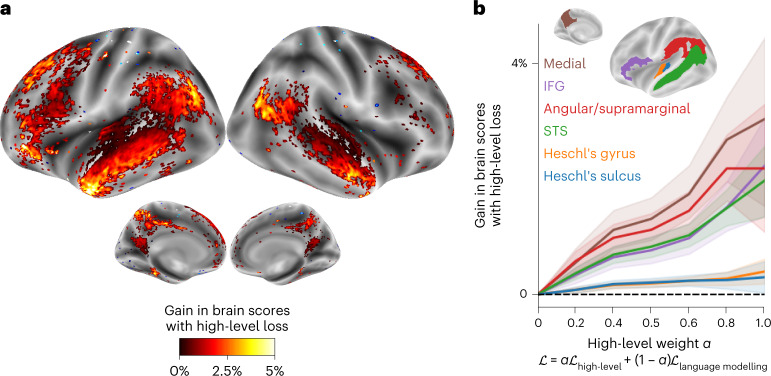
Considerable progress has recently been made in natural language processing: deep learning algorithms are increasingly able to generate, summarize, translate and classify texts. Yet, these language models still fail to match the language abilities of humans. Predictive coding theory offers a tentative explanation to this discrepancy: while language models are optimized to predict nearby words, the human brain would continuously predict a hierarchy of representations that spans multiple timescales. To test this hypothesis, we analysed the functional magnetic resonance imaging brain signals of 304 participants listening to short stories. First, we confirmed that the activations of modern language models linearly map onto the brain responses to speech. Second, we showed that enhancing these algorithms with predictions that span multiple timescales improves this brain mapping. Finally, we showed that these predictions are organized hierarchically: frontoparietal cortices predict higher-level, longer-range and more contextual representations than temporal cortices. Overall, these results strengthen the role of hierarchical predictive coding in language processing and illustrate how the synergy between neuroscience and artificial intelligence can unravel the computational bases of human cognition.
Overview
The claims and statistics of this paper haven’t been checked yet.
Free: it reads the open-access text and checks the first 5 claims that cite a source we can check. Create a free account to check every claim.
Integrity signals
Registry
Cites
Statistics
Figures
Verification
Claims the paper makes
The claims and statistics of this paper haven’t been checked yet.
Free: it reads the open-access text and checks the first 5 claims that cite a source we can check. Create a free account to check every claim.
Claims other papers make about this one
Each is checked against this paper’s own text: does it say what the citing paper says it does?
The cited source doesn’t support the claim as written.
In the citing paper
“Previous studies in the neural encoding literature all used LLMs that were only aware of the short-term context, i.e., where the context window size was as large as several tens of words1–10.”
From Incremental accumulation of linguistic context in artificial and biological neural networks (2025) · cites this paper as [5]
Checked by a reasoning model — may be wrong.
Experimental — accuracy not yet measuredThe source backs part of the claim, not all of it — or backs it for a different population, condition or comparison.
In the citing paper
“Additionally, we focused on the intermediate-to-deep layers ( 𝑙 = 2 3 𝑛 𝑙𝑎𝑦𝑒𝑟𝑠 ) of each LLM, as suggested by Caucheteux et al. (2023). These layers merit particular attention due to their demonstrated superior predictive capabilities for human brain activity (Schrimpf et al., 2021; Caucheteux and King, 2022; Caucheteux et al., 2023).”
From Can "consciousness" be observed from large language model (LLM) internal states? Dissecting LLM representations obtained from Theory of Mind test with Integrated Information Theory and Span Representation analysis (2025) · cites this paper as Caucheteux et al., 2023
Experimental — accuracy not yet measuredThe cited source says what the claim attributes to it.
In the citing paper
“Recent studies have increasingly explored LLM representations as analogs to neuroimaging data, aligning and comparing the human brain with the LLM”
From Can "consciousness" be observed from large language model (LLM) internal states? Dissecting LLM representations obtained from Theory of Mind test with Integrated Information Theory and Span Representation analysis (2025) · cites this paper as Caucheteux et al., 2023
The cited source says what the claim attributes to it.
In the citing paper
“This finding is consistent with previous studies, which suggest that the 2 3 layer is optimal for predicting human brain activity (Schrimpf et al., 2021; Caucheteux and King, 2022; Caucheteux et al., 2023).”
From Can "consciousness" be observed from large language model (LLM) internal states? Dissecting LLM representations obtained from Theory of Mind test with Integrated Information Theory and Span Representation analysis (2025) · cites this paper as Caucheteux et al., 2023
The cited source says what the claim attributes to it.
In the citing paper
“While LLM representations are being increasingly studied as analogs of neuroimaging data when comparing and aligning human brain activity with LLM”
From Can "consciousness" be observed from large language model (LLM) internal states? Dissecting LLM representations obtained from Theory of Mind test with Integrated Information Theory and Span Representation analysis (2025) · cites this paper as Caucheteux et al., 2023
3 more claims about this paper
Create a free account to see every claim other papers make about this one.
Self-check
Percentages, sums and reported differences re-computed from the paper’s own numbers.
The self-check needs the paper’s full text.
Citations
Cites
Vaswani, A., Shazeer, N., Parmar, N., Uszkoreit, J., Jones, L., Gomez, A. N., Kaiser, L., & Polosukhin, I. (2017) · arXiv · doi:10.48550/arxiv.1706.03762 · Cited by 120,404 · cited 10×
“For each word, (1) we generated n = 10”
BackgroundMethodResultInfluentialScikit-learn: Machine Learning in Python
Pedregosa, F., Varoquaux, G., Gramfort, A., Michel, V., Thirion, B., Grisel, O., Blondel, M., Müller, A., Nothman, J., Louppe, G., et al. (2012) · arXiv · doi:10.48550/arxiv.1201.0490 · Cited by 71,016
Self-citationGoing deeper with convolutions
Szegedy, C., Liu, W., Jia, Y., Sermanet, P., Reed, S., Anguelov, D., Erhan, D., Vanhoucke, V., & Rabinovich, A. (2015) · 2015 IEEE Conference on Computer Vision and Pattern Recognition (CVPR) · doi:10.1109/cvpr.2015.7298594 · Cited by 48,562
SciPy 1.0: fundamental algorithms for scientific computing in Python
Virtanen, P., Gommers, R., Oliphant, T. E., Haberland, M., Reddy, T., Cournapeau, D., Burovski, E., Peterson, P., Weckesser, W., Bright, J., et al. (2020) · Nature Methods · doi:10.1038/s41592-019-0686-2 · Cited by 38,430
Exploring the Limits of Transfer Learning with a Unified Text-to-Text Transformer
Raffel, C., Shazeer, N., Roberts, A., Lee, K., Narang, S., Matena, M., Zhou, Y., Li, W., & Liu, P. J. (2019) · arXiv · doi:10.48550/arxiv.1910.10683 · Cited by 31,859
Language Models are Few-Shot Learners
Brown, T. B., Mann, B., Ryder, N., Subbiah, M., Kaplan, J., Dhariwal, P., Neelakantan, A., Shyam, P., Sastry, G., Askell, A., et al. (2020) · arXiv · doi:10.48550/arxiv.2005.14165 · Cited by 23,372 · cited 8×
“with F(Xk) = R(Xk ⊕ X̃k (d) ) − R(Xk) (equation (3)).”
MethodResultInfluentialRoBERTa: A Robustly Optimized BERT Pretraining Approach
Liu, Y., Ott, M., Goyal, N., Du, J., Joshi, M., Chen, D., Levy, O., Lewis, M., Zettlemoyer, L., & Stoyanov, V. (2019) · arXiv · doi:10.48550/arxiv.1907.11692 · Cited by 16,515
Momentum Contrast for Unsupervised Visual Representation LearningPreprint
He, K., Fan, H., Wu, Y., Xie, S., & Girshick, R. B. (2019) · Computer Vision and Pattern Recognition · doi:10.48550/arxiv.1911.05722 · Cited by 16,385
Bellman, R. E. (2010) · doi:10.1515/9781400835386 · Cited by 14,588
Momentum Contrast for Unsupervised Visual Representation Learning
He, K., Fan, H., Wu, Y., Xie, S., & Girshick, R. (2020) · 2020 IEEE/CVF Conference on Computer Vision and Pattern Recognition (CVPR) · doi:10.1109/cvpr42600.2020.00975 · Cited by 13,347
Research works printed but not linked: 5
- Toneva, M. & Wehbe, L. Interpreting and improving natural-language processing (in machines) with natural language-processing (in the brain). In Advances in Neural Information Processing Systems, Vol. 32 (Curran Associates, 2019).
- Holtzman, A., Buys, J., Maxwell Forbes, L. D. & Choi, Y. The curious case of neural text degeneration. In International Conference on Learning Representations (2020).
- Thakur, N., Reimers, N., Rücklé, A., Srivastava, A. & Gurevych, I. BEIR: a heterogenous benchmark for zero-shot evaluation of information retrieval models. In Thirty-fifth Conference on Neural Information Processing Systems Datasets and Benchmarks Track (Round 2) (2021).
- Devlin, J., Chang, M.-W., Lee, K. & Toutanova, K. BERT: pre-training of deep bidirectional transformers for language understanding. In Proceedings of the 2019 Conference of the North American Chapter of the Association for Computational Linguistics: Human Language Technologies, 1, 4171–4186, (Association for Computational Linguistics, 2019).
- Bardes, A., Ponce, J. & LeCun, Y. VICReg: variance-invariance-covariance regularization for self-supervised learning. In International Conference on Learning Representations (2022).
Cited by
Items 301–340 of 340
Hierarchical Predictive Processing during Natural ReadingPreprint
Chan, L., Dimigen, O., Gagl, B., & Maurer, U. (2026) · bioRxiv (Cold Spring Harbor Laboratory) · doi:10.64898/2026.06.24.734402
“For language comprehension, recent studies have shown evidence of HPP on high-level (e.g., context) and low-level (e.g., visual and auditory features) linguistic representations respectively ( 10–14 ).”
The human language processing system straightens natural speechPreprint
Xu, J., Nguyen, T. D., Tang, J., Huth, A. G., & Goris, R. L. T. (2026) · bioRxiv (Cold Spring Harbor Laboratory) · doi:10.64898/2026.06.30.735613
Trauma and surprise in free energy models of the mind
Reis, R., & Rabeyron, T. (2026) · Neuropsychoanalysis · doi:10.1080/15294145.2026.2633513
“…distributed networks (e.g., frontal and parietal lobes), and other times favoring linear syntactic performance (e.g., superior temporal and left frontal areas), in a manner similar to how deep learning algorithms predict natural language processing based on adjacent words (Caucheteux et al., 2023).”
BCCWJ-Brain: A Multi-Modal fMRI, MEG, and EEG Dataset of Naturalistic Japanese ReadingPreprint
Sugimoto, Y., Asahara, M., Jeong, H., Kanno, A., Koizumi, M., & Oseki, Y. (2026) · bioRxiv (Cold Spring Harbor Laboratory) · doi:10.64898/2026.07.05.736621
Zhang, Z., Zhou, W. H., Xiang, Q., Jin, G., Dong, L., Zhang, L., & Li, L. (2026) · Biomedical Signal Processing and Control · doi:10.1016/j.bspc.2026.110981
Surprisal contributes little beyond contextual embeddings in high-gamma ECoG encodingPreprint
Sakuma, T. (2026) · bioRxiv (Cold Spring Harbor Laboratory) · doi:10.64898/2026.07.10.737662
Hou, Y., Pizzuti, A., Knoblauch, K., Vezoli, J., Goebel, R., Vinck, M. A., & Kennedy, H. (2026) · PLoS Biology · doi:10.1371/journal.pbio.3003906
“Finally, significant progress in primate hPC in terms of circuits and signals is likely to further emphasize the synergy between neurobiology and artificial intelligence, with important consequences for both domains [74].”
Neural Coding of Multiple Linguistic Components During Reading Comprehension Across Development
Chen, J., Feng, X., Zhang, J. I.-X., Tang, C., Liu, L., Fan, S., Zhao, N., Lei, Y., Yang, X., Meng, X., et al. (2026) · Neurobiology of Language · doi:10.1162/nol.a.286
“…results showed that Cluster 2 (anterior fronto-temporal regions) exhibited a more refined processing pattern, demonstrating stronger correspondence with syntactic + situation model in adults compared to children (Caucheteux et al., 2023; Ding et al., 2016; Ferstl et al., 2008; Lerner et al., 2011).”
Nakai, T. (2026) · Frontiers in Psychology · doi:10.3389/fpsyg.2026.1881045
“In particular, encoding/decoding models can be combined with ANNs to relate brain activity to high-dimensional feature spaces learned from large-scale data (Güçlü and van Gerven, 2015; Horikawa and Kamitani, 2017; Schrimpf et al., 2021; Caucheteux et al., 2023; Nakai and Nishimoto, 2023a).”
Hierarchical processing of continuous natural language: From monologue to conversation
Wang, M., & Lu, C. (2026) · Brain and Language · doi:10.1016/j.bandl.2026.105815
How Does Your Brain Predict the Future When You Hear Speech?
Ergin, I., Turner, W., & Gwilliams, L. (2026) · Frontiers for Young Minds · doi:10.3389/frym.2026.1723690
Deep learning reveals a neurocomputational mechanism predicting depression risk in adolescents
Lu, H., Yan, X., Becker, B., Heinz, A., Sahakian, B. J., Langley, C., Zuo, Z., Cao, L., Zhang, Z., Robinson, L., et al. (2026) · Science Advances · doi:10.1126/sciadv.aed0772
“Given the inherent noise in fMRI recordings, we assessed the amount of explainable signal following the previous work ( 66 , 67 ).”
Nakai, T., & Prado, J. (2026) · iScience · doi:10.1016/j.isci.2026.117180
“28 In the math domain, a Transformer-based ANN model has been shown to predict brain activity of adult participants when they solve a variety of arithmetic problems.”
Šimić, G. (2026) · International review of neurobiology · doi:10.1016/bs.irn.2026.08.004
Mekheimer, M. A. A. G. (2026) · Research Square · doi:10.21203/rs.3.rs-10394489/v1
Behavioral engagement and stimulus regularities coordinate auditory-prefrontal network activity
Xu, H., Song, P., Ye, H., Lao-Rodríguez, A. B., Zhang, Q., Zhai, Y., Bao, X., Mehmood, I., Tanigawa, H., Tu, Z., et al. (2026) · PLoS Biology · doi:10.1371/journal.pbio.3003966
Wittmann, A., Ceravolo, L., & Grandjean, D. (2026) · bioRxiv (Cold Spring Harbor Laboratory) · doi:10.64898/2026.08.21.746185
“While this approach allowed us to capture holistic processing, it may not align with methods used in prior work that modeled embeddings at the TR level and employed finite impulse response functions to characterize the delayed dynamics of August 17, 2026 9/36 the BOLD signal [15,21,22].”
InfluentialRepeated listening induces exposure-specific cortical tracking of intelligible continuous speechPreprint
Emmendorfer, A. K., Riecke, L., Kröger, H., Zavialova, E., & Hausfeld, L. G. (2026) · bioRxiv (Cold Spring Harbor Laboratory) · doi:10.64898/2026.08.28.747801
“Lexical predictors consisted of word onsets, GPT2-surprisal (e.g., Caucheteux et al., 2023), and parts of speech (POS; e.g., Gillis et al., 2021).”
Hierarchical gist representation of events in human brain during naturalistic stimuli
Li, K. X., Ren, P., Liu, Q., Zhang, Z., Li, S., Li, Z., Sun, L., Ding, X., & Liang, X. (2026) · NeuroImage · doi:10.1016/j.neuroimage.2026.122191
Deep-layer cortical tracking abruptly collapses in the absence of language comprehensionPreprint
Yang, C., Thwaites, A., Wingfield, C., Zhang, C., & Woolgar, A. (2026) · bioRxiv (Cold Spring Harbor Laboratory) · doi:10.64898/2026.09.04.747128
“Deep-network models of speech and language now predict cortical responses directly from natural speech [9–12], offering a computational lens on the hierarchy, but the same entanglement persists: model representations mix acoustic and linguistic information, and alignments to the brain are typically…”
Neural Processing of Phoneme Changes: Differences Between Children and Adults
Liang, J., & Tong, X. (2026) · Journal of Speech Language and Hearing Research · doi:10.1044/2026_jslhr-25-00900
Speech as Inference, Signal, and Social Action: A Sequence-Sensitive Integrative ReviewPreprint
Svet, M. (2026) · SSRN Electronic Journal · doi:10.2139/ssrn.7435323
The interacting language network: A framework for neuromodulation and clinical translation
Preisig, B. C., Proix, T., Borghesani, V., Brem, S., Marchesotti, S., & Guggisberg, A. G. (2026) · Neuroscience & Biobehavioral Reviews · doi:10.1016/j.neubiorev.2026.106972
AI-like parallelogram geometry of word relations in the human neocortexPreprint
Wang, R., Tian, Y., Ohmae, K., & Ohmae, S. (2026) · bioRxiv (Cold Spring Harbor Laboratory) · doi:10.64898/2026.09.07.749996
Copeland, A., & Payne, B. R. (2026) · Frontiers in Cognition · doi:10.3389/fcogn.2026.1768534
“Similarly, work using spoken narratives demonstrates unfolding predictions at multiple levels of representation across timescales, consistent with PC architecture (Caucheteux et al., 2023).”
Content-Sensitive Linguistic Representations in the Human Multiple-Demand NetworkPreprint
Havin, M., Meshulam, M., Karidi, T., Tikochinski, R., Hasson, U., & Goldstein, A. (2026) · bioRxiv (Cold Spring Harbor Laboratory) · doi:10.64898/2026.09.14.749455
Bridging language phenotypes, neural dynamics and gene regulation in autism
Vinurel, M., Wang, X., Kordon, D., Jochaut, D., Speranza, M., Boeckx, C. A., & Giraud, A. (2026) · Imaging Neuroscience · doi:10.1162/imag.a.1396
“According to the predictive coding theory ( Caucheteux et al., 2023; Friston & Kiebel, 2009; Rumelhart & McClelland, 1982), feed-forward bottom-up information corresponds to the mismatch between predicted and perceived signals, i.e. the prediction error.”
Predictive coding networks capture human neural representations missing in supervised DNNsPreprint
Gütlin, D., Kittelmann, D., & Auksztulewicz, R. (2026) · bioRxiv (Cold Spring Harbor Laboratory) · doi:10.64898/2026.09.18.752626 · Cited by 1
Zhang, Y., Zhang, Y., Chen, Y., Xie, P., Jian, S., 谢松云, Xie, X., Li, N., & Zhang, X. (2026) · Neurocomputing · doi:10.1016/j.neucom.2026.135265
Dev, P., Sankar, A., & Varma, V. (2026) · arXiv (Cornell University) · doi:10.48550/arxiv.2609.35664
“Real-world signals such as text, images, and time series naturally exhibit multi-scale structure, with patterns ranging from fine-grained, high-frequency details to coarse, global trends (Caucheteux et al., 2023; Shi et al., 2023).”
Metabolism beyond the neuron: system-level constraints on cognitive modelling
Penacchio, O., & Clemente, A. (2026) · Behavioral and Brain Sciences · doi:10.1017/s0140525x26106232
Undesigned cognitive architectures
Acciai, A., Angius, N., Perconti, P., & Plebe, A. (2026) · Cognitive Systems Research · doi:10.1016/j.cogsys.2026.101523
Optimizing pre-listening activities with AI-assisted priming for L2 listening comprehension
Vu, D. C., & Vu, B. C. (2026) · Discover Education · doi:10.1007/s44217-026-02256-5
“Most recent evidence lends credence to a predictive coding account of human speech processing (e.g., Caucheteux et al. [12], Gold-stein [24, 32, 55]).”
Zhang, Y., Zhou, W., Wang, X., Huang, L., Wang, S., & Lin, N. (2026) · Cortex · doi:10.1016/j.cortex.2026.10.001
Bai, Y., & Zhang, Q. (2026) · Brain Research · doi:10.1016/j.brainres.2026.150594
Cruz, J. D. L., Franco, P., Arasteh, H., Gómez-Luna, E., Malmierca, M. S., & Guerrero, J. M. (2026) · Applied Soft Computing · doi:10.1016/j.asoc.2026.116708
Gao, S., Leong, Y. C., & Rosenberg, M. D. (2026) · bioRxiv (Cold Spring Harbor Laboratory) · doi:10.64898/2026.10.21.760815
Marchal, M., Scholman, M., Sanders, T. J. M., & Demberg, V. (2026) · Open Mind · doi:10.1162/opmi.a.403
Parvizi, J., Jung, H., Keleş, Ü., Huang, W., Mo, Y., Yih, J., Jain, H., Chen, G., Shi-bei, T., Pushkarev, O., et al. (2026) · Research Square · doi:10.21203/rs.3.rs-11380728/v1
Saket, M. A., & Pakravan, M. (2026) · Results in Engineering · doi:10.1016/j.rineng.2026.114084
Metadata
- Authors
- Caucheteux, C., Gramfort, A., & King, J.-R.
- Affiliations
- Institut national de recherche en sciences et technologies du numérique (FR)
- Centre National de la Recherche Scientifique (FR)
- Corresponding author
- Caucheteux, Charlotte
- King, Jean-Rémi
- Venue
- Nature Human Behaviour
- Published
- 2023-03-02
- Volume
- 7
- Issue
- 3
- Pages
- 430-441
- ISSN
- 2397-3374 (ISSN-L)
- PMC
- PMC10038805
- OpenAlex
- W4322766928
- Semantic Scholar
- 66c286df54551baba7351a1ed44019367e5aa7ea
- Cited by
- 308
- References
- 82
- Citations by year
- 2026: 78 · 2025: 109 · 2024: 76 · 2023: 43
- FWCI
- 45.83
- Type
- journal article
- Language
- en
- Open access
- hybrid
- doi.org
- Licence
- cc-by
- creativecommons.org/licenses/by/4.0 (tdm)
- creativecommons.org/licenses/by/4.0 (vor)
- Locations
- Nature Human Behaviour (publishedVersion, cc-by)
- PubMed Central (publishedVersion, cc-by)
- PubMed (publishedVersion)
- HAL (submittedVersion, other-oa)
- RePEc: Research Papers in Economics (submittedVersion)
- Funders
- Philippe Foundation
- Agence Nationale de la Recherche (ANR-17-EURE-, ANR-17-EURE-0017, ANR-17)
- Université de Recherche Paris Sciences et Lettres (ANR-17-EURE-0017)
- Topics
- Life Sciences › Neuroscience › Cognitive Neuroscience › Neurobiology of Language and Bilingualism
- Life Sciences › Neuroscience › Cognitive Neuroscience › Neuroscience and Music Perception
- Social Sciences › Psychology › Developmental and Educational Psychology › Reading and Literacy Development
- Keywords
- predictive coding, hierarchical predictive coding, speech perception, language processing, natural language models, short stories, frontoparietal cortex, temporal cortex, multiple time scales, computational neuroscience, artificial intelligence
- MeSH terms
- Artificial Intelligence, Auditory Perception, Brain, Humans, Speech, Temporal Lobe
About these checks
Registry, retraction, Cites and statistics results are computed, not judged, with one exception: a printed reference that no index lists is read once by a model before it counts as a citation error. Claims are extracted by a model and kept only when their quote appears verbatim in the text; each cited source is then checked, with a model’s help, for whether it says what the claim relies on. Those verdicts can be wrong — read the claim’s quote and the cited source before relying on one.
Statistics and arithmetic are recomputed, not judged.
Confidence bands are shown only for fields calibrated on our annotated test set. None is calibrated yet, so no band is shown.
What counts as a claim ›How we measure confidence ›How we check this ›
Are you an author, or do you see a problem with this page? Request a review
Data sources
Bibliographic data: Semantic Scholar, OpenAlex, Crossref.
Contains information from the Semantic Scholar Academic Graph Datasets, made available under the ODC Attribution License (ODC-BY 1.0).
Semantic Scholar’s data is described in: Kinney, R., et al. (2023). The Semantic Scholar Open Data Platform. arXiv:2301.10140.
