

Transposon-associated TnpB is a programmable RNA-guided DNA endonuclease
Open accessThe DOI matches its Crossref record; 46 of the 46 references it cites were found in a registry or an index.
Abstract
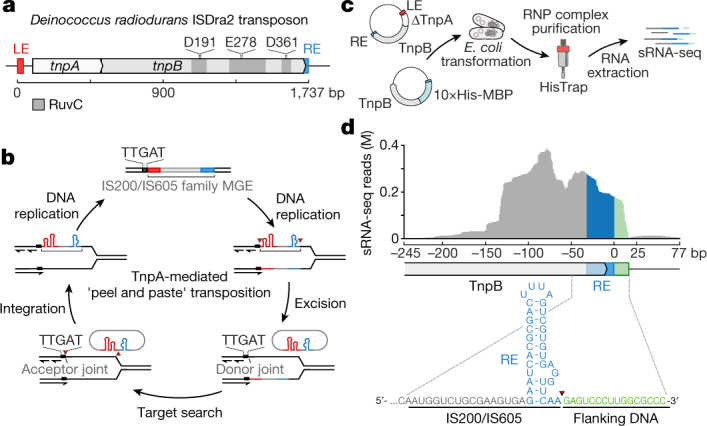
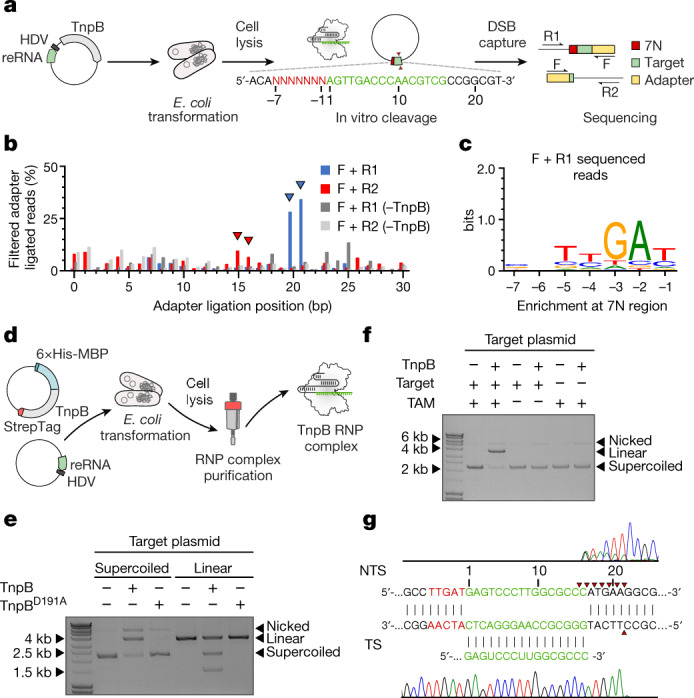
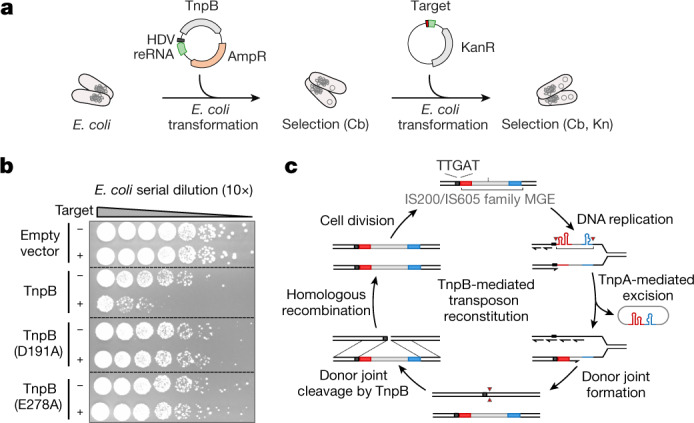
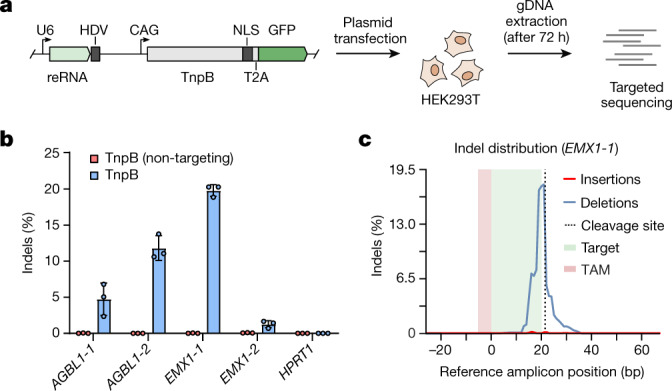
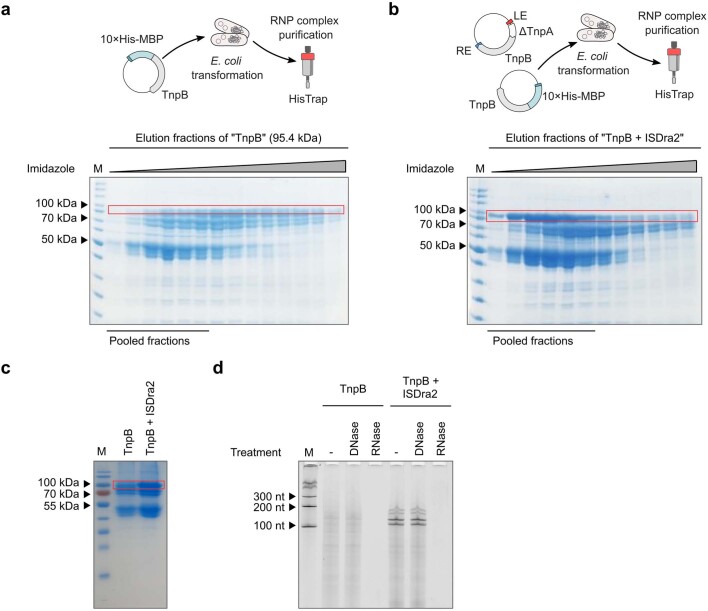
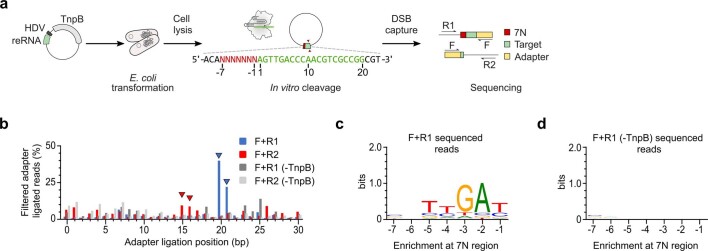
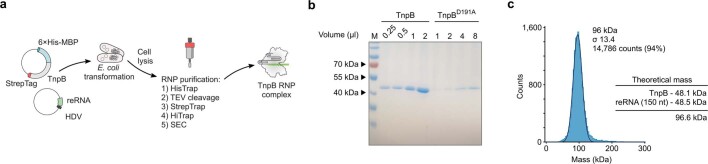
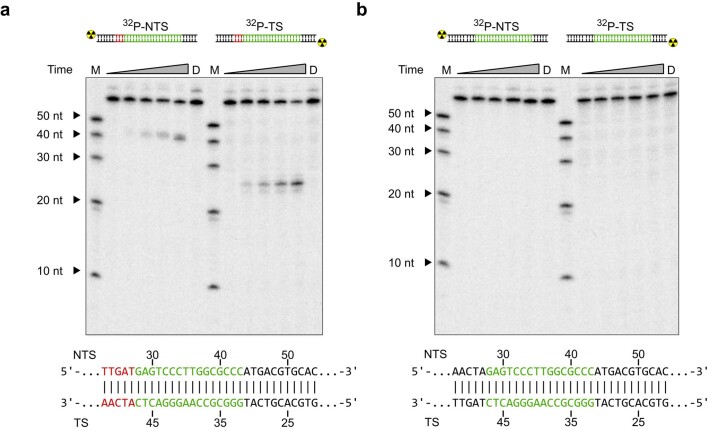
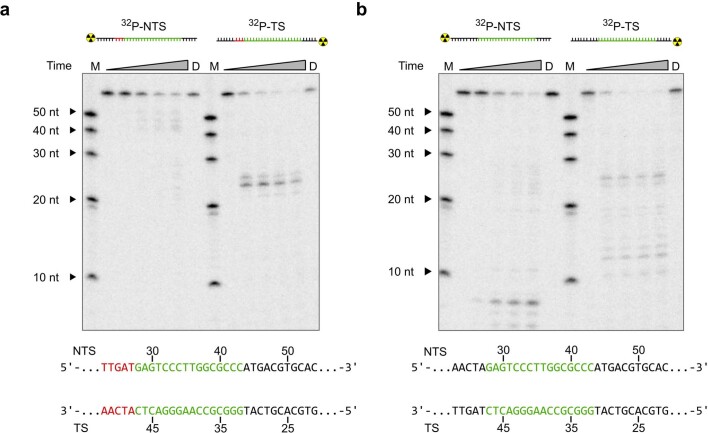
Transposition has a key role in reshaping genomes of all living organisms 1 . Insertion sequences of IS200/IS605 and IS607 families 2 are among the simplest mobile genetic elements and contain only the genes that are required for their transposition and its regulation. These elements encode tnpA transposase, which is essential for mobilization, and often carry an accessory tnpB gene, which is dispensable for transposition. Although the role of TnpA in transposon mobilization of IS200/IS605 is well documented, the function of TnpB has remained largely unknown. It had been suggested that TnpB has a role in the regulation of transposition, although no mechanism for this has been established 3–5 . A bioinformatic analysis indicated that TnpB might be a predecessor of the CRISPR–Cas9/Cas12 nucleases 6–8 . However, no biochemical activities have been ascribed to TnpB. Here we show that TnpB of Deinococcus radiodurans ISDra2 is an RNA-directed nuclease that is guided by an RNA, derived from the right-end element of a transposon, to cleave DNA next to the 5′-TTGAT transposon-associated motif. We also show that TnpB could be reprogrammed to cleave DNA target sites in human cells. Together, this study expands our understanding of transposition mechanisms by highlighting the role of TnpB in transposition, experimentally confirms that TnpB is a functional progenitor of CRISPR–Cas nucleases and establishes TnpB as a prototype of a new system for genome editing.
Overview
The claims and statistics of this paper haven’t been checked yet.
Free: it reads the open-access text and checks the first 5 claims that cite a source we can check. Create a free account to check every claim.
Integrity signals
Registry
Cites
Statistics
Figures

Verification
Claims the paper makes
The claims and statistics of this paper haven’t been checked yet.
Free: it reads the open-access text and checks the first 5 claims that cite a source we can check. Create a free account to check every claim.
Claims other papers make about this one
Each is checked against this paper’s own text: does it say what the citing paper says it does?
The source backs part of the claim, not all of it — or backs it for a different population, condition or comparison.
In the citing paper
“The IS200/IS605 family of MGEs spreads through “peel-and-paste” transposition catalyzed by the homodimeric transposase TnpA interacting with terminal hairpins at the left end (LE) and right end (RE) of the element.”
From Sequence modeling and design from molecular to genome scale with Evo (2024) · cites this paper as [67]
Experimental — accuracy not yet measuredThe source backs part of the claim, not all of it — or backs it for a different population, condition or comparison.
In the citing paper
“IS605 elements additionally contain an RNA-guided TnpB nuclease and a cognate ωRNA that bias the selfish inheritance of the transposable element (Fig. 4A) (66–69).”
From Sequence modeling and design from molecular to genome scale with Evo (2024) · cites this paper as [67]
Experimental — accuracy not yet measured
Self-check
Percentages, sums and reported differences re-computed from the paper’s own numbers.
The self-check needs the paper’s full text.
Citations
Cites
The Sequence Alignment/Map format and SAMtools
Li, H., Handsaker, B., Wysoker, A., Fennell, T., Ruan, J., Homer, N., Marth, G., Abecasis, G., Durbin, R., & 1000 Genome Project Data Processing Subgroup (2009) · Bioinformatics · doi:10.1093/bioinformatics/btp352 · Cited by 62,041
Fast and accurate short read alignment with Burrows-Wheeler transform
Li, H., & Durbin, R. (2009) · Bioinformatics · doi:10.1093/bioinformatics/btp324 · Cited by 58,607
Highly accurate protein structure prediction with AlphaFold
Jumper, J., Evans, R., Pritzel, A., Green, T., Figurnov, M., Ronneberger, O., Tunyasuvunakool, K., Bates, R., Žídek, A., Potapenko, A., et al. (2021) · Nature · doi:10.1038/s41586-021-03819-2 · Cited by 43,764
Cutadapt removes adapter sequences from high-throughput sequencing reads
Martin, M. (2011) · EMBnet.journal · doi:10.14806/ej.17.1.200 · Cited by 33,889
Robinson, J. T., Thorvaldsdóttir, H., Winckler, W., Guttman, M., Lander, E. S., Getz, G., & Mesirov, J. P. (2011) · Nature Biotechnology · doi:10.1038/nbt.1754 · Cited by 15,390
Multiplex Genome Engineering Using CRISPR/Cas Systems
Cong, L., Ran, F. A., Cox, D., Lin, S., Barretto, R., Habib, N., Hsu, P. D., Wu, X., Jiang, W., Marraffini, L. A., et al. (2013) · Science · doi:10.1126/science.1231143 · Cited by 15,339
WebLogo: A Sequence Logo Generator: Figure 1
Crooks, G. E., Hon, G., Chandonia, J.-M., & Brenner, S. E. (2004) · Genome Research · doi:10.1101/gr.849004 · Cited by 12,386
Fast and accurate long-read alignment with Burrows-Wheeler transform.
Li, H., & Durbin, R. (2010) · Bioinformatics · doi:10.1093/bioinformatics/btp698 · Cited by 12,063
RNA-Guided Human Genome Engineering via Cas9
Mali, P., Yang, L., Esvelt, K. M., Aach, J., Guell, M., DiCarlo, J. E., Norville, J. E., & Church, G. M. (2013) · Science · doi:10.1126/science.1232033 · Cited by 9,210
Cpf1 Is a Single RNA-Guided Endonuclease of a Class 2 CRISPR-Cas System
Zetsche, B., Gootenberg, J. S., Abudayyeh, O. O., Slaymaker, I. M., Makarova, K. S., Essletzbichler, P., Volz, S. E., Joung, J., van der Oost, J., Regev, A., et al. (2015) · Cell · doi:10.1016/j.cell.2015.09.038 · Cited by 4,761
Cited by
Past, present, and future of CRISPR genome editing technologies
Pacesa, M., Pelea, O., & Jinek, M. (2024) · Cell · doi:10.1016/j.cell.2024.01.042 · Cited by 609
“117,291 These efforts have focused on the evolutionary ancestors of Cas9 and Cas12 enzymes, namely IscB/IsrB 117 and TnpB, 291 respectively.”
BackgroundSequence modeling and design from molecular to genome scale with Evo
Nguyen, E., Poli, M., Durrant, M. G., Thomas, A. W., Kang, B., Sullivan, J., Ng, M. Y., Lewis, A., Patel, A., Lou, A., et al. (2024) · doi:10.1101/2024.02.27.582234 · Cited by 592
Sequence modeling and design from molecular to genome scale with Evo
Nguyen, E., Poli, M., Durrant, M. G., Kang, B., Katrekar, D., Li, D. B., Bartie, L. J., Thomas, A. W., King, S. H., Brixi, G., et al. (2024) · Science · doi:10.1126/science.ado9336 · Cited by 898
The CRISPR-Cas toolbox and gene editing technologies
Liu, G., Lin, Q., Jin, S., & Gao, C. (2022) · Molecular Cell · doi:10.1016/j.molcel.2021.12.002 · Cited by 404
Fanzor is a eukaryotic programmable RNA-guided endonuclease
Saito, M., Xu, P., Faure, G., Maguire, S., Kannan, S., Altae-Tran, H., Vo, S., Desimone, A., Macrae, R. K., & Zhang, F. (2023) · Nature · doi:10.1038/s41586-023-06356-2 · Cited by 213
CRISPR-based genome editing through the lens of DNA repair
Nambiar, T. S., Baudrier, L., Billon, P., & Ciccia, A. (2022) · Molecular Cell · doi:10.1016/j.molcel.2021.12.026 · Cited by 208
Microbial defenses against mobile genetic elements and viruses: Who defends whom from what?
Rocha, E. P. C., & Bikard, D. (2022) · PLOS Biology · doi:10.1371/journal.pbio.3001514 · Cited by 196
“Such processes of co-option may have been at the independent origins of both Cas-9 and Cas-12 proteins from transposonencoded RNA-guided endonucleases [75,76].”
BackgroundStructural biology of CRISPR–Cas immunity and genome editing enzymes
Wang, J. Y., Pausch, P., & Doudna, J. A. (2022) · Nature Reviews Microbiology · doi:10.1038/s41579-022-00739-4 · Cited by 187
CRISPR-Cas9-mediated homology-directed repair for precise gene editing
Liao, H., Wu, J., VanDusen, N. J., Li, Y., & Zheng, Y. (2024) · Molecular Therapy Nucleic Acids · doi:10.1016/j.omtn.2024.102344 · Cited by 164
“New Cas variants, however, are constantly being developed, such as Cas12a, 208 Cas12e, 209 Cas12f, 210,211 Cas12j, 212,213 Cas12n, 214 IscB, 215 and TnpB. 216 One advantage is that some new Cas variants have been developed to improve the ef fi ciency of HDR-mediated precise gene editing or to reduce the rates of off-ta…”
BackgroundBridge RNAs direct programmable recombination of target and donor DNA
Durrant, M. G., Perry, N. T., Pai, J. J., Jangid, A. R., Athukoralage, J. S., Hiraizumi, M., McSpedon, J. P., Pawluk, A., Nishimasu, H., Konermann, S., et al. (2024) · Nature · doi:10.1038/s41586-024-07552-4 · Cited by 163
CRISPR–Cas applications in agriculture and plant research
Tuncel, A., Pan, C., Clem, J. S., Liu, D., & Qi, Y. (2025) · Nature Reviews Molecular Cell Biology · doi:10.1038/s41580-025-00834-3 · Cited by 159
Diverse virus-encoded CRISPR-Cas systems include streamlined genome editors
Al-Shayeb, B., Skopintsev, P., Soczek, K. M., Stahl, E. C., Li, Z., Groover, E., Smock, D., Eggers, A. R., Pausch, P., Cress, B. F., et al. (2022) · Cell · doi:10.1016/j.cell.2022.10.020 · Cited by 139
CRISPR/Cas9 Landscape: Current State and Future Perspectives
Tyumentsev, A. I., Tyumentsev, A. I., & Акимкин, В. Г. (2023) · International Journal of Molecular Sciences · doi:10.3390/ijms242216077 · Cited by 112
An engineered hypercompact CRISPR-Cas12f system with boosted gene-editing activity
Wu, T., Liu, C., Zou, S., Lyu, R., Yang, B., Yan, H., Zhao, M., & Tang, W. (2023) · Nature Chemical Biology · doi:10.1038/s41589-023-01380-9 · Cited by 109
Xiang, G., Li, Y., Sun, J., Huo, Y., Cao, S., Cao, Y., Guo, Y., Yang, L., Cai, Y., Zhang, Y. E., et al. (2023) · Nature Biotechnology · doi:10.1038/s41587-023-01857-x · Cited by 109
TnpB structure reveals minimal functional core of Cas12 nuclease family
Sasnauskas, G., Tamulaitienė, G., Druteika, G., Carabias, A., Šilanskas, A., Kazlauskas, D., Venclovas, Č., Montoya, G., Karvelis, T., & Šikšnys, V. (2023) · Nature · doi:10.1038/s41586-023-05826-x · Cited by 107
Self-citationPrime editing using CRISPR-Cas12a and circular RNAs in human cells
Liang, R., He, Z., Zhao, K. T., Zhu, H., Hu, J., Liu, G., Gao, Q., Liu, M., Zhang, R., Qiu, J., et al. (2024) · Nature Biotechnology · doi:10.1038/s41587-023-02095-x · Cited by 108
Cryo-EM structure of the transposon-associated TnpB enzyme
Nakagawa, R., Hirano, H., Omura, S. N., Nety, S. P., Kannan, S., Altae-Tran, H., Xiao, Y., Sakaguchi, Y., Ohira, T., Wu, W. Y., et al. (2023) · Nature · doi:10.1038/s41586-023-05933-9 · Cited by 106
Viral delivery of an RNA-guided genome editor for transgene-free germline editing in Arabidopsis
Weiss, T. J., Kamalu, M., Shi, H., Li, Z., Amerasekera, J., Zhong, Z., Adler, B. A., Song, M. M., Vohra, K., Wirnowski, G., et al. (2025) · Nature Plants · doi:10.1038/s41477-025-01989-9 · Cited by 105
The miniature CRISPR-Cas12m effector binds DNA to block transcription
Wu, W. Y., Mohanraju, P., Liao, C., Adiego-Pérez, B., Creutzburg, S. C. A., Makarova, K. S., Keessen, K., Lindeboom, T. A., Khan, T. S., Prinsen, S., et al. (2022) · Molecular Cell · doi:10.1016/j.molcel.2022.11.003 · Cited by 103
Discovery of Diverse CRISPR-Cas Systems and Expansion of the Genome Engineering Toolbox
Koonin, E. V., Gootenberg, J. S., & Abudayyeh, O. O. (2023) · Biochemistry · doi:10.1021/acs.biochem.3c00159 · Cited by 103
Structural basis for RNA-guided DNA cleavage by IscB-ωRNA and mechanistic comparison with Cas9
Schuler, G. A., Hu, C., & Ke, A. (2022) · Science · doi:10.1126/science.abq7220 · Cited by 101
Recent Advances in CRISPR-Cas Technologies for Synthetic Biology
Jeong, S. H., Lee, H. J., & Lee, S. J. (2023) · The Journal of Microbiology · doi:10.1007/s12275-022-00005-5 · Cited by 95
Structural mechanism of bridge RNA-guided recombination
Hiraizumi, M., Perry, N. T., Durrant, M. G., Soma, T., Nagahata, N., Okazaki, S., Athukoralage, J. S., Isayama, Y., Pai, J. J., Pawluk, A., et al. (2024) · Nature · doi:10.1038/s41586-024-07570-2 · Cited by 93
Li, Z., Wang, J., Xu, J.-P., Wang, J., & Yang, X. F. (2023) · Military Medical Research · doi:10.1186/s40779-023-00447-x · Cited by 93
Evolutionary plasticity and functional versatility of CRISPR systems
Koonin, E. V., & Makarova, K. S. (2022) · PLoS Biology · doi:10.1371/journal.pbio.3001481 · Cited by 92
Cheng, P., Mao, C., Tang, J., Yang, S., Cheng, Y., Wang, W., Gu, Q., Han, W., Chen, H., Li, S., et al. (2024) · Cell Research · doi:10.1038/s41422-024-00989-2 · Cited by 92
Chen, W., Ma, J., Wu, Z., Wang, Z., Zhang, H., Fu, W., Pan, D., Jin, S. K., & Ji, Q. (2023) · Molecular Cell · doi:10.1016/j.molcel.2023.06.014 · Cited by 88
Xu, W., Zhang, S., Qin, H., & Yao, K. (2024) · Journal of Translational Medicine · doi:10.1186/s12967-024-05957-3 · Cited by 85
Wu, Y., Li, S., Yu, K., Hu, J., Chen, Q., & Sun, W. (2023) · Journal of Hazardous Materials · doi:10.1016/j.jhazmat.2023.132528 · Cited by 81
Recent application of CRISPR-Cas12 and OMEGA system for genome editing
Badon, I. W., Oh, Y., Kim, H., & Lee, S. H. (2023) · Molecular Therapy · doi:10.1016/j.ymthe.2023.11.013 · Cited by 78
Diversity, evolution, and classification of the RNA-guided nucleases TnpB and Cas12
Altae-Tran, H., Shmakov, S. A., Makarova, K. S., Wolf, Y. I., Kannan, S., Zhang, F., & Koonin, E. V. (2023) · Proceedings of the National Academy of Sciences · doi:10.1073/pnas.2308224120 · Cited by 77
Emerging trends in prime editing for precision genome editing
Lee, J., Kweon, J., & Kim, Y. (2025) · Experimental & Molecular Medicine · doi:10.1038/s12276-025-01463-8 · Cited by 76
Genetic engineering meets hematopoietic stem cell biology for next-generation gene therapy
Ferrari, S., Valeri, E., Conti, A., Scala, S., Aprile, A., Di Micco, R., Kajaste-Rudnitski, A., Montini, E., Ferrari, G., Aiuti, A., et al. (2023) · Cell Stem Cell · doi:10.1016/j.stem.2023.04.014 · Cited by 70
Structure-guided discovery of ancestral CRISPR-Cas13 ribonucleases
Yoon, P. H., Zhang, Z. T., Loi, K. J., Adler, B. A., Lahiri, A., Vohra, K., Shi, H., Rabelo, D. B., Trinidad, M. I., Boger, R. S., et al. (2024) · Science · doi:10.1126/science.adq0553 · Cited by 70
Pudžiuvelytė, I., Olechnovič, K., Godliauskaite, E., Sermokas, K., Urbaitis, T., Gasiunas, G., & Kazlauskas, D. (2024) · Bioinformatics · doi:10.1093/bioinformatics/btae157 · Cited by 65
Self-citationAdvances in gene editing without residual transgenes in plants
He, Y., Mudgett, M., & Zhao, Y. (2021) · PLANT PHYSIOLOGY · doi:10.1093/plphys/kiab574 · Cited by 65
The compact Casπ (Cas12l) ‘bracelet’ provides a unique structural platform for DNA manipulation
(2023) · doi:10.1038/s41422-022-00771-2 · Cited by 64
The compact Casπ (Cas12l) ‘bracelet’ provides a unique structural platform for DNA manipulation
Sun, A., Li, C.-P., Chen, Z., Zhang, S., Li, D., Yang, Y., Li, L.-Q., Zhao, Y., Wang, K., Li, Z., et al. (2022) · doi:10.1101/2022.12.16.519550 · Cited by 64
CRISPR/Cas9: a sustainable technology to enhance climate resilience in major Staple Crops
Kaur, N., Qadir, M., Francis, D. V., Alok, A., Tiwari, S., & Ahmed, Z. F. R. (2025) · Frontiers in Genome Editing · doi:10.3389/fgeed.2025.1533197 · Cited by 61
Biology and applications of CRISPR–Cas12 and transposon-associated homologs
Wu, W. Y., Adiego-Pérez, B., & John van der, O. O. S. T. (2024) · Nature Biotechnology · doi:10.1038/s41587-024-02485-9 · Cited by 61
Transposon-encoded nucleases use guide RNAs to promote their selfish spread
Meers, C., Le, H. C., Pesari, S. R., Hoffmann, F. T., Walker, M. W. G., Gezelle, J., Tang, S., & Sternberg, S. H. (2023) · Nature · doi:10.1038/s41586-023-06597-1 · Cited by 60
Programmable RNA-guided DNA endonucleases are widespread in eukaryotes and their viruses
Jiang, K., Lim, J., Sgrizzi, S., Trinh, M., Kayabolen, A., Yutin, N., Bao, W., Kato, K., Koonin, E. V., Gootenberg, J. S., et al. (2023) · Science Advances · doi:10.1126/sciadv.adk0171 · Cited by 60
“This relationship is supported by phylogenetic analysis of the RuvC-like domains, which indicates independent origins of Cas12s of different type V subtypes from distinct groups of TnpBs ( 6 , 7 ).”
InfluentialHan, X., Li, S., Zeng, Q., Sun, P., Wu, D., Wu, J., Yu, X., Lai, Z., Milne, R. J., Kang, Z., et al. (2024) · Plant Communications · doi:10.1016/j.xplc.2024.101195 · Cited by 59
De novo gene synthesis by an antiviral reverse transcriptase
Tang, S., Conte, V., Zhang, D. J., Žedaveinytė, R., Lampe, G. D., Wiegand, T., Tang, L. C., Wang, M., Walker, M. W. G., George, J. T., et al. (2024) · Science · doi:10.1126/science.adq0876 · Cited by 58
Vasantha‐Srinivasan, P., Noh, M. Y., Park, K. B., Kim, T. Y., Jung, W.-J., Senthil‐Nathan, S., & Han, Y. S. (2025) · Frontiers in Plant Science · doi:10.3389/fpls.2025.1599450 · Cited by 57
Karmakar, S., Panda, D., Panda, S., Dash, M., Saha, R., Das, P., Avinash, S. P., Shih, J., Yang, Y., Nayak, A. K., et al. (2024) · Plant Biotechnology Journal · doi:10.1111/pbi.14416 · Cited by 57
Emerging applications of gene editing technologies for the development of climate-resilient crops
Chavhan, R. L., Jaybhaye, S. G., Hinge, V. R., Deshmukh, A. S., Shaikh, U. S., Jadhav, P. K., Kadam, U. S., & Hong, J. C. (2025) · Frontiers in Genome Editing · doi:10.3389/fgeed.2025.1524767 · Cited by 55
Prokaryotic Argonaute Proteins as a Tool for Biotechnology
Kropocheva, E., Lisitskaya, L., Agapov, A., Musabirov, A. A., Kulbachinskiy, A. V., & Esyunina, D. (2022) · Molecular Biology · doi:10.1134/s0026893322060103 · Cited by 55
The expanded CRISPR toolbox for constructing microbial cell factories
Teng, Y., Jiang, T., & Yan, Y. (2023) · Trends in biotechnology · doi:10.1016/j.tibtech.2023.06.012 · Cited by 55
Li, Z., Guo, R., Sun, X.-Z., Li, G., Shao, Z., Huo, X., Yang, R., Liu, X., Cao, X., Zhang, H., et al. (2024) · Nature Communications · doi:10.1038/s41467-024-45197-z · Cited by 55
Hypercompact adenine base editors based on a Cas12f variant guided by engineered RNA
Kim, D. Y., Chung, Y., Lee, Y., Jeong, D., Park, K., Chin, H. J., Lee, J. M., Park, S., Ko, S., Ko, J., et al. (2022) · Nature Chemical Biology · doi:10.1038/s41589-022-01077-5 · Cited by 54
Current strategies employed in the manipulation of gene expression for clinical purposes
Tsai, H., Pietrobon, V., Peng, M., Wang, S., Zhao, L., Marincola, F. M., & Cai, Q. (2022) · Journal of Translational Medicine · doi:10.1186/s12967-022-03747-3 · Cited by 53
Continuous directed evolution of a compact CjCas9 variant with broad PAM compatibility
Schmidheini, L., Mathis, N., Marquart, K. F., Rothgangl, T., Kissling, L., Böck, D., Chanez, C., Wang, J. P., Jínek, M., & Schwank, G. (2023) · Nature Chemical Biology · doi:10.1038/s41589-023-01427-x · Cited by 54
A programmable seekRNA guides target selection by IS1111 and IS110 type insertion sequences
Siddiquee, R., Pong, C. H., Hall, R. M., & Ataide, S. F. (2024) · Nature Communications · doi:10.1038/s41467-024-49474-9 · Cited by 51
Alariqi, M., Ramadan, M., Yu, L., Hui, F., Hussain, A., Zhou, X., Yu, Y., Zhang, X., & Jin, S. (2025) · Advanced Science · doi:10.1002/advs.202416331 · Cited by 52
Evolution-guided protein design of IscB for persistent epigenome editing in vivo
Kannan, S., Altae-Tran, H., Zhu, S., Xu, P., Strebinger, D., Oshiro, R., Faure, G., Moeller, L., Pham, J., Mears, K. S., et al. (2025) · Nature Biotechnology · doi:10.1038/s41587-025-02655-3 · Cited by 48
A naturally DNase-free CRISPR-Cas12c enzyme silences gene expression
Huang, C. J., Adler, B. A., & Doudna, J. A. (2022) · Molecular Cell · doi:10.1016/j.molcel.2022.04.020 · Cited by 48
Molecular basis and engineering of miniature Cas12f with C-rich PAM specificity
Su, M., Li, F., Wang, Y., Gao, Y., Lan, W., Shao, Z., Zhu, C., Tang, N., Gan, J., Wu, Z., et al. (2023) · Nature Chemical Biology · doi:10.1038/s41589-023-01420-4 · Cited by 47
Exploiting viral vectors to deliver genome editing reagents in plants
Shen, Y., Tao, Y., Li, Z., Kimutai, T. H., Song, H., Dong, O. X., & Wan, J. (2024) · aBIOTECH · doi:10.1007/s42994-024-00147-7 · Cited by 47
Engineering IscB to develop highly efficient miniature editing tools in mammalian cells and embryos
Xue, N., Hong, D., Zhang, D., Wang, Q., Zhang, S., Yang, L., Chen, X., Li, Y., Han, H., Hu, C., et al. (2024) · Molecular Cell · doi:10.1016/j.molcel.2024.07.007 · Cited by 46
Effective genome editing with an enhanced ISDra2 TnpB system and deep learning-predicted ωRNAs
Marquart, K. F., Mathis, N., Mollaysa, A., Müller, S., Kissling, L., Rothgangl, T., Schmidheini, L., Kulcsár, P. I., Allam, A., Kaufmann, M. M., et al. (2024) · Nature Methods · doi:10.1038/s41592-024-02418-z · Cited by 45
Engineered IscB–ωRNA system with expanded target range for base editing
Xiao, Q., Li, G., Han, D., Wang, H., Yao, M., Ma, T., Zhou, J., Zhang, Y., Zhang, X., He, B., et al. (2024) · Nature Chemical Biology · doi:10.1038/s41589-024-01706-1 · Cited by 44
Application of CRISPR/Cas-based gene-editing for developing better banana
Tripathi, L., Ntui, V. O., & Tripathi, J. N. (2024) · Frontiers in Bioengineering and Biotechnology · doi:10.3389/fbioe.2024.1395772 · Cited by 45
Harnessing artificial intelligence to advance CRISPR-based genome editing technologies
Thomson, T., Li, G. L., Strilchuk, A. W., Cui, H., Wang, B., & Li, B. (2025) · Nature Reviews Genetics · doi:10.1038/s41576-025-00907-1 · Cited by 43
TadA reprogramming to generate potent miniature base editors with high precision
Zhang, S., Song, L., Yuan, B., Zhang, C., Cao, J., Chen, J., Qiu, J., Tai, Y., Chen, J., Qiu, Z., et al. (2023) · Nature Communications · doi:10.1038/s41467-023-36004-2 · Cited by 43
TnpB homologues exapted from transposons are RNA-guided transcription factors
Wiegand, T., Hoffmann, F. T., Walker, M. W. G., Tang, S., Richard, E., Le, H. C., Meers, C., & Sternberg, S. H. (2024) · Nature · doi:10.1038/s41586-024-07598-4 · Cited by 43
Assessing and engineering the IscB–ωRNA system for programmed genome editing
Yan, H., Tan, X., Zou, S., Sun, Y., Ke, A., & Tang, W. (2024) · Nature Chemical Biology · doi:10.1038/s41589-024-01669-3 · Cited by 41
Engineering miniature IscB nickase for robust base editing with broad targeting range
Han, L., Hu, Y., Mo, Q., Yang, H., Gu, F., Bai, F., Sun, Y., & Ma, H. (2024) · Nature Chemical Biology · doi:10.1038/s41589-024-01670-w · Cited by 41
Kantor, B., O’Donovan, B., & Chiba‐Falek, O. (2025) · Molecular Therapy — Nucleic Acids · doi:10.1016/j.omtn.2025.102635 · Cited by 40
The type V effectors for CRISPR/Cas-mediated genome engineering in plants
Zhang, R., Chai, N., Liu, T., Zheng, Z., Lin, Q., Xie, X., Wen, J., Yang, Z. F., Liu, Y., & Zhu, Q. (2024) · Biotechnology Advances · doi:10.1016/j.biotechadv.2024.108382 · Cited by 39
Eukaryotic RNA-guided endonucleases evolved from a unique clade of bacterial enzymes
Yoon, P. H., Skopintsev, P., Shi, H., Chen, L.-X., Adler, B. A., Al-Shimary, M. J., Craig, R. J., Loi, K. J., DeTurk, E. C., Li, Z., et al. (2023) · Nucleic Acids Research · doi:10.1093/nar/gkad1053 · Cited by 39
Emerging Gene Therapeutics for Epidermolysis Bullosa under Development
Bischof, J., Hierl, M., & Koller, U. (2024) · International Journal of Molecular Sciences · doi:10.3390/ijms25042243 · Cited by 39
Strategies for precise gene edits in mammalian cells
Fichter, K. M., Setayesh, T., & Malik, P. (2023) · Molecular Therapy — Nucleic Acids · doi:10.1016/j.omtn.2023.04.012 · Cited by 37
Promoter editing for the genetic improvement of crops
Shi, L., Su, J., Cho, M., Song, H., Dong, O. X., Liang, Y., & Zhang, Z. (2023) · Journal of Experimental Botany · doi:10.1093/jxb/erad175 · Cited by 37
Yu, Z., Liu, Z., Sun, L., Dong, C., Yan, J., Hu, B., & Cheng, D. (2024) · The Science of The Total Environment · doi:10.1016/j.scitotenv.2024.172115 · Cited by 38
Mechanistic and evolutionary insights into a type V-M CRISPR–Cas effector enzyme
Omura, S. N., Nakagawa, R., Südfeld, C., Warren, R. V., Wu, W. Y., Hirano, H., Laffeber, C., Kusakizako, T., Kise, Y., Lebbink, J. H. G., et al. (2023) · Nature Structural & Molecular Biology · doi:10.1038/s41594-023-01042-3 · Cited by 36
The transposon-encoded protein TnpB processes its own mRNA into ωRNA for guided nuclease activity
Nety, S. P., Altae-Tran, H., Kannan, S., Demircioglu, F. E., Faure, G., Hirano, S., Mears, K., Zhang, Y., Macrae, R. K., & Zhang, F. (2023) · The CRISPR Journal · doi:10.1089/crispr.2023.0015 · Cited by 35
“The limited TAM diversity of TnpBs may be explained by the co-evolution of TnpA and TnpB, as TnpA also utilizes the TAM to recognize the transposon ssDNA for excision and insertion.(1,2,6,43,52) Although it is not yet clear how, if at all, TnpB interacts with TnpA and the transposon DNA, the fact that both proteins po…”
BackgroundInfluentialIsolation and Characterization of Brochothrix Phage ADU4
Karaynir, A., Salih, H., Bozdoğan, B., Güçlü, Ö., & Keskin, D. (2022) · Virus Research · doi:10.1016/j.virusres.2022.198902 · Cited by 35
Structure and engineering of miniature Acidibacillus sulfuroxidans Cas12f1
Wu, Z., Liu, D., Pan, D. Y., Yu, H., Shi, J. F., Ma, J., Fu, W., Wang, Z., Zheng, Z., Qu, Y., et al. (2023) · Nature Catalysis · doi:10.1038/s41929-023-00995-4 · Cited by 34
Zhou, X., Chen, G., Ye, J., Wang, E., Zhang, J., Mao, C., Li, Z., Hao, J., Huang, X., Tang, J., et al. (2023) · Nature Communications · doi:10.1038/s41467-023-43166-6 · Cited by 34
Engineering a New Generation of Gene Editors: Integrating Synthetic Biology and AI Innovations
Chia, B. S., Seah, S., Wang, B., Shen, K., Srivastava, D., & Chew, W. L. (2025) · ACS Synthetic Biology · doi:10.1021/acssynbio.4c00686 · Cited by 33
Genome editing in plants using the TnpB transposase system
Li, Q., Wang, Y., Hou, Z., Zong, H., Wang, X., Zhang, Y. E., Wang, H., Chen, H., Wang, W., & Duan, K. (2024) · aBIOTECH · doi:10.1007/s42994-024-00172-6 · Cited by 33
Wyler, E., Lauber, C., Manukyan, A., Deter, A., Quedenau, C., Alves, L. G. T., Wylezich, C., Borodina, T. A., Seitz, S., Altmüller, J., et al. (2024) · Environment International · doi:10.1016/j.envint.2024.108875 · Cited by 33
Badet, T., Tralamazza, S. M., Feurtey, A., & Croll, D. (2023) · Nucleic Acids Research · doi:10.1093/nar/gkad1214 · Cited by 32
Deciphering soil resistance and virulence gene risks in conventional and organic farming systems
Wang, M., Zhao, J., Liu, Y., Huang, S., Zhao, C., Jiang, Z., Gu, Y., Xiao, J., Wu, Y., Ying, R., et al. (2024) · Journal of Hazardous Materials · doi:10.1016/j.jhazmat.2024.133788 · Cited by 32
Programmable genome engineering and gene modifications for plant biodesign
Liu, J., Zhang, R., Chai, N., Su, L., Zheng, Z., Liu, T., Guo, Z., Ma, Y., Xie, Y., Xie, X., et al. (2025) · Plant Communications · doi:10.1016/j.xplc.2025.101427 · Cited by 32
Aragonés, V., Aliaga, F., Pasin, F., & Daròs, J. (2022) · Biotechnology Journal · doi:10.1002/biot.202100504 · Cited by 31
Compact Cje3Cas9 for Efficient In Vivo Genome Editing and Adenine Base Editing
Chen, S., Liu, Z., Xie, W., Yu, H., Lai, L., & Li, Z. (2022) · The CRISPR Journal · doi:10.1089/crispr.2021.0143 · Cited by 31
Massive expansion of the pig gut virome based on global metagenomic mining
Mi, J., Jing, X., Ma, C., Yang, Y., Li, Y., Zhang, Y., Long, R., & Zheng, H. (2024) · npj Biofilms and Microbiomes · doi:10.1038/s41522-024-00554-0 · Cited by 31
High-efficiency, transgene-free plant genome editing by viral delivery of an engineered TnpB
Nagalakshmi, U., Rodriguez, J. E., Nguyen, T., Weissman, R. F., Thornton, B. W., Terrace, C. I., Savage, D. F., & Dinesh-Kumar, S. P. (2026) · Nature Plants · doi:10.1038/s41477-026-02237-4 · Cited by 30
Evolutionary Classification of CRISPR‐Cas Systems
Makarova, K. S., Wolf, Y. I., & Koonin, E. V. (2022) · Wiley eBooks · doi:10.1002/9781683673798.ch2 · Cited by 29
Thornton, B. W., Weissman, R. F., Rodriguez, J. E., Tran, R., Duong, B. C., Terrace, C. I., Nagalakshmi, U., Austin, G., Groover, E. D., Wang, F. Z., et al. (2026) · Nature Biotechnology · doi:10.1038/s41587-026-03059-7 · Cited by 28
Recruitment of Mobile Genetic Elements for Diverse Cellular Functions in Prokaryotes
Benler, S., & Koonin, E. V. (2022) · Frontiers in Molecular Biosciences · doi:10.3389/fmolb.2022.821197 · Cited by 28
Strategies for improving the genome-editing efficiency of class 2 CRISPR/Cas system
Wang, L., & Han, H. (2024) · Heliyon · doi:10.1016/j.heliyon.2024.e38588 · Cited by 28
Zhou, F., Yu, X., Gan, R., Ren, K., Chen, C., Ren, C., Cui, M., Liu, Y., Gao, Y., Wang, S., et al. (2023) · Nucleic Acids Research · doi:10.1093/nar/gkad425 · Cited by 28
CRISPR-Cas, Argonaute proteins and the emerging landscape of amplification-free diagnostics
Santiago‐Frangos, A., Nemudryi, A. A., Nemudraia, A., Wiegand, T., Nichols, J. E., Krishna, P., Scherffius, A. M., Zahl, T., Wilkinson, R. A., & Wiedenheft, B. (2022) · Methods · doi:10.1016/j.ymeth.2022.06.002 · Cited by 28
Innate programmable DNA binding by CRISPR-Cas12m effectors enable efficient base editing
Bigelyte, G., Duchovska, B., Žedaveinytė, R., Sasnauskas, G., Šinkūnas, T., Dalgėdienė, I., Tamulaitienė, G., Šilanskas, A., Kazlauskas, D., Valančauskas, L., et al. (2024) · Nucleic Acids Research · doi:10.1093/nar/gkae016 · Cited by 26
Self-citationIntegrating CRISPR/Cas systems with programmable DNA nanostructures for delivery and beyond
Piskunen, P., Latham, R., West, C. E., Castronovo, M., & Linko, V. (2022) · iScience · doi:10.1016/j.isci.2022.104389 · Cited by 26
Zhang, Y., Wang, M., Zhou, X., Cheng, W., Ren, J., Wan, T., & Liu, X. (2024) · Environmental Research · doi:10.1016/j.envres.2024.119057 · Cited by 26
Metadata
- Authors
- Karvelis, T., Druteika, G., Bigelyte, G., Budre, K., Zedaveinyte, R., Silanskas, A., Kazlauskas, D., Venclovas, Č., & Siksnys, V.
- Affiliations
- Vilnius University (LT)
- Corresponding author
- Karvelis, Tautvydas
- ORCID
- Venue
- Nature
- Published
- 2021-10-07
- Volume
- 599
- Issue
- 7886
- Pages
- 692-696
- ISSN
- 0028-0836 (ISSN-L)
- 1476-4687
- PMC
- PMC8612924
- OpenAlex
- W3203405076
- Cited by
- 348
- References
- 46
- Citations by year
- 2026: 84 · 2025: 79 · 2024: 90 · 2023: 59 · 2022: 33 · 2021: 3
- FWCI
- 14.66
- Type
- journal article
- Language
- en
- Open access
- hybrid
- doi.org
- Licence
- cc-by
- creativecommons.org/licenses/by/4.0 (tdm)
- creativecommons.org/licenses/by/4.0 (vor)
- Locations
- Nature (publishedVersion, cc-by)
- PubMed Central (publishedVersion, cc-by)
- PubMed (publishedVersion)
- RePEc: Research Papers in Economics (submittedVersion)
- Topics
- Life Sciences › Biochemistry, Genetics and Molecular Biology › Molecular Biology › CRISPR and Genetic Engineering
- Life Sciences › Biochemistry, Genetics and Molecular Biology › Genetics › Bacterial Genetics and Biotechnology
- Life Sciences › Biochemistry, Genetics and Molecular Biology › Genetics › Chromosomal and Genetic Variations
- Keywords
- TnpB, transposable elements, Deinococcus radiodurans, RNA-guided DNA endonuclease, transposition regulation, genome editing, mobile genetic elements
- MeSH terms
- Gene Editing, Base Sequence, Deoxyribonuclease I, DNA Transposable Elements, Escherichia coli, Humans, RNA, Deinococcus, HEK293 Cells, Nucleotide Motifs, CRISPR-Cas Systems, CRISPR-Associated Proteins
About these checks
Registry, retraction, Cites and statistics results are computed, not judged, with one exception: a printed reference that no index lists is read once by a model before it counts as a citation error. Claims are extracted by a model and kept only when their quote appears verbatim in the text; each cited source is then checked, with a model’s help, for whether it says what the claim relies on. Those verdicts can be wrong — read the claim’s quote and the cited source before relying on one.
Statistics and arithmetic are recomputed, not judged.
Confidence bands are shown only for fields calibrated on our annotated test set. None is calibrated yet, so no band is shown.
What counts as a claim ›How we measure confidence ›How we check this ›
Are you an author, or do you see a problem with this page? Request a review
Data sources
Bibliographic data: Semantic Scholar, OpenAlex, Crossref.
Contains information from the Semantic Scholar Academic Graph Datasets, made available under the ODC Attribution License (ODC-BY 1.0).
Semantic Scholar’s data is described in: Kinney, R., et al. (2023). The Semantic Scholar Open Data Platform. arXiv:2301.10140.
