

Transposon-associated TnpB is a programmable RNA-guided DNA endonuclease
Open accessThe DOI matches its Crossref record; 46 of the 46 references it cites were found in a registry or an index.
Abstract
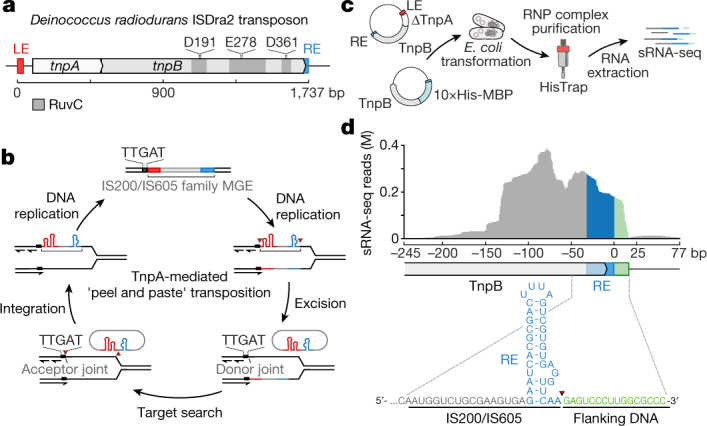
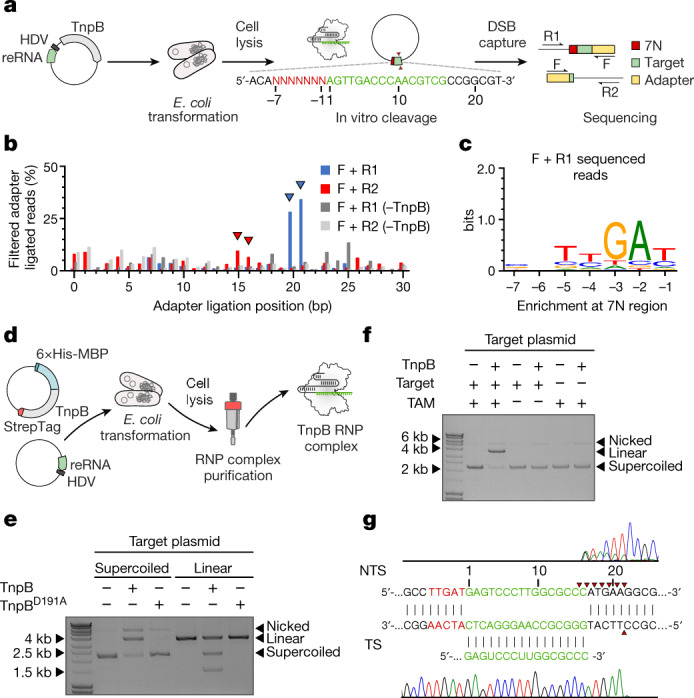
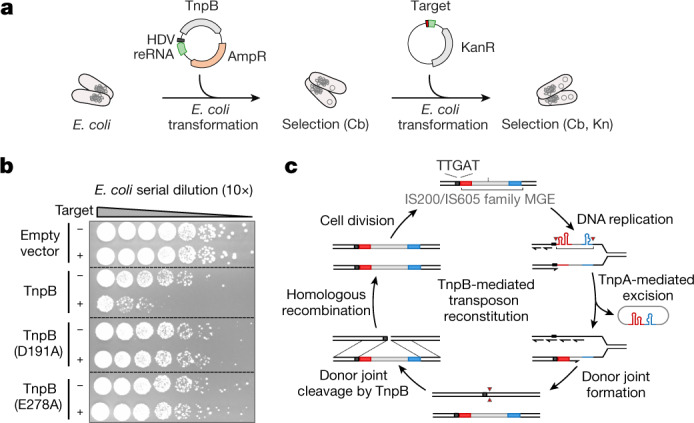
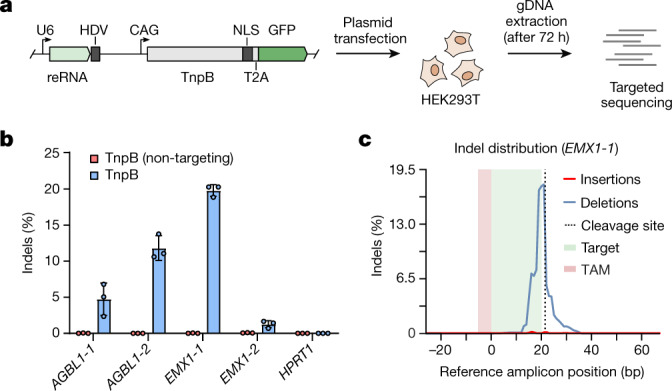
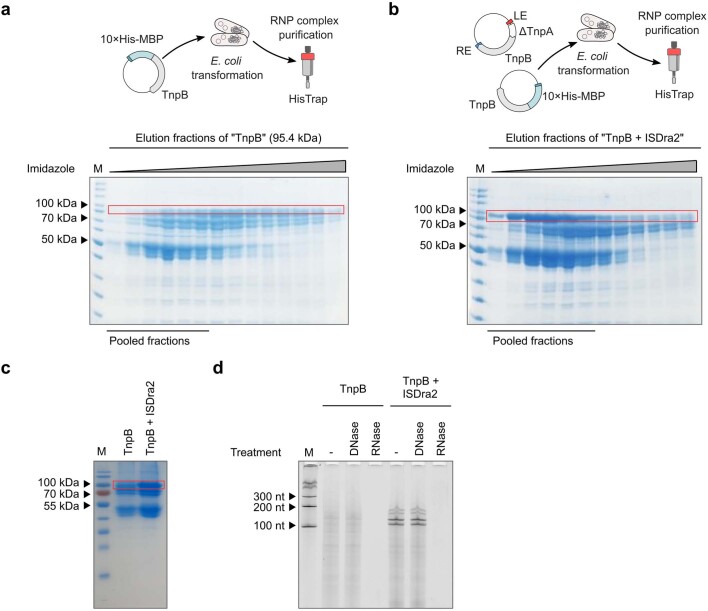
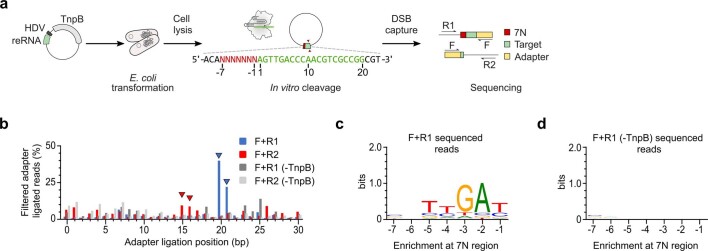
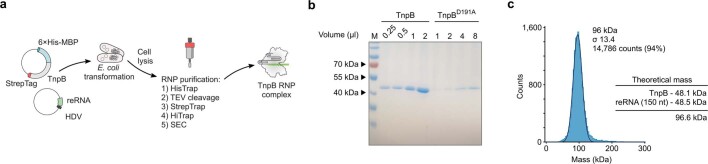
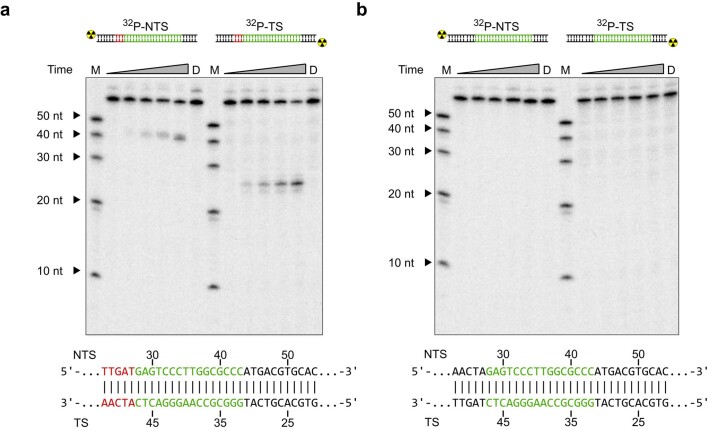
Transposition has a key role in reshaping genomes of all living organisms 1 . Insertion sequences of IS200/IS605 and IS607 families 2 are among the simplest mobile genetic elements and contain only the genes that are required for their transposition and its regulation. These elements encode tnpA transposase, which is essential for mobilization, and often carry an accessory tnpB gene, which is dispensable for transposition. Although the role of TnpA in transposon mobilization of IS200/IS605 is well documented, the function of TnpB has remained largely unknown. It had been suggested that TnpB has a role in the regulation of transposition, although no mechanism for this has been established 3–5 . A bioinformatic analysis indicated that TnpB might be a predecessor of the CRISPR–Cas9/Cas12 nucleases 6–8 . However, no biochemical activities have been ascribed to TnpB. Here we show that TnpB of Deinococcus radiodurans ISDra2 is an RNA-directed nuclease that is guided by an RNA, derived from the right-end element of a transposon, to cleave DNA next to the 5′-TTGAT transposon-associated motif. We also show that TnpB could be reprogrammed to cleave DNA target sites in human cells. Together, this study expands our understanding of transposition mechanisms by highlighting the role of TnpB in transposition, experimentally confirms that TnpB is a functional progenitor of CRISPR–Cas nucleases and establishes TnpB as a prototype of a new system for genome editing.
Overview
The claims and statistics of this paper haven’t been checked yet.
Free: it reads the open-access text and checks the first 5 claims that cite a source we can check. Create a free account to check every claim.
Integrity signals
Registry
Cites
Statistics
Figures

Verification
Claims the paper makes
The claims and statistics of this paper haven’t been checked yet.
Free: it reads the open-access text and checks the first 5 claims that cite a source we can check. Create a free account to check every claim.
Claims other papers make about this one
Each is checked against this paper’s own text: does it say what the citing paper says it does?
The source backs part of the claim, not all of it — or backs it for a different population, condition or comparison.
In the citing paper
“The IS200/IS605 family of MGEs spreads through “peel-and-paste” transposition catalyzed by the homodimeric transposase TnpA interacting with terminal hairpins at the left end (LE) and right end (RE) of the element.”
From Sequence modeling and design from molecular to genome scale with Evo (2024) · cites this paper as [67]
Experimental — accuracy not yet measuredThe source backs part of the claim, not all of it — or backs it for a different population, condition or comparison.
In the citing paper
“IS605 elements additionally contain an RNA-guided TnpB nuclease and a cognate ωRNA that bias the selfish inheritance of the transposable element (Fig. 4A) (66–69).”
From Sequence modeling and design from molecular to genome scale with Evo (2024) · cites this paper as [67]
Experimental — accuracy not yet measured
Self-check
Percentages, sums and reported differences re-computed from the paper’s own numbers.
The self-check needs the paper’s full text.
Citations
Cites
The Sequence Alignment/Map format and SAMtools
Li, H., Handsaker, B., Wysoker, A., Fennell, T., Ruan, J., Homer, N., Marth, G., Abecasis, G., Durbin, R., & 1000 Genome Project Data Processing Subgroup (2009) · Bioinformatics · doi:10.1093/bioinformatics/btp352 · Cited by 62,041
Fast and accurate short read alignment with Burrows-Wheeler transform
Li, H., & Durbin, R. (2009) · Bioinformatics · doi:10.1093/bioinformatics/btp324 · Cited by 58,607
Highly accurate protein structure prediction with AlphaFold
Jumper, J., Evans, R., Pritzel, A., Green, T., Figurnov, M., Ronneberger, O., Tunyasuvunakool, K., Bates, R., Žídek, A., Potapenko, A., et al. (2021) · Nature · doi:10.1038/s41586-021-03819-2 · Cited by 43,764
Cutadapt removes adapter sequences from high-throughput sequencing reads
Martin, M. (2011) · EMBnet.journal · doi:10.14806/ej.17.1.200 · Cited by 33,889
Robinson, J. T., Thorvaldsdóttir, H., Winckler, W., Guttman, M., Lander, E. S., Getz, G., & Mesirov, J. P. (2011) · Nature Biotechnology · doi:10.1038/nbt.1754 · Cited by 15,390
Multiplex Genome Engineering Using CRISPR/Cas Systems
Cong, L., Ran, F. A., Cox, D., Lin, S., Barretto, R., Habib, N., Hsu, P. D., Wu, X., Jiang, W., Marraffini, L. A., et al. (2013) · Science · doi:10.1126/science.1231143 · Cited by 15,339
WebLogo: A Sequence Logo Generator: Figure 1
Crooks, G. E., Hon, G., Chandonia, J.-M., & Brenner, S. E. (2004) · Genome Research · doi:10.1101/gr.849004 · Cited by 12,386
Fast and accurate long-read alignment with Burrows-Wheeler transform.
Li, H., & Durbin, R. (2010) · Bioinformatics · doi:10.1093/bioinformatics/btp698 · Cited by 12,063
RNA-Guided Human Genome Engineering via Cas9
Mali, P., Yang, L., Esvelt, K. M., Aach, J., Guell, M., DiCarlo, J. E., Norville, J. E., & Church, G. M. (2013) · Science · doi:10.1126/science.1232033 · Cited by 9,210
Cpf1 Is a Single RNA-Guided Endonuclease of a Class 2 CRISPR-Cas System
Zetsche, B., Gootenberg, J. S., Abudayyeh, O. O., Slaymaker, I. M., Makarova, K. S., Essletzbichler, P., Volz, S. E., Joung, J., van der Oost, J., Regev, A., et al. (2015) · Cell · doi:10.1016/j.cell.2015.09.038 · Cited by 4,761
ISfinder: the reference centre for bacterial insertion sequences
Siguier, P. (2006) · Nucleic Acids Research · doi:10.1093/nar/gkj014 · Cited by 2,767
Evolutionary classification of CRISPR–Cas systems: a burst of class 2 and derived variants
Makarova, K. S., Wolf, Y. I., Iranzo, J., Shmakov, S. A., Alkhnbashi, O. S., Brouns, S. J. J., Charpentier, E., Cheng, D., Haft, D. H., Horvath, P., et al. (2020) · Nature Reviews Microbiology · doi:10.1038/s41579-019-0299-x · Cited by 2,445
Self-citationRNA-programmed genome editing in human cells
Jinek, M., East, A., Cheng, A., Lin, S., Ma, E., & Doudna, J. (2013) · eLife · doi:10.7554/elife.00471 · Cited by 2,098
CRISPResso2 provides accurate and rapid genome editing sequence analysis
Clement, K., Rees, H., Canver, M. C., Gehrke, J. M., Farouni, R., Hsu, J. Y., Cole, M. A., Liu, D. R., Joung, J. K., Bauer, D. E., et al. (2019) · Nature Biotechnology · doi:10.1038/s41587-019-0032-3 · Cited by 1,660
Improved protein structure prediction using predicted interresidue orientations
Yang, J., Anishchenko, I., Park, H., Peng, Z., Ovchinnikov, S., & Baker, D. (2020) · Proceedings of the National Academy of Sciences · doi:10.1073/pnas.1914677117 · Cited by 1,421
Programmed DNA destruction by miniature CRISPR-Cas14 enzymes
Harrington, L. B., Burstein, D., Chen, J. S., Paez-Espino, D., Ma, E., Witte, I. P., Cofsky, J. C., Kyrpides, N. C., Banfield, J. F., & Doudna, J. A. (2018) · Science · doi:10.1126/science.aav4294 · Cited by 1,247
Diversity and evolution of class 2 CRISPR–Cas systems
Shmakov, S., Smargon, A., Scott, D., Cox, D., Pyzocha, N., Yan, W., Abudayyeh, O. O., Gootenberg, J. S., Makarova, K. S., Wolf, Y. I., et al. (2017) · Nature Reviews Microbiology · doi:10.1038/nrmicro.2016.184 · Cited by 1,029
Bacterial insertion sequences: their genomic impact and diversity
Siguier, P., Gourbeyre, E., & Chandler, M. (2014) · FEMS Microbiology Reviews · doi:10.1111/1574-6976.12067 · Cited by 726
RNA-guided DNA insertion with CRISPR-associated transposases
Strecker, J., Ladha, A., Gardner, Z., Schmid-Burgk, J. L., Makarova, K. S., Koonin, E. V., & Zhang, F. (2019) · Science · doi:10.1126/science.aax9181 · Cited by 708
Transposon-encoded CRISPR–Cas systems direct RNA-guided DNA integration
Klompe, S. E., Vo, P. L. H., Halpin-Healy, T. S., & Sternberg, S. H. (2019) · Nature · doi:10.1038/s41586-019-1323-z · Cited by 627
Using Dali for Protein Structure Comparison
Holm, L. (2020) · Methods in Molecular Biology · doi:10.1007/978-1-0716-0270-6_3 · Cited by 603
CRISPR-CasΦ from huge phages is a hypercompact genome editor
Pausch, P., Al-Shayeb, B., Bisom-Rapp, E., Tsuchida, C. A., Li, Z., Cress, B. F., Knott, G. J., Jacobsen, S. E., Banfield, J. F., & Doudna, J. A. (2020) · Science · doi:10.1126/science.abb1400 · Cited by 555
CasX enzymes comprise a distinct family of RNA-guided genome editors
Liu, J.-J., Orlova, N., Oakes, B. L., Ma, E., Spinner, H. B., Baney, K. L. M., Chuck, J., Tan, D., Knott, G. J., Harrington, L. B., et al. (2019) · Nature · doi:10.1038/s41586-019-0908-x · Cited by 446
The widespread IS200/IS605 transposon family encodes diverse programmable RNA-guided endonucleases
Altae-Tran, H., Kannan, S., Demircioglu, F. E., Oshiro, R., Nety, S. P., McKay, L. J., Dlakić, M., Inskeep, W. P., Makarova, K. S., Macrae, R. K., et al. (2021) · Science · doi:10.1126/science.abj6856 · Cited by 407
Distance-based protein folding powered by deep learning
Xu, J. (2019) · Proceedings of the National Academy of Sciences · doi:10.1073/pnas.1821309116 · Cited by 401
Karvelis, T., Bigelyte, G., Young, J. K., Hou, Z., Zedaveinyte, R., Budre, K., Paulraj, S., Djukanovic, V., Gasior, S., Silanskas, A., et al. (2020) · Nucleic Acids Research · doi:10.1093/nar/gkaa208 · Cited by 349
Self-citationRapid characterization of CRISPR-Cas9 protospacer adjacent motif sequence elements
Karvelis, T., Gasiunas, G., Young, J., Bigelyte, G., Silanskas, A., Cigan, M., & Siksnys, V. (2015) · Genome Biology · doi:10.1186/s13059-015-0818-7 · Cited by 225
Self-citationStructure of the miniature type V-F CRISPR-Cas effector enzyme
Takeda, S. N., Nakagawa, R., Okazaki, S., Hirano, H., Kobayashi, K., Kusakizako, T., Nishizawa, T., Yamashita, K., Nishimasu, H., & Nureki, O. (2021) · Molecular Cell · doi:10.1016/j.molcel.2020.11.035 · Cited by 185
Homing endonucleases from mobile group I introns: discovery to genome engineering
Stoddard, B. L. (2014) · Mobile DNA · doi:10.1186/1759-8753-5-7 · Cited by 170
Viruses and mobile elements as drivers of evolutionary transitions
Koonin, E. V. (2016) · Philosophical Transactions of the Royal Society B: Biological Sciences · doi:10.1098/rstb.2015.0442 · Cited by 161
Barabas, O., Ronning, D. R., Guynet, C., Hickman, A. B., Ton-Hoang, B., Chandler, M., & Dyda, F. (2008) · Cell · doi:10.1016/j.cell.2007.12.029 · Cited by 143
Xiao, R., Li, Z., Wang, S., Han, R., & Chang, L. (2021) · Nucleic Acids Research · doi:10.1093/nar/gkab179 · Cited by 139
ISC, a Novel Group of Bacterial and Archaeal DNA Transposons That Encode Cas9 Homologs
Kapitonov, V. V., Makarova, K. S., & Koonin, E. V. (2016) · Journal of Bacteriology · doi:10.1128/jb.00783-15 · Cited by 116
Primary transcriptome map of the hyperthermophilic archaeon Thermococcus kodakarensis
Jäger, D., Förstner, K. U., Sharma, C. M., Santangelo, T. J., & Reeve, J. N. (2014) · BMC Genomics · doi:10.1186/1471-2164-15-684 · Cited by 114
Homologues of bacterial TnpB_IS605 are widespread in diverse eukaryotic transposable elements
Bao, W., & Jurka, J. (2013) · Mobile DNA · doi:10.1186/1759-8753-4-12 · Cited by 110
Kersulyte, D., Velapatiño, B., Dailide, G., Mukhopadhyay, A. K., Ito, Y., Cahuayme, L., Parkinson, A. J., Gilman, R. H., & Berg, D. E. (2002) · Journal of Bacteriology · doi:10.1128/jb.184.4.992-1002.2002 · Cited by 86
Single-Stranded DNA Transposition Is Coupled to Host Replication
Ton-Hoang, B., Pasternak, C., Siguier, P., Guynet, C., Hickman, A. B., Dyda, F., Sommer, S., & Chandler, M. (2010) · Cell · doi:10.1016/j.cell.2010.06.034 · Cited by 80
The IS 200 /IS 605 Family and “Peel and Paste” Single-strand Transposition Mechanism
He, S., Corneloup, A., Guynet, C., Lavatine, L., Caumont‐Sarcos, A., Siguier, P., Marty, B., Dyda, F., Chandler, M., & Ton‐Hoang, B. (2015) · Microbiology Spectrum · doi:10.1128/microbiolspec.mdna3-0039-2014 · Cited by 80
Functional Organization and Insertion Specificity of IS607, a Chimeric Element ofHelicobacter pylori
Kersulyte, D., Mukhopadhyay, A. K., Shirai, M., Nakazawa, T., & Berg, D. E. (2000) · Journal of Bacteriology · doi:10.1128/jb.182.19.5300-5308.2000 · Cited by 79
Pasternak, C., Ton-Hoang, B., Coste, G., Bailone, A., Chandler, M., & Sommer, S. (2010) · PLoS Genetics · doi:10.1371/journal.pgen.1000799 · Cited by 73
In Vitro Reconstitution of a Single-Stranded Transposition Mechanism of IS608
Guynet, C., Hickman, A. B., Barábas, O., Dyda, F., Chandler, M., & Ton‐Hoang, B. (2008) · Molecular Cell · doi:10.1016/j.molcel.2007.12.008 · Cited by 72
IS Dra2 transposition in Deinococcus radiodurans is downregulated by TnpB
Pasternak, C., Dulermo, R., Ton‐Hoang, B., Debuchy, R., Siguier, P., Coste, G., Chandler, M., & Sommer, S. (2013) · Molecular Microbiology · doi:10.1111/mmi.12194 · Cited by 57
DNA recognition and the precleavage state during single‐stranded DNA transposition in D. radiodurans
Hickman, A. B., James, J. A., Barábas, O., Pasternak, C., Ton‐Hoang, B., Chandler, M., Sommer, S., & Dyda, F. (2010) · The EMBO Journal · doi:10.1038/emboj.2010.241 · Cited by 51
Gomes-Filho, J. V., Zaramela, L. S., Italiani, V. C. D. S., Baliga, N. S., Vêncio, R. Z. N., & Koide, T. (2015) · RNA Biology · doi:10.1080/15476286.2015.1019998 · Cited by 29
Characterization and distribution of IS8301 in the radioresistant bacterium Deinococcus radiodurans.
Islam, M., Hua, Y., Ohba, H., Satoh, K., Kikuchi, M., Yanagisawa, T., & Narumi, I. (2003) · Genes & Genetic Systems · doi:10.1266/ggs.78.319 · Cited by 23
A pipeline for characterization of novel Cas9 orthologs
Karvelis, T., Young, J. K., & Šikšnys, V. (2018) · Methods in enzymology on CD-ROM/Methods in enzymology · doi:10.1016/bs.mie.2018.10.021 · Cited by 19
Self-citation
Cited by
Past, present, and future of CRISPR genome editing technologies
Pacesa, M., Pelea, O., & Jinek, M. (2024) · Cell · doi:10.1016/j.cell.2024.01.042 · Cited by 609
“117,291 These efforts have focused on the evolutionary ancestors of Cas9 and Cas12 enzymes, namely IscB/IsrB 117 and TnpB, 291 respectively.”
BackgroundSequence modeling and design from molecular to genome scale with Evo
Nguyen, E., Poli, M., Durrant, M. G., Kang, B., Katrekar, D., Li, D. B., Bartie, L. J., Thomas, A. W., King, S. H., Brixi, G., et al. (2024) · Science · doi:10.1126/science.ado9336 · Cited by 580
The CRISPR-Cas toolbox and gene editing technologies
Liu, G., Lin, Q., Jin, S., & Gao, C. (2022) · Molecular Cell · doi:10.1016/j.molcel.2021.12.002 · Cited by 404
Fanzor is a eukaryotic programmable RNA-guided endonuclease
Saito, M., Xu, P., Faure, G., Maguire, S., Kannan, S., Altae-Tran, H., Vo, S., Desimone, A., Macrae, R. K., & Zhang, F. (2023) · Nature · doi:10.1038/s41586-023-06356-2 · Cited by 213
CRISPR-based genome editing through the lens of DNA repair
Nambiar, T. S., Baudrier, L., Billon, P., & Ciccia, A. (2022) · Molecular Cell · doi:10.1016/j.molcel.2021.12.026 · Cited by 208
Metadata
- Authors
- Karvelis, T., Druteika, G., Bigelyte, G., Budre, K., Zedaveinyte, R., Silanskas, A., Kazlauskas, D., Venclovas, Č., & Siksnys, V.
- Affiliations
- Vilnius University (LT)
- Corresponding author
- Karvelis, Tautvydas
- ORCID
- Venue
- Nature
- Published
- 2021-10-07
- Volume
- 599
- Issue
- 7886
- Pages
- 692-696
- ISSN
- 0028-0836 (ISSN-L)
- 1476-4687
- PMC
- PMC8612924
- OpenAlex
- W3203405076
- Cited by
- 348
- References
- 46
- Citations by year
- 2026: 84 · 2025: 79 · 2024: 90 · 2023: 59 · 2022: 33 · 2021: 3
- FWCI
- 14.66
- Type
- journal article
- Language
- en
- Open access
- hybrid
- doi.org
- Licence
- cc-by
- creativecommons.org/licenses/by/4.0 (tdm)
- creativecommons.org/licenses/by/4.0 (vor)
- Locations
- Nature (publishedVersion, cc-by)
- PubMed Central (publishedVersion, cc-by)
- PubMed (publishedVersion)
- RePEc: Research Papers in Economics (submittedVersion)
- Topics
- Life Sciences › Biochemistry, Genetics and Molecular Biology › Molecular Biology › CRISPR and Genetic Engineering
- Life Sciences › Biochemistry, Genetics and Molecular Biology › Genetics › Bacterial Genetics and Biotechnology
- Life Sciences › Biochemistry, Genetics and Molecular Biology › Genetics › Chromosomal and Genetic Variations
- Keywords
- TnpB, transposable elements, Deinococcus radiodurans, RNA-guided DNA endonuclease, transposition regulation, genome editing, mobile genetic elements
- MeSH terms
- Gene Editing, Base Sequence, Deoxyribonuclease I, DNA Transposable Elements, Escherichia coli, Humans, RNA, Deinococcus, HEK293 Cells, Nucleotide Motifs, CRISPR-Cas Systems, CRISPR-Associated Proteins
About these checks
Registry, retraction, Cites and statistics results are computed, not judged, with one exception: a printed reference that no index lists is read once by a model before it counts as a citation error. Claims are extracted by a model and kept only when their quote appears verbatim in the text; each cited source is then checked, with a model’s help, for whether it says what the claim relies on. Those verdicts can be wrong — read the claim’s quote and the cited source before relying on one.
Statistics and arithmetic are recomputed, not judged.
Confidence bands are shown only for fields calibrated on our annotated test set. None is calibrated yet, so no band is shown.
What counts as a claim ›How we measure confidence ›How we check this ›
Are you an author, or do you see a problem with this page? Request a review
Data sources
Bibliographic data: Semantic Scholar, OpenAlex, Crossref.
Contains information from the Semantic Scholar Academic Graph Datasets, made available under the ODC Attribution License (ODC-BY 1.0).
Semantic Scholar’s data is described in: Kinney, R., et al. (2023). The Semantic Scholar Open Data Platform. arXiv:2301.10140.
