

Universal control of a six-qubit quantum processor in silicon
Open accessThe DOI matches its Crossref record; 64 of the 64 references it cites were found in a registry or an index.
Abstract
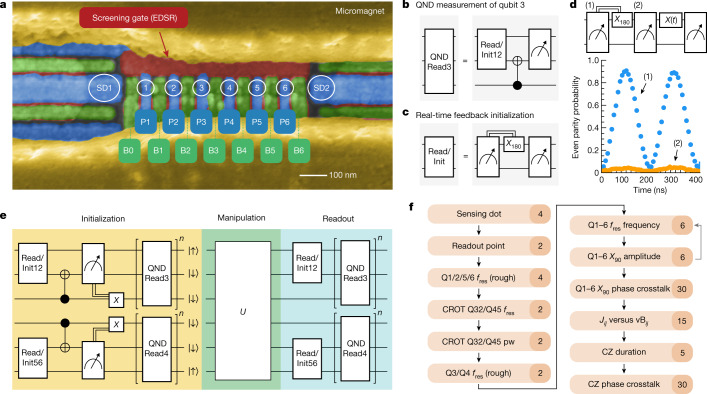
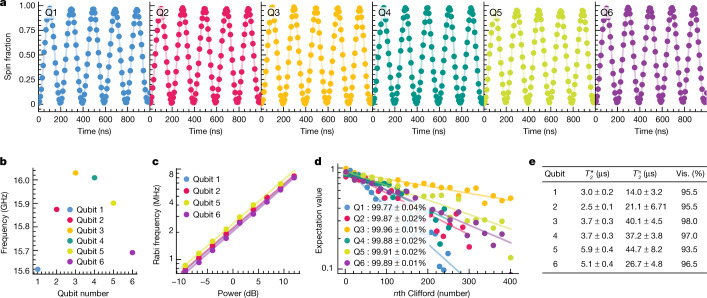
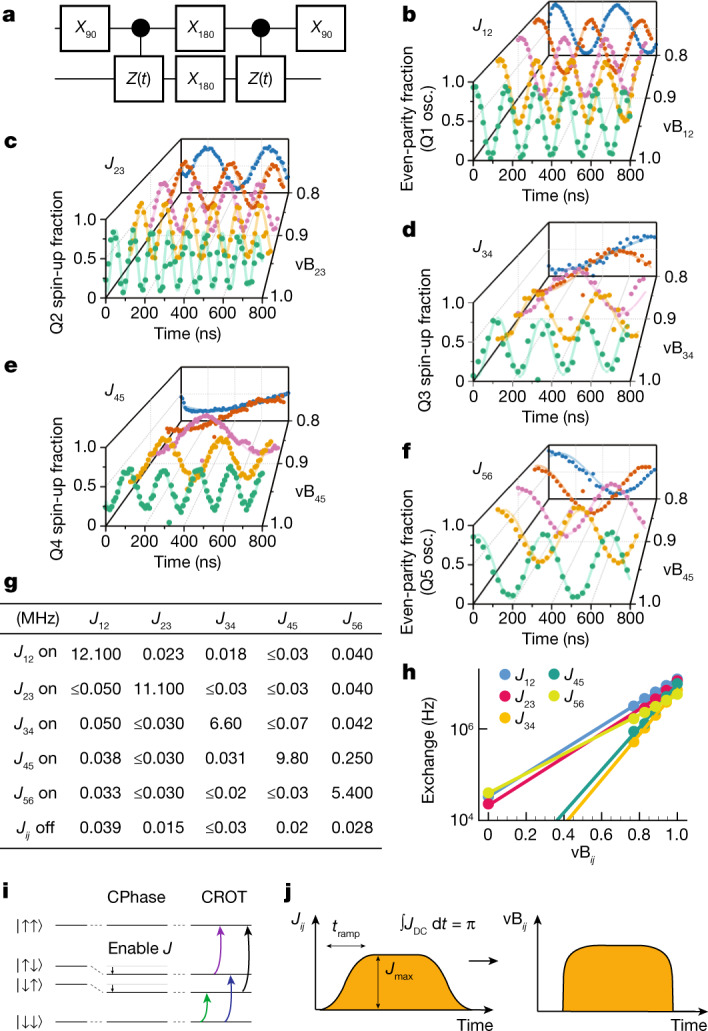
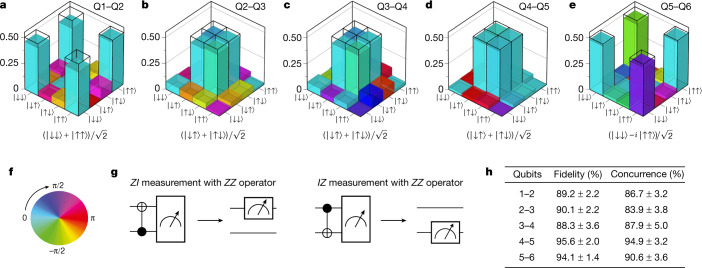
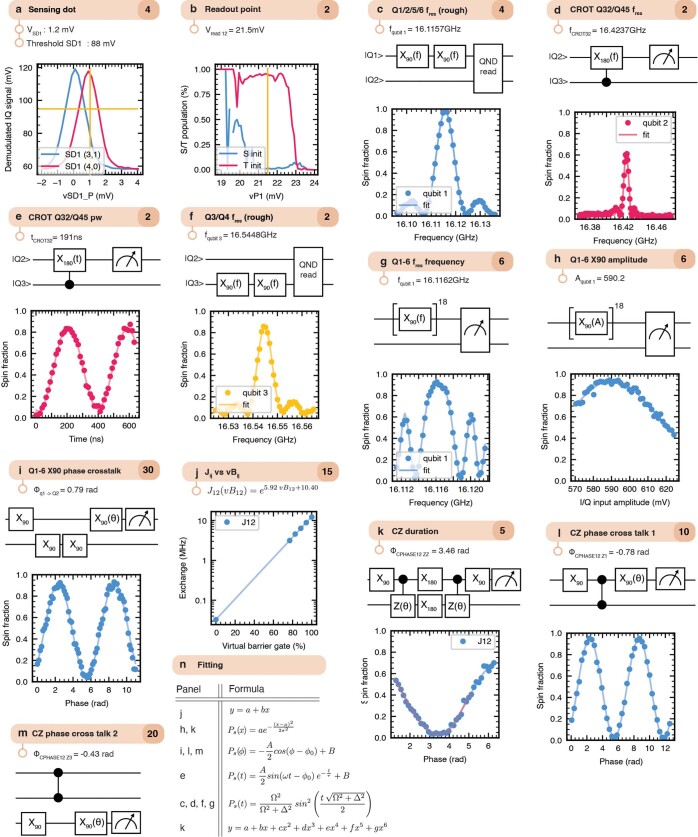
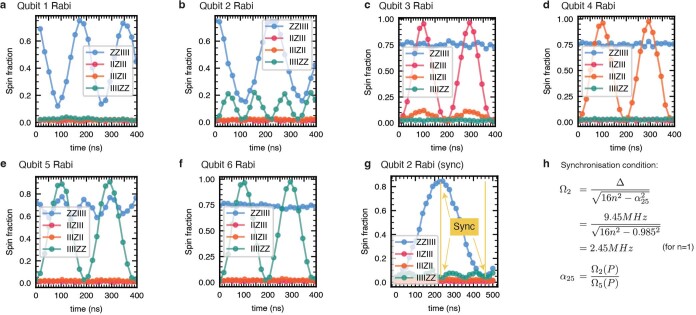
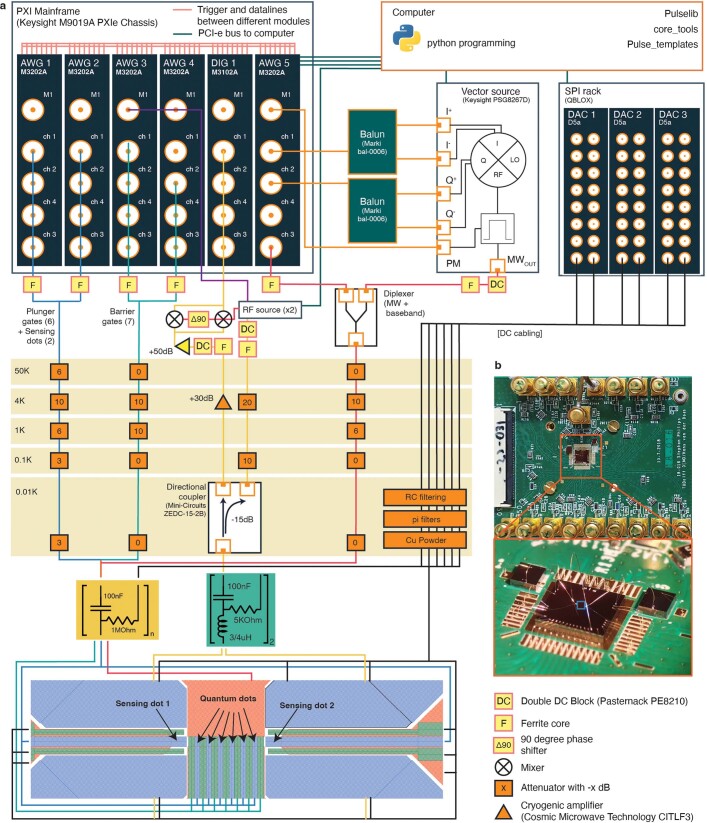
Future quantum computers capable of solving relevant problems will require a large number of qubits that can be operated reliably 1 . However, the requirements of having a large qubit count and operating with high fidelity are typically conflicting. Spins in semiconductor quantum dots show long-term promise 2,3 but demonstrations so far use between one and four qubits and typically optimize the fidelity of either single- or two-qubit operations, or initialization and readout 4–11 . Here, we increase the number of qubits and simultaneously achieve respectable fidelities for universal operation, state preparation and measurement. We design, fabricate and operate a six-qubit processor with a focus on careful Hamiltonian engineering, on a high level of abstraction to program the quantum circuits, and on efficient background calibration, all of which are essential to achieve high fidelities on this extended system. State preparation combines initialization by measurement and real-time feedback with quantum-non-demolition measurements. These advances will enable testing of increasingly meaningful quantum protocols and constitute a major stepping stone towards large-scale quantum computers.
Overview
The claims and statistics of this paper haven’t been checked yet.
Free: it reads the open-access text and checks the first 5 claims that cite a source we can check. Create a free account to check every claim.
Integrity signals
Registry
Cites
Statistics
Figures
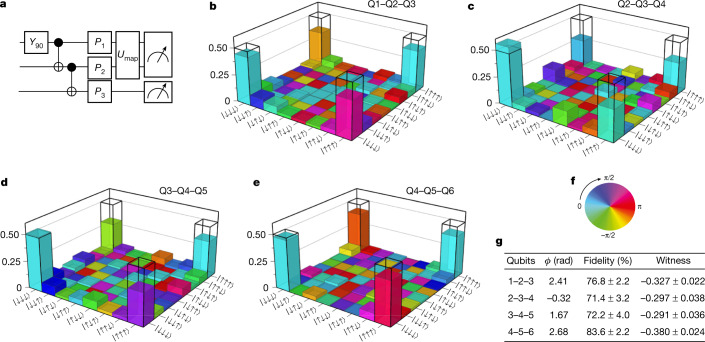
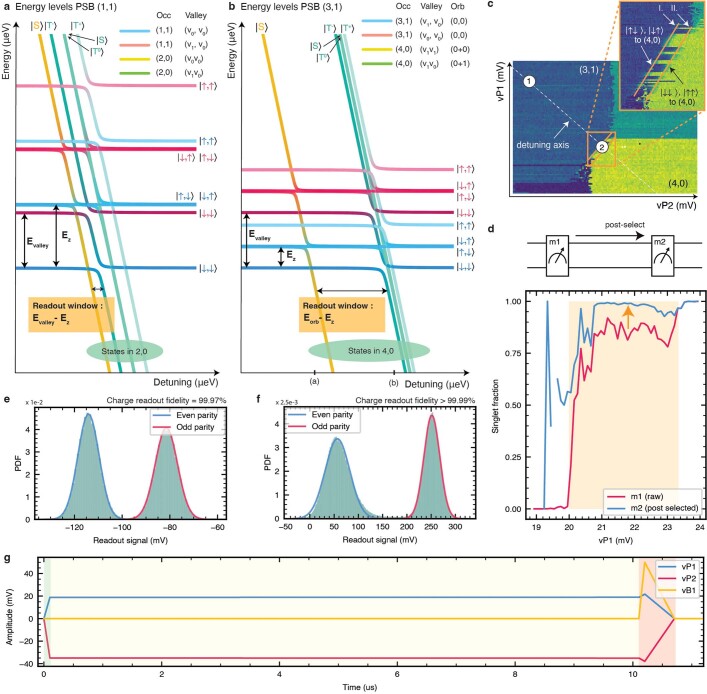
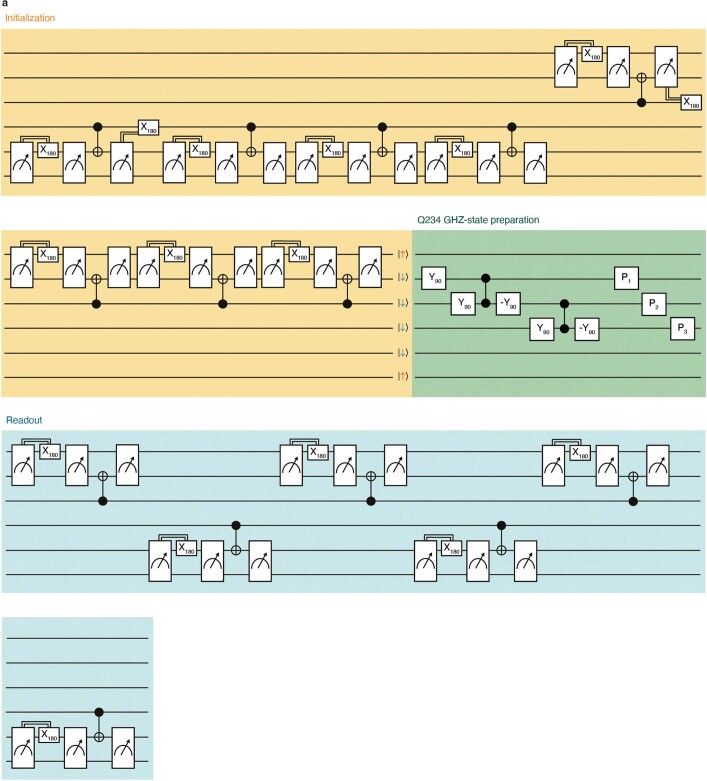
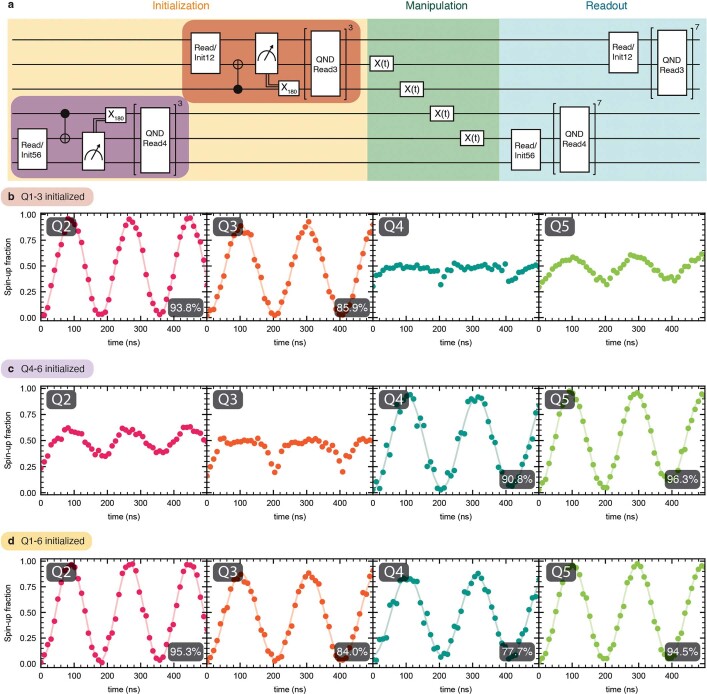
Verification
Claims the paper makes
The claims and statistics of this paper haven’t been checked yet.
Free: it reads the open-access text and checks the first 5 claims that cite a source we can check. Create a free account to check every claim.
Self-check
Percentages, sums and reported differences re-computed from the paper’s own numbers.
The self-check needs the paper’s full text.
Citations
Cites
Quantum supremacy using a programmable superconducting processor
Arute, F., Arya, K., Babbush, R., Bacon, D., Bardin, J. C., Barends, R., Biswas, R., Boixo, S., Brandao, F. G. S. L., Buell, D. A., et al. (2019) · Nature · doi:10.1038/s41586-019-1666-5 · Cited by 7,720 · cited 1×
“Nevertheless, spin qubits currently lag behind in scale when compared to superconducting, trapped ions and photonic platforms, which have demonstrated control of several dozen qubits 16–18 .”
BackgroundQuantum computational advantage using photons
Zhong, H.-S., Wang, H., Deng, Y.-H., Chen, M.-C., Peng, L.-C., Luo, Y.-H., Qin, J., Wu, D., Ding, X., Hu, Y., et al. (2020) · Science · doi:10.1126/science.abe8770 · Cited by 2,405 · cited 1×
“Nevertheless, spin qubits currently lag behind in scale when compared to superconducting, trapped ions and photonic platforms, which have demonstrated control of several dozen qubits 16–18 .”
BackgroundGreenberger, D. M., Horne, M. A., & Zeilinger, A. (1989) · Bell’s Theorem, Quantum Theory and Conceptions of the Universe · doi:10.1007/978-94-017-0849-4_10 · Cited by 1,513
Trapped-ion quantum computing: Progress and challenges
Bruzewicz, C. D., Chiaverini, J., McConnell, R., & Sage, J. M. (2019) · Applied Physics Reviews · doi:10.1063/1.5088164 · Cited by 1,483 · cited 1×
“…shows that, in scaling up, maintaining the quality of the control requires substantial effort, particularly, for instance, to deal with the denser motional spectrum in trapped ions 23 , to avert crosstalk in superconducting circuits 24 or to avoid increased losses in photonic circuits 25 .”
BackgroundZwanenburg, F. A., Dzurak, A. S., Morello, A., Simmons, M. Y., Hollenberg, L. C. L., Klimeck, G., Rogge, S., Coppersmith, S. N., & Eriksson, M. A. (2013) · Reviews of Modern Physics · doi:10.1103/revmodphys.85.961 · Cited by 1,210
An addressable quantum dot qubit with fault-tolerant control-fidelity
Veldhorst, M., Hwang, J. C. C., Yang, C. H., Leenstra, A. W., de Ronde, B., Dehollain, J. P., Muhonen, J. T., Hudson, F. E., Itoh, K. M., Morello, A., et al. (2014) · Nature Nanotechnology · doi:10.1038/nnano.2014.216 · Cited by 940
Self-citationA quantum-dot spin qubit with coherence limited by charge noise and fidelity higher than 99.9%
Yoneda, J., Takeda, K., Otsuka, T., Nakajima, T., Delbecq, M. R., Allison, G., Honda, T., Kodera, T., Oda, S., Hoshi, Y., et al. (2018) · Nature Nanotechnology · doi:10.1038/s41565-017-0014-x · Cited by 900 · cited 1×
“• Following [13], we aim at a maximal decoherence gradient (|z ∂z |+ | ∂Bz ∂y |) of 0.”
MethodCurrent Rectification by Pauli Exclusion in a Weakly Coupled Double Quantum Dot System
Ono, K., Austing, D. G., Tokura, Y., & Tarucha, S. (2002) · Science · doi:10.1126/science.1070958 · Cited by 801 · cited 1×
“PSB readout is a method used to convert a spin state to a more easily detectable charge state 58 .”
MethodA programmable two-qubit quantum processor in silicon
Watson, T. F., Philips, S. G. J., Kawakami, E., Ward, D. R., Scarlino, P., Veldhorst, M., Savage, D. E., Lagally, M. G., Friesen, M., Coppersmith, S. N., et al. (2018) · Nature · doi:10.1038/nature25766 · Cited by 741 · cited 2×
“…measured across the six-dot array have state fidelity ranging from 88% to 96%, which is considerably higher than the Bell state fidelities of 78% to 89% (all state preparation and measurement (SPAM) corrected, see Methods) reported on two-qubit quantum dot devices just a few years ago 42,44,45 .”
BackgroundSelf-citationInterfacing spin qubits in quantum dots and donors—hot, dense, and coherent
Vandersypen, L. M. K., Bluhm, H., Clarke, J. S., Dzurak, A. S., Ishihara, R., Morello, A., Reilly, D. J., Schreiber, L. R., & Veldhorst, M. (2017) · npj Quantum Information · doi:10.1038/s41534-017-0038-y · Cited by 624 · cited 1×
“To scale beyond, we envision networks of local registers [6, 7], connected together with quantum coherent links.”
BackgroundSelf-citation
Research works printed but not linked: 1
- Harvey-Collard P High-fidelity single-shot readout for a spin qubit via an enhanced latching mechanism Phys. Rev. X 2018 8 021046
Cited by
Items 101–200 of 468
Pipeline quantum processor architecture for silicon spin qubits
Patomäki, S. M., González-Zalba, M. F., Fogarty, M. A., Cai, Z., Benjamin, S. C., & Morton, J. J. L. (2024) · npj Quantum Information · doi:10.1038/s41534-024-00823-y · Cited by 28
Beating the Thermal Limit of Qubit Initialization with a Bayesian Maxwell’s Demon
Johnson, M. A. I., Mądzik, M. T., Hudson, F. E., Itoh, K. M., Jakob, A., Jamieson, D. N., Dzurak, A. S., & Morello, A. (2022) · Physical Review X · doi:10.1103/physrevx.12.041008 · Cited by 25
Self-citationBell inequality violation in gate-defined quantum dots
Steinacker, P., Tanttu, T., Lim, W. H., Stuyck, N. D., Feng, M., Serrano, S., Vahapoglu, E., Su, R. Y., Huang, J. Y., Jones, C., et al. (2025) · Nature Communications · doi:10.1038/s41467-025-57987-0 · Cited by 25
Identification and mitigation of errors in hole spin qubit readout
Kelly, E. G., Massai, L., Hetényi, B., Pita‐Vidal, M., Orekhov, A., Carlsson, C., Seidler, I., Tsoukalas, K., Sommer, L., Aldeghi, M., et al. (2026) · Nature Electronics · doi:10.1038/s41928-026-01705-1 · Cited by 19
“1c, dashed grey lines).”
Simulation of 1/f charge noise affecting a quantum dot in a Si/SiGe structure
Kępa, M., Focke, N., Cywiński, Ł., & Krzywda, J. A. (2023) · Applied Physics Letters · doi:10.1063/5.0151029 · Cited by 20
Coherent charge oscillations in a bilayer graphene double quantum dot
Hecker, K., Banszerus, L., Schäpers, A., Möller, S., Peters, A., Icking, E., Watanabe, K., Taniguchi, T., Volk, C., & Stampfer, C. (2023) · Nature Communications · doi:10.1038/s41467-023-43541-3 · Cited by 24
Self-citationClassification and magic magnetic field directions for spin-orbit-coupled double quantum dots
Sen, A., Frank, G., Kolok, B., Danon, J., & Pályi, A. (2023) · Physical review. B./Physical review. B · doi:10.1103/physrevb.108.245406 · Cited by 18
Single-spin-qubit geometric gate in a silicon quantum dot
Ma, R.-L., Li, A.-R., Wang, C., Kong, Z., Liao, W.-Z., Ni, M., Zhu, S.-K., Chu, N., Zhang, C., Liu, D., et al. (2024) · Physical Review Applied · doi:10.1103/physrevapplied.21.014044 · Cited by 19
“[37] Stephan GJ Philips, Mateusz T Madzik, Sergey V Amitonov, Sander L de Snoo, Maximilian Russ, Nima Kalhor, Christian Volk, William IL Lawrie, Delphine Brousse, Larysa Tryputen, et al.”
BackgroundClassical interfaces for controlling cryogenic quantum computing technologies
Brennan, J. C., Barbosa, J., Li, C., Ahmad, M., Imroze, F., Rose, C., Karar, W., Stanley, M., Heidari, H., Ridler, N., et al. (2025) · APL Quantum · doi:10.1063/5.0273490 · Cited by 23
Two-dimensional vertex-decorated Lieb lattice with exact mobility edges and robust flat bands
Wang, Y., Zhang, L., Wan, Y., He, Y., & Wang, Y. (2023) · Physical review. B./Physical review. B · doi:10.1103/physrevb.107.l140201 · Cited by 25
Feedback-based active reset of a spin qubit in silicon
Kobayashi, T., Nakajima, T., Takeda, K., Noiri, A., Yoneda, J., & Tarucha, S. (2023) · npj Quantum Information · doi:10.1038/s41534-023-00719-3 · Cited by 25
Valley splitting correlations across a silicon quantum well containing germanium
Marcks, J. C., Eagen, E., Brann, E., Losert, M. P., Oh, T., Reily, J., Wang, C., Keith, D., Mohiyaddin, F. A., Luthi, F., et al. (2025) · Nature Communications · doi:10.1038/s41467-025-67325-z · Cited by 31
von Horstig, F.-E., Ibberson, D. J., Oakes, G. A., Cochrane, L., Wise, D. F., Stelmashenko, N. A., Barraud, S., Robinson, J. W. A., Martins, F., & González-Zalba, M. F. (2024) · Physical Review Applied · doi:10.1103/physrevapplied.21.044016 · Cited by 21
“…two-qubit gates [18–20], the demonstrations of simple instances of quantum error correction [21], the operation of a six-qubit processors [22] and the compatibility with advanced manufacturing techniques [23–27], these steps show important progress towards a scalable silicon-based quantum…”
BackgroundMethodCorley-Wiciak, C. X., Zoellner, M. H., Zaitsev, I., Anand, K., Zatterin, E. M., Yamamoto, Y., Corley‐Wiciak, A. A., Reichmann, F., Langheinrich, W., Schreiber, L. R., et al. (2023) · Physical Review Applied · doi:10.1103/physrevapplied.20.024056 · Cited by 23
Industrially Fabricated Single-Electron Quantum Dots in Si/Si—Ge Heterostructures
Huckemann, T., Muster, P., Langheinrich, W., Brackmann, V., Friedrich, M., Komericki, N. D., Diebel, L. K., Stieß, V., Bougeard, D., Yamamoto, Y., et al. (2025) · IEEE Electron Device Letters · doi:10.1109/led.2025.3553672 · Cited by 24
“Using devices fabricated in academic labs, all required qubit operations [1], [2], [3], few-qubit devices [4], [5] and qubit shuttling as a scalability element [6], [7], [8] have been demonstrated.”
High-fidelity geometric quantum gates exceeding 99.9% in germanium quantum dots
Zhou, Y.-C., Ma, R.-L., Kong, Z., Li, A.-R., Zhang, C., Zhang, X., Liu, Y., Jiang, H.-T., Wu, Z., Wang, G., et al. (2025) · Nature Communications · doi:10.1038/s41467-025-63241-4 · Cited by 32
“In current devices with a limited number of qubits, calibration requires a considerable amount of time 20,66,69 .”
Running a Six-Qubit Quantum Circuit on a Silicon Spin-Qubit Array
de Fuentes, I. F., Raymenants, E., Undseth, B., Pietx-Casas, O., Philips, S. G. J., Mądzik, M. T., de Snoo, S. L., Amitonov, S. V., Tryputen, L., Schmitz, A. T., et al. (2026) · PRX Quantum · doi:10.1103/f285-l2v5 · Cited by 26
Self-citationHybrid quantum learning with data reuploading on a small-scale superconducting quantum simulator
Tolstobrov, A., Fedorov, G., Sanduleanu, S. V., Kadyrmetov, S., Vasenin, A. V., Bolgar, A. N., Kalacheva, D. A., Lubsanov, V. B., Dorogov, A., Zotova, J., et al. (2024) · Physical Review A · doi:10.1103/physreva.109.012411 · Cited by 19
“…and the fact that the superconducting quantum computing platform currently features the fastest known gates (compare with silicon, with 100-s of ns [49], and trapped atom/ion or diamond platforms, with 100-s of µ s [50, 51, 52]), the training process is currently orders of magnitude slower than…”
BackgroundHeat transport at the nanoscale and ultralow temperatures—Implications for quantum technologies
Majidi, D., Bergfield, J. P., Maisi, V. F., Höfer, J., Courtois, H., & Winkelmann, C. B. (2024) · Applied Physics Letters · doi:10.1063/5.0204207 · Cited by 16
Martínez, B., Franceschi, S. D., & Niquet, Y. (2024) · Physical Review Applied · doi:10.1103/physrevapplied.22.024030 · Cited by 16
“Considerable progress has been made recently with, e.g., the operation of four Ge/SiGe hole spin qubits [25] and six Si/SiGe electron spin qubits [15], and the demonstration of spin-photon coupling [31–36] as well as sweet spots with long dephasing times [4, 24, 28, 37].”
BackgroundGeometric correspondence of noisy quantum dynamics and universal robust quantum gates
Hai, Y.-J., Song, Y., Li, J., Zeng, J., & Deng, X. (2025) · Physical Review Applied · doi:10.1103/physrevapplied.23.054002 · Cited by 21
Determination of spin-orbit interaction in semiconductor nanostructures via nonlinear transport
Dantas, R. M. A., Legg, H. F., Bosco, S., Loss, D., & Klinovaja, J. (2023) · Physical review. B./Physical review. B · doi:10.1103/physrevb.107.l241202 · Cited by 18
Single-Electron Occupation in Quantum Dot Arrays at Selectable Plunger Gate Voltage
Meyer, M., Déprez, C., Meijer, I. N., Unseld, F. K., Karwal, S., Sammak, A., Scappucci, G., Vandersypen, L. M. K., & Veldhorst, M. (2023) · Nano Letters · doi:10.1021/acs.nanolett.3c03349 · Cited by 17
Self-citationA Cryo-CMOS SAR ADC With FIA Sampling Driver Enabled by Cryogenic-Aware Back-Biasing
Kiene, G., Overwater, R. W. J., Babaie, M., & Sebastiano, F. (2023) · IEEE Transactions on Circuits and Systems I Regular Papers · doi:10.1109/tcsi.2023.3336566 · Cited by 15
“2 K [2], [3], [4], posing significant challenges to the realization of large-scale quantum computers.”
BackgroundAccelerated Adiabatic Passage of a Single Electron Spin Qubit in Quantum Dots
Liu, X.-F., Matsumoto, Y., Fujita, T., Ludwig, A., Wieck, A. D., & Oiwa, A. (2024) · Physical Review Letters · doi:10.1103/physrevlett.132.027002 · Cited by 21
“Since the gate-defined QDs are moving toward the scalable quantum processor [35], the results of this paper will greatly promote related researches about quantum control and quantum simulations.”
BackgroundShinde, U. U., & Bandaru, R. (2024) · Scientific Reports · doi:10.1038/s41598-024-65182-2 · Cited by 16
“Researchers are actively exploring novel algorithms and hardware improvements to surmount these challenges and advance the field of quantum error correction 17–20 .”
BackgroundValley-Free Silicon Fins Caused by Shear Strain
Adelsberger, C., Bosco, S., Klinovaja, J., & Loss, D. (2024) · Physical Review Letters · doi:10.1103/physrevlett.133.037001 · Cited by 15
Impact of electrostatic crosstalk on spin qubits in dense CMOS quantum dot arrays
Cifuentes, J. D., Tanttu, T., Steinacker, P., Serrano, S., Hansen, I., Slack-Smith, J., Gilbert, W., Huang, J. Y., Vahapoglu, E., Leon, R. C. C., et al. (2024) · Physical review. B./Physical review. B · doi:10.1103/physrevb.110.125414 · Cited by 17
Autonomous bootstrapping of quantum dot devices
Zubchenko, A., Middlebrooks, D., Rasmussen, T., Lausen, L., Kuemmeth, F., Chatterjee, A., & Zwolak, J. P. (2025) · Physical Review Applied · doi:10.1103/physrevapplied.23.014072 · Cited by 20
Single-Step High-Fidelity Three-Qubit Gates by Anisotropic Chiral Interactions
Nguyen, M. T. P., Rimbach-Russ, M., Vandersypen, L. M. K., & Bosco, S. (2025) · PRX Quantum · doi:10.1103/kp8s-py9m · Cited by 19
Self-citationSpin Qubit in a 2D GdIIINaI‐Based Oxamato Supramolecular Coordination Framework
Wang, J., Jing, Y., Cui, M., Lu, Y., Ouyang, Z., Shao, C., Wang, Z., & Song, Y. (2023) · Chemistry - A European Journal · doi:10.1002/chem.202301771 · Cited by 15
Cryogenic hyperabrupt strontium titanate varactors for sensitive reflectometry of quantum dots
Eggli, R. S., Svab, S., Patlatiuk, T., Trüssel, D. A., Carballido, M. J., Kwon, P. C., Geyer, S., Li, A., Bakkers, E. P. A. M., Kuhlmann, A. V., et al. (2023) · Physical Review Applied · doi:10.1103/physrevapplied.20.054056 · Cited by 15
Hamiltonian phase error in resonantly driven CNOT gate above the fault-tolerant threshold
Wu, Y.-H., Camenzind, L. C., Noiri, A., Takeda, K., Nakajima, T., Kobayashi, T., Chang, C. Y., Sammak, A., Scappucci, G., Goan, H., et al. (2024) · npj Quantum Information · doi:10.1038/s41534-023-00802-9 · Cited by 16
Self-citationMeasurement of cryoelectronics heating using a local quantum dot thermometer in silicon
de Kruijf, M., Noah, G. M., Gomez-Saiz, A., Morton, J. J. L., & González-Zalba, M. F. (2024) · Chip · doi:10.1016/j.chip.2024.100097 · Cited by 17
“One-and two-qubit gates have been shown to perform above fault-tolerant thresholds for electron spins [2–4], simple instances of quantum error correction have been performed [5] and a 6-qubit quantum processor has been demonstrated [6].”
BackgroundCoherence limit due to hyperfine interaction with nuclei in the barrier material of Si spin qubits
Cvitkovich, L., Stano, P., Wilhelmer, C., Waldhoer, D., Loss, D., Niquet, Y., & Grasser, T. (2024) · Physical Review Applied · doi:10.1103/physrevapplied.22.064089 · Cited by 20
Passive and active suppression of transduced noise in silicon spin qubits
Park, J., Jang, H., Sohn, H., Yun, J., Song, Y., Kang, B., Stehouwer, L. E. A., Esposti, D. D., Scappucci, G., & Kim, D. (2025) · Nature Communications · doi:10.1038/s41467-024-55338-z · Cited by 24
“…calculation time on the hardware level, minimizing the heating effect that enables minimal waiting time after qubit manipulation, and by reducing the readout time using different spin to charge conversion method such as Pauli spin blockade-based parity measurements 7,46 (see Supplementary Note 6).”
InfluentialSelf-citationScalable entanglement of nuclear spins mediated by electron exchange
Stemp, H. G., van Blankenstein, M. R., Asaad, S., Mądzik, M. T., Joecker, B., Firgau, H. R., Laucht, A., Hudson, F. E., Dzurak, A. S., Itoh, K. M., et al. (2025) · Science · doi:10.1126/science.ady3799 · Cited by 21
Self-citationQuantum Dot-Based Frequency Multiplier
Oakes, G. A., Peri, L., Cochrane, L., Martins, F., Hutin, L., Bertrand, B., Vinet, M., Gomez-Saiz, A., Ford, C. J. B., Smith, C. G., et al. (2023) · PRX Quantum · doi:10.1103/prxquantum.4.020346 · Cited by 18
Coupled vertical double quantum dots at single-hole occupancy
Ivlev, A., Tidjani, H., Oosterhout, S. D., Sammak, A., Scappucci, G., & Veldhorst, M. (2024) · Applied Physics Letters · doi:10.1063/5.0198274 · Cited by 13
Self-citationNoro, K., Kozuka, Y., Matsumura, K., Kumasaka, T., Fujiwara, Y., Tsukazaki, A., Kawasaki, M., & Otsuka, T. (2024) · Nature Communications · doi:10.1038/s41467-024-53890-2 · Cited by 14
A tri-linear quantum dot architecture for semiconductor spin qubits
Li, R., Levajac, V., Godfrin, C., Kubicek, S., Simion, G., Raes, B., Beyne, S., Fattal, I., Loenders, A., Roeck, W. D., et al. (2026) · Scientific Reports · doi:10.1038/s41598-026-42575-z · Cited by 21
“These include high quantum dot yield rate 26 , single and two qubit gates beyond the fault-tolerant threshold 63 , coherent shuttling 18 and operation of small-scale 1D arrays 64 .”
A crossbar chip for benchmarking semiconductor spin qubits
Tosato, A., Elsayed, A., Poggiali, F., Stehouwer, L. E. A., Costa, D., Hudson, K., Esposti, D. D., & Scappucci, G. (2026) · Nature Electronics · doi:10.1038/s41928-026-01569-5 · Cited by 24
Self-citationFlopping-mode electron dipole spin resonance in the strong-driving regime
Teske, J. D., Butt, F., Cerfontaine, P., Burkard, G., & Bluhm, H. (2023) · Physical review. B./Physical review. B · doi:10.1103/physrevb.107.035302 · Cited by 15
Identifying Pauli spin blockade using deep learning
Ares, N., Schuff, J., Lennon, D., Geyer, S., Craig, D., Fedele, F., Vigneau, F., Camenzind, L., Kuhlmann, A. V., Briggs, G. A. D., et al. (2023) · Quantum · doi:10.22331/q-2023-08-08-1077 · Cited by 19
“Their properties are attractive for large-scale quantum processors, namely all-electrical control, compact size [2, 7, 8], and potential operating temperatures of above 1K [9–11].”
BackgroundEntangling gates on degenerate spin qubits dressed by a global field
Hansen, I., Seedhouse, A. E., Serrano, S., Nickl, A., Feng, M., Huang, J. Y., Tanttu, T., Stuyck, N. D., Lim, W. H., Hudson, F. E., et al. (2024) · Nature Communications · doi:10.1038/s41467-024-52010-4 · Cited by 19
“With these aforementioned strategies one can control a handful of qubits 18,19,21 – 23 .”
BackgroundPlanar Josephson junctions templated by nanowire shadowing
Zhang, P., Zarassi, A., Pendharkar, M., Lee, J. S., Jarjat, L., Sande, V. V. D., Zhang, B., Mudi, S., Wu, H., Tan, S., et al. (2026) · Nanotechnology · doi:10.1088/1361-6528/ae5aa6 · Cited by 13
“In the rapidly advancing field of quantum technologies, some of the breakthroughs are based on the better understood materials, such as silicon and aluminum [1, 2].”
Real-time millikelvin thermometry in a semiconductor-qubit architecture
Champain, V., Schmitt, V., Bertrand, B., Niebojewski, H., Maurand, R., Jehl, X., Winkelmann, C. B., Franceschi, S. D., & Brun, B. (2024) · Physical Review Applied · doi:10.1103/physrevapplied.21.064039 · Cited by 12
“As compared to this recent literature, the relaxation times reported here are either comparable [4] or significantly shorter [2, 36].”
BackgroundResultZhou, Z. G., Li, Y., Wu, Z., Ma, X., Fan, S., & Huang, S. (2024) · Journal of Semiconductors · doi:10.1088/1674-4926/24050043 · Cited by 16
Automation of quantum dot measurement analysis via explainable machine learning
Schug, D., Kovach, T. J., Wolfe, M. A., Benson, J. H., Park, S., Dodson, J. P., Corrigan, J. D., Eriksson, M. A., & Zwolak, J. P. (2025) · Machine Learning Science and Technology · doi:10.1088/2632-2153/ada087 · Cited by 16
“Finally, while all data used in this work comes from a quad-QD device with an overlapping gate architecture, we expect these results to be generalizable to an entire subclass of devices in Si/Si x Ge 1 − x with different gate designs [21, 36, 37].”
Operating Semiconductor Qubits without Individual Barrier Gates
Ivlev, A., Crielaard, D. R., Meyer, M., Lawrie, W. I. L., Hendrickx, N. W., Sammak, A., Matsumoto, Y., Vandersypen, L. M. K., Scappucci, G., Déprez, C., et al. (2025) · Physical Review X · doi:10.1103/xhq3-4jxz · Cited by 17
“Current state-of-the-art devices [6, 7, 10, 11, 22] generally consist of individual plunger gates separated by dedicated barrier gates.”
Self-citationMeunier, T., Daval, N., Perruchot, F., & Vinet, M. (2025) · The European Physical Journal A · doi:10.1140/epja/s10050-025-01514-8 · Cited by 15
Inferring Charge-Noise Source Locations from Correlations in Spin Qubits
Rojas-Arias, J. S., Noiri, A., Yoneda, J., Stano, P., Nakajima, T., Takeda, K., Kobayashi, T., Scappucci, G., Tarucha, S., & Loss, D. (2026) · Physical Review Letters · doi:10.1103/glp5-bb5b · Cited by 12
“Our analysis can be immediately applied in larger one-dimensional qubit arrays [23].”
Self-citationQuantum error detection in a silicon quantum processor
Zhang, C., Li, C., Tian, Z., Jiang, Y., Xu, F., Zhang, S., Wang, H., Zhang, Y.-N., Bai, X., Zhao, B., et al. (2026) · Nature Electronics · doi:10.1038/s41928-025-01557-1 · Cited by 20
Modular nanomagnet design for spin qubits confined in a linear chain
Aldeghi, M., Allenspach, R., & Salis, G. (2023) · Applied Physics Letters · doi:10.1063/5.0139670 · Cited by 14
Vertical gate-defined double quantum dot in a strained germanium double quantum well
Tidjani, H., Tosato, A., Ivlev, A., Déprez, C., Oosterhout, S. D., Stehouwer, L. E. A., Sammak, A., Scappucci, G., & Veldhorst, M. (2023) · Physical Review Applied · doi:10.1103/physrevapplied.20.054035 · Cited by 12
Self-citationRecent progress in undoped group-IV heterostructures for quantum technologies
Tai, C., & Li, J. (2024) · Materials for Quantum Technology · doi:10.1088/2633-4356/ad2980 · Cited by 12
Aldeghi, M., Allenspach, R., Vervelaki, A., Jetter, D., Bagani, K., Braakman, F., Poggio, M., & Salis, G. (2025) · Nano Letters · doi:10.1021/acs.nanolett.4c05037 · Cited by 12
Multi-time quantum process tomography on a superconducting qubit
Giarmatzi, C., Jones, T., Gilchrist, A., Pakkiam, P., Fedorov, A., & Costa, F. (2025) · Quantum · doi:10.22331/q-2025-12-18-1952 · Cited by 20
“Beyond this, a number of techniques designed to reduce non-Markovian noise have been developed [11–15], and shown to increase computational accuracy [11], but all rely on ad-hoc meth-ods, and a rigorous approach is still lacking.”
Kępa, M., Cywiński, Ł., & Krzywda, J. A. (2023) · Applied Physics Letters · doi:10.1063/5.0156358 · Cited by 12
Electrically driven spin resonance with bichromatic driving
György, Z., Pályi, A., & Széchenyi, G. (2022) · Physical review. B./Physical review. B · doi:10.1103/physrevb.106.155412 · Cited by 11
Radiofrequency cascade readout of coupled spin qubits
Chittock-Wood, J. F., Leon, R. C. C., Fogarty, M. A., Murphy, T., von Horstig, F.-E., Patomäki, S. M., Oakes, G. A., Williams, J., Johnson, N., Jussot, J., et al. (2026) · Nature Electronics · doi:10.1038/s41928-026-01582-8 · Cited by 12
“Spin qubits based on silicon metal–oxide–semiconductor (MOS) technology 18,19 and Si/SiGe heterostructures 10,14,20 are of interest for industrial manufacturing.”
Observing time-dependent energy level renormalisation in an ultrastrongly coupled open system
Colla, A., Hasse, F., Palani, D., Schaetz, T., Breuer, H., & Warring, U. (2025) · Nature Communications · doi:10.1038/s41467-025-57840-4 · Cited by 13
Mitigation of exchange crosstalk in dense quantum dot arrays
Jirovec, D., Fariña, P. C., Reale, S., Oosterhout, S. D., Zhang, X., de Snoo, S. L., Sammak, A., Scappucci, G., Veldhorst, M., & Vandersypen, L. M. K. (2025) · Physical Review Applied · doi:10.1103/qgnt-n527 · Cited by 15
Self-citationEngineering Ge Profiles in Si/SiGe Heterostructures for Increased Valley Splitting
Stehouwer, L. E. A., Losert, M. P., Rigot, M., Esposti, D. D., Martí‐Sánchez, S., Rimbach-Russ, M., Arbiol, J., Friesen, M. G., & Scappucci, G. (2025) · Nano Letters · doi:10.1021/acs.nanolett.5c02848 · Cited by 17
“1 − 3 Moreover, linear array devices have scaled the number of qubits from 6 4 to 12, 5 and a two-by-two qubit array has been demonstrated.”
Self-citationOperating two exchange-only qubits in parallel
Mądzik, M. T., Luthi, F., Guerreschi, G. G., Mohiyaddin, F. A., Borjans, F., Chadwick, J. D., Curry, M., Ziegler, J., Atanasov, S. E., Bavdaz, P. L., et al. (2025) · Nature · doi:10.1038/s41586-025-09767-5 · Cited by 39
“In the experiments presented here, the readout sequence is also utilized as a means of initialization through post-selection [22] (see Methods).”
Self-citationQuantum logic operations and algorithms in a single 25-level atomic qudit
Low, P. J., Zutt, N., Tathed, G. A., & Senko, C. (2026) · Nature Communications · doi:10.1038/s41467-026-72662-8 · Cited by 15
Interacting random-field dipole defect model for heating in semiconductor-based qubit devices
Choi, Y., & Joynt, R. (2024) · Physical Review Research · doi:10.1103/physrevresearch.6.013168 · Cited by 12
BeSnake: A Routing Algorithm for Scalable Spin-Qubit Architectures
Paraskevopoulos, N., Almudéver, C. G., & Feld, S. (2024) · IEEE Transactions on Quantum Engineering · doi:10.1109/tqe.2024.3429451 · Cited by 13
“As for gate fidelities, they can achieve on average 99.9% fidelity for single-qubit gates and 99% for two-qubit gates [31], [32], [33].”
BackgroundInfluentialFlip-Chip-Based Fast Inductive Parity Readout of a Planar Superconducting Island
Hinderling, M., ten Kate, S. C., Haxell, D. Z., Coraiola, M., Paredes, S., Cheah, E., Křížek, F., Schott, R., Wegscheider, W., Sabonis, D., et al. (2024) · PRX Quantum · doi:10.1103/prxquantum.5.030337 · Cited by 11
Coupling a high-Q resonator to a spin qubit with all-electrical control
Eggli, R. S., Patlatiuk, T., Kelly, E. G., Orekhov, A., Salis, G., Warburton, R. J., Zumbühl, D. M., & Kuhlmann, A. V. (2025) · Physical Review Research · doi:10.1103/physrevresearch.7.013197 · Cited by 11
“Additional on-chip components beyond the qubit-defining gate electrodes such as single electron transistors for readout [2,3,8,17] and microwave striplines [8,18] or micro magnets [3,4,19] for spin manipulation create undesirable overhead which impedes scalability, connectivity, and qubit density.”
Thin films as practical quantum materials: A status quo and beyond
Ha, C., & Chung, Y. J. (2024) · APL Materials · doi:10.1063/5.0235472 · Cited by 13
Tracking spin qubit frequency variations over 912 days
Capannelli, K., Undseth, B., de Fuentes, I. F., Raymenants, E., Unseld, F. K., Pietx-Casas, O., Philips, S. G. J., Mądzik, M. T., Amitonov, S. V., Tryputen, L., et al. (2025) · npj Quantum Information · doi:10.1038/s41534-025-01134-6 · Cited by 14
“The linear device has been kept cold for several years, leading to multiple publications [12, 45, 46].”
InfluentialSelf-citationPulse shaping for ultra-fast adiabatic quantum gates
Polat, İ., Overwater, R. W. J., Rimbach-Russ, M., & Sebastiano, F. (2026) · npj Quantum Information · doi:10.1038/s41534-026-01245-8 · Cited by 12
“In practice, the exchange interaction J is controlled by tuning the tunnel coupling between the two qubits via barrier gate electrodes, and Δ E Z is realized either by local differences in the g-factor 36 – 40 or designed via anisotropic magnetic fi eld via micromagnets 23,41,42 .”
Error channels in quantum nondemolition measurements on spin systems
Joecker, B., Stemp, H. G., de Fuentes, I. F., Johnson, M. A. I., & Morello, A. (2024) · Physical review. B./Physical review. B · doi:10.1103/physrevb.109.085302 · Cited by 11
“This kind of QND measurement has been experimentally demonstrated with electrons in quantum dots[11, 24, 25], and in various electron-nuclear spin systems including Nitrogen-Vacancy (NV) centers in diamond[8, 26–30], donors in silicon[9, 10, 31], and a quantum dot electron spin coupled to a nuclear…”
BackgroundMethodEfficient electronic cooling by niobium-based superconducting tunnel junctions
Hätinen, J., Ronzani, A., Loreto, R. P., Mykkänen, E., Kemppinen, A., Viisanen, K., Rantanen, T., Geisor, J., Lehtinen, J. S., Ribeiro, M., et al. (2024) · Physical Review Applied · doi:10.1103/physrevapplied.22.064048 · Cited by 10
“Timely examples include different classical sensors such as X-ray calorimeters [6] and THz bolometers [7], quantum information components like Josephson junction [5] and quantum-dot-based quantum processors [8], and single-photon detectors of quantum key distribution systems [9].”
QDsim: A user-friendly toolbox for simulating large-scale quantum dot devices
Gualtieri, V., Renshaw-Whitman, C., Hernandes, V., & Greplová, E. (2025) · SciPost Physics Codebases · doi:10.21468/scipostphyscodeb.46 · Cited by 19
“In this section we highlight several common use-cases of QDsim, some of which corresponding to recently experimentally achieved devices [ 6 ] [ 5 ] .”
Near-Term Spin-Qubit Architecture Design via Multipartite Maximally Entangled States
Paraskevopoulos, N., Steinberg, M., Undseth, B., Sarkar, A., Vandersypen, L. M. K., Xue, X., & Feld, S. (2025) · PRX Quantum · doi:10.1103/prxquantum.6.020307 · Cited by 11
“Regarding gate fidelity, we assume an average of 99.99% for single-qubit gates and nearest-neighbor shuttles, 99.90% for two-qubit gates, and readout [141, 142, 144].”
InfluentialSelf-citationMicrosecond-lived quantum states in a carbon-based circuit driven by cavity photons
Neukelmance, B., Hue, B., Schaeverbeke, Q., Jarjat, L., Théry, A., Craquelin, J., Legrand, W., Cubaynes, T., Abulizi, G., Becdelievre, J., et al. (2025) · Nature Communications · doi:10.1038/s41467-025-60952-6 · Cited by 10
“Third, the quantum states are solely controlled by cavity photons, which fully exploits the possibilities of cQED.”
Zwanenburg, M. F. S., Singh, S., Huang, E. Y., Yilmaz, F., Stefanski, T. V., Hu, J., Kumaravadivel, P., & Andersen, C. K. (2025) · Physical Review Research · doi:10.1103/z62h-kcnh · Cited by 14
“In many quantum computing architectures, such as NV centers [3], quantum dots [4, 5], trapped ions [6, 7], and superconducting circuits [8, 9], these operations are implemented using linearly polarized signals.”
Yun, J., Park, J., Jang, H., Kim, J., Jang, W., Song, Y., Cho, M.-K., Sohn, H., Jung, H., Umansky, V., et al. (2023) · npj Quantum Information · doi:10.1038/s41534-023-00699-4 · Cited by 10
Abualnaja, F., He, W., Chu, K.-L., Andreev, A. D., Jones, M., & Durrani, Z. A. K. (2023) · Applied Physics Letters · doi:10.1063/5.0154994 · Cited by 10
Elongated quantum dot as a distributed charge sensor
Patomäki, S. M., Williams, J., Berritta, F., Lainé, C., Fogarty, M. A., Leon, R. C. C., Jussot, J., Kubicek, S., Chatterjee, A., Govoreanu, B., et al. (2024) · Physical Review Applied · doi:10.1103/physrevapplied.21.054042 · Cited by 10
“…include the demonstration of high-fidelity one-and two-qubit gates on the same device [2–4], high-fidelity readout using rf single-electron transistors (SETs) [5], the demonstration of simple instances of quantum error correction [6] and the scale up to six-qubit devices in a linear arrangement [7].”
Improved Single-Shot Qubit Readout Using Twin rf-SET Charge Correlations
Serrano, S., Feng, M., Lim, W. H., Seedhouse, A. E., Tanttu, T., Gilbert, W., Escott, C. C., Abrosimov, N. V., Pohl, H.-J., Thewalt, M. L. W., et al. (2024) · PRX Quantum · doi:10.1103/prxquantum.5.010301 · Cited by 9
Hands-on introduction to randomized benchmarking
Silva, A., & Greplová, E. (2025) · SciPost Physics Lecture Notes · doi:10.21468/scipostphyslectnotes.97 · Cited by 10
Fast Quantum Gates for Exchange-Only Qubits Using Simultaneous Exchange Pulses
Heinz, I., Borjans, F., Curry, M., Kotlyar, R., Luthi, F., Mądzik, M. T., Mohiyaddin, F. A., Bishop, N. C., & Burkard, G. (2025) · PRX Quantum · doi:10.1103/njq3-fcdd · Cited by 16
Self-citationToward Low‐Power Cryogenic Metal‐Oxide Semiconductor Field‐Effect Transistors
Knoch, J., Richstein, B., Han, Y., Frentzen, M., Schreiber, L. R., Klos, J., Raffauf, L., Wilck, N., König, D., & Zhao, Q. (2023) · physica status solidi (a) · doi:10.1002/pssa.202300069 · Cited by 9
Bersano, F., Aldeghi, M., Collette, E., Ghini, M., Palma, F. D., Oppliger, F., Scarlino, P., Braakman, F., Poggio, M., Riel, H., et al. (2023) · IEEE Symposium on VLSI Technology and Circuits (VLSI Technology and Circuits) · doi:10.23919/vlsitechnologyandcir57934.2023.10185278 · Cited by 9
SiGe Qubit Biasing with a Cryogenic CMOS DAC at mK Temperature
Schreckenberg, L., Otten, R., Vliex, P., Xue, R., Tu, J., Seidler, I., Trellenkamp, S., Schreiber, L. R., Bluhm, H., & van Waasen, S. (2023) · European Solid-State Circuits Conference (ESSCIRC) · doi:10.1109/esscirc59616.2023.10268801 · Cited by 9
“The most advanced approaches are superconducting circuits, trapped ions, neutral atoms and electrons in semiconductor materials [4]–[8].”
BackgroundExcited state spectroscopy and spin splitting in single layer MoS 2 quantum dots
Kumar, P., Kim, H., Tripathy, S., Watanabe, K., Taniguchi, T., Novoselov, K. S., & Kotekar‐Patil, D. (2023) · Nanoscale · doi:10.1039/d3nr03844k · Cited by 9
High temperature spin selectivity in a quantum dot qubit using reservoir spin accumulation
Jansen, R., & Yuasa, S. (2024) · npj Quantum Information · doi:10.1038/s41534-024-00815-y · Cited by 9
“For electron-based quantum dots, the singlet-triplet splitting is often comparable to the valley splitting, with reported values of 0.3 - 0.8 meV for Si quantum dots 24 and up to about 0.3 meV for the SiGe/Si system 25 .”
BackgroundMethodInfluentialEngineering the Kitaev Spin Liquid in a Quantum Dot System
Cookmeyer, T., & Sarma, S. D. (2024) · Physical Review Letters · doi:10.1103/physrevlett.132.186501 · Cited by 14
“Quantum dot systems are a potential spin qubit quantum computing platform where full con-trol has been demonstrated for six sites [55] but where systems with more dots (with as many as sixteen having been fabricated so far [56]) can be considered quantum simulators of Hubbard-model physics [57].”
BackgroundPursuing high-fidelity control of spin qubits in natural Si/SiGe quantum dot
Wang, N., Wang, S., Zhang, R.-Z., Kang, J., Lu, W.-L., Li, H.-O., Cao, G., Wang, B., & Guo, G. (2024) · Applied Physics Letters · doi:10.1063/5.0230605 · Cited by 10
“19 The native two-qubit gate in our device is the controlled phase (CPhase) gate.”
BackgroundA 2 × 2 Quantum Dot Array in Silicon with Fully Tunable Pairwise Interdot Coupling
Lim, W. H., Tanttu, T., Youn, T., Huang, J. Y., Serrano, S., Dickie, A., Yianni, S. A., Hudson, F. E., Escott, C. C., Yang, C. H., et al. (2025) · Nano Letters · doi:10.1021/acs.nanolett.4c06264 · Cited by 9
“Recent research efforts have already demonstrated significant progress in semiconductor-based spin qubits, showcasing high-fidelity operations [1–6], high temperature operations [7–11], as well as increasing qubit counts from devices made in both academic[12] and foundry[13] cleanrooms.”
High-fidelity sub-microsecond single-shot electron spin readout above 3.5 K
Geng, H., Kiczynski, M., Timofeev, A., Osika, E. N., Keith, D., Rowlands, J., Kranz, L., Rahman, R., Chung, Y., Keizer, J. G., et al. (2025) · Nature Communications · doi:10.1038/s41467-025-58279-3 · Cited by 9
Challenges in advancing our understanding of atomic-like quantum systems: Theory and experiment
Gali, Á., Schleife, A., Heinrich, A. J., Laucht, A., Schuler, B., Chakraborty, C., Anderson, C. P., Déprez, C., McCallum, J. C., Bassett, L. C., et al. (2024) · MRS Bulletin · doi:10.1557/s43577-023-00659-5 · Cited by 9
Variability of hole-spin qubits in planar germanium
Martinez, B., & Niquet, Y. (2025) · Physical Review Applied · doi:10.1103/mtky-93p1 · Cited by 8
“The electrical confinement of electrons and holes into quantum dots (QD) of nanometric size, and the use of their spin as a coherent carrier of information has been successfully demonstrated in a variety of materials including GaAs/AlGaAs [3, 4], Si/SiO2 [5–8], Si/SiGe [9– 11], and Ge/SiGe [12–16].”
Coherence of a hole-spin flopping-mode qubit in a circuit quantum electrodynamics environment
Noirot, L., Yu, C. X., Abadillo-Uriel, J. C., Dumur, É., Niebojewski, H., Bertrand, B., Maurand, R., & Zihlmann, S. (2026) · Nature Physics · doi:10.1038/s41567-026-03262-y · Cited by 8
“However, inherently short-range spin–spin coupling based on the exchange interaction, together with increasingly dense wiring demands 7 , has constrained spin qubit arrays to relatively small sizes 8–10 .”
Conveyor-mode electron shuttling through a T-junction in Si/SiGe
Beer, M., Xue, R., Deda, L., Trellenkamp, S., Tu, J., Surrey, P., Seidler, I., Bluhm, H., & Schreiber, L. R. (2026) · Nature Communications · doi:10.1038/s41467-026-78805-1 · Cited by 8
A Q-band SiGe-HBT Cryogenic Colpitts VCO for Frequency-Division Multiplexed Quantum Computing
Vardarli, E., Jin, X., Chen, A. Y.-K., Aufinger, K., & Schröter, M. (2023) · IEEE MTT-S International Microwave Symposium digest · doi:10.1109/ims37964.2023.10188024 · Cited by 8
“These structures have longer coherence times than competing technologies and have the potential to be integrated in high density with reliable commercial silicon-based fabrication processes [5], [6].”
BackgroundElectron qubits surfing on acoustic waves: review of recent progress
Wang, J., Edlbauer, H., Jadot, B., Meunier, T., Takada, S., Bäuerle, C., & Sellier, H. (2024) · Journal of Physics D Applied Physics · doi:10.1088/1361-6463/ad6c5a · Cited by 11
“Although this comes with the drawback of a more complicated nanofabrication owing to the need of accumulations gates, it is certainly possible to real-ise, as experiments on spin qubits with Si/Ge [169, 170] and strained Ge [171, 172] have shown over the last years.”
Metadata
- Authors
- Philips, S. G. J., Mądzik, M. T., Amitonov, S. V., de Snoo, S. L., Russ, M., Kalhor, N., Volk, C., Lawrie, W. I. L., Brousse, D., Tryputen, L., Wuetz, B. P., Sammak, A., Veldhorst, M., Scappucci, G., & Vandersypen, L. M. K.
- Affiliations
- QuTech (NL)
- Netherlands Organisation for Applied Scientific Research (NL)
- Corresponding author
- Vandersypen, Lieven M. K.
- ORCID
- Venue
- Nature
- Published
- 2022-09-28
- Volume
- 609
- Issue
- 7929
- Pages
- 919-924
- ISSN
- 0028-0836 (ISSN-L)
- 1476-4687
- PMC
- PMC9519456
- OpenAlex
- W4297473634
- Semantic Scholar
- ff7a92d1abbe5d355cfd40b7d1e3a8bf25055c26
- Cited by
- 410
- References
- 64
- Citations by year
- 2026: 58 · 2025: 117 · 2024: 121 · 2023: 94 · 2022: 20
- FWCI
- 36.09
- Type
- journal article
- Language
- en
- Open access
- hybrid
- doi.org
- Licence
- cc-by
- creativecommons.org/licenses/by/4.0 (tdm)
- creativecommons.org/licenses/by/4.0 (vor)
- Locations
- Nature (publishedVersion, cc-by)
- PubMed Central (publishedVersion, cc-by)
- PubMed (publishedVersion)
- arXiv (Cornell University) (submittedVersion)
- TNO Repository (submittedVersion)
- OSTI OAI (U.S. Department of Energy Office of Scientific and Technical Information) (submittedVersion)
- RePEc: Research Papers in Economics (submittedVersion)
- Research Repository (Delft University of Technology) (submittedVersion)
- Data Archiving and Networked Services (DANS) (submittedVersion, cc-by)
- arXiv (Cornell University) (cc-by)
- Funders
- U.S. Department of Energy (DE‐FG02‐, FG0203ER46028, DEFG0203ER46028)
- Keysight Technologies
- Nederlandse Organisatie voor Wetenschappelijk Onderzoek (NWA.1292.19.194)
- Army Research Office (W911NF‐17‐1‐0274, W911NF, W911NF1210607)
- H2020 Marie Skłodowska-Curie Actions (676108)
- Topics
- Physical Sciences › Physics and Astronomy › Condensed Matter Physics › Quantum and electron transport phenomena
- Physical Sciences › Physics and Astronomy › Atomic and Molecular Physics, and Optics › Semiconductor Quantum Structures and Devices
- Physical Sciences › Computer Science › Artificial Intelligence › Quantum Computing Algorithms and Architecture
- Keywords
- silicon quantum dots, semiconductor spin qubits, Hamiltonian engineering, background calibration, real-time feedback, quantum non-demolition measurement, state preparation and measurement, gate fidelity
About these checks
Registry, retraction, Cites and statistics results are computed, not judged, with one exception: a printed reference that no index lists is read once by a model before it counts as a citation error. Claims are extracted by a model and kept only when their quote appears verbatim in the text; each cited source is then checked, with a model’s help, for whether it says what the claim relies on. Those verdicts can be wrong — read the claim’s quote and the cited source before relying on one.
Statistics and arithmetic are recomputed, not judged.
Confidence bands are shown only for fields calibrated on our annotated test set. None is calibrated yet, so no band is shown.
What counts as a claim ›How we measure confidence ›How we check this ›
Are you an author, or do you see a problem with this page? Request a review
Data sources
Bibliographic data: Semantic Scholar, OpenAlex, Crossref.
Contains information from the Semantic Scholar Academic Graph Datasets, made available under the ODC Attribution License (ODC-BY 1.0).
Semantic Scholar’s data is described in: Kinney, R., et al. (2023). The Semantic Scholar Open Data Platform. arXiv:2301.10140.
