

Universal control of a six-qubit quantum processor in silicon
Open accessThe DOI matches its Crossref record; 64 of the 64 references it cites were found in a registry or an index.
Abstract
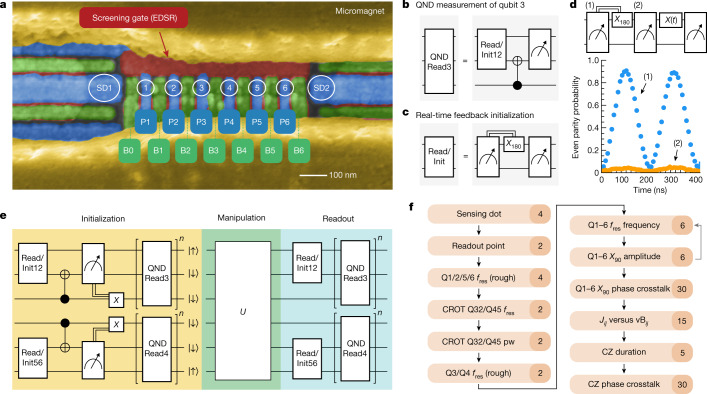
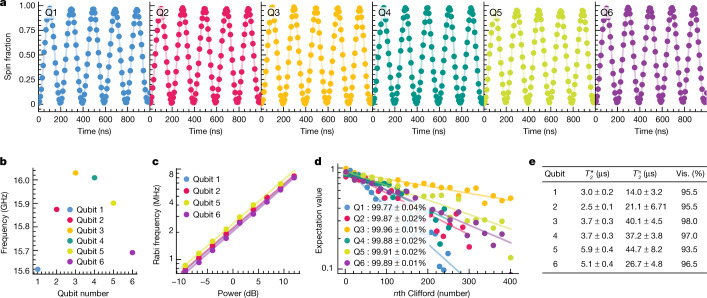
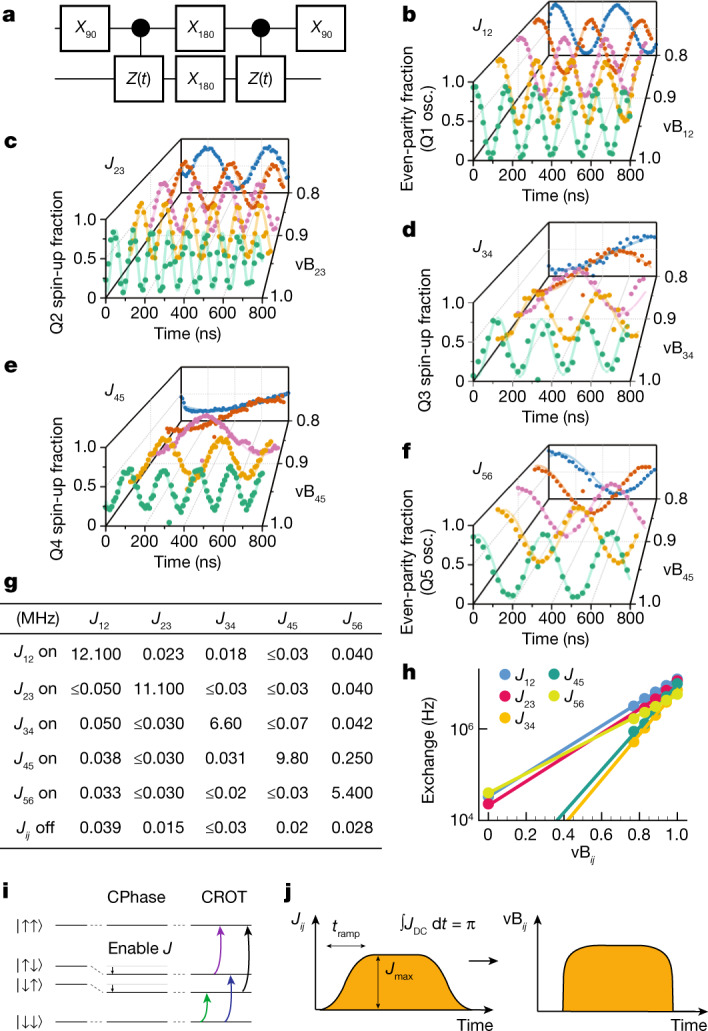
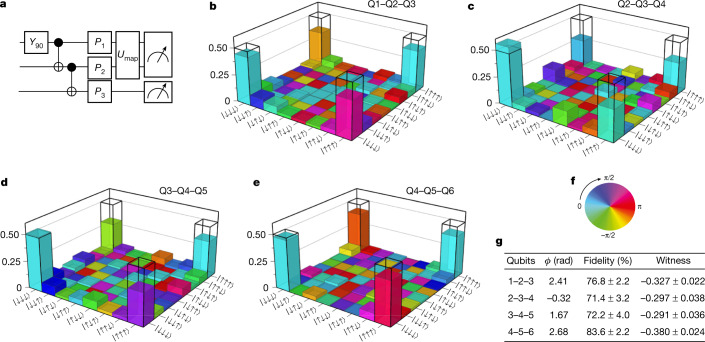
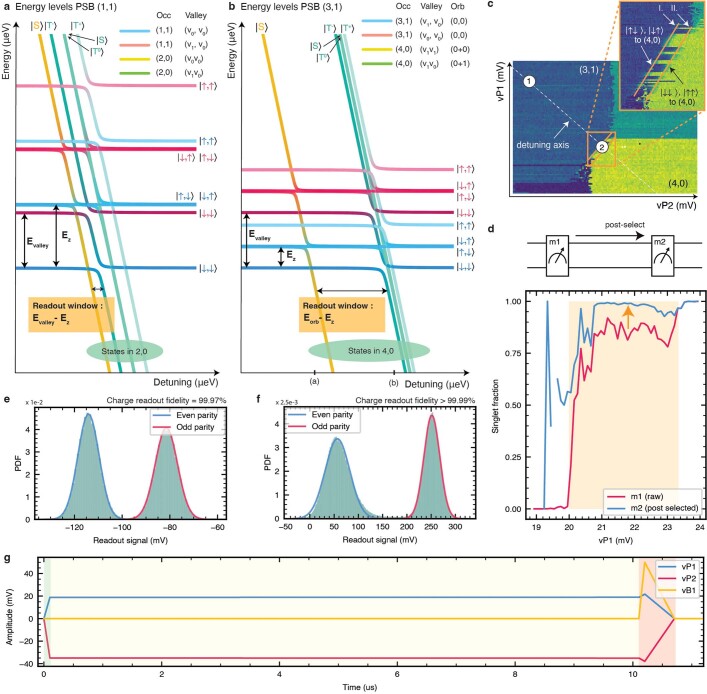
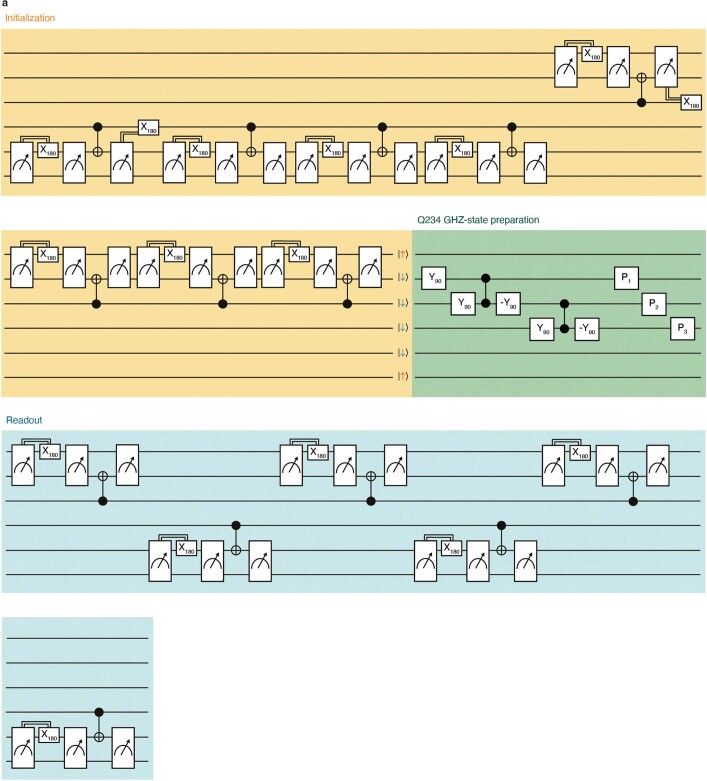
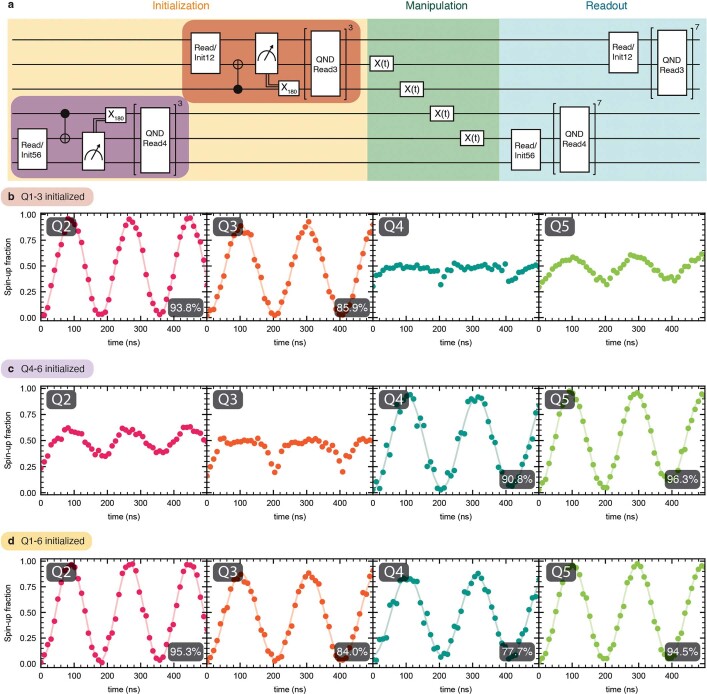
Future quantum computers capable of solving relevant problems will require a large number of qubits that can be operated reliably 1 . However, the requirements of having a large qubit count and operating with high fidelity are typically conflicting. Spins in semiconductor quantum dots show long-term promise 2,3 but demonstrations so far use between one and four qubits and typically optimize the fidelity of either single- or two-qubit operations, or initialization and readout 4–11 . Here, we increase the number of qubits and simultaneously achieve respectable fidelities for universal operation, state preparation and measurement. We design, fabricate and operate a six-qubit processor with a focus on careful Hamiltonian engineering, on a high level of abstraction to program the quantum circuits, and on efficient background calibration, all of which are essential to achieve high fidelities on this extended system. State preparation combines initialization by measurement and real-time feedback with quantum-non-demolition measurements. These advances will enable testing of increasingly meaningful quantum protocols and constitute a major stepping stone towards large-scale quantum computers.
Overview
The claims and statistics of this paper haven’t been checked yet.
Free: it reads the open-access text and checks the first 5 claims that cite a source we can check. Create a free account to check every claim.
Integrity signals
Registry
Cites
Statistics
Figures
Verification
Claims the paper makes
The claims and statistics of this paper haven’t been checked yet.
Free: it reads the open-access text and checks the first 5 claims that cite a source we can check. Create a free account to check every claim.
Self-check
Percentages, sums and reported differences re-computed from the paper’s own numbers.
The self-check needs the paper’s full text.
Citations
Cites
Quantum supremacy using a programmable superconducting processor
Arute, F., Arya, K., Babbush, R., Bacon, D., Bardin, J. C., Barends, R., Biswas, R., Boixo, S., Brandao, F. G. S. L., Buell, D. A., et al. (2019) · Nature · doi:10.1038/s41586-019-1666-5 · Cited by 7,720 · cited 1×
“Nevertheless, spin qubits currently lag behind in scale when compared to superconducting, trapped ions and photonic platforms, which have demonstrated control of several dozen qubits 16–18 .”
BackgroundQuantum computational advantage using photons
Zhong, H.-S., Wang, H., Deng, Y.-H., Chen, M.-C., Peng, L.-C., Luo, Y.-H., Qin, J., Wu, D., Ding, X., Hu, Y., et al. (2020) · Science · doi:10.1126/science.abe8770 · Cited by 2,405 · cited 1×
“Nevertheless, spin qubits currently lag behind in scale when compared to superconducting, trapped ions and photonic platforms, which have demonstrated control of several dozen qubits 16–18 .”
BackgroundGreenberger, D. M., Horne, M. A., & Zeilinger, A. (1989) · Bell’s Theorem, Quantum Theory and Conceptions of the Universe · doi:10.1007/978-94-017-0849-4_10 · Cited by 1,513
Trapped-ion quantum computing: Progress and challenges
Bruzewicz, C. D., Chiaverini, J., McConnell, R., & Sage, J. M. (2019) · Applied Physics Reviews · doi:10.1063/1.5088164 · Cited by 1,483 · cited 1×
“…shows that, in scaling up, maintaining the quality of the control requires substantial effort, particularly, for instance, to deal with the denser motional spectrum in trapped ions 23 , to avert crosstalk in superconducting circuits 24 or to avoid increased losses in photonic circuits 25 .”
BackgroundZwanenburg, F. A., Dzurak, A. S., Morello, A., Simmons, M. Y., Hollenberg, L. C. L., Klimeck, G., Rogge, S., Coppersmith, S. N., & Eriksson, M. A. (2013) · Reviews of Modern Physics · doi:10.1103/revmodphys.85.961 · Cited by 1,210
An addressable quantum dot qubit with fault-tolerant control-fidelity
Veldhorst, M., Hwang, J. C. C., Yang, C. H., Leenstra, A. W., de Ronde, B., Dehollain, J. P., Muhonen, J. T., Hudson, F. E., Itoh, K. M., Morello, A., et al. (2014) · Nature Nanotechnology · doi:10.1038/nnano.2014.216 · Cited by 940
Self-citationA quantum-dot spin qubit with coherence limited by charge noise and fidelity higher than 99.9%
Yoneda, J., Takeda, K., Otsuka, T., Nakajima, T., Delbecq, M. R., Allison, G., Honda, T., Kodera, T., Oda, S., Hoshi, Y., et al. (2018) · Nature Nanotechnology · doi:10.1038/s41565-017-0014-x · Cited by 900 · cited 1×
“• Following [13], we aim at a maximal decoherence gradient (|z ∂z |+ | ∂Bz ∂y |) of 0.”
MethodCurrent Rectification by Pauli Exclusion in a Weakly Coupled Double Quantum Dot System
Ono, K., Austing, D. G., Tokura, Y., & Tarucha, S. (2002) · Science · doi:10.1126/science.1070958 · Cited by 801 · cited 1×
“PSB readout is a method used to convert a spin state to a more easily detectable charge state 58 .”
MethodA programmable two-qubit quantum processor in silicon
Watson, T. F., Philips, S. G. J., Kawakami, E., Ward, D. R., Scarlino, P., Veldhorst, M., Savage, D. E., Lagally, M. G., Friesen, M., Coppersmith, S. N., et al. (2018) · Nature · doi:10.1038/nature25766 · Cited by 741 · cited 2×
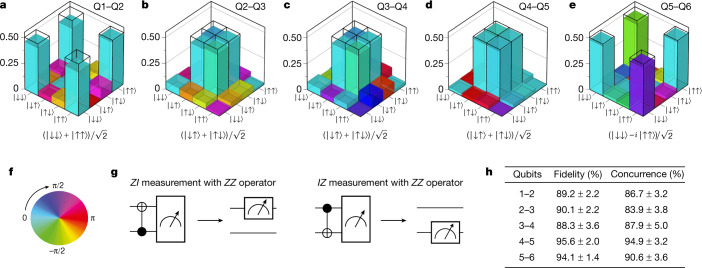
“…measured across the six-dot array have state fidelity ranging from 88% to 96%, which is considerably higher than the Bell state fidelities of 78% to 89% (all state preparation and measurement (SPAM) corrected, see Methods) reported on two-qubit quantum dot devices just a few years ago 42,44,45 .”
BackgroundSelf-citationInterfacing spin qubits in quantum dots and donors—hot, dense, and coherent
Vandersypen, L. M. K., Bluhm, H., Clarke, J. S., Dzurak, A. S., Ishihara, R., Morello, A., Reilly, D. J., Schreiber, L. R., & Veldhorst, M. (2017) · npj Quantum Information · doi:10.1038/s41534-017-0038-y · Cited by 624 · cited 1×
“To scale beyond, we envision networks of local registers [6, 7], connected together with quantum coherent links.”
BackgroundSelf-citation
Research works printed but not linked: 1
- Harvey-Collard P High-fidelity single-shot readout for a spin qubit via an enhanced latching mechanism Phys. Rev. X 2018 8 021046
Cited by
Items 401–468 of 468
Bersano, F., Martinolli, N., Bouquet, I., Ghini, M., Collette, E., Žaper, L., Braakman, F., Poggio, M., Luisier, M., & Ionescu, A. M. (2025) · IEEE Journal of the Electron Devices Society · doi:10.1109/jeds.2025.3545661
“These advancements have been demonstrated in 2D and 1D qubit arrays in planar structures, such as 28 Si/SiGe heterostructures [2] and planar Ge [3], as well as in Si metal-oxide-semiconductor (MOS) architectures inspired by nano-CMOS technology, including bulk silicon FinFETs [4] and fully-depleted…”
Fundamental Technologies for Silicon Quantum Computers
Kodera, T. (2025) · Vacuum and Surface Science · doi:10.1380/vss.68.149
Multi-Objective Selection Method of Analog Circuit Measuring Points Based on Sensitivity Factor
Zhou, H. (2025) · Lecture notes in electrical engineering · doi:10.1007/978-981-97-4620-0_14
Exploring Entanglement Spectra and Phase Diagrams in Multi-Electron Quantum Dot Chains
He, G., & Wang, X. (2025) · Entropy · doi:10.3390/e27050479
Silizium‐Halbleitertechnologie für Quantencomputer: Quantenrechnen mit Spins
Heinz, I., & Burkard, G. (2025) · Physik in unserer Zeit · doi:10.1002/piuz.202501730
Iizuka, S., Asai, H., Kato, K., Oka, H., Chiashi, Y., Hattori, J., Fukuda, K., & Mori, T. (2025) · Japanese Journal of Applied Physics · doi:10.35848/1347-4065/ade214
Silicon spin qubits: A scalable solution for quantum computing
Kriekouki, I., Power, C., Bashir, I., & Blokhina, E. (2025) · IEEE International Symposium on Circuits and Systems proceedings · doi:10.1109/iscas56072.2025.11043641 · Cited by 1
Quantum algorithm compiler for architectures with semiconductor spin qubits
Tadokoro, M., Matsuoka, R., & Kodera, T. (2025) · EPJ Quantum Technology · doi:10.1140/epjqt/s40507-025-00384-9
Superimposed two-contact gate stacks for an improved electrostatic control of Si spin qubits
Martínez, B., Bertrand, B., Niquet, Y., & Vinet, M. (2025) · Solid-State Electronics · doi:10.1016/j.sse.2025.109178
Ge$_{1-x}$Si$_{x}$ single crystals for Ge hole spin qubit integrationPreprint
Fuhrberg, A., Düring, P. M., Fedchenko, O., Tkach, O., Lytvynenko, Y., Gradwohl, K., Chernov, S., Gloskovskii, A., Schlueter, C., Schönhense, G., et al. (2025) · arXiv (Cornell University) · doi:10.48550/arxiv.2504.15943
“Semiconductor spin qubits have made significant advances in recent years, with the demonstration of universal control in quantum processors featuring up to six qubits 1,2 , and even 12-qubit arrays fabricated on a 300 mm semiconductor manufacturing line 3 .”
Jiaqi, 郭. G., Jianing, 汤. T., & Chao, 申. S. (2025) · Acta Optica Sinica · doi:10.3788/aos251296
Pulse-Driven Spin Paradigm for Noise-Aware Quantum Classification
Riascos-Moreno, C., Álvarez-Meza, A. M., & Castellanos-Dominguez, G. (2025) · Computers · doi:10.3390/computers14110475
“Moreover, recent demonstrations of a six-qubit programmable processor further underscore the viability of this platform [30].”
Compact radio frequency module for gate-defined quantum dot qubits
Wu, Z., Zhou, Z., Pan, X., Li, Y., & Huang, S. (2025) · Applied Physics Letters · doi:10.1063/5.0291408
Quantum Computing with Semiconductor Spin
Ramanandan, S. P., & Morral, A. F. I. (2025) · Springer eBooks · doi:10.1007/978-3-031-90727-2_4
Real-Time DCZ Gate Control by Bayesian Optimization with Forgetting
Sato, Y., & Kawahara, T. (2025) · IEEE International Conference on Quantum Computing and Engineering (QCE) · doi:10.1109/qce65121.2025.00151
“Additionally, some experiments employ a virtual barrier gate voltage, which involves simultaneous tuning of multiple gates around the target qubits to enhance the exchange interaction [3].”
InfluentialReal-time analog circuit for auto-correlative weak-value amplification in the time domain
Huang, J.-H., Wang, G.-J., & Hu, X. (2025) · International Conference on Advanced Optics and Photonics Research in Engineering (AOPR) · doi:10.1117/12.3090298
“3 Meanwhile, custom FPGA systems are increasingly prevalent in sensing and quantum information applications, 1,4 offering superior computational capabilities and noise immunity.”
Erbium dopants in nanophotonic silicon waveguides and cavities
Gritsch, A., Reiserer, A., & München, T. U. (2024)
Wanningen, N. (. (2022) · Research Repository (Delft University of Technology)
Li, P.-W. (2025) · IEEE Electron Devices Magazine · doi:10.1109/med.2025.3577179
“To date, six Si quantum-dot electron-spin qubits [6] and 16 Ge quantum-dot hole-spin qubits [7] have been demonstrated in linear-chain and cross-bar configurations, respectively, using the gate-defined approach.”
Integration Technology Challenges in Quantum Computers: The Size, Noise and Wires Matter
Ishihara, R. (2025) · IEEE Electron Devices Magazine · doi:10.1109/med.2025.3588563
“Multiple approaches for qubit platforms include superconducting qubits [5], semiconductor spins [6], trapped ions [7], neutral atoms [8], photonics [9], and color centers in diamond [10], [11].”
Thermal circuit model for silicon quantum-dot array structures
Utsugi, T., Kusuno, N., Kuno, T., Lee, N., Yanagi, I., Mine, T., Saito, S., Hisamoto, D., Tsuchiya, R., & Mizuno, H. (2026) · APL Quantum · doi:10.1063/5.0299263
Direct dispersive signature of Pauli spin blockade with voltage bias
Svab, S., Eggli, R. S., Patlatiuk, T., Carballido, M. J., Kwon, P. C., Trüssel, D. A., Li, A., Bakkers, E. P. A. M., Kuhlmann, A. V., & Zumbühl, D. M. (2026) · Physical Review Applied · doi:10.1103/8jmt-m432
Hyperfine Dependence of Nuclear-Spin Rabi Frequencies in Silicon Donors
Li, C., Zhang, S., Wang, H., Gao, M., Deng, Y., Zhang, Y.-N., Bai, X., Yin, C., Huan, S., Liu, J., et al. (2026) · Nano Letters · doi:10.1021/acs.nanolett.5c05023
Advances in mixed reality in quantum computing
Khou, T., & Roosan, D. (2026) · Elsevier eBooks · doi:10.1016/b978-0-443-34193-9.00009-0
Rabi oscillations induced by nonresonant gyrating drive
Kolok, B., & Pályi, A. (2026) · Physical review. B./Physical review. B · doi:10.1103/ffkk-q3g3
Geometric protected quantum bus in a hybrid superconducting-spin architecture
Zhu, X., Yue, Z.-C., Guo, G., Tu, T., & Li, C.-F. (2026) · Physical Review Applied · doi:10.1103/dftf-g4kc · Cited by 1
Site-controlled Ge hut wire-based multiple quantum dots with integrated charge sensing capability
Leng, J., Gao, F., Zhou, Y.-C., Wang, C., Jiang, H.-T., Wu, Z., Cao, G., Zhang, J., Li, H.-O., & guo, G. (2026) · Nanoscale · doi:10.1039/d5nr04259c
Quantum transport in voltage-biased Josephson junctions
Lamic, B. (2022) · theses.fr (ABES) · doi:10.70675/f9ef11c8z0db7z4c80z9fc9z54ae471a17f1
Controlled quantum dot array segmentation and complete two-electron spin state readout
Nurizzo, M. (2023) · theses.fr (ABES) · doi:10.70675/963584c3z511az4a27zad9dz7ee33fec3306
Hybrid circuit quantum electrodynamics with a hole spin in silicon
Yu, C. X. (2022) · theses.fr (ABES) · doi:10.70675/5d372839zf41cz4f16z8834zfa670184a3f9 · Cited by 1
Charge and spin control of electron and holes in silicon quantum dot arrays
Aprá, A. (2023) · theses.fr (ABES) · doi:10.70675/e8ff03a2z656cz4847za912z9cea6f501898
Towards Scalable Si and Ge Spin Qubit Architectures : Highlights from Modelling
Martínez, B. (2022) · theses.fr (ABES) · doi:10.70675/255c74a8z7866z4efczbf93ze3a557f678c1 · Cited by 2
Piot, N. (2023) · theses.fr (ABES) · doi:10.70675/37d095adzd522z4386z80d0zdd272b37cbd6
Point defects in silicon : towards a novel platform for quantum technologies
Baron, Y. (2022) · theses.fr (ABES) · doi:10.70675/edbff12dz0d59z4c68z8ef9zf2ee62a857b0
Gardin, A. (2024) · theses.fr (ABES) · doi:10.70675/f4f3d556za977z4158zb908zfa6c4b059fce
Taming noise for CMOS electron spin qubits
El-Homsy, V. (2024) · theses.fr (ABES) · doi:10.70675/1576e82fzb695z413bza0d8zf7d10a0ddcfa
Flying qubit using ultra-short single-electron charge pulses
Geffroy, C. (2023) · theses.fr (ABES) · doi:10.70675/1cff1312zbe60z4f99z8388z874573846f82 · Cited by 1
Spin-photons interface and quantum gates for spins in carbon nanotubes
Neukelmance, B. (2024) · theses.fr (ABES) · doi:10.70675/81330814z0190z4f2dza227zb50e198f8e5b · Cited by 1
Tunable resilience to charge noise of a hole spin
Bassi, M. (2024) · theses.fr (ABES) · doi:10.70675/ae2184eezf4e2z43ddzaa34z28b7efe324a2 · Cited by 1
Electronic circuits at cryogenic temperatures for scalable readout of spin qubits
Houriez, T. (2025) · theses.fr (ABES) · doi:10.70675/8dcbfc6az000ez4914za437z923bc73d925e
Fidorra, F., Mistroni, A., Hnida, K. E., Reichmann, F., Adnadane, M., Wen, W.-C., Yamamoto, Y., Bärwolf, F., Schubert, M. A., & Lisker, M. (2026) · physica status solidi (a) · doi:10.1002/pssa.202501036
Valley enhanced Rabi frequency in n-type planar Silicon-MOS quantum dotPreprint
Luo, X., Peetroons, X., Yang, T.-Y., Otxoa, R. M., Mertig, N., Beyne, S., Jussot, J., Shimura, Y., Godfrin, C., Raes, B., et al. (2026) · arXiv (Cornell University) · doi:10.48550/arxiv.2604.22547
On the Improvement of Gate Fidelity in Spin Qubits With Two-Level Fluctuators at Higher Temperatures
Sato, Y., Asai, H., Mori, T., & Kawahara, T. (2026) · IEEE Access · doi:10.1109/access.2026.3690197
“…in isotopic purification and control techniques have enabled high-fidelity operations for both single-qubit gates [3], [4], [5], [6], [7], [8] and two-qubit gates [5], [6], [7], achieving gate fidelities that surpass the threshold required for surface code quantum error correction [9], [10].”
Four-state discrimination for a pair of spin qubits via gate reflectometry
Sen, A., & Pályi, A. (2026) · Physical review. B./Physical review. B · doi:10.1103/737j-gmns
“Over the past decade, rapid progress has been achieved in high-fidelity single-[10, 11] and two-qubit gates [12– 14], the implementation of small multi-qubit processors [15–18], and elementary quantum simulation [19–21] and error-correction primitives [22–24].”
Surface magnon polaritons for fault-tolerant quantum computing in Si/SiGe spin qubits
Qian, C., Zhou, H., Lu, X., Sigllito, A., & Zhen, B. (2026) · Image Sensing Technologies: Materials, Devices, Systems, and Applications · doi:10.1117/12.3100608
“In particular, many two-qubit gate implementations in Si/SiGe, including resonant-CNOT 22 and decoupled-CZ 23,24 gates, incorporate single-qubit gate operations.”
Dislocation- and crosshatch-free high-mobility silicon two-dimensional electron gases
Zhang, J., Liu, F. Y., Ming, M., Liao, L.-X., Zhou, X.-Y., & Zhang, J.-J. (2026) · APL Materials · doi:10.1063/5.0334357
Rotating Zeeman field as a tool for Majorana zero mode detection in topological superconducting wire
Stefański, P. (2026) · Journal of Magnetism and Magnetic Materials · doi:10.1016/j.jmmm.2026.174561
“However, recently an unprecedented control on the spin manipulations in quantum dots by micromagnets in various geometries has been demonstrated [25–27].”
Multiparticle entanglement of nuclear spins in silicon
Xu, F., Deng, Y., Hu, G., Yang, K., Li, C., Wei, C., Zhang, S., Zhang, C., Du, P., Shi, K., et al. (2026) · Nature Communications · doi:10.1038/s41467-026-74491-1
“These effects have indeed been reported across different semiconductor quantum platforms 12,21,22,60 – 62 .”
Ayo, E. B., Belgar, M. G. M., Cabuhayan, B. M., Gabion, M., Parcher, J. B. C., & Peralta, R. (2026) · International Journal of Multidisciplinary Applied Business and Education Research · doi:10.11594/ijmaber.07.06.14
Spectroscopy of low-lying valley states in hot Si/SiGe quantum dots
Nasseraddin, C., Yoo, H. M., Janda, T. M., & Petta, J. R. (2026) · Applied Physics Letters · doi:10.1063/5.0352205
Snakelike trajectories of electrons released from quantum dots driven by the spin Hall effect
Szafran, B., & Wójcik, P. (2026) · Physical review. B./Physical review. B · doi:10.1103/bk42-s5p1
“Consequently, spin qubits in semiconductor QDs [3–5] have emerged as promising building blocks for the development of scalable quantum computers, owing to their long coherence times, full electrical tunability, and compatibility with well-established semiconductor fabrication technologies [6–12].”
Multimodal deep learning for automated atomic qubits fabrication in silicon
Cui, Y.-W., Wu, K., Wu, P., Yang, L.-Y.-L., Duan, M., Wang, G.-Y., Shi, K., Lyu, Y., Huang, P.-H., Xin, T., et al. (2026) · Machine Learning: Science and Technology · doi:10.1088/2632-2153/ae8e30
“Recent milestones include the demonstration of long-coherence qubits [4], high-fidelity quantum gates [5– 7], CMOS-compatible chip fabrication [8–11], and prototype integrated processors [12–14].”
Interference-protected long-range spin–valley gates in carbon-nanotube double quantum dots
Altuijri, R., Ghorashi, S. A., Shaaban, S. M., Matoog, R. T., Mahmoud, M., Alharthi, N. S., & Abdel‐Aty, A. (2026) · Physica E Low-dimensional Systems and Nanostructures · doi:10.1016/j.physe.2026.116620
Valley splitting and density-driven scattering in undoped Si/SiGe two-dimensional electron system
Kynshi, L. D. L., Soni, U., Sharma, C. H., Cheng, Y., Deneke, K., Zierold, R., Zhou, S., Blick, R. H., Shaji, A., & Thalakulam, M. (2026) · Journal of Physics Condensed Matter · doi:10.1088/1361-648x/ae8fae
Nanoscale Stray Fields from Micromagnets for Optimal Spin Qubit Architecture
Lopes, S., Schaeverbeke, Q., Desjardins, M. M., Lacour, D., Hehn, M., & Montaigne, F. (2026) · Nano Letters · doi:10.1021/acs.nanolett.6c01469
“In single quantum-dot platforms, accurate knowledge of the micromagnet stray-field distribution is essential for electrical spin control, and in larger quantum-dot arrays, engineered field profiles enable individual qubit addressability 31 and single-qubit gate operations via hopping gates.”
Impact of gate-voltage noise on silicon spin-qubit variational quantum eigensolvers
Wang, X., Khromets, B., Merino, Z. D., & Baugh, J. (2026) · Quantum Science and Technology · doi:10.1088/2058-9565/ae9188
Nakane, J. J., Asai, H., Hashizume, M., Horiba, T., Kutsuki, K., Iizuka, S., Chiashi, Y., Oka, H., Kato, K., Kajita, S., et al. (2026) · IEEE Journal of the Electron Devices Society · doi:10.1109/jeds.2026.3719324
“Recently, both single-and two-qubit gates in silicon have reached fidelities above 99% [6], [7], [8], [9], [10], [11], [12], exceeding typical fault-tolerant thresholds [13], [14].”
Alamoudi, T. A. (2026) · International Journal of Computer Applications · doi:10.5120/ijca2b2d25a3c082
Arpiainen, U. (2026) · Aaltodoc (Aalto University)
Ryu, H. (2026) · IEEE International Conference on Nanotechnology (IEEE-NANO) · doi:10.1109/nano67986.2026.11667589
“In this work, we computationally investigate how electron spins confined in electrode-driven Si quantum dot (QD) platform, which has been actively utilized for physical realization of Si quantum processing units [2-4], can be preserved for a long time with purely electrical controls.”
Epitaxial growth of strain relaxed SiGe layers grown with GeCl4 for SiGe on nothing
Shimura, Y., Kuwazuru, H., Porret, C., Wang, D., Yamamoto, K., & Loo, R. (2026) · Materials Science in Semiconductor Processing · doi:10.1016/j.mssp.2026.111176
Electron-mediated coupling schemes between nuclear-spin qudits in silicon
Anonymous, Xu, F., Xiang, Y., Zhang, S., Song, J., Zhai, Y., Duan, M., Pan, T., Tian, Z., Wang, G., et al. (2026) · Physical Review Applied · doi:10.1103/mr2x-jt6m
In-plane optimal qubit operation with control fidelities exceeding 99%
Anonymous, Kong, Z., Ma, R.-L., Jiang, H.-T., Li, A.-R., Zhong, Y., Wu, Z.-T., Zheng, R., Wang, G., Cao, G., et al. (2026) · Physical Review Applied · doi:10.1103/fw9y-ylsv
Scalable Passive QRAMPreprint
Jain, S., Dalzell, A. M., & Hann, C. T. (2026) · arXiv (Cornell University) · doi:10.48550/arxiv.2610.03700 · Cited by 1
“There is a practical limit of how close we could put two Hamiltonian terms but superconducting architectures have demonstrated sites less than 1 micron apart [MOR + 14], and recent works on spin qubits have demonstrated less than 100 nanometers [PMA + 22, Mem26].”
Cochrane, O. L. (2026) · Apollo (University of Cambridge) · doi:10.17863/cam.135261
Optimal Hamiltonian control for variational quantum algorithms: on spin-qubit quantum processors
Long, C. K. (2026) · Apollo (University of Cambridge) · doi:10.17863/cam.135673
High-fidelity flopping-mode single-spin operation via triple-dot orbital-band engineering
Matsumoto, Y., Liu, X.-F., Ludwig, A., Wieck, A. D., Koike, K., Miyoshi, T., Fujita, T., & Oiwa, A. (2026) · npj Quantum Information · doi:10.1038/s41534-026-01400-1
Coupling single spins to superconducting circuits
Stern, M., Xue, X., Flurin, E., Andersen, C. K., Vandersypen, L. M. K., & Bertet, P. (2026) · Applied Physics Reviews · doi:10.1063/5.0342292
Self-citation
Metadata
- Authors
- Philips, S. G. J., Mądzik, M. T., Amitonov, S. V., de Snoo, S. L., Russ, M., Kalhor, N., Volk, C., Lawrie, W. I. L., Brousse, D., Tryputen, L., Wuetz, B. P., Sammak, A., Veldhorst, M., Scappucci, G., & Vandersypen, L. M. K.
- Affiliations
- QuTech (NL)
- Netherlands Organisation for Applied Scientific Research (NL)
- Corresponding author
- Vandersypen, Lieven M. K.
- ORCID
- Venue
- Nature
- Published
- 2022-09-28
- Volume
- 609
- Issue
- 7929
- Pages
- 919-924
- ISSN
- 0028-0836 (ISSN-L)
- 1476-4687
- PMC
- PMC9519456
- OpenAlex
- W4297473634
- Semantic Scholar
- ff7a92d1abbe5d355cfd40b7d1e3a8bf25055c26
- Cited by
- 410
- References
- 64
- Citations by year
- 2026: 58 · 2025: 117 · 2024: 121 · 2023: 94 · 2022: 20
- FWCI
- 36.09
- Type
- journal article
- Language
- en
- Open access
- hybrid
- doi.org
- Licence
- cc-by
- creativecommons.org/licenses/by/4.0 (tdm)
- creativecommons.org/licenses/by/4.0 (vor)
- Locations
- Nature (publishedVersion, cc-by)
- PubMed Central (publishedVersion, cc-by)
- PubMed (publishedVersion)
- arXiv (Cornell University) (submittedVersion)
- TNO Repository (submittedVersion)
- OSTI OAI (U.S. Department of Energy Office of Scientific and Technical Information) (submittedVersion)
- RePEc: Research Papers in Economics (submittedVersion)
- Research Repository (Delft University of Technology) (submittedVersion)
- Data Archiving and Networked Services (DANS) (submittedVersion, cc-by)
- arXiv (Cornell University) (cc-by)
- Funders
- U.S. Department of Energy (DE‐FG02‐, FG0203ER46028, DEFG0203ER46028)
- Keysight Technologies
- Nederlandse Organisatie voor Wetenschappelijk Onderzoek (NWA.1292.19.194)
- Army Research Office (W911NF‐17‐1‐0274, W911NF, W911NF1210607)
- H2020 Marie Skłodowska-Curie Actions (676108)
- Topics
- Physical Sciences › Physics and Astronomy › Condensed Matter Physics › Quantum and electron transport phenomena
- Physical Sciences › Physics and Astronomy › Atomic and Molecular Physics, and Optics › Semiconductor Quantum Structures and Devices
- Physical Sciences › Computer Science › Artificial Intelligence › Quantum Computing Algorithms and Architecture
- Keywords
- silicon quantum dots, semiconductor spin qubits, Hamiltonian engineering, background calibration, real-time feedback, quantum non-demolition measurement, state preparation and measurement, gate fidelity
About these checks
Registry, retraction, Cites and statistics results are computed, not judged, with one exception: a printed reference that no index lists is read once by a model before it counts as a citation error. Claims are extracted by a model and kept only when their quote appears verbatim in the text; each cited source is then checked, with a model’s help, for whether it says what the claim relies on. Those verdicts can be wrong — read the claim’s quote and the cited source before relying on one.
Statistics and arithmetic are recomputed, not judged.
Confidence bands are shown only for fields calibrated on our annotated test set. None is calibrated yet, so no band is shown.
What counts as a claim ›How we measure confidence ›How we check this ›
Are you an author, or do you see a problem with this page? Request a review
Data sources
Bibliographic data: Semantic Scholar, OpenAlex, Crossref.
Contains information from the Semantic Scholar Academic Graph Datasets, made available under the ODC Attribution License (ODC-BY 1.0).
Semantic Scholar’s data is described in: Kinney, R., et al. (2023). The Semantic Scholar Open Data Platform. arXiv:2301.10140.
