

Universal control of a six-qubit quantum processor in silicon
Open accessThe DOI matches its Crossref record; 64 of the 64 references it cites were found in a registry or an index.
Abstract
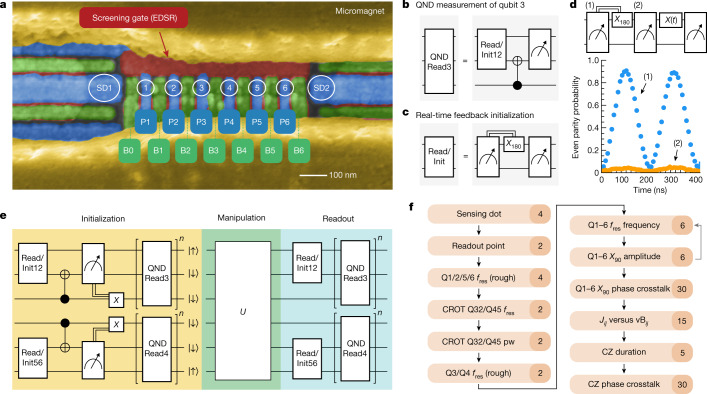
Future quantum computers capable of solving relevant problems will require a large number of qubits that can be operated reliably 1 . However, the requirements of having a large qubit count and operating with high fidelity are typically conflicting. Spins in semiconductor quantum dots show long-term promise 2,3 but demonstrations so far use between one and four qubits and typically optimize the fidelity of either single- or two-qubit operations, or initialization and readout 4–11 . Here, we increase the number of qubits and simultaneously achieve respectable fidelities for universal operation, state preparation and measurement. We design, fabricate and operate a six-qubit processor with a focus on careful Hamiltonian engineering, on a high level of abstraction to program the quantum circuits, and on efficient background calibration, all of which are essential to achieve high fidelities on this extended system. State preparation combines initialization by measurement and real-time feedback with quantum-non-demolition measurements. These advances will enable testing of increasingly meaningful quantum protocols and constitute a major stepping stone towards large-scale quantum computers.
Overview
The claims and statistics of this paper haven’t been checked yet.
Free: it reads the open-access text and checks the first 5 claims that cite a source we can check. Create a free account to check every claim.
Integrity signals
Registry
Cites
Statistics
Figures
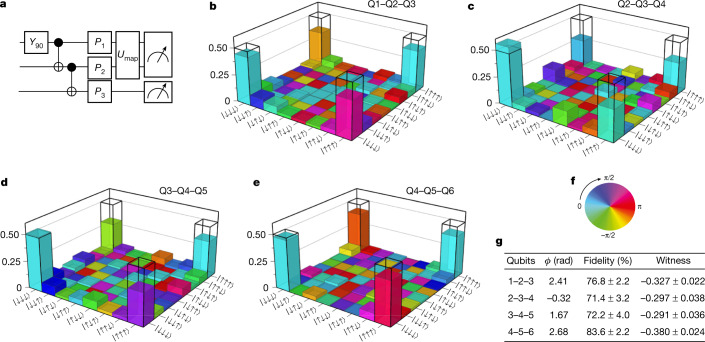
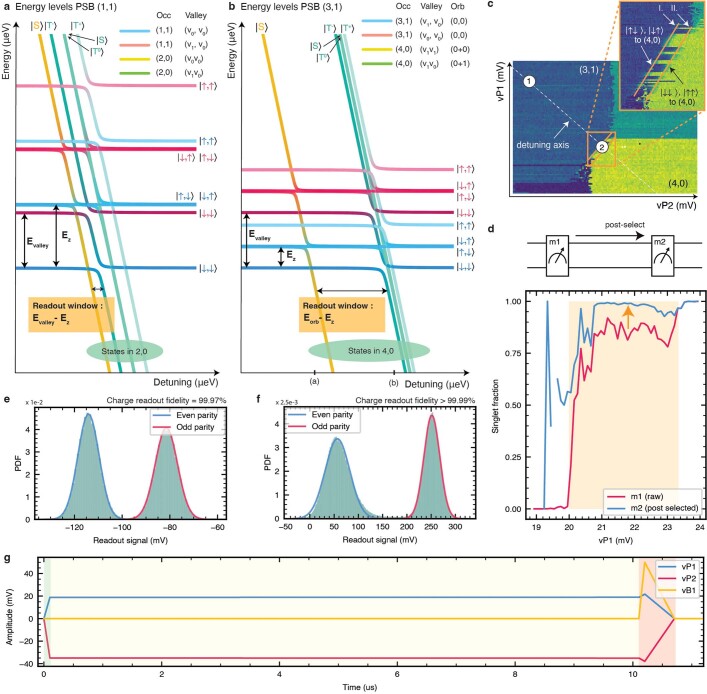
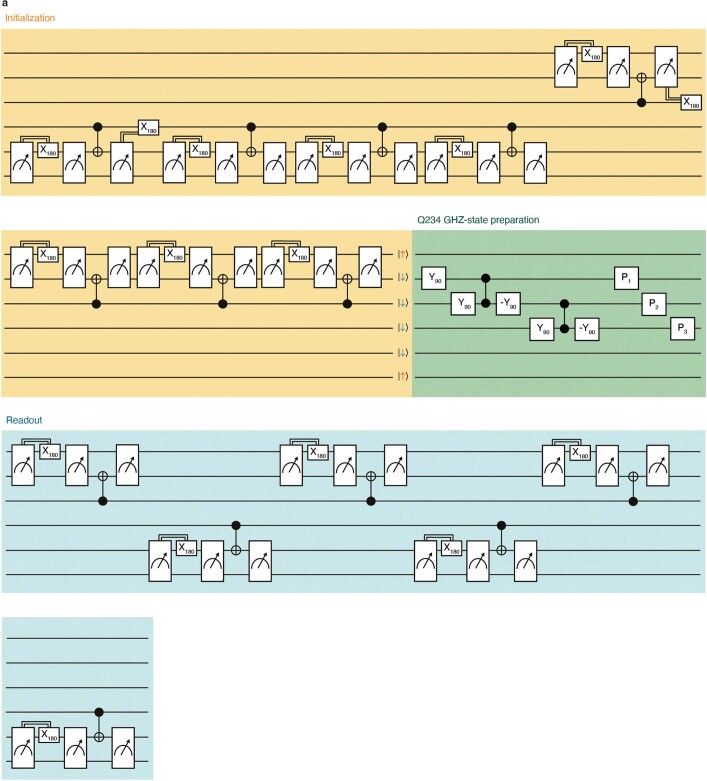
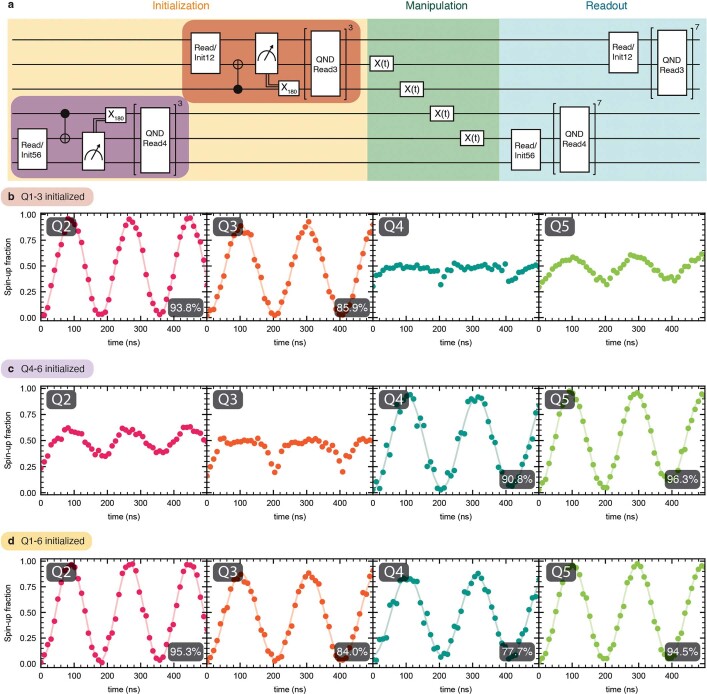
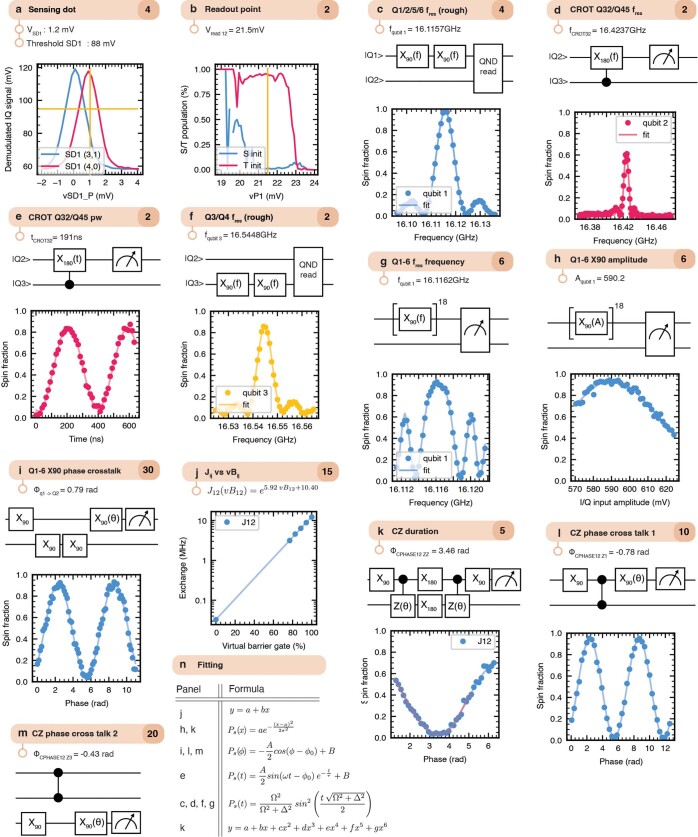
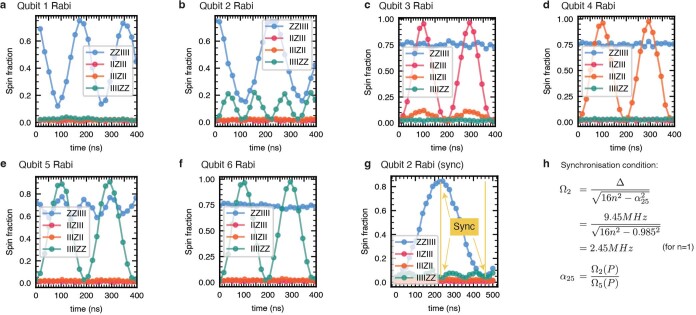
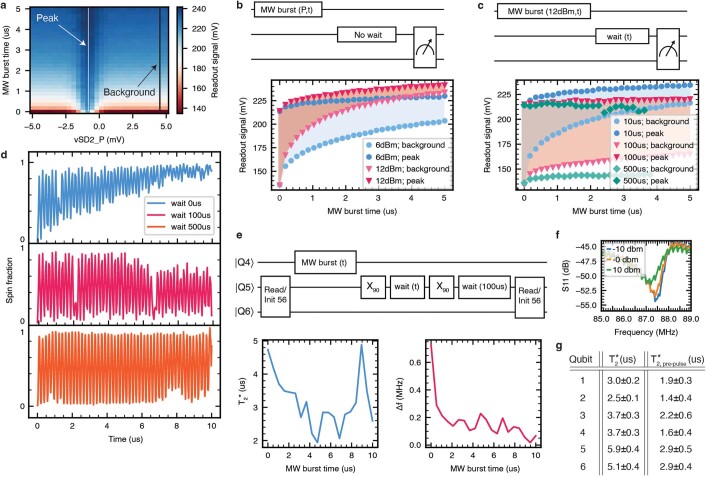
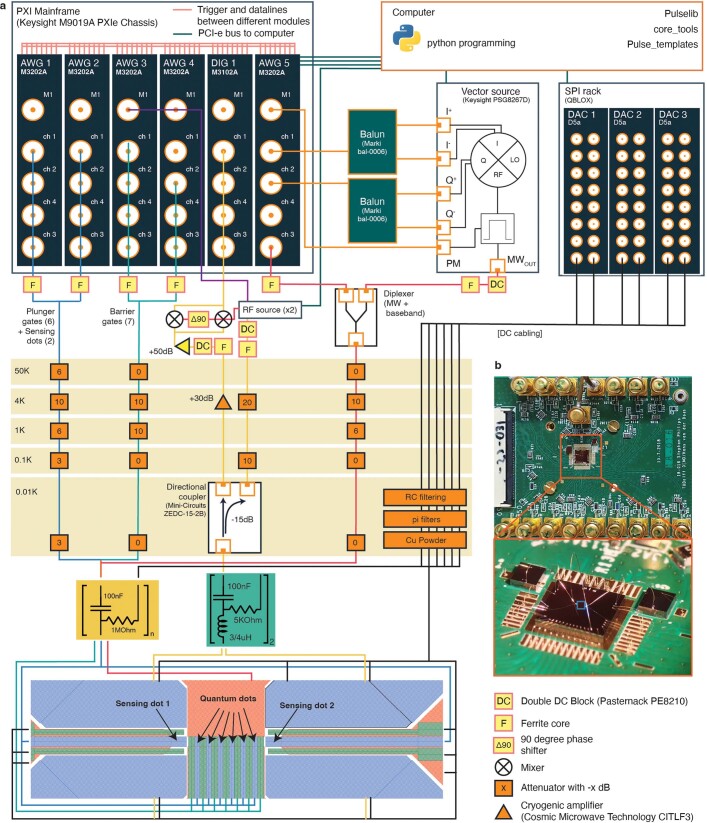
Verification
Claims the paper makes
The claims and statistics of this paper haven’t been checked yet.
Free: it reads the open-access text and checks the first 5 claims that cite a source we can check. Create a free account to check every claim.
Self-check
Percentages, sums and reported differences re-computed from the paper’s own numbers.
The self-check needs the paper’s full text.
Citations
Cites
Quantum supremacy using a programmable superconducting processor
Arute, F., Arya, K., Babbush, R., Bacon, D., Bardin, J. C., Barends, R., Biswas, R., Boixo, S., Brandao, F. G. S. L., Buell, D. A., et al. (2019) · Nature · doi:10.1038/s41586-019-1666-5 · Cited by 7,720 · cited 1×
“Nevertheless, spin qubits currently lag behind in scale when compared to superconducting, trapped ions and photonic platforms, which have demonstrated control of several dozen qubits 16–18 .”
BackgroundQuantum computational advantage using photons
Zhong, H.-S., Wang, H., Deng, Y.-H., Chen, M.-C., Peng, L.-C., Luo, Y.-H., Qin, J., Wu, D., Ding, X., Hu, Y., et al. (2020) · Science · doi:10.1126/science.abe8770 · Cited by 2,405 · cited 1×
“Nevertheless, spin qubits currently lag behind in scale when compared to superconducting, trapped ions and photonic platforms, which have demonstrated control of several dozen qubits 16–18 .”
BackgroundGreenberger, D. M., Horne, M. A., & Zeilinger, A. (1989) · Bell’s Theorem, Quantum Theory and Conceptions of the Universe · doi:10.1007/978-94-017-0849-4_10 · Cited by 1,513
Trapped-ion quantum computing: Progress and challenges
Bruzewicz, C. D., Chiaverini, J., McConnell, R., & Sage, J. M. (2019) · Applied Physics Reviews · doi:10.1063/1.5088164 · Cited by 1,483 · cited 1×
“…shows that, in scaling up, maintaining the quality of the control requires substantial effort, particularly, for instance, to deal with the denser motional spectrum in trapped ions 23 , to avert crosstalk in superconducting circuits 24 or to avoid increased losses in photonic circuits 25 .”
BackgroundZwanenburg, F. A., Dzurak, A. S., Morello, A., Simmons, M. Y., Hollenberg, L. C. L., Klimeck, G., Rogge, S., Coppersmith, S. N., & Eriksson, M. A. (2013) · Reviews of Modern Physics · doi:10.1103/revmodphys.85.961 · Cited by 1,210
An addressable quantum dot qubit with fault-tolerant control-fidelity
Veldhorst, M., Hwang, J. C. C., Yang, C. H., Leenstra, A. W., de Ronde, B., Dehollain, J. P., Muhonen, J. T., Hudson, F. E., Itoh, K. M., Morello, A., et al. (2014) · Nature Nanotechnology · doi:10.1038/nnano.2014.216 · Cited by 940
Self-citationA quantum-dot spin qubit with coherence limited by charge noise and fidelity higher than 99.9%
Yoneda, J., Takeda, K., Otsuka, T., Nakajima, T., Delbecq, M. R., Allison, G., Honda, T., Kodera, T., Oda, S., Hoshi, Y., et al. (2018) · Nature Nanotechnology · doi:10.1038/s41565-017-0014-x · Cited by 900 · cited 1×
“• Following [13], we aim at a maximal decoherence gradient (|z ∂z |+ | ∂Bz ∂y |) of 0.”
MethodCurrent Rectification by Pauli Exclusion in a Weakly Coupled Double Quantum Dot System
Ono, K., Austing, D. G., Tokura, Y., & Tarucha, S. (2002) · Science · doi:10.1126/science.1070958 · Cited by 801 · cited 1×
“PSB readout is a method used to convert a spin state to a more easily detectable charge state 58 .”
MethodA programmable two-qubit quantum processor in silicon
Watson, T. F., Philips, S. G. J., Kawakami, E., Ward, D. R., Scarlino, P., Veldhorst, M., Savage, D. E., Lagally, M. G., Friesen, M., Coppersmith, S. N., et al. (2018) · Nature · doi:10.1038/nature25766 · Cited by 741 · cited 2×
“…measured across the six-dot array have state fidelity ranging from 88% to 96%, which is considerably higher than the Bell state fidelities of 78% to 89% (all state preparation and measurement (SPAM) corrected, see Methods) reported on two-qubit quantum dot devices just a few years ago 42,44,45 .”
BackgroundSelf-citationInterfacing spin qubits in quantum dots and donors—hot, dense, and coherent
Vandersypen, L. M. K., Bluhm, H., Clarke, J. S., Dzurak, A. S., Ishihara, R., Morello, A., Reilly, D. J., Schreiber, L. R., & Veldhorst, M. (2017) · npj Quantum Information · doi:10.1038/s41534-017-0038-y · Cited by 624 · cited 1×
“To scale beyond, we envision networks of local registers [6, 7], connected together with quantum coherent links.”
BackgroundSelf-citation
Research works printed but not linked: 1
- Harvey-Collard P High-fidelity single-shot readout for a spin qubit via an enhanced latching mechanism Phys. Rev. X 2018 8 021046
Cited by
Items 301–400 of 468
Local model dynamics for two qubits
Tabakin, F. (2023) · Annals of Physics · doi:10.1016/j.aop.2023.169408 · Cited by 4
Modularized and scalable compilation for double quantum dot quantum computing
He, R.-H., Xu, X., Byrd, M., & Wang, Z.-M. (2023) · Quantum Science and Technology · doi:10.1088/2058-9565/acfe38 · Cited by 5
“By leveraging the degrees of spin and charge of electrons trapped in quantum dots, various qubit modalities have been suggested and realized in experiments, such as the single-electron spin-1/2 qubit [12], two-electron singlettriplet (S-T0) qubit in double quantum dots (DQDs) [14], three-electron exchange-only qubit […”
An Assessment of U.S.-Allied Nations' Industrial Bases in Quantum Technology
Parker, E., Silberglitt, R., Gonzales, D., Sanchez, N., Lee, J. W., Rand, L., Schmid, J., Dortmans, P., & Eusebi, C. A. (2023) · RAND Corporation eBooks · doi:10.7249/rra2055-1 · Cited by 5
Variability in Si/SiGe and Si/SiO2 Spin Qubits due to Interfacial Disorder
Cvitkovich, L., Sklénard, B., Waldhoer, D., Li, J., Wilhelmer, C., Veste, G., Niquet, Y., & Grasser, T. (2023) · International Conference on Simulation of Semiconductor Processes and Devices · doi:10.23919/sispad57422.2023.10319618 · Cited by 3
Lai, C.-C., Tsai, T., Kuo, D. M.-T., Lin, H., & Li, P.-W. (2024) · IEEE Electron Device Letters · doi:10.1109/led.2024.3435536 · Cited by 3
“…sensitivity of SETs or SHTs. Si-and Ge-QD SETs/SHTs have been implemented using the gate-defined QDs and confinement barriers that are elec-trostatically created by applying bias voltages to plunger-gates and barrier-gates, respectively, over Si/Ge quantum well and nanowire structures [1], [2].”
MethodAutomated long-range compensation of an rf quantum dot sensor
Hickie, J., van Straaten, B., Fedele, F., Jirovec, D., Ballabio, A., Chrastina, D., Isella, G., Katsaros, G., & Ares, N. (2024) · Physical Review Applied · doi:10.1103/physrevapplied.22.064026 · Cited by 5
“As devices scale to multi-qubit architectures, the number of read-out sensors per chip is bound to increase [9, 10], making their manual tuning and optimisation an increasingly time-consuming task.”
Yananose, K., Park, C., & Son, Y. (2026) · Physical review. B./Physical review. B · doi:10.1103/yfqy-6235 · Cited by 3
“Despite impressive progress in quantum information applications us-ing QD arrays [9–11], significant challenges still remain in achieving their large-scale arrangements with uniform electronic properties [6] and their controlled on-demand reconfigurations [12, 13] — capabilities that are more…”
Lorenzelli, F., Elsayed, A., Godfrin, C., Grill, A., Kubicek, S., Li, R., Stucchi, M., Wan, D., Greve, K. D., Marinissen, E. J., et al. (2023) · IEEE European Test Symposium (ETS) · doi:10.1109/ets56758.2023.10173954 · Cited by 3
(2022) · Nature Electronics · doi:10.1038/s41928-022-00750-w · Cited by 3
Tailoring quantum error correction to spin qubits
Hetényi, B., & Wootton, J. R. (2023) · arXiv (Cornell University) · doi:10.48550/arxiv.2306.17786 · Cited by 3
“Spin qubit platforms to date have demonstrated single-and two-qubit operations and spin read-out above 99% fidelity [4–6] in devices with up to six qubits [7].”
BackgroundThrockmorton, R. E., & Sarma, S. D. (2022) · Physical review. B./Physical review. B · doi:10.1103/physrevb.106.245419 · Cited by 2
Quantum information processing in electrically defined Silicon triple quantum dot systems
Kang, J.-H., & Ryu, H. (2024) · Solid-State Electronics · doi:10.1016/j.sse.2024.108863 · Cited by 2
Integration of buried nanomagnet and silicon spin qubits in a one-dimensional fin structure
Iizuka, S., Kato, K., Yagishita, A., Asai, H., Ueda, T., Oka, H., Hattori, J., Ikegami, T., Fukuda, K., & Mori, T. (2024) · Japanese Journal of Applied Physics · doi:10.35848/1347-4065/ad59ea · Cited by 2
Coupling and characterization of a Si/SiGe triple quantum dot array with a microwave resonator
Jiang, S.-L., Jiang, T.-Y., Xu, Y.-Q., 吴, R. 睿. W., Hao, T.-Y., Ye, S.-K., 蔡, R.-R. 冉. C., Wang, B., Li, H.-O., Cao, G., et al. (2024) · Chinese Physics B · doi:10.1088/1674-1056/ad711d · Cited by 2
Kato, K., Asai, H., Oka, H., Iizuka, S., Fuketa, H., Inaba, T., & Mori, T. (2024) · Solid-State Electronics · doi:10.1016/j.sse.2024.109013 · Cited by 2
Single-electron charge sensor self-aligned to a quantum dot array by double-gate patterning process
Kuno, T., Utsugi, T., Tsuchiya, R., Lee, N., Mine, T., Yanagi, I., Mizokuchi, R., Yoneda, J., Kodera, T., Saito, S., et al. (2024) · Japanese Journal of Applied Physics · doi:10.35848/1347-4065/ada348 · Cited by 2
Measuring pulse heating in Si quantum dots with individual two-level fluctuators
Ye, F., Dhami, L. S., & Nichol, J. M. (2026) · Physical Review Applied · doi:10.1103/1fz7-tjq8 · Cited by 3
Cryo-CMOS Antenna for Wireless Communications within a Quantum Computer Cryostat
Centritto, V., Bandara, A., Deng, H., Babaie, M., Vinogradov, E. A., Abadal, S., & Alarcón, E. (2026) · IEEE International Symposium on Circuits and Systems proceedings · doi:10.1109/iscas66217.2026.11562680 · Cited by 2
“A. Differential Dipole Antenna”
Low-current transport through dopant atom-based quantum dots in a nanoscale silicon transistor
Chu, K.-L., He, W., Kim, J., Chen, J., Andreev, A. D., Jones, M., & Durrani, Z. A. K. (2025) · Applied Physics Letters · doi:10.1063/5.0293627 · Cited by 2
Radio-Frequency Charge Detection on Graphene Electron–Hole Double Quantum Dots
Hecker, K., Möller, S., Dulisch, H., Duman, Ş., Stecher, L., Valerius, L., Deußen, T., Ravuri, S., Watanabe, K., Taniguchi, T., et al. (2025) · Nano Letters · doi:10.1021/acs.nanolett.5c04648 · Cited by 2
“The relative distance of the detector to adjacent QDs is maximized, following designs of other semiconductor QD devices [13].”
Self-citationPeetroons, X., Luo, X., Yang, T.-Y., Mertig, N., Beyne, S., Jussot, J., Shimura, Y., Godfrin, C., Raes, B., Li, R., et al. (2026) · Applied Physics Letters · doi:10.1063/5.0352438 · Cited by 2
In situ control of hole-spin driving mechanisms
Geyer, S., Eggli, R. S., dos Santos, C., Carballido, M. J., Stano, P., Loss, D., Zumbühl, D. M., Warburton, R. J., & Kuhlmann, A. V. (2026) · Physical Review Research · doi:10.1103/f1hx-nk4s · Cited by 2
Reconstructing quantum dot charge stability diagrams with diffusion models
Hernandes, V., Rogers, J., Koch, R., Spriggs, T., Undseth, B., Chatterjee, A., Vandersypen, L. M. K., & Greplová, E. (2026) · Machine Learning Science and Technology · doi:10.1088/2632-2153/ae8070 · Cited by 2
Self-citationMeasuring and Correcting Nanosecond Pulse Distortions in Quantum-Dot Spin Qubits
Anonymous, Torres-Leal, F., & Nichol, J. M. (2026) · Physical Review Letters · doi:10.1103/l5k6-csy3 · Cited by 2
Nano-MOSFET – Foundation of Quantum Computing Part I
Xue, X., Hart, P. A. T., Charbon, E., Sebastiano, F., & Vladimirescu, A. (2023) · IEEE Nanotechnology Magazine · doi:10.1109/mnano.2022.3228097 · Cited by 2
“Operations of multiple qubits have been demonstrated in a linear 6-dot array [19] (Figure 4), and a 2×2 array [20], with further scaling underway.”
BackgroundMethodImproving quantum annealing by engineering the coupling to the environment
Najafabadi, M. S., Schumayer, D., Lee, C., Jaksch, D., & Hutchinson, D. A. W. (2023) · EPJ Quantum Technology · doi:10.1140/epjqt/s40507-023-00202-0 · Cited by 4
Assessing quantum dot SWAP gate fidelity using tensor network methods
Taylor, J. R., Foulk, N. L., & Sarma, S. D. (2024) · Physical review. B./Physical review. B · doi:10.1103/physrevb.109.165403 · Cited by 4
Lorber, S., Zimron, O., Zak, I. L., Milo, A., & Dubi, Y. (2024) · Physical Review Applied · doi:10.1103/physrevapplied.22.014041 · Cited by 4
Understanding the Transistor Behavior of Electron-Spin Qubits Above Cryogenic Temperatures
Lorenzelli, F., Godfrin, C., Stucchi, M., Grill, A., Li, R., Wan, D., Greve, K. D., Marinissen, E. J., & Gielen, G. E. (2024) · IEEE Electron Device Letters · doi:10.1109/led.2024.3463009 · Cited by 2
“Electron-Spin Qubits Above Cryogenic Temperatures developed with the goal of scaling them up from a few [8] to millions of qubits [9].”
BackgroundAmitonov, S. V., Aprá, A., Asker, M., Bals, R., Barry, B., Bashir, I., Blokhina, E., Giounanlis, P., Harkin, M., Hanos-Puskai, P., et al. (2026) · Applied Physics Letters · doi:10.1063/5.0312195 · Cited by 2
Self-citationHigh-Fidelity TiN Processing Modes for Multigate Ge-Based Quantum Devices
Bugu, S., Biradar, S., Blake, A., Liu, C. W., Myronov, M., Duffy, R., Fagas, G., & Petkov, N. (2025) · ACS Applied Electronic Materials · doi:10.1021/acsaelm.4c01499 · Cited by 2
Effect of interface trap charge on Coulomb oscillation in MOS-type quantum dots
Asai, H., Iizuka, S., Hattori, J., Fukuda, K., Ikegami, T., Oka, H., Inaba, T., Shitakata, S., Kato, K., Nakayama, T., et al. (2025) · Japanese Journal of Applied Physics · doi:10.35848/1347-4065/adabee · Cited by 2
RF detection of split-gate modes in Si-MOS quantum dots
楚, N. 凝. C., Zhu, S.-K., Li, A.-R., Wang, C., Liao, W.-Z., 曹, G. 刚. C., Li, H.-O., & Guo, G. (2025) · Chinese Physics B · doi:10.1088/1674-1056/adb68b · Cited by 2
Fault-tolerant Quantum Error Correction Using a Linear Array of Emitters
Kim, J., Han, J. H., & Kim, I. H. (2025) · Quantum · doi:10.22331/q-2025-03-26-1676 · Cited by 2
“We note that such a gate can be applied between a pair of gate-defined semiconductor quantum dots [40, 42, 46, 49, 80], and there-Figure 1: Schematic description of our scheme, which is a linear array of emitters and delay lines.”
Möller, S., Banszerus, L., Hecker, K., Dulisch, H., Watanabe, K., Taniguchi, T., Volk, C., & Stampfer, C. (2025) · Physical review. B./Physical review. B · doi:10.1103/physrevb.111.165416 · Cited by 2
Self-citationChen, K., Godfrin, C., Simion, G., Fattal, I., Jussot, J., Kubicek, S., Beyne, S., Raes, B., Loenders, A., Kao, K.-H., et al. (2025) · Physical review. B./Physical review. B · doi:10.1103/physrevb.111.125301 · Cited by 3
Mistroni, A., Lisker, M., Yamamoto, Y., Wen, W.-C., Fidorra, F., Tetzner, H., Diebel, L. K., Visser, L., Anupam, S., Mourik, V., et al. (2025) · Applied Physics Letters · doi:10.1063/5.0285958 · Cited by 2
“Using Si/SiGe-based devices, significant milestones towards scalable quantum computing have already been achieved, including the demonstration of a 6 qubit quantum processor 10 and 12 qubit arrays fabricated in a industrial manufacturing lines 311 .”
Spin-based Quantum Computing in Silicon: Scaling with CMOS
González-Zalba, M. F. (2022) · IEEE International Conference on Electronics, Circuits and Systems (ICECS) · doi:10.1109/icecs202256217.2022.9971032 · Cited by 2
“Such feature has enabled the simultaneous demonstration of high-fidelity one-and two-qubits gates beyond the requirements for quantum error correction on two-qubit Si/SiGe quantum processors [8,9] and has allowed scaling to a fully programmable 6-qubit Si/SiGe quantum processor [10].”
BackgroundPhotoionisation detection of a single Er3+ ion with sub-100-ns time resolution
Zhang, Y., Fan, W., Yang, J., Guan, H., Zhang, Q., Qin, X., Duan, C., de Boo, G. G., Johnson, B. C., McCallum, J. C., et al. (2023) · National Science Review · doi:10.1093/nsr/nwad134 · Cited by 2
“RF reflectometry provides a promising direction forward for scalable optical quantum systems, and it is compatible with the microwave drive for spin manipulation as demonstrated in quantum electronic devices [43,44].”
Break-even point of the phase-flip error correcting code
Rozgonyi, Á., & Széchenyi, G. (2023) · New Journal of Physics · doi:10.1088/1367-2630/acfba5 · Cited by 2
Brackmann, V., Neul, M., Friedrich, M., Langheinrich, W., Simon, M., Muster, P., Pregl, S., Demmler, A., Hanisch, N., Lederer, M., et al. (2023) · European Mask and Lithography Conference (EMLC) · doi:10.1117/12.2675943 · Cited by 2
Coulomb collisions of hot and cold single electrons in series-coupled silicon single-electron pumps
Yamahata, G., Johnson, N., & Fujiwara, A. (2023) · Physical Review Applied · doi:10.1103/physrevapplied.20.044043 · Cited by 2
Ahmed, H., Deng, X., Heller, H., Guillén, C., Zulfiqar, A., Ruefnacht, M., Jamadagni, A., Tovey, M., Schulz, M., & Schulz, L. B. (2023) · IEEE International Conference on Quantum Computing and Engineering (QCE) · doi:10.1109/qce57702.2023.10200 · Cited by 3
“Some of the more prominent include superconducting qubits [1], trapped ions [2], neutral atoms [3], nitrogen vacancies (NV) in diamonds [4], silicon quantum dots [5], and photonic platforms [6].”
BackgroundWafer-Scale Electrical Characterization of Silicon Quantum Dots from Room to Low Temperatures
Lorenzelli, F., Elsayed, A., Godfrin, C., Grill, A., Kubicek, S., Li, R., Stucchi, M., Wan, D., Greve, K. D., Marinissen, E. J., et al. (2023) · IEEE International Test Conference (ITC) · doi:10.1109/itc51656.2023.00031 · Cited by 2
“This brings the physical qubit count to build a large-scale quantum computer to millions, still very far from the hundreds of super-conducting qubits [6] and the six Si spin qubits [7] available at this moment.”
BackgroundChang, C.-H., Li, Y., Wu, Y.-J., Liao, C.-Y., Lin, M.-J., Tsao, H.-Y., & Li, J. (2024) · IEEE Electron Device Letters · doi:10.1109/led.2024.3368408 · Cited by 2
“Compared to the state-of-the-art 6 qubits array [18] with f Rabi ≤ 8 MHz and (cid:49) f Larmor = 20 MHz, our 6 qubits array in Fig.”
BackgroundUnderdog technologies gain ground in quantum-computing race
Castelvecchi, D. (2023) · Nature · doi:10.1038/d41586-023-00278-9 · Cited by 2
Quantum Control Architecture and Circuit Blocks for Solid-State Microwave QubitsPreprint
Nikbakhtnasrabadi, F., & Weides, M. P. (2025) · doi:10.36227/techrxiv.173933155.57992122/v1 · Cited by 4
Quantum capacitance properties of the holes in planar germanium
Li, J.-K., Wang, H.-Z., Zhang, J.-Y., Song, Y.-J., Guo, Z.-S., Yang, C., Lin, X., Zhang, J., Chen, J., & Pei, T. (2023) · Applied Physics Letters · doi:10.1063/5.0137292 · Cited by 1
Realizable time crystal of four silicon quantum dot qubits
Foulk, N. L., & Sarma, S. D. (2023) · Physical review. B./Physical review. B · doi:10.1103/physrevb.107.125420 · Cited by 1
Noise properties in the Coulomb blockade region of FinFETs
Tanamoto, T., Ono, K., Deguchi, J., Wadatsumi, J., & Fujimoto, R. (2024) · Japanese Journal of Applied Physics · doi:10.35848/1347-4065/ad2823 · Cited by 1
Wang, Y., Wang, T., & Zhu, X. (2024) · Entropy · doi:10.3390/e26050379 · Cited by 2
Fast Thermodynamic Study on a Silicon Nanotransistor at Cryogenic Temperatures
Zhang, Y., Guan, H., Sheng, T., Chen, R., Rogge, S. M. J., Du, J., & Yin, C. (2024) · Nano Letters · doi:10.1021/acs.nanolett.4c01424 · Cited by 2
Lai, C.-C., Chiu, Y.-W., Wang, I.-H., Tsai, T., Chen, J.-W., Wang, Y.-H., Chang, M.-C. F., Lin, H., & Li, P.-W. (2024) · IEEE Symposium on VLSI Technology and Circuits (VLSI Technology and Circuits) · doi:10.1109/vlsitechnologyandcir46783.2024.10631509 · Cited by 1
Resonator-activated entangling gates for spin qubits in quantum dots
He, W.-Q., Liu, J.-R., & Zhu, X. (2025) · Physical Review A · doi:10.1103/xx7c-36f5 · Cited by 1
Lorenzelli, F., Chen, K., Godfrin, C., Stucchi, M., Grill, A., Wan, D., Greve, K. D., Marinissen, E. J., & Gielen, G. E. (2025) · IEEE Transactions on Electron Devices · doi:10.1109/ted.2025.3578553 · Cited by 1
“This opens the possibility of integrating quantum systems with the current semiconductor manufacturing infrastructure, enabling large-scale production and miniaturization [7] of spin-qubit arrays [8].”
Matsuoka, R., Wachi, Y., Tsuchiya, R., Mizuno, H., & Kodera, T. (2025) · Japanese Journal of Applied Physics · doi:10.35848/1347-4065/adeb23 · Cited by 3
Addressable and tunable module for donor-based scalable silicon quantum computing
Zhang, S., He, Y., & Huang, P. (2025) · Physical review. B./Physical review. B · doi:10.1103/tfnf-b78h · Cited by 1
Spin-qubit readout analysis based on a hidden Markov model
Spethmann, M., Stano, P., & Loss, D. (2025) · Physical review. B./Physical review. B · doi:10.1103/x8yx-5111 · Cited by 1
On the feasibility of quantum teleportation protocols implemented with silicon devices
Ryu, J., & Ryu, H. (2025) · Nanoscale · doi:10.1039/d5nr02992a · Cited by 1
“…(GHZ) entangled state is generated by deploying sequential two-qubit entangling operations in the Si triple QD system [7], and the latest work reported by Philips et al ., successfully extended the scope of physical implementation of a GHZ resource to a six QD system [8].”
Influential28 GHz Wireless Channel Characterization for a Quantum Computer Cryostat at 4 Kelvin
Bandara, A., Centritto, V., Deng, H., Babaie, M., Sebastiano, F., Edoardo Charbon, A., Vinogradov, E. A., Alarcón, E., & Abadal, S. (2026) · European Conference on Antennas and Propagation · doi:10.23919/eucap68105.2026.11612733 · Cited by 1
Kolok, B., Frank, G., & Pályi, A. (2025) · Physical review. B./Physical review. B · doi:10.1103/gfk2-lm2j · Cited by 2
Revealing the quantum nature of memory in non-Markovian dynamics on IBM quantum
Bäcker, C., Palaparthy, K., & Strunz, W. T. (2026) · New Journal of Physics · doi:10.1088/1367-2630/ae5f3d · Cited by 3
“The past years have witnessed tremendous advances in quantum computing, especially in terms of physical realizations and their performance [1–7], shaping the era of noisy intermediate-scale quantum (NISQ) computing [8].”
Phonon-induced frequency shift in semiconductor spin qubits
Heinz, I., Danon, J., & Burkard, G. (2026) · Physical review. B./Physical review. B · doi:10.1103/7wp1-zgs7 · Cited by 1
Zeeman-like coupling to valley degree of freedom in Si-based spin qubits
Jafari, S. A., Bluhm, H., & Divincenzo, D. P. (2026) · Physical review. B./Physical review. B · doi:10.1103/64lc-9d5w · Cited by 1
Spin qubit shuttling between coupled quantum dots with inhomogeneous Landé g tensors
Liu, Z.-H., Liu, X., & Xu, H. Q. (2026) · Physical review. B./Physical review. B · doi:10.1103/2yvw-xdy3 · Cited by 1
“Experimentally, the single-and two-qubit gate fidelities of spin qubits in silicon-based 5–9 and Ge-based 10–12 QDs have exceeded the quantum error correction threshold, thereby paving the way for the practical implementation of noisy intermediate-scale quantum devices 13 .”
300mm fabrication of silicon quantum dot spin qubits using 0.33NA EUV lithography
Beyne, S., Kubicek, S., Godfrin, C., Raes, B., Caekenberghe, T. V., Backer, J. D., Hermans, Y., Treska, F., Kaushik, S., Jiang, Y., et al. (2025) · Technical digest - International Electron Devices Meeting/Technical digest · doi:10.1109/iedm50572.2025.11353541 · Cited by 1
Engineering Cryogenic FETs: Addressing SCEs and Impact of Interface Traps Down to 2-K Temperature
Pandey, N., Basu, D., & Banerjee, S. K. (2026) · IEEE Transactions on Electron Devices · doi:10.1109/ted.2026.3661968 · Cited by 1
“In addition, silicon qubit devices and circuits have been explored for quantum computing, further necessitating the reliable device operation at cryogenic temperatures [5], [6], [7], [8], [9], [10], [11].”
Perspective: Quantum Computing on Magnetic Racetrack
Zou, J., Klinovaja, J., & Loss, D. (2026) · Advanced Electronic Materials · doi:10.1002/aelm.70614 · Cited by 1
Statistical structure of charge disorder in Si / Si - Ge quantum dots
Samadi, S., Cywiński, Ł., & Krzywda, J. A. (2026) · Physical Review Applied · doi:10.1103/x86t-n64x · Cited by 1
Nanoscale ‘conveyor belt’ teleports quantum state of electron
Schreiber, L. R. (2026) · Nature · doi:10.1038/d41586-026-01157-9 · Cited by 1
High-fidelity, robust, and programmable quantum logic units via intersubspace dynamical decoupling
Anonymous, Zeng, J., Hu, G., He, Y., & Deng, X. (2026) · Physical Review Applied · doi:10.1103/l2l1-632m · Cited by 2
Multimode RF reflectometry for spin qubit readout and device characterization
Rivard, J., Morel, A., Romain, O., Ndiaye, E. B., Aboubakari, I., Lupien, C., Godfrin, C., Jussot, J., Kubicek, S., Wan, D., et al. (2026) · Applied Physics Letters · doi:10.1063/5.0312320 · Cited by 1
“The readout was carried out at the (3,1)–(4,0) interdot transition, where the singlet-triplet energy splitting is enhanced due to the larger difference between the valley and Zeeman energies 17 .”
Field-tunable polaronic qubit in a triangular InAs quantum dot
Tiotsop, M. (2026) · Physics Letters A · doi:10.1016/j.physleta.2026.131915 · Cited by 1
Vegh, N. M., Philippopoulos, P., Prentki, R. J., Zhang, W., Zhu, Y., Beaudoin, F., & Guo, H. (2026) · Semiconductor Science and Technology · doi:10.1088/1361-6641/ae949d · Cited by 1
“Strained Si/Si 1 − x Ge x and Ge/Si 1 − x Ge x heterostructures are central to modern electronic and quantum devices, including high-mobility transistors, modulation-doped quantum wells, and electron and hole quantum dots [1–6].”
Semiconductor quantum computing
ZHANG, J., Li, H.-O., & Guo, G. (2023) · Scientia Sinica Informationis · doi:10.1360/ssi-2023-0333 · Cited by 1
Kanaar, D. W., & Kestner, J. P. (2024) · Physical Review A · doi:10.1103/physreva.109.032605 · Cited by 4
Epitaxy and characterization of undoped Si/SiGe heterojunctions
Geng, X., Zhang, J., Lu, W., Ming, M., Liu, F., Fu, B.-X., Chu, Y.-X., Yan, M.-H., Wang, B., Zhang, X.-D., et al. (2024) · Acta Physica Sinica · doi:10.7498/aps.73.20240310 · Cited by 1
A quantum algorithm of multislice method
Wang, Y. C., Sun, Y., & Ding, Z. (2024) · Results in Physics · doi:10.1016/j.rinp.2024.107834 · Cited by 2
Cakar, E., Ercan, H. E., Fuchs, G., Denisov, A. O., Anderson, C. R., Gyure, M. F., & Petta, J. R. (2024) · Applied Physics Letters · doi:10.1063/5.0217704 · Cited by 3
A Computational Analysis on 5-Qubit Quantum Circuits Designed With Electron Spins in Silicon
Ryu, J., & Ryu, H. (2024) · IEEE Nanotechnology Magazine · doi:10.1109/mnano.2024.3475889 · Cited by 1
“In experiments [18], [19], [20], [21], B t Y ( ) is presented to the channel with a current that is small enough in magnitude not to corrupt electrostatic conditions predefined for the system initialization (Operation Mode I-V in our case).”
InfluentialKramers versus Kramers makes a stable qubit
Chatterjee, A. (2025) · Nature Nanotechnology · doi:10.1038/s41565-025-01876-6 · Cited by 1
Kriekouki, I. (2022) · theses.fr (ABES) · doi:10.70675/9fed023fze214z429fzbf66z0d82f6e955c8 · Cited by 5
Klemt, B. (2023) · theses.fr (ABES) · doi:10.70675/c9289d27z7165z4474z83c2ze6a5cd30184e · Cited by 1
Pulse-optimised circuit elements for scalable and noise-resilient quantum chemistryPreprint
Gothen, H., Long, C. K., Hiller, D., Qian, Y., Barnes, C. H. W., Mertig, N., & Arvidsson-Shukur, D. R. M. (2026) · arXiv (Cornell University) · doi:10.48550/arxiv.2606.17357 · Cited by 2
“High-fidelity qubit operations for Loss— DiVincenzo spin qubits typically employ the following native gates: (i) a controlled-Z (CZ) gate [60–64, 70] , ( ii ) an R x ( π 2 ) gate together 2.”
Learning Many-Body Hamiltonians Using a Local ProbePreprint
Liu, S., Xu, Z., Gorshkov, A. V., Wu, X., Wang, Y.-X., & Wei, Z.-Y. (2026) · arXiv (Cornell University) · doi:10.48550/arxiv.2610.02157 · Cited by 1
“One-dimensional chains and two-dimensional lattices are standard interaction geometries for quantum devices [22–24].”
Enabling full fault tolerant quantum computing with silicon based VLSI technologies
Vinet, M. (2022) · Technical digest - International Electron Devices Meeting/Technical digest · doi:10.1109/iedm45625.2022.10019418
Wang, I.-H., & Li, P.-W. (2023) · Journal of Vacuum Science & Technology B Nanotechnology and Microelectronics Materials Processing Measurement and Phenomena · doi:10.1116/6.0002845
Ji, S., & Iwamoto, S. (2023) · Optics Continuum · doi:10.1364/optcon.492718
“This result suggests that utilizing substrate-induced asymmetry is a promising approach for realizing efficient photon–spin interfaces using gate-defined QDs.”
InfluentialKalt, H., & Klingshirn, C. F. (2024) · Graduate texts in physics · doi:10.1007/978-3-031-51296-4_12
Addressing individual electronic spins with a microwave superconducting resonator
Wang, Z. (2023) · theses.fr (ABES) · doi:10.70675/2ef00470z031dz4bc2z8186z736e756a1ca0 · Cited by 2
Wärme in der Quantenwelt: Thermische Effekte in Quantenschaltkreisen
Winkelmann, C. B. (2024) · Physik in unserer Zeit · doi:10.1002/piuz.202401709
Limitations on the maximal level of entanglement of two singlet–triplet qubits in GaAs quantum dots
Bragar, I., & Cywiński, Ł. (2024) · Quantum Information Processing · doi:10.1007/s11128-024-04407-9
“Influence of quasistatic charge and nuclear noises on the simplest protocol of generation of entanglement of two capacitively coupled S -”
Gys, B., Burgelman, L., Greve, K. D., Gielen, G. E., & Catthoor, F. (2024) · IEEE Transactions on Quantum Engineering · doi:10.1109/tqe.2024.3486546
Full-stack control system for ultracold Rydberg atom quantum computers and simulators
Morgado, M. (2024) · theses.fr (ABES) · doi:10.70675/7167d192z0d6fz4a56z8675zebc27d8e972e
Quantum Circuit Learning Enhanced by Dynamic Circuit
Sato, Y., & Kawahara, T. (2024) · International Joint Symposium on Artificial Intelligence and Natural Language Processing (iSAI-NLP) · doi:10.1109/isai-nlp64410.2024.10799377
“Recent advances in hardware technology have enabled research teams to develop physical implementations of quantum computers using various platforms, including superconductivity [6], ion traps [7], neutral atoms [8], electron spins [9], and photons [10].”
(2024) · SciPost Physics Codebases · doi:10.21468/scipost.report.9529
Noise Correlation in Silicon Spin Qubits: A Computational Study
Cheng, G., & Guo, J. H. (2024) · IEEE International Conference on Quantum Computing and Engineering (QCE) · doi:10.1109/qce60285.2024.00140
Nanometer Layers and Structures in Silicon Electronics
Popov, V. P., Antonov, V. A., Tarkov, M. S., Myakon’kikh, A. V., & Rudenko, K. V. (2024) · Optoelectronics Instrumentation and Data Processing · doi:10.3103/s8756699024700572
Li, Y.-C., Chang, C.-H., Wu, Y.-J., Liao, C.-Y., & Li, J. (2025) · Applied Physics Letters · doi:10.1063/5.0245929
Metadata
- Authors
- Philips, S. G. J., Mądzik, M. T., Amitonov, S. V., de Snoo, S. L., Russ, M., Kalhor, N., Volk, C., Lawrie, W. I. L., Brousse, D., Tryputen, L., Wuetz, B. P., Sammak, A., Veldhorst, M., Scappucci, G., & Vandersypen, L. M. K.
- Affiliations
- QuTech (NL)
- Netherlands Organisation for Applied Scientific Research (NL)
- Corresponding author
- Vandersypen, Lieven M. K.
- ORCID
- Venue
- Nature
- Published
- 2022-09-28
- Volume
- 609
- Issue
- 7929
- Pages
- 919-924
- ISSN
- 0028-0836 (ISSN-L)
- 1476-4687
- PMC
- PMC9519456
- OpenAlex
- W4297473634
- Semantic Scholar
- ff7a92d1abbe5d355cfd40b7d1e3a8bf25055c26
- Cited by
- 410
- References
- 64
- Citations by year
- 2026: 58 · 2025: 117 · 2024: 121 · 2023: 94 · 2022: 20
- FWCI
- 36.09
- Type
- journal article
- Language
- en
- Open access
- hybrid
- doi.org
- Licence
- cc-by
- creativecommons.org/licenses/by/4.0 (tdm)
- creativecommons.org/licenses/by/4.0 (vor)
- Locations
- Nature (publishedVersion, cc-by)
- PubMed Central (publishedVersion, cc-by)
- PubMed (publishedVersion)
- arXiv (Cornell University) (submittedVersion)
- TNO Repository (submittedVersion)
- OSTI OAI (U.S. Department of Energy Office of Scientific and Technical Information) (submittedVersion)
- RePEc: Research Papers in Economics (submittedVersion)
- Research Repository (Delft University of Technology) (submittedVersion)
- Data Archiving and Networked Services (DANS) (submittedVersion, cc-by)
- arXiv (Cornell University) (cc-by)
- Funders
- U.S. Department of Energy (DE‐FG02‐, FG0203ER46028, DEFG0203ER46028)
- Keysight Technologies
- Nederlandse Organisatie voor Wetenschappelijk Onderzoek (NWA.1292.19.194)
- Army Research Office (W911NF‐17‐1‐0274, W911NF, W911NF1210607)
- H2020 Marie Skłodowska-Curie Actions (676108)
- Topics
- Physical Sciences › Physics and Astronomy › Condensed Matter Physics › Quantum and electron transport phenomena
- Physical Sciences › Physics and Astronomy › Atomic and Molecular Physics, and Optics › Semiconductor Quantum Structures and Devices
- Physical Sciences › Computer Science › Artificial Intelligence › Quantum Computing Algorithms and Architecture
- Keywords
- silicon quantum dots, semiconductor spin qubits, Hamiltonian engineering, background calibration, real-time feedback, quantum non-demolition measurement, state preparation and measurement, gate fidelity
About these checks
Registry, retraction, Cites and statistics results are computed, not judged, with one exception: a printed reference that no index lists is read once by a model before it counts as a citation error. Claims are extracted by a model and kept only when their quote appears verbatim in the text; each cited source is then checked, with a model’s help, for whether it says what the claim relies on. Those verdicts can be wrong — read the claim’s quote and the cited source before relying on one.
Statistics and arithmetic are recomputed, not judged.
Confidence bands are shown only for fields calibrated on our annotated test set. None is calibrated yet, so no band is shown.
What counts as a claim ›How we measure confidence ›How we check this ›
Are you an author, or do you see a problem with this page? Request a review
Data sources
Bibliographic data: Semantic Scholar, OpenAlex, Crossref.
Contains information from the Semantic Scholar Academic Graph Datasets, made available under the ODC Attribution License (ODC-BY 1.0).
Semantic Scholar’s data is described in: Kinney, R., et al. (2023). The Semantic Scholar Open Data Platform. arXiv:2301.10140.
