

Foundation models for generalist medical artificial intelligence
Open accessThe DOI matches its Crossref record; 69 of the 70 references it cites were found in a registry or an index; 23 of the 33 sources its claims cite were checked for support.
Abstract
The exceptionally rapid development of highly flexible, reusable artificial intelligence (AI) models is likely to usher in newfound capabilities in medicine. We propose a new paradigm for medical AI, which we refer to as generalist medical AI (GMAI). GMAI models will be capable of carrying out a diverse set of tasks using very little or no task-specific labelled data. Built through self-supervision on large, diverse datasets, GMAI will flexibly interpret different combinations of medical modalities, including data from imaging, electronic health records, laboratory results, genomics, graphs or medical text. Models will in turn produce expressive outputs such as free-text explanations, spoken recommendations or image annotations that demonstrate advanced medical reasoning abilities. Here we identify a set of high-impact potential applications for GMAI and lay out specific technical capabilities and training datasets necessary to enable them. We expect that GMAI-enabled applications will challenge current strategies for regulating and validating AI devices for medicine and will shift practices associated with the collection of large medical datasets. This review discusses generalist medical artificial intelligence, identifying potential applications and setting out specific technical capabilities and training datasets necessary to enable them, as well as highlighting challenges to its implementation.
Overview
CoChat Summary
TL;DR
The paper proposes generalist medical AI (GMAI), a class of foundation models that would use self-supervision on large, diverse medical data to perform dynamically specified tasks, flexibly combine modalities, and reason with formal medical knowledge. It outlines six high-impact use cases and argues that GMAI will require new approaches to validation, regulation, bias auditing, privacy, and data collection.
Key findings
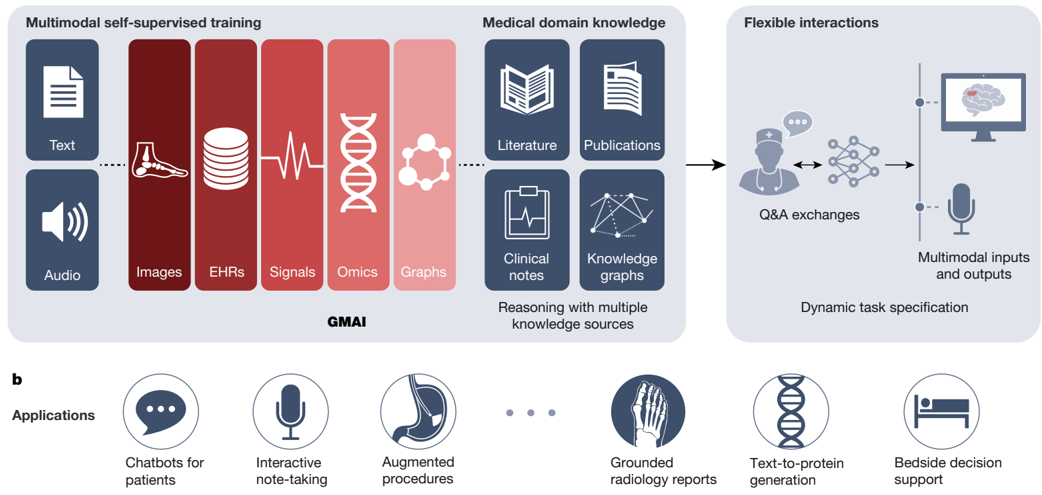
- Defines GMAI by three capabilities: dynamic task specification, flexible multimodal inputs/outputs, and formal representation of medical knowledge for advanced reasoning; existing models such as GPT-3 or PaLM show some medical reasoning but are not multimodal and do not reliably generate factual statements.
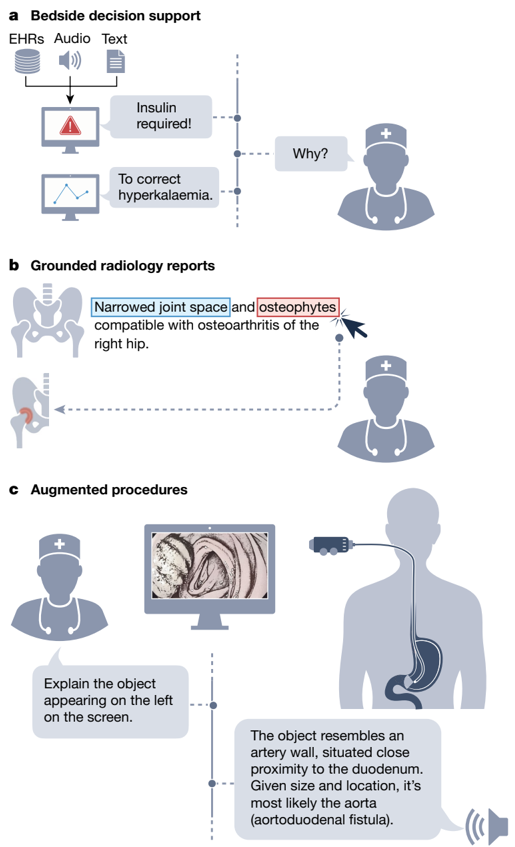
- Proposes six use cases: grounded radiology reports, augmented procedures, bedside decision support, chatbots for patients, text-to-protein generation, and interactive note-taking.
- Notes current medical AI is narrow: of more than 500 FDA-approved AI models for clinical medicine, most were approved for only 1 or 2 narrow tasks; CheXzero can detect dozens of diseases in chest X-rays without explicit labels; GPT-3 powered more than 300 apps within months of release.
- Flags scale and cost: PaLM, a 540-billion-parameter model, required an estimated 8.4 million hours’ worth of tensor processing unit v4 chips, using roughly 3,000 to 6,000 chips at a time, amounting to millions of dollars; training each model has been estimated to generate up to hundreds of tons of CO₂ equivalent; one study recommended 20 times more tokens than parameters for optimal performance.
Methods
- Perspective/review article; no primary data, sample, or experimental analysis.
- Synthesizes recent foundation-model advances and proposes the GMAI paradigm, identifying technical capabilities, training-data needs, use cases, and challenges.
- Draws on cited prior work and examples (e.g., GPT-3, Gato, CheXzero, PaLM) rather than new experiments.
Limitations
- Stated: GMAI will be uniquely difficult to validate because it can carry out previously unseen tasks, making failure modes hard to anticipate; social bias can increase with model scale; privacy risks include memorization of training data and prompt attacks; scale brings high computational, financial, and environmental costs; verification may require multidisciplinary panels; data collection/access and regulatory/liability frameworks are unresolved.
- Evident from the text: no GMAI model is built or empirically evaluated here; the use cases are prospective and illustrative; many capabilities depend on future advances in multimodal self-supervision, in-context learning, and medical knowledge integration.
Model-written summary. Check it against the paper before relying on it.
Integrity signals
Registry
Cites
Statistics
Figures
Verification
Claims the paper makes
17 Valid · 3 Not valid · 5 Not checked · 59 Own results and interpretations
The cited sources support only part of this claim — read each source’s verdict below.
In the paper
“They can acquire biases during training, when datasets either underrepresent certain groups of patients or contain harmful correlations 44,45 .”
§ Perspective Foundation models for generalist medical artificial intelligence > Social biases.
What the sources say
- Partly supportedcites [44] 44. Chung, H. W. et al. Scaling instruction-finetuned language models. Preprint at https:// arxiv.org/abs/2210.11416 (2022). sourceExperimental — accuracy not yet measured
The Mechanism of bias section (pp. 4–5) shows that the model learned to predict health care costs, which were correlated with race differently from health needs, producing racial bias. The paper does not identify underrepresentation of patient groups in training data as a cause of the bias it studied. (LLM, conf=0.87)
- Not matchedcites [45] 45. Kung, T. H. et al. Performance of ChatGPT on USMLE: potential for AI-assisted medical education using large language models. PLoS Dig. Health 2, 2 (2023).
Its entry has no title and year that we can search by.
plainstates a cause- Asserted: passes — The authors put it forward as true.
- Checkable: passes — It can be checked against evidence.
- Load-bearing: passes — The paper’s conclusions depend on it.
- Based: passes — The paper gives a reason why it holds.
- Partly supported
The cited sources support only part of this claim — read each source’s verdict below.
In the paper
“Individual models can now achieve state-of-the-art performance on a wide variety of problems, ranging from answering questions about texts to describing images and playing video games [2][3][4] .”
What the sources say
- Not matchedcites [2] 2. Yang, X. et al. A large language model for electronic health records. npj Digit. Med. 5, 194 (2022).
We searched by its title and found no matching paper.
- Partly supportedcites [3] 3. Food and Drug Administration. Artificial intelligence and machine learning (AI/ML)-enabled medical devices. FDA https://www.fda.gov/medical-devices/software-medical-device- samd/artificial-intelligence-and-machine-learning-aiml-enabled-medical-devices (2022). sourceExperimental — accuracy not yet measured
Section 3.1 (p. 7) reports that Flamingo outperforms previous zero- and few-shot methods across 16 vision-language benchmarks and exceeds fine-tuned state of the art on six tasks. Table 6 (p. 30) includes image scene description, supporting that example. The cited paper does not establish the sentence’s examples of answering questions about texts or playing video games. (LLM, conf=0.86)
- Partly supportedcites [4] 4. Acosta, J. N., Falcone, G. J., Rajpurkar, P. & Topol, E. J. Multimodal biomedical AI. Nat. Med. 28, 1773-1784 (2022). sourceExperimental — accuracy not yet measured
The Introduction (pp. 1–2) describes one model performing diverse vision and language tasks and reports the top overall score on the GRIT benchmark. The Results (p. 10) report state-of-the-art performance on A-OKVQA and strong image captioning, but say its NLP results lag behind state-of-the-art models. Related Work (p. 11) mentions another model's Atari button presses; it does not establish state-of-the-art video-game performance for Unified-IO. (LLM, conf=0.88)
plain- Asserted: passes — The authors put it forward as true.
- Checkable: passes — It can be checked against evidence.
- Load-bearing: passes — The paper’s conclusions depend on it.
- Based: passes — The paper gives a reason why it holds.
- Not matched
The cited sources support only part of this claim — read each source’s verdict below.
In the paper
“Furthermore, building on recent retrieval-based approaches, GMAI can retrieve relevant context from existing databases, in the form of articles, images or entire previous cases 19,20 .”
§ Perspective Foundation models for generalist medical artificial intelligence > Medical domain knowledge
What the sources say
- Partly supportedcites [19] 19. Guha Roy, A. et al. Does your dermatology classifier know what it doesn't know? Detecting the long-tail of unseen conditions. Med. Image Anal. 75, 102274 (2022). sourceExperimental — accuracy not yet measured
The Introduction (p. 1) describes Retro retrieving similar text from a large database, and the training-dataset section (p. 3) includes Wikipedia articles among its text sources. The paper does not establish that GMAI can retrieve images or entire previous medical cases; it supports the retrieval-based approach, but not those extensions. (LLM, conf=0.88)
- Partly supportedcites [20] 20. Radford, A. et al. Robust speech recognition via large-scale weak supervision. Preprint at https://arxiv.org/abs/2212.04356 (2022). sourceExperimental — accuracy not yet measured
The Introduction (p. 1) says REALM retrieves relevant documents from a corpus such as Wikipedia, supporting the article-retrieval part. Future Work (p. 9) proposes image retrieval as a possible extension, not an existing capability. The paper does not establish that GMAI retrieves images or entire previous cases. (LLM, conf=0.88)
plainstates a cause- Asserted: passes — The authors put it forward as true.
- Checkable: passes — It can be checked against evidence.
- Load-bearing: passes — The paper’s conclusions depend on it.
- Based: passes — The paper gives a reason why it holds.
- Partly supported
The cited sources support only part of this claim — read each source’s verdict below.
In the paper
“Models will be able to solve previously unseen problems simply by having new tasks explained to them (dynamic task specification), without needing to be retrained 3,5 .”
What the sources say
- Partly supportedcites [3] 3. Food and Drug Administration. Artificial intelligence and machine learning (AI/ML)-enabled medical devices. FDA https://www.fda.gov/medical-devices/software-medical-device- samd/artificial-intelligence-and-machine-learning-aiml-enabled-medical-devices (2022). sourceExperimental — accuracy not yet measured
The Introduction says Flamingo is designed to adapt to new vision-language tasks without fine-tuning, and the Contributions passage says it performs multimodal tasks from a few input/output examples. That supports adaptation without retraining, but not the broader claim that GMAI models can solve previously unseen problems simply by having tasks explained to them: Flamingo's demonstrated scope is narrower, and its task specification generally uses examples rather than an explanation alone. (LLM, conf=0.84)
- Not matchedcites [5] 5. Krishnan, R., Rajpurkar, P. & Topol, E. J. Self-supervised learning in medicine and healthcare. Nat. Biomed. Eng. 6, 1346-1352 (2022).
We searched by its title and found no matching paper.
plainstates a cause- Asserted: passes — The authors put it forward as true.
- Checkable: passes — It can be checked against evidence.
- Load-bearing: passes — The paper’s conclusions depend on it.
- Based: passes — The paper gives a reason why it holds.
- Partly supported
Every source the paper cites for this claim was checked and supports it.
In the paper
“CheXzero can be applied to detect dozens of diseases in chest X-rays without being trained on explicit labels for these diseases 9 .”
§ Perspective Foundation models for generalist medical artificial intelligence > Applicability.
What the sources say
- Supportedcites [9] 9. Vaswani, A. et al. Attention is all you need. In Advances in Neural Information Processing Systems (eds Guyon, I. et al.) 30, 5998-6008 (2017). source
The Main section describes CheXzero as a zero-shot chest X-ray classifier that needs no explicit pathology labels during training. The Results report an AUC of at least 0.700 for 38 of 57 radiographic findings evaluated on the PadChest test set, supporting the claim that it can detect dozens of conditions. (LLM, conf=0.90)
plainstates a cause- Asserted: passes — The authors put it forward as true.
- Checkable: passes — It can be checked against evidence.
- Load-bearing: unclear — It is unclear whether the paper’s conclusions depend on it.
- Based: passes — The paper gives a reason why it holds.
- Supported
32 more claims · 2 with their cited sources checked
Create a free account to see all 84 claims and to verify the 2 references still open.
- Probably not a substantial claim. 35
- It may state two separate claims as one. 25
Claims other papers make about this one
Each is checked against this paper’s own text: does it say what the citing paper says it does?
The source backs part of the claim, not all of it — or backs it for a different population, condition or comparison.
In the citing paper
“First, these models are predominantly pretrained using vision-only modeling57,59,60, which neglects not only rich supervisory signals found in pathology reports but also precludes multimodal capabilities such as zero-shot visual-language understanding and cross-model retrieval—a fundamental hallmark in foundation models84,85.”
From A multimodal whole-slide foundation model for pathology (2025) · cites this paper as [85]
Experimental — accuracy not yet measuredThe source backs part of the claim, not all of it — or backs it for a different population, condition or comparison.
In the citing paper
“Barriers to the clinical implementation of LLMs include their susceptibility to hallucinations, the absence of reliable references [13].”
From Diagnostic performance of Prof. Valmed, ChatGPT-5 Thinking, and OpenEvidence in rheumatology: A comparative evaluation (2026) · cites this paper as [13]
Experimental — accuracy not yet measuredThe cited source says what the claim attributes to it.
In the citing paper
“The emergence of (medical) foundational models (Moor et al., 2023), which are generally multimodal, is expected to accelerate research in optimal data fusion further.”
From Navigating the landscape of multimodal AI in medicine: A scoping review on technical challenges and clinical applications (2025) · cites this paper as Moor et al., 2023
The cited source says what the claim attributes to it.
In the citing paper
“Moor et al. introduced a paradigm for foundation model application in medical AI, named generalist medical AI (GMAI) [16].”
From Challenges in AI-driven Biomedical Multimodal Data Fusion and Analysis (2025) · cites this paper as [16]
The cited source says what the claim attributes to it.
In the citing paper
“Moor et al. proposed a framework of the GMAI, a foundation model designed to handle most clinical tasks, aiming to provide high-quality medical support to both patients and clinicians [16].”
From Challenges in AI-driven Biomedical Multimodal Data Fusion and Analysis (2025) · cites this paper as [16]
6 more claims about this paper
Create a free account to see every claim other papers make about this one.
Self-check
Percentages, sums and reported differences re-computed from the paper’s own numbers.
Each contradiction between two passages listed here was confirmed by an independent check.
Rated minor: it would not touch a result — a value no result rests on, a p-value that stays on the same side of the significance level, or a conflict that is clerical, resolved elsewhere in the paper, or outside its own findings.
In the paper
§ Perspective Foundation models for generalist medical artificial intelligence > Conclusion
“The presented example is inspired by a case report 58 .Image of the fistula in panel c adapted from ref. 58, CC BY 3.0.”
§ Perspective Foundation models for generalist medical artificial intelligence > References
“50. Vegunta, R., Vegunta, R. & Kutti Sridharan, G. Secondary aortoduodenal fistula presenting as gastrointestinal bleeding and fungemia. Cureus 11, e5575 (2019).”
Citations
Cites
Vaswani, A., Shazeer, N., Parmar, N., Uszkoreit, J., Jones, L., Gomez, A. N., Kaiser, L., & Polosukhin, I. (2017) · arXiv · doi:10.48550/arxiv.1706.03762 · Cited by 120,404
BERT: Pre-training of Deep Bidirectional Transformers for Language Understanding
Devlin, J., Chang, M.-W., Lee, K., & Toutanova, K. (2019) · Proceedings of the 2019 Conference of the North American Chapter of the Association for Computational Linguistics: Human Language Technologies, Volume 1 (Long and Short Papers) · doi:10.18653/v1/n19-1423 · Cited by 54,325
Highly accurate protein structure prediction with AlphaFold
Jumper, J., Evans, R., Pritzel, A., Green, T., Figurnov, M., Ronneberger, O., Tunyasuvunakool, K., Bates, R., Žídek, A., Potapenko, A., et al. (2021) · Nature · doi:10.1038/s41586-021-03819-2 · Cited by 43,764 · cited 1×
“There have already been early efforts to develop foundation models for biological sequences 33,34 , including RFdiffusion, which generates proteins on the basis of simple specifications (for example, a binding target) 35 .”
BackgroundHigh-Resolution Image Synthesis with Latent Diffusion Models
Rombach, R., Blattmann, A., Lorenz, D., Esser, P., & Ommer, B. (2022) · 2022 IEEE/CVF Conference on Computer Vision and Pattern Recognition (CVPR) · doi:10.1109/cvpr52688.2022.01042 · Cited by 20,302 · cited 2×
“For certain use cases (for example, chatbots), GMAI models can be stored on central compute clusters maintained by organizations with deep technical expertise, as DALL-E or GPT-3 are.”
BackgroundLearning Transferable Visual Models From Natural Language Supervision
Radford, A., Kim, J. W., Hallacy, C., Ramesh, A., Goh, G., Agarwal, S., Sastry, G., Askell, A., Mishkin, P., Clark, J., et al. (2021) · arXiv · doi:10.48550/arxiv.2103.00020 · Cited by 15,293 · cited 2×
“These include the rise of multimodal architectures 13 and self-supervised learning techniques 14 that dispense with explicit labels (for example, language modelling 15 and contrastive learning 16 ), as well as the advent of in-context learning capabilities 5 .”
BackgroundSudlow, C., Gallacher, J., Allen, N., Beral, V., Burton, P., Danesh, J., Downey, P., Elliott, P., Green, J., Landray, M., et al. (2015) · PLOS Medicine · doi:10.1371/journal.pmed.1001779 · Cited by 12,728 · cited 1×
“Large-scale data-sharing efforts, such as the MIMIC (Medical Information Mart for Intensive Care) database 55 or the UK Biobank 56 , will play a critical role in GMAI, and they should be extended to underrepresented countries to create larger, richer and more inclusive training datasets.”
BackgroundAdvances in Neural Information Processing Systems 14: Proceedings of the 2001 Conference
(2002) · The MIT Press eBooks · doi:10.7551/mitpress/1120.001.0001 · Cited by 8,890
Dissecting racial bias in an algorithm used to manage the health of populations
Obermeyer, Z., Powers, B., Vogeli, C., & Mullainathan, S. (2019) · Science · doi:10.1126/science.aax2342 · Cited by 7,137 · cited 1×
“They can acquire biases during training, when datasets either under-represent certain groups of patients or contain harmful correlations 44,45 .”
BackgroundUniProt: the universal protein knowledgebase
The UniProt Consortium (2017) · Nucleic Acids Research · doi:10.1093/nar/gkw1099 · Cited by 4,436
Training language models to follow instructions with human feedback
Ouyang, L., Wu, J., Jiang, X., Almeida, D., Wainwright, C. L., Mishkin, P., Zhang, C., Agarwal, S., Slama, K., Ray, A., et al. (2022) · arXiv · doi:10.48550/arxiv.2203.02155 · Cited by 4,208 · cited 1×
“Such feedback can then be used to improve model behaviour, following the example of InstructGPT, a model created by using human feedback to refine GPT-3 through reinforcement learning 41 .”
Method
Research works printed but not linked: 2
- Reed, S. et al. A generalist agent. In Transactions on Machine Learning Research (2022). This study presented Gato, a generalist model that can carry out a variety of tasks across modalities such as chatting, captioning images, playing video games and controlling a robot arm.
- Brown, T. et al. Language models are few-shot learners. In Advances in Neural Information Processing Systems (eds Larochelle, H. et al.) 33, 1877–1901 (2020). This study presented the language model GPT-3 and discovered that large language models can carry out in-context learning.
Cited by
Items 601–700 of 1,962
What Are the Opportunities and Challenges of Using AI in Medical Education in Vietnam?
Nguyen, T. A., Nguyen, T. B., Nguyen, D. C., Vu, A. D., Dang, K. L., Le, N. Q., Ngo, D. A., Nguyen, D. K., Hoang, V. T., & Ngo, T. B. (2025) · JMIR Medical Education · doi:10.2196/77817 · Cited by 16
“Student exposure Widespread use of AI tools for adaptive learning, automated assessment, and clinical simulation [1, 22-25].”
Wei, C., Zhou, L., Liang, B., Chen, J., Wang, G., & Li, X. (2025) · Food Chemistry · doi:10.1016/j.foodchem.2025.147377 · Cited by 16
Panayides, A. S., Chen, H., Filipović, N., Geroski, T., Hou, J., Lekadir, K., Marias, K., Matsopoulos, G. K., Papanastasiou, G., Sarder, P., et al. (2025) · IEEE Journal of Biomedical and Health Informatics · doi:10.1109/jbhi.2025.3649496 · Cited by 21
Foundation Models Meet Medical Image Interpretation
Jiao, L., Hao, J., Li, R., Li, L., Liu, X., Liu, F., Ma, W., Chen, P., Huang, Z., Yang, J., et al. (2026) · Research · doi:10.34133/research.1024 · Cited by 20
MedVersa: A Generalist Foundation Model for Diverse Medical Imaging Tasks
Zhou, H.-Y., Acosta, J., Adithan, S., Datta, S., Topol, E. J., & Rajpurkar, P. (2026) · NEJM AI · doi:10.1056/aioa2500595 · Cited by 22
Self-citationXia, K., Yang, S., Qiang, D., & Yu, M. (2026) · Interdisciplinary materials · doi:10.1002/idm2.70045 · Cited by 12
Zsidai, B., Kaarre, J., Hilkert, A., Narup, E., Senorski, E. H., Grassi, A., Ayeni, O. R., Musahl, V., Ley, C., Herbst, E., et al. (2023) · Journal of Experimental Orthopaedics · doi:10.1186/s40634-023-00662-4 · Cited by 14
“Additionally, GAI may be applied in a broader sense, with the capability to interpret multi-modal, domain-specific information, including labelled or unlabelled medical images, patient interviews and patient reported outcome data in the context of complex clinical scenarios [6].”
BackgroundEffects of Different Prompts on the Quality of GPT-4 Responses to Dementia Care Questions
Li, Z., Xie, B., Hilsabeck, R. C., Aguirre, A., Zou, N., Luo, Z., & He, D. (2024) · IEEE International Conference on Healthcare Informatics (ICHI) · doi:10.1109/ichi61247.2024.00059 · Cited by 13
“Large language models (LLMs) such as ChatGPT [5] and GPT-4 [6] can comprehend and interpret users’ needs, and generate outputs that meet their requirements [7], [8].”
BackgroundLSL-SS-Net: level set loss-guided semantic segmentation networks for landslide extraction
Yang, Y., Miao, Z., Li, X., Zhang, H., & Chen, S. (2024) · GIScience & Remote Sensing · doi:10.1080/15481603.2024.2416727 · Cited by 11
de Weerd, H. A., Guala, D., Gustafsson, M., Synnergren, J., Tegner, J. N., Lubovac-Pilav, Z., & Magnusson, R. (2024) · Patterns · doi:10.1016/j.patter.2024.101093 · Cited by 11
“52 Our study is, in this sense, part of a growing approach to machine learning in life sciences that aims to capture the fundamentals of a system to make explainable predictions that accurately generalize outside of training data.”
Application of GenAI in Clinical Administration Support
Taheri, A., Farhadi, A., & Zamanifar, A. (2025) · Springer eBooks · doi:10.1007/978-3-031-82963-5_4 · Cited by 15
IR-GPT: AI Foundation Models to Optimize Interventional Radiology
Brenner, J., Anibal, J., Hazen, L., Song, M. J., Huth, H. B., Xu, D., Xu, S., & Wood, B. J. (2025) · CardioVascular and Interventional Radiology · doi:10.1007/s00270-024-03945-0 · Cited by 12
Hasan, K. R., Kim, S., Cho, J., & Han, H. S. (2025) · IEEE Access · doi:10.1109/access.2025.3570673 · Cited by 12
“Despite this promise, training high-performing DL models requires a massive volume of labeled data [5], which is often scarce and expensive to obtain in the medical domain.”
URFM: A general Ultrasound Representation Foundation Model for advancing ultrasound image diagnosis
Kang, Q., Lao, Q., Gao, J. Y., Bao, W., He, Z., Du, C., Lu, Q., & Li, K. (2025) · iScience · doi:10.1016/j.isci.2025.112917 · Cited by 27
Opportunities for Causal Machine Learning in Precision Oncology
Weberpals, J. G., Feuerriegel, S., van der Schaar, M., & Kehl, K. L. (2025) · NEJM AI · doi:10.1056/aip2500277 · Cited by 20
CRCFound: A Colorectal Cancer CT Image Foundation Model Based on Self‐Supervised Learning
Yang, J., Cai, D., Liu, J., Zhuang, Z., Zhao, Y., Wang, F., Li, C., Hu, C., Gai, B., Chen, Y., et al. (2025) · Advanced Science · doi:10.1002/advs.202407339 · Cited by 13
Technosolutionism and the empathetic medical chatbot
Sharon, T. (2025) · AI & Society · doi:10.1007/s00146-025-02441-4 · Cited by 17
“…used to summarize, paraphrase, and generate text-based content, have become a source of excitement in the medical and healthcare fields (Clusmann et al. 2023), with tech developers and medical practitioners celebrating their potential to “reshape modern medicine” (Li et al. 2023; Moor et al. 2023).”
Wang, Y., Gu, Y., Zhang, X., Wang, B., Wang, R., Li, X., Liu, Y., Qu, F., Ren, F., Yan, R., et al. (2025) · Chinese Medical Journal · doi:10.1097/cm9.0000000000003790 · Cited by 10
“Foundation models [7] are general-purpose AI models trained by self-supervised learning [49,50] on large and diverse datasets, which enables them to be transferred to a wide range of downstream tasks.”
Understanding pre-training data effects in retinal foundation models using two large fundus cohorts
Zhou, Y., Wang, Z., Wu, Y., Ong, A. Y., Wagner, S. K., Ruffell, E., Chia, M. A., Guan, Z., Ju, L., Engelmann, J., et al. (2026) · Nature Communications · doi:10.1038/s41467-026-70077-z · Cited by 23
“Details of the downstream task datasets are listed in Supplementary Data 1 and 2.”
Self-citationPhotonic optical accelerators: The future engine for the era of modern AI?
Makarenko, M. O., Wang, Q., Lopez, A. B., & Fratalocchi, A. (2023) · APL Photonics · doi:10.1063/5.0174044 · Cited by 10
Clinical Deployment of Machine Learning Tools in Transplant Medicine: What Does the Future Hold?
Rabindranath, M., Naghibzadeh, M., Zhao, X., Holdsworth, S., Brudno, M., Sidhu, A., & Bhat, M. (2023) · Transplantation · doi:10.1097/tp.0000000000004876 · Cited by 9
Noaeen, M., Amini, S., Bhasker, S., Ghezelsefli, Z., Ahmed, A., Jafarinezhad, O., & Abad, Z. S. H. (2023) · Annual International Conference of the IEEE Engineering in Medicine and Biology Society (EMBC) · doi:10.1109/embc40787.2023.10340232 · Cited by 14
“The advent of generative AI models, such as GPT-4, presents new opportunities for effectively extracting social and behavioral factors from unstructured clinical notes, which could further enhance the accuracy and stability of ML algorithms in predicting patient outcomes [26].”
MethodSelf-citationThe dawn of multimodal artificial intelligence in nephrology
Shickel, B., & Bihorac, A. (2023) · Nature Reviews Nephrology · doi:10.1038/s41581-023-00799-6 · Cited by 9
“…the potential to advance our understanding of the kidney and to enable intelligent real-time assistance in the clinic via applications such as personalized decision support using natural language, context-aware image report generation, real-time augmented procedures and automated notetaking 4 .”
Telemedicine and Cancer Clinical Research: Opportunities for Transformation
von Itzstein, M. S., Gwin, M. E., Gupta, A., & Gerber, D. E. (2024) · The Cancer Journal · doi:10.1097/ppo.0000000000000695 · Cited by 9
Stadlbauer, A., Nikolic, K., Oberndorfer, S., Marhold, F., Kinfe, T. M., Meyer‐Baese, A., Bistrian, D. A., Schnell, O., & Doerfler, A. (2024) · Cancers · doi:10.3390/cancers16061102 · Cited by 10
An efficient full-size convolutional computing method based on memristor crossbar
Tan, J., Shen, S., Duan, S., & Wang, L. (2024) · Artificial Intelligence Review · doi:10.1007/s10462-024-10787-2 · Cited by 10
“…in turn produce expressive output, such as text description, oral recommendation or image annotation showing advanced medical reasoning ability (Moor et al. 2023); at the same time, biomimetic organs based on modern AI technology, such as prostheses and biomimetic eyes, significantly improve…”
Samsel, K., Tiwana, A., Ali, S., Guergachi, A., Keshavjee, K., Noaeen, M., & Shakeri, Z. (2024) · medRxiv · doi:10.1101/2024.02.03.24302303 · Cited by 9
Sung, Y.-N., Lee, H., Kim, E., Jung, W. Y., Sohn, J.-H., Lee, Y. J., Keum, B., Ahn, S., & Lee, S. H. (2024) · American Journal of Cancer Research · doi:10.62347/rjbh6076 · Cited by 14
Kayabaşı, M., Köksaldı, S., & Engin, C. D. (2024) · Clinical and Experimental Optometry · doi:10.1080/08164622.2024.2419524 · Cited by 14
The Treasure Trove Hidden in Plain Sight: The Utility of GPT-4 in Chest Radiograph Evaluation
Arasteh, S. T., Siepmann, R. M., Huppertz, M., Lotfinia, M., Puladi, B., Kuhl, C. K., Truhn, D., & Nebelung, S. (2024) · Radiology · doi:10.1148/radiol.233441 · Cited by 10
Detection of Disease Features on Retinal OCT Scans Using RETFound
Du, K., Nair, A. R., Shah, S. V., Gadari, A., Vupparaboina, S. C., Bollepalli, S. C., Sutharahan, S., Sahel, J., Jana, S., Chhablani, J. K., et al. (2024) · Bioengineering · doi:10.3390/bioengineering11121186 · Cited by 15
Brain-ID: Learning Contrast-Agnostic Anatomical Representations for Brain Imaging
Liu, P., Puonti, O., Hu, X., Alexander, D. C., & Iglesias, J. E. (2024) · Lecture notes in computer science · doi:10.1007/978-3-031-73254-6_19 · Cited by 16
“Lately, generalist biomedical AI systems [42, 48, 52] have shown great potential in biomedical tasks under vision-language context, e.g., (visual) question answering, image classification, radiology report generation and summarization.”
BackgroundEnhancing Medical Vision-Language Contrastive Learning via Inter-Matching Relation Modeling
Li, M., Meng, M., FULHAM, M. J., Feng, D. D., Bi, L., & Kim, J. (2025) · IEEE Transactions on Medical Imaging · doi:10.1109/tmi.2025.3534436 · Cited by 19
“This design provoked great interest in the community given the transferability of the learned image representations to the downstream tasks such as disease classification, lesion detection and segmentation [2], [3], [4], [5], [6].”
Sun, D., Chen, W., He, J., Yong-jian, H., Jiang, H., Jiang, H., Liu, D., Li, L., Liu, M., Mao, Z., et al. (2025) · BMC Medical Informatics and Decision Making · doi:10.1186/s12911-025-02892-1 · Cited by 9
“In recent years, ML and AI have been increasingly used in various branches of medicine [12].”
Thieme, A., Rajamohan, A. M., Cooper, B., Groombridge, H., Simister, R. J., Wong, B., Woznitza, N., Pinnock, M. A., Wetscherek, M. T., Morrison, C. P., et al. (2025) · ACM Transactions on Computer-Human Interaction · doi:10.1145/3716500 · Cited by 20
RelAI: an automated approach to judge pointwise ML prediction reliability
Peracchio, L., Nicora, G., Parimbelli, E., Buonocore, T. M., Tavazzi, E., Bergamaschi, R., Dagliati, A., & Bellazzi, R. (2025) · International Journal of Medical Informatics · doi:10.1016/j.ijmedinf.2025.105857 · Cited by 11
Fine-tuning of conditional Transformers improves in silico enzyme prediction and generation
Nicolini, M., Saitto, E., Franco, R. E. J., Cavalleri, E., Galeano, A., Malchiodi, D., Paccanaro, A., Robinson, P. N., Casiraghi, E., & Valentini, G. (2025) · Computational and Structural Biotechnology Journal · doi:10.1016/j.csbj.2025.03.037 · Cited by 8
Ma, J., Bu, W., Wan, M., Deng, L., & Cheng, J. (2025) · Journal of Clinical Anesthesia · doi:10.1016/j.jclinane.2025.111839 · Cited by 8
CAPTAIN: a multimodal foundation model pretrained on co-assayed single-cell RNA and protein
Ji, B., Hu, T., Wang, J., Liu, M., Xu, L., Zhang, Q., Zhong, S., Qiao, L., Zhang, Y., Peng, S., et al. (2026) · Nature Communications · doi:10.1038/s41467-026-72882-y · Cited by 22
GutGPT: A multidimensional knowledge-enhanced large language model for gastrointestinal medicine
Zhang, R.-Y., Qiang, P.-P., Hao, Y.-X., Tan, H., Zhao, K., Cai, L.-J., & Wang, J. (2025) · Journal of Biomedical Informatics · doi:10.1016/j.jbi.2025.104885 · Cited by 10
Li, J., Gao, Y., Xu, Y., Dai, W., Hu, Y., Feng, X., Wu, D., & Zhao, L. (2025) · NeuroImage · doi:10.1016/j.neuroimage.2025.121392 · Cited by 18
“In addition, the performance of the proposed model could be improved using generalization strategies, such as Domain-Adversarial Neural Networks (Ganin et al., 2016) or foundation models (Moor et al., 2023), which warrants further investigation.”
Zhang, L., Yang, L., Ma, Y., Zhu, A., Wei, R., Liu, J., Greve, M. H., & Zhou, C. (2025) · Geoderma · doi:10.1016/j.geoderma.2025.117466 · Cited by 10
Specialized curricula for training vision language models in retinal image analysis
Holland, R., Taylor, T. R. P., Holmes, C., Riedl, S., Mai, J., Patsiamanidi, M., Mitsopoulou, D., Hager, P., Müller, P., Paetzold, J. C., et al. (2025) · npj Digital Medicine · doi:10.1038/s41746-025-01893-8 · Cited by 26
Artificial Intelligence Applications in Emergency Toxicology: Advancements and Challenges
Yong, L. P. X., Tung, J. Y. M., Cheung, N. M. T., Lee, Z. Y., Ng, E. Y., Ng, A. J. Y., Lim, C. K. W., Boon, Y., Lim, D. Y. Z., Sng, G. G. R., et al. (2025) · Journal of Medical Internet Research · doi:10.2196/73121 · Cited by 13
The Financial, Operational, and Clinical Advantages of Generalist Radiology AI
Dogra, S., Zhang, X., Silva, E., & Rajpurkar, P. (2025) · Radiology · doi:10.1148/radiol.242362 · Cited by 12
Self-citationRole of artificial intelligence in gastric diseases
Gong, E. J., Woo, J., Lee, J. J., & Bang, C. S. (2025) · World Journal of Gastroenterology · doi:10.3748/wjg.v31.i37.111327 · Cited by 11
Li, R., Zhao, A., Lei, P., Shi, H., Zhao, J., Li, Z., Liang, R., & Wang, H. (2025) · Annals of Surgical Oncology · doi:10.1245/s10434-025-18492-2 · Cited by 12
“1,2 For example, OpenAI’s ChatGPT progressed to the o1 model and later to the o3 version, demonstrating outstanding proficiency in mathematics and science assessments.”
Diagnosis and Triage Performance of Contemporary Large Language Models on Short Clinical Vignettes
Xu, L., Zhao, W., & Huang, X. (2025) · Journal of Medical Systems · doi:10.1007/s10916-025-02284-y · Cited by 20
Education Research: Can Large Language Models Match MS Specialist Training?
Inojosa, H., Ramezanzadeh, A., Gasparovic-Curtini, I., Wiest, I. C., Kather, J. N., Gilbert, S., & Ziemssen, T. (2025) · Neurology Education · doi:10.1212/ne9.0000000000200260 · Cited by 8
Pataranutaporn, P., Powdthavee, N., Archiwaranguprok, C., & Maes, P. (2025) · Proceedings of the National Academy of Sciences · doi:10.1073/pnas.2519394122 · Cited by 27
“…work shows that LLMs can generate plausible associations in other domains—such as identifying medical risk factors from clinical records ( 11 , 12 ) and forecasting political preferences from demographic and attitudinal profiles—but these applications involve patterns that are relatively well…”
Nadimi, F., Abdisarabshali, P., Borazjani, K., Chakareski, J., & Hosseinalipour, S. (2025) · npj Wireless Technology · doi:10.1038/s44459-025-00003-0 · Cited by 17
“In particular, diffusion models (e.g., DALL·E 3) are generative models that can generate realistic data, such as images or audio.”
Artificial intelligence‐enabled digital biomedical engineering
Song, P., Tang, X., Lv, X., Reis, R. L., Chen, X., Bai, L., & Su, J. (2025) · BMEMat · doi:10.1002/bmm2.70049 · Cited by 10
Torchia, E., Sante, M. D., Horda, B., Mihajlovic, M., Zimmermann, J., Pezzotti, M., Cimetta, E., Gabriele, S., Auricchio, F., Lind, J. U., et al. (2025) · Communications Engineering · doi:10.1038/s44172-025-00575-3 · Cited by 10
Empowering front-line physicians with AI: Evaluating large language models in everyday ENT care
Hack, S., Zalzal, H. G., Attal, R., Farzad, A., Crew, L. A., Tessler, I., Frankel, T., Gvili, B., Shivatzki, S., Wolfovitz, A., et al. (2026) · The American Journal of Emergency Medicine · doi:10.1016/j.ajem.2026.01.029 · Cited by 12
Li, S., Liu, C., Zhao, J., Zheng, P., Wang, X. V., & Wang, L. (2026) · Advanced Engineering Informatics · doi:10.1016/j.aei.2026.104370 · Cited by 14
A foundation model for breast and lung cancer screening using non-contrast computed tomography
Liang, Z., Niu, Q., Wang, J., Han, C., Li, Q., Wu, Y., Zhu, B., Han, X., Wang, Z., Wang, X., et al. (2026) · Nature Health · doi:10.1038/s44360-026-00055-8 · Cited by 13
Zhou, X., & Tao, W. (2026) · Frontiers in Bioinformatics · doi:10.3389/fbinf.2026.1755843 · Cited by 13
“Unlike traditional models trained on narrow datasets, BFMs learn generalizable biological patterns via self-supervised pre-training, enabling zero-shot/few-shot transfer to downstream tasks (Moor et al., 2023).”
A Survey on lightweight technology of neural networks for medical image segmentation
Zhu, Z., Wang, H., Qi, G., Li, Y., Mazur, N., Liu, Y., Li, H., Cong, B., & Bai, L. (2026) · Pattern Recognition · doi:10.1016/j.patcog.2026.113870 · Cited by 18
Fully sprayed triboelectric-piezoresistive hybrid sensor for intelligent sports analytics
Huang, L. L., Ji, M., guo, W., Pang, Y., Liu, Z., Jiang, T., Shi, X., Luo, J., & Wang, Z. L. (2026) · Materials Today · doi:10.1016/j.mattod.2026.103400 · Cited by 11
Decoding ChatGPT: A primer on large language models for clinicians
Hunter, R. B., Mehta, S. D., Limon, A., & Chang, A. C. (2023) · Intelligence-Based Medicine · doi:10.1016/j.ibmed.2023.100114 · Cited by 11
Genomics-based tools for drug discovery and development: From network maps to efficacy prediction
Fang, J., Qi, C., & Wu, G. (2023) · Journal of Holistic Integrative Pharmacy · doi:10.1016/j.jhip.2023.11.001 · Cited by 10
Jafar, A., & Pasqua, M. (2024) · Diabetes Obesity and Metabolism · doi:10.1111/dom.15463 · Cited by 11
“…aid in planning optimized therapeutic and behavioural recommendations. insulin data) and unstructured data (such as clinical notes and images from clinical reports), it is worth employing foundation models 130,131 with their tendency to learn patterns across both structured and unstructured data.”
BackgroundArtificial intelligence powered advancements in upper extremity joint MRI: A review
Chen, W., Lim, L. J. R., Lim, R. Q. R., Yi, Z., Huang, J., He, J., Yang, G., & Liu, B. (2024) · Heliyon · doi:10.1016/j.heliyon.2024.e28731 · Cited by 9
“In the following period, more DL architectures have been developed and optimized to obtain higher-quality MRI images to achieve better diagnostic performance [11,12].”
BackgroundMethodInfluentialArtificial intelligence in autoimmune bullous dermatoses
Manuelyan, K., Dragolov, M., Drenovska, K., Shahid, M., & Vassileva, S. (2024) · Clinics in Dermatology · doi:10.1016/j.clindermatol.2024.06.008 · Cited by 10
Smart Operating Room in Digestive Surgery: A Narrative Review
Laterza, V., Marchegiani, F., Aisoni, F., Ammendola, M., Schena, C. A., Lavazza, L., Ravaioli, C., Carra, M. C., Costa, V., Franceschi, A. D., et al. (2024) · Healthcare · doi:10.3390/healthcare12151530 · Cited by 10
“They might then be capable of generating a highly diverse output, including augmented procedures, automated reports generation, and chatbots for verbal communication [135].”
BackgroundImproving Agent Behaviors with RL Fine-Tuning for Autonomous Driving
Peng, Z., Luo, W., Lu, Y., Shen, T., Gulino, C., Seff, A., & Fu, J. (2024) · Lecture notes in computer science · doi:10.1007/978-3-031-72698-9_10 · Cited by 47
Evaluating Quality and Readability of AI-generated Information on Living Kidney Donation
Villani, V., Nguyen, H. T., & Shanmugarajah, K. (2024) · Transplantation Direct · doi:10.1097/txd.0000000000001740 · Cited by 11
The performance of ChatGPT-4 and Bing Chat in frequently asked questions about glaucoma
Doğan, L., & Yılmaz, İ. E. (2025) · European Journal of Ophthalmology · doi:10.1177/11206721251321197 · Cited by 9
Lin, F., Gao, T., Sun, D., Ni, Q., Ding, X., Wang, J., Gao, W., & Wang, F. (2025) · IEEE/CAA Journal of Automatica Sinica · doi:10.1109/jas.2024.124614 · Cited by 8
Controlling risks of AI in chemical science with agents
He, J., Guan, H., Feng, W., Min, Y., Yi, J., Tang, K., Li, S. C., Zhang, J., Chen, K., Zhou, W., et al. (2025) · AI for Science · doi:10.1088/3050-287x/adfee5 · Cited by 49
A clinician's guide to large language models
Briganti, G. (2023) · Future Medicine AI · doi:10.2217/fmai-2023-0003 · Cited by 21
Application and technology of an open source AI large language model in the medical field
Zhang, T., & Feng, T. (2023) · Radiology Science · doi:10.15212/radsci-2023-0007 · Cited by 8
“Generalist medical artificial intelligence (GMAI) was proposed by Topol and Rajpurkar in 2022 [59].”
BackgroundArtificial Intelligence in Medicine
-, M. S. D. (2024) · International Journal For Multidisciplinary Research · doi:10.36948/ijfmr.2024.v06i01.12490 · Cited by 10
“The generalist AI models to provide comprehensive solutions to the task of interpretation of radiologic images is likely to transform both the fields of radiology and healthcare [33, 44].”
BackgroundTeikari, P., & Pietrusz, A. (2021) · SportRxiv (OSF Preprints) · doi:10.31236/osf.io/w734a · Cited by 17
Foundation Models for Quantitative Biomarker Discovery in Cancer ImagingPreprint
Pai, S., Bontempi, D., Hadžić, I., Prudente, V., Sokač, M., Chaunzwa, T. L., Bernatz, S., Hosny, A., Mak, R. H., Birkbak, N. J., et al. (2023) · medRxiv · doi:10.1101/2023.09.04.23294952 · Cited by 9
A Justifiable Investment in AI for Healthcare: Aligning Ambition with RealityPreprint
Karpathakis, K., Morley, J., & Floridi, L. (2024) · SSRN Electronic Journal · doi:10.2139/ssrn.4795198 · Cited by 8
Reese, J. T., Chimirri, L., Bridges, Y., Danis, D., Caufield, J. H., Gargano, M. A., Kroll, C., Schmeder, A., Liu, F., Wissink, K., et al. (2024) · doi:10.1101/2024.07.22.24310816 · Cited by 8
Lee, Y., Liu, X., Hao, M., Liu, T., & Regev, A. (2024) · bioRxiv (Cold Spring Harbor Laboratory) · doi:10.1101/2024.12.10.627865 · Cited by 12
Patil, D. (2025) · SSRN Electronic Journal · doi:10.2139/ssrn.5057410 · Cited by 26
Sen, C. K., & DeMazumder, D. (2025) · Advances in Wound Care · doi:10.1177/21621918251380217 · Cited by 14
Karataş, G., & Karataş, M. E. (2026) · Strabismus · doi:10.1080/09273972.2025.2536782 · Cited by 7
Survey of US physicians’ attitudes and knowledge of AI
Gebauer, S. L., & Eckert, C. (2024) · BMJ Evidence-Based Medicine · doi:10.1136/bmjebm-2023-112726 · Cited by 8
Toward Realizing the Promise of AI in Precision Health Across the Spectrum of Care
Wiens, J., Spector‐Bagdady, K., & Mukherjee, B. (2024) · Annual Review of Genomics and Human Genetics · doi:10.1146/annurev-genom-010323-010230 · Cited by 9
Regulatory barriers to US-China collaboration for generative AI development in genomic research
Wang, Z., Gregg, B., & Du, L. (2024) · Cell Genomics · doi:10.1016/j.xgen.2024.100564 · Cited by 11
Artificial intelligence in surgical pathology – Where do we stand, where do we go?
Sagiv, C., Hadar, O., Najjar, A., & Pahnke, J. (2024) · European Journal of Surgical Oncology · doi:10.1016/j.ejso.2024.109541 · Cited by 12
Artificial intelligence‐driven change redefining radiology through interdisciplinary innovation
Huang, R., Meng, X., Zhang, X., Luo, Z., Cao, L., Feng, Q., Ma, G., Dong, D., & Wang, Y. (2025) · Interdisciplinary medicine · doi:10.1002/inmd.20240063 · Cited by 13
SeisBERT: A pretrained seismic image representation model for seismic data interpretation
Pham, N. H., Di, H., Zhao, T., & Abubakar, A. (2025) · The Leading Edge · doi:10.1190/tle44020096.1 · Cited by 10
Li, K., Wang, L., Wan, S., Wang, C.-Y., Chen, S., Liu, S., & Li, Y. (2025) · Journal of Endourology · doi:10.1089/end.2024.0860 · Cited by 13
“19 Furthermore, taking inspiration from Rewtham-rongsris et al., 20 we propose to enhance research depth by expanding our dataset with more granular coverage of complex BLCA management scenarios.”
New tools for diagnosis of primary immunodeficiencies: from awareness to artificial intelligence
Soler‐Palacín, P., Riviere, J. G., Burns, S. O., et al. (2025) · Frontiers in Immunology · doi:10.3389/fimmu.2025.1593897 · Cited by 7
“…of image characteristics, chatbots to address patients ’ questions, interactive video augmentation of surgical procedures, bedside decision support that can provide predictive warnings and care recommendations and interactive note-taking that can lessen the administrative burden on providers (36).”
Deep learning for diagnosing and grading pterygium: A systematic review and meta-analysis
Tiong, E. W. W., Soon, C. Y. S., Ong, Z. Z., Liu, S., Qureshı, R., Rauz, S., & Ting, D. S. J. (2025) · Computers in Biology and Medicine · doi:10.1016/j.compbiomed.2025.110743 · Cited by 10
Mansoor, M. A., Ibrahim, A., & Hamide, A. (2025) · JMIR AI · doi:10.2196/76056 · Cited by 9
“Recent advancements in AI have produced models with increasingly advanced medical reasoning capabilities [1,2], but limited research exists evaluating AI performance on standardized medical assessments.”
Hou, Q., Zhou, Y., Goh, J. H. L., Zou, K., Yew, S. M. E., Srinivasan, S., Wang, M., Lo, T. W. S., Lei, X., Wagner, S. K., et al. (2025) · Ophthalmology Science · doi:10.1016/j.xops.2025.100923 · Cited by 23
General Methods Make Great Domain-Specific Foundation Models: A Case-Study on Fetal Ultrasound
Ambsdorf, J., Munk, A., Llambias, S. N., Christensen, A. N., Mikolaj, K. W., Balestriero, R., Tolsgaard, M. G., Feragen, A., & Nielsen, M. (2025) · Lecture notes in computer science · doi:10.1007/978-3-032-04981-0_26 · Cited by 21
NeoCLIP: a self-supervised foundation model for the interpretation of neonatal radiographs
Huang, Y., Sharma, P., Palepu, A. K., Greenbaum, N. R., Beam, A. L., & Beam, K. (2025) · npj Digital Medicine · doi:10.1038/s41746-025-01922-6 · Cited by 8
Guo, L., Zhang, S., Chen, H., Li, Y., Liu, Y., Liu, W., Wang, Q., Tang, Z., Jiang, P., & Wang, J. (2025) · Visual Computing for Industry Biomedicine and Art · doi:10.1186/s42492-025-00201-1 · Cited by 8
Memristor-based Neuromorphic Diagnostic Systems: An Emerging Strategy for Intelligent Medicine
Sun, B. T., Zhang, J., Yang, C. F., Zhou, G., Sun, L., Cao, Z., Yang, B., Li, X., Chen, X., & Shao, J. (2025) · ACS Nano Medicine · doi:10.1021/acsnanomed.5c00084 · Cited by 8
Generative Psychometrics—An Emerging Frontier in Mental Health Measurement
Galatzer‐Levy, I. R., Tomašev, N., Chung, S., & Williams, G. (2025) · JAMA Psychiatry · doi:10.1001/jamapsychiatry.2025.3258 · Cited by 11
Chang, L., Li, H., Wu, W., Liu, X., Yan, J., Chen, Z., Wu, H., & Song, S. (2025) · Journal of Translational Medicine · doi:10.1186/s12967-025-07591-z · Cited by 10
Linde, P., Fichter, F., Dietlein, M., Sudbrock, F., Afshar, K., Dapper, H., Fokas, E., Hillebrecht, A., Raupach, T., & Laupichler, M. C. (2026) · npj Digital Medicine · doi:10.1038/s41746-025-02313-7 · Cited by 16
“Foundation models for medical imaging demonstrate how scaling and promptability can unlock breadth 16 , but educational policies and curricular governance 17 — through clear task de fi nitions, expert review, and post-hoc performance monitoring — ultimately determines safe translation 10 .”
Magouliotis, D. E., Sicouri, N., Ramlawi, L., Baudo, M., Androutsopoulou, V. A., & Sicouri, S. (2026) · Journal of Personalized Medicine · doi:10.3390/jpm16020069 · Cited by 13
“Such foundation models, analogous to large language models but trained on medical signals and imaging, are expected to dramatically improve risk prediction, early-detection capabilities, and automated interpretation of complex physiologic patterns [124].”
Metadata
- Authors
- Moor, M., Banerjee, O., Abad, Z. S. H., Krumholz, H. M., Leskovec, J., Topol, E. J., & Rajpurkar, P.
- Affiliations
- Stanford University (US)
- Harvard University (US)
- University of Toronto (CA)
- Yale New Haven Hospital (US)
- Scripps Research Institute (US)
- Corresponding author
- Topol, Eric J.
- Rajpurkar, Pranav
- ORCID
- Venue
- Nature
- Published
- 2023-04-12
- Volume
- 616
- Issue
- 7956
- Pages
- 259-265
- ISSN
- 0028-0836 (ISSN-L)
- 1476-4687
- OpenAlex
- W4365143687
- Semantic Scholar
- 9faa2b0e5cb93f20df0555c3c350fab0b2eccf3a
- Cited by
- 2,028
- References
- 50
- Citations by year
- 2026: 753 · 2025: 645 · 2024: 445 · 2023: 181
- FWCI
- 23.78
- Type
- journal article
- Language
- en
- Open access
- hybrid
- doi.org
- Licence
- cc-by
- www.springernature.com/gp/researchers/text-and-data-mining (tdm)
- www.springernature.com/gp/researchers/text-and-data-mining (vor)
- Locations
- Nature (publishedVersion, cc-by)
- PubMed (publishedVersion)
- RePEc: Research Papers in Economics (submittedVersion)
- Funders
- National Science Foundation (1934578, 1835598, UL1TR001114, 1918940)
- National Institutes of Health (UL1TR001114)
- Defense Advanced Research Projects Agency (HR00112190039, N660011924033)
- Advanced Research Projects Agency
- Multidisciplinary University Research Initiative
- Wu Tsai Neurosciences Institute, Stanford University
- National Human Genome Research Institute (U54HG010426)
- National Institute of Neurological Disorders and Stroke (R61NS11865)
- National Center for Advancing Translational Sciences (grant UL1TR001114)
- Army Research Office (W911NF-16-1-0342, W911NF-16-1-, W911NF)
- Topics
- Health Sciences › Medicine › Health Informatics › Artificial Intelligence in Healthcare and Education
- Physical Sciences › Computer Science › Artificial Intelligence › Machine Learning in Healthcare
- Physical Sciences › Computer Science › Computer Vision and Pattern Recognition › Multimodal Machine Learning Applications
- Keywords
- foundation models, self-supervised learning, multimodal medical data, medical reasoning, explainable AI, health data collection, artificial intelligence in healthcare
- MeSH terms
- Unsupervised Machine Learning, Artificial Intelligence, Diagnostic Imaging, Humans, Medicine, Genomics, Electronic Health Records, Datasets as Topic
About these checks
Registry, retraction, Cites and statistics results are computed, not judged, with one exception: a printed reference that no index lists is read once by a model before it counts as a citation error. Claims are extracted by a model and kept only when their quote appears verbatim in the text; each cited source is then checked, with a model’s help, for whether it says what the claim relies on. Those verdicts can be wrong — read the claim’s quote and the cited source before relying on one.
The claim verdicts this report counts are experimental: their accuracy is not yet measured.
A language model drew the claims from the paper on 2026-10-10, under version 3 of the claim definition (model deepseek-v4.1-flash, prompt extract-v3).
A second model labelled each claim on 2026-10-10 (model jev-1.13-20260917, definition revision gold-guideline-v0.2).
Cited sources are checked with a language model’s help (gpt-6-sol).
Statistics and arithmetic are recomputed, not judged.
Confidence bands are shown only for fields calibrated on our annotated test set. None is calibrated yet, so no band is shown.
What counts as a claim ›How we measure confidence ›How we check this ›
Are you an author, or do you see a problem with this page? Request a review
Data sources
Bibliographic data: Semantic Scholar, OpenAlex, Crossref.
Contains information from the Semantic Scholar Academic Graph Datasets, made available under the ODC Attribution License (ODC-BY 1.0).
Semantic Scholar’s data is described in: Kinney, R., et al. (2023). The Semantic Scholar Open Data Platform. arXiv:2301.10140.
