

Walking naturally after spinal cord injury using a brain–spine interface
Open accessThe DOI matches its Crossref record; 53 of the 53 references it cites were found in a registry or an index; 43 of the 64 sources its claims cite were checked for support.
Abstract
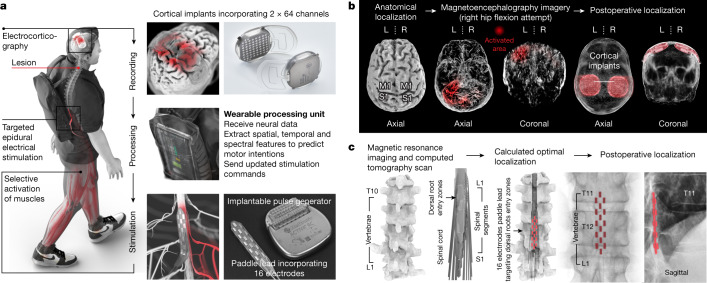
A spinal cord injury interrupts the communication between the brain and the region of the spinal cord that produces walking, leading to paralysis 1,2 . Here, we restored this communication with a digital bridge between the brain and spinal cord that enabled an individual with chronic tetraplegia to stand and walk naturally in community settings. This brain–spine interface (BSI) consists of fully implanted recording and stimulation systems that establish a direct link between cortical signals 3 and the analogue modulation of epidural electrical stimulation targeting the spinal cord regions involved in the production of walking 4–6 . A highly reliable BSI is calibrated within a few minutes. This reliability has remained stable over one year, including during independent use at home. The participant reports that the BSI enables natural control over the movements of his legs to stand, walk, climb stairs and even traverse complex terrains. Moreover, neurorehabilitation supported by the BSI improved neurological recovery. The participant regained the ability to walk with crutches overground even when the BSI was switched off. This digital bridge establishes a framework to restore natural control of movement after paralysis.
Overview
CoChat Summary
TL;DR
A fully implanted brain–spine interface restored volitional standing and walking in one man with chronic incomplete cervical spinal cord injury, enabling natural control over leg movements and use in community settings. Neurorehabilitation supported by the interface also produced neurological recovery that persisted with the interface switched off.
Key findings
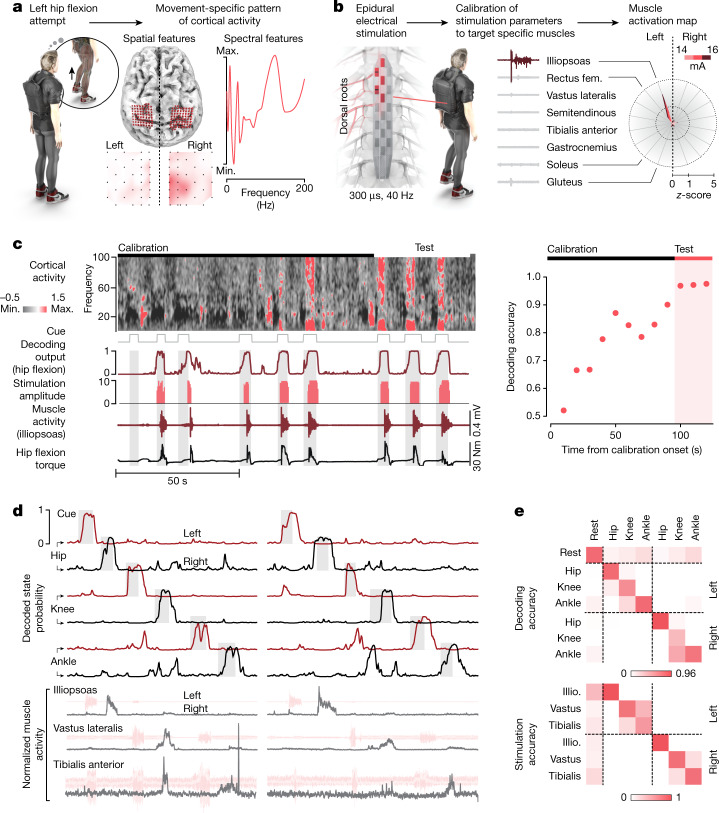
- The BSI enabled rapid calibration: within less than two minutes the participant controlled hip muscle activity with 97% accuracy, and a seven-state proportional decoder achieved 74 ± 7% accuracy versus 14% chance, with decoder latency of 1.1 s (±0.15 s s.e.m.).
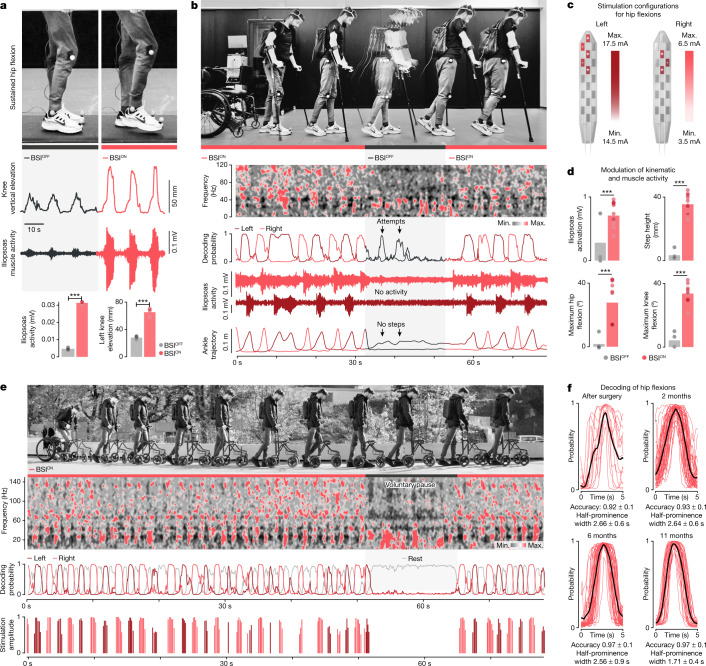
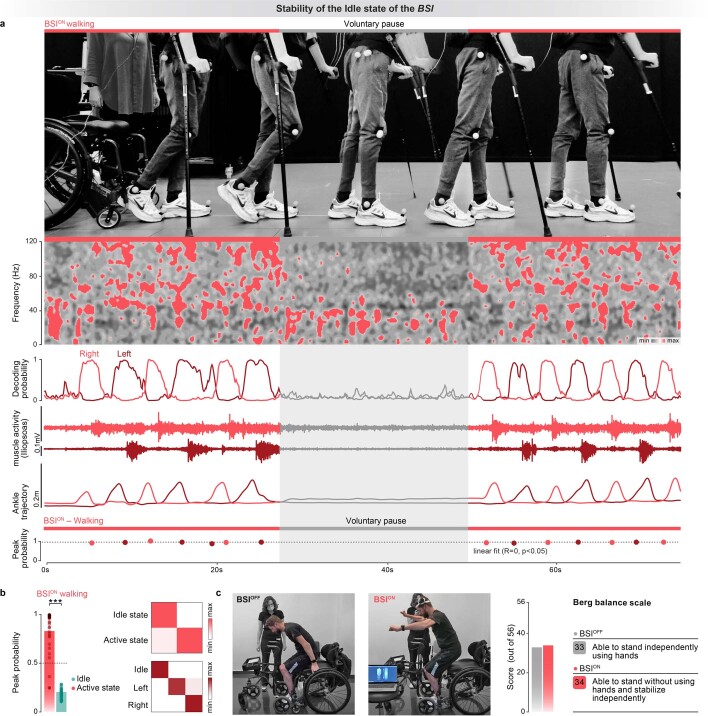
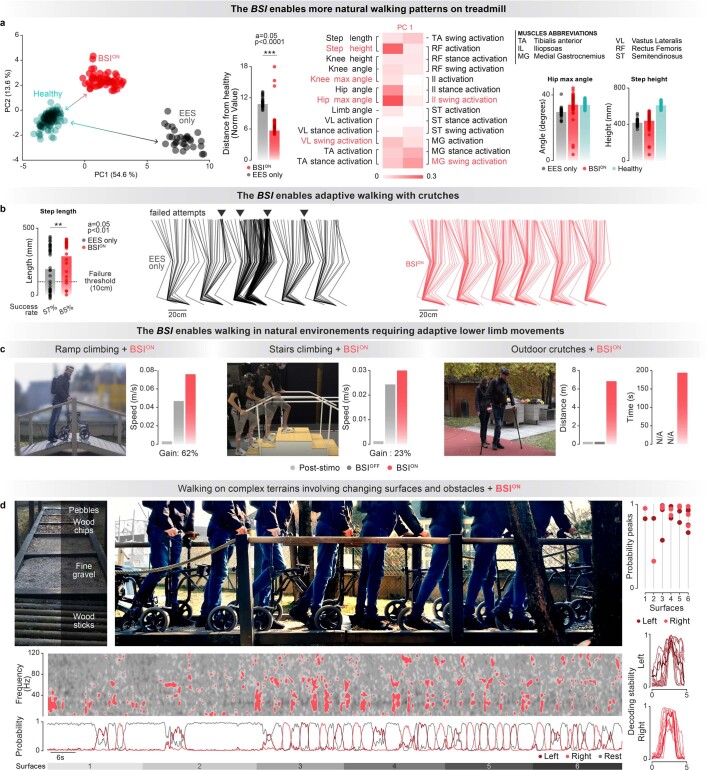
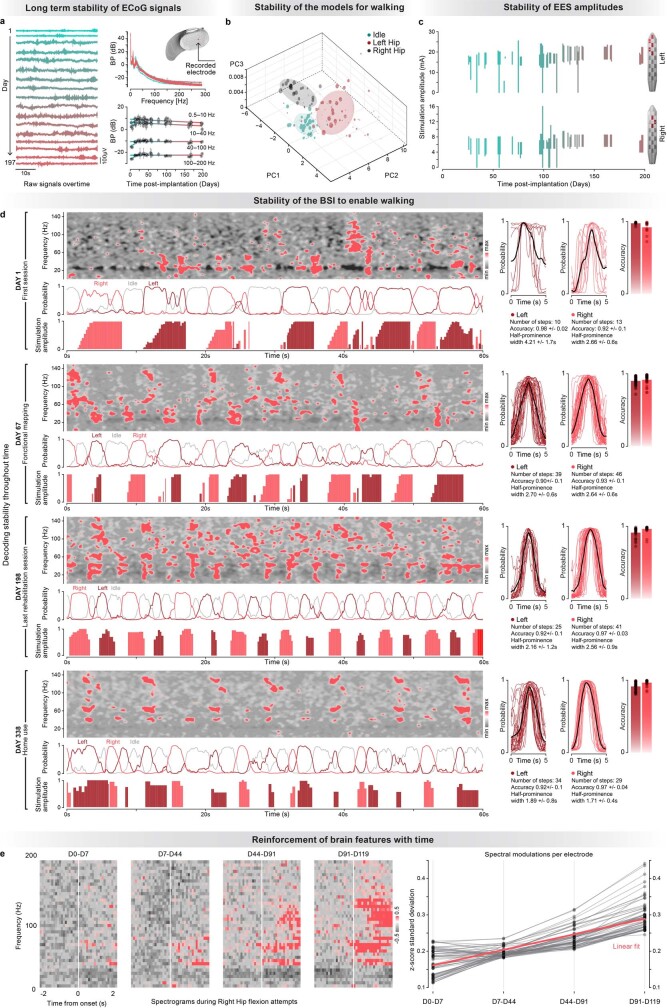
- Walking with the BSI produced a fivefold increase in hip flexor muscle activity compared with attempts without the BSI, and decoding accuracy during walking remained stable over nearly one year (0.92 ± 0.1 s.d. in the first session; 0.97 ± 0.1 s.d. at 11 months).
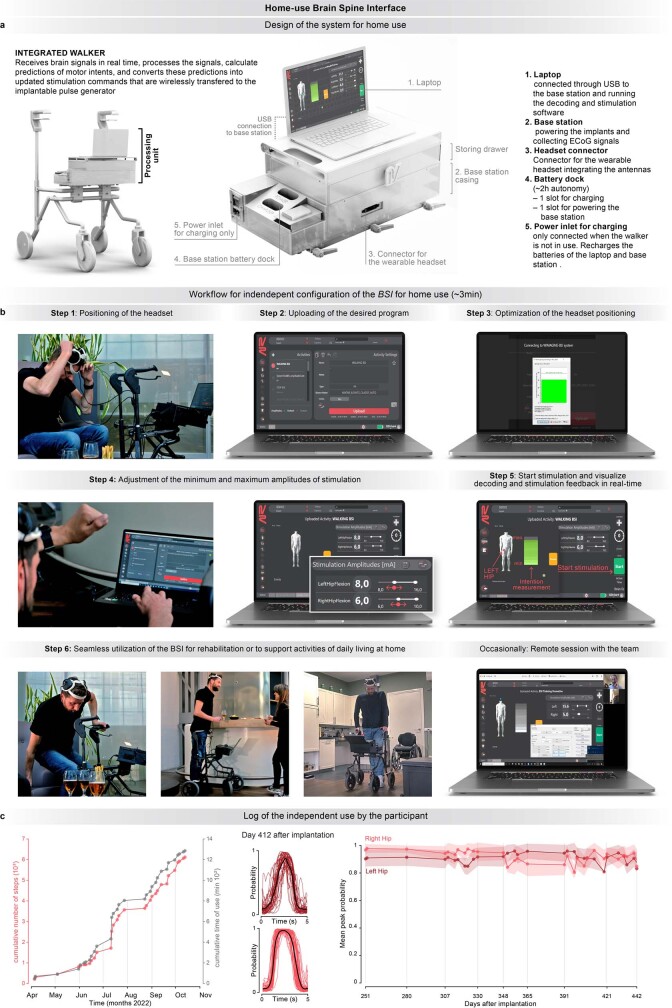
- The participant used the BSI at home regularly over 7 months with stable decoding performance, and ECoG signal power decreased by only 0.03 dB per day on average after a transitory one-month period.
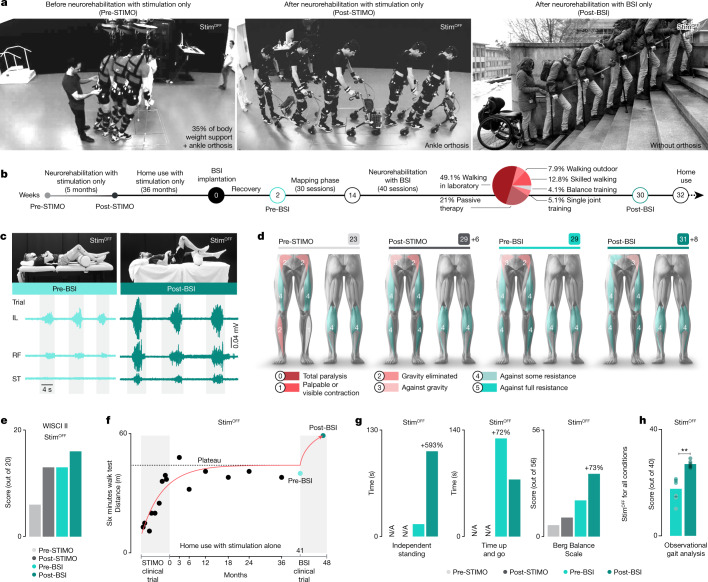
- Neurorehabilitation supported by the BSI improved neurological recovery without stimulation: WISCI II scores increased from 6 before STIMO to 16 after STIMO-BSI, with gains in sensory score (4 points in light touch) and multiple clinical walking and balance assessments.
Methods
- Design: ongoing clinical feasibility study STIMO-BSI (NCT04632290) in a single 38-year-old male with incomplete cervical C5/C6 spinal cord injury sustained ten years earlier, who had previously completed the STIMO trial and reached a recovery plateau.
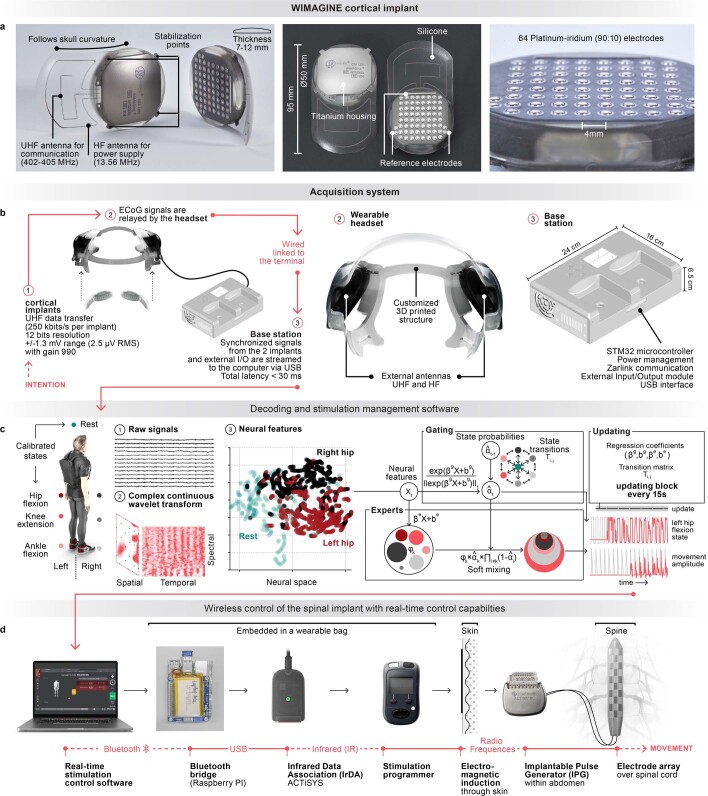
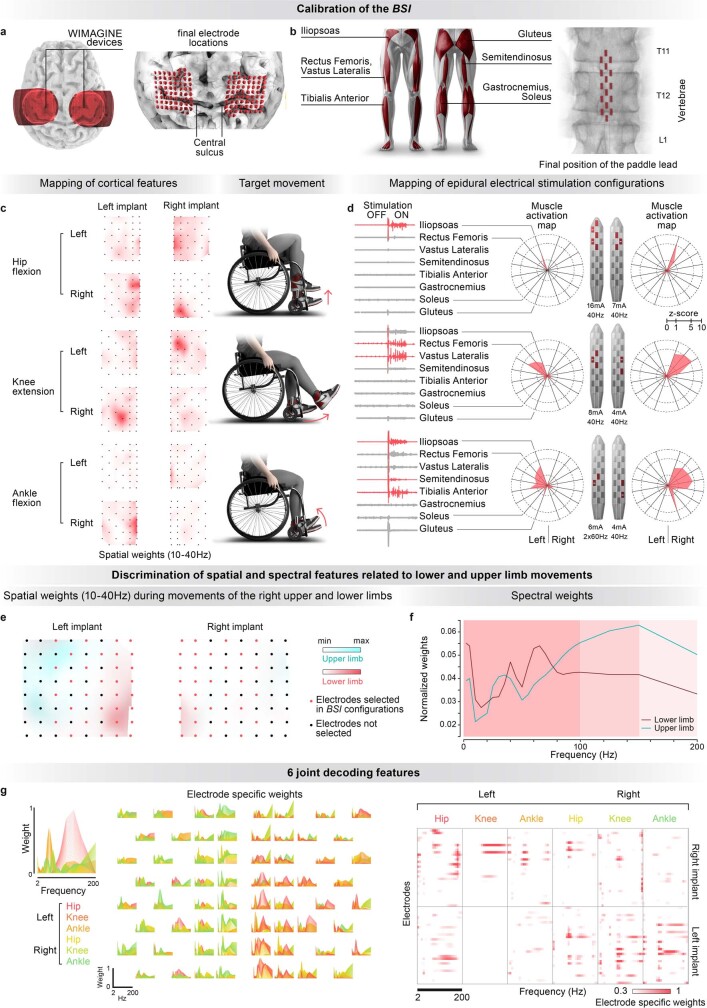
- Intervention: two fully implanted WIMAGINE ECoG recording implants over the sensorimotor cortex, an ACTIVA RC implantable pulse generator, and a Specify 5-6-5 paddle lead targeting lumbar dorsal root entry zones; cortical signals were decoded with a recursive exponentially weighted Markov-switching multilinear model and translated into analogue modulation of epidural electrical stimulation.
- Procedures and analysis: pre-operative MEG and CT planning, intra-operative electrophysiology, 40 neurorehabilitation sessions, home use, and assessments including EMG, 3D gait kinematics, PCA, ISNCSCI, WISCI II, six-minute walk test, Berg Balance Scale, and observational gait analysis scored by blinded physiotherapists.
Limitations
- The paper states that validation was restricted to a single individual with severe but partial spinal cord damage, so it remains unclear whether the BSI will be applicable to other injury locations and severities.
- The paper notes that the participant’s prior experience with spinal cord stimulation accelerated BSI configuration, and that the relative amount of neurological recovery will necessarily correlate with lesion severity.
- Evident from the text: this is a single-case feasibility study without a control group; the participant had residual function and prior STIMO rehabilitation, and the right cortical implant was explanted 167 days after implantation due to a subcutaneous Staphylococcus aureus infection.
Model-written summary. Check it against the paper before relying on it.
Integrity signals
Registry
Cites
Statistics
Figures
Verification
Claims the paper makes
13 Valid · 6 Not valid · 10 Not checked · 93 Own results and interpretations
At least one cited source doesn’t support this claim or points to a different paper, and none confirmed it — see the verdicts below.
In the paper
“However, this recovery required wearable motion sensors to detect motor intentions from residual movements or compensatory strategies to initiate the preprogrammed stimulation sequences5.”
§ Walking naturally after spinal cord injury using a brain–spine interface > Main
What the sources say
- Disputedcites [5] Rowald, A. et al. Activity-dependent spinal cord neuromodulation rapidly restores trunk and leg motor functions after complete paralysis. Nat. Med. 28, 260–271 (2022). 35132264 sourceExperimental — accuracy not yet measured
The ‘Recovery of independence in ecological settings’ section says participants could use open-loop sequences, clickers, or closed-loop control based on wearable sensors. The ‘Software App for configuration, optimization and evaluation of neurostimulation’ section likewise describes automatic looping and button-triggered sequences alongside sensor-detected movement. Wearable motion sensors were therefore an option, not a requirement for initiating stimulation. (LLM, conf=0.90)
Checked by a reasoning model — may be wrong.
plainstates a cause- Asserted: passes — The authors put it forward as true.
- Checkable: passes — It can be checked against evidence.
- Load-bearing: passes — The paper’s conclusions depend on it.
- Based: passes — The paper gives a reason why it holds.
- Disputed
Some cited sources support this claim and some don’t — read each source’s verdict below.
In the paper
“Third, a comparable robustness and stability of this computational and technological brain decoding framework has now been observed in two additional individuals with tetraplegia3,26,29.”
§ Walking naturally after spinal cord injury using a brain–spine interface > Discussion
What the sources say
- Partly supportedcites [3] Benabid, A. L. et al. An exoskeleton controlled by an epidural wireless brain–machine interface in a tetraplegic patient: a proof-of-concept demonstration. Lancet Neurol. 10.1016/S1474-4422(19)30321-7 (2019). 31587955 sourceExperimental — accuracy not yet measured
The Discussion reports stable decoding without recalibration for several weeks, but only for the study’s single evaluated participant. The Magnetic resonance imaging (MRI) section says the other implanted patient was excluded and three further patients were still being recruited; it does not support an observation in two additional individuals. Page numbers are unavailable in our copy. (LLM, conf=0.88)
- Disputedcites [26] Moly, A. et al. An adaptive closed-loop ECoG decoder for long-term and stable bimanual control of an exoskeleton by a tetraplegic. J. Neural Eng. 19, 026021 (2022). 35234665 sourceExperimental — accuracy not yet measured
The Clinical trial description (§2.4; page not provided) says the decoder was tested on a single patient. Limitations and perspectives (§4.4; page not provided) likewise says the stability results were demonstrated for a single patient and that implantation of more patients was planned, contrary to the claim that comparable results had already been observed in two additional individuals. (LLM, conf=0.88)
Checked by a reasoning model — may be wrong.
- Partly supportedcites [29] Larzabal, C. et al. Long-term stability of the chronic epidural wireless recorder WIMAGINE in tetraplegic patients. J. Neural Eng. 18, 056026 (2021). 34425566 sourceExperimental — accuracy not yet measured
The Discussion and Conclusion report stable WIMAGINE recordings in two tetraplegic patients enrolled in a BCI protocol. They do not establish comparable robustness of the full computational brain-decoding framework in two additional individuals: the paper evaluates recorder signals, and the Discussion says training for patient 2 was ongoing. (LLM, conf=0.87)
plainn = 2- Asserted: passes — The authors put it forward as true.
- Checkable: passes — It can be checked against evidence.
- Load-bearing: passes — The paper’s conclusions depend on it.
- Based: passes — The paper gives a reason why it holds.
- Partly supported
The cited sources support only part of this claim — read each source’s verdict below.
In the paper
“We previously showed that epidural electrical stimulation targeting the individual dorsal root entry zones of the lumbosacral spinal cord enables the modulation of specific leg motor pools9–12.”
§ Walking naturally after spinal cord injury using a brain–spine interface > Main
What the sources say
- Partly supportedcites [9] Capogrosso, M. et al. A computational model for epidural electrical stimulation of spinal sensorimotor circuits. J. Neurosci. 33, 19326–19340 (2013). 24305828 PMC6618777 sourceExperimental — accuracy not yet measured
In “Evaluation of EES selectivity during standing and walking in spinal rats” (page unavailable), the paper reports that stimulation at L2 and S1 preferentially modulated different hindlimb muscles and motor pools. It describes electrodes on the lateral aspect of those spinal segments, but does not establish that they targeted individual dorsal root entry zones; that anatomical detail is more specific than the evidence supports. (LLM, conf=0.84)
- Not checked — no full text of the sourcecites [10] Wenger, N. et al. Closed-loop neuromodulation of spinal sensorimotor circuits controls refined locomotion after complete spinal cord injury. Sci. Transl. Med. 6, 255ra133 (2014). 25253676 source
- Supportedcites [11] Wenger, N. et al. Spatiotemporal neuromodulation therapies engaging muscle synergies improve motor control after spinal cord injury. Nat. Med. 22, 138–145 (2016). 26779815 PMC5061079 source
The Results section, “Electrode position to target extensor vs. flexor hotspots” (page not supplied), reports that electrodes positioned to recruit different dorsal roots preferentially targeted flexor or extensor hotspots. Acute experiments confirmed that stimulation at those locations could target spatially restricted hindlimb motor-activation hotspots. (LLM, conf=0.90)
- Partly supportedcites [12] Moraud, E. M. et al. Mechanisms underlying the neuromodulation of spinal circuits for correcting gait and balance deficits after spinal cord injury. Neuron 89, 814–828 (2016). 26853304 sourceExperimental — accuracy not yet measured
The section “Exploiting Spinal Circuit Dynamics” (p. 5) reports that phase-specific epidural stimulation selectively modulated extensor and flexor muscle activity, supporting modulation of distinct leg motor circuits. But the Surgical Procedures (p. 13) place stimulation electrodes at the spinal midline at L2 and S1; the cited passages do not establish targeting of individual dorsal root entry zones. (LLM, conf=0.86)
plainstates a cause- Asserted: passes — The authors put it forward as true.
- Checkable: passes — It can be checked against evidence.
- Load-bearing: passes — The paper’s conclusions depend on it.
- Based: passes — The paper gives a reason why it holds.
- Partly supported
The cited sources support only part of this claim — read each source’s verdict below.
In the paper
“He had previously participated in the STIMO clinical trial (clinicaltrials.gov, NCT02936453), which involved a five-month neurorehabilitation programme supported by targeted epidural electrical stimulation of the spinal cord4,5.”
§ Walking naturally after spinal cord injury using a brain–spine interface > Neurosurgical implantation of the BSI
What the sources say
- Supportedcites [4] Wagner, F. B. et al. Targeted neurotechnology restores walking in humans with spinal cord injury. Nature 563, 65–71 (2018). 30382197 source
The 'Rehabilitation improves walking with EES' section states that 'Participants followed a rehabilitation program four to five times per week for five months ... each of which was enabled by task-specific EES', matching the five-month neurorehabilitation programme supported by epidural electrical stimulation. The Methods/trial-protocol section ('April 2018') names the STIMO study and gives its inclusion/exclusion criteria, and the Abstract/Introduction describe targeted (spatially selective, spatiotemporal) stimulation of the lumbosacral spinal cord via an implanted paddle array, so the trial description the citation is attached to is stated in our copy. The registry number NCT02936453 is not printed in our copy, but it is given parenthetically by the citing authors rather than attributed to this source. (LLM, conf=0.88)
- Partly supportedcites [5] Rowald, A. et al. Activity-dependent spinal cord neuromodulation rapidly restores trunk and leg motor functions after complete paralysis. Nat. Med. 28, 260–271 (2022). 35132264 sourceExperimental — accuracy not yet measured
The Study design and objectives section identifies STIMO as trial NCT02936453 and describes a five-month rehabilitation period with epidural electrical stimulation. Recovery of independence in ecological settings says the paper’s three participants underwent that programme. Our copy does not establish that the particular person referred to as “he” in the citing sentence was one of them; no page numbers are available in the indexed passages. (LLM, conf=0.82)
plainSingle case- Asserted: passes — The authors put it forward as true.
- Checkable: passes — It can be checked against evidence.
- Load-bearing: unclear — It is unclear whether the paper’s conclusions depend on it.
- Based: passes — The paper gives a reason why it holds.
- Supported
The cited sources support only part of this claim — read each source’s verdict below.
In the paper
“In turn, recruiting these dorsal root entry zones with preprogrammed spatiotemporal sequences replicates the physiological activation of leg motor pools underlying standing and walking4,5,11,13,14.”
§ Walking naturally after spinal cord injury using a brain–spine interface > Main
What the sources say
- Supportedcites [4] Wagner, F. B. et al. Targeted neurotechnology restores walking in humans with spinal cord injury. Nature 563, 65–71 (2018). 30382197 source
The paper's Introduction states that EES activates motor neurons 'by recruiting proprioceptive circuits within the posterior roots of the spinal cord', with protocols that 'target individual posterior roots to access the motor neuron pools located in the spinal cord segment innervated by each root' and trains 'delivered with timing that coincides with the intended movement'; Methods/Results note EES sequences 'could be pre-programmed in an open loop or triggered in a closed loop'. Under 'Spatiotemporal EES enables walking', it reports that targeted EES 'effectively activated the regions embedding these hotspots' of the physiological motor neuron activation maps and that train onset/duration were adjusted to approach the maps of healthy individuals, enabling participants to stand and walk overground. The only wording gap is strength ('approach' rather than fully 'replicates') and terminology (our copy says posterior/dorsal roots rather than 'dorsal root entry zone'), which is the citing authors' phrasing within a multi-citation sentence. (LLM, conf=0.80)
- Supportedcites [5] Rowald, A. et al. Activity-dependent spinal cord neuromodulation rapidly restores trunk and leg motor functions after complete paralysis. Nat. Med. 28, 260–271 (2022). 35132264 source
The Main text says that stimulation programs target individual dorsal roots with predefined timing to reproduce the natural spatiotemporal activation of motor neurons during walking. The section on spatiotemporal stimulation sequences says the authors used the same framework for standing and designed sequences to reproduce natural motor-group activation during each activity. The paper describes this as the design and purpose of the sequences, rather than a measured exact replication. (LLM, conf=0.88)
- Partly supportedcites [11] Wenger, N. et al. Spatiotemporal neuromodulation therapies engaging muscle synergies improve motor control after spinal cord injury. Nat. Med. 22, 138–145 (2016). 26779815 PMC5061079 sourceExperimental — accuracy not yet measured
The Results (page unavailable) report that stimulation targeting dorsal roots produced hindlimb motoneuron-activation maps resembling those of intact rats during locomotion. They do not establish that the sequences replicated physiological activation during standing; the reported comparison concerns walking rats and describes resemblance, not exact replication. (LLM, conf=0.88)
- Partly supportedcites [13] Capogrosso, M. et al. A brain–spine interface alleviating gait deficits after spinal cord injury in primates. Nature 539, 284–288 (2016). 27830790 PMC5108412 sourceExperimental — accuracy not yet measured
The paper reports that electrodes targeting dorsal-root entry points produced spinal activation correlated with the natural flexion and extension hotspots during locomotion (Abstract; page unavailable). Extended Data Figure 2 describes pre-programmed stimulation protocols, but the Methods say they were triggered by decoded gait states. The copy supports an approximation of activation during walking, not replication of physiological motor-pool activation during standing. (LLM, conf=0.85)
- Partly supportedcites [14] Minev, I. R. et al. Biomaterials. Electronic dura mater for long-term multimodal neural interfaces. Science 347, 159–163 (2015). 25574019 sourceExperimental — accuracy not yet measured
Minev et al. (2015) supports only the general point: in the BIOMATERIALS section the e-dura over lumbosacral segments 'was used to engage spinal locomotor circuits located below injury', with 'continuous electrical stimulation ... delivered on the lateral aspect of L2 and S1 segments (40 Hz, 0.2 ms, 50 to 150 mA)' plus serotonergic agents enabling paralyzed rats to walk, and 'distributed electrodes delivered stimulation restricted to specific segments, which allowed facilitation of left versus right leg movements'. What the claim attributes specifically — recruitment of dorsal root entry zones, preprogrammed spatiotemporal stimulation sequences, and replication of the physiological activation pattern of leg motor pools — is absent from our copy (searched: dorsal root entry zone, spatiotemporal sequences, motor pool recruitment, physiological activation); the stimulation described was continuous and fixed-parameter in acute rat SCI experiments, not programmed spatiotemporal sequences in humans. Hence only the segment-selective spinal neuromodulation enabling standing/walking part is backed. (LLM, conf=0.70)
plainstates a cause- Asserted: passes — The authors put it forward as true.
- Checkable: passes — It can be checked against evidence.
- Load-bearing: passes — The paper’s conclusions depend on it.
- Based: passes — The paper gives a reason why it holds.
- Supported
58 more claims · 8 with their cited sources checked
Create a free account to see all 122 claims and to verify the 6 references still open.
- It may state two separate claims as one. 42
- Probably not a substantial claim. 23
Citations
Cites
MEG and EEG data analysis with MNE-Python
Gramfort, A. (2013) · Frontiers in Neuroscience · doi:10.3389/fnins.2013.00267 · Cited by 3,784 · cited 1×
“Stereotypical artefacts (cardiac, ocular) were identified by independent components analysis using MNE-Python software 45 and rejected on visual screening (Infomax method, calculated separately for magnetometers and gradiometers using 64 components).”
MethodBrainstorm: A User-Friendly Application for MEG/EEG Analysis
Tadel, F., Baillet, S., Mosher, J. C., Pantazis, D., & Leahy, R. M. (2011) · Computational Intelligence and Neuroscience · doi:10.1155/2011/879716 · Cited by 3,677 · cited 1×
“The head, skull and cortex geometries were calculated from CT scan using the MRI segmentation routine included in the Brainstorm software 46 , followed by calculation of the head model using the overlapping spheres method.”
MethodAhuja, C. S., Wilson, J. R., Nori, S., Kotter, M. R. N., Druschel, C., Curt, A., & Fehlings, M. G. (2017) · Nature Reviews Disease Primers · doi:10.1038/nrdp.2017.18 · Cited by 2,441
Fall risk index for elderly patients based on number of chronic disabilities
Tinetti, M. E., Franklin Williams, T., & Mayewski, R. (1986) · The American Journal of Medicine · doi:10.1016/0002-9343(86)90717-5 · Cited by 1,587
Classification of Walking Handicap in the Stroke Population
Perry, J., Garrett, M., Gronley, J. K., & Mulroy, S. J. (1995) · Stroke · doi:10.1161/01.str.26.6.982 · Cited by 1,560
Harkema, S., Gerasimenko, Y., Hodes, J., Burdick, J., Angeli, C., Chen, Y., Ferreira, C., Willhite, A., Rejc, E., Grossman, R. G., et al. (2011) · The Lancet · doi:10.1016/s0140-6736(11)60547-3 · Cited by 1,229 · cited 1×
“This recovery has been documented in various independent studies, including in participants with complete sensorimotor paralysis 5,6,30–34 .”
BackgroundTargeted neurotechnology restores walking in humans with spinal cord injury
Wagner, F. B., Mignardot, J.-B., Le Goff-Mignardot, C. G., Demesmaeker, R., Komi, S., Capogrosso, M., Rowald, A., Seáñez, I., Caban, M., Pirondini, E., et al. (2018) · Nature · doi:10.1038/s41586-018-0649-2 · Cited by 1,087 · cited 9×
“This brain–spine interface (BSI) consists of fully implanted recording and stimulation systems that establish a direct link between cortical signals 3 and the analogue modulation of epidural electrical stimulation targeting the spinal cord regions involved in the production of walking 4–6 .”
BackgroundMethodInfluentialSelf-citationElectronic dura mater for long-term multimodal neural interfaces
Minev, I. R., Musienko, P., Hirsch, A., Barraud, Q., Wenger, N., Moraud, E. M., Gandar, J., Capogrosso, M., Milekovic, T., Asboth, L., et al. (2015) · Science · doi:10.1126/science.1260318 · Cited by 1,082
Self-citationHigh-performance brain-to-text communication via handwriting
Willett, F. R., Avansino, D. T., Hochberg, L. R., Henderson, J. M., & Shenoy, K. V. (2021) · Nature · doi:10.1038/s41586-021-03506-2 · Cited by 1,024
Recovery of Over-Ground Walking after Chronic Motor Complete Spinal Cord Injury
Angeli, C. A., Boakye, M., Morton, R. A., Vogt, J., Benton, K., Chen, Y., Ferreira, C. K., & Harkema, S. J. (2018) · New England Journal of Medicine · doi:10.1056/nejmoa1803588 · Cited by 670
Cited by
Items 301–400 of 603
A Personalized Predictor of Motor Imagery Ability Based on Multi-frequency EEG Features
Li, M., Zhao, Q., Zhang, T., Ge, J., Wang, J., & Xu, G. (2025) · Neuroscience Bulletin · doi:10.1007/s12264-025-01390-8 · Cited by 2
“A brain-computer interface (BCI) is a method of human-computer interaction that directly converts brain signals into machine-controlled commands without relying on peripheral nerves and muscles [1, 2].”
Chhabra, H. S., Kalidindi, K. K. V., Garg, N., Sharma, A., Chhibber, B., Kumar, H., Vishwakarma, G., Sharma, N., Sharma, R., Gupta, M., et al. (2025) · Journal of Spinal Cord Medicine · doi:10.1080/10790268.2025.2517935 · Cited by 5
“Brain-spine interface (BSI) is another emerging technology which has been reported recently (19).”
Neural Interfaces: Applications, Innovative Approaches, Biocompatibility, Biomimetics
Zemlyanskov, M. S., Arsentiev, K. A., Shtol, V. S., Konovalova, S. P., Grinevich, V. P., & Евгеньевич, М. П. (2025) · Journal of Evolutionary Biochemistry and Physiology · doi:10.1134/s0022093025040118 · Cited by 2
Yan, D., Guo, Z., Liu, H., Wang, X., Liang, F., Jie, J., & Yin, M. (2025) · Scientific Reports · doi:10.1038/s41598-025-19555-w · Cited by 3
Yin, M., Shi, H., Lv, C., Shi, L., Xie, L., Yu, G., & Xu, K. (2025) · Medicine Plus · doi:10.1016/j.medp.2025.100104 · Cited by 2
The effect of device-based neuromodulation on the motor recovery of patients with spinal cord injury
Li, J., Chen, T., Yan, X., & Luo, L. (2025) · Spinal Cord · doi:10.1038/s41393-025-01133-6 · Cited by 2
“Lorach, H, et al. restored interrupted communication by building a digital bridge between the brain and spinal cord, enabling an individual with chronic quadriplegia to naturally stand and walk in a community environment [11].”
A brain-computer interface roadmap for diagnosing and treating neurological disorders
Sun, G., Wang, Y., Liu, H., Weng, L., Li, X., He, W., Sun, J., Liang, S., Kong, W., Dong, J.-Z., et al. (2025) · The Innovation Informatics · doi:10.59717/j.xinn-inform.2025.100016 · Cited by 2
Roventini, E., Iacoponi, F., Poliziani, A., Canepa, P., Cavalleri, O., Cassa, M. A., Parlanti, P., Pucci, C., Gemmi, M., Tonda‐Turo, C., et al. (2025) · Scientific Reports · doi:10.1038/s41598-025-25082-5 · Cited by 3
“In particular, thanks to its elastic modulus (3–4 GPa), which is comparable to that of bone tissue (human cortical bone: 7–30 GPa) 18,20 , it is widely used in medical fields, such as orthopedics, maxillofacial surgery, and dentistry 21,22 .”
High-Performance Magnetically Actuated MXene-Based Microelectrodes for Epineural Interfacing
Davis, B., Chen, Z.-K., Zhang, A., Putcha, A., Xing, S., Doan, H., Gupta, N., Dang, Q., Giulumian, G. K., Song, J., et al. (2025) · ACS Applied Bio Materials · doi:10.1021/acsabm.5c01442 · Cited by 2
Efficacy of temporal interference electrical stimulation for spinal cord injury rehabilitation
Cheng, R., Shao, Y., Xu, Y., & Wang, M. (2025) · The Innovation Medicine · doi:10.59717/j.xinn-med.2025.100171 · Cited by 3
Mo, L., Chen, L., Liao, Y., Ren, Y., Li, B., Song, Z., Xu, W., Liang, F., Fan, Q., Han, X., et al. (2025) · BIO Integration · doi:10.15212/bioi-2025-0171 · Cited by 2
“In recent years epidural electrical stimulation (EES) has emerged as a promising intervention for functional recovery in SCI [1–3].”
Li, C., Zhao, X., Jiang, K., Kang, H., Liu, S., Jiang, L., Bai, B., Cui, H., Zhang, Z., Dong, M., et al. (2026) · Advanced Materials · doi:10.1002/adma.202521427 · Cited by 2
“Descending commands activate spinal central pattern generators (CPGs) to drive locomotion, while the locomotor parameters are largely governed by monoaminergic neuromodulation, especially serotonin (5-hydroxytryptamine, 5-HT) [1, 5, 13].”
Jiang, W., Kong, D., Lou, J., Li, M., Jin, M., Zhu, L., Hu, Y., & Wu, J. (2026) · International Journal of Surgery · doi:10.1097/js9.0000000000004109 · Cited by 3
Real-time brain-computer interface control of walking exoskeleton with bilateral sensory feedback
Lim, J., Wang, P. T., Sohn, W. J., Lin, D., Thaploo, S., Bashford, L., Bjånes, D. A., Nguyen, A., Gong, H., Armacost, M., et al. (2026) · Brain stimulation · doi:10.1016/j.brs.2026.103065 · Cited by 10
Bridging cortical intentions: brain–computer interfaces for spinal cord injury recovery
Hu, X., He, J., Li, N., et al. (2026) · 中国科学通报:英文版 · doi:10.1016/j.scib.2026.03.016 · Cited by 2
Lin, D., Tran, T., Thaploo, S., Matias, J. G. E., Pixley, J. E., Nenadić, Z., & Do, A. H. (2026) · Frontiers in Neuroscience · doi:10.3389/fnins.2026.1678175 · Cited by 6
“…in implantable BCIs with potentially high clinical impact, including language/speech BCIs (Komeiji et al., 2024; Liu et al., 2023; Metzger et al., 2023), restoration of gait after spinal cord injury (SCI) (Lorach et al., 2023; Lim et al., 2024), and sensory restoration (Lim et al., 2024, 2026).”
Promises and performance in brain–machine interfaces: will AI be our saviour?
Saldanha, P., Vaupel, M., Dunn, B. A., & Whitlock, J. R. (2026) · The European Physical Journal Special Topics · doi:10.1140/epjs/s11734-026-02169-2 · Cited by 2
“While Meta, Neuralink, and Synchron are prominent players, many others in academia and industry are pushing the frontiers [10, 11, 28, 30, 42, 45].”
Brain-computer interface: an update for the clinicians
Jain, A., Raveendran, S., Nair, K. P. S., & Ramakrishnan, S. (2026) · Frontiers in Human Neuroscience · doi:10.3389/fnhum.2026.1777024 · Cited by 6
“The patient regained the ability to walk on flat surfaces and over complex terrain (stairs, steep ramps, and obstacles) with crutches (Lorach et al., 2023).”
Cellular mechano-memory informs biomaterials and mechano-medicine
Qiao, P., Zhao, H., Ma, Z., Hasani, M., & Song, Y. (2026) · Cell Reports Physical Science · doi:10.1016/j.xcrp.2026.103308 · Cited by 3
Liu, P., Wang, X., Liu, Y., Xu, Z., He, Y., Lu, Y., Ye, L., Wu, W., Chen, Z., Wang, Y., et al. (2026) · Science Advances · doi:10.1126/sciadv.aeg0515 · Cited by 5
“Clinical translation requires careful scaling of Piezo Gel to account for differences in vertebral biomechanics, spinal geometry, tissue depth, and physiological loading conditions ( 52 ).”
Two-Stream Spectral-Temporal Denoising Network for End-to-End Robust EEG-Based Emotion Recognition
Liu, X.-H., Jiang, W.-B., Zheng, W., & Lu, B. (2023) · Lecture notes in computer science · doi:10.1007/978-981-99-8067-3_14 · Cited by 6
A Clockless Robust Bionic Spike Detector for Implantable Brain-Computer Interfaces
Chen, J., Liu, X., Wu, H., Tian, F., Zou, W., Katebi, M., Eskandari, R., Yang, J., & Sawan, M. (2023) · IEEE Biomedical Circuits and Systems Conference (BioCAS) · doi:10.1109/biocas58349.2023.10388732 · Cited by 2
Renewable Energy Solutions for Commercial Ships
ÖZBEY, S., & Tıkız, İ. (2024) · Özgür Yayınları eBooks · doi:10.58830/ozgur.pub426.c1851 · Cited by 4
Roy, J., Sarah, U. T., Lissorgues, G., Français, O., Rezgui, A., Poulichet, P., Takhedmit, H., Scorsone, E., & Rousseau, L. (2024) · Sensors · doi:10.3390/s24113619 · Cited by 3
“Experiments have shown that an array of microelectrodes inserted into the cortex can capture brain activity and trigger movements in prosthetic limbs [1,2] or elicit certain visual sensations through electrical stimulation [2,3].”
BackgroundReverse engineering spinal-cord injury
(2024) · Nature · doi:10.1038/d41586-024-02307-7 · Cited by 2
Brain-spine interface for movement restoration after spinal cord injury
Lakshmipriya, T., & Gopinath, S. C. B. (2024) · Brain and Spine · doi:10.1016/j.bas.2024.102926 · Cited by 2
“…et al. developed a wireless digital bridge between the spinal cord and brain, which allows volitional control over the amplitude and timing of muscle activity, providing adaptive and natural control over walking and standing activity for patients with spinal cord injury (Lorach et al., 2023).”
BackgroundLearning EEG Motor Characteristics via Temporal-Spatial Representations
Xiang, T., Zhou, X.-H., Xie, X., Liu, S.-Q., Yang, H., Feng, Z.-Q., Gui, M.-J., Li, H., Huang, D.-X., Liu, X., et al. (2024) · IEEE Transactions on Emerging Topics in Computational Intelligence · doi:10.1109/tetci.2024.3425328 · Cited by 5
“Thisconceptofbrain-computerinterfaces (BCI)assistsindividualswithparalysistorestoremobilityand thosewithoutimpairmentstoenhancetheirmotorfunctions[7], [8].”
Stepping up after spinal cord injury: negotiating an obstacle during walking
Frigon, A., & Lecomte, C. G. (2024) · Neural Regeneration Research · doi:10.4103/nrr.nrr-d-24-00369 · Cited by 2
Xiao, L., Wang, M., Shi, Y., Huang, X., Zhang, W., Wu, Y., Deng, H., Xiong, B., Pan, W., Zhang, J., et al. (2024) · International Immunopharmacology · doi:10.1016/j.intimp.2024.113483 · Cited by 9
Wang, J., Fan, L., Sun, J. M., Chen, J., Wang, Y., Ouyang, Z., Yuan, Z., Sun, C., Jin, L., & Wang, Y. (2024) · BMC Neurology · doi:10.1186/s12883-024-03947-y · Cited by 2
“As research increasingly focuses on spinal SCS for improving ambulation in individuals with paraplegia [16], the effective control of dynamic spasticity emerges as a crucial prerequisite for achieving optimal walking performance [15].”
InfluentialMinimally Invasive Motor Function Rehabilitation Through Digital Twin Technology: A Review
Harlan, B., & Tjahyadi, H. (2024) · International Conference on Technology Innovation and Its Applications (ICTIIA) · doi:10.1109/ictiia61827.2024.10761584 · Cited by 2
“This can be caused by various conditions such as amputation, spinal cord injuries, muscle atrophy, stroke, etc [1], [5], [8-9], [17-18], [22].”
Repeated epidural stimulation modulates cervical spinal cord excitability in healthy adult rats
Sharma, P., Rampersaud, H., & Shah, P. K. (2024) · Experimental Brain Research · doi:10.1007/s00221-024-06965-x · Cited by 6
“Epidural stimulation (ES) is effective in improving several physiological functions, such as independent standing, step - ping, and autonomic functions, following spinal cord inju - ries (SCI) (Rejc et al. 2015 ; Angeli et al. 2018; Harkema et al. 2018 ; Lorach et al. 2023 ).”
InfluentialSpinal Cord Tract Integrity in Degenerative Cervical Myelopathy
Cho, N., Al-Shawwa, A., Jacobs, W. B., Evaniew, N., Bouchard, J., Casha, S., DuPlessis, S., Lewkonia, P. D., Nicholls, F. H., Soroceanu, A., et al. (2025) · Neurosurgery · doi:10.1227/neu.0000000000003428 · Cited by 3
Ruszala, B. M., & Schieber, M. H. (2025) · Cell Reports · doi:10.1016/j.celrep.2025.115664 · Cited by 1
Merino, E. C., Sun, Q., & Hulle, M. M. V. (2025) · Cerebral Cortex · doi:10.1093/cercor/bhaf226 · Cited by 2
Prefrontal Network Mechanisms of Psychiatric Deep Brain Stimulation
Glewwe, N., Grissom, N. M., & Widge, A. S. (2025) · Journal of Neuroscience · doi:10.1523/jneurosci.1944-24.2025 · Cited by 4
Rethinking stroke rehabilitation in the technological age
Lo, Y. T., Tan, B. Y., & Ramani, N. (2025) · Singapore Medical Journal · doi:10.4103/singaporemedj.smj-2025-190 · Cited by 2
Bailey, Z., Nairac, Z., Cuttaz, E. A., M’Rad, I. B., Chapman, C. A. R., Rapeaux, A., Goding, J. A., Roche, A. D., Constandinou, T. G., & Green, R. A. (2026) · Journal of Neural Engineering · doi:10.1088/1741-2552/ae44d0 · Cited by 2
“Experimental clinical trials exploring more selective stimulation of subpopulations of fibers within a mixed nerve have shown the potential for tailored treatments [2, 4, 5].”
Neural Encoding of Pavement Textures during Exoskeleton Control: A Pilot Study
Ramos, J., Aguiar, M., & Pais-Vieira, M. (2023) · Applied Sciences · doi:10.3390/app13169356 · Cited by 3
Rehabilitation nach einer Querschnittlähmung: Aktuelle Trends und Grundlagen
Harder, M., Baumberger, M. E., Pannek, J., Decker, J., & Bersch, I. (2023) · Die Unfallchirurgie · doi:10.1007/s00113-023-01360-7 · Cited by 6
Planells, H., Parmar, V., Marcus, H. J., & Pandit, A. S. (2023) · Expert Review of Neurotherapeutics · doi:10.1080/14737175.2023.2285432 · Cited by 2
Classification of BCI-EEG based on augmented covariance matrixPreprint
Carrara, I., & Papadopoulo, T. (2023) · arXiv (Cornell University) · doi:10.48550/arxiv.2302.04508 · Cited by 2
Iwata, T., Nakamura, H., Uemura, T., et al. (2024) · bioRxiv (Cold Spring Harbor Laboratory) · doi:10.1101/2024.08.29.610418 · Cited by 2
Wang, D. D., Ramesh, R., Azgomi, H. F., Louie, K. H., Balakid, J. P., & Marks, J. (2025) · Research Square · doi:10.21203/rs.3.rs-6058394/v1 · Cited by 3
Brain-Controlled Epidural Spinal Stimulation for Upper-Limb Motor Function after TetraplegiaPreprint
Sasaki, A., Fadli, R. A., Yuasa, A., Boogaart, Z., Saito, H., Musikic, N., de Freitas, R., Macellari, N., Davis, K., Datta, N., et al. (2025) · medRxiv · doi:10.1101/2025.07.02.25330433 · Cited by 5
Faz Değiştiren Kimyasal Maddelerle Enerji Depolama
Kaygusuz, K. (2024) · Özgür Yayınları eBooks · doi:10.58830/ozgur.pub426.c1852 · Cited by 1
Kirliliğin PV Panel Verimine Etkisi ve Panel Temizleme Yöntemleri
İçel, Y. (2024) · Özgür Yayınları eBooks · doi:10.58830/ozgur.pub426.c1854 · Cited by 1
Human Cervical Epidural Spinal Electrogram Topographically Maps Distinct Volitional Movements
Shukla, P. D., Burke, J. F., Kunwar, N., Presbrey, K. N., Balakid, J. P., Yaroshinsky, M. S., Louie, K. H., Jacques, L. G., Shirvalkar, P. R., & Wang, D. D. (2024) · Journal of Neuroscience · doi:10.1523/jneurosci.2258-23.2024 · Cited by 3
Bibliometric analysis of research on spinal cord and sacral neuromodulation in spinal cord injury
Ye, J., Chen, J., Wang, J., Ren, J., Jia, Y., & Xia, Z. (2024) · Spinal Cord · doi:10.1038/s41393-024-01029-x · Cited by 1
Early feasibility of an embedded bi-directional brain-computer interface for ambulation
Lim, J., Wang, P. T., Sohn, W. J., Serrano-Amenos, C., Ibrahim, M., Lin, D., Thaploo, S., Shaw, S. J., Armacost, M., Gong, H., et al. (2024) · Annual International Conference of the IEEE Engineering in Medicine and Biology Society (EMBC) · doi:10.1109/embc53108.2024.10782271 · Cited by 4
“Benabid et. al [4] and Lorach et. al [15] employed an implantable embedded system [16] to acquire and transmit neural information for their lower-extremity BCIs, but relied on body-mounted laptops/computers to perform decoding computations.”
Xing, Y., Chen, W., Yu, D., Gao, X. Y., Bao, J., & Xu, K. (2024) · Annual International Conference of the IEEE Engineering in Medicine and Biology Society (EMBC) · doi:10.1109/embc53108.2024.10782244 · Cited by 1
Systems-on-Chips for Invasive Brain-Computer Interfaces: Challenges and Opportunities
Yang, J., & Sawan, M. (2024) · IEEE International Conference on Solid-State and Integrated Circuit Technology · doi:10.1109/icsict62049.2024.10831917 · Cited by 1
“More importantly, invasive BCIs can record brain signals and decode human intentions, which is critical for functional rehabilitation in conditions such as spinal cord injuries [4] or speech impairments [5].”
Challenges and future directions in brain–computer interface research for exoskeletons usage
Sudhani, H. P. K., Vattikuti, P., & Rekha, D. (2025) · Elsevier eBooks · doi:10.1016/b978-0-443-33414-6.00012-5 · Cited by 2
Wang, S., Zhu, J., Feng, Y., Hua, Y., You, G., Su, J., & Shi, B. (2025) · Biomedicines · doi:10.3390/biomedicines13020342 · Cited by 1
“Emerging brain–computer interface technology also offers hope for patients to recover some motor functions [54].”
Letner, J. G., Lam, J. L. W., Copenhaver, M. G., Barrow, M., Patel, P. R., Richie, J. M., Lee, J., Kim, H.-S., Cai, D., Weiland, J. D., et al. (2026) · Frontiers in Neuroscience · doi:10.3389/fnins.2026.1848862 · Cited by 2
“These include brain machine interfaces (BMIs), which can restore functions lost by neurological injury or disease (Losanno et al., 2023; Rubin et al., 2023), such as speech (Metzger et al., 2023; Willett et al., 2023) and walking (Lorach et al., 2023).”
Low-Power Feature Extraction for BCI Applications Using Approximate Continuous Wavelet Transform
Saad, J., Evans, A., Miro-Panades, I., Aksenova, T., & Anghel, L. (2025) · International Winter Conference on Brain-Computer Interface (BCI) · doi:10.1109/bci65088.2025.10931272 · Cited by 1
“…sufficient information for certain ECoG and EEG BCI applications [24], many brain decoders require detecting frequencies that are not power-of-two multiples of a base frequency, or using non orthogonal-wavelets such as the “Mexican Hat” [21], [25] or the Morlet wavelets [2], [3], [10], [20], [26].”
Self-citationMetabolic Reprogramming in Spinal Cord Injury and Analysis of Potential Therapeutic Targets
Chen, X., Wang, D., Chan, P., Zhu, Q., Zhu, Z., Zheng, M., Chen, X., Wu, H., Cui, M., & Zhang, Y. (2025) · Journal of Molecular Neuroscience · doi:10.1007/s12031-025-02343-6 · Cited by 1
“Researchers have explored various methods to treat SCI, including different medications, surgical procedures, stem cell and biomaterial transplantation (Hu et al. 2023), electrophysiology and functional exercise (Dorrian et al. 2023), smart prostheses, and brain-spine interface (Lorach et al. 2023).”
Atypical Applications of Neuromodulation for Non-Painful Conditions
Brown, A., Lam, L., Huh, B., D'Souza, R. S., & Javed, S. (2025) · Current Pain and Headache Reports · doi:10.1007/s11916-025-01389-w · Cited by 1
“These findings under-score the transformative potential of neuromodulation in restoring functions for individuals paralyzed by spinal cord injuries [27].”
Enabling a Portable Brain Computer Interface for Rehabilitation of Spinal Cord Injuries
Evans, A., Roux-Sibillon, V., Saad, J., Miro-Panades, I., Aksenova, T., & Anghel, L. (2025) · Design, Automation, and Test in Europe · doi:10.23919/date64628.2025.10993056 · Cited by 1
“This approach can be used to restore mobility to paralyzed patients, by detecting the patient’s movement intention, and then inducing controlled movements in the lower-limbs through spinal cord stimulation [1], [4], as shown in Fig.”
Self-citationNew Applications of Neurotechnologies for Neurological Disorders
Orsborn, A. L., Pirondini, E., Capogrosso, M., Gaunt, R. A., & Stavisky, S. D. (2025) · Springer eBooks · doi:10.1007/978-3-031-89307-0_25 · Cited by 1
Semantics of Brain-Machine Hybrids
Ikegaya, Y. (2025) · Biological and Pharmaceutical Bulletin · doi:10.1248/bpb.b25-00285 · Cited by 1
Differential modulation of trunk muscle activation using thoracic epidural spinal stimulation
Schadan, S. M., Steele, A. G., Faraji, A. H., Vette, A. H., & Sayenko, D. G. (2025) · Journal of Neural Engineering · doi:10.1088/1741-2552/adf9a0 · Cited by 1
“This approach aids in enhancing specific motor functions with greater precision and objectivity, aligning with the priorities of targeted neurore-habilitation and restorative interventions [22].”
Boufidis, D., Krizman, E. N., Smith, C. M., Xie, Y., Garg, R., O’Donnell, J. C., Vitale, F., & Cullen, D. K. (2025) · Advanced Materials Interfaces · doi:10.1002/admi.202500261 · Cited by 3
THE LEGAL PERSONALITY OF AI, HUMANITY, AND TRANSHUMANITY
de Oliveira, A. L. S. (2025) · Revista Foco · doi:10.54751/revistafoco.v18n8-097 · Cited by 1
Li, H., Wang, S., Luo, X., Jiang, C., & Zhang, B. (2025) · IEEE Transactions on Neural Systems and Rehabilitation Engineering · doi:10.1109/tnsre.2025.3614215 · Cited by 1
“For instance, personalized epidural electrical stimulation (EES) strategies have shown promise in restoring lower-limb motor function in patients with spinal cord injury [5], [6], [7], [9].”
Electroceuticals for Paralympic Athletes: A Fair Play and Classification Concern?
Hodgkiss, D. D., Balthazaar, S. J. T., Gee, C. M., Boardley, I. D., Janssen, T. W. J., Krassioukov, A. V., & Nightingale, T. E. (2025) · Sports Medicine · doi:10.1007/s40279-025-02331-1 · Cited by 1
Overlapping mechanisms of epidural spinal cord stimulation for pain control and movement recovery
Joiner, E. F., Bikson, M., & Carmel, J. B. (2025) · Current Opinion in Neurology · doi:10.1097/wco.0000000000001433 · Cited by 1
Dere, M. D., Ku, G., Jo, J.-H., Cheong, S., Ali, S., & Lee, B. (2025) · IEEE Transactions on Neural Systems and Rehabilitation Engineering · doi:10.1109/tnsre.2025.3622132 · Cited by 2
“…sensorimotor neural codes from sEMG is crucial for developing next-generation human-computer interfaces (HCI), as demonstrated by recent advancements such as virtual keyboard typing [1], [2], bionic limb control [3], [4], neuro-rehabilitation [5], [6], [7], and biometrics authentication [8].”
Repurposing of Chemokine Antagonists for Combined Phase‐Resolved Spinal Cord Injury Treatment
Belogurov, A. A., Telegin, G. B., Чернов, А. С., Kudriaeva, A. A., Minakov, A. N., Rodionov, M. V., Kazakov, V. A., Паликов, В. А., Poluektov, Y. M., Ziganshin, R., et al. (2025) · Advanced Science · doi:10.1002/advs.202516569 · Cited by 4
Lampert, F., Baker, M. R., Jensen, M. A., Ayyoubi, A. H., Bentler, C., Bowersock, J. L., Esteller, R., Herron, J. A., Johnson, G. W., Kipke, D. R., et al. (2025) · Journal of Neural Engineering · doi:10.1088/1741-2552/ae2359 · Cited by 4
“…clinical implantable devices are limited by their low number of acquisition channels (typically 8–16 contacts), battery constraints and low sampling rates (up to 256 Hz), that restrict them for monitoring the high-frequency neural events on the long-term basis (see table 3) [42, 63, 113, 166–169].”
InfluentialSelf-citationLeng, J., Lv, C., Li, J., et al. (2025) · IEEE Transactions on Instrumentation and Measurement · doi:10.1109/tim.2025.3628441 · Cited by 1
“It often leads to partial or complete loss of motor and sensory functions, severely impairing patients’ quality of life [1], [2].”
Neurorestoration – A New Synthesis: Repair, Replace, and Optimize
Liu, C. Y., Abedi, A., Lam, J. L. W., Lo, Y. T., & Young, C. C. (2025) · Cambridge University Press eBooks · doi:10.1017/9781009597852.006 · Cited by 1
Biotic‐Abiotic Interface Engineering for Peripheral Nerve Modulation and Repair
Jekal, J., Park, J. T., Kim, E., Lee, Y., & Jang, K. (2025) · Small Methods · doi:10.1002/smtd.202501620 · Cited by 2
Cheng, J., Chen, B., Zhou, Y., Zhou, J., Wang, Z., & Ye, X. (2025) · IEEE Sensors Journal · doi:10.1109/jsen.2025.3644689 · Cited by 1
“I NTELLIGENT wearable systems that seamlessly integrate with human physiological rhythms revolutionize fields such as medical rehabilitation and motor enhancement [1], [2], [3].”
Eyvazpour, R., Farrokhi, B., & Erfanian, A. (2025) · iScience · doi:10.1016/j.isci.2025.114521 · Cited by 4
Olorocisimo, J. P., Nag, S., Zhang, H., Yang, S. M., Prytula, M., Liu, S., Kanchwala, M., Sun, Y., Zariffa, J., & Genov, R. (2025) · Journal of NeuroEngineering and Rehabilitation · doi:10.1186/s12984-025-01825-3 · Cited by 3
“By testing more parameters across frequencies, amplitudes, and wave-forms; and searching through all the possible induced movements by TIS, an adaptive closed-loop algorithm can be designed to try and generate a desired motion [52, 53].”
Chia, R., & Lin, C.-T. (2026) · PLoS Computational Biology · doi:10.1371/journal.pcbi.1013866 · Cited by 1
“reproduction in any medium, provided the original author and source are credited.”
ControlIt: A Universal Framework for Translational, Adaptive, and Online Brain–Computer Interfaces
Yang, W., Li, C., Xu, X., Wang, X., Guo, Y., Chai, X., Cao, T., Song, J., Wang, N., Zhang, X., et al. (2026) · Advanced Intelligent Systems · doi:10.1002/aisy.202501148 · Cited by 3
Militskova, A., Andrianov, V. V., Biktimirov, A., Владимирович, Г. Е., Alfimova, T., Shkap, M. O., Burachek, L., Panfilov, R. V., Bulgin, D., Zhirnov, S., et al. (2026) · Biomedicines · doi:10.3390/biomedicines14010166 · Cited by 1
“This idea was investigated in an experiment on non-human primates [32], and was also implemented in a pilot study involving patients [45].”
Toni, L., de Seta, V., Albano, L., Emedoli, D., Xu, A., Mendez, V., Agnesi, F., Iannaccone, S., Mortini, P., Micera, S., et al. (2026) · APL Bioengineering · doi:10.1063/5.0297307 · Cited by 1
“30 Despite the promising results, ECoG requires a surgery involving the exposure of part of the brain, leading to the risk of infections, 31 thus limiting its adoption.”
Yousak, A., Jose, K. A., & Gorgey, A. S. (2026) · Journal of Clinical Medicine · doi:10.3390/jcm15020879 · Cited by 1
“The process is rather complex when implanted brain–computer interface is bridged to control that implanted epidural stimulation in a phase-dependent manner [44].”
An intracortical brain-machine interface based on macaque ventral premotor activity
Schrijver, S. D., Ramirez, J. G., Iregui, S., Aertbeliën, E., Schutter, J. D., Theys, T., Decramer, T., & Janssen, P. (2026) · Scientific Reports · doi:10.1038/s41598-026-38536-1 · Cited by 2
Spiking neural network for intra-cortical brain signal decoding
Yang, S., Fu, H., Zhang, H., Zhang, P., Li, W., & Wu, D. (2026) · Knowledge-Based Systems · doi:10.1016/j.knosys.2026.115508 · Cited by 5
Bergeron, D., Barthélemy, D., Hadjinicolaou, A., Bonizzato, M., Martinez, M., Dancause, N., & Weil, A. G. (2026) · Journal of Child Neurology · doi:10.1177/08830738251413830 · Cited by 1
“3 4 – 7 In this article, we review the mechanisms of motor recovery after a hemispherectomy and discuss how emerging neuromo-dulation options could be used to improve function the surgery.”
Perilesional neuromodulation replaces lost sensorimotor function in persons with spinal cord injury
Calvert, J. S., Parker, S. R., Govindarajan, L. N., Darie, R., Shaaya, E. A., Solinsky, R. J., Valle, L. M. D., Miranda, P., Jang, J., Tiwari, E., et al. (2026) · Nature Biomedical Engineering · doi:10.1038/s41551-026-01627-5 · Cited by 9
Mac-Auliffe, D., Surapaneni, A., & Millán, J. D. R. (2026) · Life · doi:10.3390/life16030506 · Cited by 1
“Building on this principle, Lorach et al. [107] linked cortical motor signals directly to spinal stimulation via an implanted brain–spine interface, showing that real-time coupling of intent and spinal activation can support more physiologically patterned movement.”
Benayas, E., Madroñero-Mariscal, R., Martín, Y. P., Rodríguez-Alfaro, J. A., Mazarío, J., Espinosa, F. M., Garcia, R. A., Polo, J. L., González‐Mayorga, A., López‐Dolado, E., et al. (2026) · Biomaterials · doi:10.1016/j.biomaterials.2026.124164 · Cited by 1
Neuromodulation for gait disorders
Balachandar, A., Sorrento, G. U., Moraud, E. M., Bonizzato, M., & Fasano, A. A. (2026) · Nature Reviews Bioengineering · doi:10.1038/s44222-026-00431-9 · Cited by 2
“Using real-time feedback from external sensors or cortical implants, these protocols restored gait in more than a dozen individuals with both complete and incomplete SCI 12,157 .”
InfluentialShi, W., Wang, W., Wang, J., Liu, S., Liang, X., Lin, T., Xiang, K., & Hou, Z.-G. (2026) · Frontiers in Neurorobotics · doi:10.3389/fnbot.2026.1779125 · Cited by 1
“The physiological signals, such as surface electromyography (sEMG) (Wang et al., 2024) and electroencephalography (EEG) (Wang et al., 2021; Lorach et al., 2023), have been widely applied for recognition of human motion intentions, and sEMG based methods can outperform others in reliability and…”
A holistic perspective on noninvasive brain–computer interfaces
Ding, Y., Kosnoff, J., & He, B. (2026) · Trends in Neurosciences · doi:10.1016/j.tins.2026.04.009 · Cited by 4
Jiang, Z., Zou, G., Ju, W., Yu, J., Guo, C., Zhu, M. J., Vaibavi, S. R., Li, W. M., Ackers-Johnson, M. A., Vidyasekar, P., et al. (2026) · Science Advances · doi:10.1126/sciadv.aed7125 · Cited by 2
Meyer, L. M., & Zamani, M. (2026) · Journal of Neural Engineering · doi:10.1088/1741-2552/ae6dfd · Cited by 1
Liu, Z., Li, M., Xu, X., Yao, C., Lin, J., Jiang, L., Wang, Q., Liu, F., Zhang, C., Yang, J., et al. (2026) · Chemical Engineering Journal · doi:10.1016/j.cej.2026.178226 · Cited by 1
Hou, X., Zhou, S., Wang, Q., Sun, H., & Yu, H. (2026) · Frontiers in Neuroscience · doi:10.3389/fnins.2026.1845752 · Cited by 1
Zhang, C., Liu, X., Zhao, B., Luo, J., Liu, W., Hao, Y., 胡付恒, Li, S., Jin, L., Huang, W., et al. (2026) · Journal of Materials Chemistry B · doi:10.1039/d6tb01356b · Cited by 2
Al-Smadi, F., Lin, Z., Li, N., Liao, J., Al-Smadi, S., Abudourusuli, X., Xie, X., Yu, C., Li, Y., Liu, M., et al. (2026) · Journal of Orthopaedic Translation · doi:10.1016/j.jot.2026.101172 · Cited by 1
“However, the practical burden often shifts to external hardware, which may require tethering or large wearable batteries, creating trade-offs between autonomy, comfort, and adherence [91,92,96].”
Xie, F., Bai, C., Luan, X., & Xu, J. (2026) · Frontiers in Medicine · doi:10.3389/fmed.2026.1861870 · Cited by 2
“Prolonged, task-specific training may allow voluntary motor improvement to persist partially after stimulation is deactivated, but such carryover has been reported mainly in small cohorts under intensive protocols (16, 24).”
InfluentialAdvancing data protections for implantable brain-computer interfaces
Sandbrink, J. D., & Young, M. J. (2026) · Communications Medicine · doi:10.1038/s43856-026-01797-y · Cited by 2
From trade-offs to translation: An interdisciplinary roadmap for neurotechnology
Serrano, R. R., Troughton, J. G., Mirkhani, N., Martínez, N., Mariello, M., Tsigarides, J., Williamson, S., Sapriza, J., Luca, I. S., Dominguez‐Alfaro, A., et al. (2026) · Science Advances · doi:10.1126/sciadv.aee8595 · Cited by 3
“Most commercially available neurotechnologies use standard microcontroller-based, printed circuit board–mounted electronics housed in large form factors ( 82 ), with part or all of the subsystem located externally, either as wearable systems ( 83 , 84 ) or wired to implanted electrodes ( 85 – 87 ).”
In conversation with Grégoire Courtine
Howells, H. (2026) · Nature Neuroscience · doi:10.1038/s41593-026-02459-x · Cited by 1
Metadata
- Authors
- Lorach, H., Galvez, A., Spagnolo, V., Martel, F., Karakas, S., Intering, N., Vat, M., Faivre, O., Harte, C., Komi, S., Ravier, J., Collin, T., Coquoz, L., Sakr, I., Baaklini, E., Hernandez-Charpak, S. D., Dumont, G., Buschman, R., Buse, N., Denison, T., van Nes, I., Asboth, L., Watrin, A., Struber, L., Sauter-Starace, F., Langar, L., Auboiroux, V., Carda, S., Chabardes, S., Aksenova, T., Demesmaeker, R., Charvet, G., Bloch, J., & Courtine, G.
- Affiliations
- Centre Hospitalier Universitaire Vaudois (CH)
- Commissariat à l'Énergie Atomique et aux Énergies Alternatives (FR)
- Medtronic (United States) (US)
- Clinatec (FR)
- Corresponding author
- Charvet, Guillaume
- Bloch, Jocelyne
- Courtine, Grégoire
- ORCID
- Venue
- Nature
- Published
- 2023-05-24
- Volume
- 618
- Issue
- 7963
- Pages
- 126-133
- ISSN
- 0028-0836 (ISSN-L)
- 1476-4687
- PMC
- PMC10232367
- OpenAlex
- W4377982165
- Semantic Scholar
- b61ba4d16a30253b80f5a96d590b93069a9c6736
- Cited by
- 631
- References
- 53
- Citations by year
- 2026: 153 · 2025: 237 · 2024: 183 · 2023: 56
- FWCI
- 124.69
- Type
- journal article
- Language
- en
- Open access
- hybrid
- doi.org
- Licence
- cc-by
- creativecommons.org/licenses/by/4.0 (tdm)
- creativecommons.org/licenses/by/4.0 (vor)
- Locations
- Nature (publishedVersion, cc-by)
- PubMed Central (publishedVersion, cc-by)
- PubMed (publishedVersion)
- HAL (submittedVersion)
- RePEc: Research Papers in Economics (submittedVersion)
- Infoscience (Ecole Polytechnique Fédérale de Lausanne) (submittedVersion, cc-by-nc-nd)
- IRIS (submittedVersion, cc-by)
- SERVAL (Université de Lausanne) (submittedVersion, cc-by)
- Funders
- Agence Nationale de la Recherche (ANR-21-CE19-0038)
- Schweizerischer Nationalfonds zur Förderung der Wissenschaftlichen Forschung (205563)
- Topics
- Health Sciences › Medicine › Clinical Neurology › Spinal Cord Injury Research
- Life Sciences › Neuroscience › Cellular and Molecular Neuroscience › Neuroscience and Neural Engineering
- Life Sciences › Neuroscience › Cognitive Neuroscience › EEG and Brain-Computer Interfaces
- Keywords
- spinal cord injury, epidural stimulation, tetraplegia, neurorehabilitation, paralysis, gait recovery
- MeSH terms
- Neurological Rehabilitation, Brain, Electric Stimulation Therapy, Humans, Leg, Male, Quadriplegia, Spinal Cord, Spinal Cord Injuries, Reproducibility of Results, Walking, Brain-Computer Interfaces
About these checks
Registry, retraction, Cites and statistics results are computed, not judged, with one exception: a printed reference that no index lists is read once by a model before it counts as a citation error. Claims are extracted by a model and kept only when their quote appears verbatim in the text; each cited source is then checked, with a model’s help, for whether it says what the claim relies on. Those verdicts can be wrong — read the claim’s quote and the cited source before relying on one.
The claim verdicts this report counts are experimental: their accuracy is not yet measured.
A language model drew the claims from the paper on 2026-10-10, under version 3 of the claim definition (model deepseek-v4.1-flash, prompt extract-v3).
A second model labelled each claim on 2026-10-10 (model jev-1.13-20260917, definition revision gold-guideline-v0.2).
Cited sources are checked with a language model’s help (gpt-6-sol and qwen3.8-omni-flash).
Statistics and arithmetic are recomputed, not judged.
Confidence bands are shown only for fields calibrated on our annotated test set. None is calibrated yet, so no band is shown.
What counts as a claim ›How we measure confidence ›How we check this ›
Are you an author, or do you see a problem with this page? Request a review
Data sources
Bibliographic data: Semantic Scholar, OpenAlex, Crossref.
Contains information from the Semantic Scholar Academic Graph Datasets, made available under the ODC Attribution License (ODC-BY 1.0).
Semantic Scholar’s data is described in: Kinney, R., et al. (2023). The Semantic Scholar Open Data Platform. arXiv:2301.10140.
