

Walking naturally after spinal cord injury using a brain–spine interface
Open accessThe DOI matches its Crossref record; 53 of the 53 references it cites were found in a registry or an index; 43 of the 64 sources its claims cite were checked for support.
Abstract
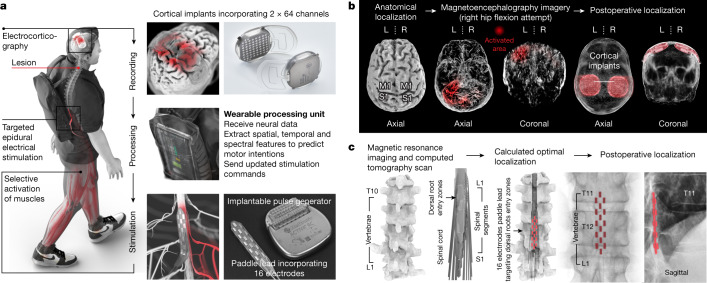
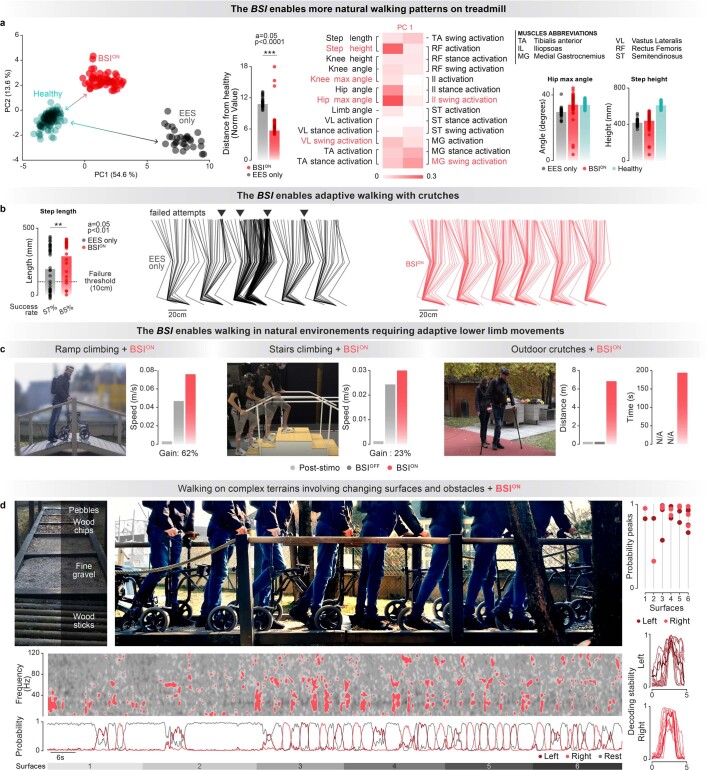
A spinal cord injury interrupts the communication between the brain and the region of the spinal cord that produces walking, leading to paralysis 1,2 . Here, we restored this communication with a digital bridge between the brain and spinal cord that enabled an individual with chronic tetraplegia to stand and walk naturally in community settings. This brain–spine interface (BSI) consists of fully implanted recording and stimulation systems that establish a direct link between cortical signals 3 and the analogue modulation of epidural electrical stimulation targeting the spinal cord regions involved in the production of walking 4–6 . A highly reliable BSI is calibrated within a few minutes. This reliability has remained stable over one year, including during independent use at home. The participant reports that the BSI enables natural control over the movements of his legs to stand, walk, climb stairs and even traverse complex terrains. Moreover, neurorehabilitation supported by the BSI improved neurological recovery. The participant regained the ability to walk with crutches overground even when the BSI was switched off. This digital bridge establishes a framework to restore natural control of movement after paralysis.
Overview
CoChat Summary
TL;DR
A fully implanted brain–spine interface restored volitional standing and walking in one man with chronic incomplete cervical spinal cord injury, enabling natural control over leg movements and use in community settings. Neurorehabilitation supported by the interface also produced neurological recovery that persisted with the interface switched off.
Key findings
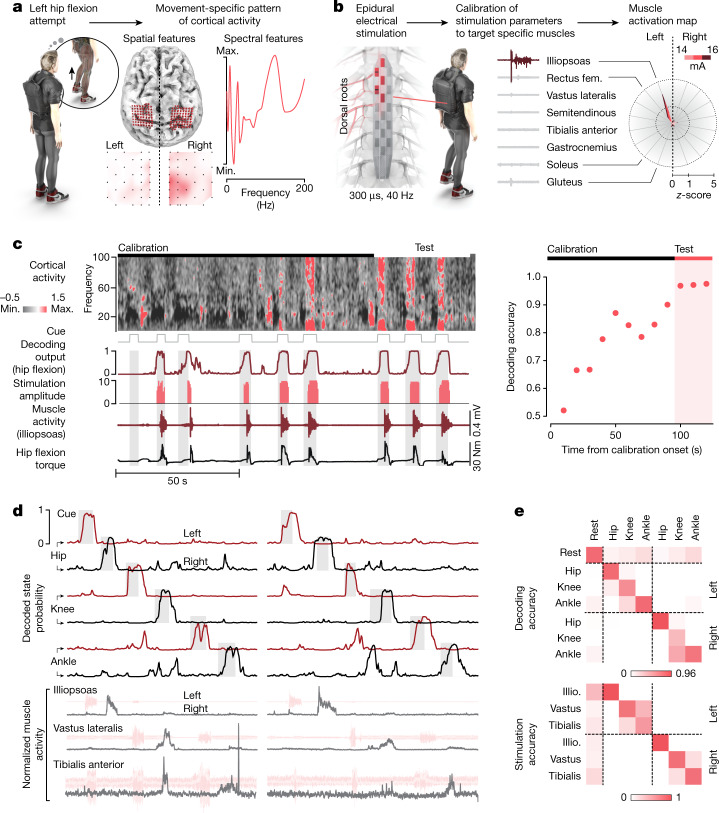
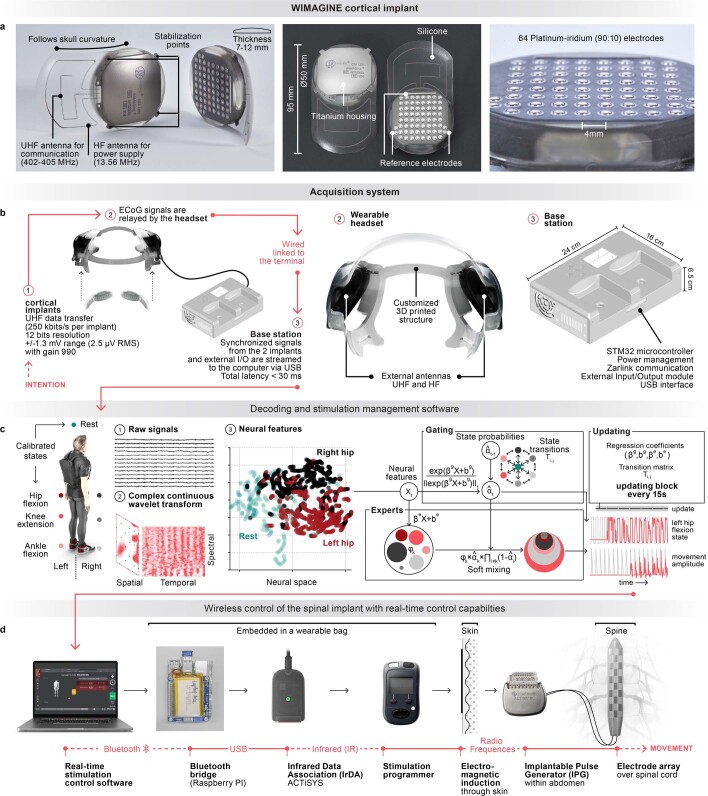
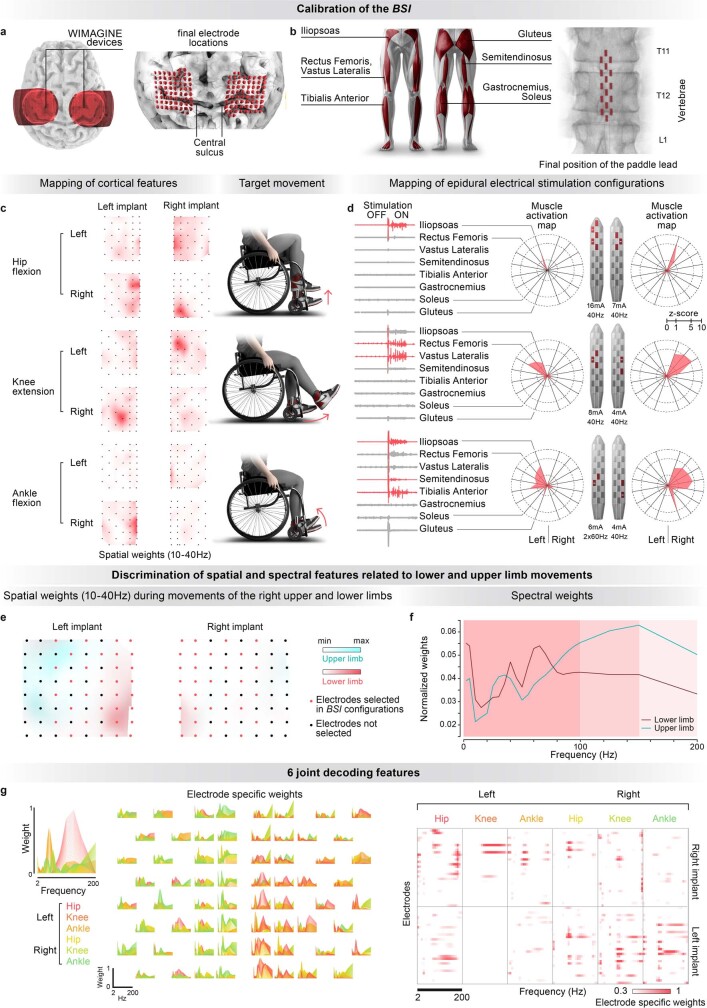
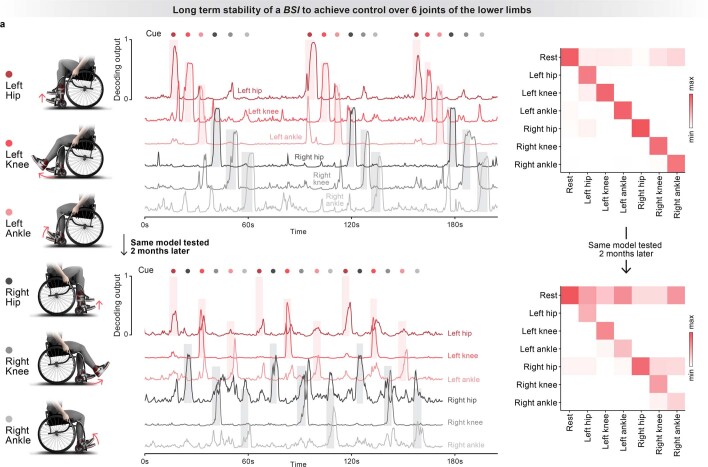
- The BSI enabled rapid calibration: within less than two minutes the participant controlled hip muscle activity with 97% accuracy, and a seven-state proportional decoder achieved 74 ± 7% accuracy versus 14% chance, with decoder latency of 1.1 s (±0.15 s s.e.m.).
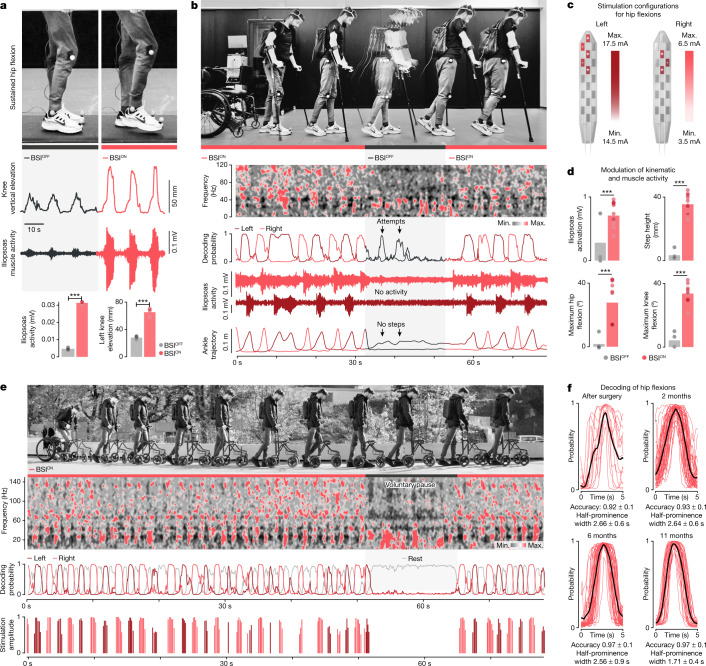
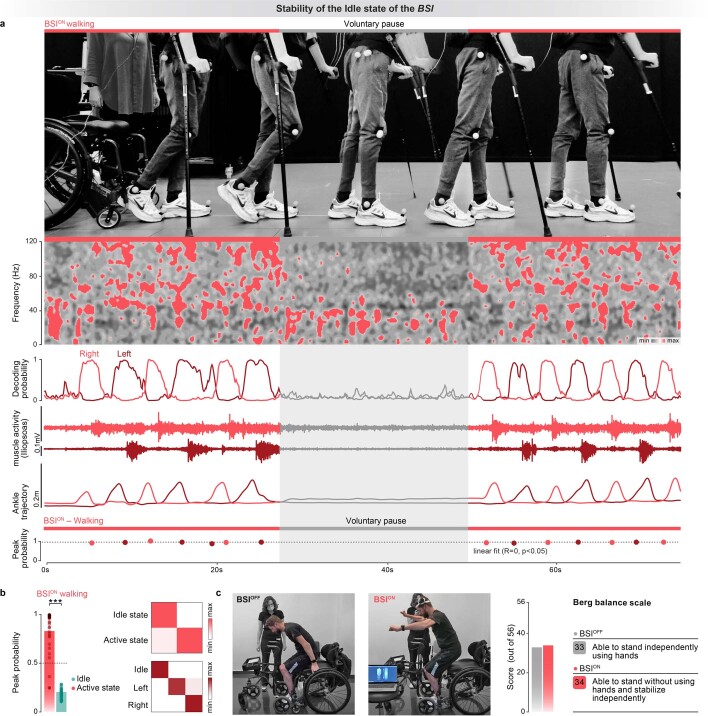
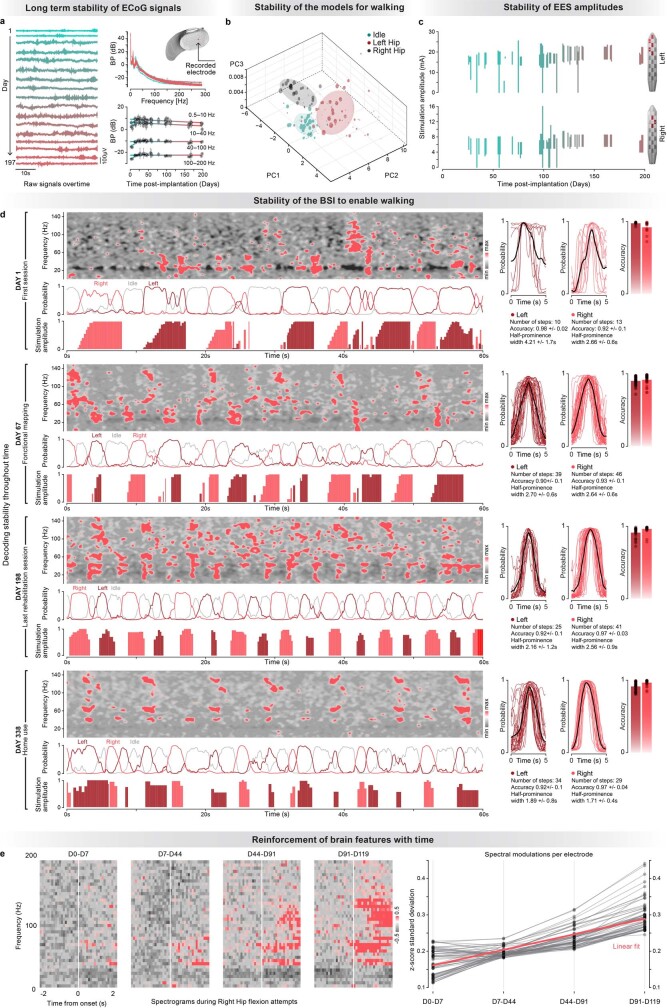
- Walking with the BSI produced a fivefold increase in hip flexor muscle activity compared with attempts without the BSI, and decoding accuracy during walking remained stable over nearly one year (0.92 ± 0.1 s.d. in the first session; 0.97 ± 0.1 s.d. at 11 months).
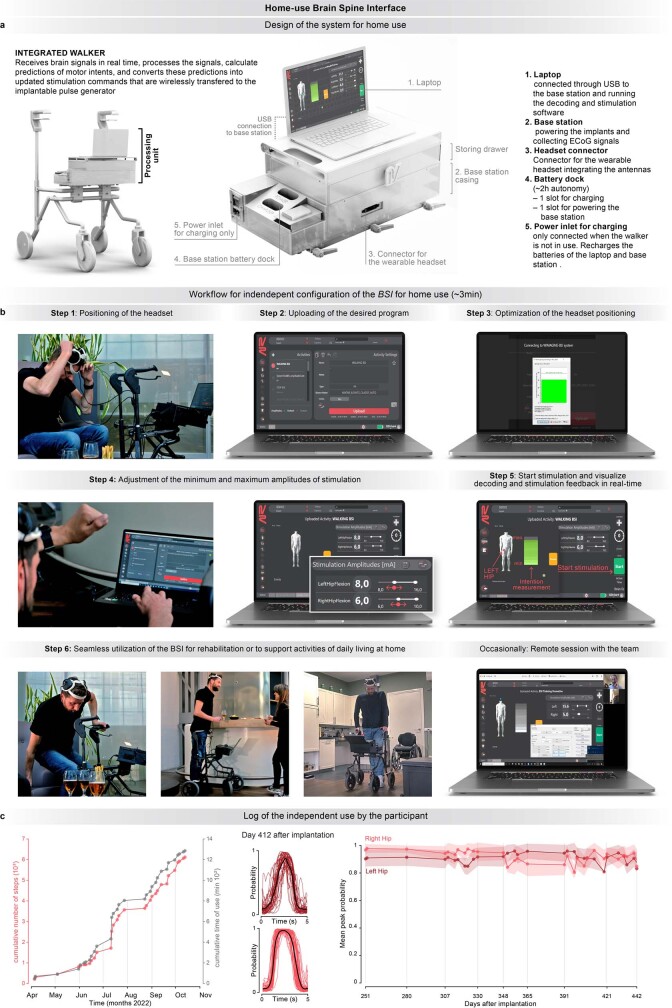
- The participant used the BSI at home regularly over 7 months with stable decoding performance, and ECoG signal power decreased by only 0.03 dB per day on average after a transitory one-month period.
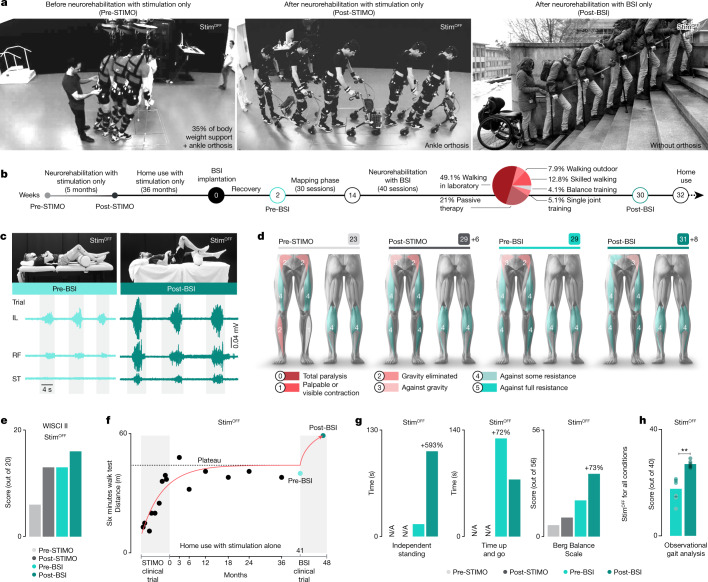
- Neurorehabilitation supported by the BSI improved neurological recovery without stimulation: WISCI II scores increased from 6 before STIMO to 16 after STIMO-BSI, with gains in sensory score (4 points in light touch) and multiple clinical walking and balance assessments.
Methods
- Design: ongoing clinical feasibility study STIMO-BSI (NCT04632290) in a single 38-year-old male with incomplete cervical C5/C6 spinal cord injury sustained ten years earlier, who had previously completed the STIMO trial and reached a recovery plateau.
- Intervention: two fully implanted WIMAGINE ECoG recording implants over the sensorimotor cortex, an ACTIVA RC implantable pulse generator, and a Specify 5-6-5 paddle lead targeting lumbar dorsal root entry zones; cortical signals were decoded with a recursive exponentially weighted Markov-switching multilinear model and translated into analogue modulation of epidural electrical stimulation.
- Procedures and analysis: pre-operative MEG and CT planning, intra-operative electrophysiology, 40 neurorehabilitation sessions, home use, and assessments including EMG, 3D gait kinematics, PCA, ISNCSCI, WISCI II, six-minute walk test, Berg Balance Scale, and observational gait analysis scored by blinded physiotherapists.
Limitations
- The paper states that validation was restricted to a single individual with severe but partial spinal cord damage, so it remains unclear whether the BSI will be applicable to other injury locations and severities.
- The paper notes that the participant’s prior experience with spinal cord stimulation accelerated BSI configuration, and that the relative amount of neurological recovery will necessarily correlate with lesion severity.
- Evident from the text: this is a single-case feasibility study without a control group; the participant had residual function and prior STIMO rehabilitation, and the right cortical implant was explanted 167 days after implantation due to a subcutaneous Staphylococcus aureus infection.
Model-written summary. Check it against the paper before relying on it.
Integrity signals
Registry
Cites
Statistics
Figures
Verification
Claims the paper makes
13 Valid · 6 Not valid · 10 Not checked · 93 Own results and interpretations
At least one cited source doesn’t support this claim or points to a different paper, and none confirmed it — see the verdicts below.
In the paper
“However, this recovery required wearable motion sensors to detect motor intentions from residual movements or compensatory strategies to initiate the preprogrammed stimulation sequences5.”
§ Walking naturally after spinal cord injury using a brain–spine interface > Main
What the sources say
- Disputedcites [5] Rowald, A. et al. Activity-dependent spinal cord neuromodulation rapidly restores trunk and leg motor functions after complete paralysis. Nat. Med. 28, 260–271 (2022). 35132264 sourceExperimental — accuracy not yet measured
The ‘Recovery of independence in ecological settings’ section says participants could use open-loop sequences, clickers, or closed-loop control based on wearable sensors. The ‘Software App for configuration, optimization and evaluation of neurostimulation’ section likewise describes automatic looping and button-triggered sequences alongside sensor-detected movement. Wearable motion sensors were therefore an option, not a requirement for initiating stimulation. (LLM, conf=0.90)
Checked by a reasoning model — may be wrong.
plainstates a cause- Asserted: passes — The authors put it forward as true.
- Checkable: passes — It can be checked against evidence.
- Load-bearing: passes — The paper’s conclusions depend on it.
- Based: passes — The paper gives a reason why it holds.
- Disputed
Some cited sources support this claim and some don’t — read each source’s verdict below.
In the paper
“Third, a comparable robustness and stability of this computational and technological brain decoding framework has now been observed in two additional individuals with tetraplegia3,26,29.”
§ Walking naturally after spinal cord injury using a brain–spine interface > Discussion
What the sources say
- Partly supportedcites [3] Benabid, A. L. et al. An exoskeleton controlled by an epidural wireless brain–machine interface in a tetraplegic patient: a proof-of-concept demonstration. Lancet Neurol. 10.1016/S1474-4422(19)30321-7 (2019). 31587955 sourceExperimental — accuracy not yet measured
The Discussion reports stable decoding without recalibration for several weeks, but only for the study’s single evaluated participant. The Magnetic resonance imaging (MRI) section says the other implanted patient was excluded and three further patients were still being recruited; it does not support an observation in two additional individuals. Page numbers are unavailable in our copy. (LLM, conf=0.88)
- Disputedcites [26] Moly, A. et al. An adaptive closed-loop ECoG decoder for long-term and stable bimanual control of an exoskeleton by a tetraplegic. J. Neural Eng. 19, 026021 (2022). 35234665 sourceExperimental — accuracy not yet measured
The Clinical trial description (§2.4; page not provided) says the decoder was tested on a single patient. Limitations and perspectives (§4.4; page not provided) likewise says the stability results were demonstrated for a single patient and that implantation of more patients was planned, contrary to the claim that comparable results had already been observed in two additional individuals. (LLM, conf=0.88)
Checked by a reasoning model — may be wrong.
- Partly supportedcites [29] Larzabal, C. et al. Long-term stability of the chronic epidural wireless recorder WIMAGINE in tetraplegic patients. J. Neural Eng. 18, 056026 (2021). 34425566 sourceExperimental — accuracy not yet measured
The Discussion and Conclusion report stable WIMAGINE recordings in two tetraplegic patients enrolled in a BCI protocol. They do not establish comparable robustness of the full computational brain-decoding framework in two additional individuals: the paper evaluates recorder signals, and the Discussion says training for patient 2 was ongoing. (LLM, conf=0.87)
plainn = 2- Asserted: passes — The authors put it forward as true.
- Checkable: passes — It can be checked against evidence.
- Load-bearing: passes — The paper’s conclusions depend on it.
- Based: passes — The paper gives a reason why it holds.
- Partly supported
The cited sources support only part of this claim — read each source’s verdict below.
In the paper
“We previously showed that epidural electrical stimulation targeting the individual dorsal root entry zones of the lumbosacral spinal cord enables the modulation of specific leg motor pools9–12.”
§ Walking naturally after spinal cord injury using a brain–spine interface > Main
What the sources say
- Partly supportedcites [9] Capogrosso, M. et al. A computational model for epidural electrical stimulation of spinal sensorimotor circuits. J. Neurosci. 33, 19326–19340 (2013). 24305828 PMC6618777 sourceExperimental — accuracy not yet measured
In “Evaluation of EES selectivity during standing and walking in spinal rats” (page unavailable), the paper reports that stimulation at L2 and S1 preferentially modulated different hindlimb muscles and motor pools. It describes electrodes on the lateral aspect of those spinal segments, but does not establish that they targeted individual dorsal root entry zones; that anatomical detail is more specific than the evidence supports. (LLM, conf=0.84)
- Not checked — no full text of the sourcecites [10] Wenger, N. et al. Closed-loop neuromodulation of spinal sensorimotor circuits controls refined locomotion after complete spinal cord injury. Sci. Transl. Med. 6, 255ra133 (2014). 25253676 source
- Supportedcites [11] Wenger, N. et al. Spatiotemporal neuromodulation therapies engaging muscle synergies improve motor control after spinal cord injury. Nat. Med. 22, 138–145 (2016). 26779815 PMC5061079 source
The Results section, “Electrode position to target extensor vs. flexor hotspots” (page not supplied), reports that electrodes positioned to recruit different dorsal roots preferentially targeted flexor or extensor hotspots. Acute experiments confirmed that stimulation at those locations could target spatially restricted hindlimb motor-activation hotspots. (LLM, conf=0.90)
- Partly supportedcites [12] Moraud, E. M. et al. Mechanisms underlying the neuromodulation of spinal circuits for correcting gait and balance deficits after spinal cord injury. Neuron 89, 814–828 (2016). 26853304 sourceExperimental — accuracy not yet measured
The section “Exploiting Spinal Circuit Dynamics” (p. 5) reports that phase-specific epidural stimulation selectively modulated extensor and flexor muscle activity, supporting modulation of distinct leg motor circuits. But the Surgical Procedures (p. 13) place stimulation electrodes at the spinal midline at L2 and S1; the cited passages do not establish targeting of individual dorsal root entry zones. (LLM, conf=0.86)
plainstates a cause- Asserted: passes — The authors put it forward as true.
- Checkable: passes — It can be checked against evidence.
- Load-bearing: passes — The paper’s conclusions depend on it.
- Based: passes — The paper gives a reason why it holds.
- Partly supported
The cited sources support only part of this claim — read each source’s verdict below.
In the paper
“He had previously participated in the STIMO clinical trial (clinicaltrials.gov, NCT02936453), which involved a five-month neurorehabilitation programme supported by targeted epidural electrical stimulation of the spinal cord4,5.”
§ Walking naturally after spinal cord injury using a brain–spine interface > Neurosurgical implantation of the BSI
What the sources say
- Supportedcites [4] Wagner, F. B. et al. Targeted neurotechnology restores walking in humans with spinal cord injury. Nature 563, 65–71 (2018). 30382197 source
The 'Rehabilitation improves walking with EES' section states that 'Participants followed a rehabilitation program four to five times per week for five months ... each of which was enabled by task-specific EES', matching the five-month neurorehabilitation programme supported by epidural electrical stimulation. The Methods/trial-protocol section ('April 2018') names the STIMO study and gives its inclusion/exclusion criteria, and the Abstract/Introduction describe targeted (spatially selective, spatiotemporal) stimulation of the lumbosacral spinal cord via an implanted paddle array, so the trial description the citation is attached to is stated in our copy. The registry number NCT02936453 is not printed in our copy, but it is given parenthetically by the citing authors rather than attributed to this source. (LLM, conf=0.88)
- Partly supportedcites [5] Rowald, A. et al. Activity-dependent spinal cord neuromodulation rapidly restores trunk and leg motor functions after complete paralysis. Nat. Med. 28, 260–271 (2022). 35132264 sourceExperimental — accuracy not yet measured
The Study design and objectives section identifies STIMO as trial NCT02936453 and describes a five-month rehabilitation period with epidural electrical stimulation. Recovery of independence in ecological settings says the paper’s three participants underwent that programme. Our copy does not establish that the particular person referred to as “he” in the citing sentence was one of them; no page numbers are available in the indexed passages. (LLM, conf=0.82)
plainSingle case- Asserted: passes — The authors put it forward as true.
- Checkable: passes — It can be checked against evidence.
- Load-bearing: unclear — It is unclear whether the paper’s conclusions depend on it.
- Based: passes — The paper gives a reason why it holds.
- Supported
The cited sources support only part of this claim — read each source’s verdict below.
In the paper
“In turn, recruiting these dorsal root entry zones with preprogrammed spatiotemporal sequences replicates the physiological activation of leg motor pools underlying standing and walking4,5,11,13,14.”
§ Walking naturally after spinal cord injury using a brain–spine interface > Main
What the sources say
- Supportedcites [4] Wagner, F. B. et al. Targeted neurotechnology restores walking in humans with spinal cord injury. Nature 563, 65–71 (2018). 30382197 source
The paper's Introduction states that EES activates motor neurons 'by recruiting proprioceptive circuits within the posterior roots of the spinal cord', with protocols that 'target individual posterior roots to access the motor neuron pools located in the spinal cord segment innervated by each root' and trains 'delivered with timing that coincides with the intended movement'; Methods/Results note EES sequences 'could be pre-programmed in an open loop or triggered in a closed loop'. Under 'Spatiotemporal EES enables walking', it reports that targeted EES 'effectively activated the regions embedding these hotspots' of the physiological motor neuron activation maps and that train onset/duration were adjusted to approach the maps of healthy individuals, enabling participants to stand and walk overground. The only wording gap is strength ('approach' rather than fully 'replicates') and terminology (our copy says posterior/dorsal roots rather than 'dorsal root entry zone'), which is the citing authors' phrasing within a multi-citation sentence. (LLM, conf=0.80)
- Supportedcites [5] Rowald, A. et al. Activity-dependent spinal cord neuromodulation rapidly restores trunk and leg motor functions after complete paralysis. Nat. Med. 28, 260–271 (2022). 35132264 source
The Main text says that stimulation programs target individual dorsal roots with predefined timing to reproduce the natural spatiotemporal activation of motor neurons during walking. The section on spatiotemporal stimulation sequences says the authors used the same framework for standing and designed sequences to reproduce natural motor-group activation during each activity. The paper describes this as the design and purpose of the sequences, rather than a measured exact replication. (LLM, conf=0.88)
- Partly supportedcites [11] Wenger, N. et al. Spatiotemporal neuromodulation therapies engaging muscle synergies improve motor control after spinal cord injury. Nat. Med. 22, 138–145 (2016). 26779815 PMC5061079 sourceExperimental — accuracy not yet measured
The Results (page unavailable) report that stimulation targeting dorsal roots produced hindlimb motoneuron-activation maps resembling those of intact rats during locomotion. They do not establish that the sequences replicated physiological activation during standing; the reported comparison concerns walking rats and describes resemblance, not exact replication. (LLM, conf=0.88)
- Partly supportedcites [13] Capogrosso, M. et al. A brain–spine interface alleviating gait deficits after spinal cord injury in primates. Nature 539, 284–288 (2016). 27830790 PMC5108412 sourceExperimental — accuracy not yet measured
The paper reports that electrodes targeting dorsal-root entry points produced spinal activation correlated with the natural flexion and extension hotspots during locomotion (Abstract; page unavailable). Extended Data Figure 2 describes pre-programmed stimulation protocols, but the Methods say they were triggered by decoded gait states. The copy supports an approximation of activation during walking, not replication of physiological motor-pool activation during standing. (LLM, conf=0.85)
- Partly supportedcites [14] Minev, I. R. et al. Biomaterials. Electronic dura mater for long-term multimodal neural interfaces. Science 347, 159–163 (2015). 25574019 sourceExperimental — accuracy not yet measured
Minev et al. (2015) supports only the general point: in the BIOMATERIALS section the e-dura over lumbosacral segments 'was used to engage spinal locomotor circuits located below injury', with 'continuous electrical stimulation ... delivered on the lateral aspect of L2 and S1 segments (40 Hz, 0.2 ms, 50 to 150 mA)' plus serotonergic agents enabling paralyzed rats to walk, and 'distributed electrodes delivered stimulation restricted to specific segments, which allowed facilitation of left versus right leg movements'. What the claim attributes specifically — recruitment of dorsal root entry zones, preprogrammed spatiotemporal stimulation sequences, and replication of the physiological activation pattern of leg motor pools — is absent from our copy (searched: dorsal root entry zone, spatiotemporal sequences, motor pool recruitment, physiological activation); the stimulation described was continuous and fixed-parameter in acute rat SCI experiments, not programmed spatiotemporal sequences in humans. Hence only the segment-selective spinal neuromodulation enabling standing/walking part is backed. (LLM, conf=0.70)
plainstates a cause- Asserted: passes — The authors put it forward as true.
- Checkable: passes — It can be checked against evidence.
- Load-bearing: passes — The paper’s conclusions depend on it.
- Based: passes — The paper gives a reason why it holds.
- Supported
58 more claims · 8 with their cited sources checked
Create a free account to see all 122 claims and to verify the 6 references still open.
- It may state two separate claims as one. 42
- Probably not a substantial claim. 23
Citations
Cites
MEG and EEG data analysis with MNE-Python
Gramfort, A. (2013) · Frontiers in Neuroscience · doi:10.3389/fnins.2013.00267 · Cited by 3,784 · cited 1×
“Stereotypical artefacts (cardiac, ocular) were identified by independent components analysis using MNE-Python software 45 and rejected on visual screening (Infomax method, calculated separately for magnetometers and gradiometers using 64 components).”
MethodBrainstorm: A User-Friendly Application for MEG/EEG Analysis
Tadel, F., Baillet, S., Mosher, J. C., Pantazis, D., & Leahy, R. M. (2011) · Computational Intelligence and Neuroscience · doi:10.1155/2011/879716 · Cited by 3,677 · cited 1×
“The head, skull and cortex geometries were calculated from CT scan using the MRI segmentation routine included in the Brainstorm software 46 , followed by calculation of the head model using the overlapping spheres method.”
MethodAhuja, C. S., Wilson, J. R., Nori, S., Kotter, M. R. N., Druschel, C., Curt, A., & Fehlings, M. G. (2017) · Nature Reviews Disease Primers · doi:10.1038/nrdp.2017.18 · Cited by 2,441
Fall risk index for elderly patients based on number of chronic disabilities
Tinetti, M. E., Franklin Williams, T., & Mayewski, R. (1986) · The American Journal of Medicine · doi:10.1016/0002-9343(86)90717-5 · Cited by 1,587
Classification of Walking Handicap in the Stroke Population
Perry, J., Garrett, M., Gronley, J. K., & Mulroy, S. J. (1995) · Stroke · doi:10.1161/01.str.26.6.982 · Cited by 1,560
Harkema, S., Gerasimenko, Y., Hodes, J., Burdick, J., Angeli, C., Chen, Y., Ferreira, C., Willhite, A., Rejc, E., Grossman, R. G., et al. (2011) · The Lancet · doi:10.1016/s0140-6736(11)60547-3 · Cited by 1,229 · cited 1×
“This recovery has been documented in various independent studies, including in participants with complete sensorimotor paralysis 5,6,30–34 .”
BackgroundTargeted neurotechnology restores walking in humans with spinal cord injury
Wagner, F. B., Mignardot, J.-B., Le Goff-Mignardot, C. G., Demesmaeker, R., Komi, S., Capogrosso, M., Rowald, A., Seáñez, I., Caban, M., Pirondini, E., et al. (2018) · Nature · doi:10.1038/s41586-018-0649-2 · Cited by 1,087 · cited 9×
“This brain–spine interface (BSI) consists of fully implanted recording and stimulation systems that establish a direct link between cortical signals 3 and the analogue modulation of epidural electrical stimulation targeting the spinal cord regions involved in the production of walking 4–6 .”
BackgroundMethodInfluentialSelf-citationElectronic dura mater for long-term multimodal neural interfaces
Minev, I. R., Musienko, P., Hirsch, A., Barraud, Q., Wenger, N., Moraud, E. M., Gandar, J., Capogrosso, M., Milekovic, T., Asboth, L., et al. (2015) · Science · doi:10.1126/science.1260318 · Cited by 1,082
Self-citationHigh-performance brain-to-text communication via handwriting
Willett, F. R., Avansino, D. T., Hochberg, L. R., Henderson, J. M., & Shenoy, K. V. (2021) · Nature · doi:10.1038/s41586-021-03506-2 · Cited by 1,024
Recovery of Over-Ground Walking after Chronic Motor Complete Spinal Cord Injury
Angeli, C. A., Boakye, M., Morton, R. A., Vogt, J., Benton, K., Chen, Y., Ferreira, C. K., & Harkema, S. J. (2018) · New England Journal of Medicine · doi:10.1056/nejmoa1803588 · Cited by 670
Cited by
Wearable and Implantable Soft Robots
Yin, S., Yao, D. R., Song, Y., Heng, W., Ma, X., Han, H., & Gao, W. (2024) · Chemical Reviews · doi:10.1021/acs.chemrev.4c00513 · Cited by 173
Non-Invasive Brain-Computer Interfaces: State of the Art and Trends
Edelman, B. J., Zhang, S., Schalk, G., Brunner, P., Müller-Putz, G., Guan, C., & He, B. (2025) · IEEE Reviews in Biomedical Engineering · doi:10.1109/rbme.2024.3449790 · Cited by 170
Squair, J. W., Milano, M., de Coucy, A., Gautier, M., Skinnider, M. A., James, N. D., Cho, N., Lasne, A., Kathe, C., Hutson, T. H., et al. (2023) · Science · doi:10.1126/science.adi6412 · Cited by 163
Self-citationBio-inspired electronics: Soft, biohybrid, and “living” neural interfaces
Boufidis, D., Garg, R., Angelopoulos, E., Cullen, D. K., & Vitale, F. (2025) · Nature Communications · doi:10.1038/s41467-025-57016-0 · Cited by 201
“…epilepsy monitoring 18 – 20 , responsive neurostimulation 21,22 , speech decoding 23 – 25 , and motor recovery following spinal cord injury 26 , closed-loop sensory-motor interfaces for prosthetic control 27,28 , as well as deep brain stimulation (DBS) for Parkinson ’ s Disease 29,30 and…”
Yogev, D., Goldberg, T., Arami, A., Tejman‐Yarden, S., Winkler, T. E., & Maoz, B. M. (2023) · APL Bioengineering · doi:10.1063/5.0152290 · Cited by 166
The state of clinical trials of implantable brain–computer interfaces
Patrick-Krueger, K. M., Burkhart, I., & Contreras-Vidal, J. L. (2024) · Nature Reviews Bioengineering · doi:10.1038/s44222-024-00239-5 · Cited by 125
Silva, A. B., Littlejohn, K. T., Liu, J. R., Moses, D. A., & Chang, E. F. (2024) · Nature Reviews Neuroscience · doi:10.1038/s41583-024-00819-9 · Cited by 103
A neural speech decoding framework leveraging deep learning and speech synthesis
Chen, X., Wang, R., Khalilian-Gourtani, A., Yu, L., Dugan, P. C., Friedman, D. J., Doyle, W., Devinsky, O., Wang, Y., & Flinker, A. (2024) · Nature Machine Intelligence · doi:10.1038/s42256-024-00824-8 · Cited by 153
A memristor-based adaptive neuromorphic decoder for brain–computer interfaces
Liu, Z., Mei, J., Tang, J., Xu, M., Gao, B., Wang, K., Ding, S., Liu, Q., Qin, Q., Chen, W., et al. (2025) · Nature Electronics · doi:10.1038/s41928-025-01340-2 · Cited by 138
Bioelectronic interfaces of organic electrochemical transistors
Saleh, A., Koklu, A., Uguz, I., Pappa, A., & Inal, S. (2024) · Nature Reviews Bioengineering · doi:10.1038/s44222-024-00180-7 · Cited by 147
“Such implanted electrodes have also accelerated the progress of brain–computer interfaces 12 , allowing recording and control over the body, for example, for weight reduction by vagus nerve stimulation 13 , restoration of walking ability after spinal injury 14 or vision 15 .”
Luo, S., Angrick, M., Coogan, C., Candrea, D. N., Wyse‐Sookoo, K., Shah, S., Rabbani, Q., Milsap, G. W., Weiss, A. R., Anderson, W. S., et al. (2023) · Advanced Science · doi:10.1002/advs.202304853 · Cited by 90
Awuah, W. A., Ahluwalia, A., Darko, K., Sanker, V., Tan, J. K., Tenkorang, P. O., Ben-Jaafar, A., Ranganathan, S., Aderinto, N., Mehta, A., et al. (2024) · World Neurosurgery · doi:10.1016/j.wneu.2024.05.104 · Cited by 120
A spinal cord neuroprosthesis for locomotor deficits due to Parkinson’s disease
Milekovic, T., Moraud, E. M., Macellari, N., Moerman, C., Raschellà, F., Sun, S., Perich, M. G., Varescon, C., Demesmaeker, R., Bruel, A., et al. (2023) · Nature Medicine · doi:10.1038/s41591-023-02584-1 · Cited by 99
“We previously designed a digital bridge between the brain and spinal cord that restored natural walking in an individual with paralysis due to spinal cord injury 34 .”
BackgroundInfluentialSelf-citationNeural Decoding for Intracortical Brain–Computer Interfaces
Dong, Y., Wang, S., Huang, Q., Berg, R. W., Li, G., & He, J. (2023) · Cyborg and Bionic Systems · doi:10.34133/cbsystems.0044 · Cited by 92
Dong, C., & Malliaras, G. G. (2025) · Advanced Materials · doi:10.1002/adma.202417325 · Cited by 89
Wan, J., Nie, Z., Xu, J., Zhang, Z., Yao, S., Xiang, Z., Lin, X., Lu, Y., Xu, C., Zhao, P., et al. (2024) · Science Advances · doi:10.1126/sciadv.adm9314 · Cited by 73
Ethical considerations for the use of brain–computer interfaces for cognitive enhancement
Gordon, E. C., & Seth, A. K. (2024) · PLOS Biology · doi:10.1371/journal.pbio.3002899 · Cited by 64
Interfacing with the Brain: How Nanotechnology Can Contribute
Ahmed, A. A. A., Alegret, N., Almeida, B., Álvarez‐Puebla, R. A., Andrews, A. M., Ballerini, L., Barrios‐Capuchino, J. J., Becker, C., Blick, R. H., Bonakdar, S., et al. (2025) · ACS Nano · doi:10.1021/acsnano.4c10525 · Cited by 75
Approaches of wearable and implantable biosensor towards of developing in precision medicine
Ghazizadeh, E., Naseri, Z., Deigner, H.-P., Rahimi, H., & Altıntaş, Z. (2024) · Frontiers in Medicine · doi:10.3389/fmed.2024.1390634 · Cited by 91
“In a more recent study, a digital bridge between the brain and spinal cord was developed based on the brain-spine interface (BSI) implant to restore communication between the brain and the spinal cord, allowing individuals with chronic tetraplegia to walk naturally in community (79).”
BackgroundClosed-loop vagus nerve stimulation aids recovery from spinal cord injury
Kilgard, M. P., Epperson, J. D., Adehunoluwa, E. A., Swank, C., Porter, A. L., Pruitt, D. T., Gallaway, H. L., Stevens, C., Gillespie, J., Arnold, D., et al. (2025) · Nature · doi:10.1038/s41586-025-09028-5 · Cited by 74
Application and Development of EEG Acquisition and Feedback Technology: A Review
Qin, Y., Zhang, Y., Yan, Z., Liu, S., & Guo, X. (2023) · Biosensors · doi:10.3390/bios13100930 · Cited by 65
“Several commonly used EEG classifi-cation algorithms include support vector machines (SVM), K-nearest neighbors (KNN), random forests, convolutional neural networks (CNN), and recurrent neural networks RNN) [106–113].”
BackgroundMethodHypothalamic deep brain stimulation augments walking after spinal cord injury
Cho, N., Squair, J. W., Aureli, V., James, N. D., Bole-Feysot, L., Dewany, I., Hankov, N., Baud, L., Leonhartsberger, A., Sveistyte, K., et al. (2024) · Nature Medicine · doi:10.1038/s41591-024-03306-x · Cited by 64
Self-citationTranslation of neurotechnologies
Schalk, G., Brunner, P., Allison, B. Z., Soekadar, S. R., Guan, C., Denison, T., Rickert, J., & Miller, K. J. (2024) · Nature Reviews Bioengineering · doi:10.1038/s44222-024-00185-2 · Cited by 74
Self-citationInvasive Brain Computer Interface for Motor Restoration in Spinal Cord Injury: A Systematic Review
Levett, J. J., Elkaim, L. M., Niazi, F., Weber, M. H., Iorio‐Morin, C., Bonizzato, M., & Weil, A. G. (2023) · Neuromodulation Technology at the Neural Interface · doi:10.1016/j.neurom.2023.10.006 · Cited by 75
Degradable and Recyclable Hydrogels for Sustainable Bioelectronics
Jia, L., Li, Y., Ren, A., Xiang, T., & Zhou, S. (2024) · ACS Applied Materials & Interfaces · doi:10.1021/acsami.4c05663 · Cited by 55
Wireless Battery-free and Fully Implantable Organ Interfaces
Bhatia, A., Hanna, J., Stuart, T., Kasper, K. A., Clausen, D. M., & Gutruf, P. (2024) · Chemical Reviews · doi:10.1021/acs.chemrev.3c00425 · Cited by 54
Wireless Technologies for Wearable Electronics: A Review
Kim, C. Y., Lee, J., Jeong, E. Y., Jang, Y., Kim, H., Choi, B., Han, D., Oh, Y., & Jeong, J. (2025) · Advanced Electronic Materials · doi:10.1002/aelm.202400884 · Cited by 69
Electrocorticogram (ECoG): Engineering Approaches and Clinical Challenges for Translational Medicine
Moon, H., Kwon, J., Eun, J., Chung, C. K., Kim, J. S., Chou, N., & Kim, S. (2024) · Advanced Materials Technologies · doi:10.1002/admt.202301692 · Cited by 59
Advances in materials for haptic skin electronics
Gao, Y., Yao, K., Jia, S., Huang, Y., Zhao, G., Zhang, B., Liu, Y., & Yu, X. (2024) · Matter · doi:10.1016/j.matt.2024.06.010 · Cited by 58
Alternative Micro/Nanofabrication Approaches for Wearable Electronics
Zhang, J., & Wang, M. (2026) · Chemical Reviews · doi:10.1021/acs.chemrev.5c00801 · Cited by 56
Yuan, T., Li, W., Zhou, M., Wang, X., Wang, B., & Zhao, Y. (2024) · Advanced Materials · doi:10.1002/adma.202411628 · Cited by 48
Ma, D., Fu, C., Li, F., Ruan, R., Lin, Y., Li, X., Li, M., & Zhang, J. C. (2024) · Bioactive Materials · doi:10.1016/j.bioactmat.2024.04.015 · Cited by 65
Woodington, B. J., Jiang, L., Carnicer‐Lombarte, A., Güemes, A., Naegele, T. E., Hilton, S., Hadwe, S. E., Trivedi, R. A., Malliaras, G. G., & Barone, D. G. (2024) · Science Advances · doi:10.1126/sciadv.adl1230 · Cited by 50
Mariello, M., & Proctor, C. M. (2024) · Advanced Materials Technologies · doi:10.1002/admt.202400797 · Cited by 58
Management of freezing of gait — mechanism-based practical recommendations
Tosserams, A., Fasano, A. A., Gilat, M., Factor, S. A., Giladi, N., Lewis, S. J. G., Moreau, C., Bloem, B. R., Nieuwboer, A., & Nonnekes, J. H. (2025) · Nature Reviews Neurology · doi:10.1038/s41582-025-01079-6 · Cited by 56
A biodegradable piezoelectric scaffold promotes spinal cord injury nerve regeneration
Zhang, J., Wang, Q., Tang, X., et al. (2024) · Nano Energy · doi:10.1016/j.nanoen.2024.110382 · Cited by 39
Romeni, S., Losanno, E., Emedoli, D., Albano, L., Agnesi, F., Mandelli, C., Barzaghi, L. R., Pompeo, E., Mura, C., Alemanno, F., et al. (2025) · Science Translational Medicine · doi:10.1126/scitranslmed.adp9607 · Cited by 52
Endalamaw, A., Zewdie, A., Wolka, E., & Assefa, Y. A. (2025) · BMC Health Services Research · doi:10.1186/s12913-025-12548-5 · Cited by 58
“Digital health technologies also enhanced the quality of life of individuals who are unable to speak and walk by converting thoughts to text, and by assisting them to walk [93, 94].”
Liu, J., Kong, G., Lu, C., Wang, J., Li, W., Lv, Z., Tong, J., Liu, Y., Xiong, W., Li, H., et al. (2024) · Journal of Nanobiotechnology · doi:10.1186/s12951-024-02697-w · Cited by 42
Reactivation of mammalian regeneration by turning on an evolutionarily disabled genetic switch
Lin, W., Jia, X., Shi, X., He, Q., Zhang, P., Zhang, X., Zhang, L., Wu, M., Ren, T., Liu, Y., et al. (2025) · Science · doi:10.1126/science.adp0176 · Cited by 46
Wang, S., Wu, M., Liu, W., Liu, J., Tian, Y., & Xiao, K. (2024) · Device · doi:10.1016/j.device.2024.100284 · Cited by 37
History and Future of Spinal Cord Stimulation
Ali, R., & Schwalb, J. M. (2023) · Neurosurgery · doi:10.1227/neu.0000000000002654 · Cited by 42
“75,76 However, SCS technology has also advanced with newer leads and stimulation paradigms associated with improved outcomes.”
BackgroundMiniature battery-free epidural cortical stimulators
Woods, J. E., Singer, A., Alrashdan, F. T., Tan, W., Tan, C., Sheth, S. A., Sheth, S. A., & Robinson, J. T. (2024) · Science Advances · doi:10.1126/sciadv.adn0858 · Cited by 44
The 2023 yearbook of Neurorestoratology
Huang, H., Bach, J. R., Sharma, H. S., Chen, L., Wu, P., Sarnowska, A., Otom, A. H., Xue, M., Saberi, H., He, X., et al. (2024) · Journal of Neurorestoratology · doi:10.1016/j.jnrt.2024.100136 · Cited by 37
“60 The Stentrode With Thought-Controlled Digital Switch (SWITCH) study indicated the possibility to record neural signals from blood vessels with wider and more rapid translation.”
BackgroundSchiff, N. D., Diringer, M. N., Diserens, K., Edlow, B. L., Gosseries, O., Hill, N. J., Hochberg, L. R., Ismail, F., Meyer, I. A., Mikell, C. B., et al. (2024) · Neurocritical Care · doi:10.1007/s12028-023-01924-w · Cited by 41
“…clinical promise for other purposes including motor effector BCIs which allow patients to control external devices, multilevel spinal cord stimulation in patients with spinal cord injuries [54–56], closed-loop deep brain stimulation applications in treatment of depression [57], pain [58, 59], and”
Phase-adapted metal ion supply for spinal cord repair with a Mg–Zn incorporated chimeric microsphere
Liu, X., Ma, B., Hu, S., Li, D., Pan, C., Xu, Z., Chen, H., Wang, Y., & Wang, H. H. (2025) · Biomaterials · doi:10.1016/j.biomaterials.2025.123253 · Cited by 33
The Layer 7 Cortical Interface: A Scalable and Minimally Invasive Brain–Computer Interface Platform
Hettick, M., Ho, E., Poole, A. J., Monge, M., Papageorgiou, D., Takahashi, K., LaMarca, M., Trietsch, D., Reed, K., Murphy, M., et al. (2022) · doi:10.1101/2022.01.02.474656 · Cited by 31
“Brain–computer interfaces have shown promise as systems for restoring, replacing, and augmenting lost or impaired neurological function in a variety of contexts, including paralysis from stroke and spinal cord injury, blindness, and some forms of cognitive impairment 1– 21 .”
BackgroundReward signals in the motor cortex: from biology to neurotechnology
Derosière, G., Shokur, S., & Vassiliadis, P. (2025) · Nature Communications · doi:10.1038/s41467-024-55016-0 · Cited by 33
“BCIs are techniques used to decode motor intentions based on neural signals to restore or enhance motor functions, such as hand and arm movements 74 , locomotion 75 , or speech 76 .”
Enhanced selectivity of transcutaneous spinal cord stimulation by multielectrode configuration
Bryson, N. K., Lombardi, L., Hawthorn, R., Fei, J., Keesey, R., Peiffer, J. D., & Seáñez, I. (2023) · Journal of Neural Engineering · doi:10.1088/1741-2552/ace552 · Cited by 35
Canny, E., Vansteensel, M. J., van der Salm, S. M. A., Müller-Putz, G., & Berezutskaya, J. (2023) · Journal of NeuroEngineering and Rehabilitation · doi:10.1186/s12984-023-01272-y · Cited by 42
“Finally, a recent fully-implantable EcoG-FES system has been used for restoration of walking in an individual with spinal cord injury [173].”
MethodA stealthy neural recorder for the study of behaviour in primates
Oh, S., Jekal, J., Won, J., Lim, K. S., Jeon, C., Park, J., Yeo, H.-G., Kim, Y. G., Lee, Y. H., Ha, L. J., et al. (2024) · Nature Biomedical Engineering · doi:10.1038/s41551-024-01280-w · Cited by 38
Multifunctional bioelectronics for brain–body circuits
Sahasrabudhe, A., Cea, C., & Anikeeva, P. (2025) · Nature Reviews Bioengineering · doi:10.1038/s44222-025-00289-3 · Cited by 38
Brain–computer interfaces in 2023–2024
Chen, S., Chen, M., Wang, X., Liu, X., Liu, B., & Ming, D. (2025) · Brain‐X · doi:10.1002/brx2.70024 · Cited by 52
Shen, J., Wu, S., Wang, Y., Yan, Z., Liu, T., Sun, X., & Qian, Y. (2025) · Nature Communications · doi:10.1038/s41467-025-66779-5 · Cited by 50
Xue, Z., Zhang, Y., Li, H., Chen, H., Shen, S., & Du, H. (2024) · IEEE Transactions on Instrumentation and Measurement · doi:10.1109/tim.2024.3417598 · Cited by 42
“One study showed that electrical stimulation targeting spinal cord regions associated with walking significantly enhanced mobility among subjects [75].”
BackgroundHan, S., Zhang, D., Kao, Y., Zhou, X., Guo, X., Zhang, W., Liu, M., Chen, H., Kong, X., Wei, Z., et al. (2024) · ACS Nano · doi:10.1021/acsnano.4c08863 · Cited by 34
Continuous operation of battery-free implants enables advanced fracture recovery monitoring
Kasper, K. A., Figueroa, G., Perez, D., Miller, A. M., Gonzales, D. A., Siqueiros, J., Margolis, D. S., & Gutruf, P. (2025) · Science Advances · doi:10.1126/sciadv.adt7488 · Cited by 37
“The few existing clinical WBF implants use tethered power casting or large, bulky battery packs, which are inconvenient at best and prohibitive or exclusionary in some applications ( 21 , 22 ).”
Kvistad, C. E., Kråkenes, T., Gavasso, S., & Bø, L. (2024) · Frontiers in Neurology · doi:10.3389/fneur.2024.1398089 · Cited by 42
Neuralink’s brain-computer interfaces: medical innovations and ethical challenges
Lavazza, A., Balconi, M., Ienca, M., Minerva, F., Pizzetti, F. G., Reichlin, M., Samorè, F., Sironi, V. A., Navarro, M. S., & Songhorian, S. (2025) · Frontiers in Human Dynamics · doi:10.3389/fhumd.2025.1553905 · Cited by 45
Perna, A., Angotzi, G. N., Berdondini, L., & Ribeiro, J. F. (2023) · Frontiers in Neuroscience · doi:10.3389/fnins.2023.1275908 · Cited by 38
Stem cell therapies for spinal cord injury in humans: A review of recent clinical research
Sugai, K., Nakamura, M., Okano, H., & Nagoshi, N. (2025) · Brain and Spine · doi:10.1016/j.bas.2025.104207 · Cited by 26
“Over 15 million people are affected by SCIs worldwide (World Health Organization, 2024).”
InfluentialNeural vs Neuromorphic Interfaces: Where Are We Standing?
Rana, D., Babushkina, N., Gini, M., Cáceres, A., Li, H., Maybeck, V., Criscuolo, V., Mayer, D., Ienca, M., Musall, S., et al. (2025) · Chemical Reviews · doi:10.1021/acs.chemrev.4c00862 · Cited by 30
Lemieux, M., Karimi, N., & Bretzner, F. (2024) · Nature Communications · doi:10.1038/s41467-024-45300-4 · Cited by 25
Shi, G., Su, T., Li, J., Wang, A., Gao, G., Tao, B., Chen, N., Tian, L., Yan, J., Zhao, L., et al. (2025) · Theranostics · doi:10.7150/thno.108329 · Cited by 31
“In recent years, electrical stimulation has demonstrated considerable potential in enhancing nerve regeneration and restoring functional capabilities [16, 17].”
Bionic perception and transmission neural device based on a self-powered concept
Ba, K., Liu, G., Ma, G., Chen, C., Pu, L., He, X., Chen, X., Wang, Y., Zhu, Q., Wang, D., et al. (2024) · Cell Reports Physical Science · doi:10.1016/j.xcrp.2024.102048 · Cited by 24
Imani, I. M., Kim, H. S., Lee, M., Kim, S., Song, S., Lee, D., Hwang, J., Lee, J., Suh, I., Kim, S. W., et al. (2025) · Advanced Materials · doi:10.1002/adma.202419264 · Cited by 35
Neuroprotective effects of interleukin 10 in spinal cord injury
Li, J., Wang, P., Zhou, T., Jiang, W., Wu, H., Zhang, S., Deng, L., & Wang, H. (2023) · Frontiers in Molecular Neuroscience · doi:10.3389/fnmol.2023.1214294 · Cited by 26
Singh, G., Sharma, P., Forrest, G. F., Harkema, S. J., Behrman, A. L., & Gerasimenko, Y. (2024) · Journal of Neurotrauma · doi:10.1089/neu.2023.0438 · Cited by 26
“14,15 Although extremely promising, the invasive nature of epidural stimulation and the associated risks could potentially limit accessibility to patients with SCI for clinical translation and long-term rehabilitation.”
Application of Optogenetics in Neurodegenerative Diseases
Zhang, Q., Li, T., Xu, M., Islam, B., & Wang, J. (2024) · Cellular and Molecular Neurobiology · doi:10.1007/s10571-024-01486-1 · Cited by 27
Next-gen spinal cord injury clinical trials: lessons learned and opportunities for future success
Scheuren, P. S., & Kramer, J. L. K. (2024) · EBioMedicine · doi:10.1016/j.ebiom.2024.105381 · Cited by 24
Chopra, M., & Kumar, H. (2025) · Drug Discovery Today · doi:10.1016/j.drudis.2025.104387 · Cited by 29
Merk, T., Köhler, R. M., Brotons, T. M., Vossberg, S. R., Peterson, V., Lyra, L. F., Vanhoecke, J., Chikermane, M., Binns, T. S., Li, N., et al. (2025) · Nature Biomedical Engineering · doi:10.1038/s41551-025-01467-9 · Cited by 52
Hersh, A. M., Weber-Levine, C., Jiang, K., & Theodore, N. (2023) · Neurosurgery Clinics of North America · doi:10.1016/j.nec.2023.10.001 · Cited by 23
Guo, J., Cao, J., Wu, J., & Gao, J. (2024) · Biomaterials Science · doi:10.1039/d4bm00959b · Cited by 21
Matter, L., Harland, B. C., Raos, B. J., Svirskis, D. M., & Asplund, M. (2023) · APL Bioengineering · doi:10.1063/5.0152669 · Cited by 22
Flexible, ultrathin bioelectronic materials and devices for chronically stable neural interfaces
Zhou, L., Wu, Z., Sun, M., Park, J., Han, M., Wang, M., Yu, J., Di, Z., Mei, Y., Bai, W., et al. (2023) · Brain‐X · doi:10.1002/brx2.47 · Cited by 29
Emerging Medical Technologies and Their Use in Bionic Repair and Human Augmentation
Manero, A. C., Rivera, V., Fu, Q., Schwartzman, J. D., Gibbs, H. P., Shah, N., Gandhi, D. A., White, E., Crawford, K. E., & Coathup, M. J. (2024) · Bioengineering · doi:10.3390/bioengineering11070695 · Cited by 28
“Remarkably, Lorach et al. [41] restored communication between the brain and spinal cord using a wireless digital bridge that enabled an individual with chronic tetraplegia to stand and walk naturally and autonomously on complex terrains and after paralysis due to spinal cord injury.”
BackgroundBlanco-Díaz, C. F., Serafini, E., Bastos-Filho, T., Dantas, A. F. O. D. A., Santo, C. C. D. E., & Delisle-Rodríguez, D. (2024) · IEEE Transactions on Biomedical Engineering · doi:10.1109/tbme.2024.3440036 · Cited by 27
Li, N., & He, J. (2024) · International Journal of Biological Macromolecules · doi:10.1016/j.ijbiomac.2024.134591 · Cited by 28
Advancements in neuroregenerative and neuroprotective therapies for traumatic spinal cord injury
Fischer, G., Bättig, L., Stienen, M. N., Curt, A. E. P., Fehlings, M. G., & Hejrati, N. (2024) · Frontiers in Neuroscience · doi:10.3389/fnins.2024.1372920 · Cited by 26
A 2.46-mm2 Miniaturized Brain-Machine Interface (MiBMI) Enabling 31-Class Brain-to-Text Decoding
Shaeri, M., Shin, U., Yadav, A., Caramellino, R., Rainer, G., & Shoaran, M. (2024) · IEEE Journal of Solid-State Circuits · doi:10.1109/jssc.2024.3443254 · Cited by 25
“…innovations in intelligent BMIs over the past decade have showcased remarkable potential, including the control of robotic limbs, restoration of walking following spinal cord injury, and the restoration of communication abilities through handwriting or speech decoding [6], [7], [8], [9], [10].”
BackgroundCovache-Busuioc, R.-A., Toader, C., Rădoi, M. P., & Șerban, M. (2025) · International Journal of Molecular Sciences · doi:10.3390/ijms26146966 · Cited by 27
“It allows for coordinated movement and sensory experience [1].”
Hettick, M., Ho, E., Poole, A. J., Monge, M., Papageorgiou, D., Takahashi, K., LaMarca, M., Trietsch, D., Reed, K., Murphy, M. E., et al. (2025) · Nature Biomedical Engineering · doi:10.1038/s41551-025-01501-w · Cited by 55
“Brain–computer interfaces have shown promise as systems for restoring, replacing and augmenting lost or impaired neurological function in a variety of contexts, including paralysis from stroke and spinal cord injury, blindness and some forms of cognitive impairment 1– 21 .”
Artificial Intelligence as a Tool for the Diagnosis and Treatment of Neurodegenerative Diseases
Stefano, G. B. (2023) · Brain Sciences · doi:10.3390/brainsci13060938 · Cited by 26
“In summary, AI is currently poised to revolutionize the nature of research into complex neurodegenerative diseases and will ultimately have a large impact on clinical practice [17].”
BackgroundGonuguntla, S., & Herz, J. (2023) · Cellular and Molecular Life Sciences · doi:10.1007/s00018-023-05013-1 · Cited by 24
Merk, T., Köhler, R. M., Peterson, V., et al. (2023) · Research Square · doi:10.21203/rs.3.rs-3212709/v1 · Cited by 19
Spinal maps of motoneuron activity during human locomotion: neuromechanical considerations
Avaltroni, P., Cappellini, G., Labini, F. S., Ivanenko, Y. P., & Lacquaniti, F. (2024) · Frontiers in Physiology · doi:10.3389/fphys.2024.1389436 · Cited by 20
“Additionally, spatiotemporal SCES is now included into brain-spine interfaces for walking (Lorach et al., 2023).”
BackgroundRecent progress of hydrogels in brain-machine interface
Zhang, M., Hao, M., Liu, B., Chen, J., Ren, G., Zhao, Y., Guo, J., Zhuang, L., Zhao, S., Peng, Z., et al. (2024) · Soft Science · doi:10.20517/ss.2024.34 · Cited by 27
Harland, B. C., Matter, L., López, S. G., Fackelmeier, B., Hazelgrove, B., Meissner, S., O’Carroll, S. J., Raos, B. J., Asplund, M., & Svirskis, D. M. (2025) · Nature Communications · doi:10.1038/s41467-025-60332-0 · Cited by 28
Xia, M., Li, C., Zhang, Y., Wang, T., Zhang, C., Zhou, J., Zhu, X., Hong, H., Li, H., Qian, Z., et al. (2025) · Redox Biology · doi:10.1016/j.redox.2025.103857 · Cited by 23
“Beyond its profound medical implications, SCI imposes a substantial socioeconomic burden driven by the high costs of medical care, rehabilitation, loss of productivity, and psychological toll on both patients and their families [4].”
Classification of BCI-EEG Based on the Augmented Covariance Matrix
Carrara, I., & Papadopoulo, T. (2024) · IEEE Transactions on Biomedical Engineering · doi:10.1109/tbme.2024.3386219 · Cited by 29
Soft Bioelectronics for Neuroengineering: New Horizons in the Treatment of Brain Tumor and Epilepsy
Yoo, S., Kim, M.-J., Choi, C., Kim, D., & Cha, G. D. (2023) · Advanced Healthcare Materials · doi:10.1002/adhm.202303563 · Cited by 23
The mechanisms of electrical neuromodulation
Balbinot, G. C., Milosevic, M., Morshead, C. M., Iwasa, S. N., Zariffa, J., Milosevic, L., Valiante, T. A., Hoffer, J. A., & Popović, M. R. (2024) · The Journal of Physiology · doi:10.1113/jp286205 · Cited by 32
“…with devices delivering exogenous electricity are crucial for optimizing performance, such as leveraging further technological advancements (Lorach et al., 2023), and for comprehensively understanding initial approaches, including spinal cord stimulation for PD (Milekovic et al., 2023) and…”
InfluentialZhang, J., Gao, Y., Zhang, M., Zhao, Y., Wang, C., Gong, J., Ding, S., Liu, M., Zhao, X., Wu, B., et al. (2025) · Advanced Functional Materials · doi:10.1002/adfm.202422906 · Cited by 26
Epidural Electrical Stimulation for Functional Recovery in Incomplete Spinal Cord Injury
Ren, Y., Mo, L., Lu, J., Zhu, P., Yin, M., Jia, W., Liang, F., Han, X., & Zhao, J. (2025) · Cyborg and Bionic Systems · doi:10.34133/cbsystems.0314 · Cited by 24
“The brain–spine interface integrates the brain–computer interface (BCI) and neuromodulation technologies and establishes a digital bridge between the brain and the spinal cord, involving the user’s intentions to control the EES in real time to meet daily needs [ 34 , 55 ].”
Polymer Bioelectronics: A Solution for Both Stimulating and Recording Electrodes
Cuttaz, E. A., Bailey, Z., Chapman, C. A. R., Goding, J. A., & Green, R. A. (2024) · Advanced Healthcare Materials · doi:10.1002/adhm.202304447 · Cited by 20
Devices for the electrical stimulation of the olfactory system: A review
Lipp, C., Laamari, L., Bertsch, A., Podlesek, D., Bensafi, M., Hummel, T. R., & Brugger, J. (2024) · Biosensors and Bioelectronics · doi:10.1016/j.bios.2024.117063 · Cited by 16
EEG2Text: Open Vocabulary EEG-to-Text Translation with Multi-View Transformer
Liu, H., Hajialigol, D., Antony, B., Han, A., & Wang, X. (2024) · IEEE International Conference on Big Data (BigData) · doi:10.1109/bigdata62323.2024.10825980 · Cited by 66
Next-Generation Closed-Loop Neural Interfaces: Circuit and AI-driven innovations
Shoaran, M. (2023) · IEEE Solid-State Circuits Magazine · doi:10.1109/mssc.2023.3309782 · Cited by 21
“…decoders, particularly those utilizing modern machine learning (ML), for reliable decoding of brain states in movement disorders [25], [28], epilepsy [29], [30], [31], [32], depression [24], migraine [26], and memory [22], as well as enhanced motor decoding for BCI [23], [33], [34], [35].”
BackgroundPolysaccharides as a promising platform for the treatment of spinal cord injury: A review
Yang, Y., Fan, R., Li, H., Chen, H., Gong, H., & Guo, G. F. (2023) · Carbohydrate Polymers · doi:10.1016/j.carbpol.2023.121672 · Cited by 18
Metadata
- Authors
- Lorach, H., Galvez, A., Spagnolo, V., Martel, F., Karakas, S., Intering, N., Vat, M., Faivre, O., Harte, C., Komi, S., Ravier, J., Collin, T., Coquoz, L., Sakr, I., Baaklini, E., Hernandez-Charpak, S. D., Dumont, G., Buschman, R., Buse, N., Denison, T., van Nes, I., Asboth, L., Watrin, A., Struber, L., Sauter-Starace, F., Langar, L., Auboiroux, V., Carda, S., Chabardes, S., Aksenova, T., Demesmaeker, R., Charvet, G., Bloch, J., & Courtine, G.
- Affiliations
- Centre Hospitalier Universitaire Vaudois (CH)
- Commissariat à l'Énergie Atomique et aux Énergies Alternatives (FR)
- Medtronic (United States) (US)
- Clinatec (FR)
- Corresponding author
- Charvet, Guillaume
- Bloch, Jocelyne
- Courtine, Grégoire
- ORCID
- Venue
- Nature
- Published
- 2023-05-24
- Volume
- 618
- Issue
- 7963
- Pages
- 126-133
- ISSN
- 0028-0836 (ISSN-L)
- 1476-4687
- PMC
- PMC10232367
- OpenAlex
- W4377982165
- Semantic Scholar
- b61ba4d16a30253b80f5a96d590b93069a9c6736
- Cited by
- 631
- References
- 53
- Citations by year
- 2026: 153 · 2025: 237 · 2024: 183 · 2023: 56
- FWCI
- 124.69
- Type
- journal article
- Language
- en
- Open access
- hybrid
- doi.org
- Licence
- cc-by
- creativecommons.org/licenses/by/4.0 (tdm)
- creativecommons.org/licenses/by/4.0 (vor)
- Locations
- Nature (publishedVersion, cc-by)
- PubMed Central (publishedVersion, cc-by)
- PubMed (publishedVersion)
- HAL (submittedVersion)
- RePEc: Research Papers in Economics (submittedVersion)
- Infoscience (Ecole Polytechnique Fédérale de Lausanne) (submittedVersion, cc-by-nc-nd)
- IRIS (submittedVersion, cc-by)
- SERVAL (Université de Lausanne) (submittedVersion, cc-by)
- Funders
- Agence Nationale de la Recherche (ANR-21-CE19-0038)
- Schweizerischer Nationalfonds zur Förderung der Wissenschaftlichen Forschung (205563)
- Topics
- Health Sciences › Medicine › Clinical Neurology › Spinal Cord Injury Research
- Life Sciences › Neuroscience › Cellular and Molecular Neuroscience › Neuroscience and Neural Engineering
- Life Sciences › Neuroscience › Cognitive Neuroscience › EEG and Brain-Computer Interfaces
- Keywords
- spinal cord injury, epidural stimulation, tetraplegia, neurorehabilitation, paralysis, gait recovery
- MeSH terms
- Neurological Rehabilitation, Brain, Electric Stimulation Therapy, Humans, Leg, Male, Quadriplegia, Spinal Cord, Spinal Cord Injuries, Reproducibility of Results, Walking, Brain-Computer Interfaces
About these checks
Registry, retraction, Cites and statistics results are computed, not judged, with one exception: a printed reference that no index lists is read once by a model before it counts as a citation error. Claims are extracted by a model and kept only when their quote appears verbatim in the text; each cited source is then checked, with a model’s help, for whether it says what the claim relies on. Those verdicts can be wrong — read the claim’s quote and the cited source before relying on one.
The claim verdicts this report counts are experimental: their accuracy is not yet measured.
A language model drew the claims from the paper on 2026-10-10, under version 3 of the claim definition (model deepseek-v4.1-flash, prompt extract-v3).
A second model labelled each claim on 2026-10-10 (model jev-1.13-20260917, definition revision gold-guideline-v0.2).
Cited sources are checked with a language model’s help (gpt-6-sol and qwen3.8-omni-flash).
Statistics and arithmetic are recomputed, not judged.
Confidence bands are shown only for fields calibrated on our annotated test set. None is calibrated yet, so no band is shown.
What counts as a claim ›How we measure confidence ›How we check this ›
Are you an author, or do you see a problem with this page? Request a review
Data sources
Bibliographic data: Semantic Scholar, OpenAlex, Crossref.
Contains information from the Semantic Scholar Academic Graph Datasets, made available under the ODC Attribution License (ODC-BY 1.0).
Semantic Scholar’s data is described in: Kinney, R., et al. (2023). The Semantic Scholar Open Data Platform. arXiv:2301.10140.
