

The DOI matches its Crossref record; 17 of the 17 references it cites were found in a registry or an index.
Extensive pedigrees reveal the social organization of a Neolithic community
Abstract
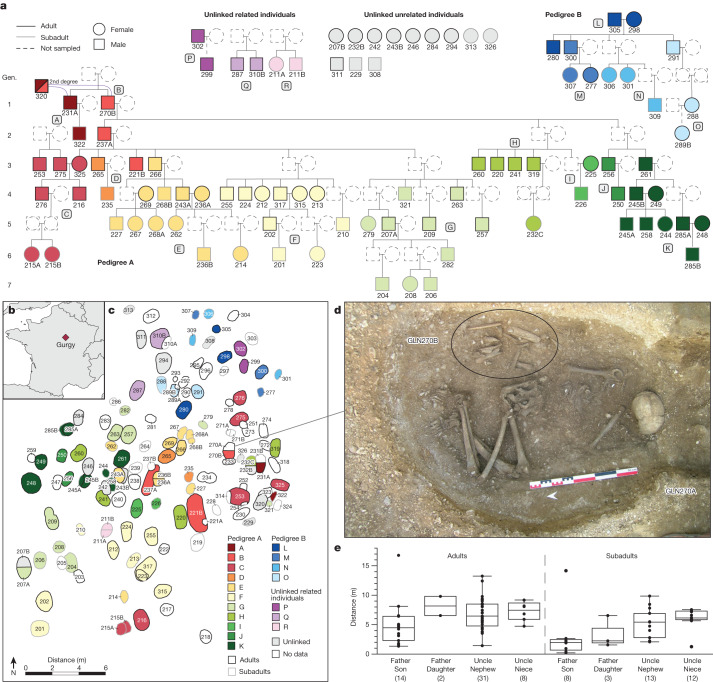
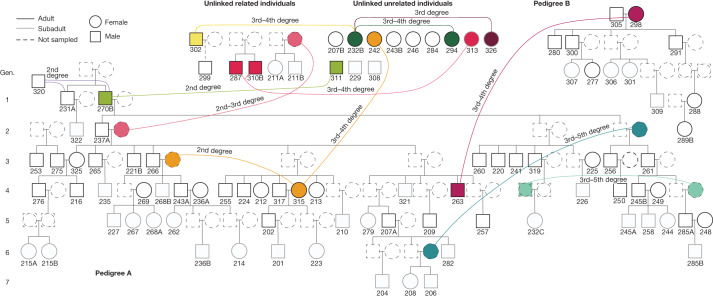
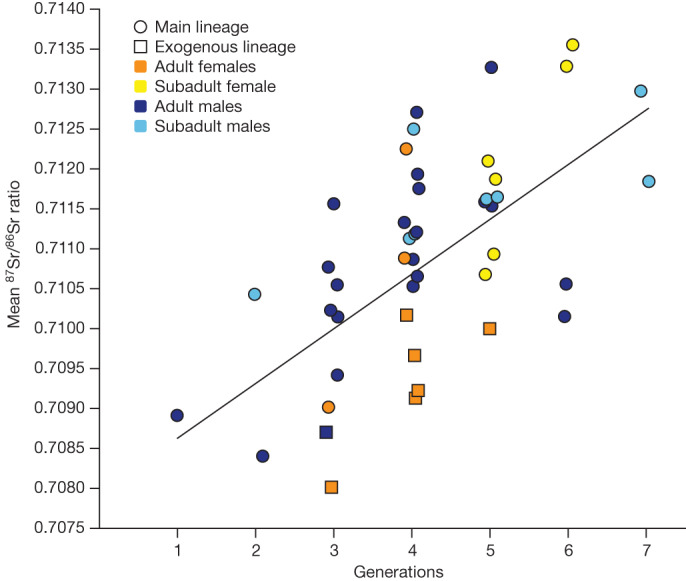
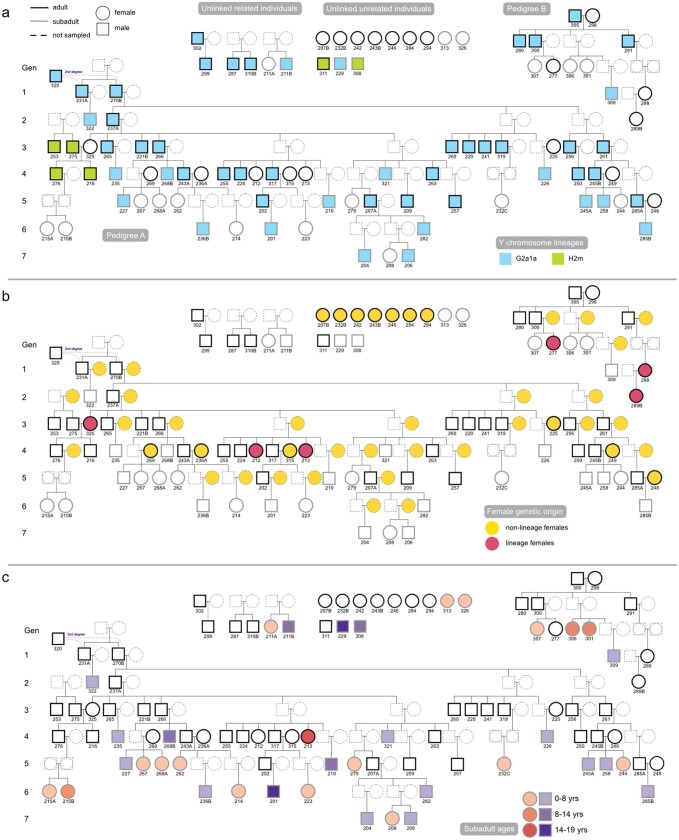
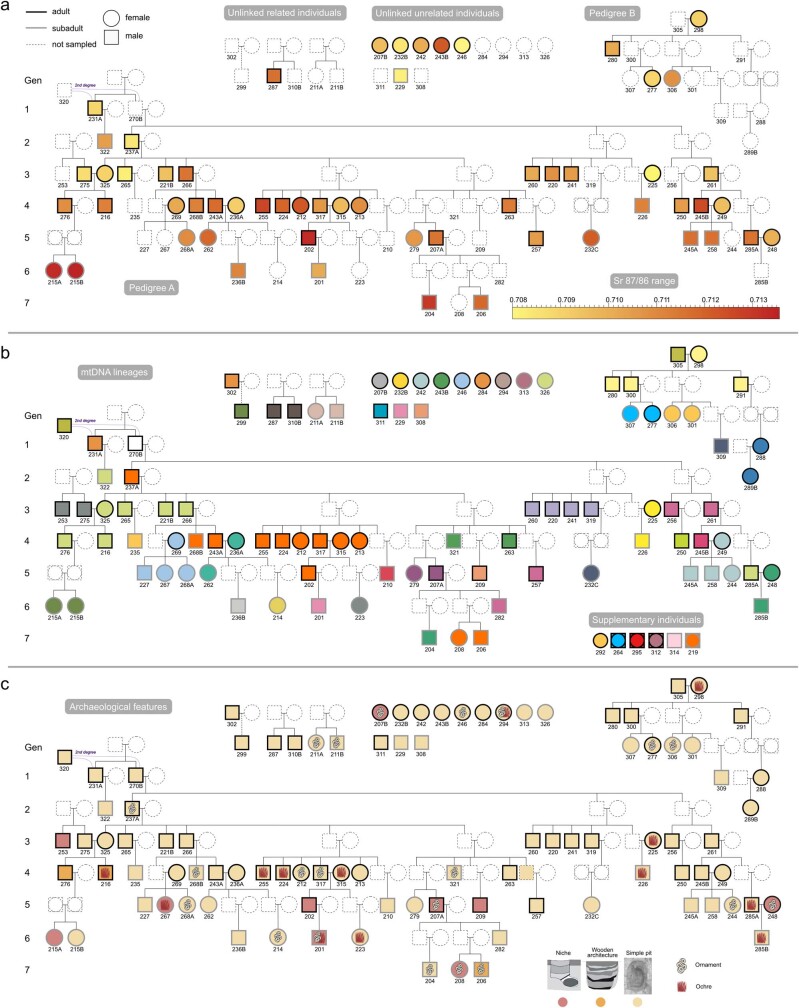
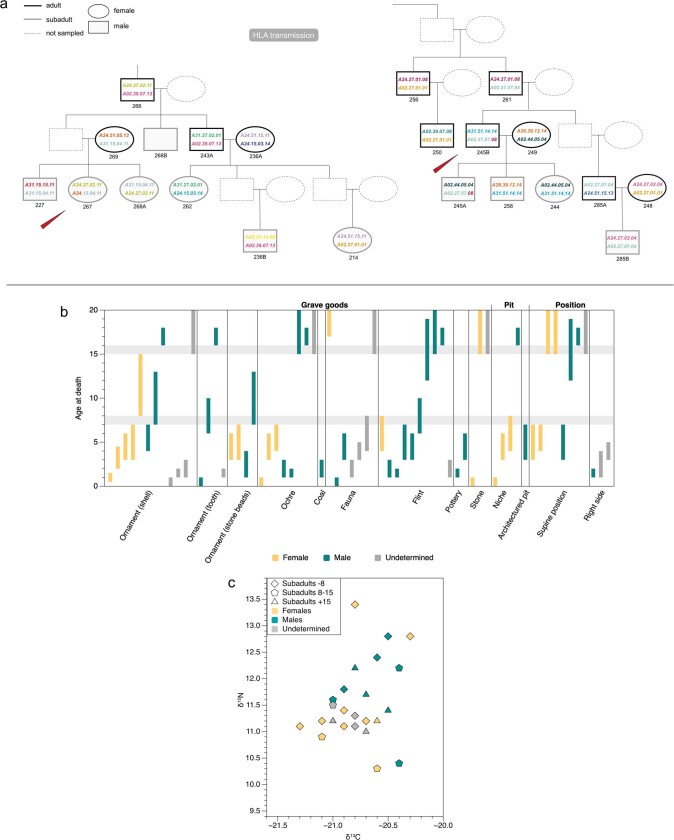
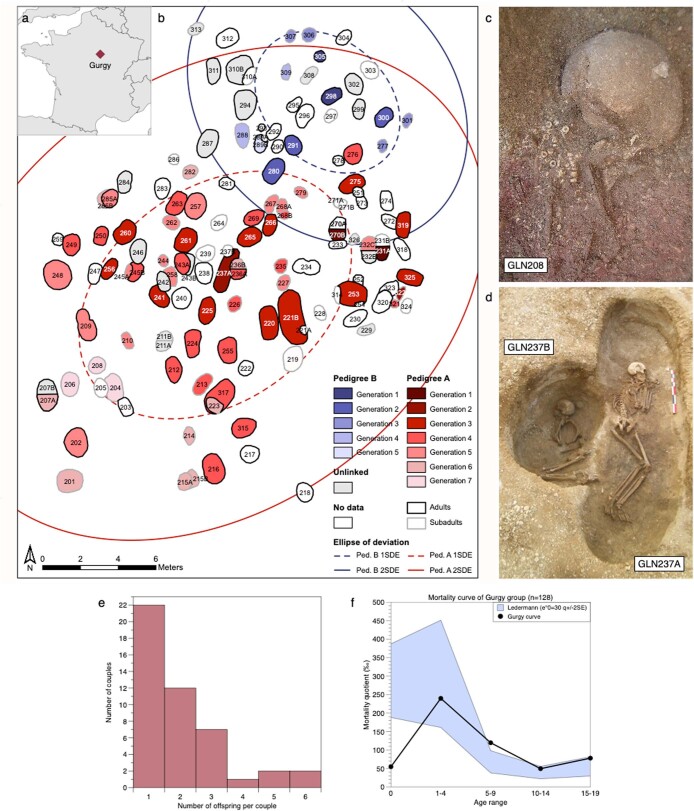
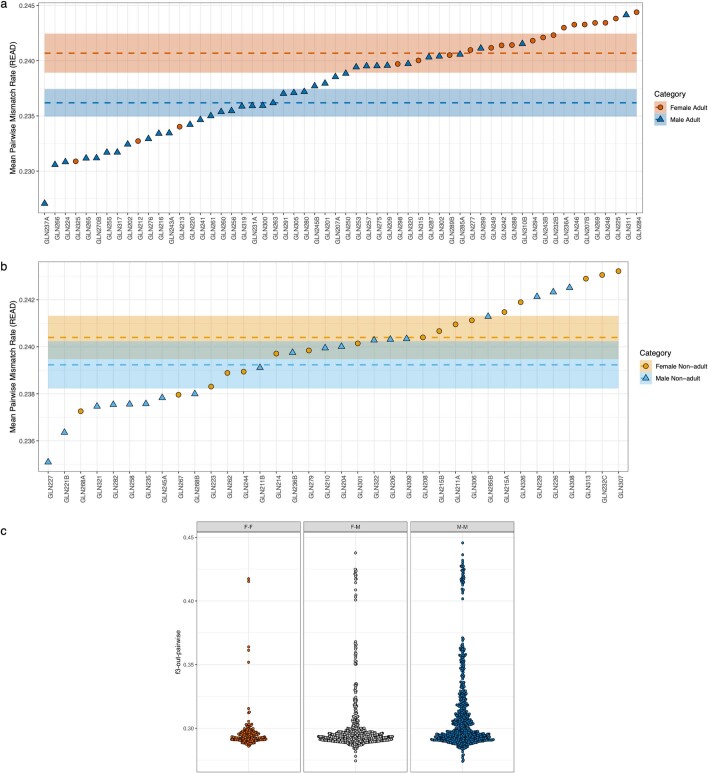
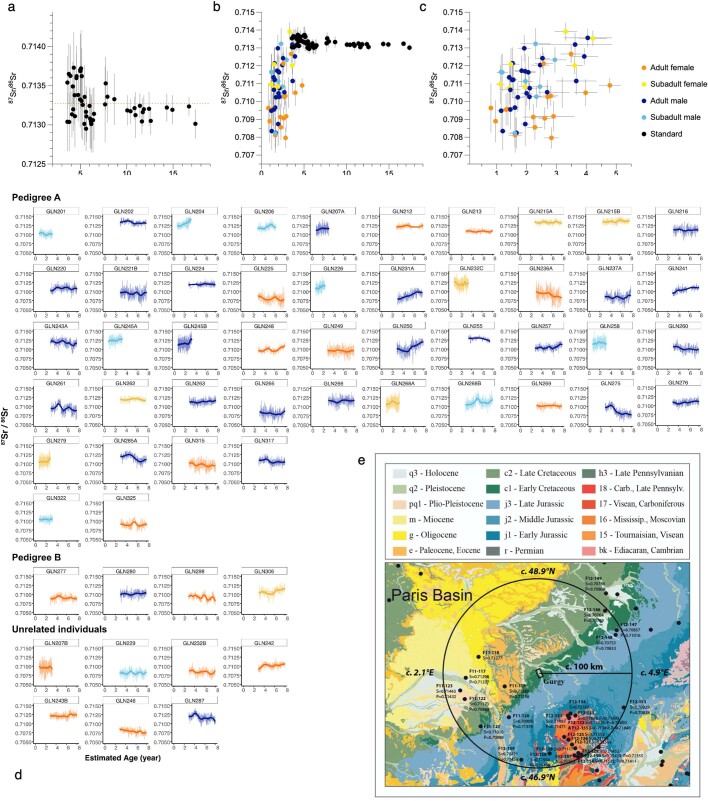
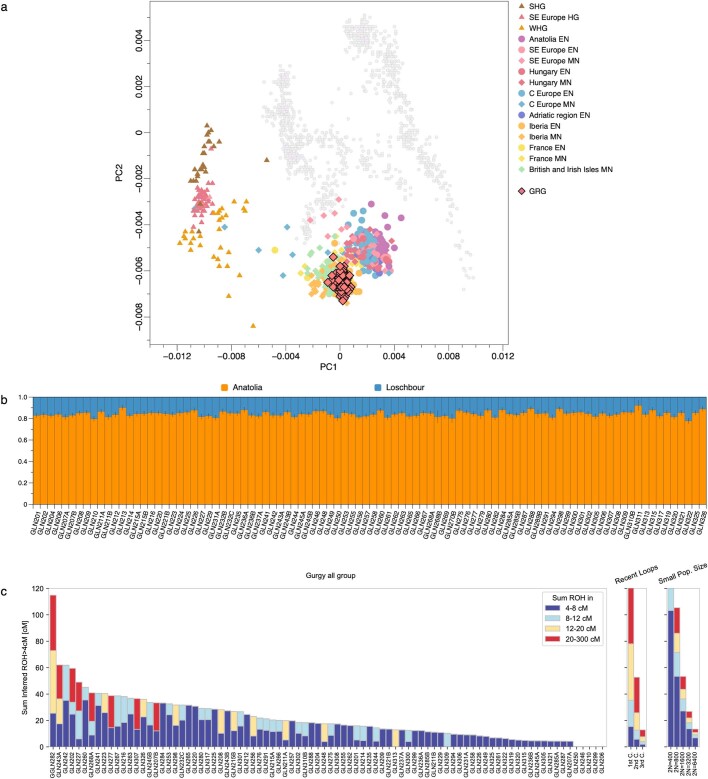
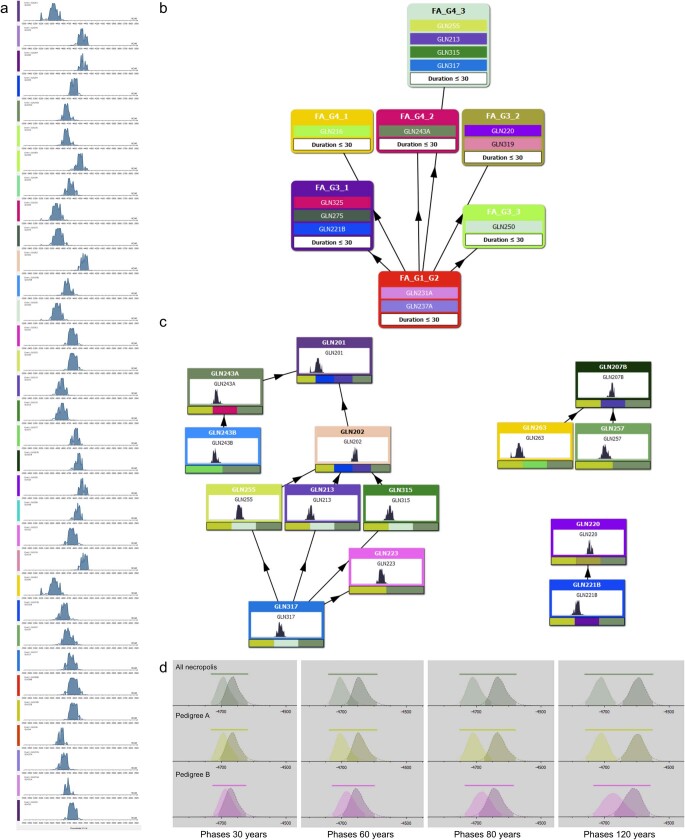
Social anthropology and ethnographic studies have described kinship systems and networks of contact and exchange in extant populations 1–4. However, for prehistoric societies, these systems can be studied only indirectly from biological and cultural remains. Stable isotope data, sex and age at death can provide insights into the demographic structure of a burial community and identify local versus non-local childhood signatures, archaeogenetic data can reconstruct the biological relationships between individuals, which enables the reconstruction of pedigrees, and combined evidence informs on kinship practices and residence patterns in prehistoric societies. Here we report ancient DNA, strontium isotope and contextual data from more than 100 individuals from the site Gurgy ‘les Noisats’ (France), dated to the western European Neolithic around 4850–4500 bc. We find that this burial community was genetically connected by two main pedigrees, spanning seven generations, that were patrilocal and patrilineal, with evidence for female exogamy and exchange with genetically close neighbouring groups. The microdemographic structure of individuals linked and unlinked to the pedigrees reveals additional information about the social structure, living conditions and site occupation. The absence of half-siblings and the high number of adult full siblings suggest that there were stable health conditions and a supportive social network, facilitating high fertility and low mortality 5. Age-structure differences and strontium isotope results by generation indicate that the site was used for just a few decades, providing new insights into shifting sedentary farming practices during the European Neolithic.
Overview
The claims and statistics of this paper haven’t been checked yet.
Run the check — free, no account needed. It reads the open-access text and checks the sources it cites.
Integrity signals
Registry
Cites
Statistics
Figures
Verification
Claims the paper makes
The claims and statistics of this paper haven’t been checked yet.
Run the check — free, no account needed. It reads the open-access text and checks the sources it cites.
Claims other papers make about this one
Each is checked against this paper’s own text: does it say what the citing paper says it does?
In the citing paper
“In particular, males tend to share more often the same haplogroup of the Y chromosome, whereas there is a greater diversity of haplogroups for mtDNA67–77.”
From Patrilineal segmentary systems provide a peaceful explanation for the post-Neolithic Y-chromosome bottleneck (2024) · cites this paper as [75]
In the citing paper
“In addition, kinship analyses based on ancient DNA data from the Neolithic and Bronze Age (mostly Europe) showed low frequency of half-brothers and half-sisters67–71,73–77, with the exception of Hazleton North long cairn72.”
From Patrilineal segmentary systems provide a peaceful explanation for the post-Neolithic Y-chromosome bottleneck (2024) · cites this paper as [75]
In the citing paper
“Consistent with the hypothesis of a rapid spread of patrilocality after the Neolithic transition, ancient DNA studies show that male relatedness is often higher than female relatedness within archaeological sites from the Neolithic and the Bronze Age (mostly from Europe).”
From Patrilineal segmentary systems provide a peaceful explanation for the post-Neolithic Y-chromosome bottleneck (2024) · cites this paper as [75]
Self-check
Percentages, sums and reported differences re-computed from the paper’s own numbers.
The self-check needs the paper’s full text.
Citations
Cites
The IntCal20 Northern Hemisphere Radiocarbon Age Calibration Curve (0–55 cal kBP)
Reimer, P. J., Austin, W. E. N., Bard, E., Bayliss, A., Blackwell, P. G., Bronk Ramsey, C., Butzin, M., Cheng, H., Edwards, R. L., Friedrich, M., et al. (2020) · Radiocarbon · doi:10.1017/rdc.2020.41 · Cited by 7,900 · cited 1×
“14c 75 and applied Bayesian chronological modelling based on the approach of the ChronoModel software 76 (Supplementary Note 13, Supplementary Table 25 and Extended Data Fig.”
Population Structure and Eigenanalysis
Patterson, N., Price, A. L., & Reich, D. (2006) · PLoS Genetics · doi:10.1371/journal.pgen.0020190 · Cited by 5,280
ANGSD: Analysis of Next Generation Sequencing Data
Korneliussen, T. S., Albrechtsen, A., & Nielsen, R. (2014) · BMC Bioinformatics · doi:10.1186/s12859-014-0356-4 · Cited by 2,982
Ancient Admixture in Human History
Patterson, N., Moorjani, P., Luo, Y., Mallick, S., Rohland, N., Zhan, Y., Genschoreck, T., Webster, T., & Reich, D. (2012) · Genetics · doi:10.1534/genetics.112.145037 · Cited by 2,848
Massive migration from the steppe was a source for Indo-European languages in Europe
Haak, W., Lazaridis, I., Patterson, N., Rohland, N., Mallick, S., Llamas, B., Brandt, G., Nordenfelt, S., Harney, E., Stewardson, K., et al. (2015) · Nature · doi:10.1038/nature14317 · Cited by 1,940
Self-citationThe Simons Genome Diversity Project: 300 genomes from 142 diverse populations
Mallick, S., Li, H., Lipson, M., Mathieson, I., Gymrek, M., Racimo, F., Zhao, M., Chennagiri, N., Nordenfelt, S., Tandon, A., et al. (2016) · Nature · doi:10.1038/nature18964 · Cited by 1,584
Genome-wide patterns of selection in 230 ancient Eurasians
Mathieson, I., Lazaridis, I., Rohland, N., Mallick, S., Patterson, N., Roodenberg, S. A., Harney, E., Stewardson, K., Fernandes, D., Novak, M., et al. (2015) · Nature · doi:10.1038/nature16152 · Cited by 1,515
Self-citationGnirke, A., Melnikov, A., Maguire, J., Rogov, P., LeProust, E. M., Brockman, W., Fennell, T., Giannoukos, G., Fisher, S., Russ, C., et al. (2009) · Nature Biotechnology · doi:10.1038/nbt.1523 · Cited by 1,433 · cited 1×
“Finally, a capture targeting 488 genes related to the immune response (including the highly polymorphic HLA) was applied to all of the libraries 46–48 .”
Genome sequence of a 45,000-year-old modern human from western Siberia
Fu, Q., Li, H., Moorjani, P., Jay, F., Slepchenko, S. M., Bondarev, A. A., Johnson, P. L. F., Aximu-Petri, A., Prüfer, K., de Filippo, C., et al. (2014) · Nature · doi:10.1038/nature13810 · Cited by 1,023
Genomic insights into the origin of farming in the ancient Near East
Lazaridis, I., Nadel, D., Rollefson, G., Merrett, D. C., Rohland, N., Mallick, S., Fernandes, D., Novak, M., Gamarra, B., Sirak, K., et al. (2016) · Nature · doi:10.1038/nature19310 · Cited by 955 · cited 2×
“We called the SNP genotypes according to the Affymetrix Human Origin (HO) panel (around 600,000 SNPs) 55,56 and the 1,240,000 panel 42 .”
Self-citation
Research works printed but not linked: 53
- Fox, R. Kinship and Marriage: An Anthropological Perspective (Cambridge Univ. Press, 1983).
- Lévi-Strauss, C. The Elementary Structures of Kinship (Beacon Press, 1971).
- Schneider, D. M. A Critique of the Study of Kinship (Univ. Michigan Press, 1984). · DOI
- Bocquet-Appel, J.-P. Paleoanthropological traces of a Neolithic demographic transition. Curr. Anthropol. 43, 637–650 (2002). · DOI
- Cassidy, L. M. et al. A dynastic elite in monumental Neolithic society. Nature 582, 384–388 (2020). · DOI · Paper page
- Sánchez-Quinto, F. et al. Megalithic tombs in western and northern Neolithic Europe were linked to a kindred society. Proc. Natl Acad. Sci. USA 116, 9469 (2019). · DOI · Paper page
- Fowler, C. et al. A high-resolution picture of kinship practices in an Early Neolithic tomb. Nature 601, 584–587 (2022). · DOI · Paper page
- Schroeder, H. et al. Unraveling ancestry, kinship, and violence in a Late Neolithic mass grave. Proc. Natl Acad. Sci. USA 116, 10705 (2019). · DOI · Paper page
- Chambon, P. & Thomas, A. The first monumental cemeteries of western Europe : the “Passy type” necropolis in the Paris basin around 4500 BC. J. Neolithic Archaeol. https://doi.org/10.12766/jna.2010.37 (2010). · DOI
- Constantin, C., Mordant, D. & Simonin, D. La culture de Cerny. Nouvelle Économie, Nouvelle Société au Néolithique. Actes du Colloque International de Nemours, 9-10-11 mai 1994 [French] Vol. 6 (Mémoires du Musée de Préhistoire d’Île-de-France, 1997).
- Rivollat, M. et al. When the waves of European neolithization met: first paleogenetic evidence from early farmers in the southern Paris Basin. PLoS ONE 10, e0125521 (2015). · DOI
- Rottier, S., Mordant, C., Chambon, P. & Thevenet, C. Découverte de plus d’une centaine de sépultures du Néolithique moyen à Gurgy, les Noisats (Yonne) [French]. Bull. Soc. Préhist. Fr. 102, 641–645 (2005). · DOI
- Rivollat, M. et al. Ancient genome-wide DNA from France highlights the complexity of interactions between Mesolithic hunter-gatherers and Neolithic farmers. Sci. Adv. 6, eaaz5344 (2020). · DOI
- Lipatov, M., Sanjeev, K., Patro, R. & Veeramah, K. R. Maximum likelihood estimation of biological relatedness from low coverage sequencing data. Preprint at bioRxiv https://doi.org/10.1101/023374 (2015). · DOI · Paper page
- Ringbauer, H. et al. ancIBD—screening for identity by descent segments in human ancient DNA. Preprint at BioRxiv https://doi.org/10.1101/2023.03.08.531671 (2023). · DOI
- Rottier, S. Observations préliminaires à l’étude des remplissages des tombes du Néolithique moyen I de Gurgy «Les Noisats» (Yonne) [French]. Rev. Archéol. Est 55, 279–285 (2006).
- Howell, N. Toward a uniformitarian theory of human paleodemography. J. Hum. Evol. 5, 25–40 (1976). · DOI
- Lazzerini, N. et al. Monthly mobility inferred from isoscapes and laser ablation strontium isotope ratios in caprine tooth enamel. Sci. Rep. 11, 2277 (2021). · DOI
- Rey, L., Rottier, S., Santos, F. & Goude, G. Sex and age-related social organization in the Neolithic: a promising survey from the Paris Basin. J. Archaeol. Sci. Rep. 38, 103092 (2021).
- Le Roy, M., Rottier, S. & Tillier, A.-M. Who was a ‘child’ during the Neolithic in France? Child. Past 11, 69–84 (2018). · DOI
- Rey, L., Goude, G. & Rottier, S. Comportements alimentaires au Néolithique: nouveaux résultats dans le Bassin parisien à partir de l’étude isotopique (δ13C, δ15N) de la nécropole de Gurgy «Les Noisats» (Yonne, Ve millénaire av. J.-C.) [French]. Bull. Mém. Soc. Anthropol. Paris 29, 54–69 (2017). · DOI
- Hrdy, S. B. in Family Relationships: An Evolutionary Perspective (eds Salmon, C. A. & Shackelford, T. K.) 39–68 (Oxford Univ. Press, 2007). · DOI · Paper page
- Ringbauer, H., Novembre, J. & Steinruecken, M. Parental relatedness through time revealed by runs of homozygosity in ancient DNA. Nat. Commun. https://doi.org/10.1038/s41467-021-25289-w (2021). · DOI
- Gage, T. B. Bio-mathematical approaches to the study of human variation in mortality. Yearb. Phys. Anthropol. 32, 185–214 (1989). · DOI
- Wood, J. W., Holman, D. J., O-Connor, K. A. & Ferrell, R. J. in Paleodemography: Age Distributions from Skeletal Samples (eds Hoppa R. D. & Vaupel J. W.) 129–168 (Cambridge Univ. Press, 2002). · DOI
- Rivollat, M. et al. Ancient DNA gives new insights into a Norman Neolithic monumental cemetery dedicated to male elites. Proc. Natl Acad. Sci. USA 119, e2120786119 (2022). · DOI · Paper page
- Pinhasi, R. et al. Optimal ancient DNA yields from the inner ear part of the human petrous bone. PLoS ONE 10, e0129102 (2015). · DOI · Paper page
- Velsko, I., Skourtianoti, E. & Brandt, G. Ancient DNA extraction from skeletal material. protocols.io https://doi.org/10.17504/protocols.io.baksicwe (2020). · DOI
- Stahl, R. et al. Illumina double-stranded DNA dual indexing for ancient DNA. protocols.io https://doi.org/10.17504/protocols.io.bakticwn (2020). · DOI
- Aron, F. & Brandt, G. Library adapter preparation for dual-index double stranded DNA Illumina sequencing. protocols.io https://www.doi.org/10.17504/protocols.io.bem5jc86 (2020). · DOI
- Gansauge, M.-T. & Meyer, M. Single-stranded DNA library preparation for the sequencing of ancient or damaged DNA. Nat. Protoc. 8, 737–748 (2013). · DOI · Paper page
- Aron, F. & Brandt, G. Amplification and pooling. protocols.io https://doi.org/10.17504/protocols.io.beqkjduw (2020). · DOI
- Peltzer, A. et al. EAGER: efficient ancient genome reconstruction. Genome Biol. 17, 60 (2016). · DOI · Paper page
- Maricic, T., Whitten, M. & Pääbo, S. Multiplexed DNA sequence capture of mitochondrial genomes using PCR products. PLoS ONE 5, e14004 (2010). · DOI
- Rohrlach, A. B. et al. Using Y-chromosome capture enrichment to resolve haplogroup H2 shows new evidence for a two-path Neolithic expansion to Western Europe. Sci. Rep. 11, 15005 (2021). · DOI
- Barquera, R. et al. Origin and health status of first-generation Africans from early colonial Mexico. Curr. Biol. 30, 2078–2091 (2020). · DOI
- Immel, A. et al. Genome-wide study of a Neolithic Wartberg grave community reveals distinct HLA variation and hunter-gatherer ancestry. Commun. Biol. 4, 113 (2021). · DOI
- Schubert, M., Lindgreen, S. & Orlando, L. AdapterRemoval v2: rapid adapter trimming, identification, and read merging. BMC Res. Notes 9, 88 (2016). · DOI
- Li, H. & Durbin, R. Fast and accurate long-read alignment with Burrows–Wheeler transform. Bioinformatics 26, 589–595 (2010). · DOI · Paper page
- Mittnik, A., Wang, C.-C., Svoboda, J. & Krause, J. A molecular approach to the sexing of the triple burial at the upper Paleolithic site of Dolní Věstonice. PLoS ONE 11, e0163019 (2016). · DOI
- Rubinacci, S., Ribeiro, D. M., Hofmeister, R. J. & Delaneau, O. Efficient phasing and imputation of low-coverage sequencing data using large reference panels. Nat. Genet. 53, 120–126 (2021). · DOI
- Andrews, R. M. et al. Reanalysis and revision of the Cambridge reference sequence for human mitochondrial DNA. Nat. Genet. 23, 147–147 (1999). · DOI · Paper page
- Kearse, M. et al. Geneious Basic: an integrated and extendable desktop software platform for the organization and analysis of sequence data. Bioinformatics 28, 1647–1649 (2012). · DOI
- Weissensteiner, H. et al. HaploGrep 2: mitochondrial haplogroup classification in the era of high-throughput sequencing. Nucleic Acids Res. 44, W58–W63 (2016). · DOI
- Rohrlach, A. B., Tuke, J., Popli, D. & Haak, W. BREADR: an R package for the Bayesian estimation of genetic relatedness from low-coverage genotype data. Preprint at bioRxiv https://doi.org/10.1101/2023.04.17.537144 (2023). · DOI
- Szolek, A. et al. OptiType: precision HLA typing from next-generation sequencing data. Bioinformatics 30, 3310–3316 (2014). · DOI
- van de Loosdrecht, M. et al. Pleistocene North African genomes link Near Eastern and sub-Saharan African human populations. Science 360, 548–552 (2018). · DOI
- Walsh, S. et al. Global skin colour prediction from DNA. Hum. Genet. 136, 847–863 (2017). · DOI
- Villalba-Mouco, V. et al. Survival of Late Pleistocene hunter-gatherer ancestry in the Iberian peninsula. Curr. Biol. 29, 1169–1177 (2019). · DOI
- Chintalapati, M., Patterson, N. & Moorjani, P. The spatio-temporal patterns of major human admixture events during the European Holocene. eLife 11, e77625 (2022). · DOI
- Le Roy, M. et al. Distinct ancestries for similar funerary practices? A GIS analysis comparing funerary, osteological and aDNA data from the Middle Neolithic necropolis Gurgy “Les Noisats” (Yonne, France). J. Archaeol. Sci. 73, 45–54 (2016). · DOI
- Lanos, P. & Philippe, A. Event Model: a Robust Bayesian Tool for Chrono-Logical Model. HAL 01241720 (HAL Open Science, 2015); https://hal.science/hal-01241720/.
- Willmes, M. et al. The IRHUM (Isotopic Reconstruction of Human Migration) database—bioavailable strontium isotope ratios for geochemical fingerprinting in France. Earth Syst. Sci. Data 6, 117–122 (2013). · DOI
Cited by
Guyon, L., Guez, J., Toupance, B., Heyer, E., & Chaix, R. (2024) · Nature Communications · doi:10.1038/s41467-024-47618-5 · Cited by 28
Metadata
- Authors
- Rivollat, M., Rohrlach, A. B., Ringbauer, H., Childebayeva, A., Mendisco, F., Barquera, R., Szolek, A., Le Roy, M., Colleran, H., Tuke, J., Aron, F., Pemonge, M.-H., Späth, E., Télouk, P., Rey, L., Goude, G., Balter, V., Krause, J., Rottier, S., Deguilloux, M.-F., & Haak, W.
- Venue
- Nature
- Published
- 2023-07-26
- Volume
- 620
- Issue
- 7974
- Pages
- 600-606
- ISSN
- 0028-0836
- 1476-4687
- PMC
- PMC10432279
- Cited by
- 116
- References
- 17
- Language
- en
About these checks
Registry, retraction, Cites and statistics results are computed, not judged, with one exception: a printed reference that no index lists is read once by a model before it counts as a citation error. Claims are extracted by a model and kept only when their quote appears verbatim in the text; each cited source is then checked, with a model’s help, for whether it says what the claim relies on. Those verdicts can be wrong — read the claim’s quote and the cited source before relying on one.
Statistics and arithmetic are recomputed, not judged.
Confidence bands are shown only for fields calibrated on our annotated test set. None is calibrated yet, so no band is shown.
What counts as a claim ›How we measure confidence ›How we check this ›
Are you an author, or do you see a problem with this page? Request a review
How to cite
Cite CoChat for the checks on this page, and the paper for its own findings.
- This page
- CoChat. (2026). Citation check: Extensive pedigrees reveal the social organization of a Neolithic community. https://app.cochat.ai/papers/10.1038/s41586-023-06350-8
- The paper
- Rivollat, M., Rohrlach, A. B., Ringbauer, H., Childebayeva, A., Mendisco, F., Barquera, R., Szolek, A., Le Roy, M., Colleran, H., Tuke, J., Aron, F., Pemonge, M.-H., Späth, E., Télouk, P., Rey, L., Goude, G., Balter, V., Krause, J., Rottier, S., . . . Haak, W. (2023). Extensive pedigrees reveal the social organization of a Neolithic community. Nature. https://doi.org/10.1038/s41586-023-06350-8
