

The DOI matches its Crossref record; 10 of the 10 references it cites were found in a registry or an index.
Ancient DNA gives new insights into a Norman Neolithic monumental cemetery dedicated to male elites
Abstract
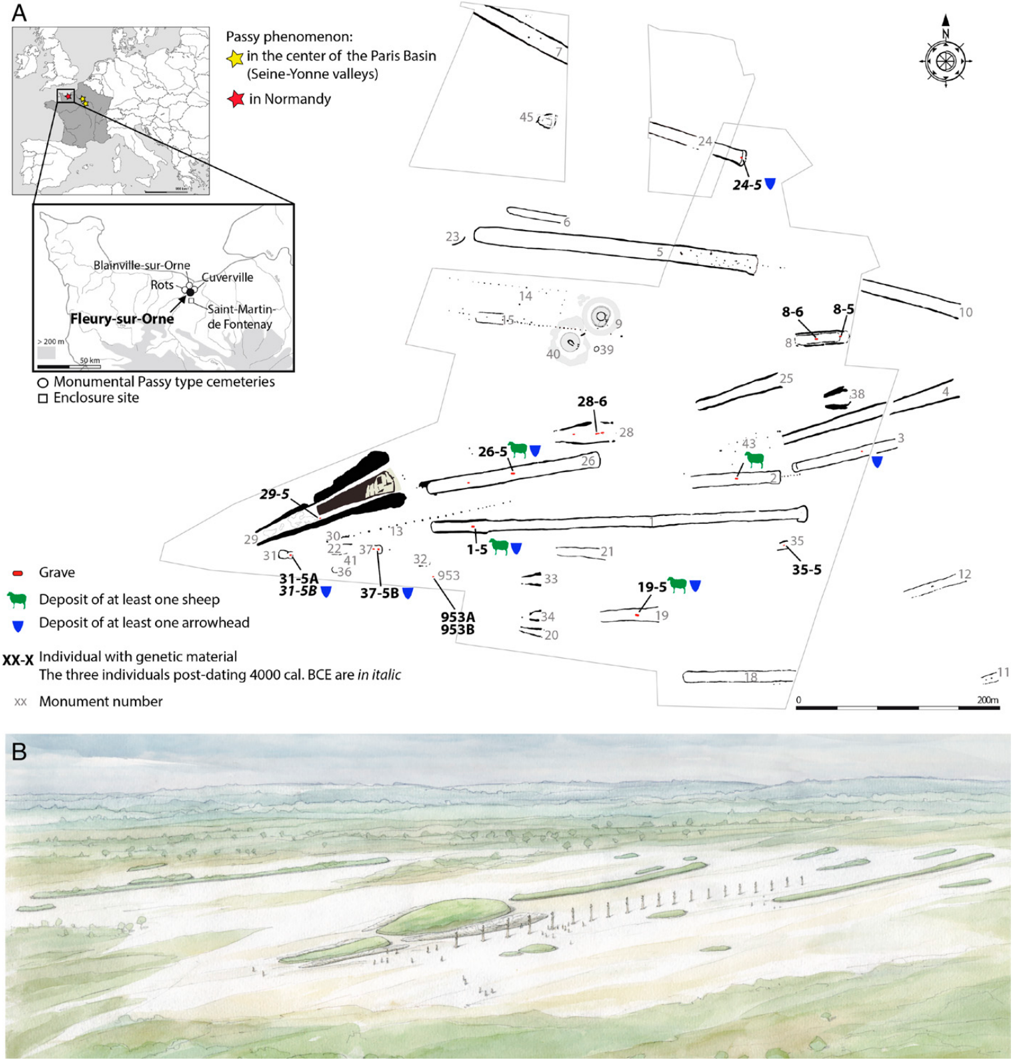
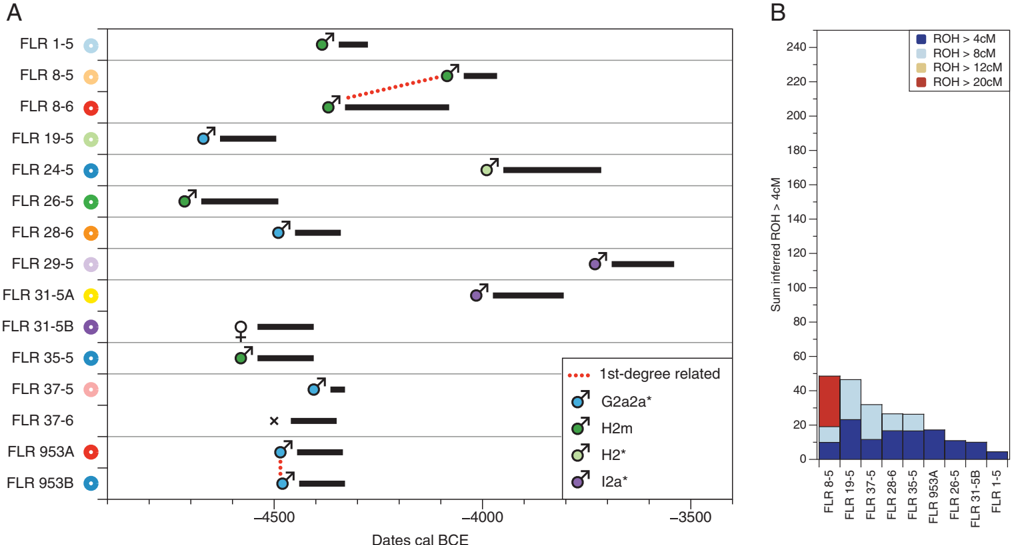
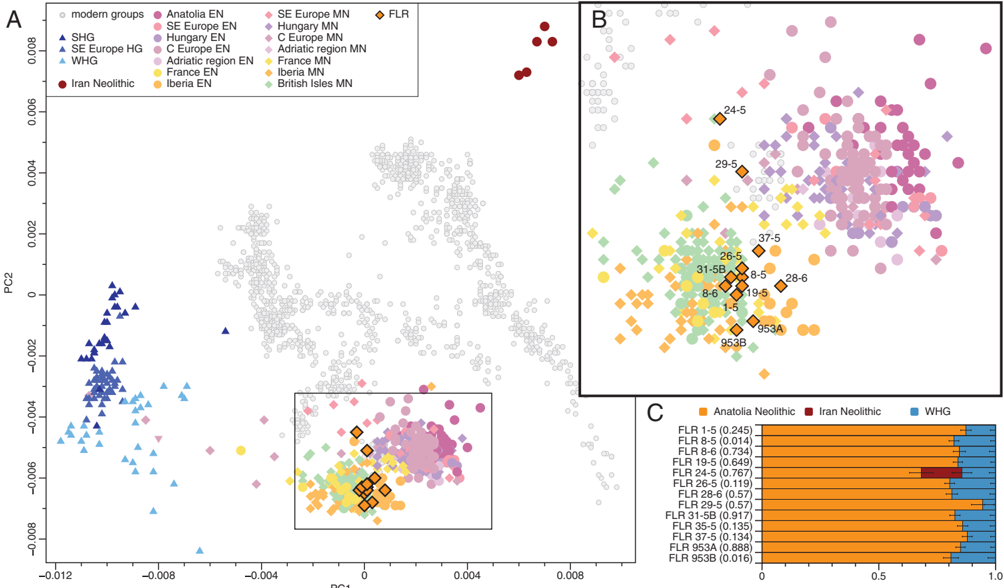
Significance: By integrating genomic and archaeological data, we provide new insights into the Neolithic French monumental site of Fleury-sur-Orne in Normandy, where a group of selected individuals was buried in impressively long monuments. The earliest individuals buried at Fleury-sur-Orne match the expected western European Neolithic genetic diversity, while three individuals, designated as genetic outliers, were buried after 4,000 calibrated BCE. We hypothesize that different, unrelated families or clans used the site over several centuries. Thirteen of 14 of the analyzed individuals were male, indicating an overarching patrilineal system. However, one exception, a female buried with a symbolically male artifact, suggests that the embodiment of the male gender in death was required to access burial at the monumental structures.
Overview
The claims and statistics of this paper haven’t been checked yet.
Run the check — free, no account needed. It reads the open-access text and checks the sources it cites.
Integrity signals
Registry
Cites
Statistics
Figures
Verification
Claims the paper makes
The claims and statistics of this paper haven’t been checked yet.
Run the check — free, no account needed. It reads the open-access text and checks the sources it cites.
Claims other papers make about this one
Each is checked against this paper’s own text: does it say what the citing paper says it does?
In the citing paper
“In addition, kinship analyses based on ancient DNA data from the Neolithic and Bronze Age (mostly Europe) showed low frequency of half-brothers and half-sisters67–71,73–77, with the exception of Hazleton North long cairn72.”
From Patrilineal segmentary systems provide a peaceful explanation for the post-Neolithic Y-chromosome bottleneck (2024) · cites this paper as [73]
In the citing paper
“Consistent with the hypothesis of a rapid spread of patrilocality after the Neolithic transition, ancient DNA studies show that male relatedness is often higher than female relatedness within archaeological sites from the Neolithic and the Bronze Age (mostly from Europe).”
From Patrilineal segmentary systems provide a peaceful explanation for the post-Neolithic Y-chromosome bottleneck (2024) · cites this paper as [73]
In the citing paper
“In particular, males tend to share more often the same haplogroup of the Y chromosome, whereas there is a greater diversity of haplogroups for mtDNA67–77.”
From Patrilineal segmentary systems provide a peaceful explanation for the post-Neolithic Y-chromosome bottleneck (2024) · cites this paper as [73]
Self-check
Percentages, sums and reported differences re-computed from the paper’s own numbers.
The self-check needs the paper’s full text.
Citations
Cites
Population Structure and Eigenanalysis
Patterson, N., Price, A. L., & Reich, D. (2006) · PLoS Genetics · doi:10.1371/journal.pgen.0020190 · Cited by 5,280
ANGSD: Analysis of Next Generation Sequencing Data
Korneliussen, T. S., Albrechtsen, A., & Nielsen, R. (2014) · BMC Bioinformatics · doi:10.1186/s12859-014-0356-4 · Cited by 2,982
Ancient Admixture in Human History
Patterson, N., Moorjani, P., Luo, Y., Mallick, S., Rohland, N., Zhan, Y., Genschoreck, T., Webster, T., & Reich, D. (2012) · Genetics · doi:10.1534/genetics.112.145037 · Cited by 2,848
Massive migration from the steppe was a source for Indo-European languages in Europe
Haak, W., Lazaridis, I., Patterson, N., Rohland, N., Mallick, S., Llamas, B., Brandt, G., Nordenfelt, S., Harney, E., Stewardson, K., et al. (2015) · Nature · doi:10.1038/nature14317 · Cited by 1,940
Self-citationGenome-wide patterns of selection in 230 ancient Eurasians
Mathieson, I., Lazaridis, I., Rohland, N., Mallick, S., Patterson, N., Roodenberg, S. A., Harney, E., Stewardson, K., Fernandes, D., Novak, M., et al. (2015) · Nature · doi:10.1038/nature16152 · Cited by 1,515
Self-citationThe genetic history of Ice Age Europe
Fu, Q., Posth, C., Hajdinjak, M., Petr, M., Mallick, S., Fernandes, D., Furtwängler, A., Haak, W., Meyer, M., Mittnik, A., et al. (2016) · Nature · doi:10.1038/nature17993 · Cited by 959
Self-citationGenomic insights into the origin of farming in the ancient Near East
Lazaridis, I., Nadel, D., Rollefson, G., Merrett, D. C., Rohland, N., Mallick, S., Fernandes, D., Novak, M., Gamarra, B., Sirak, K., et al. (2016) · Nature · doi:10.1038/nature19310 · Cited by 955
Partial uracil–DNA–glycosylase treatment for screening of ancient DNA
Rohland, N., Harney, E., Mallick, S., Nordenfelt, S., & Reich, D. (2015) · Philosophical Transactions of the Royal Society B: Biological Sciences · doi:10.1098/rstb.2013.0624 · Cited by 572
Parallel palaeogenomic transects reveal complex genetic history of early European farmers
Lipson, M., Szécsényi-Nagy, A., Mallick, S., Pósa, A., Stégmár, B., Keerl, V., Rohland, N., Stewardson, K., Ferry, M., Michel, M., et al. (2017) · Nature · doi:10.1038/nature24476 · Cited by 389
Self-citationEstimating genetic kin relationships in prehistoric populations
Monroy Kuhn, J. M., Jakobsson, M., & Günther, T. (2018) · PLOS ONE · doi:10.1371/journal.pone.0195491 · Cited by 330
Research works printed but not linked: 67
- 10.1038/s41586-020-2378-6 · DOI · Paper page
- 10.1073/pnas.1818037116 · DOI · Paper page
- 10.1073/pnas.1820210116 · DOI · Paper page
- 10.1016/j.cub.2021.03.050 · DOI
- 10.1038/s41586-021-04241-4 · DOI · Paper page
- M. Godelier, Métamorphoses de la parenté (Fayard, 2004).
- 10.1126/science.aax6219 · DOI · Paper page
- 10.1371/journal.pone.0241278 · DOI
- 10.1038/s41598-021-89090-x · DOI
- 10.1073/pnas.1113710109 · DOI
- 10.1016/S0883-2927(97)00030-9 · DOI
- 10.1073/pnas.1706355114 · DOI · Paper page
- E. Ghesquière , “Monumental cemeteries of the 5th millenium BC: The Fleury-sur-Orne contribution” in Megaliths–Societies–Landscapes, Early Monumentality and Social Differentiation in Neolithic Europe, J. Müller, M. Hinz, M. Wunderlich, Eds. (Verlag Dr. Rudolf Habelt GmbH, Bonn, Germany, 2019), pp. 177–191.
- P. Duhamel, M. Fonton, H. Carré, “La nécropole monumentale Cerny de Passy (Yonne): Description d'ensemble et problèmes d'interprétation” in La culture de Cerny, nouvelle économie, nouvelle société au Néolithique. Actes du Colloques International de Nemours, 9-10-11 mai 1994, C. Constantin, D. Mordant, D. Simonin, Eds. (Mémoires du Musée de préhistoire d'Ile-de-France, 1997), vol. 6, pp. 397–448.
- C. Constantin, D. Mordant, D. Simonin, La culture de Cerny. Nouvelle économie, nouvelle société au Néolithique. Actes du Colloque International de Nemours, 9-10-11 mai 1994 (Mémoires du Musée de Préhistoire d'Île-de-France, 1997), vol. 6.
- P. Duhamel, D. Mordant, “Les nécropoles monumentales Cerny du bassin Seine-Yonne” in La culture de Cerny, nouvelle économie, nouvelle société au Néolithique. Actes du Colloques International de Nemours, 9-10-11 mai 1994, C. Constantin, D. Mordant, D. Simonin, Eds. (Mémoires du Musée de Préhistoire d'Île-de-France, 1997), vol. 6, pp. 481–488.
- P. Duhamel, M. Midgley, “Espaces, monumentalisme et pratiques funéraires des sociétés néolithiques en voie de hiérarchisation - Les nécropoles monumentales Cerny du bassin Seine-Yonne” in Archéologie des Pratiques Funéraires. Approches Critiques, L. Barry, Ed. (Bibracte 9, Glux-en-Glenne, France, 2004), pp. 211–248.
- P. Chambon, A. Thomas, The first monumental cemeteries of western Europe: The “Passy type” necropolis in the Paris basin around 4500 BC. J. Neolithic Archaeol., 10.12766/jna.2010.37 (2010). · DOI
- P. Chambon, D. Mordant, J.-G. Pariat, “Sépultures du Néolithique moyen en Bassin parisien: Le cas des architectures sépulcrales” in Relations interrégionales au Néolithique entre Bassin parisien et Bassin rhénan. Actes du 26e Colloque interrégional sur le Néolithique (Luxembourg, 8–9 November 2003), F. Le Brun-Ricalens, F. Valotteau, A. Hauzeur, Eds. (Archeologia Mosellana, 2007), pp. 445–467.
- 10.3406/bspf.2003.12869 · DOI
- P. Chambon, “La nécropole de Balloy Les Réaudins: Approche archéo-anthropologique” in La culture de Cerny, nouvelle économie, nouvelle société au Néolithique. Actes du Colloque International de Nemours, 9-10-11 mai 1994, C. Constantin, D. Mordant, D. Simonin, Eds. (Mémoires du Musée de préhistoire d'Ile-de-France, 1997), vol. 6, pp. 489–498.
- 10.3406/bspf.2014.14398 · DOI
- A. Thomas “Identités funéraires variants biologiques et facteurs chronologiques: Une nouvelle perception du contexte culturel et social du Cerny (Bassin parisien 4700-4300 avant J.-C.) ” PhD thesis University Bordeaux 1 Bordeaux France (2011).
- A. Thomas, Social discriminations through the grave: Identity and status of the dead in the Cerny culture (Middle Neolithic, Paris Basin, France). Anthropologie 52, 171–182 (2014).
- 10.3406/bspf.2009.13894 · DOI
- 10.1002/ajpa.22504 · DOI
- I. Sidéra, “Le mobilier en matières dures animales en milieu funéraire Cerny: Symbolisme et socio-économie” in La culture de Cerny, nouvelle économie, nouvelle société au Néolithique. Actes du Colloque International de Nemours 9-10-11 mai 1994, C. Constantin, D. Mordant, D. Simonin, Eds. (Mémoires du Musée de Préhistoire d'Île-de-France, 1997), vol. 6, pp. 499–513.
- J. Desloges, “Les premières architectures funéraires de Basse-Normandie” in La culture de Cerny, nouvelle économie, nouvelle société au Néolithique. Actes du Colloque International de Nemours, 9-10-11 mai 1994, C. Constantin, D. Mordant, D. Simonin, Eds. (Mémoires du Musée de Préhistoire d'Île-de-France, 1997), vol. 6, pp. 515–539.
- 10.1126/sciadv.aaz5344 · DOI
- 10.1371/journal.pone.0014004 · DOI
- 10.1038/s41598-021-94491-z · DOI
- 10.1002/ajpa.10012 · DOI
- 10.1002/ajpa.23282 · DOI
- 10.1002/(SICI)1099-1212(199901/02)9:1<39::AID-OA458>3.0.CO;2-V · DOI
- 10.1126/science.1241844 · DOI · Paper page
- 10.1126/science.1176869 · DOI · Paper page
- 10.1073/pnas.1918034117 · DOI
- 10.1038/s41559-019-0871-9 · DOI
- 10.1038/nature25778 · DOI
- 10.1038/s41467-019-09209-7 · DOI
- 10.1038/nature25738 · DOI · Paper page
- 10.1073/pnas.1518445113 · DOI
- 10.1016/j.cub.2019.02.006 · DOI
- 10.1038/s41559-020-1102-0 · DOI
- 10.1126/sciadv.abi7038 · DOI
- 10.1093/genetics/iyaa045 · DOI
- G. Bailloud, “Le Néolithique et Chalcolithique en France” in La Protohistoire de l’Europe, J. Lichardus, M. Lichardus, Eds. (PUF, Paris, France, 1985), pp. 516–568. · DOI
- 10.1371/journal.pbio.1000536 · DOI · Paper page
- 10.1038/s41598-017-15480-9 · DOI
- 10.1073/pnas.1100723108 · DOI
- 10.1038/s41467-021-25289-w · DOI
- A. Chancerel C. Marcigny E. Ghesquière “Le plateau de mondeville (calvados): Du néolithique à l'âge du bronze” (Documents d'archéologie française 99 Edition de la Maison des Sciences de l'Homme Paris France 2006). · DOI
- 10.3406/bspf.2004.12957 · DOI
- 10.1017/S0003598X00068307 · DOI
- E. Orfanou M. Himmel F. Aron W. Haak Minimally-invasive sampling of pars petrosa (os temporale) for ancient DNA extraction V.2. (2020). dx.doi.org/10.17504/protocols.io.bqd8ms9w. Accessed 11 December 2020. · DOI
- G. U. Neumann A. Andrades Valtueña J. A. Fellows Yates R. Stahl G. Brandt Tooth sampling from the inner pulp chamber for ancient DNA extraction V.2. (2020). https://doi.org/10.17504/protocols.io.bqebmtan. Accessed 11 December 2020. · DOI
- I. Velsko E. Skourtianoti G. Brandt Ancient DNA extraction from skeletal material. (2020). https://doi.org/10.17504/protocols.io.baksicwe. Accessed 11 December 2020. · DOI
- F. Aron G. U. Neumann G. Brandt Half-UDG treated double-stranded ancient DNA library preparation for Illumina sequencing. (2020). dx.doi.org/10.17504/protocols.io.bmh6k39e. Accessed 11 December 2020. · DOI
- R. Stahl Illumina double-stranded DNA dual indexing for ancient DNA. (2020). https://doi.org/10.17504/protocols.io.bakticwn. Accessed 15 June 2021. · DOI
- 10.1186/s13059-016-0918-z · DOI · Paper page
- 10.1186/s13104-016-1900-2 · DOI
- 10.1093/bioinformatics/btp698 · DOI · Paper page
- 10.1093/bioinformatics/btp352 · DOI · Paper page
- 10.1371/journal.pone.0163019 · DOI
- 10.1038/13779 · DOI · Paper page
- 10.1093/bioinformatics/bts199 · DOI
- 10.1093/nar/gkw233 · DOI
Cited by
Guyon, L., Guez, J., Toupance, B., Heyer, E., & Chaix, R. (2024) · Nature Communications · doi:10.1038/s41467-024-47618-5 · Cited by 28
Metadata
- Authors
- Rivollat, M., Thomas, A., Ghesquière, E., Rohrlach, A. B., Späth, E., Pemonge, M.-H., Haak, W., Chambon, P., & Deguilloux, M.-F.
- Venue
- Proceedings of the National Academy of Sciences
- Publisher
- National Academy of Sciences
- Published
- 2022-04-21
- Volume
- 119
- Issue
- 18
- ISSN
- 0027-8424
- 1091-6490
- Cited by
- 44
- References
- 10
- Language
- en
- Funders
- Fondation Fyssen (2017-2018)
- ANR / DFG (ANR-17-FRAL-0010, DFG-HA-5407/4-1)
- European Union''''s Horizon 2020 research and innovation program (771234 - PALEoRIDER)
About these checks
Registry, retraction, Cites and statistics results are computed, not judged, with one exception: a printed reference that no index lists is read once by a model before it counts as a citation error. Claims are extracted by a model and kept only when their quote appears verbatim in the text; each cited source is then checked, with a model’s help, for whether it says what the claim relies on. Those verdicts can be wrong — read the claim’s quote and the cited source before relying on one.
Statistics and arithmetic are recomputed, not judged.
Confidence bands are shown only for fields calibrated on our annotated test set. None is calibrated yet, so no band is shown.
What counts as a claim ›How we measure confidence ›How we check this ›
Are you an author, or do you see a problem with this page? Request a review
How to cite
Cite CoChat for the checks on this page, and the paper for its own findings.
- This page
- CoChat. (2026). Citation check: Ancient DNA gives new insights into a Norman Neolithic monumental cemetery dedicated to male elites. https://app.cochat.ai/papers/10.1073/pnas.2120786119
- The paper
- Rivollat, M., Thomas, A., Ghesquière, E., Rohrlach, A. B., Späth, E., Pemonge, M.-H., Haak, W., Chambon, P., & Deguilloux, M.-F. (2022). Ancient DNA gives new insights into a Norman Neolithic monumental cemetery dedicated to male elites. Proceedings of the National Academy of Sciences. https://doi.org/10.1073/pnas.2120786119
