

A high-performance speech neuroprosthesis
Open accessPublished version of a preprint
The DOI matches its Crossref record; 60 of the 60 references it cites were found in a registry or an index; 28 of the 35 sources its claims cite were checked for support.
Abstract
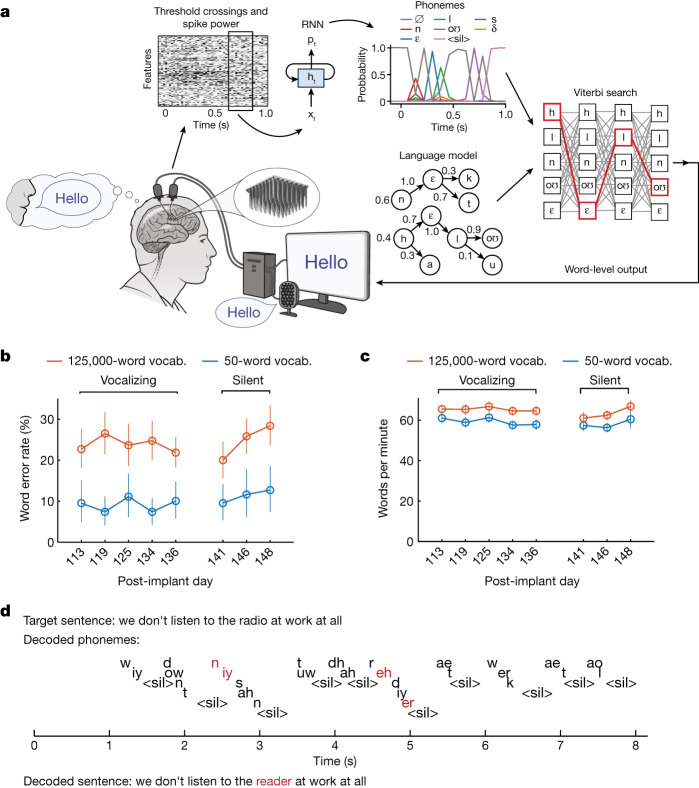
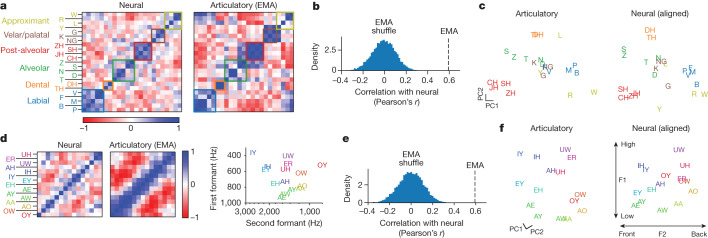
Abstract Speech brain–computer interfaces (BCIs) have the potential to restore rapid communication to people with paralysis by decoding neural activity evoked by attempted speech into text 1,2 or sound 3,4 . Early demonstrations, although promising, have not yet achieved accuracies sufficiently high for communication of unconstrained sentences from a large vocabulary 1–7 . Here we demonstrate a speech-to-text BCI that records spiking activity from intracortical microelectrode arrays. Enabled by these high-resolution recordings, our study participant—who can no longer speak intelligibly owing to amyotrophic lateral sclerosis—achieved a 9.1% word error rate on a 50-word vocabulary (2.7 times fewer errors than the previous state-of-the-art speech BCI 2 ) and a 23.8% word error rate on a 125,000-word vocabulary (the first successful demonstration, to our knowledge, of large-vocabulary decoding). Our participant’s attempted speech was decoded at 62 words per minute, which is 3.4 times as fast as the previous record 8 and begins to approach the speed of natural conversation (160 words per minute 9 ). Finally, we highlight two aspects of the neural code for speech that are encouraging for speech BCIs: spatially intermixed tuning to speech articulators that makes accurate decoding possible from only a small region of cortex, and a detailed articulatory representation of phonemes that persists years after paralysis. These results show a feasible path forward for restoring rapid communication to people with paralysis who can no longer speak.
Overview
CoChat Summary
TL;DR
A speech-to-text brain–computer interface using intracortical microelectrode arrays in one participant with ALS decoded attempted speech at 62 words per minute, with 9.1% word error rate on a 50-word vocabulary and 23.8% on a 125,000-word vocabulary. The study also reports spatially intermixed articulator tuning in area 6v and a preserved articulatory representation of phonemes years after paralysis.
Key findings
- The participant achieved a 9.1% word error rate on a 50-word vocabulary when vocalizing (11.2% silent) and a 23.8% word error rate on a 125,000-word vocabulary when vocalizing (24.7% silent); the 50-word result was 2.7 times fewer errors than the previous state-of-the-art speech BCI.
- Attempted speech was decoded at 62 words per minute, described as 3.4 times as fast as the previous record and approaching natural conversation at 160 words per minute.
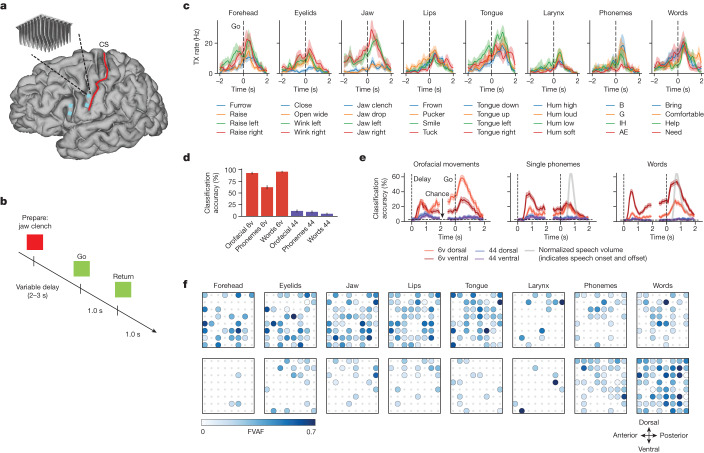
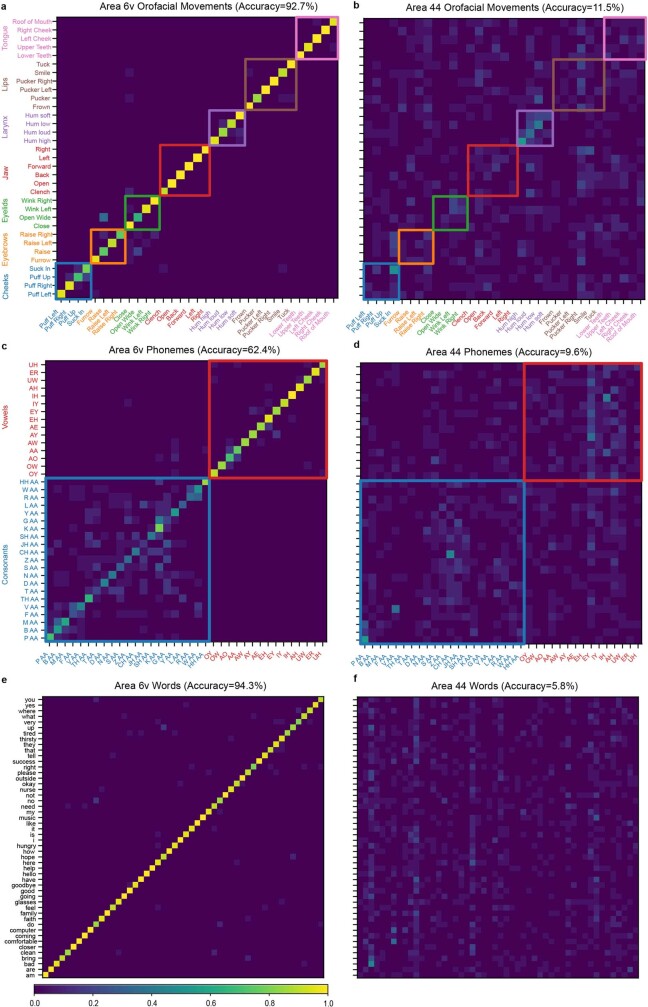
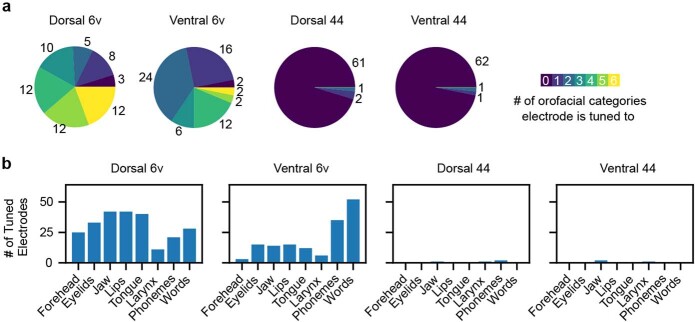
- Area 6v contained strong speech-related information: naive Bayes decoding from 1 s of neural activity reached 92% accuracy for 33 orofacial movements, 62% for 39 phonemes, and 94% for 50 words; area 44 showed classification accuracy below 12%.
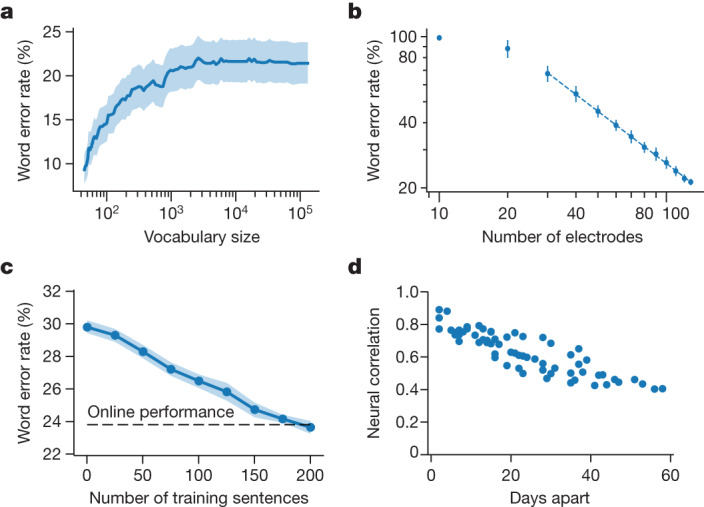
- Offline analyses reduced 125,000-word word error rate from 23.8% to 17.4% with an improved language model and to 11.8% with an improved language model plus a proximal test set; doubling electrode count cut word error rate by nearly half (factor of 0.57), and word error rate was 30% with no retraining on the evaluation day.
Methods
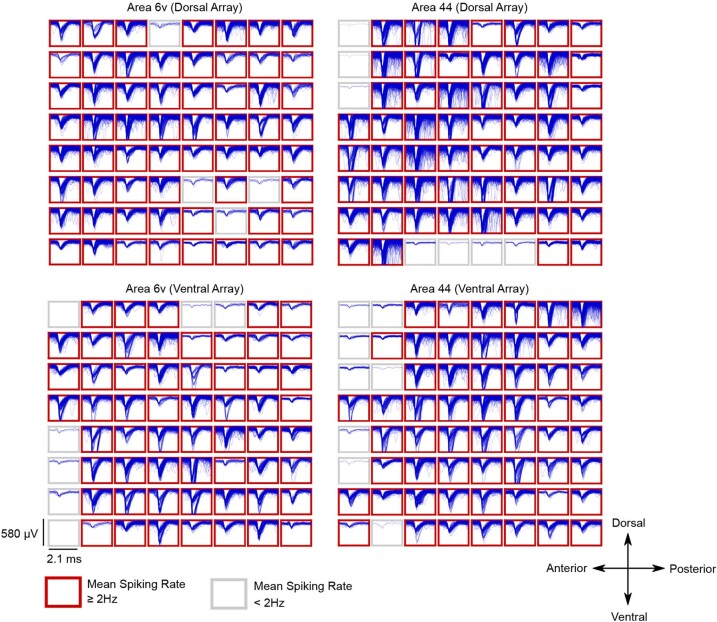
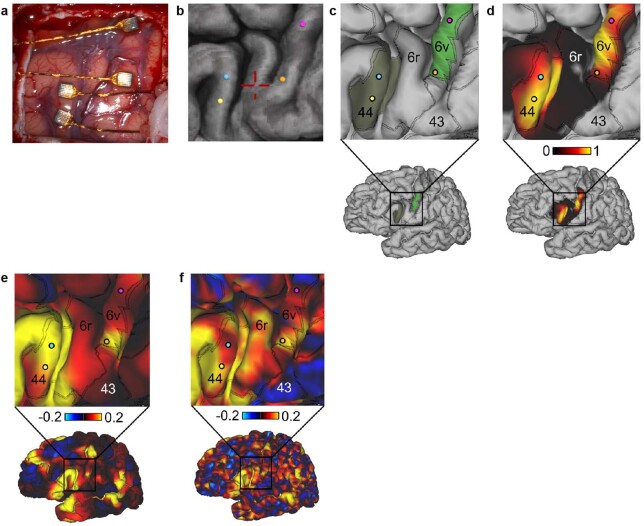
- Single participant T12 in the BrainGate2 pilot clinical trial, with bulbar-onset ALS, limited orofacial movement and vocalization but no intelligible speech; four intracortical microelectrode arrays were implanted, two in area 6v and two in area 44.
- Tasks included attempted individual orofacial movements, single phonemes, single words, and sentences; evaluation used 5 vocalized speech days and 3 silent speech days, with sentences from the Switchboard corpus for the 125,000-word vocabulary and the word set/test sentences from Moses et al. for the 50-word vocabulary.
- A five-layer gated recurrent unit RNN emitted phoneme probabilities every 80 ms, combined with a custom 125,000-word trigram language model in Kaldi; training used 260–480 sentences per day, reaching 10,850 total sentences by the final day, with unique input layers per day and rolling feature adaptation. Additional analyses used naive Bayes classifiers, RNN saliency vectors, electromagnetic articulography comparisons, and offline language-model and electrode-count manipulations.
Limitations
- The paper states that this is a proof of concept and not yet a complete, clinically viable system; work remains to reduce decoder training time and adapt to across-day neural changes without requiring the user to pause and recalibrate.
- The paper states that results must be confirmed in additional participants, generalizability to people with more profound orofacial weakness remains open, brain anatomy variability is a concern, and intracortical microelectrode array technology still needs further demonstrations of longevity and efficacy.
- The paper states that a 24% word error rate is probably not yet sufficiently low for everyday use, compared with 4–5% for state-of-the-art speech-to-text systems; evident from the text, the study reports one participant, and the best 11.8% word error rate came from offline analyses rather than online real-time decoding.
Model-written summary. Check it against the paper before relying on it.
Integrity signals
Registry
Cites
Statistics
Figures
Verification
Claims the paper makes
11 Valid · 1 Not valid · 4 Not checked · 52 Own results and interpretations
At least one cited source doesn’t support this claim or points to a different paper, and none confirmed it — see the verdicts below.
In the paper
“which is 3.4 times as fast as the previous record8”
- Also stated in: § Decoding attempted speech · plain
“which more than triples the speed of the previous state of the art for any type of BCI (18 words per minute for a handwriting BCI8)”
§ A high-performance speech neuroprosthesis > Abstract
What the sources say
- Disputedcites [8] Willett FR Avansino DT Hochberg LR Henderson JM Shenoy KV High-performance brain-to-text communication via handwriting Nature 2021 593 249 254 10.1038/s41586-021-03506-2 33981047 PMC8163299 sourceExperimental — accuracy not yet measured
The Discussion (page unavailable) reports 90 characters per minute for this BCI and 60 characters per minute for an earlier EEG speller. That makes the reported speed 1.5 times the earlier rate, not 3.4 times the previous record for any type of BCI. (LLM, conf=0.88)
Checked by a reasoning model — may be wrong.
plainSingle case- Asserted: passes — The authors put it forward as true.
- Checkable: passes — It can be checked against evidence.
- Load-bearing: passes — The paper’s conclusions depend on it.
- Based: passes — The paper gives a reason why it holds.
- Also stated in: § Decoding attempted speech · plain
The cited sources support only part of this claim — read each source’s verdict below.
In the paper
“Recently, BCIs based on hand movement activity have enabled typing speeds of between eight and 18 words per minute in people with paralysis8,29.”
§ A high-performance speech neuroprosthesis > Discussion
What the sources say
- Supportedcites [8] Willett FR Avansino DT Hochberg LR Henderson JM Shenoy KV High-performance brain-to-text communication via handwriting Nature 2021 593 249 254 10.1038/s41586-021-03506-2 33981047 PMC8163299 source
The Discussion reports 90 characters per minute for the paper’s handwriting BCI in a person with tetraplegia, while “Temporal variety improves decoding” reports 40 characters per minute for prior point-and-click BCIs. At five characters per word, those rates correspond to 18 and eight words per minute. No page numbers are available in our copy. (LLM, conf=0.90)
- Partly supportedcites [29] Pandarinath C High performance communication by people with paralysis using an intracortical brain-computer interface eLife 2017 6 e18554 10.7554/eLife.18554 28220753 PMC5319839 sourceExperimental — accuracy not yet measured
The Introduction’s Figure 1 caption describes recordings from the hand area of motor cortex, and the Discussion reports copy-typing rates in people with paralysis reaching 7.8 words per minute—approximately eight. This paper does not report an 18-word-per-minute typing rate, so it supports the lower end of the cited range but not the upper end. (LLM, conf=0.88)
plainstates a cause- Asserted: passes — The authors put it forward as true.
- Checkable: passes — It can be checked against evidence.
- Load-bearing: passes — The paper’s conclusions depend on it.
- Based: passes — The paper gives a reason why it holds.
- Supported
Every source the paper cites for this claim was checked and supports it.
In the paper
“Furthermore, we found that neural activity changed at a gradual rate over time, suggesting that unsupervised algorithms for updating decoders to neural changes should be feasible24–27 (Fig. 4d).”
§ A high-performance speech neuroprosthesis > Design considerations for speech BCIs
What the sources say
- Supportedcites [24] Dyer EL A cryptography-based approach for movement decoding Nat. Biomed. Eng. 2017 1 967 976 10.1038/s41551-017-0169-7 31015712 PMC8376093 source
The Discussion (page unavailable) proposes DAD, an unsupervised decoding approach, as a way to re-align a decoder and suggests extending it to reduce the labeled data needed for calibration. That supports the citing sentence’s qualified claim that unsupervised decoder updates should be feasible; the observation that neural activity changed gradually is the citing authors’ own finding, not a claim attributed to this source. (LLM, conf=0.86)
- Supportedcites [25] Farshchian, A. et al. Adversarial domain adaptation for stable brain-machine interfaces. Preprint at 10.48550/arXiv.1810.00045 (2019). source
Section 4.2.3 (p. 5) says ADAN aligns neural recordings across days in an unsupervised manner. The Introduction (p. 2) reports that this adaptation stabilizes a fixed decoder despite changes in neural recordings, supporting the cited suggestion that unsupervised updating is feasible. (LLM, conf=0.91)
- Supportedcites [26] Degenhart, A. D. et al. Stabilization of a brain–computer interface via the alignment of low-dimensional spaces of neural activity. Nat. Biomed. Eng. 10.1038/s41551-020-0542-9 (2020). PMC7822646 32313100 source
The section ‘Stabilization can outperform supervised recalibration’ says the stabilizer is updated without estimating user intent and can counteract neural recording instabilities. The Methods section ‘Stabilization and decoder’ describes updates using neural activity collected during online BCI use, supporting the feasibility of unsupervised adaptation to neural changes. The citing authors’ observation that changes were gradual is their own finding, not a finding attributed to this source. (LLM, conf=0.88)
- Supportedcites [27] Karpowicz, B. M. et al. Stabilizing brain-computer interfaces through alignment of latent dynamics. Preprint at bioRxiv10.1101/2022.04.06.487388 (2022). PMC12089531 40389429 source
The Introduction describes unsupervised recalibration as a way to compensate for neural-interface instabilities using data collected during normal use. In “Potential Future Applications,” the paper reports that its completely unsupervised NoMAD alignment stabilized decoding for weeks to months, supporting the claim that such updating is feasible. (LLM, conf=0.92)
hedgedSingle case- Asserted: passes — The authors put it forward as true.
- Checkable: passes — It can be checked against evidence.
- Load-bearing: passes — The paper’s conclusions depend on it.
- Based: passes — The paper gives a reason why it holds.
- Supported
The cited sources support only part of this claim — read each source’s verdict below.
In the paper
“Early demonstrations, although promising, have not yet achieved accuracies sufficiently high for communication of unconstrained sentences from a large vocabulary1–7.”
- Also stated in: § Discussion · plain
“Speech BCIs have the potential to restore natural communication at a much faster rate but have not yet achieved high accuracies on large vocabularies (that is, unconstrained communication of any sentence the user may want to say)1–7.”
§ A high-performance speech neuroprosthesis > Abstract
What the sources say
- Supportedcites [1] Herff C Brain-to-text: decoding spoken phrases from phone representations in the brain Front. Neurosci. 2015 9 217 10.3389/fnins.2015.00217 26124702 PMC4464168 source
The Conclusion (section 4.4; page unavailable) says the system reconstructs phrases with a limited dictionary and describes communication with scalable vocabularies as an eventual possibility. The Results (section 3.2; page unavailable) report 75% word recognition with a 10-word dictionary. Together, these support the claim that this early demonstration had not achieved sufficiently accurate communication of unconstrained sentences from a large vocabulary. (LLM, conf=0.88)
- Partly supportedcites [2] Moses DA Neuroprosthesis for decoding speech in a paralyzed person with anarthria N. Engl. J. Med. 2021 385 217 227 10.1056/NEJMoa2027540 34260835 PMC8972947 sourceExperimental — accuracy not yet measured
The Methods (Word and Sentence Task Design; page unavailable) describe decoding 50 preset sentences using a 50-word vocabulary, and the Results (Sentence Decoding; page unavailable) report a median word error rate of 25.6% with language modeling. This supports the narrower point that this demonstration did not establish communication using unconstrained sentences and a large vocabulary. The paper does not establish that insufficient accuracy is the reason such communication had not been achieved across early demonstrations. (LLM, conf=0.82)
- Supportedcites [3] Anumanchipalli GK Chartier J Chang EF Speech synthesis from neural decoding of spoken sentences Nature 2019 568 493 498 10.1038/s41586-019-1119-1 31019317 PMC9714519 source
The Discussion (page not provided) says previous speech-decoding strategies were limited in their ability to scale to larger vocabularies and communication rates. The Synthesis performance section (page not provided) describes this paper’s sentence-transcription test as closed-vocabulary, using pools of 25 or 50 words. Together, these passages support the claim that early demonstrations had not established accurate communication of unconstrained, large-vocabulary sentences. (LLM, conf=0.88)
- Partly supportedcites [4] Herff C Generating natural, intelligible speech from brain activity in motor, premotor, and inferior frontal cortices Front. Neurosci. 2019 13 1267 10.3389/fnins.2019.01267 31824257 PMC6882773 sourceExperimental — accuracy not yet measured
The Results report 66.1% word identification in a four-option listening test and estimate 36% intelligibility for transcription; the Limitations section says usable speech BCIs remain a long way off. These findings support the limitation for this demonstration, but the paper does not establish that early demonstrations generally failed to achieve sufficient accuracy for unconstrained, large-vocabulary sentences. (LLM, conf=0.84)
- Supportedcites [5] Kellis S Decoding spoken words using local field potentials recorded from the cortical surface J. Neural Eng. 2010 7 056007 10.1088/1741-2560/7/5/056007 20811093 PMC2970568 source
The Introduction reports classification of finite sets of up to 10 words and says the breadth of decoded language is inherently limited. The Conclusion describes the result as enabling limited communication, while Future work identifies improving accuracy for larger dictionaries as an open task. This demonstration therefore did not achieve communication of unconstrained sentences from a large vocabulary. (LLM, conf=0.88)
- Supportedcites [6] Pei X Barbour DL Leuthardt EC Schalk G Decoding vowels and consonants in spoken and imagined words using electrocorticographic signals in humans J. Neural Eng. 2011 8 046028 10.1088/1741-2560/8/4/046028 21750369 PMC3772685 source
The Results (§3.1) report roughly 36–41% accuracy for decoding vowels and consonants, not unconstrained sentences. The Discussion (§4) says further work is needed to improve accuracy and extend decoding to more vowel and consonant categories, supporting the claim as applied to this early demonstration. (LLM, conf=0.91)
- Supportedcites [7] Mugler EM Direct classification of all American English phonemes using signals from functional speech motor cortex J. Neural Eng. 2014 11 035015 10.1088/1741-2560/11/3/035015 24836588 PMC4097188 source
The Introduction says early whole-word speech-decoding results were preliminary and could not be extrapolated to more complex speech. The Discussion states that this study’s word-identification accuracy was insufficient for communication and describes whole-word decoding from a broader set of words as a future step. The supplied passages do not give page numbers. (LLM, conf=0.91)
plain- Asserted: passes — The authors put it forward as true.
- Checkable: passes — It can be checked against evidence.
- Load-bearing: passes — The paper’s conclusions depend on it.
- Based: passes — The paper gives a reason why it holds.
- Also stated in: § Discussion · plain
The cited sources support only part of this claim — read each source’s verdict below.
In the paper
“These results indicate that substantial gains in performance are probably still possible with further language model improvements and more robust decoding algorithms that generalize better to non-stationary data (for example, unsupervised methods that track non-stationarities without the requirement for new training data24–27).”
§ A high-performance speech neuroprosthesis > Decoding attempted speech
What the sources say
- Partly supportedcites [24] Dyer EL A cryptography-based approach for movement decoding Nat. Biomed. Eng. 2017 1 967 976 10.1038/s41551-017-0169-7 31015712 PMC8376093 sourceExperimental — accuracy not yet measured
The Results describe DAD as an unsupervised decoder that worked across recording days without changing model parameters, supporting its use without new paired training data. But the paper does not show the method tracking non-stationarities; the Discussion treats accounting for drift in neural properties as a potential improvement not included in DAD. (LLM, conf=0.82)
- Partly supportedcites [25] Farshchian, A. et al. Adversarial domain adaptation for stable brain-machine interfaces. Preprint at 10.48550/arXiv.1810.00045 (2019). sourceExperimental — accuracy not yet measured
The Methods (p. 5) describe an unsupervised approach to aligning neural recordings across days, supporting the example of a method that addresses non-stationarity. But the Results (p. 7) say domain adaptation with ADAN requires a small new training set—prediction accuracy saturates at about one minute of data—so this source does not support the claim that no new training data is required. It does not address language-model improvements. (LLM, conf=0.88)
- Supportedcites [26] Degenhart, A. D. et al. Stabilization of a brain–computer interface via the alignment of low-dimensional spaces of neural activity. Nat. Biomed. Eng. 10.1038/s41551-020-0542-9 (2020). PMC7822646 32313100 source
The cited paper supports the parenthetical example, not the citing authors’ prediction about language-model gains. Its Methods (‘Stabilization and decoder’; page unavailable) describe updating the stabilizer with neural data collected during ongoing BCI use, and its results (‘Stabilization can outperform supervised recalibration’; page unavailable) state that stabilization does not require an estimate of user intent. The paper also reports recovery from recording instabilities without a new supervised calibration session. (LLM, conf=0.89)
- Supportedcites [27] Karpowicz, B. M. et al. Stabilizing brain-computer interfaces through alignment of latent dynamics. Preprint at bioRxiv10.1101/2022.04.06.487388 (2022). PMC12089531 40389429 source
The citation supports the parenthetical example, not the sentence's separate prediction about language-model improvements. In “Potential Future Applications” (page unavailable), the paper says NoMAD's alignment is completely unsupervised and uses only a small initial supervised training dataset; the reaching-task section describes unsupervised alignment of later sessions before applying the original decoder. (LLM, conf=0.91)
hedgedstates a possible causeSingle case- Asserted: passes — The authors put it forward as true.
- Checkable: passes — It can be checked against evidence.
- Load-bearing: passes — The paper’s conclusions depend on it.
- Based: passes — The paper gives a reason why it holds.
- Partly supported
48 more claims · 4 with their cited sources checked
Create a free account to see all 68 claims and every source verdict.
- Probably not a substantial claim. 6
- It may state two separate claims as one. 8
- The quote only partly states this claim. 1
Claims other papers make about this one
Each is checked against this paper’s own text: does it say what the citing paper says it does?
The cited source doesn’t support the claim as written.
In the citing paper
“we also targeted one array each into two areas which, to our knowledge, have not previously been recorded from with multielectrode arrays”
From An Accurate and Rapidly Calibrating Speech Neuroprosthesis (2024) · cites this paper as [21]
Checked by a reasoning model — may be wrong.
Experimental — accuracy not yet measuredThe source backs part of the claim, not all of it — or backs it for a different population, condition or comparison.
In the citing paper
“They have shown significant efficacy in improving the quality of life for those suffering from a range of conditions, including but not limited to Parkinson’s disease, ALS (Willett et al., 2023), movement disorders, epilepsy, and mental health issues (Fisher and Velasco, 2014; Bergfeld et al., 2016; França et al., 2022).”
From Comparative analysis of energy transfer mechanisms for neural implants (2024) · cites this paper as Willett et al., 2023
Experimental — accuracy not yet measuredThe source backs part of the claim, not all of it — or backs it for a different population, condition or comparison.
In the citing paper
“Current speech-decoding applications from brain activity are primarily aimed at restoring communication to individuals with both limb and vocal-tract paralysis14–16.”
From The speech neuroprosthesis (2024) · cites this paper as [15]
Experimental — accuracy not yet measuredThe source backs part of the claim, not all of it — or backs it for a different population, condition or comparison.
In the citing paper
“Interestingly, at the neuronal level, locations on the anterior precentral gyrus in orofacial or hand areas contain single neurons tuned to movements of the whole body, including key speech articulators15,51,52.”
From The speech neuroprosthesis (2024) · cites this paper as [15]
Experimental — accuracy not yet measuredThe source backs part of the claim, not all of it — or backs it for a different population, condition or comparison.
In the citing paper
“Recent studies have also achieved high-performance speech-decoding results15,16 by measuring relevant single-unit and multi-unit neuronal activity from multiple small (4 × 4 mm2 (ref. 83)) cortical regions on the anterior precentral gyrus15,16,52,98.”
From The speech neuroprosthesis (2024) · cites this paper as [15]
Experimental — accuracy not yet measured
20 more claims about this paper
Create a free account to see every claim other papers make about this one.
Self-check
Percentages, sums and reported differences re-computed from the paper’s own numbers.
Each contradiction between two passages listed here was confirmed by an independent check.
Rated minor: it would not touch a result — a value no result rests on, a p-value that stays on the same side of the significance level, or a conflict that is clerical, resolved elsewhere in the paper, or outside its own findings.
In the paper
§ A high-performance speech neuroprosthesis > Decoding attempted speech
“At the beginning of each RNN performance-evaluation day we first recorded training data during which T12 attempted to speak 260–480 sentences at her own pace”
§ A high-performance speech neuroprosthesis > Design considerations for speech BCIs
“Finally, in this demonstration we used a large amount of training data per day (260–440 sentences).”
Citations
Cites
BERT: Pre-training of Deep Bidirectional Transformers for Language Understanding
Devlin, J., Chang, M.-W., Lee, K., & Toutanova, K. (2018) · arXiv · doi:10.48550/arxiv.1810.04805 · Cited by 73,173
Language Models are Few-Shot Learners
Brown, T. B., Mann, B., Ryder, N., Subbiah, M., Kaplan, J., Dhariwal, P., Neelakantan, A., Shyam, P., Sastry, G., Askell, A., et al. (2020) · arXiv · doi:10.48550/arxiv.2005.14165 · Cited by 23,372
Brainard, D. H. (1997) · Spatial Vision · doi:10.1163/156856897x00357 · Cited by 19,702
Hinton, G., Deng, L., Yu, D., Dahl, G., Mohamed, A.-R., Jaitly, N., Senior, A., Vanhoucke, V., Nguyen, P., Sainath, T., et al. (2012) · IEEE Signal Processing Magazine · doi:10.1109/msp.2012.2205597 · Cited by 10,260
Speech recognition with deep recurrent neural networks
Graves, A., Mohamed, A.-R., & Hinton, G. (2013) · 2013 IEEE International Conference on Acoustics, Speech and Signal Processing · doi:10.1109/icassp.2013.6638947 · Cited by 8,893
Graves, A., Fernández, S., Gomez, F., & Schmidhuber, J. (2006) · Proceedings of the 23rd international conference on Machine learning - ICML '06 · doi:10.1145/1143844.1143891 · Cited by 5,370
A multi-modal parcellation of human cerebral cortex
Glasser, M. F., Coalson, T. S., Robinson, E. C., Hacker, C. D., Harwell, J., Yacoub, E., Ugurbil, K., Andersson, J., Beckmann, C. F., Jenkinson, M., et al. (2016) · Nature · doi:10.1038/nature18933 · Cited by 5,111
Self-citationTHE POPULATION FREQUENCIES OF SPECIES AND THE ESTIMATION OF POPULATION PARAMETERS
GOOD, I. J. (1953) · Biometrika · doi:10.1093/biomet/40.3-4.237 · Cited by 3,437
SWITCHBOARD: telephone speech corpus for research and development
Godfrey, J. J., Holliman, E. C., & McDaniel, J. (1992) · [Proceedings] ICASSP-92: 1992 IEEE International Conference on Acoustics, Speech, and Signal Processing · doi:10.1109/icassp.1992.225858 · Cited by 2,134
An Integrated Brain-Machine Interface Platform With Thousands of Channels
Musk, E., & Neuralink (2019) · Journal of Medical Internet Research · doi:10.2196/16194 · Cited by 1,206
Research works printed but not linked: 1
- Broca P Nouvelle observation d’aphemie produite par une lesion de la troisieme circonvolution frontale Bull. Soc. Anat. 1861 2 398 407
Cited by
Items 401–500 of 577
El-Osta, A. A. R., Al-Ammouri, M., Khan, S., Altalib, S., Karki, M., Sasco, E. R., & Majeed, A. (2024) · Research Square · doi:10.21203/rs.3.rs-4227958/v1
Delineating neural contributions to electroencephalogram-based speech decodingPreprint
Sato, M., Kabe, Y., Nobe, S., Yoshida, A., Inoue, M., Shimizu, M., Tomeoka, K., & Sasai, S. (2024) · bioRxiv (Cold Spring Harbor Laboratory) · doi:10.1101/2024.05.09.591996
Reducing calibration effort for brain-computer interfaces
Smedemark-Margulies, N. (2024) · Digital Repository Service (Northeastern University) · doi:10.17760/d20653003
Population Transformer: Learning Population-level Representations of Neural Activity
Chau, G., Wang, C., Talukder, S., Subramaniam, V., Soedarmadji, S., Yue, Y., Katz, B., & Barbu, A. (2024) · International Conference on Learning Representations · doi:10.48550/arxiv.2406.03044 · Cited by 25
The Luckiest Network Gives the Average Error on Disjoint Tests: Experiments
Wu, X., & Weng, J. (2024) · International Conference on Artificial Intelligence in Electronics Engineering (AIEE) · doi:10.1145/3658835.3658839 · Cited by 2
Decoding models: From brain representation to machine interfaces
Takagi, Y., & Nishimoto, S. (2024) · Elsevier eBooks · doi:10.1016/b978-0-443-13480-7.00013-2
Des décodeurs de parole plus rapides et fiables
Clavere, A. (2024) · Cerveau & Psycho · doi:10.3917/cerpsy.167.0013
Persistent tactile P3 in long-term brain-computer interface home use by a patient in locked-in statePreprint
Ziebell, P., Pfeiffer, M., Tröger, W., Halder, S., Giesler, T., Kübler, A., & Eidel, M. (2024) · PsyArXiv (OSF Preprints) · doi:10.31234/osf.io/abjyw · Cited by 3
Mender, M. J., Ward, A. L., Cubillos, L. H., Kelberman, M. M., Costello, J. T., Temmar, H., Wallace, D. M., Lin, E. T., Lam, J. L. W., Willsey, M. S., et al. (2026) · Journal of NeuroEngineering and Rehabilitation · doi:10.1186/s12984-026-02091-7 · Cited by 3
Luu, C. P. (2024) · SSRN Electronic Journal · doi:10.2139/ssrn.4964328
Exploring the trade-off between deep-learning and explainable models for brain-machine interfacesPreprint
Cubillos, L. H., Revach, G., Mender, M. J., et al. (2024) · bioRxiv (Cold Spring Harbor Laboratory) · doi:10.1101/2024.10.03.616126
Spatially mismatched cerebral blood flow and neuronal activity by intracortical microstimulationPreprint
Yonza, A. K. I., Tao, L., Kucharz, K., Lind, B. L., Zhang, X., Kim, K., & Cai, C. (2024) · bioRxiv (Cold Spring Harbor Laboratory) · doi:10.1101/2024.11.10.622852
Zhang, Y., Wang, W., Liu, G., Qiao, Y., Shi, R., Duan, Y., Du, Y., Li, S., Guo, F., McHugh, T. J., et al. (2024) · International Convention on Rehabilitation Engineering & Assistive Technology · doi:10.1109/i-create62067.2024.10776552
Towards Speech Synthesis of Unconstrained Sentences from Speech-related Biosignals
Kim, D.-S., Lee, S., Lee, Y.-E., & Lee, S.-W. (2024) · Annual International Conference of the IEEE Engineering in Medicine and Biology Society (EMBC) · doi:10.1109/embc53108.2024.10782977 · Cited by 1
“Recent studies in the field of speech BCI include invasive methods to decode speech-related brain signals [7], [8].”
Liu, H., Yang, B., Guan, S., Rong, F., Guo, M., Fang, Y. Z., Liu, B., Gao, Y., & Gu, Y. (2024) · Annual International Conference of the IEEE Engineering in Medicine and Biology Society (EMBC) · doi:10.1109/embc53108.2024.10782649
“The intracortical brain-computer interface restores impaired motor, speech, and other functions in people with disabilities by converting neural activity into control signals for external devices [1]–[3].”
Li, J., Guo, C., Chang, E. F., & Li, Y. (2024) · bioRxiv (Cold Spring Harbor Laboratory) · doi:10.1101/2024.12.16.628596
Encoding and Decoding of Chinese Phonemes Based on MEG Signals
Liang, J., Wang, B., Wu, X. H., & Chen, J. W. (2024) · International Symposium on Chinese Spoken Language Processing (ISCSLP) · doi:10.1109/iscslp63861.2024.10800550
Cognitive and Mobility Enhancement through Brain-Machine Interfaces and Neuroengineering
Nandwani, R. K., Palanikumar, S., Singh, S. S., & Balading, J. M. (2024) · Berkeley Pharma Tech Journal of Medicine · doi:10.52243/bptjm.v4i2.61
Brain–computer interfaces and deep learning methods for cognitive impairments
Karacan, S. Ş. (2025) · Elsevier eBooks · doi:10.1016/b978-0-443-33414-6.00008-3 · Cited by 1
Neural signal analysis in chronic stroke: advancing intracortical brain-computer interface design
Shawki, N., Napoli, A., Vargas-Irwin, C. E., Thompson, C. K., Donoghue, J. P., & Serruya, M. D. (2025) · Frontiers in Human Neuroscience · doi:10.3389/fnhum.2025.1544397 · Cited by 4
Comparing a BCI communication system in a patient with Multiple System Atrophy, with an animal model
Premchand, B., Toe, K. K., Wang, C., Wan, K. R., Selvaratnam, T., Toh, V. E., Ng, W. H., Libedinsky, C., Chen, W., Lim, R., et al. (2025) · Brain Research Bulletin · doi:10.1016/j.brainresbull.2025.111289
Enhancing Listened Speech Decoding from EEG via Parallel Phoneme Sequence Prediction
Lee, J., Feng, T., Kommineni, A., et al. (2025) · IEEE International Conference on Acoustics Speech and Signal Processing · doi:10.1109/icassp49660.2025.10887915
Impact of Temporal Precision on Speech Synthesis Accuracy From Electrocorticographic Brain Signals
Rabbani, Q., Fifer, M. S., Crone, N. E., & Moro-Velázquez, L. (2025) · IEEE International Conference on Acoustics Speech and Signal Processing · doi:10.1109/icassp49660.2025.10888813 · Cited by 2
Conductive-Hydrogel-Based Electrodes for Invasive Neural Interfaces
Кириллова, Д. А., Шарикова, Н. А., Romanov, A. O., Vasilov, R. G., Grigoriev, T. Е., & Gotovtsev, P. M. (2024) · Nanobiotechnology Reports · doi:10.1134/s2635167624602535
Expanding Human Capabilities with Neurotechnology: Neuroprosthetics, BCIs, and Emerging Innovations
Chaudhary, U. (2025) · Springer eBooks · doi:10.1007/978-3-031-78991-5_10 · Cited by 3
Bird’s Eye View of Artificial Intelligence in Neuroscience
Zhou, M. H., Lin, E., Ye, A. Q., Mukherjee, P., & Yuh, E. L. (2025) · AI in neuroscience. · doi:10.1089/ains.2024.0001 · Cited by 2
Towards Scalable Handwriting Communication via EEG Decoding and Latent Embedding Integration
Kim, J.-Y., Kim, D.-S., & Lee, S. (2025) · International Winter Conference on Brain-Computer Interface (BCI) · doi:10.1109/bci65088.2025.10931608
“…to monitor rest quality [2], mental states to prevent cognitive fatigue–related accidents [3]–[7], motor imagery for controlling external devices [8], [9], imagined speech for communication efficiency [10], as well as classified schizophrenia from the EEG to aid in diagnosis and treatment [11].”
Material damage to multielectrode arrays after electrolytic lesioning is insignificant
Tor, A., Clarke, S. E., Bray, I. E., & Nuyujukian, P. (2026) · eLife · doi:10.1101/2025.03.26.645429 · Cited by 3
Self-paced silent speech brain-computer interface for device control
Luo, S., Angrick, M., Coogan, C. G., Candrea, D. N., Wyse‐Sookoo, K., Schippers, A., Ganji, R., Milsap, G., Anderson, W. S., Gordon, C. R., et al. (2026) · Communications Biology · doi:10.1101/2025.04.09.25325542 · Cited by 2
Golchha, R., Sahu, M., & Londhe, N. D. (2025) · International Conference on Ambient Intelligence in Health Care (ICAIHC) · doi:10.1109/icaihc64101.2025.10957608
“The dataset by Willett et al. [14] provides neural activity recordings from an intracortical BCI that decodes attempted speech movements from motor cortex activity into text in real time.”
InfluentialCLOOSE: An open-source platform for optical closed-loop experimentsPreprint
Francioni, V., Beltramini, A., Fan, L. Z., & Harnett, M. T. (2025) · bioRxiv (Cold Spring Harbor Laboratory) · doi:10.1101/2025.04.09.648061
Ultrasound-induced wireless implantable stimulator for adaptive pain management
(2025) · Nature Electronics · doi:10.1038/s41928-025-01377-3 · Cited by 3
Neural hierarchy for coding articulatory dynamics in speech imagery and productionPreprint
Zhao, Z.-H., Wang, Z.-J., Liu, Y., Qian, Y.-K., Yin, Y., Gao, X.-W., Yuan, B.-K., Tong, S. X., Tian, X., Chen, G., et al. (2025) · bioRxiv · doi:10.1101/2025.05.27.656311 · Cited by 1
Towards Unified Neural Decoding with Brain Functional Network ModelingPreprint
Wu, D., Bu, L., Jia, Y., Cao, L., Li, S., Chen, S., Zhou, Y., Fan, S., Ren, W., Wu, D., et al. (2025) · bioRxiv (Cold Spring Harbor Laboratory) · doi:10.1101/2025.06.02.657011 · Cited by 1
Material Damage to Multielectrode Arrays after Electrolytic Lesioning is in the NoisePreprint
Tor, A., Clarke, S. E., Bray, I. E., & Nuyujukian, P. (2025) · eLife · doi:10.7554/elife.106452.1 · Cited by 1
Partial Domain Adaptation for Stable Neural Decoding in Disentangled Latent Subspaces
Wang, P., Qi, Y., & Pan, G. (2025) · IEEE Transactions on Biomedical Engineering · doi:10.1109/tbme.2025.3577222 · Cited by 1
Cloarec, J., Meyer‐Waarden, L., Timmler, K., Thiele, S., Weiß, M., & Wiese, M. (2025) · Recherche et Applications en Marketing (French Edition) · doi:10.1177/07673701251347492
“Aujourd’hui, les ICM sont largement utilisées dans le domaine médical, par exemple pour le suivi des patients (Michael et Michael, 2014), l’amélioration des dispositifs médicaux ou d’autres usages thérapeutiques (Willett et al., 2023).”
Reading specific memories from human neurons before and after sleepPreprint
Ding, Y., Dunn, S. L. S., Sakon, J. J., Aghajan, Z. M., Chan, C. A., Datta, A., Duan, C., Zhang, Y., Berger, J. I., Rhone, A. E., et al. (2025) · bioRxiv (Cold Spring Harbor Laboratory) · doi:10.1101/2025.07.01.662486 · Cited by 2
Weng, J. (2025) · Proceedings of the 2025 International Conference on Artificial Intelligence and Computational Intelligence · doi:10.1145/3730436.3745779
Robinson, J. T. (2025) · IEEE Pulse · doi:10.1109/mpuls.2025.3572593
Restoring communication with speech brain–computer interfaces
Prakash, P. R., Luo, S., Crone, N. E., & Slutzky, M. W. (2025) · Elsevier eBooks · doi:10.1016/b978-0-443-24824-5.00015-6 · Cited by 2
Wu, X., Hu, K., Fu, Z., & Zhang, D. (2025) · Imaging Neuroscience · doi:10.1162/imag.a.146 · Cited by 2
Gerrity, C. G., Treuting, R. L., Peters, R. A., & Womelsdorf, T. (2025) · bioRxiv (Cold Spring Harbor Laboratory) · doi:10.1101/2025.08.20.671126 · Cited by 1
Grajski, K. A. (2025) · bioRxiv (Cold Spring Harbor Laboratory) · doi:10.1101/2025.08.21.671572
Toward Non-Invasive Voice Restoration: A Deep Learning Approach Using Real-Time MRIPreprint
Saleh, M. (2025) · medRxiv · doi:10.1101/2025.08.22.25334256
A stereoencephalography study of internal speechPreprint
Naumov, A., Soghoyan, G., Makarova, A. V., et al. (2025) · Research Square · doi:10.21203/rs.3.rs-7306546/v1
Iwata, T., Nakamura, H., Uemura, T., Araki, T., Matsumura, T., Abe, T., Nezu, T., Takagaki, M., Ozaki, T., Miura, S., et al. (2025) · Advanced Intelligent Systems · doi:10.1002/aisy.202500487 · Cited by 2
Li, J., Guo, C., Zhang, C., et al. (2025) · bioRxiv (Cold Spring Harbor Laboratory) · doi:10.1101/2025.09.24.678428
A Framework for Compressive On-Chip Action Potential Recording
Yan, P., Muratore, D. G., Chichilnisky, E. J., Murmann, B., & Weissman, T. (2025) · IEEE Transactions on Biomedical Engineering · doi:10.1109/tbme.2025.3615514 · Cited by 1
“Applications of neural interfaces range from basic studies of sensory processing to brain-machine interfaces for motor rehabilitation, vision restoration, and sensory augmentation [8], [9].”
Longitudinal study of gesture decoding in a clinical trial participant with ALSPreprint
Candrea, D. N., Angrick, M., Luo, S., Ganji, R., Coogan, C. G., Milsap, G., Rosenblatt, K. R., Uchil, A., Clawson, L., Maragakis, N. J., et al. (2025) · medRxiv · doi:10.1101/2025.09.26.25335804
Improved interpretability in LFADS models using a learned, context-dependent per-trial biasPreprint
Shah, N. P., Meschede-Krasa, B., Kunz, E. M., Hahn, N. V., Kamdar, F. B., Avansino, D. T., Hochberg, L. R., Henderson, J. M., & Sussillo, D. (2025) · bioRxiv (Cold Spring Harbor Laboratory) · doi:10.1101/2025.10.03.680303 · Cited by 1
Self-citationUGR-MINDVOICE: A Multimodal EEG-Audio Dataset for Overt and Covert Iberian Spanish Speech ProductionPreprint
Cortina, I. V., Khanday, O. M., Ouellet, M., et al. (2025) · SSRN Electronic Journal · doi:10.2139/ssrn.5576287
Sasaki, H., Shimizu, S., Nerchan, R. A., Yamashita, K., Takahashi, N., Chinone, R., Kurashige, Y., Numano, R., Koida, K., Ohsawa, M., et al. (2025) · SSRN Electronic Journal · doi:10.2139/ssrn.5605796
Electrophysiology: Tapping Into the Wonders of the Brain
Ojerinde, L., Pearce, A. R., & Lapish, C. C. (2025) · Frontiers for Young Minds · doi:10.3389/frym.2025.1588454
Moghrabi, H. A., Audi, Z. F., Ayache, M., Chmaisse, H. N., Harati, H., & Estephan, E. (2025) · International Conference on Advances in Biomedical Engineering (ICABME) · doi:10.1109/icabme66883.2025.11211618
“MS-related mobility and speech impairments also correlate with high rates of depression and anxiety [50].”
Sasaki, H., Shimizu, S., Nerchan, R. A., Yamashita, K., Takahashi, N., Chinone, R., Kurashige, Y., Numano, R., Koida, K., Ohsawa, M., et al. (2025) · Sensing and Bio-Sensing Research · doi:10.1016/j.sbsr.2025.100915 · Cited by 2
A 40-nm 3.9mW, 200words/Min Neural Signal Processor in Speech Decoding for Brain-Machine Interface
Chang, T.-Y., Wang, J.-B., Tsai, Y.-H., Tsao, Y., & Yang, C. (2025) · IEEE Transactions on Biomedical Circuits and Systems · doi:10.1109/tbcas.2025.3625650
Efficient on-chip cross-subject local field potential decoding for implantable neural interfaces
Marin‐Llobet, A., Clerico, V., López-Asunción, S., Manasanch, A., Merino, I., Torao‐Angosto, M., Ituero, P., Sanchez-Vives, M. V., & Porta, L. D. (2025) · International Joint Conference on Neural Networks (IJCNN) · doi:10.1109/ijcnn64981.2025.11228470
A Wireless Neural Signal Acquisition System for Interventional Brain–Computer Interface
Li, S., Kuang, W., Zhang, Y., Liu, G., Wang, W., Jia, H., Ma, Y., & Duan, F. (2025) · IEEE Sensors Journal · doi:10.1109/jsen.2025.3631268 · Cited by 1
“Recent advances in invasive BCIs have demonstrated remarkable capabilities, including high-performance motor decoding for paralyzed individuals, speech neuroprosthetics achieving real-time communication [21], and precise control of exter-nal devices through direct neural interfaces [22].”
Transhumanism and artificial intelligence
Herrera, R. J., & Garcia‐Bertrand, R. (2025) · Elsevier eBooks · doi:10.1016/b978-0-443-28919-4.00015-5
Herrera, R. J., & Garcia‐Bertrand, R. (2025) · Elsevier eBooks · doi:10.1016/b978-0-443-28919-4.00002-7
Neuromodulation Through Axonal Stimulations in Brain
Feng, Z. (2025) · Springer eBooks · doi:10.1007/978-981-95-4145-4_9
Foresee: A Modular and Open Framework to Explore Integrated Processing on Brain-Computer Interfaces
Yadav, A., Garcia, F. C., Gonzalez, A., Trevisan, B. E., Xu, A., Ugur, M., Bhattacharjee, A., & Pothukuchi, R. P. (2025) · Annual International Conference of the IEEE Engineering in Medicine and Biology Society (EMBC) · doi:10.1109/embc58623.2025.11254710 · Cited by 1
“…neural decoding [18, 39], modern BCIs can read and process several tens of megabits per second (Mbps) of neural data [38] with complex signal processing methods to infer intended movement or speech, detect aberrant activity (as in epilepsy and Parkinson’s), and respond in seconds [32, 34, 39].”
In vivo microstimulation stability of electrodeposited platinum-iridium on carbon fiber electrodes
Weiland, J. D., Koo, B., Paier, G., della Valle, E., Patel, P. R., & Chestek, C. A. (2025) · Annual International Conference of the IEEE Engineering in Medicine and Biology Society (EMBC) · doi:10.1109/embc58623.2025.11253521
State-Dependent Neural Decoding of Complex Handwriting via Mixture of Experts With Recurrent Routing
Wang, L., Yang, X., Xiong, X., Jia, Y., Wang, Y., & Qi, Y. (2025) · IEEE Transactions on Cognitive and Developmental Systems · doi:10.1109/tcds.2025.3642409 · Cited by 1
Event-based SerDes telemetry network for distributed brain computer interfaces
Russo, P., He, Y., Romme, J., Traferro, S., van Schaik, G.-J., Liaw, H.-P., Ren, Z., Gao, Z., Dolmans, G., & Liu, Y. (2025) · Neuromorphic Computing and Engineering · doi:10.1088/2634-4386/ae2cc2
An EEG Dataset for Multimodal Semantic Alignment and Neural Decoding during Reading and Listening
Chen, S., Li, B., He, C., Li, D., Wu, M., Shen, X., Wang, S. M., Wei, X., Wang, X., Wu, H., et al. (2025) · Scientific Data · doi:10.1038/s41597-025-06466-8 · Cited by 10
Brain-aligning of semantic vectors improves neural decoding of visual stimuli
Vafaei, S., Fukuma, R., Yanagisawa, T., Huixiang, Y. A. N. G., Oshino, S., Tani, N., Khoo, H. M., Sugano, H., Iimura, Y., Suzuki, H., et al. (2026) · Communications Biology · doi:10.1038/s42003-025-09482-x · Cited by 3
“2 – 3, Supplementary Figs.”
Neural Mechanisms of Mixed Speech and Grasp Representation in Sensorimotor CorticesPreprint
Foli, C., Conlan, E. C., Memberg, W. D., et al. (2026) · bioRxiv (Cold Spring Harbor Laboratory) · doi:10.64898/2026.01.02.697428
Comparison of single-channel EEG decoding performance in imagined speech tasks
Ma, X., Ding, Y., Zhao, K., Zhang, P., Tang, Y., Shi, J., Chen, D., Wu, D., & Tang, Z. (2026) · Brain Hemorrhages · doi:10.1016/j.hest.2026.01.001
Andrade, P., Mercado, R. R. P. S., Jiménez, F., & Visser-Vandewalle, V. E. R. M. (2026) · Die Chirurgie · doi:10.1007/s00104-025-02436-3
Higham, S. J., Jung, Y. J., León, S. E. D., Tong, W., Au, S. L. C., Shang, Y., Wang, H., Kalra, M., Morokoff, A. P., Maturana, M. I., et al. (2026) · bioRxiv (Cold Spring Harbor Laboratory) · doi:10.64898/2026.01.06.696090 · Cited by 1
Su, H., Hu, Z., Cheng, S., Zhang, X., Zhao, W., Tian, X., Yang, W., Sun, X., & Sun, L. (2025) · IEEE Biomedical Circuits and Systems Conference (BioCAS) · doi:10.1109/biocas67066.2025.00068
“Invasive brain-machine interfaces (BMIs) based on high-throughput recording devices have already enabled significant applications, such as speech reconstruction [1-3] and precise motor control [4].”
EEG-based Neural Representation and Decoding of Imagined Phonemes
Zhu, Z., Patel, R., Kelly, M. A., Garrison-Hooks, E., Cho, Y., & Carlson, T. (2025) · Conference proceedings/Conference proceedings - IEEE International Conference on Systems, Man, and Cybernetics · doi:10.1109/smc58881.2025.11342466
“This is also similar to the results by Willett, F. R. et al. [37] that showed a far F2 distance between /i:/ vs. /u:/ in the vowel articulatory representation with intracortical microelectrode arrays recording on an ALS patient’s ventral premotor cortex.”
Wang, F., Chen, Y., Wang, P., Gong, A., Xu, J., & Fu, Y. (2026) · Scientific Data · doi:10.1038/s41597-026-06708-3 · Cited by 2
Word classification across speech modes from low-density electrocorticography signals
de Borman, A., Dyck, B. V., Rooy, K. V., Carrette, E., Meurs, A., Roost, D. V., & Hulle, M. M. V. (2026) · Journal of Neural Engineering · doi:10.1088/1741-2552/ae3a1b · Cited by 1
Gene-targeted versus broad-spectrum therapies in ALS: comparative lessons and strategic outlook
Shen, Y. Q., Shen, S., & Luo, Z. (2026) · Journal of genetics and genomics/Journal of Genetics and Genomics · doi:10.1016/j.jgg.2026.01.012
Li, J., Guo, C., Zhang, C., Chang, E. F., & Li, Y. (2026) · eLife · doi:10.7554/elife.109400.2
Seto, B. A., Ahmadi, N., & Lestari, D. P. (2025) · International Conference on Speech Database and Assessments · doi:10.1109/o-cocosda68185.2025.11384997
“Their approach employed a trigram language model implemented in Kaldi, successfully demonstrating a high communication speed of 62 words per minute [4].”
InfluentialOpportunities and challenges in the development of neurology medical education in China
Song, Y., Chu, J., Yao, X., Pan, Y., Zhi, N., Cao, W., Ruolian, D. A. I., Lu, Z., & Wang, G. (2026) · Global Medical Education · doi:10.1515/gme-2025-0015
“Similarly, neuroinformatics pipelines for large-scale neuroimaging data analysis are revolutionizing research methodology education, with machine learning-based approaches to disease biomarker discovery becoming core competencies in modern neurology training [9].”
UGR-MINDVOICE: A multimodal EEG-audio dataset for overt and covert Iberian Spanish speech production
Cortina, I. V., Khanday, O. M., Ouellet, M., Pérez-Córdoba, J. L., Esteban, P. R.-S., Miccoli, L., Galdón, A., Granados, G. O., & González, J. A. (2026) · Computer Speech & Language · doi:10.1016/j.csl.2026.101964 · Cited by 1
Empowering Silent Voices: Adaptive EEG-to-Text Systems for Assistive Technologies
Fares, A. H., Gedawy, M. E., Nabil, O., Mamdouh, O., Nady, M., Adel, N. A., & ElHalawany, B. M. (2025) · International Conference on ICT & Accessibility (ICTA) · doi:10.1109/icta-atsn68371.2025.11398250
“These technological developments enable speech restoration through neural signal decoding, producing both text and synthesized speech outputs [6], [7].”
Cross-subject decoding of human neural data for speech Brain Computer InterfacesPreprint
Boccato, T., Olak, M., & Ferrante, M. (2026) · bioRxiv (Cold Spring Harbor Laboratory) · doi:10.64898/2026.02.27.708564
Wu, R., Berezutskaya, J., Freudenburg, Z. V., & Ramsey, N. F. (2026) · Journal of Neural Engineering · doi:10.1088/1741-2552/ae4cca
Material Damage to Multielectrode Arrays after Electrolytic Lesioning is in the NoisePreprint
Tor, A., Clarke, S. E., Bray, I. E., & Nuyujukian, P. (2026) · eLife · doi:10.7554/elife.106452.2 · Cited by 1
Impact of artificial intelligence on neural implants
Rosahl, S. K., & Stieglitz, T. (2026) · De Gruyter eBooks · doi:10.1515/9783111586458-016 · Cited by 3
Time–frequency-spatial channel attention network for semantic decoding: an exploratory EEG study
Tang, X., Wu, H., Li, S., Bezerianos, A., Hu, R. L., Chen, Z., & Wang, H. (2026) · Medical & Biological Engineering & Computing · doi:10.1007/s11517-026-03539-7
Enhancing point-of-care diagnosis through brain–computer interaction and IoT
Mazumdar, H., Das, S., Khondakar, K. R., Halder, A., & Kaushik, A. (2026) · Elsevier eBooks · doi:10.1016/b978-0-443-26466-5.00007-6
Huang, Z. Z., Liu, R., Ma, X., Pang, Y., Li, Y., Ma, D., Yu, Z., Liu, J., Li, J., & Li, Z. (2026) · IEEE International Conference on Micro Electro Mechanical Systems (MEMS) · doi:10.1109/mems64181.2026.11419532
MEMS-Based High-Resolution Neural Interfaces for Chinese Phonemes Decoding
Liu, C., Yang, J., Tao, T. H., & Zhou, Z. (2026) · IEEE International Conference on Micro Electro Mechanical Systems (MEMS) · doi:10.1109/mems64181.2026.11419608
Wang, Z., Xu, G., Yu, B., Xu, K., Zhu, J., Pan, G., Zhang, J., Wang, Y., & Hao, Y. (2026) · Nature Communications · doi:10.1038/s41467-026-70536-7 · Cited by 4
“Furthermore, a logical and promising next step — inspired by advances in speech BCIs 43,44 — is to integrate our handwriting trajectory decoder with a large language model (LLM).”
InfluentialFederated Learning in Offline and Online EMG Decoding: A Privacy and Performance Perspective
Malcolm, K., Uribe, C. A., & Yamagami, M. (2026) · IEEE Transactions on Neural Systems and Rehabilitation Engineering · doi:10.1109/tnsre.2026.3674102
“Neural interfaces enable human-centric, accessible, and high-bandwidth inputs [1–4].”
Toward Practical BCI: A Real-time Wireless Imagined Speech EEG Decoding System
Park, J.-H., Kwak, H.-G., Shin, G.-H., Jeon, Y.-I., Park, S.-M., Hwang, J.-Y., & Lee, S.-W. (2026) · International Winter Conference on Brain-Computer Interface (BCI) · doi:10.1109/bci69045.2026.11435050
“Among the various approaches, endogenous paradigms, which utilize internally generated brain signals like imagined speech, offer a highly intuitive and natural means of communication without reliance on external stimuli [5], [6].”
Leinders, S., Aarnoutse, E. J., Branco, M. P., Freudenburg, Z. V., Geukes, S. H., Schippers, A., Verberne, M. S. W., van den Boom, M., van der Vijgh, B. H., Crone, N. E., et al. (2026) · Scientific Reports · doi:10.1038/s41598-026-44228-7 · Cited by 10
“Other ECoG-based BCI systems that employ multidimensional control signals (e.g 10,13,34 ) or BCI systems using intracranial micro-electrode arrays (e.g 15,16,18,19 ) are being tested.”
Speech Decoding from Non-invasive Brain Signals Using Generative Learning Framework
Lee, S.-H., Kim, S.-W., Kim, J.-Y., & Lee, S.-W. (2026) · International Winter Conference on Brain-Computer Interface (BCI) · doi:10.1109/bci69045.2026.11435073
“The ability to directly decode intended speech from neural activity could transform communication for individuals suffering from paralysis or speech impairments [6], [7].”
Geetha, S., Thrisha, M., Gowda, V., & Varsha, K. (2025) · International Conference on Computational Innovations and Sustainable Technologies (ICCIST) · doi:10.1109/iccist67338.2025.11438651 · Cited by 1
“While Willett et al. [16], [18] introduced high-performance brain-to-text and speech neuroprosthe-ses that achieved near-natural communication speeds, Moses et al. [17] created a system that could decode entire sentences from cortical activity in a paralyzed person with anarthria.”
A right-hemispheric language network at single-neuron resolutionPreprint
Schiffl, L., Held, L. M., Waitzmann, F., Eder, M., Chen, H., Alkan, G., Favero, P., Utzschmid, A., Eisenkolb, V. M., Grosse‐Wentrup, M., et al. (2026) · bioRxiv (Cold Spring Harbor Laboratory) · doi:10.64898/2026.03.24.713937 · Cited by 2
Artificial Intelligence-Based Brain-Computer Interfaces: A Key Direction in BCI Development
Li, Z., Yan, L., Cao, Y.-Y., Wang, F., Chen, Y., Li, T., Zhao, L., Xu, J.-P., & Fu, Y. (2025) · Journal of Brain-Computer Interface · doi:10.58195/bci.2025.1.010
A Multichannel Flexible Interface for Environmental-Robust Laryngeal Signal Decoding
Guo, Y., Huo, P., Huang, S., Liu, S., Luo, J., Gou, G., & Li, Q. (2026) · ACS Applied Materials & Interfaces · doi:10.1021/acsami.6c01457
Metadata
- Authors
- Willett, F. R., Kunz, E. M., Fan, C., Avansino, D. T., Wilson, G. H., Choi, E. Y., Kamdar, F., Glasser, M. F., Hochberg, L. R., Druckmann, S., Shenoy, K. V., & Henderson, J. M.
- Affiliations
- Howard Hughes Medical Institute (US)
- Stanford University (US)
- Stanford Medicine (US)
- Washington University in St. Louis (US)
- Harvard University (US)
- Corresponding author
- Willett, Francis R.
- ORCID
- Venue
- Nature
- Published
- 2023-08-23
- Volume
- 620
- Issue
- 7976
- Pages
- 1031-1036
- ISSN
- 0028-0836 (ISSN-L)
- 1476-4687
- PMC
- PMC10468393
- OpenAlex
- W4386091044
- Semantic Scholar
- f95f33b05683dd8172afa9d08e71e924bed9c5f3
- Cited by
- 581
- References
- 38
- Citations by year
- 2026: 175 · 2025: 207 · 2024: 155 · 2023: 42
- FWCI
- 86.49
- Type
- journal article
- Language
- en
- Open access
- hybrid
- doi.org
- Licence
- cc-by
- creativecommons.org/licenses/by/4.0 (tdm)
- creativecommons.org/licenses/by/4.0 (vor)
- Locations
- Nature (publishedVersion, cc-by)
- bioRxiv (Cold Spring Harbor Laboratory) (acceptedVersion)
- PubMed Central (publishedVersion, cc-by)
- PubMed (publishedVersion)
- PubMed Central (submittedVersion)
- Digital Commons@Becker (Washington University School of Medicine) (submittedVersion, cc-by)
- RePEc: Research Papers in Economics (submittedVersion)
- Funders
- U.S. Department of Veterans Affairs (A2295R)
- Office of Research and Development
- National Institutes of Health (5u01dc017844-06)
- Wu Tsai Neurosciences Institute, Stanford University
- National Institute of Mental Health (R01MH060974)
- National Institute on Deafness and Other Communication Disorders (DC017844, U01DC019430, U01- DC017844)
- Topics
- Life Sciences › Neuroscience › Cognitive Neuroscience › EEG and Brain-Computer Interfaces
- Life Sciences › Neuroscience › Cellular and Molecular Neuroscience › Neuroscience and Neural Engineering
- Life Sciences › Neuroscience › Cognitive Neuroscience › Tactile and Sensory Interactions
- Keywords
- amyotrophic lateral sclerosis, paralysis, intracortical microelectrode arrays, speech articulators, communication restoration
About these checks
Registry, retraction, Cites and statistics results are computed, not judged, with one exception: a printed reference that no index lists is read once by a model before it counts as a citation error. Claims are extracted by a model and kept only when their quote appears verbatim in the text; each cited source is then checked, with a model’s help, for whether it says what the claim relies on. Those verdicts can be wrong — read the claim’s quote and the cited source before relying on one.
The claim verdicts this report counts are experimental: their accuracy is not yet measured.
A language model drew the claims from the paper on 2026-10-10, under version 3 of the claim definition (model deepseek-v4.1-flash, prompt extract-v3).
A second model labelled each claim on 2026-10-10 (model jev-1.13-20260917, definition revision gold-guideline-v0.2).
Cited sources are checked with a language model’s help (gpt-6-sol).
Statistics and arithmetic are recomputed, not judged.
Confidence bands are shown only for fields calibrated on our annotated test set. None is calibrated yet, so no band is shown.
What counts as a claim ›How we measure confidence ›How we check this ›
Are you an author, or do you see a problem with this page? Request a review
Data sources
Bibliographic data: Semantic Scholar, OpenAlex, Crossref.
Contains information from the Semantic Scholar Academic Graph Datasets, made available under the ODC Attribution License (ODC-BY 1.0).
Semantic Scholar’s data is described in: Kinney, R., et al. (2023). The Semantic Scholar Open Data Platform. arXiv:2301.10140.
